Atoms and the Periodic Table
Topic 1
Atomic Theory
• What is an atom? In 430 BCE, Democritus proposed that all matter
consisted of small pieces that were indivisible
• He called them atomos (= “uncuttable”)
• Atom: The smallest particle that can still be considered an element
Lesson 1 Atomic Theory
History of Atomic Theory
John Dalton’s Theory (1600s):
1. All elements consist of atoms that cannot be divided.
2. All atoms of the same element are exactly alike and have the same
mass.
3. An atom of one element cannot be changed into an atom of
another element.
4. Compounds are formed when atoms of more than one element
combine in a specific ratio.
Lesson 1 Atomic Theory
History of Atomic Theory
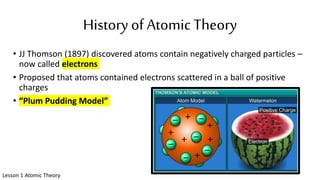
• JJ Thomson (1897) discovered atoms contain negatively charged particles –
now called electrons
• Proposed that atoms contained electrons scattered in a ball of positive
charges
• “Plum Pudding Model”
Lesson 1 Atomic Theory
History of Atomic Theory
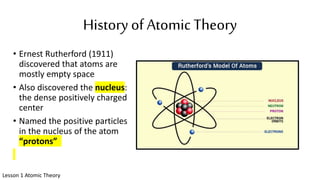
• Ernest Rutherford (1911)
discovered that atoms are
mostly empty space
• Also discovered the nucleus:
the dense positively charged
center
• Named the positive particles
in the nucleus of the atom
“protons”
Lesson 1 Atomic Theory
History of Atomic Theory
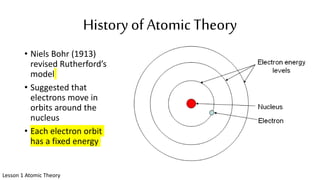
• Niels Bohr (1913)
revised Rutherford’s
model
• Suggested that
electrons move in
orbits around the
nucleus
• Each electron orbit
has a fixed energy
Lesson 1 Atomic Theory
History of AtomicTheory
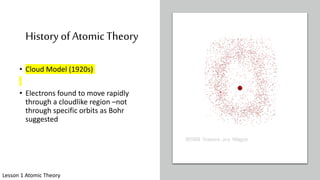
• Cloud Model (1920s)
• Electrons found to move rapidly
through a cloudlike region –not
through specific orbits as Bohr
suggested
Lesson 1 Atomic Theory
History of Atomic Theory
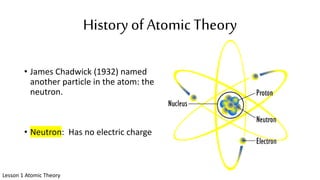
• James Chadwick (1932) named
another particle in the atom: the
neutron.
• Neutron: Has no electric charge
Lesson 1 Atomic Theory
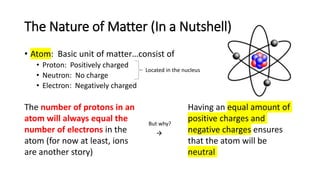
The Nature of Matter (In a Nutshell)
• Atom: Basic unit of matter…consist of
• Proton: Positively charged
• Neutron: No charge
• Electron: Negatively charged
Located in the nucleus
The number of protons in an
atom will always equal the
number of electrons in the
atom (for now at least, ions
are another story)
But why?

Having an equal amount of
positive charges and
negative charges ensures
that the atom will be
neutral
Mendeleev, what a guy!
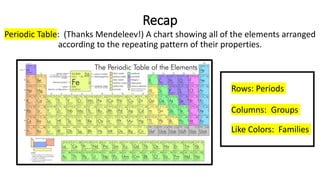
Recap
Periodic Table: (Thanks Mendeleev!) A chart showing all of the elements arranged
according to the repeating pattern of their properties.
Rows: Periods
Columns: Groups
Like Colors: Families
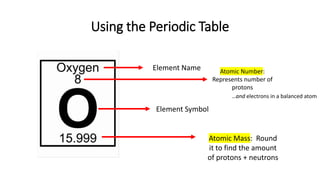
Using the Periodic Table
Element Name Atomic Number:
Represents number of
protons
…and electrons in a balanced atom
Element Symbol
Atomic Mass: Round
it to find the amount
of protons + neutrons
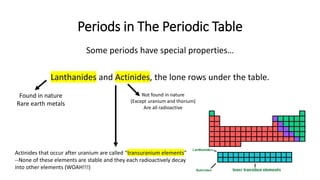
Periods in The Periodic Table
Some periods have special properties…
Lanthanides and Actinides, the lone rows under the table.
Found in nature
Rare earth metals
Not found in nature
(Except uranium and thorium)
Are all radioactive
Actinides that occur after uranium are called “transuranium elements”
--None of these elements are stable and they each radioactively decay
into other elements (WOAH!!!)
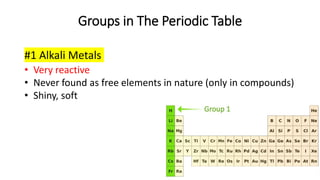
Groups in The Periodic Table
#1 Alkali Metals
• Very reactive
• Never found as free elements in nature (only in compounds)
• Shiny, soft
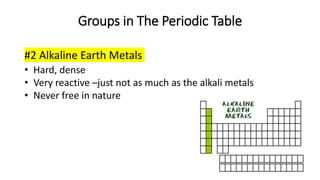
Groups in The Periodic Table
#2 Alkaline Earth Metals
• Hard, dense
• Very reactive –just not as much as the alkali metals
• Never free in nature
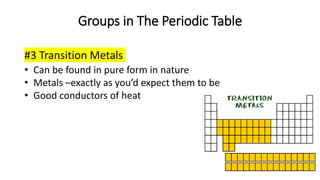
Groups in The Periodic Table
#3 Transition Metals
• Can be found in pure form in nature
• Metals –exactly as you’d expect them to be
• Good conductors of heat
Groups in The Periodic Table
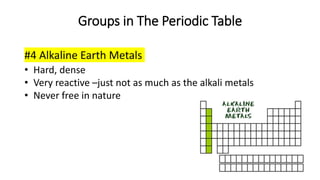
#4 Alkaline Earth Metals
• Hard, dense
• Very reactive –just not as much as the alkali metals
• Never free in nature
Groups in The Periodic Table
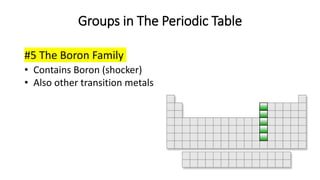
#5 The Boron Family
• Contains Boron (shocker)
• Also other transition metals
Groups in The Periodic Table
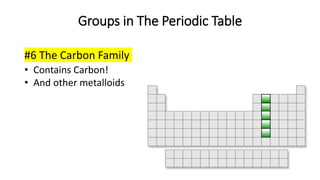
#6 The Carbon Family
• Contains Carbon!
• And other metalloids
Groups in The Periodic Table
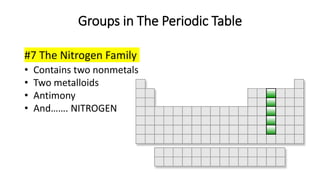
#7 The Nitrogen Family
• Contains two nonmetals
• Two metalloids
• Antimony
• And……. NITROGEN
Groups in The Periodic Table
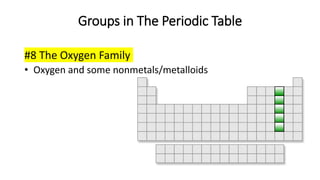
#8 The Oxygen Family
• Oxygen and some nonmetals/metalloids
Groups in The Periodic Table
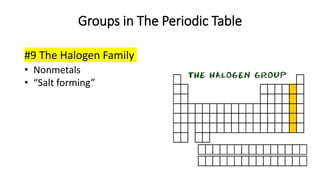
#9 The Halogen Family
• Nonmetals
• “Salt forming”
Groups in The Periodic Table
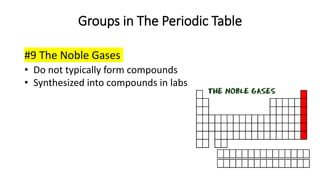
#9 The Noble Gases
• Do not typically form compounds
• Synthesized into compounds in labs

Science 8.1.1

  • 1.
    Atoms and thePeriodic Table Topic 1
  • 2.
    Atomic Theory • Whatis an atom? In 430 BCE, Democritus proposed that all matter consisted of small pieces that were indivisible • He called them atomos (= “uncuttable”) • Atom: The smallest particle that can still be considered an element Lesson 1 Atomic Theory
  • 3.
    History of AtomicTheory John Dalton’s Theory (1600s): 1. All elements consist of atoms that cannot be divided. 2. All atoms of the same element are exactly alike and have the same mass. 3. An atom of one element cannot be changed into an atom of another element. 4. Compounds are formed when atoms of more than one element combine in a specific ratio. Lesson 1 Atomic Theory
  • 4.
    History of AtomicTheory • JJ Thomson (1897) discovered atoms contain negatively charged particles – now called electrons • Proposed that atoms contained electrons scattered in a ball of positive charges • “Plum Pudding Model” Lesson 1 Atomic Theory
  • 5.
    History of AtomicTheory • Ernest Rutherford (1911) discovered that atoms are mostly empty space • Also discovered the nucleus: the dense positively charged center • Named the positive particles in the nucleus of the atom “protons” Lesson 1 Atomic Theory
  • 6.
    History of AtomicTheory • Niels Bohr (1913) revised Rutherford’s model • Suggested that electrons move in orbits around the nucleus • Each electron orbit has a fixed energy Lesson 1 Atomic Theory
  • 7.
    History of AtomicTheory •Cloud Model (1920s) • Electrons found to move rapidly through a cloudlike region –not through specific orbits as Bohr suggested Lesson 1 Atomic Theory
  • 8.
    History of AtomicTheory • James Chadwick (1932) named another particle in the atom: the neutron. • Neutron: Has no electric charge Lesson 1 Atomic Theory
  • 9.
    The Nature ofMatter (In a Nutshell) • Atom: Basic unit of matter…consist of • Proton: Positively charged • Neutron: No charge • Electron: Negatively charged Located in the nucleus The number of protons in an atom will always equal the number of electrons in the atom (for now at least, ions are another story) But why?  Having an equal amount of positive charges and negative charges ensures that the atom will be neutral
  • 10.
  • 11.
    Recap Periodic Table: (ThanksMendeleev!) A chart showing all of the elements arranged according to the repeating pattern of their properties. Rows: Periods Columns: Groups Like Colors: Families
  • 12.
    Using the PeriodicTable Element Name Atomic Number: Represents number of protons …and electrons in a balanced atom Element Symbol Atomic Mass: Round it to find the amount of protons + neutrons
  • 13.
    Periods in ThePeriodic Table Some periods have special properties… Lanthanides and Actinides, the lone rows under the table. Found in nature Rare earth metals Not found in nature (Except uranium and thorium) Are all radioactive Actinides that occur after uranium are called “transuranium elements” --None of these elements are stable and they each radioactively decay into other elements (WOAH!!!)
  • 14.
    Groups in ThePeriodic Table #1 Alkali Metals • Very reactive • Never found as free elements in nature (only in compounds) • Shiny, soft
  • 15.
    Groups in ThePeriodic Table #2 Alkaline Earth Metals • Hard, dense • Very reactive –just not as much as the alkali metals • Never free in nature
  • 16.
    Groups in ThePeriodic Table #3 Transition Metals • Can be found in pure form in nature • Metals –exactly as you’d expect them to be • Good conductors of heat
  • 17.
    Groups in ThePeriodic Table #4 Alkaline Earth Metals • Hard, dense • Very reactive –just not as much as the alkali metals • Never free in nature
  • 18.
    Groups in ThePeriodic Table #5 The Boron Family • Contains Boron (shocker) • Also other transition metals
  • 19.
    Groups in ThePeriodic Table #6 The Carbon Family • Contains Carbon! • And other metalloids
  • 20.
    Groups in ThePeriodic Table #7 The Nitrogen Family • Contains two nonmetals • Two metalloids • Antimony • And……. NITROGEN
  • 21.
    Groups in ThePeriodic Table #8 The Oxygen Family • Oxygen and some nonmetals/metalloids
  • 22.
    Groups in ThePeriodic Table #9 The Halogen Family • Nonmetals • “Salt forming”
  • 23.
    Groups in ThePeriodic Table #9 The Noble Gases • Do not typically form compounds • Synthesized into compounds in labs