Classification of Microbes   What are Microbes?   A microbe is any living thing that spends its life at a size visible sometimes only with a microscope.  It is too tiny to be seen with the naked eye. Microbes are the oldest form of life on Earth.  The term microbe is short for microorganism, which means small organism.  To help people understand the different types of microbes, they are grouped or classified in various ways.  Microbes are very diverse and represent all the great kingdoms of life.
Prokaryotes (Bacteria) Eubacter  "True" bacteria  Human pathogens Clinical or environmental One kingdom Archaea   Environmental organisms  Second kingdom
Eukaryotes Other cell-based life e.g. Plants Animals Fungi
Prokaryotic vs. Eukaryotic Cells Prokaryotic cells No Nucleus No Organelles Cell Wall of peptidoglycan Binary Fission 1 circular chromosome Eukaryotic Cells Nucleus Organelles If cell wall, Cellulose or chitin Mitosis Linear chromosomes
Here is an outline of the major groups of microorganisms:  Viruses   Bacteria   Algae   Fungi   Protozoa
Bacteria Bacteria consist of only one cell, but they're a very complex group of living things.  Some bacteria can live in temperatures above the boiling point and in cold below the freezing point.  There are thousands of species of bacteria, but all of them are basically one of three different shapes.  Some are rod- or stick-shaped; others are shaped like little balls.  Others still are helical or spiral in shape.  Some bacteria cells exist as individuals while others cluster together to form pairs, chains, squares or other groupings.
Classification of Microbes Taxonomic Hierarchy  For eg:  Escherichia  coli Domain  Bacteria  Kingdom  Monera Phylum  Proteobacteria   Class  Gammaproteobacteria   Order  Enterobacteriales Family  Enterobacteriaceae   Genus  Escherichia   Species  E. coli
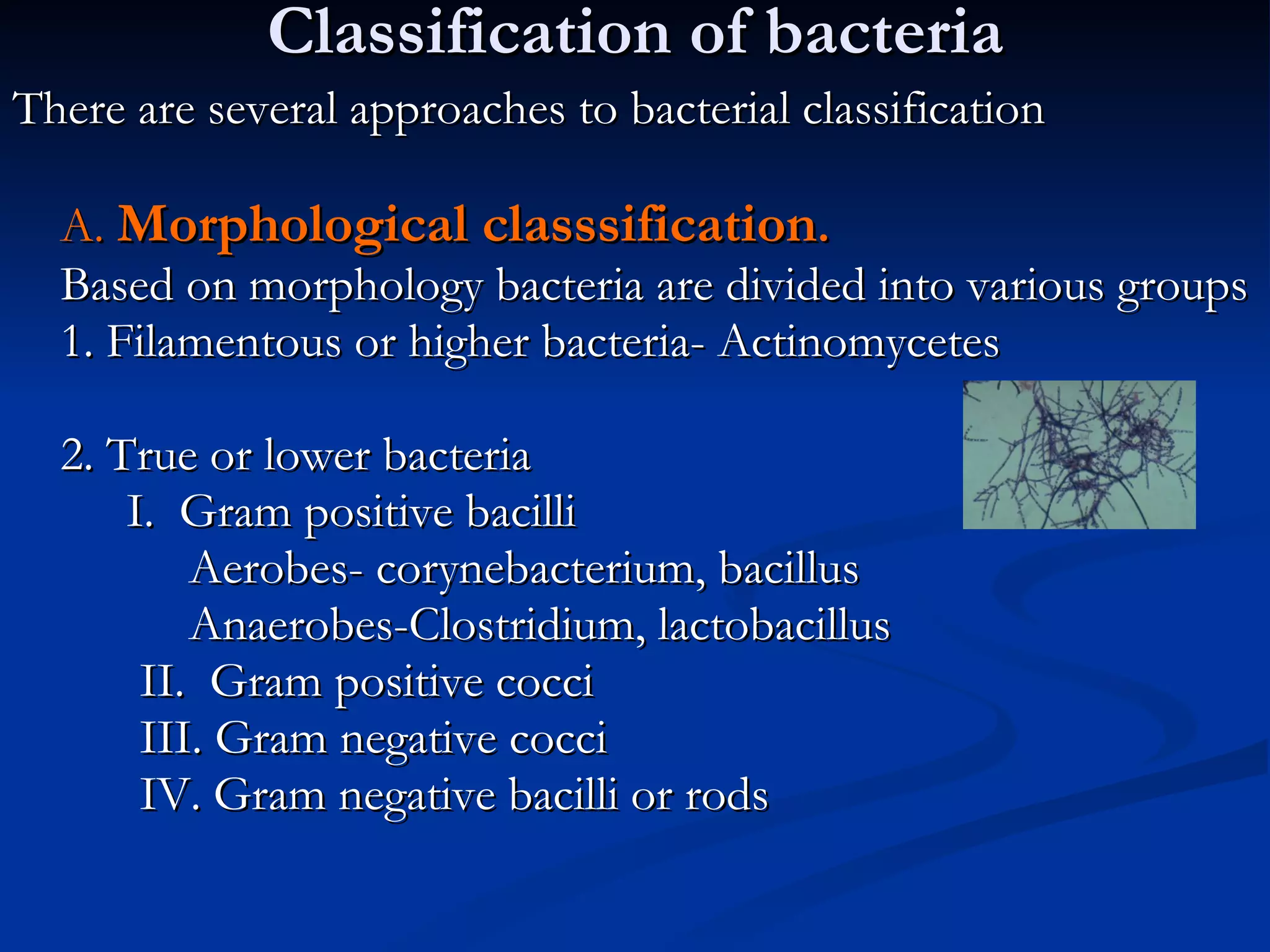
Classification of bacteria There are several approaches to bacterial classification A.  Morphological classsification . Based on morphology bacteria are divided into various groups 1. Filamentous or higher bacteria- Actinomycetes 2. True or lower bacteria   I.  Gram positive bacilli   Aerobes- corynebacterium, bacillus   Anaerobes-Clostridium, lactobacillus II.  Gram positive cocci III. Gram negative cocci IV. Gram negative bacilli or rods
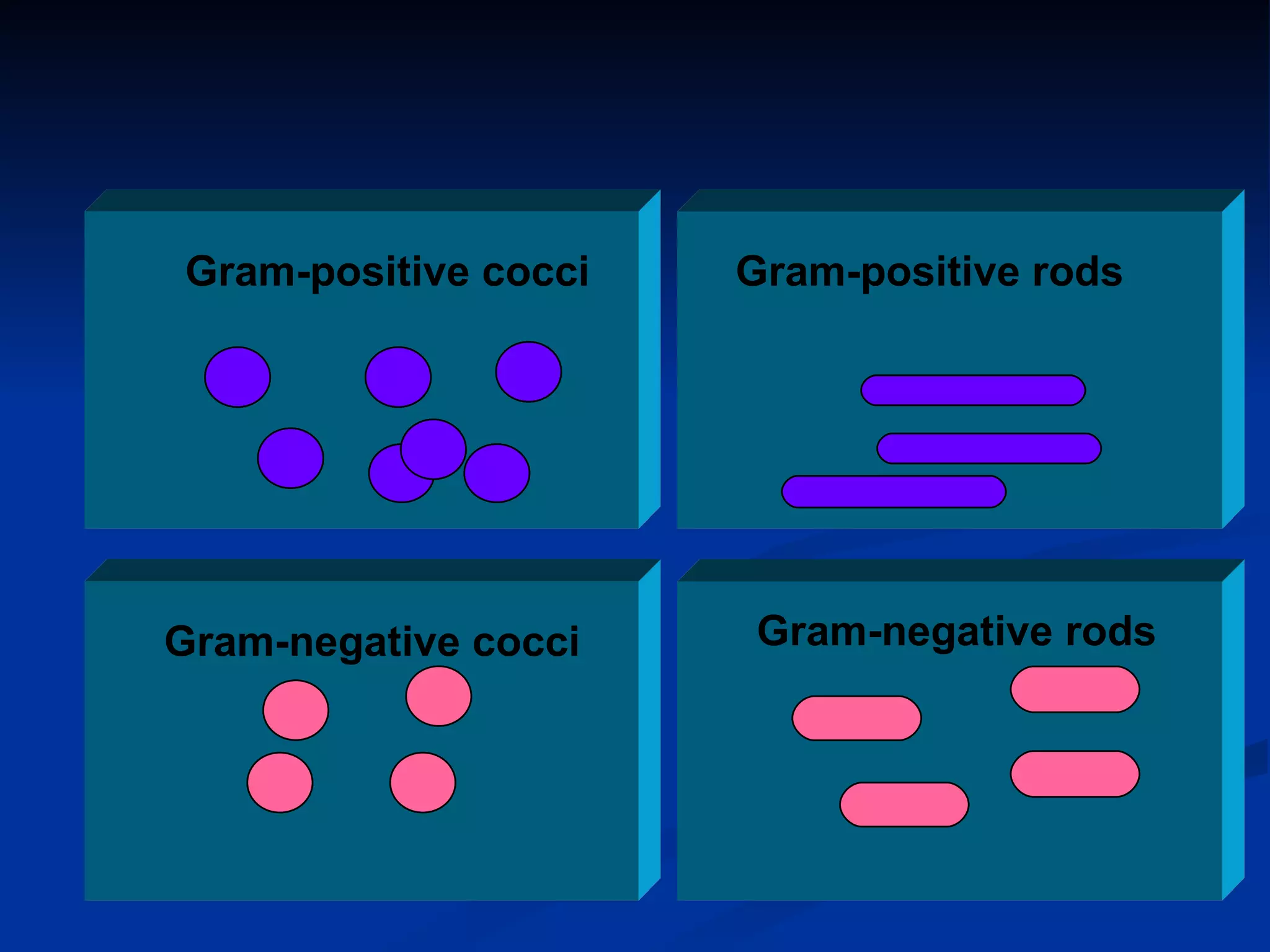
Gram-positive rods Gram-negative rods Gram-positive cocci Gram-negative cocci
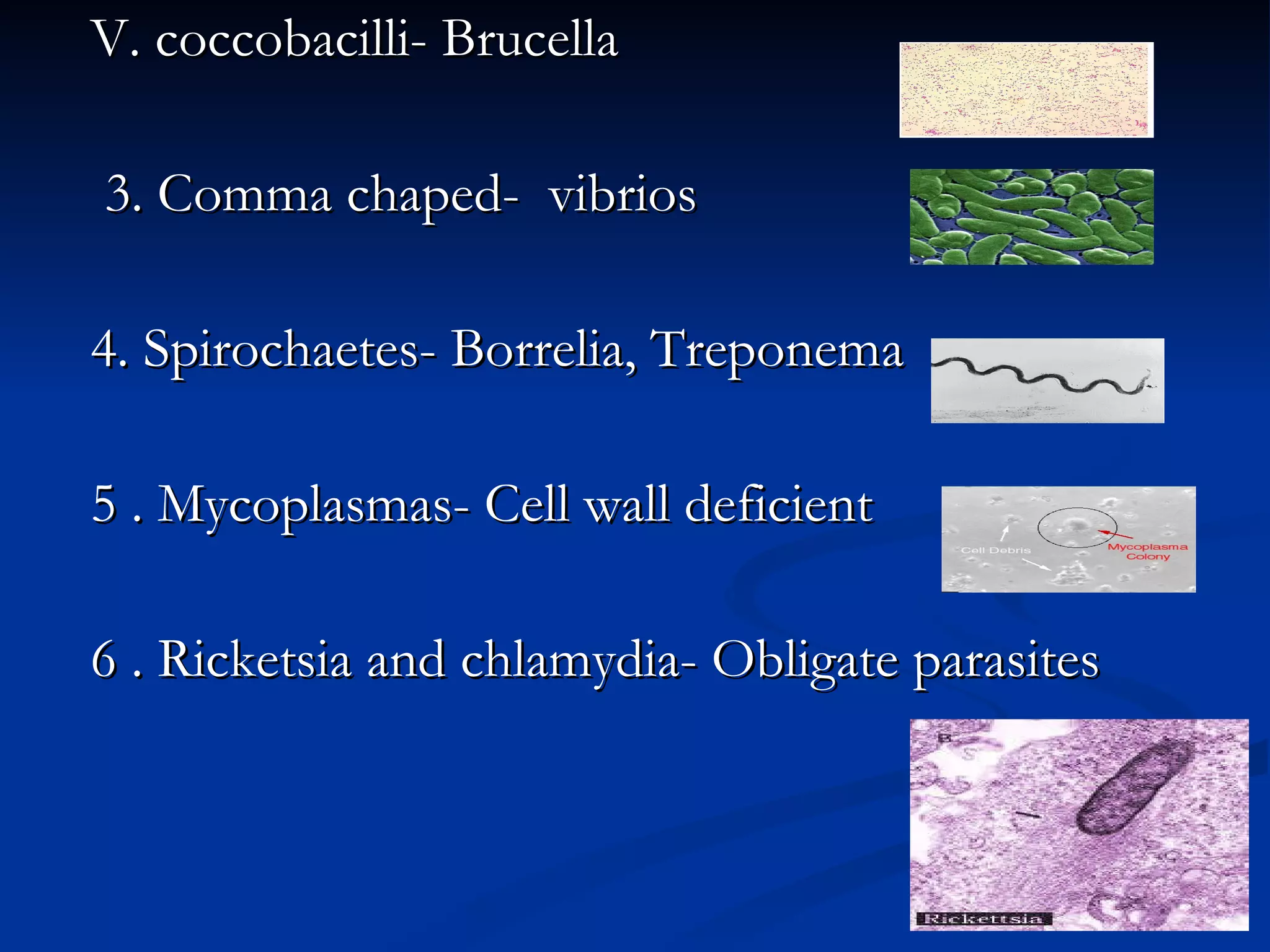
V. coccobacilli- Brucella 3. Comma chaped-  vibrios 4. Spirochaetes- Borrelia, Treponema 5 . Mycoplasmas- Cell wall deficient 6 . Ricketsia and chlamydia- Obligate parasites
B.Nutritional classification I. Based on Energy requirements Phototrophs: Derive energy from sunlight Chemotrophs:  Use Chemicals II. Based on ability to synthesize essential metabolites Autotrophs: Synthesize organic coumpounds from  carbon dioxide and nitrogen Heterotrophs: Depend on preformed organic  compounds eg pathogens III. Based on oxygen requirements Aerobes Anaerobes
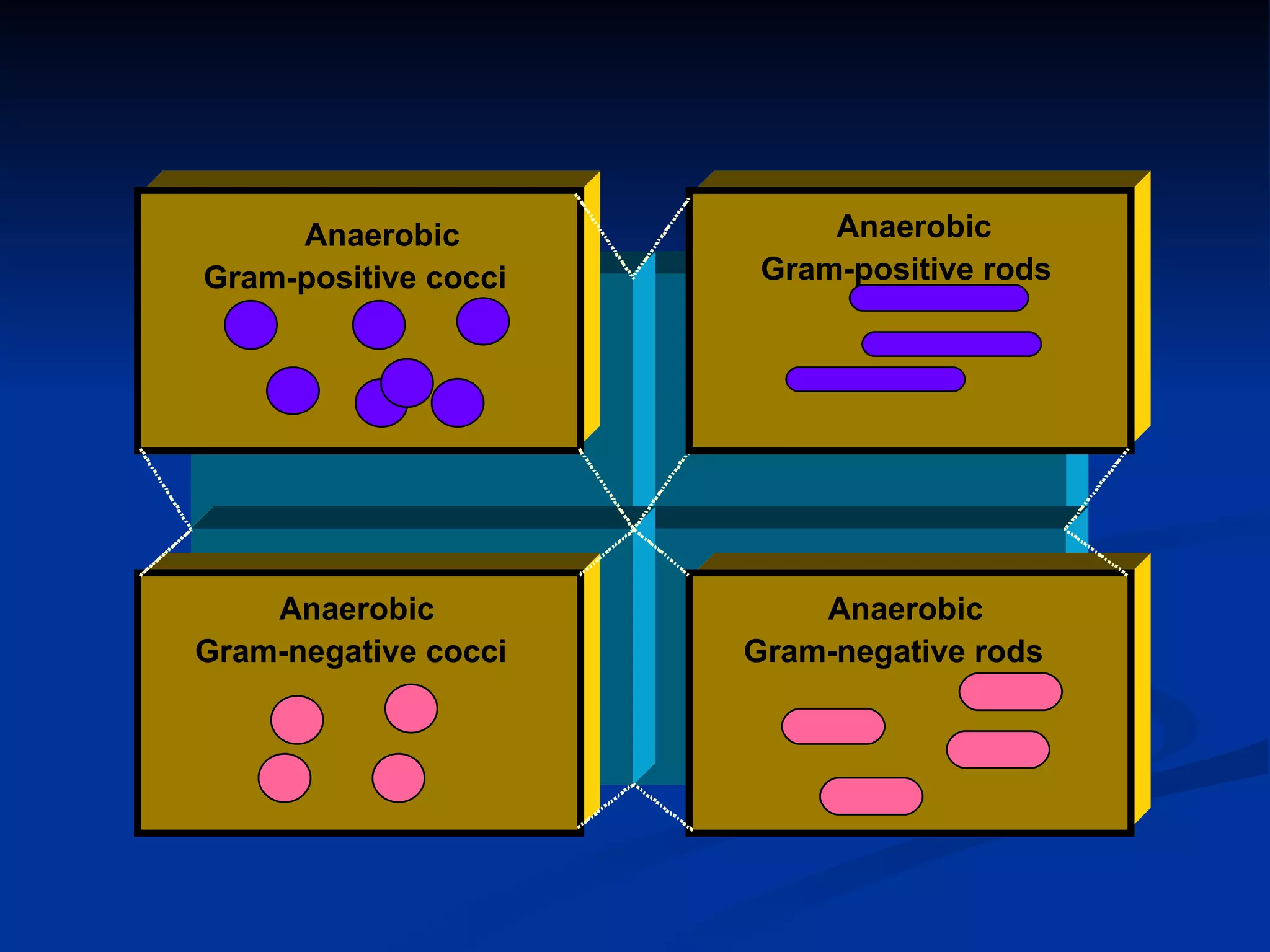
Gram-positive  cocci Anaerobic Gram-positive rods Anaerobic Gram-negative rods Anaerobic Gram-positive cocci Anaerobic Gram-negative cocci
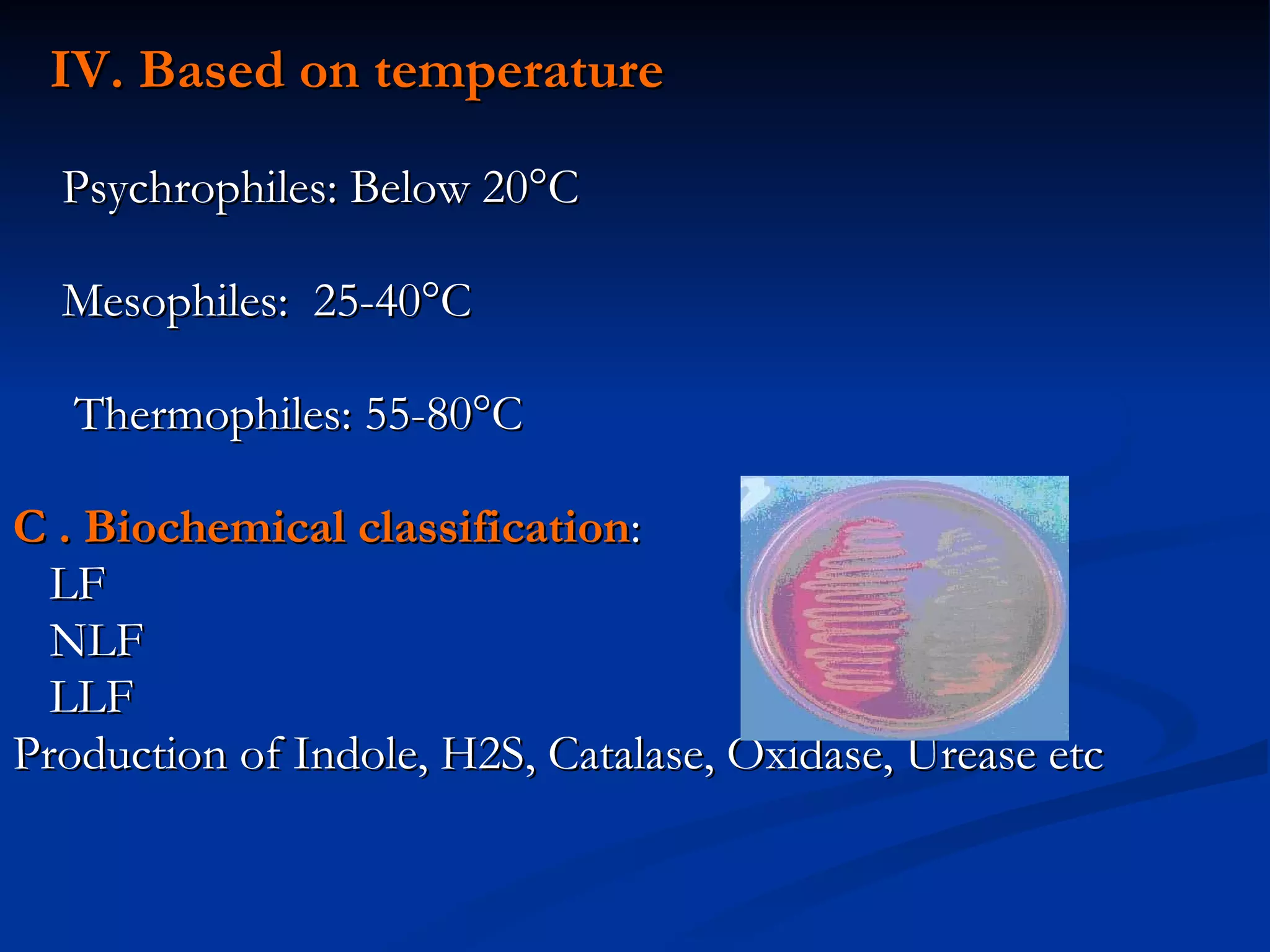
IV. Based on temperature Psychrophiles: Below 20°C  Mesophiles:  25-40°C Thermophiles: 55-80°C C . Biochemical classification : LF  NLF  LLF Production of Indole, H2S, Catalase, Oxidase, Urease etc
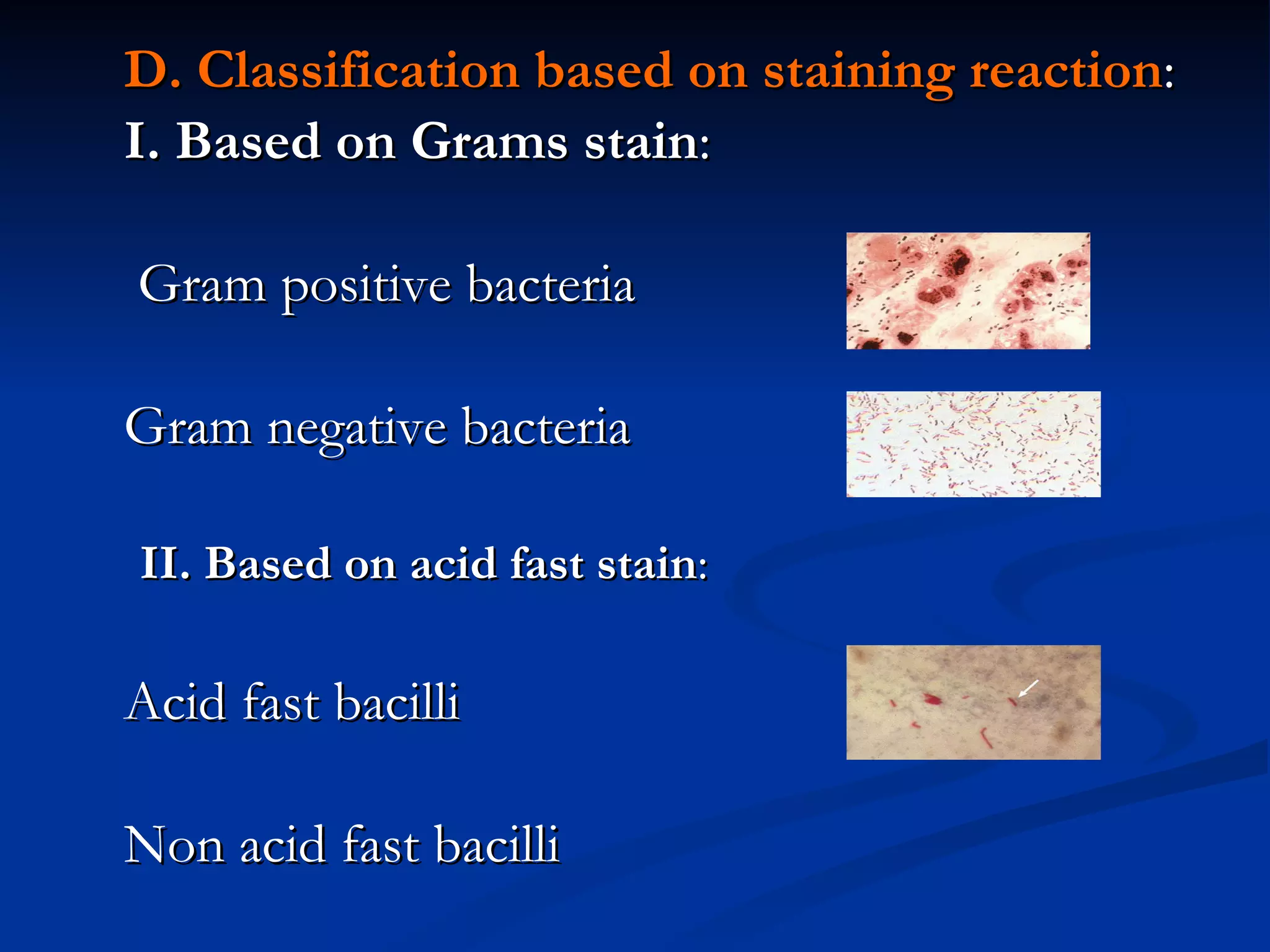
D. Classification based on staining reaction : I. Based on Grams stain :  Gram positive bacteria Gram negative bacteria II. Based on acid fast stain : Acid fast bacilli Non acid fast bacilli
E. Serological/ antigenic classification Microorganism possess many different kinds of antigens, based on which they are classified into I. Serovars  or Serotype II. Sero groups
Major Taxonomic Groups of Bacteria per  Bergey’s manual Gracilicutes  –  gram-negative cell walls, thin-skinned Firmicutes  – gram-positive cell walls, thick skinned Tenericutes  – lack a cell wall & are soft Mendosicutes  – archaea, primitive procaryotes with unusual cell walls & nutritional habits
Assignment: Find out what is   Bergey’s manual  i n detail.

Classification

  • 1.
    Classification of Microbes What are Microbes? A microbe is any living thing that spends its life at a size visible sometimes only with a microscope. It is too tiny to be seen with the naked eye. Microbes are the oldest form of life on Earth. The term microbe is short for microorganism, which means small organism. To help people understand the different types of microbes, they are grouped or classified in various ways. Microbes are very diverse and represent all the great kingdoms of life.
  • 2.
    Prokaryotes (Bacteria) Eubacter "True" bacteria Human pathogens Clinical or environmental One kingdom Archaea Environmental organisms Second kingdom
  • 3.
    Eukaryotes Other cell-basedlife e.g. Plants Animals Fungi
  • 4.
    Prokaryotic vs. EukaryoticCells Prokaryotic cells No Nucleus No Organelles Cell Wall of peptidoglycan Binary Fission 1 circular chromosome Eukaryotic Cells Nucleus Organelles If cell wall, Cellulose or chitin Mitosis Linear chromosomes
  • 5.
    Here is anoutline of the major groups of microorganisms: Viruses Bacteria Algae Fungi Protozoa
  • 6.
    Bacteria Bacteria consistof only one cell, but they're a very complex group of living things. Some bacteria can live in temperatures above the boiling point and in cold below the freezing point. There are thousands of species of bacteria, but all of them are basically one of three different shapes. Some are rod- or stick-shaped; others are shaped like little balls. Others still are helical or spiral in shape. Some bacteria cells exist as individuals while others cluster together to form pairs, chains, squares or other groupings.
  • 7.
    Classification of MicrobesTaxonomic Hierarchy For eg: Escherichia coli Domain Bacteria Kingdom Monera Phylum Proteobacteria Class Gammaproteobacteria Order Enterobacteriales Family Enterobacteriaceae Genus Escherichia Species E. coli
  • 8.
    Classification of bacteriaThere are several approaches to bacterial classification A. Morphological classsification . Based on morphology bacteria are divided into various groups 1. Filamentous or higher bacteria- Actinomycetes 2. True or lower bacteria I. Gram positive bacilli Aerobes- corynebacterium, bacillus Anaerobes-Clostridium, lactobacillus II. Gram positive cocci III. Gram negative cocci IV. Gram negative bacilli or rods
  • 9.
    Gram-positive rods Gram-negativerods Gram-positive cocci Gram-negative cocci
  • 10.
    V. coccobacilli- Brucella3. Comma chaped- vibrios 4. Spirochaetes- Borrelia, Treponema 5 . Mycoplasmas- Cell wall deficient 6 . Ricketsia and chlamydia- Obligate parasites
  • 11.
    B.Nutritional classification I.Based on Energy requirements Phototrophs: Derive energy from sunlight Chemotrophs: Use Chemicals II. Based on ability to synthesize essential metabolites Autotrophs: Synthesize organic coumpounds from carbon dioxide and nitrogen Heterotrophs: Depend on preformed organic compounds eg pathogens III. Based on oxygen requirements Aerobes Anaerobes
  • 12.
    Gram-positive cocciAnaerobic Gram-positive rods Anaerobic Gram-negative rods Anaerobic Gram-positive cocci Anaerobic Gram-negative cocci
  • 13.
    IV. Based ontemperature Psychrophiles: Below 20°C Mesophiles: 25-40°C Thermophiles: 55-80°C C . Biochemical classification : LF NLF LLF Production of Indole, H2S, Catalase, Oxidase, Urease etc
  • 14.
    D. Classification basedon staining reaction : I. Based on Grams stain : Gram positive bacteria Gram negative bacteria II. Based on acid fast stain : Acid fast bacilli Non acid fast bacilli
  • 15.
    E. Serological/ antigenicclassification Microorganism possess many different kinds of antigens, based on which they are classified into I. Serovars or Serotype II. Sero groups
  • 16.
    Major Taxonomic Groupsof Bacteria per Bergey’s manual Gracilicutes – gram-negative cell walls, thin-skinned Firmicutes – gram-positive cell walls, thick skinned Tenericutes – lack a cell wall & are soft Mendosicutes – archaea, primitive procaryotes with unusual cell walls & nutritional habits
  • 17.
    Assignment: Find outwhat is Bergey’s manual i n detail.