sweat
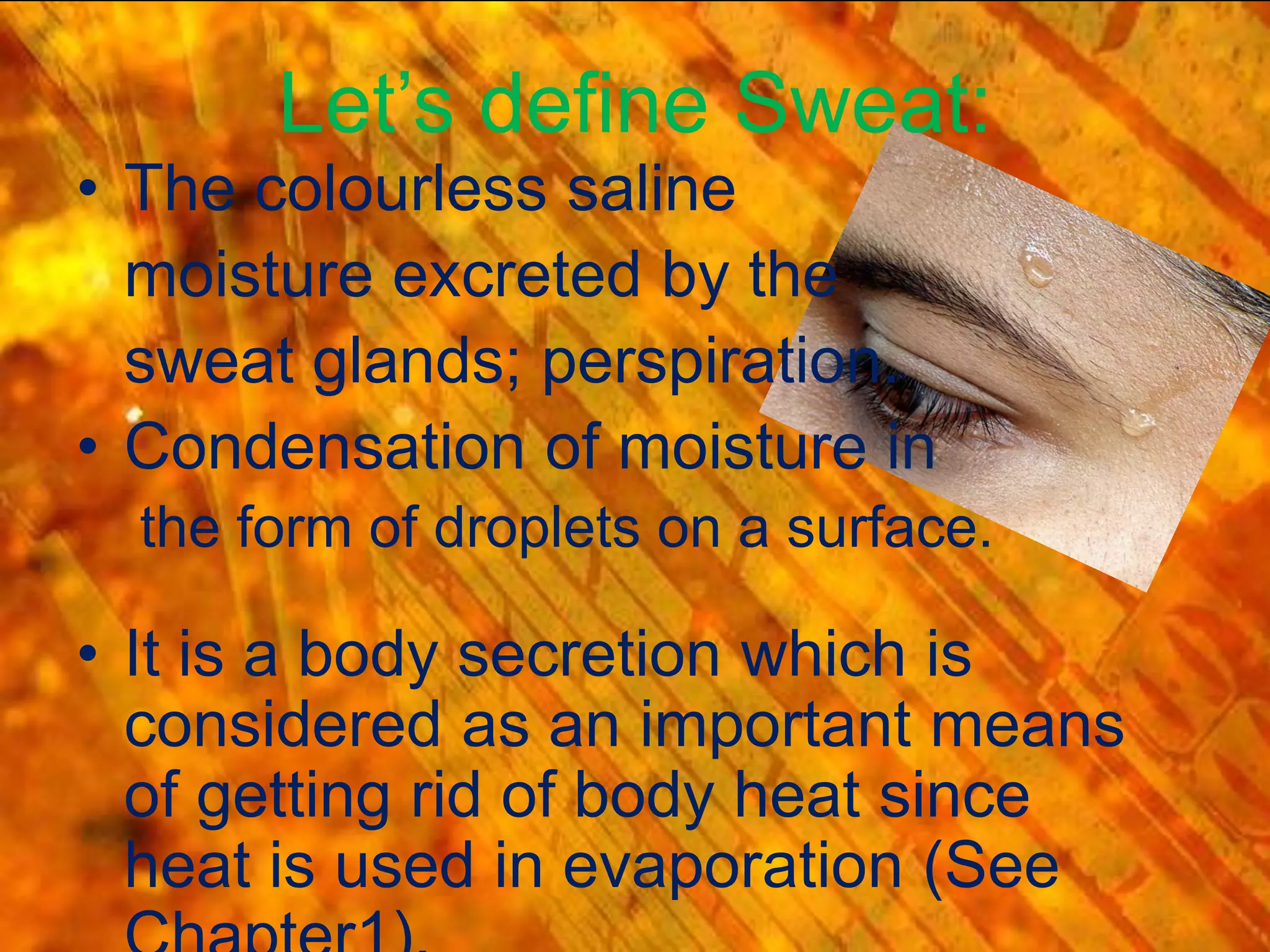
Let’s define Sweat:The colourless saline moisture excreted by the sweat glands; perspiration.Condensation of moisture in the form of droplets on a surface.It is a body secretion which is considered as an important means of getting rid of body heat since heat is used in evaporation (See Chapter1).
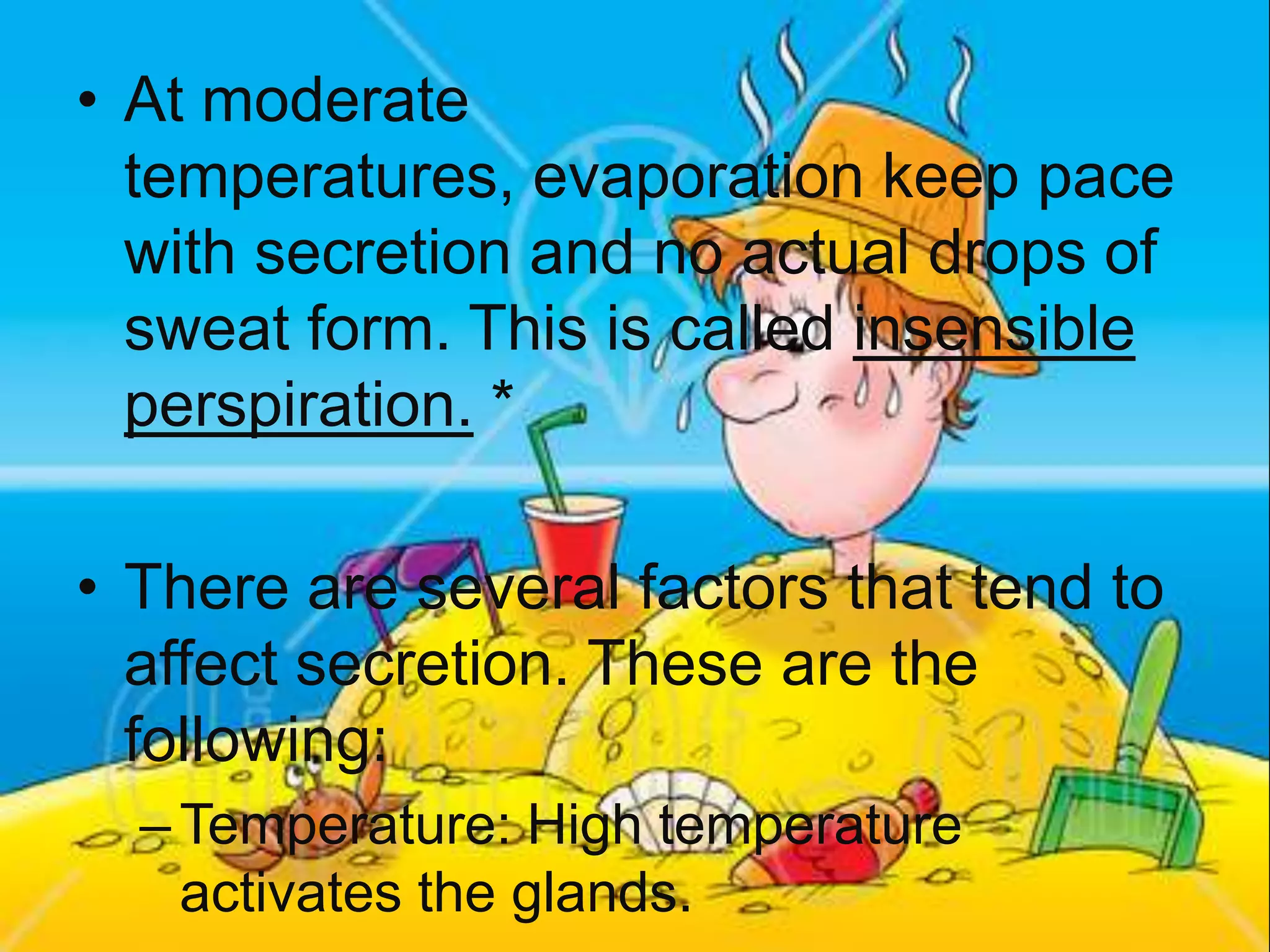
At moderate temperatures, evaporation keep pace with secretion and no actual drops of sweat form. This is called insensible perspiration. *There are several factors that tend to affect secretion. These are the following:Temperature: High temperature activates the glands.
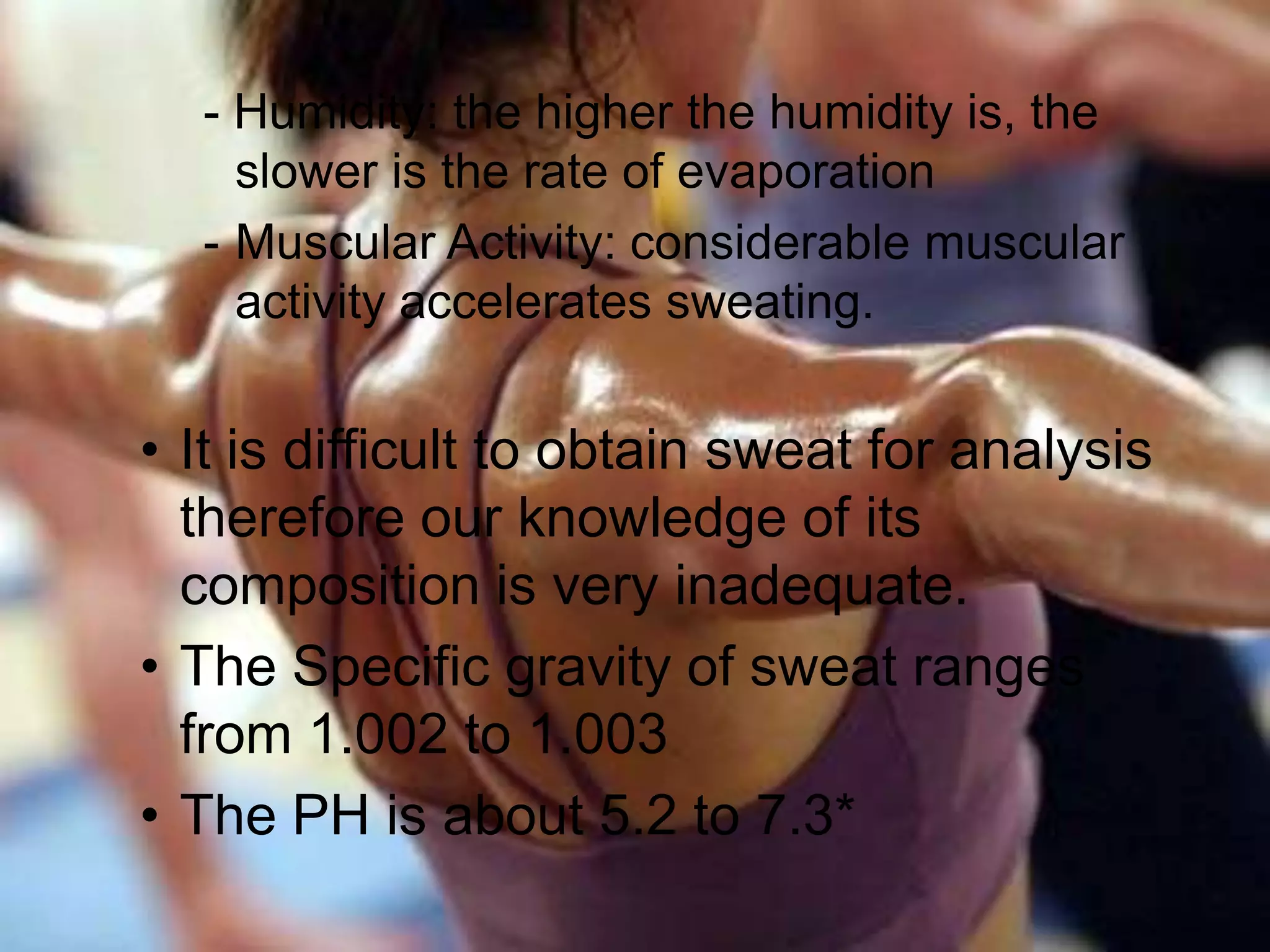
- Humidity: the higher the humidity is, the slower is the rate of evaporationMuscular Activity: considerable muscular activity accelerates sweating.
It is difficult to obtain sweat for analysis therefore our knowledge of its composition is very inadequate.
The Specific gravity of sweat ranges from 1.002 to 1.003
The PH is about 5.2 to 7.3*Urea is present and certain inorganic salt like:Sodium ChloridePotassium saltsNitrogen is secreted in perspiration at about less than 0.1g each day. If sweating is profuse much as 0.2g may be eliminated each day.

Sweat

  • 1.
  • 2.
    Let’s define Sweat:Thecolourless saline moisture excreted by the sweat glands; perspiration.Condensation of moisture in the form of droplets on a surface.It is a body secretion which is considered as an important means of getting rid of body heat since heat is used in evaporation (See Chapter1).
  • 3.
    At moderate temperatures,evaporation keep pace with secretion and no actual drops of sweat form. This is called insensible perspiration. *There are several factors that tend to affect secretion. These are the following:Temperature: High temperature activates the glands.
  • 4.
    - Humidity: thehigher the humidity is, the slower is the rate of evaporationMuscular Activity: considerable muscular activity accelerates sweating.
  • 5.
    It is difficultto obtain sweat for analysis therefore our knowledge of its composition is very inadequate.
  • 6.
    The Specific gravityof sweat ranges from 1.002 to 1.003
  • 7.
    The PH isabout 5.2 to 7.3*Urea is present and certain inorganic salt like:Sodium ChloridePotassium saltsNitrogen is secreted in perspiration at about less than 0.1g each day. If sweating is profuse much as 0.2g may be eliminated each day.
  • 8.
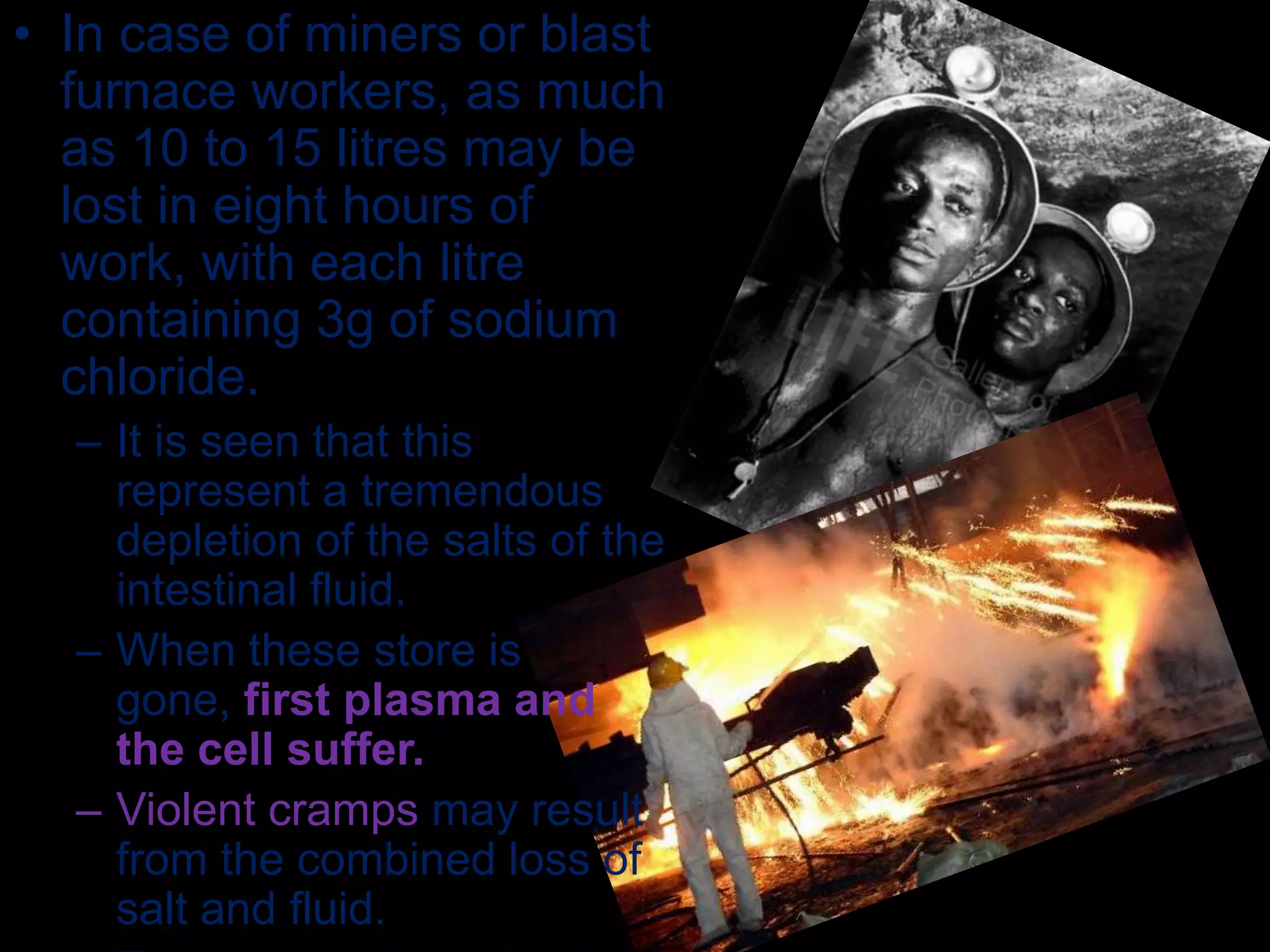
    In case ofminers or blast furnace workers, as much as 10 to 15 litres may be lost in eight hours of work, with each litre containing 3g of sodium chloride.It is seen that this represent a tremendous depletion of the salts of the intestinal fluid.When these store is gone, first plasma and the cell suffer.Violent cramps may result from the combined loss of salt and fluid.To guard against this, the drinking water of such workers should contain about 0.1% Sodium chloride.*
  • 9.
    In fevers, patientsmay loss large amounts of moisture and electrolytes in perspiration. An increased intake during hot weather has also been recommended for most people because of the salt lost in the perspiration. Only in cases of renal insufficiency* or edema* would this be inadvisable.