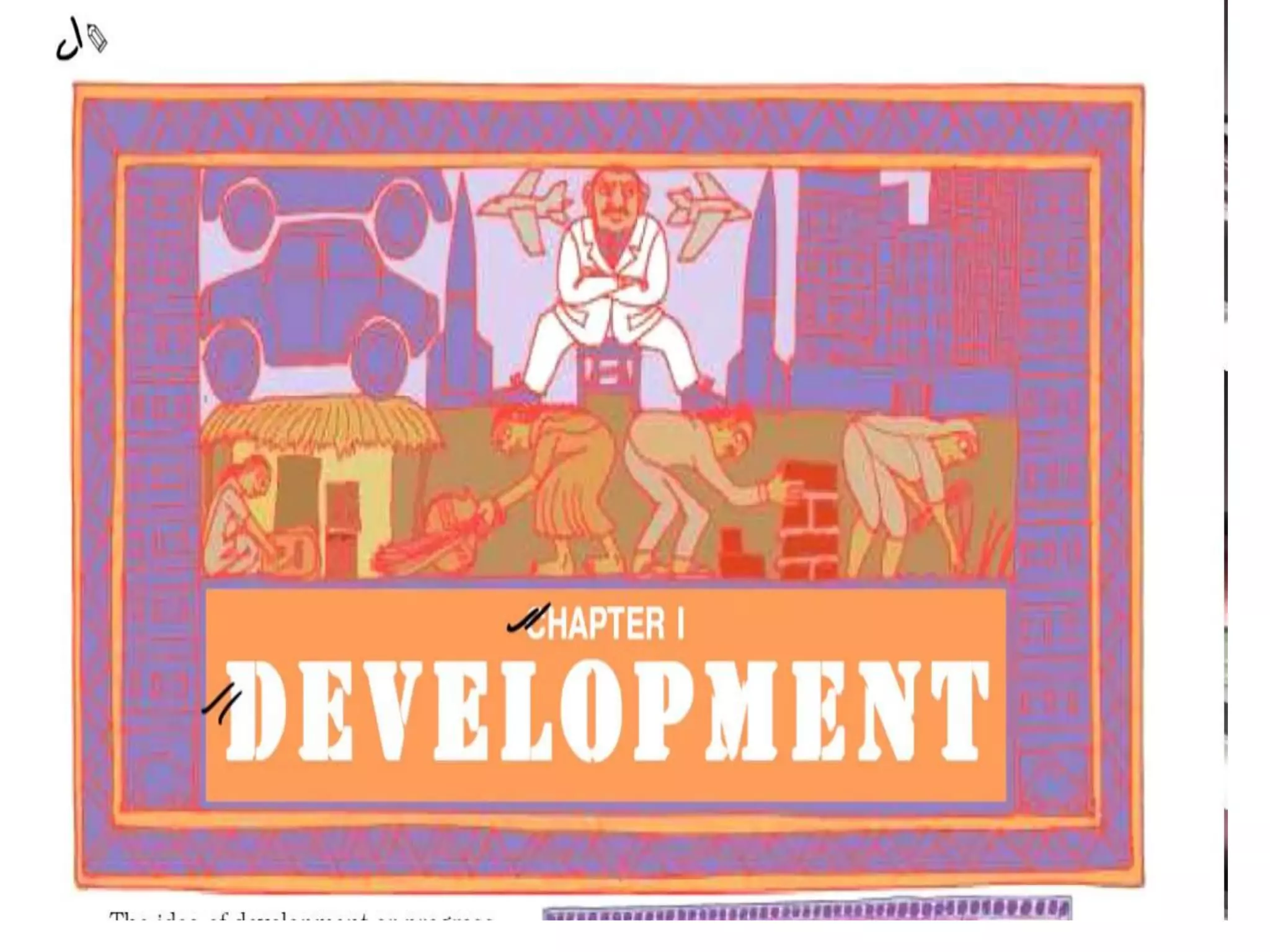
DEVELOPMENT
CLASS – X
CHPTER 1
How Development is different from growth?
Growth is quantitative
Development is qualitative and more complex
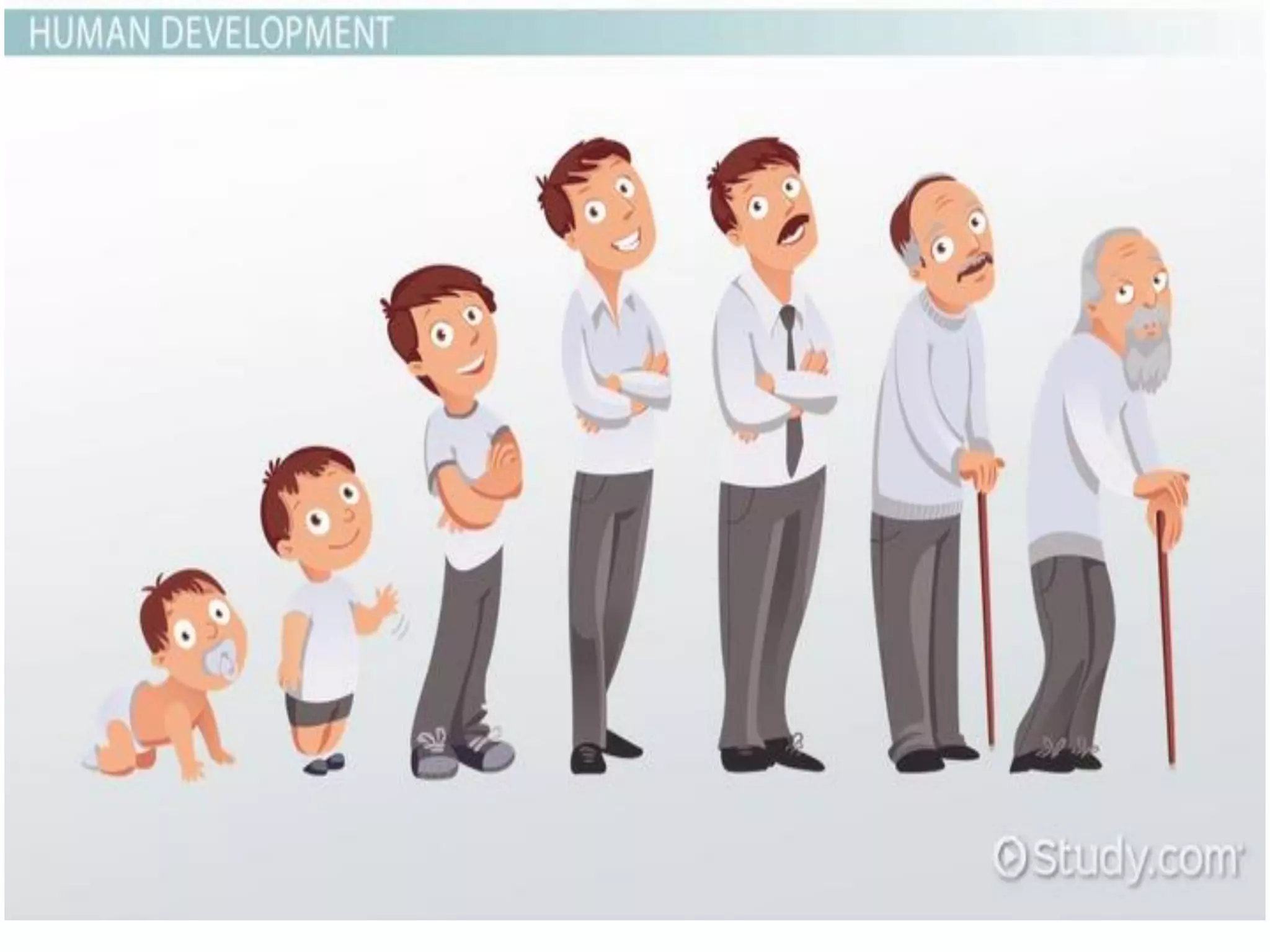
DEVELOPMENT
Development is a process where people think ,
seek and achieve their goals in life;
• A better life situation
• Better standard of life for all
• Equality
• Better means of recreation and leisure
• Freedom of thought and expression , practice
of religion, etc
It is a complex economic, political, social
process.
CHARACTERISTICS OF DEVELOPMENT
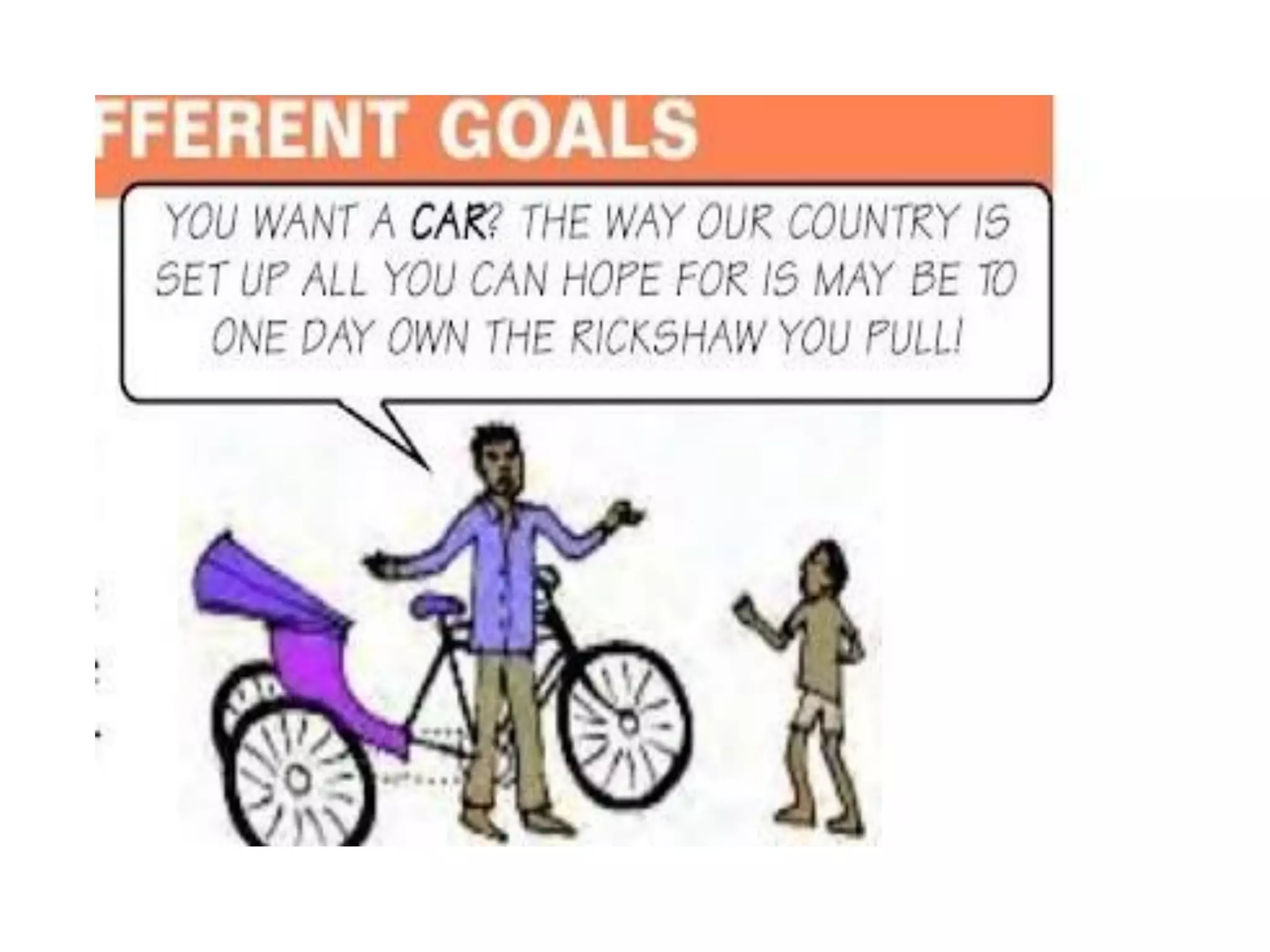
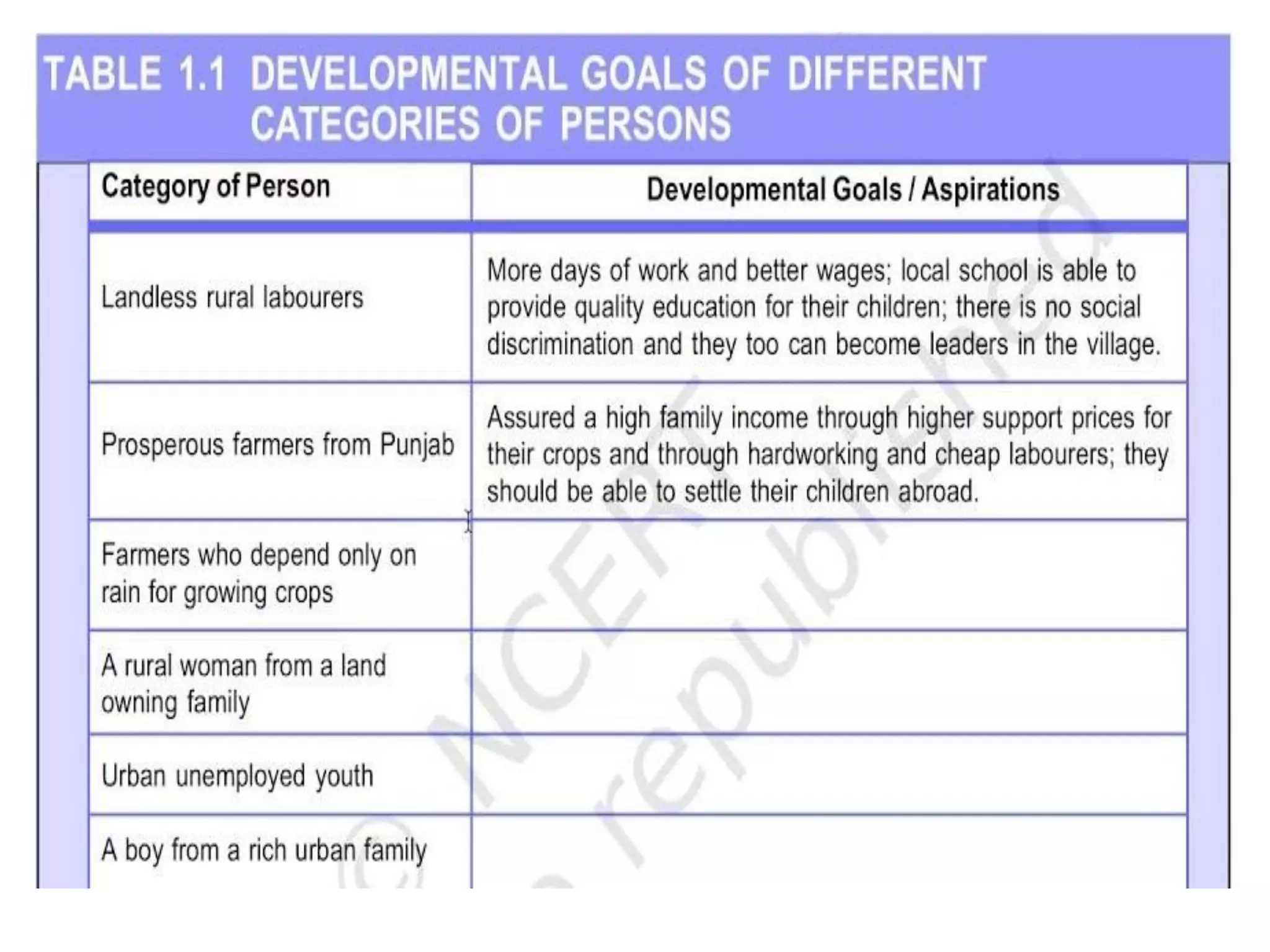
• Different persons have different
developmental goals.
WHY
• Developmental goals can be conflicting in
nature.
HOW
• Development is a mix of goals.
INCOME & OTHER GOALS
What according to you is the requirements of a
good life? Important needs other than material
things for a good life?
• Equal treatment
• Freedom
• Security
• Respect for others
• No discrimination
• Better Health Facilities
• Better Education facilities , etc.
These parameters are difficult to measure but they
are important in our lives.
Homework
Give some (at least 3)examples where factors other
than income are important aspects of our lives.
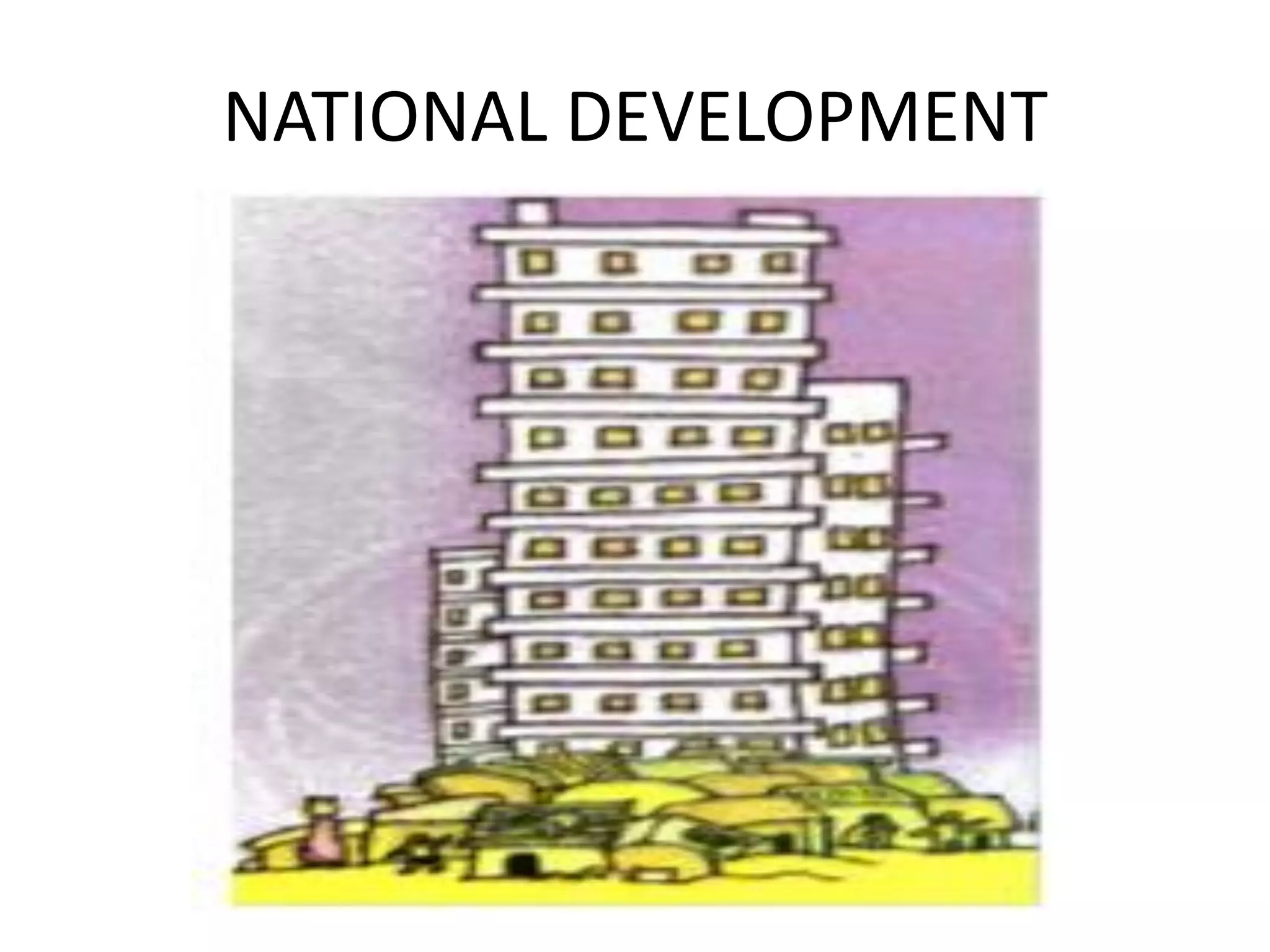
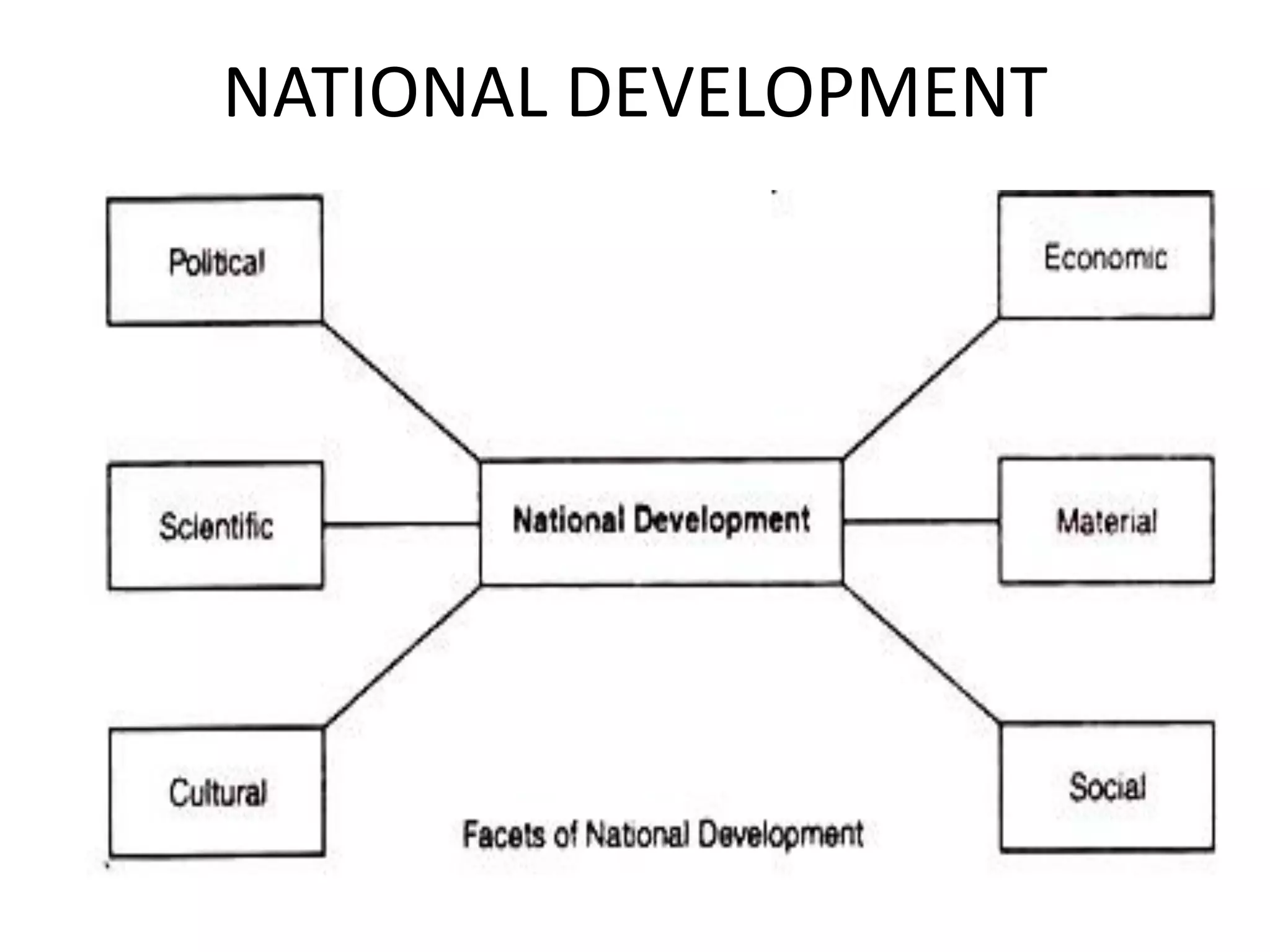
NATIONAL DEVELOPMENT
• It is a comprehensive term which includes the
all aspects of the life of an individual and the
nation.
• It is holistic in approach. It is a process of
reconstruction and development in various
dimensions of a nation and development of
individuals.
• It includes the welfare of both majority and
minority groups.
How to compare different countries or
states??
The countries can be compared on the basis of
• Total National Income
(the income of all the residents of the country)
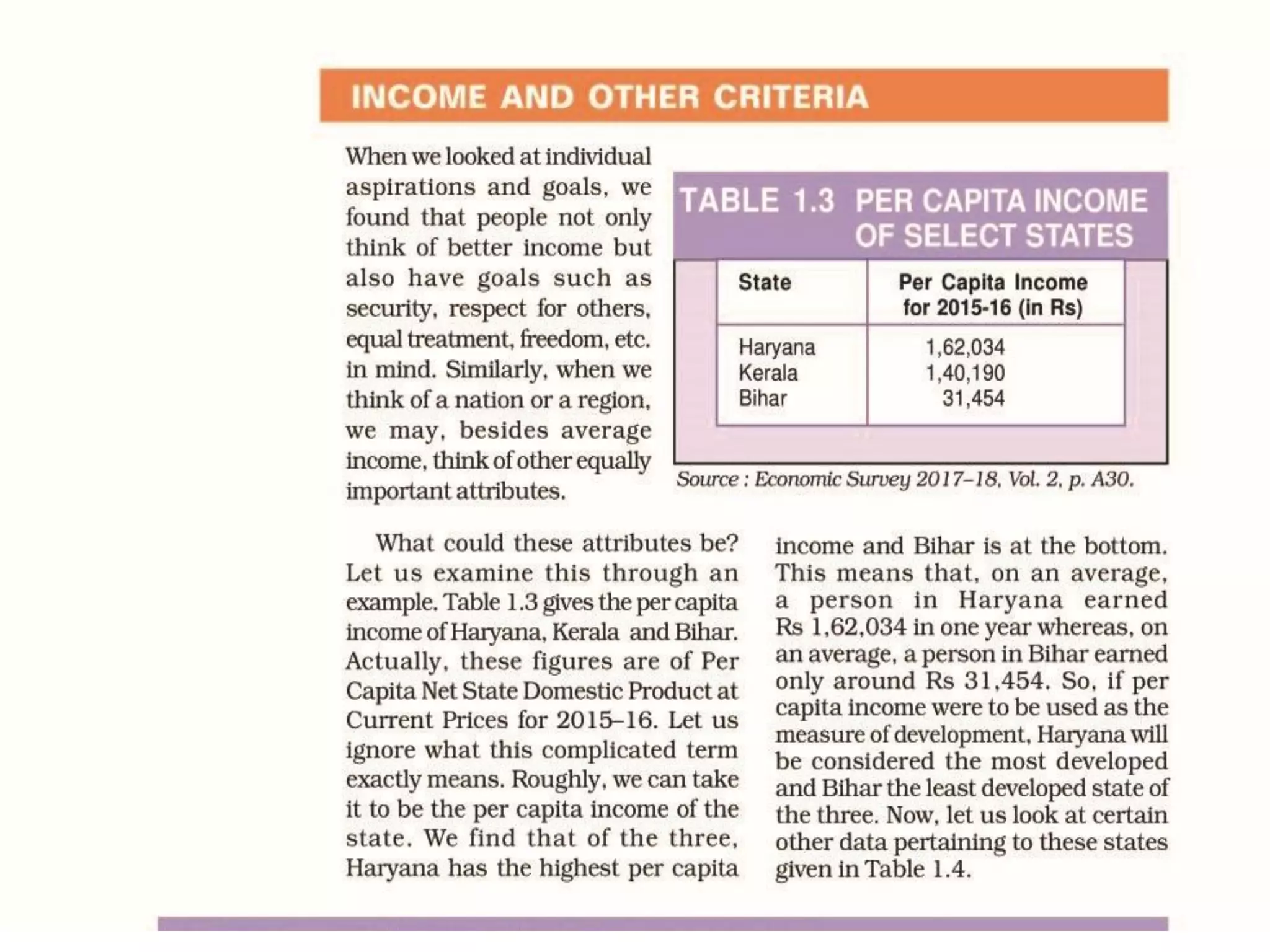
• Average Income
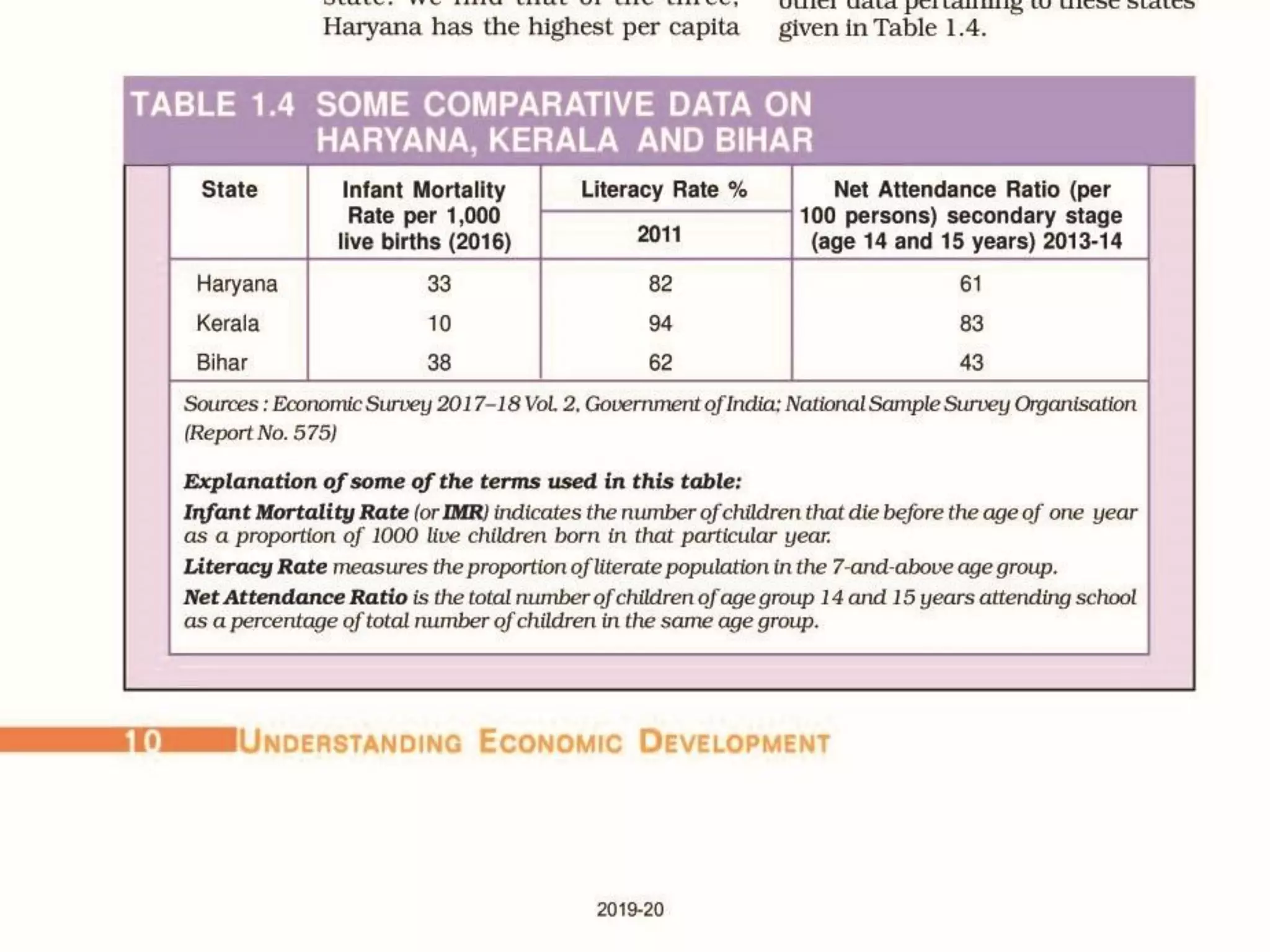
• Other criteria like IMR, Literacy Rate , Net
Attendance Ratio, Public Facilities, Gross
Enrolment Ratio
• Human Development Index (HDI)
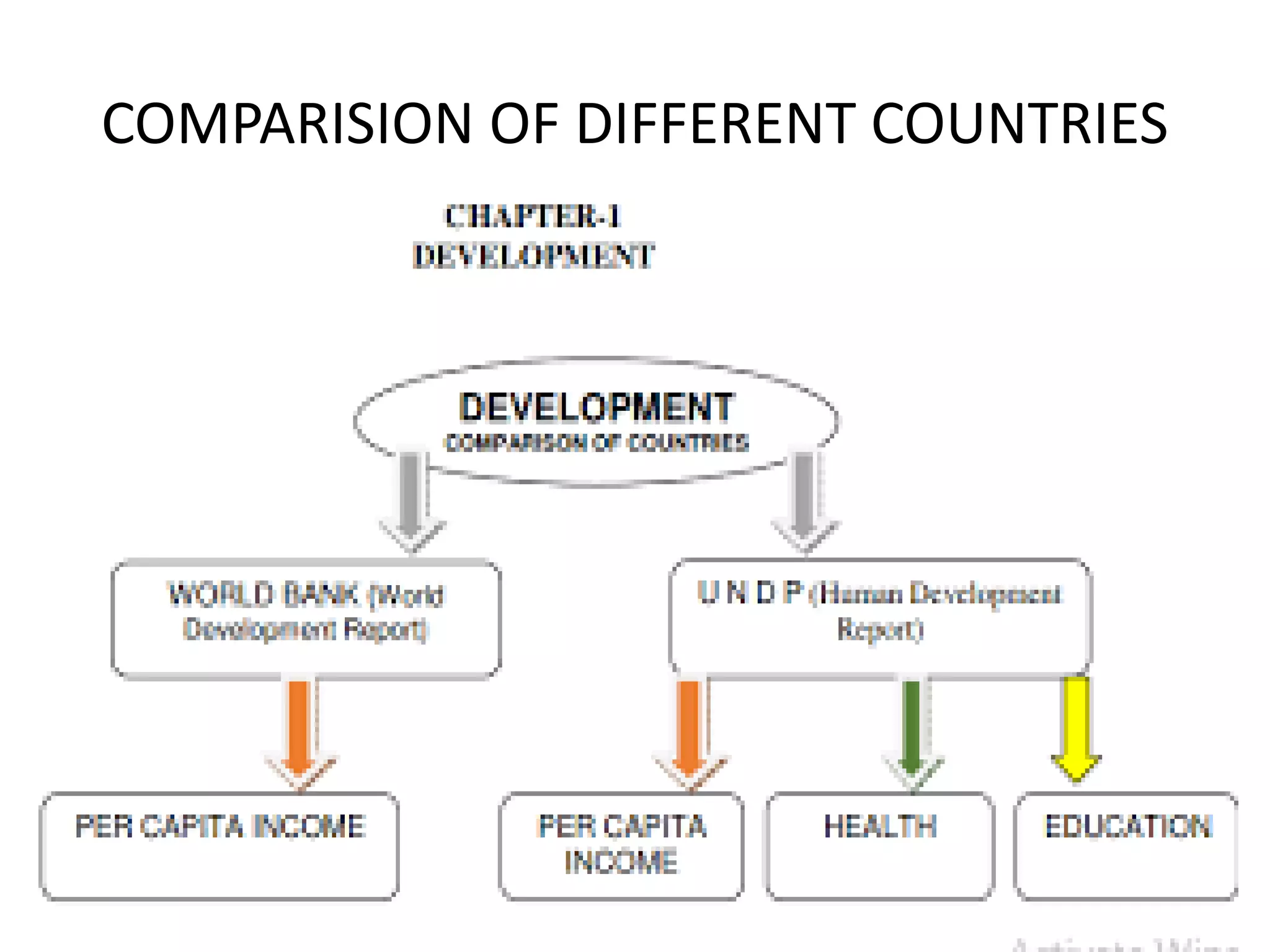
COMPARISION OF DIFFERENT COUNTRIES
PER CAPITA INCOME- CRITERION BY WORLD
BANK
PER CAPITA INCOME- CRITERION BY WORLD
BANK
PER CAPITA INCOME- CRITERION BY WORLD
BANK
PER CAPITA INCOME- CRITERION BY
WORLD BANK
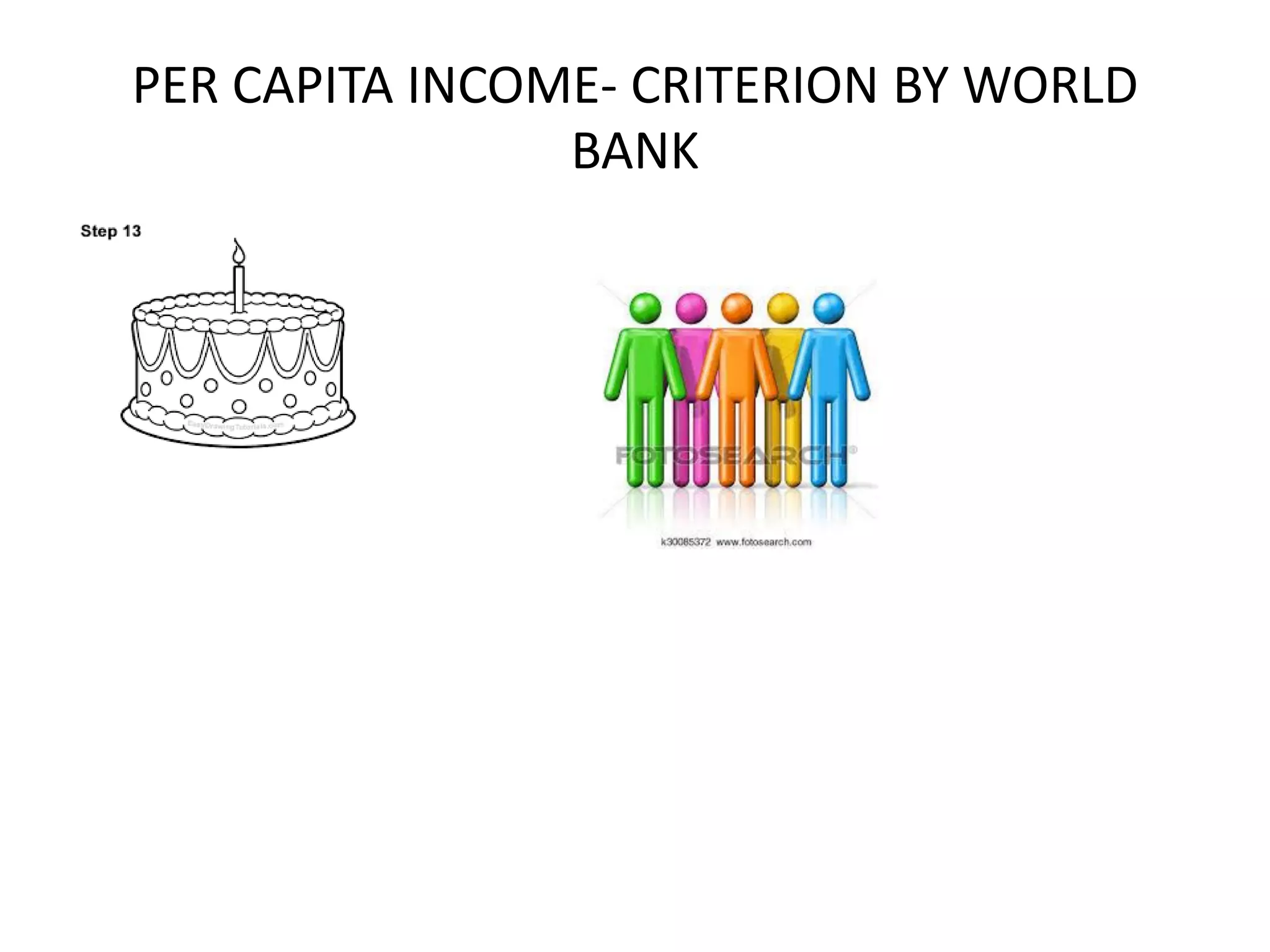
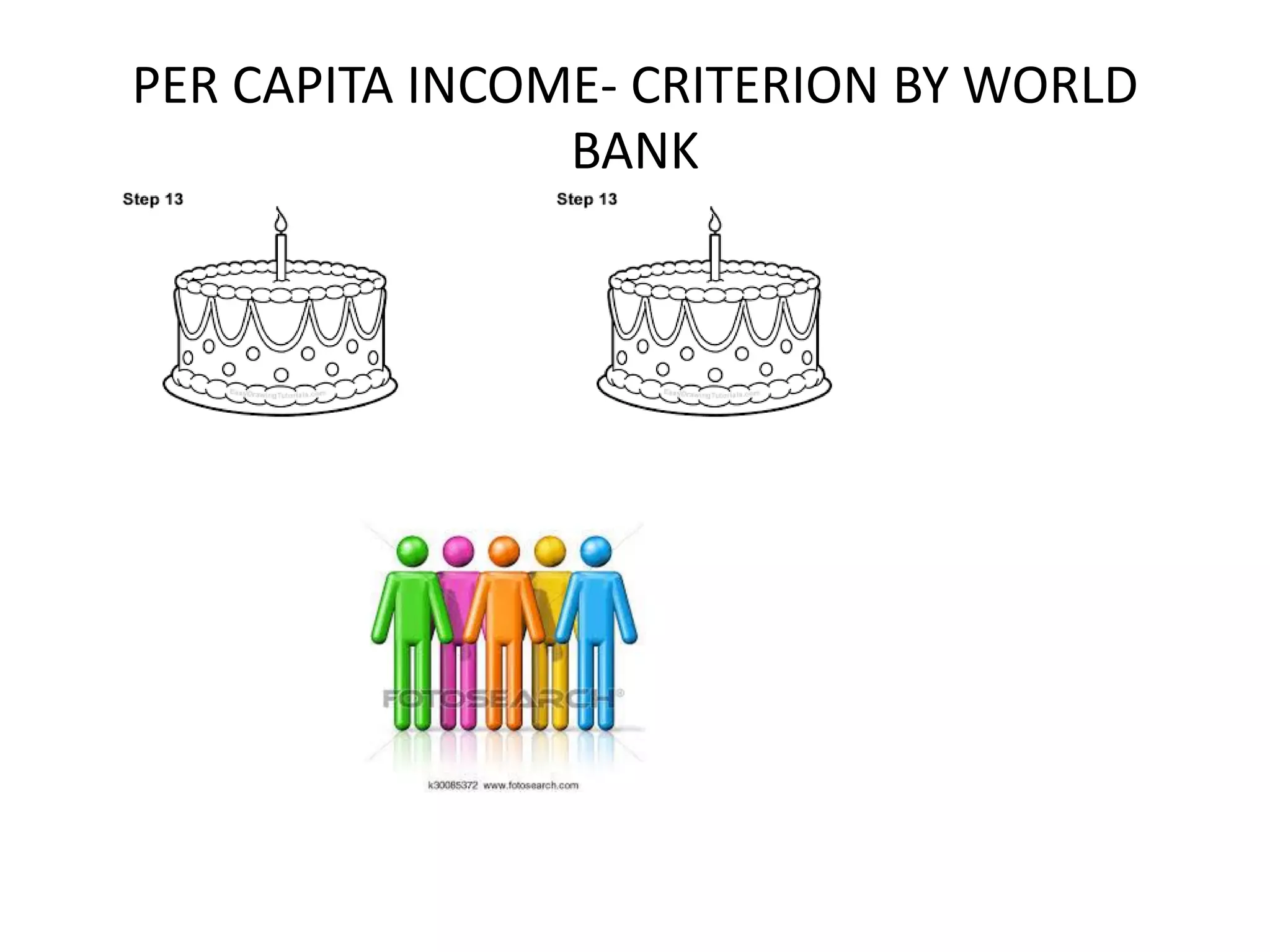
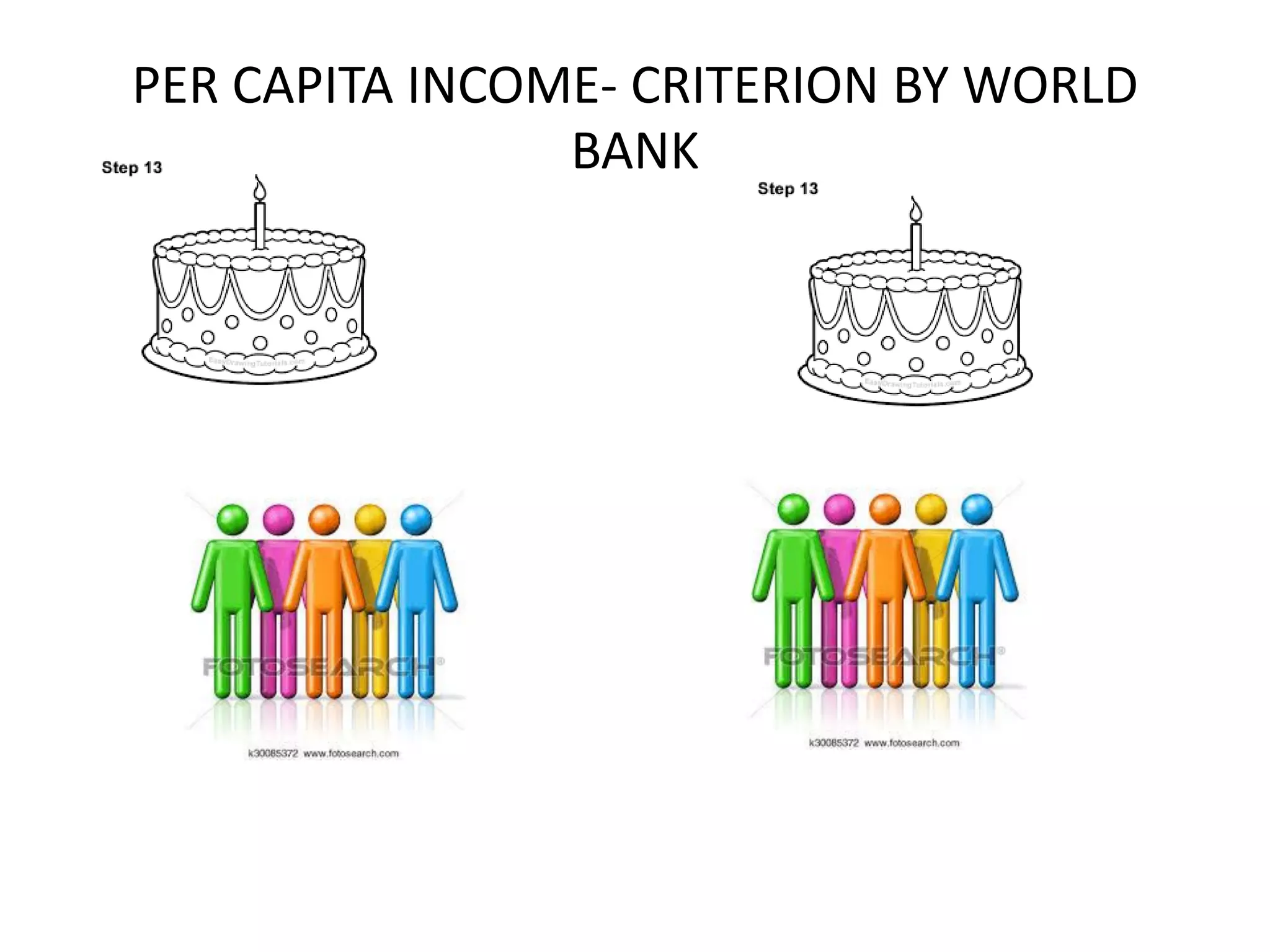
Per capita share of cake =
( total cake)/ (total population)
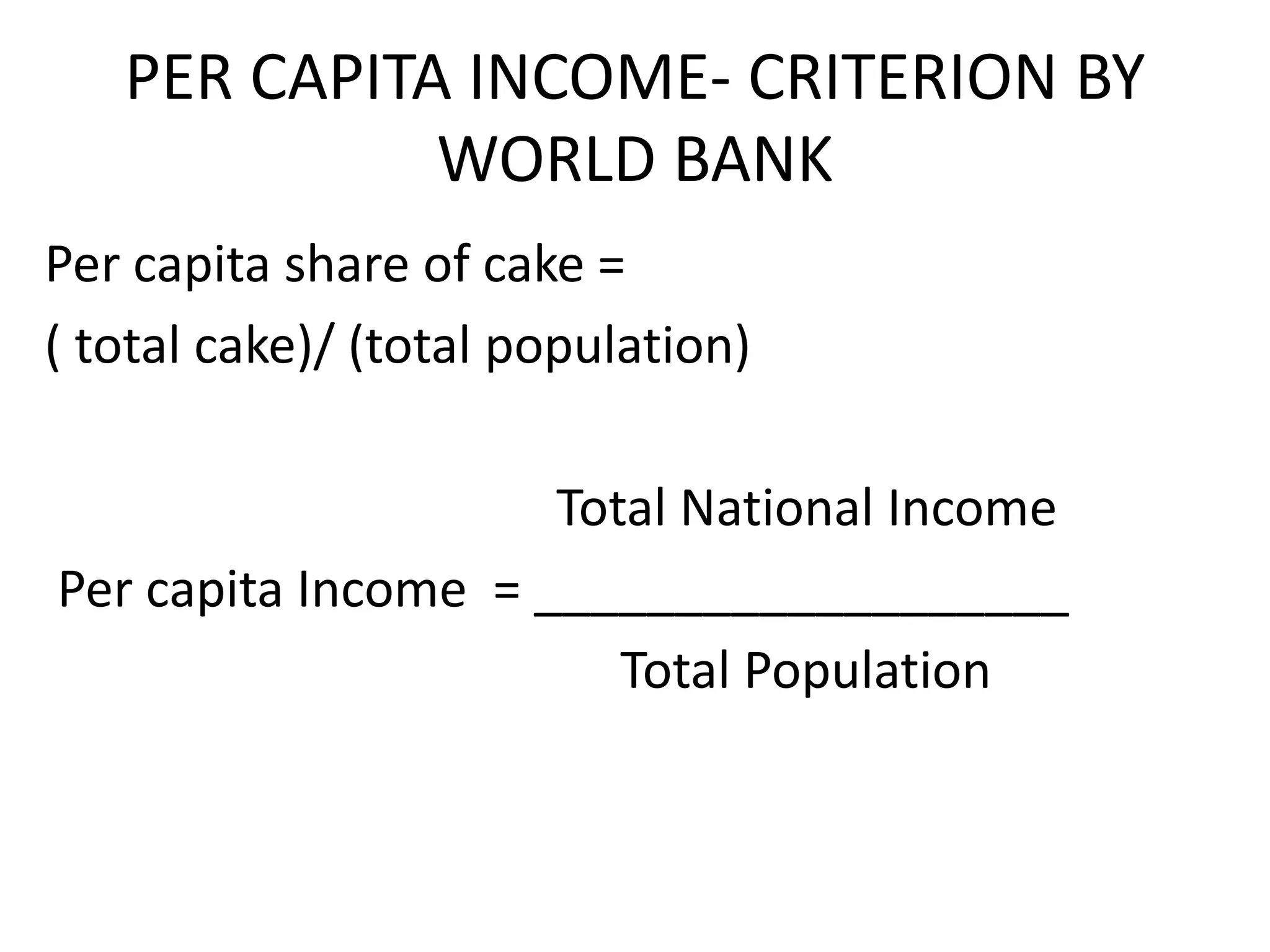
Total National Income
Per capita Income = ___________________
Total Population
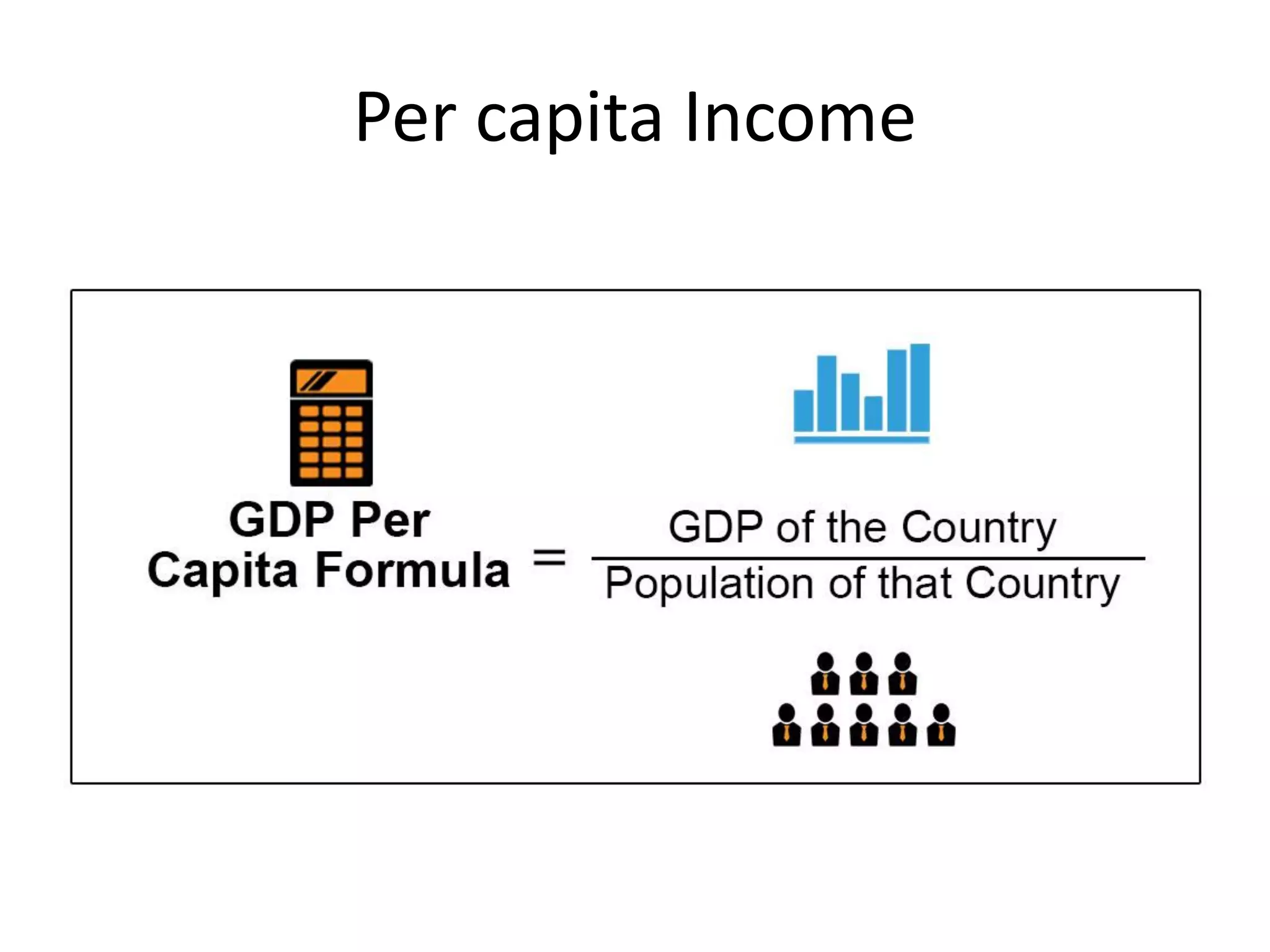
Per capita Income
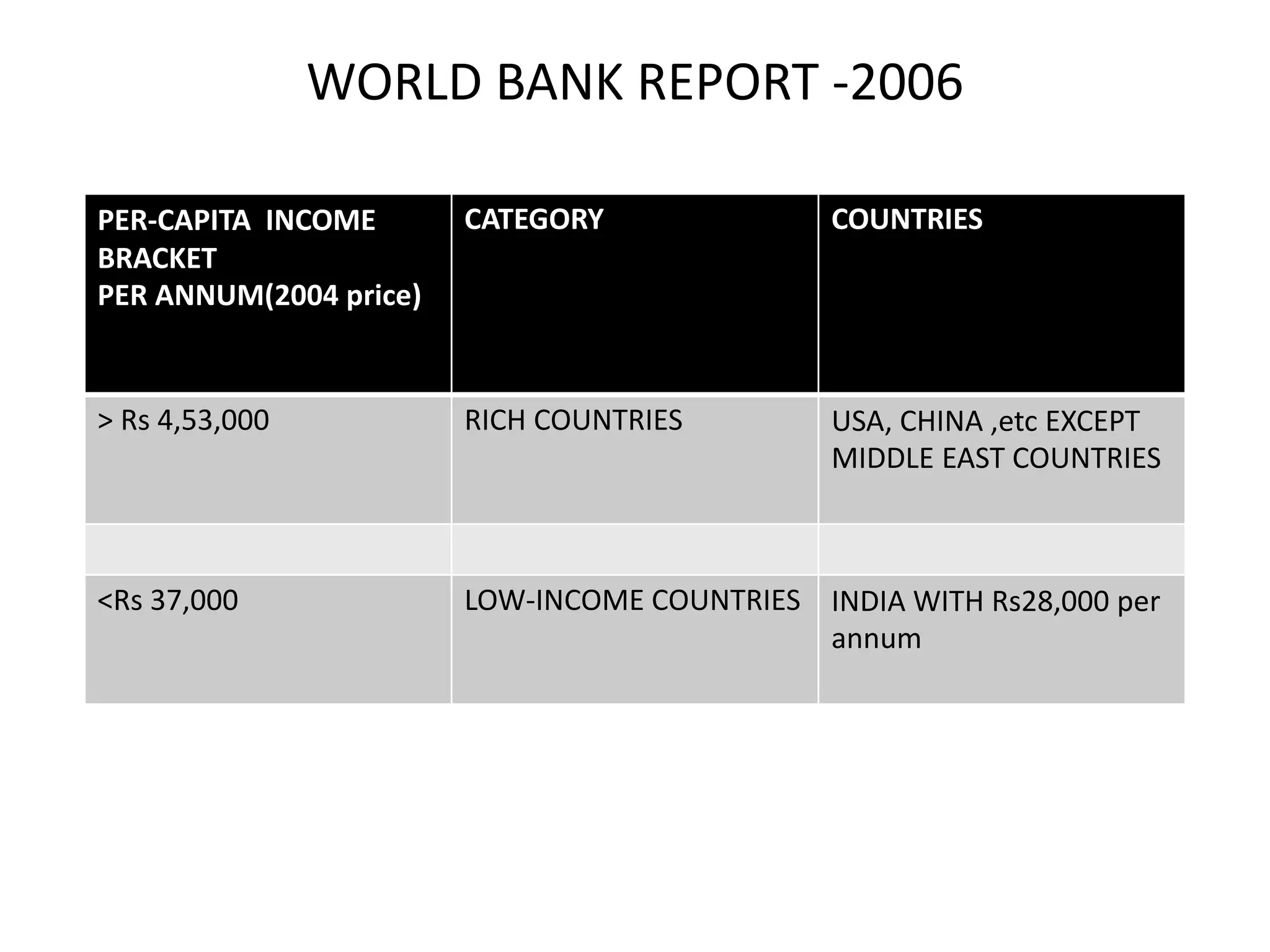
WORLD BANK REPORT -2006
PER-CAPITA INCOME
BRACKET
PER ANNUM(2004 price)
CATEGORY COUNTRIES
> Rs 4,53,000 RICH COUNTRIES USA, CHINA ,etc EXCEPT
MIDDLE EAST COUNTRIES
<Rs 37,000 LOW-INCOME COUNTRIES INDIA WITH Rs28,000 per
annum
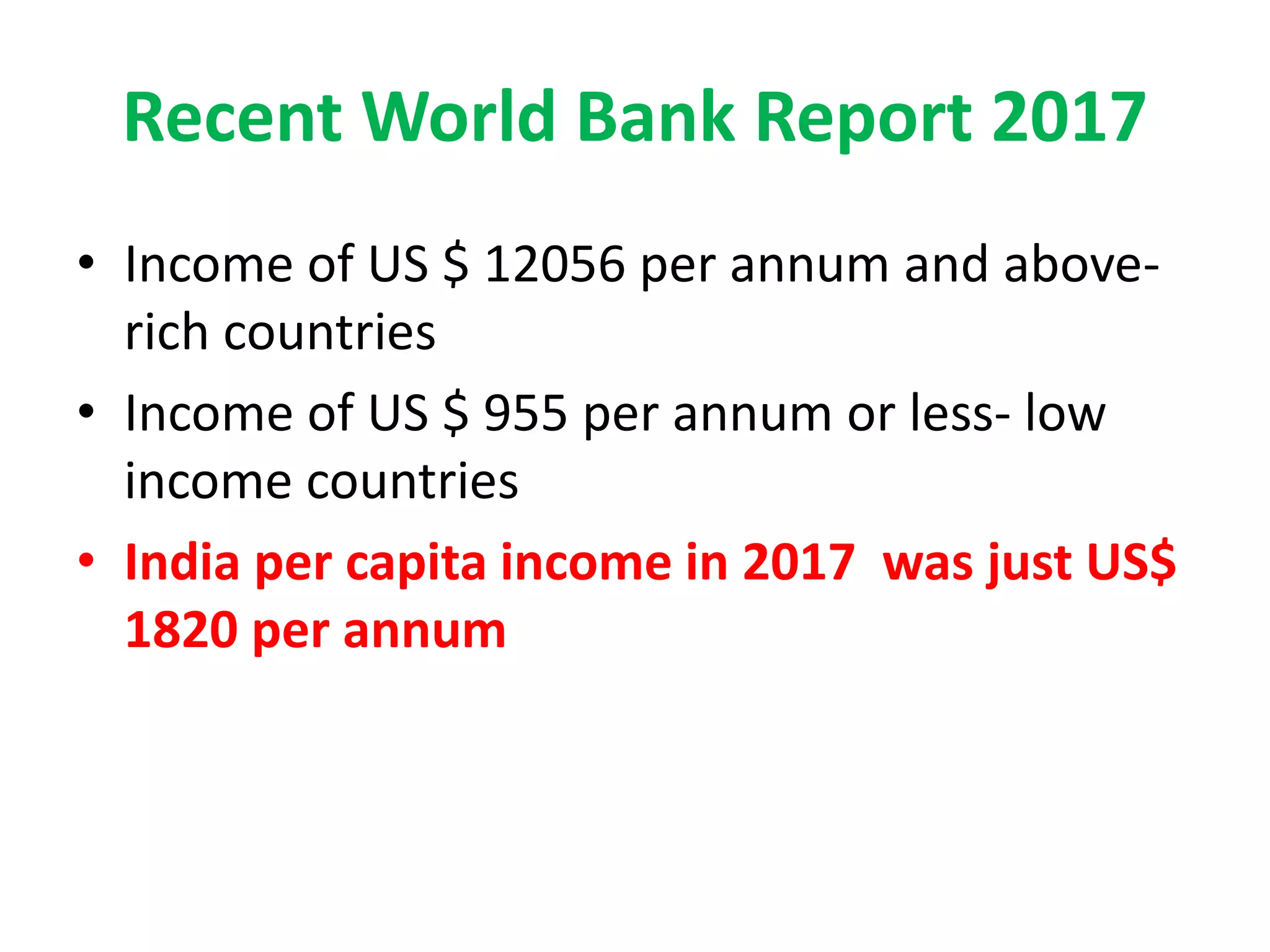
Recent World Bank Report 2017
• Income of US $ 12056 per annum and above-
rich countries
• Income of US $ 955 per annum or less- low
income countries
• India per capita income in 2017 was just US$
1820 per annum
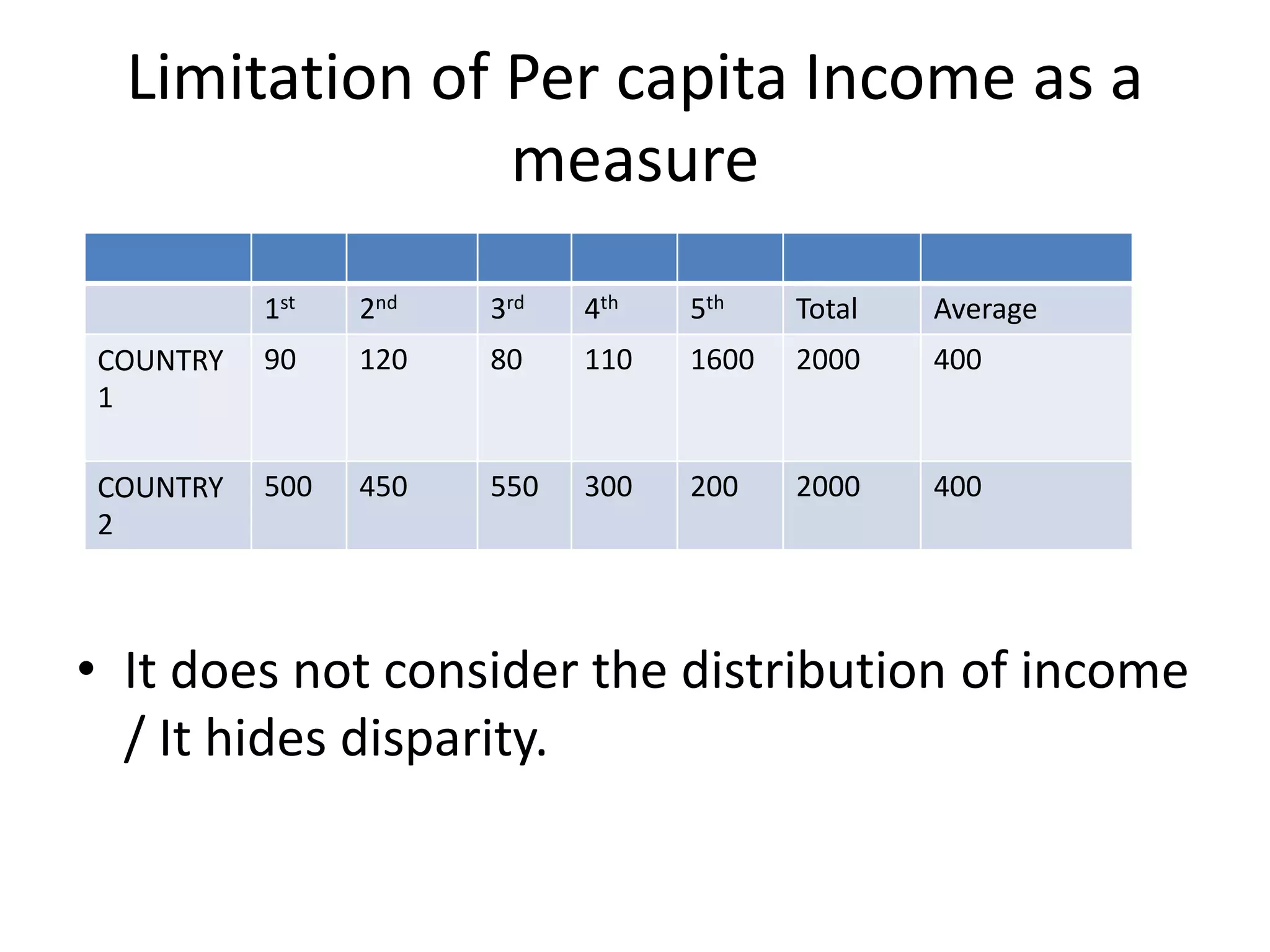
Limitation of Per capita Income as a
measure
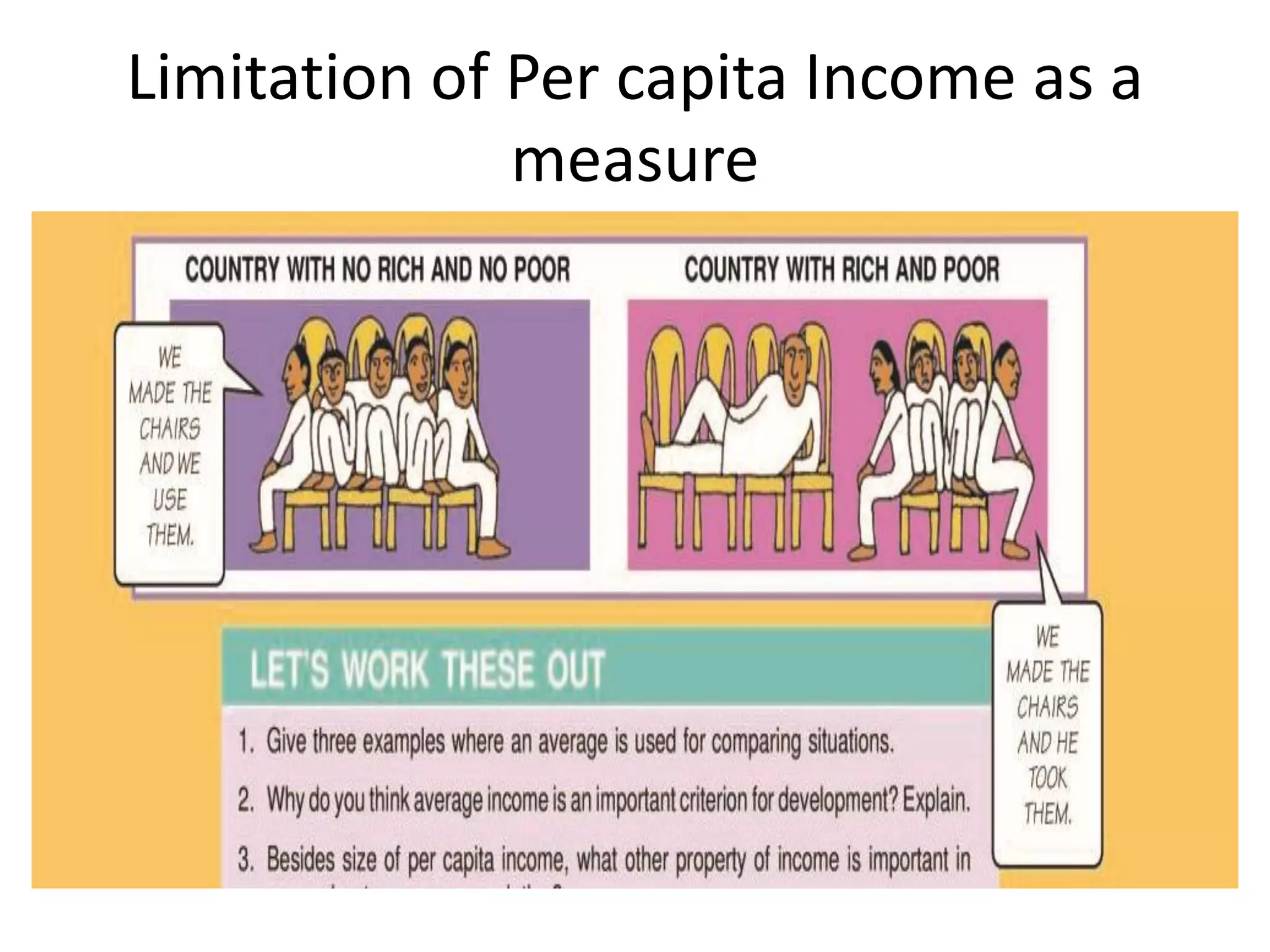
• It does not consider the distribution of income
/ It hides disparity.
1st 2nd 3rd 4th 5th Total Average
COUNTRY
1
90 120 80 110 1600 2000 400
COUNTRY
2
500 450 550 300 200 2000 400
Limitation of Per capita Income as a
measure
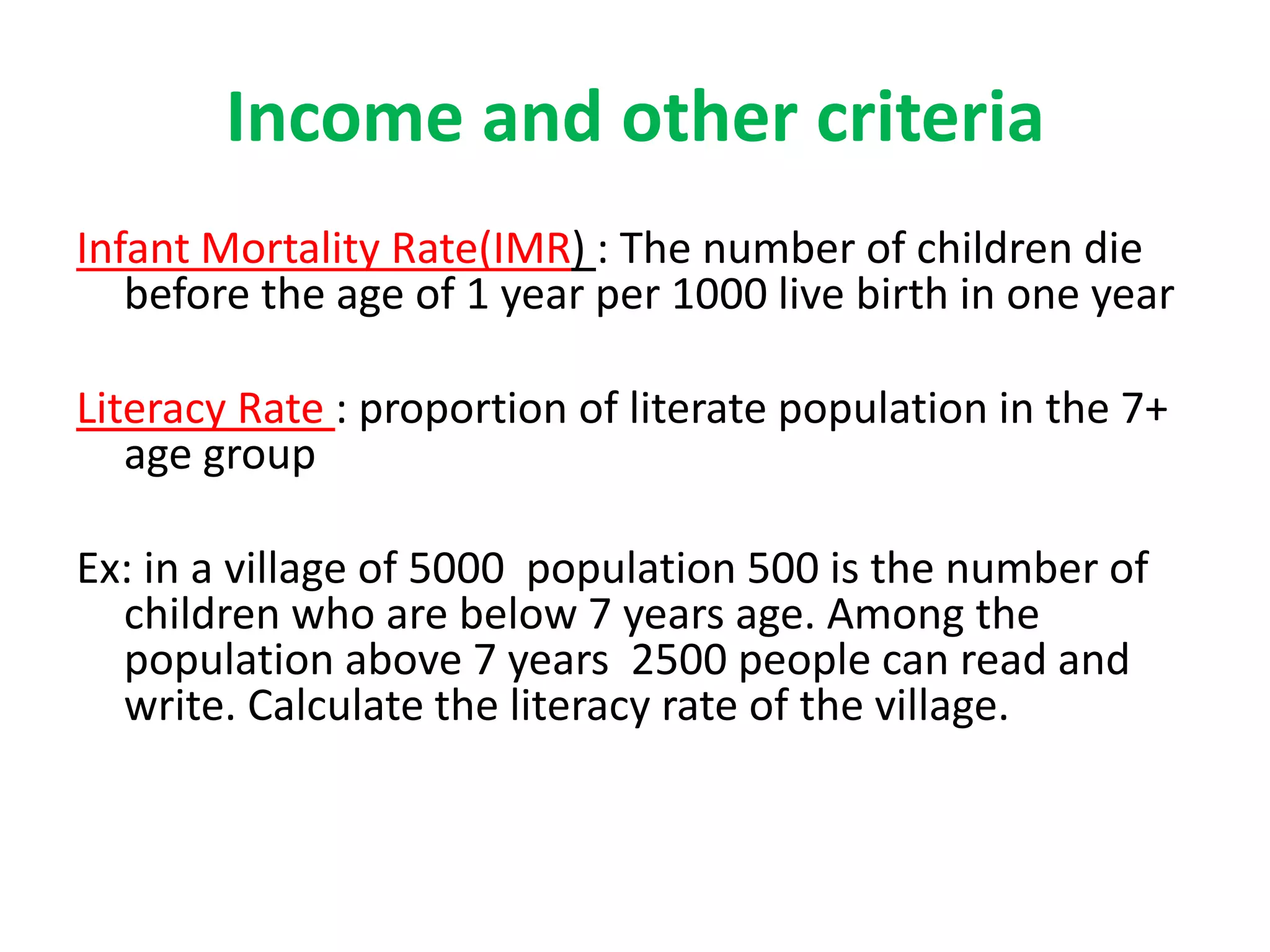
Income and other criteria
Infant Mortality Rate(IMR) : The number of children die
before the age of 1 year per 1000 live birth in one year
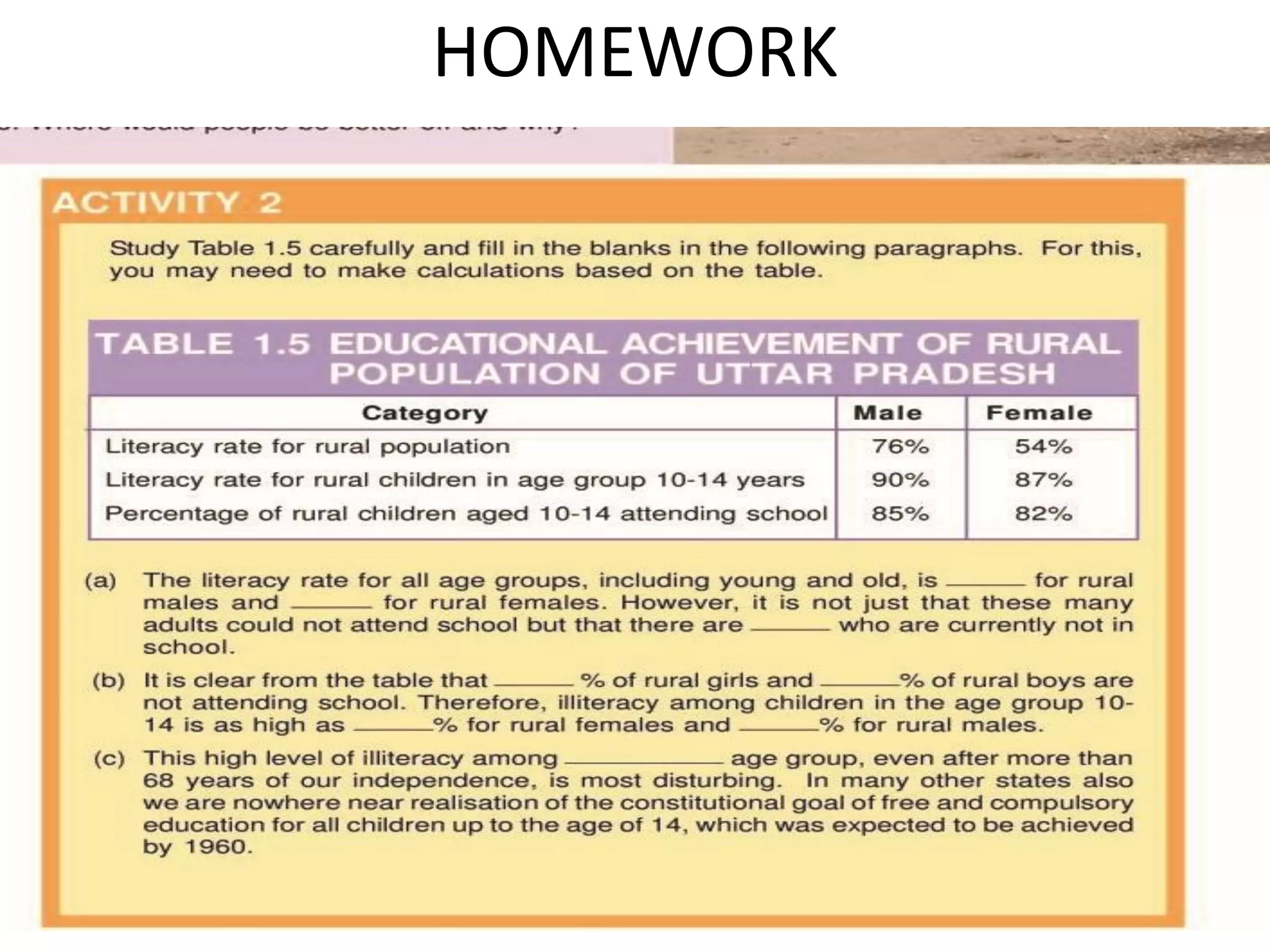
Literacy Rate : proportion of literate population in the 7+
age group
Ex: in a village of 5000 population 500 is the number of
children who are below 7 years age. Among the
population above 7 years 2500 people can read and
write. Calculate the literacy rate of the village.
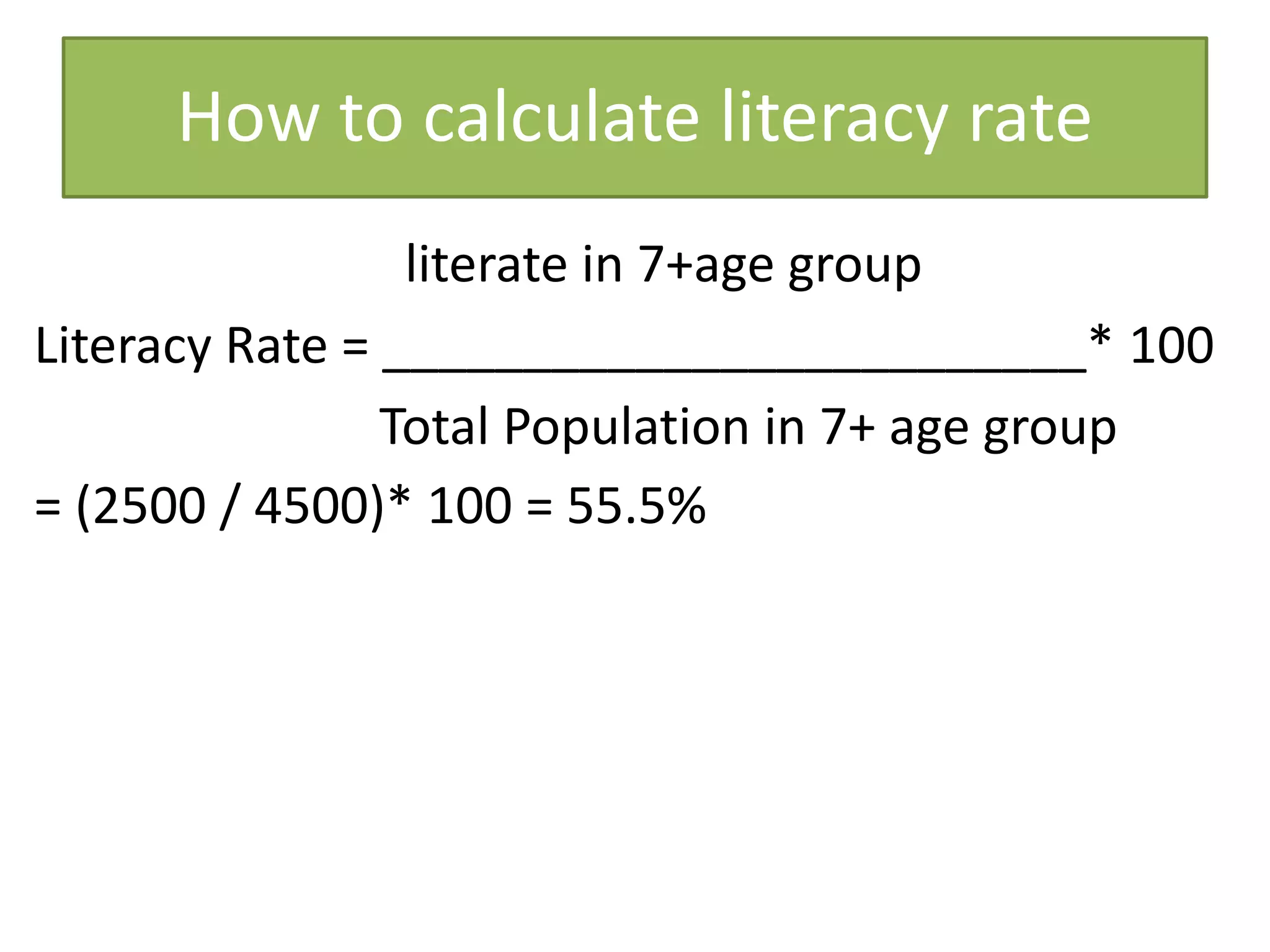
How to calculate literacy rate
literate in 7+age group
Literacy Rate = _________________________* 100
Total Population in 7+ age group
= (2500 / 4500)* 100 = 55.5%
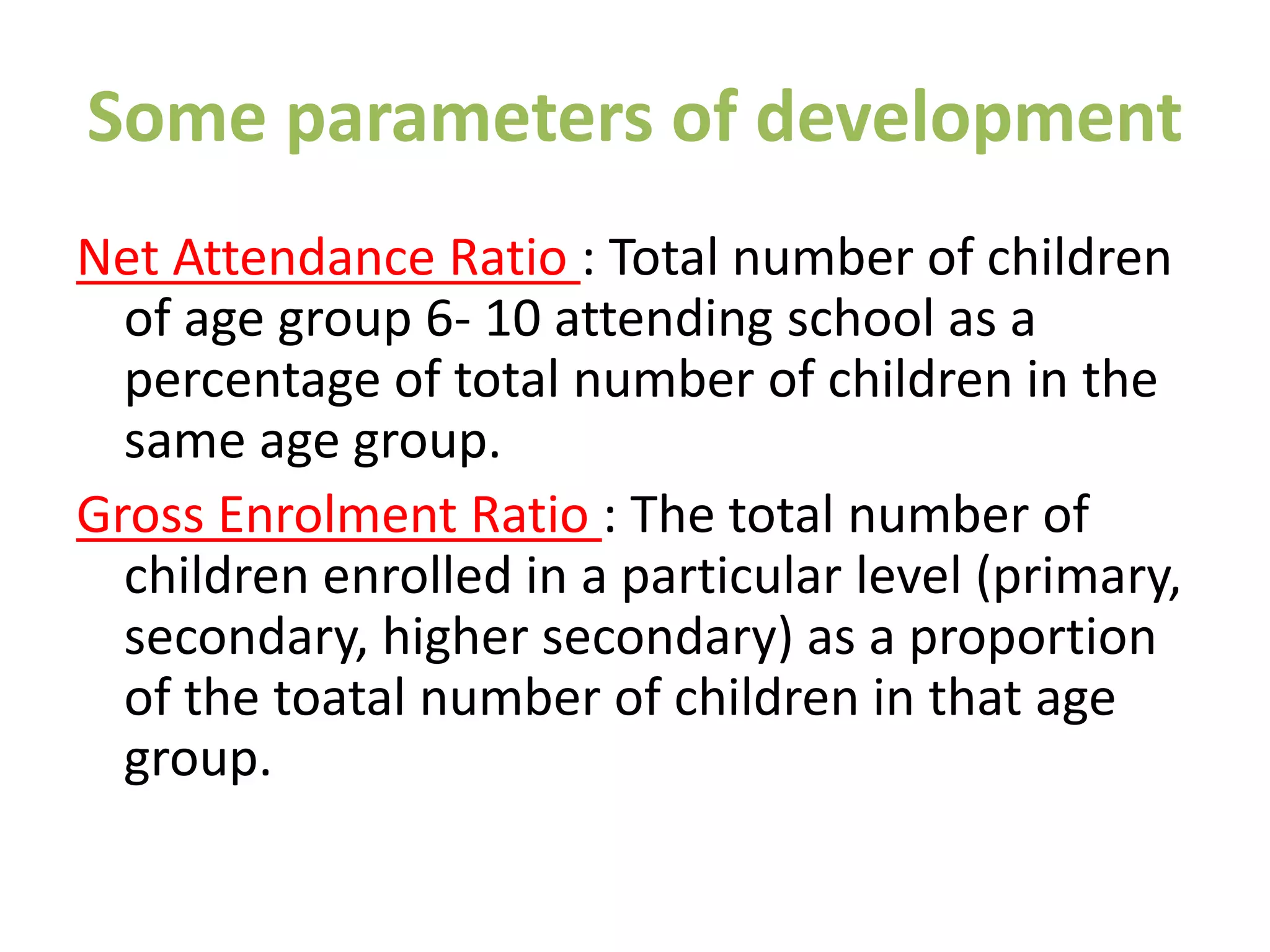
Some parameters of development
Net Attendance Ratio : Total number of children
of age group 6- 10 attending school as a
percentage of total number of children in the
same age group.
Gross Enrolment Ratio : The total number of
children enrolled in a particular level (primary,
secondary, higher secondary) as a proportion
of the toatal number of children in that age
group.
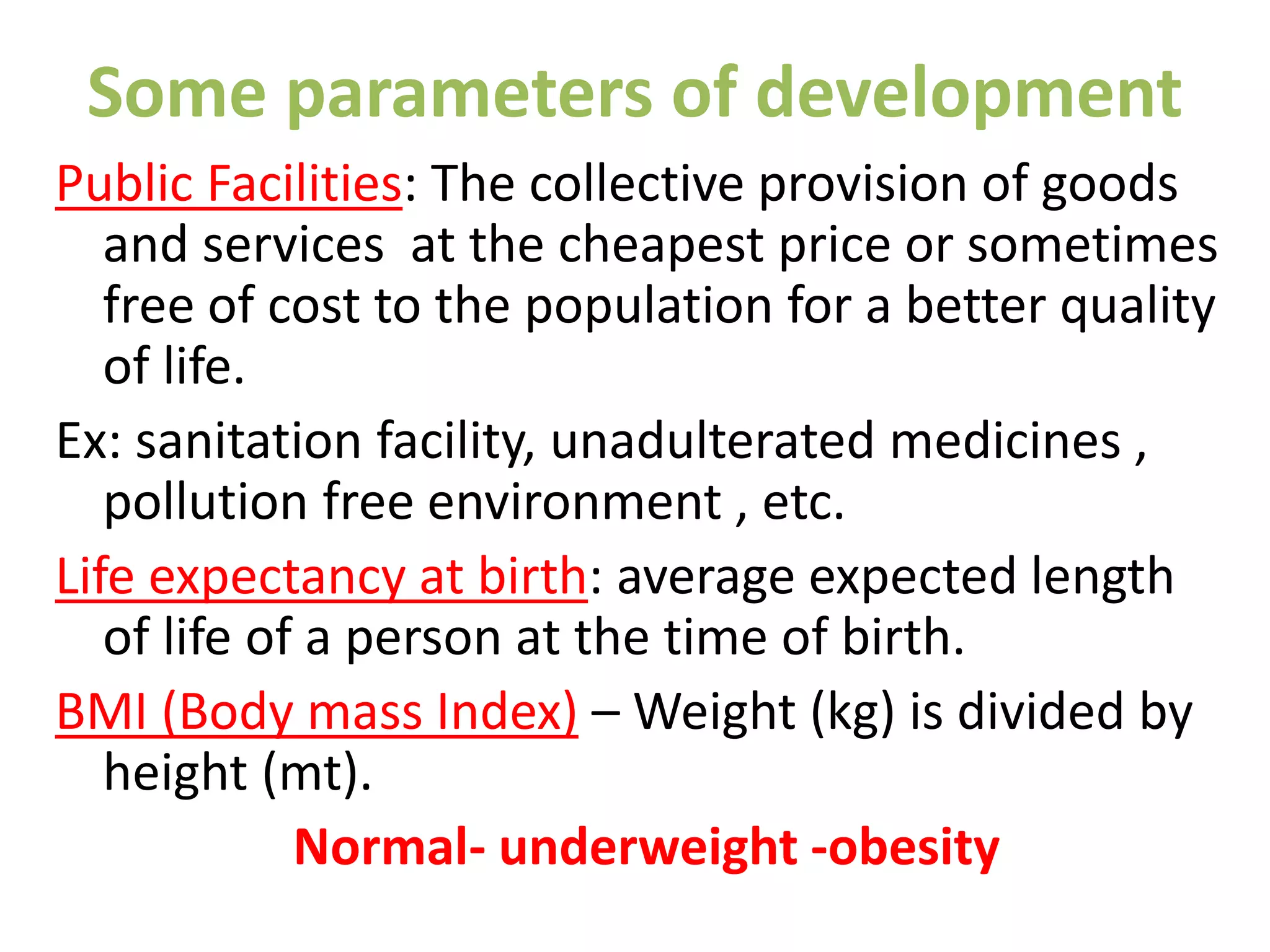
Some parameters of development
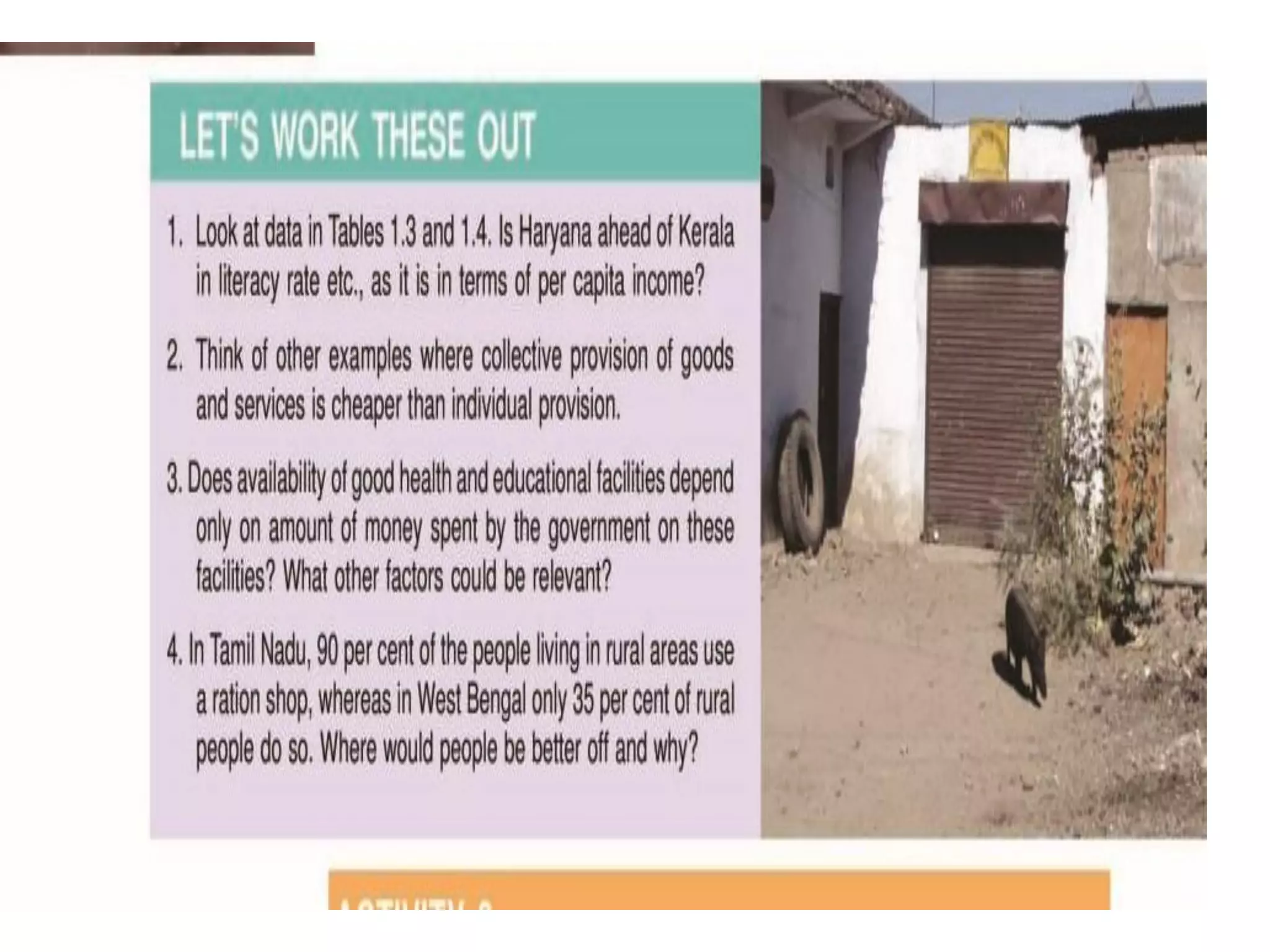
Public Facilities: The collective provision of goods
and services at the cheapest price or sometimes
free of cost to the population for a better quality
of life.
Ex: sanitation facility, unadulterated medicines ,
pollution free environment , etc.
Life expectancy at birth: average expected length
of life of a person at the time of birth.
BMI (Body mass Index) – Weight (kg) is divided by
height (mt).
Normal- underweight -obesity
HOMEWORK
NCERT QUESTIONS
• 1. Development of a country can generally be
determined by
(i) its per capita income
(ii) its average literacy level
(iii) health status of its people
(iv) all the above
Answer: (iv) all the above
NCERT QUESTIONS
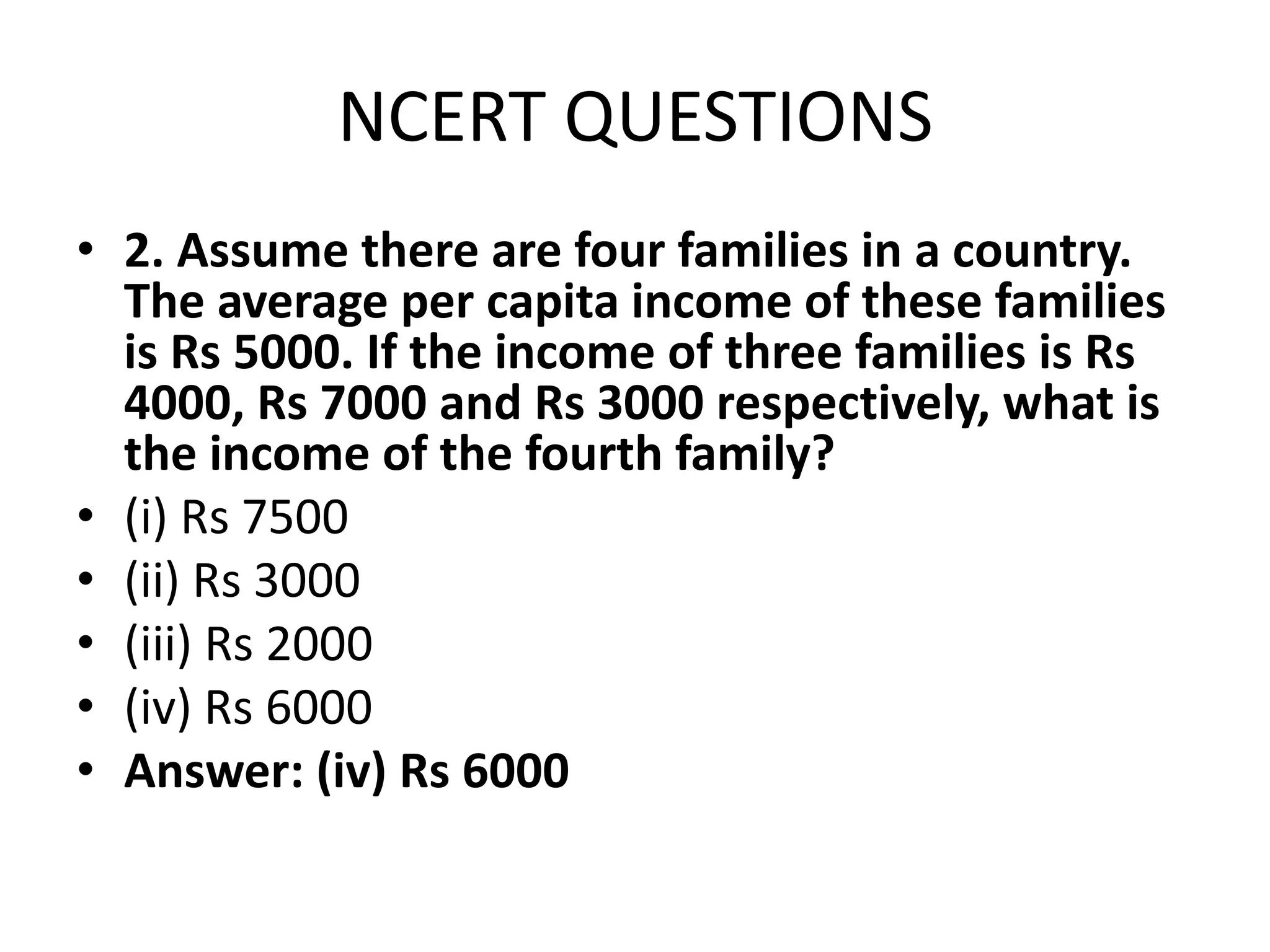
• 2. Assume there are four families in a country.
The average per capita income of these families
is Rs 5000. If the income of three families is Rs
4000, Rs 7000 and Rs 3000 respectively, what is
the income of the fourth family?
• (i) Rs 7500
• (ii) Rs 3000
• (iii) Rs 2000
• (iv) Rs 6000
• Answer: (iv) Rs 6000
Explanation
• Explanation:
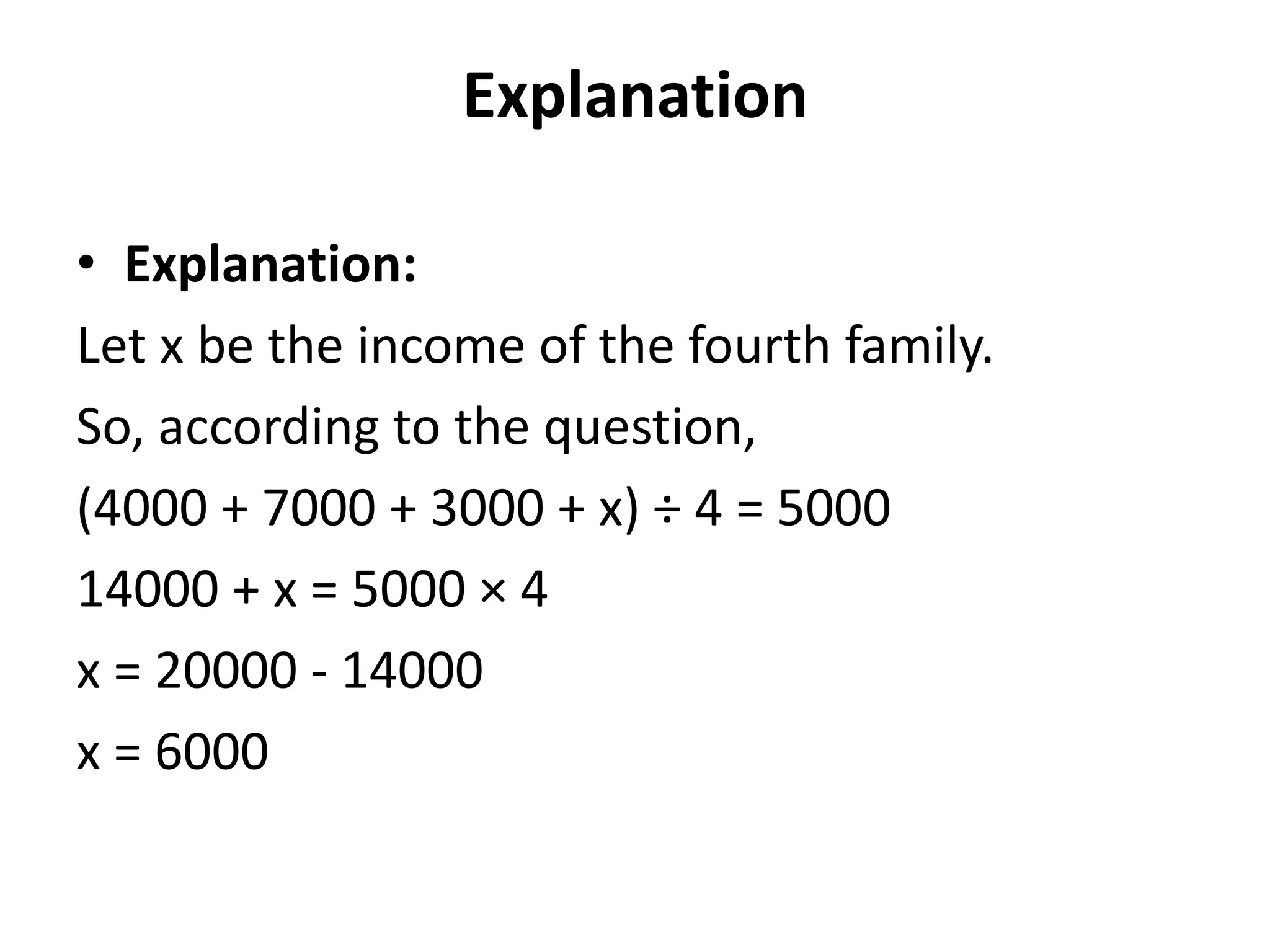
Let x be the income of the fourth family.
So, according to the question,
(4000 + 7000 + 3000 + x) ÷ 4 = 5000
14000 + x = 5000 × 4
x = 20000 - 14000
x = 6000
What is the main criterion used by
the World Bank in classifying different
countries? What are the limitations of
this criterion, if any?
World Bank classifies different countries on the basis of the
per capita income or the average income of a person in the
country. It is calculated by dividing the total income of the
country by the population of the country.
The limitations of the criterion are:
• It does not give any information about the distribution of
the average income among the people in a country.
• It ignores important factors like literacy rate, infant
mortality rate, healthcare, etc. which play a crucial role in
the development of a country.
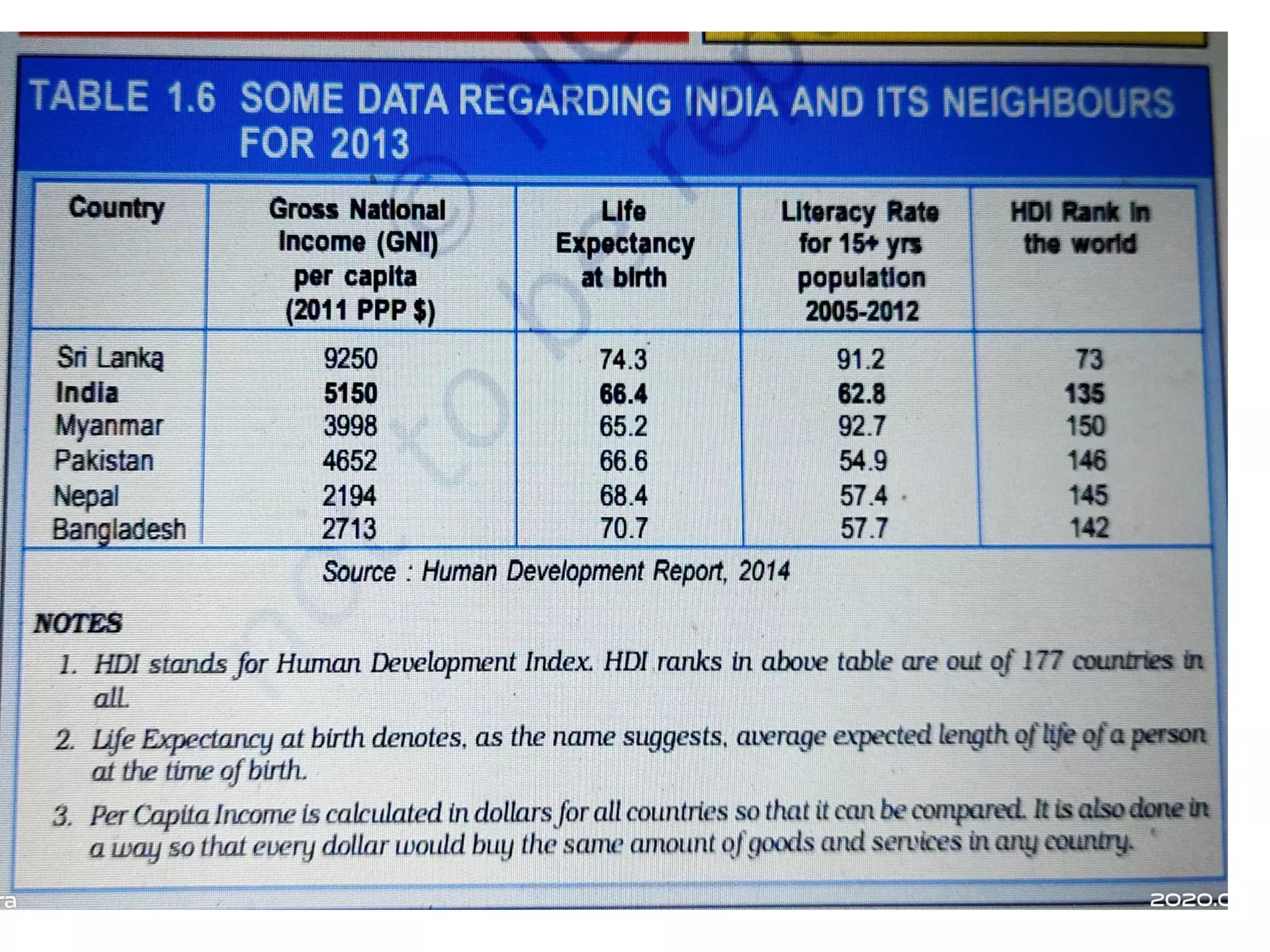
Human Development Index
• Human Development Report published by
UNDP compares countries based on the
educational levels of the people, their health
status and per capita income.
Sustainable Development
• Do you think there are certain other aspects
that should be considered in measuring
human development?
• “We have not inherited the world from our
forefathers — we have borrowed it from our
children.”
Sustainable Development
Sustainable development is a development that
meets the needs of the present without
compromising the ability of future generations
to meet their own needs.
The issue of sustainability is important for
development because if the natural resources
are not used carefully, they may not be
available for future generations. The depleting
resources of a country may ultimately result in
a lack of development of the country.
“The Earth has enough resources to meet the
needs of all but not enough to satisfy the
greed of even one person”. How is this
statement relevant to the discussion of
development? Discuss.
• The statement, “The Earth has enough resources to
meet the needs of all but not enough to satisfy the
greed of even one person” is completely relevant in
terms of the development of a country because both
resources and development go hand in hand.
• For the sustainability of development, the maintenance
of resources is very crucial.
• All the natural resources are non-renewable and will
exhaust if not used cautiously.
• Therefore, it is the responsibility of the people to use
them only to meet their needs and not to satisfy their
greed.
• If natural resources are not used wisely now, the future
generations may not be able to use them to meet their
needs that will ultimately result in the downfall of the
development of a country.
List a few examples of environmental
degradation that you may have
observed around you.
• Decreased level of air quality
• Water pollution
• Deforestation
• Soil Erosion
• Falling level of ground water

CLASS X-Development.pdf

  • 1.
  • 4.
    How Development isdifferent from growth? Growth is quantitative Development is qualitative and more complex
  • 5.
    DEVELOPMENT Development is aprocess where people think , seek and achieve their goals in life; • A better life situation • Better standard of life for all • Equality • Better means of recreation and leisure • Freedom of thought and expression , practice of religion, etc It is a complex economic, political, social process.
  • 10.
    CHARACTERISTICS OF DEVELOPMENT •Different persons have different developmental goals. WHY • Developmental goals can be conflicting in nature. HOW • Development is a mix of goals.
  • 11.
  • 12.
    INCOME & OTHERGOALS What according to you is the requirements of a good life? Important needs other than material things for a good life? • Equal treatment • Freedom • Security • Respect for others • No discrimination • Better Health Facilities • Better Education facilities , etc. These parameters are difficult to measure but they are important in our lives.
  • 13.
    Homework Give some (atleast 3)examples where factors other than income are important aspects of our lives.
  • 14.
  • 15.
  • 16.
    NATIONAL DEVELOPMENT • Itis a comprehensive term which includes the all aspects of the life of an individual and the nation. • It is holistic in approach. It is a process of reconstruction and development in various dimensions of a nation and development of individuals. • It includes the welfare of both majority and minority groups.
  • 17.
    How to comparedifferent countries or states?? The countries can be compared on the basis of • Total National Income (the income of all the residents of the country) • Average Income • Other criteria like IMR, Literacy Rate , Net Attendance Ratio, Public Facilities, Gross Enrolment Ratio • Human Development Index (HDI)
  • 18.
  • 19.
    PER CAPITA INCOME-CRITERION BY WORLD BANK
  • 20.
    PER CAPITA INCOME-CRITERION BY WORLD BANK
  • 21.
    PER CAPITA INCOME-CRITERION BY WORLD BANK
  • 22.
    PER CAPITA INCOME-CRITERION BY WORLD BANK Per capita share of cake = ( total cake)/ (total population) Total National Income Per capita Income = ___________________ Total Population
  • 23.
  • 24.
    WORLD BANK REPORT-2006 PER-CAPITA INCOME BRACKET PER ANNUM(2004 price) CATEGORY COUNTRIES > Rs 4,53,000 RICH COUNTRIES USA, CHINA ,etc EXCEPT MIDDLE EAST COUNTRIES <Rs 37,000 LOW-INCOME COUNTRIES INDIA WITH Rs28,000 per annum
  • 25.
    Recent World BankReport 2017 • Income of US $ 12056 per annum and above- rich countries • Income of US $ 955 per annum or less- low income countries • India per capita income in 2017 was just US$ 1820 per annum
  • 26.
    Limitation of Percapita Income as a measure • It does not consider the distribution of income / It hides disparity. 1st 2nd 3rd 4th 5th Total Average COUNTRY 1 90 120 80 110 1600 2000 400 COUNTRY 2 500 450 550 300 200 2000 400
  • 27.
    Limitation of Percapita Income as a measure
  • 29.
    Income and othercriteria Infant Mortality Rate(IMR) : The number of children die before the age of 1 year per 1000 live birth in one year Literacy Rate : proportion of literate population in the 7+ age group Ex: in a village of 5000 population 500 is the number of children who are below 7 years age. Among the population above 7 years 2500 people can read and write. Calculate the literacy rate of the village.
  • 30.
    How to calculateliteracy rate literate in 7+age group Literacy Rate = _________________________* 100 Total Population in 7+ age group = (2500 / 4500)* 100 = 55.5%
  • 31.
    Some parameters ofdevelopment Net Attendance Ratio : Total number of children of age group 6- 10 attending school as a percentage of total number of children in the same age group. Gross Enrolment Ratio : The total number of children enrolled in a particular level (primary, secondary, higher secondary) as a proportion of the toatal number of children in that age group.
  • 32.
    Some parameters ofdevelopment Public Facilities: The collective provision of goods and services at the cheapest price or sometimes free of cost to the population for a better quality of life. Ex: sanitation facility, unadulterated medicines , pollution free environment , etc. Life expectancy at birth: average expected length of life of a person at the time of birth. BMI (Body mass Index) – Weight (kg) is divided by height (mt). Normal- underweight -obesity
  • 36.
  • 37.
    NCERT QUESTIONS • 1.Development of a country can generally be determined by (i) its per capita income (ii) its average literacy level (iii) health status of its people (iv) all the above Answer: (iv) all the above
  • 38.
    NCERT QUESTIONS • 2.Assume there are four families in a country. The average per capita income of these families is Rs 5000. If the income of three families is Rs 4000, Rs 7000 and Rs 3000 respectively, what is the income of the fourth family? • (i) Rs 7500 • (ii) Rs 3000 • (iii) Rs 2000 • (iv) Rs 6000 • Answer: (iv) Rs 6000
  • 39.
    Explanation • Explanation: Let xbe the income of the fourth family. So, according to the question, (4000 + 7000 + 3000 + x) ÷ 4 = 5000 14000 + x = 5000 × 4 x = 20000 - 14000 x = 6000
  • 40.
    What is themain criterion used by the World Bank in classifying different countries? What are the limitations of this criterion, if any? World Bank classifies different countries on the basis of the per capita income or the average income of a person in the country. It is calculated by dividing the total income of the country by the population of the country. The limitations of the criterion are: • It does not give any information about the distribution of the average income among the people in a country. • It ignores important factors like literacy rate, infant mortality rate, healthcare, etc. which play a crucial role in the development of a country.
  • 41.
    Human Development Index •Human Development Report published by UNDP compares countries based on the educational levels of the people, their health status and per capita income.
  • 43.
    Sustainable Development • Doyou think there are certain other aspects that should be considered in measuring human development? • “We have not inherited the world from our forefathers — we have borrowed it from our children.”
  • 44.
    Sustainable Development Sustainable developmentis a development that meets the needs of the present without compromising the ability of future generations to meet their own needs. The issue of sustainability is important for development because if the natural resources are not used carefully, they may not be available for future generations. The depleting resources of a country may ultimately result in a lack of development of the country.
  • 45.
    “The Earth hasenough resources to meet the needs of all but not enough to satisfy the greed of even one person”. How is this statement relevant to the discussion of development? Discuss.
  • 46.
    • The statement,“The Earth has enough resources to meet the needs of all but not enough to satisfy the greed of even one person” is completely relevant in terms of the development of a country because both resources and development go hand in hand. • For the sustainability of development, the maintenance of resources is very crucial. • All the natural resources are non-renewable and will exhaust if not used cautiously. • Therefore, it is the responsibility of the people to use them only to meet their needs and not to satisfy their greed. • If natural resources are not used wisely now, the future generations may not be able to use them to meet their needs that will ultimately result in the downfall of the development of a country.
  • 47.
    List a fewexamples of environmental degradation that you may have observed around you. • Decreased level of air quality • Water pollution • Deforestation • Soil Erosion • Falling level of ground water