Poverty is the lack of basic human needs such
as Nutrition, health care education, clothing
and shelter, because of the inability to afford
them.
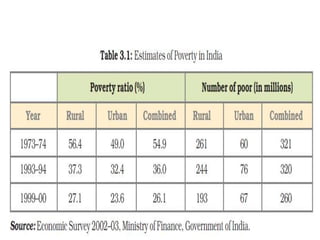
•Every 4th person in India is poor.
•260 million or 26 crore people in India are poor.
•India has the largest single concentration of the poor in the world.
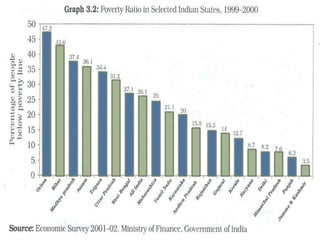
•Poverty in India varies from state to state. The rate of success for poverty
reduction is different from state to state, thus causing inter-state disparities.
• Orissa, Madhya Pradesh and Bihar are the poorest states of India.
• Punjab, Himachal Pradesh ad Jammu and Kashmir are the best states when
poverty is concerned.
 BRITISH RULE
 RURAL ECONOMY
 HEAVY PRESSURE OF POPULATION
 CHRONIC UNEMPLOYMENT AND UNDEREMPLOYMENT
 LACK OF PROPER INDUSTRIALISATION
 SOCIAL FACTORS
 INDIA’S ECONOMIC POLICY
 NEO-LIBERAL POLICIES AND THEIR EFFECTS
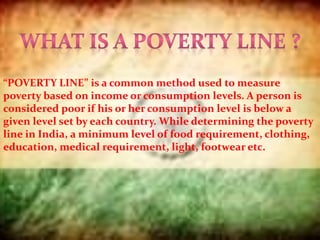
“POVERTY LINE” is a common method used to measure
poverty based on income or consumption levels. A person is
considered poor if his or her consumption level is below a
given level set by each country. While determining the poverty
line in India, a minimum level of food requirement, clothing,
education, medical requirement, light, footwear etc.
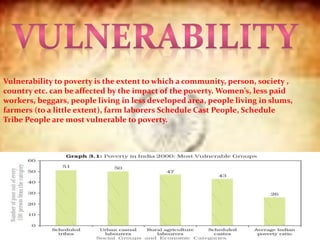
Vulnerability to poverty is the extent to which a community, person, society ,
country etc. can be affected by the impact of the poverty. Women’s, less paid
workers, beggars, people living in less developed area, people living in slums,
farmers (to a little extent), farm laborers Schedule Cast People, Schedule
Tribe People are most vulnerable to poverty.
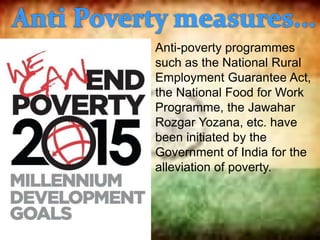
Anti-poverty programmes
such as the National Rural
Employment Guarantee Act,
the National Food for Work
Programme, the Jawahar
Rozgar Yozana, etc. have
been initiated by the
Government of India for the
alleviation of poverty.
→ LANDLESSNESS
→UNEMPLOYEMENT
→SIZE OF FAMILIES
→ILLETRACY
→MALNUTRITION
→CHILD LABOUR
→HELPLESNESS
 The government of India has been trying its best to
remove poverty. Some of the measures which the
government has taken to remove rural poverty are:
Small farmer’s development program.
Drought area development Program.
Minimum needs Program.
National rural employment Program.
Assurance on employment.
Lack of proper housing facilities.
Unhygienic environments.
No social security schemes.
Lack of opportunity to quality health and educational
services.
Nehru Rozgar Yojna.
Prime Minister Rozgar Yojna.
Urban Basic services for the poor Program.
National social Assistance Program.
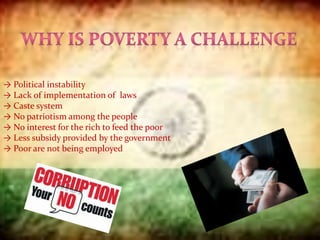
→ Political instability
→ Lack of implementation of laws
→ Caste system
→ No patriotism among the people
→ No interest for the rich to feed the poor
→ Less subsidy provided by the government
→ Poor are not being employed
Poverty as a challenge class 9

Poverty as a challenge class 9

  • 2.
    Poverty is thelack of basic human needs such as Nutrition, health care education, clothing and shelter, because of the inability to afford them.
  • 3.
    •Every 4th personin India is poor. •260 million or 26 crore people in India are poor. •India has the largest single concentration of the poor in the world. •Poverty in India varies from state to state. The rate of success for poverty reduction is different from state to state, thus causing inter-state disparities. • Orissa, Madhya Pradesh and Bihar are the poorest states of India. • Punjab, Himachal Pradesh ad Jammu and Kashmir are the best states when poverty is concerned.
  • 4.
     BRITISH RULE RURAL ECONOMY  HEAVY PRESSURE OF POPULATION  CHRONIC UNEMPLOYMENT AND UNDEREMPLOYMENT  LACK OF PROPER INDUSTRIALISATION  SOCIAL FACTORS  INDIA’S ECONOMIC POLICY  NEO-LIBERAL POLICIES AND THEIR EFFECTS
  • 5.
    “POVERTY LINE” isa common method used to measure poverty based on income or consumption levels. A person is considered poor if his or her consumption level is below a given level set by each country. While determining the poverty line in India, a minimum level of food requirement, clothing, education, medical requirement, light, footwear etc.
  • 8.
    Vulnerability to povertyis the extent to which a community, person, society , country etc. can be affected by the impact of the poverty. Women’s, less paid workers, beggars, people living in less developed area, people living in slums, farmers (to a little extent), farm laborers Schedule Cast People, Schedule Tribe People are most vulnerable to poverty.
  • 9.
    Anti-poverty programmes such asthe National Rural Employment Guarantee Act, the National Food for Work Programme, the Jawahar Rozgar Yozana, etc. have been initiated by the Government of India for the alleviation of poverty.
  • 10.
    → LANDLESSNESS →UNEMPLOYEMENT →SIZE OFFAMILIES →ILLETRACY →MALNUTRITION →CHILD LABOUR →HELPLESNESS
  • 12.
     The governmentof India has been trying its best to remove poverty. Some of the measures which the government has taken to remove rural poverty are: Small farmer’s development program. Drought area development Program. Minimum needs Program. National rural employment Program. Assurance on employment.
  • 13.
    Lack of properhousing facilities. Unhygienic environments. No social security schemes. Lack of opportunity to quality health and educational services.
  • 15.
    Nehru Rozgar Yojna. PrimeMinister Rozgar Yojna. Urban Basic services for the poor Program. National social Assistance Program.
  • 17.
    → Political instability →Lack of implementation of laws → Caste system → No patriotism among the people → No interest for the rich to feed the poor → Less subsidy provided by the government → Poor are not being employed