MONEY AND CREDIT
Class : 10
Economics, Chapter: 3
By Tsering Chokeyi
Teacher
Buying and Selling
Importance of money
Barter System
Barter system means the
direct exchange of one
commodity for another.
Double coincidence of wants
It is a transaction that occurs between two
people where they both willing to carry out
the exchange of goods they are both happy
Difficulties of Barter System
• Double coincident of wants is an essential
feature
• Lack of measurement
• Difficult to store or keep the things
Money in Economy
• Eliminate double coincidence
of wants
• Money as a medium of
exchange
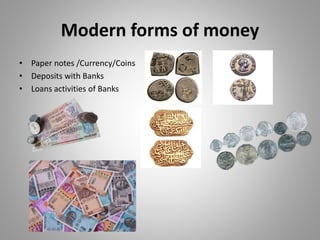
Modern forms of money
• Paper notes /Currency/Coins
• Deposits with Banks
• Loans activities of Banks
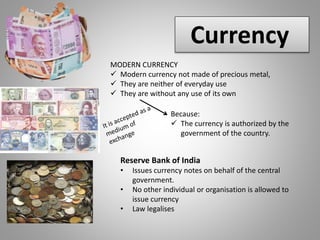
Currency
MODERN CURRENCY
 Modern currency not made of precious metal,
 They are neither of everyday use
 They are without any use of its own
Because:
 The currency is authorized by the
government of the country.
Reserve Bank of India
• Issues currency notes on behalf of the central
government.
• No other individual or organisation is allowed to
issue currency
• Law legalises
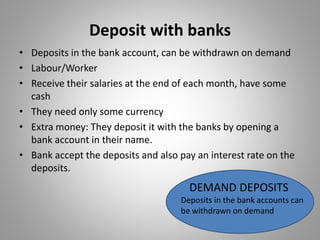
Deposit with banks
• Deposits in the bank account, can be withdrawn on demand
• Labour/Worker
• Receive their salaries at the end of each month, have some
cash
• They need only some currency
• Extra money: They deposit it with the banks by opening a
bank account in their name.
• Bank accept the deposits and also pay an interest rate on the
deposits.
DEMAND DEPOSITS
Deposits in the bank accounts can
be withdrawn on demand
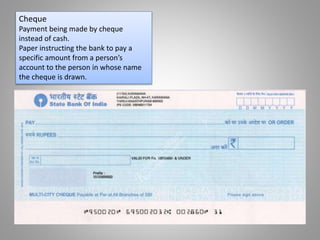
Cheque
Payment being made by cheque
instead of cash.
Paper instructing the bank to pay a
specific amount from a person’s
account to the person in whose name
the cheque is drawn.
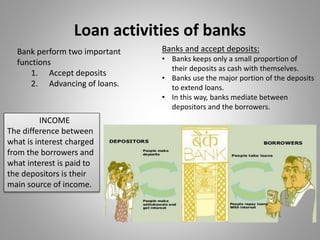
Loan activities of banks
Bank perform two important
functions
1. Accept deposits
2. Advancing of loans.
Banks and accept deposits:
• Banks keeps only a small proportion of
their deposits as cash with themselves.
• Banks use the major portion of the deposits
to extend loans.
• In this way, banks mediate between
depositors and the borrowers.
INCOME
The difference between
what is interest charged
from the borrowers and
what interest is paid to
the depositors is their
main source of income.
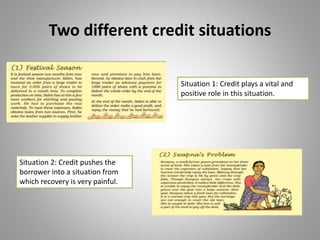
Two different credit situations
Situation 1: Credit plays a vital and
positive role in this situation.
Situation 2: Credit pushes the
borrower into a situation from
which recovery is very painful.
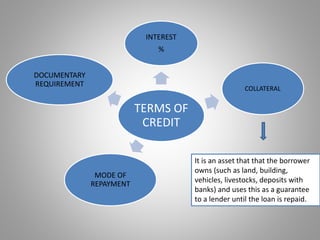
TERMS OF
CREDIT
INTEREST
%
COLLATERAL
MODE OF
REPAYMENT
DOCUMENTARY
REQUIREMENT
It is an asset that that the borrower
owns (such as land, building,
vehicles, livestocks, deposits with
banks) and uses this as a guarantee
to a lender until the loan is repaid.
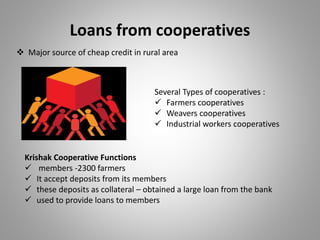
Loans from cooperatives
 Major source of cheap credit in rural area
Several Types of cooperatives :
 Farmers cooperatives
 Weavers cooperatives
 Industrial workers cooperatives
Krishak Cooperative Functions
 members -2300 farmers
 It accept deposits from its members
 these deposits as collateral – obtained a large loan from the bank
 used to provide loans to members
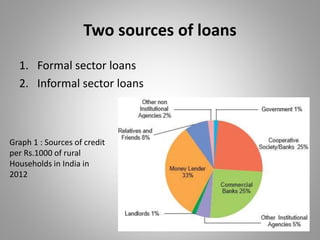
Two sources of loans
1. Formal sector loans
2. Informal sector loans
Graph 1 : Sources of credit
per Rs.1000 of rural
Households in India in
2012
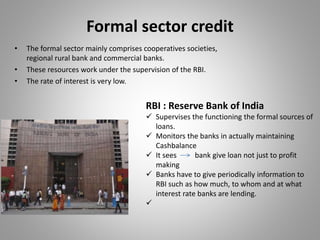
Formal sector credit
• The formal sector mainly comprises cooperatives societies,
regional rural bank and commercial banks.
• These resources work under the supervision of the RBI.
• The rate of interest is very low.
RBI : Reserve Bank of India
 Supervises the functioning the formal sources of
loans.
 Monitors the banks in actually maintaining
Cashbalance
 It sees bank give loan not just to profit
making
 Banks have to give periodically information to
RBI such as how much, to whom and at what
interest rate banks are lending.

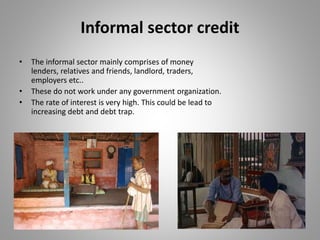
Informal sector credit
• The informal sector mainly comprises of money
lenders, relatives and friends, landlord, traders,
employers etc..
• These do not work under any government organization.
• The rate of interest is very high. This could be lead to
increasing debt and debt trap.
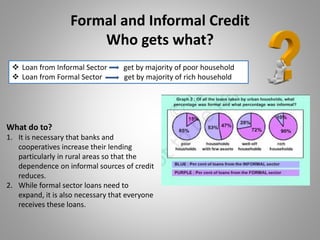
Formal and Informal Credit
Who gets what?
 Loan from Informal Sector get by majority of poor household
 Loan from Formal Sector get by majority of rich household
What do to?
1. It is necessary that banks and
cooperatives increase their lending
particularly in rural areas so that the
dependence on informal sources of credit
reduces.
2. While formal sector loans need to
expand, it is also necessary that everyone
receives these loans.
Self Help Group for the Poor
Poor households dependent on informal sources of credit
REASON:
• Banks are not present everywhere in rural India
• Even if banks are present, getting a loan is much more difficult
as it requires proper documents and collateral.
On the other hand moneylender borrow money easily but
charge high rate of interest, keep no records of
transactions and harass the poor borrower.
To overcome these problems people created Self Help
Groups (SHG)
What is SHG?
Self Help Group:
SHGs are small groups of poor
people which promote small savings
among their members. A typical SHG
has 15-20 members, usually
belonging to one neighbourhood,
who meet and save regularly.
Advantages of SHG:
 It helps borrowers to overcome the problem
of lack of collateral.
 People can get timely loans for a variety of
purposes and at a reasonable interest rate.
 SHGs are the building blocks of organisation
of the rural poor.
 It helps women to become financially self-
reliant.
 The regular meetings of the group provide a
platform to discuss and act on a variety of
social issues such as health, nutrition,
domestic violence, etc.
Class:10 Economics Money and credit