The chapter ’People as Resource’ is an effort to
explain population as an asset for the economy
rather than a liability.
Introduction
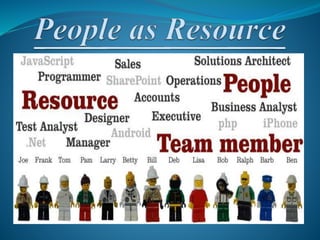
 People as Resource is a way of referring to country’s working
people in terms of their existing productive skills and ability.
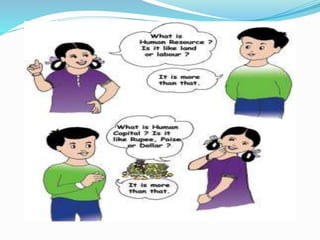
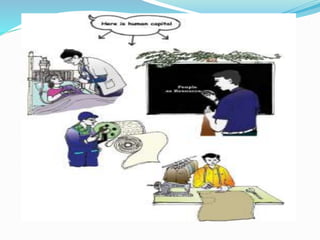
 When the existing human resource is further developed by
becoming more educated and healthy. We call it human capital
formation that adds to the productive power of the country just
like physical capital formation
 This can seen directly in the form of higher incomes earned
because of higher productivity.
Resource:- Any material which can be transformed in a ay that
becomes more valuable an useful is known as resource.
 Human Resources:- A natural resource which is developed by
high education and skills.
 Economic Activities:-All those activities that give income to the
people .
 Disguised unemployment:- It is an situation in which more
people are engaged in particular work than required.
 Liable Person:- The person who is healthy but not educated or
he
is educated but not healthy and giving no profit to himself or the
country is called liable person.
 Asset:- If a person is healthy as well as educated and earning
with profit is called asset person.
VICIOUS CYCLE
 This cycle is a complex chain including parent and
childrens
It is Of Tow types:-
1. Poor Cycle:-In this people do not have enough money
to invest on their children, so children become
uneducated due to which they had to do a low leveling
work with less income.
2. Rich Cycle:-In this rich people know the importance
of education and invest on their children. In this way
rich people are becoming more rich.
S.Madan Kumar M.A.,M.A.,B.Ed.,M.Phil.,M.B.A
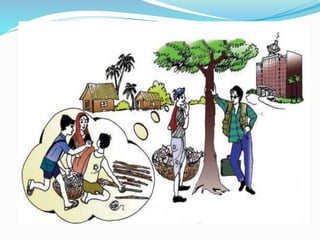
Story of Sakal
There were two friends Vilas and Sakal living in the same village Semapur.
Sakal was a twelve-yearold boy. His mother Sheela looked after domestic
chores. His father Buta Chaudhary worked in an agricultural field. Sakal
helped his mother in domestic chores. He also looked after his younger
brother Jeetu and sister Seetu. His uncle Shyam had passed the matriculation
examination, but, was sitting idle in the house as he had no job. Buta and
Sheela were eager to teach Sakal. They forced him to join the village school
which he soon joined. He started studying and completed his higher
secondary examination. His father persuaded him to continue his studies. He
raised a loan for Sakal to study a vocational course in computers. Sakal was
meritorious and interested in studies from the beginning. With great vigour
and enthusiasm he completed his course. After some time he got a job in a
private firm. He even designed a new kind of software. This software helped
him increase the sale of the firm. His boss acknowledged his services and
rewarded him with a promotion.
Story of Vilas
Vilas was an eleven-year old boy residing in the same village as
Sakal. Vilas’s father Mahesh was a fisherman. His father passed
away when he was only two years old. His mother Geeta sold fish to
earn money to feed the family. She bought fish from the
landowner’s pond and sold it in the nearby mandi. She could earn
only Rs 20 to 30 a day by selling fish. Vilas became a patient of
arthritis. His mother could not afford to take him to the doctor. He
could not go to school either. He was not interested in studies. He
helped his mother in cooking and also looked after his younger
brother Mohan. After some time his mother fell sick and there was
no one to look after her. There was no one in the family to support
them. Vilas, too, was forced to sell fish in the same village. He like
his mother earned only a meager income.
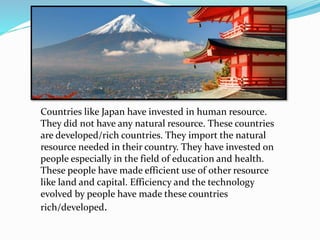
Countries like Japan have invested in human resource.
They did not have any natural resource. These countries
are developed/rich countries. They import the natural
resource needed in their country. They have invested on
people especially in the field of education and health.
These people have made efficient use of other resource
like land and capital. Efficiency and the technology
evolved by people have made these countries
rich/developed.
People has been engaged in various
activities. The various activities have
been classified into three main Sectors
i.e.
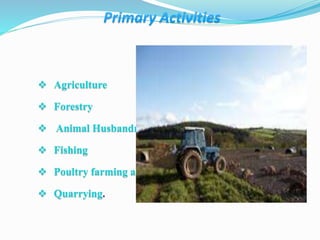
1. Primary
2. Secondary
3. Tertiary
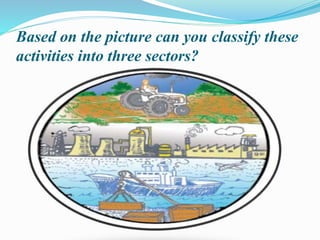
Based on the picture can you classify these
activities into three sectors?
 Agriculture
 Forestry
 Animal Husbandry
 Fishing
 Poultry farming and
 Quarrying.
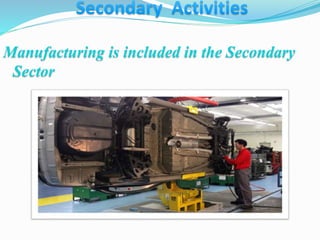
Manufacturing is included in the Secondary
Sector
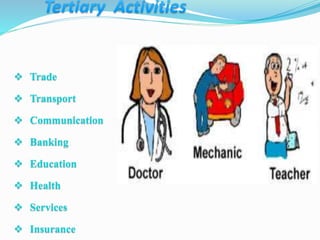
 Trade
 Transport
 Communication
 Banking
 Education
 Health
 Services
 Insurance
The quality of population
Depends upon the literacy rate, health of a person
indicated by life expectancy and skill formation
acquired by the people of the country. The quality
of the population ultimately decides the growth
rate of the country. Illiterate and unhealthy
population are a liability for the economy.
Literate and healthy population are an asset.
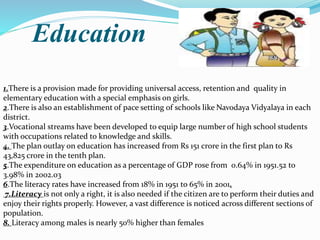
Education
1.There is a provision made for providing universal access, retention and quality in
elementary education with a special emphasis on girls.
2.There is also an establishment of pace setting of schools like Navodaya Vidyalaya in each
district.
3.Vocational streams have been developed to equip large number of high school students
with occupations related to knowledge and skills.
4. The plan outlay on education has increased from Rs 151 crore in the first plan to Rs
43,825 crore in the tenth plan.
5.The expenditure on education as a percentage of GDP rose from 0.64% in 1951.52 to
3.98% in 2002.03
6.The literacy rates have increased from 18% in 1951 to 65% in 2001.
7.Literacy is not only a right, it is also needed if the citizen are to perform their duties and
enjoy their rights properly. However, a vast difference is noticed across different sections of
population.
8. Literacy among males is nearly 50% higher than females
Literacy rates vary from
96% in some district of Kerala to a below 30% in
some parts of Madhya Pradesh.
 The primary school system has expanded to
over 5,00,000 villages in India. Expansion of
schools has been diluted by Sarva Siksha
Abhiyan ,as it is a significant step towards
providing elementary education to all children
in the age group of six to fourteen years by
2014.....
 It is a time-bound initiative of the central
government, in partnership with the states, the
local government and the community for
achieving the goal of universalisation of
elementary education.. .
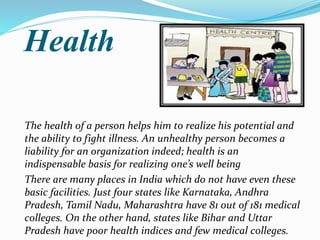
Health
The health of a person helps him to realize his potential and
the ability to fight illness. An unhealthy person becomes a
liability for an organization indeed; health is an
indispensable basis for realizing one’s well being
There are many places in India which do not have even these
basic facilities. Just four states like Karnataka, Andhra
Pradesh, Tamil Nadu, Maharashtra have 81 out of 181 medical
colleges. On the other hand, states like Bihar and Uttar
Pradesh have poor health indices and few medical colleges.
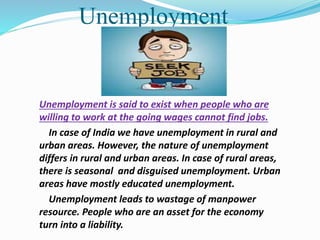
Unemployment
Unemployment is said to exist when people who are
willing to work at the going wages cannot find jobs.
In case of India we have unemployment in rural and
urban areas. However, the nature of unemployment
differs in rural and urban areas. In case of rural areas,
there is seasonal and disguised unemployment. Urban
areas have mostly educated unemployment.
Unemployment leads to wastage of manpower
resource. People who are an asset for the economy
turn into a liability.
People as resource