DEVELOPMENT
Economics
SST
MADE BY :- DEWANG
CLASS :- Xth B
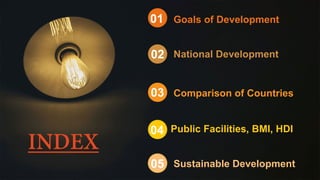
INDEX
01
02
03
04
Goals of Development
National Development
Comparison of Countries
Public Facilities, BMI, HDI
05 Sustainable Development
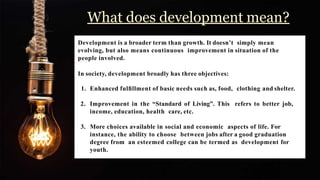
What does development mean?
Development is a broader term than growth. It doesn’t simply mean
evolving, but also means continuous improvement in situation of the
people involved.
In society, development broadly has three objectives:
1. Enhanced fulfillment of basic needs such as, food, clothing and shelter.
2. Improvement in the “Standard of Living”. This refers to better job,
income, education, health care, etc.
3. More choices available in social and economic aspects of life. For
instance, the ability to choose between jobs after a good graduation
degree from an esteemed college can be termed as development for
youth.
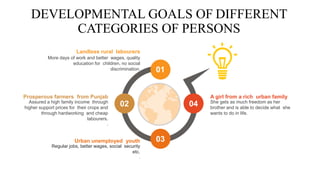
DEVELOPMENTAL GOALS OF DIFFERENT
CATEGORIES OF PERSONS
01
02
03
04
More days of work and better wages, quality
education for children, no social
discrimination.
Landless rural labourers
Assured a high family income through
higher support prices for their crops and
through hardworking and cheap
labourers.
.
Prosperous farmers from Punjab
Regular jobs, better wages, social security
etc.
.
Urban unemployed youth
She gets as much freedom as her
brother and is able to decide what she
wants to do in life.
A girl from a rich urban family
INCOME AND OTHER GOALS
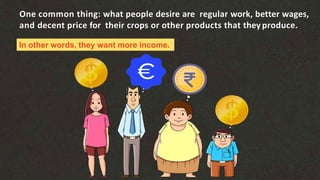
In other words, they want more income.
One common thing: what people desire are regular work, better wages,
and decent price for their crops or other products that theyproduce.
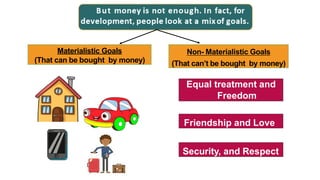
Materialistic Goals
(That can be bought by money)
Non- Materialistic Goals
(That can’t be bought by money)
Equal treatment and
Freedom
Friendship and Love
Security, and Respect
It is very important to keep in mind
that different persons could have
different as well as conflicting notions
of a country’s development.
However, can all the ideas be considered
equally important?
Before any step towards national
Development, we have to think: Would the
idea benefit a everyone or only a small group?
National development refers to the ability of
the country to improvethe social welfare of the
people and improve their living standard.
This can be done through various ways. For
example,
1.Educating the poor
2.Providing facilities
3.Portable water
4. Transportation etc
HOW TO COMPARE DIFFERENT
COUNTRIES OR STATES?
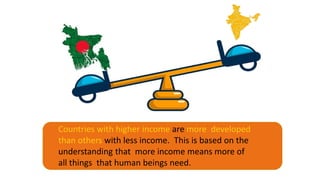
Countries with higher income are more developed
than others with less income. This is based on the
understanding that more income means more of
all things that human beings need.
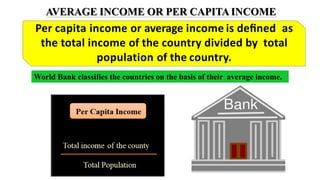
AVERAGE INCOME OR PER CAPITAINCOME
Per capita income or average income is defined as
the total income of the country divided by total
population of the country.
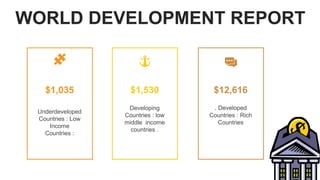
World Bank classifies the countries on the basis of their average income.
$1,035
Underdeveloped
Countries : Low
Income
Countries :
$12,616
. Developed
Countries : Rich
Countries
$1,530
Developing
Countries : low
middle income
countries .
WORLD DEVELOPMENT REPORT
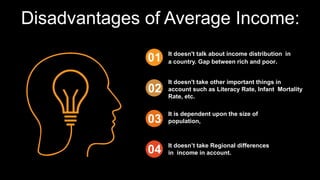
Disadvantages of Average Income:
It doesn't take other important things in
account such as Literacy Rate, Infant Mortality
Rate, etc.
It is dependent upon the size of
population,
It doesn’t take Regional differences
in income in account.
It doesn't talk about income distribution in
a country. Gap between rich and poor.
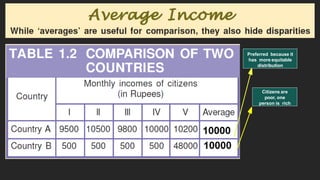
Preferred because it
has more equitable
distribution
Citizens are
poor, one
person is rich
INCOME AND OTHER CRITERIAS
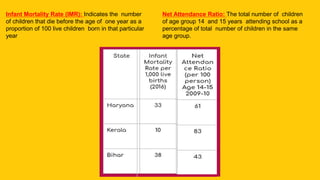
Infant Mortality Rate (IMR): Indicates the number
of children that die before the age of one year as a
proportion of 100 live children born in that particular
year
Net Attendance Ratio: The total number of children
of age group 14 and 15 years attending school as a
percentage of total number of children in the same
age group.
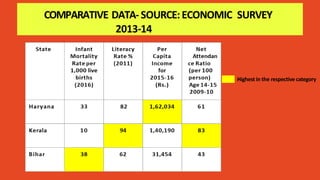
Highest in the respective category
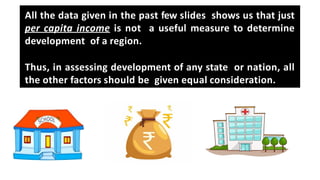
All the data given in the past few slides shows us that just
per capita income is not a useful measure to determine
development of a region.
Thus, in assessing development of any state or nation, all
the other factors should be given equal consideration.
PUBLIC FACILITIES
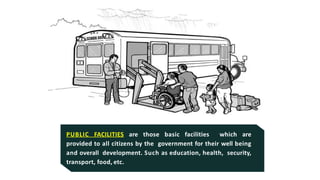
PUBLIC FACILITIES are those basic facilities which are
provided to all citizens by the government for their well being
and overall development. Such as education, health, security,
transport, food, etc.
WHY DO WE NEED PUBLIC FACILITIES?
03
02
01
All citizens are not equal in a nation.
Some are capable to afford basic facilities
but some are not.
Even if a person has income to suffice
his needs,sometimes they too cannot afford
certain facilities.
Without them, the nation can suffer from
inadequate Healthcare, poor nutrition job,
education etc.
Moreover, for many of the important things in life the best way, also the
cheapest way, is to provide these goods and services collectively.
For e.g. It is cheaper to have collective
security for the whole locality or for each
house to have its own security man?
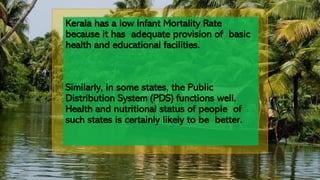
Kerala has a low Infant Mortality Rate
because it has adequate provision of basic
health and educational facilities.
Similarly, in some states, the Public
Distribution System (PDS) functions well.
Health and nutritional status of people of
such states is certainly likely to be better.
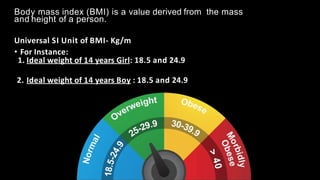
Body Mass Index
Body mass index (BMI) is a value derived from the mass
and height of a person.
Universal SI Unit of BMI- Kg/m
• For Instance:
1. Ideal weight of 14 years Girl: 18.5 and 24.9
2. Ideal weight of 14 years Boy : 18.5 and 24.9
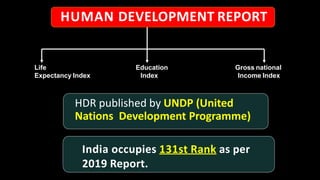
India occupies 131st Rank as per
2019 Report.
Life
Expectancy Index
Education
Index
Gross national
Income Index
HDR published by UNDP (United
Nations Development Programme)
HUMAN DEVELOPMENT REPORT
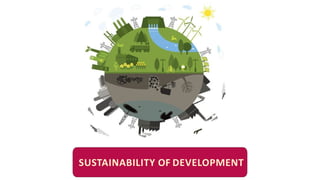
SUSTAINABILITY OF DEVELOPMENT
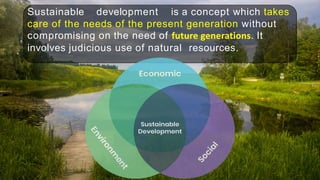
Sustainable development is a concept which takes
care of the needs of the present generation without
compromising on the need of future generations. It
involves judicious use of natural resources.
03
02
01
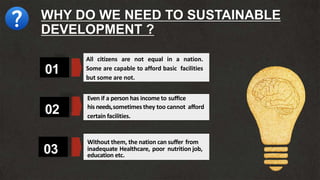
All citizens are not equal in a nation.
Some are capable to afford basic facilities
but some are not.
Even if a person has income to suffice
his needs,sometimes they too cannot afford
certain facilities.
Without them, the nation can suffer from
inadequate Healthcare, poor nutrition job,
education etc.
WHY DO WE NEED TO SUSTAINABLE
DEVELOPMENT ?
Groundwater is a renewable resource
But its overuse is particularly found in the
agriculturally prosperous regions of Punjab and
Western U.P., hard rock plateau areas of central and
south India, some coastal areas and the rapidly
growing urban settlements.
Till now there has been a decline of 61% of ground
water in India.
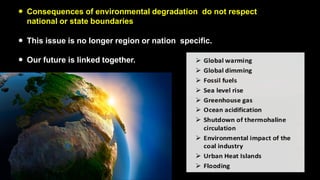
● Consequences of environmental degradation do not respect
national or state boundaries
● This issue is no longer region or nation specific.
● Our future is linked together.
If industrialists want more dams then why do local
people resist it?
A. Local people will be displaced
B. Local people lands will be submerged
C. Local people will have no source of
earning
D. All of the above
If industrialists want more dams then why do local
people resist it?
A. Local people will be displaced
B. Local people lands will be submerged
C. Local people will have no source of
earning
D. All of the above
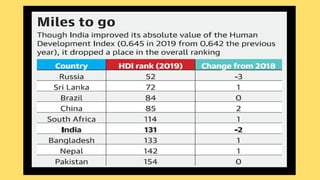
Which of the following neighbouring country of
India has higher HDI rank than India?
A. Sri Lanka
B. Nepal
C. Pakistan
D. None of the above
Which of the following neighbouring country of
India has higher HDI rank than India?
A. Sri Lanka
B. Nepal
C. Pakistan
D. None of the above
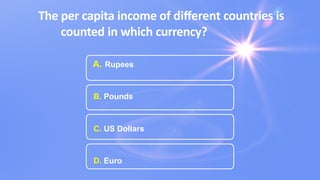
The per capita income of different countries is
counted in which currency?
A. Rupees
B. Pounds
C. US Dollars
D. Euro
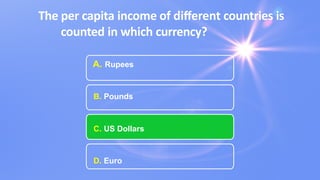
The per capita income of different countries is
counted in which currency?
A. Rupees
B. Pounds
C. US Dollars
D. Euro
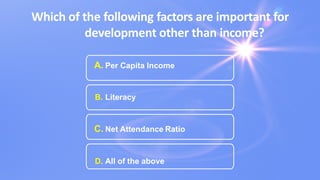
Which of the following factors are important for
development other than income?
A. Per Capita Income
B. Literacy
C. Net Attendance Ratio
D. All of the above
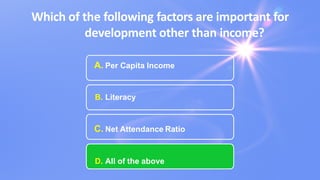
Which of the following factors are important for
development other than income?
A. Per Capita Income
B. Literacy
C. Net Attendance Ratio
D. All of the above
The total number of children attending school as
a percentage of total number of children in the
same age group is called?
A. Net attendance ratio
B. Literacy rate
C. Gross Enrolment ratio
D. Level of education
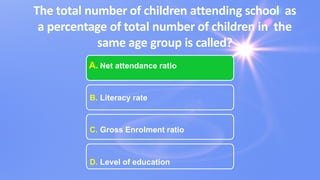
The total number of children attending school as
a percentage of total number of children in the
same age group is called?
A. Net attendance ratio
B. Literacy rate
C. Gross Enrolment ratio
D. Level of education
Assertion: Non-renewable resources are abundant in nature
Reason: Non-renewable resources can be replenished over a
period of time.
A. Both A & R are true and R is correct
explanation of A
B. Both A & R are true, but R is not
the correct explanation of A
C. A is true, but R is false
D. Both A & R are false
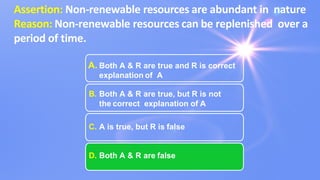
Assertion: Non-renewable resources are abundant in nature
Reason: Non-renewable resources can be replenished over a
period of time.
A. Both A & R are true and R is correct
explanation of A
B. Both A & R are true, but R is not
the correct explanation of A
C. A is true, but R is false
D. Both A & R are false
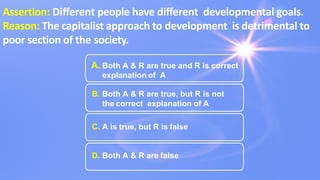
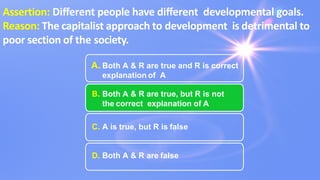
Assertion: Different people have different developmental goals.
Reason: The capitalist approach to development is detrimental to
poor section of the society.
A. Both A & R are true and R is correct
explanation of A
B. Both A & R are true, but R is not
the correct explanation of A
C. A is true, but R is false
D. Both A & R are false
A. Both A & R are true and R is correct
explanation of A
B. Both A & R are true, but R is not
the correct explanation of A
C. A is true, but R is false
D. Both A & R are false
Assertion: Different people have different developmental goals.
Reason: The capitalist approach to development is detrimental to
poor section of the society.
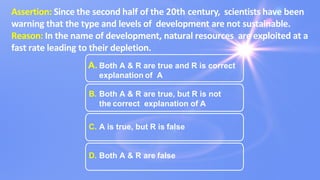
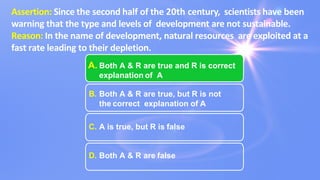
Assertion: Since the second half of the 20th century, scientists have been
warning that the type and levels of development are not sustainable.
Reason: In the name of development, natural resources are exploited at a
fast rate leading to their depletion.
A. Both A & R are true and R is correct
explanation of A
B. Both A & R are true, but R is not
the correct explanation of A
C. A is true, but R is false
D. Both A & R are false
Assertion: Since the second half of the 20th century, scientists have been
warning that the type and levels of development are not sustainable.
Reason: In the name of development, natural resources are exploited at a
fast rate leading to their depletion.
A. Both A & R are true and R is correct
explanation of A
B. Both A & R are true, but R is not
the correct explanation of A
C. A is true, but R is false
D. Both A & R are false
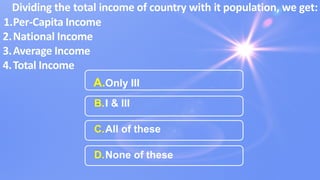
Dividing the total income of country with it population, we get:
1.Per-Capita Income
2.National Income
3.Average Income
4.Total Income
A.Only III
B.I & III
C.All of these
D.None of these
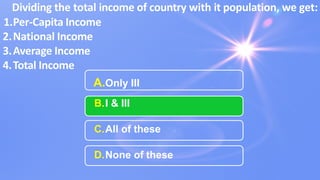
A.Only III
B.I & III
C.All of these
D.None of these
Dividing the total income of country with it population, we get:
1.Per-Capita Income
2.National Income
3.Average Income
4.Total Income
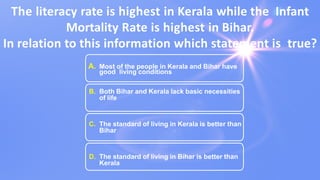
The literacy rate is highest in Kerala while the Infant
Mortality Rate is highest in Bihar.
In relation to this information which statement is true?
A. Most of the people in Kerala and Bihar have
good living conditions
B. Both Bihar and Kerala lack basic necessities
of life
C. The standard of living in Kerala is better than
Bihar
D. The standard of living in Bihar is better than
Kerala
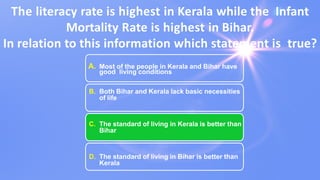
The literacy rate is highest in Kerala while the Infant
Mortality Rate is highest in Bihar.
In relation to this information which statement is true?
A. Most of the people in Kerala and Bihar have
good living conditions
B. Both Bihar and Kerala lack basic necessities
of life
C. The standard of living in Kerala is better than
Bihar
D. The standard of living in Bihar is better than
Kerala
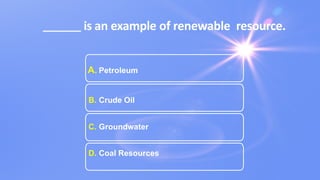
is an example of renewable resource.
A. Petroleum
B. Crude Oil
C. Groundwater
D. Coal Resources
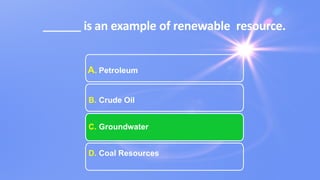
is an example of renewable resource.
A. Petroleum
B. Crude Oil
C. Groundwater
D. Coal Resources
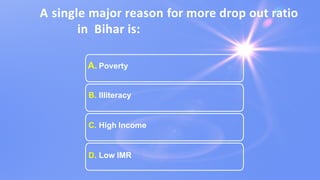
A single major reason for more drop out ratio
in Bihar is:
A. Poverty
B. Illiteracy
C. High Income
D. Low IMR
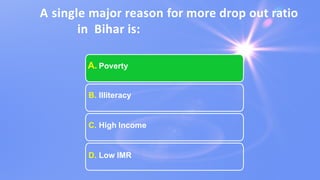
A single major reason for more drop out ratio
in Bihar is:
A. Poverty
B. Illiteracy
C. High Income
D. Low IMR
What is the full form of PDS?
A. Public Development System
B. Public Distribution System
C. Public Division System
D. Public Discussion System
What is the full form of PDS?
A. Public Development System
B. Public Distribution System
C. Public Division System
D. Public Discussion System
Which of the following statement defines
Sustainable Development?
A. Sustainable use of natural resources without
considering the need of the future generation
B. Present generation fulfils its needs while
considering the needs of the future generation
as well
C. Utilization of natural resources by the past,
present and forthcoming future generation
D. To meet the needs of the future generations
even if the needs of the present generation go
unmet
Which of the following statement defines
Sustainable Development?
A. Sustainable use of natural resources without
considering the need of the future generation
B. Present generation fulfils its needs while
considering the needs of the future generation
as well
C. Utilization of natural resources by the past,
present and forthcoming future generation
D. To meet the needs of the future generations
even if the needs of the present generation go
unmet
THANK YOU
For Your Attention

Development Economics Class10

  • 1.
  • 2.
    INDEX 01 02 03 04 Goals of Development NationalDevelopment Comparison of Countries Public Facilities, BMI, HDI 05 Sustainable Development
  • 3.
    What does developmentmean? Development is a broader term than growth. It doesn’t simply mean evolving, but also means continuous improvement in situation of the people involved. In society, development broadly has three objectives: 1. Enhanced fulfillment of basic needs such as, food, clothing and shelter. 2. Improvement in the “Standard of Living”. This refers to better job, income, education, health care, etc. 3. More choices available in social and economic aspects of life. For instance, the ability to choose between jobs after a good graduation degree from an esteemed college can be termed as development for youth.
  • 4.
    DEVELOPMENTAL GOALS OFDIFFERENT CATEGORIES OF PERSONS 01 02 03 04 More days of work and better wages, quality education for children, no social discrimination. Landless rural labourers Assured a high family income through higher support prices for their crops and through hardworking and cheap labourers. . Prosperous farmers from Punjab Regular jobs, better wages, social security etc. . Urban unemployed youth She gets as much freedom as her brother and is able to decide what she wants to do in life. A girl from a rich urban family
  • 5.
  • 6.
    In other words,they want more income. One common thing: what people desire are regular work, better wages, and decent price for their crops or other products that theyproduce.
  • 7.
    Materialistic Goals (That canbe bought by money) Non- Materialistic Goals (That can’t be bought by money) Equal treatment and Freedom Friendship and Love Security, and Respect
  • 9.
    It is veryimportant to keep in mind that different persons could have different as well as conflicting notions of a country’s development. However, can all the ideas be considered equally important? Before any step towards national Development, we have to think: Would the idea benefit a everyone or only a small group?
  • 10.
    National development refersto the ability of the country to improvethe social welfare of the people and improve their living standard. This can be done through various ways. For example, 1.Educating the poor 2.Providing facilities 3.Portable water 4. Transportation etc
  • 11.
    HOW TO COMPAREDIFFERENT COUNTRIES OR STATES?
  • 12.
    Countries with higherincome are more developed than others with less income. This is based on the understanding that more income means more of all things that human beings need.
  • 13.
    AVERAGE INCOME ORPER CAPITAINCOME Per capita income or average income is defined as the total income of the country divided by total population of the country. World Bank classifies the countries on the basis of their average income.
  • 14.
    $1,035 Underdeveloped Countries : Low Income Countries: $12,616 . Developed Countries : Rich Countries $1,530 Developing Countries : low middle income countries . WORLD DEVELOPMENT REPORT
  • 15.
    Disadvantages of AverageIncome: It doesn't take other important things in account such as Literacy Rate, Infant Mortality Rate, etc. It is dependent upon the size of population, It doesn’t take Regional differences in income in account. It doesn't talk about income distribution in a country. Gap between rich and poor.
  • 16.
    Preferred because it hasmore equitable distribution Citizens are poor, one person is rich
  • 17.
  • 18.
    Infant Mortality Rate(IMR): Indicates the number of children that die before the age of one year as a proportion of 100 live children born in that particular year Net Attendance Ratio: The total number of children of age group 14 and 15 years attending school as a percentage of total number of children in the same age group.
  • 19.
    Highest in therespective category
  • 20.
    All the datagiven in the past few slides shows us that just per capita income is not a useful measure to determine development of a region. Thus, in assessing development of any state or nation, all the other factors should be given equal consideration.
  • 21.
  • 22.
    PUBLIC FACILITIES arethose basic facilities which are provided to all citizens by the government for their well being and overall development. Such as education, health, security, transport, food, etc.
  • 23.
    WHY DO WENEED PUBLIC FACILITIES? 03 02 01 All citizens are not equal in a nation. Some are capable to afford basic facilities but some are not. Even if a person has income to suffice his needs,sometimes they too cannot afford certain facilities. Without them, the nation can suffer from inadequate Healthcare, poor nutrition job, education etc.
  • 24.
    Moreover, for manyof the important things in life the best way, also the cheapest way, is to provide these goods and services collectively. For e.g. It is cheaper to have collective security for the whole locality or for each house to have its own security man?
  • 25.
    Kerala has alow Infant Mortality Rate because it has adequate provision of basic health and educational facilities. Similarly, in some states, the Public Distribution System (PDS) functions well. Health and nutritional status of people of such states is certainly likely to be better.
  • 26.
  • 27.
    Body mass index(BMI) is a value derived from the mass and height of a person. Universal SI Unit of BMI- Kg/m • For Instance: 1. Ideal weight of 14 years Girl: 18.5 and 24.9 2. Ideal weight of 14 years Boy : 18.5 and 24.9
  • 28.
    India occupies 131stRank as per 2019 Report. Life Expectancy Index Education Index Gross national Income Index HDR published by UNDP (United Nations Development Programme) HUMAN DEVELOPMENT REPORT
  • 30.
  • 31.
    Sustainable development isa concept which takes care of the needs of the present generation without compromising on the need of future generations. It involves judicious use of natural resources.

  • 32.
    03 02 01 All citizens arenot equal in a nation. Some are capable to afford basic facilities but some are not. Even if a person has income to suffice his needs,sometimes they too cannot afford certain facilities. Without them, the nation can suffer from inadequate Healthcare, poor nutrition job, education etc. WHY DO WE NEED TO SUSTAINABLE DEVELOPMENT ?

  • 33.
    Groundwater is arenewable resource But its overuse is particularly found in the agriculturally prosperous regions of Punjab and Western U.P., hard rock plateau areas of central and south India, some coastal areas and the rapidly growing urban settlements. Till now there has been a decline of 61% of ground water in India.
  • 35.
    ● Consequences ofenvironmental degradation do not respect national or state boundaries ● This issue is no longer region or nation specific. ● Our future is linked together.
  • 37.
    If industrialists wantmore dams then why do local people resist it? A. Local people will be displaced B. Local people lands will be submerged C. Local people will have no source of earning D. All of the above
  • 38.
    If industrialists wantmore dams then why do local people resist it? A. Local people will be displaced B. Local people lands will be submerged C. Local people will have no source of earning D. All of the above
  • 39.
    Which of thefollowing neighbouring country of India has higher HDI rank than India? A. Sri Lanka B. Nepal C. Pakistan D. None of the above
  • 40.
    Which of thefollowing neighbouring country of India has higher HDI rank than India? A. Sri Lanka B. Nepal C. Pakistan D. None of the above
  • 41.
    The per capitaincome of different countries is counted in which currency? A. Rupees B. Pounds C. US Dollars D. Euro
  • 42.
    The per capitaincome of different countries is counted in which currency? A. Rupees B. Pounds C. US Dollars D. Euro
  • 43.
    Which of thefollowing factors are important for development other than income? A. Per Capita Income B. Literacy C. Net Attendance Ratio D. All of the above
  • 44.
    Which of thefollowing factors are important for development other than income? A. Per Capita Income B. Literacy C. Net Attendance Ratio D. All of the above
  • 45.
    The total numberof children attending school as a percentage of total number of children in the same age group is called? A. Net attendance ratio B. Literacy rate C. Gross Enrolment ratio D. Level of education
  • 46.
    The total numberof children attending school as a percentage of total number of children in the same age group is called? A. Net attendance ratio B. Literacy rate C. Gross Enrolment ratio D. Level of education
  • 47.
    Assertion: Non-renewable resourcesare abundant in nature Reason: Non-renewable resources can be replenished over a period of time. A. Both A & R are true and R is correct explanation of A B. Both A & R are true, but R is not the correct explanation of A C. A is true, but R is false D. Both A & R are false
  • 48.
    Assertion: Non-renewable resourcesare abundant in nature Reason: Non-renewable resources can be replenished over a period of time. A. Both A & R are true and R is correct explanation of A B. Both A & R are true, but R is not the correct explanation of A C. A is true, but R is false D. Both A & R are false
  • 49.
    Assertion: Different peoplehave different developmental goals. Reason: The capitalist approach to development is detrimental to poor section of the society. A. Both A & R are true and R is correct explanation of A B. Both A & R are true, but R is not the correct explanation of A C. A is true, but R is false D. Both A & R are false
  • 50.
    A. Both A& R are true and R is correct explanation of A B. Both A & R are true, but R is not the correct explanation of A C. A is true, but R is false D. Both A & R are false Assertion: Different people have different developmental goals. Reason: The capitalist approach to development is detrimental to poor section of the society.
  • 51.
    Assertion: Since thesecond half of the 20th century, scientists have been warning that the type and levels of development are not sustainable. Reason: In the name of development, natural resources are exploited at a fast rate leading to their depletion. A. Both A & R are true and R is correct explanation of A B. Both A & R are true, but R is not the correct explanation of A C. A is true, but R is false D. Both A & R are false
  • 52.
    Assertion: Since thesecond half of the 20th century, scientists have been warning that the type and levels of development are not sustainable. Reason: In the name of development, natural resources are exploited at a fast rate leading to their depletion. A. Both A & R are true and R is correct explanation of A B. Both A & R are true, but R is not the correct explanation of A C. A is true, but R is false D. Both A & R are false
  • 53.
    Dividing the totalincome of country with it population, we get: 1.Per-Capita Income 2.National Income 3.Average Income 4.Total Income A.Only III B.I & III C.All of these D.None of these
  • 54.
    A.Only III B.I &III C.All of these D.None of these Dividing the total income of country with it population, we get: 1.Per-Capita Income 2.National Income 3.Average Income 4.Total Income
  • 55.
    The literacy rateis highest in Kerala while the Infant Mortality Rate is highest in Bihar. In relation to this information which statement is true? A. Most of the people in Kerala and Bihar have good living conditions B. Both Bihar and Kerala lack basic necessities of life C. The standard of living in Kerala is better than Bihar D. The standard of living in Bihar is better than Kerala
  • 56.
    The literacy rateis highest in Kerala while the Infant Mortality Rate is highest in Bihar. In relation to this information which statement is true? A. Most of the people in Kerala and Bihar have good living conditions B. Both Bihar and Kerala lack basic necessities of life C. The standard of living in Kerala is better than Bihar D. The standard of living in Bihar is better than Kerala
  • 57.
    is an exampleof renewable resource. A. Petroleum B. Crude Oil C. Groundwater D. Coal Resources
  • 58.
    is an exampleof renewable resource. A. Petroleum B. Crude Oil C. Groundwater D. Coal Resources
  • 59.
    A single majorreason for more drop out ratio in Bihar is: A. Poverty B. Illiteracy C. High Income D. Low IMR
  • 60.
    A single majorreason for more drop out ratio in Bihar is: A. Poverty B. Illiteracy C. High Income D. Low IMR
  • 61.
    What is thefull form of PDS? A. Public Development System B. Public Distribution System C. Public Division System D. Public Discussion System
  • 62.
    What is thefull form of PDS? A. Public Development System B. Public Distribution System C. Public Division System D. Public Discussion System
  • 63.
    Which of thefollowing statement defines Sustainable Development? A. Sustainable use of natural resources without considering the need of the future generation B. Present generation fulfils its needs while considering the needs of the future generation as well C. Utilization of natural resources by the past, present and forthcoming future generation D. To meet the needs of the future generations even if the needs of the present generation go unmet
  • 64.
    Which of thefollowing statement defines Sustainable Development? A. Sustainable use of natural resources without considering the need of the future generation B. Present generation fulfils its needs while considering the needs of the future generation as well C. Utilization of natural resources by the past, present and forthcoming future generation D. To meet the needs of the future generations even if the needs of the present generation go unmet
  • 65.