CHAPTER 1
DEVELOPMENT
LEARNING
OBJECTIVES
• Explain the traditional notion of development,
national income and per capita income
• Discuss about the income and other goals
• Analyze the national development in a vision of
income and other criteria
• Analyzing the public facilities, human
development report
• Evaluate the need for health and educational
development, human development indicators
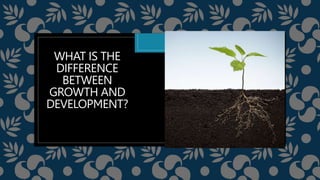
WHAT IS THE
DIFFERENCE
BETWEEN
GROWTH AND
DEVELOPMENT?
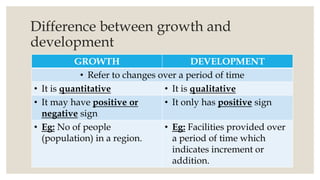
Difference between growth and
development
GROWTH DEVELOPMENT
• Refer to changes over a period of time
• It is quantitative • It is qualitative
• It may have positive or
negative sign
• It only has positive sign
• Eg: No of people
(population) in a region.
• Eg: Facilities provided over
a period of time which
indicates increment or
addition.
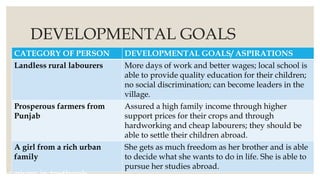
DEVELOPMENTAL GOALS
CATEGORY OF PERSON DEVELOPMENTAL GOALS/ ASPIRATIONS
Landless rural labourers More days of work and better wages; local school is
able to provide quality education for their children;
no social discrimination; can become leaders in the
village.
Prosperous farmers from
Punjab
Assured a high family income through higher
support prices for their crops and through
hardworking and cheap labourers; they should be
able to settle their children abroad.
A girl from a rich urban
family
She gets as much freedom as her brother and is able
to decide what she wants to do in life. She is able to
pursue her studies abroad.
As given in textbook
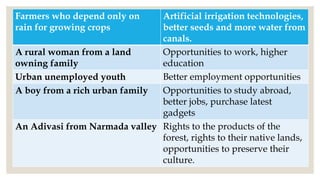
Farmers who depend only on
rain for growing crops
Artificial irrigation technologies,
better seeds and more water from
canals.
A rural woman from a land
owning family
Opportunities to work, higher
education
Urban unemployed youth Better employment opportunities
A boy from a rich urban family Opportunities to study abroad,
better jobs, purchase latest
gadgets
An Adivasi from Narmada valley Rights to the products of the
forest, rights to their native lands,
opportunities to preserve their
culture.
DO YOU THINK THAT ALL
THE PEOPLE HAVE SAME
NOTION OF DEVELOPMENT?
Your views…
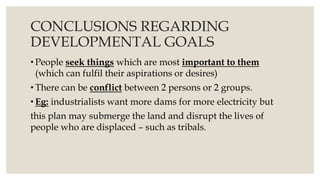
CONCLUSIONS REGARDING
DEVELOPMENTAL GOALS
• People seek things which are most important to them
(which can fulfil their aspirations or desires)
• There can be conflict between 2 persons or 2 groups.
• Eg: industrialists want more dams for more electricity but
this plan may submerge the land and disrupt the lives of
people who are displaced – such as tribals.
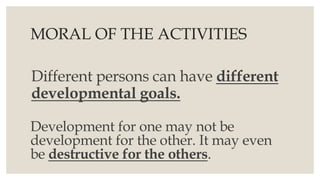
MORAL OF THE ACTIVITIES
Development for one may not be
development for the other. It may even
be destructive for the others.
Different persons can have different
developmental goals.
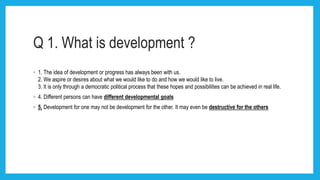
Q 1. What is development ?
◦ 1. The idea of development or progress has always been with us.
2. We aspire or desires about what we would like to do and how we would like to live.
3. It is only through a democratic political process that these hopes and possibilities can be achieved in real life.
◦ 4. Different persons can have different developmental goals
◦ 5. Development for one may not be development for the other. It may even be destructive for the others
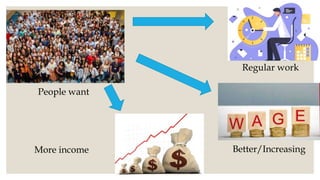
INCOME AND
OTHER GOALS
People want
Regular work
More income Better/Increasing
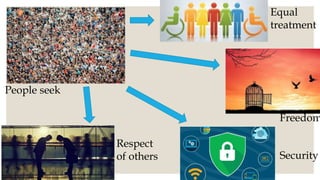
Equal
treatment
Freedom
Security
Respect
of others
People seek
INCOME AND OTHER
GOALS
◦ Material things can be bought by money.
◦ Quality of life depends on non-material things discussed before.
◦ There are many things which cannot be measured but they mean a
lot to our lives.
INCOME AND
OTHER
GOALS
◦ For development, people look at a mix of goals.
◦ If women are engaged in paid work, their dignity
in household and society increases.
◦ If there is respect for women, there would be
more sharing of housework and a greater
acceptance of women working outside.
◦ A safe and secure environment may allow more
women to take up a variety of jobs or run a
business.
After seeing these
pictures, what comes
to your mind?
Are these parameters
necessary for the
development of a
country? Your views.
NATIONAL
DEVELOPMENT
?
Q2.What is meant by national
development?
NATIONAL
DEVELOPMENT
◦ It is very important to keep in mind that different
persons could have different as well as
conflicting notions of a country’s development.
◦ National development means thinking from
different aspects which lead to the overall
development.
ON WHAT BASIS CAN
WE COMPARE THE
STUDENTS IN THE
CLASS?
Can I use the same criteria for selecting a sports team or debate team or
singing team?
COMPARING COUNTRIES
Usually we take one or
more important
characteristics of
and compare them
based on these
characteristics.
For countries, comparing
their incomes is
considered to be one of
the most important
attributes.
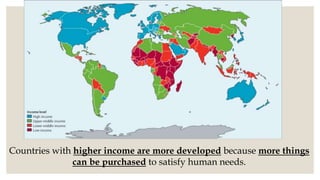
Countries with higher income are more developed because more things
can be purchased to satisfy human needs.
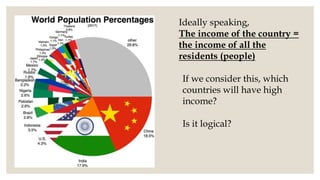
Ideally speaking,
The income of the country =
the income of all the
residents (people)
If we consider this, which
countries will have high
income?
Is it logical?
PER CAPITA INCOME
◦Total income is not such an useful measure.
◦Comparing total income will not tell us what
an average person is likely to earn.
◦Average income = total income of the country
◦ total population
◦Average income is known as ‘PER CAPITA
INCOME’
Q3.In the world
development
reports, brought out
by the world bank
how countries are
classified?
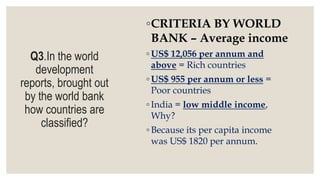
◦CRITERIA BY WORLD
BANK – Average income
◦ US$ 12,056 per annum and
above = Rich countries
◦ US$ 955 per annum or less =
Poor countries
◦ India = low middle income,
Why?
◦ Because its per capita income
was US$ 1820 per annum.
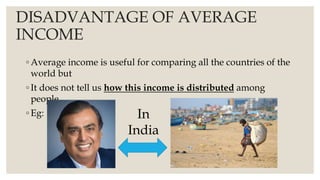
DISADVANTAGE OF AVERAGE
INCOME
◦ Average income is useful for comparing all the countries of the
world but
◦ It does not tell us how this income is distributed among
people
◦ Eg: In
India
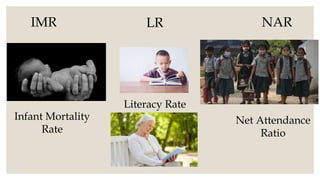
SOME KEY TERMS
Identify the terms from the pictures.
IMR LR NAR
Infant Mortality
Rate
Literacy Rate
Net Attendance
Ratio
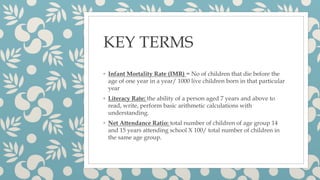
KEY TERMS
◦ Infant Mortality Rate (IMR) = No of children that die before the
age of one year in a year/ 1000 live children born in that particular
year
◦ Literacy Rate: the ability of a person aged 7 years and above to
read, write, perform basic arithmetic calculations with
understanding.
◦ Net Attendance Ratio: total number of children of age group 14
and 15 years attending school X 100/ total number of children in
the same age group.
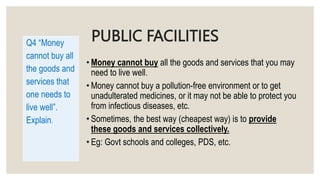
PUBLIC FACILITIES
PUBLIC FACILITIES
• Money cannot buy all the goods and services that you may
need to live well.
• Money cannot buy a pollution-free environment or to get
unadulterated medicines, or it may not be able to protect you
from infectious diseases, etc.
• Sometimes, the best way (cheapest way) is to provide
these goods and services collectively.
• Eg: Govt schools and colleges, PDS, etc.
Q4 “Money
cannot buy all
the goods and
services that
one needs to
live well”.
Explain.
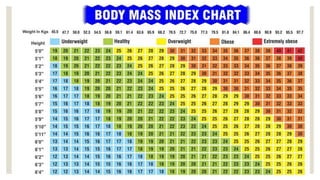
BODY MASS INDEX [BMI]
Important means
to understand
nutrition level of
person.
Calculation
1. take the weight
in kilograms (kg)
2. convert the
height measured
in centimetres
into metres (m)
3. BMI = kg/m2
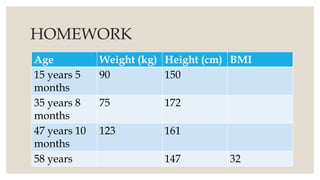
HOMEWORK
Age Weight (kg) Height (cm) BMI
15 years 5
months
90 150
35 years 8
months
75 172
47 years 10
months
123 161
58 years 147 32
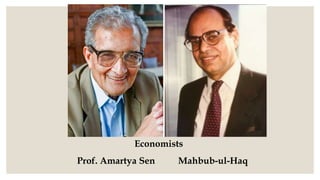
Mahbub-ul-Haq
Economists
Prof. Amartya Sen
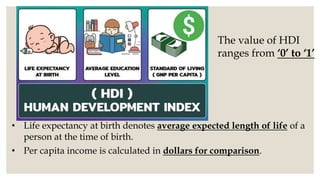
• Life expectancy at birth denotes average expected length of life of a
person at the time of birth.
• Per capita income is calculated in dollars for comparison.
The value of HDI
ranges from ‘0’ to ‘1’
HDI DOES NOT INCLUDE
• Poverty rate
• Housing
• Sex ratio
• Happiness index
• Threat of war
• Levels of pollution
• Access to clean drinking water
HOMEWORK [Mark in Textbook]
4. What is the main criterion used by the World Bank in classifying different
countries? What are the limitations of this criterion, if any?
5. In what respects is the criterion used by the UNDP for measuring
development different from the one used by the World Bank?
6. Why do we use averages? Are there any limitations to their use? Illustrate
with your own examples related to development.
9. Why is the issue of sustainability important for development?
THANK YOU..

Economics_Chapter 1_Development.pptx class 10

  • 1.
  • 2.
    LEARNING OBJECTIVES • Explain thetraditional notion of development, national income and per capita income • Discuss about the income and other goals • Analyze the national development in a vision of income and other criteria • Analyzing the public facilities, human development report • Evaluate the need for health and educational development, human development indicators
  • 3.
  • 4.
    Difference between growthand development GROWTH DEVELOPMENT • Refer to changes over a period of time • It is quantitative • It is qualitative • It may have positive or negative sign • It only has positive sign • Eg: No of people (population) in a region. • Eg: Facilities provided over a period of time which indicates increment or addition.
  • 5.
    DEVELOPMENTAL GOALS CATEGORY OFPERSON DEVELOPMENTAL GOALS/ ASPIRATIONS Landless rural labourers More days of work and better wages; local school is able to provide quality education for their children; no social discrimination; can become leaders in the village. Prosperous farmers from Punjab Assured a high family income through higher support prices for their crops and through hardworking and cheap labourers; they should be able to settle their children abroad. A girl from a rich urban family She gets as much freedom as her brother and is able to decide what she wants to do in life. She is able to pursue her studies abroad. As given in textbook
  • 6.
    Farmers who dependonly on rain for growing crops Artificial irrigation technologies, better seeds and more water from canals. A rural woman from a land owning family Opportunities to work, higher education Urban unemployed youth Better employment opportunities A boy from a rich urban family Opportunities to study abroad, better jobs, purchase latest gadgets An Adivasi from Narmada valley Rights to the products of the forest, rights to their native lands, opportunities to preserve their culture.
  • 7.
    DO YOU THINKTHAT ALL THE PEOPLE HAVE SAME NOTION OF DEVELOPMENT? Your views…
  • 8.
    CONCLUSIONS REGARDING DEVELOPMENTAL GOALS •People seek things which are most important to them (which can fulfil their aspirations or desires) • There can be conflict between 2 persons or 2 groups. • Eg: industrialists want more dams for more electricity but this plan may submerge the land and disrupt the lives of people who are displaced – such as tribals.
  • 9.
    MORAL OF THEACTIVITIES Development for one may not be development for the other. It may even be destructive for the others. Different persons can have different developmental goals.
  • 10.
    Q 1. Whatis development ? ◦ 1. The idea of development or progress has always been with us. 2. We aspire or desires about what we would like to do and how we would like to live. 3. It is only through a democratic political process that these hopes and possibilities can be achieved in real life. ◦ 4. Different persons can have different developmental goals ◦ 5. Development for one may not be development for the other. It may even be destructive for the others
  • 11.
  • 12.
    People want Regular work Moreincome Better/Increasing
  • 13.
  • 14.
    INCOME AND OTHER GOALS ◦Material things can be bought by money. ◦ Quality of life depends on non-material things discussed before. ◦ There are many things which cannot be measured but they mean a lot to our lives.
  • 15.
    INCOME AND OTHER GOALS ◦ Fordevelopment, people look at a mix of goals. ◦ If women are engaged in paid work, their dignity in household and society increases. ◦ If there is respect for women, there would be more sharing of housework and a greater acceptance of women working outside. ◦ A safe and secure environment may allow more women to take up a variety of jobs or run a business.
  • 16.
    After seeing these pictures,what comes to your mind? Are these parameters necessary for the development of a country? Your views. NATIONAL DEVELOPMENT
  • 17.
    ? Q2.What is meantby national development?
  • 18.
    NATIONAL DEVELOPMENT ◦ It isvery important to keep in mind that different persons could have different as well as conflicting notions of a country’s development. ◦ National development means thinking from different aspects which lead to the overall development.
  • 19.
    ON WHAT BASISCAN WE COMPARE THE STUDENTS IN THE CLASS? Can I use the same criteria for selecting a sports team or debate team or singing team?
  • 20.
    COMPARING COUNTRIES Usually wetake one or more important characteristics of and compare them based on these characteristics. For countries, comparing their incomes is considered to be one of the most important attributes.
  • 21.
    Countries with higherincome are more developed because more things can be purchased to satisfy human needs.
  • 22.
    Ideally speaking, The incomeof the country = the income of all the residents (people) If we consider this, which countries will have high income? Is it logical?
  • 23.
    PER CAPITA INCOME ◦Totalincome is not such an useful measure. ◦Comparing total income will not tell us what an average person is likely to earn. ◦Average income = total income of the country ◦ total population ◦Average income is known as ‘PER CAPITA INCOME’
  • 24.
    Q3.In the world development reports,brought out by the world bank how countries are classified? ◦CRITERIA BY WORLD BANK – Average income ◦ US$ 12,056 per annum and above = Rich countries ◦ US$ 955 per annum or less = Poor countries ◦ India = low middle income, Why? ◦ Because its per capita income was US$ 1820 per annum.
  • 25.
    DISADVANTAGE OF AVERAGE INCOME ◦Average income is useful for comparing all the countries of the world but ◦ It does not tell us how this income is distributed among people ◦ Eg: In India
  • 26.
    SOME KEY TERMS Identifythe terms from the pictures.
  • 27.
    IMR LR NAR InfantMortality Rate Literacy Rate Net Attendance Ratio
  • 28.
    KEY TERMS ◦ InfantMortality Rate (IMR) = No of children that die before the age of one year in a year/ 1000 live children born in that particular year ◦ Literacy Rate: the ability of a person aged 7 years and above to read, write, perform basic arithmetic calculations with understanding. ◦ Net Attendance Ratio: total number of children of age group 14 and 15 years attending school X 100/ total number of children in the same age group.
  • 29.
  • 30.
    PUBLIC FACILITIES • Moneycannot buy all the goods and services that you may need to live well. • Money cannot buy a pollution-free environment or to get unadulterated medicines, or it may not be able to protect you from infectious diseases, etc. • Sometimes, the best way (cheapest way) is to provide these goods and services collectively. • Eg: Govt schools and colleges, PDS, etc. Q4 “Money cannot buy all the goods and services that one needs to live well”. Explain.
  • 31.
    BODY MASS INDEX[BMI] Important means to understand nutrition level of person. Calculation 1. take the weight in kilograms (kg) 2. convert the height measured in centimetres into metres (m) 3. BMI = kg/m2
  • 32.
    HOMEWORK Age Weight (kg)Height (cm) BMI 15 years 5 months 90 150 35 years 8 months 75 172 47 years 10 months 123 161 58 years 147 32
  • 34.
  • 35.
    • Life expectancyat birth denotes average expected length of life of a person at the time of birth. • Per capita income is calculated in dollars for comparison. The value of HDI ranges from ‘0’ to ‘1’
  • 36.
    HDI DOES NOTINCLUDE • Poverty rate • Housing • Sex ratio • Happiness index • Threat of war • Levels of pollution • Access to clean drinking water
  • 37.
    HOMEWORK [Mark inTextbook] 4. What is the main criterion used by the World Bank in classifying different countries? What are the limitations of this criterion, if any? 5. In what respects is the criterion used by the UNDP for measuring development different from the one used by the World Bank? 6. Why do we use averages? Are there any limitations to their use? Illustrate with your own examples related to development. 9. Why is the issue of sustainability important for development?
  • 38.