DELIVERY TECHNIQUES
INTRODUCING THE TOPIC AND POWERFUL
CONCLUSIONS
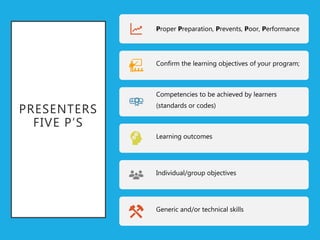
PRESENTERS
FIVE P’S
Proper Preparation, Prevents, Poor, Performance
Confirm the learning objectives of your program;
Competencies to be achieved by learners
(standards or codes)
Learning outcomes
Individual/group objectives
Generic and/or technical skills
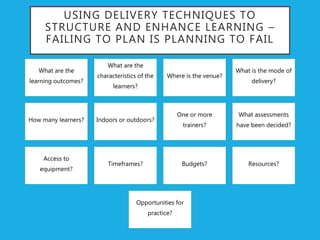
USING DELIVERY TECHNIQUES TO
STRUCTURE AND ENHANCE LEARNING –
FAILING TO PLAN IS PLANNING TO FAIL
What are the
learning outcomes?
What are the
characteristics of the
learners?
Where is the venue?
What is the mode of
delivery?
How many learners? Indoors or outdoors?
One or more
trainers?
What assessments
have been decided?
Access to
equipment?
Timeframes? Budgets? Resources?
Opportunities for
practice?
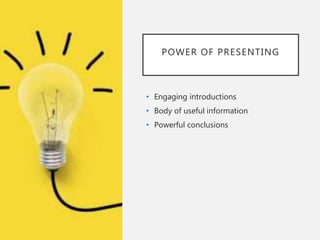
POWER OF PRESENTING
• Engaging introductions
• Body of useful information
• Powerful conclusions
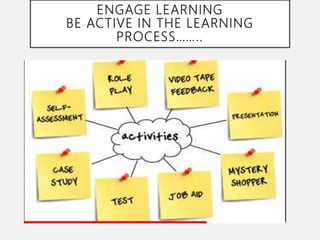
ENGAGE LEARNING
BE ACTIVE IN THE LEARNING
PROCESS……..
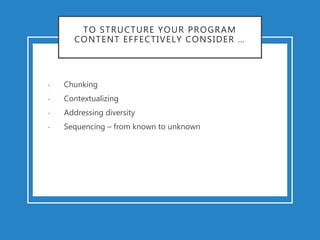
TO STRUCTURE YOUR PROGRAM
CONTENT EFFECTIVELY CONSIDER …
• Chunking
• Contextualizing
• Addressing diversity
• Sequencing – from known to unknown
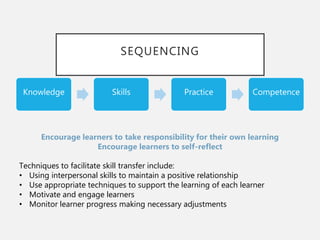
SEQUENCING
Knowledge Skills Practice Competence
Encourage learners to take responsibility for their own learning
Encourage learners to self-reflect
Techniques to facilitate skill transfer include:
• Using interpersonal skills to maintain a positive relationship
• Use appropriate techniques to support the learning of each learner
• Motivate and engage learners
• Monitor learner progress making necessary adjustments
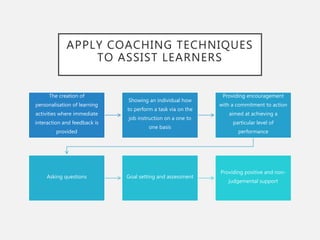
APPLY COACHING TECHNIQUES
TO ASSIST LEARNERS
The creation of
personalisation of learning
activities where immediate
interaction and feedback is
provided
Showing an individual how
to perform a task via on the
job instruction on a one to
one basis
Providing encouragement
with a commitment to action
aimed at achieving a
particular level of
performance
Asking questions Goal setting and assessment
Providing positive and non-
judgemental support
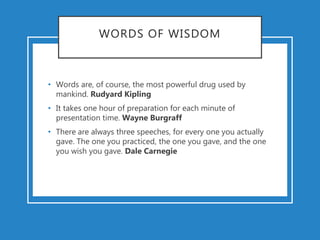
WORDS OF WISDOM
• Words are, of course, the most powerful drug used by
mankind. Rudyard Kipling
• It takes one hour of preparation for each minute of
presentation time. Wayne Burgraff
• There are always three speeches, for every one you actually
gave. The one you practiced, the one you gave, and the one
you wish you gave. Dale Carnegie

Delivery techniques

  • 1.
    DELIVERY TECHNIQUES INTRODUCING THETOPIC AND POWERFUL CONCLUSIONS
  • 2.
    PRESENTERS FIVE P’S Proper Preparation,Prevents, Poor, Performance Confirm the learning objectives of your program; Competencies to be achieved by learners (standards or codes) Learning outcomes Individual/group objectives Generic and/or technical skills
  • 3.
    USING DELIVERY TECHNIQUESTO STRUCTURE AND ENHANCE LEARNING – FAILING TO PLAN IS PLANNING TO FAIL What are the learning outcomes? What are the characteristics of the learners? Where is the venue? What is the mode of delivery? How many learners? Indoors or outdoors? One or more trainers? What assessments have been decided? Access to equipment? Timeframes? Budgets? Resources? Opportunities for practice?
  • 4.
    POWER OF PRESENTING •Engaging introductions • Body of useful information • Powerful conclusions
  • 5.
    ENGAGE LEARNING BE ACTIVEIN THE LEARNING PROCESS……..
  • 6.
    TO STRUCTURE YOURPROGRAM CONTENT EFFECTIVELY CONSIDER … • Chunking • Contextualizing • Addressing diversity • Sequencing – from known to unknown
  • 7.
    SEQUENCING Knowledge Skills PracticeCompetence Encourage learners to take responsibility for their own learning Encourage learners to self-reflect Techniques to facilitate skill transfer include: • Using interpersonal skills to maintain a positive relationship • Use appropriate techniques to support the learning of each learner • Motivate and engage learners • Monitor learner progress making necessary adjustments
  • 8.
    APPLY COACHING TECHNIQUES TOASSIST LEARNERS The creation of personalisation of learning activities where immediate interaction and feedback is provided Showing an individual how to perform a task via on the job instruction on a one to one basis Providing encouragement with a commitment to action aimed at achieving a particular level of performance Asking questions Goal setting and assessment Providing positive and non- judgemental support
  • 9.
    WORDS OF WISDOM •Words are, of course, the most powerful drug used by mankind. Rudyard Kipling • It takes one hour of preparation for each minute of presentation time. Wayne Burgraff • There are always three speeches, for every one you actually gave. The one you practiced, the one you gave, and the one you wish you gave. Dale Carnegie

Editor's Notes

  • #7 At this stage we will focus on how you will structure the content, the materials you use to deliver the content and techniques you can use to engage your learners