Needs
Assessment & Analysis
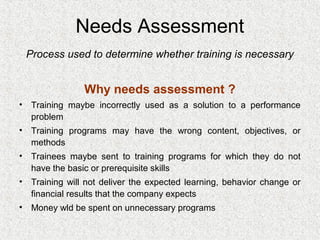
Needs Assessment
 Process used to determine whether training is necessary


               Why needs assessment ?
• Training maybe incorrectly used as a solution to a performance
  problem
• Training programs may have the wrong content, objectives, or
  methods
• Trainees maybe sent to training programs for which they do not
  have the basic or prerequisite skills
• Training will not deliver the expected learning, behavior change or
  financial results that the company expects
• Money wld be spent on unnecessary programs
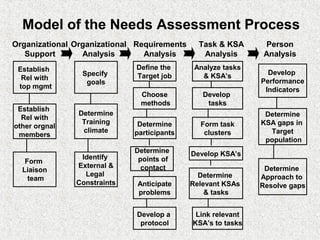
Model of the Needs Assessment Process
Organizational Organizational Requirements     Task & KSA      Person
   Support       Analysis       Analysis        Analysis       Analysis
 Establish                   Define the       Analyze tasks
                Specify      Target job         & KSA’s         Develop
  Rel with                                                    Performance
                 goals
 top mgmt                                                      Indicators
                               Choose           Develop
                               methods           tasks
 Establish
                Determine                                      Determine
  Rel with
                 Training     Determine        Form task      KSA gaps in
other orgnal
                 climate     participants       clusters        Target
 members
                                                               population
                             Determine       Develop KSA’s
                Identify      points of
   Form
               External &      contact                         Determine
  Liaison
                 Legal                         Determine      Approach to
    team
               Constraints    Anticipate     Relevant KSAs    Resolve gaps
                              problems           & tasks


                              Develop a       Link relevant
                               protocol      KSA’s to tasks
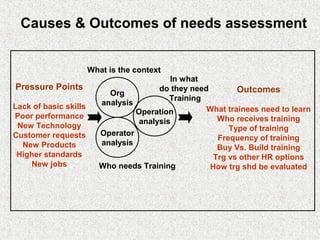
Causes & Outcomes of needs assessment


                       What is the context
                                            In what
Pressure Points                          do they need        Outcomes
                            Org
                                            Training
Lack of basic skills      analysis
                                   Operation         What trainees need to learn
Poor performance                                        Who receives training
                                    analysis
 New Technology                                            Type of training
Customer requests         Operator
                                                        Frequency of training
  New Products            analysis
                                                        Buy Vs. Build training
 Higher standards                                      Trg vs other HR options
    New jobs              Who needs Training          How trg shd be evaluated
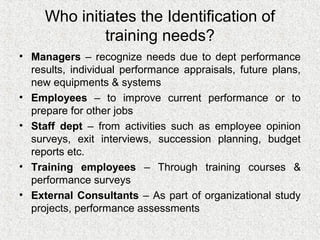
Who initiates the Identification of
              training needs?
• Managers – recognize needs due to dept performance
  results, individual performance appraisals, future plans,
  new equipments & systems
• Employees – to improve current performance or to
  prepare for other jobs
• Staff dept – from activities such as employee opinion
  surveys, exit interviews, succession planning, budget
  reports etc.
• Training employees – Through training courses &
  performance surveys
• External Consultants – As part of organizational study
  projects, performance assessments
Initiating the Identification of Training needs

• A published procedure
  Requisition forms from anyone in the organization
• An Annual survey
  Conducted by training department
• Requirement
  that all appropriate activities like performance reviews,
  purchase of new equipment, employee opinion surveys
  include communication to the training function of any
  possible training needs
Who should participate in Needs Assessment?


• Subject Matter Experts
  – Trainers, Technical experts, Managers, Employees,
    Academics
  – Who are knowledgeable in regard to
     • Training issues including tasks to be performed
     • KSA’s required for successful task performance
     • Necessary equipment
     • Condition under which tasks have to be performed
• Job Incumbents
Key concerns
• Upper Level Managers
   – Is training important to achieve our business objectives?
   – What business units need training?
• Mid Level Managers
   – Do I want to spend money on trg? How much?
   – Who should be trained? Mgrs/Employees
   – For what jobs can training make the biggest difference in
     product quality or customer service?
• Trainers
   – Do I have the budget to buy training services? Will managers
     support training?
   – How will I identify employees need training?
   – What tasks should be trained? What KSA’s or other
     characteristics are important
Training Needs

• A   gap   between    actual    performance     &     desired

  performance    or   between    current   abilities   &   job

  requirements that can be closed by training

• Categories of Training needs

   – Needs of the Organization

   – Needs of the Individual
Training needs of the Organization
• Recognized Training needs
   Planned training needs, required by all
   – Need to know the organization, its structure, policies,
     procedures, benefits
   – Need to know a department, its rules, operating procedures &
     personnel
   – Need to have specific job skills & knowledge not generally
     known by employees

• Requested Training needs
   Unplanned needs resulting from different activities
   – Changes in jobs/systems
   – Addition of new equipment
   – Department Performance reviews
   – New government requirements
   – Employee opinion surveys, organizational studies,      dept
     meetings
   – Exit Interviews conducted with departing employees
Training needs of Individual
             employees

• Initiated through activities such as
  – Performance Reviews
  – Selection Process
  – Testing & Assessment
  – Employee Career Objectives
  – Succession plans
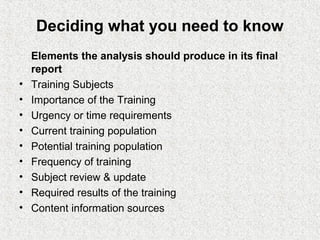
Deciding what you need to know
    Elements the analysis should produce in its final
    report
•   Training Subjects
•   Importance of the Training
•   Urgency or time requirements
•   Current training population
•   Potential training population
•   Frequency of training
•   Subject review & update
•   Required results of the training
•   Content information sources
E
       PL
SA
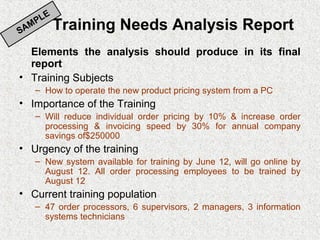
     M        Training Needs Analysis Report
  Elements the analysis should produce in its final
  report
• Training Subjects
      – How to operate the new product pricing system from a PC
• Importance of the Training
      – Will reduce individual order pricing by 10% & increase order
        processing & invoicing speed by 30% for annual company
        savings of$250000
• Urgency of the training
      – New system available for training by June 12, will go online by
        August 12. All order processing employees to be trained by
        August 12
• Current training population
      – 47 order processors, 6 supervisors, 2 managers, 3 information
        systems technicians
E
  M PL     Training Needs Analysis Report
SA
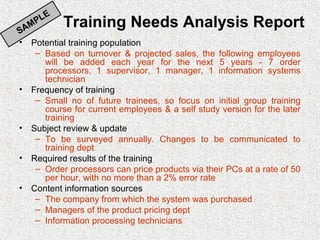
• Potential training population
   – Based on turnover & projected sales, the following employees
     will be added each year for the next 5 years - 7 order
     processors, 1 supervisor, 1 manager, 1 information systems
     technician
• Frequency of training
   – Small no of future trainees, so focus on initial group training
     course for current employees & a self study version for the later
     training
• Subject review & update
   – To be surveyed annually. Changes to be communicated to
     training dept
• Required results of the training
   – Order processors can price products via their PCs at a rate of 50
     per hour, with no more than a 2% error rate
• Content information sources
   – The company from which the system was purchased
   – Managers of the product pricing dept
   – Information processing technicians
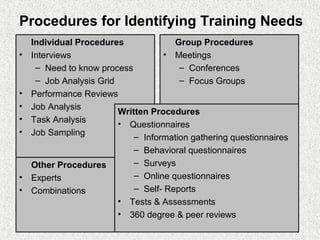
Procedures for Identifying Training Needs
    Individual Procedures              Group Procedures
•   Interviews                      • Meetings
     – Need to know process             – Conferences
     – Job Analysis Grid                – Focus Groups
•   Performance Reviews
•   Job Analysis
                         Written Procedures
•   Task Analysis        • Questionnaires
•   Job Sampling             – Information gathering questionnaires
                             – Behavioral questionnaires
    Other Procedures         – Surveys
•   Experts                  – Online questionnaires
•   Combinations             – Self- Reports
                         • Tests & Assessments
                         • 360 degree & peer reviews
Methods used in
Needs Assessment
Interviews
• Knowing whom to interview
• Planning the Interview
• Designing the Questions
• Scheduling the Interview
• Notifying the Interviewee
• Conducting the Interview
• Conclude the Interview
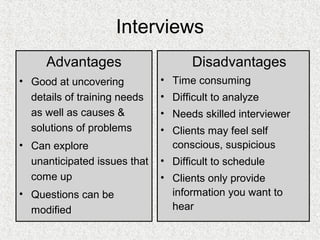
Interviews
     Advantages                      Disadvantages
• Good at uncovering          • Time consuming
  details of training needs   • Difficult to analyze
  as well as causes &         • Needs skilled interviewer
  solutions of problems       • Clients may feel self
• Can explore                   conscious, suspicious
  unanticipated issues that   • Difficult to schedule
  come up                     • Clients only provide
• Questions can be              information you want to
  modified                      hear
Job Analysis Grid Interviews
• Method to eliminate the drawback of information
  contamination in traditional interviews
• Outgrowth of a behavioral inquiry technique called the
  Repertoire Grid – a comprehensive approach for
  identifying specific human behaviors
• Begins with a series of questions that do not appear to
  be related to the objective of the investigation
• A less direct form of interview, requires more time and
  an interviewer trained in the technique
• Suited more to determine basic needs, when the
  investigation is for a possible first time course.
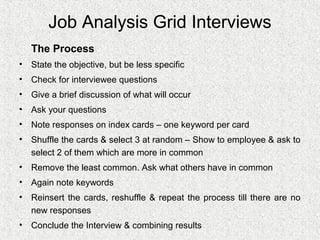
Job Analysis Grid Interviews
   The Process
• State the objective, but be less specific
• Check for interviewee questions
• Give a brief discussion of what will occur
• Ask your questions
• Note responses on index cards – one keyword per card
• Shuffle the cards & select 3 at random – Show to employee & ask to
  select 2 of them which are more in common
• Remove the least common. Ask what others have in common
• Again note keywords
• Reinsert the cards, reshuffle & repeat the process till there are no
  new responses
• Conclude the Interview & combining results
E
     M PL
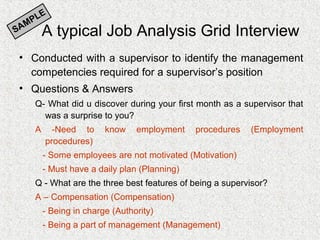
SA         A typical Job Analysis Grid Interview
• Conducted with a supervisor to identify the management
  competencies required for a supervisor’s position
• Questions & Answers
       Q- What did u discover during your first month as a supervisor that
         was a surprise to you?
       A     -Need to      know    employment    procedures   (Employment
           procedures)
           - Some employees are not motivated (Motivation)
           - Must have a daily plan (Planning)
       Q - What are the three best features of being a supervisor?
       A – Compensation (Compensation)
           - Being in charge (Authority)
           - Being a part of management (Management)
E
       PL
SA
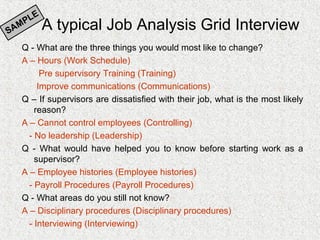
     M       A typical Job Analysis Grid Interview
     Q - What are the three things you would most like to change?
     A – Hours (Work Schedule)
           Pre supervisory Training (Training)
          Improve communications (Communications)
     Q – If supervisors are dissatisfied with their job, what is the most likely
         reason?
     A – Cannot control employees (Controlling)
       - No leadership (Leadership)
     Q - What would have helped you to know before starting work as a
         supervisor?
     A – Employee histories (Employee histories)
       - Payroll Procedures (Payroll Procedures)
     Q - What areas do you still not know?
     A – Disciplinary procedures (Disciplinary procedures)
       - Interviewing (Interviewing)
E
       PL
SA
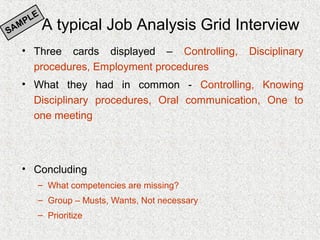
     M       A typical Job Analysis Grid Interview
     • Three cards displayed – Controlling,      Disciplinary
       procedures, Employment procedures
     • What they had in common - Controlling, Knowing
       Disciplinary procedures, Oral communication, One to
       one meeting


     • Concluding
         – What competencies are missing?
         – Group – Musts, Wants, Not necessary
         – Prioritize
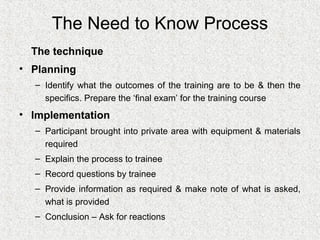
The Need to Know Process
• Based on discovering exactly what a person to be trained
  needs to know in order to meet the objectives of the training
• When to use
   – When number of people to be trained
   – To teach a new subject as well as to make revisions to
     existing training
   – Can be used to design the training course & also conduct it
• The person who conducts it should have full knowledge of the
  ultimate training course content or job for which training is
  provided
• People to be interviewed must be representative of those to be
  trained & have varying levels of performance
The Need to Know Process
  The technique
• Planning
  – Identify what the outcomes of the training are to be & then the
    specifics. Prepare the ‘final exam’ for the training course
• Implementation
  – Participant brought into private area with equipment & materials
    required
  – Explain the process to trainee
  – Record questions by trainee
  – Provide information as required & make note of what is asked,
    what is provided
  – Conclusion – Ask for reactions
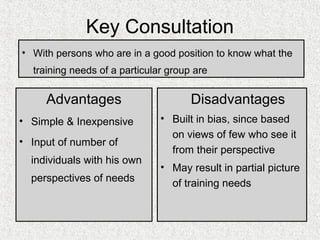
Key Consultation
• With persons who are in a good position to know what the
  training needs of a particular group are

     Advantages                       Disadvantages
• Simple & Inexpensive         • Built in bias, since based
                                 on views of few who see it
• Input of number of
                                 from their perspective
  individuals with his own
                               • May result in partial picture
  perspectives of needs          of training needs
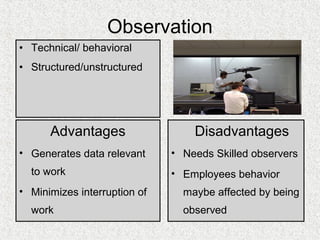
Observation
• Technical/ behavioral
• Structured/unstructured


      Advantages                  Disadvantages
• Generates data relevant     • Needs Skilled observers
  to work                     • Employees behavior
• Minimizes interruption of     maybe affected by being
  work                          observed
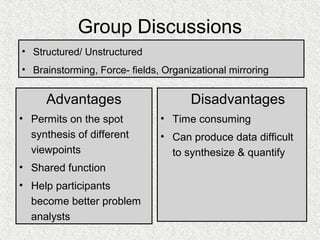
Group Discussions
• Structured/ Unstructured
• Brainstorming, Force- fields, Organizational mirroring


     Advantages                       Disadvantages
• Permits on the spot          • Time consuming
  synthesis of different       • Can produce data difficult
  viewpoints                     to synthesize & quantify
• Shared function
• Help participants
  become better problem
  analysts
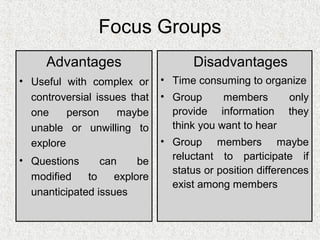
Focus Groups
     Advantages                      Disadvantages
• Useful with complex or      • Time consuming to organize
  controversial issues that   • Group      members       only
  one     person    maybe       provide information      they
  unable or unwilling to        think you want to hear
  explore                     • Group members maybe
• Questions      can     be     reluctant to participate if
                                status or position differences
  modified    to    explore
                                exist among members
  unanticipated issues
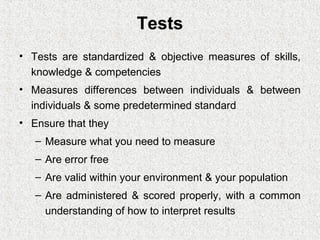
Tests
• Tests are standardized & objective measures of skills,
  knowledge & competencies
• Measures differences between individuals & between
  individuals & some predetermined standard
• Ensure that they
   – Measure what you need to measure
   – Are error free
   – Are valid within your environment & your population
   – Are administered & scored properly, with a common
     understanding of how to interpret results
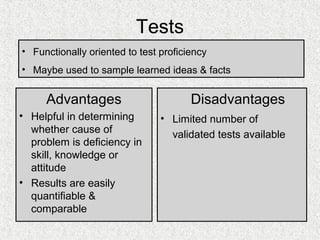
Tests
• Functionally oriented to test proficiency
• Maybe used to sample learned ideas & facts


     Advantages                        Disadvantages
• Helpful in determining        • Limited number of
  whether cause of                validated tests available
  problem is deficiency in
  skill, knowledge or
  attitude
• Results are easily
  quantifiable &
  comparable
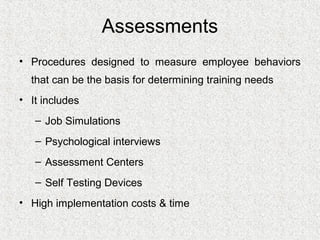
Assessments
• Procedures designed to measure employee behaviors
  that can be the basis for determining training needs
• It includes
   – Job Simulations
   – Psychological interviews
   – Assessment Centers
   – Self Testing Devices
• High implementation costs & time
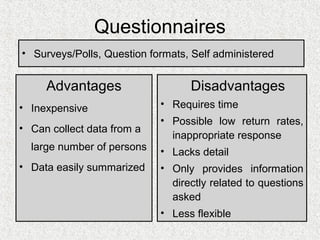
Questionnaires
• Surveys/Polls, Question formats, Self administered


     Advantages                   Disadvantages
• Inexpensive               • Requires time
                            • Possible low return rates,
• Can collect data from a
                              inappropriate response
  large number of persons   • Lacks detail
• Data easily summarized    • Only provides information
                              directly related to questions
                              asked
                            • Less flexible
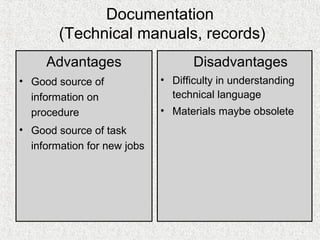
Documentation
        (Technical manuals, records)
     Advantages                     Disadvantages
• Good source of             • Difficulty in understanding
  information on               technical language
  procedure                  • Materials maybe obsolete
• Good source of task
  information for new jobs
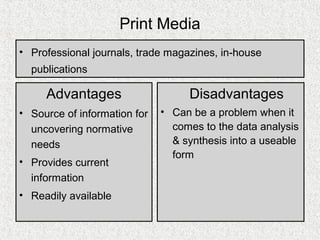
Print Media
• Professional journals, trade magazines, in-house
  publications

     Advantages                    Disadvantages
• Source of information for   • Can be a problem when it
  uncovering normative          comes to the data analysis
  needs                         & synthesis into a useable
                                form
• Provides current
  information
• Readily available

3 -needs_assessment___analysis_187

  • 1.
  • 2.
    Needs Assessment Processused to determine whether training is necessary Why needs assessment ? • Training maybe incorrectly used as a solution to a performance problem • Training programs may have the wrong content, objectives, or methods • Trainees maybe sent to training programs for which they do not have the basic or prerequisite skills • Training will not deliver the expected learning, behavior change or financial results that the company expects • Money wld be spent on unnecessary programs
  • 3.
    Model of theNeeds Assessment Process Organizational Organizational Requirements Task & KSA Person Support Analysis Analysis Analysis Analysis Establish Define the Analyze tasks Specify Target job & KSA’s Develop Rel with Performance goals top mgmt Indicators Choose Develop methods tasks Establish Determine Determine Rel with Training Determine Form task KSA gaps in other orgnal climate participants clusters Target members population Determine Develop KSA’s Identify points of Form External & contact Determine Liaison Legal Determine Approach to team Constraints Anticipate Relevant KSAs Resolve gaps problems & tasks Develop a Link relevant protocol KSA’s to tasks
  • 4.
    Causes & Outcomesof needs assessment What is the context In what Pressure Points do they need Outcomes Org Training Lack of basic skills analysis Operation What trainees need to learn Poor performance Who receives training analysis New Technology Type of training Customer requests Operator Frequency of training New Products analysis Buy Vs. Build training Higher standards Trg vs other HR options New jobs Who needs Training How trg shd be evaluated
  • 5.
    Who initiates theIdentification of training needs? • Managers – recognize needs due to dept performance results, individual performance appraisals, future plans, new equipments & systems • Employees – to improve current performance or to prepare for other jobs • Staff dept – from activities such as employee opinion surveys, exit interviews, succession planning, budget reports etc. • Training employees – Through training courses & performance surveys • External Consultants – As part of organizational study projects, performance assessments
  • 6.
    Initiating the Identificationof Training needs • A published procedure Requisition forms from anyone in the organization • An Annual survey Conducted by training department • Requirement that all appropriate activities like performance reviews, purchase of new equipment, employee opinion surveys include communication to the training function of any possible training needs
  • 7.
    Who should participatein Needs Assessment? • Subject Matter Experts – Trainers, Technical experts, Managers, Employees, Academics – Who are knowledgeable in regard to • Training issues including tasks to be performed • KSA’s required for successful task performance • Necessary equipment • Condition under which tasks have to be performed • Job Incumbents
  • 8.
    Key concerns • UpperLevel Managers – Is training important to achieve our business objectives? – What business units need training? • Mid Level Managers – Do I want to spend money on trg? How much? – Who should be trained? Mgrs/Employees – For what jobs can training make the biggest difference in product quality or customer service? • Trainers – Do I have the budget to buy training services? Will managers support training? – How will I identify employees need training? – What tasks should be trained? What KSA’s or other characteristics are important
  • 9.
    Training Needs • A gap between actual performance & desired performance or between current abilities & job requirements that can be closed by training • Categories of Training needs – Needs of the Organization – Needs of the Individual
  • 10.
    Training needs ofthe Organization • Recognized Training needs Planned training needs, required by all – Need to know the organization, its structure, policies, procedures, benefits – Need to know a department, its rules, operating procedures & personnel – Need to have specific job skills & knowledge not generally known by employees • Requested Training needs Unplanned needs resulting from different activities – Changes in jobs/systems – Addition of new equipment – Department Performance reviews – New government requirements – Employee opinion surveys, organizational studies, dept meetings – Exit Interviews conducted with departing employees
  • 11.
    Training needs ofIndividual employees • Initiated through activities such as – Performance Reviews – Selection Process – Testing & Assessment – Employee Career Objectives – Succession plans
  • 12.
    Deciding what youneed to know Elements the analysis should produce in its final report • Training Subjects • Importance of the Training • Urgency or time requirements • Current training population • Potential training population • Frequency of training • Subject review & update • Required results of the training • Content information sources
  • 13.
    E PL SA M Training Needs Analysis Report Elements the analysis should produce in its final report • Training Subjects – How to operate the new product pricing system from a PC • Importance of the Training – Will reduce individual order pricing by 10% & increase order processing & invoicing speed by 30% for annual company savings of$250000 • Urgency of the training – New system available for training by June 12, will go online by August 12. All order processing employees to be trained by August 12 • Current training population – 47 order processors, 6 supervisors, 2 managers, 3 information systems technicians
  • 14.
    E MPL Training Needs Analysis Report SA • Potential training population – Based on turnover & projected sales, the following employees will be added each year for the next 5 years - 7 order processors, 1 supervisor, 1 manager, 1 information systems technician • Frequency of training – Small no of future trainees, so focus on initial group training course for current employees & a self study version for the later training • Subject review & update – To be surveyed annually. Changes to be communicated to training dept • Required results of the training – Order processors can price products via their PCs at a rate of 50 per hour, with no more than a 2% error rate • Content information sources – The company from which the system was purchased – Managers of the product pricing dept – Information processing technicians
  • 15.
    Procedures for IdentifyingTraining Needs Individual Procedures Group Procedures • Interviews • Meetings – Need to know process – Conferences – Job Analysis Grid – Focus Groups • Performance Reviews • Job Analysis Written Procedures • Task Analysis • Questionnaires • Job Sampling – Information gathering questionnaires – Behavioral questionnaires Other Procedures – Surveys • Experts – Online questionnaires • Combinations – Self- Reports • Tests & Assessments • 360 degree & peer reviews
  • 16.
  • 17.
    Interviews • Knowing whomto interview • Planning the Interview • Designing the Questions • Scheduling the Interview • Notifying the Interviewee • Conducting the Interview • Conclude the Interview
  • 18.
    Interviews Advantages Disadvantages • Good at uncovering • Time consuming details of training needs • Difficult to analyze as well as causes & • Needs skilled interviewer solutions of problems • Clients may feel self • Can explore conscious, suspicious unanticipated issues that • Difficult to schedule come up • Clients only provide • Questions can be information you want to modified hear
  • 19.
    Job Analysis GridInterviews • Method to eliminate the drawback of information contamination in traditional interviews • Outgrowth of a behavioral inquiry technique called the Repertoire Grid – a comprehensive approach for identifying specific human behaviors • Begins with a series of questions that do not appear to be related to the objective of the investigation • A less direct form of interview, requires more time and an interviewer trained in the technique • Suited more to determine basic needs, when the investigation is for a possible first time course.
  • 20.
    Job Analysis GridInterviews The Process • State the objective, but be less specific • Check for interviewee questions • Give a brief discussion of what will occur • Ask your questions • Note responses on index cards – one keyword per card • Shuffle the cards & select 3 at random – Show to employee & ask to select 2 of them which are more in common • Remove the least common. Ask what others have in common • Again note keywords • Reinsert the cards, reshuffle & repeat the process till there are no new responses • Conclude the Interview & combining results
  • 21.
    E M PL SA A typical Job Analysis Grid Interview • Conducted with a supervisor to identify the management competencies required for a supervisor’s position • Questions & Answers Q- What did u discover during your first month as a supervisor that was a surprise to you? A -Need to know employment procedures (Employment procedures) - Some employees are not motivated (Motivation) - Must have a daily plan (Planning) Q - What are the three best features of being a supervisor? A – Compensation (Compensation) - Being in charge (Authority) - Being a part of management (Management)
  • 22.
    E PL SA M A typical Job Analysis Grid Interview Q - What are the three things you would most like to change? A – Hours (Work Schedule) Pre supervisory Training (Training) Improve communications (Communications) Q – If supervisors are dissatisfied with their job, what is the most likely reason? A – Cannot control employees (Controlling) - No leadership (Leadership) Q - What would have helped you to know before starting work as a supervisor? A – Employee histories (Employee histories) - Payroll Procedures (Payroll Procedures) Q - What areas do you still not know? A – Disciplinary procedures (Disciplinary procedures) - Interviewing (Interviewing)
  • 23.
    E PL SA M A typical Job Analysis Grid Interview • Three cards displayed – Controlling, Disciplinary procedures, Employment procedures • What they had in common - Controlling, Knowing Disciplinary procedures, Oral communication, One to one meeting • Concluding – What competencies are missing? – Group – Musts, Wants, Not necessary – Prioritize
  • 24.
    The Need toKnow Process • Based on discovering exactly what a person to be trained needs to know in order to meet the objectives of the training • When to use – When number of people to be trained – To teach a new subject as well as to make revisions to existing training – Can be used to design the training course & also conduct it • The person who conducts it should have full knowledge of the ultimate training course content or job for which training is provided • People to be interviewed must be representative of those to be trained & have varying levels of performance
  • 25.
    The Need toKnow Process The technique • Planning – Identify what the outcomes of the training are to be & then the specifics. Prepare the ‘final exam’ for the training course • Implementation – Participant brought into private area with equipment & materials required – Explain the process to trainee – Record questions by trainee – Provide information as required & make note of what is asked, what is provided – Conclusion – Ask for reactions
  • 26.
    Key Consultation • Withpersons who are in a good position to know what the training needs of a particular group are Advantages Disadvantages • Simple & Inexpensive • Built in bias, since based on views of few who see it • Input of number of from their perspective individuals with his own • May result in partial picture perspectives of needs of training needs
  • 27.
    Observation • Technical/ behavioral •Structured/unstructured Advantages Disadvantages • Generates data relevant • Needs Skilled observers to work • Employees behavior • Minimizes interruption of maybe affected by being work observed
  • 28.
    Group Discussions • Structured/Unstructured • Brainstorming, Force- fields, Organizational mirroring Advantages Disadvantages • Permits on the spot • Time consuming synthesis of different • Can produce data difficult viewpoints to synthesize & quantify • Shared function • Help participants become better problem analysts
  • 29.
    Focus Groups Advantages Disadvantages • Useful with complex or • Time consuming to organize controversial issues that • Group members only one person maybe provide information they unable or unwilling to think you want to hear explore • Group members maybe • Questions can be reluctant to participate if status or position differences modified to explore exist among members unanticipated issues
  • 30.
    Tests • Tests arestandardized & objective measures of skills, knowledge & competencies • Measures differences between individuals & between individuals & some predetermined standard • Ensure that they – Measure what you need to measure – Are error free – Are valid within your environment & your population – Are administered & scored properly, with a common understanding of how to interpret results
  • 31.
    Tests • Functionally orientedto test proficiency • Maybe used to sample learned ideas & facts Advantages Disadvantages • Helpful in determining • Limited number of whether cause of validated tests available problem is deficiency in skill, knowledge or attitude • Results are easily quantifiable & comparable
  • 32.
    Assessments • Procedures designedto measure employee behaviors that can be the basis for determining training needs • It includes – Job Simulations – Psychological interviews – Assessment Centers – Self Testing Devices • High implementation costs & time
  • 33.
    Questionnaires • Surveys/Polls, Questionformats, Self administered Advantages Disadvantages • Inexpensive • Requires time • Possible low return rates, • Can collect data from a inappropriate response large number of persons • Lacks detail • Data easily summarized • Only provides information directly related to questions asked • Less flexible
  • 34.
    Documentation (Technical manuals, records) Advantages Disadvantages • Good source of • Difficulty in understanding information on technical language procedure • Materials maybe obsolete • Good source of task information for new jobs
  • 35.
    Print Media • Professionaljournals, trade magazines, in-house publications Advantages Disadvantages • Source of information for • Can be a problem when it uncovering normative comes to the data analysis needs & synthesis into a useable form • Provides current information • Readily available