What helps and what
hinders reflective teaching?
Discussing results from a collaborative
Erasmus+ project
Agnes Simon
Masaryk University
Gabriela Pleschová
University of Economics in Bratislava
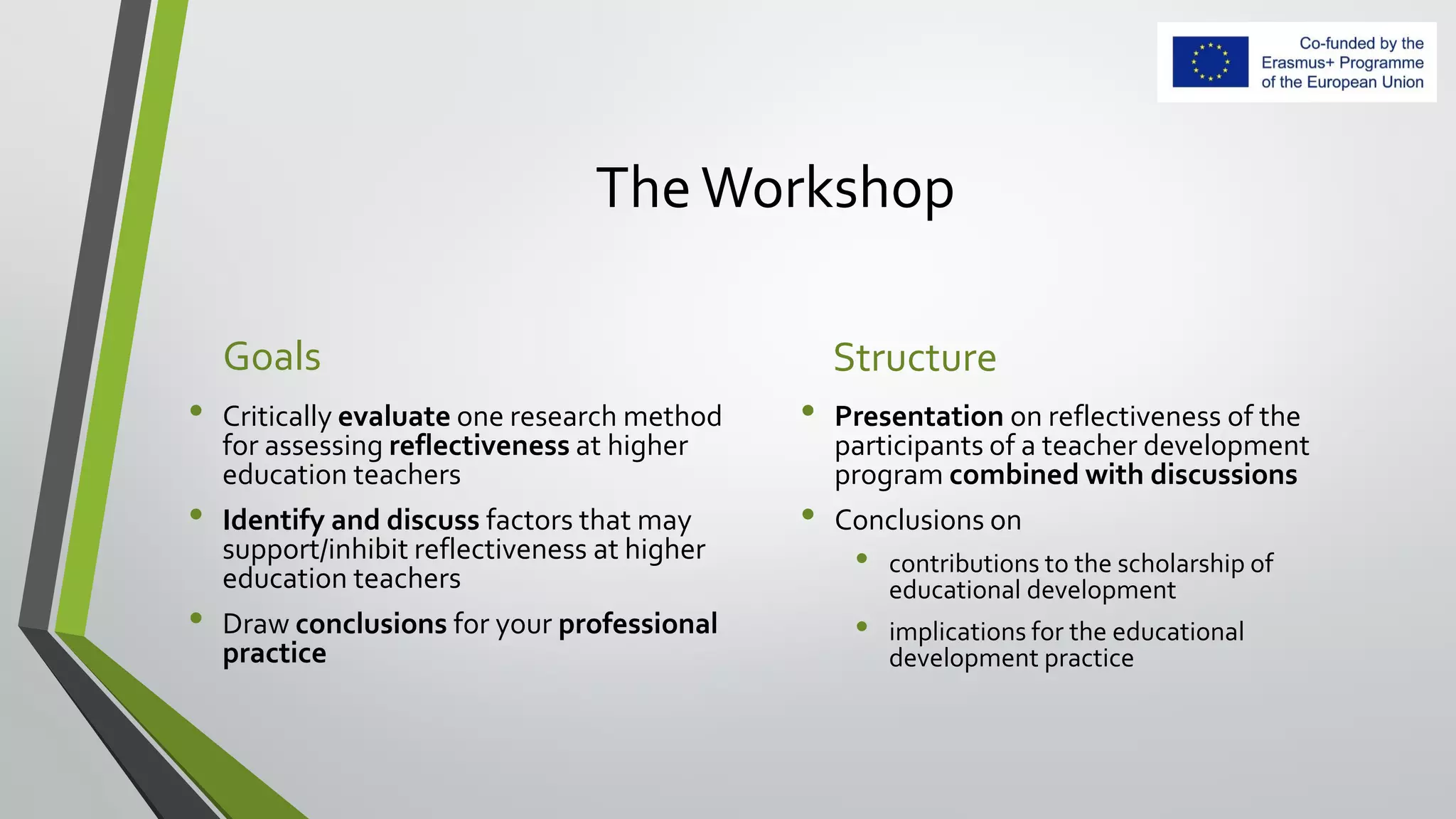
TheWorkshop
Goals
• Critically evaluate one research method
for assessing reflectiveness at higher
education teachers
• Identify and discuss factors that may
support/inhibit reflectiveness at higher
education teachers
• Draw conclusions for your professional
practice
Structure
• Presentation on reflectiveness of the
participants of a teacher development
program combined with discussions
• Conclusions on
• contributions to the scholarship of
educational development
• implications for the educational
development practice
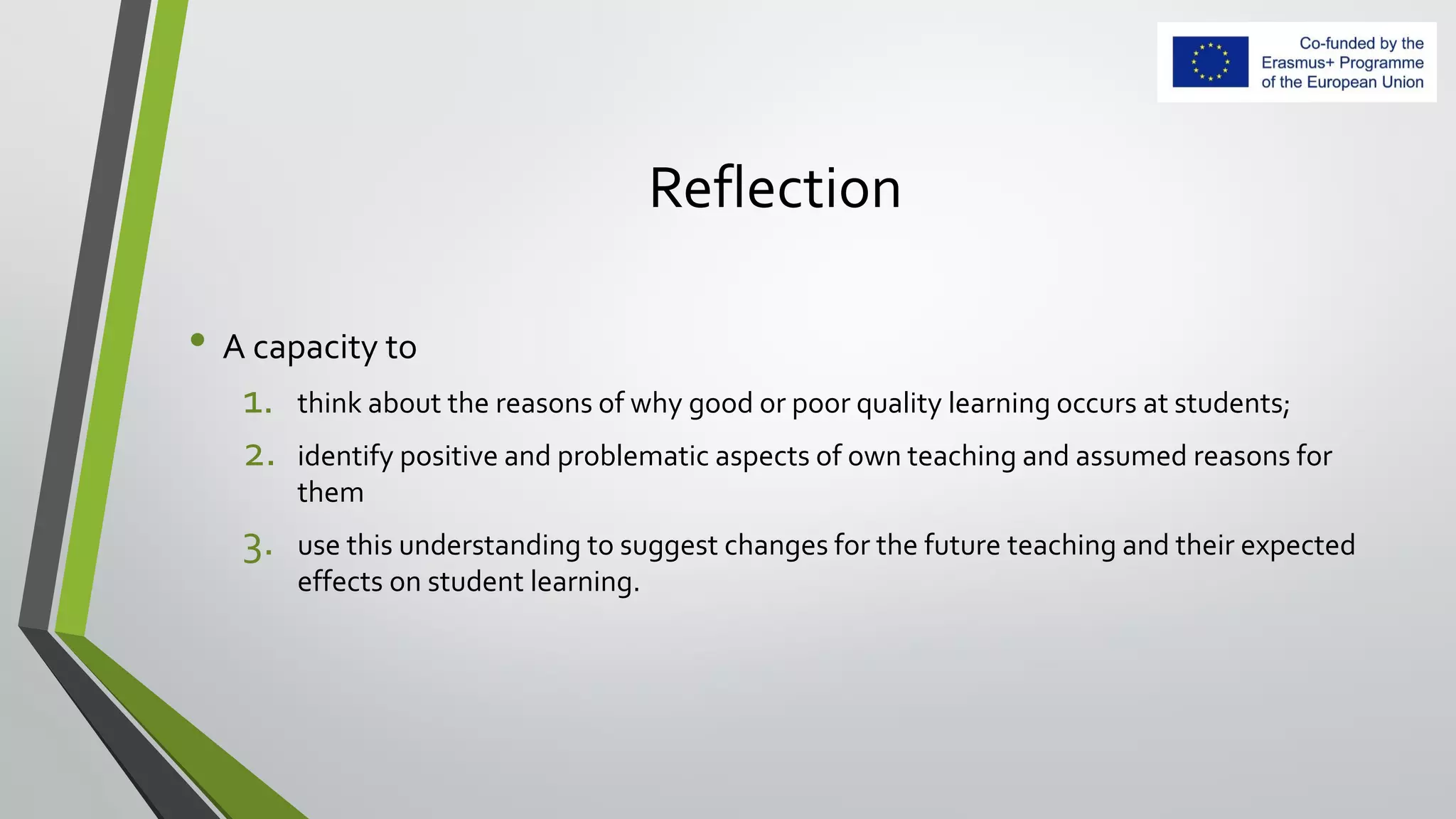
Reflection
• A capacity to
1. think about the reasons of why good or poor quality learning occurs at students;
2. identify positive and problematic aspects of own teaching and assumed reasons for
them
3. use this understanding to suggest changes for the future teaching and their expected
effects on student learning.
Brainstorming
Pair/group discussion (~5 mins.)
•What factors usually
hinder teachers’
reflection on own
practice?
•What factors usually
facilitate teachers’
reflection on own
practice?
Brainstorming
Plenary discussion
•What factors usually
hinder teachers’
reflection on own
practice?
•What factors usually
facilitate teachers’
reflection on own
practice?
The Program
• “Extending and reinforcing good practice in teacher development”
• Masaryk University and University of Economics in Bratislava
• 12 graduates
• Learning objective: as a result of the program participants' reflection on
and critical attitude to teaching should increase.
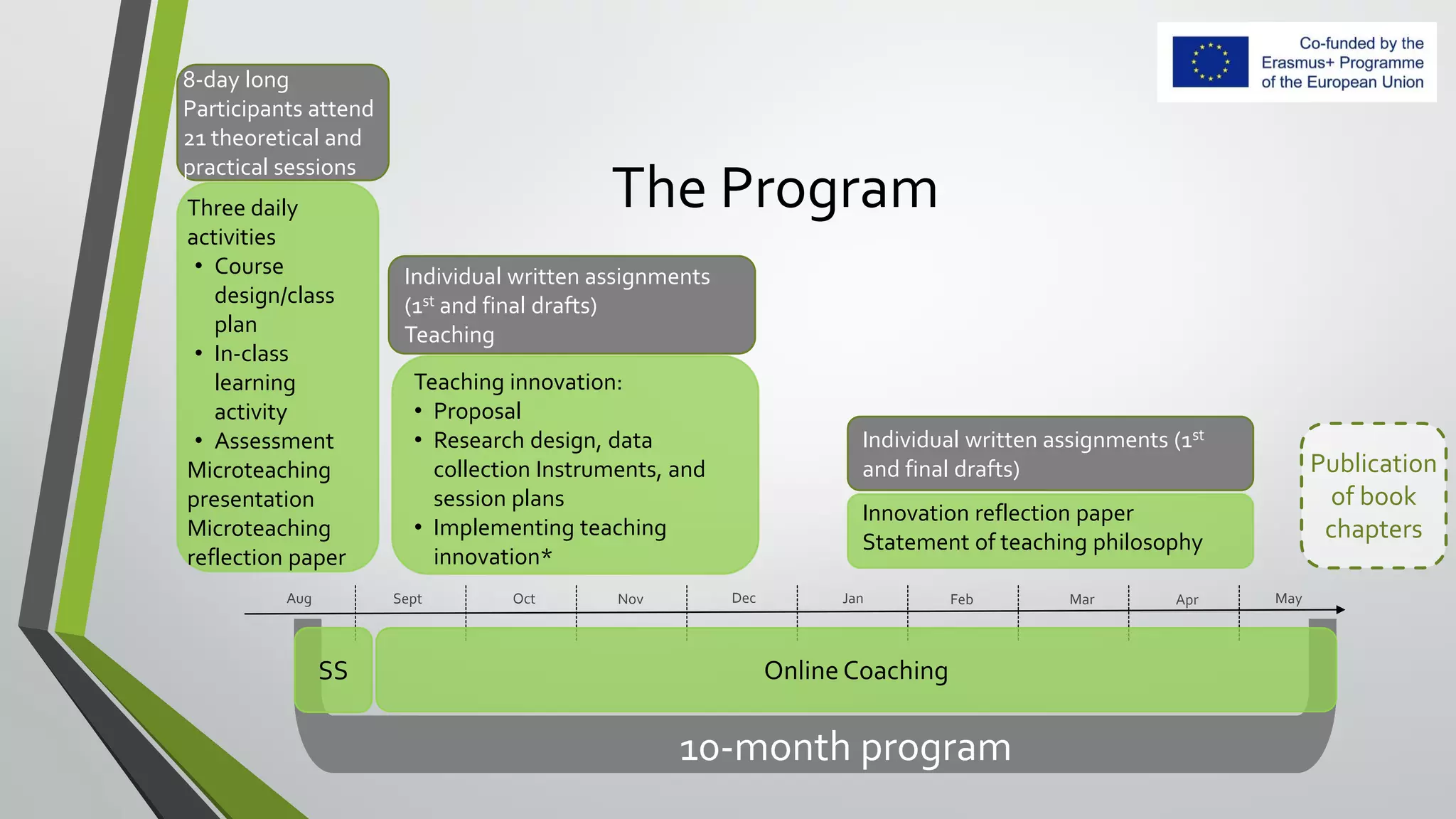
10-month program
SS Online Coaching
Aug Sept Nov FebOct Dec MayAprMarJan
The Program
8-day long
Participants attend
21 theoretical and
practical sessions
Three daily
activities
• Course
design/class
plan
• In-class
learning
activity
• Assessment
Microteaching
presentation
Microteaching
reflection paper
Individual written assignments
(1st and final drafts)
Teaching
Teaching innovation:
• Proposal
• Research design, data
collection Instruments, and
session plans
• Implementing teaching
innovation*
Individual written assignments (1st
and final drafts)
Innovation reflection paper
Statement of teaching philosophy
Publication
of book
chapters
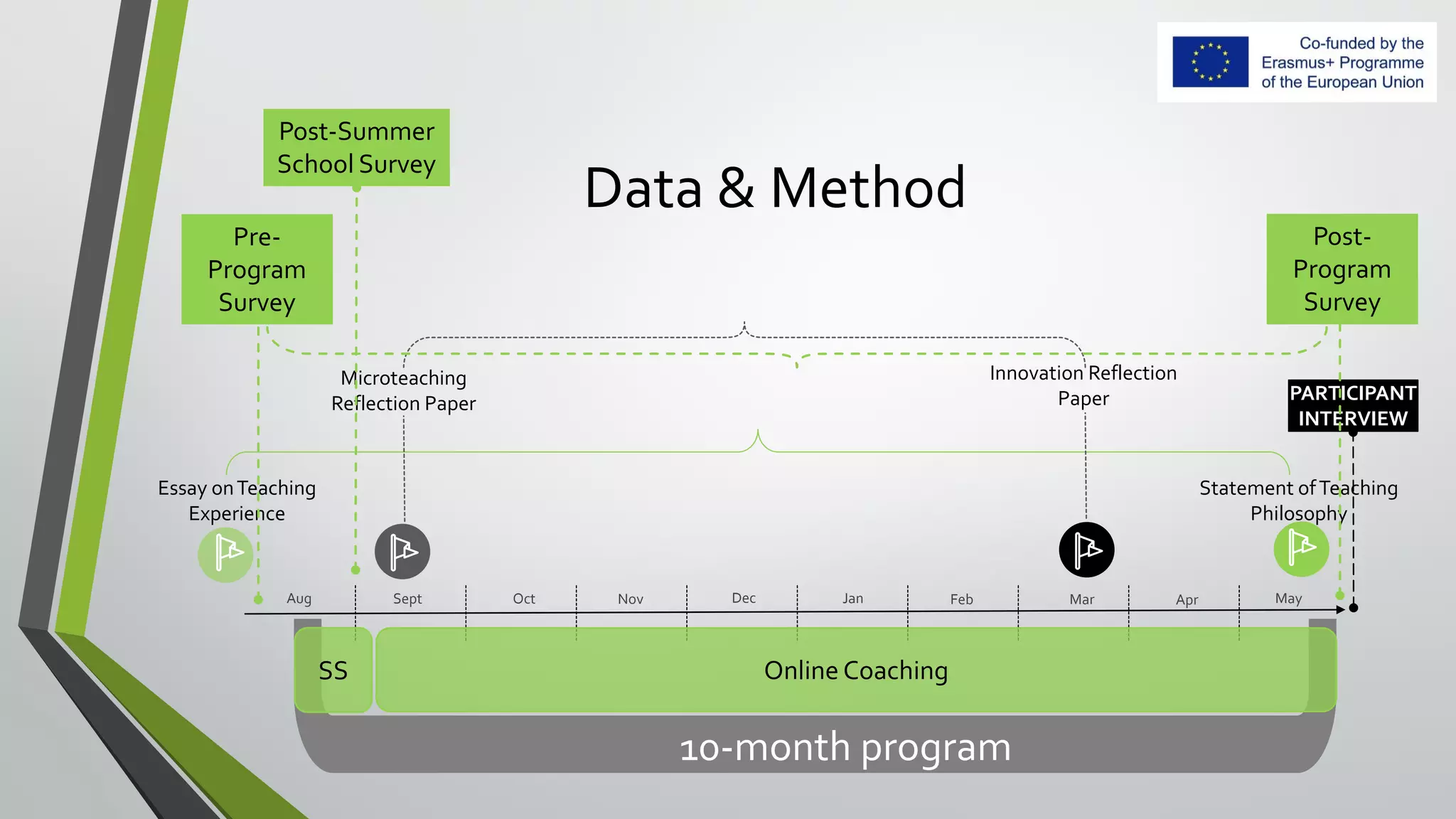
Essay onTeaching
Experience
10-month program
Microteaching
Reflection Paper
SS Online Coaching
Aug Sept Nov FebOct Dec MayAprMarJan
Innovation Reflection
Paper
Statement ofTeaching
Philosophy
PARTICIPANT
INTERVIEW
Post-
Program
Survey
Pre-
Program
Survey
Data & Method
Post-Summer
School Survey
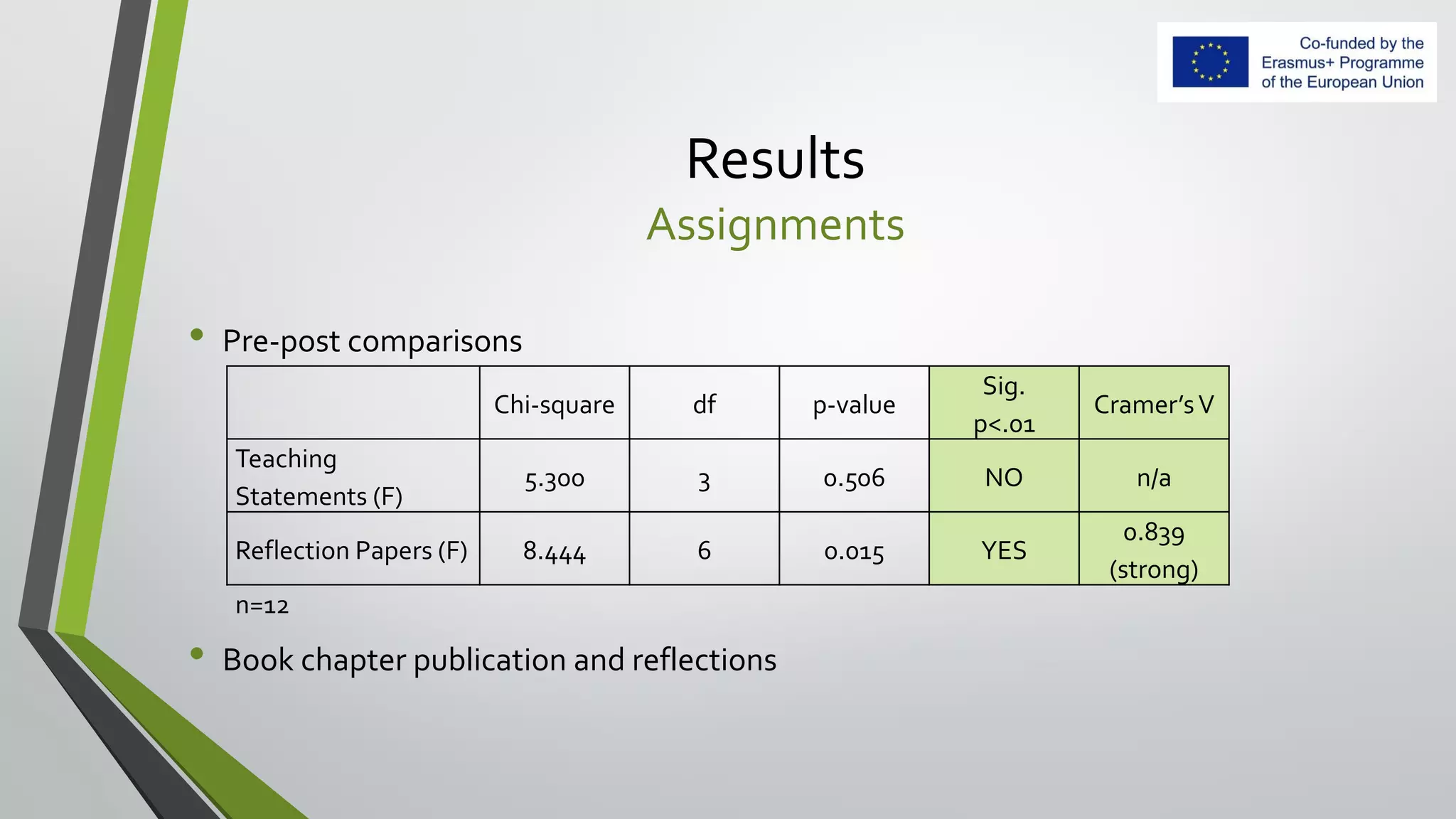
Results
Assignments
• Pre-post comparisons
• Book chapter publication and reflections
Chi-square df p-value
Sig.
p<.01
Cramer’sV
Teaching
Statements (F)
5.300 3 0.506 NO n/a
Reflection Papers (F) 8.444 6 0.015 YES
0.839
(strong)
n=12
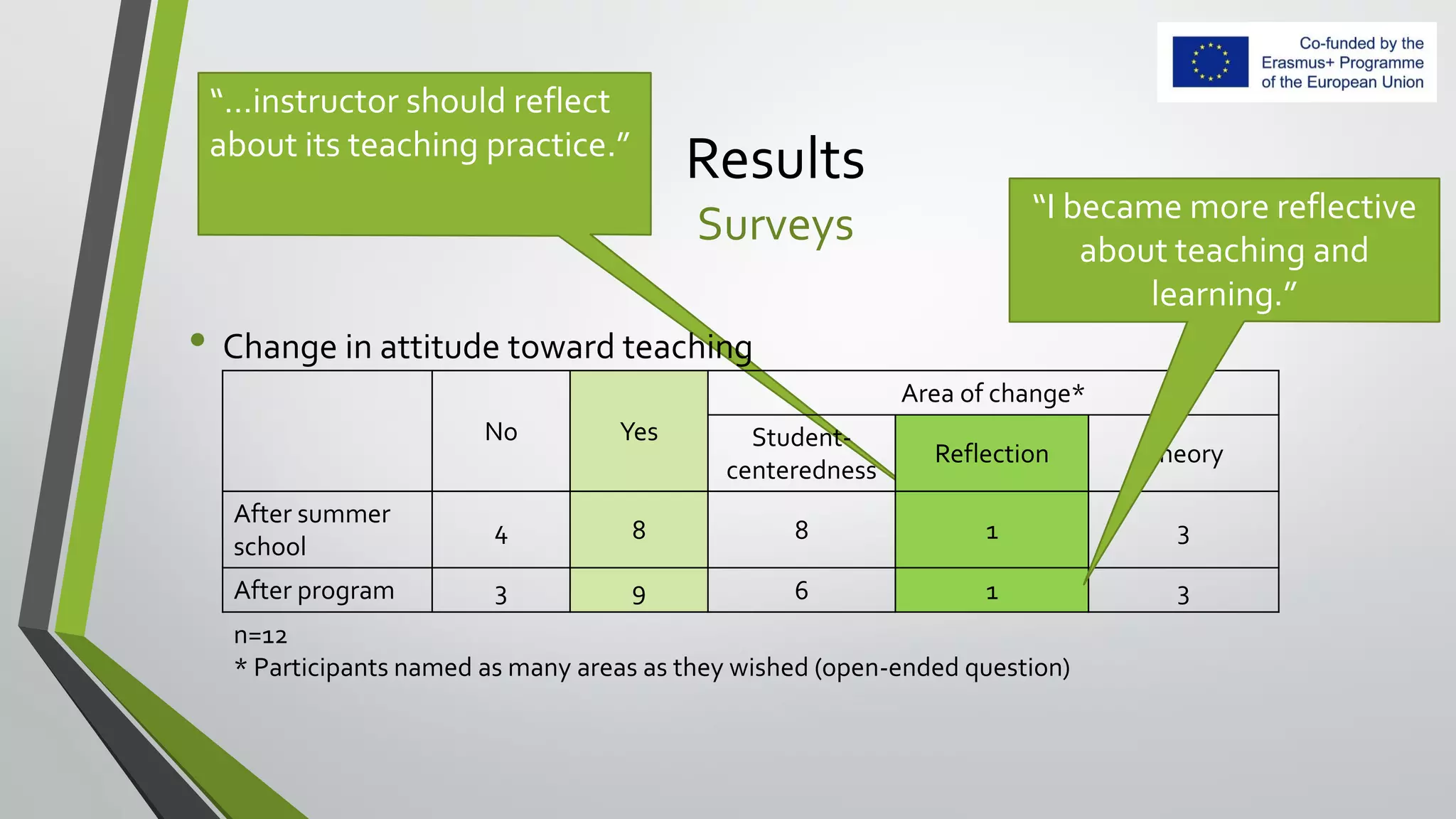
“…instructor should reflect
about its teaching practice.”
Results
Surveys
• Change in attitude toward teaching
No Yes
Area of change*
Student-
centeredness
Reflection Theory
After summer
school
4 8 8 1 3
After program 3 9 6 1 3
n=12
* Participants named as many areas as they wished (open-ended question)
“I became more reflective
about teaching and
learning.”
Results
Surveys
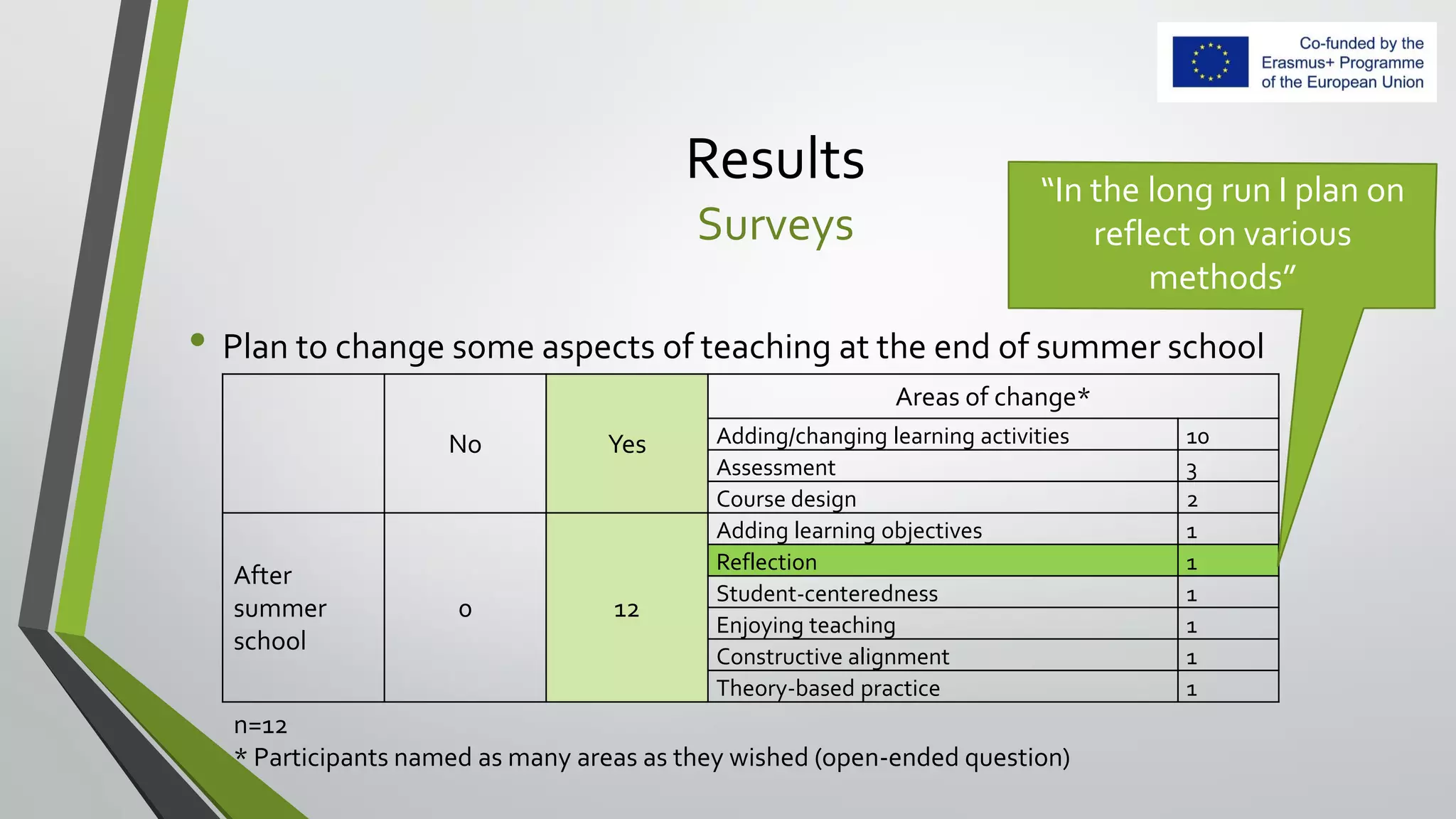
• Plan to change some aspects of teaching at the end of summer school
No Yes
Areas of change*
Adding/changing learning activities 10
Assessment 3
Course design 2
After
summer
school
0 12
Adding learning objectives 1
Reflection 1
Student-centeredness 1
Enjoying teaching 1
Constructive alignment 1
Theory-based practice 1
n=12
* Participants named as many areas as they wished (open-ended question)
“In the long run I plan on
reflect on various
methods”
Results
Interviews
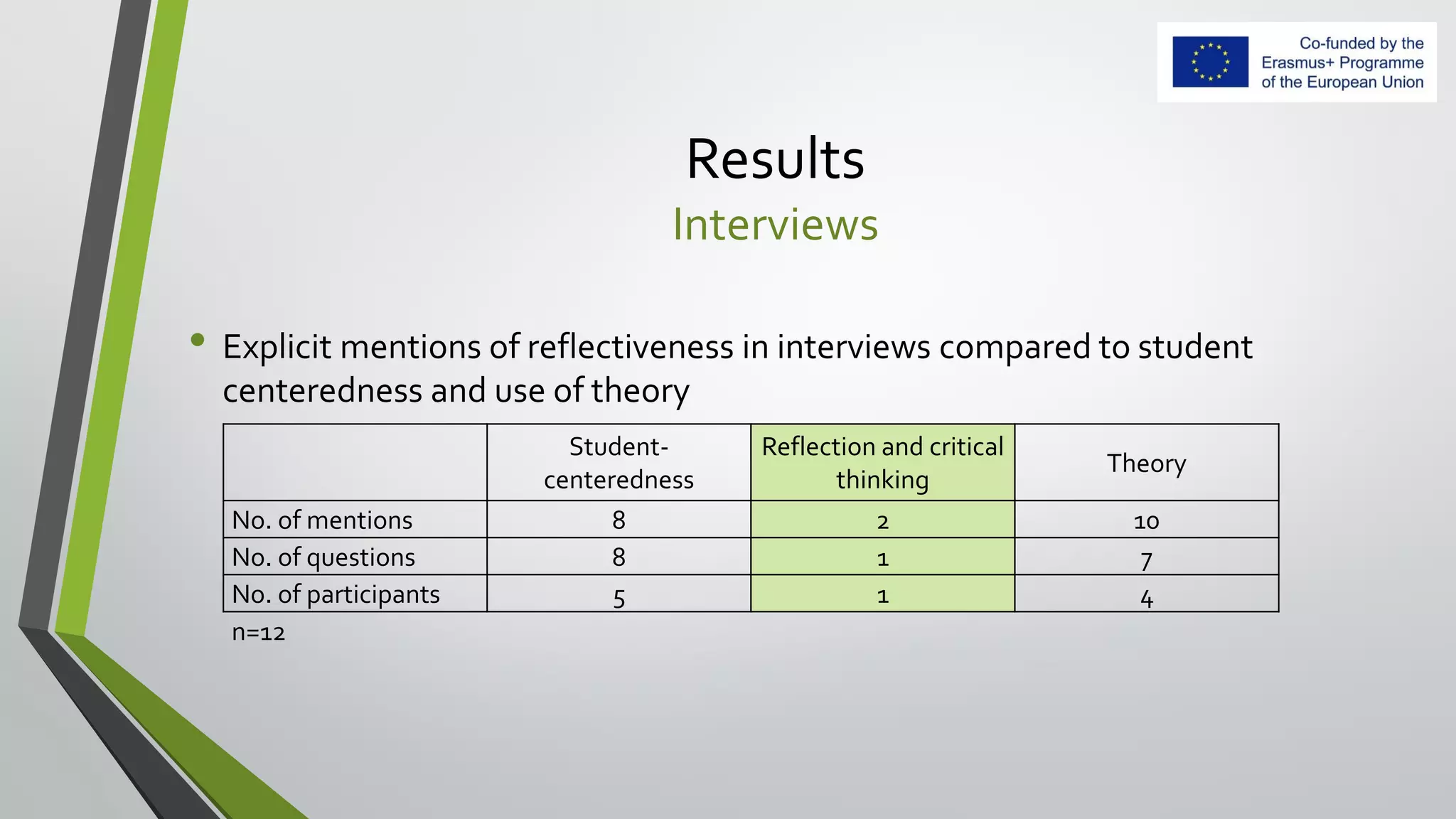
• Explicit mentions of reflectiveness in interviews compared to student
centeredness and use of theory
Student-
centeredness
Reflection and critical
thinking
Theory
No. of mentions 8 2 10
No. of questions 8 1 7
No. of participants 5 1 4
n=12
Brainstorming
Pair/group discussion (~5 mins.)
•What factors do you think
hindered reflection by
teachers in this particular
program?
•What factors do you think
facilitated reflections of
teachers in this particular
program?
Brainstorming
Plenary discussion
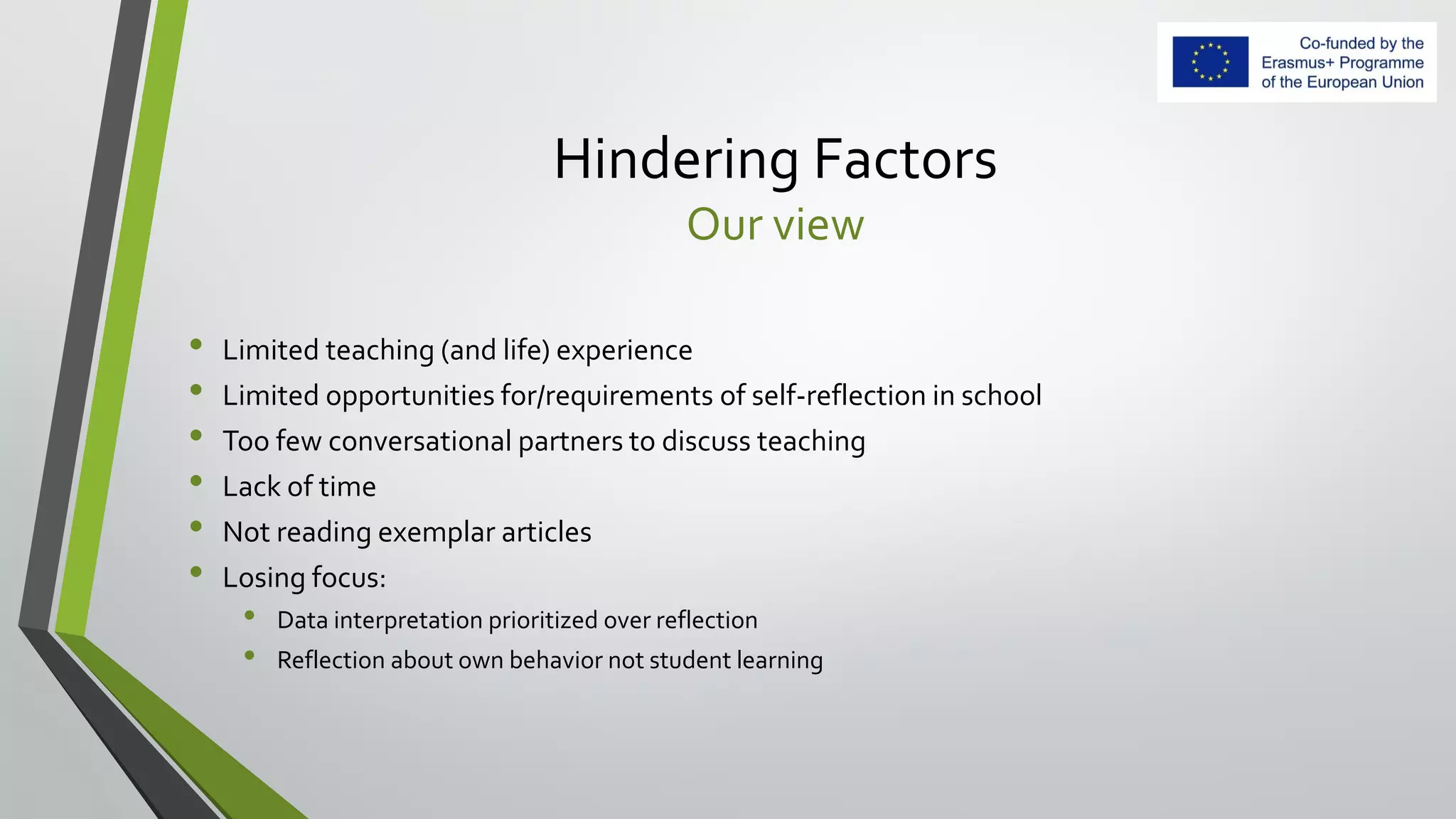
•What factors do you think
hinder reflection by
teachers in this particular
program?
•What factors do you think
facilitate reflections of
teachers in this particular
program?
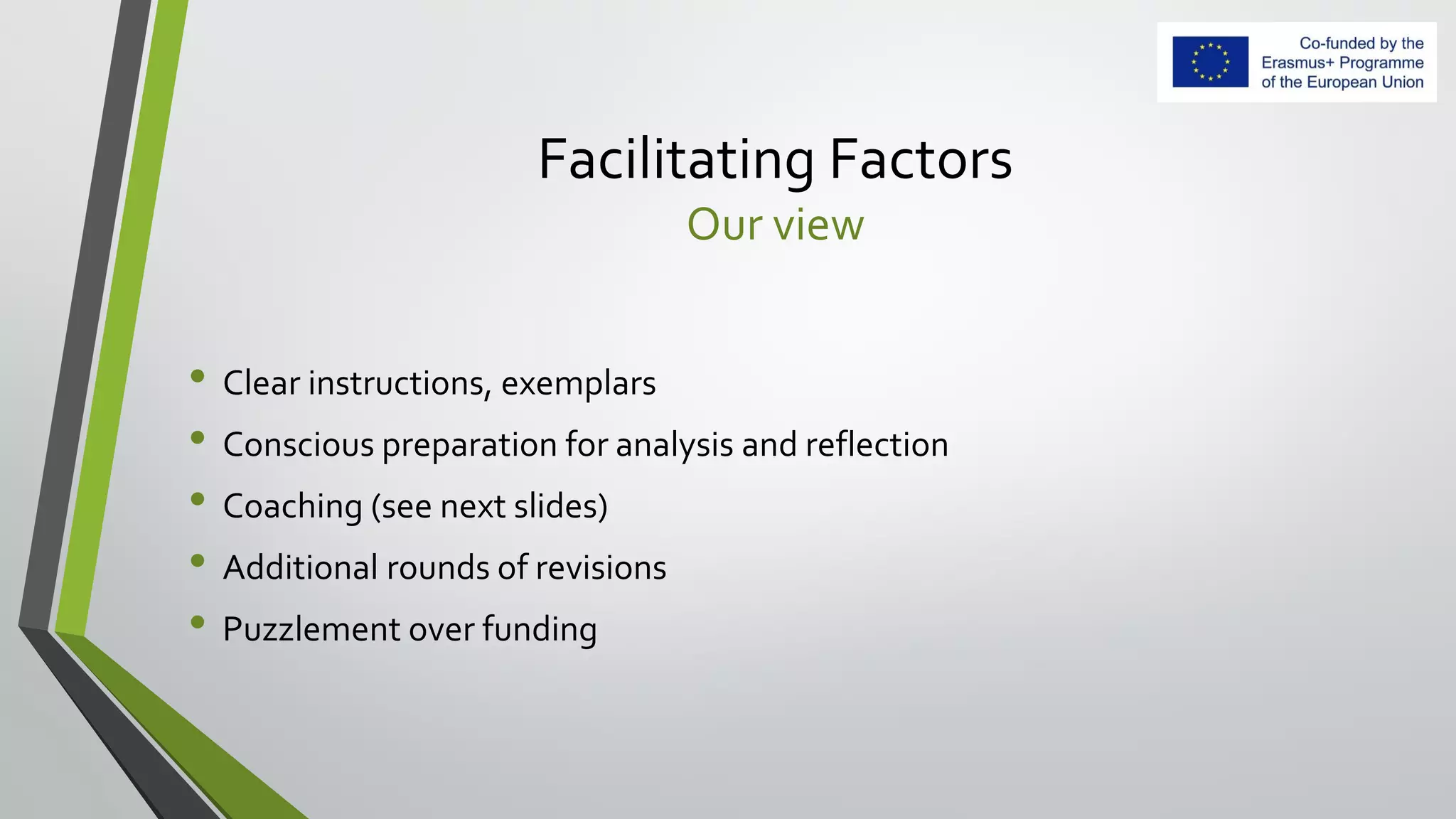
Hindering Factors
Our view
• Limited teaching (and life) experience
• Limited opportunities for/requirements of self-reflection in school
• Too few conversational partners to discuss teaching
• Lack of time
• Not reading exemplar articles
• Losing focus:
• Data interpretation prioritized over reflection
• Reflection about own behavior not student learning
Facilitating Factors
Our view
• Clear instructions, exemplars
• Conscious preparation for analysis and reflection
• Coaching (see next slides)
• Additional rounds of revisions
• Puzzlement over funding
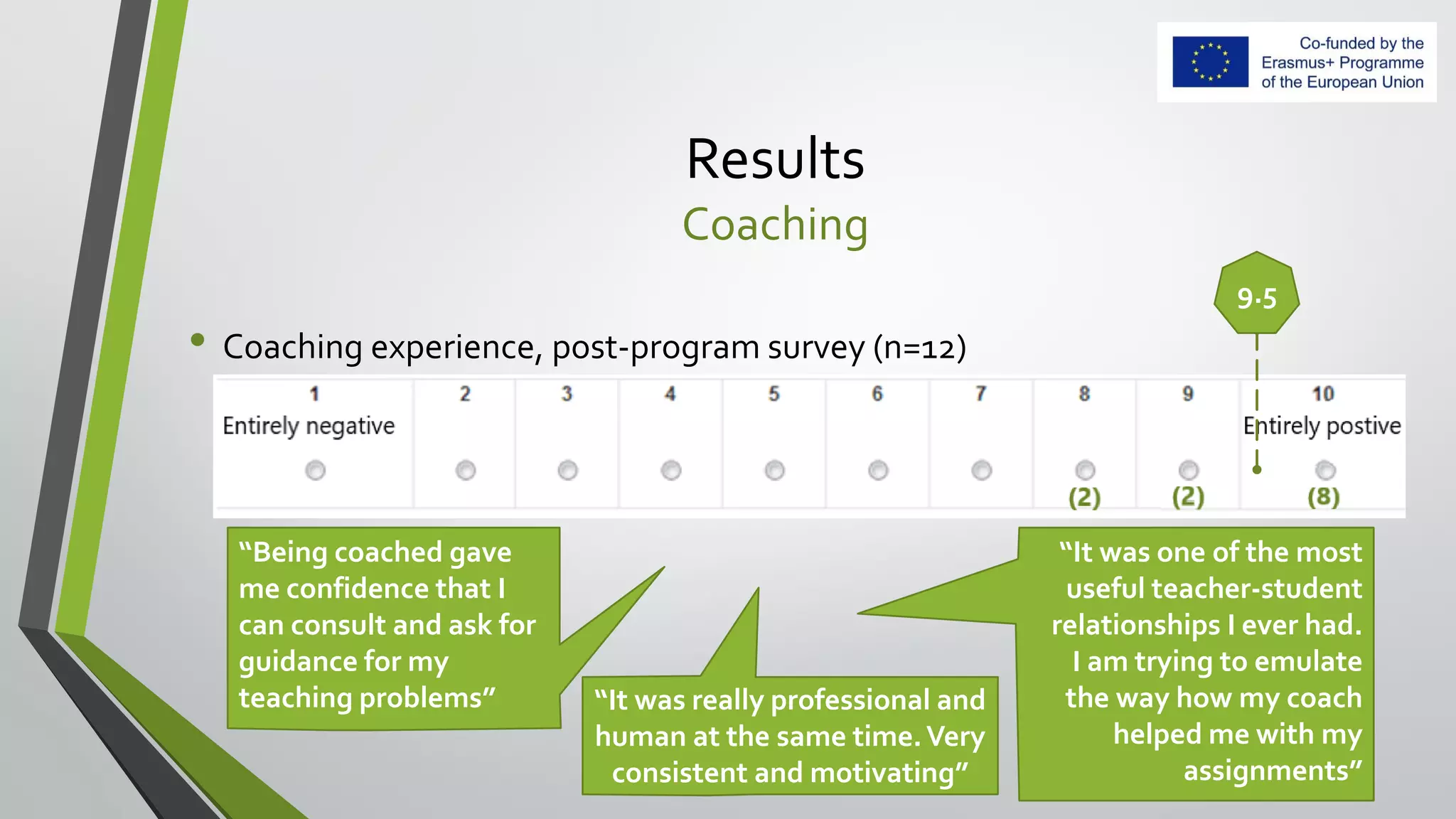
Results
Coaching
• Coaching experience, post-program survey (n=12)
9.5
“It was really professional and
human at the same time.Very
consistent and motivating”
“Being coached gave
me confidence that I
can consult and ask for
guidance for my
teaching problems”
“It was one of the most
useful teacher-student
relationships I ever had.
I am trying to emulate
the way how my coach
helped me with my
assignments”
Results
Coaching
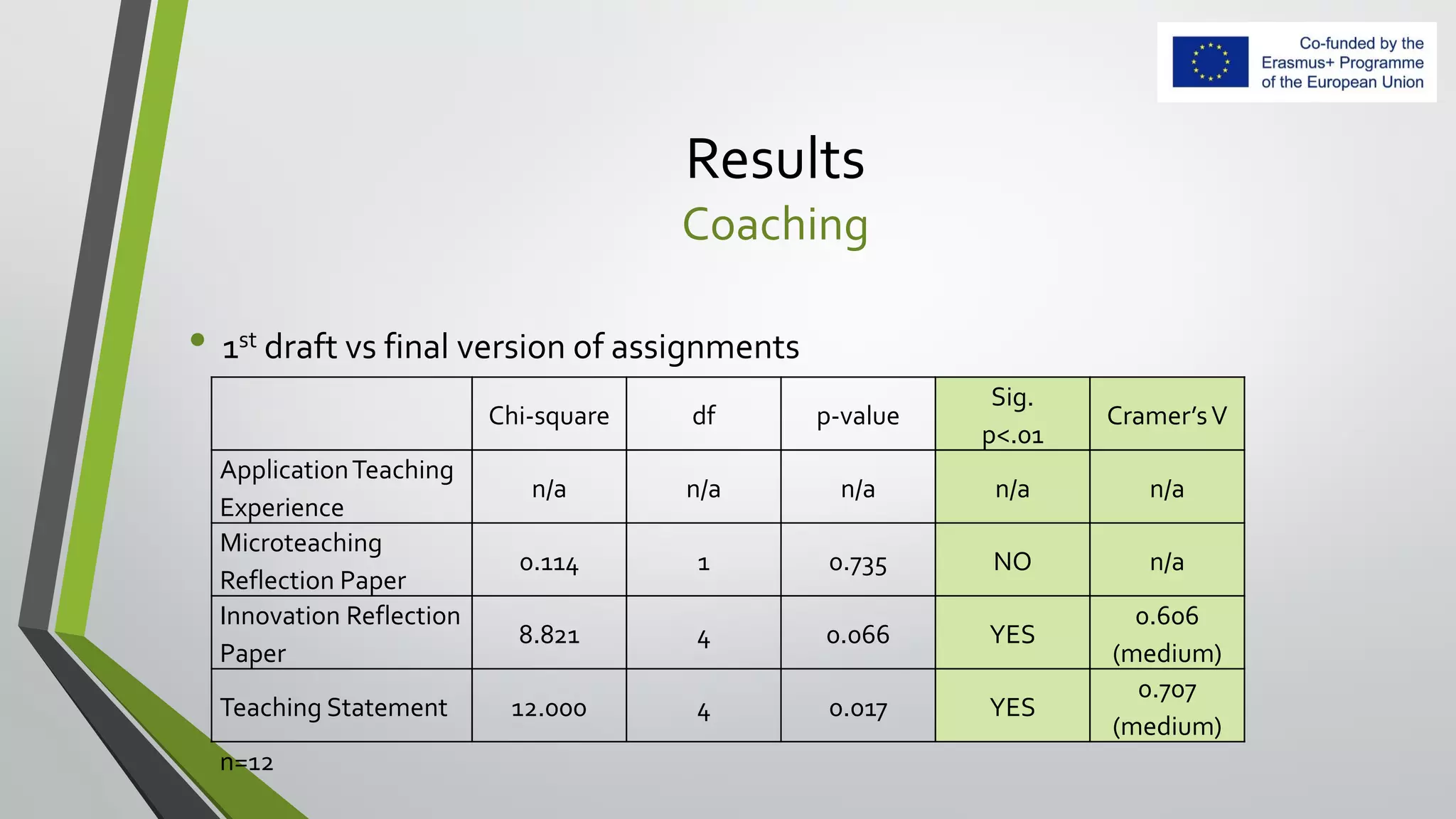
• 1st draft vs final version of assignments
Chi-square df p-value
Sig.
p<.01
Cramer’sV
ApplicationTeaching
Experience
n/a n/a n/a n/a n/a
Microteaching
Reflection Paper
0.114 1 0.735 NO n/a
Innovation Reflection
Paper
8.821 4 0.066 YES
0.606
(medium)
Teaching Statement 12.000 4 0.017 YES
0.707
(medium)
n=12
Conclusions
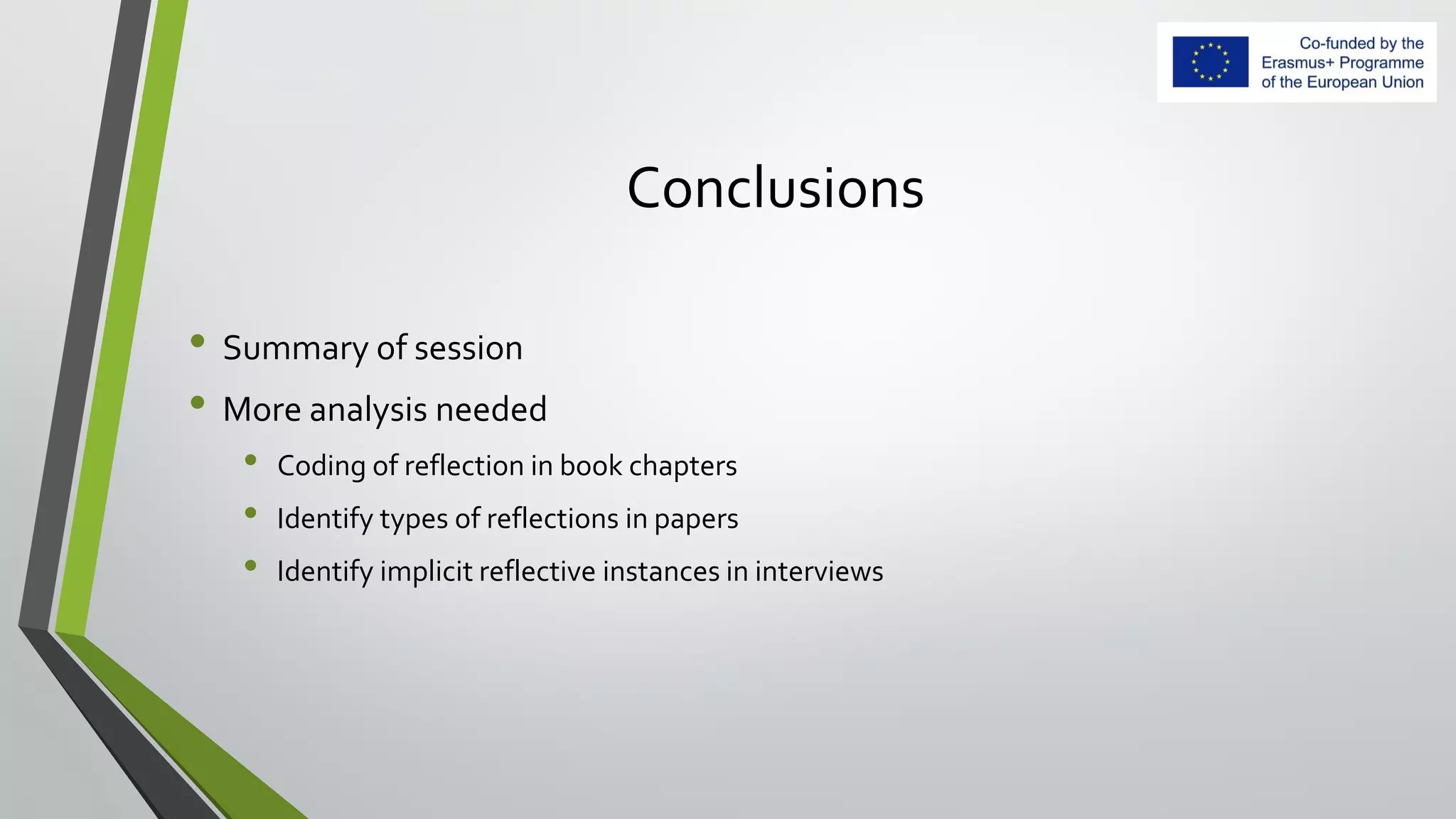
• Summary of session
• More analysis needed
• Coding of reflection in book chapters
• Identify types of reflections in papers
• Identify implicit reflective instances in interviews
Conclusions
• Contact us:
“Extending and reinforcing good practice in teacher
development” Erasmus+ No. 2016-1-SK01-KA203-022551
• Thank you for your attention!
Gabriela Pleschova Agnes Simon
gabriela.pleschova@euba agi_simon@yahoo.com

What helps and what hinders reflective teaching?

  • 1.
    What helps andwhat hinders reflective teaching? Discussing results from a collaborative Erasmus+ project Agnes Simon Masaryk University Gabriela Pleschová University of Economics in Bratislava
  • 2.
    TheWorkshop Goals • Critically evaluateone research method for assessing reflectiveness at higher education teachers • Identify and discuss factors that may support/inhibit reflectiveness at higher education teachers • Draw conclusions for your professional practice Structure • Presentation on reflectiveness of the participants of a teacher development program combined with discussions • Conclusions on • contributions to the scholarship of educational development • implications for the educational development practice
  • 3.
    Reflection • A capacityto 1. think about the reasons of why good or poor quality learning occurs at students; 2. identify positive and problematic aspects of own teaching and assumed reasons for them 3. use this understanding to suggest changes for the future teaching and their expected effects on student learning.
  • 4.
    Brainstorming Pair/group discussion (~5mins.) •What factors usually hinder teachers’ reflection on own practice? •What factors usually facilitate teachers’ reflection on own practice?
  • 5.
    Brainstorming Plenary discussion •What factorsusually hinder teachers’ reflection on own practice? •What factors usually facilitate teachers’ reflection on own practice?
  • 6.
    The Program • “Extendingand reinforcing good practice in teacher development” • Masaryk University and University of Economics in Bratislava • 12 graduates • Learning objective: as a result of the program participants' reflection on and critical attitude to teaching should increase.
  • 7.
    10-month program SS OnlineCoaching Aug Sept Nov FebOct Dec MayAprMarJan The Program 8-day long Participants attend 21 theoretical and practical sessions Three daily activities • Course design/class plan • In-class learning activity • Assessment Microteaching presentation Microteaching reflection paper Individual written assignments (1st and final drafts) Teaching Teaching innovation: • Proposal • Research design, data collection Instruments, and session plans • Implementing teaching innovation* Individual written assignments (1st and final drafts) Innovation reflection paper Statement of teaching philosophy Publication of book chapters
  • 8.
    Essay onTeaching Experience 10-month program Microteaching ReflectionPaper SS Online Coaching Aug Sept Nov FebOct Dec MayAprMarJan Innovation Reflection Paper Statement ofTeaching Philosophy PARTICIPANT INTERVIEW Post- Program Survey Pre- Program Survey Data & Method Post-Summer School Survey
  • 9.
    Results Assignments • Pre-post comparisons •Book chapter publication and reflections Chi-square df p-value Sig. p<.01 Cramer’sV Teaching Statements (F) 5.300 3 0.506 NO n/a Reflection Papers (F) 8.444 6 0.015 YES 0.839 (strong) n=12
  • 10.
    “…instructor should reflect aboutits teaching practice.” Results Surveys • Change in attitude toward teaching No Yes Area of change* Student- centeredness Reflection Theory After summer school 4 8 8 1 3 After program 3 9 6 1 3 n=12 * Participants named as many areas as they wished (open-ended question) “I became more reflective about teaching and learning.”
  • 11.
    Results Surveys • Plan tochange some aspects of teaching at the end of summer school No Yes Areas of change* Adding/changing learning activities 10 Assessment 3 Course design 2 After summer school 0 12 Adding learning objectives 1 Reflection 1 Student-centeredness 1 Enjoying teaching 1 Constructive alignment 1 Theory-based practice 1 n=12 * Participants named as many areas as they wished (open-ended question) “In the long run I plan on reflect on various methods”
  • 12.
    Results Interviews • Explicit mentionsof reflectiveness in interviews compared to student centeredness and use of theory Student- centeredness Reflection and critical thinking Theory No. of mentions 8 2 10 No. of questions 8 1 7 No. of participants 5 1 4 n=12
  • 13.
    Brainstorming Pair/group discussion (~5mins.) •What factors do you think hindered reflection by teachers in this particular program? •What factors do you think facilitated reflections of teachers in this particular program?
  • 14.
    Brainstorming Plenary discussion •What factorsdo you think hinder reflection by teachers in this particular program? •What factors do you think facilitate reflections of teachers in this particular program?
  • 15.
    Hindering Factors Our view •Limited teaching (and life) experience • Limited opportunities for/requirements of self-reflection in school • Too few conversational partners to discuss teaching • Lack of time • Not reading exemplar articles • Losing focus: • Data interpretation prioritized over reflection • Reflection about own behavior not student learning
  • 16.
    Facilitating Factors Our view •Clear instructions, exemplars • Conscious preparation for analysis and reflection • Coaching (see next slides) • Additional rounds of revisions • Puzzlement over funding
  • 17.
    Results Coaching • Coaching experience,post-program survey (n=12) 9.5 “It was really professional and human at the same time.Very consistent and motivating” “Being coached gave me confidence that I can consult and ask for guidance for my teaching problems” “It was one of the most useful teacher-student relationships I ever had. I am trying to emulate the way how my coach helped me with my assignments”
  • 18.
    Results Coaching • 1st draftvs final version of assignments Chi-square df p-value Sig. p<.01 Cramer’sV ApplicationTeaching Experience n/a n/a n/a n/a n/a Microteaching Reflection Paper 0.114 1 0.735 NO n/a Innovation Reflection Paper 8.821 4 0.066 YES 0.606 (medium) Teaching Statement 12.000 4 0.017 YES 0.707 (medium) n=12
  • 19.
    Conclusions • Summary ofsession • More analysis needed • Coding of reflection in book chapters • Identify types of reflections in papers • Identify implicit reflective instances in interviews
  • 20.
    Conclusions • Contact us: “Extendingand reinforcing good practice in teacher development” Erasmus+ No. 2016-1-SK01-KA203-022551 • Thank you for your attention! Gabriela Pleschova Agnes Simon gabriela.pleschova@euba agi_simon@yahoo.com