




CLASS INSECTA 
Group 2 
Eileen B. Aycardo 
Abegail Vergara 
Peter Glenn Lelis 
Crisanta Oane 
Charmaine Bongon 
Joy Branuelo 
Estefanie Asicate 
Annie Pearl Moriones
ORDER 
LEPIDOPTERA
BUTTERFLIES 
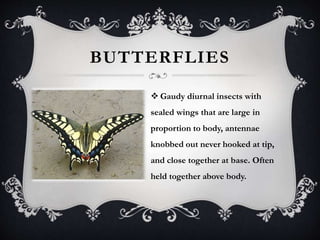
 Gaudy diurnal insects with 
sealed wings that are large in 
proportion to body, antennae 
knobbed out never hooked at tip, 
and close together at base. Often 
held together above body.
 Butterflies and moths belong to the Order Lepidoptera. 
 It comes from the Greek word Lepidos which means ‘scales’ 
and ptera meaning ‘wings’ 
There are more types of butterflies and moths than there are 
of any other type of insects except beetles. 
 It is estimated that there are about 150,000 different species 
of these order. 28,000 of these are butterflies and 
the rest are moths.
ANATOMY 
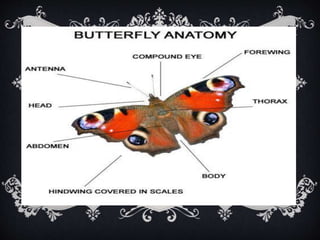
Like all insects, they have : 
six (6) jointed legs, 
3 body parts (the head, the thorax and the abdomen) 
A pair of antennae 
Compound eyes 
And exoskeleton
The butterfly’s body is covered by tiny sensory hairs. 
The four (4) wings and the six (6) legs are attached to 
the thorax which also contains the muscles that make 
the legs and wings move.
FEEDING BEHAVIOR 
Caterpillars spend most of their time eating leaves 
using strong mandibles (jaws). 
A caterpillar’s first meal however, is its own eggshell. 
A few caterpillars are meat – eaters. 
The larva of the carnivorous harvester butterfly 
eats wholly aphids.
Butterflies and moths can only sip liquid food using 
a tube – like proboscis, a long flexible ‘tongue’ 
This proboscis uncoils to sip food, and coils up 
again into a spiral when not in use. 
Most butterflies live on nectar of flowers.
HABITAT 
Butterflies are found all over the world and in all 
types of environments: hot and cold; dry and 
moist at sea level and high in the mountains. 
Most butterflies are found in tropical rainforests. 
Most migrate in order to avoid adverse 
environmental conditions.
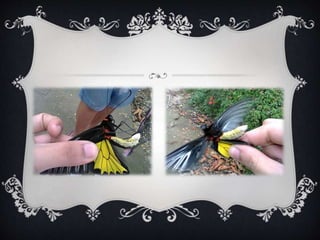
 Common Name: 
Grey Pansy 
 Scientific Name: 
Precis atlites
ORDER ODONATA
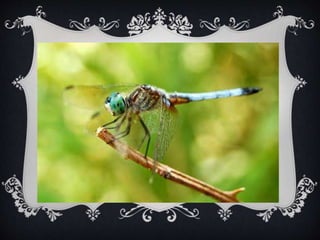
DRAGONFLIES & DAMSELFLIES 
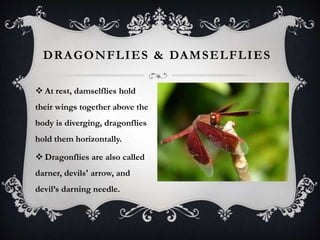
 At rest, damselflies hold 
their wings together above the 
body is diverging, dragonflies 
hold them horizontally. 
 Dragonflies are also called 
darner, devils' arrow, and 
devil’s darning needle.
ANATOMY 
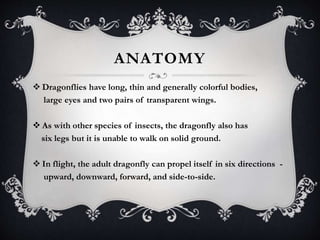
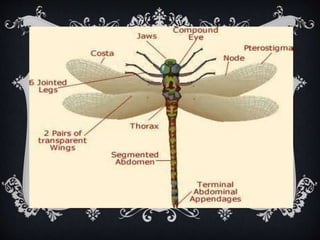
 Dragonflies have long, thin and generally colorful bodies, 
large eyes and two pairs of transparent wings. 
 As with other species of insects, the dragonfly also has 
six legs but it is unable to walk on solid ground. 
 In flight, the adult dragonfly can propel itself in six directions - 
upward, downward, forward, and side-to-side.
FEEDING BEHAVIOR 
Dragonflies are major predators that eat mosquitoes 
and other small insects like flies, bees, ants, wasps and 
very rarely butterflies. 
As a larva, it eats tadpoles or small fish. 
Dragonflies are carnivorous in both larval and adult 
stages.
HABITAT 
Dragonflies are most often found near water and 
usually remain within a few miles of the place where 
the eggs are hatched. 
Female dragonflies deposit their eggs insert them 
into aquatic plant or mosses.
THANK YOU!

Class Insecta - Order Leptidoptera and Order Odonata

  • 1.
    CLASS INSECTA Group2 Eileen B. Aycardo Abegail Vergara Peter Glenn Lelis Crisanta Oane Charmaine Bongon Joy Branuelo Estefanie Asicate Annie Pearl Moriones
  • 2.
  • 3.
    BUTTERFLIES  Gaudydiurnal insects with sealed wings that are large in proportion to body, antennae knobbed out never hooked at tip, and close together at base. Often held together above body.
  • 4.
     Butterflies andmoths belong to the Order Lepidoptera.  It comes from the Greek word Lepidos which means ‘scales’ and ptera meaning ‘wings’ There are more types of butterflies and moths than there are of any other type of insects except beetles.  It is estimated that there are about 150,000 different species of these order. 28,000 of these are butterflies and the rest are moths.
  • 5.
    ANATOMY Like allinsects, they have : six (6) jointed legs, 3 body parts (the head, the thorax and the abdomen) A pair of antennae Compound eyes And exoskeleton
  • 7.
    The butterfly’s bodyis covered by tiny sensory hairs. The four (4) wings and the six (6) legs are attached to the thorax which also contains the muscles that make the legs and wings move.
  • 8.
    FEEDING BEHAVIOR Caterpillarsspend most of their time eating leaves using strong mandibles (jaws). A caterpillar’s first meal however, is its own eggshell. A few caterpillars are meat – eaters. The larva of the carnivorous harvester butterfly eats wholly aphids.
  • 9.
    Butterflies and mothscan only sip liquid food using a tube – like proboscis, a long flexible ‘tongue’ This proboscis uncoils to sip food, and coils up again into a spiral when not in use. Most butterflies live on nectar of flowers.
  • 10.
    HABITAT Butterflies arefound all over the world and in all types of environments: hot and cold; dry and moist at sea level and high in the mountains. Most butterflies are found in tropical rainforests. Most migrate in order to avoid adverse environmental conditions.
  • 11.
     Common Name: Grey Pansy  Scientific Name: Precis atlites
  • 13.
  • 15.
    DRAGONFLIES & DAMSELFLIES  At rest, damselflies hold their wings together above the body is diverging, dragonflies hold them horizontally.  Dragonflies are also called darner, devils' arrow, and devil’s darning needle.
  • 16.
    ANATOMY  Dragonflieshave long, thin and generally colorful bodies, large eyes and two pairs of transparent wings.  As with other species of insects, the dragonfly also has six legs but it is unable to walk on solid ground.  In flight, the adult dragonfly can propel itself in six directions - upward, downward, forward, and side-to-side.
  • 18.
    FEEDING BEHAVIOR Dragonfliesare major predators that eat mosquitoes and other small insects like flies, bees, ants, wasps and very rarely butterflies. As a larva, it eats tadpoles or small fish. Dragonflies are carnivorous in both larval and adult stages.
  • 19.
    HABITAT Dragonflies aremost often found near water and usually remain within a few miles of the place where the eggs are hatched. Female dragonflies deposit their eggs insert them into aquatic plant or mosses.
  • 20.