Order LepidopteraBy:Paige Carleton
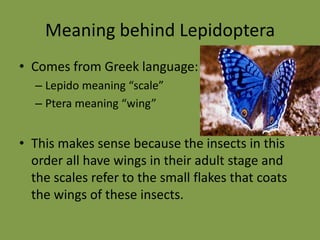
Meaning behind LepidopteraComes from Greek language:Lepido meaning “scale” Ptera meaning “wing”This makes sense because the insects in this order all have wings in their adult stage and the scales refer to the small flakes that coats the wings of these insects.
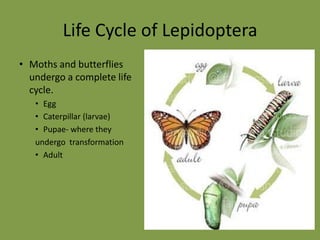
Life Cycle of LepidopteraMoths and butterflies undergo a complete life cycle.EggCaterpillar (larvae)Pupae- where they undergo  transformationAdult
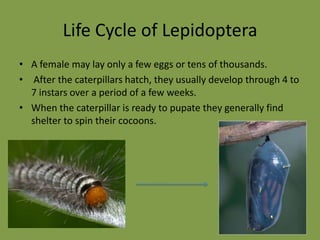
Life Cycle of LepidopteraA female may lay only a few eggs or tens of thousands.
 After the caterpillars hatch, they usually develop through 4 to 7 instars over a period of a few weeks.
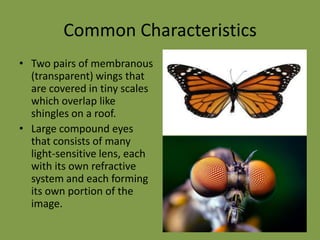
When the caterpillar is ready to pupate they generally find shelter to spin their cocoons.   Common CharacteristicsTwo pairs of membranous (transparent) wings that are covered in tiny scales which overlap like shingles on a roof. Large compound eyes that consists of many light-sensitive lens, each with its own refractive system and each forming its own portion of the image.
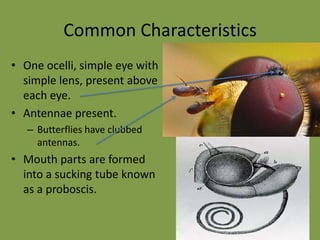
Common CharacteristicsOne ocelli, simple eye with simple lens, present above each eye.Antennae present.Butterflies have clubbed antennas.Mouth parts are formed into a sucking tube known as a proboscis.
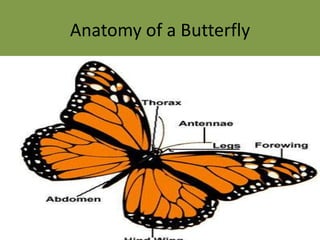
Anatomy of a Butterfly
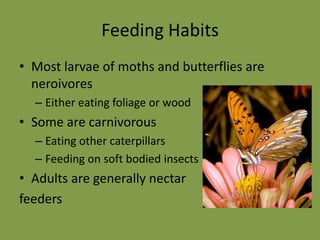
Feeding HabitsMost larvae of moths and butterflies are neroivoresEither eating foliage or woodSome are carnivorousEating other caterpillarsFeeding on soft bodied insectsAdults are generally nectar feeders
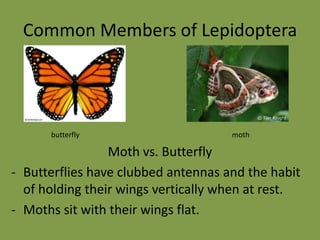
Common Members of LepidopterabutterflymothMoth vs. ButterflyButterflies have clubbed antennas and the habit of holding their wings vertically when at rest.
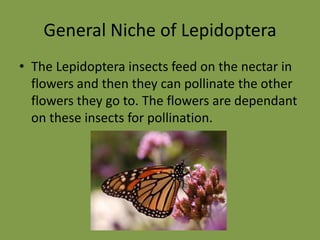
Moths sit with their wings flat.General Niche of LepidopteraThe Lepidoptera insects feed on the nectar in flowers and then they can pollinate the other flowers they go to. The flowers are dependant on these insects for pollination.
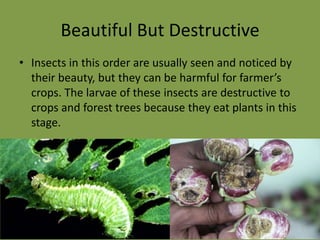
Beautiful But DestructiveInsects in this order are usually seen and noticed by their beauty, but they can be harmful for farmer’s crops. The larvae of these insects are destructive to crops and forest trees because they eat plants in this stage.
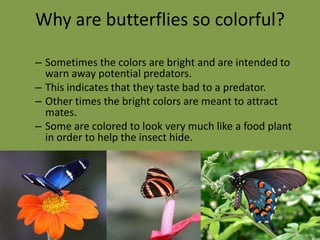
Why are butterflies so colorful?Sometimes the colors are bright and are intended to warn away potential predators. This indicates that they taste bad to a predator. Other times the bright colors are meant to attract mates. Some are colored to look very much like a food plant in order to help the insect hide.
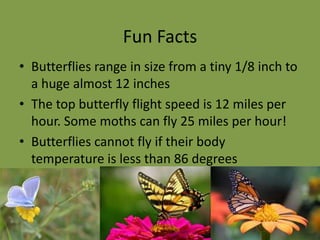
Fun FactsButterflies range in size from a tiny 1/8 inch to a huge almost 12 inchesThe top butterfly flight speed is 12 miles per hour. Some moths can fly 25 miles per hour!Butterflies cannot fly if their body temperature is less than 86 degrees

Lepidoptera

  • 1.
  • 2.
    Meaning behind LepidopteraComesfrom Greek language:Lepido meaning “scale” Ptera meaning “wing”This makes sense because the insects in this order all have wings in their adult stage and the scales refer to the small flakes that coats the wings of these insects.
  • 3.
    Life Cycle ofLepidopteraMoths and butterflies undergo a complete life cycle.EggCaterpillar (larvae)Pupae- where they undergo transformationAdult
  • 4.
    Life Cycle ofLepidopteraA female may lay only a few eggs or tens of thousands.
  • 5.
    After thecaterpillars hatch, they usually develop through 4 to 7 instars over a period of a few weeks.
  • 6.
    When the caterpillaris ready to pupate they generally find shelter to spin their cocoons. Common CharacteristicsTwo pairs of membranous (transparent) wings that are covered in tiny scales which overlap like shingles on a roof. Large compound eyes that consists of many light-sensitive lens, each with its own refractive system and each forming its own portion of the image.
  • 7.
    Common CharacteristicsOne ocelli,simple eye with simple lens, present above each eye.Antennae present.Butterflies have clubbed antennas.Mouth parts are formed into a sucking tube known as a proboscis.
  • 8.
    Anatomy of aButterfly
  • 9.
    Feeding HabitsMost larvaeof moths and butterflies are neroivoresEither eating foliage or woodSome are carnivorousEating other caterpillarsFeeding on soft bodied insectsAdults are generally nectar feeders
  • 10.
    Common Members ofLepidopterabutterflymothMoth vs. ButterflyButterflies have clubbed antennas and the habit of holding their wings vertically when at rest.
  • 11.
    Moths sit withtheir wings flat.General Niche of LepidopteraThe Lepidoptera insects feed on the nectar in flowers and then they can pollinate the other flowers they go to. The flowers are dependant on these insects for pollination.
  • 12.
    Beautiful But DestructiveInsectsin this order are usually seen and noticed by their beauty, but they can be harmful for farmer’s crops. The larvae of these insects are destructive to crops and forest trees because they eat plants in this stage.
  • 13.
    Why are butterfliesso colorful?Sometimes the colors are bright and are intended to warn away potential predators. This indicates that they taste bad to a predator. Other times the bright colors are meant to attract mates. Some are colored to look very much like a food plant in order to help the insect hide.
  • 14.
    Fun FactsButterflies rangein size from a tiny 1/8 inch to a huge almost 12 inchesThe top butterfly flight speed is 12 miles per hour. Some moths can fly 25 miles per hour!Butterflies cannot fly if their body temperature is less than 86 degrees