B.J.P.S Samiti’s
M.V.HERWADKAR ENGLISH MEDIUM HIGH SCHOOL
CLASS8th: CROP PRODUCTION AND MANAGEMENT
Program:
Semester:
Course: NAME OF THE COURSE
Staff Name: Neeta Patil 1
INTRODUCTION
•All living organisms require food. Plants can
make their food themselves.
•Green plants synthesise their own food Animals
including humans can not make their own food.
•Energy from the food is utilised by organisms
for carrying out their various body functions,
such as digestion, respiration and excretion. We
get our food from plants, or animals, or both.
M.V.HERWADKAR ENGLISH MEDIUM SCHOOL 2
TYPES OF CROPS
• When plants of the same kind are cultivated at one place
on a large scale, it is called a crop.
• (i) Kharif Crops : The crops which are sown in the rainy
season are called kharif crops. The rainy season in
India is generally from June to September. Paddy,
maize, soyabean, groundnut and cotton are kharif crops.
• (ii) Rabi Crops : The crops grown in the winter season
(October to March) are called rabi crops. Examples of
rabi crops are wheat, gram, pea, mustard and linseed.
M.V.HERWADKAR ENGLISH MEDIUM SCHOOL 3
AGRICULTURAL PRACTICES
M.V.HERWADKAR ENGLISH MEDIUM SCHOOL 4
• (i) Preparation of soil
• (ii) Sowing
• (iii) Adding manure and fertilisers
• (iv) Irrigation
• (v) Protecting from weeds
• (vi) Harvesting
• (vii) Storage
• The preparation of soil is the first step before
growing a crop. One of the most important tasks in
agriculture is to turn the soil and loosen it
• The loosened soil helps in the growth of earthworms
and microbes present in the soil. These organisms
are friends of the farmer since they further turn and
loosen the soil and add humus to it.
M.V.HERWADKAR ENGLISH MEDIUM SCHOOL 5
M.V.HERWADKAR ENGLISH MEDIUM SCHOOL 6
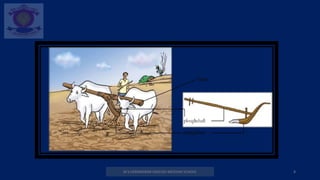
• The process of loosening and turning of the soil is called tilling or
ploughing. This is done by using a plough. Ploughs are made of
wood or iron. If the soil is very dry, it may need watering before
ploughing. The ploughed field may have big clumps of soil called
crumbs. It is necessary to break these crumbs. Levelling the field is
beneficial for sowing as well as for irrigation. Levelling of soil is
done with the help of a leveler.
• Sometimes, manure is added to the soil before tilling. This helps in
proper mixing of manure with soil. The soil is moistened before
sowing.
AGRICULTURAL IMPLEMENTS
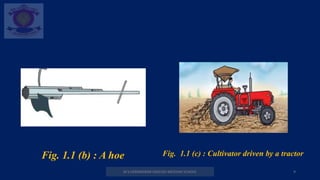
•The main tools used to break soil clumps
are plough, hoe and cultivator.
•Plough
•Hoe
•Cultivator
M.V.HERWADKAR ENGLISH MEDIUM SCHOOL 7
M.V.HERWADKAR ENGLISH MEDIUM SCHOOL 8
M.V.HERWADKAR ENGLISH MEDIUM SCHOOL 9
Fig. 1.1 (b) : A hoe Fig. 1.1 (c) : Cultivator driven by a tractor
SOWING
• Sowing is an important part of crop production.
Before sowing, good quality, clean and healthy seeds
of a good variety—are selected. Farmers prefer to
use seeds which give high yield.
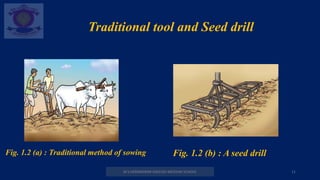
• The tools used for sowing seeds:
• Traditional tool
• Seed drill
M.V.HERWADKAR ENGLISH MEDIUM SCHOOL 10
Traditional tool and Seed drill
M.V.HERWADKAR ENGLISH MEDIUM SCHOOL 11
Fig. 1.2 (a) : Traditional method of sowing Fig. 1.2 (b) : A seed drill
Adding Manure and Fertilisers
• The substances which are added to the soil in the form of nutrients for the
healthy growth of plants are called manure and fertilisers.
• Soil supplies mineral nutrients to the crop plants. Continuous cultivation
of crops makes the soil poor in nutrients. Therefore, farmers have to add
manure to the fields to replenish the soil with nutrients. This process is
called manuring. Improper or insufficient manuring results in weak
plants.
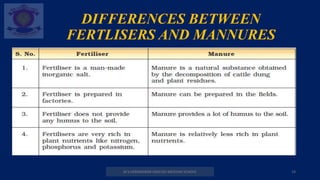
• Manure is an organic substance obtained from the decomposition of plant
or animal wastes. Farmers dump plant and animal waste in pits at open
places and allow it to decompose. The decomposition is caused by some
microorganisms. The decomposed matter is used as organic manure.
M.V.HERWADKAR ENGLISH MEDIUM SCHOOL 12
FERTILISERS
• Fertilisers are chemicals which are rich in a particular
nutrient.
• Fertilisers are produced in factories. Some examples of
fertilisers are— urea, ammonium sulphate, super
phosphate, potash, NPK (Nitrogen, Phosphorus,
Potassium). The use of fertilisers has helped farmers to get
better yield of crops such as wheat, paddy and maize. But
excessive use of fertilisers has made the soil less fertile.
Fertilisers have also become a source of water pollution.
M.V.HERWADKAR ENGLISH MEDIUM SCHOOL 13
DIFFERENCES BETWEEN
FERTLISERS AND MANNURES
M.V.HERWADKAR ENGLISH MEDIUM SCHOOL 14
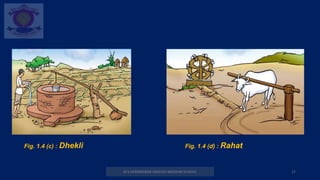
IRRIGATION
• The supply of water to crops at regular intervals is
called irrigation.
• Traditional Methods of Irrigation
• (i) moat (pulley-system) (ii) chain pump
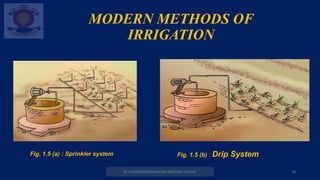
• Modern Methods of Irrigation
• (i) Sprinkler System (ii) Drip system
M.V.HERWADKAR ENGLISH MEDIUM SCHOOL 15
TRADITIONAL METHODS OF
IRRIGATION
M.V.HERWADKAR ENGLISH MEDIUM SCHOOL 16
Fig. 1.4 (a) : Moat Fig. 1.4 (b) : Chain pump
M.V.HERWADKAR ENGLISH MEDIUM SCHOOL 17
Fig. 1.4 (c) : Dhekli Fig. 1.4 (d) : Rahat
MODERN METHODS OF
IRRIGATION
M.V.HERWADKAR ENGLISH MEDIUM SCHOOL 18
Fig. 1.5 (a) : Sprinkler system Fig. 1.5 (b) : Drip System
PROTECTION FROM WEEDS
• In a field many other undesirable plants may grow naturally along with
the crop. These undesirable plants are called weeds.
• The removal of weeds is called weeding. Weeding is necessary since weeds
compete with the crop plants for water, nutrients, space and light. Thus,
they affect the growth of the crop. Some weeds interfere even in
harvesting and may be poisonous for animals and human beings.
• Weeds are also controlled by using certain chemicals, called weedicides,
like 2,4-D. These are sprayed in the fields to kill the weeds. They do not
damage the crops.
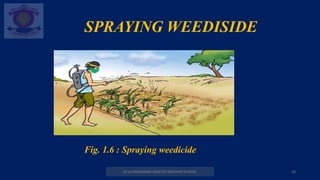
• Spraying of weedicides may affect the health of farmers. So they should
use these chemicals very carefully. They should cover their nose and
mouth with a piece of cloth during spraying of these chemicals.
M.V.HERWADKAR ENGLISH MEDIUM SCHOOL 19
SPRAYING WEEDISIDE
M.V.HERWADKAR ENGLISH MEDIUM SCHOOL 20
Fig. 1.6 : Spraying weedicide
HARVESTING
M.V.HERWADKAR ENGLISH MEDIUM SCHOOL 21
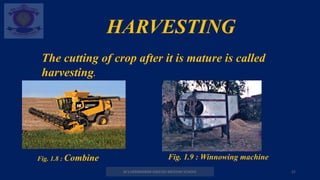
Fig. 1.8 : Combine Fig. 1.9 : Winnowing machine
The cutting of crop after it is mature is called
harvesting.
STORAGE
M.V.HERWADKAR ENGLISH MEDIUM SCHOOL 22
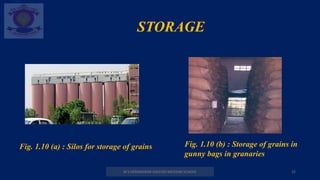
Fig. 1.10 (a) : Silos for storage of grains Fig. 1.10 (b) : Storage of grains in
gunny bags in granaries
HOMEWORK
1] What is crop? Give examples.
2] Name the agricultural practices in the cultivation of crops
3] What is ploughing?
4] Draw a neat labelled diagram of plough and explain it
5] Draw a neat labelled diagram of hoe and explain it
6] What are manures and fertilisers?
7] What are the advantages of manures?
8] Explain the modern methods of irrigation
9] Define the following terms i)harvesting ii)threshing iii)winnowing
10] What is animal husbandry?
M.V.HERWADKAR ENGLISH MEDIUM SCHOOL 23

CLASS 8 CROP PRODUCTION AND MANAGEMENT.pptx

  • 1.
    B.J.P.S Samiti’s M.V.HERWADKAR ENGLISHMEDIUM HIGH SCHOOL CLASS8th: CROP PRODUCTION AND MANAGEMENT Program: Semester: Course: NAME OF THE COURSE Staff Name: Neeta Patil 1
  • 2.
    INTRODUCTION •All living organismsrequire food. Plants can make their food themselves. •Green plants synthesise their own food Animals including humans can not make their own food. •Energy from the food is utilised by organisms for carrying out their various body functions, such as digestion, respiration and excretion. We get our food from plants, or animals, or both. M.V.HERWADKAR ENGLISH MEDIUM SCHOOL 2
  • 3.
    TYPES OF CROPS •When plants of the same kind are cultivated at one place on a large scale, it is called a crop. • (i) Kharif Crops : The crops which are sown in the rainy season are called kharif crops. The rainy season in India is generally from June to September. Paddy, maize, soyabean, groundnut and cotton are kharif crops. • (ii) Rabi Crops : The crops grown in the winter season (October to March) are called rabi crops. Examples of rabi crops are wheat, gram, pea, mustard and linseed. M.V.HERWADKAR ENGLISH MEDIUM SCHOOL 3
  • 4.
    AGRICULTURAL PRACTICES M.V.HERWADKAR ENGLISHMEDIUM SCHOOL 4 • (i) Preparation of soil • (ii) Sowing • (iii) Adding manure and fertilisers • (iv) Irrigation • (v) Protecting from weeds • (vi) Harvesting • (vii) Storage
  • 5.
    • The preparationof soil is the first step before growing a crop. One of the most important tasks in agriculture is to turn the soil and loosen it • The loosened soil helps in the growth of earthworms and microbes present in the soil. These organisms are friends of the farmer since they further turn and loosen the soil and add humus to it. M.V.HERWADKAR ENGLISH MEDIUM SCHOOL 5
  • 6.
    M.V.HERWADKAR ENGLISH MEDIUMSCHOOL 6 • The process of loosening and turning of the soil is called tilling or ploughing. This is done by using a plough. Ploughs are made of wood or iron. If the soil is very dry, it may need watering before ploughing. The ploughed field may have big clumps of soil called crumbs. It is necessary to break these crumbs. Levelling the field is beneficial for sowing as well as for irrigation. Levelling of soil is done with the help of a leveler. • Sometimes, manure is added to the soil before tilling. This helps in proper mixing of manure with soil. The soil is moistened before sowing.
  • 7.
    AGRICULTURAL IMPLEMENTS •The maintools used to break soil clumps are plough, hoe and cultivator. •Plough •Hoe •Cultivator M.V.HERWADKAR ENGLISH MEDIUM SCHOOL 7
  • 8.
  • 9.
    M.V.HERWADKAR ENGLISH MEDIUMSCHOOL 9 Fig. 1.1 (b) : A hoe Fig. 1.1 (c) : Cultivator driven by a tractor
  • 10.
    SOWING • Sowing isan important part of crop production. Before sowing, good quality, clean and healthy seeds of a good variety—are selected. Farmers prefer to use seeds which give high yield. • The tools used for sowing seeds: • Traditional tool • Seed drill M.V.HERWADKAR ENGLISH MEDIUM SCHOOL 10
  • 11.
    Traditional tool andSeed drill M.V.HERWADKAR ENGLISH MEDIUM SCHOOL 11 Fig. 1.2 (a) : Traditional method of sowing Fig. 1.2 (b) : A seed drill
  • 12.
    Adding Manure andFertilisers • The substances which are added to the soil in the form of nutrients for the healthy growth of plants are called manure and fertilisers. • Soil supplies mineral nutrients to the crop plants. Continuous cultivation of crops makes the soil poor in nutrients. Therefore, farmers have to add manure to the fields to replenish the soil with nutrients. This process is called manuring. Improper or insufficient manuring results in weak plants. • Manure is an organic substance obtained from the decomposition of plant or animal wastes. Farmers dump plant and animal waste in pits at open places and allow it to decompose. The decomposition is caused by some microorganisms. The decomposed matter is used as organic manure. M.V.HERWADKAR ENGLISH MEDIUM SCHOOL 12
  • 13.
    FERTILISERS • Fertilisers arechemicals which are rich in a particular nutrient. • Fertilisers are produced in factories. Some examples of fertilisers are— urea, ammonium sulphate, super phosphate, potash, NPK (Nitrogen, Phosphorus, Potassium). The use of fertilisers has helped farmers to get better yield of crops such as wheat, paddy and maize. But excessive use of fertilisers has made the soil less fertile. Fertilisers have also become a source of water pollution. M.V.HERWADKAR ENGLISH MEDIUM SCHOOL 13
  • 14.
    DIFFERENCES BETWEEN FERTLISERS ANDMANNURES M.V.HERWADKAR ENGLISH MEDIUM SCHOOL 14
  • 15.
    IRRIGATION • The supplyof water to crops at regular intervals is called irrigation. • Traditional Methods of Irrigation • (i) moat (pulley-system) (ii) chain pump • Modern Methods of Irrigation • (i) Sprinkler System (ii) Drip system M.V.HERWADKAR ENGLISH MEDIUM SCHOOL 15
  • 16.
    TRADITIONAL METHODS OF IRRIGATION M.V.HERWADKARENGLISH MEDIUM SCHOOL 16 Fig. 1.4 (a) : Moat Fig. 1.4 (b) : Chain pump
  • 17.
    M.V.HERWADKAR ENGLISH MEDIUMSCHOOL 17 Fig. 1.4 (c) : Dhekli Fig. 1.4 (d) : Rahat
  • 18.
    MODERN METHODS OF IRRIGATION M.V.HERWADKARENGLISH MEDIUM SCHOOL 18 Fig. 1.5 (a) : Sprinkler system Fig. 1.5 (b) : Drip System
  • 19.
    PROTECTION FROM WEEDS •In a field many other undesirable plants may grow naturally along with the crop. These undesirable plants are called weeds. • The removal of weeds is called weeding. Weeding is necessary since weeds compete with the crop plants for water, nutrients, space and light. Thus, they affect the growth of the crop. Some weeds interfere even in harvesting and may be poisonous for animals and human beings. • Weeds are also controlled by using certain chemicals, called weedicides, like 2,4-D. These are sprayed in the fields to kill the weeds. They do not damage the crops. • Spraying of weedicides may affect the health of farmers. So they should use these chemicals very carefully. They should cover their nose and mouth with a piece of cloth during spraying of these chemicals. M.V.HERWADKAR ENGLISH MEDIUM SCHOOL 19
  • 20.
    SPRAYING WEEDISIDE M.V.HERWADKAR ENGLISHMEDIUM SCHOOL 20 Fig. 1.6 : Spraying weedicide
  • 21.
    HARVESTING M.V.HERWADKAR ENGLISH MEDIUMSCHOOL 21 Fig. 1.8 : Combine Fig. 1.9 : Winnowing machine The cutting of crop after it is mature is called harvesting.
  • 22.
    STORAGE M.V.HERWADKAR ENGLISH MEDIUMSCHOOL 22 Fig. 1.10 (a) : Silos for storage of grains Fig. 1.10 (b) : Storage of grains in gunny bags in granaries
  • 23.
    HOMEWORK 1] What iscrop? Give examples. 2] Name the agricultural practices in the cultivation of crops 3] What is ploughing? 4] Draw a neat labelled diagram of plough and explain it 5] Draw a neat labelled diagram of hoe and explain it 6] What are manures and fertilisers? 7] What are the advantages of manures? 8] Explain the modern methods of irrigation 9] Define the following terms i)harvesting ii)threshing iii)winnowing 10] What is animal husbandry? M.V.HERWADKAR ENGLISH MEDIUM SCHOOL 23