B.J.P.S Samiti’s
M.V.HERWADKAR ENGLISH MEDIUM HIGH SCHOOL
CLASS: 9th CHAPTER 2: POLYNOMIALS
Program:
Semester:
Course: NAME OF THE COURSE
Staff Name: VINAYAK PATIL 1
POLYNOMIALS
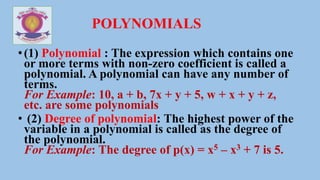
•(1) Polynomial : The expression which contains one
or more terms with non-zero coefficient is called a
polynomial. A polynomial can have any number of
terms.
For Example: 10, a + b, 7x + y + 5, w + x + y + z,
etc. are some polynomials
• (2) Degree of polynomial: The highest power of the
variable in a polynomial is called as the degree of
the polynomial.
For Example: The degree of p(x) = x5 – x3 + 7 is 5.
Types of Polynomials based on terms
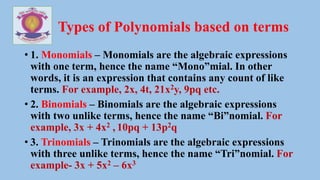
• 1. Monomials – Monomials are the algebraic expressions
with one term, hence the name “Mono”mial. In other
words, it is an expression that contains any count of like
terms. For example, 2x, 4t, 21x2y, 9pq etc.
• 2. Binomials – Binomials are the algebraic expressions
with two unlike terms, hence the name “Bi”nomial. For
example, 3x + 4x2 , 10pq + 13p2q
• 3. Trinomials – Trinomials are the algebraic expressions
with three unlike terms, hence the name “Tri”nomial. For
example- 3x + 5x2 – 6x3
Types of Polynomials based on
degree(powers)
• (1) Linear polynomial: A polynomial of degree one is called a linear
polynomial. In general a linear polynomial can be expressed in the
form ax + b where a≠0
For Example: 2x – 7, x + 5, etc. are some linear polynomial.
• (2) Quadratic polynomial: A polynomial having highest degree of two
is called a quadratic polynomial. The term ‘quadratic’ is derived from
word ‘quadrate’ which means square. In general, a quadratic
polynomial can be expressed in the form ax2 + b x + c, where a≠0 and
a, b, c are constants.
For Example: x2 – 9, a2 + a + 7, etc. are some quadratic polynomials.
• (3) Cubic Polynomial : A polynomial having highest degree of three is
called a cubic polynomial. In general, a cubic polynomial can be
expressed in the form ax3 + bx2 + cx + d, where a≠0 and a, b, c, d are
constants.
For Example: x3 – 9x +2, a3 + a2 + a + 7, etc. are some cubic
polynomial.
Zeroes of a Polynomial
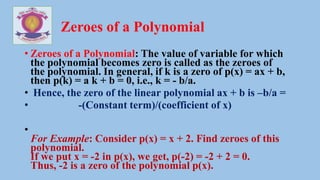
• Zeroes of a Polynomial: The value of variable for which
the polynomial becomes zero is called as the zeroes of
the polynomial. In general, if k is a zero of p(x) = ax + b,
then p(k) = a k + b = 0, i.e., k = - b/a.
• Hence, the zero of the linear polynomial ax + b is –b/a =
• -(Constant term)/(coefficient of x)
•
For Example: Consider p(x) = x + 2. Find zeroes of this
polynomial.
If we put x = -2 in p(x), we get, p(-2) = -2 + 2 = 0.
Thus, -2 is a zero of the polynomial p(x).
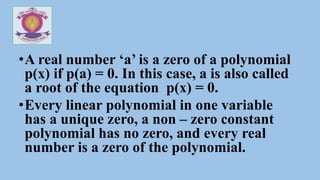
•A real number ‘a’ is a zero of a polynomial
p(x) if p(a) = 0. In this case, a is also called
a root of the equation p(x) = 0.
•Every linear polynomial in one variable
has a unique zero, a non – zero constant
polynomial has no zero, and every real
number is a zero of the polynomial.
Factorisation of Polynomials
•Factor theorem: If p(x) is a
polynomial of degree n ≥ 1 and a is
any real number then i) x – a is a
factor of p(x), if p(a) = 0 and ii) p(a) =
0, if x – a is a factor of p(x)
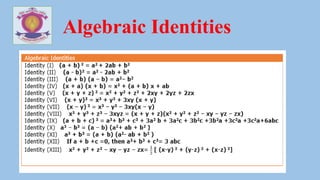
Algebraic Identities

Class 9 Maths Polynomials 2.pptx ppt ppt

  • 1.
    B.J.P.S Samiti’s M.V.HERWADKAR ENGLISHMEDIUM HIGH SCHOOL CLASS: 9th CHAPTER 2: POLYNOMIALS Program: Semester: Course: NAME OF THE COURSE Staff Name: VINAYAK PATIL 1
  • 2.
    POLYNOMIALS •(1) Polynomial :The expression which contains one or more terms with non-zero coefficient is called a polynomial. A polynomial can have any number of terms. For Example: 10, a + b, 7x + y + 5, w + x + y + z, etc. are some polynomials • (2) Degree of polynomial: The highest power of the variable in a polynomial is called as the degree of the polynomial. For Example: The degree of p(x) = x5 – x3 + 7 is 5.
  • 3.
    Types of Polynomialsbased on terms • 1. Monomials – Monomials are the algebraic expressions with one term, hence the name “Mono”mial. In other words, it is an expression that contains any count of like terms. For example, 2x, 4t, 21x2y, 9pq etc. • 2. Binomials – Binomials are the algebraic expressions with two unlike terms, hence the name “Bi”nomial. For example, 3x + 4x2 , 10pq + 13p2q • 3. Trinomials – Trinomials are the algebraic expressions with three unlike terms, hence the name “Tri”nomial. For example- 3x + 5x2 – 6x3
  • 4.
    Types of Polynomialsbased on degree(powers) • (1) Linear polynomial: A polynomial of degree one is called a linear polynomial. In general a linear polynomial can be expressed in the form ax + b where a≠0 For Example: 2x – 7, x + 5, etc. are some linear polynomial. • (2) Quadratic polynomial: A polynomial having highest degree of two is called a quadratic polynomial. The term ‘quadratic’ is derived from word ‘quadrate’ which means square. In general, a quadratic polynomial can be expressed in the form ax2 + b x + c, where a≠0 and a, b, c are constants. For Example: x2 – 9, a2 + a + 7, etc. are some quadratic polynomials. • (3) Cubic Polynomial : A polynomial having highest degree of three is called a cubic polynomial. In general, a cubic polynomial can be expressed in the form ax3 + bx2 + cx + d, where a≠0 and a, b, c, d are constants. For Example: x3 – 9x +2, a3 + a2 + a + 7, etc. are some cubic polynomial.
  • 5.
    Zeroes of aPolynomial • Zeroes of a Polynomial: The value of variable for which the polynomial becomes zero is called as the zeroes of the polynomial. In general, if k is a zero of p(x) = ax + b, then p(k) = a k + b = 0, i.e., k = - b/a. • Hence, the zero of the linear polynomial ax + b is –b/a = • -(Constant term)/(coefficient of x) • For Example: Consider p(x) = x + 2. Find zeroes of this polynomial. If we put x = -2 in p(x), we get, p(-2) = -2 + 2 = 0. Thus, -2 is a zero of the polynomial p(x).
  • 6.
    •A real number‘a’ is a zero of a polynomial p(x) if p(a) = 0. In this case, a is also called a root of the equation p(x) = 0. •Every linear polynomial in one variable has a unique zero, a non – zero constant polynomial has no zero, and every real number is a zero of the polynomial.
  • 7.
    Factorisation of Polynomials •Factortheorem: If p(x) is a polynomial of degree n ≥ 1 and a is any real number then i) x – a is a factor of p(x), if p(a) = 0 and ii) p(a) = 0, if x – a is a factor of p(x)
  • 8.