B.J.P.S Samiti’s
M.V.HERWADKAR ENGLISH MEDIUM HIGH SCHOOL
CLASS: 10th CHAPTER 1: REAL NUMBERS
Program:
Semester:
Course: NAME OF THE COURSE
Staff Name: VINAYAK PATIL 1
REAL NUMBERS
•Real numbers can be defined as the
union of both rational and irrational
numbers.
•They can be both positive or negative
and are demoted by the symbol “R”
•Real numbers include integers,
fractions and decimals
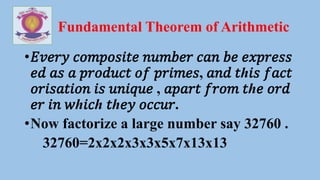
Fundamental Theorem of Arithmetic
•𝐸𝑣𝑒𝑟𝑦 𝑐𝑜𝑚𝑝𝑜𝑠𝑖𝑡𝑒 𝑛𝑢𝑚𝑏𝑒𝑟 𝑐𝑎𝑛 𝑏𝑒 𝑒𝑥𝑝𝑟𝑒𝑠𝑠
𝑒𝑑 𝑎𝑠 𝑎 𝑝𝑟𝑜𝑑𝑢𝑐𝑡 𝑜𝑓 𝑝𝑟𝑖𝑚𝑒𝑠, 𝑎𝑛𝑑 𝑡ℎ𝑖𝑠 𝑓𝑎𝑐𝑡
𝑜𝑟𝑖𝑠𝑎𝑡𝑖𝑜𝑛 𝑖𝑠 𝑢𝑛𝑖𝑞𝑢𝑒 , 𝑎𝑝𝑎𝑟𝑡 𝑓𝑟𝑜𝑚 𝑡ℎ𝑒 𝑜𝑟𝑑
𝑒𝑟 𝑖𝑛 𝑤ℎ𝑖𝑐ℎ 𝑡ℎ𝑒𝑦 𝑜𝑐𝑐𝑢𝑟.
•Now factorize a large number say 32760 .
32760=2x2x2x3x3x5x7x13x13
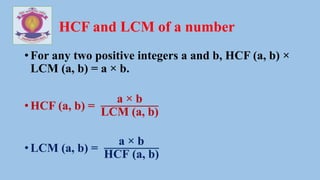
HCF and LCM of a number
• For any two positive integers a and b, HCF (a, b) ×
LCM (a, b) = a × b.
• HCF (a, b) =
a × b
LCM (a, b)
• LCM (a, b) =
a × b
HCF (a, b)
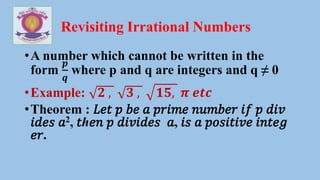
Revisiting Irrational Numbers
•A number which cannot be written in the
form
𝒑
𝒒
where p and q are integers and q ≠ 0
•Example: 𝟐 , 𝟑 , 𝟏𝟓, 𝝅 𝒆𝒕𝒄
•Theorem : 𝐿𝑒𝑡 𝑝 𝑏𝑒 𝑎 𝑝𝑟𝑖𝑚𝑒 𝑛𝑢𝑚𝑏𝑒𝑟 𝑖𝑓 𝑝 𝑑𝑖𝑣
𝑖𝑑𝑒𝑠 𝑎2, 𝑡ℎ𝑒𝑛 𝑝 𝑑𝑖𝑣𝑖𝑑𝑒𝑠 𝑎, 𝑖𝑠 𝑎 𝑝𝑜𝑠𝑖𝑡𝑖𝑣𝑒 𝑖𝑛𝑡𝑒𝑔
𝑒𝑟.
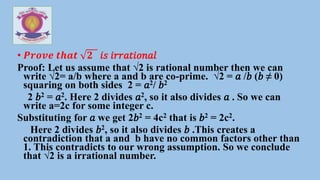
• 𝑷𝒓𝒐𝒗𝒆 𝒕𝒉𝒂𝒕 𝟐 𝑖𝑠 𝑖𝑟𝑟𝑎𝑡𝑖𝑜𝑛𝑎𝑙
Proof: Let us assume that √2 is rational number then we can
write √2= a/b where a and b are co-prime. √2 = 𝑎 /𝑏 (𝑏 ≠ 0)
squaring on both sides 2 = 𝑎2/ 𝑏2
2 𝑏2 = 𝑎2. Here 2 divides 𝑎2, so it also divides 𝑎 . So we can
write a=2c for some integer c.
Substituting for 𝑎 we get 2𝑏2 = 4c2 that is 𝑏2 = 2c2.
Here 2 divides 𝑏2, so it also divides 𝑏 .This creates a
contradiction that a and b have no common factors other than
1. This contradicts to our wrong assumption. So we conclude
that √2 is a irrational number.

Class 10 Maths Real Numbers.pptx ppt ppt

  • 1.
    B.J.P.S Samiti’s M.V.HERWADKAR ENGLISHMEDIUM HIGH SCHOOL CLASS: 10th CHAPTER 1: REAL NUMBERS Program: Semester: Course: NAME OF THE COURSE Staff Name: VINAYAK PATIL 1
  • 2.
    REAL NUMBERS •Real numberscan be defined as the union of both rational and irrational numbers. •They can be both positive or negative and are demoted by the symbol “R” •Real numbers include integers, fractions and decimals
  • 3.
    Fundamental Theorem ofArithmetic •𝐸𝑣𝑒𝑟𝑦 𝑐𝑜𝑚𝑝𝑜𝑠𝑖𝑡𝑒 𝑛𝑢𝑚𝑏𝑒𝑟 𝑐𝑎𝑛 𝑏𝑒 𝑒𝑥𝑝𝑟𝑒𝑠𝑠 𝑒𝑑 𝑎𝑠 𝑎 𝑝𝑟𝑜𝑑𝑢𝑐𝑡 𝑜𝑓 𝑝𝑟𝑖𝑚𝑒𝑠, 𝑎𝑛𝑑 𝑡ℎ𝑖𝑠 𝑓𝑎𝑐𝑡 𝑜𝑟𝑖𝑠𝑎𝑡𝑖𝑜𝑛 𝑖𝑠 𝑢𝑛𝑖𝑞𝑢𝑒 , 𝑎𝑝𝑎𝑟𝑡 𝑓𝑟𝑜𝑚 𝑡ℎ𝑒 𝑜𝑟𝑑 𝑒𝑟 𝑖𝑛 𝑤ℎ𝑖𝑐ℎ 𝑡ℎ𝑒𝑦 𝑜𝑐𝑐𝑢𝑟. •Now factorize a large number say 32760 . 32760=2x2x2x3x3x5x7x13x13
  • 4.
    HCF and LCMof a number • For any two positive integers a and b, HCF (a, b) × LCM (a, b) = a × b. • HCF (a, b) = a × b LCM (a, b) • LCM (a, b) = a × b HCF (a, b)
  • 5.
    Revisiting Irrational Numbers •Anumber which cannot be written in the form 𝒑 𝒒 where p and q are integers and q ≠ 0 •Example: 𝟐 , 𝟑 , 𝟏𝟓, 𝝅 𝒆𝒕𝒄 •Theorem : 𝐿𝑒𝑡 𝑝 𝑏𝑒 𝑎 𝑝𝑟𝑖𝑚𝑒 𝑛𝑢𝑚𝑏𝑒𝑟 𝑖𝑓 𝑝 𝑑𝑖𝑣 𝑖𝑑𝑒𝑠 𝑎2, 𝑡ℎ𝑒𝑛 𝑝 𝑑𝑖𝑣𝑖𝑑𝑒𝑠 𝑎, 𝑖𝑠 𝑎 𝑝𝑜𝑠𝑖𝑡𝑖𝑣𝑒 𝑖𝑛𝑡𝑒𝑔 𝑒𝑟.
  • 6.
    • 𝑷𝒓𝒐𝒗𝒆 𝒕𝒉𝒂𝒕𝟐 𝑖𝑠 𝑖𝑟𝑟𝑎𝑡𝑖𝑜𝑛𝑎𝑙 Proof: Let us assume that √2 is rational number then we can write √2= a/b where a and b are co-prime. √2 = 𝑎 /𝑏 (𝑏 ≠ 0) squaring on both sides 2 = 𝑎2/ 𝑏2 2 𝑏2 = 𝑎2. Here 2 divides 𝑎2, so it also divides 𝑎 . So we can write a=2c for some integer c. Substituting for 𝑎 we get 2𝑏2 = 4c2 that is 𝑏2 = 2c2. Here 2 divides 𝑏2, so it also divides 𝑏 .This creates a contradiction that a and b have no common factors other than 1. This contradicts to our wrong assumption. So we conclude that √2 is a irrational number.