Confidential 1
1) Magnetic Induction or Magnetic Flux density (B): The
magnetic induction or magnetic flux density is the number of lines of
magnetic force passing through unit area perpendicularly. Where Φ is the
magnetic flux and A is the area of cross section. Units: Weber/m2 or Tesla.
2) Magnetic Field Intensity or Intensity of Magnetic
Field (H): Magnetic Field Intensity at any point in the magnetic field is
the force experienced by an unit north pole placed at that point. Units:
A/m.
Confidential 2
3) Magnetic Permeability (µ): It describes the nature of the material
i.e. it is a material property. It is the ease with which the material allows
magnetic lines of force to pass through it or the degree to which magnetic
field can penetrate a given medium. Mathematically it is equal to the ratio
of magnetic induction B inside a material to the applied magnetic field
intensity H. Units: H/m.
Confidential 3
4) Magnetization: Process of converting a non magnetic material into
magnetic sample.
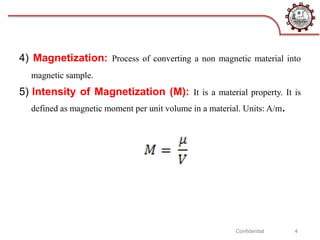
5) Intensity of Magnetization (M): It is a material property. It is
defined as magnetic moment per unit volume in a material. Units: A/m.
Confidential 4
Confidential 5
Confidential 6
Sources of Magnetic Fields
• Created by current through a coil:
• Relation for the applied magnetic field, H:
L
I
N
H 
applied magnetic field
units = (ampere-turns/m)
current
Magnetic Field Strength
magnetic field H
current I
N = total number of turns
L = length of the coil
Confidential 7
• Magnetic induction results in the material
Response to a Magnetic Field
current I
B = Magnetic Induction (tesla)
inside the material
Confidential 8
Confidential 9
Confidential 10
Origin of Magnetic Moment
Magnetism arises from the Magnetic Moment or
Magnetic dipole of Magnetic Materials.
When the electrons revolves around the nucleus Orbital
magnetic moment arises, similarly when the electron
spins, spin Magnetic moment arises.
The permanent Magnetic Moments can arise due to the
1.The orbital magnetic moment of the electrons
2.The spin magnetic moment of the electrons, and
3.The spin magnetic moment of the nucleus
Nuclear spin
Orbital motion of electrons
Origin of Magnetism Spin of electrons
A moving electric charge, macroscopically or “microscopically” is
responsible for Magnetism
Very Weak effect
Unpaired electrons required
for net Magnetic Moment
Magnetic Moment resultant from the spin of a single unpaired electron
→ Bohr Magneton = 9.273 x 1024 A/m2
Weak effect.
Confidential 11
Origin of Magnetic Moment
Confidential 12
Origin of magnetic dipoles
 The spin of the electron produces a magnetic field with a
direction dependent on the quantum number ml.
The spin of the electron produces a magnetic field with
a direction dependent on the quantum number ms.
Origin of magnetic dipoles
Confidential 13
Confidential 14
Electrons orbiting around the nucleus create a magnetic
field around the atom.
Permanent
Dipoles
Alignment of
dipoles
Direction of
dipoles
Magnitudes of
dipoles
Dia magnetic
materials
Para, Ferro, Anti ferro,
Ferri magnetic materials
Para
Uniform
Ferro, Anti ferro, Ferri
Ferro Anti ferro, Ferri
Anti ferro
Ferri
Classification of magnetic Materials
Confidential 15
Confidential 16
Diamagnetic Materials
Confidential 17
Properties
• It is a weak form of magnetism
• Diamagnetism is because of orbital magnetic moment.
• No permanent dipoles are present so net magnetic moment is zero.
• Persists only when external field is applied.
• The number of orientations of electronic orbits is such that the vector
sum of the magnetic moments is zero.
• Dipoles are induced by change in orbital motion of electrons due to
applied magnetic field.
Confidential 18
No Applied
Magnetic Field (H = 0)
Applied
Magnetic Field (H)
none
opposing
Confidential 19
Confidential 20
• External field will cause a rotation action on the individual
electronic orbits.
• The external magnetic field produces induced magnetic
moment which is due to orbital magnetic moment.
• Induced magnetic moment is always in opposite direction of
the applied magnetic field.
• So magnetic induction in the specimen decreases.
• Magnetic susceptibility is small and negative.
• Repels magnetic lines of force.
Confidential 21
• Diamagnetic susceptibility is independent of temperature and
applied magnetic field strength.
• Susceptibility is of the order of -10-5.
• Relative permeability is less than one.
• It is present in all materials, but since it is so weak it can be
observed only when other types of magnetism are totally
absent.
• Examples: Bi, Zn, gold, H2O, alkali earth elements (Be, Mg,
Ca, Sr), superconducting elements in superconducting
state.
Confidential 22
Paramagnetic Materials
Confidential 23
Properties
• Possess permanent dipoles.
• If the orbital's are not completely filled or spins not balanced,
an overall small magnetic moment may exist.
• i.e. paramagnetism is because of orbital and spin magnetic
moments of the electron.
• In the absence of external magnetic field
• all dipoles are randomly oriented
• so net magnetic moment is zero.
• Spin alignment is random.
• The magnetic dipoles do not interact
No Applied
Magnetic Field (H = 0)
Applied
Magnetic Field (H)
random
aligned
Paramagnetic Materials
Confidential 24
Confidential 25
• In presence of magnetic field the
• material gets feebly magnetized i.e. the material allows
few magnetic lines of force to pass through it.
• Relative permeability µr >1 (barely, ≈ 1.00001 to 1.01).
• The orientation of magnetic dipoles depends on temperature
and applied field.
• Susceptibility is independent of applied mag. field & depends
on temperature
• C is Curie constant
Confidential 26
Confidential 27
• With increase in temperature susceptibility decreases.
• Susceptibility is small and positive.
• These materials are used in lasers.
• Paramagnetic property of oxygen is used in NMR technique
for medical diagnose.
• The susceptibility range from 10-5 to 10-2.
• Examples: alkali metals (Li, Na, K, Rb), transition metals, Al,
Pt, Mn, Cr etc.
Confidential 28
Confidential 29
Confidential 30
Ferromagnetic Materials
Confidential 31
Properties
• Permanent dipoles are present so possess net magnetic
moment
• Origin for magnetism in Ferro mag. Materials is due to Spin
magnetic moment of electrons.
• Material shows magnetic properties even in the absence of
external magnetic field.
• Possess spontaneous magnetization.
• Spontaneous magnetization is because of interaction between
dipoles called EXCHANGE COUPLING.
Confidential 32
aligned
aligned
No Applied
Magnetic Field (H = 0)
Applied
Magnetic Field (H)
• Magnetic susceptibility is as high as 106.
• So H << M. thus Bs = µoMs
Confidential 33
Magnetic
induction
B
(tesla)
Strength of applied magnetic field (H)
(ampere-turns/m)
Ferromagnetic
Confidential 34
• When placed in external mag. field it strongly attracts magnetic
lines of force.
• All spins are aligned parallel & in same direction.
• Susceptibility is large and positive, it is given by Curie Weiss
Law
• C is Curie constant & θ is Curie temperature.
• When temp is greater than curie temp then the material gets
converted in to paramagnetic.
• Material gets divided into small regions called domains.
• They possess the property of HYSTERESIS.
• Examples: Fe, Co, Ni.
Ferro magnetic Materials
Even when H = 0, the dipoles
tend to strongly align over
small patches.
When H is applied, the domains
align to produce a large net
magnetization.
Confidential 35
Thermal energy can randomize the spin
Ferromagnetic Paramagnetic
Tcurie
Heat
Tc for different materials:
Fe=1043 K, Ni=631 K,
Co=1400 K, Gd= 298 K
Confidential 36
Curie Temperature
 The temperature above (Tc) which ferromagnetic material become
paramagnetic.
 Below the Curie temperature, the ferromagnetic is ordered and
above it, disordered.
 The saturation magnetization goes to zero at the Curie
temperature.
Confidential 37
Confidential 38
Antiferro magnetic
Material
Confidential 39
Properties
• The spin alignment is in antiparallel manner.
• So net magnetic moment is zero.
• Susceptibility depends on temperature.
• Susceptibility is small and positive.
• Initially susceptibility increases with increase in temperature
and beyond Neel temperature the susceptibility decreases with
temperature.
• At Neel temperature susceptibility is maximum.
• Examples: FeO, MnO, Cr2O3 and salts of transition elements.
Confidential 40
Confidential 41
Confidential 42
Ferri-magnetic Materials
Confidential 43
Classification of Ferri-magnetic
Materials
Ferrimagnetic
Materials
Cubic Ferrites
MFe2O4
Hexagonal
Ferrites
AB12O19
Garnets
M3Fe5O12
Confidential 44
Properties
• Special type of ferro and antiferromagnetic material.
• Generally oxides in nature.
• Ionic in nature
• Ceramic in nature so high resistivity (insulators)
• The spin alignment is antiparallel but different magnitude.
• So they possess net magnetic moment.
• Also called ferrites.
• General form MFe2O4 where M is a divalent metal ion.
• Susceptibility is very large and positive.
• Examples: ferrous ferrite, nickle ferrite
Confidential 45
Ion
Mn2+ 3d5
E.C Spin Orientation Net Spin S Magnetic Moment
5/2 5µB
Fe2+ 3d6 2 4µB
Co2+ 3d7 3/2 3µB
Ni2+ 3d8 1 2µB
Cu2+ 3d9 1/2 1µB
Confidential 46
Unpaired electrons give rise to ferromagnetism in alkali
metals
Net magnetic moment
Na 3s1
1 B
Fe 3d64s2 4 B
atom crystal
2.2 B
Co 3d74s2 3 B 1.7 B
Ni 3d84s2
2 B 0.6 B
Ms = m. N
N = ρ NA/A
Ferrimagnetism
• All Fe2+ have a spin magnetic
moment.
• Half of Fe3+ have a spin moment in
one direction, the other half in the
other (decreasing the overall moment
to just that contributed by the Fe2+
ions).
Simpler picture showing a net
magnetic moment.
Confidential 47
Ferrimagnetism-Structure
Confidential 48
Confidential 49
Confidential 50
Domain Theory of Ferromagnetic
Materials
Confidential 51
Domain Theory of Ferromagnetism
The domain in ferromagnetic solid is understandable from
the thermo dynamical principle (i.e,) in equilibrium the
total energy of the system is minimum.
Total Energy of the domains comprises the sum of
(i) Exchange Energy (or) Magnetic Field Energy
(ii) Anisotropic Energy => Easy and Hard direction
(iii)Domain Wall Energy => Thick wall and Thin Wall
(iv) Magneto-strictive Energy
Exchange Energy or Magnetic Field
Energy
• The interaction energy that makes the adjacent
dipoles to align themselves is known as Exchange
Energy.
• It establishes a single domain in the ferromagnetic
material.
• It is the energy required in assembling the atomic
magnets into a single domain and this work done is
stored as potential energy.
Confidential 52
Confidential 53
Anisotropy Energy
• Two types of directions of magnetization
• Easy Direction
• Hard Direction
• Along easy direction weak field.
• Along hard direction strong field.
• For producing same amount of magnetisation.
• The excess of energy required to magnetize the
specimen along hard direction over that required to
magnetize the specimen along easy direction is called
crystalline anistropy energy.
Confidential 54
Confidential 55
Domain Wall Energy or Bloch Wall
Energy
• Bloch is a transition layer which separates the adjacent
domains, magnetized in different directions.
• Based on the spin alignments Thick Wall & Thin Wall
• Thick Wall: When the spins at the boundary are
misaligned and if the direction of the spins changes
gradually. The misalignment of spins is associated with
exchange energy.
• Thin Wall: When the spins at the boundaries changes
abruptly, then the anistropic energy becomes very less.
• Ansitropy energy is directly proportional to the thickness
of the wall.
Confidential 56
• Bloch walls - The boundaries between magnetic domains.
Domain Structure and the Hysteresis Loop
• The entire change in spin direction between domains does not
occur in one sudden jump across a single atomic plane rather takes
place in a gradual way extending over many atomic planes.
Bloch Wall
• The magnetic moments in adjoining atoms change direction continuously
across the boundary between domains.
Confidential 57
Magnetostrictive Energy
• When the domains are magnatised in different directions,
they will either expand or shrink this leads to deformation
of the material, when magnetised. This phenomenon is
known as magnetostriction.
• Energy produced in this effect is called Magnetostriction
Energy.
• The deformation is different along different crystal
directions & the change in dimension depends on nature
of the material.
Confidential 58
Confidential 59
Confidential 60
Confidential 61
Ferromagnetism
• Materials that retain a
magnetization in zero
field
• Quantum mechanical
exchange interactions
favour parallel
alignment of moments
• Examples: iron, cobalt
Confidential 62
• According to Becker, there are two independent
processes which take place and lead to magnetization
when magnetic field is applied.
1. Domain wall moment or Domain growth
2. Domain rotation
Domain wall moment or Domain wall
growth
• Volume of favorably oriented domains will increase.
• Occurs at low magnetic field.
• It is a reversible process.
Confidential 63
Rotation of Domains
• Rotation of less favorably oriented domains takes
place.
• Occurs at large magnetic field.
• It is a irreversible process.
Domain Structure and the Hysteresis Loop
1. Domain growth:
1. Each domain is magnetized in a different direction
2. Applying a field changes domain structure. Domains with
magnetization in direction of field grow.
3. Other domains shrink
2. Domain rotation:
Finally by applying very strong fields can saturate magnetization
by creating single domain Confidential 64
Confidential 65
Magnetic domains
• Applying very strong
fields can saturate
magnetization by
creating single domain
Confidential 66
Hysteresis Curve
• Means lagging or retarding of an effect behind the
cause of the effect.
• Here effect is B & cause of the effect is H.
• Also called B H curve.
• Hysteresis in magnetic materials means lagging of
magnetic induction (B) or magnetization (M) behind
the magnetizing field (H).
Confidential 67
Confidential 68
• “Domains” with
aligned magnetic
moment grow at
expense of poorly
aligned ones!
Domain Structure and the Hysteresis Loop
• Notice the permeability values depend upon the magnitude of H.
 When a magnetic field is first applied
to a magnetic material, magnetization
initially increases slowly, then more
rapidly as the domains begin to grow.
 Later, magnetization slows, as
domains must eventually rotate to reach
saturation.
Domain Structure and the Hysteresis Loop
Confidential 69
• Hysteresis loop - The loop traced out by magnetization in a
ferromagnetic or ferrimagnetic material as the magnetic field is
cycled. OR
• Removing the field does not necessarily return domain structure to
original state. Hence results in magnetic hysteresis.
Hysteresis Loop
Applied Magnetic
Field (H)
1. initial (unmagnetized state)
B
2. apply H, cause
alignment
4
Negative H needed to demagnitize!
. Coercivity, HC
3. remove H, alignment stays!
=> permanent magnet!
Confidential 70
Ferromagnetism: Magnetic hysteresis
Ms – Saturation
magnetization
Hc – Coercive force
(the field needed to
bring the magnetization
back to zero)
Mrs– Saturation remanent
magnetization
M
H
Mrs
Hc
Ms
71
Confidential 72
remanent magnetization = M0
coercivity = Hc
Domain growth reversible
boundary displacements.
Domain growth irreversible
boundary displacements.
Magnetization by
domain rotation
Hysteresis Loop
• Means lagging or retarding of an
effect behind the cause of the effect.
• Here effect is B & cause of the effect
is H.
• Also called B H curve.
• Hysteresis in magnetic materials
means lagging of magnetic induction
(B) or magnetization (M) behind the
magnetizing field (H).
Confidential 73
Confidential 74
Hysteresis, Remanence, & Coercivity of
Ferromagnetic Materials
Confidential 75
“hard” ferromagnetic material
has a large M0 and large Hc.
“soft” ferromagnetic material
has both a small M0 and Hc.
Confidential 76
Confidential 77
Hard versus Soft Magnets
 High initial permeability.
 Low coercivity.
 Reaches to saturation magnetization with a
relatively low applied magnetic field.
 It can be easily magnetized and demagnetized.
 Low Hysteresis loss.
 Applications involve, generators, motors,
dynamos, Cores of transformers and switching
circuits.
Characteristics of soft magnetic materials:
Soft Magnets:
Confidential 78
Importance of Soft Magnetic Materials:
 Saturation magnetization can be changed by altering composition
of the materials.
Ex:- substitution of Ni2+ in place of Fe2+ changes saturation
magnetization of ferrous-Ferrite.
 Susceptibility and coercivity which also influence the shape of the
Hysteresis curve are sensitive to the structural variables rather than
composition.
 Low value of coercivity corresponds to the easy movement of
domain walls as magnetic field changes magnitude and/ or direction.
Confidential 79
Hard versus Soft Magnets
Characteristics of Hard magnetic materials:
 Low initial permeability.
 High coercivity and High remanence.
 High saturation flux density.
 Reaches to saturation magnetization with a
high applied magnetic field.
 It can not be easily magnetized and
demagnetized.
 High Hysteresis loss.
 Used as permanent magnets.
Hard Magnets:
Confidential 80
Two important characteristics related to applications of these materials are (i)
Coercivity and (ii) energy product expressed as (BH)max with units in kJ/m3.
 This corresponds to the area of largest B-H rectangle that can be
constructed within the second quadrant of the Hysteresis curve.
 Larger the value of energy product harder is the material in terms of its
magnetic characteristics.
Schematic magnetization curve that displays hysteresis. Within
the second quadrant are drawn two B–H energy product
rectangles; the area of that rectangle labeled (BH)max is the
largest possible, which is greater than the area defined by Bd–
Hd
Confidential 81
Importance of Hard magnetic material
Who to get larger area of (BH)max i.e., who to
produce Hard magnets?
 Energy product represents the amount of energy required to demagnetize a
permanent magnet.
 Hysteresis behaviour depends upon the movement of domain walls.
 The movement of domain walls depends on the final microstructure.
Ex: the size, shape and orientation of crystal domains and impurities.
 Microstructure will depend upon how the material is processed.
 In a hard magnetic material, impurities are purposely introduced, to make
it hard. Due to these impurities domain walls cannot move easily.
 Finally the coercivity can increase and susceptibility can be decrease.
 So large external field is required to demagnetization i.e., difficult to move
the domain walls.
Confidential 82
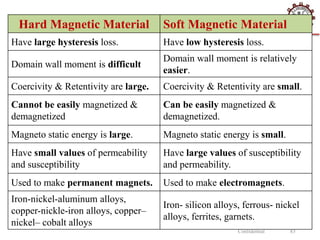
Hard Magnetic Material Soft Magnetic Material
Have large hysteresis loss. Have low hysteresis loss.
Domain wall moment is difficult
Domain wall moment is relatively
easier.
Coercivity & Retentivity are large. Coercivity & Retentivity are small.
Cannot be easily magnetized &
demagnetized
Can be easily magnetized &
demagnetized.
Magneto static energy is large. Magneto static energy is small.
Have small values of permeability
and susceptibility
Have large values of susceptibility
and permeability.
Used to make permanent magnets. Used to make electromagnets.
Iron-nickel-aluminum alloys,
copper-nickle-iron alloys, copper–
nickel– cobalt alloys
Iron- silicon alloys, ferrous- nickel
alloys, ferrites, garnets.
Confidential 83
Confidential 84
Applications
of
Magnetic Materials
Confidential 85
1) Ferrite Applications
2) Magnetic Storage
Reading Process
Writing Process
Storage of data( Tapes, Floppy and Magnetic
Disc Drives)
3) Transformer
4) Motors
Magnetic materials applications
 Since ferrites have a domains & hysteresis loop they are used as
memory elements for rapid storage and retrieval of digital
information by switching the direction of magnetization in very
small toroidal cores.
 Garnets (Y3Fe5O12) are useful in microwave applications.
 Magnetic recording uses ferrite material in powder form.
 Ferrites can be used as magnets.
FERRITE APPLICATIONS
Ferrites Being Ferro-magnetic but high resistivity
eddy currents less effective
Used as transformer cores
Used as induction cores, antennas for medium and long wave broad
casting, electronic tuning, auto frequency control, FM, switching etc.
Confidential 86
Transformer Core
 Should be ceramic in nature.
 Should have very high permeability.
 The material should have very high susceptibility.
 The material should have low coresive field and low remeanent field.
 Magnetostriction should be small.
http://www.marktec.co.jp/e/product/ndt/ect/et.html
Properties:
--Best example is Iron-Silicon
alloy (97% Fe & 3% Si)
--Fe-Si (alloy) anisotropic poly
crystalline materials can develop
via plastic deformation, for
example by rolling.
Confidential 87
M V V K Srinivas Prasad; K L University
-- For body centred cubic alloys including Fe-Si alloy, the rolling texture
is (1 1 0) [0 0 1].
1/6/2024 Confidential 88
Magnetic Storage Devices
• Head can...
--apply magnetic field H & align
domains (i.e., magnetize the medium).
--detect a change in the magnetization
of the medium.
• Information is stored by magnetizing material due to high retentivity.
Recording Head: Soft Magnetic
Materials
Ex: Fe-Ni, Fe-Al-Si alloy, Mn-Zn
ferrite, Ni-Zn ferrite
Confidential 89
Recording Principle (Digital)
Confidential 90
How Magnetic Storage Works
 A magnetic disk's medium contains
iron particles, which can be
polarized—given a magnetic
charge—in one of two directions.
 Each particle's direction represents a
1 (on) or 0 (off), representing each bit
of data that the CPU can recognize.
 A disk drive uses read/write heads
containing electromagnets to create
magnetic charges on the medium.
Confidential 91
Confidential 92
Confidential 93
Magnetic Storage Devices
• There are two types of magnetic storage media.
• Those are particulate and thin film.
• Particulate media consist of very small needle like or acicular particles.
• Ex: γ-Fe2O3 ferrite, Co- γ- Fe2O3 ferrite and CrO2 .
Confidential 94
Thin film: It provides higher storage capacities at lower costs.
Ex: Co-Pt-Cr alloy, Co-Cr-Ta alloy (thickness 10 to 50 nm).Domains
are ~ 10-30nm! (hard drive)
• The thin film is a poly crystalline material.
• Each grain within the thin film is a single magnetic domain.
• The grain shape and size must be uniform.
Magnetic Storage Devices
Confidential 95
Magnetic Storage Devices
Thin film:
Confidential 96
Confidential 97
Confidential 98
Magnetic Tapes
Confidential 99
©2003 Brooks/Cole, a division of Thomson Learning, Inc. Thomson Learning™ is a trademark used herein under license.
Confidential 100
Confidential 101
Confidential 102
 Hard magnetic materials are used.
 Motor converts electrical energy into mechanical energy.
 No heat is generated during operation.
 Motors using permanent magnets are much smaller than their
electromagnets motors.
MOTORS
http://www.animations.physics.unsw.edu.au/jw/electricmotors.html
Confidential 103
Confidential 104

magnetic-materials-.pptx

  • 1.
  • 2.
    1) Magnetic Inductionor Magnetic Flux density (B): The magnetic induction or magnetic flux density is the number of lines of magnetic force passing through unit area perpendicularly. Where Φ is the magnetic flux and A is the area of cross section. Units: Weber/m2 or Tesla. 2) Magnetic Field Intensity or Intensity of Magnetic Field (H): Magnetic Field Intensity at any point in the magnetic field is the force experienced by an unit north pole placed at that point. Units: A/m. Confidential 2
  • 3.
    3) Magnetic Permeability(µ): It describes the nature of the material i.e. it is a material property. It is the ease with which the material allows magnetic lines of force to pass through it or the degree to which magnetic field can penetrate a given medium. Mathematically it is equal to the ratio of magnetic induction B inside a material to the applied magnetic field intensity H. Units: H/m. Confidential 3
  • 4.
    4) Magnetization: Processof converting a non magnetic material into magnetic sample. 5) Intensity of Magnetization (M): It is a material property. It is defined as magnetic moment per unit volume in a material. Units: A/m. Confidential 4
  • 5.
  • 6.
  • 7.
    • Created bycurrent through a coil: • Relation for the applied magnetic field, H: L I N H  applied magnetic field units = (ampere-turns/m) current Magnetic Field Strength magnetic field H current I N = total number of turns L = length of the coil Confidential 7
  • 8.
    • Magnetic inductionresults in the material Response to a Magnetic Field current I B = Magnetic Induction (tesla) inside the material Confidential 8
  • 9.
  • 10.
    Confidential 10 Origin ofMagnetic Moment Magnetism arises from the Magnetic Moment or Magnetic dipole of Magnetic Materials. When the electrons revolves around the nucleus Orbital magnetic moment arises, similarly when the electron spins, spin Magnetic moment arises. The permanent Magnetic Moments can arise due to the 1.The orbital magnetic moment of the electrons 2.The spin magnetic moment of the electrons, and 3.The spin magnetic moment of the nucleus
  • 11.
    Nuclear spin Orbital motionof electrons Origin of Magnetism Spin of electrons A moving electric charge, macroscopically or “microscopically” is responsible for Magnetism Very Weak effect Unpaired electrons required for net Magnetic Moment Magnetic Moment resultant from the spin of a single unpaired electron → Bohr Magneton = 9.273 x 1024 A/m2 Weak effect. Confidential 11 Origin of Magnetic Moment
  • 12.
    Confidential 12 Origin ofmagnetic dipoles  The spin of the electron produces a magnetic field with a direction dependent on the quantum number ml.
  • 13.
    The spin ofthe electron produces a magnetic field with a direction dependent on the quantum number ms. Origin of magnetic dipoles Confidential 13
  • 14.
    Confidential 14 Electrons orbitingaround the nucleus create a magnetic field around the atom.
  • 15.
    Permanent Dipoles Alignment of dipoles Direction of dipoles Magnitudesof dipoles Dia magnetic materials Para, Ferro, Anti ferro, Ferri magnetic materials Para Uniform Ferro, Anti ferro, Ferri Ferro Anti ferro, Ferri Anti ferro Ferri Classification of magnetic Materials Confidential 15
  • 16.
  • 17.
    Confidential 17 Properties • Itis a weak form of magnetism • Diamagnetism is because of orbital magnetic moment. • No permanent dipoles are present so net magnetic moment is zero. • Persists only when external field is applied. • The number of orientations of electronic orbits is such that the vector sum of the magnetic moments is zero. • Dipoles are induced by change in orbital motion of electrons due to applied magnetic field.
  • 18.
    Confidential 18 No Applied MagneticField (H = 0) Applied Magnetic Field (H) none opposing
  • 19.
  • 20.
    Confidential 20 • Externalfield will cause a rotation action on the individual electronic orbits. • The external magnetic field produces induced magnetic moment which is due to orbital magnetic moment. • Induced magnetic moment is always in opposite direction of the applied magnetic field. • So magnetic induction in the specimen decreases. • Magnetic susceptibility is small and negative. • Repels magnetic lines of force.
  • 21.
    Confidential 21 • Diamagneticsusceptibility is independent of temperature and applied magnetic field strength. • Susceptibility is of the order of -10-5. • Relative permeability is less than one. • It is present in all materials, but since it is so weak it can be observed only when other types of magnetism are totally absent. • Examples: Bi, Zn, gold, H2O, alkali earth elements (Be, Mg, Ca, Sr), superconducting elements in superconducting state.
  • 22.
  • 23.
    Confidential 23 Properties • Possesspermanent dipoles. • If the orbital's are not completely filled or spins not balanced, an overall small magnetic moment may exist. • i.e. paramagnetism is because of orbital and spin magnetic moments of the electron. • In the absence of external magnetic field • all dipoles are randomly oriented • so net magnetic moment is zero. • Spin alignment is random. • The magnetic dipoles do not interact
  • 24.
    No Applied Magnetic Field(H = 0) Applied Magnetic Field (H) random aligned Paramagnetic Materials Confidential 24
  • 25.
    Confidential 25 • Inpresence of magnetic field the • material gets feebly magnetized i.e. the material allows few magnetic lines of force to pass through it. • Relative permeability µr >1 (barely, ≈ 1.00001 to 1.01). • The orientation of magnetic dipoles depends on temperature and applied field. • Susceptibility is independent of applied mag. field & depends on temperature • C is Curie constant
  • 26.
  • 27.
    Confidential 27 • Withincrease in temperature susceptibility decreases. • Susceptibility is small and positive. • These materials are used in lasers. • Paramagnetic property of oxygen is used in NMR technique for medical diagnose. • The susceptibility range from 10-5 to 10-2. • Examples: alkali metals (Li, Na, K, Rb), transition metals, Al, Pt, Mn, Cr etc.
  • 28.
  • 29.
  • 30.
  • 31.
    Confidential 31 Properties • Permanentdipoles are present so possess net magnetic moment • Origin for magnetism in Ferro mag. Materials is due to Spin magnetic moment of electrons. • Material shows magnetic properties even in the absence of external magnetic field. • Possess spontaneous magnetization. • Spontaneous magnetization is because of interaction between dipoles called EXCHANGE COUPLING.
  • 32.
    Confidential 32 aligned aligned No Applied MagneticField (H = 0) Applied Magnetic Field (H)
  • 33.
    • Magnetic susceptibilityis as high as 106. • So H << M. thus Bs = µoMs Confidential 33 Magnetic induction B (tesla) Strength of applied magnetic field (H) (ampere-turns/m) Ferromagnetic
  • 34.
    Confidential 34 • Whenplaced in external mag. field it strongly attracts magnetic lines of force. • All spins are aligned parallel & in same direction. • Susceptibility is large and positive, it is given by Curie Weiss Law • C is Curie constant & θ is Curie temperature. • When temp is greater than curie temp then the material gets converted in to paramagnetic. • Material gets divided into small regions called domains. • They possess the property of HYSTERESIS. • Examples: Fe, Co, Ni.
  • 35.
    Ferro magnetic Materials Evenwhen H = 0, the dipoles tend to strongly align over small patches. When H is applied, the domains align to produce a large net magnetization. Confidential 35
  • 36.
    Thermal energy canrandomize the spin Ferromagnetic Paramagnetic Tcurie Heat Tc for different materials: Fe=1043 K, Ni=631 K, Co=1400 K, Gd= 298 K Confidential 36
  • 37.
    Curie Temperature  Thetemperature above (Tc) which ferromagnetic material become paramagnetic.  Below the Curie temperature, the ferromagnetic is ordered and above it, disordered.  The saturation magnetization goes to zero at the Curie temperature. Confidential 37
  • 38.
  • 39.
    Confidential 39 Properties • Thespin alignment is in antiparallel manner. • So net magnetic moment is zero. • Susceptibility depends on temperature. • Susceptibility is small and positive. • Initially susceptibility increases with increase in temperature and beyond Neel temperature the susceptibility decreases with temperature. • At Neel temperature susceptibility is maximum. • Examples: FeO, MnO, Cr2O3 and salts of transition elements.
  • 40.
  • 41.
  • 42.
  • 43.
    Confidential 43 Classification ofFerri-magnetic Materials Ferrimagnetic Materials Cubic Ferrites MFe2O4 Hexagonal Ferrites AB12O19 Garnets M3Fe5O12
  • 44.
    Confidential 44 Properties • Specialtype of ferro and antiferromagnetic material. • Generally oxides in nature. • Ionic in nature • Ceramic in nature so high resistivity (insulators) • The spin alignment is antiparallel but different magnitude. • So they possess net magnetic moment. • Also called ferrites. • General form MFe2O4 where M is a divalent metal ion. • Susceptibility is very large and positive. • Examples: ferrous ferrite, nickle ferrite
  • 45.
    Confidential 45 Ion Mn2+ 3d5 E.CSpin Orientation Net Spin S Magnetic Moment 5/2 5µB Fe2+ 3d6 2 4µB Co2+ 3d7 3/2 3µB Ni2+ 3d8 1 2µB Cu2+ 3d9 1/2 1µB
  • 46.
    Confidential 46 Unpaired electronsgive rise to ferromagnetism in alkali metals Net magnetic moment Na 3s1 1 B Fe 3d64s2 4 B atom crystal 2.2 B Co 3d74s2 3 B 1.7 B Ni 3d84s2 2 B 0.6 B Ms = m. N N = ρ NA/A
  • 47.
    Ferrimagnetism • All Fe2+have a spin magnetic moment. • Half of Fe3+ have a spin moment in one direction, the other half in the other (decreasing the overall moment to just that contributed by the Fe2+ ions). Simpler picture showing a net magnetic moment. Confidential 47
  • 48.
  • 49.
  • 50.
    Confidential 50 Domain Theoryof Ferromagnetic Materials
  • 51.
    Confidential 51 Domain Theoryof Ferromagnetism The domain in ferromagnetic solid is understandable from the thermo dynamical principle (i.e,) in equilibrium the total energy of the system is minimum. Total Energy of the domains comprises the sum of (i) Exchange Energy (or) Magnetic Field Energy (ii) Anisotropic Energy => Easy and Hard direction (iii)Domain Wall Energy => Thick wall and Thin Wall (iv) Magneto-strictive Energy
  • 52.
    Exchange Energy orMagnetic Field Energy • The interaction energy that makes the adjacent dipoles to align themselves is known as Exchange Energy. • It establishes a single domain in the ferromagnetic material. • It is the energy required in assembling the atomic magnets into a single domain and this work done is stored as potential energy. Confidential 52
  • 53.
  • 54.
    Anisotropy Energy • Twotypes of directions of magnetization • Easy Direction • Hard Direction • Along easy direction weak field. • Along hard direction strong field. • For producing same amount of magnetisation. • The excess of energy required to magnetize the specimen along hard direction over that required to magnetize the specimen along easy direction is called crystalline anistropy energy. Confidential 54
  • 55.
  • 56.
    Domain Wall Energyor Bloch Wall Energy • Bloch is a transition layer which separates the adjacent domains, magnetized in different directions. • Based on the spin alignments Thick Wall & Thin Wall • Thick Wall: When the spins at the boundary are misaligned and if the direction of the spins changes gradually. The misalignment of spins is associated with exchange energy. • Thin Wall: When the spins at the boundaries changes abruptly, then the anistropic energy becomes very less. • Ansitropy energy is directly proportional to the thickness of the wall. Confidential 56
  • 57.
    • Bloch walls- The boundaries between magnetic domains. Domain Structure and the Hysteresis Loop • The entire change in spin direction between domains does not occur in one sudden jump across a single atomic plane rather takes place in a gradual way extending over many atomic planes. Bloch Wall • The magnetic moments in adjoining atoms change direction continuously across the boundary between domains. Confidential 57
  • 58.
    Magnetostrictive Energy • Whenthe domains are magnatised in different directions, they will either expand or shrink this leads to deformation of the material, when magnetised. This phenomenon is known as magnetostriction. • Energy produced in this effect is called Magnetostriction Energy. • The deformation is different along different crystal directions & the change in dimension depends on nature of the material. Confidential 58
  • 59.
  • 60.
  • 61.
    Confidential 61 Ferromagnetism • Materialsthat retain a magnetization in zero field • Quantum mechanical exchange interactions favour parallel alignment of moments • Examples: iron, cobalt
  • 62.
    Confidential 62 • Accordingto Becker, there are two independent processes which take place and lead to magnetization when magnetic field is applied. 1. Domain wall moment or Domain growth 2. Domain rotation
  • 63.
    Domain wall momentor Domain wall growth • Volume of favorably oriented domains will increase. • Occurs at low magnetic field. • It is a reversible process. Confidential 63 Rotation of Domains • Rotation of less favorably oriented domains takes place. • Occurs at large magnetic field. • It is a irreversible process.
  • 64.
    Domain Structure andthe Hysteresis Loop 1. Domain growth: 1. Each domain is magnetized in a different direction 2. Applying a field changes domain structure. Domains with magnetization in direction of field grow. 3. Other domains shrink 2. Domain rotation: Finally by applying very strong fields can saturate magnetization by creating single domain Confidential 64
  • 65.
    Confidential 65 Magnetic domains •Applying very strong fields can saturate magnetization by creating single domain
  • 66.
    Confidential 66 Hysteresis Curve •Means lagging or retarding of an effect behind the cause of the effect. • Here effect is B & cause of the effect is H. • Also called B H curve. • Hysteresis in magnetic materials means lagging of magnetic induction (B) or magnetization (M) behind the magnetizing field (H).
  • 67.
  • 68.
    Confidential 68 • “Domains”with aligned magnetic moment grow at expense of poorly aligned ones! Domain Structure and the Hysteresis Loop
  • 69.
    • Notice thepermeability values depend upon the magnitude of H.  When a magnetic field is first applied to a magnetic material, magnetization initially increases slowly, then more rapidly as the domains begin to grow.  Later, magnetization slows, as domains must eventually rotate to reach saturation. Domain Structure and the Hysteresis Loop Confidential 69
  • 70.
    • Hysteresis loop- The loop traced out by magnetization in a ferromagnetic or ferrimagnetic material as the magnetic field is cycled. OR • Removing the field does not necessarily return domain structure to original state. Hence results in magnetic hysteresis. Hysteresis Loop Applied Magnetic Field (H) 1. initial (unmagnetized state) B 2. apply H, cause alignment 4 Negative H needed to demagnitize! . Coercivity, HC 3. remove H, alignment stays! => permanent magnet! Confidential 70
  • 71.
    Ferromagnetism: Magnetic hysteresis Ms– Saturation magnetization Hc – Coercive force (the field needed to bring the magnetization back to zero) Mrs– Saturation remanent magnetization M H Mrs Hc Ms 71
  • 72.
  • 73.
    Domain growth reversible boundarydisplacements. Domain growth irreversible boundary displacements. Magnetization by domain rotation Hysteresis Loop • Means lagging or retarding of an effect behind the cause of the effect. • Here effect is B & cause of the effect is H. • Also called B H curve. • Hysteresis in magnetic materials means lagging of magnetic induction (B) or magnetization (M) behind the magnetizing field (H). Confidential 73
  • 74.
    Confidential 74 Hysteresis, Remanence,& Coercivity of Ferromagnetic Materials
  • 75.
    Confidential 75 “hard” ferromagneticmaterial has a large M0 and large Hc. “soft” ferromagnetic material has both a small M0 and Hc.
  • 76.
  • 77.
  • 78.
    Hard versus SoftMagnets  High initial permeability.  Low coercivity.  Reaches to saturation magnetization with a relatively low applied magnetic field.  It can be easily magnetized and demagnetized.  Low Hysteresis loss.  Applications involve, generators, motors, dynamos, Cores of transformers and switching circuits. Characteristics of soft magnetic materials: Soft Magnets: Confidential 78
  • 79.
    Importance of SoftMagnetic Materials:  Saturation magnetization can be changed by altering composition of the materials. Ex:- substitution of Ni2+ in place of Fe2+ changes saturation magnetization of ferrous-Ferrite.  Susceptibility and coercivity which also influence the shape of the Hysteresis curve are sensitive to the structural variables rather than composition.  Low value of coercivity corresponds to the easy movement of domain walls as magnetic field changes magnitude and/ or direction. Confidential 79
  • 80.
    Hard versus SoftMagnets Characteristics of Hard magnetic materials:  Low initial permeability.  High coercivity and High remanence.  High saturation flux density.  Reaches to saturation magnetization with a high applied magnetic field.  It can not be easily magnetized and demagnetized.  High Hysteresis loss.  Used as permanent magnets. Hard Magnets: Confidential 80
  • 81.
    Two important characteristicsrelated to applications of these materials are (i) Coercivity and (ii) energy product expressed as (BH)max with units in kJ/m3.  This corresponds to the area of largest B-H rectangle that can be constructed within the second quadrant of the Hysteresis curve.  Larger the value of energy product harder is the material in terms of its magnetic characteristics. Schematic magnetization curve that displays hysteresis. Within the second quadrant are drawn two B–H energy product rectangles; the area of that rectangle labeled (BH)max is the largest possible, which is greater than the area defined by Bd– Hd Confidential 81 Importance of Hard magnetic material
  • 82.
    Who to getlarger area of (BH)max i.e., who to produce Hard magnets?  Energy product represents the amount of energy required to demagnetize a permanent magnet.  Hysteresis behaviour depends upon the movement of domain walls.  The movement of domain walls depends on the final microstructure. Ex: the size, shape and orientation of crystal domains and impurities.  Microstructure will depend upon how the material is processed.  In a hard magnetic material, impurities are purposely introduced, to make it hard. Due to these impurities domain walls cannot move easily.  Finally the coercivity can increase and susceptibility can be decrease.  So large external field is required to demagnetization i.e., difficult to move the domain walls. Confidential 82
  • 83.
    Hard Magnetic MaterialSoft Magnetic Material Have large hysteresis loss. Have low hysteresis loss. Domain wall moment is difficult Domain wall moment is relatively easier. Coercivity & Retentivity are large. Coercivity & Retentivity are small. Cannot be easily magnetized & demagnetized Can be easily magnetized & demagnetized. Magneto static energy is large. Magneto static energy is small. Have small values of permeability and susceptibility Have large values of susceptibility and permeability. Used to make permanent magnets. Used to make electromagnets. Iron-nickel-aluminum alloys, copper-nickle-iron alloys, copper– nickel– cobalt alloys Iron- silicon alloys, ferrous- nickel alloys, ferrites, garnets. Confidential 83
  • 84.
  • 85.
    Confidential 85 1) FerriteApplications 2) Magnetic Storage Reading Process Writing Process Storage of data( Tapes, Floppy and Magnetic Disc Drives) 3) Transformer 4) Motors Magnetic materials applications
  • 86.
    Magnetic materials applications Since ferrites have a domains & hysteresis loop they are used as memory elements for rapid storage and retrieval of digital information by switching the direction of magnetization in very small toroidal cores.  Garnets (Y3Fe5O12) are useful in microwave applications.  Magnetic recording uses ferrite material in powder form.  Ferrites can be used as magnets. FERRITE APPLICATIONS Ferrites Being Ferro-magnetic but high resistivity eddy currents less effective Used as transformer cores Used as induction cores, antennas for medium and long wave broad casting, electronic tuning, auto frequency control, FM, switching etc. Confidential 86
  • 87.
    Transformer Core  Shouldbe ceramic in nature.  Should have very high permeability.  The material should have very high susceptibility.  The material should have low coresive field and low remeanent field.  Magnetostriction should be small. http://www.marktec.co.jp/e/product/ndt/ect/et.html Properties: --Best example is Iron-Silicon alloy (97% Fe & 3% Si) --Fe-Si (alloy) anisotropic poly crystalline materials can develop via plastic deformation, for example by rolling. Confidential 87
  • 88.
    M V VK Srinivas Prasad; K L University -- For body centred cubic alloys including Fe-Si alloy, the rolling texture is (1 1 0) [0 0 1]. 1/6/2024 Confidential 88
  • 89.
    Magnetic Storage Devices •Head can... --apply magnetic field H & align domains (i.e., magnetize the medium). --detect a change in the magnetization of the medium. • Information is stored by magnetizing material due to high retentivity. Recording Head: Soft Magnetic Materials Ex: Fe-Ni, Fe-Al-Si alloy, Mn-Zn ferrite, Ni-Zn ferrite Confidential 89
  • 90.
  • 91.
    How Magnetic StorageWorks  A magnetic disk's medium contains iron particles, which can be polarized—given a magnetic charge—in one of two directions.  Each particle's direction represents a 1 (on) or 0 (off), representing each bit of data that the CPU can recognize.  A disk drive uses read/write heads containing electromagnets to create magnetic charges on the medium. Confidential 91
  • 92.
  • 93.
  • 94.
    Magnetic Storage Devices •There are two types of magnetic storage media. • Those are particulate and thin film. • Particulate media consist of very small needle like or acicular particles. • Ex: γ-Fe2O3 ferrite, Co- γ- Fe2O3 ferrite and CrO2 . Confidential 94
  • 95.
    Thin film: Itprovides higher storage capacities at lower costs. Ex: Co-Pt-Cr alloy, Co-Cr-Ta alloy (thickness 10 to 50 nm).Domains are ~ 10-30nm! (hard drive) • The thin film is a poly crystalline material. • Each grain within the thin film is a single magnetic domain. • The grain shape and size must be uniform. Magnetic Storage Devices Confidential 95
  • 96.
    Magnetic Storage Devices Thinfilm: Confidential 96
  • 97.
  • 98.
  • 99.
    Confidential 99 ©2003 Brooks/Cole,a division of Thomson Learning, Inc. Thomson Learning™ is a trademark used herein under license.
  • 100.
  • 101.
  • 102.
  • 103.
     Hard magneticmaterials are used.  Motor converts electrical energy into mechanical energy.  No heat is generated during operation.  Motors using permanent magnets are much smaller than their electromagnets motors. MOTORS http://www.animations.physics.unsw.edu.au/jw/electricmotors.html Confidential 103
  • 104.