PRESENTED BY:
Miss.Harshada R. Bafna.
M. Pharmacy.(Q.A.)
1. Introduction
2. Factors affecting rate of filtration
3. Filter media
4. Filter aids
5. Filtration equipments
7/29/2022 Filtration and clarification (HRB) 2
Definition
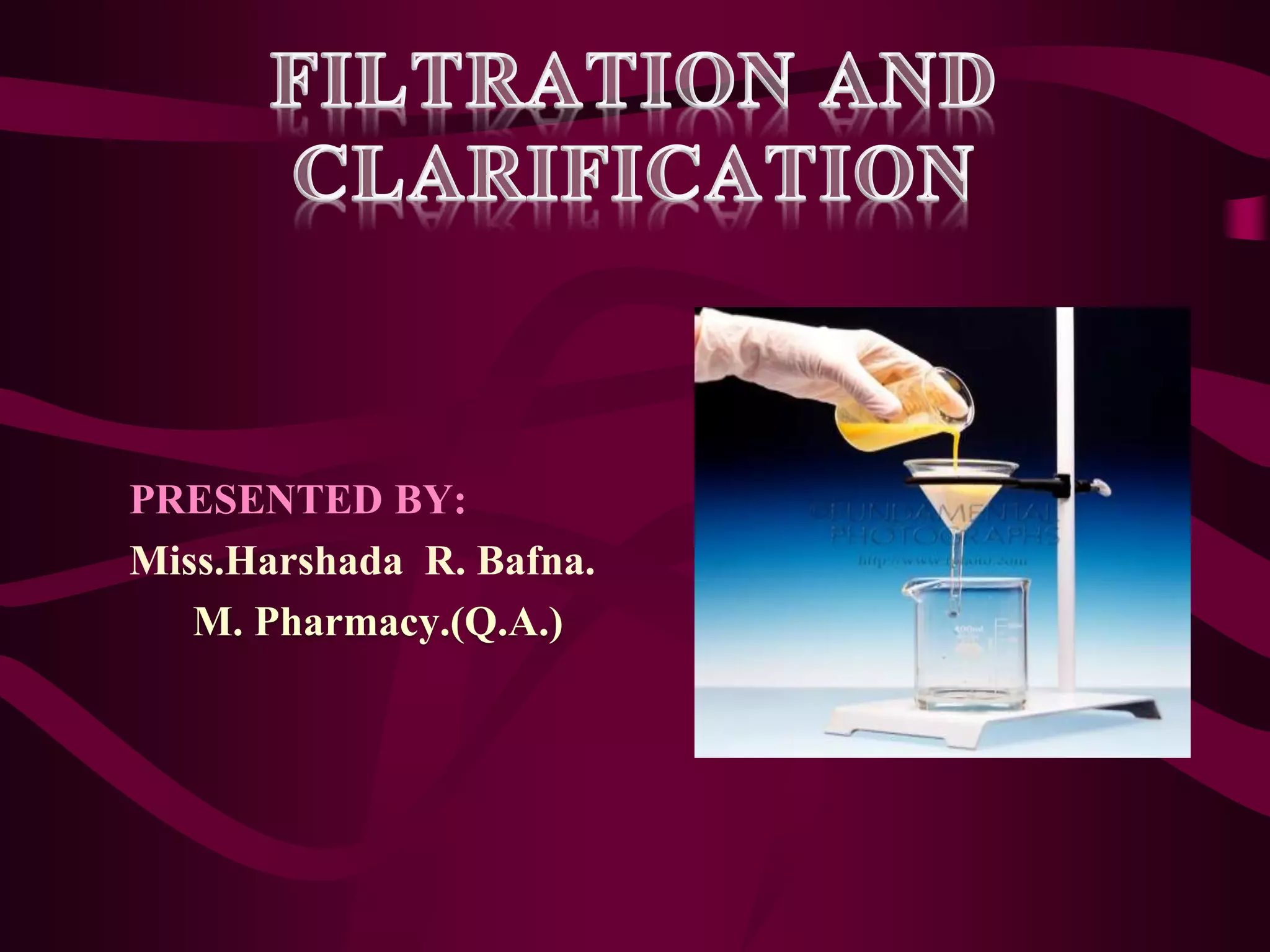
• Filtration: It may be define as a process of separation of
solids from a fluid by passing the same through a porous
medium that retains the solids but allows the fluid to pass
through.
• Clarification: When solid are present in very low
concentration, i.e., not exceeding 1.0% w/v, the process of
its separation from liquid is called clarification.
3
7/29/2022 Filtration and clarification (HRB)
Introduction
 Ultra-Filtration: Separation of
intermicellar liquid from solid by the use of
pressure on a semi permeable membrane.
 Cake Filtration: If recovery of solid is
desired, the process is called cake filtration.
7/29/2022 Filtration and clarification (HRB) 4
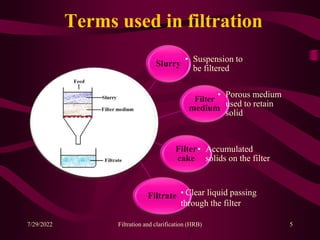
Terms used in filtration
Slurry
• Suspension to
be filtered
Filter
medium
• Porous medium
used to retain
solid
Filter
cake
• Accumulated
solids on the filter
Filtrate • Clear liquid passing
through the filter
5
7/29/2022 Filtration and clarification (HRB)
Theories of filtration
7/29/2022 Filtration and clarification (HRB) 6
Darcy’s Equation
• Poiseullie's law assumes that the capillaries found in the
filter are highly irregular and non-uniform.
• Therefore, if the length of capillary is taken as the
thickness of bed, a correction factor for radius is applied so
that the rate is closely approximated and simplified.
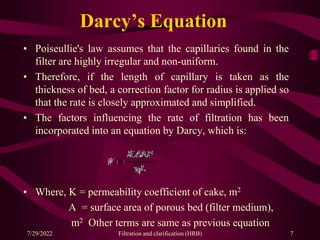
• The factors influencing the rate of filtration has been
incorporated into an equation by Darcy, which is:
• Where, K = permeability coefficient of cake, m2
A = surface area of porous bed (filter medium),
m2 Other terms are same as previous equation
7
7/29/2022 Filtration and clarification (HRB)
• K depends on characteristics of cake, such as porosity,
specific surface area and compressibility
• Permeability may be defined quantitatively as the flow rate
of a liquid of unit viscosity across a unit area of cake
having unit thickness under a pressure gradient of unity.
• This equation is valid for liquids flowing through sand,
glass beds and various porous media.
• This model is applied to filter beds or cakes and other
types of depth filter.
• This equation is further modified by including
characteristics of K by Kozeny-Carman.
8
7/29/2022 Filtration and clarification (HRB)
1. Area of filter surface.
2. Particle size of cake solids.
3. Pore size of filter media.
4. The resistant of the filter cake and filter
media.
5. Viscosity of liquid to be filter.
6. Temperature.
7. Pressure difference across the filter.
8. Nature of solid material.
7/29/2022 Filtration and clarification (HRB) 9
“The surface upon which solids are deposited in a filter
is called the Filter medium”.
PROPERTIES OF IDEAL FILTER MEDIA:
1. Chemically inert.
2. High retention power.
3. Sufficient mechanical strength.
4. Absorbs negligible amount of material.
5. Resistant to the corrosive action of liquid.
Selection of filter media depends on followings:
1. Size of particle to be filtered.
2. Amount of liquid to be filtered.
3. Nature of product to be filtered.
4. Purpose of filter.
7/29/2022
10
Filtration and clarification (HRB)
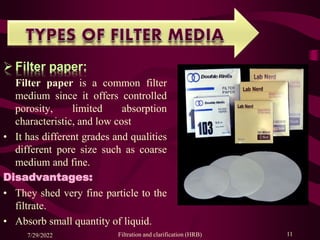
 Filter paper:
Filter paper is a common filter
medium since it offers controlled
porosity, limited absorption
characteristic, and low cost
• It has different grades and qualities
different pore size such as coarse
medium and fine.
Disadvantages:
• They shed very fine particle to the
filtrate.
• Absorb small quantity of liquid.
7/29/2022 Filtration and clarification (HRB) 11
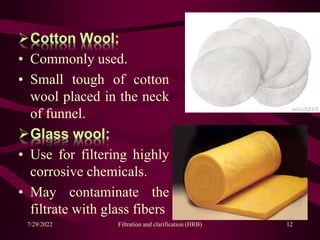
Cotton Wool:
• Commonly used.
• Small tough of cotton
wool placed in the neck
of funnel.
Glass wool:
• Use for filtering highly
corrosive chemicals.
• May contaminate the
filtrate with glass fibers
7/29/2022 Filtration and clarification (HRB) 12
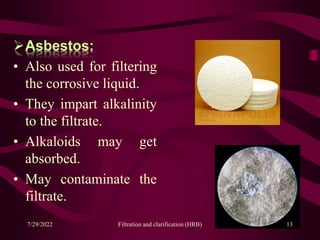
Asbestos:
• Also used for filtering
the corrosive liquid.
• They impart alkalinity
to the filtrate.
• Alkaloids may get
absorbed.
• May contaminate the
filtrate.
7/29/2022 Filtration and clarification (HRB) 13
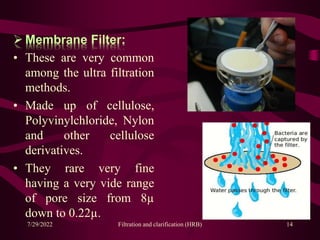
 Membrane Filter:
• These are very common
among the ultra filtration
methods.
• Made up of cellulose,
Polyvinylchloride, Nylon
and other cellulose
derivatives.
• They rare very fine
having a very vide range
of pore size from 8µ
down to 0.22µ.
7/29/2022 Filtration and clarification (HRB) 14
Craft Paper:
• Mainly used in plate and frame filters.
• They offer controlled porosity
• Limited absorption.
• Quite cheap.
Sintered Glass:
• Consist of Pyrex glass powder.
• Used for filtering parenteral preparations.
• Useful for filtering the corrosive liquid and oxidizing agent.
• Don’t shed particles.
• Don’t absorbs any liquid.
• Can be easily washed.
7/29/2022 Filtration and clarification (HRB) 15
“The substances which when added to the liquid to be
filtered, reduce the resistance of the filter cake and
increase the filtration”.
 Properties of Filter Aids:
• Chemically inert
• Low specific gravity
• Insoluble in liquids
• Form a porous cake
• Free from impurities
• Suitable particle size with irregular shape
• Able to remain suspended in liquids
• Free from moisture
7/29/2022 Filtration and clarification (HRB) 16
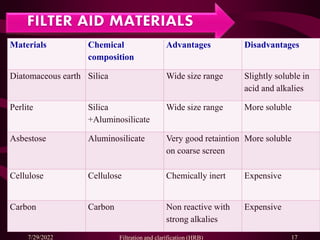
Materials Chemical
composition
Advantages Disadvantages
Diatomaceous earth Silica Wide size range Slightly soluble in
acid and alkalies
Perlite Silica
+Aluminosilicate
Wide size range More soluble
Asbestose Aluminosilicate Very good retaintion
on coarse screen
More soluble
Cellulose Cellulose Chemically inert Expensive
Carbon Carbon Non reactive with
strong alkalies
Expensive
7/29/2022 Filtration and clarification (HRB) 17
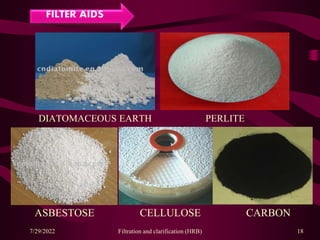
ASBESTOSE CELLULOSE CARBON
DIATOMACEOUS EARTH PERLITE
7/29/2022 Filtration and clarification (HRB) 18
Selection of method and equipment required
for filtration of a liquid depends on nature
of the material and quantity to be filtered as
well as the object of the operation.
7/29/2022 Filtration and clarification (HRB) 19
Construction
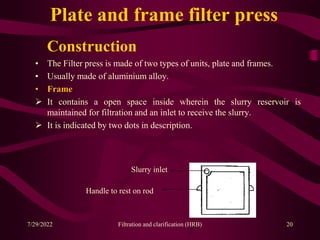
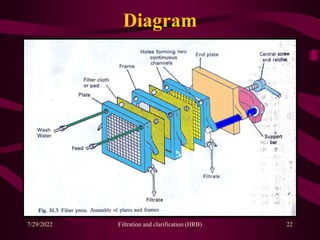
• The Filter press is made of two types of units, plate and frames.
• Usually made of aluminium alloy.
• Frame
 It contains a open space inside wherein the slurry reservoir is
maintained for filtration and an inlet to receive the slurry.
 It is indicated by two dots in description.
20
Slurry inlet
Handle to rest on rod
Plate and frame filter press
7/29/2022 Filtration and clarification (HRB)
• Frames of different thickness are available.
• It is selected based on the thickness of cake formed during filtration.
• Optimum thickness of frame should be chosen.
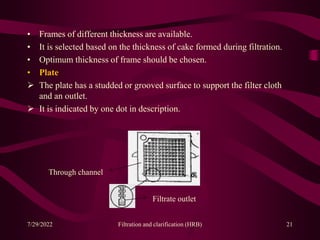
• Plate
 The plate has a studded or grooved surface to support the filter cloth
and an outlet.
 It is indicated by one dot in description.
21
Through channel
Filtrate outlet
7/29/2022 Filtration and clarification (HRB)
Diagram
22
7/29/2022 Filtration and clarification (HRB)
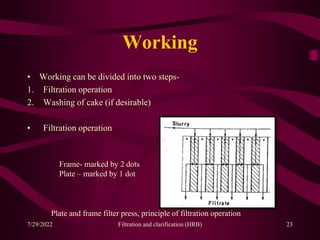
Working
• Working can be divided into two steps-
1. Filtration operation
2. Washing of cake (if desirable)
• Filtration operation
23
Frame- marked by 2 dots
Plate – marked by 1 dot
Plate and frame filter press, principle of filtration operation
7/29/2022 Filtration and clarification (HRB)
Advantages:
• Construction is very simple.
• Used for coarse to fine filtration.
• Operation and maintenance is easy.
• Filter cloth can be easily replaced.
Disadvantages:
• Not economical for filtration of small quantities
• Leakage between the plates may take place
• Suitable when the slurry contain less than 5%
solids.
7/29/2022 Filtration and clarification (HRB) 24
Filter leaf
Construction:
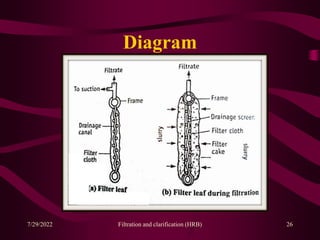
• The leaf filter is consisting of a frame enclosing a drainage screen or
grooved plate.
• The frame may be any shape circular, square or rectangular.
• The whole unite being covered with filter cloth.
• The outlet for the filtrate connects to the inside of the frame through
suction.
25
7/29/2022 Filtration and clarification (HRB)
Diagram
26
7/29/2022 Filtration and clarification (HRB)
Working and uses
Working:
Use:
• Use for the filtration of slurry which do not contain high solid content,
about 5%, i.e. dilute suspensions.
27
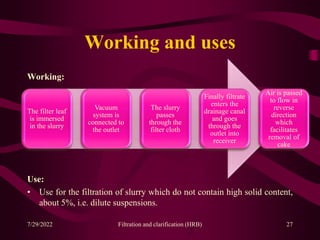
The filter leaf
is immersed
in the slurry
Vacuum
system is
connected to
the outlet
The slurry
passes
through the
filter cloth
Finally filtrate
enters the
drainage canal
and goes
through the
outlet into
receiver
Air is passed
to flow in
reverse
direction
which
facilitates
removal of
cake
7/29/2022 Filtration and clarification (HRB)
Advantages:
• Liquid can be filtered form any vessel.
• Filter cake can be removed simply by washing or
blowing air.
• It is very economical.
Disadvantage:
• It is not effective when solid content in the liquid is
more than 5%.
7/29/2022 Filtration and clarification (HRB) 28
Metafilter
Construction
• Metafilter consists of a series of metal rings.
• These are threaded so that a channel is formed on the edges.
• It contains a grooved drainage column on which a series of metal rings
are packed.
• These rings are usually made up of stainless steel and have dimensions
of about 15.0 mm internal diameter and 22.0 mm external diameter.
• Each metal ring has a number of semicircular projections (0.8 mm in
thickness) on one side of surface.
• The projections are arranged as a nest to form channels on the edges.
• These rings are tightened on the drainage column with a nut.
• Metafilters are also known as edge filters.
29
7/29/2022 Filtration and clarification (HRB)
Diagram
30
7/29/2022 Filtration and clarification (HRB)
Working
Filters are placed in a
vessel
Slurry is pumped
under pressure or
occasionally by
applying reduced
pressure to the outlet
side
Slurry passes through
the channels formed
on the edges between
the rings
The clear liquid rises
up and collected from
the outlet into
receiver
31
 For separation of fine particles, a bed of suitable materials such
kieselguhr is first built up.
 The pack of rings serves essentially as a base on which the true filter
medium is supported.
7/29/2022 Filtration and clarification (HRB)
Uses
• Metafilters can be used for-
 Clarification of syrups
 Filtration of injection solutions
 Clarification of insulin liquors
 Filtration of viscous liquids can be achieved by applying pressure.
32
7/29/2022 Filtration and clarification (HRB)
Advantages
• Can be used under high pressures, without any danger of bursting the
filter medium.
• Running cost are low, as separate filter medium is not used.
• Can be constructed from a material that can provide excellent
resistance to corrosion and avoid contamination of sensitive products.
• It is extremely versatile filter because fine as well as large both type of
particles can be separated.
• Removal of cake can be carried out by simply back- flushing with
water.
• Change over from one batch to another or one product to another is
easy.
• Sterile products can be handled.
33
7/29/2022 Filtration and clarification (HRB)
clarification and filtration.pptx

clarification and filtration.pptx

  • 1.
    PRESENTED BY: Miss.Harshada R.Bafna. M. Pharmacy.(Q.A.)
  • 2.
    1. Introduction 2. Factorsaffecting rate of filtration 3. Filter media 4. Filter aids 5. Filtration equipments 7/29/2022 Filtration and clarification (HRB) 2
  • 3.
    Definition • Filtration: Itmay be define as a process of separation of solids from a fluid by passing the same through a porous medium that retains the solids but allows the fluid to pass through. • Clarification: When solid are present in very low concentration, i.e., not exceeding 1.0% w/v, the process of its separation from liquid is called clarification. 3 7/29/2022 Filtration and clarification (HRB)
  • 4.
    Introduction  Ultra-Filtration: Separationof intermicellar liquid from solid by the use of pressure on a semi permeable membrane.  Cake Filtration: If recovery of solid is desired, the process is called cake filtration. 7/29/2022 Filtration and clarification (HRB) 4
  • 5.
    Terms used infiltration Slurry • Suspension to be filtered Filter medium • Porous medium used to retain solid Filter cake • Accumulated solids on the filter Filtrate • Clear liquid passing through the filter 5 7/29/2022 Filtration and clarification (HRB)
  • 6.
    Theories of filtration 7/29/2022Filtration and clarification (HRB) 6
  • 7.
    Darcy’s Equation • Poiseullie'slaw assumes that the capillaries found in the filter are highly irregular and non-uniform. • Therefore, if the length of capillary is taken as the thickness of bed, a correction factor for radius is applied so that the rate is closely approximated and simplified. • The factors influencing the rate of filtration has been incorporated into an equation by Darcy, which is: • Where, K = permeability coefficient of cake, m2 A = surface area of porous bed (filter medium), m2 Other terms are same as previous equation 7 7/29/2022 Filtration and clarification (HRB)
  • 8.
    • K dependson characteristics of cake, such as porosity, specific surface area and compressibility • Permeability may be defined quantitatively as the flow rate of a liquid of unit viscosity across a unit area of cake having unit thickness under a pressure gradient of unity. • This equation is valid for liquids flowing through sand, glass beds and various porous media. • This model is applied to filter beds or cakes and other types of depth filter. • This equation is further modified by including characteristics of K by Kozeny-Carman. 8 7/29/2022 Filtration and clarification (HRB)
  • 9.
    1. Area offilter surface. 2. Particle size of cake solids. 3. Pore size of filter media. 4. The resistant of the filter cake and filter media. 5. Viscosity of liquid to be filter. 6. Temperature. 7. Pressure difference across the filter. 8. Nature of solid material. 7/29/2022 Filtration and clarification (HRB) 9
  • 10.
    “The surface uponwhich solids are deposited in a filter is called the Filter medium”. PROPERTIES OF IDEAL FILTER MEDIA: 1. Chemically inert. 2. High retention power. 3. Sufficient mechanical strength. 4. Absorbs negligible amount of material. 5. Resistant to the corrosive action of liquid. Selection of filter media depends on followings: 1. Size of particle to be filtered. 2. Amount of liquid to be filtered. 3. Nature of product to be filtered. 4. Purpose of filter. 7/29/2022 10 Filtration and clarification (HRB)
  • 11.
     Filter paper: Filterpaper is a common filter medium since it offers controlled porosity, limited absorption characteristic, and low cost • It has different grades and qualities different pore size such as coarse medium and fine. Disadvantages: • They shed very fine particle to the filtrate. • Absorb small quantity of liquid. 7/29/2022 Filtration and clarification (HRB) 11
  • 12.
    Cotton Wool: • Commonlyused. • Small tough of cotton wool placed in the neck of funnel. Glass wool: • Use for filtering highly corrosive chemicals. • May contaminate the filtrate with glass fibers 7/29/2022 Filtration and clarification (HRB) 12
  • 13.
    Asbestos: • Also usedfor filtering the corrosive liquid. • They impart alkalinity to the filtrate. • Alkaloids may get absorbed. • May contaminate the filtrate. 7/29/2022 Filtration and clarification (HRB) 13
  • 14.
     Membrane Filter: •These are very common among the ultra filtration methods. • Made up of cellulose, Polyvinylchloride, Nylon and other cellulose derivatives. • They rare very fine having a very vide range of pore size from 8µ down to 0.22µ. 7/29/2022 Filtration and clarification (HRB) 14
  • 15.
    Craft Paper: • Mainlyused in plate and frame filters. • They offer controlled porosity • Limited absorption. • Quite cheap. Sintered Glass: • Consist of Pyrex glass powder. • Used for filtering parenteral preparations. • Useful for filtering the corrosive liquid and oxidizing agent. • Don’t shed particles. • Don’t absorbs any liquid. • Can be easily washed. 7/29/2022 Filtration and clarification (HRB) 15
  • 16.
    “The substances whichwhen added to the liquid to be filtered, reduce the resistance of the filter cake and increase the filtration”.  Properties of Filter Aids: • Chemically inert • Low specific gravity • Insoluble in liquids • Form a porous cake • Free from impurities • Suitable particle size with irregular shape • Able to remain suspended in liquids • Free from moisture 7/29/2022 Filtration and clarification (HRB) 16
  • 17.
    Materials Chemical composition Advantages Disadvantages Diatomaceousearth Silica Wide size range Slightly soluble in acid and alkalies Perlite Silica +Aluminosilicate Wide size range More soluble Asbestose Aluminosilicate Very good retaintion on coarse screen More soluble Cellulose Cellulose Chemically inert Expensive Carbon Carbon Non reactive with strong alkalies Expensive 7/29/2022 Filtration and clarification (HRB) 17
  • 18.
    ASBESTOSE CELLULOSE CARBON DIATOMACEOUSEARTH PERLITE 7/29/2022 Filtration and clarification (HRB) 18
  • 19.
    Selection of methodand equipment required for filtration of a liquid depends on nature of the material and quantity to be filtered as well as the object of the operation. 7/29/2022 Filtration and clarification (HRB) 19
  • 20.
    Construction • The Filterpress is made of two types of units, plate and frames. • Usually made of aluminium alloy. • Frame  It contains a open space inside wherein the slurry reservoir is maintained for filtration and an inlet to receive the slurry.  It is indicated by two dots in description. 20 Slurry inlet Handle to rest on rod Plate and frame filter press 7/29/2022 Filtration and clarification (HRB)
  • 21.
    • Frames ofdifferent thickness are available. • It is selected based on the thickness of cake formed during filtration. • Optimum thickness of frame should be chosen. • Plate  The plate has a studded or grooved surface to support the filter cloth and an outlet.  It is indicated by one dot in description. 21 Through channel Filtrate outlet 7/29/2022 Filtration and clarification (HRB)
  • 22.
  • 23.
    Working • Working canbe divided into two steps- 1. Filtration operation 2. Washing of cake (if desirable) • Filtration operation 23 Frame- marked by 2 dots Plate – marked by 1 dot Plate and frame filter press, principle of filtration operation 7/29/2022 Filtration and clarification (HRB)
  • 24.
    Advantages: • Construction isvery simple. • Used for coarse to fine filtration. • Operation and maintenance is easy. • Filter cloth can be easily replaced. Disadvantages: • Not economical for filtration of small quantities • Leakage between the plates may take place • Suitable when the slurry contain less than 5% solids. 7/29/2022 Filtration and clarification (HRB) 24
  • 25.
    Filter leaf Construction: • Theleaf filter is consisting of a frame enclosing a drainage screen or grooved plate. • The frame may be any shape circular, square or rectangular. • The whole unite being covered with filter cloth. • The outlet for the filtrate connects to the inside of the frame through suction. 25 7/29/2022 Filtration and clarification (HRB)
  • 26.
  • 27.
    Working and uses Working: Use: •Use for the filtration of slurry which do not contain high solid content, about 5%, i.e. dilute suspensions. 27 The filter leaf is immersed in the slurry Vacuum system is connected to the outlet The slurry passes through the filter cloth Finally filtrate enters the drainage canal and goes through the outlet into receiver Air is passed to flow in reverse direction which facilitates removal of cake 7/29/2022 Filtration and clarification (HRB)
  • 28.
    Advantages: • Liquid canbe filtered form any vessel. • Filter cake can be removed simply by washing or blowing air. • It is very economical. Disadvantage: • It is not effective when solid content in the liquid is more than 5%. 7/29/2022 Filtration and clarification (HRB) 28
  • 29.
    Metafilter Construction • Metafilter consistsof a series of metal rings. • These are threaded so that a channel is formed on the edges. • It contains a grooved drainage column on which a series of metal rings are packed. • These rings are usually made up of stainless steel and have dimensions of about 15.0 mm internal diameter and 22.0 mm external diameter. • Each metal ring has a number of semicircular projections (0.8 mm in thickness) on one side of surface. • The projections are arranged as a nest to form channels on the edges. • These rings are tightened on the drainage column with a nut. • Metafilters are also known as edge filters. 29 7/29/2022 Filtration and clarification (HRB)

  • 30.
  • 31.
    Working Filters are placedin a vessel Slurry is pumped under pressure or occasionally by applying reduced pressure to the outlet side Slurry passes through the channels formed on the edges between the rings The clear liquid rises up and collected from the outlet into receiver 31  For separation of fine particles, a bed of suitable materials such kieselguhr is first built up.  The pack of rings serves essentially as a base on which the true filter medium is supported. 7/29/2022 Filtration and clarification (HRB)
  • 32.
    Uses • Metafilters canbe used for-  Clarification of syrups  Filtration of injection solutions  Clarification of insulin liquors  Filtration of viscous liquids can be achieved by applying pressure. 32 7/29/2022 Filtration and clarification (HRB)
  • 33.
    Advantages • Can beused under high pressures, without any danger of bursting the filter medium. • Running cost are low, as separate filter medium is not used. • Can be constructed from a material that can provide excellent resistance to corrosion and avoid contamination of sensitive products. • It is extremely versatile filter because fine as well as large both type of particles can be separated. • Removal of cake can be carried out by simply back- flushing with water. • Change over from one batch to another or one product to another is easy. • Sterile products can be handled. 33 7/29/2022 Filtration and clarification (HRB)