RAHUL KUMAR
M.pharm
(Pharmaceutics)
MEERUT INSTITUE OF ENGINEERING AND TECNOLOGY, MEERUT
CONTENT
 SOME DEFINITIONS
 Theory of Filtration
 Factors affecting the rate of filtration
 Filter aids used in pharmaceutical industry
 Filtration equipments
1. Filter press.
2. Meta filter.
3. Filter leaf.
4. Membrane filter.
5. Filter candles.
6. Sintered filter.
SOME DEFINITIONS:-
Filtration:- The separetion of solid from a fluid by means of a
porous medium that retains the solid but allows the
fluid to pass.
Clarification:- This term is applied when solid do not exceed
1.0%.
NOTE:-
Feed or slurry:- The suspension of solid and liquid to be filtered
is known as slurry or feed.
 Filter medium:- The porous medium used to retain the solid is
described as the filter medium.
Filter cake:- The accumulation of solids on the filter is referred to
as the filter cake.
Filtrate:-The clear liquid is passing through the filter is the filtrate.
Theory of Filtration:-
 Darcy’s law is an equation that describes the flow of a fluid through a
porous medium.
 The law was formulated by Henry Darcy based on the results of
experiments on the flow of water through beds of sand.
Factors affecting the rate of filtration:-
1) Pressure.
2) Viscosity.
3) Surface area of filter media.
4) Temperature of liquid to be filtered.
5) Particle size.
6) Pore size of filter media.
7) Thickness of cake.
8) Nature of solid materials.
Filter media:-
 The surface upon which solids are deposits in a filter is called filter
medium.
 Properties:-
 Chemically inert.
 High retention power.
 Sufficient mechanical strength.
 Absorbs negligible amount of materials.
Selection of filter media depends on followings:-
 Size of paricles to be filtered.
 Amount of liquid to be filtered.
 Nature of product to be filtered.
Filter media types:-
1) Filter paper.
2) Cotton wool.
3) Glass wool.
4) Asbestos.
5) Fine muslin.
6) Filter cloth.
7) Membrane filter.
8) Sintered glass filter.
Filter paper:-
 Filter paper is a common filter medium since it offers controlled
porosity, limited absorption characterstics and low cost.
 It has different grades and qualities, different pore size such as coarse
medium and fine.
DRAWBACKS-
 The shed very fine particles to be filtered.
 Absorb property of liquid.
Cotton wool:-
 Small tough of cotton wool placed in the nack of funnel.
 Commonly used filter media of moderately coarse particles.
DRAWBACKS-
 It shed fine cotton hair in the filtrate.
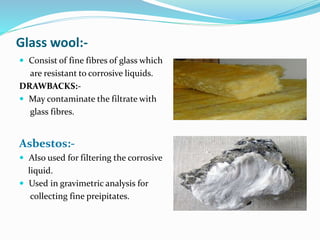
Glass wool:-
 Consist of fine fibres of glass which
are resistant to corrosive liquids.
DRAWBACKS:-
 May contaminate the filtrate with
glass fibres.
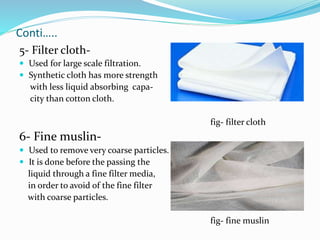
Asbestos:-
 Also used for filtering the corrosive
liquid.
 Used in gravimetric analysis for
collecting fine preipitates.
Conti…..
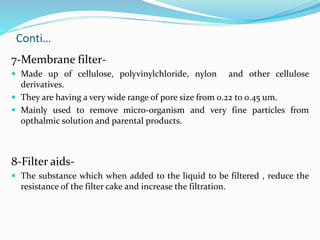
5- Filter cloth-
 Used for large scale filtration.
 Synthetic cloth has more strength
with less liquid absorbing capa-
city than cotton cloth.
fig- filter cloth
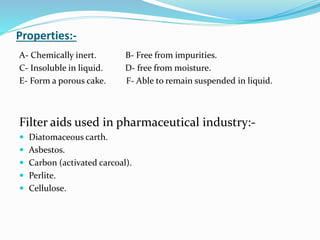
6- Fine muslin-
 Used to remove very coarse particles.
 It is done before the passing the
liquid through a fine filter media,
in order to avoid of the fine filter
with coarse particles.
fig- fine muslin
Conti…
7-Membrane filter-
 Made up of cellulose, polyvinylchloride, nylon and other cellulose
derivatives.
 They are having a very wide range of pore size from 0.22 to 0.45 um.
 Mainly used to remove micro-organism and very fine particles from
opthalmic solution and parental products.
8-Filter aids-
 The substance which when added to the liquid to be filtered , reduce the
resistance of the filter cake and increase the filtration.
Properties:-
A- Chemically inert. B- Free from impurities.
C- Insoluble in liquid. D- free from moisture.
E- Form a porous cake. F- Able to remain suspended in liquid.
Filter aids used in pharmaceutical industry:-
 Diatomaceous carth.
 Asbestos.
 Carbon (activated carcoal).
 Perlite.
 Cellulose.
Filtration equipments:-
1. Filter press.
2. Meta filter.
3. Filter leaf.
4. Membrane filter.
5. Filter candles.
6. Sintered filter.
Filter press:-
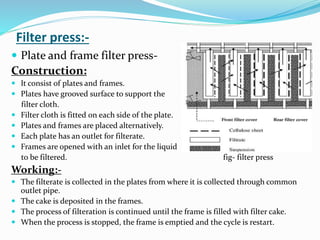
 Plate and frame filter press-
Construction:
 It consist of plates and frames.
 Plates have grooved surface to support the
filter cloth.
 Filter cloth is fitted on each side of the plate.
 Plates and frames are placed alternatively.
 Each plate has an outlet for filterate.
 Frames are opened with an inlet for the liquid
to be filtered. fig- filter press
Working:-
 The filterate is collected in the plates from where it is collected through common
outlet pipe.
 The cake is deposited in the frames.
 The process of filteration is continued until the frame is filled with filter cake.
 When the process is stopped, the frame is emptied and the cycle is restart.
Meta filter:-
 Meta filter are the filter which are used to separate very fine size. Particles from the
liquid or solid suspensions.
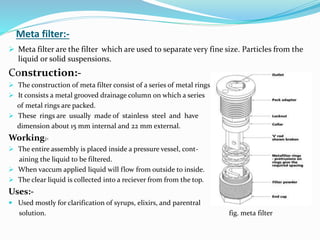
Construction:-
 The construction of meta filter consist of a series of metal rings.
 It consists a metal grooved drainage column on which a series
of metal rings are packed.
 These rings are usually made of stainless steel and have
dimension about 15 mm internal and 22 mm external.
Working:-
 The entire assembly is placed inside a pressure vessel, cont-
aining the liquid to be filtered.
 When vaccum applied liquid will flow from outside to inside.
 The clear liquid is collected into a reciever from from the top.
Uses:-
 Used mostly for clarification of syrups, elixirs, and parentral
solution. fig. meta filter
Filter candles:-
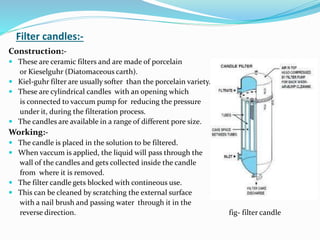
Construction:-
 These are ceramic filters and are made of porcelain
or Kieselguhr (Diatomaceous carth).
 Kiel-guhr filter are usually softer than the porcelain variety.
 These are cylindrical candles with an opening which
is connected to vaccum pump for reducing the pressure
under it, during the filteration process.
 The candles are available in a range of different pore size.
Working:-
 The candle is placed in the solution to be filtered.
 When vaccum is applied, the liquid will pass through the
wall of the candles and gets collected inside the candle
from where it is removed.
 The filter candle gets blocked with contineous use.
 This can be cleaned by scratching the external surface
with a nail brush and passing water through it in the
reverse direction. fig- filter candle
Clarification and filtration

Clarification and filtration

  • 1.
    RAHUL KUMAR M.pharm (Pharmaceutics) MEERUT INSTITUEOF ENGINEERING AND TECNOLOGY, MEERUT
  • 2.
    CONTENT  SOME DEFINITIONS Theory of Filtration  Factors affecting the rate of filtration  Filter aids used in pharmaceutical industry  Filtration equipments 1. Filter press. 2. Meta filter. 3. Filter leaf. 4. Membrane filter. 5. Filter candles. 6. Sintered filter.
  • 3.
    SOME DEFINITIONS:- Filtration:- Theseparetion of solid from a fluid by means of a porous medium that retains the solid but allows the fluid to pass. Clarification:- This term is applied when solid do not exceed 1.0%.
  • 4.
    NOTE:- Feed or slurry:-The suspension of solid and liquid to be filtered is known as slurry or feed.  Filter medium:- The porous medium used to retain the solid is described as the filter medium. Filter cake:- The accumulation of solids on the filter is referred to as the filter cake. Filtrate:-The clear liquid is passing through the filter is the filtrate.
  • 5.
    Theory of Filtration:- Darcy’s law is an equation that describes the flow of a fluid through a porous medium.  The law was formulated by Henry Darcy based on the results of experiments on the flow of water through beds of sand.
  • 6.
    Factors affecting therate of filtration:- 1) Pressure. 2) Viscosity. 3) Surface area of filter media. 4) Temperature of liquid to be filtered. 5) Particle size. 6) Pore size of filter media. 7) Thickness of cake. 8) Nature of solid materials.
  • 7.
    Filter media:-  Thesurface upon which solids are deposits in a filter is called filter medium.  Properties:-  Chemically inert.  High retention power.  Sufficient mechanical strength.  Absorbs negligible amount of materials. Selection of filter media depends on followings:-  Size of paricles to be filtered.  Amount of liquid to be filtered.  Nature of product to be filtered.
  • 8.
    Filter media types:- 1)Filter paper. 2) Cotton wool. 3) Glass wool. 4) Asbestos. 5) Fine muslin. 6) Filter cloth. 7) Membrane filter. 8) Sintered glass filter.
  • 9.
    Filter paper:-  Filterpaper is a common filter medium since it offers controlled porosity, limited absorption characterstics and low cost.  It has different grades and qualities, different pore size such as coarse medium and fine. DRAWBACKS-  The shed very fine particles to be filtered.  Absorb property of liquid. Cotton wool:-  Small tough of cotton wool placed in the nack of funnel.  Commonly used filter media of moderately coarse particles. DRAWBACKS-  It shed fine cotton hair in the filtrate.
  • 10.
    Glass wool:-  Consistof fine fibres of glass which are resistant to corrosive liquids. DRAWBACKS:-  May contaminate the filtrate with glass fibres. Asbestos:-  Also used for filtering the corrosive liquid.  Used in gravimetric analysis for collecting fine preipitates.
  • 11.
    Conti….. 5- Filter cloth- Used for large scale filtration.  Synthetic cloth has more strength with less liquid absorbing capa- city than cotton cloth. fig- filter cloth 6- Fine muslin-  Used to remove very coarse particles.  It is done before the passing the liquid through a fine filter media, in order to avoid of the fine filter with coarse particles. fig- fine muslin
  • 12.
    Conti… 7-Membrane filter-  Madeup of cellulose, polyvinylchloride, nylon and other cellulose derivatives.  They are having a very wide range of pore size from 0.22 to 0.45 um.  Mainly used to remove micro-organism and very fine particles from opthalmic solution and parental products. 8-Filter aids-  The substance which when added to the liquid to be filtered , reduce the resistance of the filter cake and increase the filtration.
  • 13.
    Properties:- A- Chemically inert.B- Free from impurities. C- Insoluble in liquid. D- free from moisture. E- Form a porous cake. F- Able to remain suspended in liquid. Filter aids used in pharmaceutical industry:-  Diatomaceous carth.  Asbestos.  Carbon (activated carcoal).  Perlite.  Cellulose.
  • 14.
    Filtration equipments:- 1. Filterpress. 2. Meta filter. 3. Filter leaf. 4. Membrane filter. 5. Filter candles. 6. Sintered filter.
  • 15.
    Filter press:-  Plateand frame filter press- Construction:  It consist of plates and frames.  Plates have grooved surface to support the filter cloth.  Filter cloth is fitted on each side of the plate.  Plates and frames are placed alternatively.  Each plate has an outlet for filterate.  Frames are opened with an inlet for the liquid to be filtered. fig- filter press Working:-  The filterate is collected in the plates from where it is collected through common outlet pipe.  The cake is deposited in the frames.  The process of filteration is continued until the frame is filled with filter cake.  When the process is stopped, the frame is emptied and the cycle is restart.
  • 16.
    Meta filter:-  Metafilter are the filter which are used to separate very fine size. Particles from the liquid or solid suspensions. Construction:-  The construction of meta filter consist of a series of metal rings.  It consists a metal grooved drainage column on which a series of metal rings are packed.  These rings are usually made of stainless steel and have dimension about 15 mm internal and 22 mm external. Working:-  The entire assembly is placed inside a pressure vessel, cont- aining the liquid to be filtered.  When vaccum applied liquid will flow from outside to inside.  The clear liquid is collected into a reciever from from the top. Uses:-  Used mostly for clarification of syrups, elixirs, and parentral solution. fig. meta filter
  • 17.
    Filter candles:- Construction:-  Theseare ceramic filters and are made of porcelain or Kieselguhr (Diatomaceous carth).  Kiel-guhr filter are usually softer than the porcelain variety.  These are cylindrical candles with an opening which is connected to vaccum pump for reducing the pressure under it, during the filteration process.  The candles are available in a range of different pore size. Working:-  The candle is placed in the solution to be filtered.  When vaccum is applied, the liquid will pass through the wall of the candles and gets collected inside the candle from where it is removed.  The filter candle gets blocked with contineous use.  This can be cleaned by scratching the external surface with a nail brush and passing water through it in the reverse direction. fig- filter candle