ADRENAL FUNCTION TESTS
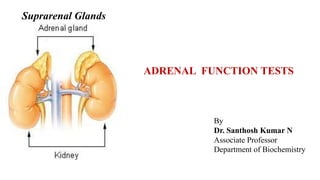
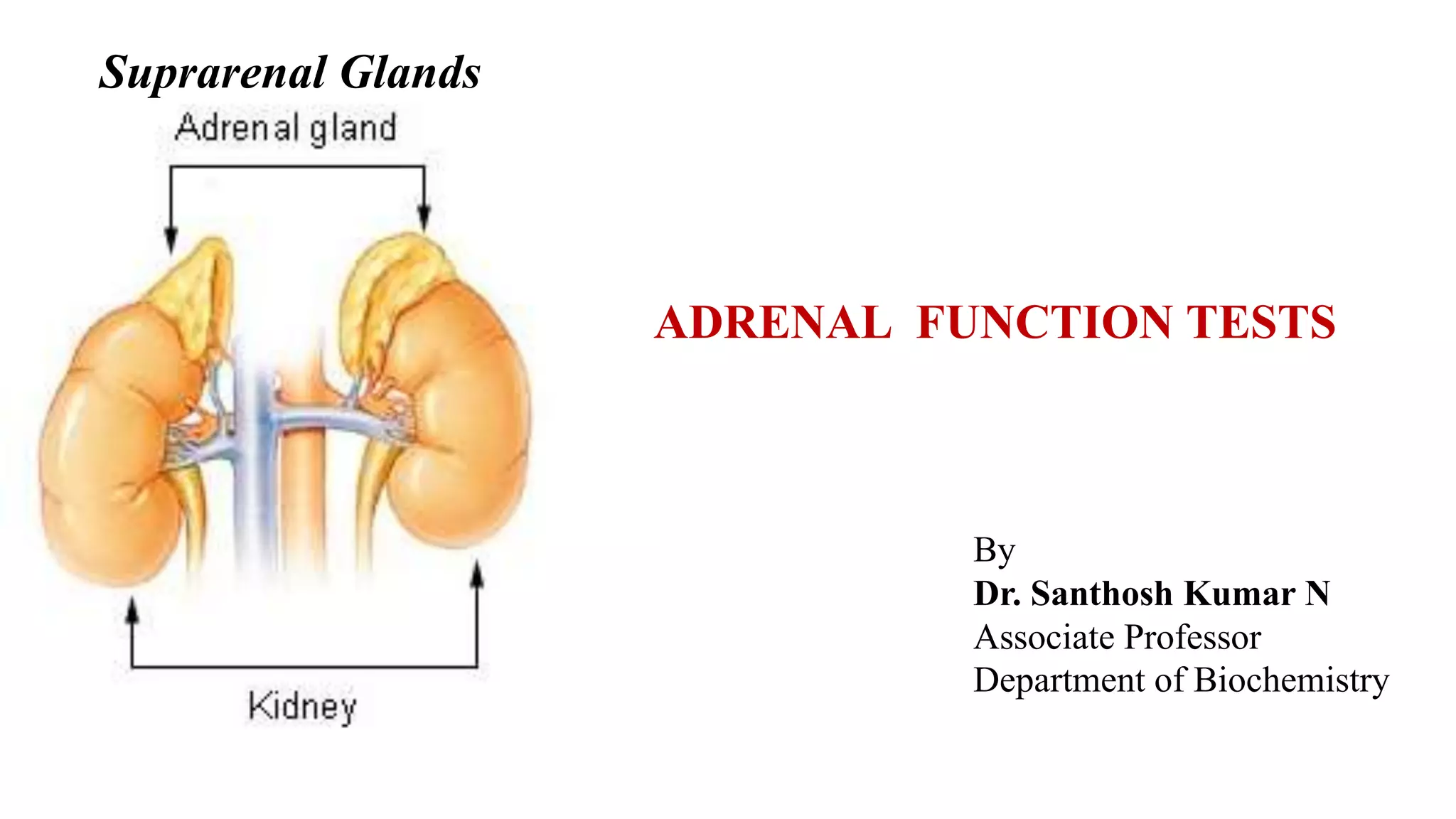
Suprarenal Glands
By
Dr. Santhosh Kumar N
Associate Professor
Department of Biochemistry
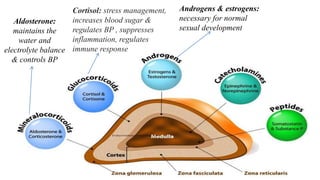
Aldosterone:
maintains the
water and
electrolyte balance
& controls BP
Cortisol: stress management,
increases blood sugar &
regulates BP , suppresses
inflammation, regulates
immune response
Androgens & estrogens:
necessary for normal
sexual development
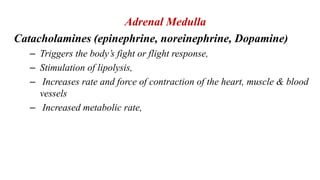
Adrenal Medulla
Catacholamines (epinephrine, noreinephrine, Dopamine)
– Triggers the body’s fight or flight response,
– Stimulation of lipolysis,
– Increases rate and force of contraction of the heart, muscle & blood
vessels
– Increased metabolic rate,
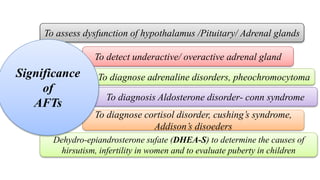
To diagnose adrenaline disorders, pheochromocytoma
To detect underactive/ overactive adrenal gland
To diagnose cortisol disorder, cushing’s syndrome,
Addison’s disoeders
To diagnosis Aldosterone disorder- conn syndrome
To assess dysfunction of hypothalamus /Pituitary/ Adrenal glands
Dehydro-epiandrosterone sufate (DHEA-S) to determine the causes of
hirsutism, infertility in women and to evaluate puberty in children
Significance
of
AFTs
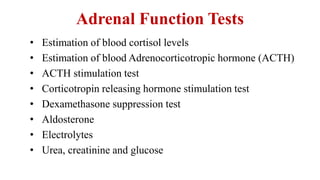
Adrenal Function Tests
• Estimation of blood cortisol levels
• Estimation of blood Adrenocorticotropic hormone (ACTH)
• ACTH stimulation test
• Corticotropin releasing hormone stimulation test
• Dexamethasone suppression test
• Aldosterone
• Electrolytes
• Urea, creatinine and glucose
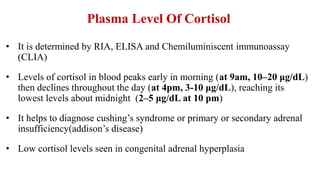
Plasma Level Of Cortisol
• It is determined by RIA, ELISA and Chemiluminiscent immunoassay
(CLIA)
• Levels of cortisol in blood peaks early in morning (at 9am, 10–20 μg/dL)
then declines throughout the day (at 4pm, 3-10 μg/dL), reaching its
lowest levels about midnight (2–5 μg/dL at 10 pm)
• It helps to diagnose cushing’s syndrome or primary or secondary adrenal
insufficiency(addison’s disease)
• Low cortisol levels seen in congenital adrenal hyperplasia
Plasma Adrenocorticotropic hormone (ACTH) test
• ACTH is a pituitary hormone that stimulates the adrenal glands to
produce cortisol.
• ACTH levels will be at highest in the morning (at 9am, 10-50 pg/ml)
and usually low at 4pm, (less than 20pg/mL).
• To evaluate and differentiate b/w 1O and 2O adrenal insufficiency
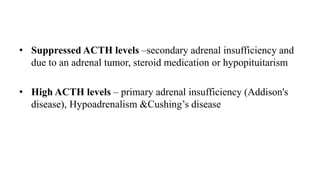
• Suppressed ACTH levels –secondary adrenal insufficiency and
due to an adrenal tumor, steroid medication or hypopituitarism
• High ACTH levels – primary adrenal insufficiency (Addison's
disease), Hypoadrenalism &Cushing’s disease
ACTH stimulation test
• It measuring the level of cortisol in a patient’s blood before and
after an injection of synthetic ACTH (synacthen/ cosyntropin)
• Diagnosis of adrenal insufficiency
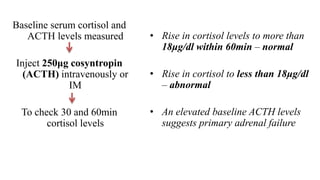
Baseline serum cortisol and
ACTH levels measured
Inject 250μg cosyntropin
(ACTH) intravenously or
IM
To check 30 and 60min
cortisol levels
• Rise in cortisol levels to more than
18μg/dl within 60min – normal
• Rise in cortisol to less than 18μg/dl
– abnormal
• An elevated baseline ACTH levels
suggests primary adrenal failure
Corticotropin-releasing hormone (CRH) stimulation test
• CRH is the stimulation of the pituitary synthesis of ACTH
• Human CRH is useful test for
i) To differentiating b/w hypothalamic and pituitary causes of adrenal
insufficiency
ii) pituitary ACTH deficiency
iii) to differentiate between pituitary from ectopic source of ACTH in Cushing's
iv) to investigate pseudo-Cushings
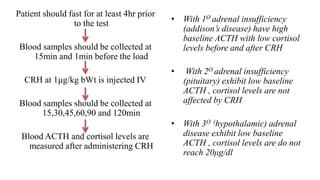
Patient should fast for at least 4hr prior
to the test
Blood samples should be collected at
15min and 1min before the load
CRH at 1μg/kg bWt is injected IV
Blood samples should be collected at
15,30,45,60,90 and 120min
Blood ACTH and cortisol levels are
measured after administering CRH
• With 1O adrenal insufficiency
(addison’s disease) have high
baseline ACTH with low cortisol
levels before and after CRH
• With 2O adrenal insufficiency
(pituitary) exhibit low baseline
ACTH , cortisol levels are not
affected by CRH
• With 3O (hypothalamic) adrenal
disease exhibit low baseline
ACTH , cortisol levels are do not
reach 20μg/dl
Dexamethasone Suppression Test (DST)
• Used to assess adrenal gland functions
• Dexamethasone is a synthetic glucocorticoid that binds to cortisol receptors in
the pituitary and suppresses ACTH release.
• Dexamethasone suppresses the secretion of cortisol due to feedback suppression
of ACTH by the adrenal gland
• Normal - overnight suppression with high dose (2 mg) causes a 50% fall in the
original value
• Adrenal hyperactivity - fail to produce suppression
17-hydroxy-cortisol levels
 17-hydroxycortisol produced in excessive in patients with primary
hyper aldosteronism
 Help to determine whether primary hyper aldosteronism is caused
by adrenal adenoma or by hyperplasia of adrenal tissue .
 Men is 3-10μg/24hrs; women is 2 -6 μg/24hrs
Aldosterone levels
• Helps in determining whether the adrenal gland is producing
Aldosterone
• Blood and urine levels are measured to diagnose Addison's
disease (low)
• Serum Electrolytes: to monitor the effectiveness of treatment
Low Na+, Cl- and bicarbonate levels and
very high K+ levels is observed in addison’s disease.
• Serum Urea and creatinine: To monitor kidney function
• Blood Glucose levels may be very low during an addisonian crisis
• Renin activity is elevated in primary adrenal insufficiency
because a lack of Aldosterone causes increased renal Na+ losses.
Lowers blood Na+ levels, blood volume and Blood pressure
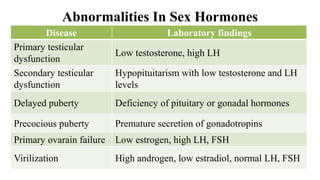
Disease Laboratory findings
Primary testicular
dysfunction
Low testosterone, high LH
Secondary testicular
dysfunction
Hypopituitarism with low testosterone and LH
levels
Delayed puberty Deficiency of pituitary or gonadal hormones
Precocious puberty Premature secretion of gonadotropins
Primary ovarain failure Low estrogen, high LH, FSH
Virilization High androgen, low estradiol, normal LH, FSH
Abnormalities In Sex Hormones
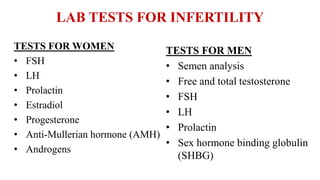
LAB TESTS FOR INFERTILITY
TESTS FOR WOMEN
• FSH
• LH
• Prolactin
• Estradiol
• Progesterone
• Anti-Mullerian hormone (AMH)
• Androgens
TESTS FOR MEN
• Semen analysis
• Free and total testosterone
• FSH
• LH
• Prolactin
• Sex hormone binding globulin
(SHBG)
THANK YOU
The End

OFT 04- AFTs.pptx

  • 1.
    ADRENAL FUNCTION TESTS SuprarenalGlands By Dr. Santhosh Kumar N Associate Professor Department of Biochemistry
  • 2.
    Aldosterone: maintains the water and electrolytebalance & controls BP Cortisol: stress management, increases blood sugar & regulates BP , suppresses inflammation, regulates immune response Androgens & estrogens: necessary for normal sexual development
  • 3.
    Adrenal Medulla Catacholamines (epinephrine,noreinephrine, Dopamine) – Triggers the body’s fight or flight response, – Stimulation of lipolysis, – Increases rate and force of contraction of the heart, muscle & blood vessels – Increased metabolic rate,
  • 4.
    To diagnose adrenalinedisorders, pheochromocytoma To detect underactive/ overactive adrenal gland To diagnose cortisol disorder, cushing’s syndrome, Addison’s disoeders To diagnosis Aldosterone disorder- conn syndrome To assess dysfunction of hypothalamus /Pituitary/ Adrenal glands Dehydro-epiandrosterone sufate (DHEA-S) to determine the causes of hirsutism, infertility in women and to evaluate puberty in children Significance of AFTs
  • 5.
    Adrenal Function Tests •Estimation of blood cortisol levels • Estimation of blood Adrenocorticotropic hormone (ACTH) • ACTH stimulation test • Corticotropin releasing hormone stimulation test • Dexamethasone suppression test • Aldosterone • Electrolytes • Urea, creatinine and glucose
  • 6.
    Plasma Level OfCortisol • It is determined by RIA, ELISA and Chemiluminiscent immunoassay (CLIA) • Levels of cortisol in blood peaks early in morning (at 9am, 10–20 μg/dL) then declines throughout the day (at 4pm, 3-10 μg/dL), reaching its lowest levels about midnight (2–5 μg/dL at 10 pm) • It helps to diagnose cushing’s syndrome or primary or secondary adrenal insufficiency(addison’s disease) • Low cortisol levels seen in congenital adrenal hyperplasia
  • 7.
    Plasma Adrenocorticotropic hormone(ACTH) test • ACTH is a pituitary hormone that stimulates the adrenal glands to produce cortisol. • ACTH levels will be at highest in the morning (at 9am, 10-50 pg/ml) and usually low at 4pm, (less than 20pg/mL). • To evaluate and differentiate b/w 1O and 2O adrenal insufficiency
  • 8.
    • Suppressed ACTHlevels –secondary adrenal insufficiency and due to an adrenal tumor, steroid medication or hypopituitarism • High ACTH levels – primary adrenal insufficiency (Addison's disease), Hypoadrenalism &Cushing’s disease
  • 9.
    ACTH stimulation test •It measuring the level of cortisol in a patient’s blood before and after an injection of synthetic ACTH (synacthen/ cosyntropin) • Diagnosis of adrenal insufficiency
  • 10.
    Baseline serum cortisoland ACTH levels measured Inject 250μg cosyntropin (ACTH) intravenously or IM To check 30 and 60min cortisol levels • Rise in cortisol levels to more than 18μg/dl within 60min – normal • Rise in cortisol to less than 18μg/dl – abnormal • An elevated baseline ACTH levels suggests primary adrenal failure
  • 11.
    Corticotropin-releasing hormone (CRH)stimulation test • CRH is the stimulation of the pituitary synthesis of ACTH • Human CRH is useful test for i) To differentiating b/w hypothalamic and pituitary causes of adrenal insufficiency ii) pituitary ACTH deficiency iii) to differentiate between pituitary from ectopic source of ACTH in Cushing's iv) to investigate pseudo-Cushings
  • 12.
    Patient should fastfor at least 4hr prior to the test Blood samples should be collected at 15min and 1min before the load CRH at 1μg/kg bWt is injected IV Blood samples should be collected at 15,30,45,60,90 and 120min Blood ACTH and cortisol levels are measured after administering CRH • With 1O adrenal insufficiency (addison’s disease) have high baseline ACTH with low cortisol levels before and after CRH • With 2O adrenal insufficiency (pituitary) exhibit low baseline ACTH , cortisol levels are not affected by CRH • With 3O (hypothalamic) adrenal disease exhibit low baseline ACTH , cortisol levels are do not reach 20μg/dl
  • 13.
    Dexamethasone Suppression Test(DST) • Used to assess adrenal gland functions • Dexamethasone is a synthetic glucocorticoid that binds to cortisol receptors in the pituitary and suppresses ACTH release. • Dexamethasone suppresses the secretion of cortisol due to feedback suppression of ACTH by the adrenal gland • Normal - overnight suppression with high dose (2 mg) causes a 50% fall in the original value • Adrenal hyperactivity - fail to produce suppression
  • 14.
    17-hydroxy-cortisol levels  17-hydroxycortisolproduced in excessive in patients with primary hyper aldosteronism  Help to determine whether primary hyper aldosteronism is caused by adrenal adenoma or by hyperplasia of adrenal tissue .  Men is 3-10μg/24hrs; women is 2 -6 μg/24hrs
  • 15.
    Aldosterone levels • Helpsin determining whether the adrenal gland is producing Aldosterone • Blood and urine levels are measured to diagnose Addison's disease (low)
  • 16.
    • Serum Electrolytes:to monitor the effectiveness of treatment Low Na+, Cl- and bicarbonate levels and very high K+ levels is observed in addison’s disease. • Serum Urea and creatinine: To monitor kidney function • Blood Glucose levels may be very low during an addisonian crisis • Renin activity is elevated in primary adrenal insufficiency because a lack of Aldosterone causes increased renal Na+ losses. Lowers blood Na+ levels, blood volume and Blood pressure
  • 17.
    Disease Laboratory findings Primarytesticular dysfunction Low testosterone, high LH Secondary testicular dysfunction Hypopituitarism with low testosterone and LH levels Delayed puberty Deficiency of pituitary or gonadal hormones Precocious puberty Premature secretion of gonadotropins Primary ovarain failure Low estrogen, high LH, FSH Virilization High androgen, low estradiol, normal LH, FSH Abnormalities In Sex Hormones
  • 18.
    LAB TESTS FORINFERTILITY TESTS FOR WOMEN • FSH • LH • Prolactin • Estradiol • Progesterone • Anti-Mullerian hormone (AMH) • Androgens TESTS FOR MEN • Semen analysis • Free and total testosterone • FSH • LH • Prolactin • Sex hormone binding globulin (SHBG)
  • 19.