Dr. T.P. Somasundaran
Professor
Department of Civil Engineering
National Institute of Technology Calicut
E-mail: soman@nitc.ac.in
WHAT IS
CIVIL ENGINEERING ?
Civil Engineers give us Quality of Life !
Civil engineering is the oldest branch of the
profession of engineering after military engineering.
Many of the important things in our lives that we
take for granted are the product of civil
engineering.
5/18/2015 tps,NITC 2
Introduction
 Since time immemorial, human beings have been
engaged in building all kinds of edifices. From huts
made of mud to Taj Mahal, we have definitely
come a long way.
 As civilisations matured, it simultaneously led to
the development of bigger, better and diverse
structures. From cave dwellings, human beings
had moved on to construct houses, palaces,
canals, dams, highways, and stadia.
 These civilian structures played a significant role in
the development of human race and gave various
dimensions to human life as various activities
evolved: social, political, economic and
recreational.
5/18/2015 tps,NITC 3
 Amongst all branches of engineering, the range
and application of civil engineering is the
broadest and the most visible.
 In fact, the entire infrastructural framework of
a modern nation is the creation of civil
engineers.
 The credit of building mighty power plants,
dams, airports, sea ports, highways, inland
waterways and industrial plants goes to civil
engineers.
 These professionals are also engaged in
building an unending array of urban structures
such as commercial complexes, skyscrapers,
tunnels, bridges, roads, urban rapid transport
systems, sports stadia and so on.
5/18/2015 tps,NITC 4
 Civil engineers typically apply the principles
of geotechnical engineering, structural
engineering, earthquake engineering,
environmental engineering, transportation
engineering and construction engineering to
residential, commercial, industrial and public
works projects of all sizes and levels of
construction.
5/18/2015 tps,NITC 5
Civil Engineers
The construction of dams
and power stations that
provide the electricity we
use every day requires
civil engineers.
The water and sewage
treatment plants that
provide us with safe
water supplies require
the expertise of civil
engineers.
5/18/2015 6tps,NITC
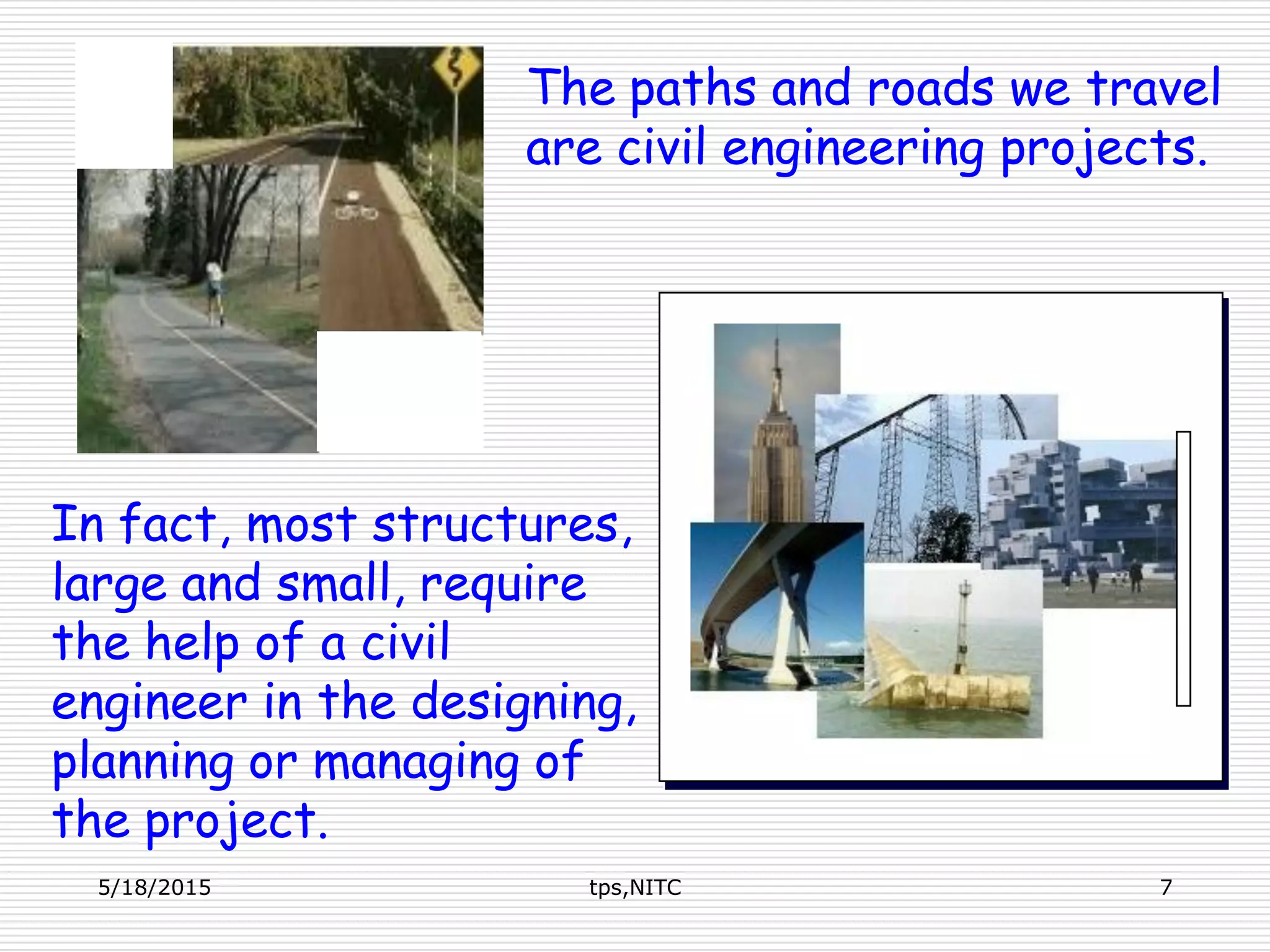
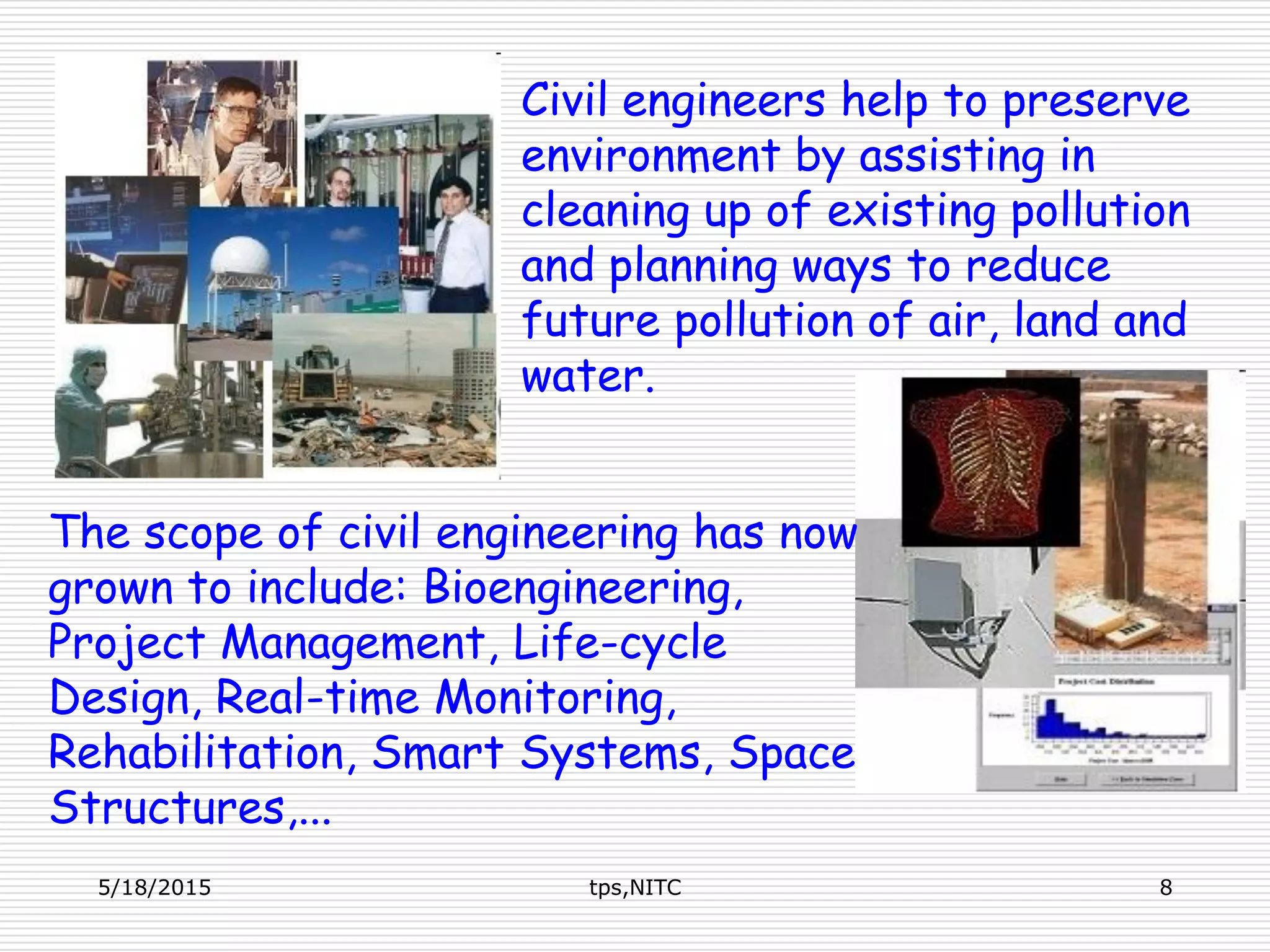
In fact, most structures,
large and small, require
the help of a civil
engineer in the designing,
planning or managing of
the project.
The paths and roads we travel
are civil engineering projects.
5/18/2015 7tps,NITC
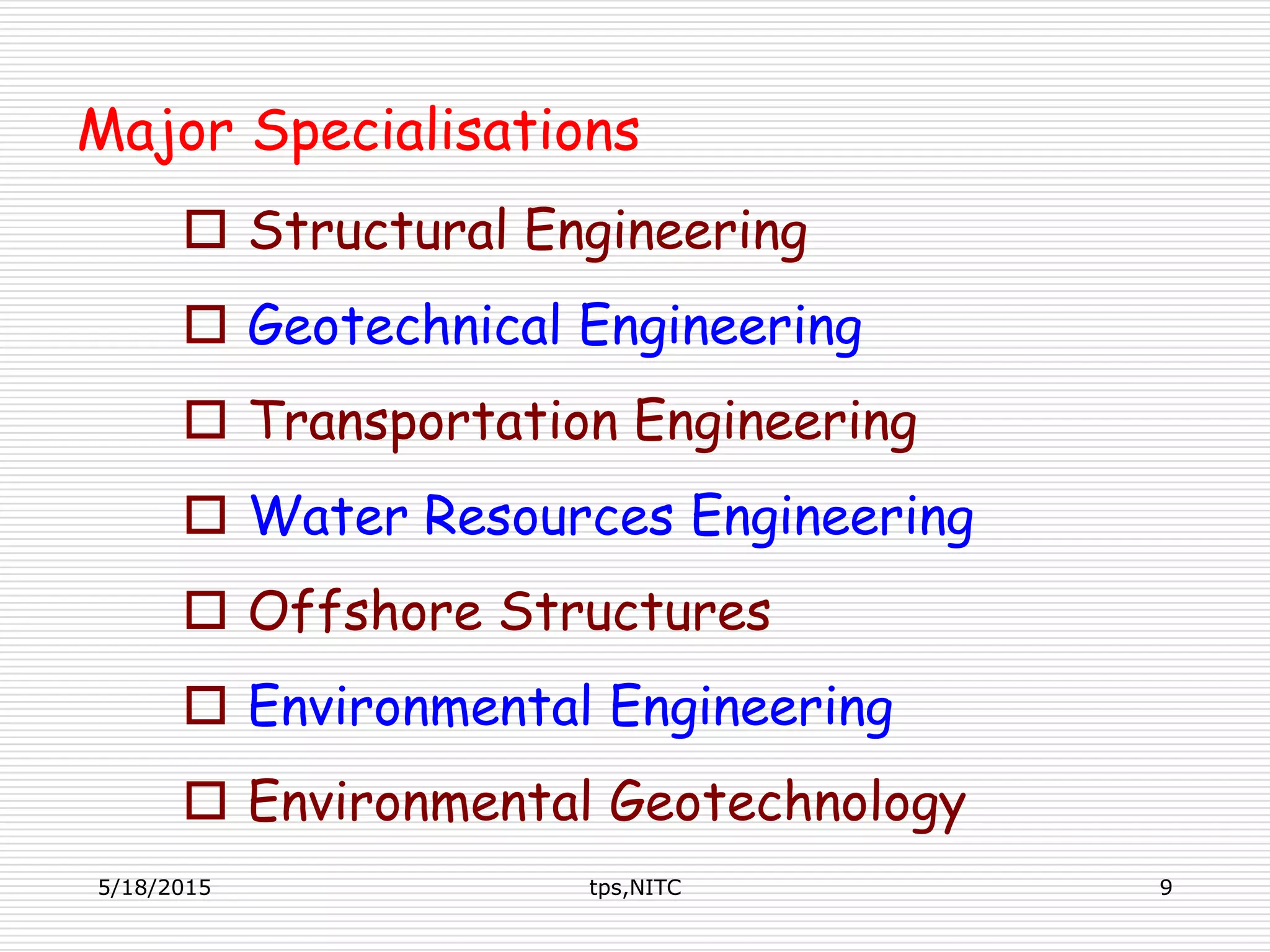
Civil engineers help to preserve
environment by assisting in
cleaning up of existing pollution
and planning ways to reduce
future pollution of air, land and
water.
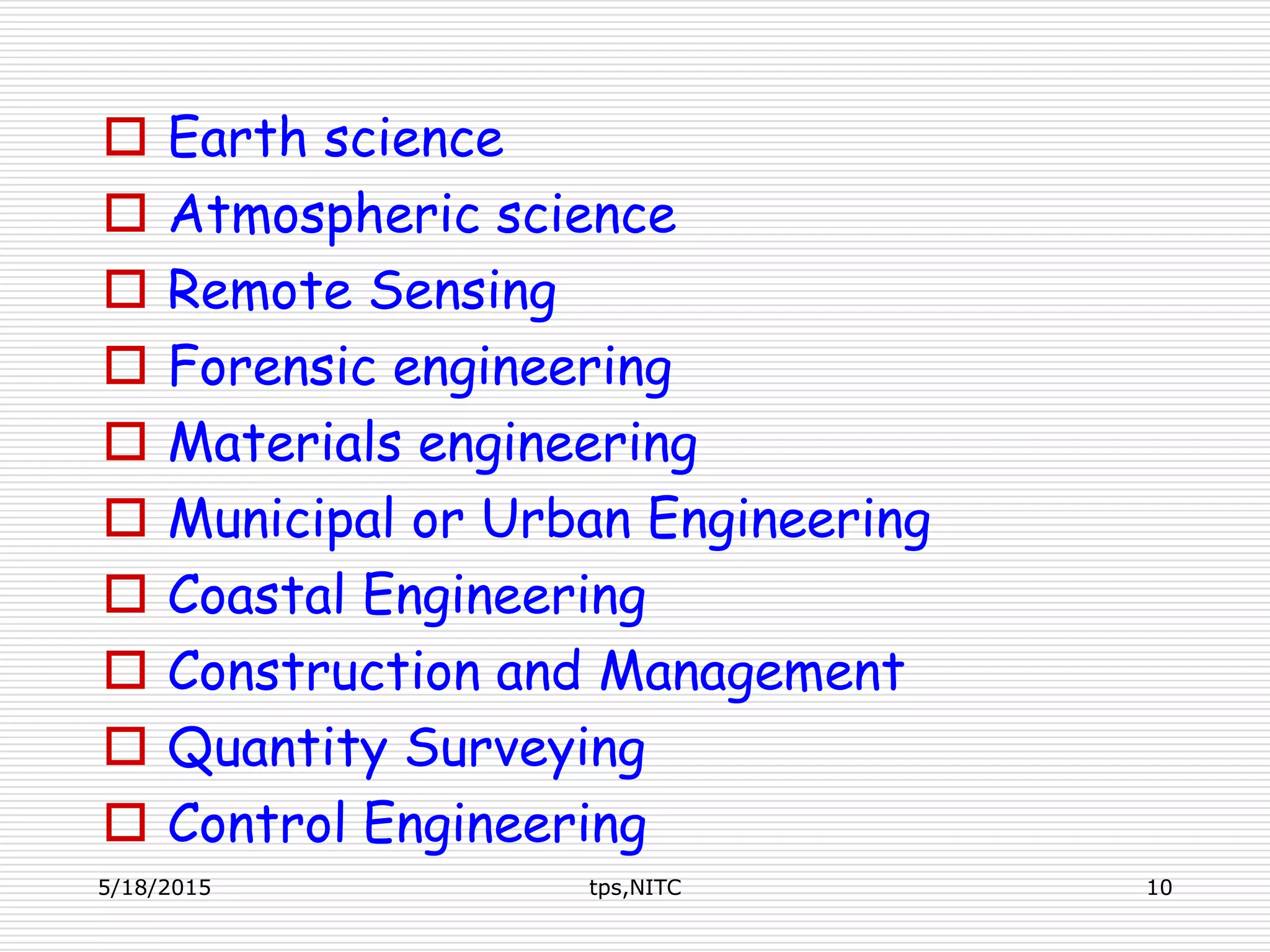
The scope of civil engineering has now
grown to include: Bioengineering,
Project Management, Life-cycle
Design, Real-time Monitoring,
Rehabilitation, Smart Systems, Space
Structures,...
5/18/2015 8tps,NITC
Major Specialisations
 Structural Engineering
 Geotechnical Engineering
 Transportation Engineering
 Water Resources Engineering
 Offshore Structures
 Environmental Engineering
 Environmental Geotechnology
5/18/2015 9tps,NITC
 Earth science
 Atmospheric science
 Remote Sensing
 Forensic engineering
 Materials engineering
 Municipal or Urban Engineering
 Coastal Engineering
 Construction and Management
 Quantity Surveying
 Control Engineering
5/18/2015 tps,NITC 10
Structural Engineering
Deals with Analysis and Design of Structures
such as
 buildings
 Bridges, Aqueducts, Canals
 Docks & Harbours
 towers (TV, telecommunication,
transmission line,…), chimneys
 water tanks
 pressure vessels
 stadia
5/18/2015 11tps,NITC
Geotechnical Engineering
 Analysis and design of foundations for
different structures
 Design of embankments and earthen dams
 Prevention of soil erosion and land slides
 Stabilisation of slopes
 Ground improvement
5/18/2015 12tps,NITC
Transportation Engineering
Planning, design, operation and maintenance
of transport facilities
 Roads
 Railways
 Airports / airways
 Waterways
Transportation planning
Traffic engineering
Pavements
5/18/2015 13tps,NITC
Environmental Engineering
Protection of environment from pollutions
Water quality management
Sewage systems
Waste management
 industrial, hospital, etc.
Air pollution control
5/18/2015 14tps,NITC
Water Resources Engineering
Planning and design of water distribution
systems
 irrigation
 drinking and other house-hold needs
 hydroelectric power generation
Rain water harvesting
Water shed management
5/18/2015 15tps,NITC
Offshore Structures
Analysis and design, fabrication and
erection of offshore structures such as
 Jacket structures
 Gravity structures
 Compliant structures
 Floating production systems
 Offshore pipelines
 Buoys
 Mooring lines
5/18/2015 16tps,NITC
5/18/2015 tps,NITC 17
185/18/2015 tps,NITC
195/18/2015 tps,NITC
Intelligent (smart) Structures
Surveying and GPS (Global Positioning System )
GPS is a satellite-based system, operated and
maintained by the U.S. Department of Defence (DoD),
that provides accurate location and timing information
to people worldwide.
The system transmits radio signals that can be used by
GPS receivers to calculate position, velocity and time
anywhere on Earth, any time of day or night, in any
kind of weather.
The GPS is a National resource and an international
utility for positioning, navigation and timing.
5/18/2015 20tps,NITC
The World Trade Centre
5/18/2015 21tps,NITC
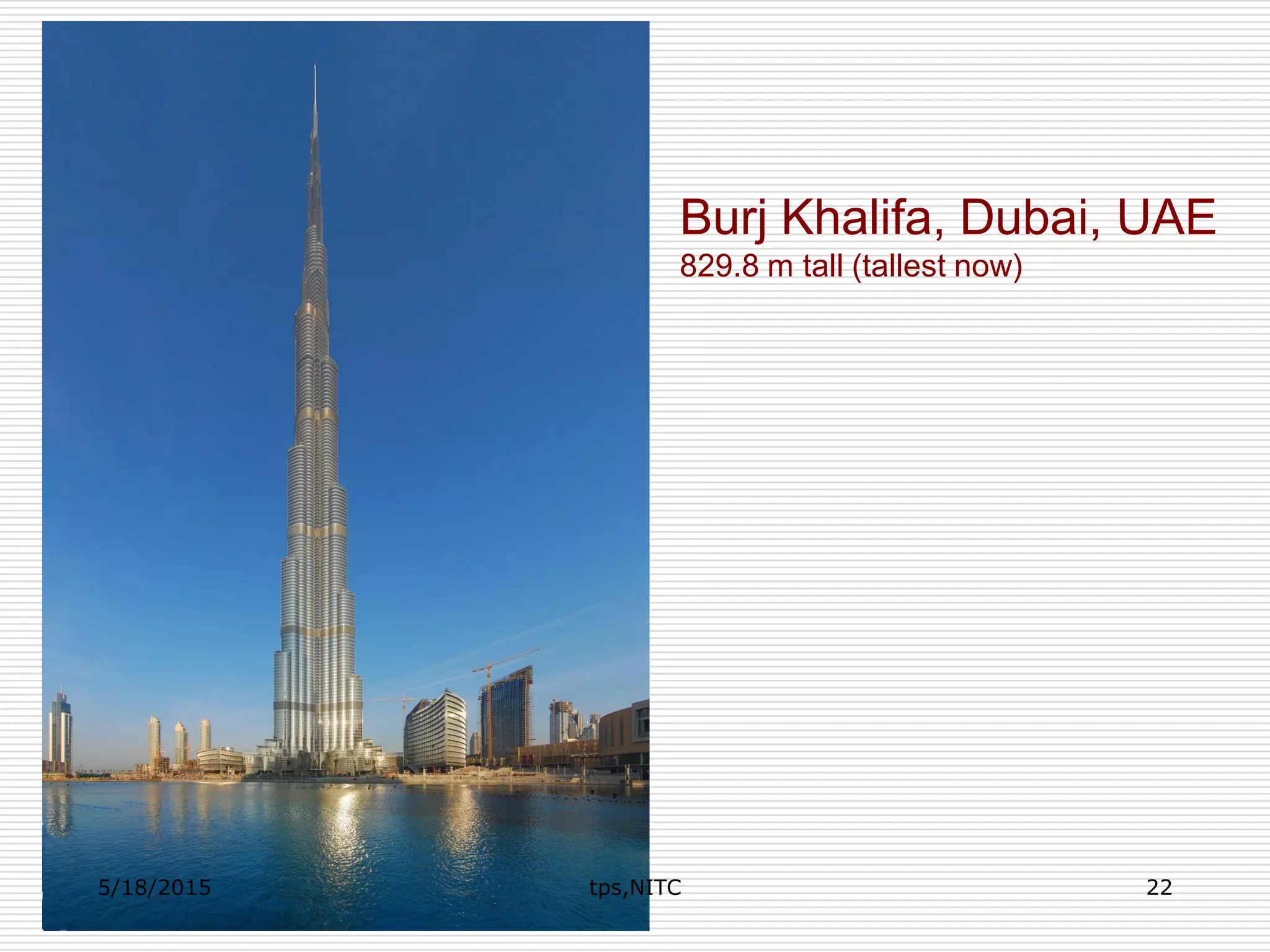
Burj Khalifa, Dubai, UAE
829.8 m tall (tallest now)
5/18/2015 22tps,NITC
The Empire State Building
New York, 1931
Commercial Office Tower,
Skyscraper
Steel Frame, Stone Cladding
102 floors, 1252 feet, 381 meters
high. Effective use of setbacks to
emphasise tower.
5/18/2015 23tps,NITC
Tokyo Sky Tree
634 m tall, Japan
5/18/2015 24tps,NITC
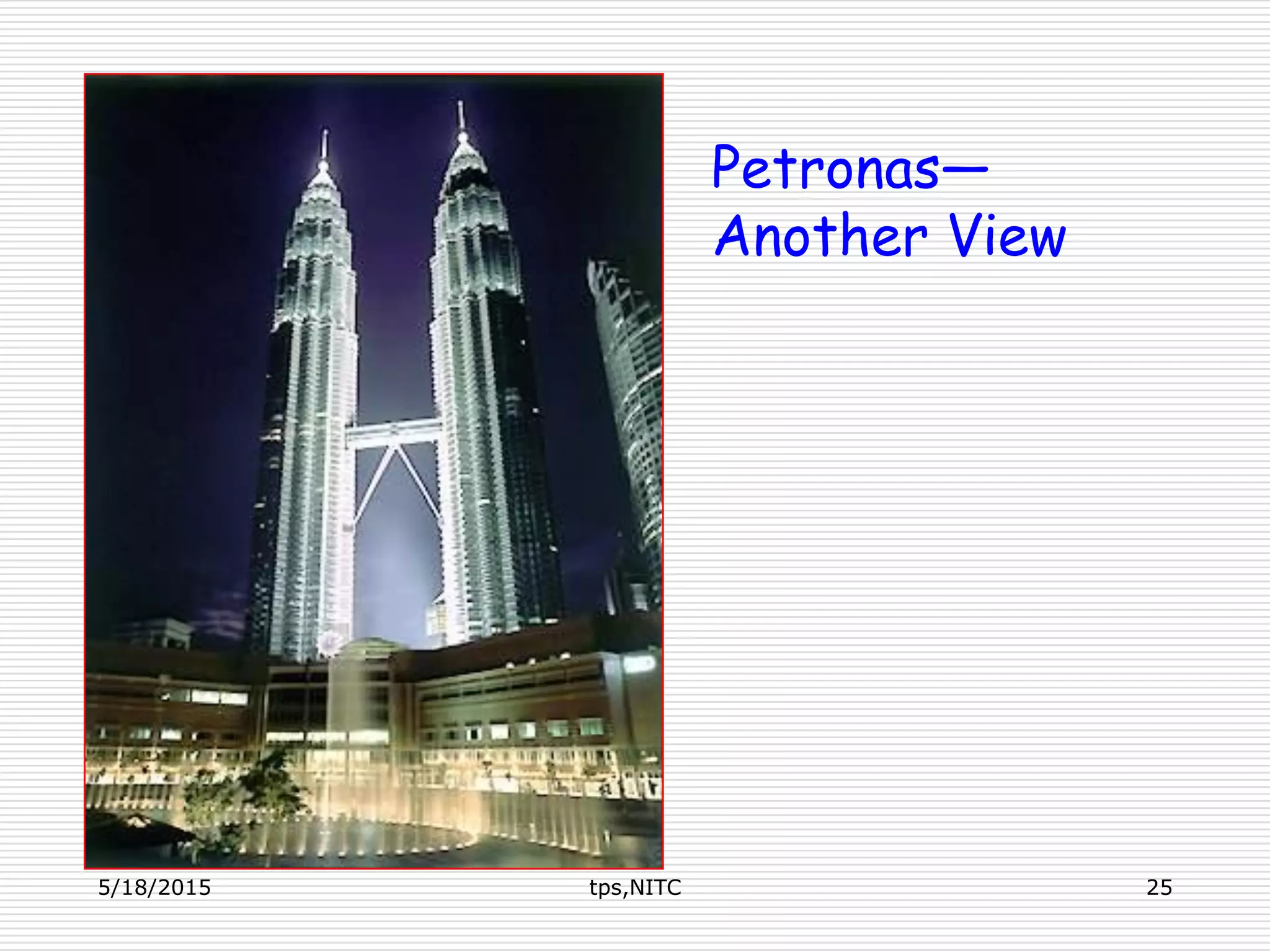
Petronas—
Another View
5/18/2015 25tps,NITC
5/18/2015 tps,NITC 26
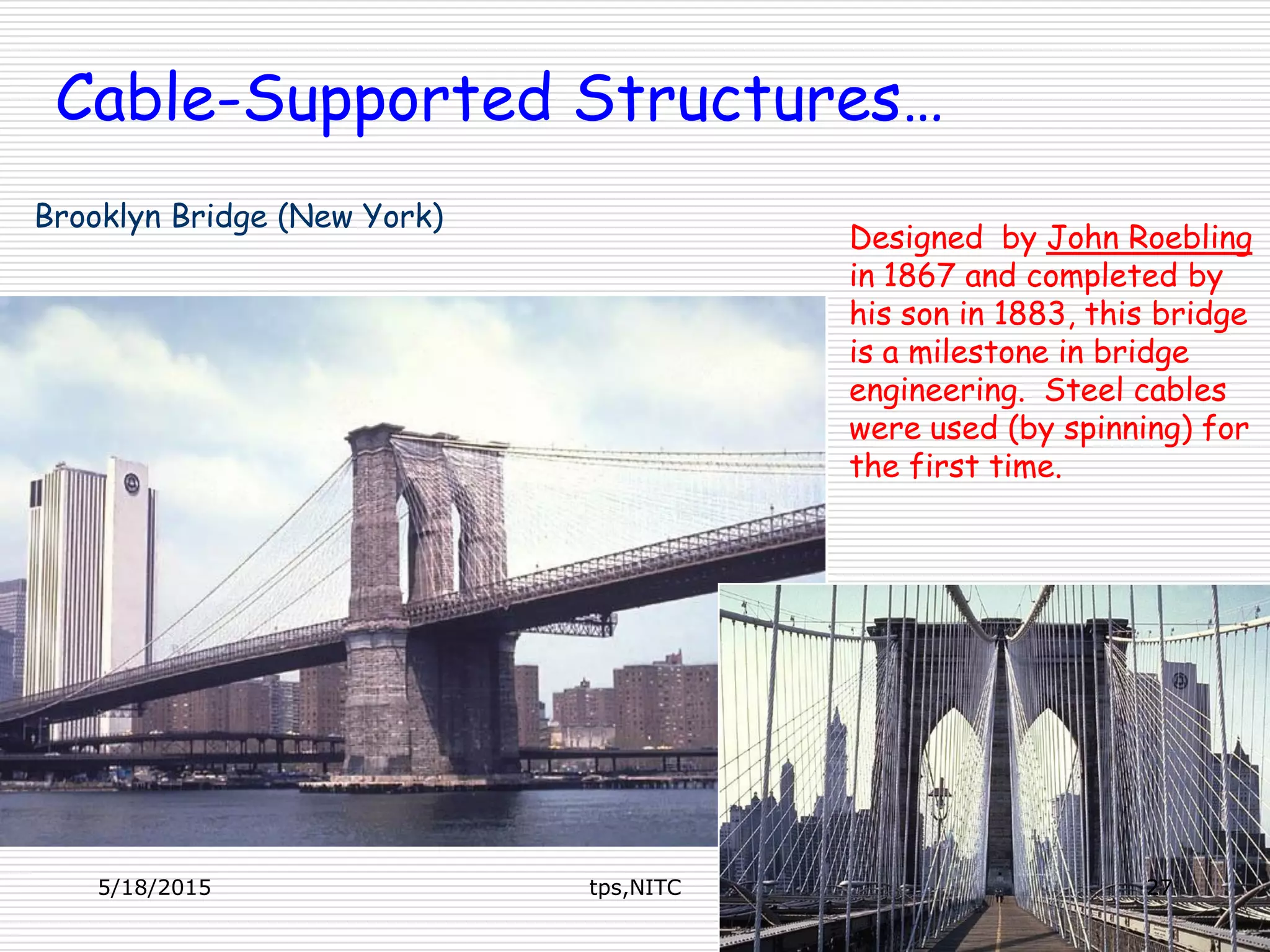
Designed by John Roebling
in 1867 and completed by
his son in 1883, this bridge
is a milestone in bridge
engineering. Steel cables
were used (by spinning) for
the first time.
Brooklyn Bridge (New York)
Cable-Supported Structures…
5/18/2015 27tps,NITC
Golden Gate Bridge (San Fransisco, 1937)
Span = 1280m
Cable-Supported Structures…
5/18/2015 28tps,NITC
Royal Gorge Bridge (Colorado)
Cable-Supported Structures…
5/18/2015 29tps,NITC
Cable-stayed bridges One of the
earliest cable-
stayed bridges.
Albert Bridge
across the River
Thames, opened
in 1873. The
spans are 147 ft,
384 ft & 147 ft.
Cable-Supported Structures…
5/18/2015 30tps,NITC
Cable-stayed bridges
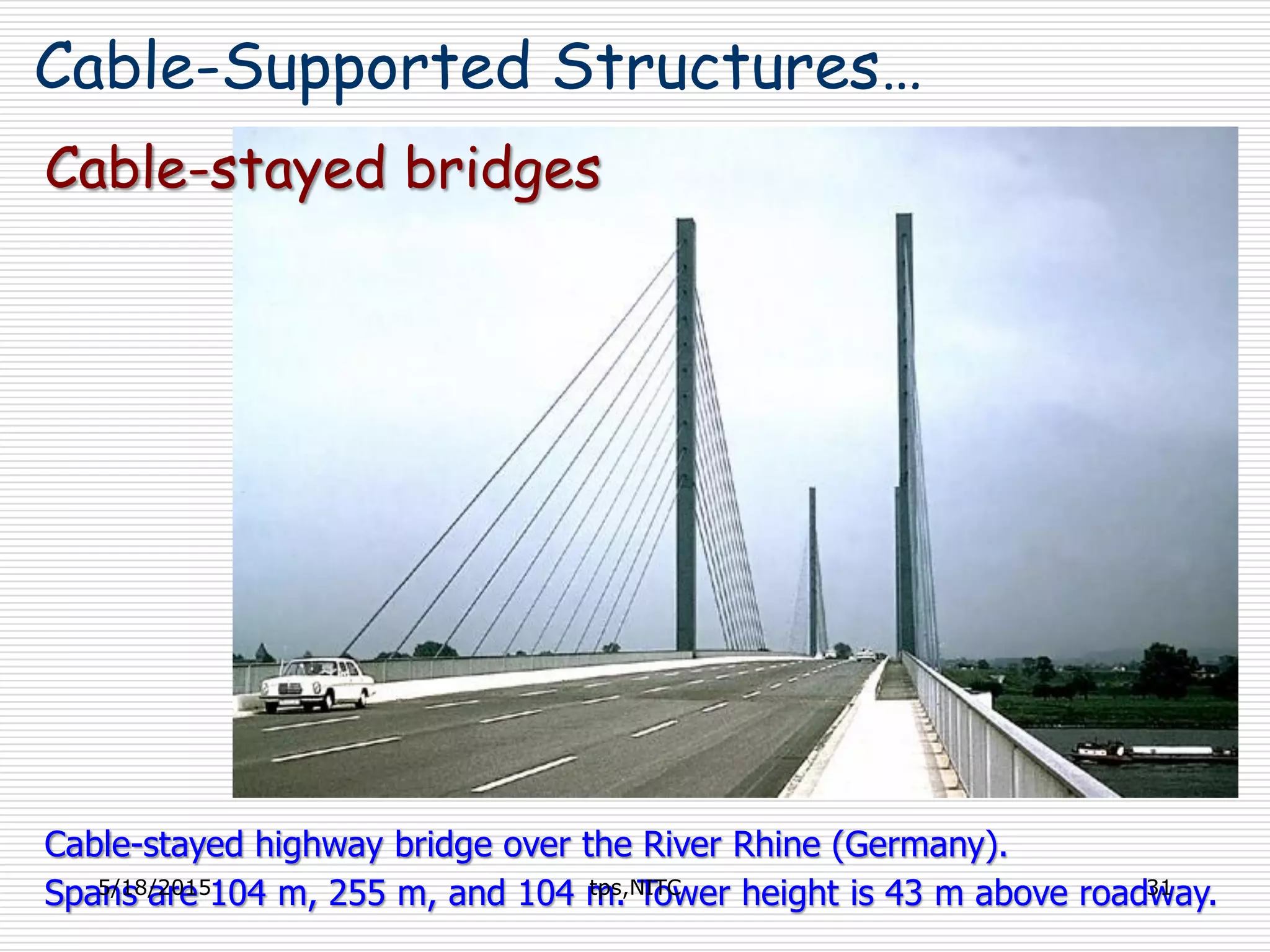
Cable-stayed highway bridge over the River Rhine (Germany).
Spans are 104 m, 255 m, and 104 m. Tower height is 43 m above roadway.
Cable-Supported Structures…
5/18/2015 31tps,NITC
Cable-stayed bridges
Over the River Rhine (Dusseldorf)—Single tower design with single
plane of cables and 3-lane traffic on either side of the centreline
Cable-Supported Structures…
5/18/2015 32tps,NITC
Cable-Supported Structures…
5/18/2015 33tps,NITC
Cable-Supported
Structures…
Katsushika Harp Bridge, Tokyo, 1986
5/18/2015 34tps,NITC
External Prestressing
Truc de la
Fare
Overpass,
France
5 supporting
cables, deviated
by 3 V-shaped
steel ribs
5/18/2015 35tps,NITC
Bahai Temple
5/18/2015 36tps,NITC
Award winning structures 2000
A structure of beauty is
a joy forever
5/18/2015 37tps,NITC
12-storey building with floors hung
from the top of the central 270-ft.
high concrete core by six sets of
continuous steel bridge cables. Floors
were erected from the top down. The
core is 36 ft.  36 ft. in section, and
can be seen at both top and bottom of
the building. (Vancouver)
Cable-Supported
Structures
5/18/2015 38tps,NITC
5/18/2015 39tps,NITC
Monorail
5/18/2015 40tps,NITC
Skybus
5/18/2015 41tps,NITC
5/18/2015 tps,NITC 42
5/18/2015 tps,NITC 43
Rotating tower in Dubai
 Wherever you might be, in cities or towns or in
the far-flung areas of the country you simply
cannot miss the creation of civil engineers.
 The nature of this profile makes it an
evergreen prospect for career minded
youngsters.
 There is an endless demand for this job profile
both in the private as well as in public sector
undertakings in our country.
5/18/2015 tps,NITC 44
Is it the Right Career for Me?
 As a civil engineer, you will have to plan out,
design and supervise the construction of
different types of buildings.
 You need to posses good knowledge of
mathematics and science. Also, you must also
have good supervisory and administrative
skills.
 Furthermore, you must be ready to sweat it
out at construction sites and even work under
stressful and hostile conditions. And if you
think you fit the bill then civil engineering is
the right profession for you.
5/18/2015 tps,NITC 45
Job Prospects
 There is huge demand for civil engineers in India and it
is also expected to get a boost as the country gets ready
to upgrade its infrastructure with growing economic and
political clout in the world.
 The career opens a lot of opportunities in numerous
government departments.
 Civil engineers are employed in all major construction
projects carried out by central and state government
agencies.
 There are equally good opportunities in the private
sector for civil engineers.
 A major opening for qualified civil engineers is also in
armed forces where they can make vital contribution to
the protection of the country.
 Last but not the least you can set up your own
engineering consultancy.
5/18/2015 tps,NITC 46
Job Role: A Sneak peek
 A career after civil engineering is highly rewarding.
There are jobs that involve supervision,
construction, design and analyzes of private as well
as public projects, such as dams, highways, canals,
water sewages and bridges.
 The profession demands excellent skills for both
administration and supervision of projects.
 Excellence and responsibility are important factors
associated with the job. In other words, whenever
you see or read about any popular landmark in the
world (iconic works like Golden Gate Bridge, The
Gateway of India, Burj Khalifa, etc.), there is a civil
engineer involved in its construction. Isn’t it
interesting!
5/18/2015 tps,NITC 47
Career Outlook
 A career as a civil engineer offers several lucrative job
avenues in both public & private sector.
 Some popular options include consulting firms, railways,
defence force, and municipal corporations. Civil
engineering includes different specializations such as
construction, geo-technical, environmental, coastal and
transportation engineering.
 The aim of every graduate is to get a highly paid job.
Experience plays a vital role in influencing your salary
package. However, the average annual salary of these
professionals includes Rs 356,262(payscale.com).
 Engineers with skills like Project Management, Visual
Basic (VB), Engineering Design, and Microsoft Project
add value to their package.
5/18/2015 tps,NITC 48
A Promising Future
 To define the future prospects for civil engineering
graduates in India, lucrative opportunities can be
expected in construction, energy, and power sector.
 In fact, civil engineering is one branch of engineering
that has lesser unemployment rate than the other
branches.
 There are several fields in this branch, which will
offer maximum scope. These include:
Designing:
For finding a designing career in civil engineering,
excellent academic record and experience is
important. Knowledge of civil engineering software
such as AutoCAD, Staad Pro, Etabs, SAP, AutoTum,
and TopoCAD makes you more employable.
5/18/2015 tps,NITC 49
Construction:
 projects Job as a project or construction engineer
offers career opportunities in construction field,
including road and industrial construction. It is
considered a challenging job and includes
execution of mega at different levels.
Planning:
If you possess excellent planning skills, choosing
a career in planning or project management is a
good option. Planning engineers find huge
demand in construction companies. Knowledge of
software such as MS Project and Primavera can
be helpful in this field.
5/18/2015 tps,NITC 50
Another Tip:
 If you are looking for consulting or management
roles, it is important to gain work experience of at
least five or more years under a qualified
engineer.
 This prepares you to understand the industry
requirement. Moreover, those who want to start
their own company, it is mandatory to get a
license to render your services.
 Hence, the scope of civil engineering is bright in
India and across the globe. Once you have earned
an engineering degree in the field from any
reputed college, finding a job is not a herculean
task.
5/18/2015 tps,NITC 51
Demand and Supply
 In the past few years, the demand for civil
engineers has exceeded the supply.
 The growth in economy and exceeding demand
for well qualified and experienced civil
engineers has resulted in towering pay levels.
 Shortage of 7,000 civil engineers is witnessed
by India every year.
 Therefore, no civil engineer can go without a
job after his graduation.
 As a civil engineer, good job opportunities will
await at your doorstep.
5/18/2015 tps,NITC 52
5/18/2015 tps,NITC 53
 Market Watch
 Growth in the economy as a whole and the
construction industry in particular has brought
cheers to youth seeking to make a career in
civil engineering.
 This demand has been further pushed higher
with more multinational engineering companies
setting up their footprint across India.
 Further, the rapid increase in population and
the steady technological progress made by the
country has considerably enhanced the market
for civil engineers
5/18/2015 tps,NITC 54
International Focus
 Indian engineers are in high demand in Asia,
Africa and the middle-east.
 Those graduating from IITs & NITs also manage
jobs in developed countries.
 The employment opportunities abroad are very
appealing.
 The packets are high compared with the pay
packets in India.
5/18/2015 tps,NITC 55
ARCHITECTURE
 One needs certain qualities, called soft skills, to
succeed in this occupation.
 If you want to be an architect you should be
creative and have good visualization skills.
 Not only do you need to be able to create designs
for buildings and other structures, you need to be
able to see, in your mind's eye, what they will look
like once they are built.
 Since architects have to describe their ideas to
other people including clients and colleagues, you
must have strong communication skills. The ability
to think critically will help you solve problems that
inevitably arise during most projects.
5/18/2015 tps,NITC 56
Advancement Opportunities
 A licensed architect, after gaining experience, may take on
increasingly responsible duties and eventual managing entire
projects.
 Architects may advance to supervisory or managerial
positions in large firms. Some become partners in established
firms while others set up their own practices.
 Job Outlook
 Employment in this field is projected to grow faster than the
average for all occupations through 2020.
 Prospective architects may face competition for positions at
prestigious firms. To increase one's chances of getting an
internship after graduation, it is important to get career-
related experience in an architectural firm while still in school.
 Those who know CADD technology will also have an
advantage.
5/18/2015 tps,NITC 57
A Day in an Architect's Life
On a typical day an architect will
 Discuss the objectives, requirements, and budget of a
project
 Provide various pre-design services which may include
conducting feasibility and environmental impact studies,
selecting a site, or specifying the requirements the design
must meet
 Prepare drawings and present ideas for the client to review
 Develop final construction plans that show the building's
appearance as well as details for its construction
 Follow building codes, zoning laws, fire regulations, and
other ordinances
 Make necessary changes throughout the planning process
5/18/2015 tps,NITC 58
ARCHITECTURE
 The areas of probable specialisation or career
for those with BArch
degree are as follows:
Architectural Consultancy
Interior Design
Landscape Architect
specialist in Housing
Project Management
Animater
Urban Planner
5/18/2015 tps,NITC 59
Architectural Conservation
Urban Design
Disaster Management
Transport Planning
Environmental Planning
Urban Infrastructure planning
Disaster Management
Community Planning
Green Building Design
5/18/2015 tps,NITC 60
Remote Sensing and GIS expert
Sustainable Planning and Design
Energy Efficient Building Design
Creative Design
Acoustics Design
Illumination Design
5/18/2015 tps,NITC 61
Any Questions?
625/18/2015 tps,NITC
Thank You!
5/18/2015 63tps,NITC

Civil and Architectural Engg - an INtroduction by Prof T P Somasundaram

  • 1.
    Dr. T.P. Somasundaran Professor Departmentof Civil Engineering National Institute of Technology Calicut E-mail: soman@nitc.ac.in WHAT IS CIVIL ENGINEERING ?
  • 2.
    Civil Engineers giveus Quality of Life ! Civil engineering is the oldest branch of the profession of engineering after military engineering. Many of the important things in our lives that we take for granted are the product of civil engineering. 5/18/2015 tps,NITC 2
  • 3.
    Introduction  Since timeimmemorial, human beings have been engaged in building all kinds of edifices. From huts made of mud to Taj Mahal, we have definitely come a long way.  As civilisations matured, it simultaneously led to the development of bigger, better and diverse structures. From cave dwellings, human beings had moved on to construct houses, palaces, canals, dams, highways, and stadia.  These civilian structures played a significant role in the development of human race and gave various dimensions to human life as various activities evolved: social, political, economic and recreational. 5/18/2015 tps,NITC 3
  • 4.
     Amongst allbranches of engineering, the range and application of civil engineering is the broadest and the most visible.  In fact, the entire infrastructural framework of a modern nation is the creation of civil engineers.  The credit of building mighty power plants, dams, airports, sea ports, highways, inland waterways and industrial plants goes to civil engineers.  These professionals are also engaged in building an unending array of urban structures such as commercial complexes, skyscrapers, tunnels, bridges, roads, urban rapid transport systems, sports stadia and so on. 5/18/2015 tps,NITC 4
  • 5.
     Civil engineerstypically apply the principles of geotechnical engineering, structural engineering, earthquake engineering, environmental engineering, transportation engineering and construction engineering to residential, commercial, industrial and public works projects of all sizes and levels of construction. 5/18/2015 tps,NITC 5 Civil Engineers
  • 6.
    The construction ofdams and power stations that provide the electricity we use every day requires civil engineers. The water and sewage treatment plants that provide us with safe water supplies require the expertise of civil engineers. 5/18/2015 6tps,NITC
  • 7.
    In fact, moststructures, large and small, require the help of a civil engineer in the designing, planning or managing of the project. The paths and roads we travel are civil engineering projects. 5/18/2015 7tps,NITC
  • 8.
    Civil engineers helpto preserve environment by assisting in cleaning up of existing pollution and planning ways to reduce future pollution of air, land and water. The scope of civil engineering has now grown to include: Bioengineering, Project Management, Life-cycle Design, Real-time Monitoring, Rehabilitation, Smart Systems, Space Structures,... 5/18/2015 8tps,NITC
  • 9.
    Major Specialisations  StructuralEngineering  Geotechnical Engineering  Transportation Engineering  Water Resources Engineering  Offshore Structures  Environmental Engineering  Environmental Geotechnology 5/18/2015 9tps,NITC
  • 10.
     Earth science Atmospheric science  Remote Sensing  Forensic engineering  Materials engineering  Municipal or Urban Engineering  Coastal Engineering  Construction and Management  Quantity Surveying  Control Engineering 5/18/2015 tps,NITC 10
  • 11.
    Structural Engineering Deals withAnalysis and Design of Structures such as  buildings  Bridges, Aqueducts, Canals  Docks & Harbours  towers (TV, telecommunication, transmission line,…), chimneys  water tanks  pressure vessels  stadia 5/18/2015 11tps,NITC
  • 12.
    Geotechnical Engineering  Analysisand design of foundations for different structures  Design of embankments and earthen dams  Prevention of soil erosion and land slides  Stabilisation of slopes  Ground improvement 5/18/2015 12tps,NITC
  • 13.
    Transportation Engineering Planning, design,operation and maintenance of transport facilities  Roads  Railways  Airports / airways  Waterways Transportation planning Traffic engineering Pavements 5/18/2015 13tps,NITC
  • 14.
    Environmental Engineering Protection ofenvironment from pollutions Water quality management Sewage systems Waste management  industrial, hospital, etc. Air pollution control 5/18/2015 14tps,NITC
  • 15.
    Water Resources Engineering Planningand design of water distribution systems  irrigation  drinking and other house-hold needs  hydroelectric power generation Rain water harvesting Water shed management 5/18/2015 15tps,NITC
  • 16.
    Offshore Structures Analysis anddesign, fabrication and erection of offshore structures such as  Jacket structures  Gravity structures  Compliant structures  Floating production systems  Offshore pipelines  Buoys  Mooring lines 5/18/2015 16tps,NITC
  • 17.
  • 18.
  • 19.
  • 20.
    Intelligent (smart) Structures Surveyingand GPS (Global Positioning System ) GPS is a satellite-based system, operated and maintained by the U.S. Department of Defence (DoD), that provides accurate location and timing information to people worldwide. The system transmits radio signals that can be used by GPS receivers to calculate position, velocity and time anywhere on Earth, any time of day or night, in any kind of weather. The GPS is a National resource and an international utility for positioning, navigation and timing. 5/18/2015 20tps,NITC
  • 21.
    The World TradeCentre 5/18/2015 21tps,NITC
  • 22.
    Burj Khalifa, Dubai,UAE 829.8 m tall (tallest now) 5/18/2015 22tps,NITC
  • 23.
    The Empire StateBuilding New York, 1931 Commercial Office Tower, Skyscraper Steel Frame, Stone Cladding 102 floors, 1252 feet, 381 meters high. Effective use of setbacks to emphasise tower. 5/18/2015 23tps,NITC
  • 24.
    Tokyo Sky Tree 634m tall, Japan 5/18/2015 24tps,NITC
  • 25.
  • 26.
  • 27.
    Designed by JohnRoebling in 1867 and completed by his son in 1883, this bridge is a milestone in bridge engineering. Steel cables were used (by spinning) for the first time. Brooklyn Bridge (New York) Cable-Supported Structures… 5/18/2015 27tps,NITC
  • 28.
    Golden Gate Bridge(San Fransisco, 1937) Span = 1280m Cable-Supported Structures… 5/18/2015 28tps,NITC
  • 29.
    Royal Gorge Bridge(Colorado) Cable-Supported Structures… 5/18/2015 29tps,NITC
  • 30.
    Cable-stayed bridges Oneof the earliest cable- stayed bridges. Albert Bridge across the River Thames, opened in 1873. The spans are 147 ft, 384 ft & 147 ft. Cable-Supported Structures… 5/18/2015 30tps,NITC
  • 31.
    Cable-stayed bridges Cable-stayed highwaybridge over the River Rhine (Germany). Spans are 104 m, 255 m, and 104 m. Tower height is 43 m above roadway. Cable-Supported Structures… 5/18/2015 31tps,NITC
  • 32.
    Cable-stayed bridges Over theRiver Rhine (Dusseldorf)—Single tower design with single plane of cables and 3-lane traffic on either side of the centreline Cable-Supported Structures… 5/18/2015 32tps,NITC
  • 33.
  • 34.
  • 35.
    External Prestressing Truc dela Fare Overpass, France 5 supporting cables, deviated by 3 V-shaped steel ribs 5/18/2015 35tps,NITC
  • 36.
  • 37.
    Award winning structures2000 A structure of beauty is a joy forever 5/18/2015 37tps,NITC
  • 38.
    12-storey building withfloors hung from the top of the central 270-ft. high concrete core by six sets of continuous steel bridge cables. Floors were erected from the top down. The core is 36 ft.  36 ft. in section, and can be seen at both top and bottom of the building. (Vancouver) Cable-Supported Structures 5/18/2015 38tps,NITC
  • 39.
  • 40.
  • 41.
  • 42.
  • 43.
  • 44.
     Wherever youmight be, in cities or towns or in the far-flung areas of the country you simply cannot miss the creation of civil engineers.  The nature of this profile makes it an evergreen prospect for career minded youngsters.  There is an endless demand for this job profile both in the private as well as in public sector undertakings in our country. 5/18/2015 tps,NITC 44
  • 45.
    Is it theRight Career for Me?  As a civil engineer, you will have to plan out, design and supervise the construction of different types of buildings.  You need to posses good knowledge of mathematics and science. Also, you must also have good supervisory and administrative skills.  Furthermore, you must be ready to sweat it out at construction sites and even work under stressful and hostile conditions. And if you think you fit the bill then civil engineering is the right profession for you. 5/18/2015 tps,NITC 45
  • 46.
    Job Prospects  Thereis huge demand for civil engineers in India and it is also expected to get a boost as the country gets ready to upgrade its infrastructure with growing economic and political clout in the world.  The career opens a lot of opportunities in numerous government departments.  Civil engineers are employed in all major construction projects carried out by central and state government agencies.  There are equally good opportunities in the private sector for civil engineers.  A major opening for qualified civil engineers is also in armed forces where they can make vital contribution to the protection of the country.  Last but not the least you can set up your own engineering consultancy. 5/18/2015 tps,NITC 46
  • 47.
    Job Role: ASneak peek  A career after civil engineering is highly rewarding. There are jobs that involve supervision, construction, design and analyzes of private as well as public projects, such as dams, highways, canals, water sewages and bridges.  The profession demands excellent skills for both administration and supervision of projects.  Excellence and responsibility are important factors associated with the job. In other words, whenever you see or read about any popular landmark in the world (iconic works like Golden Gate Bridge, The Gateway of India, Burj Khalifa, etc.), there is a civil engineer involved in its construction. Isn’t it interesting! 5/18/2015 tps,NITC 47
  • 48.
    Career Outlook  Acareer as a civil engineer offers several lucrative job avenues in both public & private sector.  Some popular options include consulting firms, railways, defence force, and municipal corporations. Civil engineering includes different specializations such as construction, geo-technical, environmental, coastal and transportation engineering.  The aim of every graduate is to get a highly paid job. Experience plays a vital role in influencing your salary package. However, the average annual salary of these professionals includes Rs 356,262(payscale.com).  Engineers with skills like Project Management, Visual Basic (VB), Engineering Design, and Microsoft Project add value to their package. 5/18/2015 tps,NITC 48
  • 49.
    A Promising Future To define the future prospects for civil engineering graduates in India, lucrative opportunities can be expected in construction, energy, and power sector.  In fact, civil engineering is one branch of engineering that has lesser unemployment rate than the other branches.  There are several fields in this branch, which will offer maximum scope. These include: Designing: For finding a designing career in civil engineering, excellent academic record and experience is important. Knowledge of civil engineering software such as AutoCAD, Staad Pro, Etabs, SAP, AutoTum, and TopoCAD makes you more employable. 5/18/2015 tps,NITC 49
  • 50.
    Construction:  projects Jobas a project or construction engineer offers career opportunities in construction field, including road and industrial construction. It is considered a challenging job and includes execution of mega at different levels. Planning: If you possess excellent planning skills, choosing a career in planning or project management is a good option. Planning engineers find huge demand in construction companies. Knowledge of software such as MS Project and Primavera can be helpful in this field. 5/18/2015 tps,NITC 50
  • 51.
    Another Tip:  Ifyou are looking for consulting or management roles, it is important to gain work experience of at least five or more years under a qualified engineer.  This prepares you to understand the industry requirement. Moreover, those who want to start their own company, it is mandatory to get a license to render your services.  Hence, the scope of civil engineering is bright in India and across the globe. Once you have earned an engineering degree in the field from any reputed college, finding a job is not a herculean task. 5/18/2015 tps,NITC 51
  • 52.
    Demand and Supply In the past few years, the demand for civil engineers has exceeded the supply.  The growth in economy and exceeding demand for well qualified and experienced civil engineers has resulted in towering pay levels.  Shortage of 7,000 civil engineers is witnessed by India every year.  Therefore, no civil engineer can go without a job after his graduation.  As a civil engineer, good job opportunities will await at your doorstep. 5/18/2015 tps,NITC 52
  • 53.
  • 54.
     Market Watch Growth in the economy as a whole and the construction industry in particular has brought cheers to youth seeking to make a career in civil engineering.  This demand has been further pushed higher with more multinational engineering companies setting up their footprint across India.  Further, the rapid increase in population and the steady technological progress made by the country has considerably enhanced the market for civil engineers 5/18/2015 tps,NITC 54
  • 55.
    International Focus  Indianengineers are in high demand in Asia, Africa and the middle-east.  Those graduating from IITs & NITs also manage jobs in developed countries.  The employment opportunities abroad are very appealing.  The packets are high compared with the pay packets in India. 5/18/2015 tps,NITC 55
  • 56.
    ARCHITECTURE  One needscertain qualities, called soft skills, to succeed in this occupation.  If you want to be an architect you should be creative and have good visualization skills.  Not only do you need to be able to create designs for buildings and other structures, you need to be able to see, in your mind's eye, what they will look like once they are built.  Since architects have to describe their ideas to other people including clients and colleagues, you must have strong communication skills. The ability to think critically will help you solve problems that inevitably arise during most projects. 5/18/2015 tps,NITC 56
  • 57.
    Advancement Opportunities  Alicensed architect, after gaining experience, may take on increasingly responsible duties and eventual managing entire projects.  Architects may advance to supervisory or managerial positions in large firms. Some become partners in established firms while others set up their own practices.  Job Outlook  Employment in this field is projected to grow faster than the average for all occupations through 2020.  Prospective architects may face competition for positions at prestigious firms. To increase one's chances of getting an internship after graduation, it is important to get career- related experience in an architectural firm while still in school.  Those who know CADD technology will also have an advantage. 5/18/2015 tps,NITC 57
  • 58.
    A Day inan Architect's Life On a typical day an architect will  Discuss the objectives, requirements, and budget of a project  Provide various pre-design services which may include conducting feasibility and environmental impact studies, selecting a site, or specifying the requirements the design must meet  Prepare drawings and present ideas for the client to review  Develop final construction plans that show the building's appearance as well as details for its construction  Follow building codes, zoning laws, fire regulations, and other ordinances  Make necessary changes throughout the planning process 5/18/2015 tps,NITC 58
  • 59.
    ARCHITECTURE  The areasof probable specialisation or career for those with BArch degree are as follows: Architectural Consultancy Interior Design Landscape Architect specialist in Housing Project Management Animater Urban Planner 5/18/2015 tps,NITC 59
  • 60.
    Architectural Conservation Urban Design DisasterManagement Transport Planning Environmental Planning Urban Infrastructure planning Disaster Management Community Planning Green Building Design 5/18/2015 tps,NITC 60
  • 61.
    Remote Sensing andGIS expert Sustainable Planning and Design Energy Efficient Building Design Creative Design Acoustics Design Illumination Design 5/18/2015 tps,NITC 61
  • 62.
  • 63.