Presented by
Miss. Aishwarya Ulhas Phutane
Asst. Professor
Department of Pharmacognosy
MarathwadaMitramandal’sCollegeof PharmacyThergaonPune
Structure Elucidation
A. Carvone:
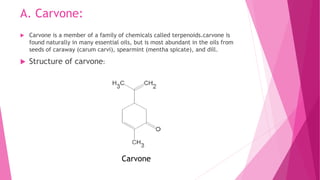
 Carvone is a member of a family of chemicals called terpenoids.carvone is
found naturally in many essential oils, but is most abundant in the oils from
seeds of caraway (carum carvi), spearmint (mentha spicate), and dill.
 Structure of carvone:
Carvone
 UV of carvone:
 UV Spectrum: (+)-carvone. 0. 0.5. 1. 1.5. 2. 2.5. 3. 3.5. 200. 220. 240. 260.
280. Wavelength (nm).
 IR of carvone:
 Mass spectroscopy:
 Mass spectrum of the carvone molecule at 536 eV.
 m/z 82(100; 39(69); 41(61.6); 95(51.7); 93(46); 94(44.6); 67(43); 79(34.9);
68(31.6); 80(29.4); 203(6.8). 5: m/z 95(100); 82(46.7); 67(45.7); 39(45.5);
41(41.5); 68(33.1); 110(26); 94(21); 79(20.4); 93(19.5); 203(6.8).
 NMR of carvone:
 a NMR spoctra were obtained at 22.6 MHz.
 4: (CDCI3) 6 212 ppm (C 0); 146.7 (--C); 119.7(CN); 110.4(--CH2); 49(C); 42.3(CH2);
40.7(2XCH); 33.5(CH2); 28.1(CH); 28.1(CH2); 21.7(CH3); 20.2(CH3).
 5: (CDCI3) di 211.5 ppm (C 0); 146.7 (--C(); 120.4(CN); 110.7(--CH2); 49.8(C);
44.2(CH2); 40.5(CH); 40.3(CH2); 34.4(CH); 30.6(CH); 28.1(CH2); 25.1(CH3);
20.3(CH3).
 6" (CDCI3) 6 211.4 ppm (C 0); 146.7(--C); 119.3(CN); 110.6(=CH2); 51.8(C);
44.3(CH2); 41.2(CH); 39.3(CH2) 30.5(CH); 29.9(CH); 26.5(CH2) 24.5(CH3);
20.6(CH3).
 l-I NMR spoctra were obtained at 80 MHz and 200 MHz. 4: di 4.65 and 4.75 ppm (2H,
vinylic protons); 3.4(q, 1H); from 1.96 to 2.67 ppm (multiplet, 8H); 1.66 (s, CH3);
1.45 (s, CH3). 5: di 4.72 and 4.78 ppm (2H, vinylic protons); 2.91 (eight lines signal,
1H); 2.66 (multiplet, 3H); 2.39 (multiplet, 3H); 2.17 (multiplet, 1n); 1.92 (td, 1n);
1.71 (s, CH3); 1.41 (s, CH3).
 di 4.68 and 4.86 ppm (2H, vinylic protons); 2.83 (t, 1H); 2.16 to 2.62 (multiplet,
7H); 2.03 (q, 1H); 1.74 (s, CH3); 1.34 (s, CH3).
 Uses:
 Carminative
 Toothpaste
 Gargles
 Flavouring
 carvones are used in the food and flavorindustry.
 R-(−)-Carvone is also used for air freshening products and, like many
essential oils, oils containing carvones are used in aromatherapy and
alternative medicine.
B. Citral:
 Lemongrass oil contains 70–80 percent citral, which may be isolated by
distillation.
 Other natural sourcesinclude the oils of verbena and citronella.
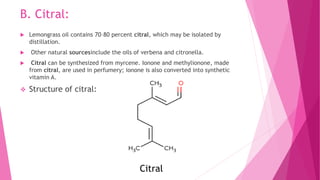
 Citral can be synthesized from myrcene. Ionone and methylionone, made
from citral, are used in perfumery; ionone is also converted into synthetic
vitamin A.
 Structure of citral:
Citral
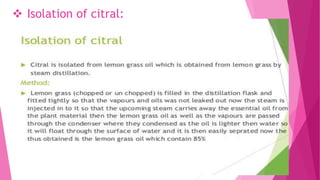
 Isolation of citral:
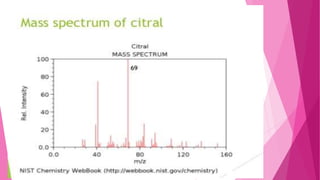
 UV of citral :
 UVspectrum displayed a band at 238 nm.
 IR of citral:
 Uses:
 Citral is therefore an aroma compound used in perfumery for its citrus
effect.
 Citral is also used as aflavor and for fortifying lemon oil.
 It also has strong antimicrobial qualities, and pheromonal effects in insects.
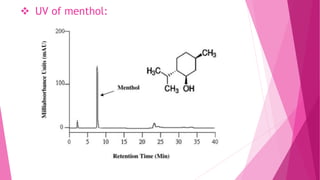
C. Menthol:
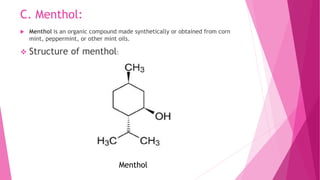
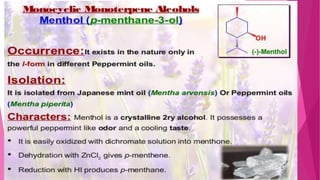
 Menthol is an organic compound made synthetically or obtained from corn
mint, peppermint, or other mint oils.
 Structure of menthol:
Menthol
 UV of menthol:
 IR of menthol:
 Uses:
 It is used to relieve minor aches and pains, such as muscle
cramps, sprains,headaches and similar conditions, alone or combined with
chemicals such as camphor, eucalyptus oil or capsaicin.
D. Luteolin:
 Luteolin is a naturally occurring flavonoid.
 The flavonoids are polyphenolic compounds found as integral components of
the human diet. They are universally present as constituents of flowering
plants, particularly of food plants.
 Structure of luteoline:
Luteolin
 Isolation of luteolin:
 UV of luteolin:
 UVspectra at 254 nm.
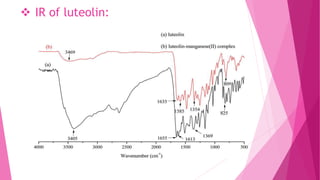
 IR of luteolin:
 NMR of luteolin:
 Uses:
 Used in many fruits, vegetables, and medicinal herbs.
 Plants rich in luteolin have been used in Chinese traditional medicine for
treating various diseases.
 such as hypertension, inflammatory disorders, and cancer.
E. Kaempferol:
 Kaempferol is a natural plant product known for its health promoting effects
and its pharmacological and nutraceutical properties.
 It is common in vegetables, fruits, plants and herbal medicines.
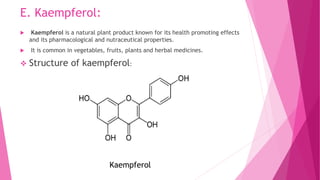
 Structure of kaempferol:
Kaempferol
 UV of kaempferol:
 UVpeak absorbance at around 250-280 nm and 350-400 nm.
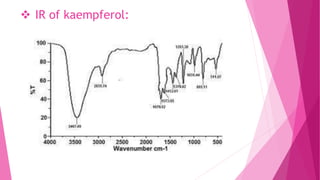
 IR of kaempferol:
 Uses:
 Kaempferol acts as anantioxidant by reducing oxidative stress.
 Many studies suggest that consuming kaempferol may reduce the risk of
various cancers.
 it is currently under consideration as a possible cancer treatment.
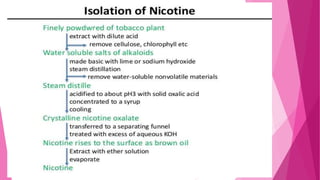
F. Nicotine:
 Nicotine is an alkaloid found in the nightshade familyof plants (Solanaceae),
predominantly in tobacco, and in lower quantities in tomato, potato, eggplant
(aubergine), and green pepper.
 Nicotine alkaloids are also found in the leaves of the coca plant.
 Structure of nicotine:
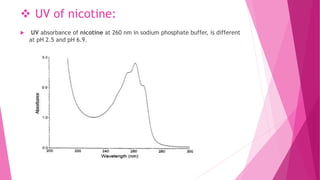
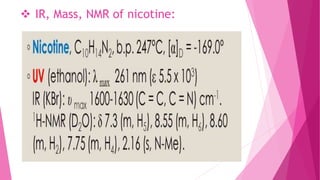
 UV of nicotine:
 UV absorbance of nicotine at 260 nm in sodium phosphate buffer, is different
at pH 2.5 and pH 6.9.
 IR, Mass, NMR of nicotine:
 Uses:
 This medication can help you quit smoking by replacing the nicotine in
cigarettes.
 The nicotine in tobacco is an important part of cigarette addiction. When you
stop smoking, your nicotine levels drop quickly.
G. Caffeine:
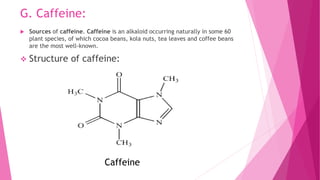
 Sources of caffeine. Caffeine is an alkaloid occurring naturally in some 60
plant species, of which cocoa beans, kola nuts, tea leaves and coffee beans
are the most well-known.
 Structure of caffeine:
Caffeine
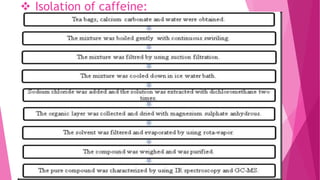
 Isolation of caffeine:
 UV of caffeine:
The UV–VIS absorption spectrum of caffeine in water is found to be in the
region of 243–302 nm at room temperature.
 IR of caffeine:
 Mass of caffeine:
The mass spectrumof caffeine displays peaks are m/z=194
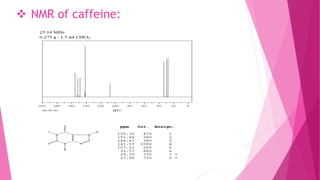
 NMR of caffeine:
 Uses:
 Caffeine is used to restore mental alertness or wakefulness during fatigue
ordrowsiness.
 Caffeine is also found in some headacheand migraine medications, in certain
dietary supplements used for weight loss, and in many popular energy drinks.
H. Glycyrrhizin:
 Glycyrrhizin (or glycyrrhizic acid or glycyrrhizinic acid) is the chief sweet-
tasting constituent of Glycyrrhiza glabra (liquorice) root.
 Structure of glycyrrhizin:
Glycyrrhizin
 UV of glycyrrhizin:
 Glycyrrhetinic acid show absorbance maximum at 254 nm.
 IR of glycyrrhizin:
IR (KBr)1 3400, 1720, 1640 cm-1
 Mass of glycyrrhizin:
 Glycyrrhizin; LC-ESI-QTOF; MS2; CE:Ramp 5-60 V; [M+H]+
 Molecular Weight: 822.942 g/mol.
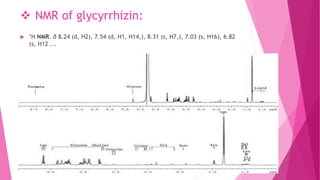
 NMR of glycyrrhizin:
 1H NMR. δ 8.24 (d, H2), 7.54 (d, H1, H14,), 8.31 (s, H7,), 7.03 (s, H16), 6.82
(s, H12 ...
 Uses:
 Glycyrrhizin is a widely used anti-inflammatory agentisolated from the
licorice root.
Structure elucidation phyto .pptx

Structure elucidation phyto .pptx

  • 1.
    Presented by Miss. AishwaryaUlhas Phutane Asst. Professor Department of Pharmacognosy MarathwadaMitramandal’sCollegeof PharmacyThergaonPune Structure Elucidation
  • 2.
    A. Carvone:  Carvoneis a member of a family of chemicals called terpenoids.carvone is found naturally in many essential oils, but is most abundant in the oils from seeds of caraway (carum carvi), spearmint (mentha spicate), and dill.  Structure of carvone: Carvone
  • 4.
     UV ofcarvone:  UV Spectrum: (+)-carvone. 0. 0.5. 1. 1.5. 2. 2.5. 3. 3.5. 200. 220. 240. 260. 280. Wavelength (nm).
  • 5.
     IR ofcarvone:
  • 6.
     Mass spectroscopy: Mass spectrum of the carvone molecule at 536 eV.  m/z 82(100; 39(69); 41(61.6); 95(51.7); 93(46); 94(44.6); 67(43); 79(34.9); 68(31.6); 80(29.4); 203(6.8). 5: m/z 95(100); 82(46.7); 67(45.7); 39(45.5); 41(41.5); 68(33.1); 110(26); 94(21); 79(20.4); 93(19.5); 203(6.8).
  • 7.
     NMR ofcarvone:  a NMR spoctra were obtained at 22.6 MHz.  4: (CDCI3) 6 212 ppm (C 0); 146.7 (--C); 119.7(CN); 110.4(--CH2); 49(C); 42.3(CH2); 40.7(2XCH); 33.5(CH2); 28.1(CH); 28.1(CH2); 21.7(CH3); 20.2(CH3).  5: (CDCI3) di 211.5 ppm (C 0); 146.7 (--C(); 120.4(CN); 110.7(--CH2); 49.8(C); 44.2(CH2); 40.5(CH); 40.3(CH2); 34.4(CH); 30.6(CH); 28.1(CH2); 25.1(CH3); 20.3(CH3).  6" (CDCI3) 6 211.4 ppm (C 0); 146.7(--C); 119.3(CN); 110.6(=CH2); 51.8(C); 44.3(CH2); 41.2(CH); 39.3(CH2) 30.5(CH); 29.9(CH); 26.5(CH2) 24.5(CH3); 20.6(CH3).  l-I NMR spoctra were obtained at 80 MHz and 200 MHz. 4: di 4.65 and 4.75 ppm (2H, vinylic protons); 3.4(q, 1H); from 1.96 to 2.67 ppm (multiplet, 8H); 1.66 (s, CH3); 1.45 (s, CH3). 5: di 4.72 and 4.78 ppm (2H, vinylic protons); 2.91 (eight lines signal, 1H); 2.66 (multiplet, 3H); 2.39 (multiplet, 3H); 2.17 (multiplet, 1n); 1.92 (td, 1n); 1.71 (s, CH3); 1.41 (s, CH3).  di 4.68 and 4.86 ppm (2H, vinylic protons); 2.83 (t, 1H); 2.16 to 2.62 (multiplet, 7H); 2.03 (q, 1H); 1.74 (s, CH3); 1.34 (s, CH3).
  • 9.
     Uses:  Carminative Toothpaste  Gargles  Flavouring  carvones are used in the food and flavorindustry.  R-(−)-Carvone is also used for air freshening products and, like many essential oils, oils containing carvones are used in aromatherapy and alternative medicine.
  • 10.
    B. Citral:  Lemongrassoil contains 70–80 percent citral, which may be isolated by distillation.  Other natural sourcesinclude the oils of verbena and citronella.  Citral can be synthesized from myrcene. Ionone and methylionone, made from citral, are used in perfumery; ionone is also converted into synthetic vitamin A.  Structure of citral: Citral
  • 11.
  • 12.
     UV ofcitral :  UVspectrum displayed a band at 238 nm.
  • 14.
     IR ofcitral:
  • 16.
     Uses:  Citralis therefore an aroma compound used in perfumery for its citrus effect.  Citral is also used as aflavor and for fortifying lemon oil.  It also has strong antimicrobial qualities, and pheromonal effects in insects.
  • 17.
    C. Menthol:  Mentholis an organic compound made synthetically or obtained from corn mint, peppermint, or other mint oils.  Structure of menthol: Menthol
  • 19.
     UV ofmenthol:
  • 20.
     IR ofmenthol:
  • 22.
     Uses:  Itis used to relieve minor aches and pains, such as muscle cramps, sprains,headaches and similar conditions, alone or combined with chemicals such as camphor, eucalyptus oil or capsaicin.
  • 23.
    D. Luteolin:  Luteolinis a naturally occurring flavonoid.  The flavonoids are polyphenolic compounds found as integral components of the human diet. They are universally present as constituents of flowering plants, particularly of food plants.  Structure of luteoline: Luteolin
  • 24.
  • 25.
     UV ofluteolin:  UVspectra at 254 nm.
  • 26.
     IR ofluteolin:
  • 27.
     NMR ofluteolin:
  • 28.
     Uses:  Usedin many fruits, vegetables, and medicinal herbs.  Plants rich in luteolin have been used in Chinese traditional medicine for treating various diseases.  such as hypertension, inflammatory disorders, and cancer.
  • 29.
    E. Kaempferol:  Kaempferolis a natural plant product known for its health promoting effects and its pharmacological and nutraceutical properties.  It is common in vegetables, fruits, plants and herbal medicines.  Structure of kaempferol: Kaempferol
  • 30.
     UV ofkaempferol:  UVpeak absorbance at around 250-280 nm and 350-400 nm.
  • 31.
     IR ofkaempferol:
  • 32.
     Uses:  Kaempferolacts as anantioxidant by reducing oxidative stress.  Many studies suggest that consuming kaempferol may reduce the risk of various cancers.  it is currently under consideration as a possible cancer treatment.
  • 33.
    F. Nicotine:  Nicotineis an alkaloid found in the nightshade familyof plants (Solanaceae), predominantly in tobacco, and in lower quantities in tomato, potato, eggplant (aubergine), and green pepper.  Nicotine alkaloids are also found in the leaves of the coca plant.  Structure of nicotine:
  • 35.
     UV ofnicotine:  UV absorbance of nicotine at 260 nm in sodium phosphate buffer, is different at pH 2.5 and pH 6.9.
  • 36.
     IR, Mass,NMR of nicotine:
  • 37.
     Uses:  Thismedication can help you quit smoking by replacing the nicotine in cigarettes.  The nicotine in tobacco is an important part of cigarette addiction. When you stop smoking, your nicotine levels drop quickly.
  • 38.
    G. Caffeine:  Sourcesof caffeine. Caffeine is an alkaloid occurring naturally in some 60 plant species, of which cocoa beans, kola nuts, tea leaves and coffee beans are the most well-known.  Structure of caffeine: Caffeine
  • 39.
  • 40.
     UV ofcaffeine: The UV–VIS absorption spectrum of caffeine in water is found to be in the region of 243–302 nm at room temperature.
  • 41.
     IR ofcaffeine:
  • 42.
     Mass ofcaffeine: The mass spectrumof caffeine displays peaks are m/z=194
  • 43.
     NMR ofcaffeine:
  • 44.
     Uses:  Caffeineis used to restore mental alertness or wakefulness during fatigue ordrowsiness.  Caffeine is also found in some headacheand migraine medications, in certain dietary supplements used for weight loss, and in many popular energy drinks.
  • 45.
    H. Glycyrrhizin:  Glycyrrhizin(or glycyrrhizic acid or glycyrrhizinic acid) is the chief sweet- tasting constituent of Glycyrrhiza glabra (liquorice) root.  Structure of glycyrrhizin: Glycyrrhizin
  • 50.
     UV ofglycyrrhizin:  Glycyrrhetinic acid show absorbance maximum at 254 nm.
  • 51.
     IR ofglycyrrhizin: IR (KBr)1 3400, 1720, 1640 cm-1
  • 52.
     Mass ofglycyrrhizin:  Glycyrrhizin; LC-ESI-QTOF; MS2; CE:Ramp 5-60 V; [M+H]+  Molecular Weight: 822.942 g/mol.
  • 53.
     NMR ofglycyrrhizin:  1H NMR. δ 8.24 (d, H2), 7.54 (d, H1, H14,), 8.31 (s, H7,), 7.03 (s, H16), 6.82 (s, H12 ...
  • 54.
     Uses:  Glycyrrhizinis a widely used anti-inflammatory agentisolated from the licorice root.