Dr Rebecca Madgin
               Lecturer in European Planning History
                             Centre for Urban History
                               University of Leicester
                                     rmm13@le.ac.uk


www.le.ac.uk
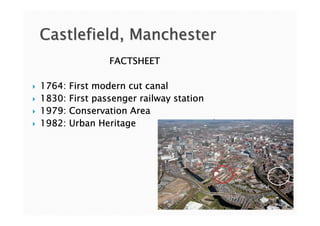
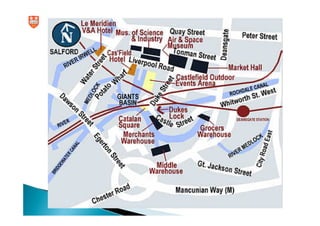
Castlefield, Manchester
                 FACTSHEET

1764:   First modern cut canal
1830:   First passenger railway station
1979:   Conservation Area
1982:   Urban Heritage                Park
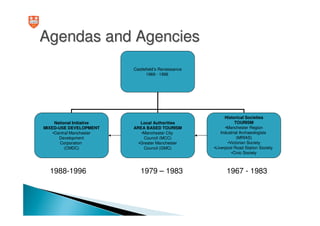
Agendas and Agencies
                           Castlefield’s Renaissance
                                 1969 - 1996


                                                             Historical Societies
     National Initiative      Local Authorities                    TOURISM
MIXED-USE DEVELOPMENT      AREA BASED TOURISM                •Manchester Region
    •Central Manchester       •Manchester City             Industrial Archaeologists
       Development              Council (MCC)                       (MRIAS)
       Corporation           •Greater Manchester               •Victorian Society
          (CMDC)                Council (GMC)          •Liverpool Road Station Society
                                                                 •Civic Society


  1988-1996                   1979 – 1983                    1967 - 1983
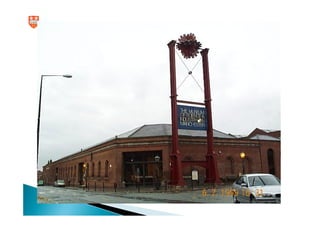
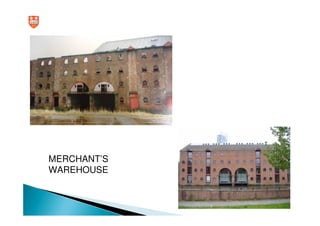
MERCHANT’S
WAREHOUSE
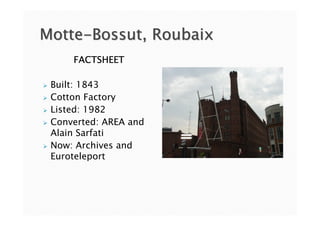
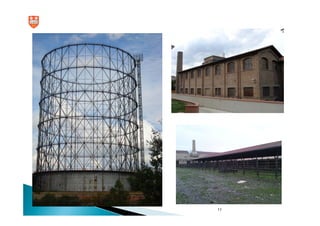
Motte-Bossut, Roubaix
     FACTSHEET

 Built: 1843
 Cotton Factory
 Listed: 1982
 Converted: AREA and
 Alain Sarfati
 Now: Archives and
 Euroteleport
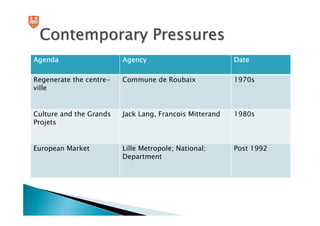
Contemporary Pressures
Agenda                   Agency                          Date

Regenerate the centre-   Commune de Roubaix              1970s
ville


Culture and the Grands   Jack Lang, Francois Mitterand   1980s
Projets


European Market          Lille Metropole; National;      Post 1992
                         Department
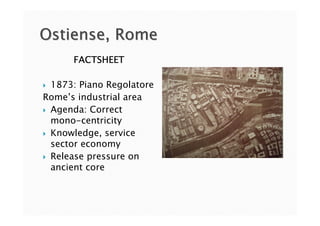
Ostiense, Rome
      FACTSHEET

 1873: Piano Regolatore
Rome’s industrial area
 Agenda: Correct
 mono-centricity
 Knowledge, service
 sector economy
 Release pressure on
 ancient core
11
“The reflections and experiences of the last fifty years
have consolidated the idea that Roman memory is
multi-layered and not just limited to the historic centre,
bounded by the perimeter of the ancient walls,
although this has its own identity and meaning.

In summary, the idea of memory needs to move out of
the centre to recognise the historic quality of the city
and a much larger area than just the centre.”

   Translation from Comune di Roma, Piano Regolatore, 2000,
                                                  point 4.7
Contemporary Pressures
 Failure of planning

 Monocentric development

 Need to diversify the economy

 Poles of attraction


                                 13
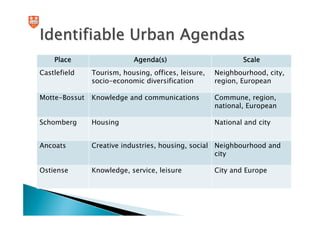
Identifiable Urban Agendas
    Place                   Agenda(s)                        Scale
Castlefield    Tourism, housing, offices, leisure,   Neighbourhood, city,
               socio-economic diversification        region, European

Motte-Bossut   Knowledge and communications          Commune, region,
                                                     national, European

Schomberg      Housing                               National and city


Ancoats        Creative industries, housing, social Neighbourhood and
                                                    city

Ostiense       Knowledge, service, leisure           City and Europe
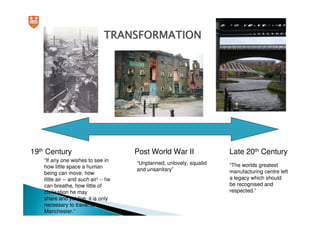
TRANSFORMATION


19th Century                           Post World War II               Late 20th Century
   “If any one wishes to see in
                                       “Unplanned, unlovely, squalid   “The worlds greatest
   how little space a human
                                       and unsanitary”                 manufacturing centre left
   being can move, how
   little air -- and such air! -- he                                   a legacy which should
   can breathe, how little of                                          be recognised and
   civilisation he may                                                 respected.”
   share and yet live, it is only
   necessary to travel to
   Manchester.”
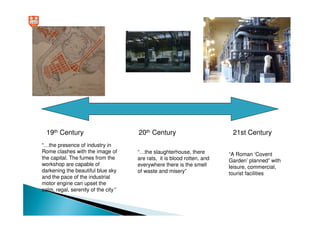
19th Century                       20th Century                         21st Century
“…the presence of industry in
Rome clashes with the image of       “…the slaughterhouse, there         “A Roman ‘Covent
the capital. The fumes from the      are rats, it is blood rotten, and   Garden’ planned” with
workshop are capable of              everywhere there is the smell       leisure, commercial,
darkening the beautiful blue sky     of waste and misery”                tourist facilities
and the pace of the industrial
motor engine can upset the
calm, regal, serenity of the city”
Similarities
 Focus on the unique

 Attract

 Diversify

 A range of audiences

 Became central to agenda
Incidental and Instrumental?
 Why the historic environment?

 What about the vernacular and the ordinary?

 Can we have ‘value’ without an identifiable
 ‘agenda’?

 Underpinning each of the schemes…
Attachment between people and
historic place

 When threatened with change/loss individuals
 and collectives were mobilised

 Outside of formal institutions

 Bath, Covent Garden, Les Halles, Bowstring
 Bridge…

 At a community level…
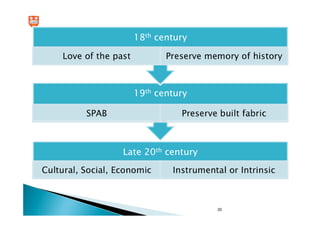
18th century


               20
19th century
 SPAB MANIFESTO:

 “Turn public attention to the intrinsic value of
 our ancient buildings, and the grievous loss
 we incur by their destruction, and of teaching
 how much that value, both artistic and
 historical, depends on their being preserved
 in a genuine condition.”
Post World War II
Cultural heritage is a source of;
 “Emotional security and personal strength’.
 Why else is the destruction and degradation
 of cultural heritage so central to oppressive
 regimes around the world? It is precisely
 because of the deep connection between
 ‘one’s sense of personal agency’ and ‘one’s
 cultural heritage’ that the destruction of
 cultural heritage is such an effective tool of
 domination.”
Attachment which is unlocked during crisis
moments

‘The continued existence of familiar
surroundings may satisfy a psychological
need, which even if irrational, is very real.
Nothing gives more tangible assurance of
stability than bricks and mortar.’
                       (Hubbard, 1993, p. 363)
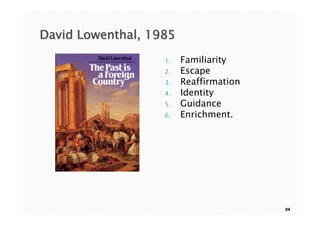
David Lowenthal, 1985
                   1.   Familiarity
                   2.   Escape
                   3.   Reaffirmation
                   4.   Identity
                   5.   Guidance
                   6.   Enrichment.


                                        24
Rediscover the value without the urban
agenda?

Does the ‘love of the past’ remain?

Does the historic environment have the
capacity to anchor society?
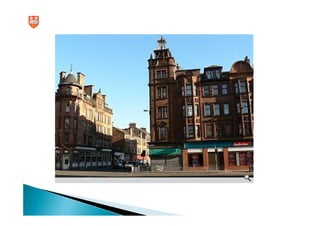
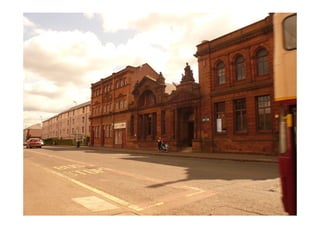
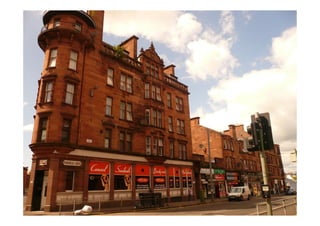
“Wiv got a lot o lovely buildings in Parkheid,
see like that old bank an that, like the listed
buildings, we really have, the outside a the
buildings seem really nice.”


                                  28
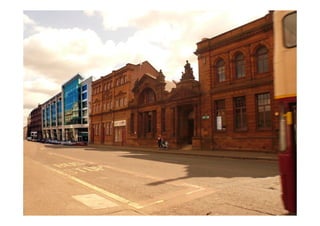
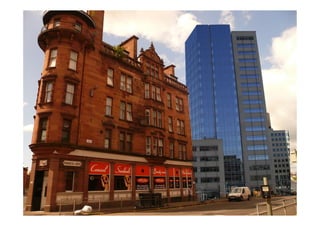
“But this, ther fallin’ apart and then they’ve
gotta pull ‘em doon, you know, it’s losing
another part o’ the history o’ Parkhead, know
whit a mean, obviously, cos a know, av got an
old book aboot Parkhead in you go intae
Duke street, thers actually an old archway,
where ther used tae be the old Forge, bit
obviously that’s a’ been knocked doon….
em...well a think they should do somethin’
with it, we cannae keep losin these
buildings”.


                                  29
“Without the buildings you wouldnae have
Parkheid, see the character of round here is
the buildings and the people are the
buildings. Parkheid is Parkheid because of
them buildings.”


                                  30
Challenges
 Localism

 Urban redevelopment

 New Planning Policy Framework

Events 22 3512061777

  • 1.
    Dr Rebecca Madgin Lecturer in European Planning History Centre for Urban History University of Leicester rmm13@le.ac.uk www.le.ac.uk
  • 2.
    Castlefield, Manchester FACTSHEET 1764: First modern cut canal 1830: First passenger railway station 1979: Conservation Area 1982: Urban Heritage Park
  • 3.
    Agendas and Agencies Castlefield’s Renaissance 1969 - 1996 Historical Societies National Initiative Local Authorities TOURISM MIXED-USE DEVELOPMENT AREA BASED TOURISM •Manchester Region •Central Manchester •Manchester City Industrial Archaeologists Development Council (MCC) (MRIAS) Corporation •Greater Manchester •Victorian Society (CMDC) Council (GMC) •Liverpool Road Station Society •Civic Society 1988-1996 1979 – 1983 1967 - 1983
  • 6.
  • 8.
    Motte-Bossut, Roubaix FACTSHEET Built: 1843 Cotton Factory Listed: 1982 Converted: AREA and Alain Sarfati Now: Archives and Euroteleport
  • 9.
    Contemporary Pressures Agenda Agency Date Regenerate the centre- Commune de Roubaix 1970s ville Culture and the Grands Jack Lang, Francois Mitterand 1980s Projets European Market Lille Metropole; National; Post 1992 Department
  • 10.
    Ostiense, Rome FACTSHEET 1873: Piano Regolatore Rome’s industrial area Agenda: Correct mono-centricity Knowledge, service sector economy Release pressure on ancient core
  • 11.
  • 12.
    “The reflections andexperiences of the last fifty years have consolidated the idea that Roman memory is multi-layered and not just limited to the historic centre, bounded by the perimeter of the ancient walls, although this has its own identity and meaning. In summary, the idea of memory needs to move out of the centre to recognise the historic quality of the city and a much larger area than just the centre.” Translation from Comune di Roma, Piano Regolatore, 2000, point 4.7
  • 13.
    Contemporary Pressures Failureof planning Monocentric development Need to diversify the economy Poles of attraction 13
  • 14.
    Identifiable Urban Agendas Place Agenda(s) Scale Castlefield Tourism, housing, offices, leisure, Neighbourhood, city, socio-economic diversification region, European Motte-Bossut Knowledge and communications Commune, region, national, European Schomberg Housing National and city Ancoats Creative industries, housing, social Neighbourhood and city Ostiense Knowledge, service, leisure City and Europe
  • 15.
    TRANSFORMATION 19th Century Post World War II Late 20th Century “If any one wishes to see in “Unplanned, unlovely, squalid “The worlds greatest how little space a human and unsanitary” manufacturing centre left being can move, how little air -- and such air! -- he a legacy which should can breathe, how little of be recognised and civilisation he may respected.” share and yet live, it is only necessary to travel to Manchester.”
  • 16.
    19th Century 20th Century 21st Century “…the presence of industry in Rome clashes with the image of “…the slaughterhouse, there “A Roman ‘Covent the capital. The fumes from the are rats, it is blood rotten, and Garden’ planned” with workshop are capable of everywhere there is the smell leisure, commercial, darkening the beautiful blue sky of waste and misery” tourist facilities and the pace of the industrial motor engine can upset the calm, regal, serenity of the city”
  • 17.
    Similarities Focus onthe unique Attract Diversify A range of audiences Became central to agenda
  • 18.
    Incidental and Instrumental? Why the historic environment? What about the vernacular and the ordinary? Can we have ‘value’ without an identifiable ‘agenda’? Underpinning each of the schemes…
  • 19.
    Attachment between peopleand historic place When threatened with change/loss individuals and collectives were mobilised Outside of formal institutions Bath, Covent Garden, Les Halles, Bowstring Bridge… At a community level…
  • 20.
  • 21.
    19th century SPABMANIFESTO: “Turn public attention to the intrinsic value of our ancient buildings, and the grievous loss we incur by their destruction, and of teaching how much that value, both artistic and historical, depends on their being preserved in a genuine condition.”
  • 22.
    Post World WarII Cultural heritage is a source of; “Emotional security and personal strength’. Why else is the destruction and degradation of cultural heritage so central to oppressive regimes around the world? It is precisely because of the deep connection between ‘one’s sense of personal agency’ and ‘one’s cultural heritage’ that the destruction of cultural heritage is such an effective tool of domination.”
  • 23.
    Attachment which isunlocked during crisis moments ‘The continued existence of familiar surroundings may satisfy a psychological need, which even if irrational, is very real. Nothing gives more tangible assurance of stability than bricks and mortar.’ (Hubbard, 1993, p. 363)
  • 24.
    David Lowenthal, 1985 1. Familiarity 2. Escape 3. Reaffirmation 4. Identity 5. Guidance 6. Enrichment. 24
  • 25.
    Rediscover the valuewithout the urban agenda? Does the ‘love of the past’ remain? Does the historic environment have the capacity to anchor society?
  • 28.
    “Wiv got alot o lovely buildings in Parkheid, see like that old bank an that, like the listed buildings, we really have, the outside a the buildings seem really nice.” 28
  • 29.
    “But this, therfallin’ apart and then they’ve gotta pull ‘em doon, you know, it’s losing another part o’ the history o’ Parkhead, know whit a mean, obviously, cos a know, av got an old book aboot Parkhead in you go intae Duke street, thers actually an old archway, where ther used tae be the old Forge, bit obviously that’s a’ been knocked doon…. em...well a think they should do somethin’ with it, we cannae keep losin these buildings”. 29
  • 30.
    “Without the buildingsyou wouldnae have Parkheid, see the character of round here is the buildings and the people are the buildings. Parkheid is Parkheid because of them buildings.” 30
  • 35.
    Challenges Localism Urbanredevelopment New Planning Policy Framework