OAuth 2.0 and OpenID
Connect Basics
From OAuth2 to OpenID
Connect by Roland Hedberg
Let’s start with OAuth2
❖ The OAuth 2.0 authorization framework enables a
third-party application to obtain limited access to an
HTTP service, !
❖ either on behalf of a resource owner by orchestrating
an approval interaction between the resource owner
and the HTTP service, !
❖ or by allowing the third-party application to obtain
access on its own behalf.
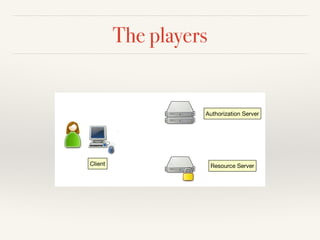
The players
Authorization Server
Resource ServerClient
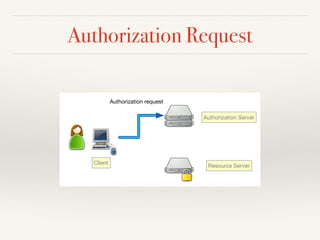
Authorization Request
Authorization Server
Resource Server
Client
Authorization request
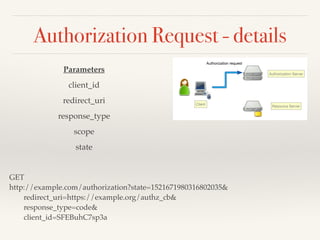
Authorization Request - details
Parameters!
client_id!
redirect_uri!
response_type!
scope!
state
Authorization Server
Resource Server
Client
Authorization request
GET!
http://example.com/authorization?state=1521671980316802035&!
! redirect_uri=https://example.org/authz_cb&!
! response_type=code&!
! client_id=SFEBuhC7sp3a
Authorization Server
Resource Server
Client
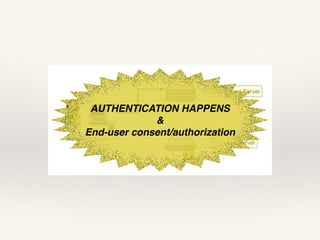
AUTHENTICATION HAPPENS
&
End-user consent/authorization
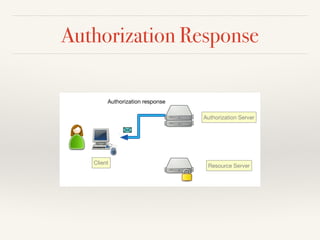
Authorization Response
Authorization Server
Resource Server
Client
Authorization response
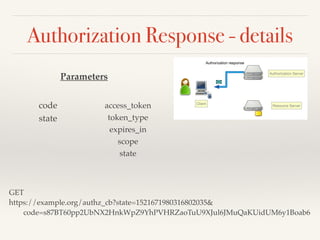
Authorization Response - details
Authorization Server
Resource Server
Client
Authorization response
GET!
https://example.org/authz_cb?state=1521671980316802035&!
! code=s87BT60pp2UbNX2HnkWpZ9YhPVHRZaoTuU9XJul6JMuQaKUidUM6y1Boab6
Parameters
code!
state
access_token!
token_type!
expires_in!
scope!
state
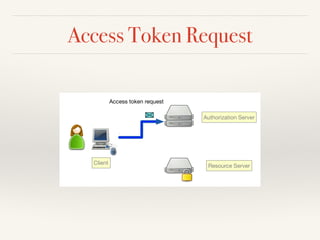
Access Token Request
Authorization Server
Resource Server
Client
Access token request
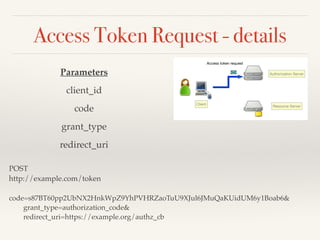
Access Token Request - details
POST!
http://example.com/token!
!
code=s87BT60pp2UbNX2HnkWpZ9YhPVHRZaoTuU9XJul6JMuQaKUidUM6y1Boab6&!
! grant_type=authorization_code&!
! redirect_uri=https://example.org/authz_cb
Authorization Server
Resource Server
Client
Access token request
Parameters!
client_id!
code!
grant_type!
redirect_uri
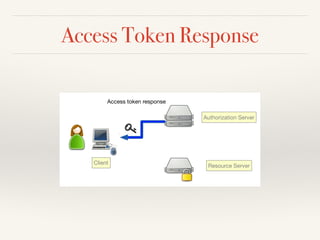
Access Token Response
Authorization Server
Resource Server
Client
Access token response
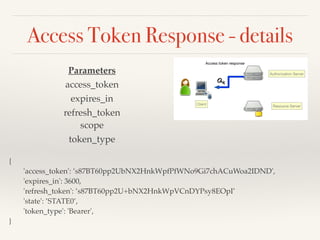
Access Token Response - details
{!
! 'access_token': ’s87BT60pp2UbNX2HnkWpfPfWNo9Gi7chACuWoa2IDND', !
! 'expires_in': 3600, !
! 'refresh_token': ’s87BT60pp2U+bNX2HnkWpVCnDYPsy8EOpI’!
! 'state': ’STATE0’,!
! 'token_type': 'Bearer', !
}
Authorization Server
Resource Server
Client
Access token response
Parameters!
access_token!
expires_in!
refresh_token
scope!
token_type
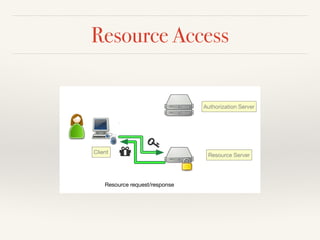
Resource Access
Authorization Server
Resource Server
Client
Resource request/response
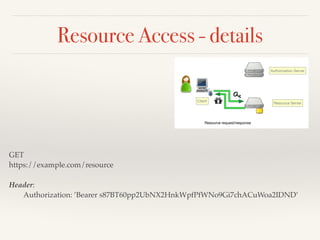
Resource Access - details
Authorization Server
Resource Server
Client
Resource request/response
GET!
https://example.com/resource!
!
Header:!
! Authorization: ’Bearer s87BT60pp2UbNX2HnkWpfPfWNo9Gi7chACuWoa2IDND’!
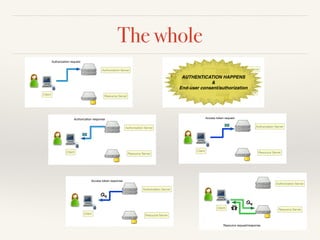
The whole
Authorization Server
Resource Server
Client
Authorization request
Authorization Server
Resource Server
Client
Authorization response
Authorization Server
Resource Server
Client
Access token request
Authorization Server
Resource Server
Client
Access token response
Authorization Server
Resource Server
Client
Resource request/response
Authorization Server
Resource Server
Client
AUTHENTICATION HAPPENS
&
End-user consent/authorization
Flows
❖ Authorization Code Grant!
❖ Implicit Grant!
❖ Resource Owner Password Credentials Grant!
❖ Client Credentials Grant
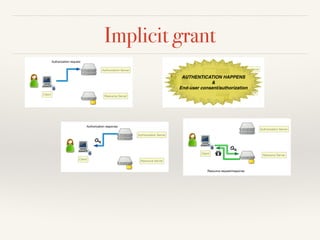
Implicit grant
Authorization Server
Resource Server
Client
Authorization request
Authorization Server
Resource Server
Client
Resource request/response
Authorization Server
Resource Server
Client
Authorization response
Authorization Server
Resource Server
Client
AUTHENTICATION HAPPENS
&
End-user consent/authorization
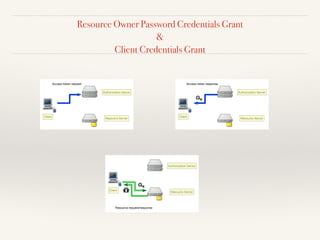
Resource Owner Password Credentials Grant
&
Client Credentials Grant
Authorization Server
Resource Server
Client
Access token request
Authorization Server
Resource Server
Client
Access token response
Authorization Server
Resource Server
Client
Resource request/response
From OAuth2 to OpenID Connect
❖ OpenID Connect 1.0 is a simple identity layer on top of
the OAuth 2.0 protocol. !
❖ It enables Clients to verify the identity of the End-User
based on the authentication performed by an
Authorization Server, as well as to obtain basic profile
information about the End-User in an interoperable and
REST-like manner.
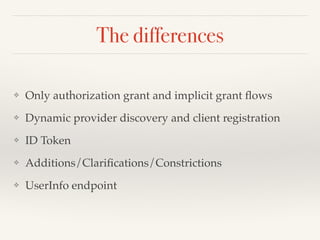
The differences
❖ Only authorization grant and implicit grant flows!
❖ Dynamic provider discovery and client registration!
❖ ID Token!
❖ Additions/Clarifications/Constrictions!
❖ UserInfo endpoint
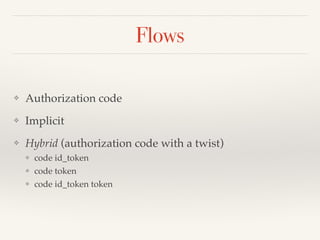
Flows
❖ Authorization code!
❖ Implicit!
❖ Hybrid (authorization code with a twist)!
❖ code id_token!
❖ code token!
❖ code id_token token
Dynamic provider
discovery and client
registration
Dynamic discovery and registration
1. Find the provider!
2. Discover provider info!
3. Register client
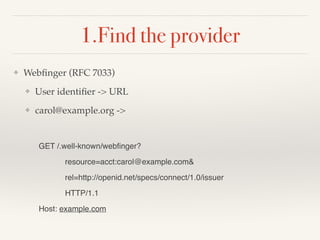
1.Find the provider
❖ Webfinger (RFC 7033)!
❖ User identifier -> URL!
❖ carol@example.org ->!
!
GET /.well-known/webfinger?!
resource=acct:carol@example.com&!
rel=http://openid.net/specs/connect/1.0/issuer!
HTTP/1.1!
Host: example.com
Webfinger response
HTTP/1.1 200 OK!
Access-Control-Allow-Origin: *!
Content-Type: application/jrd+json!
!
{!
"subject" : "acct:carol@example.com",!
"links" :!
[ {!
"rel" : "http://openid.net/specs/connect/1.0/issuer",!
"href" : "https://openid.example.com"!
} ]!
}
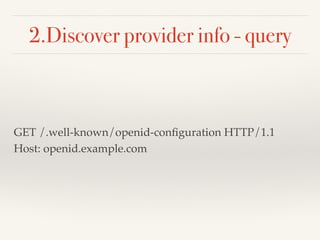
2.Discover provider info - query
GET /.well-known/openid-configuration HTTP/1.1!
Host: openid.example.com
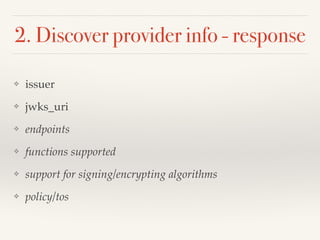
2. Discover provider info - response
❖ issuer!
❖ jwks_uri!
❖ endpoints!
❖ functions supported!
❖ support for signing/encrypting algorithms!
❖ policy/tos
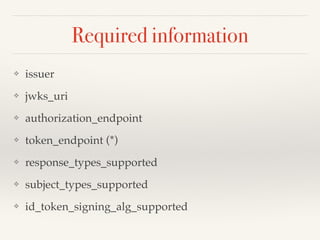
Required information
❖ issuer!
❖ jwks_uri!
❖ authorization_endpoint!
❖ token_endpoint (*)!
❖ response_types_supported!
❖ subject_types_supported!
❖ id_token_signing_alg_supported
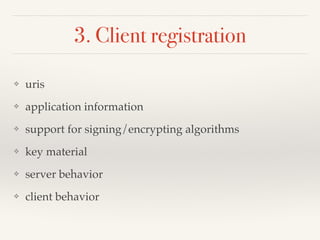
3. Client registration
❖ uris!
❖ application information!
❖ support for signing/encrypting algorithms!
❖ key material!
❖ server behavior!
❖ client behavior
required information
❖ redirect_uris
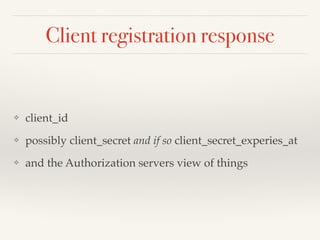
Client registration response
❖ client_id!
❖ possibly client_secret and if so client_secret_experies_at!
❖ and the Authorization servers view of things
An Authorization Server
❖ MAY add fields the client didn’t include.!
❖ MAY reject or replace any of the Client's requested field
values and substitute them with suitable values.!
❖ MAY ignore values provided by the client, and MUST
ignore any fields sent by the Client that it does not
understand.
A Client can not
❖ modify a registration!
❖ delete a registration
ID Token
ID Token
❖ Have to make a detour into JWT/K/A/S/E land
JWT
❖ Jason Web Token!
❖ a compact URL-safe means of representing claims to be
transferred between two parties!
❖ Suggested pronunciation: ’jot’
JWS
represents content secured with digital signatures or
Message Authentication Codes (MACs) using JavaScript
Object Notation (JSON) based data structures.
JWE
represents encrypted content using JavaScript Object
Notation (JSON) based data structures.
JWK
a JavaScript Object Notation (JSON) data structure that
represents a cryptographic key
JWA
registers cryptographic algorithms and identifiers to be
used with the JSON Web Signature(JWS), JSON Web
Encryption (JWE), and JSON Web Key (JWK) specifications
ID Token
❖a security token that contains Claims about the
Authentication of an End-User by an Authorization
Server when using a Client, and potentially other
requested Claims. !
❖is represented as a JSON Web Token (JWT)
ID Token claims -required
❖ iss - Issuer Identifier for the Issuer of the response!
❖ sub - Subject Identifier!
❖ aud - Intended audience!
❖ exp - Expiration time!
❖ iat - Issued at!
❖ auth_time - Authentication time!
❖ nonce
ID Token claims - optional
❖ acr - Authentication Context Class Reference!
❖ amr - Authentication Method References!
❖ azp - Authorized party
Additions/
Clarifications/
Constrictions
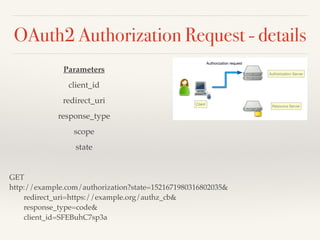
OAuth2 Authorization Request - details
Parameters!
client_id!
redirect_uri!
response_type!
scope!
state
Authorization Server
Resource Server
Client
Authorization request
GET!
http://example.com/authorization?state=1521671980316802035&!
! redirect_uri=https://example.org/authz_cb&!
! response_type=code&!
! client_id=SFEBuhC7sp3a
Authentication Request - OpenID Connect extensions
❖ response_mode - The mechanism to use for returning
parameters!
❖ nonce - Associates client session with ID Token!
❖ Signed/encrypted Authentication Request!
❖ End-user interactions!
❖ Response details
Signed/encrypted Authentication Request
❖ request - by value!
❖ request_uri - by reference!
!
❖ Single self-contained parameter!
❖ Signed and/or encrypted (JWT)
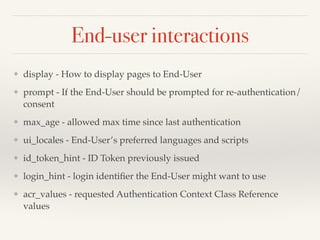
End-user interactions
❖ display - How to display pages to End-User!
❖ prompt - If the End-User should be prompted for re-authentication/
consent!
❖ max_age - allowed max time since last authentication!
❖ ui_locales - End-User’s preferred languages and scripts!
❖ id_token_hint - ID Token previously issued !
❖ login_hint - login identifier the End-User might want to use!
❖ acr_values - requested Authentication Context Class Reference
values
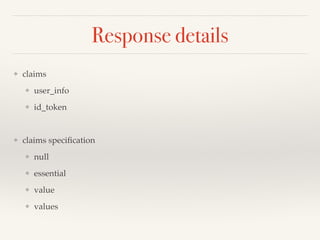
Response details
❖ claims!
❖ user_info!
❖ id_token!
!
❖ claims specification!
❖ null!
❖ essential!
❖ value!
❖ values
UserInfo endpoint
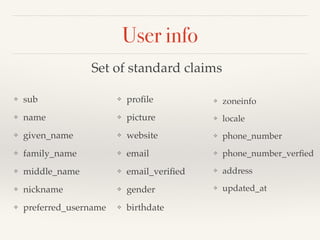
User info
❖ sub!
❖ name!
❖ given_name!
❖ family_name!
❖ middle_name!
❖ nickname!
❖ preferred_username
Set of standard claims
❖ profile!
❖ picture!
❖ website!
❖ email!
❖ email_verified!
❖ gender!
❖ birthdate
❖ zoneinfo!
❖ locale!
❖ phone_number!
❖ phone_number_verfied!
❖ address!
❖ updated_at!
claims types
❖ Normal!
❖ Aggregated!
❖ Distributed
Summary
❖ OAuth2 is about authorization!
❖ OpenID Connect adds authentication and identity
information
Questions ?

CIS14: Working with OAuth and OpenID Connect

  • 1.
    OAuth 2.0 andOpenID Connect Basics From OAuth2 to OpenID Connect by Roland Hedberg
  • 2.
  • 3.
    ❖ The OAuth2.0 authorization framework enables a third-party application to obtain limited access to an HTTP service, ! ❖ either on behalf of a resource owner by orchestrating an approval interaction between the resource owner and the HTTP service, ! ❖ or by allowing the third-party application to obtain access on its own behalf.
  • 4.
  • 5.
    Authorization Request Authorization Server ResourceServer Client Authorization request
  • 6.
    Authorization Request -details Parameters! client_id! redirect_uri! response_type! scope! state Authorization Server Resource Server Client Authorization request GET! http://example.com/authorization?state=1521671980316802035&! ! redirect_uri=https://example.org/authz_cb&! ! response_type=code&! ! client_id=SFEBuhC7sp3a
  • 7.
    Authorization Server Resource Server Client AUTHENTICATIONHAPPENS & End-user consent/authorization
  • 8.
    Authorization Response Authorization Server ResourceServer Client Authorization response
  • 9.
    Authorization Response -details Authorization Server Resource Server Client Authorization response GET! https://example.org/authz_cb?state=1521671980316802035&! ! code=s87BT60pp2UbNX2HnkWpZ9YhPVHRZaoTuU9XJul6JMuQaKUidUM6y1Boab6 Parameters code! state access_token! token_type! expires_in! scope! state
  • 10.
    Access Token Request AuthorizationServer Resource Server Client Access token request
  • 11.
    Access Token Request- details POST! http://example.com/token! ! code=s87BT60pp2UbNX2HnkWpZ9YhPVHRZaoTuU9XJul6JMuQaKUidUM6y1Boab6&! ! grant_type=authorization_code&! ! redirect_uri=https://example.org/authz_cb Authorization Server Resource Server Client Access token request Parameters! client_id! code! grant_type! redirect_uri
  • 12.
    Access Token Response AuthorizationServer Resource Server Client Access token response
  • 13.
    Access Token Response- details {! ! 'access_token': ’s87BT60pp2UbNX2HnkWpfPfWNo9Gi7chACuWoa2IDND', ! ! 'expires_in': 3600, ! ! 'refresh_token': ’s87BT60pp2U+bNX2HnkWpVCnDYPsy8EOpI’! ! 'state': ’STATE0’,! ! 'token_type': 'Bearer', ! } Authorization Server Resource Server Client Access token response Parameters! access_token! expires_in! refresh_token scope! token_type
  • 14.
    Resource Access Authorization Server ResourceServer Client Resource request/response
  • 15.
    Resource Access -details Authorization Server Resource Server Client Resource request/response GET! https://example.com/resource! ! Header:! ! Authorization: ’Bearer s87BT60pp2UbNX2HnkWpfPfWNo9Gi7chACuWoa2IDND’!
  • 16.
    The whole Authorization Server ResourceServer Client Authorization request Authorization Server Resource Server Client Authorization response Authorization Server Resource Server Client Access token request Authorization Server Resource Server Client Access token response Authorization Server Resource Server Client Resource request/response Authorization Server Resource Server Client AUTHENTICATION HAPPENS & End-user consent/authorization
  • 17.
    Flows ❖ Authorization CodeGrant! ❖ Implicit Grant! ❖ Resource Owner Password Credentials Grant! ❖ Client Credentials Grant
  • 18.
    Implicit grant Authorization Server ResourceServer Client Authorization request Authorization Server Resource Server Client Resource request/response Authorization Server Resource Server Client Authorization response Authorization Server Resource Server Client AUTHENTICATION HAPPENS & End-user consent/authorization
  • 19.
    Resource Owner PasswordCredentials Grant & Client Credentials Grant Authorization Server Resource Server Client Access token request Authorization Server Resource Server Client Access token response Authorization Server Resource Server Client Resource request/response
  • 20.
    From OAuth2 toOpenID Connect
  • 21.
    ❖ OpenID Connect1.0 is a simple identity layer on top of the OAuth 2.0 protocol. ! ❖ It enables Clients to verify the identity of the End-User based on the authentication performed by an Authorization Server, as well as to obtain basic profile information about the End-User in an interoperable and REST-like manner.
  • 22.
    The differences ❖ Onlyauthorization grant and implicit grant flows! ❖ Dynamic provider discovery and client registration! ❖ ID Token! ❖ Additions/Clarifications/Constrictions! ❖ UserInfo endpoint
  • 23.
    Flows ❖ Authorization code! ❖Implicit! ❖ Hybrid (authorization code with a twist)! ❖ code id_token! ❖ code token! ❖ code id_token token
  • 24.
    Dynamic provider discovery andclient registration
  • 25.
    Dynamic discovery andregistration 1. Find the provider! 2. Discover provider info! 3. Register client
  • 26.
    1.Find the provider ❖Webfinger (RFC 7033)! ❖ User identifier -> URL! ❖ carol@example.org ->! ! GET /.well-known/webfinger?! resource=acct:carol@example.com&! rel=http://openid.net/specs/connect/1.0/issuer! HTTP/1.1! Host: example.com
  • 27.
    Webfinger response HTTP/1.1 200OK! Access-Control-Allow-Origin: *! Content-Type: application/jrd+json! ! {! "subject" : "acct:carol@example.com",! "links" :! [ {! "rel" : "http://openid.net/specs/connect/1.0/issuer",! "href" : "https://openid.example.com"! } ]! }
  • 28.
    2.Discover provider info- query GET /.well-known/openid-configuration HTTP/1.1! Host: openid.example.com
  • 29.
    2. Discover providerinfo - response ❖ issuer! ❖ jwks_uri! ❖ endpoints! ❖ functions supported! ❖ support for signing/encrypting algorithms! ❖ policy/tos
  • 30.
    Required information ❖ issuer! ❖jwks_uri! ❖ authorization_endpoint! ❖ token_endpoint (*)! ❖ response_types_supported! ❖ subject_types_supported! ❖ id_token_signing_alg_supported
  • 31.
    3. Client registration ❖uris! ❖ application information! ❖ support for signing/encrypting algorithms! ❖ key material! ❖ server behavior! ❖ client behavior
  • 32.
  • 33.
    Client registration response ❖client_id! ❖ possibly client_secret and if so client_secret_experies_at! ❖ and the Authorization servers view of things
  • 34.
    An Authorization Server ❖MAY add fields the client didn’t include.! ❖ MAY reject or replace any of the Client's requested field values and substitute them with suitable values.! ❖ MAY ignore values provided by the client, and MUST ignore any fields sent by the Client that it does not understand.
  • 35.
    A Client cannot ❖ modify a registration! ❖ delete a registration
  • 36.
  • 37.
    ID Token ❖ Haveto make a detour into JWT/K/A/S/E land
  • 38.
    JWT ❖ Jason WebToken! ❖ a compact URL-safe means of representing claims to be transferred between two parties! ❖ Suggested pronunciation: ’jot’
  • 39.
    JWS represents content securedwith digital signatures or Message Authentication Codes (MACs) using JavaScript Object Notation (JSON) based data structures. JWE represents encrypted content using JavaScript Object Notation (JSON) based data structures.
  • 40.
    JWK a JavaScript ObjectNotation (JSON) data structure that represents a cryptographic key JWA registers cryptographic algorithms and identifiers to be used with the JSON Web Signature(JWS), JSON Web Encryption (JWE), and JSON Web Key (JWK) specifications
  • 41.
    ID Token ❖a securitytoken that contains Claims about the Authentication of an End-User by an Authorization Server when using a Client, and potentially other requested Claims. ! ❖is represented as a JSON Web Token (JWT)
  • 42.
    ID Token claims-required ❖ iss - Issuer Identifier for the Issuer of the response! ❖ sub - Subject Identifier! ❖ aud - Intended audience! ❖ exp - Expiration time! ❖ iat - Issued at! ❖ auth_time - Authentication time! ❖ nonce
  • 43.
    ID Token claims- optional ❖ acr - Authentication Context Class Reference! ❖ amr - Authentication Method References! ❖ azp - Authorized party
  • 44.
  • 45.
    OAuth2 Authorization Request- details Parameters! client_id! redirect_uri! response_type! scope! state Authorization Server Resource Server Client Authorization request GET! http://example.com/authorization?state=1521671980316802035&! ! redirect_uri=https://example.org/authz_cb&! ! response_type=code&! ! client_id=SFEBuhC7sp3a
  • 46.
    Authentication Request -OpenID Connect extensions ❖ response_mode - The mechanism to use for returning parameters! ❖ nonce - Associates client session with ID Token! ❖ Signed/encrypted Authentication Request! ❖ End-user interactions! ❖ Response details
  • 47.
    Signed/encrypted Authentication Request ❖request - by value! ❖ request_uri - by reference! ! ❖ Single self-contained parameter! ❖ Signed and/or encrypted (JWT)
  • 48.
    End-user interactions ❖ display- How to display pages to End-User! ❖ prompt - If the End-User should be prompted for re-authentication/ consent! ❖ max_age - allowed max time since last authentication! ❖ ui_locales - End-User’s preferred languages and scripts! ❖ id_token_hint - ID Token previously issued ! ❖ login_hint - login identifier the End-User might want to use! ❖ acr_values - requested Authentication Context Class Reference values
  • 49.
    Response details ❖ claims! ❖user_info! ❖ id_token! ! ❖ claims specification! ❖ null! ❖ essential! ❖ value! ❖ values
  • 50.
  • 51.
    User info ❖ sub! ❖name! ❖ given_name! ❖ family_name! ❖ middle_name! ❖ nickname! ❖ preferred_username Set of standard claims ❖ profile! ❖ picture! ❖ website! ❖ email! ❖ email_verified! ❖ gender! ❖ birthdate ❖ zoneinfo! ❖ locale! ❖ phone_number! ❖ phone_number_verfied! ❖ address! ❖ updated_at!
  • 52.
    claims types ❖ Normal! ❖Aggregated! ❖ Distributed
  • 53.
    Summary ❖ OAuth2 isabout authorization! ❖ OpenID Connect adds authentication and identity information
  • 54.