Protecting web APIs with 
OAuth 2.0 
Vladimir Dzhuvinov
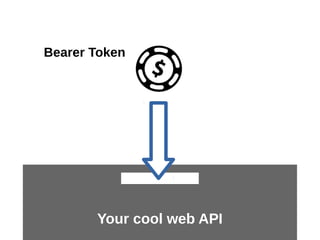
Bearer Token 
Your cool web API
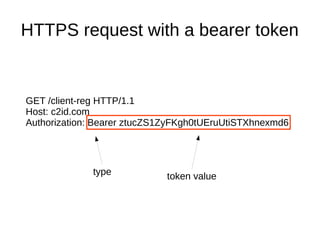
HTTPS request with a bearer token 
GET /client-reg HTTP/1.1 
Host: c2id.com 
Authorization: Bearer ztucZS1ZyFKgh0tUEruUtiSTXhnexmd6 
type token value
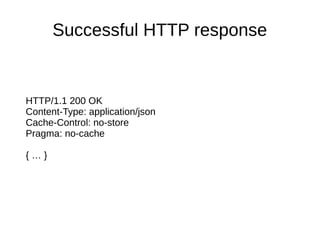
Successful HTTP response 
HTTP/1.1 200 OK 
Content-Type: application/json 
Cache-Control: no-store 
Pragma: no-cache 
{ … }
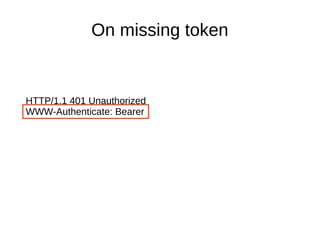
On missing token 
HTTP/1.1 401 Unauthorized 
WWW-Authenticate: Bearer
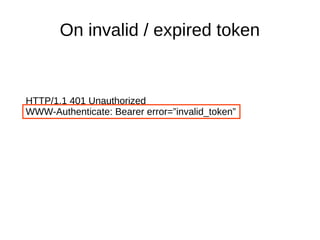
On invalid / expired token 
HTTP/1.1 401 Unauthorized 
WWW-Authenticate: Bearer error=”invalid_token”
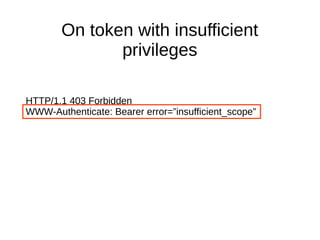
On token with insufficient 
privileges 
HTTP/1.1 403 Forbidden 
WWW-Authenticate: Bearer error=”insufficient_scope”
To learn more about 
bearer token usage 
See RFC 6750 
[ http://tools.ietf.org/html/rfc6750 ]
How does your web API 
decode the access tokens? 
Your W eb API
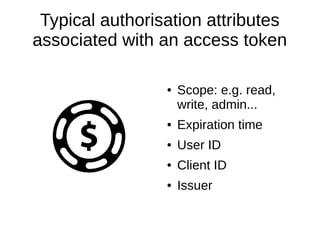
Typical authorisation attributes 
associated with an access token 
● Scope: e.g. read, 
write, admin... 
● Expiration time 
● User ID 
● Client ID 
● Issuer
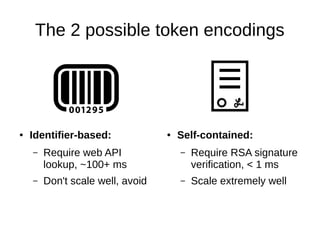
The 2 possible token encodings 
● Self-contained: 
– Require RSA signature 
verification, < 1 ms 
– Scale extremely well 
● Identifier-based: 
– Require web API 
lookup, ~100+ ms 
– Don't scale well, avoid
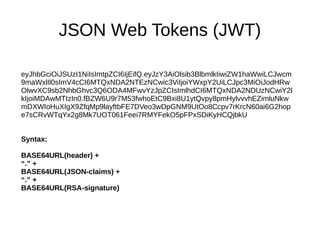
JSON Web Tokens (JWT) 
eyJhbGciOiJSUzI1NiIsImtpZCI6IjEifQ.eyJzY3AiOlsib3BlbmlkIiwiZW1haWwiLCJwcm 
9maWxlIl0sImV4cCI6MTQxNDA2NTEzNCwic3ViIjoiYWxpY2UiLCJpc3MiOiJodHRw 
OlwvXC9sb2NhbGhvc3Q6ODA4MFwvYzJpZCIsImlhdCI6MTQxNDA2NDUzNCwiY2l 
kIjoiMDAwMTIzIn0.fBZW6U9r7M53fwhoEtC9Bxi8U1ytQvpy8pmHylvvvhEZimluNkw 
mDXWIoHuXIgX9ZfqMp9layftbFE7DVeo3wDpGNM9UtOo8Ccpv7rKrcN60ai6G2hop 
e7sCRvWTqYx2g8Mk7UOT061Feei7RMYFekO5pFPxSDiKyHCQjbkU 
Syntax: 
BASE64URL(header) + 
“.” + 
BASE64URL(JSON-claims) + 
“.” + 
BASE64URL(RSA-signature)
JSON Web Tokens (JWT) 
Header 
{ "alg": "RS256", "kid": "1" } 
Claims 
{ "sub": "alice", 
"cid": "000123", 
"iss": "https://connect2id.com", 
"exp": 1414065134, 
"iat": 1414064534, 
"scp": [ "read", "write", "admin" ] 
} 
Signature (RSA) 
fBZW6U9r7M53fwh­oEtC9 
Bxi8U1ytQvpy8pmHylvvvhEZimlu­NkwmDXWIoHuXIgX9ZfqMp9layftbFE7DVeo­3wDpGNM9UtOo8Cc
To learn more about JWT 
See draft-ietf-oauth-json-web-token-29 
[ http://tools.ietf.org/html/draft-ietf-oauth-json-web-token-29 ]
The ultimate Java library for JWT 
http://connect2id.com/products/nimbus-jose-jwt 
Thousands of deployments, tens of reviewers and 
contributors 
Connect2id, Mitre Corp, Microsoft, EA, Square, Zendesk, 
CertiVox, Harvard Medical Schools, unnamed banks, etc.
Who issues the access tokens?
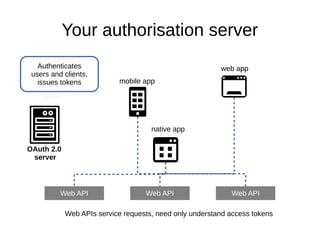
Your authorisation server 
Authenticates 
users and clients, 
issues tokens 
OAuth 2.0 
server 
mobile app 
web app 
native app 
Web API Web API Web API 
Web APIs service requests, need only understand access tokens
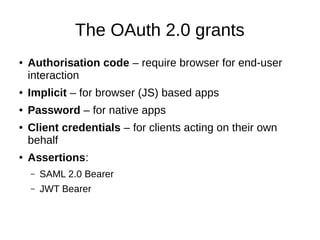
The OAuth 2.0 grants 
● Authorisation code – require browser for end-user 
interaction 
● Implicit – for browser (JS) based apps 
● Password – for native apps 
● Client credentials – for clients acting on their own 
behalf 
● Assertions: 
– SAML 2.0 Bearer 
– JWT Bearer
To learn more about OAuth 2.0 
See RFC 6749 
[ http://tools.ietf.org/html/rfc6749 ]
OpenID Connect 
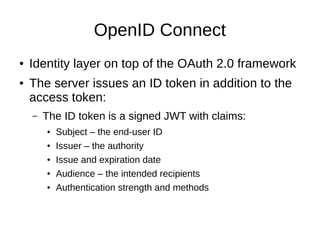
● Identity layer on top of the OAuth 2.0 framework 
● The server issues an ID token in addition to the 
access token: 
– The ID token is a signed JWT with claims: 
● Subject – the end-user ID 
● Issuer – the authority 
● Issue and expiration date 
● Audience – the intended recipients 
● Authentication strength and methods
ID token claims 
{ 
"sub" : "alice", 
"iss" : "https://connect2id.com", 
"iat" : 1414076589, 
"exp" : 1414077489, 
"aud" : [ "000123" ], 
"ip_address" : "10.20.30.40", 
"acr" : "1", 
"amr" : [ "ldap" ] 
}
To learn more about 
OpenID Connect 
See 
OpenID Connect 1.0 Core 
OpenID Connect 1.0 Discovery 
OpenID Connect 1.0 Dynamic Registration 
OpenID Connect 1.0 Session Management 
[ http://openid.net/connect/ ]

Protecting web APIs with OAuth 2.0

  • 1.
    Protecting web APIswith OAuth 2.0 Vladimir Dzhuvinov
  • 2.
    Bearer Token Yourcool web API
  • 3.
    HTTPS request witha bearer token GET /client-reg HTTP/1.1 Host: c2id.com Authorization: Bearer ztucZS1ZyFKgh0tUEruUtiSTXhnexmd6 type token value
  • 4.
    Successful HTTP response HTTP/1.1 200 OK Content-Type: application/json Cache-Control: no-store Pragma: no-cache { … }
  • 5.
    On missing token HTTP/1.1 401 Unauthorized WWW-Authenticate: Bearer
  • 6.
    On invalid /expired token HTTP/1.1 401 Unauthorized WWW-Authenticate: Bearer error=”invalid_token”
  • 7.
    On token withinsufficient privileges HTTP/1.1 403 Forbidden WWW-Authenticate: Bearer error=”insufficient_scope”
  • 8.
    To learn moreabout bearer token usage See RFC 6750 [ http://tools.ietf.org/html/rfc6750 ]
  • 9.
    How does yourweb API decode the access tokens? Your W eb API
  • 10.
    Typical authorisation attributes associated with an access token ● Scope: e.g. read, write, admin... ● Expiration time ● User ID ● Client ID ● Issuer
  • 11.
    The 2 possibletoken encodings ● Self-contained: – Require RSA signature verification, < 1 ms – Scale extremely well ● Identifier-based: – Require web API lookup, ~100+ ms – Don't scale well, avoid
  • 12.
    JSON Web Tokens(JWT) eyJhbGciOiJSUzI1NiIsImtpZCI6IjEifQ.eyJzY3AiOlsib3BlbmlkIiwiZW1haWwiLCJwcm 9maWxlIl0sImV4cCI6MTQxNDA2NTEzNCwic3ViIjoiYWxpY2UiLCJpc3MiOiJodHRw OlwvXC9sb2NhbGhvc3Q6ODA4MFwvYzJpZCIsImlhdCI6MTQxNDA2NDUzNCwiY2l kIjoiMDAwMTIzIn0.fBZW6U9r7M53fwhoEtC9Bxi8U1ytQvpy8pmHylvvvhEZimluNkw mDXWIoHuXIgX9ZfqMp9layftbFE7DVeo3wDpGNM9UtOo8Ccpv7rKrcN60ai6G2hop e7sCRvWTqYx2g8Mk7UOT061Feei7RMYFekO5pFPxSDiKyHCQjbkU Syntax: BASE64URL(header) + “.” + BASE64URL(JSON-claims) + “.” + BASE64URL(RSA-signature)
  • 13.
    JSON Web Tokens(JWT) Header { "alg": "RS256", "kid": "1" } Claims { "sub": "alice", "cid": "000123", "iss": "https://connect2id.com", "exp": 1414065134, "iat": 1414064534, "scp": [ "read", "write", "admin" ] } Signature (RSA) fBZW6U9r7M53fwh­oEtC9 Bxi8U1ytQvpy8pmHylvvvhEZimlu­NkwmDXWIoHuXIgX9ZfqMp9layftbFE7DVeo­3wDpGNM9UtOo8Cc
  • 14.
    To learn moreabout JWT See draft-ietf-oauth-json-web-token-29 [ http://tools.ietf.org/html/draft-ietf-oauth-json-web-token-29 ]
  • 15.
    The ultimate Javalibrary for JWT http://connect2id.com/products/nimbus-jose-jwt Thousands of deployments, tens of reviewers and contributors Connect2id, Mitre Corp, Microsoft, EA, Square, Zendesk, CertiVox, Harvard Medical Schools, unnamed banks, etc.
  • 16.
    Who issues theaccess tokens?
  • 17.
    Your authorisation server Authenticates users and clients, issues tokens OAuth 2.0 server mobile app web app native app Web API Web API Web API Web APIs service requests, need only understand access tokens
  • 18.
    The OAuth 2.0grants ● Authorisation code – require browser for end-user interaction ● Implicit – for browser (JS) based apps ● Password – for native apps ● Client credentials – for clients acting on their own behalf ● Assertions: – SAML 2.0 Bearer – JWT Bearer
  • 19.
    To learn moreabout OAuth 2.0 See RFC 6749 [ http://tools.ietf.org/html/rfc6749 ]
  • 20.
    OpenID Connect ●Identity layer on top of the OAuth 2.0 framework ● The server issues an ID token in addition to the access token: – The ID token is a signed JWT with claims: ● Subject – the end-user ID ● Issuer – the authority ● Issue and expiration date ● Audience – the intended recipients ● Authentication strength and methods
  • 21.
    ID token claims { "sub" : "alice", "iss" : "https://connect2id.com", "iat" : 1414076589, "exp" : 1414077489, "aud" : [ "000123" ], "ip_address" : "10.20.30.40", "acr" : "1", "amr" : [ "ldap" ] }
  • 22.
    To learn moreabout OpenID Connect See OpenID Connect 1.0 Core OpenID Connect 1.0 Discovery OpenID Connect 1.0 Dynamic Registration OpenID Connect 1.0 Session Management [ http://openid.net/connect/ ]