Subject: Surgery
Topic: VMMC
G. Amalia
Objectives
By the end of this lesson, you should be able to:
 Define circumcision
 Outline indications of circumcision
 Outline contra-indications of circumcision
 Describe pre-operative preparation
 Discuss the various circumcision methods
 Discuss post-operative care of circumcision
 Identify complications of circumcision
Definition
 It is the surgical removal of the foreskin
(prepuce) of the penis usually performed
under local anaethesia
- It is an ancient practice that has its origin in
cultural and religious rites
- In many communities, it is often performed
within the 1st two weeks or at the beginning of
adolescence as a rite of passage to adulthood
Indications
1. Medical indications
 Phimosis- narrowing of preputial opening
 Paraphimosis- tight prepuce which ones retracted
fails to return
 Prevention of sexually transmitted infections incl.
HIV
 Prevention of penile cancer
 Prevention of urinary tract infections in boys with
urological abnormalities
Indications cont.
 Trauma to the prepuce
2. Cultural
3. Religious
Contraindications
Absolute contraindications
 Prematurity
 Hypospadias- urethra opening on ventral aspect of the
penis- preputial skin utilized during surgical repair
 Epispadias- urethra opening on the dorsal aspect of the
penis- preputial skin utilized during surgical repair
 Micropenis
 Concealed or buried penis
Contraindications cont.
 Webbed penis
 Ambiguous genitalia
 Chronic Paraphimosis
 Genital ulcer disease
 Urethral discharge
 Penile cancer
 Chronic disorders of the foreskin e.g filariasis
 Bleeding disorders such as haemophilia
Contraindications cont.
Relative contraindications
 Scar tissue at the frenulum
 Extensive penile warts
 Balanitis xerotica obliterans
 Sickle cell disease
 Other abnormalities of the genitalia e.g hydrocele
Pre-operative preparation
Take history
Monitor vital signs
Carefully examine the genitalia
Obtain an informed (written) consent- after
explaining the procedure to the client incl. benefits
and risks
Advice the client to wash the genital area with soap
and water
NB: Shaving of pubic hair is not recommended since
it damages the skin & promotes infections
Assemble the instruments and other supplies
Pre-operative preparation cont.
Requirements
Instruments
- Instrument tray wrapped with sterile drape
- Kidney dish
- Toothed dissecting forceps (tweezers)
- 6 artery forceps ( 3 straight & 3 curved)
- Curved scissors
- Straight ( stitch scissors)
Pre-operative preparations cont.
- Needle holding forceps
• Gallipot for antiseptic solution such as povidone
iodine
- Sponge holding forceps
- Scalpel knife handle & blades*
Pre-operative preparation cont.
Other supplies
 Povidone iodine
 Normal saline
 Sterile plain gauze swabs
 Petroleum impregnated gauze (suflatulle)
 Co adhesive bandage
 Lignocaine – either 1% or 2%
 10cc syringe
 Needles- gauges 18 & 23
Pre-operative preparations cont.
 Suture material –chromic catgut 3-0 or 4-0 with
reverse-cutting needle
 Sterile gloves, masks, caps and apron
 Sterile marker pen or gentian violet solution
 Couch bed
Procedure
 The surgeon/clinician and the assistants should
scrub
 Dry hands with a sterile towel and hold the hand
s and arms away from the body & higher than the
elbow until sterile gown and sterile gloves have
been put on
 Ensure the instruments and supplies are
assembled
Procedure cont.
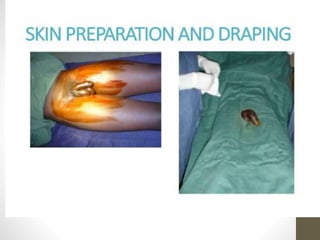
 Let the client remove pants and lay on the coach
 Clean the skin with povidone iodine starting with
the glans and the shaft of the penis and moving
out to the periphery, foreskin should be retracted
so as to clean the glans
 Drape the patient with ‘O’ drape
Procedure cont.
Administering local anaethesia (lignocaine)
 Use 1% or 2% lignocaine without adrenaline
 Dosage is 3mg per kg body weight
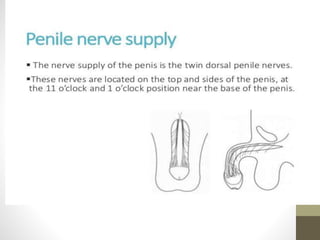
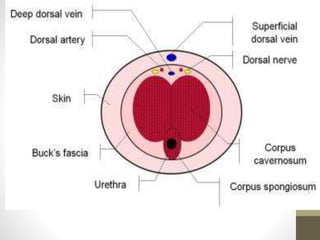
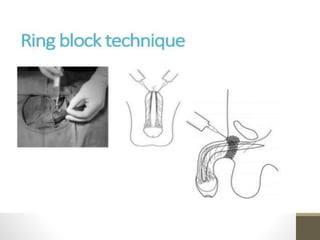
 Do a dorsal and ring block
- Dorsal block- on top of the penis near the base at 11 & 1
o'clock sites
- Ring block- administered round on the penile skin taking
care not to give into the penile tissue (corpora)
Release all adhesions between the prepuce and glans
Procedure cont.
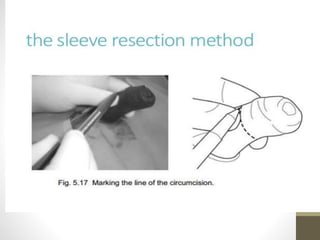
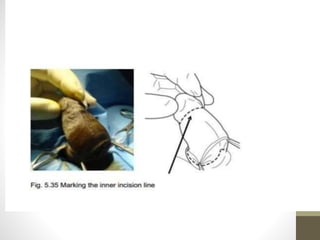
Marking of the incision site
 It is done using either marker pen, gentian violet or
pinches using a toothed dissecting forceps
 It is made over the penile skin just proximal to the
corona
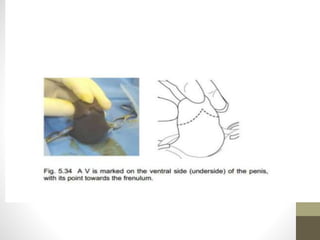
 A V shaped mark is made at the region of the
frenulum
Procedure cont.
Method of removing the foreskin
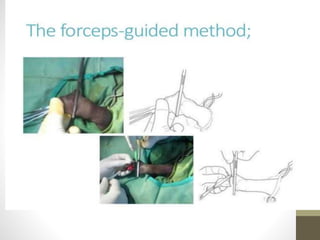
1. Forceps guided method- highly discouraged
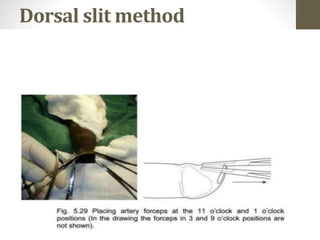
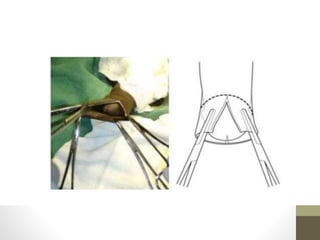
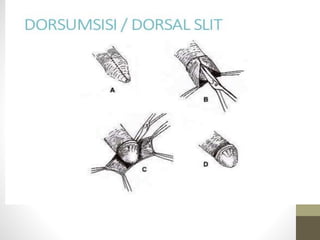
2. Dorsal slit method- highly recommended
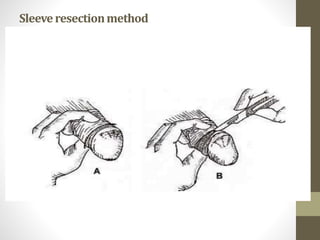
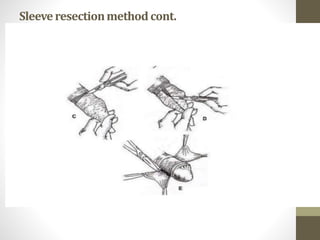
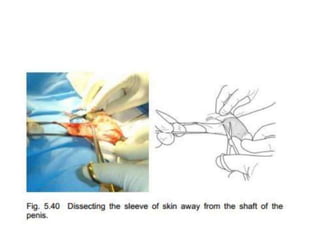
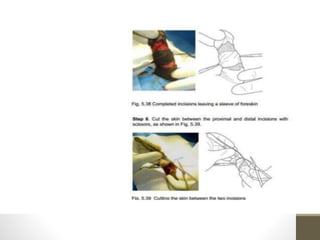
3. Sleeve resection method
Dorsal slit method
Sleeveresectionmethod
Sleeveresectionmethodcont.
Procedurecont.
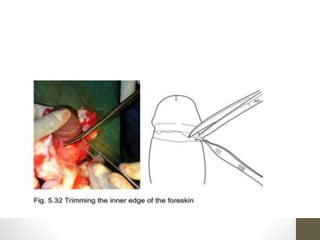
Trimming
 After removal of the foreskin, trim the edges
Procedurecont.
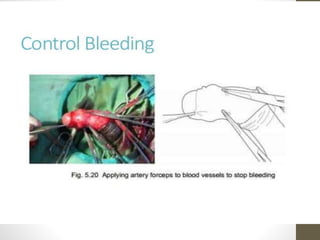
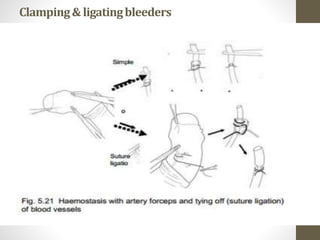
Controlling bleeding (achieving hemostasis)
 Clamp bleeding blood vessels with artery forceps
 Tie/ ligate them with catgut (suture material)
Clamping& ligatingbleeders
Procedure cont.
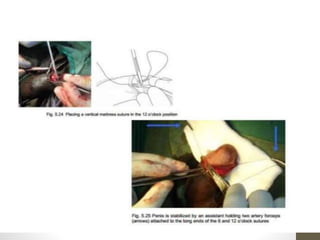
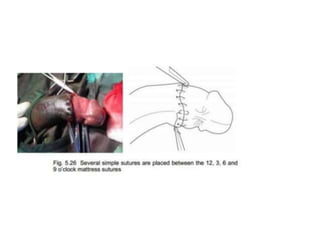
Wound closure
 Approximate the edges starting with frenulum
region (6 o’clock) and suture with horizontal
mattress suturing technique
 Approximate the dorsal region (12 o’clock) with
vertical mattress suturing technique
 Approximate the edges at 3 o’clock and 9 o’clock
with vertical mattress sutures
 Approximate the regions in between 6,12,3 & 9
o'clock with simple interrupted sutures
Procedure cont.
Wound dressing
 Clean the site with normal saline
 Wrap with suflatulle and then with thin gauze
bandage
 Dress with co adhesive bandage
 Assist the client wear inner wear with the penis
facing upwards
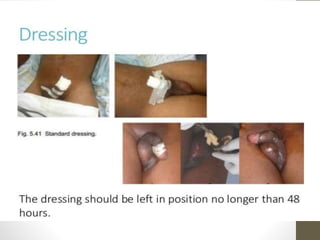
Procedurecont.
Wound dressing
 Clean the incision site with normal saline, apply
suflatulle and then sterile gauze and wrap with co
adhesive bandage
Post-operative management
 Before discharge:
- Monitor vital signs
- Check for bleeding
- Give analgesics
- Record details of the procedure in clients card & in the
register
Post operative management
Advise the client to:
 Come back if he experiences; bleeding, excessive
pain, fever, swelling, inability to pass urine,
gapping wound and pus discharge
 Wear well fitting cotton inner wear
 Not to contaminate the site with urine
 Remove dressing after 48 hours
Post-operative management cont.
Bathe twice daily and clean/take care of the site
 Come back for review after 7 days
Avoid sexual intercourse and masturbation for 6
weeks after the procedure to prevent breakdown
of the wound
Use a condom for every sexual activity for at least
6 months
Complications
1. During surgery
 Excessive bleeding
 Accidental injury- associated with forceps guided
method
2. 1 to days after surgery
 Bleeding
 Haematoma formation
 Wound disruption
Complications cont.
3. 1-2 weeks after surgery
 Wound infection
 Wound disruption and cutting out of stitches
 Fournier’s gangrene of penis and scrotum
 Tetanus infection
4. Late complications
 Decreased glans sensitivity
 Oversensitivity of glans
 Unsightly ragged scar and cosmetic concerns
Complications cont.
 Persistent adhesions of the corona and inclusion
cysts
 Keloid formation
 Erectile discomfort
 Torsion (misalignment) of the skin of the penile
shaft
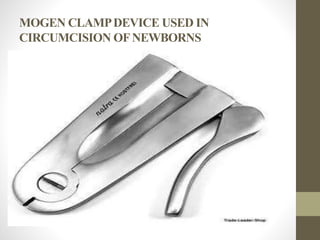
MOGEN CLAMPDEVICE USED IN
CIRCUMCISION OFNEWBORNS
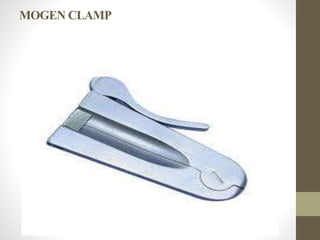
MOGEN CLAMP
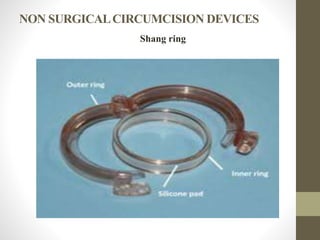
NON SURGICALCIRCUMCISION DEVICES
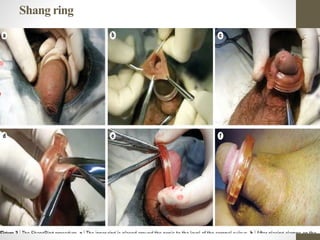
Shang ring
Shang ring
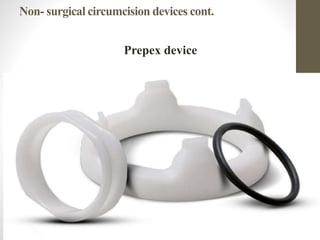
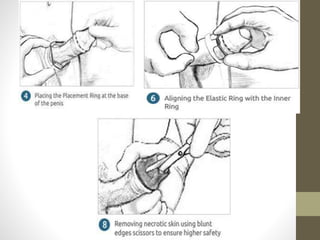
Non- surgical circumcision devices cont.
Prepex device
Thank you

circumcision-1.pptx

  • 1.
  • 2.
    Objectives By the endof this lesson, you should be able to:  Define circumcision  Outline indications of circumcision  Outline contra-indications of circumcision  Describe pre-operative preparation  Discuss the various circumcision methods  Discuss post-operative care of circumcision  Identify complications of circumcision
  • 3.
    Definition  It isthe surgical removal of the foreskin (prepuce) of the penis usually performed under local anaethesia - It is an ancient practice that has its origin in cultural and religious rites - In many communities, it is often performed within the 1st two weeks or at the beginning of adolescence as a rite of passage to adulthood
  • 4.
    Indications 1. Medical indications Phimosis- narrowing of preputial opening  Paraphimosis- tight prepuce which ones retracted fails to return  Prevention of sexually transmitted infections incl. HIV  Prevention of penile cancer  Prevention of urinary tract infections in boys with urological abnormalities
  • 5.
    Indications cont.  Traumato the prepuce 2. Cultural 3. Religious
  • 6.
    Contraindications Absolute contraindications  Prematurity Hypospadias- urethra opening on ventral aspect of the penis- preputial skin utilized during surgical repair  Epispadias- urethra opening on the dorsal aspect of the penis- preputial skin utilized during surgical repair  Micropenis  Concealed or buried penis
  • 7.
    Contraindications cont.  Webbedpenis  Ambiguous genitalia  Chronic Paraphimosis  Genital ulcer disease  Urethral discharge  Penile cancer  Chronic disorders of the foreskin e.g filariasis  Bleeding disorders such as haemophilia
  • 8.
    Contraindications cont. Relative contraindications Scar tissue at the frenulum  Extensive penile warts  Balanitis xerotica obliterans  Sickle cell disease  Other abnormalities of the genitalia e.g hydrocele
  • 9.
    Pre-operative preparation Take history Monitorvital signs Carefully examine the genitalia Obtain an informed (written) consent- after explaining the procedure to the client incl. benefits and risks Advice the client to wash the genital area with soap and water NB: Shaving of pubic hair is not recommended since it damages the skin & promotes infections Assemble the instruments and other supplies
  • 10.
    Pre-operative preparation cont. Requirements Instruments -Instrument tray wrapped with sterile drape - Kidney dish - Toothed dissecting forceps (tweezers) - 6 artery forceps ( 3 straight & 3 curved) - Curved scissors - Straight ( stitch scissors)
  • 11.
    Pre-operative preparations cont. -Needle holding forceps • Gallipot for antiseptic solution such as povidone iodine - Sponge holding forceps - Scalpel knife handle & blades*
  • 12.
    Pre-operative preparation cont. Othersupplies  Povidone iodine  Normal saline  Sterile plain gauze swabs  Petroleum impregnated gauze (suflatulle)  Co adhesive bandage  Lignocaine – either 1% or 2%  10cc syringe  Needles- gauges 18 & 23
  • 13.
    Pre-operative preparations cont. Suture material –chromic catgut 3-0 or 4-0 with reverse-cutting needle  Sterile gloves, masks, caps and apron  Sterile marker pen or gentian violet solution  Couch bed
  • 14.
    Procedure  The surgeon/clinicianand the assistants should scrub  Dry hands with a sterile towel and hold the hand s and arms away from the body & higher than the elbow until sterile gown and sterile gloves have been put on  Ensure the instruments and supplies are assembled
  • 15.
    Procedure cont.  Letthe client remove pants and lay on the coach  Clean the skin with povidone iodine starting with the glans and the shaft of the penis and moving out to the periphery, foreskin should be retracted so as to clean the glans  Drape the patient with ‘O’ drape
  • 17.
    Procedure cont. Administering localanaethesia (lignocaine)  Use 1% or 2% lignocaine without adrenaline  Dosage is 3mg per kg body weight  Do a dorsal and ring block - Dorsal block- on top of the penis near the base at 11 & 1 o'clock sites - Ring block- administered round on the penile skin taking care not to give into the penile tissue (corpora) Release all adhesions between the prepuce and glans
  • 21.
    Procedure cont. Marking ofthe incision site  It is done using either marker pen, gentian violet or pinches using a toothed dissecting forceps  It is made over the penile skin just proximal to the corona  A V shaped mark is made at the region of the frenulum
  • 23.
    Procedure cont. Method ofremoving the foreskin 1. Forceps guided method- highly discouraged 2. Dorsal slit method- highly recommended 3. Sleeve resection method
  • 25.
  • 28.
  • 29.
  • 34.
    Procedurecont. Trimming  After removalof the foreskin, trim the edges
  • 36.
    Procedurecont. Controlling bleeding (achievinghemostasis)  Clamp bleeding blood vessels with artery forceps  Tie/ ligate them with catgut (suture material)
  • 38.
  • 39.
    Procedure cont. Wound closure Approximate the edges starting with frenulum region (6 o’clock) and suture with horizontal mattress suturing technique  Approximate the dorsal region (12 o’clock) with vertical mattress suturing technique  Approximate the edges at 3 o’clock and 9 o’clock with vertical mattress sutures  Approximate the regions in between 6,12,3 & 9 o'clock with simple interrupted sutures
  • 42.
    Procedure cont. Wound dressing Clean the site with normal saline  Wrap with suflatulle and then with thin gauze bandage  Dress with co adhesive bandage  Assist the client wear inner wear with the penis facing upwards
  • 43.
    Procedurecont. Wound dressing  Cleanthe incision site with normal saline, apply suflatulle and then sterile gauze and wrap with co adhesive bandage
  • 44.
    Post-operative management  Beforedischarge: - Monitor vital signs - Check for bleeding - Give analgesics - Record details of the procedure in clients card & in the register
  • 45.
    Post operative management Advisethe client to:  Come back if he experiences; bleeding, excessive pain, fever, swelling, inability to pass urine, gapping wound and pus discharge  Wear well fitting cotton inner wear  Not to contaminate the site with urine  Remove dressing after 48 hours
  • 46.
    Post-operative management cont. Bathetwice daily and clean/take care of the site  Come back for review after 7 days Avoid sexual intercourse and masturbation for 6 weeks after the procedure to prevent breakdown of the wound Use a condom for every sexual activity for at least 6 months
  • 47.
    Complications 1. During surgery Excessive bleeding  Accidental injury- associated with forceps guided method 2. 1 to days after surgery  Bleeding  Haematoma formation  Wound disruption
  • 48.
    Complications cont. 3. 1-2weeks after surgery  Wound infection  Wound disruption and cutting out of stitches  Fournier’s gangrene of penis and scrotum  Tetanus infection 4. Late complications  Decreased glans sensitivity  Oversensitivity of glans  Unsightly ragged scar and cosmetic concerns
  • 49.
    Complications cont.  Persistentadhesions of the corona and inclusion cysts  Keloid formation  Erectile discomfort  Torsion (misalignment) of the skin of the penile shaft
  • 50.
    MOGEN CLAMPDEVICE USEDIN CIRCUMCISION OFNEWBORNS
  • 51.
  • 52.
  • 53.
  • 54.
    Non- surgical circumcisiondevices cont. Prepex device
  • 56.