Male Circumcision:
Indications and Complications
David Galvin
Mr. Dennis Murphy
23.1.06
Introduction
• 1 in 6 men worldwide is circumcised
• In the US, 62% of male neonates are circumcised
(1.2 million)
• Uncircumcised males are at an increased risk of
UTI especially in first 6 to 12 months 1
– 1 in 120 risk. 1 in 195 risk of hospitilisation.
– Protection is x6 - 10
– Mandatory circumcision if at high risk of UTI or if a UTI
would have serious consequences
• Neither recommended nor condemned by AAP
1 Wisell TE. Paediatrics 1985
Foreskin Embryology
• Development of prepuce between week 8 and
16 in utero
• Prepuce mucosa and glans are contiguous
• Exfoliation of underlying epithelium in a
proximal direction leads to resolution of the
physiological adhesions and formation of a
preputial sac
• Usually complete by 3 - 5 years but may
continue until puberty
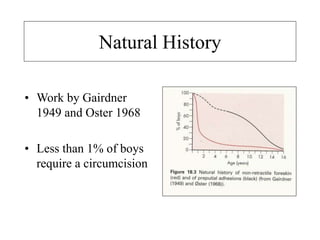
Natural History
• Work by Gairdner
1949 and Oster 1968
• Less than 1% of boys
require a circumcision
Introduction
• Controversial Issues
– Risk of UTI
– Anaesthesia
– Sexual function
– Malignancy
– STDs
Risk of UTI
• Risk is Low
– 1 in 120 - 140 of UTI in a male < 1 year
• Many studies did not examine other factors that
may also have lowered the risk
• Mandatory circumcision is not warranted
• May be recommended if a UTI would risk renal
injury e.g congenital anomalies
• Risk of UTI is 10% (1:11) for those with recurrent
UTIs and 30% (1:4) for those with VUR 1
1 Arch Dis Child. Craig J. Aug 2005
Anaesthesia - Neonates
• Studies mainly in neonates in USA
– Only used by 45% of doctors
• Options
– Eutectic mixture of local anaesthetics (EMLA)
– Dorsal penile nerve block
– Ring block
– Sucking on pacifier / blanket (Religious)
Sexual Function
• Prepuce is filled with nerve endings similar to lips or
fingers (much more so than the glans)
• Circumcision permanently inhibits sexual function ?
Mutilation ?
• Function
– Produce a gliding mechanism during intercourse
– Prevents the loss of vaginal secretions
– Smegma may release pheremones
• Glandular skin undergoes hyperkeritinisation
• Tactile sensation would appear to be unchanged
• One study showed women preferred uncircumcised !
Malignancy
• SCC penis is rare and also depends on
smoking and phimosis.
• Neonatal circumcision is protective whereas
adult circumcision is not.
• Incidence of penile cancer is higher in
circumcised men but overall the incidence
is very low.
• Probably related more so to poor hygiene 1
1 Pediatr Clin North Am. 2001 Neonatal circumcision. Liao JC
Sexually Transmitted Diseases
• Jewish men had lower levels of syphilis in
19th century
• Meta-analysis: no clear evidence that
circumcision prevents STDs 1
• Studies on risk of HIV risk are conflicting
and no conclusion can be made 2
1 Van Howe RS. BJU Int 1999
2 East Afr Med J. 2005 Jan. Nyindo M.
Indications
• Medical
– Pathological Phimosis
• White, scarred prepuce (BXO - absolute)
• May cause ballooning, bleeding, dysuria or retention
• Alternatives are preputioplasty / steroid cream
– Recurrent Balanitis
• Exclude diabetes
– Urinary Tract Infection Prophylaxis
• Protects against UTI in infants with VUR, PUJ, posterior valves
and hydronephrosis 1
• In VUR: 63% v 19% of circumcised boys suffered UTIs
1 Herden CDA. J Urol 1999
Religious
Contraindications
• Premature Infants
• Congenital Penile Abnormalities
– Hypospadias, episapdias, chordee, penile
webbing or concealed penis
• Blood Dyscrasias
Complications
• Death
• Bleeding (2-5%)
• Suture sinus tracts
• Infection (2%)
• Phimosis and
concealed penis
• Adhesions
• Meatal stenosis
• Chordee
• Urethrocutaneous
fistula
• Necrosis
• Amputation
• Hypospadias
• Meatitis
Complications
• Death
– Canada 2002: 5 year old died 48 hours after non-
therapeutic circumcision
• Bleeding
– Usually from frenulum or dorsal fascial vessel
– Should be explored if large haematoma / deep (2-5%)
• Concealed penis
– Conservative circumcision or excess dorsal skin may
lead to phimosis again. Suprapubic fat pad may lead to a
concealed penis.
Complications
• Chordee
– Secondary to circumcision is related to excess skin removal
• Urethrocutaneous Fistula
– Urethral injury during excision of prepuce
• Necrosis
– May occur secondary to surgery or infection
– Only use bipolar electrocautery sparingly and never with a
‘clamp’ device
• Amputation of Glans
– May occur using a ‘clamp’ device
Current Status in N. America
• Medicaid no longer cover routine neonatal
circumcision in 11 states
• Legally, routine circumcison may be
considered battery - as parents are
consenting to invasive non-therapeutic
surgery for their son
• www.doctorsopposingcircumcision.org

Circumcision.ppt

  • 1.
    Male Circumcision: Indications andComplications David Galvin Mr. Dennis Murphy 23.1.06
  • 2.
    Introduction • 1 in6 men worldwide is circumcised • In the US, 62% of male neonates are circumcised (1.2 million) • Uncircumcised males are at an increased risk of UTI especially in first 6 to 12 months 1 – 1 in 120 risk. 1 in 195 risk of hospitilisation. – Protection is x6 - 10 – Mandatory circumcision if at high risk of UTI or if a UTI would have serious consequences • Neither recommended nor condemned by AAP 1 Wisell TE. Paediatrics 1985
  • 3.
    Foreskin Embryology • Developmentof prepuce between week 8 and 16 in utero • Prepuce mucosa and glans are contiguous • Exfoliation of underlying epithelium in a proximal direction leads to resolution of the physiological adhesions and formation of a preputial sac • Usually complete by 3 - 5 years but may continue until puberty
  • 4.
    Natural History • Workby Gairdner 1949 and Oster 1968 • Less than 1% of boys require a circumcision
  • 5.
    Introduction • Controversial Issues –Risk of UTI – Anaesthesia – Sexual function – Malignancy – STDs
  • 6.
    Risk of UTI •Risk is Low – 1 in 120 - 140 of UTI in a male < 1 year • Many studies did not examine other factors that may also have lowered the risk • Mandatory circumcision is not warranted • May be recommended if a UTI would risk renal injury e.g congenital anomalies • Risk of UTI is 10% (1:11) for those with recurrent UTIs and 30% (1:4) for those with VUR 1 1 Arch Dis Child. Craig J. Aug 2005
  • 7.
    Anaesthesia - Neonates •Studies mainly in neonates in USA – Only used by 45% of doctors • Options – Eutectic mixture of local anaesthetics (EMLA) – Dorsal penile nerve block – Ring block – Sucking on pacifier / blanket (Religious)
  • 8.
    Sexual Function • Prepuceis filled with nerve endings similar to lips or fingers (much more so than the glans) • Circumcision permanently inhibits sexual function ? Mutilation ? • Function – Produce a gliding mechanism during intercourse – Prevents the loss of vaginal secretions – Smegma may release pheremones • Glandular skin undergoes hyperkeritinisation • Tactile sensation would appear to be unchanged • One study showed women preferred uncircumcised !
  • 9.
    Malignancy • SCC penisis rare and also depends on smoking and phimosis. • Neonatal circumcision is protective whereas adult circumcision is not. • Incidence of penile cancer is higher in circumcised men but overall the incidence is very low. • Probably related more so to poor hygiene 1 1 Pediatr Clin North Am. 2001 Neonatal circumcision. Liao JC
  • 10.
    Sexually Transmitted Diseases •Jewish men had lower levels of syphilis in 19th century • Meta-analysis: no clear evidence that circumcision prevents STDs 1 • Studies on risk of HIV risk are conflicting and no conclusion can be made 2 1 Van Howe RS. BJU Int 1999 2 East Afr Med J. 2005 Jan. Nyindo M.
  • 11.
    Indications • Medical – PathologicalPhimosis • White, scarred prepuce (BXO - absolute) • May cause ballooning, bleeding, dysuria or retention • Alternatives are preputioplasty / steroid cream – Recurrent Balanitis • Exclude diabetes – Urinary Tract Infection Prophylaxis • Protects against UTI in infants with VUR, PUJ, posterior valves and hydronephrosis 1 • In VUR: 63% v 19% of circumcised boys suffered UTIs 1 Herden CDA. J Urol 1999 Religious
  • 12.
    Contraindications • Premature Infants •Congenital Penile Abnormalities – Hypospadias, episapdias, chordee, penile webbing or concealed penis • Blood Dyscrasias
  • 13.
    Complications • Death • Bleeding(2-5%) • Suture sinus tracts • Infection (2%) • Phimosis and concealed penis • Adhesions • Meatal stenosis • Chordee • Urethrocutaneous fistula • Necrosis • Amputation • Hypospadias • Meatitis
  • 14.
    Complications • Death – Canada2002: 5 year old died 48 hours after non- therapeutic circumcision • Bleeding – Usually from frenulum or dorsal fascial vessel – Should be explored if large haematoma / deep (2-5%) • Concealed penis – Conservative circumcision or excess dorsal skin may lead to phimosis again. Suprapubic fat pad may lead to a concealed penis.
  • 15.
    Complications • Chordee – Secondaryto circumcision is related to excess skin removal • Urethrocutaneous Fistula – Urethral injury during excision of prepuce • Necrosis – May occur secondary to surgery or infection – Only use bipolar electrocautery sparingly and never with a ‘clamp’ device • Amputation of Glans – May occur using a ‘clamp’ device
  • 16.
    Current Status inN. America • Medicaid no longer cover routine neonatal circumcision in 11 states • Legally, routine circumcison may be considered battery - as parents are consenting to invasive non-therapeutic surgery for their son • www.doctorsopposingcircumcision.org