Business Performance Management
Project
Enabling the building of an integrated information
solution to enhance business performance,
planning and analytics

Irelan Tam
Johnson & Johnson Medical
Nov, 27, 2012
TODAY’S DISCUSSION

• Business Intelligence and Business Performance
Management

• Role of Finance
• Performance Management and Analytics
• Critical Success Factors
• A Case Study

1
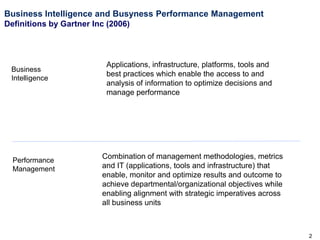
Business Intelligence and Busyness Performance Management
Definitions by Gartner Inc (2006)

Business
Intelligence

Performance
Management

Applications, infrastructure, platforms, tools and
best practices which enable the access to and
analysis of information to optimize decisions and
manage performance

Combination of management methodologies, metrics
and IT (applications, tools and infrastructure) that
enable, monitor and optimize results and outcome to
achieve departmental/organizational objectives while
enabling alignment with strategic imperatives across
all business units

2
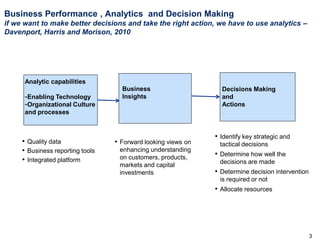
Business Performance , Analytics and Decision Making
if we want to make better decisions and take the right action, we have to use analytics –
Davenport, Harris and Morison, 2010

Analytic capabilities

-Enabling Technology
-Organizational Culture

Business
Insights

Decisions Making
and
Actions

and processes

• Quality data
• Business reporting tools
• Integrated platform

• Forward looking views on
enhancing understanding
on customers, products,
markets and capital
investments

• Identify key strategic and
tactical decisions

• Determine how well the
decisions are made

• Determine decision intervention
is required or not

• Allocate resources

3
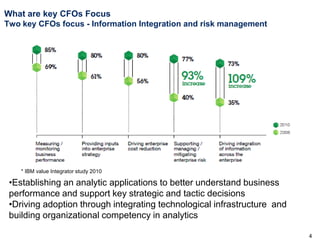
What are key CFOs Focus
Two key CFOs focus - Information Integration and risk management

* IBM value Integrator study 2010

•Establishing an analytic applications to better understand business
performance and support key strategic and tactic decisions
•Driving adoption through integrating technological infrastructure and
building organizational competency in analytics
4
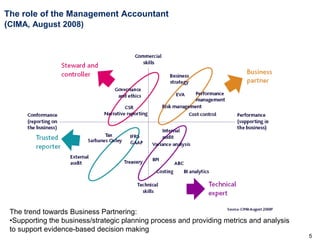
The role of the Management Accountant
(CIMA, August 2008)

The trend towards Business Partnering:
•Supporting the business/strategic planning process and providing metrics and analysis
to support evidence-based decision making
5
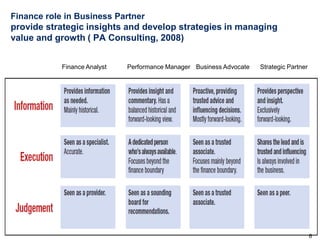
Finance role in Business Partner

provide strategic insights and develop strategies in managing
value and growth ( PA Consulting, 2008)
Finance Analyst

Performance Manager Business Advocate

Strategic Partner

6
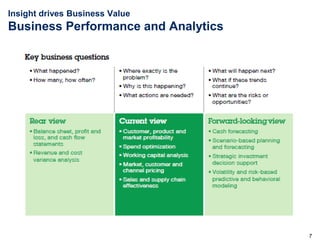
Insight drives Business Value

Business Performance and Analytics

7
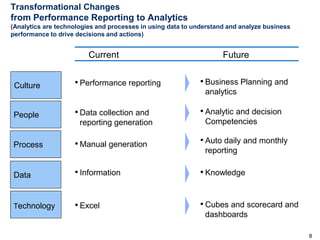
Transformational Changes

from Performance Reporting to Analytics
(Analytics are technologies and processes in using data to understand and analyze business
performance to drive decisions and actions)

Current
Culture

• Performance reporting

People

• Data collection and

Future

• Business Planning and
analytics

reporting generation

• Analytic and decision
Competencies

Process

• Manual generation

• Auto daily and monthly

Data

• Information

• Knowledge

Technology

• Excel

• Cubes and scorecard and

reporting

dashboards
8
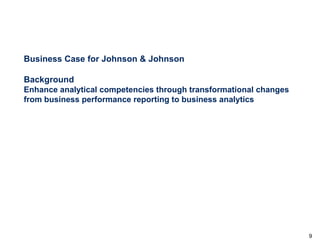
Business Case for Johnson & Johnson
Background
Enhance analytical competencies through transformational changes
from business performance reporting to business analytics

9
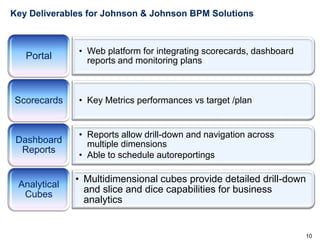
Key Deliverables for Johnson & Johnson BPM Solutions

Portal

• Web platform for integrating scorecards, dashboard
reports and monitoring plans

Scorecards

• Key Metrics performances vs target /plan

Dashboard
Reports

• Reports allow drill-down and navigation across
multiple dimensions
• Able to schedule autoreportings

Analytical
Cubes

• Multidimensional cubes provide detailed drill-down
and slice and dice capabilities for business
analytics

10
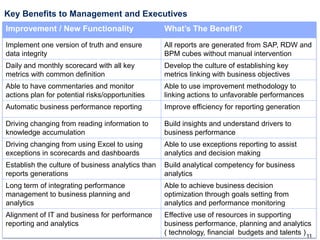
Key Benefits to Management and Executives
Improvement / New Functionality

What’s The Benefit?

Implement one version of truth and ensure
data integrity

All reports are generated from SAP, RDW and
BPM cubes without manual intervention

Daily and monthly scorecard with all key
metrics with common definition

Develop the culture of establishing key
metrics linking with business objectives

Able to have commentaries and monitor
actions plan for potential risks/opportunities

Able to use improvement methodology to
linking actions to unfavorable performances

Automatic business performance reporting

Improve efficiency for reporting generation

Driving changing from reading information to
knowledge accumulation

Build insights and understand drivers to
business performance

Driving changing from using Excel to using
exceptions in scorecards and dashboards

Able to use exceptions reporting to assist
analytics and decision making

Establish the culture of business analytics than
reports generations

Build analytical competency for business
analytics

Long term of integrating performance
management to business planning and
analytics

Able to achieve business decision
optimization through goals setting from
analytics and performance monitoring

Alignment of IT and business for performance
reporting and analytics

Effective use of resources in supporting
business performance, planning and analytics
( technology, financial budgets and talents ) 11
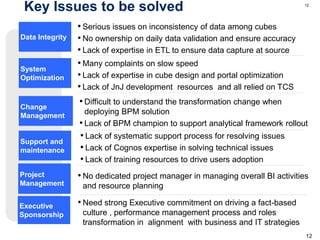
Key Issues to be solved
Data Integrity

System
Optimization

Change
Management

Support and
maintenance
Project
Management
Executive
Sponsorship

12

• Serious issues on inconsistency of data among cubes
• No ownership on daily data validation and ensure accuracy
• Lack of expertise in ETL to ensure data capture at source
• Many complaints on slow speed
• Lack of expertise in cube design and portal optimization
• Lack of JnJ development resources and all relied on TCS
• Difficult to understand the transformation change when
deploying BPM solution
• Lack of BPM champion to support analytical framework rollout

• Lack of systematic support process for resolving issues
• Lack of Cognos expertise in solving technical issues
• Lack of training resources to drive users adoption
• No dedicated project manager in managing overall BI activities
and resource planning

• Need strong Executive commitment on driving a fact-based
culture , performance management process and roles
transformation in alignment with business and IT strategies
12
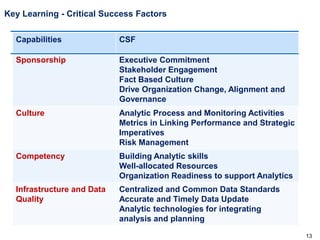
Key Learning - Critical Success Factors
Capabilities

CSF

Sponsorship

Executive Commitment
Stakeholder Engagement
Fact Based Culture
Drive Organization Change, Alignment and
Governance

Culture

Analytic Process and Monitoring Activities
Metrics in Linking Performance and Strategic
Imperatives
Risk Management

Competency

Building Analytic skills
Well-allocated Resources
Organization Readiness to support Analytics

Infrastructure and Data
Quality

Centralized and Common Data Standards
Accurate and Timely Data Update
Analytic technologies for integrating
analysis and planning
13
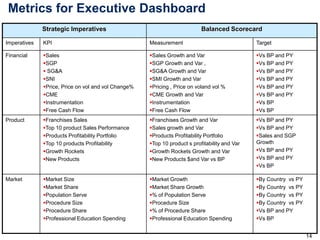
Metrics for Executive Dashboard
Strategic Imperatives

Balanced Scorecard

Imperatives

KPI

Measurement

Target

Financial

Sales
SGP
 SG&A
SNI
Price, Price on vol and vol Change%
CME
Instrumentation
Free Cash Flow

Sales Growth and Var
SGP Growth and Var ,
SG&A Growth and Var
SMI Growth and Var
Pricing , Price on voland vol %
CME Growth and Var
Instrumentation
Free Cash Flow

Vs BP and PY
Vs BP and PY
Vs BP and PY
Vs BP and PY
Vs BP and PY
Vs BP and PY
Vs BP
Vs BP

Product

Franchises Sales
Top 10 product Sales Performance
Products Profitability Portfolio
Top 10 products Profitability
Growth Rockets
New Products

Franchises Growth and Var
Sales growth and Var
Products Profitability Portfolio
Top 10 product s profitability and Var
Growth Rockets Growth and Var
New Products $and Var vs BP

Vs BP and PY
Vs BP and PY
Sales and SGP
Growth
Vs BP and PY
Vs BP and PY
Vs BP

Market

Market Size
Market Share
Population Serve
Procedure Size
Procedure Share
Professional Education Spending

Market Growth
Market Share Growth
% of Population Serve
Procedure Size
% of Procedure Share
Professional Education Spending

By Country vs PY
By Country vs PY
By Country vs PY
By Country vs PY
Vs BP and PY
Vs BP
14
14
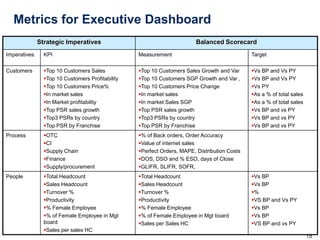
Metrics for Executive Dashboard
Strategic Imperatives

Balanced Scorecard

Imperatives

KPI

Measurement

Target

Customers

Top 10 Customers Sales
Top 10 Customers Profitability
Top 10 Customers Price%
In market sales
In Market profitability
Top PSR sales growth
Top3 PSRs by country
Top PSR by Franchise

Top 10 Customers Sales Growth and Var
Top 10 Customers SGP Growth and Var ,
Top 10 Customers Price Change
In market sales
In market Sales SGP
Top PSR sales growth
Top3 PSRs by country
Top PSR by Franchise

Vs BP and Vs PY
Vs BP and Vs PY
Vs PY
As a % of total sales
Vs BP and vs PY
Vs BP and vs PY
Vs BP and vs PY

Process

OTC
CI
Supply Chain
Finance
Supply/procurement

% of Back orders, Order Accuracy
Value of internet sales
Perfect Orders, MAPE, Distribution Costs
DOS, DSO and % ESO, days of Close
GLIFR, SLIFR, SOFR,

People

Total Headcount
Sales Headcount
Turnover %
Productivity
% Female Employee
% of Female Employee in Mgt
board
Sales per sales HC

Total Headcount
Sales Headcount
Turnover %
Productivity
% Female Employee
% of Female Employee in Mgt board
Sales per Sales HC

Vs BP
Vs BP
%
VS BP and Vs PY
Vs BP
Vs BP
VS BP and vs PY
15
15

Cima bpm presentation 1

  • 1.
    Business Performance Management Project Enablingthe building of an integrated information solution to enhance business performance, planning and analytics Irelan Tam Johnson & Johnson Medical Nov, 27, 2012
  • 2.
    TODAY’S DISCUSSION • BusinessIntelligence and Business Performance Management • Role of Finance • Performance Management and Analytics • Critical Success Factors • A Case Study 1
  • 3.
    Business Intelligence andBusyness Performance Management Definitions by Gartner Inc (2006) Business Intelligence Performance Management Applications, infrastructure, platforms, tools and best practices which enable the access to and analysis of information to optimize decisions and manage performance Combination of management methodologies, metrics and IT (applications, tools and infrastructure) that enable, monitor and optimize results and outcome to achieve departmental/organizational objectives while enabling alignment with strategic imperatives across all business units 2
  • 4.
    Business Performance ,Analytics and Decision Making if we want to make better decisions and take the right action, we have to use analytics – Davenport, Harris and Morison, 2010 Analytic capabilities -Enabling Technology -Organizational Culture Business Insights Decisions Making and Actions and processes • Quality data • Business reporting tools • Integrated platform • Forward looking views on enhancing understanding on customers, products, markets and capital investments • Identify key strategic and tactical decisions • Determine how well the decisions are made • Determine decision intervention is required or not • Allocate resources 3
  • 5.
    What are keyCFOs Focus Two key CFOs focus - Information Integration and risk management * IBM value Integrator study 2010 •Establishing an analytic applications to better understand business performance and support key strategic and tactic decisions •Driving adoption through integrating technological infrastructure and building organizational competency in analytics 4
  • 6.
    The role ofthe Management Accountant (CIMA, August 2008) The trend towards Business Partnering: •Supporting the business/strategic planning process and providing metrics and analysis to support evidence-based decision making 5
  • 7.
    Finance role inBusiness Partner provide strategic insights and develop strategies in managing value and growth ( PA Consulting, 2008) Finance Analyst Performance Manager Business Advocate Strategic Partner 6
  • 8.
    Insight drives BusinessValue Business Performance and Analytics 7
  • 9.
    Transformational Changes from PerformanceReporting to Analytics (Analytics are technologies and processes in using data to understand and analyze business performance to drive decisions and actions) Current Culture • Performance reporting People • Data collection and Future • Business Planning and analytics reporting generation • Analytic and decision Competencies Process • Manual generation • Auto daily and monthly Data • Information • Knowledge Technology • Excel • Cubes and scorecard and reporting dashboards 8
  • 10.
    Business Case forJohnson & Johnson Background Enhance analytical competencies through transformational changes from business performance reporting to business analytics 9
  • 11.
    Key Deliverables forJohnson & Johnson BPM Solutions Portal • Web platform for integrating scorecards, dashboard reports and monitoring plans Scorecards • Key Metrics performances vs target /plan Dashboard Reports • Reports allow drill-down and navigation across multiple dimensions • Able to schedule autoreportings Analytical Cubes • Multidimensional cubes provide detailed drill-down and slice and dice capabilities for business analytics 10
  • 12.
    Key Benefits toManagement and Executives Improvement / New Functionality What’s The Benefit? Implement one version of truth and ensure data integrity All reports are generated from SAP, RDW and BPM cubes without manual intervention Daily and monthly scorecard with all key metrics with common definition Develop the culture of establishing key metrics linking with business objectives Able to have commentaries and monitor actions plan for potential risks/opportunities Able to use improvement methodology to linking actions to unfavorable performances Automatic business performance reporting Improve efficiency for reporting generation Driving changing from reading information to knowledge accumulation Build insights and understand drivers to business performance Driving changing from using Excel to using exceptions in scorecards and dashboards Able to use exceptions reporting to assist analytics and decision making Establish the culture of business analytics than reports generations Build analytical competency for business analytics Long term of integrating performance management to business planning and analytics Able to achieve business decision optimization through goals setting from analytics and performance monitoring Alignment of IT and business for performance reporting and analytics Effective use of resources in supporting business performance, planning and analytics ( technology, financial budgets and talents ) 11
  • 13.
    Key Issues tobe solved Data Integrity System Optimization Change Management Support and maintenance Project Management Executive Sponsorship 12 • Serious issues on inconsistency of data among cubes • No ownership on daily data validation and ensure accuracy • Lack of expertise in ETL to ensure data capture at source • Many complaints on slow speed • Lack of expertise in cube design and portal optimization • Lack of JnJ development resources and all relied on TCS • Difficult to understand the transformation change when deploying BPM solution • Lack of BPM champion to support analytical framework rollout • Lack of systematic support process for resolving issues • Lack of Cognos expertise in solving technical issues • Lack of training resources to drive users adoption • No dedicated project manager in managing overall BI activities and resource planning • Need strong Executive commitment on driving a fact-based culture , performance management process and roles transformation in alignment with business and IT strategies 12
  • 14.
    Key Learning -Critical Success Factors Capabilities CSF Sponsorship Executive Commitment Stakeholder Engagement Fact Based Culture Drive Organization Change, Alignment and Governance Culture Analytic Process and Monitoring Activities Metrics in Linking Performance and Strategic Imperatives Risk Management Competency Building Analytic skills Well-allocated Resources Organization Readiness to support Analytics Infrastructure and Data Quality Centralized and Common Data Standards Accurate and Timely Data Update Analytic technologies for integrating analysis and planning 13
  • 15.
    Metrics for ExecutiveDashboard Strategic Imperatives Balanced Scorecard Imperatives KPI Measurement Target Financial Sales SGP  SG&A SNI Price, Price on vol and vol Change% CME Instrumentation Free Cash Flow Sales Growth and Var SGP Growth and Var , SG&A Growth and Var SMI Growth and Var Pricing , Price on voland vol % CME Growth and Var Instrumentation Free Cash Flow Vs BP and PY Vs BP and PY Vs BP and PY Vs BP and PY Vs BP and PY Vs BP and PY Vs BP Vs BP Product Franchises Sales Top 10 product Sales Performance Products Profitability Portfolio Top 10 products Profitability Growth Rockets New Products Franchises Growth and Var Sales growth and Var Products Profitability Portfolio Top 10 product s profitability and Var Growth Rockets Growth and Var New Products $and Var vs BP Vs BP and PY Vs BP and PY Sales and SGP Growth Vs BP and PY Vs BP and PY Vs BP Market Market Size Market Share Population Serve Procedure Size Procedure Share Professional Education Spending Market Growth Market Share Growth % of Population Serve Procedure Size % of Procedure Share Professional Education Spending By Country vs PY By Country vs PY By Country vs PY By Country vs PY Vs BP and PY Vs BP 14 14
  • 16.
    Metrics for ExecutiveDashboard Strategic Imperatives Balanced Scorecard Imperatives KPI Measurement Target Customers Top 10 Customers Sales Top 10 Customers Profitability Top 10 Customers Price% In market sales In Market profitability Top PSR sales growth Top3 PSRs by country Top PSR by Franchise Top 10 Customers Sales Growth and Var Top 10 Customers SGP Growth and Var , Top 10 Customers Price Change In market sales In market Sales SGP Top PSR sales growth Top3 PSRs by country Top PSR by Franchise Vs BP and Vs PY Vs BP and Vs PY Vs PY As a % of total sales As a % of total sales Vs BP and vs PY Vs BP and vs PY Vs BP and vs PY Process OTC CI Supply Chain Finance Supply/procurement % of Back orders, Order Accuracy Value of internet sales Perfect Orders, MAPE, Distribution Costs DOS, DSO and % ESO, days of Close GLIFR, SLIFR, SOFR, People Total Headcount Sales Headcount Turnover % Productivity % Female Employee % of Female Employee in Mgt board Sales per sales HC Total Headcount Sales Headcount Turnover % Productivity % Female Employee % of Female Employee in Mgt board Sales per Sales HC Vs BP Vs BP % VS BP and Vs PY Vs BP Vs BP VS BP and vs PY 15 15