A Case Study On Typhoid
Fever
(SOAP)
- Ajita Sadhukhan
- Pharm D. 3rd year
- Roll No. : 1
- Enrolment No. : 150821207001
Definition
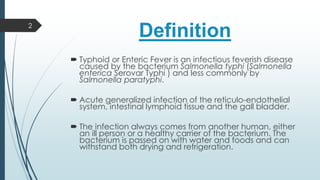
 Typhoid or Enteric Fever is an infectious feverish disease
caused by the bacterium Salmonella typhi (Salmonella
enterica Serovar Typhi ) and less commonly by
Salmonella paratyphi.
 Acute generalized infection of the reticulo-endothelial
system, intestinal lymphoid tissue and the gall bladder.
 The infection always comes from another human, either
an ill person or a healthy carrier of the bacterium. The
bacterium is passed on with water and foods and can
withstand both drying and refrigeration.
2
Patient Demographics:
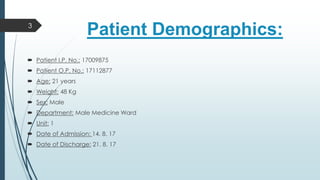
 Patient I.P. No.: 17009875
 Patient O.P. No.: 17112877
 Age: 21 years
 Weight: 48 Kg
 Sex: Male
 Department: Male Medicine Ward
 Unit: 1
 Date of Admission: 14. 8. 17
 Date of Discharge: 21. 8. 17
3
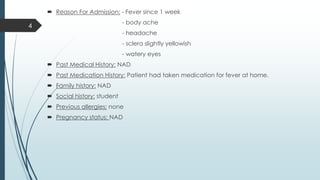
 Reason For Admission: - Fever since 1 week
- body ache
- headache
- sclera slightly yellowish
- watery eyes
 Past Medical History: NAD
 Past Medication History: Patient had taken medication for fever at home.
 Family history: NAD
 Social history: student
 Previous allergies: none
 Pregnancy status: NAD
4
OBJECTIVES
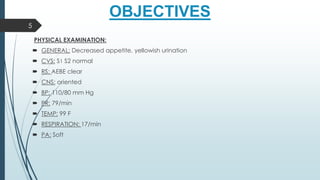
PHYSICAL EXAMINATION:
 GENERAL: Decreased appetite, yellowish urination
 CVS: S1 S2 normal
 RS: AEBE clear
 CNS: oriented
 BP: 110/80 mm Hg
 PR: 79/min
 TEMP: 99 F
 RESPIRATION: 17/min
 PA: Soft
5
LAB. INVESTIGATION REPORTS [first day]
LABORATORY PARAMETERS OBSERVED VALUE NORMAL RANGE UNIT
Hb 14.0 11.5-18 g%
Neutrophils 69.6 40-70 %
Lymphocytes 45 20-40 /cu mm
Monocytes 04 2-10 /cu mm
ESR 45 1-20 mm/hr
Platelets 348000 1.5-4 /cu mm
ALT 55 <40 IU/L
6
 PS for MP: Malarial parasite not seen
 Widal Test: Positive
 HIV test: negative
OTHERS (2nd day)
ASSESSMENT:
PROVISIONAL DIAGNOSIS: Typhoid Fever
7
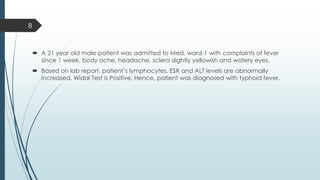
 A 21 year old male patient was admitted to Med. ward-1 with complaints of fever
since 1 week, body ache, headache, sclera slightly yellowish and watery eyes.
 Based on lab report, patient’s lymphocytes, ESR and ALT levels are abnormally
increased. Widal Test is Positive. Hence, patient was diagnosed with typhoid fever.
8
FINAL DIAGNOSIS:
Typhoid Fever
9
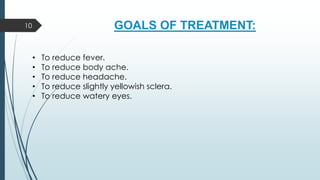
GOALS OF TREATMENT:10
• To reduce fever.
• To reduce body ache.
• To reduce headache.
• To reduce slightly yellowish sclera.
• To reduce watery eyes.
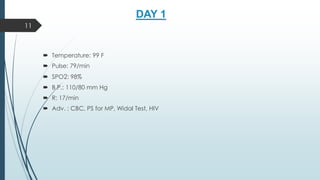
DAY 1
 Temperature: 99 F
 Pulse: 79/min
 SPO2: 98%
 B.P.: 110/80 mm Hg
 R: 17/min
 Adv. : CBC, PS for MP, Widal Test, HIV
11
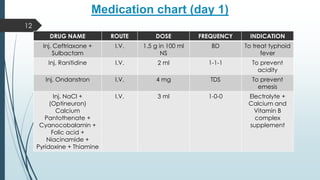
Medication chart (day 1)
DRUG NAME ROUTE DOSE FREQUENCY INDICATION
Inj. Ceftriaxone +
Sulbactam
I.V. 1.5 g in 100 ml
NS
BD To treat typhoid
fever
Inj. Ranitidine I.V. 2 ml 1-1-1 To prevent
acidity
Inj. Ondanstron I.V. 4 mg TDS To prevent
emesis
Inj. NaCl +
(Optineuron)
Calcium
Pantothenate +
Cyanocobalamin +
Folic acid +
Niacinamide +
Pyridoxine + Thiamine
I.V. 3 ml 1-0-0 Electrolyte +
Calcium and
Vitamin B
complex
supplement
12
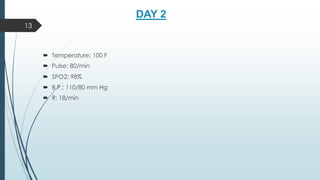
DAY 2
 Temperature: 100 F
 Pulse: 80/min
 SPO2: 98%
 B.P.: 110/80 mm Hg
 R: 18/min
13
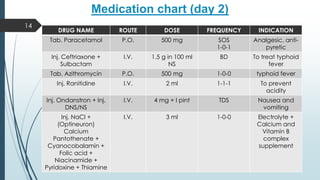
Medication chart (day 2)
14
DRUG NAME ROUTE DOSE FREQUENCY INDICATION
Tab. Paracetamol P.O. 500 mg SOS
1-0-1
Analgesic, anti-
pyretic
Inj. Ceftriaxone +
Sulbactam
I.V. 1.5 g in 100 ml
NS
BD To treat typhoid
fever
Tab. Azithromycin P.O. 500 mg 1-0-0 typhoid fever
Inj. Ranitidine I.V. 2 ml 1-1-1 To prevent
acidity
Inj. Ondanstron + Inj.
DNS/NS
I.V. 4 mg + I pint TDS Nausea and
vomiting
Inj. NaCl +
(Optineuron)
Calcium
Pantothenate +
Cyanocobalamin +
Folic acid +
Niacinamide +
Pyridoxine + Thiamine
I.V. 3 ml 1-0-0 Electrolyte +
Calcium and
Vitamin B
complex
supplement
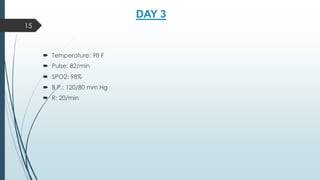
DAY 3
 Temperature: 98 F
 Pulse: 82/min
 SPO2: 98%
 B.P.: 120/80 mm Hg
 R: 20/min
15
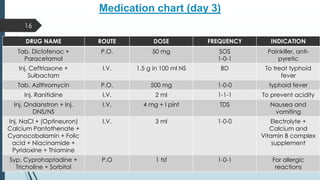
Medication chart (day 3)
DRUG NAME ROUTE DOSE FREQUENCY INDICATION
Tab. Diclofenac +
Paracetamol
P.O. 50 mg SOS
1-0-1
Painkiller, anti-
pyretic
Inj. Ceftriaxone +
Sulbactam
I.V. 1.5 g in 100 ml NS BD To treat typhoid
fever
Tab. Azithromycin P.O. 500 mg 1-0-0 typhoid fever
Inj. Ranitidine I.V. 2 ml 1-1-1 To prevent acidity
Inj. Ondanstron + Inj.
DNS/NS
I.V. 4 mg + I pint TDS Nausea and
vomiting
Inj. NaCl + (Optineuron)
Calcium Pantothenate +
Cyanocobalamin + Folic
acid + Niacinamide +
Pyridoxine + Thiamine
I.V. 3 ml 1-0-0 Electrolyte +
Calcium and
Vitamin B complex
supplement
Syp. Cyprohaptadine +
Tricholine + Sorbitol
P.O 1 tsf 1-0-1 For allergic
reactions
16
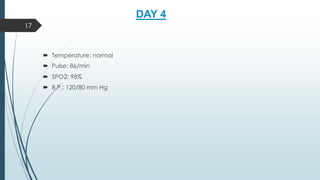
DAY 4
 Temperature: normal
 Pulse: 86/min
 SPO2: 98%
 B.P.: 120/80 mm Hg
17
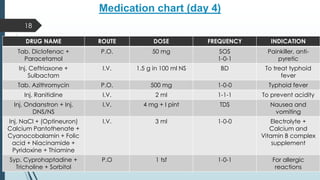
Medication chart (day 4)
DRUG NAME ROUTE DOSE FREQUENCY INDICATION
Tab. Diclofenac +
Paracetamol
P.O. 50 mg SOS
1-0-1
Painkiller, anti-
pyretic
Inj. Ceftriaxone +
Sulbactam
I.V. 1.5 g in 100 ml NS BD To treat typhoid
fever
Tab. Azithromycin P.O. 500 mg 1-0-0 Typhoid fever
Inj. Ranitidine I.V. 2 ml 1-1-1 To prevent acidity
Inj. Ondanstron + Inj.
DNS/NS
I.V. 4 mg + I pint TDS Nausea and
vomiting
Inj. NaCl + (Optineuron)
Calcium Pantothenate +
Cyanocobalamin + Folic
acid + Niacinamide +
Pyridoxine + Thiamine
I.V. 3 ml 1-0-0 Electrolyte +
Calcium and
Vitamin B complex
supplement
Syp. Cyprohaptadine +
Tricholine + Sorbitol
P.O 1 tsf 1-0-1 For allergic
reactions
18
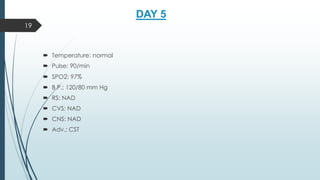
DAY 5
 Temperature: normal
 Pulse: 90/min
 SPO2: 97%
 B.P.: 120/80 mm Hg
 RS: NAD
 CVS: NAD
 CNS: NAD
 Adv.: CST
19
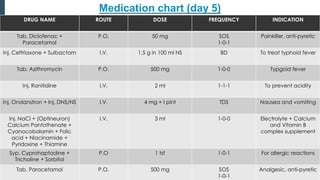
DRUG NAME ROUTE DOSE FREQUENCY INDICATION
Tab. Diclofenac +
Paracetamol
P.O. 50 mg SOS
1-0-1
Painkiller, anti-pyretic
Inj. Ceftriaxone + Sulbactam I.V. 1.5 g in 100 ml NS BD To treat typhoid fever
Tab. Azithromycin P.O. 500 mg 1-0-0 Typgoid fever
Inj. Ranitidine I.V. 2 ml 1-1-1 To prevent acidity
Inj. Ondanstron + Inj. DNS/NS I.V. 4 mg + I pint TDS Nausea and vomiting
Inj. NaCl + (Optineuron)
Calcium Pantothenate +
Cyanocobalamin + Folic
acid + Niacinamide +
Pyridoxine + Thiamine
I.V. 3 ml 1-0-0 Electrolyte + Calcium
and Vitamin B
complex supplement
Syp. Cyprohaptadine +
Tricholine + Sorbitol
P.O 1 tsf 1-0-1 For allergic reactions
Tab. Paracetamol P.O. 500 mg SOS
1-0-1
Analgesic, anti-pyretic
Medication chart (day 5)
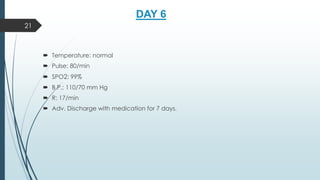
DAY 6
 Temperature: normal
 Pulse: 80/min
 SPO2: 99%
 B.P.: 110/70 mm Hg
 R: 17/min
 Adv. Discharge with medication for 7 days.
21
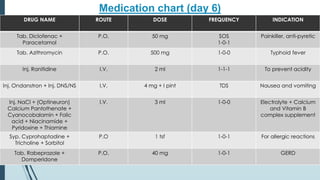
DRUG NAME ROUTE DOSE FREQUENCY INDICATION
Tab. Diclofenac +
Paracetamol
P.O. 50 mg SOS
1-0-1
Painkiller, anti-pyretic
Tab. Azithromycin P.O. 500 mg 1-0-0 Typhoid fever
Inj. Ranitidine I.V. 2 ml 1-1-1 To prevent acidity
Inj. Ondanstron + Inj. DNS/NS I.V. 4 mg + I pint TDS Nausea and vomiting
Inj. NaCl + (Optineuron)
Calcium Pantothenate +
Cyanocobalamin + Folic
acid + Niacinamide +
Pyridoxine + Thiamine
I.V. 3 ml 1-0-0 Electrolyte + Calcium
and Vitamin B
complex supplement
Syp. Cyprohaptadine +
Tricholine + Sorbitol
P.O 1 tsf 1-0-1 For allergic reactions
Tab. Rabeprazole +
Domperidone
P.O. 40 mg 1-0-1 GERD
Medication chart (day 6)
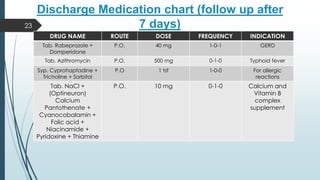
Discharge Medication chart (follow up after
7 days)
DRUG NAME ROUTE DOSE FREQUENCY INDICATION
Tab. Rabeprazole +
Domperidone
P.O. 40 mg 1-0-1 GERD
Tab. Azithromycin P.O. 500 mg 0-1-0 Typhoid fever
Syp. Cyprohaptadine +
Tricholine + Sorbitol
P.O 1 tsf 1-0-0 For allergic
reactions
Tab. NaCl +
(Optineuron)
Calcium
Pantothenate +
Cyanocobalamin +
Folic acid +
Niacinamide +
Pyridoxine + Thiamine
P.O. 10 mg 0-1-0 Calcium and
Vitamin B
complex
supplement
23
TREATMENT PLAN:
24
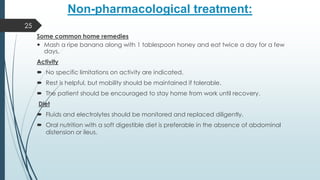
Non-pharmacological treatment:
Some common home remedies
 Mash a ripe banana along with 1 tablespoon honey and eat twice a day for a few
days.
Activity
 No specific limitations on activity are indicated.
 Rest is helpful, but mobility should be maintained if tolerable.
 The patient should be encouraged to stay home from work until recovery.
Diet
 Fluids and electrolytes should be monitored and replaced diligently.
 Oral nutrition with a soft digestible diet is preferable in the absence of abdominal
distension or ileus.
25
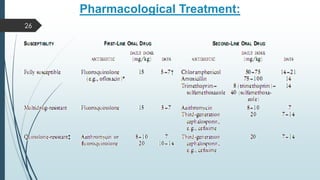
Pharmacological Treatment:
26
INTERVENTION/POINTS TO BE
COMMUNICATED WITH DOCTOR
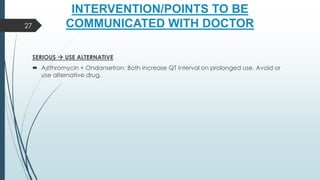
SERIOUS → USE ALTERNATIVE
 Azithromycin + Ondansetron: Both increase QT interval on prolonged use. Avoid or
use alternative drug.
27
PATIENT COUNSELING:
28
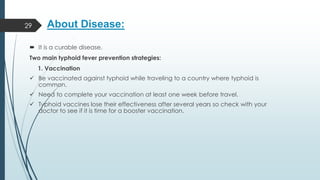
About Disease:
 It is a curable disease.
Two main typhoid fever prevention strategies:
1. Vaccination
✓ Be vaccinated against typhoid while traveling to a country where typhoid is
common.
✓ Need to complete your vaccination at least one week before travel.
✓ Typhoid vaccines lose their effectiveness after several years so check with your
doctor to see if it is time for a booster vaccination.
29
2. Avoid risky food and drinks
✓ Buy bottled drinking water or bring it to a rolling boil for one minute before drinking it.
✓ Ask for drinks without ice, unless the ice is made from bottled or boiled water. Avoid
Popsicles and flavored ices.
✓ Eat food that have been thoroughly cooked and that are still hot and steaming.
✓ Avoid raw vegetables and food that cannot be peeled like lettuce.
✓ When eat raw fruit and vegetables that can be peeled, peel yourself. Don’t eat the
peelings.
✓ Avoid foods and beverages from street vendors.
30
About Medications:
 Dose of drugs
 Frequency of dose
 Route of administrations such as I.V, I.M., t/d, s/c, P.O., S/L.
 Counselling regarding overdose (may cause toxicity), underdose
(submaximal or no response) and missing of dose of medication. E.G. If a
dose is missed, then the patient is to be advised to go for the next dose,
otherwise toxicity of drug may occur.
 Contraindications
 Drug interactions (drug-drug, drug-food)
31
Life Style Modifications:
SANITORY MEASURES:
 Sanitary disposal of human faeces and maintain fly-proof latrines.
 Provision of safe chlorinated water and avoid possible back-flow connections between water and
sewer systems.
 Educate the community regarding the importance of hand washing especially after defecating.
 Control of flies by screening, spraying with insecticides, and use of insecticidal baits and traps.
 Control fly breeding by frequent collection and disposal of garbage, and fly-control measures in
latrine construction and maintenance.
 Use scrupulous cleanliness in food preparation and handling; refrigerate as appropriate. Particular
attention should be directed to the proper storage of salads and other foods served cold. These
provisions apply equally to home and public eating places.
 If uncertain about sanitary practices, select foods that are cooked and served hot, and fruits peeled
by the consumer.
 Pasteurize or boil all milk and dairy products. Supervise the sanitary aspects of commercial milk
production, storage and delivery.
 Enforce suitable quality-control procedures in industries that prepare food and drink for human
consumption.
32
FOOD SAFETY:
 Contaminated food is another important vehicle for typhoid fever transmission.
 Appropriate food handling and processing is paramount and the following basic hygiene measures must be
implemented or reinforced during epidemics:
 Washing hands with soap before preparing or eating food;
 Avoiding raw food, shellfish, ice; eating only cooked and still hot food or re-heating it.
NATURAL REMEDIES:
 Complete bed rest is essential.
 Patient should be kept on a liquid diet of orange, barley juice and milk.
 Orange juice especially hastens recovery as it increases energy, promotes body resistance and increases
urinary output.
 Administer warm water enema regularly.
 Apply cold compress to head if temperature rises above 1030F
 Wrap the body and legs twice with a sheet wrung in cold water and then cover it with a warm material.
 The pack should be kept for an hour and renewed after every 3 hours.
 Hot water bottles may be applied to the sides of the body and feet.
 Fresh fruits and easily digestible foods can be given after temperature comes down to normal.
 Plain water or unsweetened lemon water can be used for drinking.
 Gradually start a well-balanced diet.
33
34

8. a case study on typhoid fever

  • 1.
    A Case StudyOn Typhoid Fever (SOAP) - Ajita Sadhukhan - Pharm D. 3rd year - Roll No. : 1 - Enrolment No. : 150821207001
  • 2.
    Definition  Typhoid orEnteric Fever is an infectious feverish disease caused by the bacterium Salmonella typhi (Salmonella enterica Serovar Typhi ) and less commonly by Salmonella paratyphi.  Acute generalized infection of the reticulo-endothelial system, intestinal lymphoid tissue and the gall bladder.  The infection always comes from another human, either an ill person or a healthy carrier of the bacterium. The bacterium is passed on with water and foods and can withstand both drying and refrigeration. 2
  • 3.
    Patient Demographics:  PatientI.P. No.: 17009875  Patient O.P. No.: 17112877  Age: 21 years  Weight: 48 Kg  Sex: Male  Department: Male Medicine Ward  Unit: 1  Date of Admission: 14. 8. 17  Date of Discharge: 21. 8. 17 3
  • 4.
     Reason ForAdmission: - Fever since 1 week - body ache - headache - sclera slightly yellowish - watery eyes  Past Medical History: NAD  Past Medication History: Patient had taken medication for fever at home.  Family history: NAD  Social history: student  Previous allergies: none  Pregnancy status: NAD 4
  • 5.
    OBJECTIVES PHYSICAL EXAMINATION:  GENERAL:Decreased appetite, yellowish urination  CVS: S1 S2 normal  RS: AEBE clear  CNS: oriented  BP: 110/80 mm Hg  PR: 79/min  TEMP: 99 F  RESPIRATION: 17/min  PA: Soft 5
  • 6.
    LAB. INVESTIGATION REPORTS[first day] LABORATORY PARAMETERS OBSERVED VALUE NORMAL RANGE UNIT Hb 14.0 11.5-18 g% Neutrophils 69.6 40-70 % Lymphocytes 45 20-40 /cu mm Monocytes 04 2-10 /cu mm ESR 45 1-20 mm/hr Platelets 348000 1.5-4 /cu mm ALT 55 <40 IU/L 6  PS for MP: Malarial parasite not seen  Widal Test: Positive  HIV test: negative OTHERS (2nd day)
  • 7.
  • 8.
     A 21year old male patient was admitted to Med. ward-1 with complaints of fever since 1 week, body ache, headache, sclera slightly yellowish and watery eyes.  Based on lab report, patient’s lymphocytes, ESR and ALT levels are abnormally increased. Widal Test is Positive. Hence, patient was diagnosed with typhoid fever. 8
  • 9.
  • 10.
    GOALS OF TREATMENT:10 •To reduce fever. • To reduce body ache. • To reduce headache. • To reduce slightly yellowish sclera. • To reduce watery eyes.
  • 11.
    DAY 1  Temperature:99 F  Pulse: 79/min  SPO2: 98%  B.P.: 110/80 mm Hg  R: 17/min  Adv. : CBC, PS for MP, Widal Test, HIV 11
  • 12.
    Medication chart (day1) DRUG NAME ROUTE DOSE FREQUENCY INDICATION Inj. Ceftriaxone + Sulbactam I.V. 1.5 g in 100 ml NS BD To treat typhoid fever Inj. Ranitidine I.V. 2 ml 1-1-1 To prevent acidity Inj. Ondanstron I.V. 4 mg TDS To prevent emesis Inj. NaCl + (Optineuron) Calcium Pantothenate + Cyanocobalamin + Folic acid + Niacinamide + Pyridoxine + Thiamine I.V. 3 ml 1-0-0 Electrolyte + Calcium and Vitamin B complex supplement 12
  • 13.
    DAY 2  Temperature:100 F  Pulse: 80/min  SPO2: 98%  B.P.: 110/80 mm Hg  R: 18/min 13
  • 14.
    Medication chart (day2) 14 DRUG NAME ROUTE DOSE FREQUENCY INDICATION Tab. Paracetamol P.O. 500 mg SOS 1-0-1 Analgesic, anti- pyretic Inj. Ceftriaxone + Sulbactam I.V. 1.5 g in 100 ml NS BD To treat typhoid fever Tab. Azithromycin P.O. 500 mg 1-0-0 typhoid fever Inj. Ranitidine I.V. 2 ml 1-1-1 To prevent acidity Inj. Ondanstron + Inj. DNS/NS I.V. 4 mg + I pint TDS Nausea and vomiting Inj. NaCl + (Optineuron) Calcium Pantothenate + Cyanocobalamin + Folic acid + Niacinamide + Pyridoxine + Thiamine I.V. 3 ml 1-0-0 Electrolyte + Calcium and Vitamin B complex supplement
  • 15.
    DAY 3  Temperature:98 F  Pulse: 82/min  SPO2: 98%  B.P.: 120/80 mm Hg  R: 20/min 15
  • 16.
    Medication chart (day3) DRUG NAME ROUTE DOSE FREQUENCY INDICATION Tab. Diclofenac + Paracetamol P.O. 50 mg SOS 1-0-1 Painkiller, anti- pyretic Inj. Ceftriaxone + Sulbactam I.V. 1.5 g in 100 ml NS BD To treat typhoid fever Tab. Azithromycin P.O. 500 mg 1-0-0 typhoid fever Inj. Ranitidine I.V. 2 ml 1-1-1 To prevent acidity Inj. Ondanstron + Inj. DNS/NS I.V. 4 mg + I pint TDS Nausea and vomiting Inj. NaCl + (Optineuron) Calcium Pantothenate + Cyanocobalamin + Folic acid + Niacinamide + Pyridoxine + Thiamine I.V. 3 ml 1-0-0 Electrolyte + Calcium and Vitamin B complex supplement Syp. Cyprohaptadine + Tricholine + Sorbitol P.O 1 tsf 1-0-1 For allergic reactions 16
  • 17.
    DAY 4  Temperature:normal  Pulse: 86/min  SPO2: 98%  B.P.: 120/80 mm Hg 17
  • 18.
    Medication chart (day4) DRUG NAME ROUTE DOSE FREQUENCY INDICATION Tab. Diclofenac + Paracetamol P.O. 50 mg SOS 1-0-1 Painkiller, anti- pyretic Inj. Ceftriaxone + Sulbactam I.V. 1.5 g in 100 ml NS BD To treat typhoid fever Tab. Azithromycin P.O. 500 mg 1-0-0 Typhoid fever Inj. Ranitidine I.V. 2 ml 1-1-1 To prevent acidity Inj. Ondanstron + Inj. DNS/NS I.V. 4 mg + I pint TDS Nausea and vomiting Inj. NaCl + (Optineuron) Calcium Pantothenate + Cyanocobalamin + Folic acid + Niacinamide + Pyridoxine + Thiamine I.V. 3 ml 1-0-0 Electrolyte + Calcium and Vitamin B complex supplement Syp. Cyprohaptadine + Tricholine + Sorbitol P.O 1 tsf 1-0-1 For allergic reactions 18
  • 19.
    DAY 5  Temperature:normal  Pulse: 90/min  SPO2: 97%  B.P.: 120/80 mm Hg  RS: NAD  CVS: NAD  CNS: NAD  Adv.: CST 19
  • 20.
    DRUG NAME ROUTEDOSE FREQUENCY INDICATION Tab. Diclofenac + Paracetamol P.O. 50 mg SOS 1-0-1 Painkiller, anti-pyretic Inj. Ceftriaxone + Sulbactam I.V. 1.5 g in 100 ml NS BD To treat typhoid fever Tab. Azithromycin P.O. 500 mg 1-0-0 Typgoid fever Inj. Ranitidine I.V. 2 ml 1-1-1 To prevent acidity Inj. Ondanstron + Inj. DNS/NS I.V. 4 mg + I pint TDS Nausea and vomiting Inj. NaCl + (Optineuron) Calcium Pantothenate + Cyanocobalamin + Folic acid + Niacinamide + Pyridoxine + Thiamine I.V. 3 ml 1-0-0 Electrolyte + Calcium and Vitamin B complex supplement Syp. Cyprohaptadine + Tricholine + Sorbitol P.O 1 tsf 1-0-1 For allergic reactions Tab. Paracetamol P.O. 500 mg SOS 1-0-1 Analgesic, anti-pyretic Medication chart (day 5)
  • 21.
    DAY 6  Temperature:normal  Pulse: 80/min  SPO2: 99%  B.P.: 110/70 mm Hg  R: 17/min  Adv. Discharge with medication for 7 days. 21
  • 22.
    DRUG NAME ROUTEDOSE FREQUENCY INDICATION Tab. Diclofenac + Paracetamol P.O. 50 mg SOS 1-0-1 Painkiller, anti-pyretic Tab. Azithromycin P.O. 500 mg 1-0-0 Typhoid fever Inj. Ranitidine I.V. 2 ml 1-1-1 To prevent acidity Inj. Ondanstron + Inj. DNS/NS I.V. 4 mg + I pint TDS Nausea and vomiting Inj. NaCl + (Optineuron) Calcium Pantothenate + Cyanocobalamin + Folic acid + Niacinamide + Pyridoxine + Thiamine I.V. 3 ml 1-0-0 Electrolyte + Calcium and Vitamin B complex supplement Syp. Cyprohaptadine + Tricholine + Sorbitol P.O 1 tsf 1-0-1 For allergic reactions Tab. Rabeprazole + Domperidone P.O. 40 mg 1-0-1 GERD Medication chart (day 6)
  • 23.
    Discharge Medication chart(follow up after 7 days) DRUG NAME ROUTE DOSE FREQUENCY INDICATION Tab. Rabeprazole + Domperidone P.O. 40 mg 1-0-1 GERD Tab. Azithromycin P.O. 500 mg 0-1-0 Typhoid fever Syp. Cyprohaptadine + Tricholine + Sorbitol P.O 1 tsf 1-0-0 For allergic reactions Tab. NaCl + (Optineuron) Calcium Pantothenate + Cyanocobalamin + Folic acid + Niacinamide + Pyridoxine + Thiamine P.O. 10 mg 0-1-0 Calcium and Vitamin B complex supplement 23
  • 24.
  • 25.
    Non-pharmacological treatment: Some commonhome remedies  Mash a ripe banana along with 1 tablespoon honey and eat twice a day for a few days. Activity  No specific limitations on activity are indicated.  Rest is helpful, but mobility should be maintained if tolerable.  The patient should be encouraged to stay home from work until recovery. Diet  Fluids and electrolytes should be monitored and replaced diligently.  Oral nutrition with a soft digestible diet is preferable in the absence of abdominal distension or ileus. 25
  • 26.
  • 27.
    INTERVENTION/POINTS TO BE COMMUNICATEDWITH DOCTOR SERIOUS → USE ALTERNATIVE  Azithromycin + Ondansetron: Both increase QT interval on prolonged use. Avoid or use alternative drug. 27
  • 28.
  • 29.
    About Disease:  Itis a curable disease. Two main typhoid fever prevention strategies: 1. Vaccination ✓ Be vaccinated against typhoid while traveling to a country where typhoid is common. ✓ Need to complete your vaccination at least one week before travel. ✓ Typhoid vaccines lose their effectiveness after several years so check with your doctor to see if it is time for a booster vaccination. 29
  • 30.
    2. Avoid riskyfood and drinks ✓ Buy bottled drinking water or bring it to a rolling boil for one minute before drinking it. ✓ Ask for drinks without ice, unless the ice is made from bottled or boiled water. Avoid Popsicles and flavored ices. ✓ Eat food that have been thoroughly cooked and that are still hot and steaming. ✓ Avoid raw vegetables and food that cannot be peeled like lettuce. ✓ When eat raw fruit and vegetables that can be peeled, peel yourself. Don’t eat the peelings. ✓ Avoid foods and beverages from street vendors. 30
  • 31.
    About Medications:  Doseof drugs  Frequency of dose  Route of administrations such as I.V, I.M., t/d, s/c, P.O., S/L.  Counselling regarding overdose (may cause toxicity), underdose (submaximal or no response) and missing of dose of medication. E.G. If a dose is missed, then the patient is to be advised to go for the next dose, otherwise toxicity of drug may occur.  Contraindications  Drug interactions (drug-drug, drug-food) 31
  • 32.
    Life Style Modifications: SANITORYMEASURES:  Sanitary disposal of human faeces and maintain fly-proof latrines.  Provision of safe chlorinated water and avoid possible back-flow connections between water and sewer systems.  Educate the community regarding the importance of hand washing especially after defecating.  Control of flies by screening, spraying with insecticides, and use of insecticidal baits and traps.  Control fly breeding by frequent collection and disposal of garbage, and fly-control measures in latrine construction and maintenance.  Use scrupulous cleanliness in food preparation and handling; refrigerate as appropriate. Particular attention should be directed to the proper storage of salads and other foods served cold. These provisions apply equally to home and public eating places.  If uncertain about sanitary practices, select foods that are cooked and served hot, and fruits peeled by the consumer.  Pasteurize or boil all milk and dairy products. Supervise the sanitary aspects of commercial milk production, storage and delivery.  Enforce suitable quality-control procedures in industries that prepare food and drink for human consumption. 32
  • 33.
    FOOD SAFETY:  Contaminatedfood is another important vehicle for typhoid fever transmission.  Appropriate food handling and processing is paramount and the following basic hygiene measures must be implemented or reinforced during epidemics:  Washing hands with soap before preparing or eating food;  Avoiding raw food, shellfish, ice; eating only cooked and still hot food or re-heating it. NATURAL REMEDIES:  Complete bed rest is essential.  Patient should be kept on a liquid diet of orange, barley juice and milk.  Orange juice especially hastens recovery as it increases energy, promotes body resistance and increases urinary output.  Administer warm water enema regularly.  Apply cold compress to head if temperature rises above 1030F  Wrap the body and legs twice with a sheet wrung in cold water and then cover it with a warm material.  The pack should be kept for an hour and renewed after every 3 hours.  Hot water bottles may be applied to the sides of the body and feet.  Fresh fruits and easily digestible foods can be given after temperature comes down to normal.  Plain water or unsweetened lemon water can be used for drinking.  Gradually start a well-balanced diet. 33
  • 34.