•   Chemistry is the basis of life as we know. Everything around you has
    chemistry
•   The summarized idea of chemistry is the properties and functions of the
    smallest units of matter known as atoms.
•   Atoms are what make up EVERYTHING IN THIS WORLD!!! Even you!!!
•   Atoms can combine in numerous ways to create compounds that have
    different properties than just the atoms simply combined.
•   The atom is a small unit consisting of three subatomic particles known
    as protons, electrons, and neutrons.
•   These three particles are organized with in the atom in a certain way
    that results in the specific atoms characteristics.
•      In an atom, there are positively charged particles called
                  protons, negatively charged particles called electrons, and neutral
                  particles called neutrons.
           •      The protons and neutrons are in the middle of the atom while the
                  electrons circle around this proton/neutron structure called the nucleus.
           •
           Every different atom on the periodic table has a differ number of these
   Atoms percent weight
           particles.
   graph
Protons


               Electrons
•   The periodic table is what chemists use to show specific types of atoms
•   It is organized by the properties of the atoms, number of subatomic
    particles of the atom, and size of the atom.
•   Going across the periodic table is going through its groups while going
    down it is going across periods.
•   These atoms that are on the periodic table are called elements; every
    atom of an element is the same, but atoms of different elements are
    different.
•   Numbers and symbols on the periodic table usually tell a number of
    properties of an atom.
•   The one or two letter symbol tells us the name of the atom Ex: C=
    Carbon
•   The atomic number (the number on top of the element) is the number of
    protons and electrons in the atom of that element since the elements
    usually have a neutral overall charge Ex: Carbon’s is 6 so it has 6
    protons and electrons.
•   The atomic weight (the number below the element symbol) is used by
    subtracting the number of protons from it (the atomic number) and
    equaling the number of neutrons Ex: Carbon’s is 12 so 12-- 6= 6 so
    carbon has six neutrons.
•   The periodic table is not only sorted by increasing numbers of particles
    but it is also organized into types of metals and special groups
•   To the left of the table you will find the metals in groups 1-2A
•   In groups 3B – 2B is all transition metals
•   Below a diagonal line from group 3A’s boron to 6A’s Tellurium is where
    you will find the metalloids.
•   Above that line is where the nonmetals are.
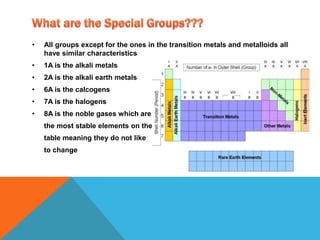
•   All groups except for the ones in the transition metals and metalloids all
    have similar characteristics
•   1A is the alkali metals
•   2A is the alkali earth metals
•   6A is the calcogens
•   7A is the halogens
•   8A is the noble gases which are
    the most stable elements on the
    table meaning they do not like
    to change
•   This is what the people in the field of chemistry deal with on a daily
    basis
•   The elements are to great importance to us because, everything is made
    up of one or more of these elements
•   Learning these concepts in chemistry may even interest you into a
    certain career field
•   Doctors, physicians, physical therapist, and etc. all have to know and
    work with chemistry
•   Most of all YOU WILL BE DEALING WITH IT A LOT MORE IN LATER
    EDUCATION!

Ci 350 power point 1

  • 2.
    Chemistry is the basis of life as we know. Everything around you has chemistry • The summarized idea of chemistry is the properties and functions of the smallest units of matter known as atoms. • Atoms are what make up EVERYTHING IN THIS WORLD!!! Even you!!! • Atoms can combine in numerous ways to create compounds that have different properties than just the atoms simply combined.
  • 3.
    The atom is a small unit consisting of three subatomic particles known as protons, electrons, and neutrons. • These three particles are organized with in the atom in a certain way that results in the specific atoms characteristics.
  • 4.
    In an atom, there are positively charged particles called protons, negatively charged particles called electrons, and neutral particles called neutrons. • The protons and neutrons are in the middle of the atom while the electrons circle around this proton/neutron structure called the nucleus. • Every different atom on the periodic table has a differ number of these Atoms percent weight particles. graph Protons Electrons
  • 5.
    The periodic table is what chemists use to show specific types of atoms • It is organized by the properties of the atoms, number of subatomic particles of the atom, and size of the atom. • Going across the periodic table is going through its groups while going down it is going across periods. • These atoms that are on the periodic table are called elements; every atom of an element is the same, but atoms of different elements are different.
  • 6.
    Numbers and symbols on the periodic table usually tell a number of properties of an atom. • The one or two letter symbol tells us the name of the atom Ex: C= Carbon • The atomic number (the number on top of the element) is the number of protons and electrons in the atom of that element since the elements usually have a neutral overall charge Ex: Carbon’s is 6 so it has 6 protons and electrons. • The atomic weight (the number below the element symbol) is used by subtracting the number of protons from it (the atomic number) and equaling the number of neutrons Ex: Carbon’s is 12 so 12-- 6= 6 so carbon has six neutrons.
  • 7.
    The periodic table is not only sorted by increasing numbers of particles but it is also organized into types of metals and special groups • To the left of the table you will find the metals in groups 1-2A • In groups 3B – 2B is all transition metals • Below a diagonal line from group 3A’s boron to 6A’s Tellurium is where you will find the metalloids. • Above that line is where the nonmetals are.
  • 8.
    All groups except for the ones in the transition metals and metalloids all have similar characteristics • 1A is the alkali metals • 2A is the alkali earth metals • 6A is the calcogens • 7A is the halogens • 8A is the noble gases which are the most stable elements on the table meaning they do not like to change
  • 9.
    This is what the people in the field of chemistry deal with on a daily basis • The elements are to great importance to us because, everything is made up of one or more of these elements • Learning these concepts in chemistry may even interest you into a certain career field • Doctors, physicians, physical therapist, and etc. all have to know and work with chemistry • Most of all YOU WILL BE DEALING WITH IT A LOT MORE IN LATER EDUCATION!