Elements & Atoms
An atom refresher
• Matter is anything that takes up space and has
mass.
• All matter is made of atoms
• Atoms are the building blocks of matter, sort of
how bricks are the building blocks of houses.
An atom refresher
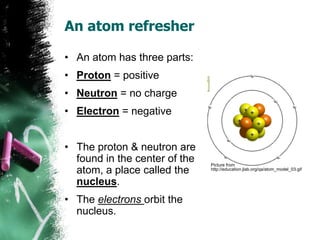
• An atom has three parts:
• Proton = positive
• Neutron = no charge
• Electron = negative
• The proton & neutron are
found in the center of the
atom, a place called the
nucleus.
• The electrons orbit the
nucleus.
Picture from
http://education.jlab.org/qa/atom_model_03.gif
What are elements?
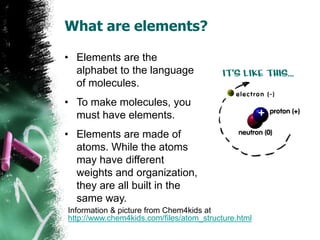
• Elements are the
alphabet to the language
of molecules.
• To make molecules, you
must have elements.
• Elements are made of
atoms. While the atoms
may have different
weights and organization,
they are all built in the
same way.
Information & picture from Chem4kids at
http://www.chem4kids.com/files/atom_structure.html
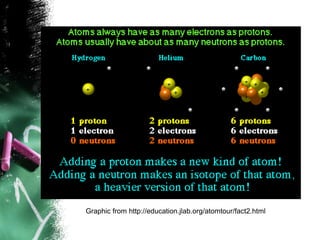
Graphic from http://education.jlab.org/atomtour/fact2.html
More about Elements..
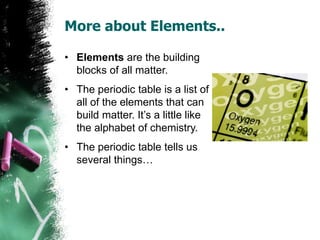
• Elements are the building
blocks of all matter.
• The periodic table is a list of
all of the elements that can
build matter. It’s a little like
the alphabet of chemistry.
• The periodic table tells us
several things…
Periodic Table
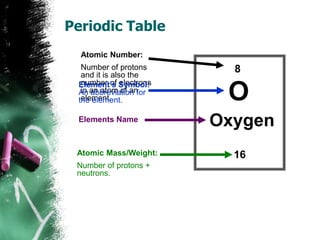
8
O
Oxygen
16
Atomic Number:
Number of protons
and it is also the
number of electrons
in an atom of an
element.
Element’s Symbol:
An abbreviation for
the element.
Elements Name
Atomic Mass/Weight:
Number of protons +
neutrons.
Atom Models
• There are two models of the atoms we will be
using in class.
• Bohr Model
• Lewis Dot Structure
Bohr Model
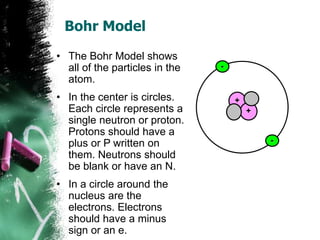
• The Bohr Model shows
all of the particles in the
atom.
• In the center is circles.
Each circle represents a
single neutron or proton.
Protons should have a
plus or P written on
them. Neutrons should
be blank or have an N.
• In a circle around the
nucleus are the
electrons. Electrons
should have a minus
sign or an e.
+
+
-
-
Electrons have special rules….
• You can’t just shove all of the electrons into the
first orbit of an electron.
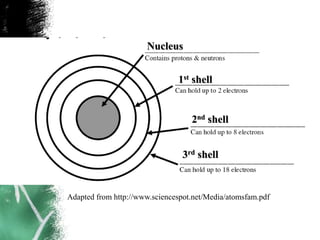
• Electrons live in something called shells or
energy levels.
• Only so many can be in any certain shell.
Nucleus
1st shell
2nd shell
3rd shell
Adapted from http://www.sciencespot.net/Media/atomsfam.pdf
Electrons have special rules….
• You can’t just shove all of the electrons into the
first orbit of an electron.
• Electrons live in something called shells or
energy levels.
• Only so many can be in any certain shell.
• The electrons in the outer most shell of any
element are called valance electrons.
So let’s try it….
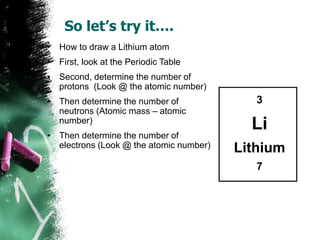
• How to draw a Lithium atom
• First, look at the Periodic Table
• Second, determine the number of
protons (Look @ the atomic number)
• Then determine the number of
neutrons (Atomic mass – atomic
number)
• Then determine the number of
electrons (Look @ the atomic number)
3
Li
Lithium
7
So let’s try it….
3
Li
Lithium
7
+
+
+
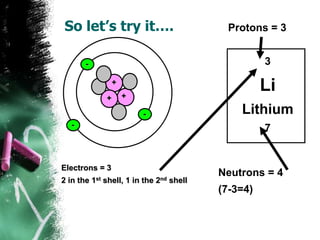
Protons = 3
Neutrons = 4
(7-3=4)
-
-
-
Electrons = 3
2 in the 1st shell, 1 in the 2nd shell
Lewis Dot Structure
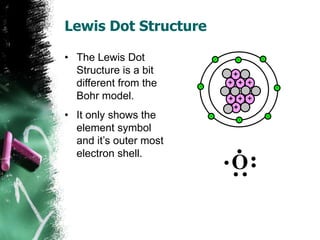
• The Lewis Dot
Structure is a bit
different from the
Bohr model.
• It only shows the
element symbol
and it’s outer most
electron shell.
O
•
•
•
• •
•
+ +
+ +
+
+
+
+
-
-
- -
-
-
- -

Elements and atoms

  • 1.
  • 2.
    An atom refresher •Matter is anything that takes up space and has mass. • All matter is made of atoms • Atoms are the building blocks of matter, sort of how bricks are the building blocks of houses.
  • 3.
    An atom refresher •An atom has three parts: • Proton = positive • Neutron = no charge • Electron = negative • The proton & neutron are found in the center of the atom, a place called the nucleus. • The electrons orbit the nucleus. Picture from http://education.jlab.org/qa/atom_model_03.gif
  • 4.
    What are elements? •Elements are the alphabet to the language of molecules. • To make molecules, you must have elements. • Elements are made of atoms. While the atoms may have different weights and organization, they are all built in the same way. Information & picture from Chem4kids at http://www.chem4kids.com/files/atom_structure.html
  • 5.
  • 6.
    More about Elements.. •Elements are the building blocks of all matter. • The periodic table is a list of all of the elements that can build matter. It’s a little like the alphabet of chemistry. • The periodic table tells us several things…
  • 7.
    Periodic Table 8 O Oxygen 16 Atomic Number: Numberof protons and it is also the number of electrons in an atom of an element. Element’s Symbol: An abbreviation for the element. Elements Name Atomic Mass/Weight: Number of protons + neutrons.
  • 8.
    Atom Models • Thereare two models of the atoms we will be using in class. • Bohr Model • Lewis Dot Structure
  • 9.
    Bohr Model • TheBohr Model shows all of the particles in the atom. • In the center is circles. Each circle represents a single neutron or proton. Protons should have a plus or P written on them. Neutrons should be blank or have an N. • In a circle around the nucleus are the electrons. Electrons should have a minus sign or an e. + + - -
  • 10.
    Electrons have specialrules…. • You can’t just shove all of the electrons into the first orbit of an electron. • Electrons live in something called shells or energy levels. • Only so many can be in any certain shell.
  • 11.
    Nucleus 1st shell 2nd shell 3rdshell Adapted from http://www.sciencespot.net/Media/atomsfam.pdf
  • 12.
    Electrons have specialrules…. • You can’t just shove all of the electrons into the first orbit of an electron. • Electrons live in something called shells or energy levels. • Only so many can be in any certain shell. • The electrons in the outer most shell of any element are called valance electrons.
  • 13.
    So let’s tryit…. • How to draw a Lithium atom • First, look at the Periodic Table • Second, determine the number of protons (Look @ the atomic number) • Then determine the number of neutrons (Atomic mass – atomic number) • Then determine the number of electrons (Look @ the atomic number) 3 Li Lithium 7
  • 14.
    So let’s tryit…. 3 Li Lithium 7 + + + Protons = 3 Neutrons = 4 (7-3=4) - - - Electrons = 3 2 in the 1st shell, 1 in the 2nd shell
  • 15.
    Lewis Dot Structure •The Lewis Dot Structure is a bit different from the Bohr model. • It only shows the element symbol and it’s outer most electron shell. O • • • • • • + + + + + + + + - - - - - - - -