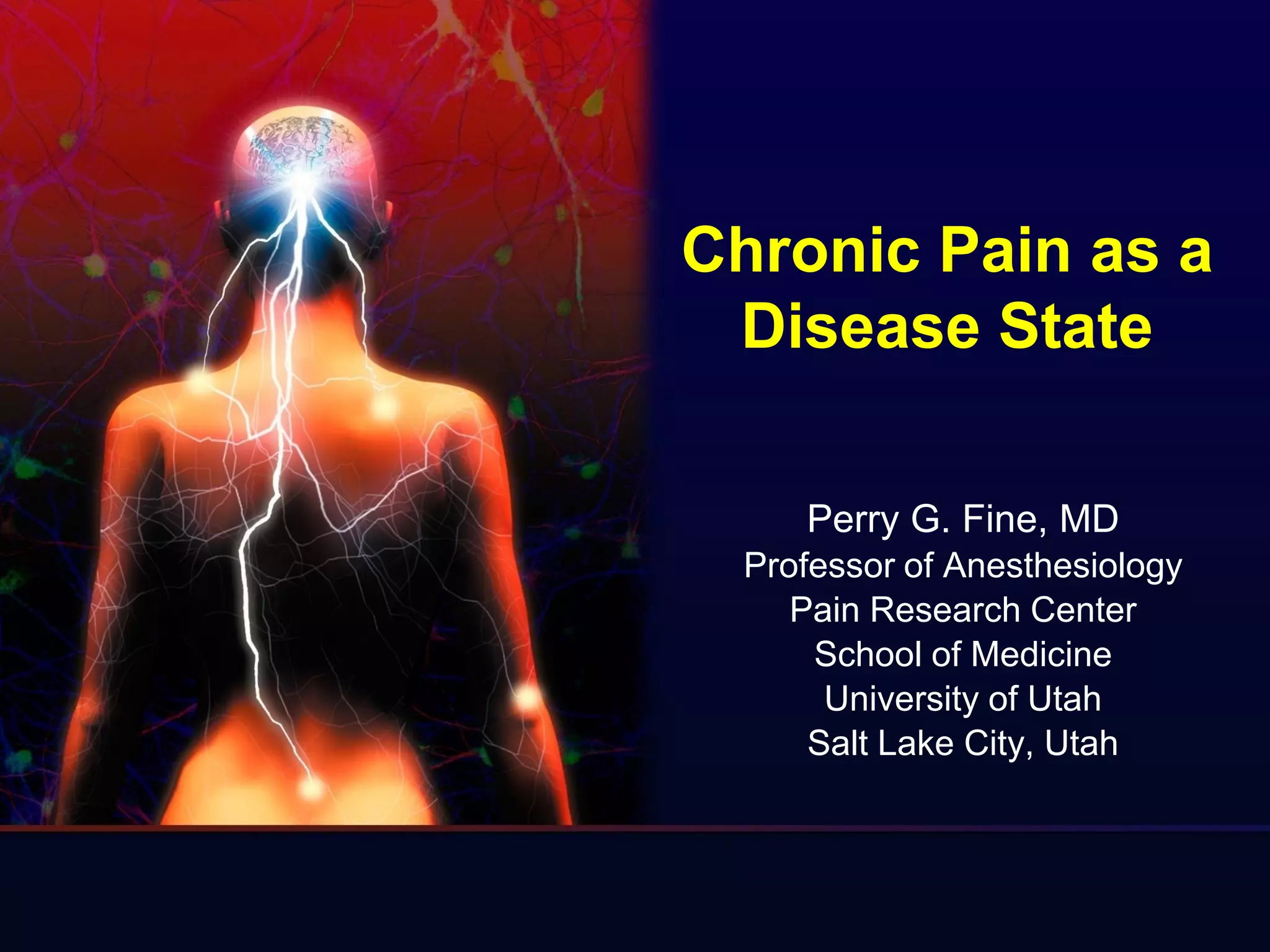
Chronic Pain as a
Disease State
Perry G. Fine, MD
Professor of Anesthesiology
Pain Research Center
School of Medicine
University of Utah
Salt Lake City, Utah
Disease
An impairment of health or condition of abnormal
functioning.
2
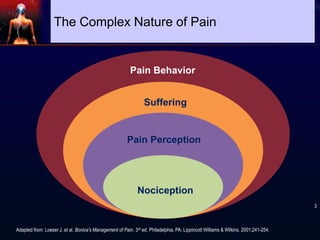
Adapted from: Loeser J, et al. Bonica's Management of Pain. 3rd ed. Philadelphia, PA: Lippincott Williams & Wilkins. 2001;241-254.
Nociception
Pain Perception
Suffering
Pain Behavior
The Complex Nature of Pain
3
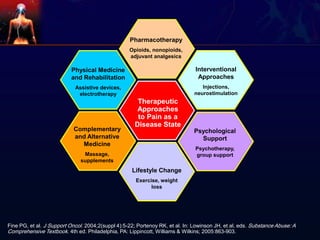
Therapeutic
Approaches
to Pain as a
Disease State
Pharmacotherapy
Opioids, nonopioids,
adjuvant analgesics
Interventional
Approaches
Injections,
neurostimulation
Psychological
Support
Psychotherapy,
group support
Lifestyle Change
Exercise, weight
loss
Complementary
and Alternative
Medicine
Massage,
supplements
Physical Medicine
and Rehabilitation
Assistive devices,
electrotherapy
Fine PG, et al. J Support Oncol. 2004;2(suppl 4):5-22; Portenoy RK, et al. In: Lowinson JH, et al, eds. Substance Abuse: A
Comprehensive Textbook. 4th ed. Philadelphia, PA: Lippincott, Williams & Wilkins; 2005:863-903.
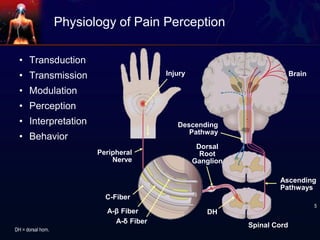
Physiology of Pain Perception
• Transduction
• Transmission
• Modulation
• Perception
• Interpretation
• Behavior
Injury
Descending
Pathway
Peripheral
Nerve
Dorsal
Root
Ganglion
C-Fiber
A-β Fiber
A-δ Fiber
Ascending
Pathways
DH
Brain
Spinal Cord
5
DH = dorsal horn.
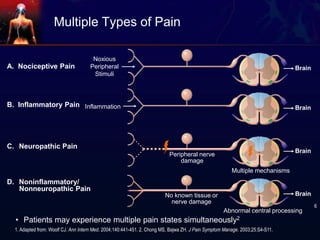
A. Nociceptive Pain
B. Inflammatory Pain
C. Neuropathic Pain
D. Noninflammatory/
Nonneuropathic Pain
Noxious
Peripheral
Stimuli
Peripheral nerve
damage
No known tissue or
nerve damage
Abnormal central processing
Multiple mechanisms
Brain
Brain
Brain
Brain
Inflammation
Multiple Types of Pain
1. Adapted from: Woolf CJ. Ann Intern Med. 2004;140:441-451. 2. Chong MS, Bajwa ZH. J Pain Symptom Manage. 2003;25:S4-S11.
• Patients may experience multiple pain states simultaneously2
6
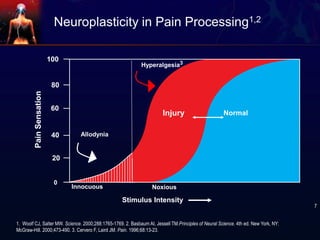
Neuroplasticity in Pain Processing1,2
1. Woolf CJ, Salter MW. Science. 2000;288:1765-1769. 2. Basbaum AI, Jessell TM.Principles of Neural Science. 4th ed. New York, NY:
McGraw-Hill. 2000;473-490. 3. Cervero F, Laird JM. Pain. 1996;68:13-23.
Stimulus Intensity
100
Injury Normal
Allodynia
Hyperalgesia3
80
60
40
20
0
Innocuous Noxious
PainSensation
7
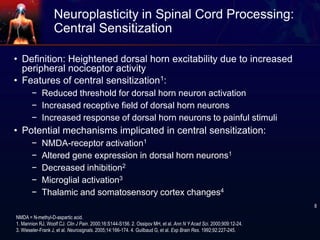
Neuroplasticity in Spinal Cord Processing:
Central Sensitization
• Definition: Heightened dorsal horn excitability due to increased
peripheral nociceptor activity
• Features of central sensitization1:
− Reduced threshold for dorsal horn neuron activation
− Increased receptive field of dorsal horn neurons
− Increased response of dorsal horn neurons to painful stimuli
• Potential mechanisms implicated in central sensitization:
− NMDA-receptor activation1
− Altered gene expression in dorsal horn neurons1
− Decreased inhibition2
− Microglial activation3
− Thalamic and somatosensory cortex changes4
NMDA = N-methyl-D-aspartic acid.
1. Mannion RJ, Woolf CJ. Clin J Pain. 2000;16:S144-S156. 2. Ossipov MH, et al. Ann N Y Acad Sci. 2000;909:12-24.
3. Wieseler-Frank J, et al. Neurosignals. 2005;14:166-174. 4. Guilbaud G, et al. Exp Brain Res. 1992;92:227-245.
8
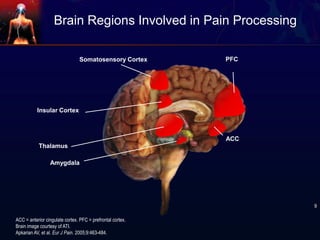
ACC = anterior cingulate cortex. PFC = prefrontal cortex.
Brain image courtesy of ATI.
Apkarian AV, et al. Eur J Pain. 2005;9:463-484.
PFCSomatosensory Cortex
Thalamus
ACC
Insular Cortex
Brain Regions Involved in Pain Processing
Amygdala
9
Allodynia Activates Some of the Regions in
the Pain Circuit
S1, S2 = primary, secondary somatosensory cortices.
Moisset X, Bouhassira D. Neuroimage. 2007;37:S80-S88. Baliki MN, et al. Curr Pain Headache Rep. 2007;11:171-177.
Thalamus
S1
S2
InsulaACC
PFC
10
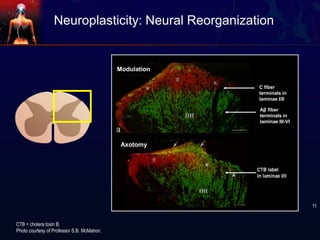
Neuroplasticity: Neural Reorganization
Modulation
Axotomy
CTB = cholera toxin B.
Photo courtesy of Professor S.B. McMahon.
11
C fiber
terminals in
laminae I/II
Aβ fiber
terminals in
laminae III-VI
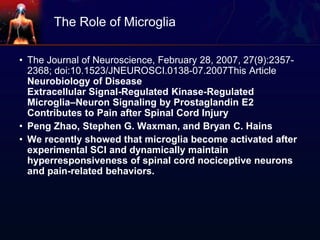
The Role of Microglia
• The Journal of Neuroscience, February 28, 2007, 27(9):2357-
2368; doi:10.1523/JNEUROSCI.0138-07.2007This Article
Neurobiology of Disease
Extracellular Signal-Regulated Kinase-Regulated
Microglia–Neuron Signaling by Prostaglandin E2
Contributes to Pain after Spinal Cord Injury
• Peng Zhao, Stephen G. Waxman, and Bryan C. Hains
• We recently showed that microglia become activated after
experimental SCI and dynamically maintain
hyperresponsiveness of spinal cord nociceptive neurons
and pain-related behaviors.
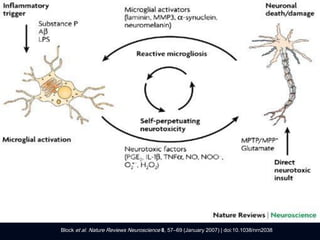
Block et al. Nature Reviews Neuroscience 8, 57–69 (January 2007) | doi:10.1038/nrn2038
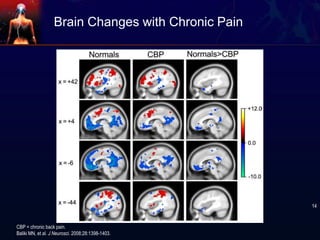
Brain Changes with Chronic Pain
CBP = chronic back pain.
Baliki MN, et al. J Neurosci. 2008;28:1398-1403.
14
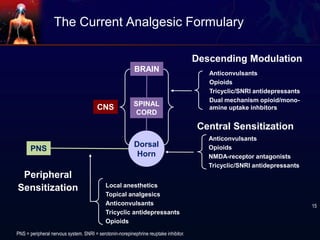
Dorsal
Horn
BRAIN
The Current Analgesic Formulary
Descending Modulation
Peripheral
Sensitization
Central Sensitization
PNS
Local anesthetics
Topical analgesics
Anticonvulsants
Tricyclic antidepressants
Opioids
Anticonvulsants
Opioids
NMDA-receptor antagonists
Tricyclic/SNRI antidepressants
Anticonvulsants
Opioids
Tricyclic/SNRI antidepressants
Dual mechanism opioid/mono-
amine uptake inhbitors
SPINAL
CORD
CNS
15
PNS = peripheral nervous system. SNRI = serotonin-norepinephrine reuptake inhibitor.
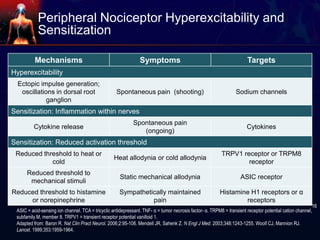
Peripheral Nociceptor Hyperexcitability and
Sensitization
Mechanisms Symptoms Targets
Hyperexcitability
Ectopic impulse generation;
oscillations in dorsal root
ganglion
Spontaneous pain (shooting) Sodium channels
Sensitization: Inflammation within nerves
Cytokine release
Spontaneous pain
(ongoing)
Cytokines
Sensitization: Reduced activation threshold
Reduced threshold to heat or
cold
Heat allodynia or cold allodynia
TRPV1 receptor or TRPM8
receptor
Reduced threshold to
mechanical stimuli
Static mechanical allodynia ASIC receptor
Reduced threshold to histamine
or norepinephrine
Sympathetically maintained
pain
Histamine H1 receptors or α
receptors
ASIC = acid-sensing ion channel. TCA = tricyclic antidepressant. TNF- α = tumor necrosis factor- α. TRPM8 = transient receptor potential cation channel,
subfamily M, member 8. TRPV1 = transient receptor potential vanilloid 1.
Adapted from: Baron R. Nat Clin Pract Neurol. 2006;2:95-106. Mendell JR, Sahenk Z. N Engl J Med. 2003;348:1243-1255. Woolf CJ, Mannion RJ.
Lancet. 1999;353:1959-1964.
16
GABA-ergic or opioidergic
interneurons decreased
Spontaneous pain (ongoing),
dynamic mechanical allodynia,
punctate mechanical hyperalgesia
Amplification of C-fiber input,
gating of Aβ-fiber and Aδ-fiber
input
Spontaneous pain (ongoing),
dynamic mechanical
allodynia, punctate
mechanical hyperalgesia
Central Dorsal Horn Hyperexcitability
Mechanisms Symptoms Targets
Central sensitization, increased synaptic transmission
Amplification of C-fiber input,
gating of Aβ-fiber and Aδ-fiber
input
Spontaneous pain (ongoing),
dynamic mechanical allodynia,
punctate mechanical
hyperalgesia
µ receptors, calcium channels
(α2-δ), NMDA-receptors, NK1
receptors, sodium channels,
intracellular cascades
Intraspinal inhibitory interneurons decreased
GABA-ergic or opioidergic
interneurons decreased
Spontaneous pain (ongoing),
dynamic mechanical allodynia,
punctate mechanical
hyperalgesia
GABAB receptors or µ receptors
Changes in supraspinal descending modulation
Inhibitory control (5-HT,
noradrenaline) decreased
Spontaneous pain (ongoing),
dynamic mechanical allodynia,
punctate mechanical
hyperalgesia
5-HT receptors, α2 receptors
α2 = alpha 2 adrenergic receptor. GABAB = gamma-aminobutyric acid receptor – subtype B. NK-1 = neurokinin. 5-HT = 5-hydroxytryptamine
(serotonin) receptor.
Adapted from: Baron R. Nat Clin Pract Neurol. 2006;2:95-106. Mendell JR, Sahenk Z. N Engl J Med. 2003;348:1243-1255. Woolf CJ, Mannion
RJ. Lancet. 1999;353:1959-1964.
17
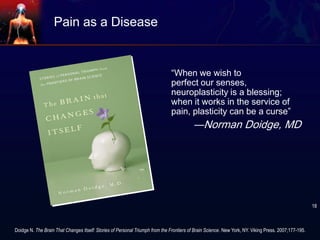
Pain as a Disease
“When we wish to
perfect our senses,
neuroplasticity is a blessing;
when it works in the service of
pain, plasticity can be a curse”
―Norman Doidge, MD
Doidge N. The Brain That Changes Itself: Stories of Personal Triumph from the Frontiers of Brain Science. New York, NY. Viking Press. 2007;177-195.
18

Chronic Pain as a Disease State

  • 1.
    Chronic Pain asa Disease State Perry G. Fine, MD Professor of Anesthesiology Pain Research Center School of Medicine University of Utah Salt Lake City, Utah
  • 2.
    Disease An impairment ofhealth or condition of abnormal functioning. 2
  • 3.
    Adapted from: LoeserJ, et al. Bonica's Management of Pain. 3rd ed. Philadelphia, PA: Lippincott Williams & Wilkins. 2001;241-254. Nociception Pain Perception Suffering Pain Behavior The Complex Nature of Pain 3
  • 4.
    Therapeutic Approaches to Pain asa Disease State Pharmacotherapy Opioids, nonopioids, adjuvant analgesics Interventional Approaches Injections, neurostimulation Psychological Support Psychotherapy, group support Lifestyle Change Exercise, weight loss Complementary and Alternative Medicine Massage, supplements Physical Medicine and Rehabilitation Assistive devices, electrotherapy Fine PG, et al. J Support Oncol. 2004;2(suppl 4):5-22; Portenoy RK, et al. In: Lowinson JH, et al, eds. Substance Abuse: A Comprehensive Textbook. 4th ed. Philadelphia, PA: Lippincott, Williams & Wilkins; 2005:863-903.
  • 5.
    Physiology of PainPerception • Transduction • Transmission • Modulation • Perception • Interpretation • Behavior Injury Descending Pathway Peripheral Nerve Dorsal Root Ganglion C-Fiber A-β Fiber A-δ Fiber Ascending Pathways DH Brain Spinal Cord 5 DH = dorsal horn.
  • 6.
    A. Nociceptive Pain B.Inflammatory Pain C. Neuropathic Pain D. Noninflammatory/ Nonneuropathic Pain Noxious Peripheral Stimuli Peripheral nerve damage No known tissue or nerve damage Abnormal central processing Multiple mechanisms Brain Brain Brain Brain Inflammation Multiple Types of Pain 1. Adapted from: Woolf CJ. Ann Intern Med. 2004;140:441-451. 2. Chong MS, Bajwa ZH. J Pain Symptom Manage. 2003;25:S4-S11. • Patients may experience multiple pain states simultaneously2 6
  • 7.
    Neuroplasticity in PainProcessing1,2 1. Woolf CJ, Salter MW. Science. 2000;288:1765-1769. 2. Basbaum AI, Jessell TM.Principles of Neural Science. 4th ed. New York, NY: McGraw-Hill. 2000;473-490. 3. Cervero F, Laird JM. Pain. 1996;68:13-23. Stimulus Intensity 100 Injury Normal Allodynia Hyperalgesia3 80 60 40 20 0 Innocuous Noxious PainSensation 7
  • 8.
    Neuroplasticity in SpinalCord Processing: Central Sensitization • Definition: Heightened dorsal horn excitability due to increased peripheral nociceptor activity • Features of central sensitization1: − Reduced threshold for dorsal horn neuron activation − Increased receptive field of dorsal horn neurons − Increased response of dorsal horn neurons to painful stimuli • Potential mechanisms implicated in central sensitization: − NMDA-receptor activation1 − Altered gene expression in dorsal horn neurons1 − Decreased inhibition2 − Microglial activation3 − Thalamic and somatosensory cortex changes4 NMDA = N-methyl-D-aspartic acid. 1. Mannion RJ, Woolf CJ. Clin J Pain. 2000;16:S144-S156. 2. Ossipov MH, et al. Ann N Y Acad Sci. 2000;909:12-24. 3. Wieseler-Frank J, et al. Neurosignals. 2005;14:166-174. 4. Guilbaud G, et al. Exp Brain Res. 1992;92:227-245. 8
  • 9.
    ACC = anteriorcingulate cortex. PFC = prefrontal cortex. Brain image courtesy of ATI. Apkarian AV, et al. Eur J Pain. 2005;9:463-484. PFCSomatosensory Cortex Thalamus ACC Insular Cortex Brain Regions Involved in Pain Processing Amygdala 9
  • 10.
    Allodynia Activates Someof the Regions in the Pain Circuit S1, S2 = primary, secondary somatosensory cortices. Moisset X, Bouhassira D. Neuroimage. 2007;37:S80-S88. Baliki MN, et al. Curr Pain Headache Rep. 2007;11:171-177. Thalamus S1 S2 InsulaACC PFC 10
  • 11.
    Neuroplasticity: Neural Reorganization Modulation Axotomy CTB= cholera toxin B. Photo courtesy of Professor S.B. McMahon. 11 C fiber terminals in laminae I/II Aβ fiber terminals in laminae III-VI
  • 12.
    The Role ofMicroglia • The Journal of Neuroscience, February 28, 2007, 27(9):2357- 2368; doi:10.1523/JNEUROSCI.0138-07.2007This Article Neurobiology of Disease Extracellular Signal-Regulated Kinase-Regulated Microglia–Neuron Signaling by Prostaglandin E2 Contributes to Pain after Spinal Cord Injury • Peng Zhao, Stephen G. Waxman, and Bryan C. Hains • We recently showed that microglia become activated after experimental SCI and dynamically maintain hyperresponsiveness of spinal cord nociceptive neurons and pain-related behaviors.
  • 13.
    Block et al.Nature Reviews Neuroscience 8, 57–69 (January 2007) | doi:10.1038/nrn2038
  • 14.
    Brain Changes withChronic Pain CBP = chronic back pain. Baliki MN, et al. J Neurosci. 2008;28:1398-1403. 14
  • 15.
    Dorsal Horn BRAIN The Current AnalgesicFormulary Descending Modulation Peripheral Sensitization Central Sensitization PNS Local anesthetics Topical analgesics Anticonvulsants Tricyclic antidepressants Opioids Anticonvulsants Opioids NMDA-receptor antagonists Tricyclic/SNRI antidepressants Anticonvulsants Opioids Tricyclic/SNRI antidepressants Dual mechanism opioid/mono- amine uptake inhbitors SPINAL CORD CNS 15 PNS = peripheral nervous system. SNRI = serotonin-norepinephrine reuptake inhibitor.
  • 16.
    Peripheral Nociceptor Hyperexcitabilityand Sensitization Mechanisms Symptoms Targets Hyperexcitability Ectopic impulse generation; oscillations in dorsal root ganglion Spontaneous pain (shooting) Sodium channels Sensitization: Inflammation within nerves Cytokine release Spontaneous pain (ongoing) Cytokines Sensitization: Reduced activation threshold Reduced threshold to heat or cold Heat allodynia or cold allodynia TRPV1 receptor or TRPM8 receptor Reduced threshold to mechanical stimuli Static mechanical allodynia ASIC receptor Reduced threshold to histamine or norepinephrine Sympathetically maintained pain Histamine H1 receptors or α receptors ASIC = acid-sensing ion channel. TCA = tricyclic antidepressant. TNF- α = tumor necrosis factor- α. TRPM8 = transient receptor potential cation channel, subfamily M, member 8. TRPV1 = transient receptor potential vanilloid 1. Adapted from: Baron R. Nat Clin Pract Neurol. 2006;2:95-106. Mendell JR, Sahenk Z. N Engl J Med. 2003;348:1243-1255. Woolf CJ, Mannion RJ. Lancet. 1999;353:1959-1964. 16
  • 17.
    GABA-ergic or opioidergic interneuronsdecreased Spontaneous pain (ongoing), dynamic mechanical allodynia, punctate mechanical hyperalgesia Amplification of C-fiber input, gating of Aβ-fiber and Aδ-fiber input Spontaneous pain (ongoing), dynamic mechanical allodynia, punctate mechanical hyperalgesia Central Dorsal Horn Hyperexcitability Mechanisms Symptoms Targets Central sensitization, increased synaptic transmission Amplification of C-fiber input, gating of Aβ-fiber and Aδ-fiber input Spontaneous pain (ongoing), dynamic mechanical allodynia, punctate mechanical hyperalgesia µ receptors, calcium channels (α2-δ), NMDA-receptors, NK1 receptors, sodium channels, intracellular cascades Intraspinal inhibitory interneurons decreased GABA-ergic or opioidergic interneurons decreased Spontaneous pain (ongoing), dynamic mechanical allodynia, punctate mechanical hyperalgesia GABAB receptors or µ receptors Changes in supraspinal descending modulation Inhibitory control (5-HT, noradrenaline) decreased Spontaneous pain (ongoing), dynamic mechanical allodynia, punctate mechanical hyperalgesia 5-HT receptors, α2 receptors α2 = alpha 2 adrenergic receptor. GABAB = gamma-aminobutyric acid receptor – subtype B. NK-1 = neurokinin. 5-HT = 5-hydroxytryptamine (serotonin) receptor. Adapted from: Baron R. Nat Clin Pract Neurol. 2006;2:95-106. Mendell JR, Sahenk Z. N Engl J Med. 2003;348:1243-1255. Woolf CJ, Mannion RJ. Lancet. 1999;353:1959-1964. 17
  • 18.
    Pain as aDisease “When we wish to perfect our senses, neuroplasticity is a blessing; when it works in the service of pain, plasticity can be a curse” ―Norman Doidge, MD Doidge N. The Brain That Changes Itself: Stories of Personal Triumph from the Frontiers of Brain Science. New York, NY. Viking Press. 2007;177-195. 18