PAIN & PAIN MANAGEMENT
By: www.seas9.com
PATHOPHYSIOLOGY
OF
PAIN
By: www.seas9.com
PAIN
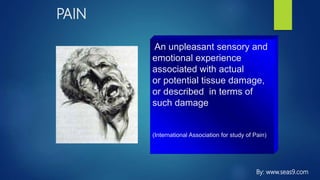
An unpleasant sensory and
emotional experience
associated with actual
or potential tissue damage,
or described in terms of
such damage
(International Association for study of Pain)
By: www.seas9.com
PAIN
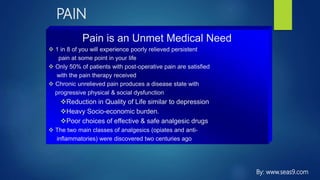
Pain is an Unmet Medical Need
 1 in 8 of you will experience poorly relieved persistent
pain at some point in your life
 Only 50% of patients with post-operative pain are satisfied
with the pain therapy received
 Chronic unrelieved pain produces a disease state with
progressive physical & social dysfunction
Reduction in Quality of Life similar to depression
Heavy Socio-economic burden.
Poor choices of effective & safe analgesic drugs
 The two main classes of analgesics (opiates and anti-
inflammatories) were discovered two centuries ago
By: www.seas9.com
HISTORY OF PAIN RELIEF
 Hippocrates(Gk.); disbalance b/w blood, phlegm,
yellow/black bile
 Aristotle; Increased sensitivity to touch
originating in the heart
 Celsus(Rome); rubor, calor, tumor, dolor &
functional loss
 Leonardo da Vinci; spinal transmission of pain to
thalamus
 1803; morphine isolated from opium
By: www.seas9.com
..contd...
 Latin poena; punishment
 Chinese; Yin vs Yang /Chi, 14 grid imbalance
 Egyptians; spirits, treatment; vomiting,urinating,
sneezing
 Buddhists; frustration of desires
 Hindus; heart seat of all pain
By: www.seas9.com
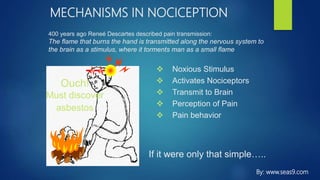
400 years ago Reneé Descartes described pain transmission:
The flame that burns the hand is transmitted along the nervous system to
the brain as a stimulus, where it torments man as a small flame
MECHANISMS IN NOCICEPTION
 Noxious Stimulus
 Activates Nociceptors
 Transmit to Brain
 Perception of Pain
 Pain behavior
Ouch!
Must discover
asbestos
If it were only that simple…..
By: www.seas9.com
THE PURPOSE OF PAIN
Protective mechanism;
 A signal of a disease
 Occurs whenever any tissue is being damaged
 Helps in detection, localisation and identification
of tissue damage
 Causes the individual to react to remove the
pain stimulus
By: www.seas9.com
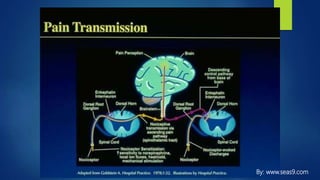
CROSS ROADS FOR TRANSMISSION OF
PAIN & ITS RESPONSE BY THE BODY
 Receptors - free nerve endings
 Electro-chemical transmission
 Synapse in the spinal cord - convergence
 Ascent in the spinal cord to pain
receiving areas in the brain
 Facilitatory/Inhibitory neurons
 Motor response
By: www.seas9.com
TWO PARTS OF NERVOUS SYSTEM
 The pain response signal is transmitted by the
neuron in the peripheral nervous system (PNS)
to the central nervous system (CNS)
 Here the signals are integrated and acted upon
 The CNS is composed of the spinal cord and
brain
 The PNS is composed of all other elements of
the nervous system
 Neurons carry all afferent impulses between the
peripheral sensory receptors and the neurons
of the CNS
By: www.seas9.com
INITIATION OF THE PAIN RESPONSE
 Algesic ( pain producing ) Substances:
 BK - Bradykinin
 5-HT - Serotonin
 H+ Acidic substance
 PgE - Prostaglandins
 SP - Substance P
 Pain Fibres:
 C fibres
 A - Delta fibres
By: www.seas9.com
INITIATION OF THE PAIN RESPONSE
 Fast Pain
 Sharp, pricking, or pinching pain
 Arise from activation of mechanical
nociceptors via small-diameter, thinly
myelinated fibers
 Conducting at ~5 – 30 m/sec.
 The spinothalamic tract conveys fast pain.
By: www.seas9.com
INITIATION OF THE PAIN RESPONSE
 Slow Pain
 Burning, itching, aching quality
 Arise from activation of polymodal
nociceptors that are activated by high-
intensity stimuli
 Information is sent to spinal cord via small-
diameter, unmyelinated C fibers.
By: www.seas9.com
TYPES OF PAIN
Fast Pain;
 sharp/ prick/acute
/electric Pain
 within milisec
 not felt in the
deeper tissues of
the body
Slow Pain;
 burning/ aching/
throbbing/ nauseating
 can be excruciating
 can occur in both skin &
deep tissues
By: www.seas9.com
CLASSIFICATION OF PAIN
 Depending on location:
deep, somatic / visceral
superficial , skin etc
 Depending on duration:
acute - more sharp
chronic - usually dull
 Depending on severity:
mild
moderate
severe
By: www.seas9.com
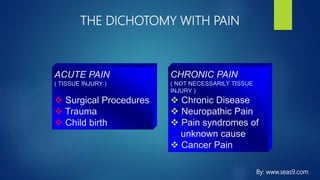
THE DICHOTOMY WITH PAIN
ACUTE PAIN
( TISSUE INJURY )
 Surgical Procedures
 Trauma
 Child birth
CHRONIC PAIN
( NOT NECESSARILY TISSUE
INJURY )
 Chronic Disease
 Neuropathic Pain
 Pain syndromes of
unknown cause
 Cancer Pain
By: www.seas9.com
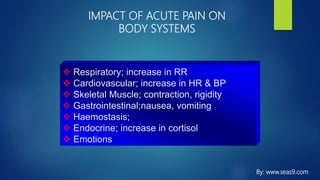
IMPACT OF ACUTE PAIN ON
BODY SYSTEMS
 Respiratory; increase in RR
 Cardiovascular; increase in HR & BP
 Skeletal Muscle; contraction, rigidity
 Gastrointestinal;nausea, vomiting
 Haemostasis;
 Endocrine; increase in cortisol
 Emotions
By: www.seas9.com
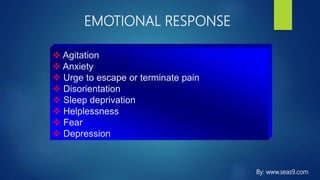
EMOTIONAL RESPONSE
 Agitation
 Anxiety
 Urge to escape or terminate pain
 Disorientation
 Sleep deprivation
 Helplessness
 Fear
 Depression
By: www.seas9.com
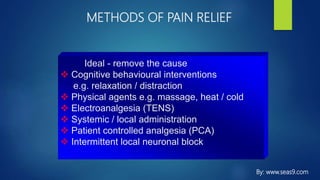
METHODS OF PAIN RELIEF
Ideal - remove the cause
 Cognitive behavioural interventions
e.g. relaxation / distraction
 Physical agents e.g. massage, heat / cold
 Electroanalgesia (TENS)
 Systemic / local administration
 Patient controlled analgesia (PCA)
 Intermittent local neuronal block
By: www.seas9.com
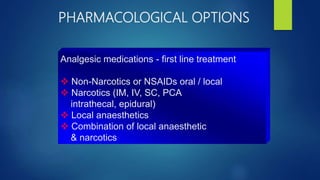
PHARMACOLOGICAL OPTIONS
Analgesic medications - first line treatment
 Non-Narcotics or NSAIDs oral / local
 Narcotics (IM, IV, SC, PCA
intrathecal, epidural)
 Local anaesthetics
 Combination of local anaesthetic
& narcotics
VISIT www.seas9.com for
more presentations
Its free
www.seas9.com

PAIN & PAIN MANAGEMENT

  • 1.
    PAIN & PAINMANAGEMENT By: www.seas9.com
  • 2.
  • 3.
    PAIN An unpleasant sensoryand emotional experience associated with actual or potential tissue damage, or described in terms of such damage (International Association for study of Pain) By: www.seas9.com
  • 4.
    PAIN Pain is anUnmet Medical Need  1 in 8 of you will experience poorly relieved persistent pain at some point in your life  Only 50% of patients with post-operative pain are satisfied with the pain therapy received  Chronic unrelieved pain produces a disease state with progressive physical & social dysfunction Reduction in Quality of Life similar to depression Heavy Socio-economic burden. Poor choices of effective & safe analgesic drugs  The two main classes of analgesics (opiates and anti- inflammatories) were discovered two centuries ago By: www.seas9.com
  • 5.
    HISTORY OF PAINRELIEF  Hippocrates(Gk.); disbalance b/w blood, phlegm, yellow/black bile  Aristotle; Increased sensitivity to touch originating in the heart  Celsus(Rome); rubor, calor, tumor, dolor & functional loss  Leonardo da Vinci; spinal transmission of pain to thalamus  1803; morphine isolated from opium By: www.seas9.com
  • 6.
    ..contd...  Latin poena;punishment  Chinese; Yin vs Yang /Chi, 14 grid imbalance  Egyptians; spirits, treatment; vomiting,urinating, sneezing  Buddhists; frustration of desires  Hindus; heart seat of all pain By: www.seas9.com
  • 7.
    400 years agoReneé Descartes described pain transmission: The flame that burns the hand is transmitted along the nervous system to the brain as a stimulus, where it torments man as a small flame MECHANISMS IN NOCICEPTION  Noxious Stimulus  Activates Nociceptors  Transmit to Brain  Perception of Pain  Pain behavior Ouch! Must discover asbestos If it were only that simple….. By: www.seas9.com
  • 8.
    THE PURPOSE OFPAIN Protective mechanism;  A signal of a disease  Occurs whenever any tissue is being damaged  Helps in detection, localisation and identification of tissue damage  Causes the individual to react to remove the pain stimulus By: www.seas9.com
  • 9.
    CROSS ROADS FORTRANSMISSION OF PAIN & ITS RESPONSE BY THE BODY  Receptors - free nerve endings  Electro-chemical transmission  Synapse in the spinal cord - convergence  Ascent in the spinal cord to pain receiving areas in the brain  Facilitatory/Inhibitory neurons  Motor response
  • 10.
  • 11.
    TWO PARTS OFNERVOUS SYSTEM  The pain response signal is transmitted by the neuron in the peripheral nervous system (PNS) to the central nervous system (CNS)  Here the signals are integrated and acted upon  The CNS is composed of the spinal cord and brain  The PNS is composed of all other elements of the nervous system  Neurons carry all afferent impulses between the peripheral sensory receptors and the neurons of the CNS By: www.seas9.com
  • 12.
    INITIATION OF THEPAIN RESPONSE  Algesic ( pain producing ) Substances:  BK - Bradykinin  5-HT - Serotonin  H+ Acidic substance  PgE - Prostaglandins  SP - Substance P  Pain Fibres:  C fibres  A - Delta fibres By: www.seas9.com
  • 13.
    INITIATION OF THEPAIN RESPONSE  Fast Pain  Sharp, pricking, or pinching pain  Arise from activation of mechanical nociceptors via small-diameter, thinly myelinated fibers  Conducting at ~5 – 30 m/sec.  The spinothalamic tract conveys fast pain. By: www.seas9.com
  • 14.
    INITIATION OF THEPAIN RESPONSE  Slow Pain  Burning, itching, aching quality  Arise from activation of polymodal nociceptors that are activated by high- intensity stimuli  Information is sent to spinal cord via small- diameter, unmyelinated C fibers. By: www.seas9.com
  • 15.
    TYPES OF PAIN FastPain;  sharp/ prick/acute /electric Pain  within milisec  not felt in the deeper tissues of the body Slow Pain;  burning/ aching/ throbbing/ nauseating  can be excruciating  can occur in both skin & deep tissues By: www.seas9.com
  • 16.
    CLASSIFICATION OF PAIN Depending on location: deep, somatic / visceral superficial , skin etc  Depending on duration: acute - more sharp chronic - usually dull  Depending on severity: mild moderate severe By: www.seas9.com
  • 17.
    THE DICHOTOMY WITHPAIN ACUTE PAIN ( TISSUE INJURY )  Surgical Procedures  Trauma  Child birth CHRONIC PAIN ( NOT NECESSARILY TISSUE INJURY )  Chronic Disease  Neuropathic Pain  Pain syndromes of unknown cause  Cancer Pain By: www.seas9.com
  • 18.
    IMPACT OF ACUTEPAIN ON BODY SYSTEMS  Respiratory; increase in RR  Cardiovascular; increase in HR & BP  Skeletal Muscle; contraction, rigidity  Gastrointestinal;nausea, vomiting  Haemostasis;  Endocrine; increase in cortisol  Emotions By: www.seas9.com
  • 19.
    EMOTIONAL RESPONSE  Agitation Anxiety  Urge to escape or terminate pain  Disorientation  Sleep deprivation  Helplessness  Fear  Depression By: www.seas9.com
  • 20.
    METHODS OF PAINRELIEF Ideal - remove the cause  Cognitive behavioural interventions e.g. relaxation / distraction  Physical agents e.g. massage, heat / cold  Electroanalgesia (TENS)  Systemic / local administration  Patient controlled analgesia (PCA)  Intermittent local neuronal block By: www.seas9.com
  • 21.
    PHARMACOLOGICAL OPTIONS Analgesic medications- first line treatment  Non-Narcotics or NSAIDs oral / local  Narcotics (IM, IV, SC, PCA intrathecal, epidural)  Local anaesthetics  Combination of local anaesthetic & narcotics
  • 22.
    VISIT www.seas9.com for morepresentations Its free www.seas9.com