

Dr. SamehAttiaAli AbdelhamidDr. SamehAttiaAli Abdelhamid
MBBChMBBCh, MSc, MSc
EgyptianBoardof VascularEgyptianBoardof Vascular
SurgerySurgery
MRCSMRCS
Definition:
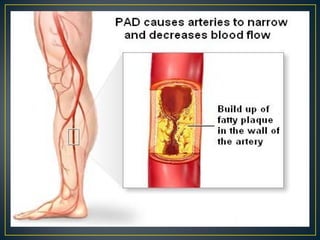
o The decrease in arterial blood supply to the
tissues due to partial or complete occlusion of
arteries.
o The severity of symptoms is related to the size
of the vessel occluded & alternative routes
(collaterals) available for blood flow.
Causes:
Atherosclerosis
Burger’s disease
Raynaud’s disease
Others
• The blood flow is restricted by a gradual
narrowing of the arterial lumen.
• During exercise the blood supply to the
tissues is not adequate for increasing energy
demands.
• The products of anaerobic metabolism (lactic
acid and potassium) accumulate and cause
pain.
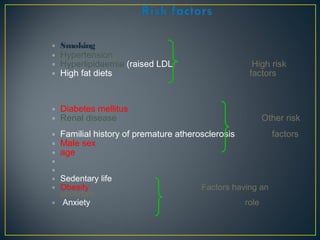
◦ Smoking
◦ Hypertension
◦ Hyperlipidaemia (raised LDL) High risk
◦ High fat diets factors
◦ Diabetes mellitus
◦ Renal disease Other risk
◦ Familial history of premature atherosclerosis factors
◦ Male sex
◦ age
◦
◦
◦ Sedentary life
◦ Obesity Factors having an
uncertain
◦ Anxiety role
• Asymptomatic disease.
• Intermittent claudication.
• Critical limb ischemia.
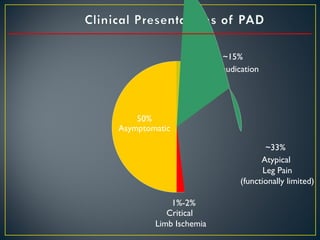
~15%
Claudication
~33%
Atypical
Leg Pain
(functionally limited)
50%
Asymptomatic
1%-2%
Critical
Limb Ischemia
Symptoms:
classically occurs in elderly male patients.
 Cigarette smokers.
may have other manifestations of atherosclerosis
• Muscular atrophy.
• Decrease hair growth.
• Thick toenails.
• cool skin .
• poor healing.
• Tissue necrosis ulcers infection .
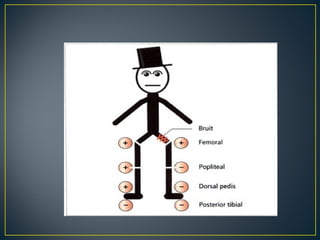
• Absent pulses.
• Bruits.
Inspection
 Color
 Posture of the limb.
 Venous guttering.
 Gangrene.
 Ulceration.
Palpation
 Temperature.
 Capillary refilling.
 Pulses.
 Sensation and movement.
Auscultation
 Bruit.
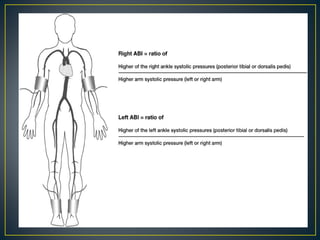
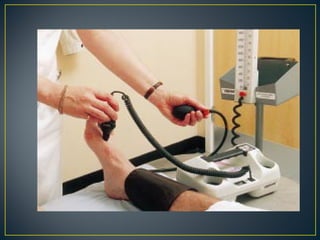
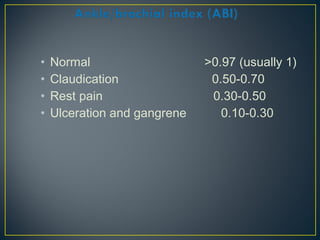
• Normal >0.97 (usually 1)
• Claudication 0.50-0.70
• Rest pain 0.30-0.50
• Ulceration and gangrene 0.10-0.30
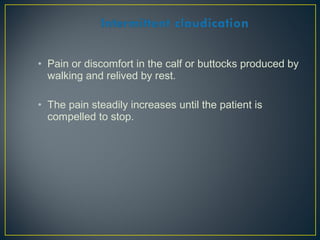
• Pain or discomfort in the calf or buttocks produced by
walking and relived by rest.
• The pain steadily increases until the patient is
compelled to stop.
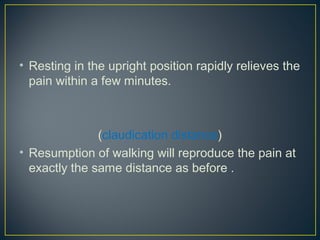
• Resting in the upright position rapidly relieves the
pain within a few minutes.
(claudication distance)
• Resumption of walking will reproduce the pain at
exactly the same distance as before .
(Leriche's syndrome)
• Aortic occlusion which produces buttock pain and loss of
erection in the male
• Majority will have Symptomatic stabilization ??
• Development of collaterals.
• Metabolic adaptation of ischemic muscle.
• The patient altering his life.
• 25% will deteriorate
21
The treatment goals are to
• relieve symptoms.
• improve exercise performance and daily
functional abilities.
23
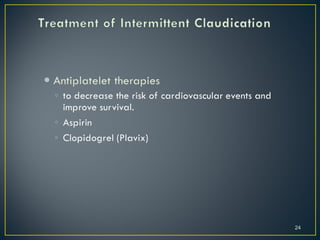
24
• Failure to respond to exercise and /or drug
therapy.
is a manifestation of peripheral arterial disease
(PAD) that describes patients with
• ischemic rest pain
• ischemic ulcers
• gangrene.
• chronic ischemia is defined as the presence of
symptoms for more than 2 weeks.
27
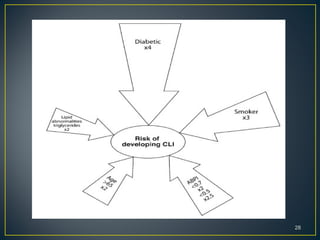
28
• characterized by:
• continuous aching severe pain.
• usually in the most distal part of the limb.
• worse at night in bed.
• the patient seeks relief by hanging the leg over the side of the
bed or sleeping in a chair.
• often associated with tissue loss (ulceration or gangrene).
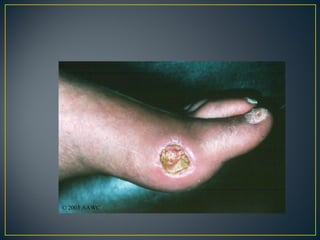
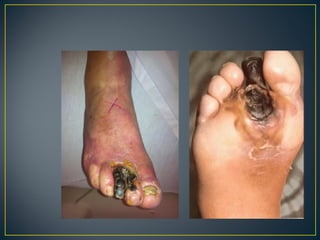
• Patients with CLI may also the first
presentation is ischemic ulcers or gangrene
as In patients with diabetic neuropathy.
• Gangrene usually affects the digits.
30
• most commonly occurs below an ankle pressure of 50
mmHg or a toe pressure less than 30 mmHg.
• non-disabling claudication
• disabling claudication
• critical ischemia.
Laboratory :
• Blood sugar.
• Lipid profile
• CBC ,Hb
• Plasma fibrinogen
• urine glucose
ECG
non-invasive
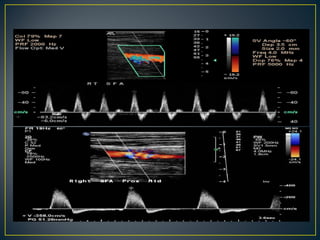
• Doppler ultrasound
• ABI ( rest and exercise )
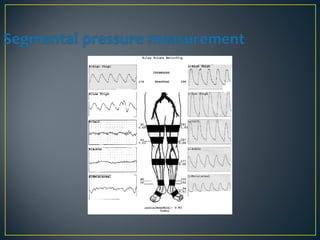
• Segmental pressure measurement
• Duplex imaging
invasive
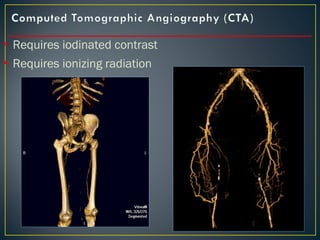
• CTA
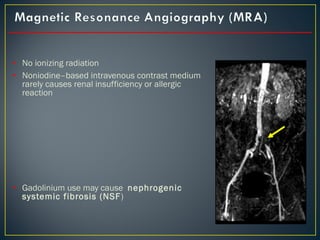
• MRA
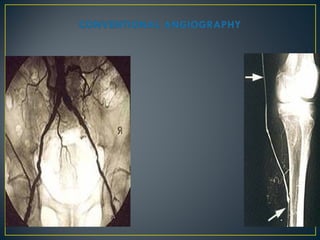
• Angio
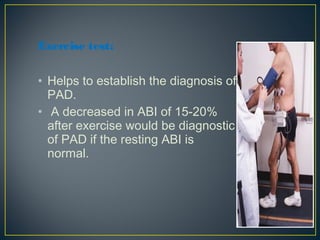
Exercise test:
• Helps to establish the diagnosis of
PAD.
• A decreased in ABI of 15-20%
after exercise would be diagnostic
of PAD if the resting ABI is
normal.
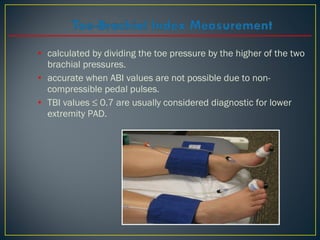
• calculated by dividing the toe pressure by the higher of the two
brachial pressures.
• accurate when ABI values are not possible due to non-
compressible pedal pulses.
• TBI values ≤ 0.7 are usually considered diagnostic for lower
extremity PAD.
• Effective method of predicting the location and
severity of arterial disease in the lower
extremities
• Can distinguish between stenoses and
occlusions.
• ideal for predicting access sites for intervention,
and can detect iatrogenic arterial injury after
intervention.
• Requires iodinated contrast
• Requires ionizing radiation
• No ionizing radiation
• Noniodine–based intravenous contrast medium
rarely causes renal insufficiency or allergic
reaction
• Gadolinium use may cause nephrogenic
systemic fibrosis (NSF)
• Smoking.
• Obesity .
• hyperlipidemia .
• hypertension.
• diabetes.
• co-existing disease.
• Smoking cessation
• smoking cessation is associated with improved walking
distance in some patients.
47
• Weight reduction
Patients who are
• overweight (BMI 25-30)
• or obese (BMI >30)
should receive counseling for weight reduction by
inducing carbohydrate restriction and increased
exercise.
48
• Hyperlipidemia is Independent risk factors for PAD
which include elevated levels of
• Total cholesterol
• Total low-density lipoprotein (LDL)
• Total triglycerides
• Factors that are protective for the development of
PAD are elevated high-density lipoprotein (HDL)
49
• Hypertention associated with a 2-3 fold
increased risk for PAD.
50
• Diabetes increases the risk of PAD
approximately
3-4 fold.
51
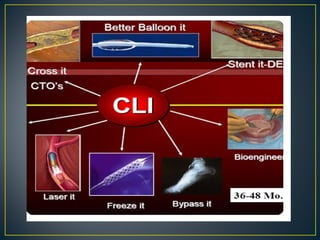
Treatment
The primary goals of the treatment are to
◦ Relieve ischemic pain.
◦ Heal ischemic ulcers
◦ Prevent limb loss
◦ Improve patient function and quality of life.
◦ Prolong survival.
In order to achieve these goals, most patients will
ultimately need a revascularization procedure.
52
• Treatment
• Aggressive modification of their cardiovascular risk factors.
• Pharmacotherapy.
• Revascularization.
• most patients with CLI will ultimately need a revascularization
procedure.
53
Chronic lower limb ischemia

Chronic lower limb ischemia

  • 1.
    Dr. SamehAttiaAli AbdelhamidDr.SamehAttiaAli Abdelhamid MBBChMBBCh, MSc, MSc EgyptianBoardof VascularEgyptianBoardof Vascular SurgerySurgery MRCSMRCS
  • 2.
    Definition: o The decreasein arterial blood supply to the tissues due to partial or complete occlusion of arteries. o The severity of symptoms is related to the size of the vessel occluded & alternative routes (collaterals) available for blood flow.
  • 3.
  • 5.
    • The bloodflow is restricted by a gradual narrowing of the arterial lumen. • During exercise the blood supply to the tissues is not adequate for increasing energy demands. • The products of anaerobic metabolism (lactic acid and potassium) accumulate and cause pain.
  • 6.
    ◦ Smoking ◦ Hypertension ◦Hyperlipidaemia (raised LDL) High risk ◦ High fat diets factors ◦ Diabetes mellitus ◦ Renal disease Other risk ◦ Familial history of premature atherosclerosis factors ◦ Male sex ◦ age ◦ ◦ ◦ Sedentary life ◦ Obesity Factors having an uncertain ◦ Anxiety role
  • 8.
    • Asymptomatic disease. •Intermittent claudication. • Critical limb ischemia.
  • 9.
  • 10.
    Symptoms: classically occurs inelderly male patients.  Cigarette smokers. may have other manifestations of atherosclerosis
  • 11.
    • Muscular atrophy. •Decrease hair growth. • Thick toenails. • cool skin . • poor healing. • Tissue necrosis ulcers infection . • Absent pulses. • Bruits.
  • 12.
    Inspection  Color  Postureof the limb.  Venous guttering.  Gangrene.  Ulceration. Palpation  Temperature.  Capillary refilling.  Pulses.  Sensation and movement. Auscultation  Bruit.
  • 16.
    • Normal >0.97(usually 1) • Claudication 0.50-0.70 • Rest pain 0.30-0.50 • Ulceration and gangrene 0.10-0.30
  • 18.
    • Pain ordiscomfort in the calf or buttocks produced by walking and relived by rest. • The pain steadily increases until the patient is compelled to stop.
  • 19.
    • Resting inthe upright position rapidly relieves the pain within a few minutes. (claudication distance) • Resumption of walking will reproduce the pain at exactly the same distance as before .
  • 20.
    (Leriche's syndrome) • Aorticocclusion which produces buttock pain and loss of erection in the male
  • 21.
    • Majority willhave Symptomatic stabilization ?? • Development of collaterals. • Metabolic adaptation of ischemic muscle. • The patient altering his life. • 25% will deteriorate 21
  • 22.
    The treatment goalsare to • relieve symptoms. • improve exercise performance and daily functional abilities.
  • 23.
  • 24.
  • 25.
    • Failure torespond to exercise and /or drug therapy.
  • 27.
    is a manifestationof peripheral arterial disease (PAD) that describes patients with • ischemic rest pain • ischemic ulcers • gangrene. • chronic ischemia is defined as the presence of symptoms for more than 2 weeks. 27
  • 28.
  • 29.
    • characterized by: •continuous aching severe pain. • usually in the most distal part of the limb. • worse at night in bed. • the patient seeks relief by hanging the leg over the side of the bed or sleeping in a chair. • often associated with tissue loss (ulceration or gangrene).
  • 30.
    • Patients withCLI may also the first presentation is ischemic ulcers or gangrene as In patients with diabetic neuropathy. • Gangrene usually affects the digits. 30
  • 33.
    • most commonlyoccurs below an ankle pressure of 50 mmHg or a toe pressure less than 30 mmHg.
  • 34.
    • non-disabling claudication •disabling claudication • critical ischemia.
  • 35.
    Laboratory : • Bloodsugar. • Lipid profile • CBC ,Hb • Plasma fibrinogen • urine glucose ECG
  • 36.
    non-invasive • Doppler ultrasound •ABI ( rest and exercise ) • Segmental pressure measurement • Duplex imaging invasive • CTA • MRA • Angio
  • 37.
    Exercise test: • Helpsto establish the diagnosis of PAD. • A decreased in ABI of 15-20% after exercise would be diagnostic of PAD if the resting ABI is normal.
  • 38.
    • calculated bydividing the toe pressure by the higher of the two brachial pressures. • accurate when ABI values are not possible due to non- compressible pedal pulses. • TBI values ≤ 0.7 are usually considered diagnostic for lower extremity PAD.
  • 40.
    • Effective methodof predicting the location and severity of arterial disease in the lower extremities • Can distinguish between stenoses and occlusions. • ideal for predicting access sites for intervention, and can detect iatrogenic arterial injury after intervention.
  • 43.
    • Requires iodinatedcontrast • Requires ionizing radiation
  • 44.
    • No ionizingradiation • Noniodine–based intravenous contrast medium rarely causes renal insufficiency or allergic reaction • Gadolinium use may cause nephrogenic systemic fibrosis (NSF)
  • 46.
    • Smoking. • Obesity. • hyperlipidemia . • hypertension. • diabetes. • co-existing disease.
  • 47.
    • Smoking cessation •smoking cessation is associated with improved walking distance in some patients. 47
  • 48.
    • Weight reduction Patientswho are • overweight (BMI 25-30) • or obese (BMI >30) should receive counseling for weight reduction by inducing carbohydrate restriction and increased exercise. 48
  • 49.
    • Hyperlipidemia isIndependent risk factors for PAD which include elevated levels of • Total cholesterol • Total low-density lipoprotein (LDL) • Total triglycerides • Factors that are protective for the development of PAD are elevated high-density lipoprotein (HDL) 49
  • 50.
    • Hypertention associatedwith a 2-3 fold increased risk for PAD. 50
  • 51.
    • Diabetes increasesthe risk of PAD approximately 3-4 fold. 51
  • 52.
    Treatment The primary goalsof the treatment are to ◦ Relieve ischemic pain. ◦ Heal ischemic ulcers ◦ Prevent limb loss ◦ Improve patient function and quality of life. ◦ Prolong survival. In order to achieve these goals, most patients will ultimately need a revascularization procedure. 52
  • 53.
    • Treatment • Aggressivemodification of their cardiovascular risk factors. • Pharmacotherapy. • Revascularization. • most patients with CLI will ultimately need a revascularization procedure. 53