Peripheral Arterial Disease
Dr. F. Brakatu
DEFINITION
PAD is the obstruction or deterioration of arteries other than those supplying the
heart and brain with impairment of circulation and resultant ischemia to the end
organ involved.
EPIDEMIOLOGY
Incidence of symptomatic PAD increases with age by 0.3%/yr for men 40-55yrs
and 1%/yr for men older than 75yrs
Non-hispanic Blacks:Whites - 2:1
PAD in GHANA
n=5516
Europe - (1487 Amsterdam, 546 Berlin,
1047 London) and Ghana [1419 urban
and 1017 rural] aged 25–70 yrs
Conc: Ghanaians living in Ghana have
higher prevalence of PAD than their
migrant compatriots
Case-control n=623 Anthropometric indices assessed
PAD (ABI ≤ 0.9, n = 261) and non-PAD (ABI > 0.9, n = 362) groups
PAD participants had higher BMI and waist
circumference than non-PAD participants
PAD participants had higher BMI and waist
circumferences than non-PAD participants
BMI ≥ 30 kg/m2 was associated with twofold increase in the odds of PAD.
HIGH RISK GROUPS
❖ Smokers
❖ Hypertension
❖ Dyslipidemia
❖ Hypercoagulable state
❖ Renal insufficiency
❖ DM ie 33% of DM pts older than
50yrs
PATHOLOGY
Atherosclerosis - commonest cause - tends to occur in bifurcations and bends
Non-atheromatous arteriopathies - Raynaud’s syndrome, Buerger’s disease
Vasculitis - Large (GCA & Takayasu), Medium (Polyarteritis nodosa, Kawasaki,
Bechet, Cogan), Small -vessel (Wegner, Churg-Strauss, microscopic polyangitis)
Heritable Arteriopathies - cystic medial necrosis, pseudoxanthoma elasticum,
arteria magna syndrome
Congenital - Persistent sciatic artery, popliteal entrapment syndrome, adventitial
cystic disease
Peripheral Arterial Aneurysms - Femoral & popliteal artery aneurysms
RISK FACTORS
Age>40
Smoking (10x RR for PAD)
Hypertension
DM - (2 to 4x RR for PAD)
Male sex
Black race
Atherosclerosis at other sites
Family History of CV disease
CKD
Metabolic Syndrome
Hyperlipidaemia
HIV Infection
Heavy Metal Exposure
Homocysteinemia
CAUSES OF ACUTE ARTERIAL ISCHEMIA
Arterial embolism
Thrombosis of an atheromatous plaque
Thrombosis of an aneurysm(usually popliteal)
Arterial Dissection (usually aortic)
Traumatic disruption
External compression eg. cervical rib or popliteal entrapment
FEATURES OF CHRONIC ARTERIAL INSUFFICIENCY
Lower extremity pain
● Intermittent Claudication - buttock & hip, thigh, calf, foot -claudication
distance?
● Atypical extremity pain
● Ischemic rest pain
● Severe diffuse pain
Non-healing wound/ulcer
Pregangrene/gangrene
CLINICAL HISTORY
Characterize the pain - SOCRATES
● Typically occurs with activity and relieved by rest
● Usually calf pain (SFA)
● May have Thigh or buttock pain (Aortoiliac involvement)
Comorbidities - CAD, Carotid artery stenosis, prior stroke
Past Surgical History and Interventions
Drug Hx - Antiplatelets, beta blockers, ACEi, statins
Allergies to contrast
CLINICAL FEATURES OF ACUTE ARTERIAL INSUFFICIENCY
6Ps - Pain , Paraesthesia, Pulselessness, Pallor, Perishingly cold, Paralysis
NB: Look out for mottled skin - partial occlusion
PHYSICAL EXAMINATION
INSPECTION
Memory :SNUGGS
Skin
● Hands - tar staining, wasting of small muscles (thoracic outlet
syndrome)
● Face - xanthalesma, corneal arcus
● Abdomen - obvious pulsatile mass
● Legs - shiny skin, discoloration (haemosiderin deposit)
Nails - tar staining, onycholysis, thick &brittle nails
Ulcers - malleoli, between toes, pressure areas
Guttering & Gangrene - venous guttering, gangrene, tissue loss
Scars - amputations, prev. surgery
PALPATION
Memory: PC BOAT
Pulses - Radial, brachial, carotid, feel for AAA,
femoral, popliteal, DP, TP
Capillary Refill - both upper and lower limbs
Buerger’s Angle + Test & Pole test
Oedema - DVT, lymphedema, post-surgical
Allen’s Test
Temperature
Pearls
● Peripheral pulses should be graded as 0–2, with normal
pulsations being 2, diminished 1, and absent 0
● DP pulse is congenitally absent in approximately 10% of the
population and that the posterior tibialis pulse is congenitally
absent in < 1% of the population ( Ludbrook J, Clarke AM,
McKenzie JK: Significance of absent ankle pulses. Br Med J
1962;I:1724–1726)
● An abnormal posterior tibialis pulse is 71.2% sensitive and
91.3% specific for PAD, whereas an abnormal dorsalis pedis
pulse is only 50% sensitive and 73.1% specific (Criqui MH et
al)
AUSCULTATION
Memory : CALF
Listen for bruits at the
● Carotid
● Aorta
● iLiacs
● Femoral
COMPLETION
ABPI
Varicose vein Exam - can have mixed arterial & venous disease
Cardiac Exam - Full Cardio exam + ECG
Neurological Exam - DM neuropathy may be present
BP(both arms) & HR - HPT & AF common
Investigations - Duplex, MRA, CTA, IADSA
ABPI
INVESTIGATIONS
ABPI
Doppler USG and Duplex - Triphasic waveform is normal
Segmental limb systolic pressure measurements
Arterial plethysmography/pulse volume recordings
Angiography - DSA. Gold Standard. Diagnostic and therapeutic
CTA
MRA - highly sensitive & specific
Carbon dioxide angiography - in patients with severe renal
insufficiency; risk of CO2 embolism, gas trapping and mesenteric
ischaemia
Intravascular Ultrasound - for endovascular treatment of chronic total
occlusion & aortic dissections
Tissue Oxygenation
Aortogram showing occluded
aorta with left renal artery
occlusion
Endovascular Ultrasound showing a patent
common iliac stent (A) vs common iliac stent
thrombosis
(Courtesy Dr. Syed Gilani, University
of Texas Medical Branch at Galveston, Department of Cardiology.)
CLASSIFICATION OF PERIPHERAL ARTERY DISEASE
DIFFERENTIAL DIAGNOSES
Nerve root compression (neurogenic claudication)
Spinal stenosis
Arthritis
Symptomatic baker’s cyst
Venous claudication
● Entire leg but usually worse in thigh & groin
● Tight bursting pain
● Subsides slowly with relief speeded by elevation
● Hx of Iliofemoral DVT, signs of venous congestion & edema
Chronic compartment syndrome
MEDICAL TREATMENT
Smoking cessation
Regular exercise - increases initial claudication distance by 179% and
the maximal walking distance to 122% (TASC Working Group:
Management of peripheral arterial disease. J Vasc Surg 2000;31(1
suppl):S1–S296)
Dyslipidemia correction - diet, exercise, medications
Manage hypertension
Antiplatelets & Vasodilators (Nifedipine, Pentoxifylline & Cilostazole) -
may increase claudication distance
Mean maximal walking distance of
cilostazol-treated patients (n = 227) was
significantly greater at every postbaseline
visit compared with patients who received
pentoxifylline (n = 232) or placebo (n = 239)
The Pentoxyfilline group did not differ
significantly from the placebo group
Cilostazol (PDE-3 inhibitor) is
contraindicated in patients with a low left
ventricular ejection fraction or subjective
CCF
SURGICAL TREATMENT
REVASCULARIZATION
REVASCULARIZATION- INTERVENTIONAL
Angioplasty - good for short occlusions & better for proximal
disease
Stenting - indicated for failed angioplasties & correction of intimal
arterial defects
Lumbar sympathectomy - used if arterial reconstruction is not
feasible
● Blockade of the lumbar sympathetic chain improves blood
supply to skin, with some relief of symptoms
REVASCULARIZATION - SURGICAL
Anatomical Procedures - restore vascular continuity through
replacement of the diseased region eg. femoropopliteal bypass
and femorodistal bypass
Extra-anatomical Procedures - restore vascular continuity by
diverting blood from other unrelated areas to the diseased region
(and are also therefore useful as a salvage procedure if there is
infection present), eg axillo-bifemoral and femorofemoral
crossover grafts
AORTO-BIFEMORAL BYPASS
Indication: occlusive or stenotic aortoiliac disease not
amenable to angioplasty or stenting a bifurcated,
prosthetic graft is anastomosed proximally to the aorta,
and distally to the iliac or femoral vessels.
Graft patency rates are excellent. Operative
mortality rate is approximately 5%.
AXILLO-BIFEMORAL GRAFT
Indication: aortic or bilateral iliac occlusion or stenosis
not amenable to angioplasty or stenting, in the
presence of a hostile abdomen, or in a patient not fit
for major abdominal surgery
Procedure : A long graft is anastomosed proximally to
the axillary artery as it passes under pectoralis major,
and distally to the femoral arteries
Patency rates are less good than aortobifemoral
grafting for this procedure but it is useful in high-
risk cases with otherwise untreatable critical
ischaemia.
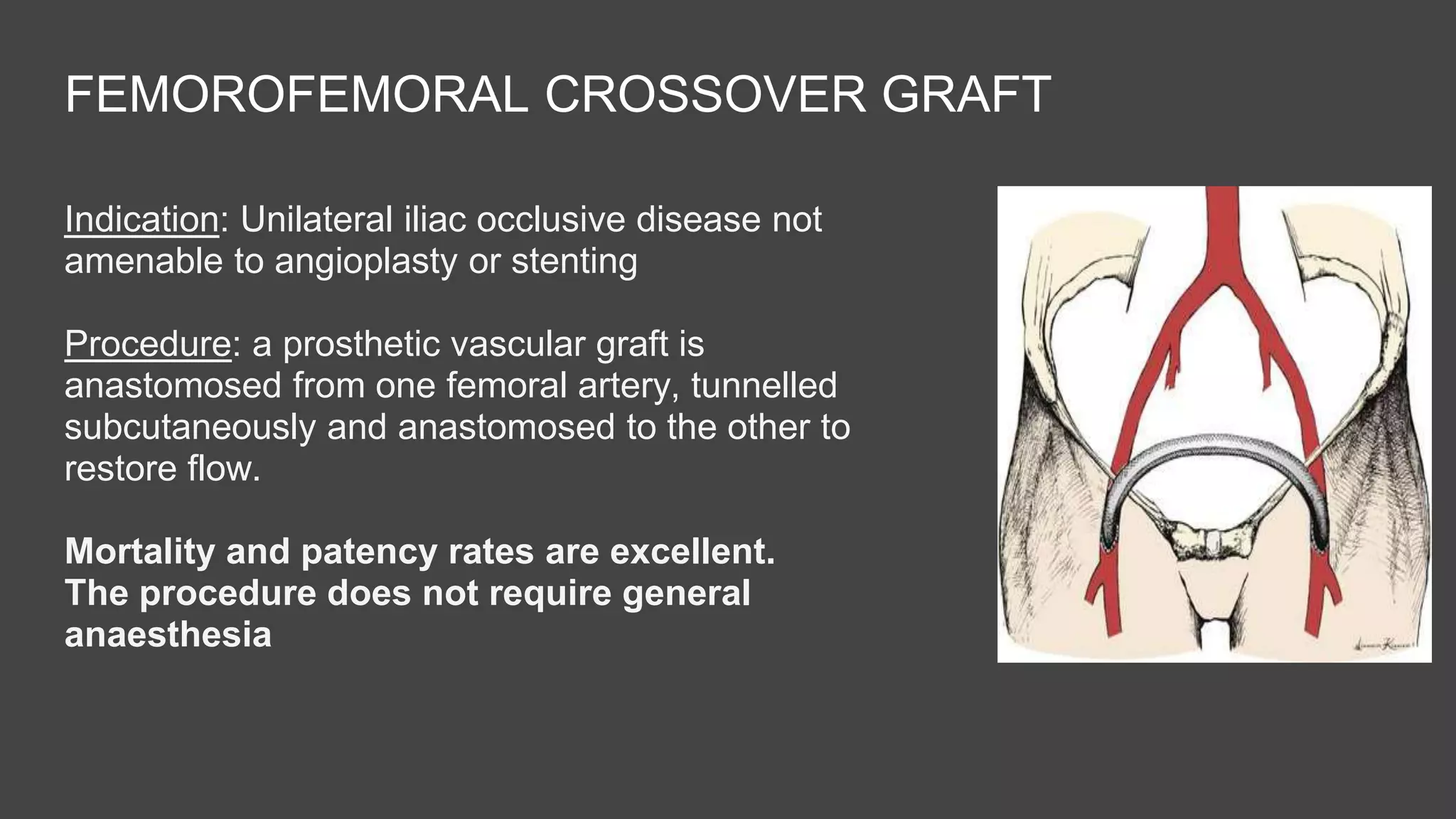
FEMOROFEMORAL CROSSOVER GRAFT
Indication: Unilateral iliac occlusive disease not
amenable to angioplasty or stenting
Procedure: a prosthetic vascular graft is
anastomosed from one femoral artery, tunnelled
subcutaneously and anastomosed to the other to
restore flow.
Mortality and patency rates are excellent.
The procedure does not require general
anaesthesia
FEMOROPOPLITEAL &
FEMORODISTAL BYPASS
Indications:
● Chronic lower limb ischaemia with incapacitating
claudication or critical ischaemia
● May also be performed for acutely ischaemic limb
(acute-on-chronic thrombosis, occluded popliteal
aneurysm, etc).
VASCULAR GRAFTS
Autologous - LSV can be harvested and used in the reverse direction (flow not
impeded by vein cusps) or used in situ after destruction of the vein cusps
Prosthetic - Dacron or PTFE.
● They may be woven or plasticised and may be supported by an external
scaffolding to prevent compression during movement
● They have a much lower patency rate than autologous grafts
PROSTHETIC GRAFTS
CAUSES OF GRAFT FAILURES
Early Causes (eg after 1 month): commonly technical failure (low flow state due to
poor inflow or insufficient run-off)
Mid-term causes (eg after 1 year): commonly neointimal hyperplasia causing
stenosis in the graft
Late causes (eg after 2–5 years): commonly atheromatous disease progression
(in inflow or run-off)
COMPLICATIONS
Early:
● Haemorrhage
● Graft Thrombosis
● Wound Infection
● Swollen Leg (Reperfusion of
DVT)
● Lymphatic fistula
Late:
● Graft Thrombosis
● False Aneurysm
● Graft Infection
AMPUTATIONS
Indications:
Dead - gangrene
Dying - Vascular disease
Dangerous - eg. Tumor or severe infection
Damned Nuisance - useless, painful limb after
trauma, neurological damage
The Ideal Stump:
● It should be of optimum length
● Vascularity of the flaps should be normal
● Good soft tissue cover -no projecting spur of bone
● End of stump is firm and conical in shape
● Stump should not be under tension
● Heals by primary intention
● Scar should not be in a tension area
● Scar should be transverse
● Does not transmit pressure through the scar
● Heals by primary intention
● Is freely mobile
● Opposing muscle groups are sutured together at
the end
● Has a mobile joint above the amputation level
Hemipelvectomy (Hind quarter amputation)
Used mainly when there’s associated malignancy
HIP DISARTICULATION
TRANSFEMORAL AMPUTATION (AKA)
Adductor myodesis (Gottschalk 2004; Tintle et al. 2010)
● Improves clinical outcomes
● Creates dynamic balance (otherwise unopposed abductors)
● Provides soft tissue envelope for prosthesis fit (5-10deg adduction ideal)
GRITTI STOKES (SUPRACONDYLAR) vs GUILLOTINE
(THROUGH KNEE) AMPUTATION
Amputation through femur near adductor
tubercle
Synovium excised to prevent post-op
effusion
Patella is arthrodesed to femur for
improved end bearing
Improved outcomes compared to AKA
For non-ambulatory patients and ambulatory patients who can’t have transtibial
amputation
LEAP Study Outcomes:
● Require more dependence than BKA
● Worse outcomes on Sickness Impact Profile (SIP) than AKA & BKA
● Physicians less satisfied with clinical, cosmetic and functional recovery
TRANSTIBIAL AMPUTATION (BKA)
Long posterior flap - 12-15cm ideal (longer
than this getss into Achilles which has a
suboptimal blood supply for cushion
Modified skewed flap is also an option
Modified Ertl - fibular strut graft
● Bone bridge enhance weightbearing
through fibula and increase surface
area for load transfer
SYME’S AMPUTATION (ANKLE DISARTICULATION)
The heel is disarticulated, and the malleoli excised and covered with a long posterior skin flap
30% require revision at a higher level
CHOPART vs LISFRANC vs TRANSMETATARSAL
AMPUTATIONS
RAY AMPUTATION
TAKE HOME MESSAGE
Look out for risk factors
Thorough Clinical Exam can go a long way
Assess candidacy for revascularization
Adhere to principles of amputation

Peripheral Arterial Disease

  • 1.
  • 2.
    DEFINITION PAD is theobstruction or deterioration of arteries other than those supplying the heart and brain with impairment of circulation and resultant ischemia to the end organ involved.
  • 3.
    EPIDEMIOLOGY Incidence of symptomaticPAD increases with age by 0.3%/yr for men 40-55yrs and 1%/yr for men older than 75yrs Non-hispanic Blacks:Whites - 2:1
  • 4.
    PAD in GHANA n=5516 Europe- (1487 Amsterdam, 546 Berlin, 1047 London) and Ghana [1419 urban and 1017 rural] aged 25–70 yrs Conc: Ghanaians living in Ghana have higher prevalence of PAD than their migrant compatriots Case-control n=623 Anthropometric indices assessed PAD (ABI ≤ 0.9, n = 261) and non-PAD (ABI > 0.9, n = 362) groups PAD participants had higher BMI and waist circumference than non-PAD participants PAD participants had higher BMI and waist circumferences than non-PAD participants BMI ≥ 30 kg/m2 was associated with twofold increase in the odds of PAD.
  • 5.
    HIGH RISK GROUPS ❖Smokers ❖ Hypertension ❖ Dyslipidemia ❖ Hypercoagulable state ❖ Renal insufficiency ❖ DM ie 33% of DM pts older than 50yrs
  • 6.
    PATHOLOGY Atherosclerosis - commonestcause - tends to occur in bifurcations and bends Non-atheromatous arteriopathies - Raynaud’s syndrome, Buerger’s disease Vasculitis - Large (GCA & Takayasu), Medium (Polyarteritis nodosa, Kawasaki, Bechet, Cogan), Small -vessel (Wegner, Churg-Strauss, microscopic polyangitis) Heritable Arteriopathies - cystic medial necrosis, pseudoxanthoma elasticum, arteria magna syndrome Congenital - Persistent sciatic artery, popliteal entrapment syndrome, adventitial cystic disease Peripheral Arterial Aneurysms - Femoral & popliteal artery aneurysms
  • 7.
    RISK FACTORS Age>40 Smoking (10xRR for PAD) Hypertension DM - (2 to 4x RR for PAD) Male sex Black race Atherosclerosis at other sites Family History of CV disease CKD Metabolic Syndrome Hyperlipidaemia HIV Infection Heavy Metal Exposure Homocysteinemia
  • 8.
    CAUSES OF ACUTEARTERIAL ISCHEMIA Arterial embolism Thrombosis of an atheromatous plaque Thrombosis of an aneurysm(usually popliteal) Arterial Dissection (usually aortic) Traumatic disruption External compression eg. cervical rib or popliteal entrapment
  • 9.
    FEATURES OF CHRONICARTERIAL INSUFFICIENCY Lower extremity pain ● Intermittent Claudication - buttock & hip, thigh, calf, foot -claudication distance? ● Atypical extremity pain ● Ischemic rest pain ● Severe diffuse pain Non-healing wound/ulcer Pregangrene/gangrene
  • 10.
    CLINICAL HISTORY Characterize thepain - SOCRATES ● Typically occurs with activity and relieved by rest ● Usually calf pain (SFA) ● May have Thigh or buttock pain (Aortoiliac involvement) Comorbidities - CAD, Carotid artery stenosis, prior stroke Past Surgical History and Interventions Drug Hx - Antiplatelets, beta blockers, ACEi, statins Allergies to contrast
  • 11.
    CLINICAL FEATURES OFACUTE ARTERIAL INSUFFICIENCY 6Ps - Pain , Paraesthesia, Pulselessness, Pallor, Perishingly cold, Paralysis NB: Look out for mottled skin - partial occlusion
  • 12.
  • 13.
    INSPECTION Memory :SNUGGS Skin ● Hands- tar staining, wasting of small muscles (thoracic outlet syndrome) ● Face - xanthalesma, corneal arcus ● Abdomen - obvious pulsatile mass ● Legs - shiny skin, discoloration (haemosiderin deposit) Nails - tar staining, onycholysis, thick &brittle nails Ulcers - malleoli, between toes, pressure areas Guttering & Gangrene - venous guttering, gangrene, tissue loss Scars - amputations, prev. surgery
  • 14.
    PALPATION Memory: PC BOAT Pulses- Radial, brachial, carotid, feel for AAA, femoral, popliteal, DP, TP Capillary Refill - both upper and lower limbs Buerger’s Angle + Test & Pole test Oedema - DVT, lymphedema, post-surgical Allen’s Test Temperature
  • 16.
    Pearls ● Peripheral pulsesshould be graded as 0–2, with normal pulsations being 2, diminished 1, and absent 0 ● DP pulse is congenitally absent in approximately 10% of the population and that the posterior tibialis pulse is congenitally absent in < 1% of the population ( Ludbrook J, Clarke AM, McKenzie JK: Significance of absent ankle pulses. Br Med J 1962;I:1724–1726) ● An abnormal posterior tibialis pulse is 71.2% sensitive and 91.3% specific for PAD, whereas an abnormal dorsalis pedis pulse is only 50% sensitive and 73.1% specific (Criqui MH et al)
  • 17.
    AUSCULTATION Memory : CALF Listenfor bruits at the ● Carotid ● Aorta ● iLiacs ● Femoral
  • 18.
    COMPLETION ABPI Varicose vein Exam- can have mixed arterial & venous disease Cardiac Exam - Full Cardio exam + ECG Neurological Exam - DM neuropathy may be present BP(both arms) & HR - HPT & AF common Investigations - Duplex, MRA, CTA, IADSA
  • 19.
  • 20.
    INVESTIGATIONS ABPI Doppler USG andDuplex - Triphasic waveform is normal Segmental limb systolic pressure measurements Arterial plethysmography/pulse volume recordings Angiography - DSA. Gold Standard. Diagnostic and therapeutic CTA MRA - highly sensitive & specific Carbon dioxide angiography - in patients with severe renal insufficiency; risk of CO2 embolism, gas trapping and mesenteric ischaemia Intravascular Ultrasound - for endovascular treatment of chronic total occlusion & aortic dissections Tissue Oxygenation
  • 22.
    Aortogram showing occluded aortawith left renal artery occlusion Endovascular Ultrasound showing a patent common iliac stent (A) vs common iliac stent thrombosis (Courtesy Dr. Syed Gilani, University of Texas Medical Branch at Galveston, Department of Cardiology.)
  • 23.
  • 24.
    DIFFERENTIAL DIAGNOSES Nerve rootcompression (neurogenic claudication) Spinal stenosis Arthritis Symptomatic baker’s cyst Venous claudication ● Entire leg but usually worse in thigh & groin ● Tight bursting pain ● Subsides slowly with relief speeded by elevation ● Hx of Iliofemoral DVT, signs of venous congestion & edema Chronic compartment syndrome
  • 25.
    MEDICAL TREATMENT Smoking cessation Regularexercise - increases initial claudication distance by 179% and the maximal walking distance to 122% (TASC Working Group: Management of peripheral arterial disease. J Vasc Surg 2000;31(1 suppl):S1–S296) Dyslipidemia correction - diet, exercise, medications Manage hypertension Antiplatelets & Vasodilators (Nifedipine, Pentoxifylline & Cilostazole) - may increase claudication distance
  • 26.
    Mean maximal walkingdistance of cilostazol-treated patients (n = 227) was significantly greater at every postbaseline visit compared with patients who received pentoxifylline (n = 232) or placebo (n = 239) The Pentoxyfilline group did not differ significantly from the placebo group Cilostazol (PDE-3 inhibitor) is contraindicated in patients with a low left ventricular ejection fraction or subjective CCF
  • 28.
  • 29.
  • 30.
    REVASCULARIZATION- INTERVENTIONAL Angioplasty -good for short occlusions & better for proximal disease Stenting - indicated for failed angioplasties & correction of intimal arterial defects Lumbar sympathectomy - used if arterial reconstruction is not feasible ● Blockade of the lumbar sympathetic chain improves blood supply to skin, with some relief of symptoms
  • 31.
    REVASCULARIZATION - SURGICAL AnatomicalProcedures - restore vascular continuity through replacement of the diseased region eg. femoropopliteal bypass and femorodistal bypass Extra-anatomical Procedures - restore vascular continuity by diverting blood from other unrelated areas to the diseased region (and are also therefore useful as a salvage procedure if there is infection present), eg axillo-bifemoral and femorofemoral crossover grafts
  • 32.
    AORTO-BIFEMORAL BYPASS Indication: occlusiveor stenotic aortoiliac disease not amenable to angioplasty or stenting a bifurcated, prosthetic graft is anastomosed proximally to the aorta, and distally to the iliac or femoral vessels. Graft patency rates are excellent. Operative mortality rate is approximately 5%.
  • 33.
    AXILLO-BIFEMORAL GRAFT Indication: aorticor bilateral iliac occlusion or stenosis not amenable to angioplasty or stenting, in the presence of a hostile abdomen, or in a patient not fit for major abdominal surgery Procedure : A long graft is anastomosed proximally to the axillary artery as it passes under pectoralis major, and distally to the femoral arteries Patency rates are less good than aortobifemoral grafting for this procedure but it is useful in high- risk cases with otherwise untreatable critical ischaemia.
  • 34.
    FEMOROFEMORAL CROSSOVER GRAFT Indication:Unilateral iliac occlusive disease not amenable to angioplasty or stenting Procedure: a prosthetic vascular graft is anastomosed from one femoral artery, tunnelled subcutaneously and anastomosed to the other to restore flow. Mortality and patency rates are excellent. The procedure does not require general anaesthesia
  • 35.
    FEMOROPOPLITEAL & FEMORODISTAL BYPASS Indications: ●Chronic lower limb ischaemia with incapacitating claudication or critical ischaemia ● May also be performed for acutely ischaemic limb (acute-on-chronic thrombosis, occluded popliteal aneurysm, etc).
  • 36.
    VASCULAR GRAFTS Autologous -LSV can be harvested and used in the reverse direction (flow not impeded by vein cusps) or used in situ after destruction of the vein cusps Prosthetic - Dacron or PTFE. ● They may be woven or plasticised and may be supported by an external scaffolding to prevent compression during movement ● They have a much lower patency rate than autologous grafts
  • 37.
  • 38.
    CAUSES OF GRAFTFAILURES Early Causes (eg after 1 month): commonly technical failure (low flow state due to poor inflow or insufficient run-off) Mid-term causes (eg after 1 year): commonly neointimal hyperplasia causing stenosis in the graft Late causes (eg after 2–5 years): commonly atheromatous disease progression (in inflow or run-off)
  • 39.
    COMPLICATIONS Early: ● Haemorrhage ● GraftThrombosis ● Wound Infection ● Swollen Leg (Reperfusion of DVT) ● Lymphatic fistula Late: ● Graft Thrombosis ● False Aneurysm ● Graft Infection
  • 40.
    AMPUTATIONS Indications: Dead - gangrene Dying- Vascular disease Dangerous - eg. Tumor or severe infection Damned Nuisance - useless, painful limb after trauma, neurological damage The Ideal Stump: ● It should be of optimum length ● Vascularity of the flaps should be normal ● Good soft tissue cover -no projecting spur of bone ● End of stump is firm and conical in shape ● Stump should not be under tension ● Heals by primary intention ● Scar should not be in a tension area ● Scar should be transverse ● Does not transmit pressure through the scar ● Heals by primary intention ● Is freely mobile ● Opposing muscle groups are sutured together at the end ● Has a mobile joint above the amputation level
  • 41.
    Hemipelvectomy (Hind quarteramputation) Used mainly when there’s associated malignancy
  • 42.
  • 43.
    TRANSFEMORAL AMPUTATION (AKA) Adductormyodesis (Gottschalk 2004; Tintle et al. 2010) ● Improves clinical outcomes ● Creates dynamic balance (otherwise unopposed abductors) ● Provides soft tissue envelope for prosthesis fit (5-10deg adduction ideal)
  • 44.
    GRITTI STOKES (SUPRACONDYLAR)vs GUILLOTINE (THROUGH KNEE) AMPUTATION Amputation through femur near adductor tubercle Synovium excised to prevent post-op effusion Patella is arthrodesed to femur for improved end bearing Improved outcomes compared to AKA For non-ambulatory patients and ambulatory patients who can’t have transtibial amputation LEAP Study Outcomes: ● Require more dependence than BKA ● Worse outcomes on Sickness Impact Profile (SIP) than AKA & BKA ● Physicians less satisfied with clinical, cosmetic and functional recovery
  • 45.
    TRANSTIBIAL AMPUTATION (BKA) Longposterior flap - 12-15cm ideal (longer than this getss into Achilles which has a suboptimal blood supply for cushion Modified skewed flap is also an option Modified Ertl - fibular strut graft ● Bone bridge enhance weightbearing through fibula and increase surface area for load transfer
  • 46.
    SYME’S AMPUTATION (ANKLEDISARTICULATION) The heel is disarticulated, and the malleoli excised and covered with a long posterior skin flap 30% require revision at a higher level
  • 47.
    CHOPART vs LISFRANCvs TRANSMETATARSAL AMPUTATIONS
  • 48.
  • 49.
    TAKE HOME MESSAGE Lookout for risk factors Thorough Clinical Exam can go a long way Assess candidacy for revascularization Adhere to principles of amputation