DR. RAJIV KUMAR GUPTA
PROFESSOR & HOD
Cardiovascular & Thoracic Surgery
Dayanand Medical College & Hospital
Unit - Hero DMC Heart Institute
Ludhiana
• 2nd most common manifestation of atherosclerosis world
wide, affecting >200 million persons.
• Approximately 5% men and 2.5% women complain of
intermittent claudication by history.
• If asymptomatic disease is included (by ABI) 13% of
women and 16% of men have peripheral vascular
disease.
• Only 1% person have critical limb ischemia.
• The diagnosis of PAD brings a heightened risk of
atherothrombotic events including MI and stroke.
• 10% will have MI and 25% have stroke.
Patient population at risk
for adverse outcomes
 Age  65 years of age
 Male gender (age over 7.0 risk equalizes)
 Diabetes mellitus (more distal and diffuse disease
29% and 7 fold risk of amputation)
 Tobacco (risk even stronger than for CAD; with
smokers having IC up to 10 years earlier)
 Hyperlipidemia
 Ankle-brachial index 0.9
 PAD with previous revascularization
Spectrum of PAD
 Atypical for asymptomatic patients.
 Exertion related lower extremity muscular discomfort
(calf, buttock or thigh)
 Intermittent claudication relieved <10mts after
stopping 33% activity
 Nocturnal pain and rest pain indicates more severe
disease
 Life-threatening ischemia
Diagnostic evalaution
 Proximal muscle symptoms associated with aorto-
iliac disease (AI or inflow)
 Calf claudication with femoro-popliteal (FP)
involvement.
 Multi segmental disease correlates with more
advanced symptoms.
Diagnostic evaluation
 History and physical examination.
 Non-classical presentations are more common.
 Asymptomatic patients had worst 6 minutes walk
test.
 Symptoms may be masked in older patients with
variety of clinical conditions like joint arthritis, lumbar
spine radiculopathy; venous insufficiency.
 More prevalence of coronary or cardiovascular
diseases.
Physical examination
 Palpate and ausculate peripheral pulses.
 Palpate and ausculate abdomen for an Aortic
aneurysm.
 Inspect condition of skin changes.
 Foot examination.
 Ankle brachial index.
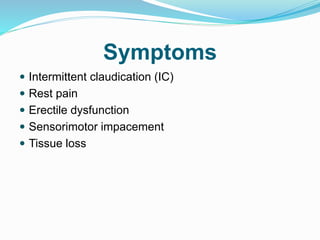
Symptoms
 Intermittent claudication (IC)
 Rest pain
 Erectile dysfunction
 Sensorimotor impacement
 Tissue loss
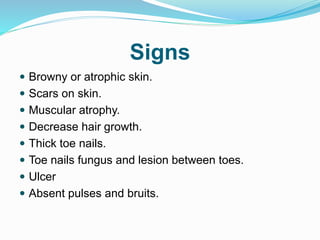
Signs
 Browny or atrophic skin.
 Scars on skin.
 Muscular atrophy.
 Decrease hair growth.
 Thick toe nails.
 Toe nails fungus and lesion between toes.
 Ulcer
 Absent pulses and bruits.
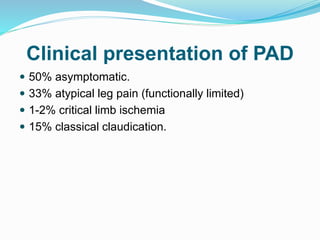
Clinical presentation of PAD
 50% asymptomatic.
 33% atypical leg pain (functionally limited)
 1-2% critical limb ischemia
 15% classical claudication.
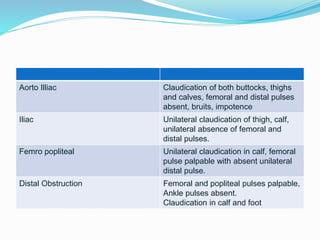
Aorto Illiac Claudication of both buttocks, thighs
and calves, femoral and distal pulses
absent, bruits, impotence
Iliac Unilateral claudication of thigh, calf,
unilateral absence of femoral and
distal pulses.
Femro popliteal Unilateral claudication in calf, femoral
pulse palpable with absent unilateral
distal pulse.
Distal Obstruction Femoral and popliteal pulses palpable,
Ankle pulses absent.
Claudication in calf and foot
Ankle Brachial Index
 Measures systolic BP in both brachial arterie sand
right and left pedal arteries.
 In young healthy pepople ABI  1.1 to 1.3
 Diagnosis of ABI is made if ABI is less than 0.9.
 May be falsely elevated in calcified vessels (DM).
ABI
Normal =>0.90
0.70-0.89 = mild disease
0.50-0.69 = moderate disease
<0.50 = severe disease (rest pain / tissue loss)
 If strongly suspect IC but WNL; measurement of pre
and post exercise test ABI.
 A post exercise decrease of >20% is diagnostic.
Non-invasive testing
 Transcutaneous oximetry (TcPO2) and segmental
perfusion pressure measurements.
 Pulse volume recordings.
 Duplex Scan (also use for follow up of patency post
intervention)
 CT/MRI angiography (non-invasive, no ionizing
radiation, contrast dye; but more artifact)
 Angiogram (gold standard, diagnostic and
therapeutic) invasive, 82% sensitivity
Segmental Pressure
Management
 Measures SDP at multiple levels (upper and lower
thigh, upper call ankle).
 Pressure reductions between levels help to localize
occlusion.
 Normally pressure increase as more further down
the leg (>20mm Hg gradient abnormal).
 Limited with calcified artery walls (DM).
Pulse Volume Recordings
 Pneumatic cuff placed similar to SPM with pulse
volume recorders.
 Caliberated air plethymographic wave form recording
system
 Instead of SBP, measure volume of blood entering
the arterial segment during systole.
 Generates a waveform which normally has rapid
systolic peak and diacrotic notch.
 Not limited by calcification of vessel walls.
SPM & PVR
 Useful in measuring general local and severity of
obstruction.
 Allow for objective monitoring of patients change
over time to serial exams.
 Do not precisely localize disease or distinguish
occlusion from severe stenosis.
Revascularization in PAD
 Limb based interventions should have : low risk;
good durability and demonstrate significant
functional and quality of life improvements over
conservative management (optimal medical therapy
and exercise)
 Exercise and revascularization (endovascular and
open) yield improved limb specific outcomes.
How to exercise for maximal
benefit
Greatest improvement in pain distances occurred with:
 Exercise to near maximal pain
 At least 3 times per week
 Duration of at least 6 months
 Walking as exercise mode
Medications
 Vasodilators (not effective)
 Antiplatelet agents
 Pentoxyfylline (Trental) (improve erythrocyte
deformability; viscosity;  platelet reactivation)
 Cilostazol (Pletoz)
When to refer to vascular
specialist
 Most patients can be managed with risk factor
modification, exercise and pharmacotherapy.
 Arteriography is not required for diagnosis; to be
done when condition required revascularization.
 Therefore referral URL is indicated for:
- Lifestyle limiting cloudification refractory to exercise
and pharmacotherapy
- Evidence of critical Limb ischemia (rest pain or
tissue loss).
Percutaneous Transluminal
Angioplasty
 High initial success rates of 90%.
 Long-term success rates varies from 51-70%.
 Best for stenosis (rather occlusion), short segment
disease, large vessels (iliac); no DM, normal renal
function.
Bypass Surgery
 Generally accepted as most effective treatment for
those with defibrillating PAD.
 In some contexts surgery appears superior
(infrainguinals lesions 5 year patency 38% for PTA
and 80% for surgery)

PERIPHERAL ARTERY DISEASE.pptx

  • 1.
    DR. RAJIV KUMARGUPTA PROFESSOR & HOD Cardiovascular & Thoracic Surgery Dayanand Medical College & Hospital Unit - Hero DMC Heart Institute Ludhiana
  • 2.
    • 2nd mostcommon manifestation of atherosclerosis world wide, affecting >200 million persons. • Approximately 5% men and 2.5% women complain of intermittent claudication by history. • If asymptomatic disease is included (by ABI) 13% of women and 16% of men have peripheral vascular disease. • Only 1% person have critical limb ischemia. • The diagnosis of PAD brings a heightened risk of atherothrombotic events including MI and stroke. • 10% will have MI and 25% have stroke.
  • 3.
    Patient population atrisk for adverse outcomes  Age  65 years of age  Male gender (age over 7.0 risk equalizes)  Diabetes mellitus (more distal and diffuse disease 29% and 7 fold risk of amputation)  Tobacco (risk even stronger than for CAD; with smokers having IC up to 10 years earlier)  Hyperlipidemia  Ankle-brachial index 0.9  PAD with previous revascularization
  • 4.
    Spectrum of PAD Atypical for asymptomatic patients.  Exertion related lower extremity muscular discomfort (calf, buttock or thigh)  Intermittent claudication relieved <10mts after stopping 33% activity  Nocturnal pain and rest pain indicates more severe disease  Life-threatening ischemia
  • 5.
    Diagnostic evalaution  Proximalmuscle symptoms associated with aorto- iliac disease (AI or inflow)  Calf claudication with femoro-popliteal (FP) involvement.  Multi segmental disease correlates with more advanced symptoms.
  • 6.
    Diagnostic evaluation  Historyand physical examination.  Non-classical presentations are more common.  Asymptomatic patients had worst 6 minutes walk test.  Symptoms may be masked in older patients with variety of clinical conditions like joint arthritis, lumbar spine radiculopathy; venous insufficiency.  More prevalence of coronary or cardiovascular diseases.
  • 7.
    Physical examination  Palpateand ausculate peripheral pulses.  Palpate and ausculate abdomen for an Aortic aneurysm.  Inspect condition of skin changes.  Foot examination.  Ankle brachial index.
  • 8.
    Symptoms  Intermittent claudication(IC)  Rest pain  Erectile dysfunction  Sensorimotor impacement  Tissue loss
  • 9.
    Signs  Browny oratrophic skin.  Scars on skin.  Muscular atrophy.  Decrease hair growth.  Thick toe nails.  Toe nails fungus and lesion between toes.  Ulcer  Absent pulses and bruits.
  • 10.
    Clinical presentation ofPAD  50% asymptomatic.  33% atypical leg pain (functionally limited)  1-2% critical limb ischemia  15% classical claudication.
  • 12.
    Aorto Illiac Claudicationof both buttocks, thighs and calves, femoral and distal pulses absent, bruits, impotence Iliac Unilateral claudication of thigh, calf, unilateral absence of femoral and distal pulses. Femro popliteal Unilateral claudication in calf, femoral pulse palpable with absent unilateral distal pulse. Distal Obstruction Femoral and popliteal pulses palpable, Ankle pulses absent. Claudication in calf and foot
  • 13.
    Ankle Brachial Index Measures systolic BP in both brachial arterie sand right and left pedal arteries.  In young healthy pepople ABI  1.1 to 1.3  Diagnosis of ABI is made if ABI is less than 0.9.  May be falsely elevated in calcified vessels (DM).
  • 14.
    ABI Normal =>0.90 0.70-0.89 =mild disease 0.50-0.69 = moderate disease <0.50 = severe disease (rest pain / tissue loss)  If strongly suspect IC but WNL; measurement of pre and post exercise test ABI.  A post exercise decrease of >20% is diagnostic.
  • 15.
    Non-invasive testing  Transcutaneousoximetry (TcPO2) and segmental perfusion pressure measurements.  Pulse volume recordings.  Duplex Scan (also use for follow up of patency post intervention)  CT/MRI angiography (non-invasive, no ionizing radiation, contrast dye; but more artifact)  Angiogram (gold standard, diagnostic and therapeutic) invasive, 82% sensitivity
  • 16.
    Segmental Pressure Management  MeasuresSDP at multiple levels (upper and lower thigh, upper call ankle).  Pressure reductions between levels help to localize occlusion.  Normally pressure increase as more further down the leg (>20mm Hg gradient abnormal).  Limited with calcified artery walls (DM).
  • 17.
    Pulse Volume Recordings Pneumatic cuff placed similar to SPM with pulse volume recorders.  Caliberated air plethymographic wave form recording system  Instead of SBP, measure volume of blood entering the arterial segment during systole.  Generates a waveform which normally has rapid systolic peak and diacrotic notch.  Not limited by calcification of vessel walls.
  • 19.
    SPM & PVR Useful in measuring general local and severity of obstruction.  Allow for objective monitoring of patients change over time to serial exams.  Do not precisely localize disease or distinguish occlusion from severe stenosis.
  • 20.
    Revascularization in PAD Limb based interventions should have : low risk; good durability and demonstrate significant functional and quality of life improvements over conservative management (optimal medical therapy and exercise)  Exercise and revascularization (endovascular and open) yield improved limb specific outcomes.
  • 21.
    How to exercisefor maximal benefit Greatest improvement in pain distances occurred with:  Exercise to near maximal pain  At least 3 times per week  Duration of at least 6 months  Walking as exercise mode
  • 22.
    Medications  Vasodilators (noteffective)  Antiplatelet agents  Pentoxyfylline (Trental) (improve erythrocyte deformability; viscosity;  platelet reactivation)  Cilostazol (Pletoz)
  • 23.
    When to referto vascular specialist  Most patients can be managed with risk factor modification, exercise and pharmacotherapy.  Arteriography is not required for diagnosis; to be done when condition required revascularization.  Therefore referral URL is indicated for: - Lifestyle limiting cloudification refractory to exercise and pharmacotherapy - Evidence of critical Limb ischemia (rest pain or tissue loss).
  • 24.
    Percutaneous Transluminal Angioplasty  Highinitial success rates of 90%.  Long-term success rates varies from 51-70%.  Best for stenosis (rather occlusion), short segment disease, large vessels (iliac); no DM, normal renal function.
  • 25.
    Bypass Surgery  Generallyaccepted as most effective treatment for those with defibrillating PAD.  In some contexts surgery appears superior (infrainguinals lesions 5 year patency 38% for PTA and 80% for surgery)