Chromosomal Anomalies
(Lecture 2)
Dr. Archana Rani
Associate Professor
Department of Anatomy
KGMU UP, Lucknow
30.10.2014
Trisomy of Sex Chromosomes
• Klinefelter syndrome
• Triple X syndrome
• Double Ysyndrome
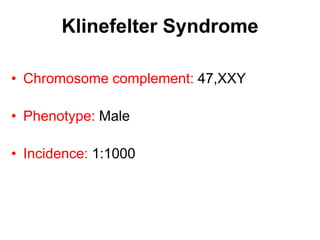
Klinefelter Syndrome
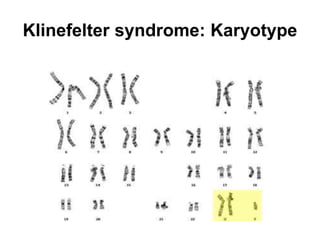
• Chromosome complement: 47,XXY
• Phenotype: Male
• Incidence: 1:1000
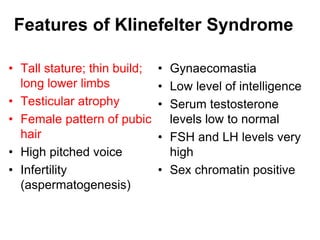
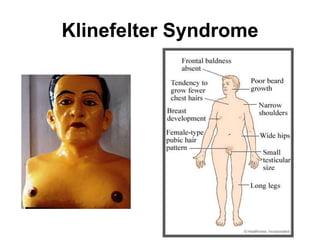
Features of Klinefelter Syndrome
• Tall stature; thin build;
long lower limbs
• Testicular atrophy
• Female pattern of pubic
hair
• High pitched voice
• Infertility
(aspermatogenesis)
• Gynaecomastia
• Low level of intelligence
• Serum testosterone
levels low to normal
• FSH and LH levels very
high
• Sex chromatin positive
Klinefelter syndrome: Karyotype
Klinefelter Syndrome
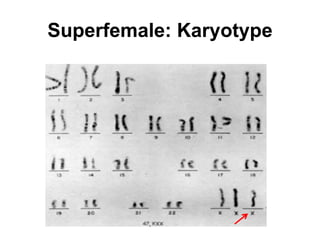
Triple X Syndrome (Superfemale)
• Chromosome complement: 47,XXX
• Phenotype: Female
• Incidence: 1:1000
Features of Triple X Syndrome
• Normal in appearance
• Difficulty in speech,
learning and emotional
responses
• Mild mental retardation
in 15-25% cases
• Two sex chromatin
Barr bodies
• Infertility
• Wide-set eyes
• Amenorrhoea
• Expressionless face
• Enamel hypoplasia
• Deficient language
skills
• Delayed development
of motor skills
Superfemale: Karyotype
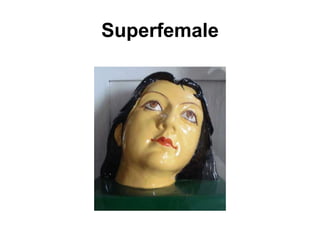
Superfemale
Double Y Syndrome
• Chromosome complement: 47,XYY
• Phenotype: Male
• Incidence: 1:1000
Features of Double Y Syndrome
• Normal in appearance
• Tall stature
• Aggressive behaviour
• Problems in motor and language
development
Monosomies of Chromosomes
• Presence of only one member of a chromosome
pair in a karyotype
• More detrimental than equivalent trisomy
• Can involve autosomes or sex chromosomes
• Usually abort spontaneously
• Monosomy of X chromosome results in XO
condition called Turner syndrome
Turner Syndrome
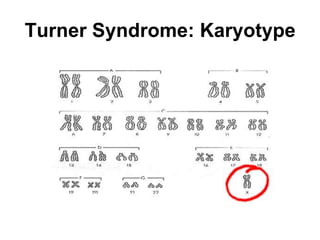
• Chromosome complement: 45,XO
• Phenotype: Female
• Incidence: 1:5000-8000
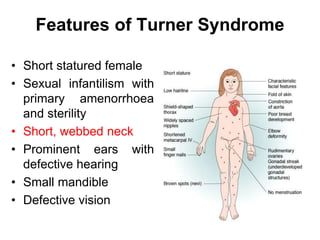
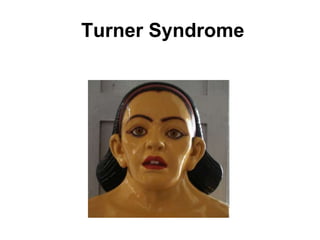
Features of Turner Syndrome
• Short statured female
• Sexual infantilism with
primary amenorrhoea
and sterility
• Short, webbed neck
• Prominent ears with
defective hearing
• Small mandible
• Defective vision
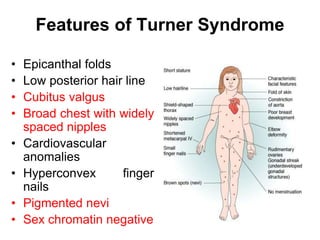
Features of Turner Syndrome
• Epicanthal folds
• Low posterior hair line
• Cubitus valgus
• Broad chest with widely
spaced nipples
• Cardiovascular
anomalies
• Hyperconvex finger
nails
• Pigmented nevi
• Sex chromatin negative
Turner Syndrome: Karyotype
Turner Syndrome
Structural Chromosomal Abnormalities
• Results from chromosome breakage
• Followed by reconstitution in an
abnormal combination
• Breaks in any chromosome may be
induced by various factors
Structural Chromosomal Abnormalities
• Deletion (Deficiency)
• Inversion
• Translocation
• Isochromosome
• Ring Chromosome
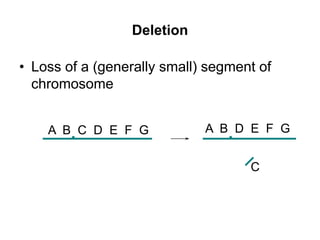
Deletion
• Loss of a (generally small) segment of
chromosome
A B C D E F G A B D E F G
C
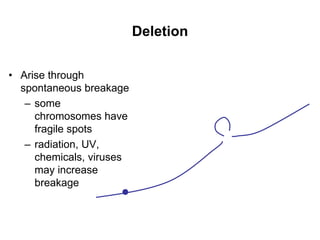
Deletion
• Arise through
spontaneous breakage
– some
chromosomes have
fragile spots
– radiation, UV,
chemicals, viruses
may increase
breakage
Deletion
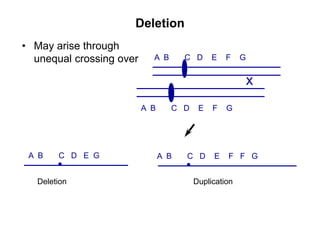
• May arise through
unequal crossing over A B C D E F G
A B C D E F G
x
A B C D E F F G
A B C D E G
Deletion Duplication
Deletions in Humans
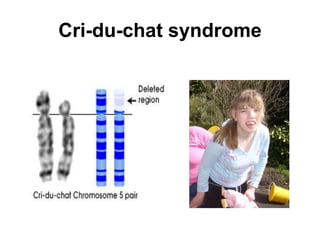
• Cri-du-chat syndrome
– Micro deletion of chromosome 5
• Di-George syndrome
– Micro deletion of chromosome 22
• Schizophrenia & Obsessive Compulsive Disorder
– Micro deletion of chromosome 22 associated
• Angelman syndrome
– Micro deletion of chromosome 15
• Prader-Willi syndrome
– Micro deletion of chromosome 15
Cri-du-chat syndrome
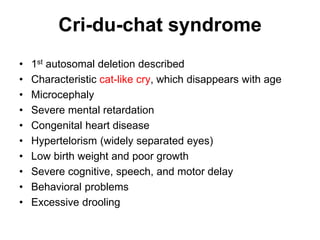
• 1st autosomal deletion described
• Characteristic cat-like cry, which disappears with age
• Microcephaly
• Severe mental retardation
• Congenital heart disease
• Hypertelorism (widely separated eyes)
• Low birth weight and poor growth
• Severe cognitive, speech, and motor delay
• Behavioral problems
• Excessive drooling
Cri-du-chat syndrome
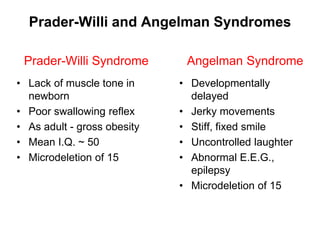
Prader-Willi and Angelman Syndromes
Prader-Willi Syndrome
• Lack of muscle tone in
newborn
• Poor swallowing reflex
• As adult - gross obesity
• Mean I.Q. ~ 50
• Microdeletion of 15
Angelman Syndrome
• Developmentally
delayed
• Jerky movements
• Stiff, fixed smile
• Uncontrolled laughter
• Abnormal E.E.G.,
epilepsy
• Microdeletion of 15
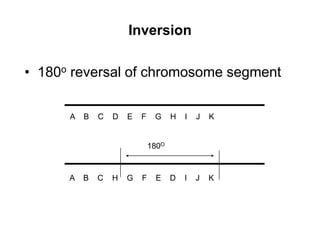
Inversion
• 180o reversal of chromosome segment
A B C D E F G H I J K
A B C H G F E D I J K
180O
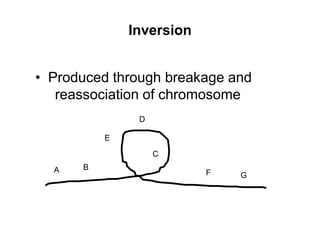
Inversion
• Produced through breakage and
reassociation of chromosome
A B
C
D
E
F G
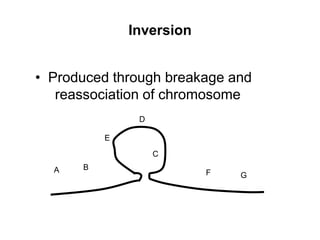
Inversion
• Produced through breakage and
reassociation of chromosome
A B
C
D
E
F G
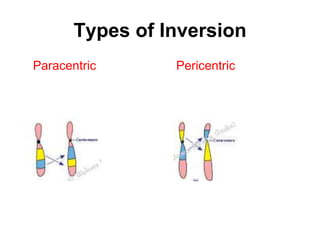
Types of Inversion
Paracentric Pericentric
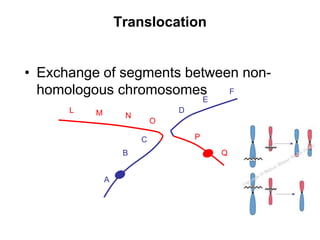
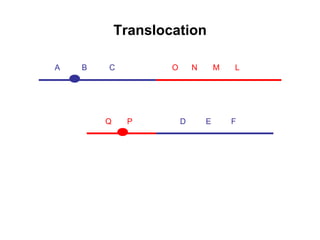
Translocation
• Exchange of segments between non-
homologous chromosomes F
A
B
C
D
E
L M N
O
P
Q
Translocation
A B C
D E F
O N M L
Q P
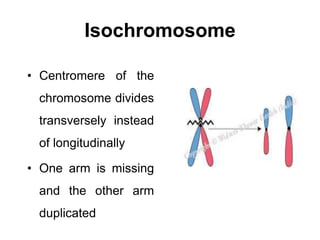
Isochromosome
• Centromere of the
chromosome divides
transversely instead
of longitudinally
• One arm is missing
and the other arm
duplicated
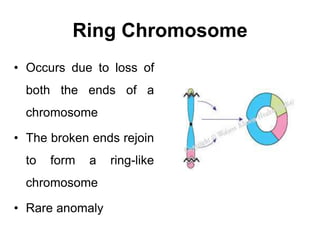
Ring Chromosome
• Occurs due to loss of
both the ends of a
chromosome
• The broken ends rejoin
to form a ring-like
chromosome
• Rare anomaly
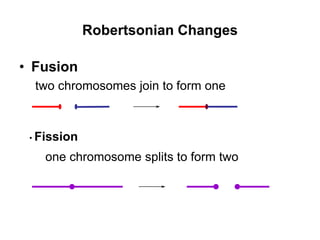
Robertsonian Changes
• Fusion
two chromosomes join to form one
• Fission
one chromosome splits to form two
REFERENCES
1. Essentials of Anatomy for Dentistry
Students,1st Edition.
2. Langman’s Medical Embryology,11th
Edition.
3. Human Embryology, 5th Edition.
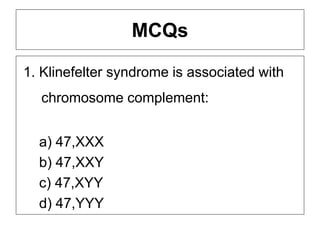
MCQs
1. Klinefelter syndrome is associated with
chromosome complement:
a) 47,XXX
b) 47,XXY
c) 47,XYY
d) 47,YYY
MCQs
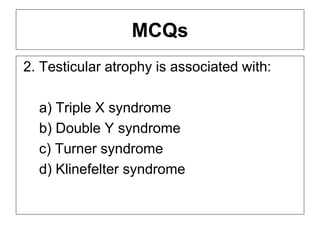
2. Testicular atrophy is associated with:
a) Triple X syndrome
b) Double Y syndrome
c) Turner syndrome
d) Klinefelter syndrome
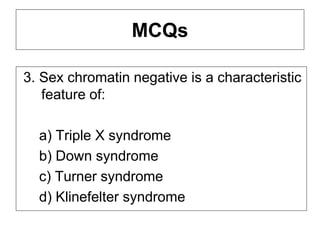
MCQs
3. Sex chromatin negative is a characteristic
feature of:
a) Triple X syndrome
b) Down syndrome
c) Turner syndrome
d) Klinefelter syndrome
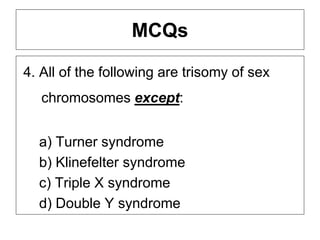
MCQs
4. All of the following are trisomy of sex
chromosomes except:
a) Turner syndrome
b) Klinefelter syndrome
c) Triple X syndrome
d) Double Y syndrome
MCQs
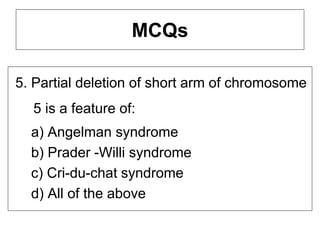
5. Partial deletion of short arm of chromosome
5 is a feature of:
a) Angelman syndrome
b) Prader -Willi syndrome
c) Cri-du-chat syndrome
d) All of the above

Chromosomal anomalies 2.ppt

  • 1.
    Chromosomal Anomalies (Lecture 2) Dr.Archana Rani Associate Professor Department of Anatomy KGMU UP, Lucknow 30.10.2014
  • 2.
    Trisomy of SexChromosomes • Klinefelter syndrome • Triple X syndrome • Double Ysyndrome
  • 3.
    Klinefelter Syndrome • Chromosomecomplement: 47,XXY • Phenotype: Male • Incidence: 1:1000
  • 4.
    Features of KlinefelterSyndrome • Tall stature; thin build; long lower limbs • Testicular atrophy • Female pattern of pubic hair • High pitched voice • Infertility (aspermatogenesis) • Gynaecomastia • Low level of intelligence • Serum testosterone levels low to normal • FSH and LH levels very high • Sex chromatin positive
  • 5.
  • 6.
  • 7.
    Triple X Syndrome(Superfemale) • Chromosome complement: 47,XXX • Phenotype: Female • Incidence: 1:1000
  • 8.
    Features of TripleX Syndrome • Normal in appearance • Difficulty in speech, learning and emotional responses • Mild mental retardation in 15-25% cases • Two sex chromatin Barr bodies • Infertility • Wide-set eyes • Amenorrhoea • Expressionless face • Enamel hypoplasia • Deficient language skills • Delayed development of motor skills
  • 9.
  • 10.
  • 11.
    Double Y Syndrome •Chromosome complement: 47,XYY • Phenotype: Male • Incidence: 1:1000
  • 12.
    Features of DoubleY Syndrome • Normal in appearance • Tall stature • Aggressive behaviour • Problems in motor and language development
  • 13.
    Monosomies of Chromosomes •Presence of only one member of a chromosome pair in a karyotype • More detrimental than equivalent trisomy • Can involve autosomes or sex chromosomes • Usually abort spontaneously • Monosomy of X chromosome results in XO condition called Turner syndrome
  • 14.
    Turner Syndrome • Chromosomecomplement: 45,XO • Phenotype: Female • Incidence: 1:5000-8000
  • 15.
    Features of TurnerSyndrome • Short statured female • Sexual infantilism with primary amenorrhoea and sterility • Short, webbed neck • Prominent ears with defective hearing • Small mandible • Defective vision
  • 16.
    Features of TurnerSyndrome • Epicanthal folds • Low posterior hair line • Cubitus valgus • Broad chest with widely spaced nipples • Cardiovascular anomalies • Hyperconvex finger nails • Pigmented nevi • Sex chromatin negative
  • 17.
  • 18.
  • 19.
    Structural Chromosomal Abnormalities •Results from chromosome breakage • Followed by reconstitution in an abnormal combination • Breaks in any chromosome may be induced by various factors
  • 20.
    Structural Chromosomal Abnormalities •Deletion (Deficiency) • Inversion • Translocation • Isochromosome • Ring Chromosome
  • 21.
    Deletion • Loss ofa (generally small) segment of chromosome A B C D E F G A B D E F G C
  • 22.
    Deletion • Arise through spontaneousbreakage – some chromosomes have fragile spots – radiation, UV, chemicals, viruses may increase breakage
  • 23.
    Deletion • May arisethrough unequal crossing over A B C D E F G A B C D E F G x A B C D E F F G A B C D E G Deletion Duplication
  • 24.
    Deletions in Humans •Cri-du-chat syndrome – Micro deletion of chromosome 5 • Di-George syndrome – Micro deletion of chromosome 22 • Schizophrenia & Obsessive Compulsive Disorder – Micro deletion of chromosome 22 associated • Angelman syndrome – Micro deletion of chromosome 15 • Prader-Willi syndrome – Micro deletion of chromosome 15
  • 25.
    Cri-du-chat syndrome • 1stautosomal deletion described • Characteristic cat-like cry, which disappears with age • Microcephaly • Severe mental retardation • Congenital heart disease • Hypertelorism (widely separated eyes) • Low birth weight and poor growth • Severe cognitive, speech, and motor delay • Behavioral problems • Excessive drooling
  • 26.
  • 27.
    Prader-Willi and AngelmanSyndromes Prader-Willi Syndrome • Lack of muscle tone in newborn • Poor swallowing reflex • As adult - gross obesity • Mean I.Q. ~ 50 • Microdeletion of 15 Angelman Syndrome • Developmentally delayed • Jerky movements • Stiff, fixed smile • Uncontrolled laughter • Abnormal E.E.G., epilepsy • Microdeletion of 15
  • 28.
    Inversion • 180o reversalof chromosome segment A B C D E F G H I J K A B C H G F E D I J K 180O
  • 29.
    Inversion • Produced throughbreakage and reassociation of chromosome A B C D E F G
  • 30.
    Inversion • Produced throughbreakage and reassociation of chromosome A B C D E F G
  • 31.
  • 32.
    Translocation • Exchange ofsegments between non- homologous chromosomes F A B C D E L M N O P Q
  • 33.
    Translocation A B C DE F O N M L Q P
  • 34.
    Isochromosome • Centromere ofthe chromosome divides transversely instead of longitudinally • One arm is missing and the other arm duplicated
  • 35.
    Ring Chromosome • Occursdue to loss of both the ends of a chromosome • The broken ends rejoin to form a ring-like chromosome • Rare anomaly
  • 36.
    Robertsonian Changes • Fusion twochromosomes join to form one • Fission one chromosome splits to form two
  • 37.
    REFERENCES 1. Essentials ofAnatomy for Dentistry Students,1st Edition. 2. Langman’s Medical Embryology,11th Edition. 3. Human Embryology, 5th Edition.
  • 38.
    MCQs 1. Klinefelter syndromeis associated with chromosome complement: a) 47,XXX b) 47,XXY c) 47,XYY d) 47,YYY
  • 39.
    MCQs 2. Testicular atrophyis associated with: a) Triple X syndrome b) Double Y syndrome c) Turner syndrome d) Klinefelter syndrome
  • 40.
    MCQs 3. Sex chromatinnegative is a characteristic feature of: a) Triple X syndrome b) Down syndrome c) Turner syndrome d) Klinefelter syndrome
  • 41.
    MCQs 4. All ofthe following are trisomy of sex chromosomes except: a) Turner syndrome b) Klinefelter syndrome c) Triple X syndrome d) Double Y syndrome
  • 42.
    MCQs 5. Partial deletionof short arm of chromosome 5 is a feature of: a) Angelman syndrome b) Prader -Willi syndrome c) Cri-du-chat syndrome d) All of the above