Chromatography &
PCR
Dr. Yash N. Panchal
Resident doctor
Pharmacology Department
AMC MET Medical college
08/10/2021 1
Presentation Layout
 Chromatography TLC : Principle
 Principle of Chromatography : Instrumentation
 Types of Chromatography : Procedure
 HPLC : Type : Application
: Components : Advantages & Disadvantages
: Procedure
: Coupling with MS PCR : Principle
: Application : Procedure
: Advantages & Disadvantages : Types , Application , Advantages
What is Chromatography ?
Chromatography
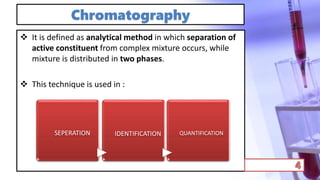
 It is defined as analytical method in which separation of
active constituent from complex mixture occurs, while
mixture is distributed in two phases.
 This technique is used in :
SEPERATION IDENTIFICATION QUANTIFICATION
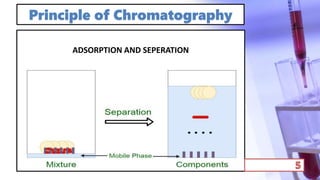
Principle of Chromatography
ADSORPTION AND SEPERATION
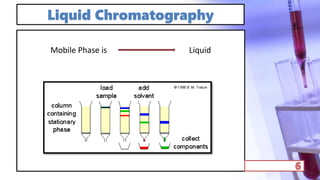
Liquid Chromatography
Mobile Phase is Liquid
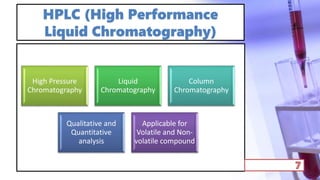
HPLC (High Performance
Liquid Chromatography)
High Pressure
Chromatography
Liquid
Chromatography
Column
Chromatography
Qualitative and
Quantitative
analysis
Applicable for
Volatile and Non-
volatile compound
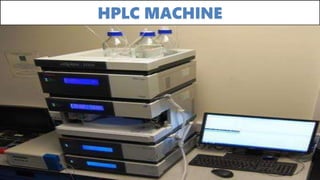
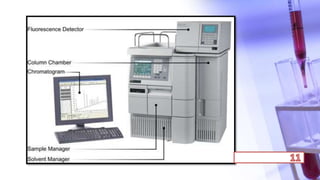
HPLC MACHINE
8
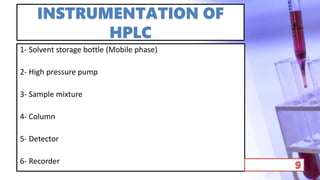
INSTRUMENTATION OF
HPLC
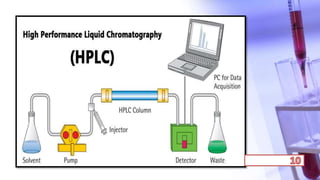
1- Solvent storage bottle (Mobile phase)
2- High pressure pump
3- Sample mixture
4- Column
5- Detector
6- Recorder
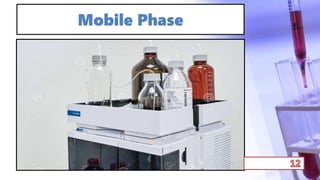
Mobile Phase
Mobile Phase
As it moves, so called as Mobile Phase
Liquid mobile phase is used in HPLC
Is mixture of solvent- polar/non-polar
Contained is glass of stainless steel, capable of holding 1L of solvent
Solvent selection, depends on Stationary phase
Degassing of Mobile Phase
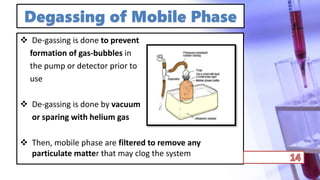
 De-gassing is done to prevent
formation of gas-bubbles in
the pump or detector prior to
use
 De-gassing is done by vacuum
or sparing with helium gas
 Then, mobile phase are filtered to remove any
particulate matter that may clog the system
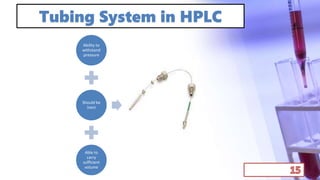
Tubing System in HPLC
Ability to
withstand
pressure
Should be
Inert
Able to
carry
sufficient
volume
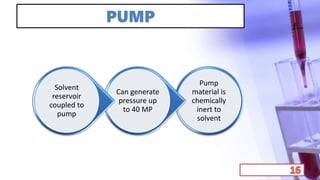
PUMP
Pump
material is
chemically
inert to
solvent
Can generate
pressure up
to 40 MP
Solvent
reservoir
coupled to
pump
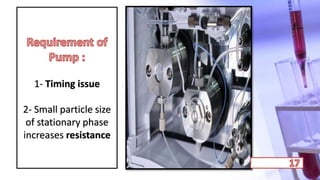
1- Timing issue
2- Small particle size
of stationary phase
increases resistance
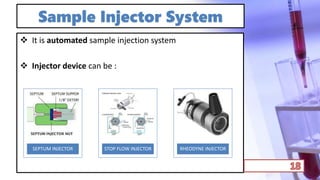
Sample Injector System
 It is automated sample injection system
 Injector device can be :
SEPTUM INJECTOR STOP FLOW INJECTOR RHEODYNE INJECTOR
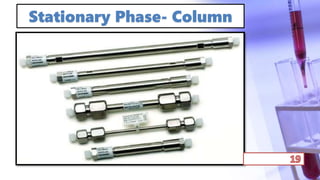
Stationary Phase- Column
 Made of stainless steel
 Can withstand pressure up to 50 MP
 Length : 5-25 cm
 Internal diameter : 4.6 mm
 Flow of solvent : 1-3 ml/minute
 Contains adsorbent (Stationary phase ) of smaller particle size
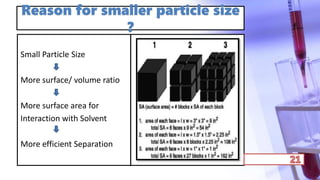
Reason for smaller particle size
?
Small Particle Size
More surface/ volume ratio
More surface area for
Interaction with Solvent
More efficient Separation
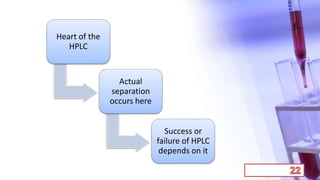
Heart of the
HPLC
Actual
separation
occurs here
Success or
failure of HPLC
depends on it
Stationary Phase material
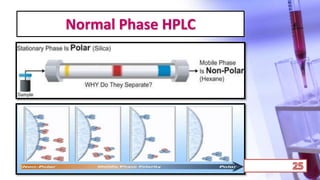
 Silica or Alumina ( of 5-10 micron ) commonly used
 The separation is the result of different components
adhering to or diffusion into the packing particles when
the mobile phase is forced through the column
 Selection of mobile phase depends on stationary phase
material
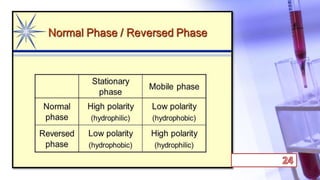
Normal Phase HPLC
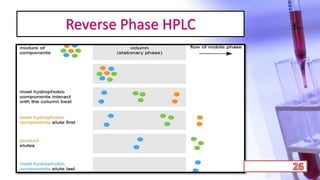
Reverse Phase HPLC
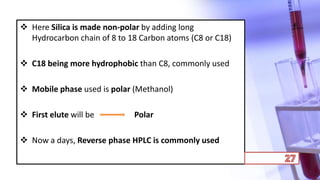
 Here Silica is made non-polar by adding long
Hydrocarbon chain of 8 to 18 Carbon atoms (C8 or C18)
 C18 being more hydrophobic than C8, commonly used
 Mobile phase used is polar (Methanol)
 First elute will be Polar
 Now a days, Reverse phase HPLC is commonly used
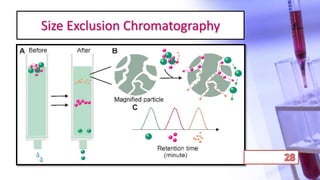
Size Exclusion Chromatography
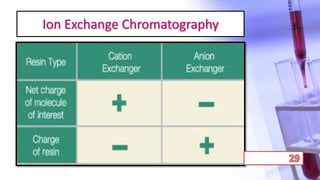
Ion Exchange Chromatography
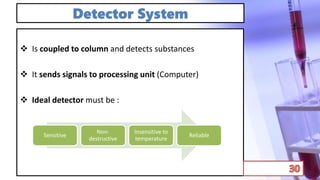
Detector System
 Is coupled to column and detects substances
 It sends signals to processing unit (Computer)
 Ideal detector must be :
Sensitive
Non-
destructive
Insensitive to
temperature
Reliable
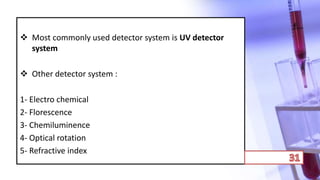
 Most commonly used detector system is UV detector
system
 Other detector system :
1- Electro chemical
2- Florescence
3- Chemiluminence
4- Optical rotation
5- Refractive index
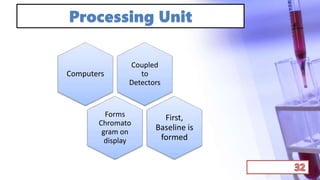
Processing Unit
Coupled
to
Detectors
Computers
Forms
Chromato
gram on
display
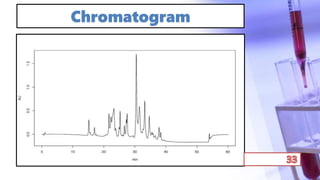
First,
Baseline is
formed
Chromatogram
Interpretation of
Chromatogram
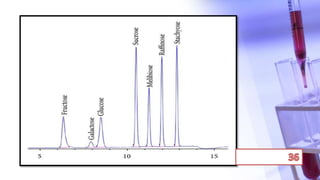
 It is the time required for individual compound to pass
from the column
 Measured from time of sample administration to peak of
that particular compound
 Different compounds have different unique R.T.
Continued…
 Retention time depends on
1- Pressure applied by pump
2- Nature and size of stationary phase molecules
3- Composition of solvent
4- Temperature of Column
Quantification of
Compounds
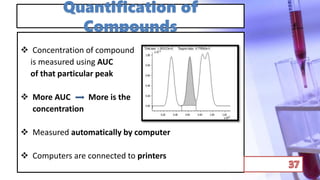
 Concentration of compound
is measured using AUC
of that particular peak
 More AUC More is the
concentration
 Measured automatically by computer
 Computers are connected to printers
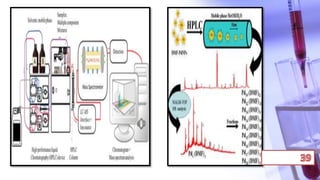
Coupling of HPLC with Mass
spectrometer
 When detector is showing the peak, some of what
substance is passing through the detector at that time
can be diverted to a mass spectrometer
 There it will form Fragmentation pattern
 Pattern can be compared against a computer database
of known pattern
 Identity of substance can be found without having to
know their retention time
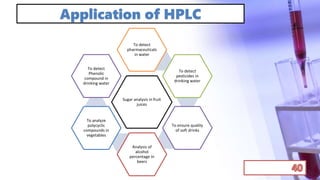
Application of HPLC
Sugar analysis in fruit
juices
To detect
pharmaceuticals
in water
To detect
pesticides in
drinking water
To ensure quality
of soft drinks
Analysis of
alcohol
percentage in
beers
To analyze
polycyclic
compounds in
vegetables
To detect
Phenolic
compound in
drinking water
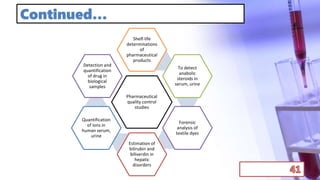
Continued…
Pharmaceutical
quality control
studies
Shelf-life
determinations
of
pharmaceutical
products
To detect
anabolic
steroids in
serum, urine
Forensic
analysis of
textile dyes
Estimation of
bilirubin and
biliverdin in
hepatic
disorders
Quantification
of ions in
human serum,
urine
Detection and
quantification
of drug in
biological
samples
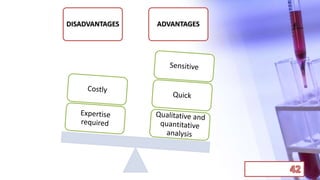
DISADVANTAGES ADVANTAGES
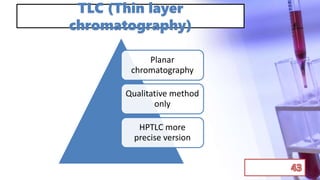
TLC (Thin layer
chromatography)
Planar
chromatography
Qualitative method
only
HPTLC more
precise version
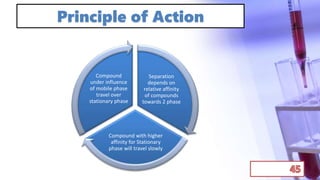
Principle of Action
Separation
depends on
relative affinity
of compounds
towards 2 phase
Compound with higher
affinity for Stationary
phase will travel slowly
Compound
under influence
of mobile phase
travel over
stationary phase
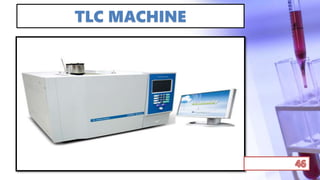
TLC MACHINE
Instrumentation of TLC
1- TLC Plates
2- TLC Chamber
3- Mobile phase
4- Filter paper
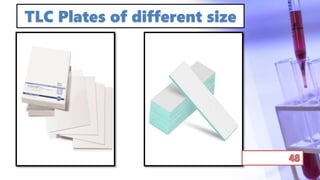
TLC Plates of different size
TLC Plates
1
• Readymade available in market, where aluminum base is used
2
• Can also prepare in lab by using glass slide as a base, where
Stationary phase is applied over it
3
• Readymade plate is preferred
4
• Any side is taken as base, and above 1 cm from base line by pencil is
made
5
• TLC plate, after preparing kept in TLC Chambers
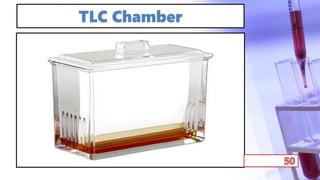
TLC Chamber
TLC Chamber
 Contains mobile phase as a solvent
 Mobile phase used, should be particulate free and of
highest purity for proper development of Spots
 Solvent used, should be chemically inert to sample and
stationary phase
 A moistened filter paper is placed onto wall of chamber
to maintain humidity and Edge effect
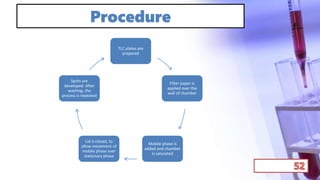
Procedure
TLC plates are
prepared
Filter paper is
applied over the
wall of chamber
Mobile phase is
added and chamber
is saturated
Lid is closed, to
allow movement of
mobile phase over
stationary phase
Spots are
developed. After
washing, the
process is repeated
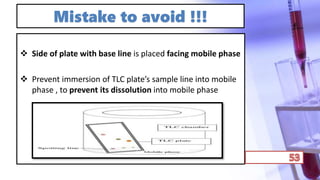
Mistake to avoid !!!
 Side of plate with base line is placed facing mobile phase
 Prevent immersion of TLC plate’s sample line into mobile
phase , to prevent its dissolution into mobile phase
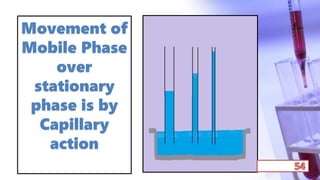
Movement of
Mobile Phase
over
stationary
phase is by
Capillary
action
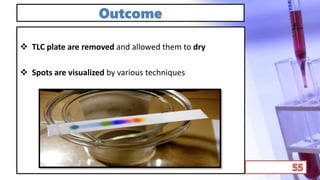
Outcome
 TLC plate are removed and allowed them to dry
 Spots are visualized by various techniques
Polyphenol are
visualized by putting
it in UV light
chamber
For Basic substance,
dip in acid, allow to
dry and then heat it
Brown spots
Iodine vapor
treatment for C=C
compounds
Valinine stain for
alcohol and
aldehyde
Ninhydrin test for
amino acids
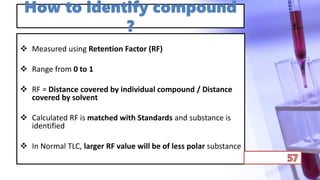
How to identify compound
?
 Measured using Retention Factor (RF)
 Range from 0 to 1
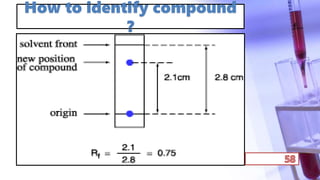
 RF = Distance covered by individual compound / Distance
covered by solvent
 Calculated RF is matched with Standards and substance is
identified
 In Normal TLC, larger RF value will be of less polar substance
How to identify compound
?
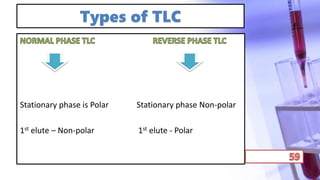
Types of TLC
Stationary phase is Polar Stationary phase Non-polar
1st elute – Non-polar 1st elute - Polar
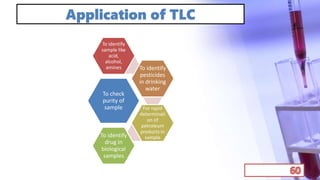
Application of TLC
To check
purity of
sample
To identify
sample like
acid,
alcohol,
amines To identify
pesticides
in drinking
water
For rapid
determinati
on of
petroleum
products in
sample
To identify
drug in
biological
samples
DISADVANTAGES
• Time consuming
• Spots larger than 2mm
overlap
• Long streak sometimes
formed rather than spots
ADVANTAGES
• Simple process
• Cheaper
• Purity standards of given
sample can be assessed
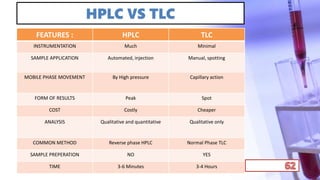
HPLC VS TLC
FEATURES : HPLC TLC
INSTRUMENTATION Much Minimal
SAMPLE APPLICATION Automated, injection Manual, spotting
MOBILE PHASE MOVEMENT By High pressure Capillary action
FORM OF RESULTS Peak Spot
COST Costly Cheaper
ANALYSIS Qualitative and quantitative Qualitative only
COMMON METHOD Reverse phase HPLC Normal Phase TLC
SAMPLE PREPERATION NO YES
TIME 3-6 Minutes 3-4 Hours
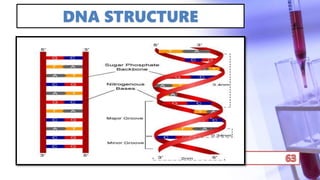
DNA STRUCTURE
PCR (Polymerase Chain
Reaction)
Used to amplify single copy of DNA to thousands
of copies
Amplify specific DNA fragments from minute
quantity, even that DNA is of poor quality
On of the those few scientific revolutionary
development
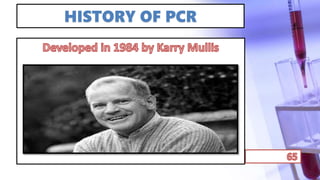
HISTORY OF PCR
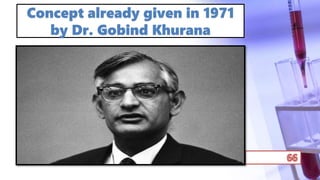
Concept already given in 1971
by Dr. Gobind Khurana
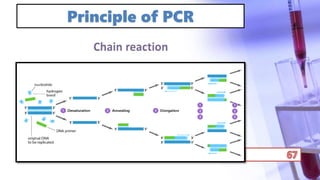
Principle of PCR
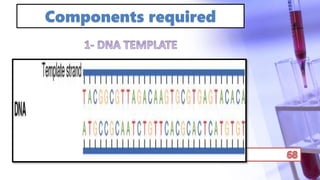
Components required
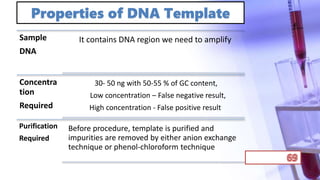
Properties of DNA Template
Sample
DNA
It contains DNA region we need to amplify
Concentra
tion
Required
30- 50 ng with 50-55 % of GC content,
Low concentration – False negative result,
High concentration - False positive result
Purification
Required
Before procedure, template is purified and
impurities are removed by either anion exchange
technique or phenol-chloroform technique
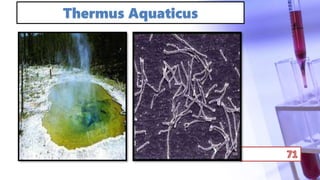
Thermus Aquaticus
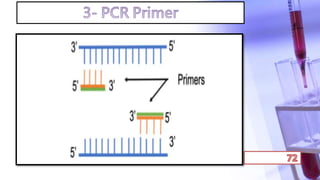
Is short sequence of
Nucleotide
20 Nucleotide
containing single DNA
strand
< 10 and > 20
Nucleotide are not
recommended
2 Primers are used in
each PCR reaction
They are designed
(given sequence) that
they bind to opposite
strand of template
DNTP is building block of DNA molecule
• Consist of Phosphate group, deoxyribose sugar, and
nitrogenous base – adenine, guanine (Purine), thymine
and cytosine (Pyrimidine)
Function of DNTP is to expand DNA strand in
presence of Taq polymerase
• It binds with complementary DNA strand by Hydrogen
bond
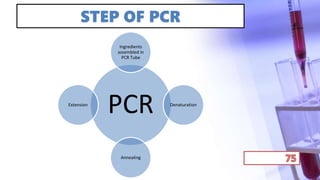
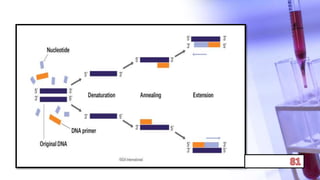
STEP OF PCR
PCR
Ingredients
assembled in
PCR Tube
Denaturation
Annealing
Extension
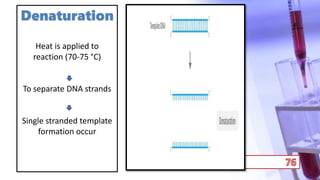
Denaturation
Heat is applied to
reaction (70-75 °C)
To separate DNA strands
Single stranded template
formation occur
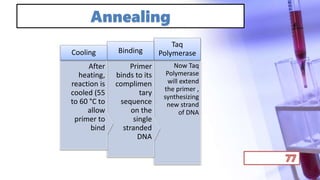
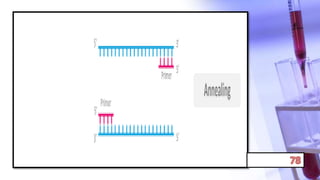
Annealing
Now Taq
Polymerase
will extend
the primer ,
synthesizing
new strand
of DNA
Taq
Polymerase
Primer
binds to its
complimen
tary
sequence
on the
single
stranded
DNA
Binding
After
heating,
reaction is
cooled (55
to 60 °C to
allow
primer to
bind
Cooling
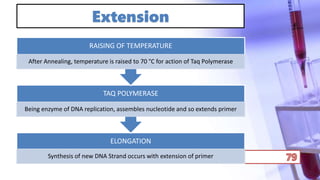
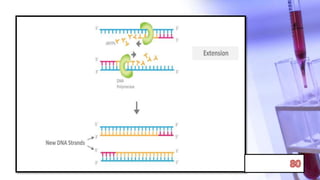
Extension
ELONGATION
Synthesis of new DNA Strand occurs with extension of primer
TAQ POLYMERASE
Being enzyme of DNA replication, assembles nucleotide and so extends primer
RAISING OF TEMPERATURE
After Annealing, temperature is raised to 70 °C for action of Taq Polymerase
Cycle and Timing
 Cycle repeats 25-35 times in one PCR reaction
 One PCR reaction takes 3-4 hrs. to complete
 Time duration, depends upon length of DNA
region to be copied
 If reaction is efficient, target region can go from
one or a few copies to billions
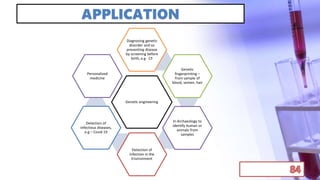
APPLICATION
Genetic engineering
Diagnosing genetic
disorder and so
preventing disease
by screening before
birth, e.g - CF
Genetic
fingerprinting –
from sample of
blood, semen, hair
In Archaeology to
identify human or
animals from
samples
Detection of
Infection in the
Environment
Detection of
infectious diseases,
e.g – Covid 19
Personalized
medicine
Types of PCR
 Here Complimentary DNA (CDNA) is created by
transcription from RNA
 Then formation of dsDNA done, then by PCR, Gene
expression is qualitatively studied using RTPCR
 Test for qualitative detection of nucleic acid from SARS-
CoV-2
 Aka Real time PCR
 Allow quantification of target species, that is total
bacterial count in chemical sample
 By adding dye like Sybr green, the florescence signal is
proportional to amount of DNA synthesized
 Used for the identification of species that inhabit humans
, e.g- Malaria
 Multiple primer pairs are used for concomitant
detection of different species
 Is modification of PCR, that reduces non-specific binding
of primary product, limiting non specific products
References
• Murray, Robert K. Harper's Illustrated Biochemistry. New York: McGraw-Hill, 2003. Print.
• Harvey, Richard A., Ph. D. Lippincott's Illustrated Reviews: Biochemistry. Philadelphia :Wolters Kluwer
Health, 2011.
• Kumar, Vinay, et al. Robbins Basic Pathology. 10th ed., Elsevier - Health Sciences Division, 2017.
• Postgraduate Pharmacology 1st Edition 2020 by Sougata Sarkar.
• Hearn, Milton TW. "High–Performance Liquid Chromatography and Its Application to Protein
Chemistry." Advances in chromatography (2021): 1-82.
• Jalil, Abduladheem Turki, et al. "Polymerase chain reaction technique for molecular detection of HPV16
infections among women with cervical cancer in Dhi-Qar Province." Materials Today:
Proceedings (2021).
90

Chromatography & PCR

  • 1.
    Chromatography & PCR Dr. YashN. Panchal Resident doctor Pharmacology Department AMC MET Medical college 08/10/2021 1
  • 2.
    Presentation Layout  ChromatographyTLC : Principle  Principle of Chromatography : Instrumentation  Types of Chromatography : Procedure  HPLC : Type : Application : Components : Advantages & Disadvantages : Procedure : Coupling with MS PCR : Principle : Application : Procedure : Advantages & Disadvantages : Types , Application , Advantages
  • 3.
  • 4.
    Chromatography  It isdefined as analytical method in which separation of active constituent from complex mixture occurs, while mixture is distributed in two phases.  This technique is used in : SEPERATION IDENTIFICATION QUANTIFICATION
  • 5.
  • 6.
  • 7.
    HPLC (High Performance LiquidChromatography) High Pressure Chromatography Liquid Chromatography Column Chromatography Qualitative and Quantitative analysis Applicable for Volatile and Non- volatile compound
  • 8.
  • 9.
    INSTRUMENTATION OF HPLC 1- Solventstorage bottle (Mobile phase) 2- High pressure pump 3- Sample mixture 4- Column 5- Detector 6- Recorder
  • 12.
  • 13.
    Mobile Phase As itmoves, so called as Mobile Phase Liquid mobile phase is used in HPLC Is mixture of solvent- polar/non-polar Contained is glass of stainless steel, capable of holding 1L of solvent Solvent selection, depends on Stationary phase
  • 14.
    Degassing of MobilePhase  De-gassing is done to prevent formation of gas-bubbles in the pump or detector prior to use  De-gassing is done by vacuum or sparing with helium gas  Then, mobile phase are filtered to remove any particulate matter that may clog the system
  • 15.
    Tubing System inHPLC Ability to withstand pressure Should be Inert Able to carry sufficient volume
  • 16.
    PUMP Pump material is chemically inert to solvent Cangenerate pressure up to 40 MP Solvent reservoir coupled to pump
  • 17.
    1- Timing issue 2-Small particle size of stationary phase increases resistance
  • 18.
    Sample Injector System It is automated sample injection system  Injector device can be : SEPTUM INJECTOR STOP FLOW INJECTOR RHEODYNE INJECTOR
  • 19.
  • 20.
     Made ofstainless steel  Can withstand pressure up to 50 MP  Length : 5-25 cm  Internal diameter : 4.6 mm  Flow of solvent : 1-3 ml/minute  Contains adsorbent (Stationary phase ) of smaller particle size
  • 21.
    Reason for smallerparticle size ? Small Particle Size More surface/ volume ratio More surface area for Interaction with Solvent More efficient Separation
  • 22.
    Heart of the HPLC Actual separation occurshere Success or failure of HPLC depends on it
  • 23.
    Stationary Phase material Silica or Alumina ( of 5-10 micron ) commonly used  The separation is the result of different components adhering to or diffusion into the packing particles when the mobile phase is forced through the column  Selection of mobile phase depends on stationary phase material
  • 25.
  • 26.
  • 27.
     Here Silicais made non-polar by adding long Hydrocarbon chain of 8 to 18 Carbon atoms (C8 or C18)  C18 being more hydrophobic than C8, commonly used  Mobile phase used is polar (Methanol)  First elute will be Polar  Now a days, Reverse phase HPLC is commonly used
  • 28.
  • 29.
  • 30.
    Detector System  Iscoupled to column and detects substances  It sends signals to processing unit (Computer)  Ideal detector must be : Sensitive Non- destructive Insensitive to temperature Reliable
  • 31.
     Most commonlyused detector system is UV detector system  Other detector system : 1- Electro chemical 2- Florescence 3- Chemiluminence 4- Optical rotation 5- Refractive index
  • 32.
  • 33.
  • 34.
    Interpretation of Chromatogram  Itis the time required for individual compound to pass from the column  Measured from time of sample administration to peak of that particular compound  Different compounds have different unique R.T.
  • 35.
    Continued…  Retention timedepends on 1- Pressure applied by pump 2- Nature and size of stationary phase molecules 3- Composition of solvent 4- Temperature of Column
  • 37.
    Quantification of Compounds  Concentrationof compound is measured using AUC of that particular peak  More AUC More is the concentration  Measured automatically by computer  Computers are connected to printers
  • 38.
    Coupling of HPLCwith Mass spectrometer  When detector is showing the peak, some of what substance is passing through the detector at that time can be diverted to a mass spectrometer  There it will form Fragmentation pattern  Pattern can be compared against a computer database of known pattern  Identity of substance can be found without having to know their retention time
  • 40.
    Application of HPLC Sugaranalysis in fruit juices To detect pharmaceuticals in water To detect pesticides in drinking water To ensure quality of soft drinks Analysis of alcohol percentage in beers To analyze polycyclic compounds in vegetables To detect Phenolic compound in drinking water
  • 41.
    Continued… Pharmaceutical quality control studies Shelf-life determinations of pharmaceutical products To detect anabolic steroidsin serum, urine Forensic analysis of textile dyes Estimation of bilirubin and biliverdin in hepatic disorders Quantification of ions in human serum, urine Detection and quantification of drug in biological samples
  • 42.
  • 43.
  • 45.
    Principle of Action Separation dependson relative affinity of compounds towards 2 phase Compound with higher affinity for Stationary phase will travel slowly Compound under influence of mobile phase travel over stationary phase
  • 46.
  • 47.
    Instrumentation of TLC 1-TLC Plates 2- TLC Chamber 3- Mobile phase 4- Filter paper
  • 48.
    TLC Plates ofdifferent size
  • 49.
    TLC Plates 1 • Readymadeavailable in market, where aluminum base is used 2 • Can also prepare in lab by using glass slide as a base, where Stationary phase is applied over it 3 • Readymade plate is preferred 4 • Any side is taken as base, and above 1 cm from base line by pencil is made 5 • TLC plate, after preparing kept in TLC Chambers
  • 50.
  • 51.
    TLC Chamber  Containsmobile phase as a solvent  Mobile phase used, should be particulate free and of highest purity for proper development of Spots  Solvent used, should be chemically inert to sample and stationary phase  A moistened filter paper is placed onto wall of chamber to maintain humidity and Edge effect
  • 52.
    Procedure TLC plates are prepared Filterpaper is applied over the wall of chamber Mobile phase is added and chamber is saturated Lid is closed, to allow movement of mobile phase over stationary phase Spots are developed. After washing, the process is repeated
  • 53.
    Mistake to avoid!!!  Side of plate with base line is placed facing mobile phase  Prevent immersion of TLC plate’s sample line into mobile phase , to prevent its dissolution into mobile phase
  • 54.
  • 55.
    Outcome  TLC plateare removed and allowed them to dry  Spots are visualized by various techniques
  • 56.
    Polyphenol are visualized byputting it in UV light chamber For Basic substance, dip in acid, allow to dry and then heat it Brown spots Iodine vapor treatment for C=C compounds Valinine stain for alcohol and aldehyde Ninhydrin test for amino acids
  • 57.
    How to identifycompound ?  Measured using Retention Factor (RF)  Range from 0 to 1  RF = Distance covered by individual compound / Distance covered by solvent  Calculated RF is matched with Standards and substance is identified  In Normal TLC, larger RF value will be of less polar substance
  • 58.
    How to identifycompound ?
  • 59.
    Types of TLC Stationaryphase is Polar Stationary phase Non-polar 1st elute – Non-polar 1st elute - Polar
  • 60.
    Application of TLC Tocheck purity of sample To identify sample like acid, alcohol, amines To identify pesticides in drinking water For rapid determinati on of petroleum products in sample To identify drug in biological samples
  • 61.
    DISADVANTAGES • Time consuming •Spots larger than 2mm overlap • Long streak sometimes formed rather than spots ADVANTAGES • Simple process • Cheaper • Purity standards of given sample can be assessed
  • 62.
    HPLC VS TLC FEATURES: HPLC TLC INSTRUMENTATION Much Minimal SAMPLE APPLICATION Automated, injection Manual, spotting MOBILE PHASE MOVEMENT By High pressure Capillary action FORM OF RESULTS Peak Spot COST Costly Cheaper ANALYSIS Qualitative and quantitative Qualitative only COMMON METHOD Reverse phase HPLC Normal Phase TLC SAMPLE PREPERATION NO YES TIME 3-6 Minutes 3-4 Hours
  • 63.
  • 64.
    PCR (Polymerase Chain Reaction) Usedto amplify single copy of DNA to thousands of copies Amplify specific DNA fragments from minute quantity, even that DNA is of poor quality On of the those few scientific revolutionary development
  • 65.
  • 66.
    Concept already givenin 1971 by Dr. Gobind Khurana
  • 67.
  • 68.
  • 69.
    Properties of DNATemplate Sample DNA It contains DNA region we need to amplify Concentra tion Required 30- 50 ng with 50-55 % of GC content, Low concentration – False negative result, High concentration - False positive result Purification Required Before procedure, template is purified and impurities are removed by either anion exchange technique or phenol-chloroform technique
  • 71.
  • 73.
    Is short sequenceof Nucleotide 20 Nucleotide containing single DNA strand < 10 and > 20 Nucleotide are not recommended 2 Primers are used in each PCR reaction They are designed (given sequence) that they bind to opposite strand of template
  • 74.
    DNTP is buildingblock of DNA molecule • Consist of Phosphate group, deoxyribose sugar, and nitrogenous base – adenine, guanine (Purine), thymine and cytosine (Pyrimidine) Function of DNTP is to expand DNA strand in presence of Taq polymerase • It binds with complementary DNA strand by Hydrogen bond
  • 75.
    STEP OF PCR PCR Ingredients assembledin PCR Tube Denaturation Annealing Extension
  • 76.
    Denaturation Heat is appliedto reaction (70-75 °C) To separate DNA strands Single stranded template formation occur
  • 77.
    Annealing Now Taq Polymerase will extend theprimer , synthesizing new strand of DNA Taq Polymerase Primer binds to its complimen tary sequence on the single stranded DNA Binding After heating, reaction is cooled (55 to 60 °C to allow primer to bind Cooling
  • 79.
    Extension ELONGATION Synthesis of newDNA Strand occurs with extension of primer TAQ POLYMERASE Being enzyme of DNA replication, assembles nucleotide and so extends primer RAISING OF TEMPERATURE After Annealing, temperature is raised to 70 °C for action of Taq Polymerase
  • 82.
    Cycle and Timing Cycle repeats 25-35 times in one PCR reaction  One PCR reaction takes 3-4 hrs. to complete  Time duration, depends upon length of DNA region to be copied  If reaction is efficient, target region can go from one or a few copies to billions
  • 84.
    APPLICATION Genetic engineering Diagnosing genetic disorderand so preventing disease by screening before birth, e.g - CF Genetic fingerprinting – from sample of blood, semen, hair In Archaeology to identify human or animals from samples Detection of Infection in the Environment Detection of infectious diseases, e.g – Covid 19 Personalized medicine
  • 85.
    Types of PCR Here Complimentary DNA (CDNA) is created by transcription from RNA  Then formation of dsDNA done, then by PCR, Gene expression is qualitatively studied using RTPCR  Test for qualitative detection of nucleic acid from SARS- CoV-2
  • 86.
     Aka Realtime PCR  Allow quantification of target species, that is total bacterial count in chemical sample  By adding dye like Sybr green, the florescence signal is proportional to amount of DNA synthesized
  • 87.
     Used forthe identification of species that inhabit humans , e.g- Malaria  Multiple primer pairs are used for concomitant detection of different species
  • 88.
     Is modificationof PCR, that reduces non-specific binding of primary product, limiting non specific products
  • 89.
    References • Murray, RobertK. Harper's Illustrated Biochemistry. New York: McGraw-Hill, 2003. Print. • Harvey, Richard A., Ph. D. Lippincott's Illustrated Reviews: Biochemistry. Philadelphia :Wolters Kluwer Health, 2011. • Kumar, Vinay, et al. Robbins Basic Pathology. 10th ed., Elsevier - Health Sciences Division, 2017. • Postgraduate Pharmacology 1st Edition 2020 by Sougata Sarkar. • Hearn, Milton TW. "High–Performance Liquid Chromatography and Its Application to Protein Chemistry." Advances in chromatography (2021): 1-82. • Jalil, Abduladheem Turki, et al. "Polymerase chain reaction technique for molecular detection of HPV16 infections among women with cervical cancer in Dhi-Qar Province." Materials Today: Proceedings (2021).
  • 90.