CHROMATOGRAPHY
INTRODUCTION
Chromatography is a color writing .
(Greek kromatos mean color and Graphos mean written).
Definition:- It is defined as the method in which the
components of a mixture are separated on an adsorbent
Column in a flowing system.
Chromatographic method represent the most useful and
powerful technique.
Chromatographic tech. are simple, rapid and require
simple apparatus.
This tech. used for separation of components of a
complex mixture. Because of rapidity and effectiveness,
chromatography has been used in all field over other
methods.
The separation can be carried out on micro or semi-micro
scale , i.e. a small quantity of mixture required for analysis.
There are two phase
a)Stationary phase it may be a solid or liquid supported on
a solid or a gel, and may be packed in coloum, spread as a
layer or distributed as a film.
b)Mobile phase it may be gaseous or liquid.
HISTORY
 The study was started in the 18th century Runge studied
with great interest the nature of inorganic compound on
filter paper.
He separated inorganic salts and observed that inorganic
salt travel to different extent producing attractive pattern.
The Russian botanist, Michael Tswett discovered the
chromatographic principle in 1909, he used a glass column
of calcium carbonate for separation of chlorophyll pigment
from plant by using petroleum ether.
The pigment were resolved into various colored zone;
then separated and estimate.
In 1930 leader and co-worker separated lutein and
xanthenes on a Column of calcium carbonate powder.
In 1935 Adams and Holmes observed some synthetic
ion exchange resins capable of exchanging ions and thus
ion exchange chromatography came into existence.
In 1944 Martin and Gorden replaced silica gel column
by strips of filter paper and developed paper
chromatography. For this achievement, they awarded
Nobel Prize in 1952.
Thin layer chromatography though discovered first by
Izmailer and Shariber was develop using silica gel on
glass plates.
Latest and most effective chromatographic tech. is gas
chromatographic. It was introduced by martin and james
in 1952.
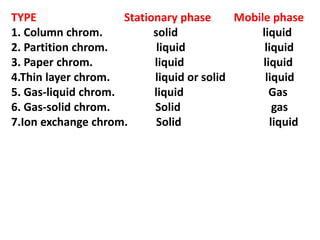
TYPE Stationary phase Mobile phase
1. Column chrom. solid liquid
2. Partition chrom. liquid liquid
3. Paper chrom. liquid liquid
4.Thin layer chrom. liquid or solid liquid
5. Gas-liquid chrom. liquid Gas
6. Gas-solid chrom. Solid gas
7.Ion exchange chrom. Solid liquid
Paper chromatography
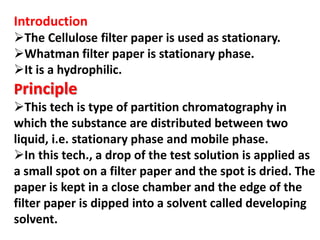
Introduction
The Cellulose filter paper is used as stationary.
Whatman filter paper is stationary phase.
It is a hydrophilic.
Principle
This tech is type of partition chromatography in
which the substance are distributed between two
liquid, i.e. stationary phase and mobile phase.
In this tech., a drop of the test solution is applied as
a small spot on a filter paper and the spot is dried. The
paper is kept in a close chamber and the edge of the
filter paper is dipped into a solvent called developing
solvent.
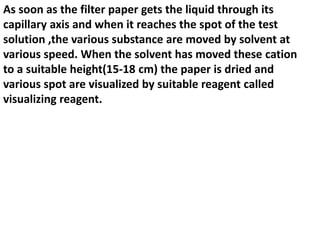
As soon as the filter paper gets the liquid through its
capillary axis and when it reaches the spot of the test
solution ,the various substance are moved by solvent at
various speed. When the solvent has moved these cation
to a suitable height(15-18 cm) the paper is dried and
various spot are visualized by suitable reagent called
visualizing reagent.
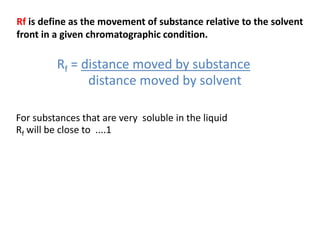
Rf = distance moved by substance
distance moved by solvent
For substances that are very soluble in the liquid
Rf will be close to ....1
Rf is define as the movement of substance relative to the solvent
front in a given chromatographic condition.
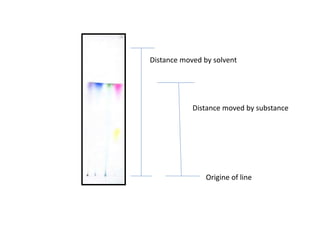
Distance moved by solvent
Distance moved by substance
Origine of line
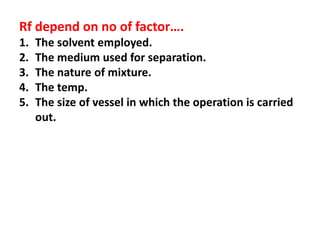
Rf depend on no of factor….
1. The solvent employed.
2. The medium used for separation.
3. The nature of mixture.
4. The temp.
5. The size of vessel in which the operation is carried
out.
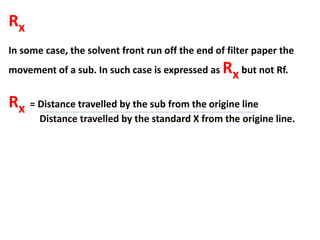
Rx
In some case, the solvent front run off the end of filter paper the
movement of a sub. In such case is expressed as Rx but not Rf.
Rx = Distance travelled by the sub from the origine line
Distance travelled by the standard X from the origine line.
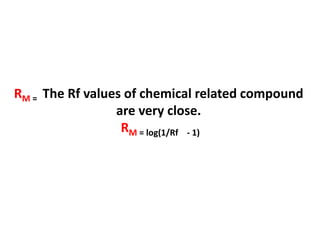
RM = The Rf values of chemical related compound
are very close.
RM = log(1/Rf - 1)
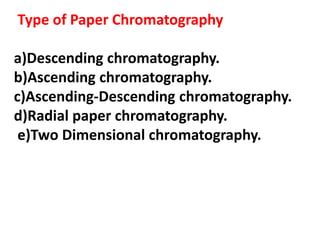
Type of Paper Chromatography
a)Descending chromatography.
b)Ascending chromatography.
c)Ascending-Descending chromatography.
d)Radial paper chromatography.
e)Two Dimensional chromatography.
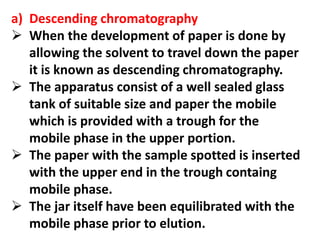
a) Descending chromatography
 When the development of paper is done by
allowing the solvent to travel down the paper
it is known as descending chromatography.
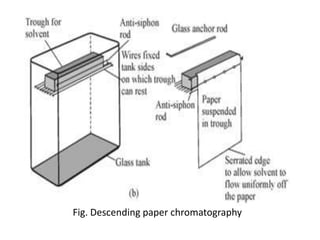
 The apparatus consist of a well sealed glass
tank of suitable size and paper the mobile
which is provided with a trough for the
mobile phase in the upper portion.
 The paper with the sample spotted is inserted
with the upper end in the trough containg
mobile phase.
 The jar itself have been equilibrated with the
mobile phase prior to elution.
Fig. Descending paper chromatography
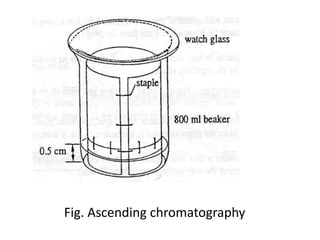
b) Ascending chromatography
 when developing of the paper is done by
allowing the solvent to travel up the paper it is
known as ascending chromatography.
In ascending chromatography the mobile phase is
placed in a suitable at the bottom of the chamber c
or in the chamber itself.
The sample are applied a few centimeter from
the bottom edge of the paper and suspended from
a hook.
Fig. Ascending chromatography
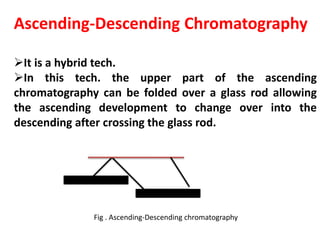
Ascending-Descending Chromatography
It is a hybrid tech.
In this tech. the upper part of the ascending
chromatography can be folded over a glass rod allowing
the ascending development to change over into the
descending after crossing the glass rod.
Fig . Ascending-Descending chromatography
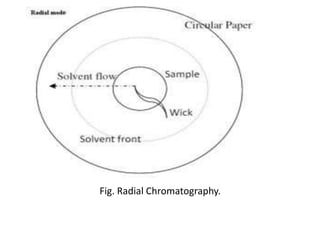
Radial chromatography
This is also known as circular paper chromatography.
In this tech. a circular filter paper is employed.
Then the various martial to be analyzed are placed a
center.
After drying the spot the paper is fixed horizontally on the
Petri-dish possessing the solvent so that the tongue or the
wick of paper dips into the solvent .
Cover the paper by means of petri-dish cover.
The solvent rises through the tongue or the wick.
Fig. Radial Chromatography.
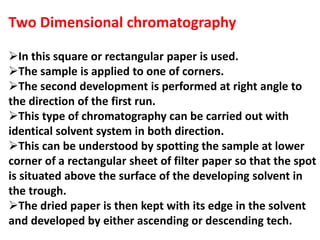
Two Dimensional chromatography
In this square or rectangular paper is used.
The sample is applied to one of corners.
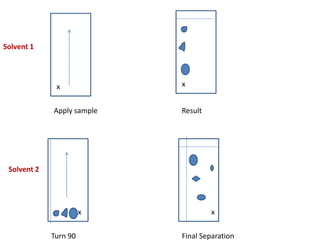
The second development is performed at right angle to
the direction of the first run.
This type of chromatography can be carried out with
identical solvent system in both direction.
This can be understood by spotting the sample at lower
corner of a rectangular sheet of filter paper so that the spot
is situated above the surface of the developing solvent in
the trough.
The dried paper is then kept with its edge in the solvent
and developed by either ascending or descending tech.
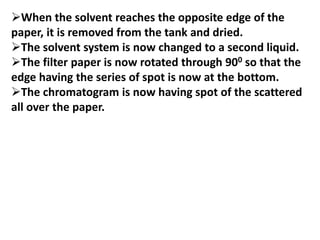
When the solvent reaches the opposite edge of the
paper, it is removed from the tank and dried.
The solvent system is now changed to a second liquid.
The filter paper is now rotated through 900 so that the
edge having the series of spot is now at the bottom.
The chromatogram is now having spot of the scattered
all over the paper.
Solvent 1
Solvent 2
Apply sample Result
Turn 90 Final Separation
x x
x x
Experimental Detail
a) Choice of proper chromatographic tech.
b) Choice of filet paper.
c) Proper developing solvent.
d) Preparation of sample.
e) Spotting.
f) Drying the chromatogram.
g) Visualization.
a) Choice of proper chromatographic tech.
 Selection of tech. is very important.
 The choice of tech. depend upon the nature of
substances to be separated.
b) Choice of filter paper
 Section of filer paper is very important.
 Various type of Whatmann filter paper are avilable.
 Choice of paper depend on type of separation.
 Mostly coarser and faster paper i.e. whatmann 31 ET
are used.
 The slow papers available are whatmann 20.
 Whatmann filter paper commonly content 99% of
alpha-cellulose.
c) Proper developing solvent(mobile phase)
The best possible developing solvent is generally
selected for the separation of sub. Under examination.
The solvent should not interfere with the detection of
spots on the developed chromatogram.
The composition of the solvent system should not alter
with time.
Solvent as per increasing order
N-hexane n-propanol
Cyclohexane acetone
Benzene ethanol
Tolune methanol
Diethyl ether water
Choroform
N-butanol
d) Preparation of Sample
No need of any standard procedure
10-20µ sample require.
e)Spotting
The spotting should on origin line.
On the line cross marks (x) are made with pencil.
The origin line draw from 1cm from bottom of
filter paper.
f) Drying of chromatogram
Use Hot air oven.
g) Visualization
By using visualizing agent spot are visualized.
e.g. Ninhydrine solution
Iodine chamber
Calculation of Rf value
Rf = Distance travelled by solute from origine line
Distance travelled by solvent from origine line

CHROMATOGRAPHY.pptx

  • 1.
  • 2.
    INTRODUCTION Chromatography is acolor writing . (Greek kromatos mean color and Graphos mean written). Definition:- It is defined as the method in which the components of a mixture are separated on an adsorbent Column in a flowing system. Chromatographic method represent the most useful and powerful technique. Chromatographic tech. are simple, rapid and require simple apparatus. This tech. used for separation of components of a complex mixture. Because of rapidity and effectiveness, chromatography has been used in all field over other methods.
  • 3.
    The separation canbe carried out on micro or semi-micro scale , i.e. a small quantity of mixture required for analysis. There are two phase a)Stationary phase it may be a solid or liquid supported on a solid or a gel, and may be packed in coloum, spread as a layer or distributed as a film. b)Mobile phase it may be gaseous or liquid.
  • 4.
    HISTORY  The studywas started in the 18th century Runge studied with great interest the nature of inorganic compound on filter paper. He separated inorganic salts and observed that inorganic salt travel to different extent producing attractive pattern. The Russian botanist, Michael Tswett discovered the chromatographic principle in 1909, he used a glass column of calcium carbonate for separation of chlorophyll pigment from plant by using petroleum ether. The pigment were resolved into various colored zone; then separated and estimate. In 1930 leader and co-worker separated lutein and xanthenes on a Column of calcium carbonate powder.
  • 5.
    In 1935 Adamsand Holmes observed some synthetic ion exchange resins capable of exchanging ions and thus ion exchange chromatography came into existence. In 1944 Martin and Gorden replaced silica gel column by strips of filter paper and developed paper chromatography. For this achievement, they awarded Nobel Prize in 1952. Thin layer chromatography though discovered first by Izmailer and Shariber was develop using silica gel on glass plates. Latest and most effective chromatographic tech. is gas chromatographic. It was introduced by martin and james in 1952.
  • 6.
    TYPE Stationary phaseMobile phase 1. Column chrom. solid liquid 2. Partition chrom. liquid liquid 3. Paper chrom. liquid liquid 4.Thin layer chrom. liquid or solid liquid 5. Gas-liquid chrom. liquid Gas 6. Gas-solid chrom. Solid gas 7.Ion exchange chrom. Solid liquid
  • 7.
  • 8.
    Introduction The Cellulose filterpaper is used as stationary. Whatman filter paper is stationary phase. It is a hydrophilic. Principle This tech is type of partition chromatography in which the substance are distributed between two liquid, i.e. stationary phase and mobile phase. In this tech., a drop of the test solution is applied as a small spot on a filter paper and the spot is dried. The paper is kept in a close chamber and the edge of the filter paper is dipped into a solvent called developing solvent.
  • 9.
    As soon asthe filter paper gets the liquid through its capillary axis and when it reaches the spot of the test solution ,the various substance are moved by solvent at various speed. When the solvent has moved these cation to a suitable height(15-18 cm) the paper is dried and various spot are visualized by suitable reagent called visualizing reagent.
  • 10.
    Rf = distancemoved by substance distance moved by solvent For substances that are very soluble in the liquid Rf will be close to ....1 Rf is define as the movement of substance relative to the solvent front in a given chromatographic condition.
  • 11.
    Distance moved bysolvent Distance moved by substance Origine of line
  • 12.
    Rf depend onno of factor…. 1. The solvent employed. 2. The medium used for separation. 3. The nature of mixture. 4. The temp. 5. The size of vessel in which the operation is carried out.
  • 13.
    Rx In some case,the solvent front run off the end of filter paper the movement of a sub. In such case is expressed as Rx but not Rf. Rx = Distance travelled by the sub from the origine line Distance travelled by the standard X from the origine line.
  • 14.
    RM = TheRf values of chemical related compound are very close. RM = log(1/Rf - 1)
  • 15.
    Type of PaperChromatography a)Descending chromatography. b)Ascending chromatography. c)Ascending-Descending chromatography. d)Radial paper chromatography. e)Two Dimensional chromatography.
  • 16.
    a) Descending chromatography When the development of paper is done by allowing the solvent to travel down the paper it is known as descending chromatography.  The apparatus consist of a well sealed glass tank of suitable size and paper the mobile which is provided with a trough for the mobile phase in the upper portion.  The paper with the sample spotted is inserted with the upper end in the trough containg mobile phase.  The jar itself have been equilibrated with the mobile phase prior to elution.
  • 17.
    Fig. Descending paperchromatography
  • 18.
    b) Ascending chromatography when developing of the paper is done by allowing the solvent to travel up the paper it is known as ascending chromatography. In ascending chromatography the mobile phase is placed in a suitable at the bottom of the chamber c or in the chamber itself. The sample are applied a few centimeter from the bottom edge of the paper and suspended from a hook.
  • 19.
  • 20.
    Ascending-Descending Chromatography It isa hybrid tech. In this tech. the upper part of the ascending chromatography can be folded over a glass rod allowing the ascending development to change over into the descending after crossing the glass rod. Fig . Ascending-Descending chromatography
  • 21.
    Radial chromatography This isalso known as circular paper chromatography. In this tech. a circular filter paper is employed. Then the various martial to be analyzed are placed a center. After drying the spot the paper is fixed horizontally on the Petri-dish possessing the solvent so that the tongue or the wick of paper dips into the solvent . Cover the paper by means of petri-dish cover. The solvent rises through the tongue or the wick.
  • 22.
  • 23.
    Two Dimensional chromatography Inthis square or rectangular paper is used. The sample is applied to one of corners. The second development is performed at right angle to the direction of the first run. This type of chromatography can be carried out with identical solvent system in both direction. This can be understood by spotting the sample at lower corner of a rectangular sheet of filter paper so that the spot is situated above the surface of the developing solvent in the trough. The dried paper is then kept with its edge in the solvent and developed by either ascending or descending tech.
  • 24.
    When the solventreaches the opposite edge of the paper, it is removed from the tank and dried. The solvent system is now changed to a second liquid. The filter paper is now rotated through 900 so that the edge having the series of spot is now at the bottom. The chromatogram is now having spot of the scattered all over the paper.
  • 25.
    Solvent 1 Solvent 2 Applysample Result Turn 90 Final Separation x x x x
  • 26.
    Experimental Detail a) Choiceof proper chromatographic tech. b) Choice of filet paper. c) Proper developing solvent. d) Preparation of sample. e) Spotting. f) Drying the chromatogram. g) Visualization.
  • 27.
    a) Choice ofproper chromatographic tech.  Selection of tech. is very important.  The choice of tech. depend upon the nature of substances to be separated. b) Choice of filter paper  Section of filer paper is very important.  Various type of Whatmann filter paper are avilable.  Choice of paper depend on type of separation.  Mostly coarser and faster paper i.e. whatmann 31 ET are used.  The slow papers available are whatmann 20.  Whatmann filter paper commonly content 99% of alpha-cellulose.
  • 28.
    c) Proper developingsolvent(mobile phase) The best possible developing solvent is generally selected for the separation of sub. Under examination. The solvent should not interfere with the detection of spots on the developed chromatogram. The composition of the solvent system should not alter with time. Solvent as per increasing order N-hexane n-propanol Cyclohexane acetone Benzene ethanol Tolune methanol Diethyl ether water Choroform N-butanol
  • 29.
    d) Preparation ofSample No need of any standard procedure 10-20µ sample require. e)Spotting The spotting should on origin line. On the line cross marks (x) are made with pencil. The origin line draw from 1cm from bottom of filter paper. f) Drying of chromatogram Use Hot air oven.
  • 30.
    g) Visualization By usingvisualizing agent spot are visualized. e.g. Ninhydrine solution Iodine chamber Calculation of Rf value Rf = Distance travelled by solute from origine line Distance travelled by solvent from origine line