240-301 Comp. Eng. Lab III (Software), Pattern Matching 1
Pattern Matching
1
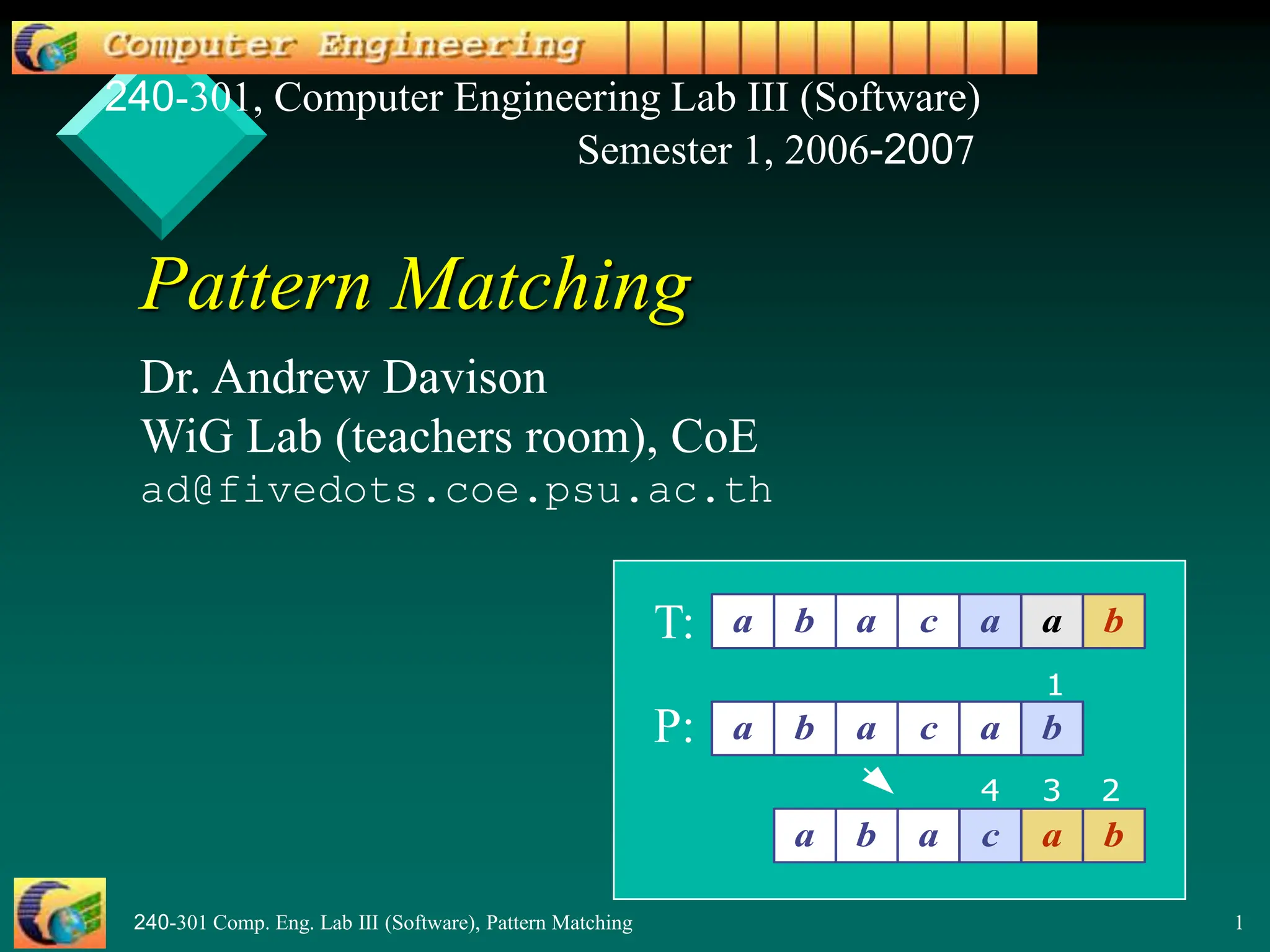
a b a c a a b
2
3
4
a b a c a b
a b a c a b
Dr. Andrew Davison
WiG Lab (teachers room), CoE
ad@fivedots.coe.psu.ac.th
240-301, Computer Engineering Lab III (Software)
T:
P:
Semester 1, 2006-2007
240-301 Comp. Eng. Lab III (Software), Pattern Matching 2
Overview
1. What is Pattern Matching?
2. The Brute Force Algorithm
3. The Knuth-Morris-Pratt Algorithm
4. The Boyer-Moore Algorithm
5. More Information
240-301 Comp. Eng. Lab III (Software), Pattern Matching 3
1. What is Pattern Matching?
 Definition:
– given a text string T and a pattern string P, find
the pattern inside the text
 T: “the rain in spain stays mainly on the plain”
 P: “n th”
 Applications:
– text editors, Web search engines (e.g. Google),
image analysis
240-301 Comp. Eng. Lab III (Software), Pattern Matching 4
String Concepts
 Assume S is a string of size m.
S = x1x2 … xm
 A prefix of S is a substring S[1 .. k-1]
 A suffix of S is a substring S[k-1 .. m]
– k is any index between 1 and m
– S[0] is null character
240-301 Comp. Eng. Lab III (Software), Pattern Matching 5
Examples
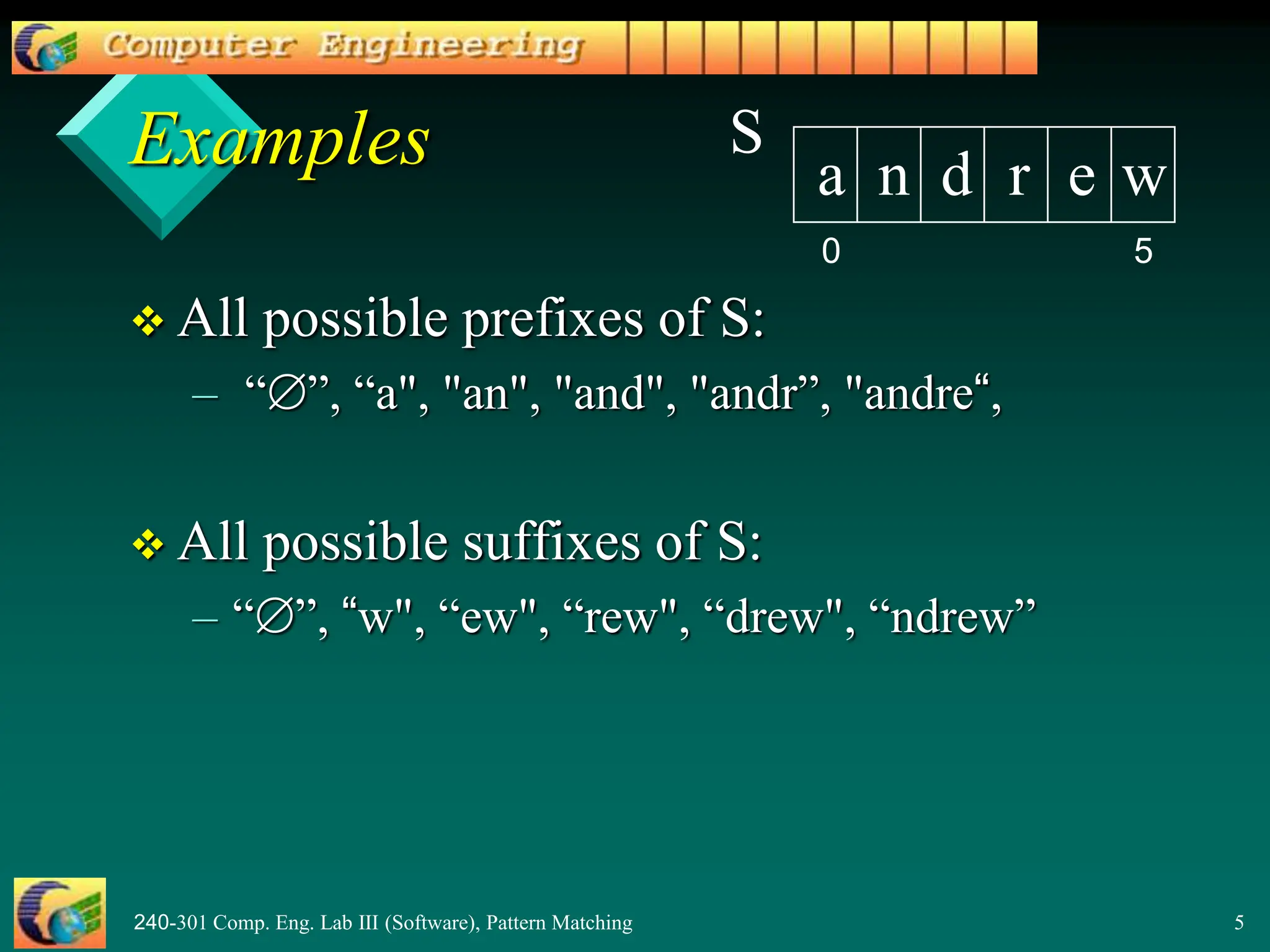
 All possible prefixes of S:
– “”, “a", "an", "and", "andr”, "andre“,
 All possible suffixes of S:
– “”, “w", “ew", “rew", “drew", “ndrew”
a n d r e w
S
0 5
240-301 Comp. Eng. Lab III (Software), Pattern Matching 6
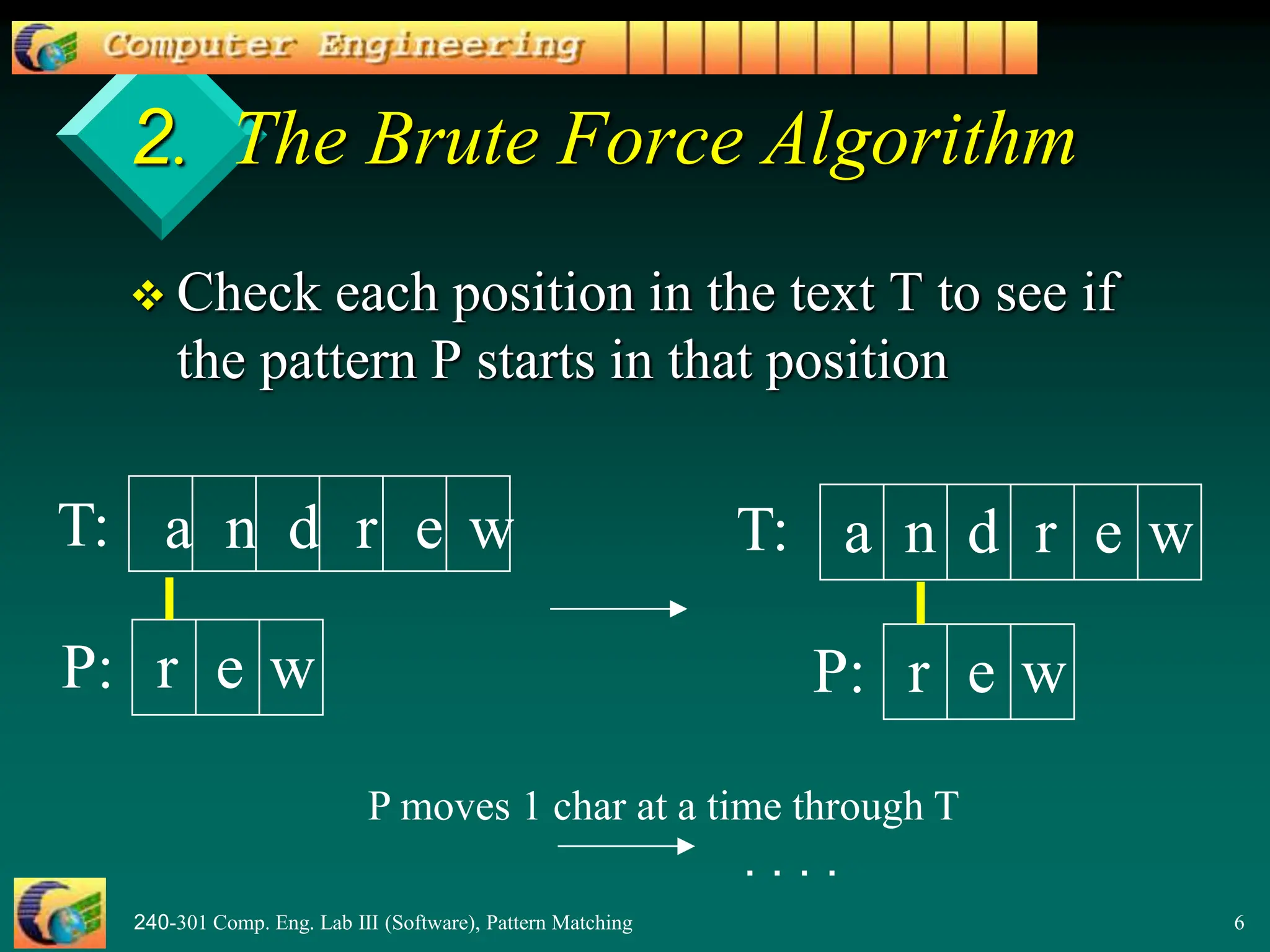
2. The Brute Force Algorithm
 Check each position in the text T to see if
the pattern P starts in that position
a n d r e w
T:
r e w
P:
a n d r e w
T:
r e w
P:
. . . .
P moves 1 char at a time through T
240-301 Comp. Eng. Lab III (Software), Pattern Matching 7
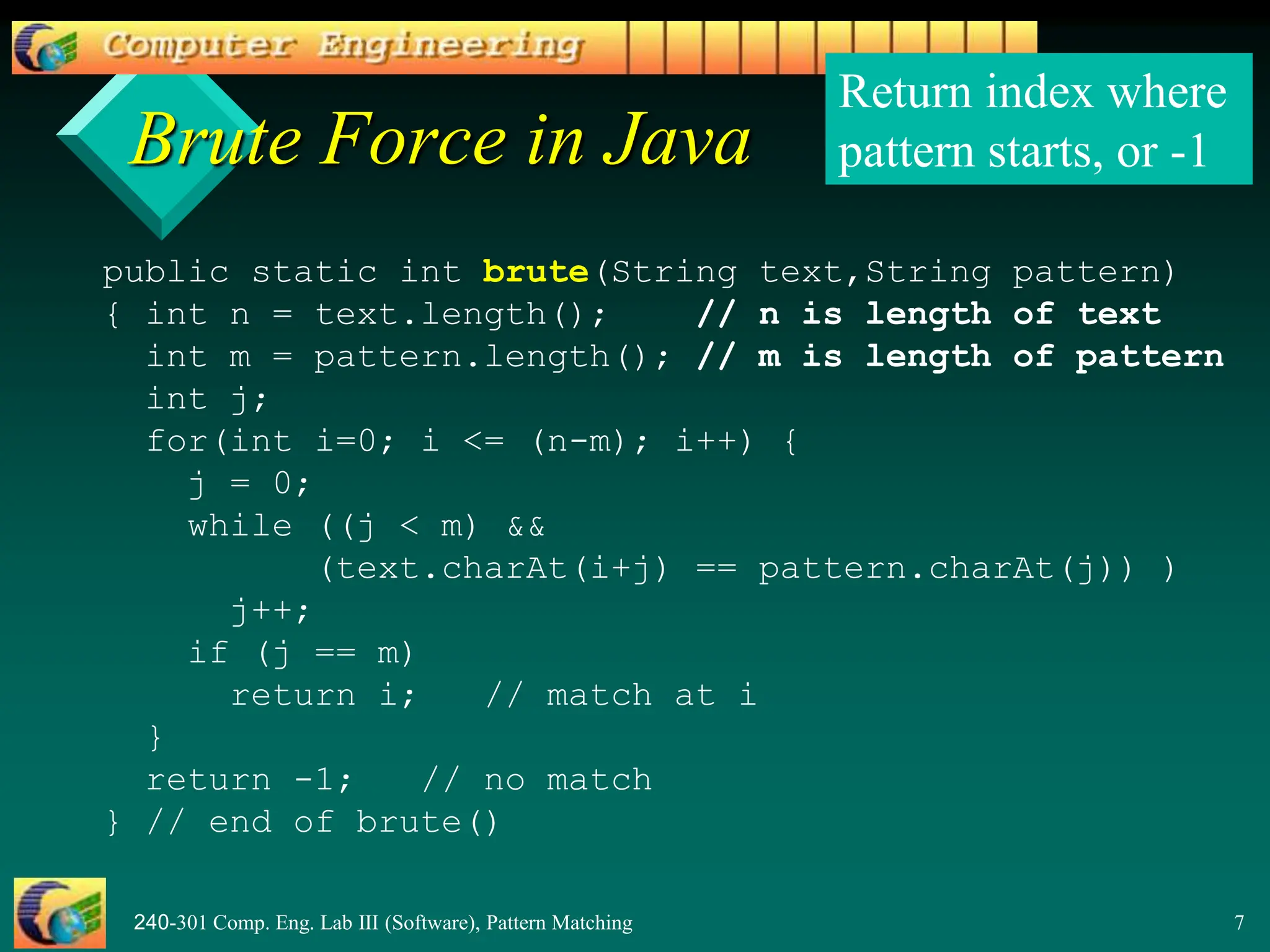
Brute Force in Java
public static int brute(String text,String pattern)
{ int n = text.length(); // n is length of text
int m = pattern.length(); // m is length of pattern
int j;
for(int i=0; i <= (n-m); i++) {
j = 0;
while ((j < m) &&
(text.charAt(i+j) == pattern.charAt(j)) )
j++;
if (j == m)
return i; // match at i
}
return -1; // no match
} // end of brute()
Return index where
pattern starts, or -1
240-301 Comp. Eng. Lab III (Software), Pattern Matching 8
Usage
public static void main(String args[])
{ if (args.length != 2) {
System.out.println("Usage: java BruteSearch
<text> <pattern>");
System.exit(0);
}
System.out.println("Text: " + args[0]);
System.out.println("Pattern: " + args[1]);
int posn = brute(args[0], args[1]);
if (posn == -1)
System.out.println("Pattern not found");
else
System.out.println("Pattern starts at posn "
+ posn);
}
240-301 Comp. Eng. Lab III (Software), Pattern Matching 9
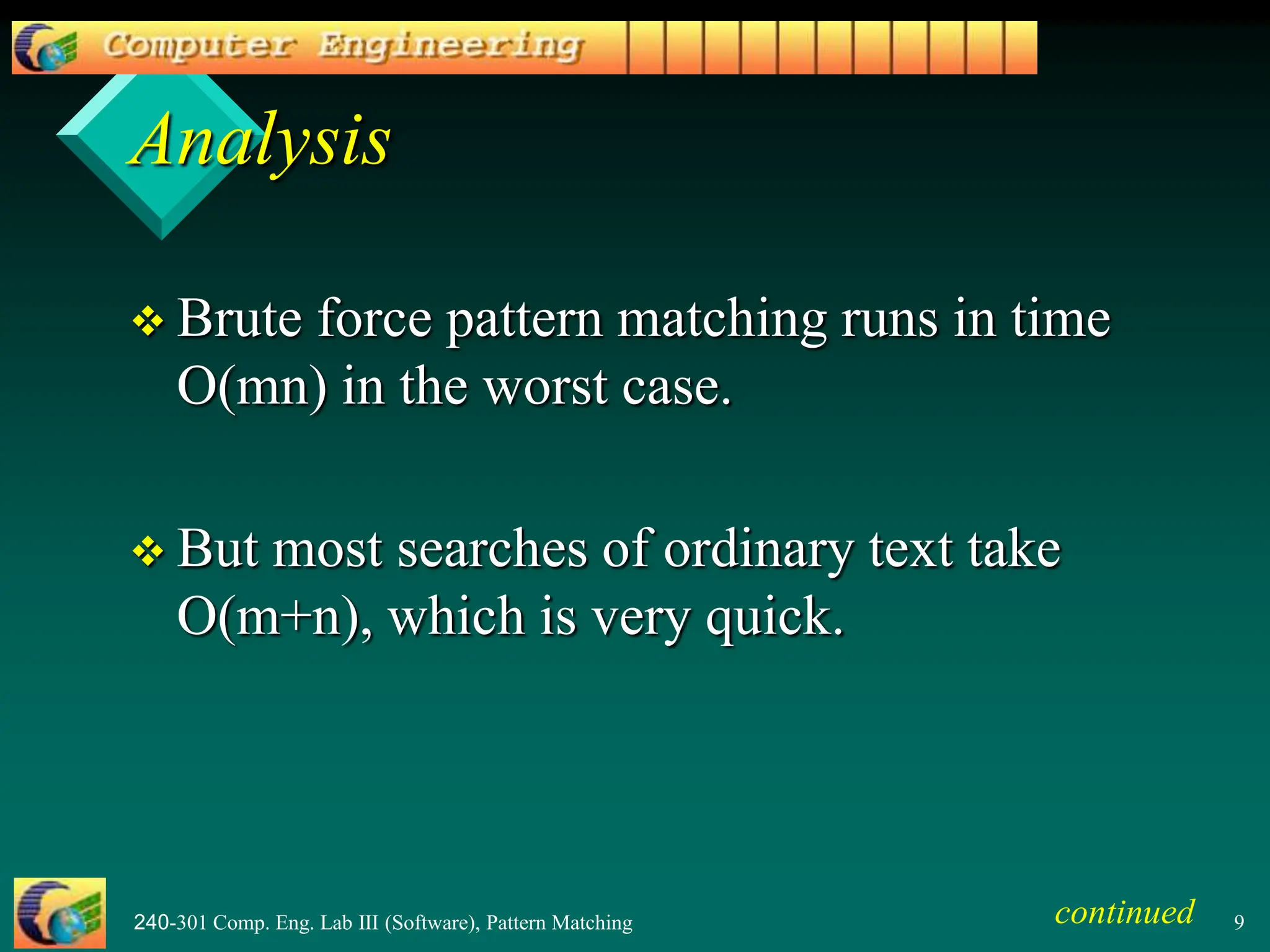
Analysis
 Brute force pattern matching runs in time
O(mn) in the worst case.
 But most searches of ordinary text take
O(m+n), which is very quick.
continued
240-301 Comp. Eng. Lab III (Software), Pattern Matching 10
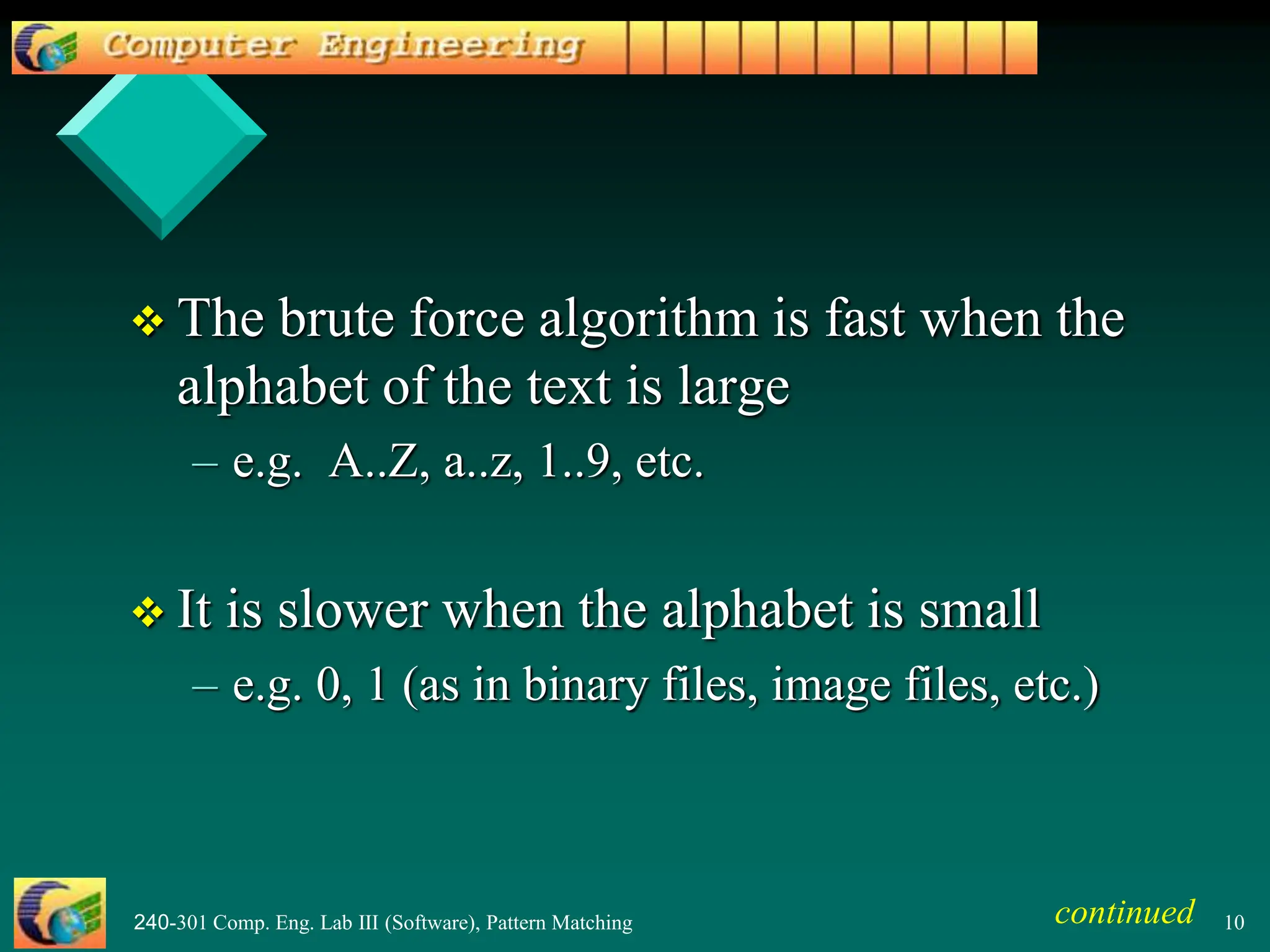
 The brute force algorithm is fast when the
alphabet of the text is large
– e.g. A..Z, a..z, 1..9, etc.
 It is slower when the alphabet is small
– e.g. 0, 1 (as in binary files, image files, etc.)
continued
240-301 Comp. Eng. Lab III (Software), Pattern Matching 11
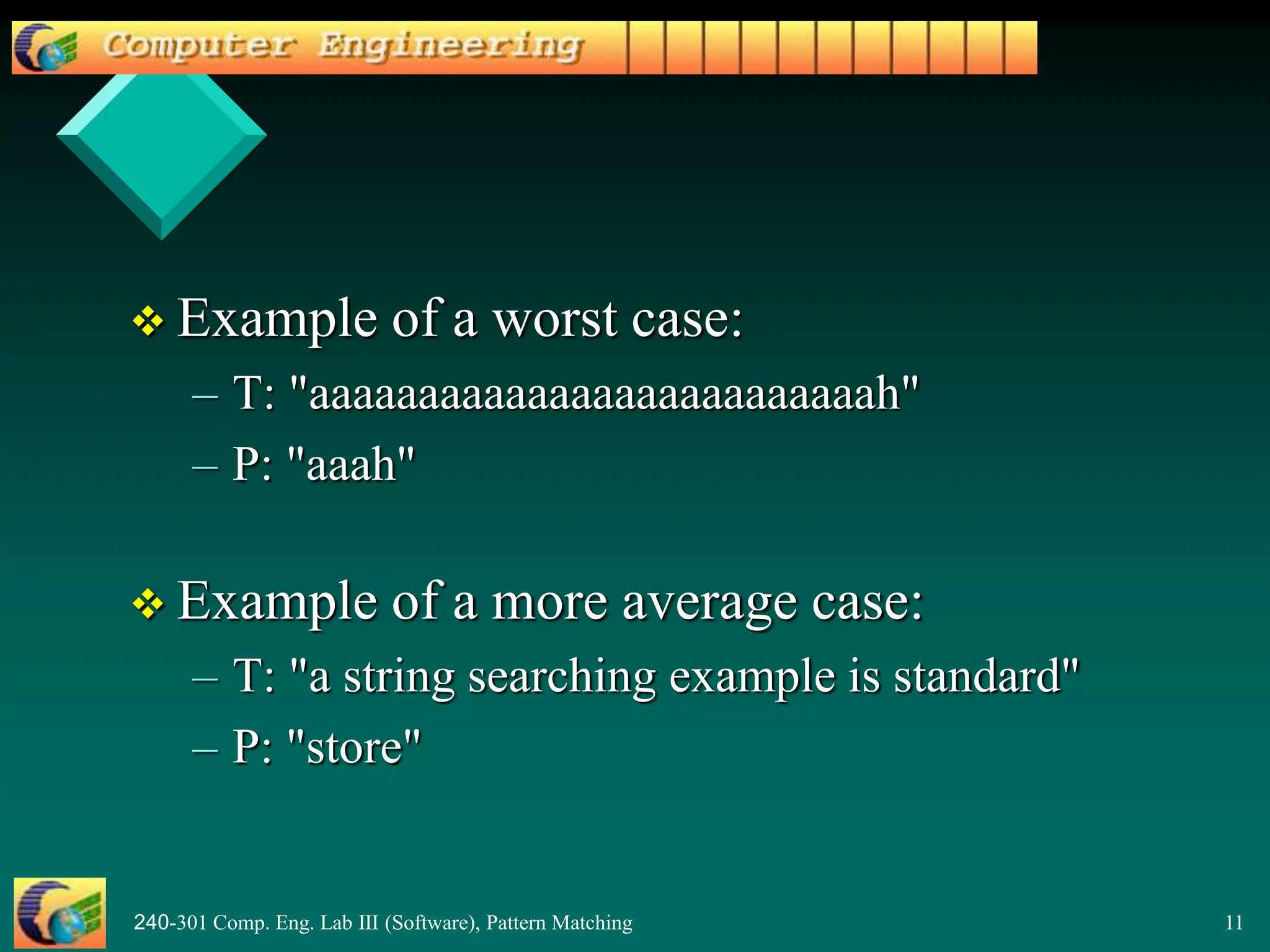
 Example of a worst case:
– T: "aaaaaaaaaaaaaaaaaaaaaaaaaah"
– P: "aaah"
 Example of a more average case:
– T: "a string searching example is standard"
– P: "store"
240-301 Comp. Eng. Lab III (Software), Pattern Matching 12
3. The KMP Algorithm
 The Knuth-Morris-Pratt (KMP) algorithm
looks for the pattern in the text in a left-to-
right order (like the brute force algorithm).
 But it shifts the pattern more intelligently
than the brute force algorithm.
continued
240-301 Comp. Eng. Lab III (Software), Pattern Matching 13
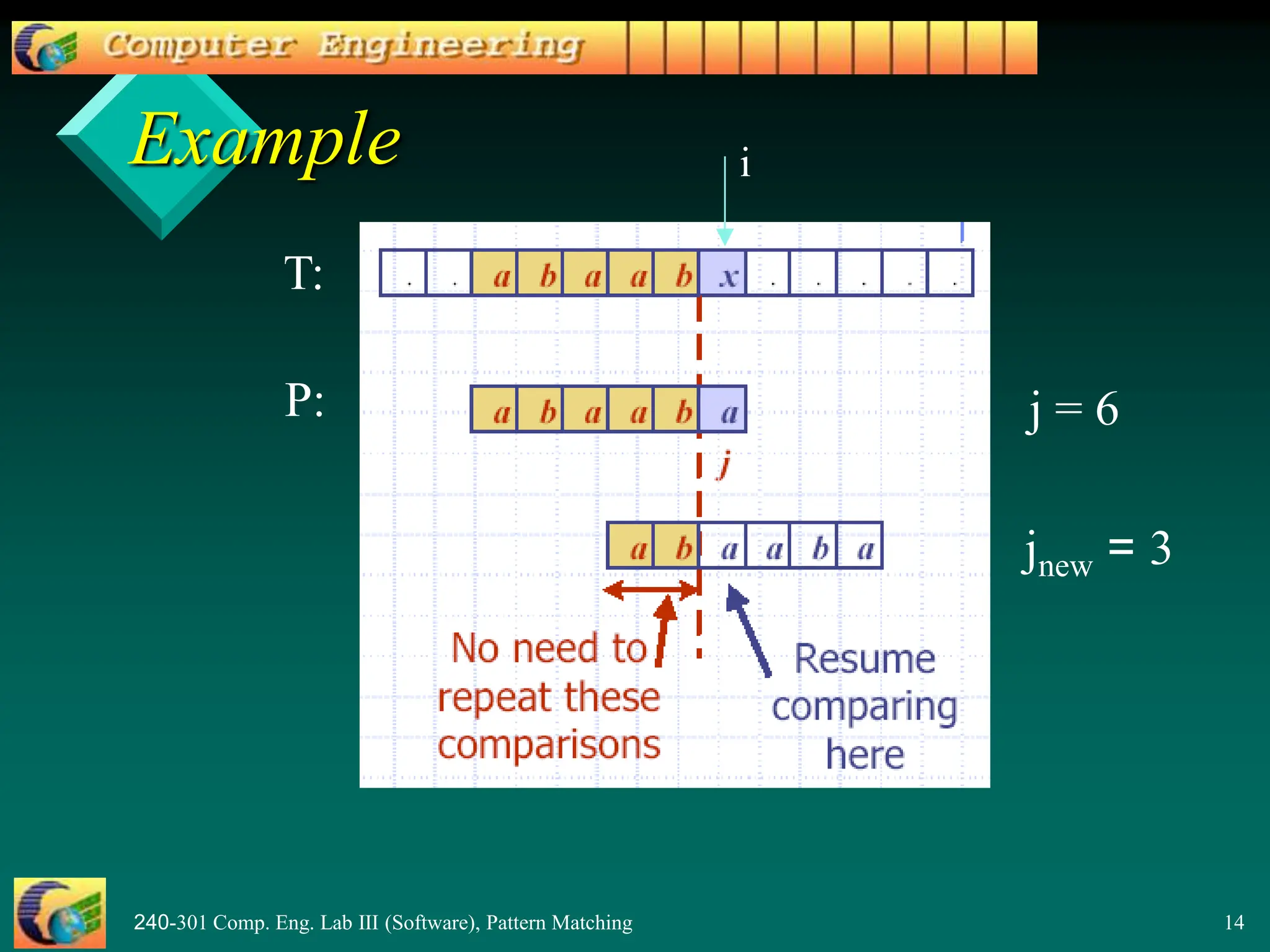
 If a mismatch occurs between the text and
pattern P at P[j], what is the most we can
shift the pattern to avoid wasteful
comparisons?
 Answer: the largest prefix of P[1 .. j-1] that
is a suffix of P[1 .. j-1]
240-301 Comp. Eng. Lab III (Software), Pattern Matching 14
Example
T:
P:
jnew = 3
j = 6
i
240-301 Comp. Eng. Lab III (Software), Pattern Matching 15
Why
 Find largest prefix (start) of:
"a b a a b" ( P[1..j-1] )
which is suffix (end) of:
“a b a a b" ( p[1 .. j-1] )
 Answer: "a b"
 Set j = 3 // the new j value
j == 5
240-301 Comp. Eng. Lab III (Software), Pattern Matching 16
KMP Border Function
 KMP preprocesses the pattern to find
matches of prefixes of the pattern with the
pattern itself.
 j = mismatch position in P[]
 k = position before the mismatch (k = j-1).
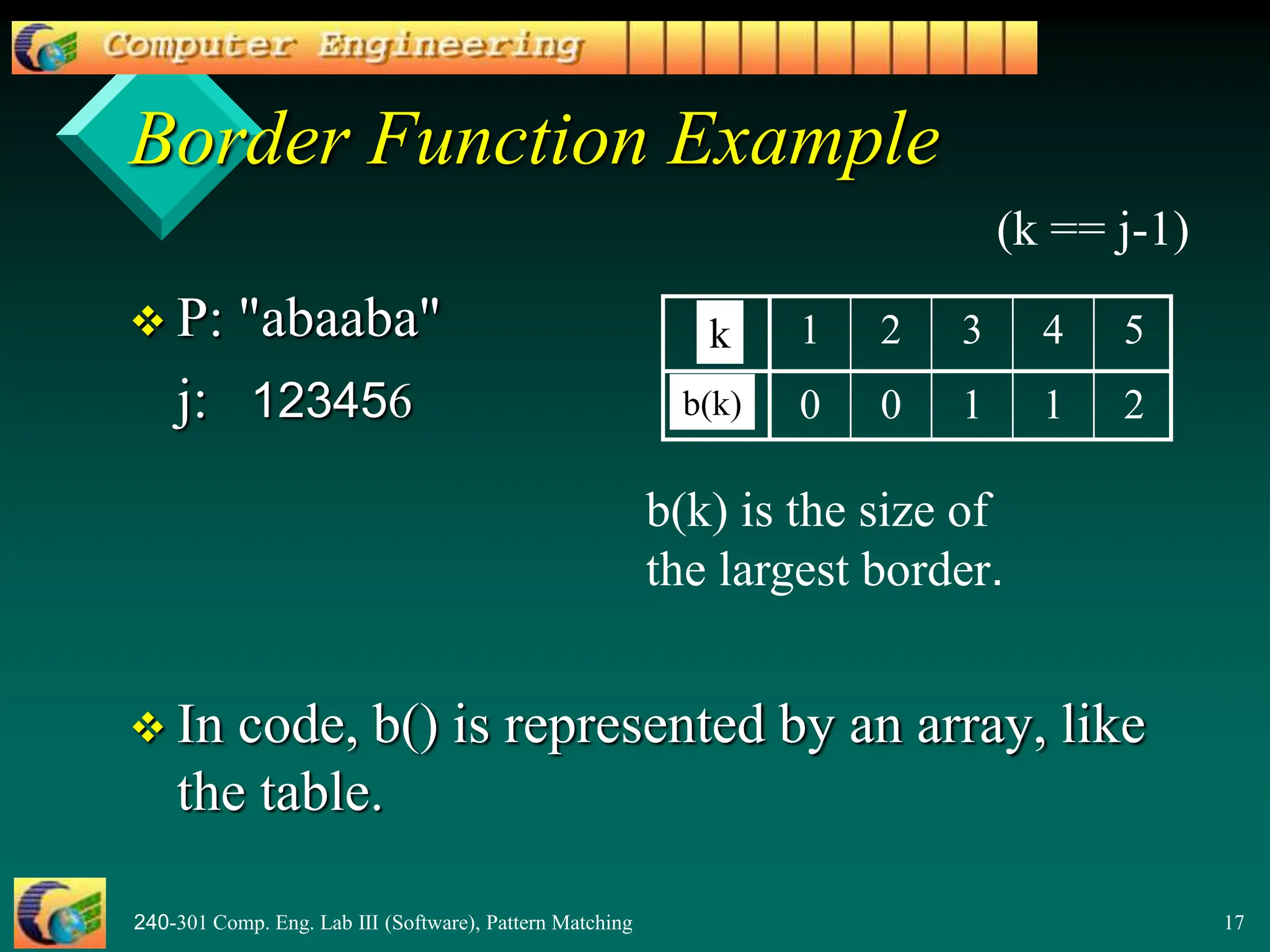
 The border function b(k) is defined as the
size of the largest prefix of P[1..k] that is
also a suffix of P[1..k].
240-301 Comp. Eng. Lab III (Software), Pattern Matching 17
 P: "abaaba"
j: 123456
 In code, b() is represented by an array, like
the table.
Border Function Example
b(k) is the size of
the largest border.
1
4
2
5
3
2
1
j
1
0
0
F(j)
k
b(k)
(k == j-1)
240-301 Comp. Eng. Lab III (Software), Pattern Matching 18
Why is b(5) == 2?
 b(5) means
– find the size of the largest prefix of P[1..5] that
is also a suffix of P[1..5]
= find the size largest prefix of "abaab" that
is also a suffix of "baab"
= find the size of "ab"
= 2
P: "abaaba"
240-301 Comp. Eng. Lab III (Software), Pattern Matching 19
 Knuth-Morris-Pratt’s algorithm modifies
the brute-force algorithm.
– if a mismatch occurs at P[j]
(i.e. P[j] != T[i]), then
k = j-1;
j = b(k) + 1; // obtain the new j
Using the Failure Function
240-301 Comp. Eng. Lab III (Software), Pattern Matching 20
KMP in Java
public static int kmpMatch(String text,
String pattern)
{
int n = text.length();
int m = pattern.length();
int fail[] = computeFail(pattern);
int i=0;
int j=0;
:
Return index where
pattern starts, or -1
240-301 Comp. Eng. Lab III (Software), Pattern Matching 21
while (i < n) {
if (pattern.charAt(j) == text.charAt(i)) {
if (j == m - 1)
return i - m + 1; // match
i++;
j++;
}
else if (j > 0)
j = fail[j-1];
else
i++;
}
return -1; // no match
} // end of kmpMatch()
240-301 Comp. Eng. Lab III (Software), Pattern Matching 22
public static int[] computeFail(
String pattern)
{
int fail[] = new int[pattern.length()];
fail[0] = 0;
int m = pattern.length();
int j = 0;
int i = 1;
:
240-301 Comp. Eng. Lab III (Software), Pattern Matching 23
while (i < m) {
if (pattern.charAt(j) ==
pattern.charAt(i)) { //j+1 chars match
fail[i] = j + 1;
i++;
j++;
}
else if (j > 0) // j follows matching prefix
j = fail[j-1];
else { // no match
fail[i] = 0;
i++;
}
}
return fail;
} // end of computeFail()
Similar code
to kmpMatch()
240-301 Comp. Eng. Lab III (Software), Pattern Matching 24
Usage
public static void main(String args[])
{ if (args.length != 2) {
System.out.println("Usage: java KmpSearch
<text> <pattern>");
System.exit(0);
}
System.out.println("Text: " + args[0]);
System.out.println("Pattern: " + args[1]);
int posn = kmpMatch(args[0], args[1]);
if (posn == -1)
System.out.println("Pattern not found");
else
System.out.println("Pattern starts at posn "
+ posn);
}
240-301 Comp. Eng. Lab III (Software), Pattern Matching 25
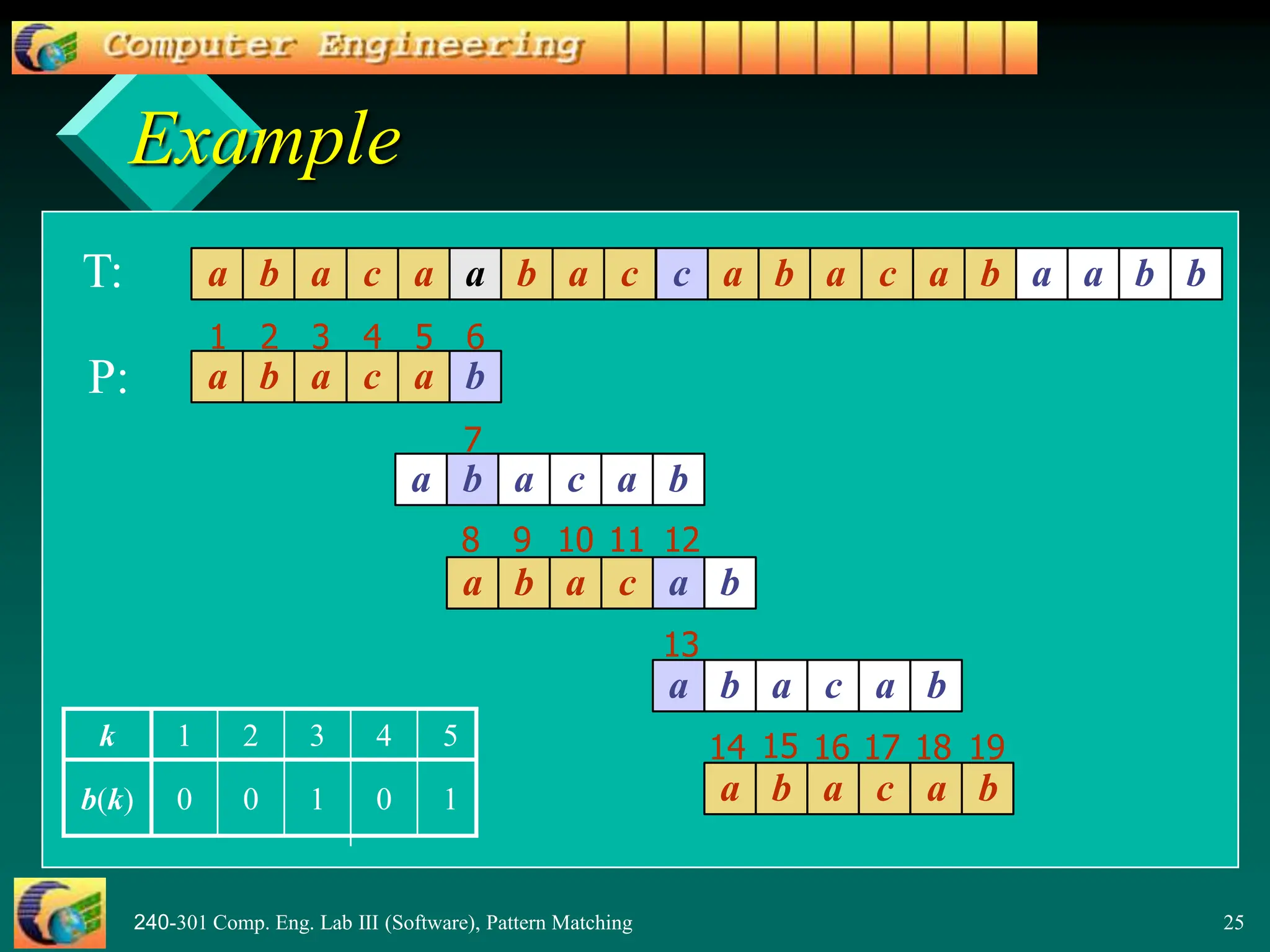
Example
1
a b a c a a b a c a b a c a b a a b b
7
8
19
18
17
15
a b a c a b
16
14
13
2 3 4 5 6
9
a b a c a b
a b a c a b
a b a c a b
a b a c a b
10 11 12
c
0
4
1
5
3
2
1
k
1
0
0
b(k)
T:
P:
240-301 Comp. Eng. Lab III (Software), Pattern Matching 26
Why is b(4) == 1?
 b(4) means
– find the size of the largest prefix of P[1..5] that
is also a suffix of P[1..5]
= find the size largest prefix of "abaca" that
is also a suffix of "baca"
= find the size of "a"
= 1
P: "abacab"
240-301 Comp. Eng. Lab III (Software), Pattern Matching 27
KMP Advantages
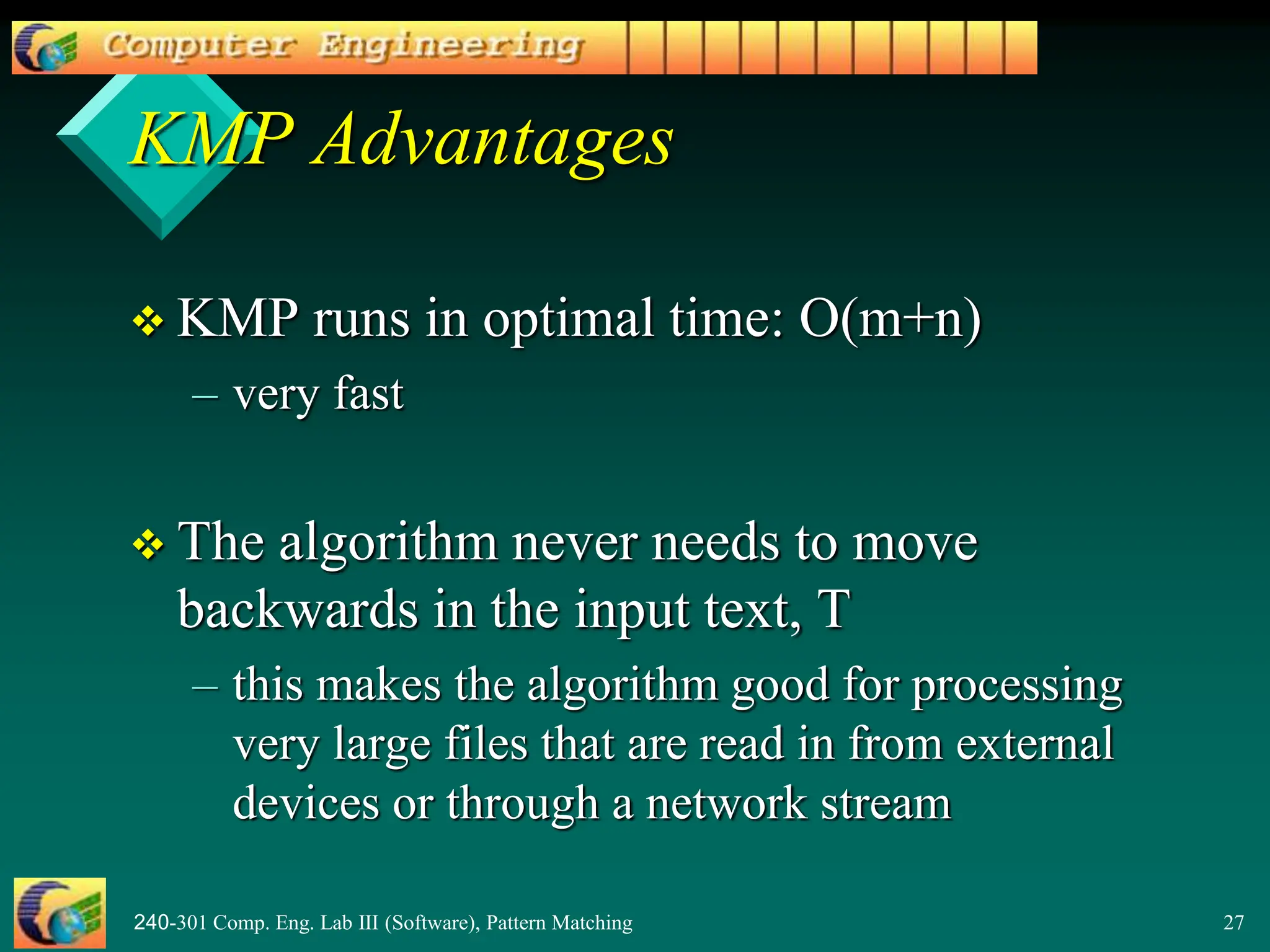
 KMP runs in optimal time: O(m+n)
– very fast
 The algorithm never needs to move
backwards in the input text, T
– this makes the algorithm good for processing
very large files that are read in from external
devices or through a network stream
240-301 Comp. Eng. Lab III (Software), Pattern Matching 28
KMP Disadvantages
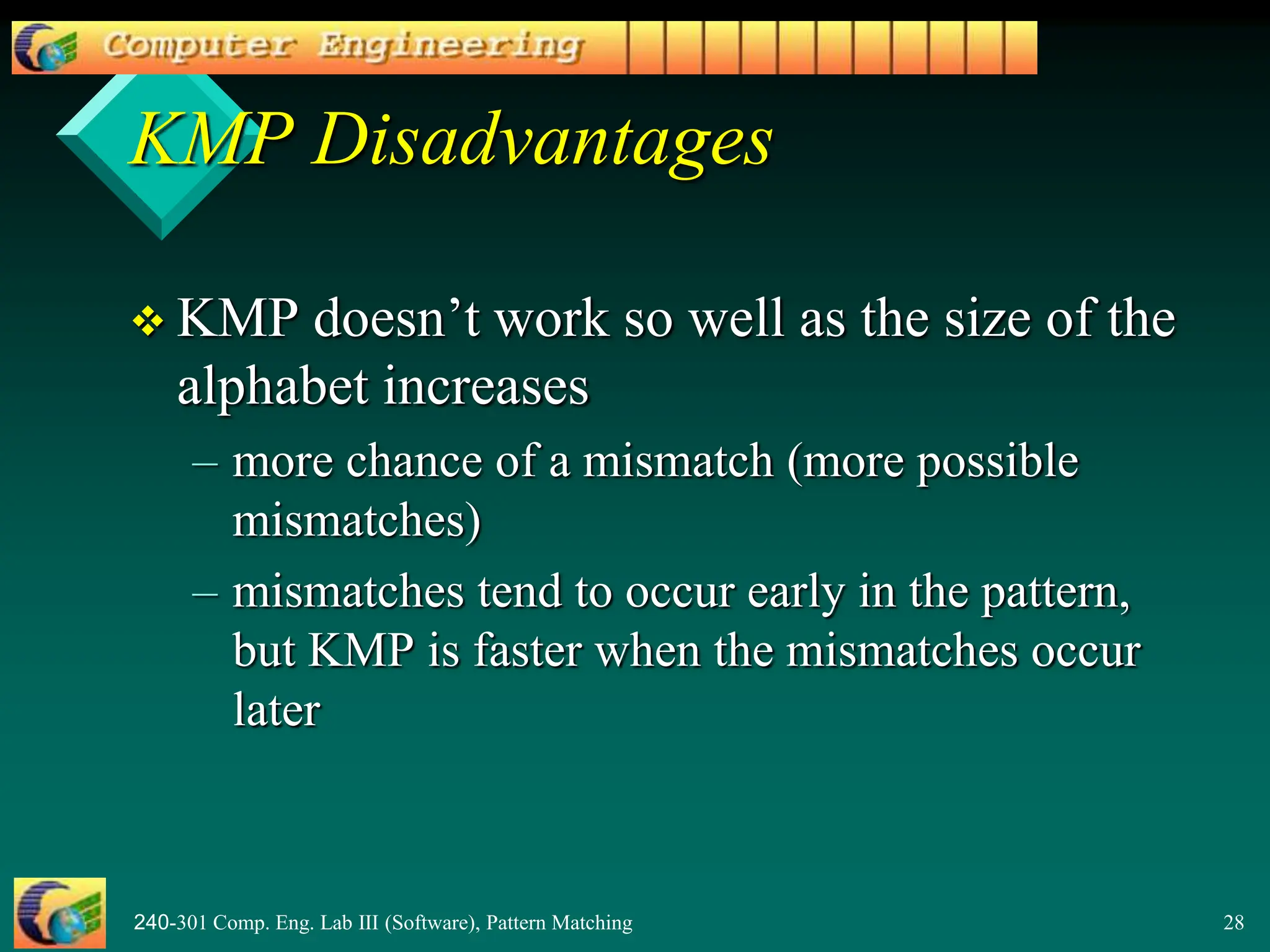
 KMP doesn’t work so well as the size of the
alphabet increases
– more chance of a mismatch (more possible
mismatches)
– mismatches tend to occur early in the pattern,
but KMP is faster when the mismatches occur
later
240-301 Comp. Eng. Lab III (Software), Pattern Matching 29
KMP Extensions
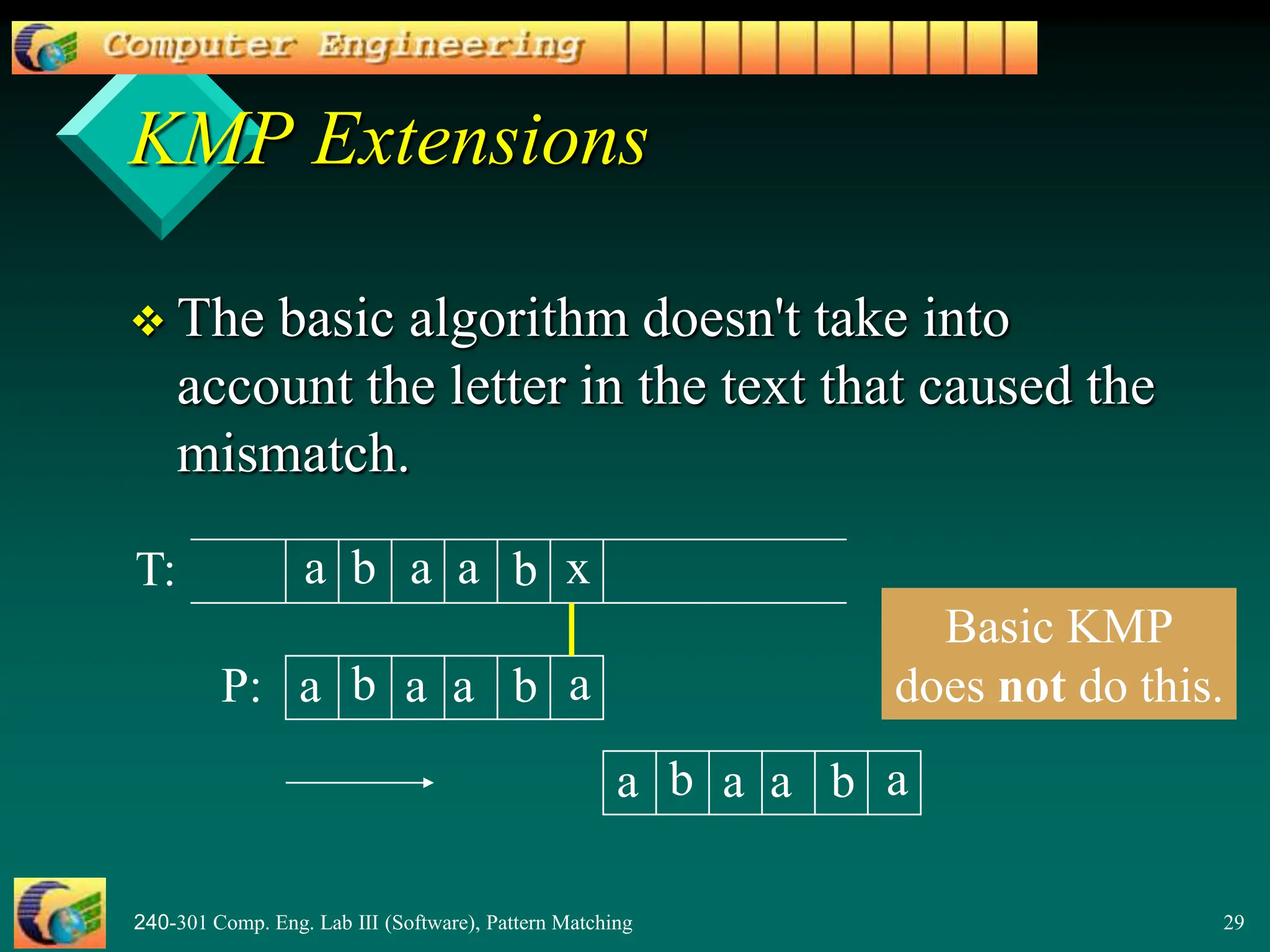
 The basic algorithm doesn't take into
account the letter in the text that caused the
mismatch.
a a a
b b
a a a
b b a
x
a a a
b b a
T:
P:
Basic KMP
does not do this.
240-301 Comp. Eng. Lab III (Software), Pattern Matching 30
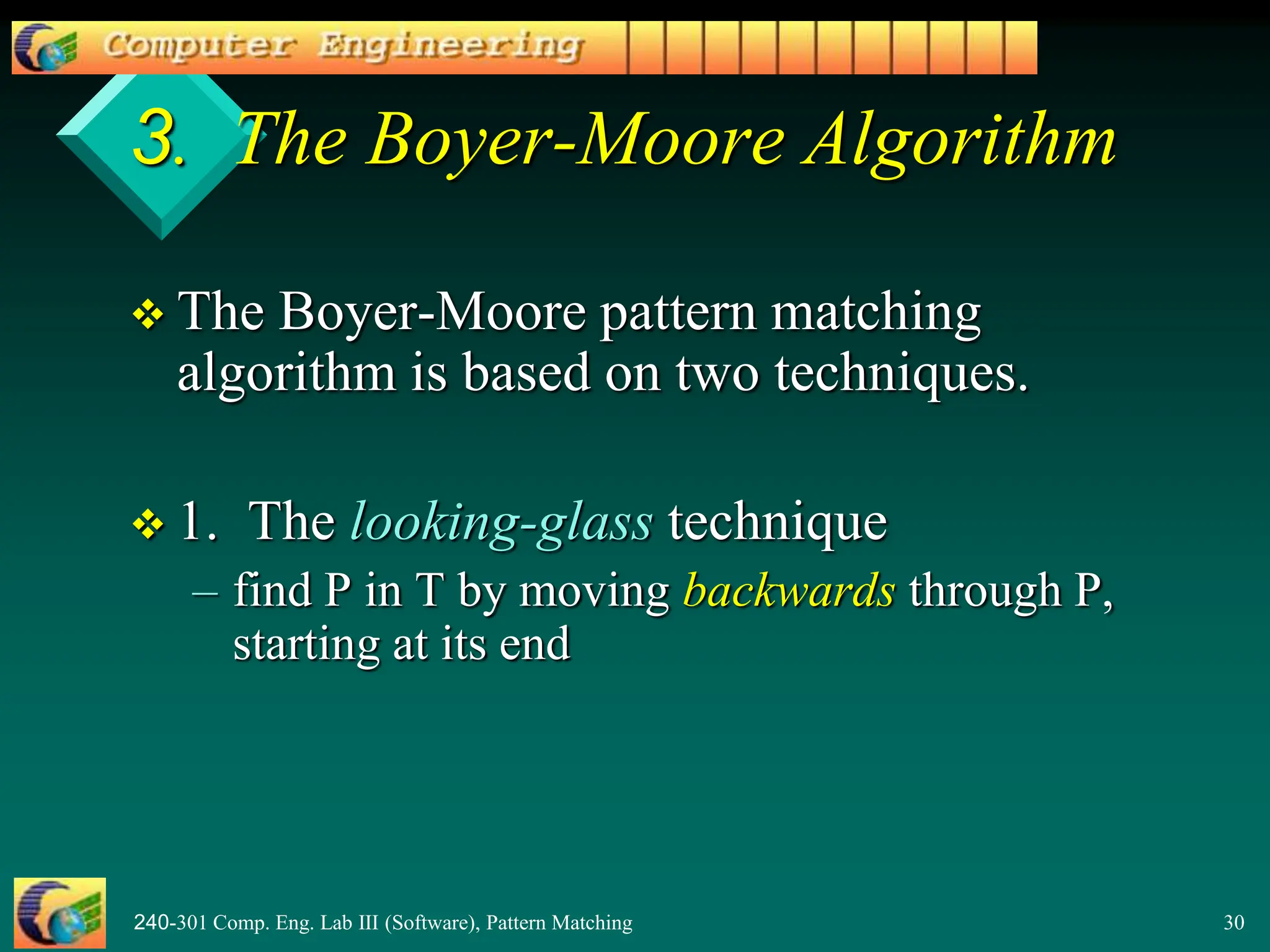
3. The Boyer-Moore Algorithm
 The Boyer-Moore pattern matching
algorithm is based on two techniques.
 1. The looking-glass technique
– find P in T by moving backwards through P,
starting at its end
240-301 Comp. Eng. Lab III (Software), Pattern Matching 31
 2. The character-jump technique
– when a mismatch occurs at T[i] == x
– the character in pattern P[j] is not the
same as T[i]
 There are 3 possible
cases, tried in order.
x a
T
i
b a
P
j
240-301 Comp. Eng. Lab III (Software), Pattern Matching 32
Case 1
 If P contains x somewhere, then try to
shift P right to align the last occurrence
of x in P with T[i].
x a
T
i
b a
P
j
x c
x a
T
inew
b a
P
jnew
x c
? ?
and
move i and
j right, so
j at end
240-301 Comp. Eng. Lab III (Software), Pattern Matching 33
Case 2
 If P contains x somewhere, but a shift right
to the last occurrence is not possible, then
shift P right by 1 character to T[i+1].
a x
T
i
a x
P
j
c w
a x
T
inew
a x
P
jnew
c w
?
and
move i and
j right, so
j at end
x
x is after
j position
x
240-301 Comp. Eng. Lab III (Software), Pattern Matching 34
Case 3
 If cases 1 and 2 do not apply, then shift P to
align P[1] with T[i+1].
x a
T
i
b a
P
j
d c
x a
T
inew
b a
P
jnew
d c
? ?
and
move i and
j right, so
j at end
No x in P
?
1
240-301 Comp. Eng. Lab III (Software), Pattern Matching 35
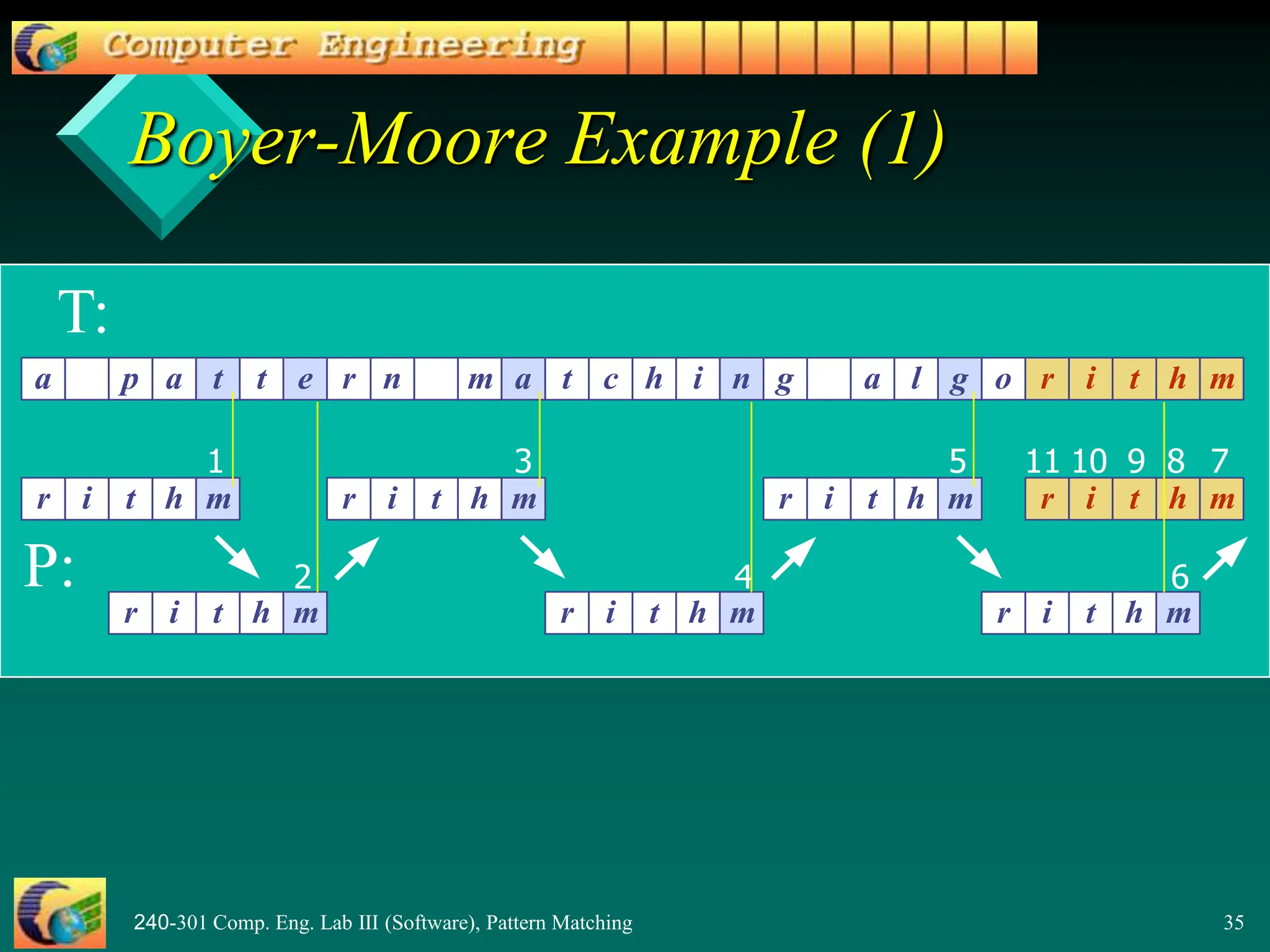
Boyer-Moore Example (1)
1
a p a t t e r n m a t c h i n g a l g o r i t h m
r i t h m
r i t h m
r i t h m
r i t h m
r i t h m
r i t h m
r i t h m
2
3
4
5
6
7
8
9
10
11
T:
P:
240-301 Comp. Eng. Lab III (Software), Pattern Matching 36
Last Occurrence Function
 Boyer-Moore’s algorithm preprocesses the
pattern P and the alphabet A to build a last
occurrence function L()
– L() maps all the letters in A to integers
 L(x) is defined as: // x is a letter in A
– the largest index i such that P[i] == x, or
– -1 if no such index exists
240-301 Comp. Eng. Lab III (Software), Pattern Matching 37
L() Example
 A = {a, b, c, d}
 P: "abacab"
-1
4
6
5
L(x)
d
c
b
a
x
a b a c a b
1 2 3 4 5 6
P
L() stores indexes into P[]
240-301 Comp. Eng. Lab III (Software), Pattern Matching 38
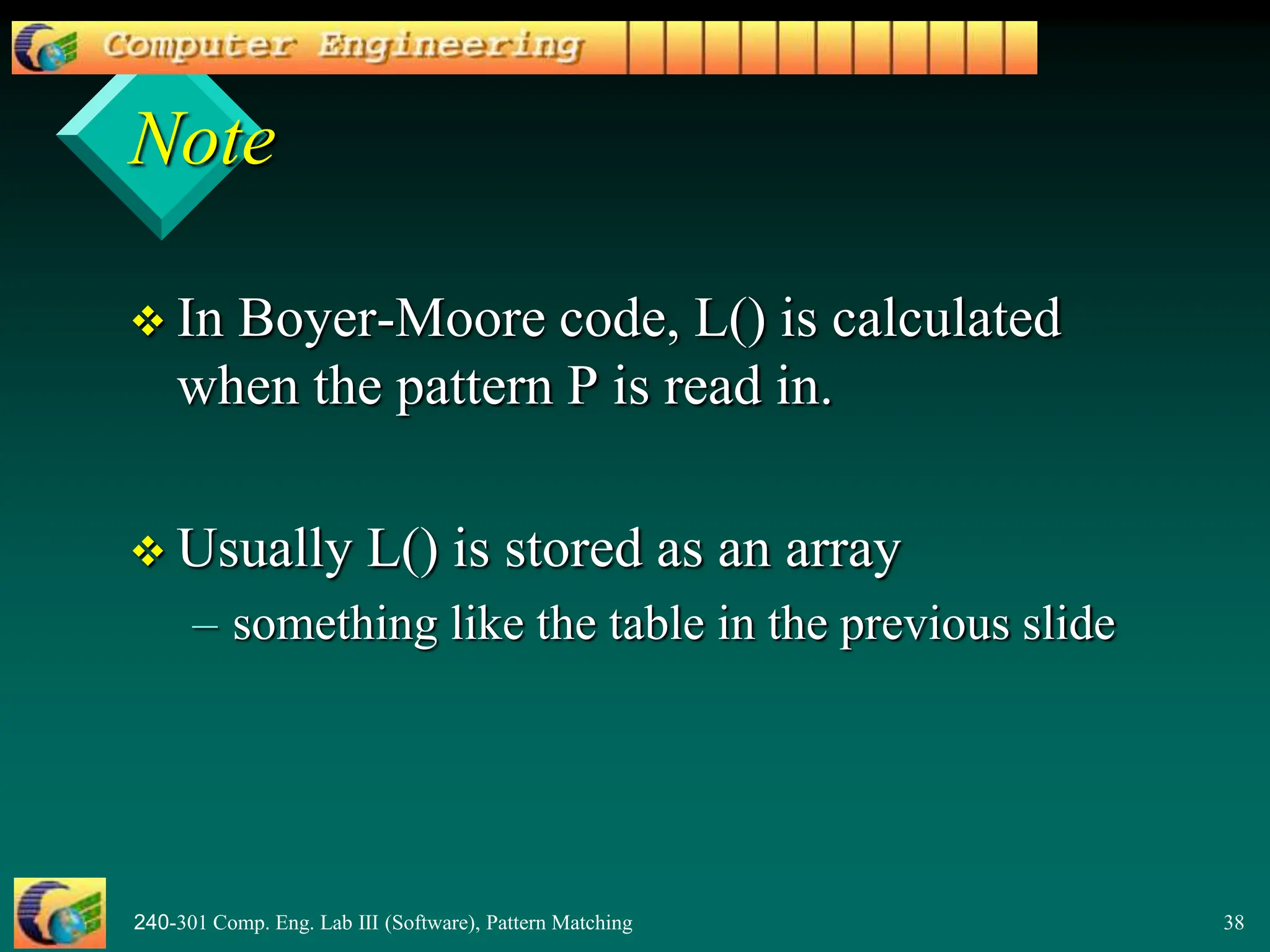
Note
 In Boyer-Moore code, L() is calculated
when the pattern P is read in.
 Usually L() is stored as an array
– something like the table in the previous slide
240-301 Comp. Eng. Lab III (Software), Pattern Matching 39
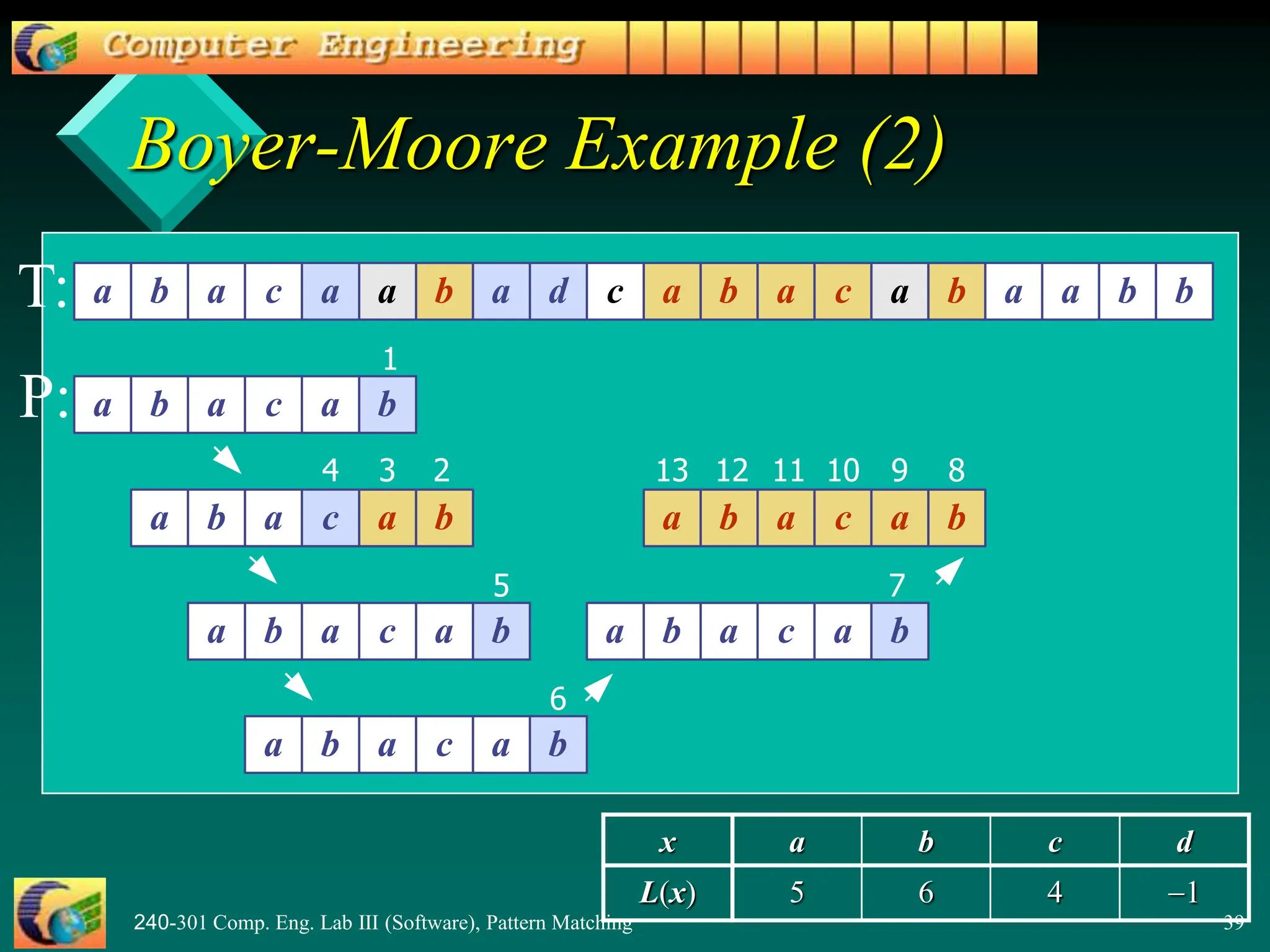
Boyer-Moore Example (2)
1
a b a c a a b a d c a b a c a b a a b b
2
3
4
5
6
7
8
9
10
12
a b a c a b
a b a c a b
a b a c a b
a b a c a b
a b a c a b
a b a c a b
11
13
-1
4
6
5
L(x)
d
c
b
a
x
T:
P:
240-301 Comp. Eng. Lab III (Software), Pattern Matching 40
Boyer-Moore in Java
public static int bmMatch(String text,
String pattern)
{
int last[] = buildLast(pattern);
int n = text.length();
int m = pattern.length();
int i = m-1;
if (i > n-1)
return -1; // no match if pattern is
// longer than text
:
Return index where
pattern starts, or -1
240-301 Comp. Eng. Lab III (Software), Pattern Matching 41
int j = m-1;
do {
if (pattern.charAt(j) == text.charAt(i))
if (j == 0)
return i; // match
else { // looking-glass technique
i--;
j--;
}
else { // character jump technique
int lo = last[text.charAt(i)]; //last occ
i = i + m - Math.min(j, 1+lo);
j = m - 1;
}
} while (i <= n-1);
return -1; // no match
} // end of bmMatch()
240-301 Comp. Eng. Lab III (Software), Pattern Matching 42
public static int[] buildLast(String pattern)
/* Return array storing index of last
occurrence of each ASCII char in pattern. */
{
int last[] = new int[128]; // ASCII char set
for(int i=0; i < 128; i++)
last[i] = -1; // initialize array
for (int i = 0; i < pattern.length(); i++)
last[pattern.charAt(i)] = i;
return last;
} // end of buildLast()
240-301 Comp. Eng. Lab III (Software), Pattern Matching 43
Usage
public static void main(String args[])
{ if (args.length != 2) {
System.out.println("Usage: java BmSearch
<text> <pattern>");
System.exit(0);
}
System.out.println("Text: " + args[0]);
System.out.println("Pattern: " + args[1]);
int posn = bmMatch(args[0], args[1]);
if (posn == -1)
System.out.println("Pattern not found");
else
System.out.println("Pattern starts at posn "
+ posn);
}
240-301 Comp. Eng. Lab III (Software), Pattern Matching 44
Analysis
 Boyer-Moore worst case running time is
O(nm + A)
 But, Boyer-Moore is fast when the alphabet
(A) is large, slow when the alphabet is small.
– e.g. good for English text, poor for binary
 Boyer-Moore is significantly faster than
brute force for searching English text.
240-301 Comp. Eng. Lab III (Software), Pattern Matching 45
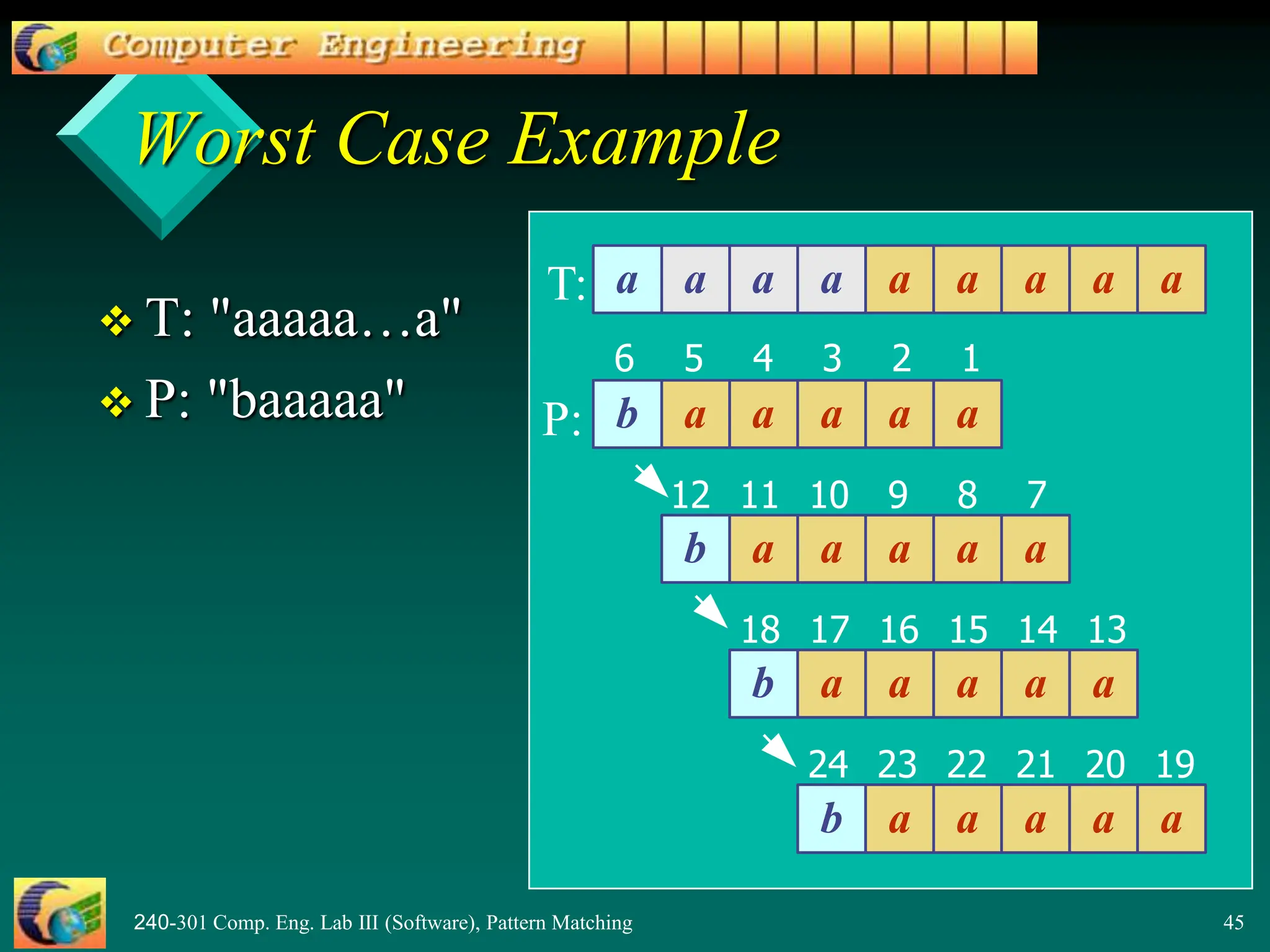
Worst Case Example
 T: "aaaaa…a"
 P: "baaaaa"
11
1
a a a a a a a a a
2
3
4
5
6
b a a a a a
b a a a a a
b a a a a a
b a a a a a
7
8
9
10
12
13
14
15
16
17
18
19
20
21
22
23
24
T:
P:
240-301 Comp. Eng. Lab III (Software), Pattern Matching 46
5. More Information
 Algorithms in C++
Robert Sedgewick
Addison-Wesley, 1992
– chapter 19, String Searching
 Online Animated Algorithms:
– http://www.ics.uci.edu/~goodrich/dsa/
11strings/demos/pattern/
– http://www-sr.informatik.uni-tuebingen.de/
~buehler/BM/BM1.html
– http://www-igm.univ-mlv.fr/~lecroq/string/
This book is
in the CoE library.

PatternMatching2.pptnnnnnnnnnnnnnnnnnnnnnnnnnnnnnnnnnnnn

  • 1.
    240-301 Comp. Eng.Lab III (Software), Pattern Matching 1 Pattern Matching 1 a b a c a a b 2 3 4 a b a c a b a b a c a b Dr. Andrew Davison WiG Lab (teachers room), CoE ad@fivedots.coe.psu.ac.th 240-301, Computer Engineering Lab III (Software) T: P: Semester 1, 2006-2007
  • 2.
    240-301 Comp. Eng.Lab III (Software), Pattern Matching 2 Overview 1. What is Pattern Matching? 2. The Brute Force Algorithm 3. The Knuth-Morris-Pratt Algorithm 4. The Boyer-Moore Algorithm 5. More Information
  • 3.
    240-301 Comp. Eng.Lab III (Software), Pattern Matching 3 1. What is Pattern Matching?  Definition: – given a text string T and a pattern string P, find the pattern inside the text  T: “the rain in spain stays mainly on the plain”  P: “n th”  Applications: – text editors, Web search engines (e.g. Google), image analysis
  • 4.
    240-301 Comp. Eng.Lab III (Software), Pattern Matching 4 String Concepts  Assume S is a string of size m. S = x1x2 … xm  A prefix of S is a substring S[1 .. k-1]  A suffix of S is a substring S[k-1 .. m] – k is any index between 1 and m – S[0] is null character
  • 5.
    240-301 Comp. Eng.Lab III (Software), Pattern Matching 5 Examples  All possible prefixes of S: – “”, “a", "an", "and", "andr”, "andre“,  All possible suffixes of S: – “”, “w", “ew", “rew", “drew", “ndrew” a n d r e w S 0 5
  • 6.
    240-301 Comp. Eng.Lab III (Software), Pattern Matching 6 2. The Brute Force Algorithm  Check each position in the text T to see if the pattern P starts in that position a n d r e w T: r e w P: a n d r e w T: r e w P: . . . . P moves 1 char at a time through T
  • 7.
    240-301 Comp. Eng.Lab III (Software), Pattern Matching 7 Brute Force in Java public static int brute(String text,String pattern) { int n = text.length(); // n is length of text int m = pattern.length(); // m is length of pattern int j; for(int i=0; i <= (n-m); i++) { j = 0; while ((j < m) && (text.charAt(i+j) == pattern.charAt(j)) ) j++; if (j == m) return i; // match at i } return -1; // no match } // end of brute() Return index where pattern starts, or -1
  • 8.
    240-301 Comp. Eng.Lab III (Software), Pattern Matching 8 Usage public static void main(String args[]) { if (args.length != 2) { System.out.println("Usage: java BruteSearch <text> <pattern>"); System.exit(0); } System.out.println("Text: " + args[0]); System.out.println("Pattern: " + args[1]); int posn = brute(args[0], args[1]); if (posn == -1) System.out.println("Pattern not found"); else System.out.println("Pattern starts at posn " + posn); }
  • 9.
    240-301 Comp. Eng.Lab III (Software), Pattern Matching 9 Analysis  Brute force pattern matching runs in time O(mn) in the worst case.  But most searches of ordinary text take O(m+n), which is very quick. continued
  • 10.
    240-301 Comp. Eng.Lab III (Software), Pattern Matching 10  The brute force algorithm is fast when the alphabet of the text is large – e.g. A..Z, a..z, 1..9, etc.  It is slower when the alphabet is small – e.g. 0, 1 (as in binary files, image files, etc.) continued
  • 11.
    240-301 Comp. Eng.Lab III (Software), Pattern Matching 11  Example of a worst case: – T: "aaaaaaaaaaaaaaaaaaaaaaaaaah" – P: "aaah"  Example of a more average case: – T: "a string searching example is standard" – P: "store"
  • 12.
    240-301 Comp. Eng.Lab III (Software), Pattern Matching 12 3. The KMP Algorithm  The Knuth-Morris-Pratt (KMP) algorithm looks for the pattern in the text in a left-to- right order (like the brute force algorithm).  But it shifts the pattern more intelligently than the brute force algorithm. continued
  • 13.
    240-301 Comp. Eng.Lab III (Software), Pattern Matching 13  If a mismatch occurs between the text and pattern P at P[j], what is the most we can shift the pattern to avoid wasteful comparisons?  Answer: the largest prefix of P[1 .. j-1] that is a suffix of P[1 .. j-1]
  • 14.
    240-301 Comp. Eng.Lab III (Software), Pattern Matching 14 Example T: P: jnew = 3 j = 6 i
  • 15.
    240-301 Comp. Eng.Lab III (Software), Pattern Matching 15 Why  Find largest prefix (start) of: "a b a a b" ( P[1..j-1] ) which is suffix (end) of: “a b a a b" ( p[1 .. j-1] )  Answer: "a b"  Set j = 3 // the new j value j == 5
  • 16.
    240-301 Comp. Eng.Lab III (Software), Pattern Matching 16 KMP Border Function  KMP preprocesses the pattern to find matches of prefixes of the pattern with the pattern itself.  j = mismatch position in P[]  k = position before the mismatch (k = j-1).  The border function b(k) is defined as the size of the largest prefix of P[1..k] that is also a suffix of P[1..k].
  • 17.
    240-301 Comp. Eng.Lab III (Software), Pattern Matching 17  P: "abaaba" j: 123456  In code, b() is represented by an array, like the table. Border Function Example b(k) is the size of the largest border. 1 4 2 5 3 2 1 j 1 0 0 F(j) k b(k) (k == j-1)
  • 18.
    240-301 Comp. Eng.Lab III (Software), Pattern Matching 18 Why is b(5) == 2?  b(5) means – find the size of the largest prefix of P[1..5] that is also a suffix of P[1..5] = find the size largest prefix of "abaab" that is also a suffix of "baab" = find the size of "ab" = 2 P: "abaaba"
  • 19.
    240-301 Comp. Eng.Lab III (Software), Pattern Matching 19  Knuth-Morris-Pratt’s algorithm modifies the brute-force algorithm. – if a mismatch occurs at P[j] (i.e. P[j] != T[i]), then k = j-1; j = b(k) + 1; // obtain the new j Using the Failure Function
  • 20.
    240-301 Comp. Eng.Lab III (Software), Pattern Matching 20 KMP in Java public static int kmpMatch(String text, String pattern) { int n = text.length(); int m = pattern.length(); int fail[] = computeFail(pattern); int i=0; int j=0; : Return index where pattern starts, or -1
  • 21.
    240-301 Comp. Eng.Lab III (Software), Pattern Matching 21 while (i < n) { if (pattern.charAt(j) == text.charAt(i)) { if (j == m - 1) return i - m + 1; // match i++; j++; } else if (j > 0) j = fail[j-1]; else i++; } return -1; // no match } // end of kmpMatch()
  • 22.
    240-301 Comp. Eng.Lab III (Software), Pattern Matching 22 public static int[] computeFail( String pattern) { int fail[] = new int[pattern.length()]; fail[0] = 0; int m = pattern.length(); int j = 0; int i = 1; :
  • 23.
    240-301 Comp. Eng.Lab III (Software), Pattern Matching 23 while (i < m) { if (pattern.charAt(j) == pattern.charAt(i)) { //j+1 chars match fail[i] = j + 1; i++; j++; } else if (j > 0) // j follows matching prefix j = fail[j-1]; else { // no match fail[i] = 0; i++; } } return fail; } // end of computeFail() Similar code to kmpMatch()
  • 24.
    240-301 Comp. Eng.Lab III (Software), Pattern Matching 24 Usage public static void main(String args[]) { if (args.length != 2) { System.out.println("Usage: java KmpSearch <text> <pattern>"); System.exit(0); } System.out.println("Text: " + args[0]); System.out.println("Pattern: " + args[1]); int posn = kmpMatch(args[0], args[1]); if (posn == -1) System.out.println("Pattern not found"); else System.out.println("Pattern starts at posn " + posn); }
  • 25.
    240-301 Comp. Eng.Lab III (Software), Pattern Matching 25 Example 1 a b a c a a b a c a b a c a b a a b b 7 8 19 18 17 15 a b a c a b 16 14 13 2 3 4 5 6 9 a b a c a b a b a c a b a b a c a b a b a c a b 10 11 12 c 0 4 1 5 3 2 1 k 1 0 0 b(k) T: P:
  • 26.
    240-301 Comp. Eng.Lab III (Software), Pattern Matching 26 Why is b(4) == 1?  b(4) means – find the size of the largest prefix of P[1..5] that is also a suffix of P[1..5] = find the size largest prefix of "abaca" that is also a suffix of "baca" = find the size of "a" = 1 P: "abacab"
  • 27.
    240-301 Comp. Eng.Lab III (Software), Pattern Matching 27 KMP Advantages  KMP runs in optimal time: O(m+n) – very fast  The algorithm never needs to move backwards in the input text, T – this makes the algorithm good for processing very large files that are read in from external devices or through a network stream
  • 28.
    240-301 Comp. Eng.Lab III (Software), Pattern Matching 28 KMP Disadvantages  KMP doesn’t work so well as the size of the alphabet increases – more chance of a mismatch (more possible mismatches) – mismatches tend to occur early in the pattern, but KMP is faster when the mismatches occur later
  • 29.
    240-301 Comp. Eng.Lab III (Software), Pattern Matching 29 KMP Extensions  The basic algorithm doesn't take into account the letter in the text that caused the mismatch. a a a b b a a a b b a x a a a b b a T: P: Basic KMP does not do this.
  • 30.
    240-301 Comp. Eng.Lab III (Software), Pattern Matching 30 3. The Boyer-Moore Algorithm  The Boyer-Moore pattern matching algorithm is based on two techniques.  1. The looking-glass technique – find P in T by moving backwards through P, starting at its end
  • 31.
    240-301 Comp. Eng.Lab III (Software), Pattern Matching 31  2. The character-jump technique – when a mismatch occurs at T[i] == x – the character in pattern P[j] is not the same as T[i]  There are 3 possible cases, tried in order. x a T i b a P j
  • 32.
    240-301 Comp. Eng.Lab III (Software), Pattern Matching 32 Case 1  If P contains x somewhere, then try to shift P right to align the last occurrence of x in P with T[i]. x a T i b a P j x c x a T inew b a P jnew x c ? ? and move i and j right, so j at end
  • 33.
    240-301 Comp. Eng.Lab III (Software), Pattern Matching 33 Case 2  If P contains x somewhere, but a shift right to the last occurrence is not possible, then shift P right by 1 character to T[i+1]. a x T i a x P j c w a x T inew a x P jnew c w ? and move i and j right, so j at end x x is after j position x
  • 34.
    240-301 Comp. Eng.Lab III (Software), Pattern Matching 34 Case 3  If cases 1 and 2 do not apply, then shift P to align P[1] with T[i+1]. x a T i b a P j d c x a T inew b a P jnew d c ? ? and move i and j right, so j at end No x in P ? 1
  • 35.
    240-301 Comp. Eng.Lab III (Software), Pattern Matching 35 Boyer-Moore Example (1) 1 a p a t t e r n m a t c h i n g a l g o r i t h m r i t h m r i t h m r i t h m r i t h m r i t h m r i t h m r i t h m 2 3 4 5 6 7 8 9 10 11 T: P:
  • 36.
    240-301 Comp. Eng.Lab III (Software), Pattern Matching 36 Last Occurrence Function  Boyer-Moore’s algorithm preprocesses the pattern P and the alphabet A to build a last occurrence function L() – L() maps all the letters in A to integers  L(x) is defined as: // x is a letter in A – the largest index i such that P[i] == x, or – -1 if no such index exists
  • 37.
    240-301 Comp. Eng.Lab III (Software), Pattern Matching 37 L() Example  A = {a, b, c, d}  P: "abacab" -1 4 6 5 L(x) d c b a x a b a c a b 1 2 3 4 5 6 P L() stores indexes into P[]
  • 38.
    240-301 Comp. Eng.Lab III (Software), Pattern Matching 38 Note  In Boyer-Moore code, L() is calculated when the pattern P is read in.  Usually L() is stored as an array – something like the table in the previous slide
  • 39.
    240-301 Comp. Eng.Lab III (Software), Pattern Matching 39 Boyer-Moore Example (2) 1 a b a c a a b a d c a b a c a b a a b b 2 3 4 5 6 7 8 9 10 12 a b a c a b a b a c a b a b a c a b a b a c a b a b a c a b a b a c a b 11 13 -1 4 6 5 L(x) d c b a x T: P:
  • 40.
    240-301 Comp. Eng.Lab III (Software), Pattern Matching 40 Boyer-Moore in Java public static int bmMatch(String text, String pattern) { int last[] = buildLast(pattern); int n = text.length(); int m = pattern.length(); int i = m-1; if (i > n-1) return -1; // no match if pattern is // longer than text : Return index where pattern starts, or -1
  • 41.
    240-301 Comp. Eng.Lab III (Software), Pattern Matching 41 int j = m-1; do { if (pattern.charAt(j) == text.charAt(i)) if (j == 0) return i; // match else { // looking-glass technique i--; j--; } else { // character jump technique int lo = last[text.charAt(i)]; //last occ i = i + m - Math.min(j, 1+lo); j = m - 1; } } while (i <= n-1); return -1; // no match } // end of bmMatch()
  • 42.
    240-301 Comp. Eng.Lab III (Software), Pattern Matching 42 public static int[] buildLast(String pattern) /* Return array storing index of last occurrence of each ASCII char in pattern. */ { int last[] = new int[128]; // ASCII char set for(int i=0; i < 128; i++) last[i] = -1; // initialize array for (int i = 0; i < pattern.length(); i++) last[pattern.charAt(i)] = i; return last; } // end of buildLast()
  • 43.
    240-301 Comp. Eng.Lab III (Software), Pattern Matching 43 Usage public static void main(String args[]) { if (args.length != 2) { System.out.println("Usage: java BmSearch <text> <pattern>"); System.exit(0); } System.out.println("Text: " + args[0]); System.out.println("Pattern: " + args[1]); int posn = bmMatch(args[0], args[1]); if (posn == -1) System.out.println("Pattern not found"); else System.out.println("Pattern starts at posn " + posn); }
  • 44.
    240-301 Comp. Eng.Lab III (Software), Pattern Matching 44 Analysis  Boyer-Moore worst case running time is O(nm + A)  But, Boyer-Moore is fast when the alphabet (A) is large, slow when the alphabet is small. – e.g. good for English text, poor for binary  Boyer-Moore is significantly faster than brute force for searching English text.
  • 45.
    240-301 Comp. Eng.Lab III (Software), Pattern Matching 45 Worst Case Example  T: "aaaaa…a"  P: "baaaaa" 11 1 a a a a a a a a a 2 3 4 5 6 b a a a a a b a a a a a b a a a a a b a a a a a 7 8 9 10 12 13 14 15 16 17 18 19 20 21 22 23 24 T: P:
  • 46.
    240-301 Comp. Eng.Lab III (Software), Pattern Matching 46 5. More Information  Algorithms in C++ Robert Sedgewick Addison-Wesley, 1992 – chapter 19, String Searching  Online Animated Algorithms: – http://www.ics.uci.edu/~goodrich/dsa/ 11strings/demos/pattern/ – http://www-sr.informatik.uni-tuebingen.de/ ~buehler/BM/BM1.html – http://www-igm.univ-mlv.fr/~lecroq/string/ This book is in the CoE library.

Editor's Notes

  • #2 4/15/2024 4:02 PM