1
Case Study: Searching for Patterns
Problem: find all occurrences of pattern
P of length m inside the text T of
length n.
 Exact matching problem
2
String Matching - Applications
 Text editing
 Term rewriting
 Lexical analysis
 Information retrieval
 And, bioinformatics
3
a g c a g a a g a g t a
T
P g
a g
g a g
a g a g
P g
a g
g a g
a g a g
P g
a g
g a g
a g a g
P g
a g
g a g
a g a g
P g
a g
g a g
a g a g
P g
a g
g a g
a g a g
P g
a g
g a g
a g a g
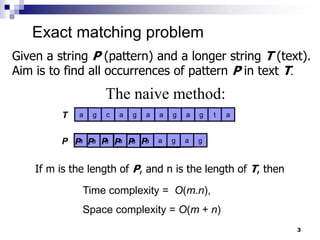
Exact matching problem
Given a string P (pattern) and a longer string T (text).
Aim is to find all occurrences of pattern P in text T.
The naive method:
Time complexity = O(m.n),
Space complexity = O(m + n)
If m is the length of P, and n is the length of T, then
4
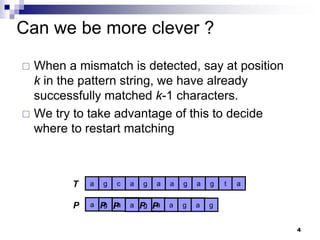
Can we be more clever ?
 When a mismatch is detected, say at position
k in the pattern string, we have already
successfully matched k-1 characters.
 We try to take advantage of this to decide
where to restart matching
a g c a g a a g a g t a
T
P g
a g
g a g
a g a g
P g
a g
g a g
a g a g
P g
a g
g a g
a g a g
P g
a g
g a g
a g a g
P g
a g
g a g
a g a g
5
The Knuth-Morris-Pratt Algorithm
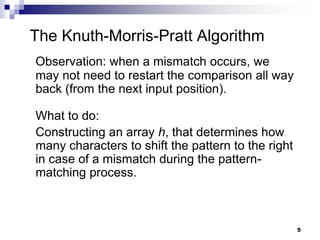
Observation: when a mismatch occurs, we
may not need to restart the comparison all way
back (from the next input position).
What to do:
Constructing an array h, that determines how
many characters to shift the pattern to the right
in case of a mismatch during the pattern-
matching process.
6
The key idea is that if we have
successfully matched the prefix P[1…i-
1] of the pattern with the substring T[j-
i+1,…,j-1] of the input string and P(i) 
T(j), then we do not need to reprocess
any of the suffix T[j-i+1,…,j-1] since we
know this portion of the text string is
the prefix of the pattern that we have
just matched.
KMP (2)
7
For each position i in pattern P, define hi to be
the length of the longest proper suffix of P[1,…,i]
that matches a prefix of P.
1 2 3 4 5 6 7 8 9 10 11 12 13
Pattern: a b a a b a b a a b a a b
i = 11
Hence, h(11) = 6.
If there is no proper suffix of P[1,…,i] with the
property mentioned above, then h(i) = 0
.
The failure function h
8
a b a a b a b a a b a a b
The KMP shift rule
a b a a b a b a a b a a b
a b a a b a b a a b a c a b a a b a b a a b
T:
P:
P:
The first mismatch in position
k=12 of T and in pos. i+1=12 of P.
h11 = 6
Shift P to the right so that P[1,…,h(i)] aligns with the suffix
T[k- h(i),…,k-1].
They must match because of the definition of h.
In other words, shift P exactly i – h(i) places to the right.
If there is no mismatch, then shift P by m – h(m) places to
the right.
9
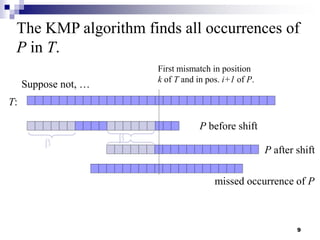
missed occurrence of P
The KMP algorithm finds all occurrences of
P in T.
P before shift
P after shift
First mismatch in position
k of T and in pos. i+1 of P.
 
Suppose not, …
T:
10
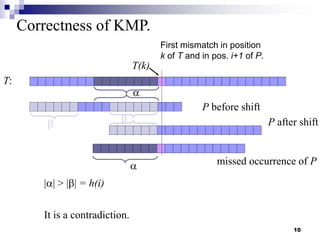
Correctness of KMP.
P before shift
P after shift
missed occurrence of P
First mismatch in position
k of T and in pos. i+1 of P.




|| > || = h(i)
T:
It is a contradiction.
T(k)
11
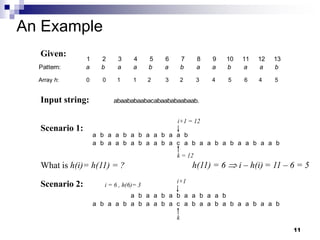
An Example
1 2 3 4 5 6 7 8 9 10 11 12 13
Pattern: a b a a b a b a a b a a b
Next funciton: 0 1 0 2 1 0 4 0 2 1 0 7 1
abaababaabacabaababaabaab.
Given:
Input string:
a b a a b a b a a b a a b
a b a a b a b a a b a c a b a a b a b a a b a a b
Scenario 1:
i+1 = 12
k = 12
Scenario 2: i+1
k
i = 6 , h(6)= 3
a b a a b a b a a b a a b
a b a a b a b a a b a c a b a a b a b a a b a a b
Array h: 0 0 1 1 2 3 2 3 4 5 6 4 5
What is h(i)= h(11) = ? h(11) = 6  i – h(i) = 11 – 6 = 5
12
An Example
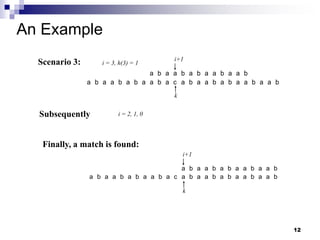
Scenario 3: i+1
k
i = 3, h(3) = 1
Subsequently i = 2, 1, 0
Finally, a match is found:
a b a a b a b a a b a a b
a b a a b a b a a b a c a b a a b a b a a b a a b
i+1
k
a b a a b a b a a b a a b
a b a a b a b a a b a c a b a a b a b a a b a a b
13
Complexity of KMP
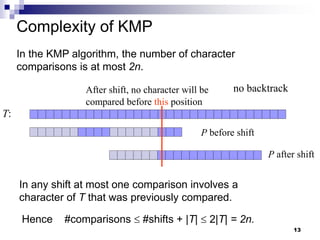
In the KMP algorithm, the number of character
comparisons is at most 2n.
Hence #comparisons  #shifts + |T|  2|T| = 2n.
P before shift
P after shift
T:
In any shift at most one comparison involves a
character of T that was previously compared.
no backtrack
After shift, no character will be
compared before this position
14
Computing the failure function
 We can compute h(i+1) if we know h(1)..h(i)
 To do this we run the KMP algorithm where the text is
the pattern with the first character replaced with a $.
 Suppose we have successfully matched a prefix of the
pattern with a suffix of T[1..i]; the length of this match is
h(i).
 If the next character of the pattern and text match then
h(i+1)=h(i)+1.
 If not, then in the KMP algorithm we would shift the
pattern; the length of the new match is h(h(i)).
 If the next character of the pattern and text match then
h(i+1)=h(h(i))+1, else we continue to shift the pattern.
 Since the no. of comparisons required by KMP is length
of pattern+text, time taken for computing the failure
function is O(n).
15
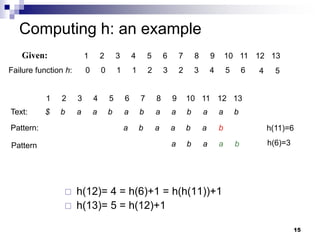
Computing h: an example
 h(12)= 4 = h(6)+1 = h(h(11))+1
 h(13)= 5 = h(12)+1
Given:
Pattern: a b a a b a
Pattern:
Failure function h: 0 0 1 1 2 3 2 3 4 5 6
1 2 3 4 5 6 7 8 9 10 11 12 13
1 2 3 4 5 6 7 8 9 10 11 12 13
$ b a a b a b a a b a a b
Text:
b
a
h(11)=6
h(6)=3
a b a
Pattern
4
b
5
16
KMP - Analysis
 The KMP algorithm never needs to
backtrack on the text string.
Time complexity = O(m + n)
Space complexity = O(m + n),
where m =|P| and n=|T|.
preprocessing searching

lec17.ppt

  • 1.
    1 Case Study: Searchingfor Patterns Problem: find all occurrences of pattern P of length m inside the text T of length n.  Exact matching problem
  • 2.
    2 String Matching -Applications  Text editing  Term rewriting  Lexical analysis  Information retrieval  And, bioinformatics
  • 3.
    3 a g ca g a a g a g t a T P g a g g a g a g a g P g a g g a g a g a g P g a g g a g a g a g P g a g g a g a g a g P g a g g a g a g a g P g a g g a g a g a g P g a g g a g a g a g Exact matching problem Given a string P (pattern) and a longer string T (text). Aim is to find all occurrences of pattern P in text T. The naive method: Time complexity = O(m.n), Space complexity = O(m + n) If m is the length of P, and n is the length of T, then
  • 4.
    4 Can we bemore clever ?  When a mismatch is detected, say at position k in the pattern string, we have already successfully matched k-1 characters.  We try to take advantage of this to decide where to restart matching a g c a g a a g a g t a T P g a g g a g a g a g P g a g g a g a g a g P g a g g a g a g a g P g a g g a g a g a g P g a g g a g a g a g
  • 5.
    5 The Knuth-Morris-Pratt Algorithm Observation:when a mismatch occurs, we may not need to restart the comparison all way back (from the next input position). What to do: Constructing an array h, that determines how many characters to shift the pattern to the right in case of a mismatch during the pattern- matching process.
  • 6.
    6 The key ideais that if we have successfully matched the prefix P[1…i- 1] of the pattern with the substring T[j- i+1,…,j-1] of the input string and P(i)  T(j), then we do not need to reprocess any of the suffix T[j-i+1,…,j-1] since we know this portion of the text string is the prefix of the pattern that we have just matched. KMP (2)
  • 7.
    7 For each positioni in pattern P, define hi to be the length of the longest proper suffix of P[1,…,i] that matches a prefix of P. 1 2 3 4 5 6 7 8 9 10 11 12 13 Pattern: a b a a b a b a a b a a b i = 11 Hence, h(11) = 6. If there is no proper suffix of P[1,…,i] with the property mentioned above, then h(i) = 0 . The failure function h
  • 8.
    8 a b aa b a b a a b a a b The KMP shift rule a b a a b a b a a b a a b a b a a b a b a a b a c a b a a b a b a a b T: P: P: The first mismatch in position k=12 of T and in pos. i+1=12 of P. h11 = 6 Shift P to the right so that P[1,…,h(i)] aligns with the suffix T[k- h(i),…,k-1]. They must match because of the definition of h. In other words, shift P exactly i – h(i) places to the right. If there is no mismatch, then shift P by m – h(m) places to the right.
  • 9.
    9 missed occurrence ofP The KMP algorithm finds all occurrences of P in T. P before shift P after shift First mismatch in position k of T and in pos. i+1 of P.   Suppose not, … T:
  • 10.
    10 Correctness of KMP. Pbefore shift P after shift missed occurrence of P First mismatch in position k of T and in pos. i+1 of P.     || > || = h(i) T: It is a contradiction. T(k)
  • 11.
    11 An Example 1 23 4 5 6 7 8 9 10 11 12 13 Pattern: a b a a b a b a a b a a b Next funciton: 0 1 0 2 1 0 4 0 2 1 0 7 1 abaababaabacabaababaabaab. Given: Input string: a b a a b a b a a b a a b a b a a b a b a a b a c a b a a b a b a a b a a b Scenario 1: i+1 = 12 k = 12 Scenario 2: i+1 k i = 6 , h(6)= 3 a b a a b a b a a b a a b a b a a b a b a a b a c a b a a b a b a a b a a b Array h: 0 0 1 1 2 3 2 3 4 5 6 4 5 What is h(i)= h(11) = ? h(11) = 6  i – h(i) = 11 – 6 = 5
  • 12.
    12 An Example Scenario 3:i+1 k i = 3, h(3) = 1 Subsequently i = 2, 1, 0 Finally, a match is found: a b a a b a b a a b a a b a b a a b a b a a b a c a b a a b a b a a b a a b i+1 k a b a a b a b a a b a a b a b a a b a b a a b a c a b a a b a b a a b a a b
  • 13.
    13 Complexity of KMP Inthe KMP algorithm, the number of character comparisons is at most 2n. Hence #comparisons  #shifts + |T|  2|T| = 2n. P before shift P after shift T: In any shift at most one comparison involves a character of T that was previously compared. no backtrack After shift, no character will be compared before this position
  • 14.
    14 Computing the failurefunction  We can compute h(i+1) if we know h(1)..h(i)  To do this we run the KMP algorithm where the text is the pattern with the first character replaced with a $.  Suppose we have successfully matched a prefix of the pattern with a suffix of T[1..i]; the length of this match is h(i).  If the next character of the pattern and text match then h(i+1)=h(i)+1.  If not, then in the KMP algorithm we would shift the pattern; the length of the new match is h(h(i)).  If the next character of the pattern and text match then h(i+1)=h(h(i))+1, else we continue to shift the pattern.  Since the no. of comparisons required by KMP is length of pattern+text, time taken for computing the failure function is O(n).
  • 15.
    15 Computing h: anexample  h(12)= 4 = h(6)+1 = h(h(11))+1  h(13)= 5 = h(12)+1 Given: Pattern: a b a a b a Pattern: Failure function h: 0 0 1 1 2 3 2 3 4 5 6 1 2 3 4 5 6 7 8 9 10 11 12 13 1 2 3 4 5 6 7 8 9 10 11 12 13 $ b a a b a b a a b a a b Text: b a h(11)=6 h(6)=3 a b a Pattern 4 b 5
  • 16.
    16 KMP - Analysis The KMP algorithm never needs to backtrack on the text string. Time complexity = O(m + n) Space complexity = O(m + n), where m =|P| and n=|T|. preprocessing searching