Chapter 6
Sexual Arousal and
Response
Hormones
• Steroid hormones
– Commonly referred to as “male sex hormones” and “female
sex hormones,” although both sexes produce both types of
hormones.
– Testosterone: the major androgen, or male sex hormone
• Produced in the testes (men), adrenal glands (men and women), &
ovaries (women).
• Men typically produce 20-40X more testosterone than women.
– Estrogen: the major female sex hormones
• produced by ovaries & testes.
• Testes produce much smaller quantities of estrogens than ovaries.
• Neuropeptide hormones
– Oxytocin--often called the “love hormone;” seems to
influence erotic and emotional attraction to one another.
– Produced in the brain by the hypothalamus.
Hormones in male sexual behavior
• Testosterone linked to male sexual desire (libido)
– Less linked to functioning; a man w/low testosterone level
can be fully capable of erection and orgasm but might have
little interest in sex.
• Evidence
1) Research on men who have undergone castration shows
significant reduction in sexual desire and activity.
2) Androgen-blocking drugs (antiandrogens)
• Have been used to try and treat sex offenders, and are used to treat
some medical conditions, such as prostate cancer.
• Depo-provera (medroxyprogesterone acetate, MPA) has been
shown to reduce sexual desire and activity in men and women.
3) Hypogonadism: endocrine disorder causing testosterone
deficiency in males; also causes major reduction in sexual
desire that can be treated with testosterone replacement.
Hormones in female sexual behavior
• Testosterone linked to female sexual desire (libido)
• Evidence
1) Testosterone-replacement therapy enhances sexual
desire and arousal in post-menopausal women and other
women with low levels of testosterone
2) In women with normal testosterone levels, supplemental
testosterone caused a significant increase in genital
responsiveness within hours.
3) Women with a history of low sex drive and inhibited
arousal positively responded to testosterone administration.
4)Comparisons of women w/history of healthy sex drive and
women w/history of low libido showed that women in the
low-libido group had lower testosterone levels.
Hormones in female sexual behavior,
(cont.)
• Estrogens: role in female sexual behavior is still
unclear.
– Contribute to general sense of well-being
– Help maintain thickness & elasticity of vaginal lining
– Contribute to vaginal lubrication
– However, there are contradictory findings about
whether administration of estrogen increases or
decreases libido in women.
How much testosterone is necessary for
normal sexual functioning?
• Levels of free testosterone are much lower in
women than men.
– This does not mean that women have lower or
weaker sex drives.
– Rather, women’s body cells are more sensitive to
testosterone than a man’s body cells are.
• Testosterone levels decline w/age in both
sexes.
Testosterone replacement therapy
• Use of testosterone supplements to treat a
deficiency in testosterone.
– Relatively common to treat sexual difficulties in men.
– Women have a harder time receiving TRT, although
testosterone deficiency is a fairly common experience
during menopause.
– There are some negative side effects, and long-term
effects of TRT aren’t yet known.
• Can stimulate growth of prostate cancer cells, if present.
• Some concerns about cardiovascular problems in men.
• Little research done on TRT in women.
• More long-term studies are needed.
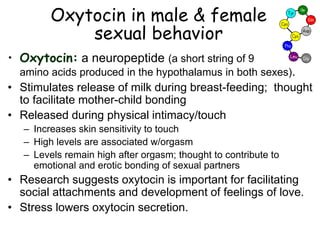
Oxytocin in male & female
sexual behavior
• Oxytocin: a neuropeptide (a short string of 9
amino acids produced in the hypothalamus in both sexes).
• Stimulates release of milk during breast-feeding; thought
to facilitate mother-child bonding
• Released during physical intimacy/touch
– Increases skin sensitivity to touch
– High levels are associated w/orgasm
– Levels remain high after orgasm; thought to contribute to
emotional and erotic bonding of sexual partners
• Research suggests oxytocin is important for facilitating
social attachments and development of feelings of love.
• Stress lowers oxytocin secretion.
Funny ad . . . oxytocin spray!
The brain and sexual arousal
• Sexual arousal can occur w/o any sensory
stimulation, through thoughts and fantasy alone.
• Stimuli that people find arousing is greatly
influenced by cultural conditioning.
– Features that are considered attractive vary from one
culture to another.
– In many cultures, bare female breasts are not viewed as
erotic stimuli, as they are in the U.S.
– Foreplay leading to arousal varies considerably in
different cultures.
• Ex: in a survey of 190 cultures, mouth kissing was only practiced
in 21.
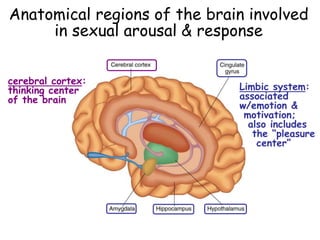
Anatomical regions of the brain involved
in sexual arousal & response
cerebral cortex:
thinking center
of the brain
Limbic system:
associated
w/emotion &
motivation;
also includes
the “pleasure
center”
Limbic system
• Associated with emotion, motivation, and memory
• Includes several brain structures
– Hypothalamus, hippocampus, amygdala, cingulate gyrus
• 1950s study: rats implanted w/electrodes in regions
of limbic system that could be activated by a lever.
– Rats pressed lever over and over, in preference to eating
or drinking, eventually dying of exhaustion.
• Limbic stimulation in people (done for therapeutic purposes)
: patients reported intense sexual pleasure.
• Damage to certain parts of the hypothalamus seems
to dramatically reduce sexual behavior of both males
and females in several species.
Neurotransmitters and sexual arousal
• Dopamine
– Released in the “pleasure center” of the limbic system.
– Facilitates sexual arousal and response.
– Testosterone stimulates dopamine release in both
males and females.
• Oxytocin (already discussed)
• Serotonin
– Inhibits sexual activity
– inhibits release of dopamine.
– Antidepressants called SSRIs increase serotonin
levels in the brain--side effects often include
decreased libido and diminished sexual response.
– (selective serotonin reuptake inhibitors)
Sexual arousal: the role of the senses
• Touch is the dominant "sexual sense”
– Primary erogenous zones: areas of the body
that contain dense concentrations of nerve
endings.
• Includes genitals, buttocks, anus, perineum, breasts,
inner thighs, armpits, navel, neck, ear lobes, mouth.
• Varies from one person to another.
– Secondary erogenous zones: areas of the body
that have become erotically sensitive through
learning and experience.
• Virtually any other region of the body--depends on
personal erotic experiences.
Sexual arousal: the role of the senses
• Vision: usually next important sense in arousal.
– Early research supported the idea that males are more
aroused by visual stimuli than females.
• Reflects many social influences:
– Was considered culturally inappropriate for women to view
pornography.
– Most pornography was made to appeal exclusively to men; some
women found themes/ideas offensive.
– Today, pornography and erotica is available that appeals to many
women.
– Studies using physiological recording devices while
subjects viewed pornography showed equal physiological
signs of arousal in women and men.
– When arousal was assessed by self-reporting, women
are less inclined to report being sexually aroused by
visual erotica.
Sexual arousal: the role of the senses
• Smell: highly influenced by a person’s sexual history
and social conditioning.
– In some cultures, the smell of genital secretions are
considered a sexual stimulant.
• Use as a ‘perfume’ by some women in Europe.
– U.S.: near obsession w/masking any natural body odor
• Difficult to study effect of natural odors on desire when they are so
heavily masked by frequent bathing, deodorants, perfumes, and
antiperspirants.
– Even so, many report being aroused by the smell of their
partner, or by people to whom they are attracted.
– Pheromones: odors produced by the body that relate to
reproductive functions (e.g. fertility).
• Very important in sexual response and arousal in many animals.
• Research still not clear on how important they are in humans.
Sexual arousal: the role of the senses
• Taste: seems to play a minor role in arousal.
• Hearing: highly variable.
– Some people find words, erotic conversation,
moans, etc. to be very arousing
– Others prefer more silent sex.
• Different people receive different cultural messages about
whether it is “okay” to talk or make noise during sex.
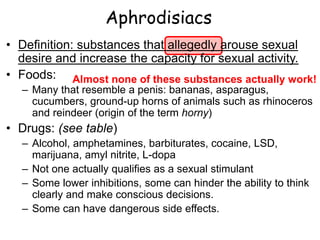
Aphrodisiacs
• Definition: substances that allegedly arouse sexual
desire and increase the capacity for sexual activity.
• Foods:
– Many that resemble a penis: bananas, asparagus,
cucumbers, ground-up horns of animals such as rhinoceros
and reindeer (origin of the term horny)
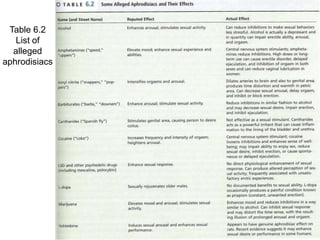
• Drugs: (see table)
– Alcohol, amphetamines, barbiturates, cocaine, LSD,
marijuana, amyl nitrite, L-dopa
– Not one actually qualifies as a sexual stimulant
– Some lower inhibitions, some can hinder the ability to think
clearly and make conscious decisions.
– Some can have dangerous side effects.
Almost none of these substances actually work!
Table 6.2
List of
alleged
aphrodisiacs
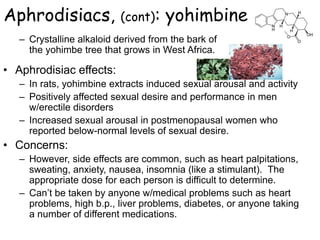
Aphrodisiacs, (cont): yohimbine
– Crystalline alkaloid derived from the bark of
the yohimbe tree that grows in West Africa.
• Aphrodisiac effects:
– In rats, yohimbine extracts induced sexual arousal and activity
– Positively affected sexual desire and performance in men
w/erectile disorders
– Increased sexual arousal in postmenopausal women who
reported below-normal levels of sexual desire.
• Concerns:
– However, side effects are common, such as heart palpitations,
sweating, anxiety, nausea, insomnia (like a stimulant). The
appropriate dose for each person is difficult to determine.
– Can’t be taken by anyone w/medical problems such as heart
problems, high b.p., liver problems, diabetes, or anyone taking
a number of different medications.
Anaphrodisiacs
• Definition: substances that inhibit sexual behavior
– Birth control pills (progesterone-containing)
• Reduce sexual desire by lowering testosterone levels
– Opiates, tranquilizers, sedatives
• Reduce sexual interest, activity, and function
– Nicotine
• Reduces sexual interest and function by constricting blood
vessels and by reducing blood testosterone levels.
– Blood pressure medicine, drugs that treat heart disease
• Inhibit erection and ejaculation, reduce orgasm intensity, reduce
sexual interest
– Antidepressants
• Decreased desire, erectile disorder, delayed or absent orgasm
– Anticonvulsant and antipsychotic drugs
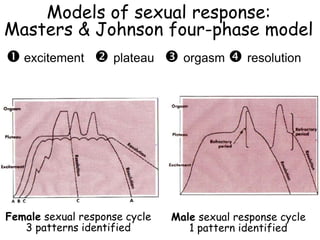
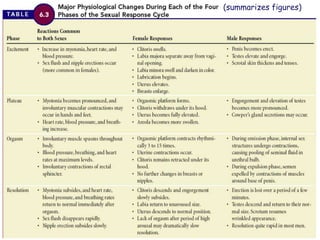
Models of sexual response:
Masters & Johnson four-phase model
 excitement  plateau  orgasm  resolution
Female sexual response cycle
3 patterns identified
Male sexual response cycle
1 pattern identified
6-A Discussion question:
Do you believe that men and women
differ in the importance they attach to
experiencing orgasm during sexual
sharing? Why or why not?
Masters & Johnson four-phase model
of sexual response:
 excitement  plateau  orgasm  resolution
• Remember:
– There’s lots of individual variation.
– Model focuses only on physiology, not the entire personal
experience of sexual response.
– Too-literal interpretation of the plateau stage
• Still a lot happening, even though it’s described as a “leveling-off”
– NOTE: Kaplan has Desire as first phase
Two fundamental physiological responses
to effective sexual stimulation
• Vasocongestion: engorgement of blood vessels in
particular body parts in response to sexual arousal.
• Myotonia: muscle tension
Masters & Johnson's four phases
• Excitement
• Plateau
• Orgasm
• Resolution
Let’s examine the changes that
occur in the internal & external
anatomy of men & women at
each stage…
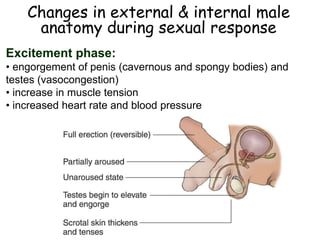
Changes in external & internal male
anatomy during sexual response
Excitement phase:
• engorgement of penis (cavernous and spongy bodies) and
testes (vasocongestion)
• increase in muscle tension
• increased heart rate and blood pressure
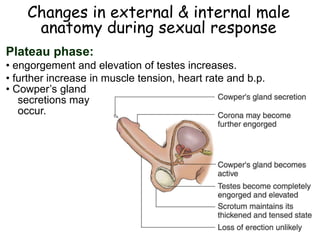
Changes in external & internal male
anatomy during sexual response
Plateau phase:
• engorgement and elevation of testes increases.
• further increase in muscle tension, heart rate and b.p.
• Cowper’s gland
secretions may
occur.
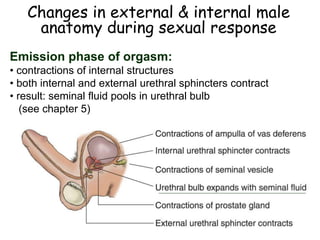
Changes in external & internal male
anatomy during sexual response
Emission phase of orgasm:
• contractions of internal structures
• both internal and external urethral sphincters contract
• result: seminal fluid pools in urethral bulb
(see chapter 5)
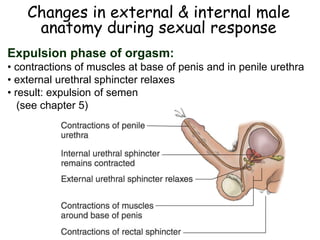
Changes in external & internal male
anatomy during sexual response
Expulsion phase of orgasm:
• contractions of muscles at base of penis and in penile urethra
• external urethral sphincter relaxes
• result: expulsion of semen
(see chapter 5)
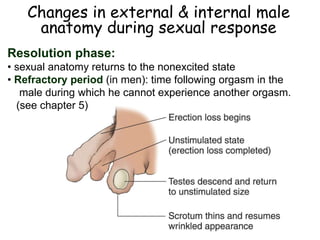
Changes in external & internal male
anatomy during sexual response
Resolution phase:
• sexual anatomy returns to the nonexcited state
• Refractory period (in men): time following orgasm in the
male during which he cannot experience another orgasm.
(see chapter 5)
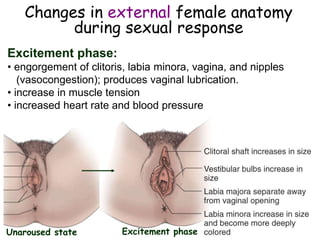
Changes in external female anatomy
during sexual response
Excitement phase:
• engorgement of clitoris, labia minora, vagina, and nipples
(vasocongestion); produces vaginal lubrication.
• increase in muscle tension
• increased heart rate and blood pressure
Unaroused state Excitement phase
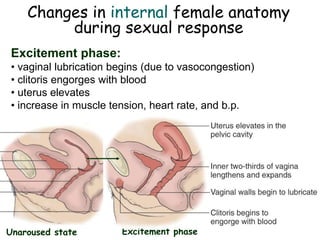
Changes in internal female anatomy
during sexual response
Excitement phase:
• vaginal lubrication begins (due to vasocongestion)
• clitoris engorges with blood
• uterus elevates
• increase in muscle tension, heart rate, and b.p.
Unaroused state Excitement phase
Changes in external female anatomy
during sexual response
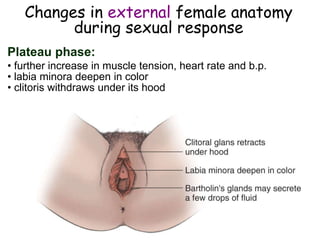
Plateau phase:
• further increase in muscle tension, heart rate and b.p.
• labia minora deepen in color
• clitoris withdraws under its hood
Changes in internal female anatomy
during sexual response
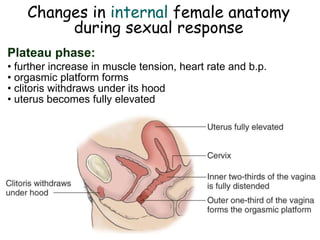
Plateau phase:
• further increase in muscle tension, heart rate and b.p.
• orgasmic platform forms
• clitoris withdraws under its hood
• uterus becomes fully elevated
Changes in external female anatomy
during sexual response
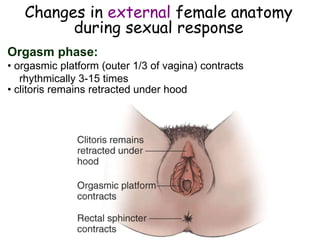
Orgasm phase:
• orgasmic platform (outer 1/3 of vagina) contracts
rhythmically 3-15 times
• clitoris remains retracted under hood
Changes in internal female anatomy
during sexual response
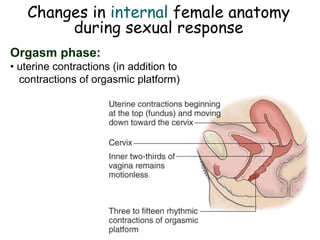
Orgasm phase:
• uterine contractions (in addition to
contractions of orgasmic platform)
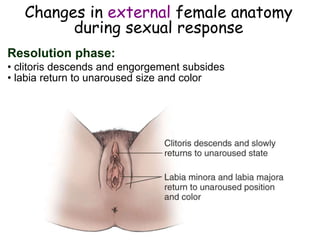
Changes in external female anatomy
during sexual response
Resolution phase:
• clitoris descends and engorgement subsides
• labia return to unaroused size and color
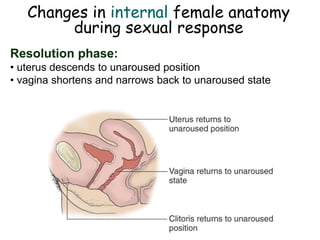
Changes in internal female anatomy
during sexual response
Resolution phase:
• uterus descends to unaroused position
• vagina shortens and narrows back to unaroused state
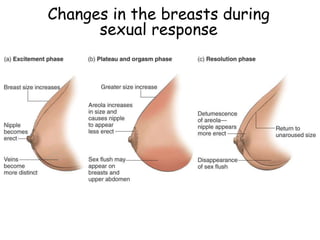
Changes in the breasts during
sexual response
(summarizes figures)
Historical misinformation about
female orgasm
• Sigmund Freud (early 1900s)
– Developed theory of the “vaginal” vs. “clitoral” orgasm that led to
misguided thinking about female sexual response for years
– Theory stemmed from erroneous assumption that the clitoris was a
“stunted penis,” so all erotic sensations from the clitoris were
expressions of “masculine” rather than “feminine” sexuality-- therefore
undesirable in a woman.
– During adolescence, female was supposed to transfer her erotic center
from her clitoris to her vagina--otherwise, she needed psychotherapy.
• During Freud’s time, surgical removal of the clitoris was actually
recommended for little girls who masturbated to help them later attain
“vaginal” orgasms.
• Cultural remnants still persist--women often feel uncomfortable
asking partners for clitoral stimulation or stimulating clitoris
herself b/c they believe they “should” experience orgasm from
vaginal stimulation alone.
The “G” spot: what is it?
• Stands for Grafenberg spot
– From Ernest Grafenberg, a gynecologist who first
publicized G spot in the 1950s.
• Area of erotic sensitivity located along the anterior
(front) wall of the vagina.
• Some women are able to experience orgasm and
possibly ejaculation from G spot stimulation.
– G spot tissue is similar to male prostate; therefore, fluid
may be similar to prostatic component of semen.
• Supported by research that showed presence of enzyme in
female ejaculate characteristic of prostate secretions
• Note: orgasm from G spot stimulation is same as
orgasm from clitoral stimulation, though intensity
may vary depending on the method of stimulation.
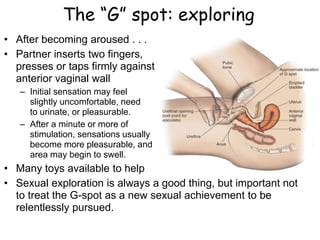
The “G” spot: exploring
• After becoming aroused . . .
• Partner inserts two fingers,
presses or taps firmly against
anterior vaginal wall
– Initial sensation may feel
slightly uncomfortable, need
to urinate, or pleasurable.
– After a minute or more of
stimulation, sensations usually
become more pleasurable, and
area may begin to swell.
• Many toys available to help
• Sexual exploration is always a good thing, but important not
to treat the G-spot as a new sexual achievement to be
relentlessly pursued.
Aging and the sexual response cycle
• Women: (note: changes in sexual response vary
considerably among women)
– Some women report reduced desire
– Reduced vasocongestion response, causing less and
slower vaginal lubrication
– Women who have more frequent sex (1-2 times weekly)
lubricated more readily
– Vaginal and urethral tissue loses some elasticity and
becomes drier
– Length and width of vagina decrease, reduced expansive
ability of inner vagina during arousal.
– Number of orgasmic contractions is often reduced.
– More rapid resolution
Aging and the sexual response cycle
• Men: (note: changes in sexual response vary
considerably among men)
– Longer time to develop an erection
• i.e. several minutes of stimulation vs. 8-10 seconds
– Erection may be less firm.
• Complete penile erection is often not obtained until late in the
plateau phase, just before orgasm.
• On the plus side, older men are often more able to sustain the
plateau phase longer, enhancing pleasure for both partners.
– Some men report reduced intensity of orgasm
• Reduced number of contractions, force of ejaculation is reduced,
less semen produced.
– More rapid resolution
– Refractory period between orgasm and next excitement
phase gradually lengthens (could be hours to days)
Sexual response:
some differences between the sexes
* There are many more similarities than differences in
sexual response btwn. men and women.
 Greater variability in female response
 Male refractory period
 Multiple orgasms
– Some women can have >1 orgasm separated by brief periods
of time (maybe only a few seconds)
– All women are theoretically physiologically capable of
experiencing multiple orgasms, though only about 15% of
women report regularly having multiple orgasms
– Some men can also experience multiple orgasms
• These men report that withholding ejaculation is important for
experiencing multiple orgasms--ejaculation often triggers
refractory period.

chp6_ss_sexual_arousal_resp.ppt

  • 1.
  • 2.
    Hormones • Steroid hormones –Commonly referred to as “male sex hormones” and “female sex hormones,” although both sexes produce both types of hormones. – Testosterone: the major androgen, or male sex hormone • Produced in the testes (men), adrenal glands (men and women), & ovaries (women). • Men typically produce 20-40X more testosterone than women. – Estrogen: the major female sex hormones • produced by ovaries & testes. • Testes produce much smaller quantities of estrogens than ovaries. • Neuropeptide hormones – Oxytocin--often called the “love hormone;” seems to influence erotic and emotional attraction to one another. – Produced in the brain by the hypothalamus.
  • 3.
    Hormones in malesexual behavior • Testosterone linked to male sexual desire (libido) – Less linked to functioning; a man w/low testosterone level can be fully capable of erection and orgasm but might have little interest in sex. • Evidence 1) Research on men who have undergone castration shows significant reduction in sexual desire and activity. 2) Androgen-blocking drugs (antiandrogens) • Have been used to try and treat sex offenders, and are used to treat some medical conditions, such as prostate cancer. • Depo-provera (medroxyprogesterone acetate, MPA) has been shown to reduce sexual desire and activity in men and women. 3) Hypogonadism: endocrine disorder causing testosterone deficiency in males; also causes major reduction in sexual desire that can be treated with testosterone replacement.
  • 4.
    Hormones in femalesexual behavior • Testosterone linked to female sexual desire (libido) • Evidence 1) Testosterone-replacement therapy enhances sexual desire and arousal in post-menopausal women and other women with low levels of testosterone 2) In women with normal testosterone levels, supplemental testosterone caused a significant increase in genital responsiveness within hours. 3) Women with a history of low sex drive and inhibited arousal positively responded to testosterone administration. 4)Comparisons of women w/history of healthy sex drive and women w/history of low libido showed that women in the low-libido group had lower testosterone levels.
  • 5.
    Hormones in femalesexual behavior, (cont.) • Estrogens: role in female sexual behavior is still unclear. – Contribute to general sense of well-being – Help maintain thickness & elasticity of vaginal lining – Contribute to vaginal lubrication – However, there are contradictory findings about whether administration of estrogen increases or decreases libido in women.
  • 6.
    How much testosteroneis necessary for normal sexual functioning? • Levels of free testosterone are much lower in women than men. – This does not mean that women have lower or weaker sex drives. – Rather, women’s body cells are more sensitive to testosterone than a man’s body cells are. • Testosterone levels decline w/age in both sexes.
  • 7.
    Testosterone replacement therapy •Use of testosterone supplements to treat a deficiency in testosterone. – Relatively common to treat sexual difficulties in men. – Women have a harder time receiving TRT, although testosterone deficiency is a fairly common experience during menopause. – There are some negative side effects, and long-term effects of TRT aren’t yet known. • Can stimulate growth of prostate cancer cells, if present. • Some concerns about cardiovascular problems in men. • Little research done on TRT in women. • More long-term studies are needed.
  • 8.
    Oxytocin in male& female sexual behavior • Oxytocin: a neuropeptide (a short string of 9 amino acids produced in the hypothalamus in both sexes). • Stimulates release of milk during breast-feeding; thought to facilitate mother-child bonding • Released during physical intimacy/touch – Increases skin sensitivity to touch – High levels are associated w/orgasm – Levels remain high after orgasm; thought to contribute to emotional and erotic bonding of sexual partners • Research suggests oxytocin is important for facilitating social attachments and development of feelings of love. • Stress lowers oxytocin secretion.
  • 9.
    Funny ad .. . oxytocin spray!
  • 10.
    The brain andsexual arousal • Sexual arousal can occur w/o any sensory stimulation, through thoughts and fantasy alone. • Stimuli that people find arousing is greatly influenced by cultural conditioning. – Features that are considered attractive vary from one culture to another. – In many cultures, bare female breasts are not viewed as erotic stimuli, as they are in the U.S. – Foreplay leading to arousal varies considerably in different cultures. • Ex: in a survey of 190 cultures, mouth kissing was only practiced in 21.
  • 11.
    Anatomical regions ofthe brain involved in sexual arousal & response cerebral cortex: thinking center of the brain Limbic system: associated w/emotion & motivation; also includes the “pleasure center”
  • 12.
    Limbic system • Associatedwith emotion, motivation, and memory • Includes several brain structures – Hypothalamus, hippocampus, amygdala, cingulate gyrus • 1950s study: rats implanted w/electrodes in regions of limbic system that could be activated by a lever. – Rats pressed lever over and over, in preference to eating or drinking, eventually dying of exhaustion. • Limbic stimulation in people (done for therapeutic purposes) : patients reported intense sexual pleasure. • Damage to certain parts of the hypothalamus seems to dramatically reduce sexual behavior of both males and females in several species.
  • 13.
    Neurotransmitters and sexualarousal • Dopamine – Released in the “pleasure center” of the limbic system. – Facilitates sexual arousal and response. – Testosterone stimulates dopamine release in both males and females. • Oxytocin (already discussed) • Serotonin – Inhibits sexual activity – inhibits release of dopamine. – Antidepressants called SSRIs increase serotonin levels in the brain--side effects often include decreased libido and diminished sexual response. – (selective serotonin reuptake inhibitors)
  • 14.
    Sexual arousal: therole of the senses • Touch is the dominant "sexual sense” – Primary erogenous zones: areas of the body that contain dense concentrations of nerve endings. • Includes genitals, buttocks, anus, perineum, breasts, inner thighs, armpits, navel, neck, ear lobes, mouth. • Varies from one person to another. – Secondary erogenous zones: areas of the body that have become erotically sensitive through learning and experience. • Virtually any other region of the body--depends on personal erotic experiences.
  • 15.
    Sexual arousal: therole of the senses • Vision: usually next important sense in arousal. – Early research supported the idea that males are more aroused by visual stimuli than females. • Reflects many social influences: – Was considered culturally inappropriate for women to view pornography. – Most pornography was made to appeal exclusively to men; some women found themes/ideas offensive. – Today, pornography and erotica is available that appeals to many women. – Studies using physiological recording devices while subjects viewed pornography showed equal physiological signs of arousal in women and men. – When arousal was assessed by self-reporting, women are less inclined to report being sexually aroused by visual erotica.
  • 16.
    Sexual arousal: therole of the senses • Smell: highly influenced by a person’s sexual history and social conditioning. – In some cultures, the smell of genital secretions are considered a sexual stimulant. • Use as a ‘perfume’ by some women in Europe. – U.S.: near obsession w/masking any natural body odor • Difficult to study effect of natural odors on desire when they are so heavily masked by frequent bathing, deodorants, perfumes, and antiperspirants. – Even so, many report being aroused by the smell of their partner, or by people to whom they are attracted. – Pheromones: odors produced by the body that relate to reproductive functions (e.g. fertility). • Very important in sexual response and arousal in many animals. • Research still not clear on how important they are in humans.
  • 17.
    Sexual arousal: therole of the senses • Taste: seems to play a minor role in arousal. • Hearing: highly variable. – Some people find words, erotic conversation, moans, etc. to be very arousing – Others prefer more silent sex. • Different people receive different cultural messages about whether it is “okay” to talk or make noise during sex.
  • 18.
    Aphrodisiacs • Definition: substancesthat allegedly arouse sexual desire and increase the capacity for sexual activity. • Foods: – Many that resemble a penis: bananas, asparagus, cucumbers, ground-up horns of animals such as rhinoceros and reindeer (origin of the term horny) • Drugs: (see table) – Alcohol, amphetamines, barbiturates, cocaine, LSD, marijuana, amyl nitrite, L-dopa – Not one actually qualifies as a sexual stimulant – Some lower inhibitions, some can hinder the ability to think clearly and make conscious decisions. – Some can have dangerous side effects. Almost none of these substances actually work!
  • 19.
  • 20.
    Aphrodisiacs, (cont): yohimbine –Crystalline alkaloid derived from the bark of the yohimbe tree that grows in West Africa. • Aphrodisiac effects: – In rats, yohimbine extracts induced sexual arousal and activity – Positively affected sexual desire and performance in men w/erectile disorders – Increased sexual arousal in postmenopausal women who reported below-normal levels of sexual desire. • Concerns: – However, side effects are common, such as heart palpitations, sweating, anxiety, nausea, insomnia (like a stimulant). The appropriate dose for each person is difficult to determine. – Can’t be taken by anyone w/medical problems such as heart problems, high b.p., liver problems, diabetes, or anyone taking a number of different medications.
  • 21.
    Anaphrodisiacs • Definition: substancesthat inhibit sexual behavior – Birth control pills (progesterone-containing) • Reduce sexual desire by lowering testosterone levels – Opiates, tranquilizers, sedatives • Reduce sexual interest, activity, and function – Nicotine • Reduces sexual interest and function by constricting blood vessels and by reducing blood testosterone levels. – Blood pressure medicine, drugs that treat heart disease • Inhibit erection and ejaculation, reduce orgasm intensity, reduce sexual interest – Antidepressants • Decreased desire, erectile disorder, delayed or absent orgasm – Anticonvulsant and antipsychotic drugs
  • 22.
    Models of sexualresponse: Masters & Johnson four-phase model  excitement  plateau  orgasm  resolution Female sexual response cycle 3 patterns identified Male sexual response cycle 1 pattern identified
  • 23.
    6-A Discussion question: Doyou believe that men and women differ in the importance they attach to experiencing orgasm during sexual sharing? Why or why not?
  • 24.
    Masters & Johnsonfour-phase model of sexual response:  excitement  plateau  orgasm  resolution • Remember: – There’s lots of individual variation. – Model focuses only on physiology, not the entire personal experience of sexual response. – Too-literal interpretation of the plateau stage • Still a lot happening, even though it’s described as a “leveling-off” – NOTE: Kaplan has Desire as first phase
  • 25.
    Two fundamental physiologicalresponses to effective sexual stimulation • Vasocongestion: engorgement of blood vessels in particular body parts in response to sexual arousal. • Myotonia: muscle tension
  • 26.
    Masters & Johnson'sfour phases • Excitement • Plateau • Orgasm • Resolution Let’s examine the changes that occur in the internal & external anatomy of men & women at each stage…
  • 27.
    Changes in external& internal male anatomy during sexual response Excitement phase: • engorgement of penis (cavernous and spongy bodies) and testes (vasocongestion) • increase in muscle tension • increased heart rate and blood pressure
  • 28.
    Changes in external& internal male anatomy during sexual response Plateau phase: • engorgement and elevation of testes increases. • further increase in muscle tension, heart rate and b.p. • Cowper’s gland secretions may occur.
  • 29.
    Changes in external& internal male anatomy during sexual response Emission phase of orgasm: • contractions of internal structures • both internal and external urethral sphincters contract • result: seminal fluid pools in urethral bulb (see chapter 5)
  • 30.
    Changes in external& internal male anatomy during sexual response Expulsion phase of orgasm: • contractions of muscles at base of penis and in penile urethra • external urethral sphincter relaxes • result: expulsion of semen (see chapter 5)
  • 31.
    Changes in external& internal male anatomy during sexual response Resolution phase: • sexual anatomy returns to the nonexcited state • Refractory period (in men): time following orgasm in the male during which he cannot experience another orgasm. (see chapter 5)
  • 32.
    Changes in externalfemale anatomy during sexual response Excitement phase: • engorgement of clitoris, labia minora, vagina, and nipples (vasocongestion); produces vaginal lubrication. • increase in muscle tension • increased heart rate and blood pressure Unaroused state Excitement phase
  • 33.
    Changes in internalfemale anatomy during sexual response Excitement phase: • vaginal lubrication begins (due to vasocongestion) • clitoris engorges with blood • uterus elevates • increase in muscle tension, heart rate, and b.p. Unaroused state Excitement phase
  • 34.
    Changes in externalfemale anatomy during sexual response Plateau phase: • further increase in muscle tension, heart rate and b.p. • labia minora deepen in color • clitoris withdraws under its hood
  • 35.
    Changes in internalfemale anatomy during sexual response Plateau phase: • further increase in muscle tension, heart rate and b.p. • orgasmic platform forms • clitoris withdraws under its hood • uterus becomes fully elevated
  • 36.
    Changes in externalfemale anatomy during sexual response Orgasm phase: • orgasmic platform (outer 1/3 of vagina) contracts rhythmically 3-15 times • clitoris remains retracted under hood
  • 37.
    Changes in internalfemale anatomy during sexual response Orgasm phase: • uterine contractions (in addition to contractions of orgasmic platform)
  • 38.
    Changes in externalfemale anatomy during sexual response Resolution phase: • clitoris descends and engorgement subsides • labia return to unaroused size and color
  • 39.
    Changes in internalfemale anatomy during sexual response Resolution phase: • uterus descends to unaroused position • vagina shortens and narrows back to unaroused state
  • 40.
    Changes in thebreasts during sexual response
  • 41.
  • 42.
    Historical misinformation about femaleorgasm • Sigmund Freud (early 1900s) – Developed theory of the “vaginal” vs. “clitoral” orgasm that led to misguided thinking about female sexual response for years – Theory stemmed from erroneous assumption that the clitoris was a “stunted penis,” so all erotic sensations from the clitoris were expressions of “masculine” rather than “feminine” sexuality-- therefore undesirable in a woman. – During adolescence, female was supposed to transfer her erotic center from her clitoris to her vagina--otherwise, she needed psychotherapy. • During Freud’s time, surgical removal of the clitoris was actually recommended for little girls who masturbated to help them later attain “vaginal” orgasms. • Cultural remnants still persist--women often feel uncomfortable asking partners for clitoral stimulation or stimulating clitoris herself b/c they believe they “should” experience orgasm from vaginal stimulation alone.
  • 43.
    The “G” spot:what is it? • Stands for Grafenberg spot – From Ernest Grafenberg, a gynecologist who first publicized G spot in the 1950s. • Area of erotic sensitivity located along the anterior (front) wall of the vagina. • Some women are able to experience orgasm and possibly ejaculation from G spot stimulation. – G spot tissue is similar to male prostate; therefore, fluid may be similar to prostatic component of semen. • Supported by research that showed presence of enzyme in female ejaculate characteristic of prostate secretions • Note: orgasm from G spot stimulation is same as orgasm from clitoral stimulation, though intensity may vary depending on the method of stimulation.
  • 44.
    The “G” spot:exploring • After becoming aroused . . . • Partner inserts two fingers, presses or taps firmly against anterior vaginal wall – Initial sensation may feel slightly uncomfortable, need to urinate, or pleasurable. – After a minute or more of stimulation, sensations usually become more pleasurable, and area may begin to swell. • Many toys available to help • Sexual exploration is always a good thing, but important not to treat the G-spot as a new sexual achievement to be relentlessly pursued.
  • 45.
    Aging and thesexual response cycle • Women: (note: changes in sexual response vary considerably among women) – Some women report reduced desire – Reduced vasocongestion response, causing less and slower vaginal lubrication – Women who have more frequent sex (1-2 times weekly) lubricated more readily – Vaginal and urethral tissue loses some elasticity and becomes drier – Length and width of vagina decrease, reduced expansive ability of inner vagina during arousal. – Number of orgasmic contractions is often reduced. – More rapid resolution
  • 46.
    Aging and thesexual response cycle • Men: (note: changes in sexual response vary considerably among men) – Longer time to develop an erection • i.e. several minutes of stimulation vs. 8-10 seconds – Erection may be less firm. • Complete penile erection is often not obtained until late in the plateau phase, just before orgasm. • On the plus side, older men are often more able to sustain the plateau phase longer, enhancing pleasure for both partners. – Some men report reduced intensity of orgasm • Reduced number of contractions, force of ejaculation is reduced, less semen produced. – More rapid resolution – Refractory period between orgasm and next excitement phase gradually lengthens (could be hours to days)
  • 47.
    Sexual response: some differencesbetween the sexes * There are many more similarities than differences in sexual response btwn. men and women.  Greater variability in female response  Male refractory period  Multiple orgasms – Some women can have >1 orgasm separated by brief periods of time (maybe only a few seconds) – All women are theoretically physiologically capable of experiencing multiple orgasms, though only about 15% of women report regularly having multiple orgasms – Some men can also experience multiple orgasms • These men report that withholding ejaculation is important for experiencing multiple orgasms--ejaculation often triggers refractory period.