



Frigid & Frustrated
17 Nov 2014
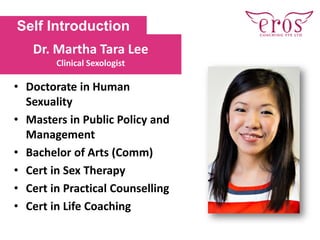
Self Introduction
Dr. Martha Tara Lee
Clinical Sexologist
• Doctorate in Human
Sexuality
• Masters in Public Policy and
Management
• Bachelor of Arts (Comm)
• Cert in Sex Therapy
• Cert in Practical Counselling
• Cert in Life Coaching
1. What: Definitions of LSD
2. Contributing Factors of LSD
3. Treatments/ Suggestions
4. Quiz/ Resources
Covering
1) What is the DSM 5 definition of low sexual
desire?
a) Frigidity
b) Inhibited Sexual Desire Disorder
c) Hypoactive sexual desire disorder
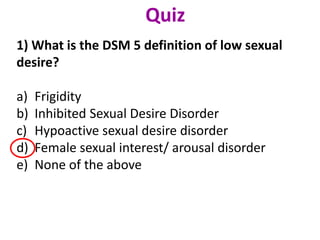
d) Female sexual interest/ arousal disorder
e) None of the above
Quiz
1) What is the DSM 5 definition of low sexual
desire?
a) Frigidity
b) Inhibited Sexual Desire Disorder
c) Hypoactive sexual desire disorder
d) Female sexual interest/ arousal disorder
e) None of the above
Quiz
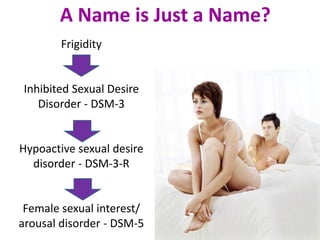
Frigidity
Inhibited Sexual Desire
Disorder - DSM-3
Hypoactive sexual desire
disorder - DSM-3-R
Female sexual interest/
arousal disorder - DSM-5
A Name is Just a Name?
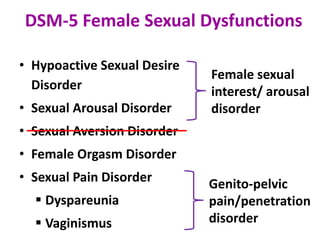
• Hypoactive Sexual Desire
Disorder
• Sexual Arousal Disorder
• Sexual Aversion Disorder
• Female Orgasm Disorder
• Sexual Pain Disorder
 Dyspareunia
 Vaginismus
Female sexual
interest/ arousal
disorder
Genito-pelvic
pain/penetration
disorder
DSM-5 Female Sexual Dysfunctions
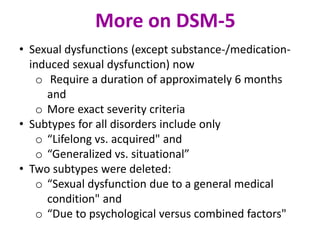
• Sexual dysfunctions (except substance-/medication-
induced sexual dysfunction) now
o Require a duration of approximately 6 months
and
o More exact severity criteria
• Subtypes for all disorders include only
o “Lifelong vs. acquired" and
o “Generalized vs. situational”
• Two subtypes were deleted:
o “Sexual dysfunction due to a general medical
condition" and
o “Due to psychological versus combined factors"
More on DSM-5
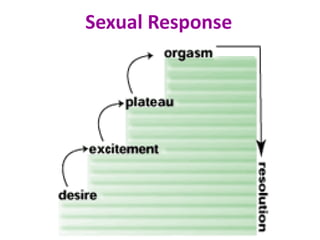
Sexual Response
Sexual Desire
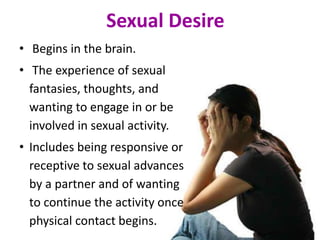
• Begins in the brain.
• The experience of sexual
fantasies, thoughts, and
wanting to engage in or be
involved in sexual activity.
• Includes being responsive or
receptive to sexual advances
by a partner and of wanting
to continue the activity once
physical contact begins.
• Can occur at ANY age!
• Affects self esteem, self-confidence and quality of
life for both partners
• Often has an organic basis, but ALWAYS has a
psychological component!
• May signal or accompany other serious illness
• A couple’s concern - Partner should be involved in
management
• Expert evaluation and counseling will assure optimal
outcomes
Sexual Dysfunction
• The immediate cause of desire disorders
manifest in the patient’s avoidance of sexual
feelings, sexual thoughts and fantasies.
• Does not initiate sexual activity.
• Not responsive to partner’s initiation of
sexual activities.
Sexual Dsyfunctions
Female sexual interest/ arousal disorder
Sexual Dsyfunctions
Female sexual interest/ arousal disorder
• The persistent or recurrent deficiency (or absence) of
sexual fantasies/ thoughts, and/ or desire for or
receptivity to sexual activity
• Involves biological, intrapsychic and interpersonal
determinants
• Dimensions must be independently evaluated when
making a diagnosis.
Specify:
• Lifelong or acquired
• Generalized or situational
Factors Influencing Sexual Response
• Vascular (Blood Vessels)
• Neurological (Brain)
• Hormonal
• Psychological (Mental mind)
• Relational
• Psychosexual skills
Psychosocial Issues
• Lifelong or acquired
• Symptom or situational
• Unresolved history of sexual abuse or
trauma
• Body image/ Self-esteem issues
• Psychiatric history
• Stress, anxiety, sadness
• Relationship conflict
• Partner’s sexual dysfunction
Relationship Problems
• Anger
• Poor Communication
• Criticism
• Neurotic Interactions
• Incompatible Sexual fantasies
• Alcoholism & Sexual Abuse
• Phobic Avoidance of Sexual Intercourse
• Unconscious Conflict About Sex, Commitment,
Pregnancy
• Sexual Abuse Issues
Medical Factors
• Chronic medical illness
• Medications
• Pelvic trauma or surgery
• Neurological illness
• Endocrinological illness
• Infection/ Sexually
transmitted diseases
• Depression/ Major
mental illness
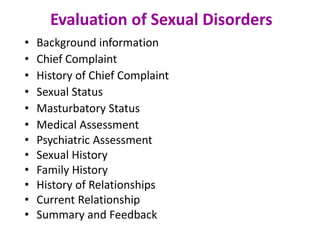
Evaluation of Sexual Disorders
• Background information
• Chief Complaint
• History of Chief Complaint
• Sexual Status
• Masturbatory Status
• Medical Assessment
• Psychiatric Assessment
• Sexual History
• Family History
• History of Relationships
• Current Relationship
• Summary and Feedback
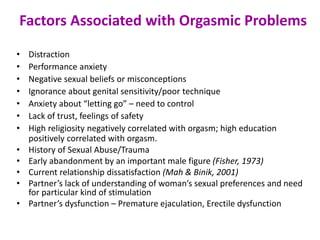
Factors Associated with Orgasmic Problems
• Distraction
• Performance anxiety
• Negative sexual beliefs or misconceptions
• Ignorance about genital sensitivity/poor technique
• Anxiety about “letting go” – need to control
• Lack of trust, feelings of safety
• High religiosity negatively correlated with orgasm; high education
positively correlated with orgasm.
• History of Sexual Abuse/Trauma
• Early abandonment by an important male figure (Fisher, 1973)
• Current relationship dissatisfaction (Mah & Binik, 2001)
• Partner’s lack of understanding of woman’s sexual preferences and need
for particular kind of stimulation
• Partner’s dysfunction – Premature ejaculation, Erectile dysfunction
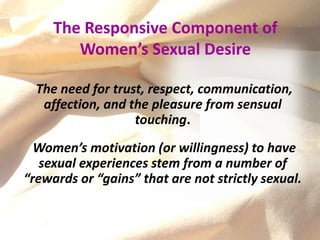
The need for trust, respect, communication,
affection, and the pleasure from sensual
touching.
Women’s motivation (or willingness) to have
sexual experiences stem from a number of
“rewards or “gains” that are not strictly sexual.
The Responsive Component of
Women’s Sexual Desire
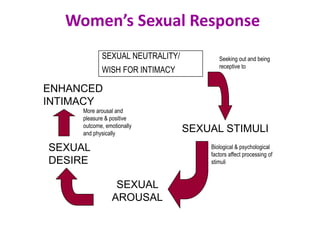
Women’s Sexual Response
SEXUAL NEUTRALITY/
WISH FOR INTIMACY
SEXUAL STIMULI
Seeking out and being
receptive to
SEXUAL
AROUSAL
SEXUAL
DESIRE
ENHANCED
INTIMACY
More arousal and
pleasure & positive
outcome, emotionally
and physically
Biological & psychological
factors affect processing of
stimuli
So
How?
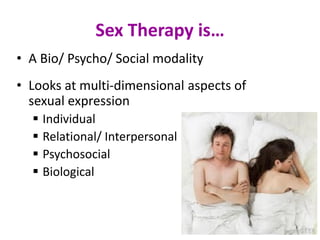
Sex Therapy is…
• A Bio/ Psycho/ Social modality
• Looks at multi-dimensional aspects of
sexual expression
 Individual
 Relational/ Interpersonal
 Psychosocial
 Biological
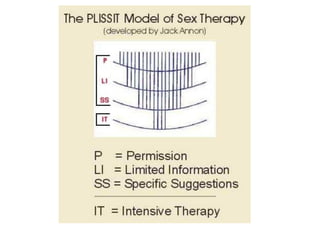
PLISSIT Model
Permission to self – Pleasure; to use vibrator, Ask for certain
kinds of touch, caress.
Limited Information – Changes in sexual response with
pregnancy, menopause, aging. Impact of medication(s) on
sexual function.
Specific Suggestions – HRT benefits and risks, use of
lubricants; Positions.
Intensive Therapy – Refer to specialists for couple therapy,
resolution of long-standing problems.
The Orgasmic Diet
1. Take supplements (especially fish oil); a multivitamin; calcium,
magnesium, and zinc; and extra iron and vitamin C.
2. Balance of 40 percent carbs, 30 percent protein, and 30 percent
fats at every meal.
• Avoid trans fats and polyunsaturated fats, including
vegetable oils such as corn oil, soybean oil, and safflower
oil, that counteract the benefits of the omega-3 fatty acids
• Eat monounsaturated fats like olive or canola oil or
moderate amounts
• Eat a half-ounce of quality dark chocolate every day.
3. Avoid things that interfere with sexual function, including caffeine,
cigarettes and other stimulants; hormonal birth control; and
drinking alcohol to excess.
4. Exercise the PC muscles
Lindberg, M (2008) The Orgasmic Diet: A Revolutionary Plan to Lift Your Libido and Bring You to Orgasm, Harmony
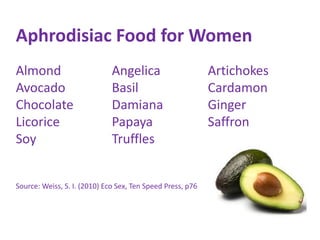
Aphrodisiac Food for Women
Almond Angelica Artichokes
Avocado Basil Cardamon
Chocolate Damiana Ginger
Licorice Papaya Saffron
Soy Truffles
Source: Weiss, S. I. (2010) Eco Sex, Ten Speed Press, p76
Aphrodisiac Food for Men
Basil Bay lead Cardamon
Cayenne Celery Chiles
Cinnamon Cnidium seeds Fennel
Figs Ginger Ginko
Ginseng Goji berries Grapes
Hemp seeds Lavender Mango
Mustard Nutmeg Peach
Pineapple Pumpkin Sea cucumber
Squash Vanilla Watermelon
Source: Weiss, S. I. (2010) Eco Sex, Ten Speed Press, p76
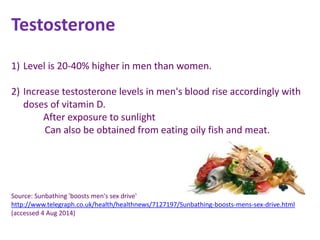
Testosterone
1) Level is 20-40% higher in men than women.
2) Increase testosterone levels in men's blood rise accordingly with
doses of vitamin D.
After exposure to sunlight
Can also be obtained from eating oily fish and meat.
Source: Sunbathing 'boosts men's sex drive'
http://www.telegraph.co.uk/health/healthnews/7127197/Sunbathing-boosts-mens-sex-drive.html
(accessed 4 Aug 2014)
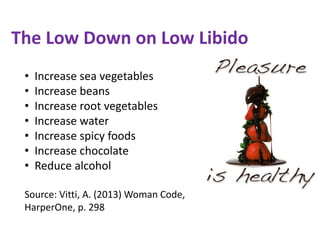
The Low Down on Low Libido
• Increase sea vegetables
• Increase beans
• Increase root vegetables
• Increase water
• Increase spicy foods
• Increase chocolate
• Reduce alcohol
Source: Vitti, A. (2013) Woman Code,
HarperOne, p. 298
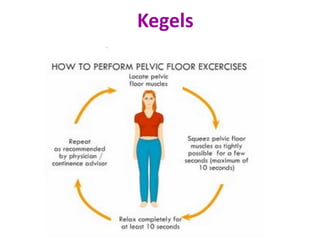
Kegels
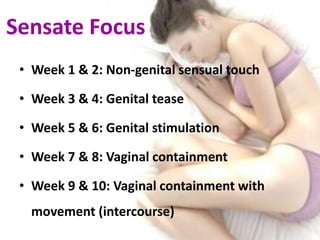
• Week 1 & 2: Non-genital sensual touch
• Week 3 & 4: Genital tease
• Week 5 & 6: Genital stimulation
• Week 7 & 8: Vaginal containment
• Week 9 & 10: Vaginal containment with
movement (intercourse)
Sensate Focus
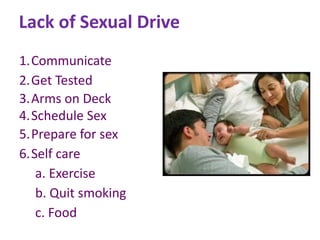
Lack of Sexual Drive
1.Communicate
2.Get Tested
3.Arms on Deck
4.Schedule Sex
5.Prepare for sex
6.Self care
a. Exercise
b. Quit smoking
c. Food
Lack of Sexual Drive
7. Expand your ways of having sex
a. Masturbation witnessing
b. Mutual masturbation
c. One-way sex
d. Sex toys
8. Recruit a Taskforce
9. Give it some time
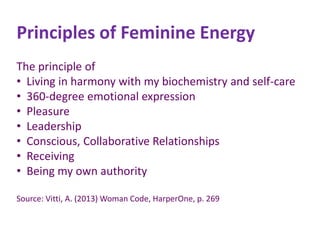
Principles of Feminine Energy
The principle of
• Living in harmony with my biochemistry and self-care
• 360-degree emotional expression
• Pleasure
• Leadership
• Conscious, Collaborative Relationships
• Receiving
• Being my own authority
Source: Vitti, A. (2013) Woman Code, HarperOne, p. 269
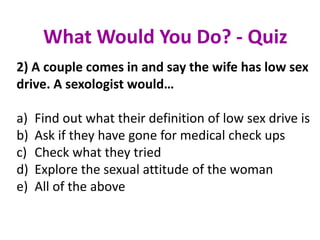
2) A couple comes in and say the wife has low sex
drive. A sexologist would…
a) Find out what their definition of low sex drive is
b) Ask if they have gone for medical check ups
c) Check what they tried
d) Explore the sexual attitude of the woman
e) All of the above
What Would You Do? - Quiz
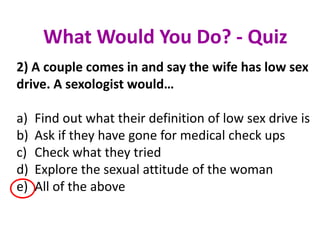
2) A couple comes in and say the wife has low sex
drive. A sexologist would…
a) Find out what their definition of low sex drive is
b) Ask if they have gone for medical check ups
c) Check what they tried
d) Explore the sexual attitude of the woman
e) All of the above
What Would You Do? - Quiz
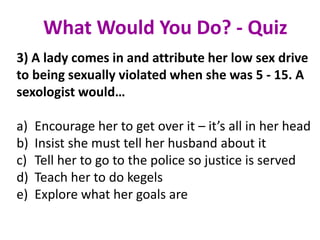
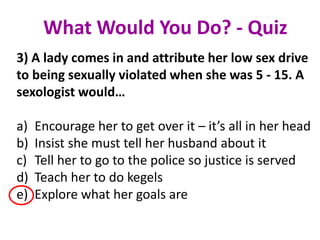
3) A lady comes in and attribute her low sex drive
to being sexually violated when she was 5 - 15. A
sexologist would…
a) Encourage her to get over it – it’s all in her head
b) Insist she must tell her husband about it
c) Tell her to go to the police so justice is served
d) Teach her to do kegels
e) Explore what her goals are
What Would You Do? - Quiz
3) A lady comes in and attribute her low sex drive
to being sexually violated when she was 5 - 15. A
sexologist would…
a) Encourage her to get over it – it’s all in her head
b) Insist she must tell her husband about it
c) Tell her to go to the police so justice is served
d) Teach her to do kegels
e) Explore what her goals are
What Would You Do? - Quiz
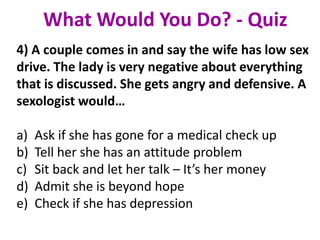
4) A couple comes in and say the wife has low sex
drive. The lady is very negative about everything
that is discussed. She gets angry and defensive. A
sexologist would…
a) Ask if she has gone for a medical check up
b) Tell her she has an attitude problem
c) Sit back and let her talk – It’s her money
d) Admit she is beyond hope
e) Check if she has depression
What Would You Do? - Quiz
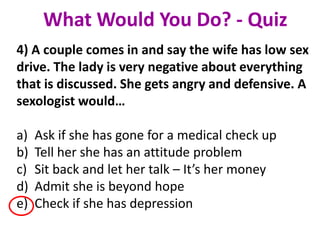
4) A couple comes in and say the wife has low sex
drive. The lady is very negative about everything
that is discussed. She gets angry and defensive. A
sexologist would…
a) Ask if she has gone for a medical check up
b) Tell her she has an attitude problem
c) Sit back and let her talk – It’s her money
d) Admit she is beyond hope
e) Check if she has depression
What Would You Do? - Quiz
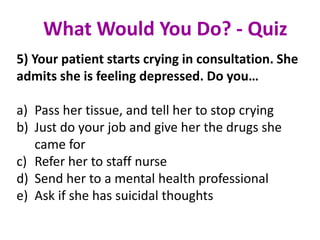
5) Your patient starts crying in consultation. She
admits she is feeling depressed. Do you…
a) Pass her tissue, and tell her to stop crying
b) Just do your job and give her the drugs she
came for
c) Refer her to staff nurse
d) Send her to a mental health professional
e) Ask if she has suicidal thoughts
What Would You Do? - Quiz
5) Your patient starts crying in consultation. She
admits she is feeling depressed. Do you…
a) Pass her tissue, and tell her to stop crying
b) Just do your job and give her the drugs she
came for
c) Refer her to staff nurse
d) Send her to a mental health professional
e) Ask if she has suicidal thoughts
What Would You Do? - Quiz
1. Reclaiming Desire, by Andrew Goldstein, M.D., and Marianne Brandon,
Ph.D — Helps readers understand what life events can influence a
person’s mood and romantic willingness, along with suggestions on how
to de-stress enough to revive a slowed-down sex drive.
2. Reclaiming Your Sexual Self, by Kathryn Hall, PhD— Discusses the reasons
people experience low libido and gives helpful suggestions for creating
the right conditions in your life for more desire and libido.
3. The Return of Desire, by Gina Ogden, PhD— An excellent book for
women of all ages and orientations who want to bring desire back into
their lives. Explores the spiritual side of sexuality as well.
4. The Heart of Desire, by Stella Resnick, PhD — A useful reference for
people in long-term relationships who want to rekindle desire. Includes a
Ten-Step Loving Sex Program to help nourish your sexual relationship.
5. Mating in Captivity, by Esther Perel — A refreshing, original look at the
way sexual relationships change over time, the choices we make that
create those changes, and what we can do to rekindle the flames.
Books
Common Sexological Issues
• Body image and sex-negative conditioning
• Sexual desire
• Courtship concerns
• Obstacles to Intimacy
• Sexual development, maturation and aging
• Sexual communication and negotiation
• Medical considerations affecting sexuality
• Atypical sexual behaviours
• Sexual trauma
• Gender identity
• Sexual orientation
• Sexual education for parents
• Women’s concerns
• Men’s concerns
Online Program
• Online
• Affordable
• 24 x 7 Access
• Multiple access
• Personalised email support
What is Your Approach?
• Sex-positive
• Non-judgemental
• Educational
• Client-centered
• Do no harm
Download Slides with
a Tweet here
Dr. Martha Tara Lee
Clinical Sexologist
Eros Coaching Pte Ltd
Website:
www.eroscoaching.com
Email:
drmarthalee@eroscoaching.com

Frigid & Frustrated @ Mt Elizabeth Hospital

  • 1.
  • 2.
    Self Introduction Dr. MarthaTara Lee Clinical Sexologist • Doctorate in Human Sexuality • Masters in Public Policy and Management • Bachelor of Arts (Comm) • Cert in Sex Therapy • Cert in Practical Counselling • Cert in Life Coaching
  • 3.
    1. What: Definitionsof LSD 2. Contributing Factors of LSD 3. Treatments/ Suggestions 4. Quiz/ Resources Covering
  • 4.
    1) What isthe DSM 5 definition of low sexual desire? a) Frigidity b) Inhibited Sexual Desire Disorder c) Hypoactive sexual desire disorder d) Female sexual interest/ arousal disorder e) None of the above Quiz
  • 5.
    1) What isthe DSM 5 definition of low sexual desire? a) Frigidity b) Inhibited Sexual Desire Disorder c) Hypoactive sexual desire disorder d) Female sexual interest/ arousal disorder e) None of the above Quiz
  • 6.
    Frigidity Inhibited Sexual Desire Disorder- DSM-3 Hypoactive sexual desire disorder - DSM-3-R Female sexual interest/ arousal disorder - DSM-5 A Name is Just a Name?
  • 7.
    • Hypoactive SexualDesire Disorder • Sexual Arousal Disorder • Sexual Aversion Disorder • Female Orgasm Disorder • Sexual Pain Disorder  Dyspareunia  Vaginismus Female sexual interest/ arousal disorder Genito-pelvic pain/penetration disorder DSM-5 Female Sexual Dysfunctions
  • 8.
    • Sexual dysfunctions(except substance-/medication- induced sexual dysfunction) now o Require a duration of approximately 6 months and o More exact severity criteria • Subtypes for all disorders include only o “Lifelong vs. acquired" and o “Generalized vs. situational” • Two subtypes were deleted: o “Sexual dysfunction due to a general medical condition" and o “Due to psychological versus combined factors" More on DSM-5
  • 9.
  • 10.
    Sexual Desire • Beginsin the brain. • The experience of sexual fantasies, thoughts, and wanting to engage in or be involved in sexual activity. • Includes being responsive or receptive to sexual advances by a partner and of wanting to continue the activity once physical contact begins.
  • 11.
    • Can occurat ANY age! • Affects self esteem, self-confidence and quality of life for both partners • Often has an organic basis, but ALWAYS has a psychological component! • May signal or accompany other serious illness • A couple’s concern - Partner should be involved in management • Expert evaluation and counseling will assure optimal outcomes Sexual Dysfunction
  • 12.
    • The immediatecause of desire disorders manifest in the patient’s avoidance of sexual feelings, sexual thoughts and fantasies. • Does not initiate sexual activity. • Not responsive to partner’s initiation of sexual activities. Sexual Dsyfunctions Female sexual interest/ arousal disorder
  • 13.
    Sexual Dsyfunctions Female sexualinterest/ arousal disorder • The persistent or recurrent deficiency (or absence) of sexual fantasies/ thoughts, and/ or desire for or receptivity to sexual activity • Involves biological, intrapsychic and interpersonal determinants • Dimensions must be independently evaluated when making a diagnosis. Specify: • Lifelong or acquired • Generalized or situational
  • 14.
    Factors Influencing SexualResponse • Vascular (Blood Vessels) • Neurological (Brain) • Hormonal • Psychological (Mental mind) • Relational • Psychosexual skills
  • 15.
    Psychosocial Issues • Lifelongor acquired • Symptom or situational • Unresolved history of sexual abuse or trauma • Body image/ Self-esteem issues • Psychiatric history • Stress, anxiety, sadness • Relationship conflict • Partner’s sexual dysfunction
  • 16.
    Relationship Problems • Anger •Poor Communication • Criticism • Neurotic Interactions • Incompatible Sexual fantasies • Alcoholism & Sexual Abuse • Phobic Avoidance of Sexual Intercourse • Unconscious Conflict About Sex, Commitment, Pregnancy • Sexual Abuse Issues
  • 17.
    Medical Factors • Chronicmedical illness • Medications • Pelvic trauma or surgery • Neurological illness • Endocrinological illness • Infection/ Sexually transmitted diseases • Depression/ Major mental illness
  • 18.
    Evaluation of SexualDisorders • Background information • Chief Complaint • History of Chief Complaint • Sexual Status • Masturbatory Status • Medical Assessment • Psychiatric Assessment • Sexual History • Family History • History of Relationships • Current Relationship • Summary and Feedback
  • 19.
    Factors Associated withOrgasmic Problems • Distraction • Performance anxiety • Negative sexual beliefs or misconceptions • Ignorance about genital sensitivity/poor technique • Anxiety about “letting go” – need to control • Lack of trust, feelings of safety • High religiosity negatively correlated with orgasm; high education positively correlated with orgasm. • History of Sexual Abuse/Trauma • Early abandonment by an important male figure (Fisher, 1973) • Current relationship dissatisfaction (Mah & Binik, 2001) • Partner’s lack of understanding of woman’s sexual preferences and need for particular kind of stimulation • Partner’s dysfunction – Premature ejaculation, Erectile dysfunction
  • 20.
    The need fortrust, respect, communication, affection, and the pleasure from sensual touching. Women’s motivation (or willingness) to have sexual experiences stem from a number of “rewards or “gains” that are not strictly sexual. The Responsive Component of Women’s Sexual Desire
  • 21.
    Women’s Sexual Response SEXUALNEUTRALITY/ WISH FOR INTIMACY SEXUAL STIMULI Seeking out and being receptive to SEXUAL AROUSAL SEXUAL DESIRE ENHANCED INTIMACY More arousal and pleasure & positive outcome, emotionally and physically Biological & psychological factors affect processing of stimuli
  • 22.
  • 23.
    Sex Therapy is… •A Bio/ Psycho/ Social modality • Looks at multi-dimensional aspects of sexual expression  Individual  Relational/ Interpersonal  Psychosocial  Biological
  • 25.
    PLISSIT Model Permission toself – Pleasure; to use vibrator, Ask for certain kinds of touch, caress. Limited Information – Changes in sexual response with pregnancy, menopause, aging. Impact of medication(s) on sexual function. Specific Suggestions – HRT benefits and risks, use of lubricants; Positions. Intensive Therapy – Refer to specialists for couple therapy, resolution of long-standing problems.
  • 26.
    The Orgasmic Diet 1.Take supplements (especially fish oil); a multivitamin; calcium, magnesium, and zinc; and extra iron and vitamin C. 2. Balance of 40 percent carbs, 30 percent protein, and 30 percent fats at every meal. • Avoid trans fats and polyunsaturated fats, including vegetable oils such as corn oil, soybean oil, and safflower oil, that counteract the benefits of the omega-3 fatty acids • Eat monounsaturated fats like olive or canola oil or moderate amounts • Eat a half-ounce of quality dark chocolate every day. 3. Avoid things that interfere with sexual function, including caffeine, cigarettes and other stimulants; hormonal birth control; and drinking alcohol to excess. 4. Exercise the PC muscles Lindberg, M (2008) The Orgasmic Diet: A Revolutionary Plan to Lift Your Libido and Bring You to Orgasm, Harmony
  • 27.
    Aphrodisiac Food forWomen Almond Angelica Artichokes Avocado Basil Cardamon Chocolate Damiana Ginger Licorice Papaya Saffron Soy Truffles Source: Weiss, S. I. (2010) Eco Sex, Ten Speed Press, p76
  • 28.
    Aphrodisiac Food forMen Basil Bay lead Cardamon Cayenne Celery Chiles Cinnamon Cnidium seeds Fennel Figs Ginger Ginko Ginseng Goji berries Grapes Hemp seeds Lavender Mango Mustard Nutmeg Peach Pineapple Pumpkin Sea cucumber Squash Vanilla Watermelon Source: Weiss, S. I. (2010) Eco Sex, Ten Speed Press, p76
  • 29.
    Testosterone 1) Level is20-40% higher in men than women. 2) Increase testosterone levels in men's blood rise accordingly with doses of vitamin D. After exposure to sunlight Can also be obtained from eating oily fish and meat. Source: Sunbathing 'boosts men's sex drive' http://www.telegraph.co.uk/health/healthnews/7127197/Sunbathing-boosts-mens-sex-drive.html (accessed 4 Aug 2014)
  • 30.
    The Low Downon Low Libido • Increase sea vegetables • Increase beans • Increase root vegetables • Increase water • Increase spicy foods • Increase chocolate • Reduce alcohol Source: Vitti, A. (2013) Woman Code, HarperOne, p. 298
  • 31.
  • 32.
    • Week 1& 2: Non-genital sensual touch • Week 3 & 4: Genital tease • Week 5 & 6: Genital stimulation • Week 7 & 8: Vaginal containment • Week 9 & 10: Vaginal containment with movement (intercourse) Sensate Focus
  • 33.
    Lack of SexualDrive 1.Communicate 2.Get Tested 3.Arms on Deck 4.Schedule Sex 5.Prepare for sex 6.Self care a. Exercise b. Quit smoking c. Food
  • 34.
    Lack of SexualDrive 7. Expand your ways of having sex a. Masturbation witnessing b. Mutual masturbation c. One-way sex d. Sex toys 8. Recruit a Taskforce 9. Give it some time
  • 35.
    Principles of FeminineEnergy The principle of • Living in harmony with my biochemistry and self-care • 360-degree emotional expression • Pleasure • Leadership • Conscious, Collaborative Relationships • Receiving • Being my own authority Source: Vitti, A. (2013) Woman Code, HarperOne, p. 269
  • 36.
    2) A couplecomes in and say the wife has low sex drive. A sexologist would… a) Find out what their definition of low sex drive is b) Ask if they have gone for medical check ups c) Check what they tried d) Explore the sexual attitude of the woman e) All of the above What Would You Do? - Quiz
  • 37.
    2) A couplecomes in and say the wife has low sex drive. A sexologist would… a) Find out what their definition of low sex drive is b) Ask if they have gone for medical check ups c) Check what they tried d) Explore the sexual attitude of the woman e) All of the above What Would You Do? - Quiz
  • 38.
    3) A ladycomes in and attribute her low sex drive to being sexually violated when she was 5 - 15. A sexologist would… a) Encourage her to get over it – it’s all in her head b) Insist she must tell her husband about it c) Tell her to go to the police so justice is served d) Teach her to do kegels e) Explore what her goals are What Would You Do? - Quiz
  • 39.
    3) A ladycomes in and attribute her low sex drive to being sexually violated when she was 5 - 15. A sexologist would… a) Encourage her to get over it – it’s all in her head b) Insist she must tell her husband about it c) Tell her to go to the police so justice is served d) Teach her to do kegels e) Explore what her goals are What Would You Do? - Quiz
  • 40.
    4) A couplecomes in and say the wife has low sex drive. The lady is very negative about everything that is discussed. She gets angry and defensive. A sexologist would… a) Ask if she has gone for a medical check up b) Tell her she has an attitude problem c) Sit back and let her talk – It’s her money d) Admit she is beyond hope e) Check if she has depression What Would You Do? - Quiz
  • 41.
    4) A couplecomes in and say the wife has low sex drive. The lady is very negative about everything that is discussed. She gets angry and defensive. A sexologist would… a) Ask if she has gone for a medical check up b) Tell her she has an attitude problem c) Sit back and let her talk – It’s her money d) Admit she is beyond hope e) Check if she has depression What Would You Do? - Quiz
  • 42.
    5) Your patientstarts crying in consultation. She admits she is feeling depressed. Do you… a) Pass her tissue, and tell her to stop crying b) Just do your job and give her the drugs she came for c) Refer her to staff nurse d) Send her to a mental health professional e) Ask if she has suicidal thoughts What Would You Do? - Quiz
  • 43.
    5) Your patientstarts crying in consultation. She admits she is feeling depressed. Do you… a) Pass her tissue, and tell her to stop crying b) Just do your job and give her the drugs she came for c) Refer her to staff nurse d) Send her to a mental health professional e) Ask if she has suicidal thoughts What Would You Do? - Quiz
  • 44.
    1. Reclaiming Desire,by Andrew Goldstein, M.D., and Marianne Brandon, Ph.D — Helps readers understand what life events can influence a person’s mood and romantic willingness, along with suggestions on how to de-stress enough to revive a slowed-down sex drive. 2. Reclaiming Your Sexual Self, by Kathryn Hall, PhD— Discusses the reasons people experience low libido and gives helpful suggestions for creating the right conditions in your life for more desire and libido. 3. The Return of Desire, by Gina Ogden, PhD— An excellent book for women of all ages and orientations who want to bring desire back into their lives. Explores the spiritual side of sexuality as well. 4. The Heart of Desire, by Stella Resnick, PhD — A useful reference for people in long-term relationships who want to rekindle desire. Includes a Ten-Step Loving Sex Program to help nourish your sexual relationship. 5. Mating in Captivity, by Esther Perel — A refreshing, original look at the way sexual relationships change over time, the choices we make that create those changes, and what we can do to rekindle the flames. Books
  • 45.
    Common Sexological Issues •Body image and sex-negative conditioning • Sexual desire • Courtship concerns • Obstacles to Intimacy • Sexual development, maturation and aging • Sexual communication and negotiation • Medical considerations affecting sexuality • Atypical sexual behaviours • Sexual trauma • Gender identity • Sexual orientation • Sexual education for parents • Women’s concerns • Men’s concerns
  • 46.
    Online Program • Online •Affordable • 24 x 7 Access • Multiple access • Personalised email support
  • 47.
    What is YourApproach? • Sex-positive • Non-judgemental • Educational • Client-centered • Do no harm
  • 48.
    Download Slides with aTweet here Dr. Martha Tara Lee Clinical Sexologist Eros Coaching Pte Ltd Website: www.eroscoaching.com Email: drmarthalee@eroscoaching.com