With Original Massage
Photo Illustrations
& Free DVD copy

Complete Reference Manual for
Licensure Examinations

DOH MASSAGE THERAPY
English-Tagalog Version 1.0

•
•

Complete & up-to-date

•

More photos, charts & tables

•
Compiled & Edited by
CPT BENJAMIN B EUGENIO JR, LMT, CIBTAC, MPA

Easy-to-read format

PWD & blind-friendly

•

The only English-Filipino
massage manual available
Page | 1
Complete Reference Manual for DOH Massage Therapy Licensure Examinations
FOREWORD

MODULE 1 - ANATOMY AND PHYSIOLOGY
A.
B.

Definition of Terms
Body Regions
1. Head and Neck
2. Trunk
3. Upper Extremities
4. Lower Extremities
C. Body Positions
1. Supine
2. Prone
3. Side-Lying
D. Major Organ Systems
1. Skeletal
2. Muscular
3. Integumentary
4. Circulatory
5. Lymphatic
6. Nervous
7. Respiratory
8. Digestive
9. Urinary
10. Endocrine
E.
Unit Test

9
11

14

23
25
30
36
39
47
50
52
57
61
64
69

MODULE 2 - MICROBIOLOGY AND PATHOLOGY
A.
B.

C.

D.

E.

Definition of Terms
Microbiology
1. Common Microorganisms
2. Infection Process
3. Signs of Inflammation
Pathology Relevant to Practice of Massage Therapy
1. Musculoskeletal System
2. Integumentary System
3. Circulatory System
4. Nervous System
5. Endocrine System
6. Excretory System
Component of Massage Therapy Infection Control Program
1. Education and Training
2. Exposure Prevention
3. Disposable Client Care Items
4. Records Management
Unit Test

REMINDER: Photocopying or Braille reproduction of this Manual without permission
from the Author is illegal & punishable by law.

70
72
75
78
80
88
95
103
105
106
108
117
120
121
Page 2
Complete Reference Manual for DOH Massage Therapy Licensure Examinations
MODULE 3 - MASSAGE THERAPY I
Fundamental Concepts of Massage Therapy
A.
B.

C.
D.
E.
F.

Definition of Terms
History of Massage
1. Ancient Era
2. Modern Era
3. Latest Developments
Effects of Massage
1. Physiological Effects
2. Psychological Effects
Indications and Contraindications of Massage
1. Indications
2. Local and Absolute Contraindications
Wellness Massage vs. Therapeutic Massage
Unit Test

122
123
124
125
129
136
139
140
145
147

MODULES 4 - MASSAGE THERAPY II
Massage Therapy Application
A.
B.

C.

F.

Definition of Terms
Massage Therapy Process
1. Pre-Massage
2. Massage Proper
a. Effleurage
b. Petrissage
c. Friction
d. Tapotement
e. Vibration
3. Post-Massage
Assessment & Documentation
1.Vital Signs
2. Visual Assessment
3. Palpation
4. Sensory Assessment
5. Range of Motion Assessment
Unit Test

148
151
156

165
166
173
174
175
176
177
186

MODULES 5 - MASSAGE THERAPY III
Practice of Massage Therapy
A.
B.
C.

Code of Ethics for Massage Therapist
Legal Mandate of Massage Therapy Practice
a. PD 856 (Code of Sanitation of the Philippines)
b. Administrative Order No. 2010-0034
Unit Test

REMINDER: Photocopying or Braille reproduction of this Manual without permission
from the Author is illegal & punishable by law.

188
197
197
198
217
Page 3
Complete Reference Manual for DOH Massage Therapy Licensure Examinations
APPENDICES
A. Answer to Unit Tests
B. Supplemental Charts (Vital Signs Taking)
C. Photo Illustrations
D. Acknowledgments
E. Bibliography

REMINDER: Photocopying or Braille reproduction of this Manual without permission
from the Author is illegal & punishable by law.

219
223
141-159
224
225

Page 4
Complete Reference Manual for DOH Massage Therapy Licensure Examinations

This labor of LOVE is dedicated to
my mom, Mila, LMT
my younger sister, Melanie, LMT
& to all
those who believe they can touch the world
(blind & sighted)

-o0o-

Ang bunga ng PAG-IBIG na ito ay inaalay sa
aking ina, Mila, LMT
aking nakakabatang kapatid, Melanie, LMT
at sa lahat
na naniniwala na kaya nilang hipuin ang mundo
(bulag o may paningin)

REMINDER: Photocopying or Braille reproduction of this Manual without permission
from the Author is illegal & punishable by law.

Page 5
Complete Reference Manual for DOH Massage Therapy Licensure Examinations

No part of this Manual shall be reproduced in any form, digital, print or Braille,
without prior written consent from the Author. All rights reserved 2013.

REMINDER

For more information, contact us at
0917 511 7744 / 0917 506 0960
Or email us at awsa_ceo@yahoo.com
Website:
www.asianwellnessandspaacademy.com

REMINDER: Photocopying or Braille reproduction of this Manual without permission
from the Author is illegal & punishable by law.

Page 6
Complete Reference Manual for DOH Massage Therapy Licensure Examinations

PREFACE

F

irst of all, I wish to extend my special thanks, on behalf of all the massage practitioners in the country, to the Department
of Health’s Committee of Examiners for Massage Therapy (CEMT) ably led by its Chairperson, Dr Kenneth Ronquillo,
Director IV, Health Human Resource Development Bureau (HHRDB) and Dr. Josephine Hipolito, Head, CEMT Secretariat for
producing the first-ever Massage Therapy DOH Licensure Examination Manual in 2010. Since then various editions of said
document came into fruition. This English- Tagalog reference manual is definitely one among those.
The Reference Manual for DOH Massage Licensure Examinations (English Tagalog Version 1.0) is witness to the earnest efforts of
Asian Wellness and Spa Academy (AWSA) also known as Handspring Institute of Massage and Shiatsu (HIMAS) to help provide
for a massage training material that is easy to understand, study and apply.
With the help of some professional translators, the author came up with a material that proved useful not only amongst sighted
massage practitioners but also the visually-impaired massage practitioners.
Also, included in this material are the following: 1) Licensure Performance Prototocol (LPP), incorporated in the Manual, 2) an
original colored pictures of various massage strokes and variations for easy reference and guidance; and 3) a DVD material of
this book plus and audio copy of the same.
It is hoped that this book, though obviously a work in progress, may encourage more spa or wellness operators or non-licensed
massage professionals to consider enrolling in a DOH accredited massage training instution or any of its affiliate institutions and
taking the DOH massage licensure examinations.
Lastly, we we remind our readers that this material was never meant to be a substitute to the current official DOH massage
licensure training manual. However, painstaking effort to collate, translate, enhance, modify previous DOH materials may prove
its worth after thorough study.
Mabuhay!

CPT Benjamin B Eugenio Jr, LMT, CIBTAC, MPA

REMINDER: Photocopying or Braille reproduction of this Manual without permission
from the Author is illegal & punishable by law.

Page 7
Complete Reference Manual for DOH Massage Therapy Licensure Examinations

PAUNANG SALITA

U

na sa lahat, nais ko magpasalamat, sa ngalan ng lahat ng mga nagmamasahe sa buong bansa, sa Kagawaran ng
Pangkalusugan lalo na sa Committee of Examiners for Massage Therapy (CEMT) na pinamunuan ni Dr. Kenneth
Ronquillo, Direktor IV ng Health Human Resource Development Bureau (HHRDB) at ni Dr. Josephine Hipolito, Pinuno ng
CEMT Secretariat sa kanilang pag limbag ng kauna-unahang Massage Therapy DOH Licensure Examination Manual
noong 2010. Mula noon iba’t –ibang bersyon na ng nasabing manwal ay lumabas. Ang English-Tagalog na manwal ay kabilang
dito.
Ang Reference Manual for DOH Massage Licensure Examinations ay patunay sa hangarin ng Asian Wellness and Spa Academy
(AWSA) na kilala rin bilang Handspring Institute of Massage and Shiatsu (HIMAS) na tumulong upang magkaroon ng isang
training material na madaling unawain, aralin at gamitin.
Sa tulong ng mga professional translators, ang may Akda ng aklat na ito ay nakabuo ng isang aralin na naging kapakapakinabang hindi lamang sa mga may paningin kundi maging sa mga may kapansanan sa paningin na mga nagmamasahe.
Kabilang din sa aklat na ito ay ang mga sumusunod: 1) Licensure Performance Protocol; 2) mga orihinal na larawan ng iba’tibang stroke ng masahe at ang mga tinatawag na sub-variations nito para sa mas madaling pag-aaral; at 3) kopya ng aklat na
ito na naka-DVD ganun din ang audio na kapalit nito.
Inaasahan na ang aklat na ito ay magbibigay-encouragement sa lahat ng mga spa o wellness operators o maging sa mga
walang lisensya na nagmamasahe upang sila ay maanyahahang mag aral sa mga DOH-accredited na institusyon o mga kaanib
nito upang kumuha ng eksaminasyon ng DOH para sa mga nagmamasahe.
Panghuli, nais naming paalalahan ang lahat ng mambabasa na hindi naisin ng manunulat na ito na palitan ang opisyal na
DOH massage licensure training manual. Subalit ang masusing pagtranslate, pagpapahusay at pagsasaayos ng mga dating
DOH na materyales ay magpapatunay ng kahalagahan nito.
Mabuhay!

CPT Benjamin B Eugenio Jr, LMT, CIBTAC, MPA

MODULE 1 - ANATOMY & PHYSIOLOGY

REMINDER: Photocopying or Braille reproduction of this Manual without permission
from the Author is illegal & punishable by law.

Page 8
Complete Reference Manual for DOH Massage Therapy Licensure Examinations
Learning Objectives
1. Identify and explain various terms, anatomical locations and body regions used in the module.
2. Explain the different major organ systems- its functions, composition and role in the whole
human organism.
3. Acquire adequate knowledge on the parameters of vital sign indicators such as: blood pressure,
body temperature, respiratory rate and pulse rate

A. DEFINITION OF TERMS - Depinisyon ng mga Katawagan

1. Abduction – Is to draw away anything from the midline of the body.
Ito ay paglayo ng anumang bagay mula sa kalagitnaang bahagi ng katawan.

2. Adduction – A joint brings a body part closer to the midline of the body or the midline of the hand or
foot in the case of finger or toes.
Ang kasukasuan ay nagpapalapit ng anumang bahagi ng katawan mula malayo tungo sa kalagitnaang
bahagi ng katawan.

3. Anatomy – The study of the structure and design of living things, from cell level up to the the whole
organism.
Anatomiya – ito ang pag-aaral ng kaayusan at disenyo ng mga bagay na may buhay, mula sa buong
organismo hanggang sa pinakamababang antas, ang selula (cell).

4. Cell – The basic structural and functional unit of most living organisms. It is the smallest unit of a
multi-cellular organism and is often called the building block of life.
Selula- Ang pangunahing kaayusan at gumaganang yunit ng karamihan sa nabubuhay na mga
organismo. Ito ang pinakamaliit na yunit ng isang organismo na maraming selula. Pangkaraniwan
itong tinatawag na bloke sa pagbuo ng buhay.
5. Circumduction – The movement of a body part so that its end follows a circular path. It is a
combination of extension, adduction, flexion and abduction and occurs in the shoulder and hip joints
and in the thumb, knuckles and wrist.
Ito ay pagkilos ng kamay na kung saan ito ay gumagalaw paikot. Ito ay may kombinasyon ng pag-unat,
pleksyon at ito ay nagaganap sa kasukasuan ng balikat, balakang at maging ng pulso.

6. Depression – It refers to the movement inferiorly or downward.
Ito ay patungkol sa sa pagkilos na pababa.

7. Dorsiflexion – It involves upward flexing of the foot at the ankle.
Ito ay patungkol sa pagkilos ng paitaas ng paa sa bukong-bukong.

8. Elevation – It is a movement superiorly or upward along the coronal plane.
Ito ay pagkilos paitaas ayon sa coronal plane.

9. Eversion – It involves turning foot laterally so the sole faces away from the body or if the foot is
positioned with toes splayed out.
Ito ay patungkol sa pagkilos ng paa upang sa ganun ang talampakan ay gumagalaw palayo sa tagiliran.
REMINDER: Photocopying or Braille reproduction of this Manual without permission
from the Author is illegal & punishable by law.

Page 9
Complete Reference Manual for DOH Massage Therapy Licensure Examinations

10. Extension – Is the opposite of flexion. Extension causes the parts at the joint to straighten out or open
so that the angle between the body parts is increased and the parts move farther apart.
11. Flexion – Movement that bends a joint so that the angle between two body parts is decreased and
parts come close together.

12. Hyperextension – It is the movement beyond the movement of extension.
Ito ay patungkol sa anumang pagkilos na lagpas sa karaniwang pag-unat.

13. Inversion – This occurs when the foot moves medially so the sole faces inward or if the foot is
positioned so toes turn in.
Ito ay patungkol sa pagkilos ng paa upang ang talampakan ay gumagalaw papasok sa gitna ng katawan.

14. Organ – tissues of different kinds are organized into organs to perform specific functions.
Organ, bahagi ng katawan – iba-ibang uri ng mga tisyu ng katawan na pinagsamasamang inayos na
maging isang bahagi (organ) na gaganap ng tiyak na mga gawain.

15. Organ System – groups of organs that work together to perform a larger, more complex function.
Sistema ng mga organ – mga grupo ng mga organ na magkakasamang gumaganap ng mas malaki at
mas kumplikadong gawain.

16. Physiology – The study of the mechanical, physical and biochemical functions of living things.
Pisyolohiya - ang pag-aaral ng mechanical, physical at biochemical na mga gawain ng mga nabubuhay
na bagay.
17. Plantar Flexion – It is the movement at the ankle joint that occurs when the toe is pointed.

18. Pronation – Turning the hand so that the palm faces down.
Pagpihit ng kamay upang sa ganun ang palad ay nakaharap pababa.

19. Rotation – The turning movement of a bone around its own long axis and involves movement in the
transverse plane. Turning your head is an example of simple rotation.

20. Supination – Involves turning the hand so that the palm faces upward and is in a supine (face up)
position.
Pagpihit ng kamay upang sa ganun ang palad ay nakaharap pataas.

21. Tissue – cells of similar origin are organized into groups (tissues) to carry out specific functions.
Tisyu – ang mga selula na iisa ang pinagmulan ay inayos na grupo-grupo (mga tisyu) upang gumanap
ng tiyak na gawain.

B. BODY REGIONS Mga Rehiyon ng Katawan

REMINDER: Photocopying or Braille reproduction ofRegions without permission
B. Body this Manual Mga Rehiyon ng Katawan
from the Author is illegal & punishable by law.

Page 10
Complete Reference Manual for DOH Massage Therapy Licensure Examinations
The human body is bilaterally symmetrical. It has right and left sides that are mirror images of each
other. Many of the body parts are found in pairs, one in each side of the body, eg. brain hemispheres, eyes,
ears, lungs, etc. Assuming that the body is in its anatomical position, the following terms describe the
orientation and direction of body parts and organs.

Ang katawan ng tao ay simetriko. Ibig sabihin, ang kanan at kaliwang bahagi ay magkapareho. Marami
sa mga bahagi ng katawan ay magkapares, isa sa kanan at isa sa kaliwang bahagi ng katawan tulad ng
dalawang bahagi ng utak, dalawang mata, dalawang tenga, mga baga at iba pa. Ipagpalagay na ang
katawan ay nasa pangkatawang (anatomical) katayuan, ang mga sumusunod na salita ay naglalarawan ng
kinalalagyan ng iba’t ibang sangkap at mga bahagi o organ nito.
Table 1
ORIENTATION AND DIRECTIONS
Orentasyon at Mga Direksyon

ORIENTATIONS/
DIRECTIONS

Superior
Superiyor, mas mataas
Inferior
Mas mababa

Anterior
Nauuna, nasa harapan
Posterior
Likod, nasa likuran
Medial
Panggitna o nakagitna,
malapit sa gitna

Lateral
Gilid, tagiliran

Proximal

MEANING

Above or towards the head. Sa ibabaw o patungo sa ulo
Example: The brain is superior to the heart. Ang utak ay mas mataas sa puso.

Below or toward the lower part of the body. Sa ilalim o patungo sa mababang
bahagi ng katawan.
Example: The nose is inferior to the forehead. Ang ilong ay mas mababa kaysa
sa noo.

Towards the front of the body. Patungo sa harap ng katawan.
Example: Breasts are at the anterior surface. Ang dibdib ay nasa harapan ng
katawan.

Towards the back of the body .Patungo sa likuran ng katawan.
Example: Buttocks are at the posterior surface. Ang puwitan ay nasa likuran
ng katawan.

At or nearer to the center plane; or in the inner side of the body.Nasa o mas
malapit sa gitna o nasa panloob na bahagi.
Example: The mouth is medial to the ears. Ang bibig ay nakagitna sa pagitan
ng mga tenga
Away from the center plane of the body. Malayo mula sa gitna ng katawan.
Example: The lungs lie lateral to the heart. Ang mga baga ay nasa
magkabilang tagiliran ng puso.
Nearer to the center of the body.Mas malapit sa gitna ng katawan.

REMINDER: Photocopying or Braille reproduction of this Manual without permission
from the Author is illegal & punishable by law.

Page 11
Complete Reference Manual for DOH Massage Therapy Licensure Examinations

Example: The hip is proximal to the knee.Ang balakang ay malapit sa mga
tuhod.

Malapit

Farther from the center of the body. Mas malayo mula sa gitna ng katawan.
Example: The foot is distal from the hip. Ang paa ay malayo sa balakang.

Distal
Malayo sa gitna

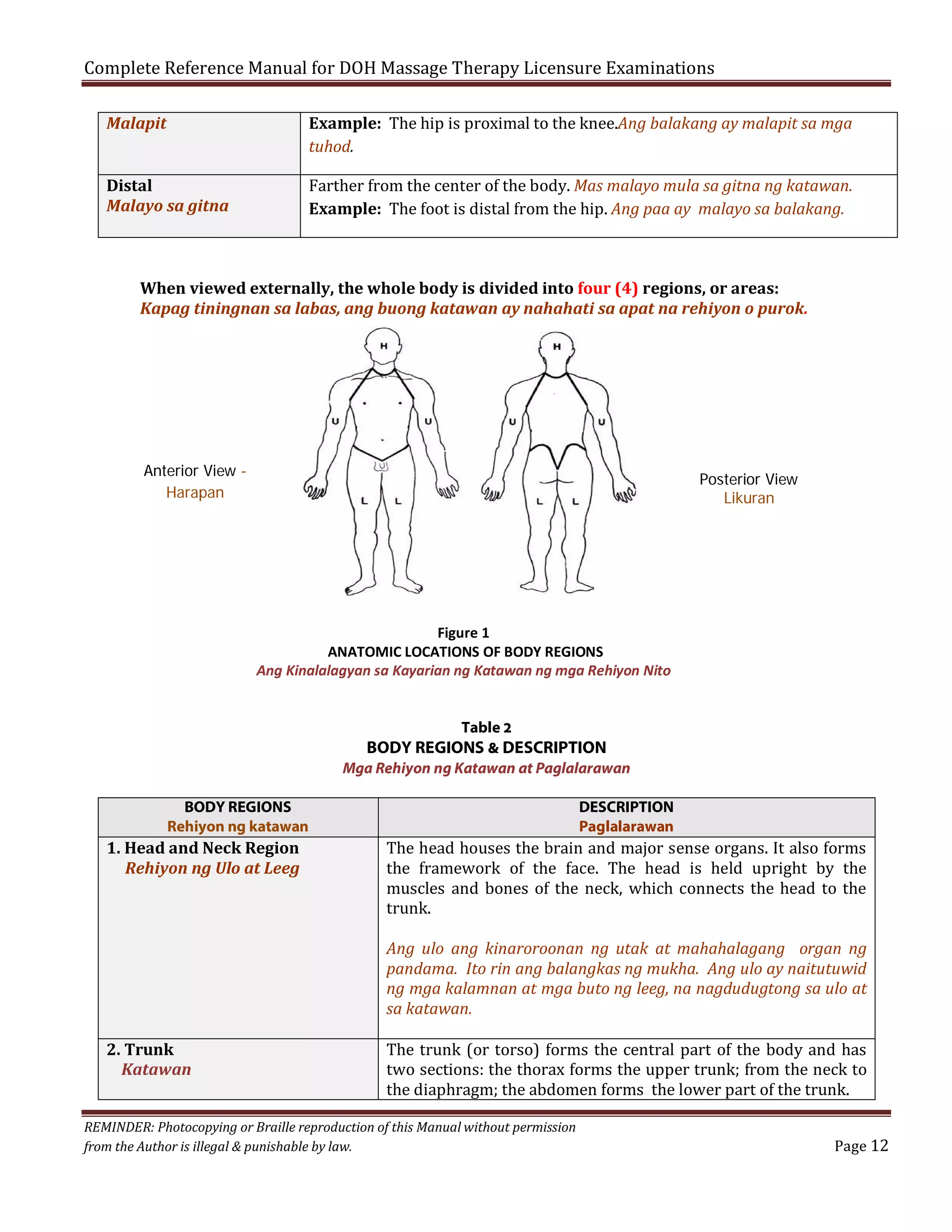
When viewed externally, the whole body is divided into four (4) regions, or areas:
Kapag tiningnan sa labas, ang buong katawan ay nahahati sa apat na rehiyon o purok.

Anterior View Harapan

Posterior View
Likuran

Figure 1
ANATOMIC LOCATIONS OF BODY REGIONS
Ang Kinalalagyan sa Kayarian ng Katawan ng mga Rehiyon Nito
Table 2

BODY REGIONS & DESCRIPTION
Mga Rehiyon ng Katawan at Paglalarawan
BODY REGIONS
Rehiyon ng katawan

1. Head and Neck Region
Rehiyon ng Ulo at Leeg

DESCRIPTION
Paglalarawan

The head houses the brain and major sense organs. It also forms
the framework of the face. The head is held upright by the
muscles and bones of the neck, which connects the head to the
trunk.

Ang ulo ang kinaroroonan ng utak at mahahalagang organ ng
pandama. Ito rin ang balangkas ng mukha. Ang ulo ay naitutuwid
ng mga kalamnan at mga buto ng leeg, na nagdudugtong sa ulo at
sa katawan.
2. Trunk
Katawan

The trunk (or torso) forms the central part of the body and has
two sections: the thorax forms the upper trunk; from the neck to
the diaphragm; the abdomen forms the lower part of the trunk.

REMINDER: Photocopying or Braille reproduction of this Manual without permission
from the Author is illegal & punishable by law.

Page 12
Complete Reference Manual for DOH Massage Therapy Licensure Examinations
Ang katawan ang bumubuo sa kalagitnaan ng buong katawan.
May dalawa itong bahagi. Ang dibdib ay bumubuo sa itaas na
bahagi, mula sa leeg hanggang dayapram (diaphragm); ang tiyan
ang bumubuo ng ibabang bahagi.
Divided into three regions: the arm, forearm and hand; the hallow
part just below the connection between the upper extremity and
the trunk is the axilla or armpit.

3. Upper Extremities
Mga Kamay

Hinati sa tatlong rehiyon: Ang braso, bisig at kamay. Ang malalim
na bahagi sa ilalim ng braso - sa dako ng pagkakaugnay ng braso
sa katawan - ay kili-kili.
Divided into thigh, leg and foot. Hinati sa hita, binti at paa

4. Lower Extremities
Mga paa
C. Body Positions

-

Mga Posisyon ng Katawan

BODY POSITIONS
Mga Posisyon ng Katawan

No matter what the position of the client, the therapist will describe the
location of the anatomical parts as if the client’s body is in its anatomical
position.
Kahit ano pa ang posisyon ng kliyente, ilalarawan ng therapist ang mga bahagi
ng katawan ayon sa Pagkakalagay nito sa Kayarian (Anatomical Position) ng
Katawan.
Anatomical Position May Be Described as:
Ang Pagkakalagay sa Kayarian (anatomical) ng
Katawan ay inilarawan na ganito:
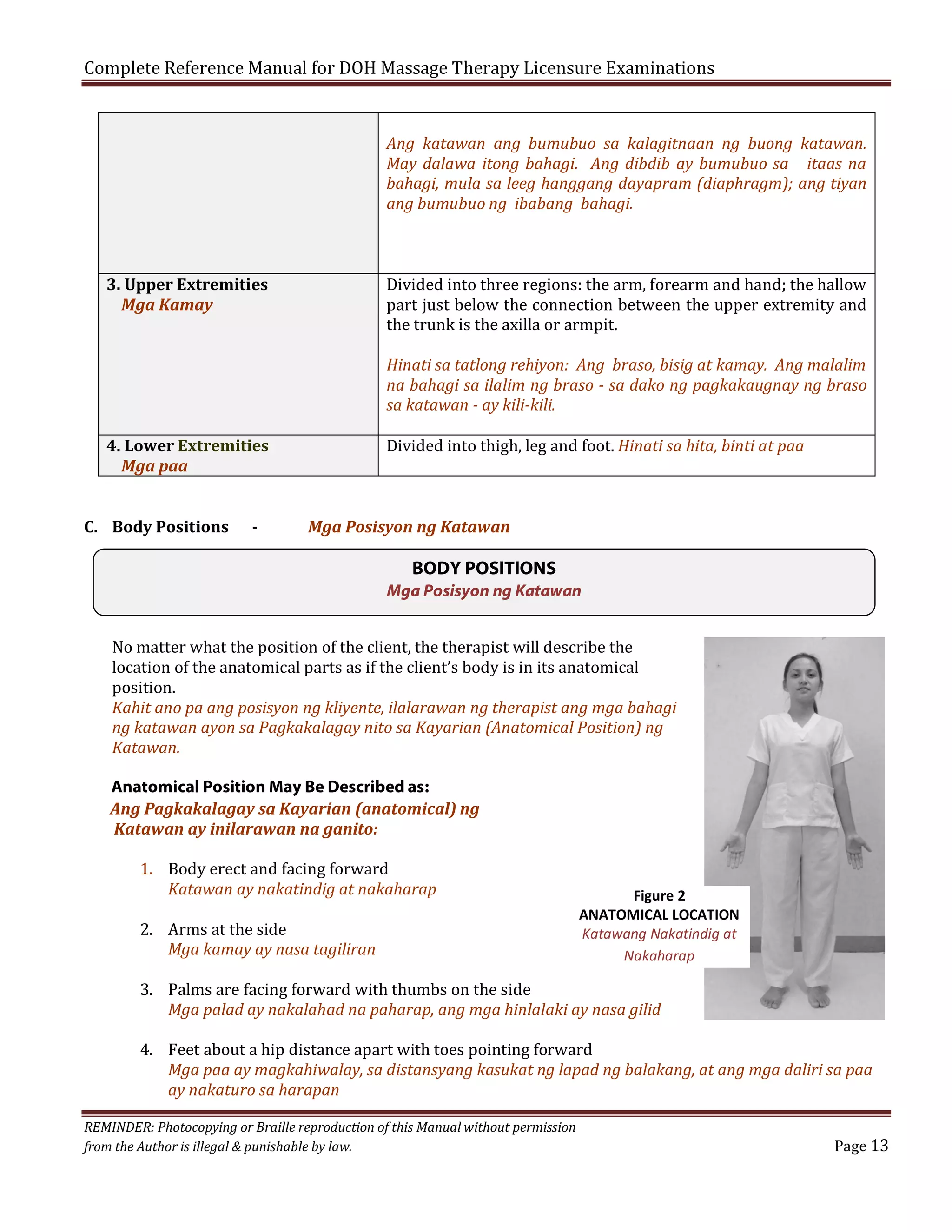
1. Body erect and facing forward
Katawan ay nakatindig at nakaharap
2. Arms at the side
Mga kamay ay nasa tagiliran

Figure 2
ANATOMICAL LOCATION
Katawang Nakatindig at
Nakaharap

3. Palms are facing forward with thumbs on the side
Mga palad ay nakalahad na paharap, ang mga hinlalaki ay nasa gilid

4. Feet about a hip distance apart with toes pointing forward
Mga paa ay magkahiwalay, sa distansyang kasukat ng lapad ng balakang, at ang mga daliri sa paa
ay nakaturo sa harapan

REMINDER: Photocopying or Braille reproduction of this Manual without permission
from the Author is illegal & punishable by law.

Page 13
Complete Reference Manual for DOH Massage Therapy Licensure Examinations

The illustrations below are the various positions used in massage therapy. The massage
therapists must recognize and understand the different positions of the client while applying massage.
This will minimize, if not totally prevent or control any possible injuries to the client.

Ang paglalarawan sa ibaba ay iba’t ibang posisyon na ginagamit sa pagmamasahe. Dapat
alamin at unawain ng nagmamasahe ang iba’t ibang posisyon na nararapat sa kliyente kapag
minamasahe niya ito. Ang ganitong kaalaman ay makakatulong na mabawasan, kung di man lubusang
maiwasan o mapigil, ang anumang kapinsalaan na maaaring mangyari sa kliyente.

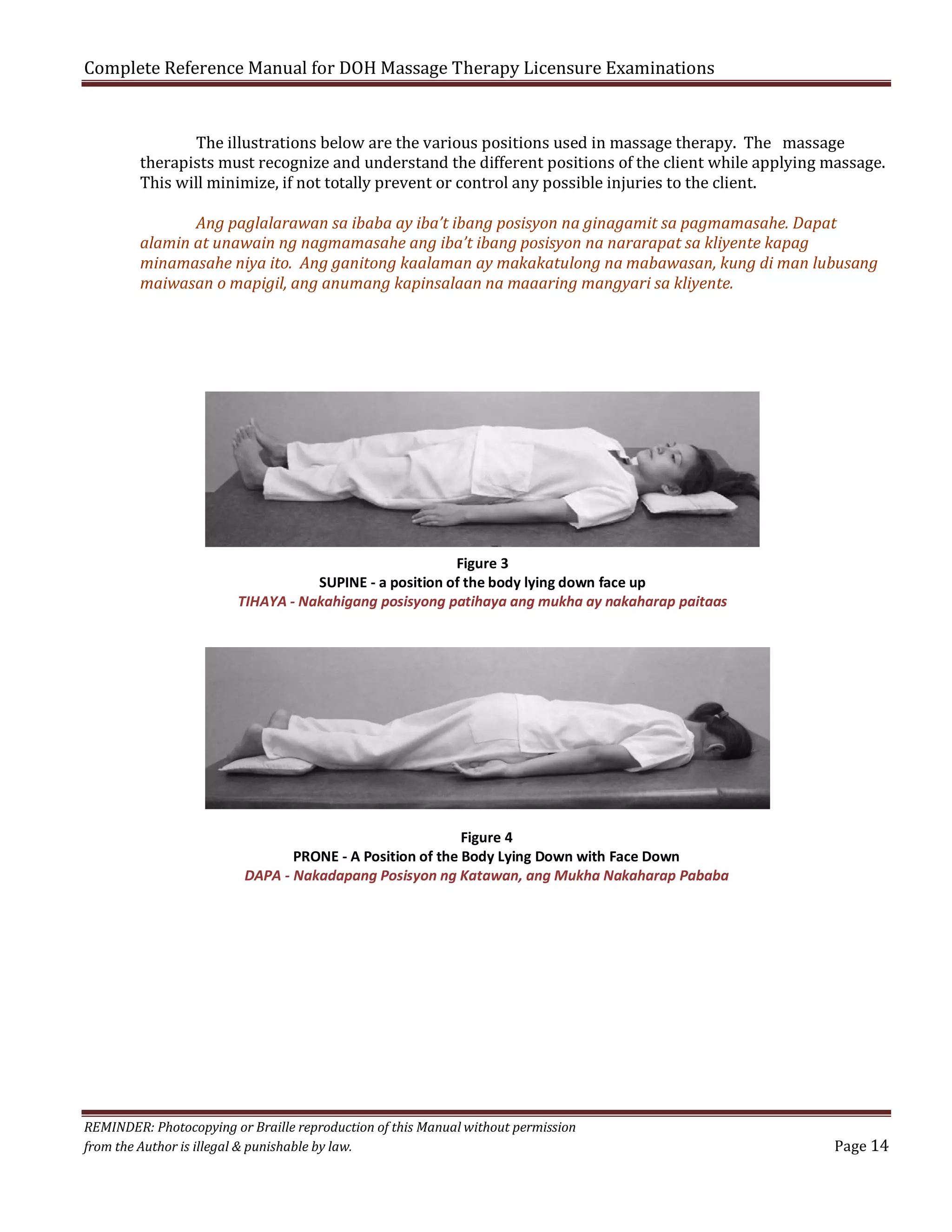
Figure 3
SUPINE - a position of the body lying down face up
TIHAYA - Nakahigang posisyong patihaya ang mukha ay nakaharap paitaas

Figure 4
PRONE - A Position of the Body Lying Down with Face Down
DAPA - Nakadapang Posisyon ng Katawan, ang Mukha Nakaharap Pababa

REMINDER: Photocopying or Braille reproduction of this Manual without permission
from the Author is illegal & punishable by law.

Page 14
Complete Reference Manual for DOH Massage Therapy Licensure Examinations

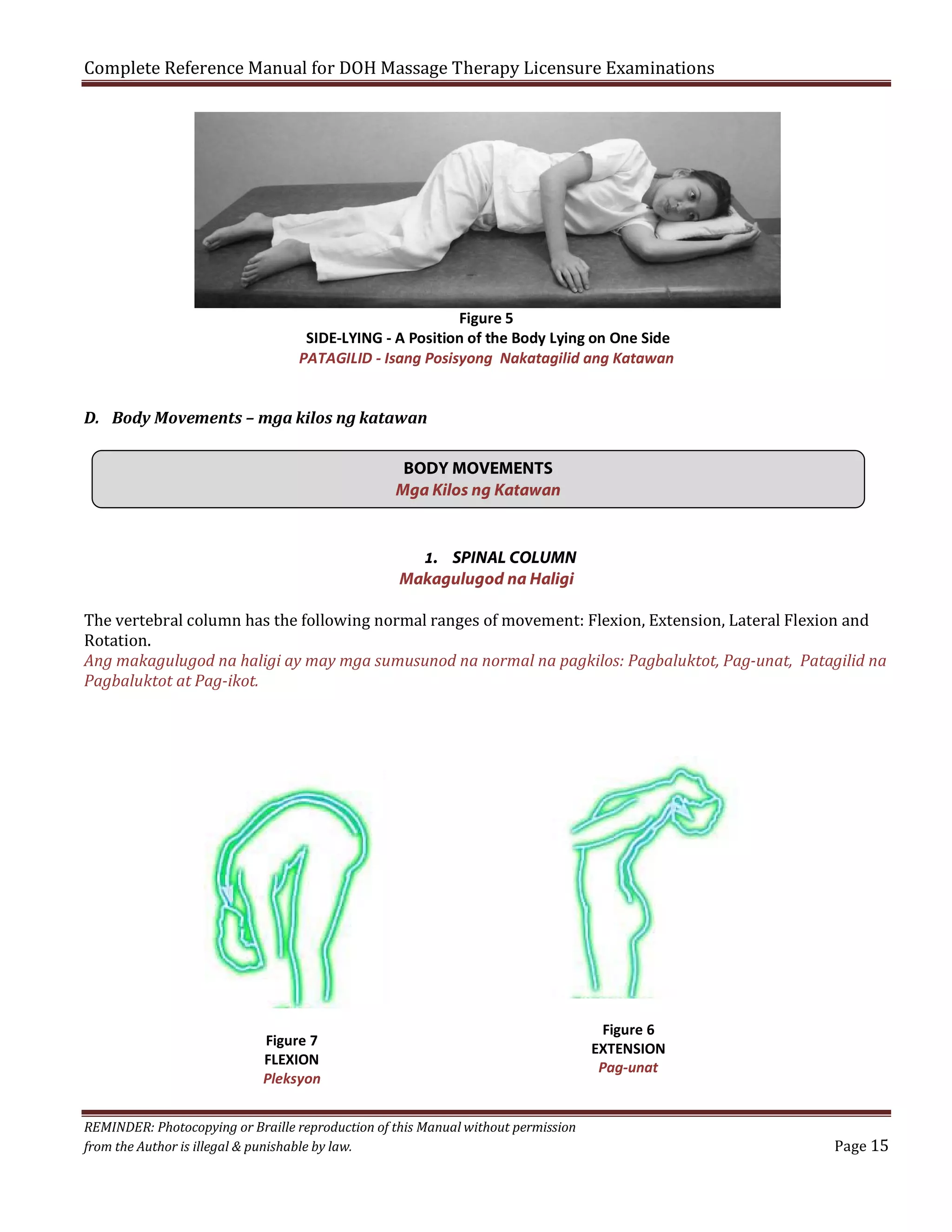
Figure 5
SIDE-LYING - A Position of the Body Lying on One Side
PATAGILID - Isang Posisyong Nakatagilid ang Katawan

D. Body Movements – mga kilos ng katawan
BODY MOVEMENTS
Mga Kilos ng Katawan

1. SPINAL COLUMN
Makagulugod na Haligi

The vertebral column has the following normal ranges of movement: Flexion, Extension, Lateral Flexion and
Rotation.
Ang makagulugod na haligi ay may mga sumusunod na normal na pagkilos: Pagbaluktot, Pag-unat, Patagilid na
Pagbaluktot at Pag-ikot.

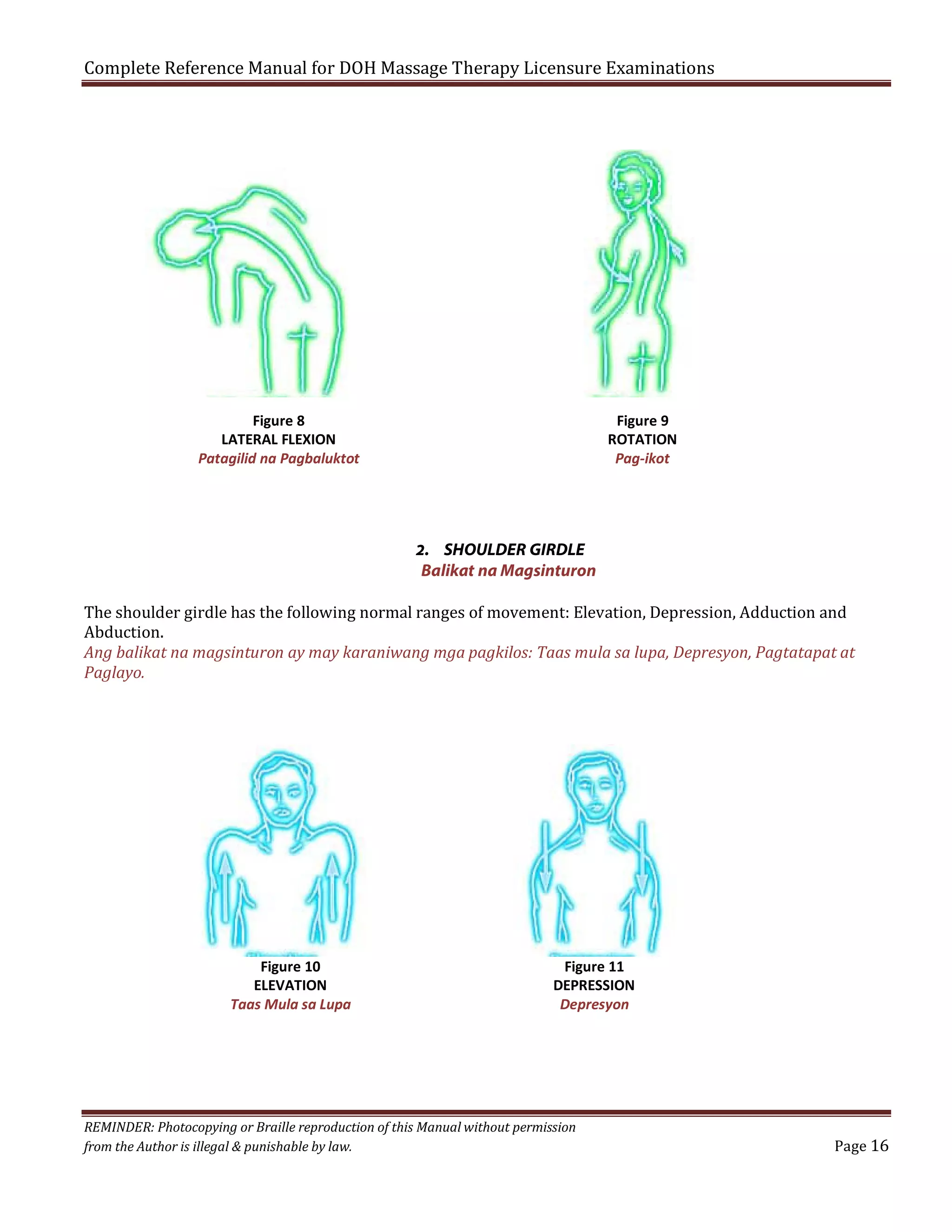
Figure 7
FLEXION
Pleksyon
REMINDER: Photocopying or Braille reproduction of this Manual without permission
from the Author is illegal & punishable by law.

Figure 6
EXTENSION
Pag-unat
Page 15
Complete Reference Manual for DOH Massage Therapy Licensure Examinations

Figure 8
LATERAL FLEXION
Patagilid na Pagbaluktot

Figure 9
ROTATION
Pag-ikot

2. SHOULDER GIRDLE
Balikat na Magsinturon

The shoulder girdle has the following normal ranges of movement: Elevation, Depression, Adduction and
Abduction.
Ang balikat na magsinturon ay may karaniwang mga pagkilos: Taas mula sa lupa, Depresyon, Pagtatapat at
Paglayo.

Figure 10
ELEVATION
Taas Mula sa Lupa

Figure 11
DEPRESSION
Depresyon

REMINDER: Photocopying or Braille reproduction of this Manual without permission
from the Author is illegal & punishable by law.

Page 16
Complete Reference Manual for DOH Massage Therapy Licensure Examinations

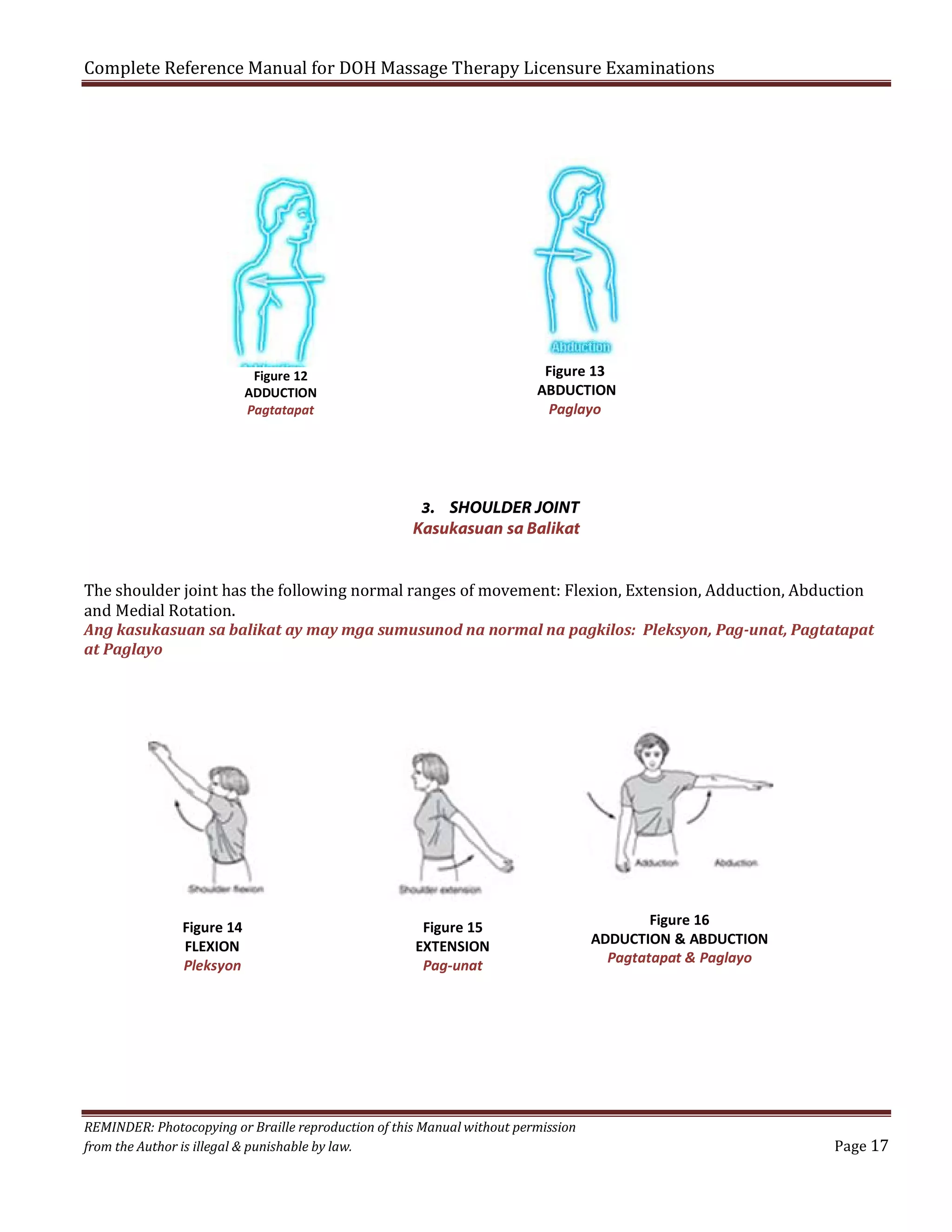
Figure 13
ABDUCTION
Paglayo

Figure 12
ADDUCTION
Pagtatapat

3. SHOULDER JOINT
Kasukasuan sa Balikat
The shoulder joint has the following normal ranges of movement: Flexion, Extension, Adduction, Abduction
and Medial Rotation.
Ang kasukasuan sa balikat ay may mga sumusunod na normal na pagkilos: Pleksyon, Pag-unat, Pagtatapat
at Paglayo

Figure 14
FLEXION
Pleksyon

Figure 15
EXTENSION
Pag-unat

REMINDER: Photocopying or Braille reproduction of this Manual without permission
from the Author is illegal & punishable by law.

Figure 16
ADDUCTION & ABDUCTION
Pagtatapat & Paglayo

Page 17
Complete Reference Manual for DOH Massage Therapy Licensure Examinations

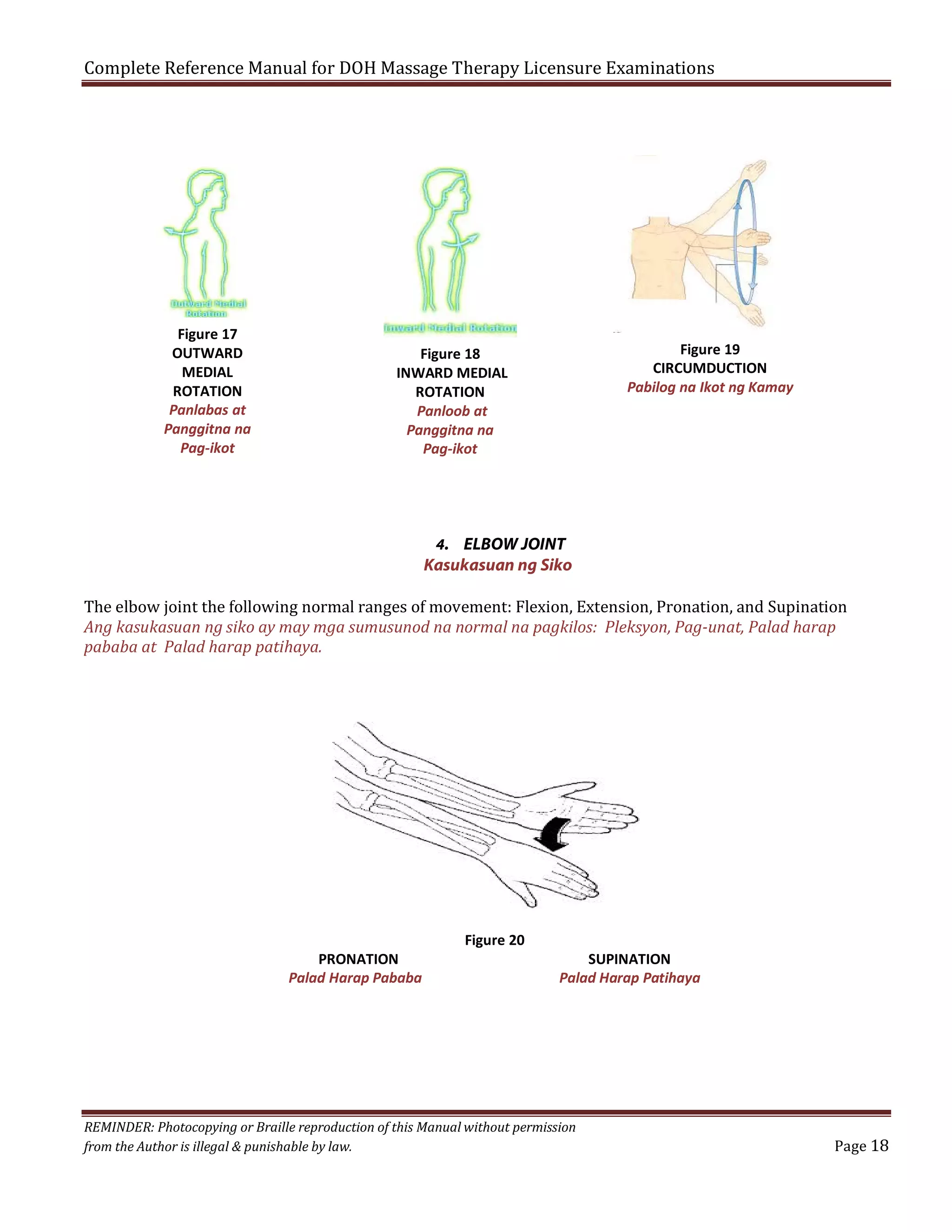
Figure 17
OUTWARD
MEDIAL
ROTATION
Panlabas at
Panggitna na
Pag-ikot

Figure 19
CIRCUMDUCTION
Pabilog na Ikot ng Kamay

Figure 18
INWARD MEDIAL
ROTATION
Panloob at
Panggitna na
Pag-ikot

4. ELBOW JOINT
Kasukasuan ng Siko

The elbow joint the following normal ranges of movement: Flexion, Extension, Pronation, and Supination
Ang kasukasuan ng siko ay may mga sumusunod na normal na pagkilos: Pleksyon, Pag-unat, Palad harap
pababa at Palad harap patihaya.

PRONATION
Palad Harap Pababa

Figure 20

SUPINATION
Palad Harap Patihaya

REMINDER: Photocopying or Braille reproduction of this Manual without permission
from the Author is illegal & punishable by law.

Page 18
Complete Reference Manual for DOH Massage Therapy Licensure Examinations

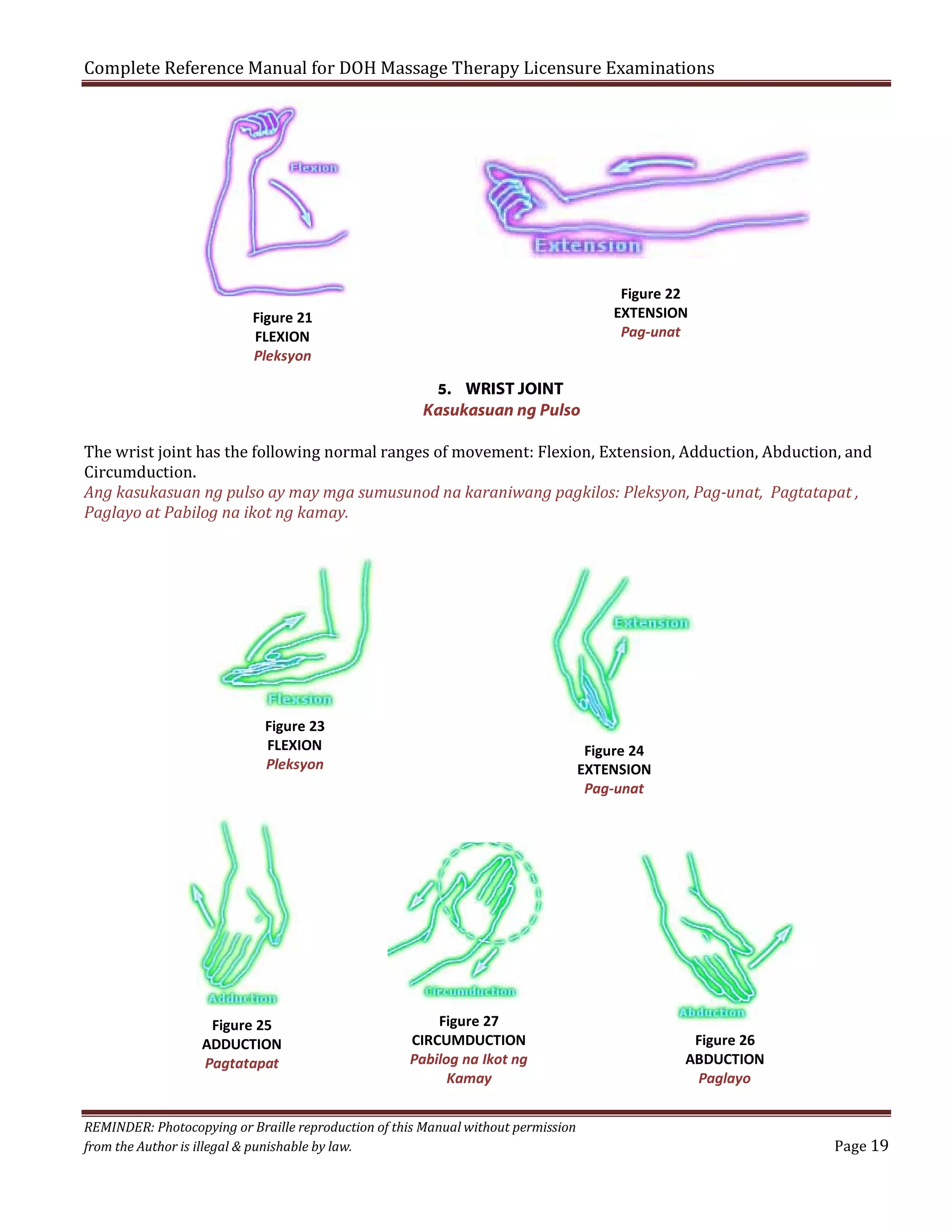
Figure 22
EXTENSION
Pag-unat

Figure 21
FLEXION
Pleksyon

5. WRIST JOINT
Kasukasuan ng Pulso

The wrist joint has the following normal ranges of movement: Flexion, Extension, Adduction, Abduction, and
Circumduction.
Ang kasukasuan ng pulso ay may mga sumusunod na karaniwang pagkilos: Pleksyon, Pag-unat, Pagtatapat ,
Paglayo at Pabilog na ikot ng kamay.

Figure 23
FLEXION
Pleksyon

Figure 25
ADDUCTION
Pagtatapat

Figure 24
EXTENSION
Pag-unat

Figure 27
CIRCUMDUCTION
Pabilog na Ikot ng
Kamay

REMINDER: Photocopying or Braille reproduction of this Manual without permission
from the Author is illegal & punishable by law.

Figure 26
ABDUCTION
Paglayo
Page 19
Complete Reference Manual for DOH Massage Therapy Licensure Examinations
6. HIP JOINT
Kasukasuan ng Bewang

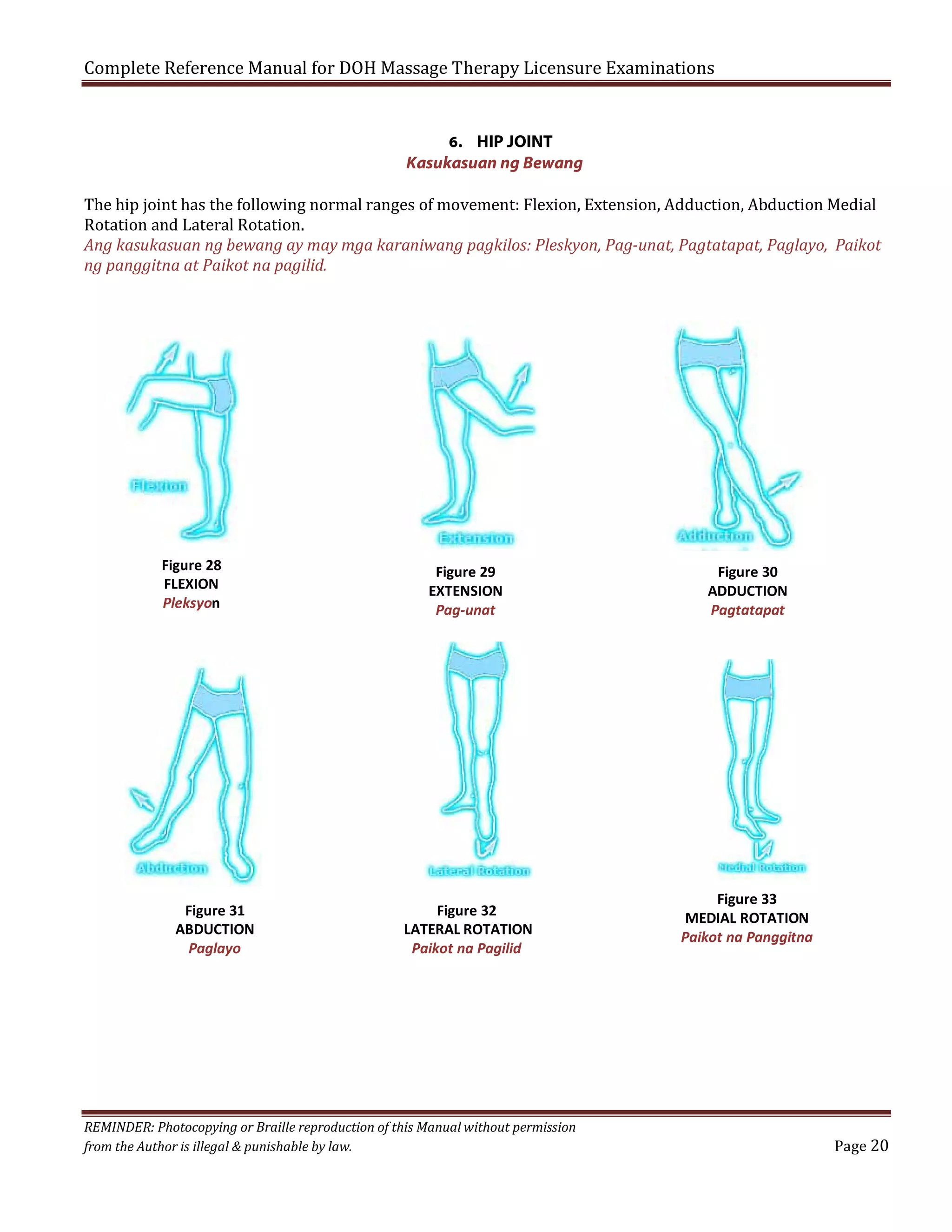
The hip joint has the following normal ranges of movement: Flexion, Extension, Adduction, Abduction Medial
Rotation and Lateral Rotation.
Ang kasukasuan ng bewang ay may mga karaniwang pagkilos: Pleskyon, Pag-unat, Pagtatapat, Paglayo, Paikot
ng panggitna at Paikot na pagilid.

Figure 28
FLEXION
Pleksyon

Figure 31
ABDUCTION
Paglayo

Figure 29
EXTENSION
Pag-unat

Figure 32
LATERAL ROTATION
Paikot na Pagilid

REMINDER: Photocopying or Braille reproduction of this Manual without permission
from the Author is illegal & punishable by law.

Figure 30
ADDUCTION
Pagtatapat

Figure 33
MEDIAL ROTATION
Paikot na Panggitna

Page 20
Complete Reference Manual for DOH Massage Therapy Licensure Examinations
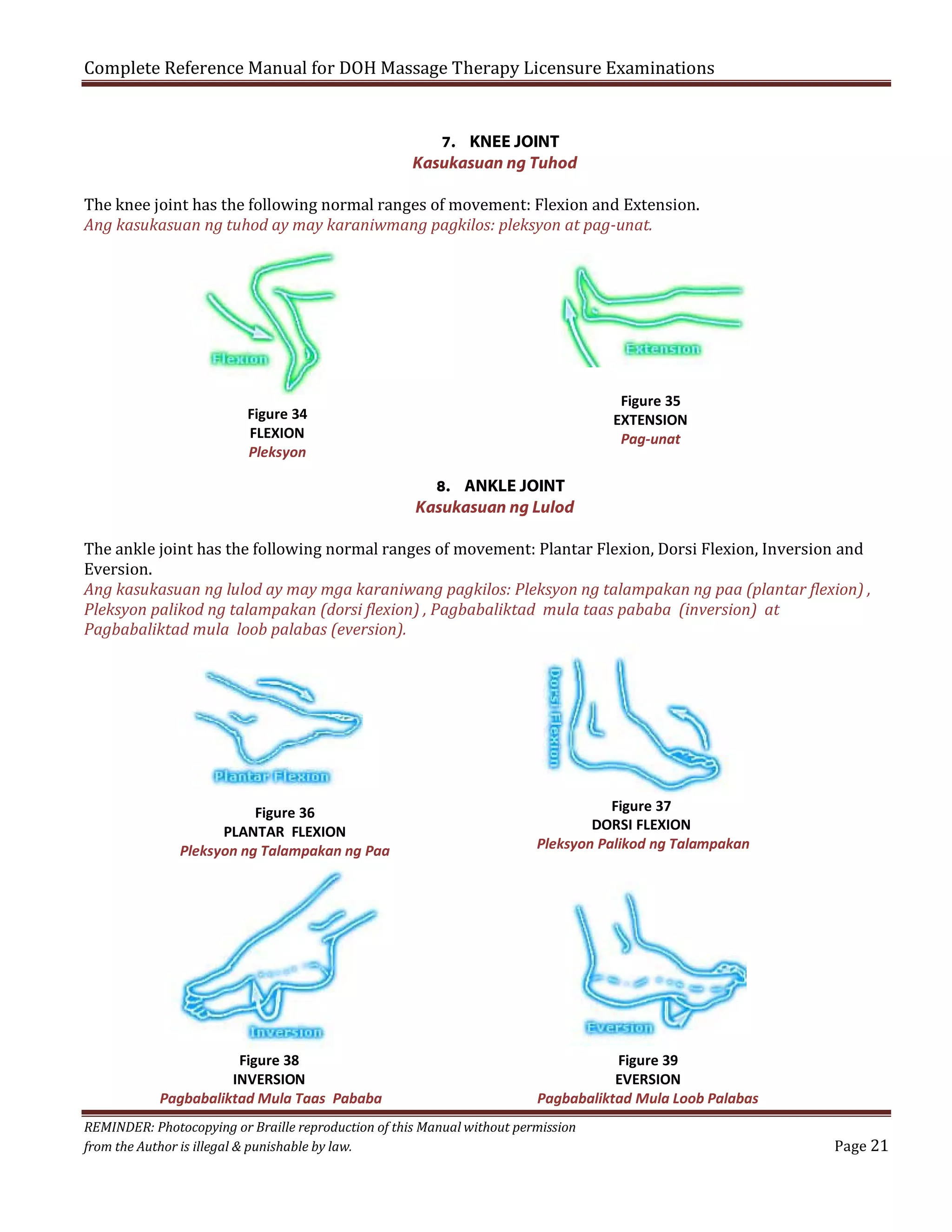
7. KNEE JOINT
Kasukasuan ng Tuhod

The knee joint has the following normal ranges of movement: Flexion and Extension.
Ang kasukasuan ng tuhod ay may karaniwmang pagkilos: pleksyon at pag-unat.

Figure 35
EXTENSION
Pag-unat

Figure 34
FLEXION
Pleksyon

8. ANKLE JOINT
Kasukasuan ng Lulod

The ankle joint has the following normal ranges of movement: Plantar Flexion, Dorsi Flexion, Inversion and
Eversion.
Ang kasukasuan ng lulod ay may mga karaniwang pagkilos: Pleksyon ng talampakan ng paa (plantar flexion) ,
Pleksyon palikod ng talampakan (dorsi flexion) , Pagbabaliktad mula taas pababa (inversion) at
Pagbabaliktad mula loob palabas (eversion).

Figure 36
PLANTAR FLEXION
Pleksyon ng Talampakan ng Paa

Figure 38
INVERSION
Pagbabaliktad Mula Taas Pababa

Figure 37
DORSI FLEXION
Pleksyon Palikod ng Talampakan

Figure 39
EVERSION
Pagbabaliktad Mula Loob Palabas

REMINDER: Photocopying or Braille reproduction of this Manual without permission
from the Author is illegal & punishable by law.

Page 21
Complete Reference Manual for DOH Massage Therapy Licensure Examinations
E. Major Organ Systems

- Mga Sistema ng Pangunahing mga Organ ng
Katawan.

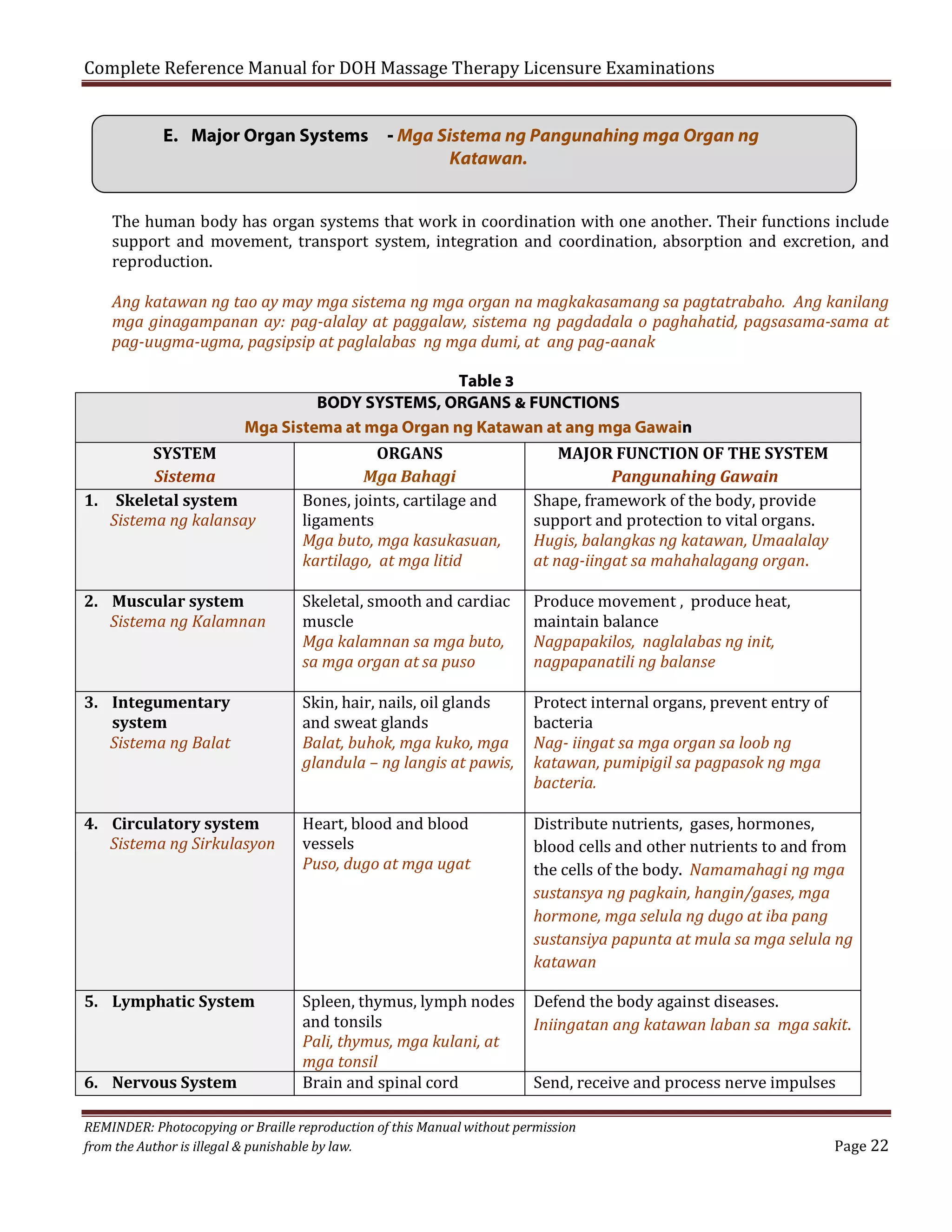
The human body has organ systems that work in coordination with one another. Their functions include
support and movement, transport system, integration and coordination, absorption and excretion, and
reproduction.

Ang katawan ng tao ay may mga sistema ng mga organ na magkakasamang sa pagtatrabaho. Ang kanilang
mga ginagampanan ay: pag-alalay at paggalaw, sistema ng pagdadala o paghahatid, pagsasama-sama at
pag-uugma-ugma, pagsipsip at paglalabas ng mga dumi, at ang pag-aanak
Table 3
BODY SYSTEMS, ORGANS & FUNCTIONS
Mga Sistema at mga Organ ng Katawan at ang mga Gawain
SYSTEM
Sistema
1. Skeletal system
Sistema ng kalansay

ORGANS
Mga Bahagi
Bones, joints, cartilage and
ligaments
Mga buto, mga kasukasuan,
kartilago, at mga litid

MAJOR FUNCTION OF THE SYSTEM
Pangunahing Gawain
Shape, framework of the body, provide
support and protection to vital organs.
Hugis, balangkas ng katawan, Umaalalay
at nag-iingat sa mahahalagang organ.

3. Integumentary
system
Sistema ng Balat

Skin, hair, nails, oil glands
and sweat glands
Balat, buhok, mga kuko, mga
glandula – ng langis at pawis,

4. Circulatory system
Sistema ng Sirkulasyon

Heart, blood and blood
vessels
Puso, dugo at mga ugat

Protect internal organs, prevent entry of
bacteria
Nag- iingat sa mga organ sa loob ng
katawan, pumipigil sa pagpasok ng mga
bacteria.

2. Muscular system
Sistema ng Kalamnan

5. Lymphatic System

6. Nervous System

Skeletal, smooth and cardiac
muscle
Mga kalamnan sa mga buto,
sa mga organ at sa puso

Spleen, thymus, lymph nodes
and tonsils
Pali, thymus, mga kulani, at
mga tonsil
Brain and spinal cord

Produce movement , produce heat,
maintain balance
Nagpapakilos, naglalabas ng init,
nagpapanatili ng balanse

Distribute nutrients, gases, hormones,
blood cells and other nutrients to and from
the cells of the body. Namamahagi ng mga
sustansya ng pagkain, hangin/gases, mga
hormone, mga selula ng dugo at iba pang
sustansiya papunta at mula sa mga selula ng
katawan
Defend the body against diseases.
Iniingatan ang katawan laban sa mga sakit.
Send, receive and process nerve impulses

REMINDER: Photocopying or Braille reproduction of this Manual without permission
from the Author is illegal & punishable by law.

Page 22
Complete Reference Manual for DOH Massage Therapy Licensure Examinations
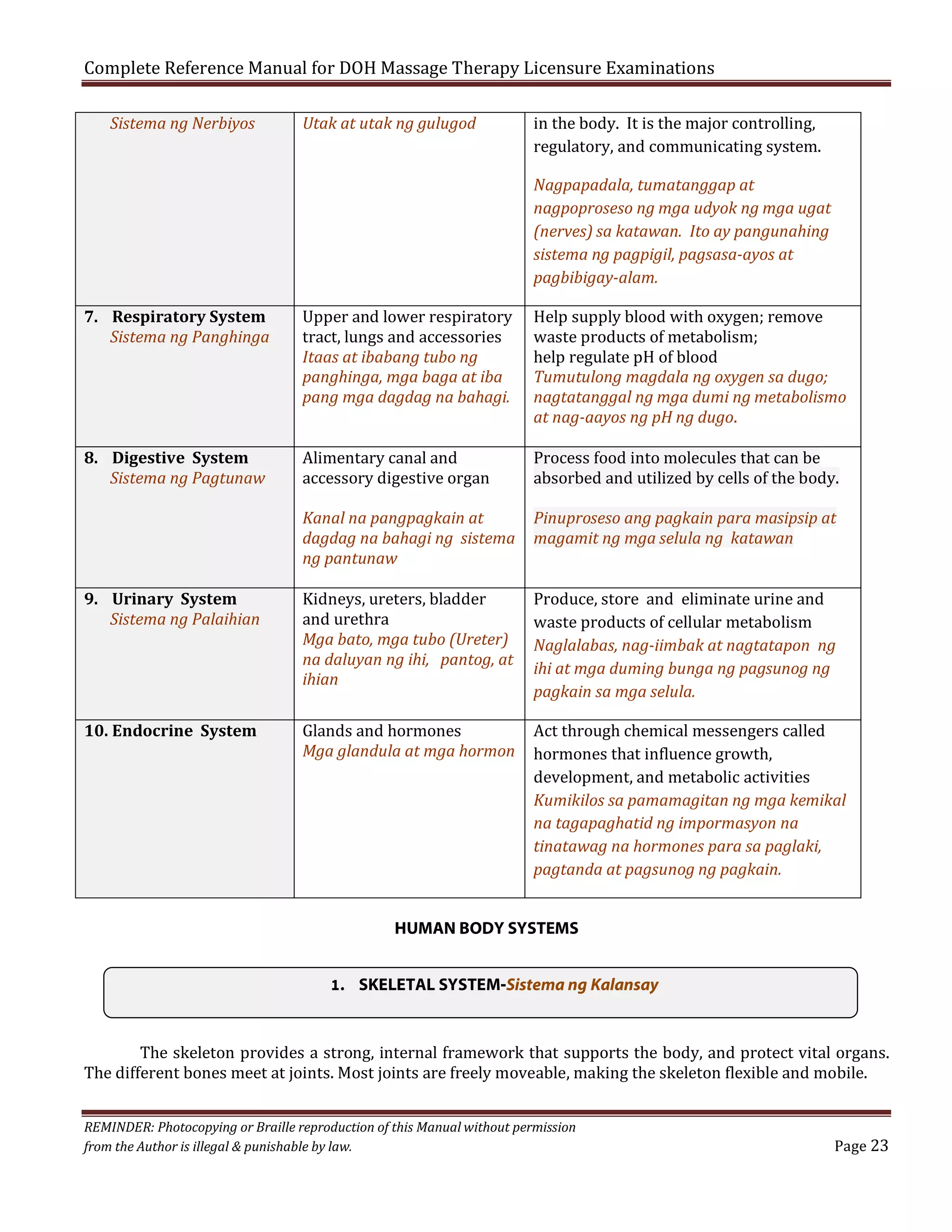
Sistema ng Nerbiyos

7. Respiratory System
Sistema ng Panghinga

8. Digestive System
Sistema ng Pagtunaw

Utak at utak ng gulugod

Upper and lower respiratory
tract, lungs and accessories
Itaas at ibabang tubo ng
panghinga, mga baga at iba
pang mga dagdag na bahagi.
Alimentary canal and
accessory digestive organ

Kanal na pangpagkain at
dagdag na bahagi ng sistema
ng pantunaw
9. Urinary System
Sistema ng Palaihian

10. Endocrine System

Kidneys, ureters, bladder
and urethra
Mga bato, mga tubo (Ureter)
na daluyan ng ihi, pantog, at
ihian

Glands and hormones
Mga glandula at mga hormon

in the body. It is the major controlling,
regulatory, and communicating system.

Nagpapadala, tumatanggap at
nagpoproseso ng mga udyok ng mga ugat
(nerves) sa katawan. Ito ay pangunahing
sistema ng pagpigil, pagsasa-ayos at
pagbibigay-alam.

Help supply blood with oxygen; remove
waste products of metabolism;
help regulate pH of blood
Tumutulong magdala ng oxygen sa dugo;
nagtatanggal ng mga dumi ng metabolismo
at nag-aayos ng pH ng dugo.
Process food into molecules that can be
absorbed and utilized by cells of the body.
Pinuproseso ang pagkain para masipsip at
magamit ng mga selula ng katawan
Produce, store and eliminate urine and
waste products of cellular metabolism
Naglalabas, nag-iimbak at nagtatapon ng
ihi at mga duming bunga ng pagsunog ng
pagkain sa mga selula.

Act through chemical messengers called
hormones that influence growth,
development, and metabolic activities
Kumikilos sa pamamagitan ng mga kemikal
na tagapaghatid ng impormasyon na
tinatawag na hormones para sa paglaki,
pagtanda at pagsunog ng pagkain.

HUMAN BODY SYSTEMS
1. SKELETAL SYSTEM-Sistema ng Kalansay
The skeleton provides a strong, internal framework that supports the body, and protect vital organs.
The different bones meet at joints. Most joints are freely moveable, making the skeleton flexible and mobile.

REMINDER: Photocopying or Braille reproduction of this Manual without permission
from the Author is illegal & punishable by law.

Page 23
Complete Reference Manual for DOH Massage Therapy Licensure Examinations

Ang kalansay ay nagbibigay ng matibay na panloob na balangkas na umaalalay sa katawan at nagiingat sa mahahalagang organ. Ang iba’t ibang uri ng mga buto ay nagtatagpo sa mga kasukasuan. Karamihan
sa mga kasu-kasuan ay malayang nakakakilos kaya ang kalansay ay madaling nakakabaluktot, nakaka-unat at
nakakalipat ng lugar.
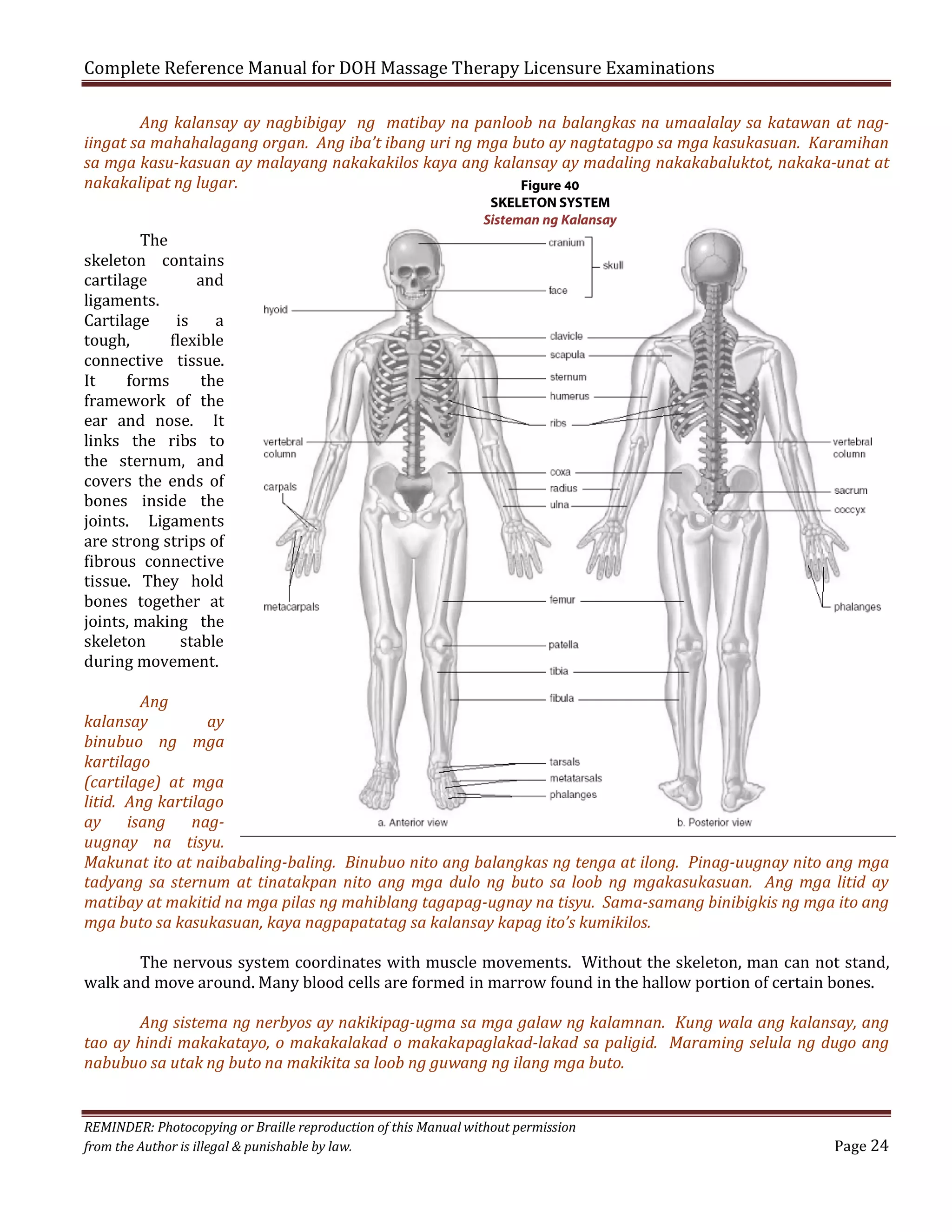
Figure 40
The
skeleton contains
cartilage
and
ligaments.
Cartilage
is
a
tough,
flexible
connective tissue.
It
forms
the
framework of the
ear and nose. It
links the ribs to
the sternum, and
covers the ends of
bones inside the
joints. Ligaments
are strong strips of
fibrous connective
tissue. They hold
bones together at
joints, making the
skeleton
stable
during movement.

SKELETON SYSTEM
Sisteman ng Kalansay

Ang
kalansay
ay
binubuo ng mga
kartilago
(cartilage) at mga
litid. Ang kartilago
ay
isang
naguugnay na tisyu.
Makunat ito at naibabaling-baling. Binubuo nito ang balangkas ng tenga at ilong. Pinag-uugnay nito ang mga
tadyang sa sternum at tinatakpan nito ang mga dulo ng buto sa loob ng mgakasukasuan. Ang mga litid ay
matibay at makitid na mga pilas ng mahiblang tagapag-ugnay na tisyu. Sama-samang binibigkis ng mga ito ang
mga buto sa kasukasuan, kaya nagpapatatag sa kalansay kapag ito’s kumikilos.

The nervous system coordinates with muscle movements. Without the skeleton, man can not stand,
walk and move around. Many blood cells are formed in marrow found in the hallow portion of certain bones.
Ang sistema ng nerbyos ay nakikipag-ugma sa mga galaw ng kalamnan. Kung wala ang kalansay, ang
tao ay hindi makakatayo, o makakalakad o makakapaglakad-lakad sa paligid. Maraming selula ng dugo ang
nabubuo sa utak ng buto na makikita sa loob ng guwang ng ilang mga buto.

REMINDER: Photocopying or Braille reproduction of this Manual without permission
from the Author is illegal & punishable by law.

Page 24
Complete Reference Manual for DOH Massage Therapy Licensure Examinations

Table 4
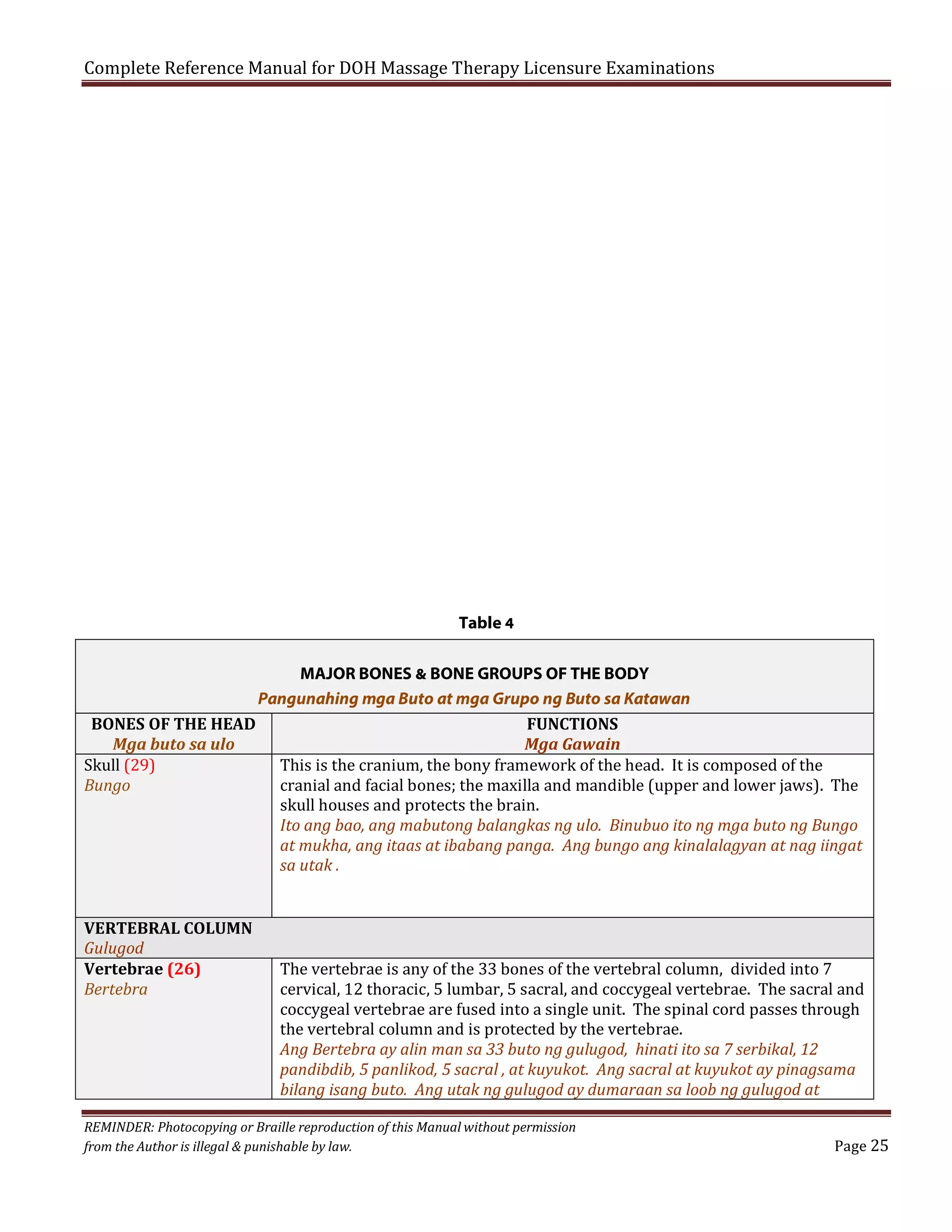
MAJOR BONES & BONE GROUPS OF THE BODY
Pangunahing mga Buto at mga Grupo ng Buto sa Katawan
BONES OF THE HEAD
FUNCTIONS
Mga buto sa ulo
Mga Gawain
Skull (29)
This is the cranium, the bony framework of the head. It is composed of the
Bungo
cranial and facial bones; the maxilla and mandible (upper and lower jaws). The
skull houses and protects the brain.
Ito ang bao, ang mabutong balangkas ng ulo. Binubuo ito ng mga buto ng Bungo
at mukha, ang itaas at ibabang panga. Ang bungo ang kinalalagyan at nag iingat
sa utak .
VERTEBRAL COLUMN
Gulugod
Vertebrae (26)
Bertebra

The vertebrae is any of the 33 bones of the vertebral column, divided into 7
cervical, 12 thoracic, 5 lumbar, 5 sacral, and coccygeal vertebrae. The sacral and
coccygeal vertebrae are fused into a single unit. The spinal cord passes through
the vertebral column and is protected by the vertebrae.
Ang Bertebra ay alin man sa 33 buto ng gulugod, hinati ito sa 7 serbikal, 12
pandibdib, 5 panlikod, 5 sacral , at kuyukot. Ang sacral at kuyukot ay pinagsama
bilang isang buto. Ang utak ng gulugod ay dumaraan sa loob ng gulugod at

REMINDER: Photocopying or Braille reproduction of this Manual without permission
from the Author is illegal & punishable by law.

Page 25
Complete Reference Manual for DOH Massage Therapy Licensure Examinations
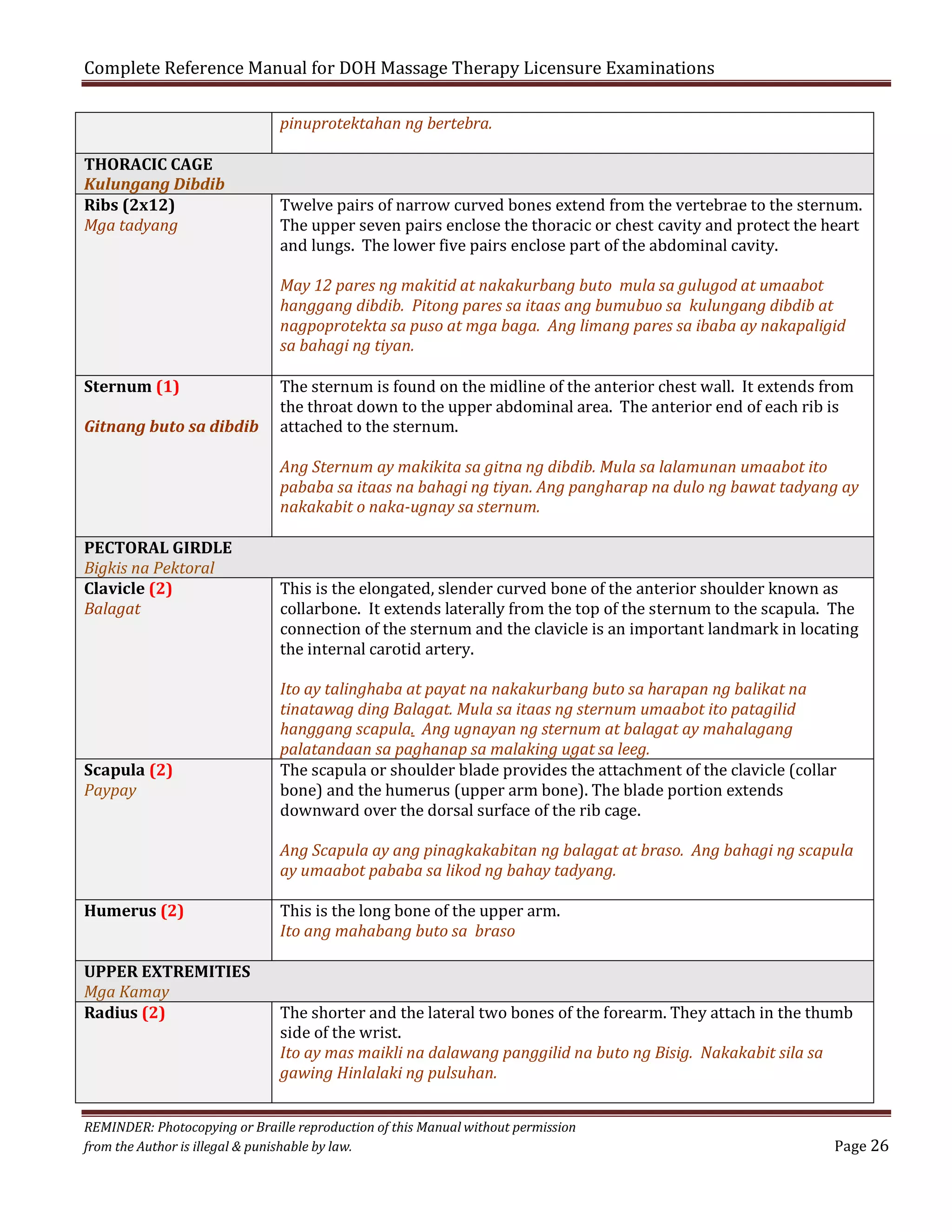
pinuprotektahan ng bertebra.

THORACIC CAGE
Kulungang Dibdib
Ribs (2x12)
Mga tadyang

Twelve pairs of narrow curved bones extend from the vertebrae to the sternum.
The upper seven pairs enclose the thoracic or chest cavity and protect the heart
and lungs. The lower five pairs enclose part of the abdominal cavity.
May 12 pares ng makitid at nakakurbang buto mula sa gulugod at umaabot
hanggang dibdib. Pitong pares sa itaas ang bumubuo sa kulungang dibdib at
nagpoprotekta sa puso at mga baga. Ang limang pares sa ibaba ay nakapaligid
sa bahagi ng tiyan.

Sternum (1)
Gitnang buto sa dibdib

The sternum is found on the midline of the anterior chest wall. It extends from
the throat down to the upper abdominal area. The anterior end of each rib is
attached to the sternum.

Ang Sternum ay makikita sa gitna ng dibdib. Mula sa lalamunan umaabot ito
pababa sa itaas na bahagi ng tiyan. Ang pangharap na dulo ng bawat tadyang ay
nakakabit o naka-ugnay sa sternum.
PECTORAL GIRDLE
Bigkis na Pektoral
Clavicle (2)
Balagat

Scapula (2)
Paypay

This is the elongated, slender curved bone of the anterior shoulder known as
collarbone. It extends laterally from the top of the sternum to the scapula. The
connection of the sternum and the clavicle is an important landmark in locating
the internal carotid artery.
Ito ay talinghaba at payat na nakakurbang buto sa harapan ng balikat na
tinatawag ding Balagat. Mula sa itaas ng sternum umaabot ito patagilid
hanggang scapula. Ang ugnayan ng sternum at balagat ay mahalagang
palatandaan sa paghanap sa malaking ugat sa leeg.
The scapula or shoulder blade provides the attachment of the clavicle (collar
bone) and the humerus (upper arm bone). The blade portion extends
downward over the dorsal surface of the rib cage.

Ang Scapula ay ang pinagkakabitan ng balagat at braso. Ang bahagi ng scapula
ay umaabot pababa sa likod ng bahay tadyang.
Humerus (2)
UPPER EXTREMITIES
Mga Kamay
Radius (2)

This is the long bone of the upper arm.
Ito ang mahabang buto sa braso

The shorter and the lateral two bones of the forearm. They attach in the thumb
side of the wrist.
Ito ay mas maikli na dalawang panggilid na buto ng Bisig. Nakakabit sila sa
gawing Hinlalaki ng pulsuhan.

REMINDER: Photocopying or Braille reproduction of this Manual without permission
from the Author is illegal & punishable by law.

Page 26
Complete Reference Manual for DOH Massage Therapy Licensure Examinations
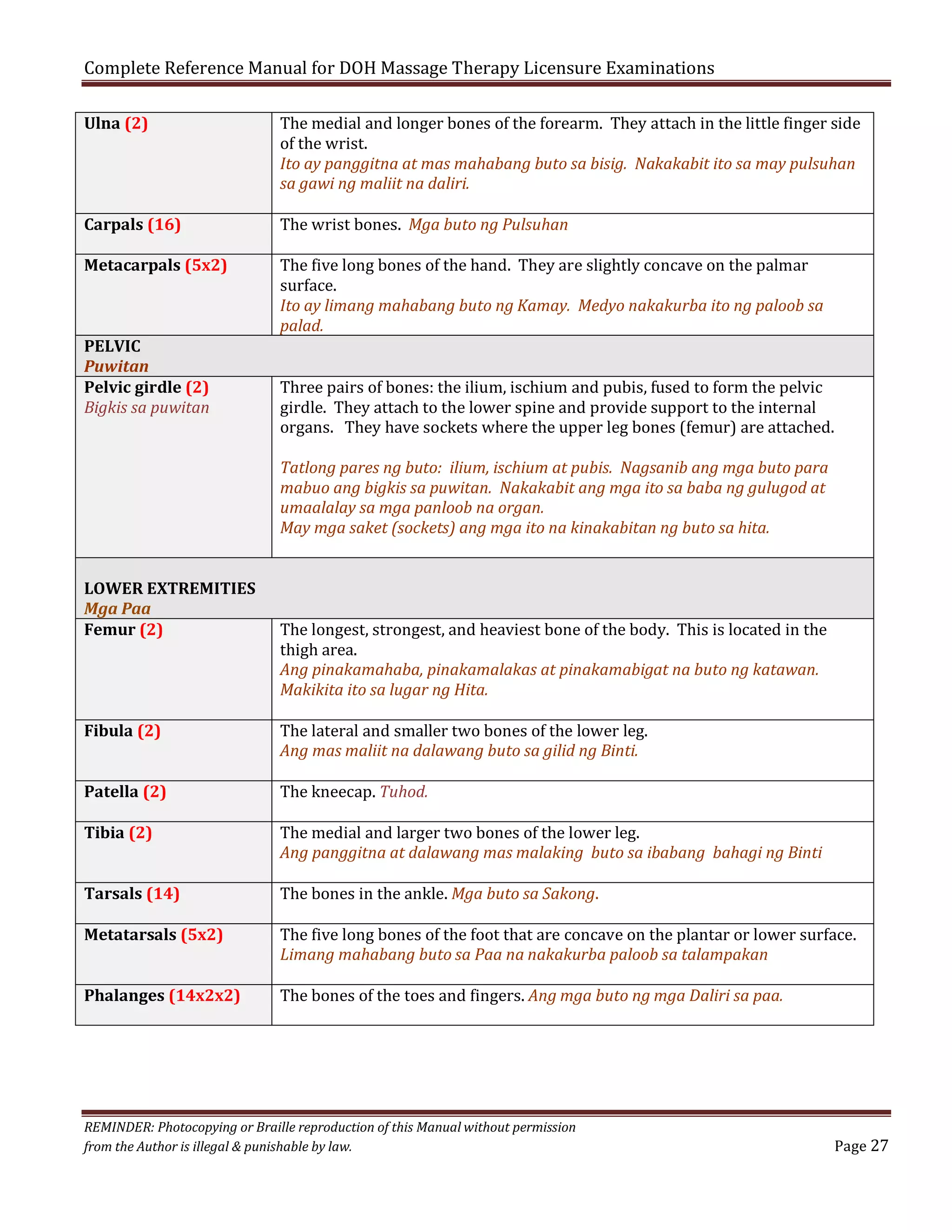
Ulna (2)

Carpals (16)
Metacarpals (5x2)

PELVIC
Puwitan
Pelvic girdle (2)
Bigkis sa puwitan

The medial and longer bones of the forearm. They attach in the little finger side
of the wrist.
Ito ay panggitna at mas mahabang buto sa bisig. Nakakabit ito sa may pulsuhan
sa gawi ng maliit na daliri.
The wrist bones. Mga buto ng Pulsuhan

The five long bones of the hand. They are slightly concave on the palmar
surface.
Ito ay limang mahabang buto ng Kamay. Medyo nakakurba ito ng paloob sa
palad.
Three pairs of bones: the ilium, ischium and pubis, fused to form the pelvic
girdle. They attach to the lower spine and provide support to the internal
organs. They have sockets where the upper leg bones (femur) are attached.

Tatlong pares ng buto: ilium, ischium at pubis. Nagsanib ang mga buto para
mabuo ang bigkis sa puwitan. Nakakabit ang mga ito sa baba ng gulugod at
umaalalay sa mga panloob na organ.
May mga saket (sockets) ang mga ito na kinakabitan ng buto sa hita.
LOWER EXTREMITIES
Mga Paa
Femur (2)

Fibula (2)
Patella (2)
Tibia (2)
Tarsals (14)
Metatarsals (5x2)
Phalanges (14x2x2)

The longest, strongest, and heaviest bone of the body. This is located in the
thigh area.
Ang pinakamahaba, pinakamalakas at pinakamabigat na buto ng katawan.
Makikita ito sa lugar ng Hita.
The lateral and smaller two bones of the lower leg.
Ang mas maliit na dalawang buto sa gilid ng Binti.
The kneecap. Tuhod.

The medial and larger two bones of the lower leg.
Ang panggitna at dalawang mas malaking buto sa ibabang bahagi ng Binti
The bones in the ankle. Mga buto sa Sakong.

The five long bones of the foot that are concave on the plantar or lower surface.
Limang mahabang buto sa Paa na nakakurba paloob sa talampakan
The bones of the toes and fingers. Ang mga buto ng mga Daliri sa paa.

REMINDER: Photocopying or Braille reproduction of this Manual without permission
from the Author is illegal & punishable by law.

Page 27
Complete Reference Manual for DOH Massage Therapy Licensure Examinations
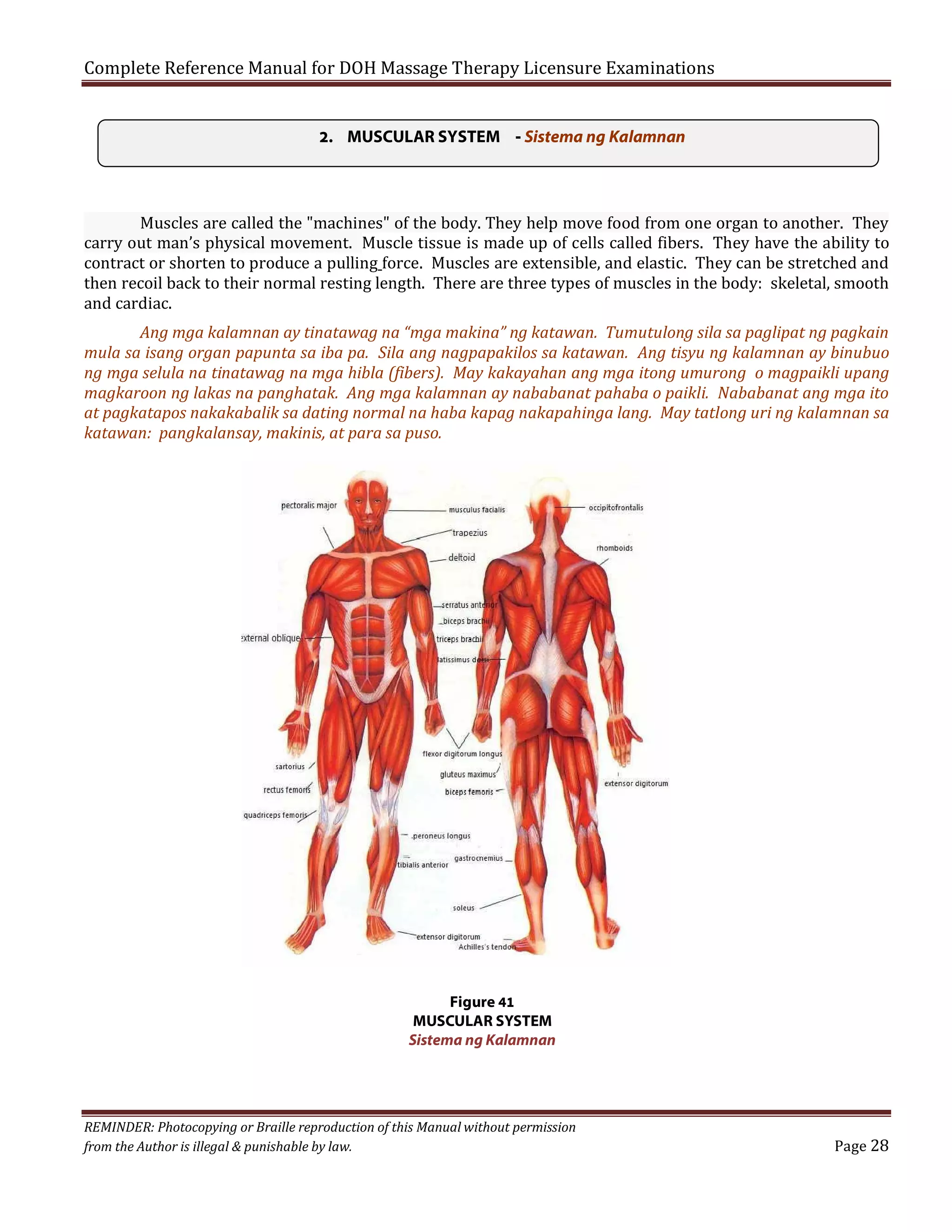
2. MUSCULAR SYSTEM - Sistema ng Kalamnan
Muscles are called the "machines" of the body. They help move food from one organ to another. They
carry out man’s physical movement. Muscle tissue is made up of cells called fibers. They have the ability to
contract or shorten to produce a pulling force. Muscles are extensible, and elastic. They can be stretched and
then recoil back to their normal resting length. There are three types of muscles in the body: skeletal, smooth
and cardiac.
Ang mga kalamnan ay tinatawag na “mga makina” ng katawan. Tumutulong sila sa paglipat ng pagkain
mula sa isang organ papunta sa iba pa. Sila ang nagpapakilos sa katawan. Ang tisyu ng kalamnan ay binubuo
ng mga selula na tinatawag na mga hibla (fibers). May kakayahan ang mga itong umurong o magpaikli upang
magkaroon ng lakas na panghatak. Ang mga kalamnan ay nababanat pahaba o paikli. Nababanat ang mga ito
at pagkatapos nakakabalik sa dating normal na haba kapag nakapahinga lang. May tatlong uri ng kalamnan sa
katawan: pangkalansay, makinis, at para sa puso.

Figure 41
MUSCULAR SYSTEM
Sistema ng Kalamnan

REMINDER: Photocopying or Braille reproduction of this Manual without permission
from the Author is illegal & punishable by law.

Page 28
Complete Reference Manual for DOH Massage Therapy Licensure Examinations

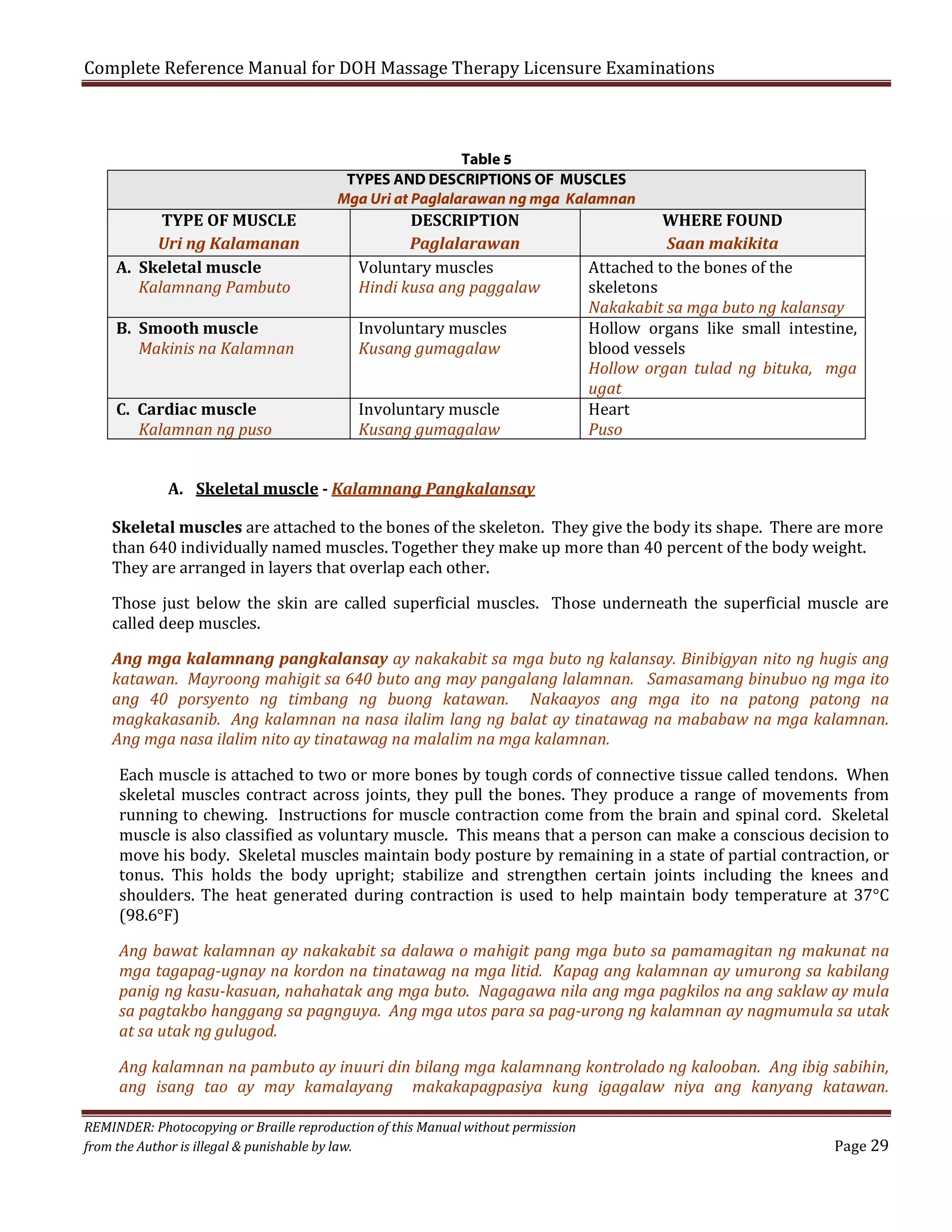
TYPE OF MUSCLE
Uri ng Kalamanan
A. Skeletal muscle
Kalamnang Pambuto
B. Smooth muscle
Makinis na Kalamnan
C. Cardiac muscle
Kalamnan ng puso

Table 5
TYPES AND DESCRIPTIONS OF MUSCLES
Mga Uri at Paglalarawan ng mga Kalamnan

DESCRIPTION
Paglalarawan
Voluntary muscles
Hindi kusa ang paggalaw
Involuntary muscles
Kusang gumagalaw
Involuntary muscle
Kusang gumagalaw

WHERE FOUND
Saan makikita
Attached to the bones of the
skeletons
Nakakabit sa mga buto ng kalansay
Hollow organs like small intestine,
blood vessels
Hollow organ tulad ng bituka, mga
ugat
Heart
Puso

A. Skeletal muscle - Kalamnang Pangkalansay

Skeletal muscles are attached to the bones of the skeleton. They give the body its shape. There are more
than 640 individually named muscles. Together they make up more than 40 percent of the body weight.
They are arranged in layers that overlap each other.

Those just below the skin are called superficial muscles. Those underneath the superficial muscle are
called deep muscles.

Ang mga kalamnang pangkalansay ay nakakabit sa mga buto ng kalansay. Binibigyan nito ng hugis ang
katawan. Mayroong mahigit sa 640 buto ang may pangalang lalamnan. Samasamang binubuo ng mga ito
ang 40 porsyento ng timbang ng buong katawan. Nakaayos ang mga ito na patong patong na
magkakasanib. Ang kalamnan na nasa ilalim lang ng balat ay tinatawag na mababaw na mga kalamnan.
Ang mga nasa ilalim nito ay tinatawag na malalim na mga kalamnan.

Each muscle is attached to two or more bones by tough cords of connective tissue called tendons. When
skeletal muscles contract across joints, they pull the bones. They produce a range of movements from
running to chewing. Instructions for muscle contraction come from the brain and spinal cord. Skeletal
muscle is also classified as voluntary muscle. This means that a person can make a conscious decision to
move his body. Skeletal muscles maintain body posture by remaining in a state of partial contraction, or
tonus. This holds the body upright; stabilize and strengthen certain joints including the knees and
shoulders. The heat generated during contraction is used to help maintain body temperature at 37°C
(98.6°F)

Ang bawat kalamnan ay nakakabit sa dalawa o mahigit pang mga buto sa pamamagitan ng makunat na
mga tagapag-ugnay na kordon na tinatawag na mga litid. Kapag ang kalamnan ay umurong sa kabilang
panig ng kasu-kasuan, nahahatak ang mga buto. Nagagawa nila ang mga pagkilos na ang saklaw ay mula
sa pagtakbo hanggang sa pagnguya. Ang mga utos para sa pag-urong ng kalamnan ay nagmumula sa utak
at sa utak ng gulugod.
Ang kalamnan na pambuto ay inuuri din bilang mga kalamnang kontrolado ng kalooban. Ang ibig sabihin,
ang isang tao ay may kamalayang makakapagpasiya kung igagalaw niya ang kanyang katawan.
REMINDER: Photocopying or Braille reproduction of this Manual without permission
from the Author is illegal & punishable by law.

Page 29
Complete Reference Manual for DOH Massage Therapy Licensure Examinations

Pinapanatili ng kalamnang pangkalansay ang tindig ng katawan sa pamamagitan ng pananatili sa
kalagayang bahagya lamang ang pag-urong o tonus ng kalamnan. Ito ang nagpapanatili sa katawan na
nakatindig; pinatatatag at pinalalakas ang ilang kasukasuan, kasama na ang mga tuhod at mga balikat.
Ang init na nalilikha ng pag-urong ay ginagamit upang mapanatili ang temperatura ng katawan sa 37°C.
(98.6°F)
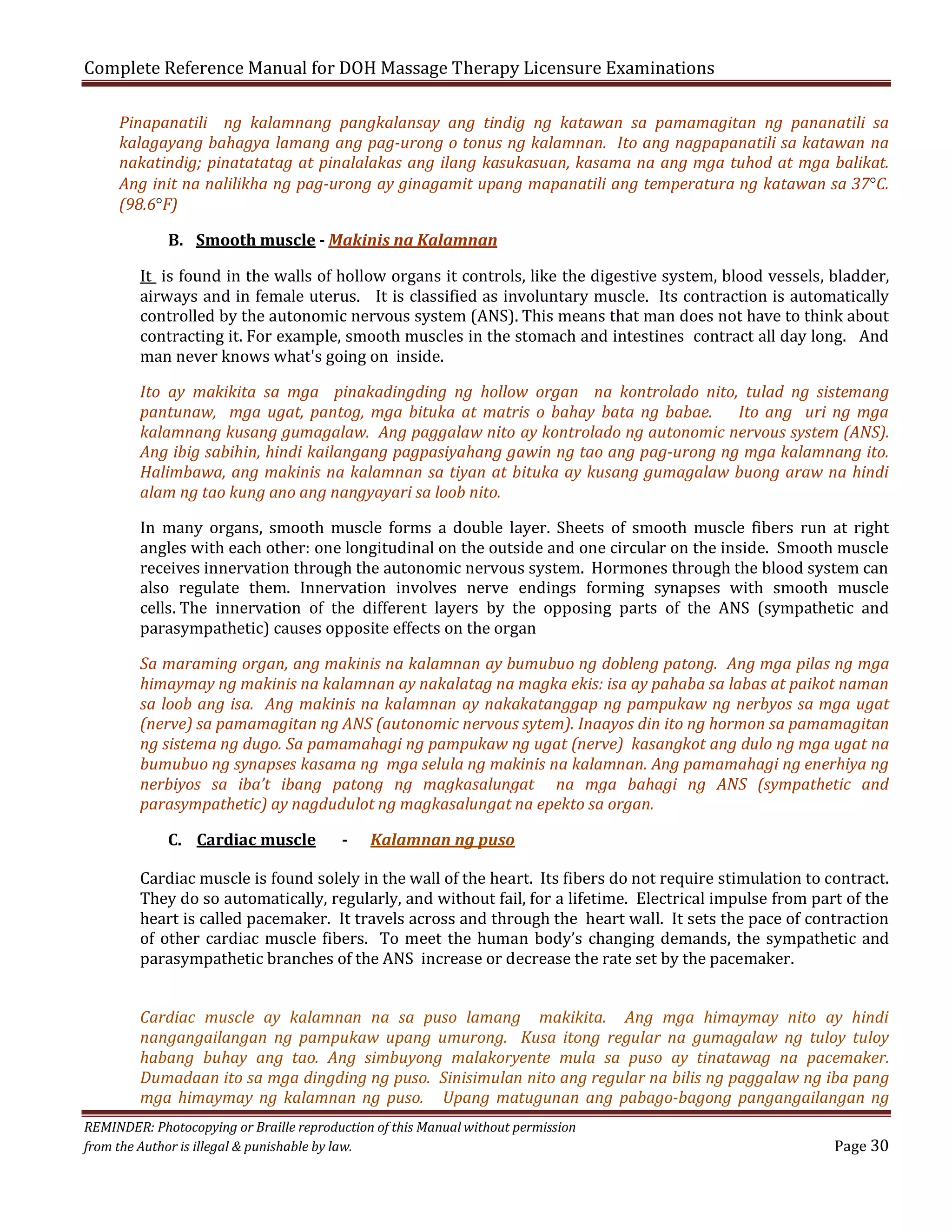
B. Smooth muscle - Makinis na Kalamnan

It is found in the walls of hollow organs it controls, like the digestive system, blood vessels, bladder,
airways and in female uterus. It is classified as involuntary muscle. Its contraction is automatically
controlled by the autonomic nervous system (ANS). This means that man does not have to think about
contracting it. For example, smooth muscles in the stomach and intestines contract all day long. And
man never knows what's going on inside.

Ito ay makikita sa mga pinakadingding ng hollow organ na kontrolado nito, tulad ng sistemang
pantunaw, mga ugat, pantog, mga bituka at matris o bahay bata ng babae.
Ito ang uri ng mga
kalamnang kusang gumagalaw. Ang paggalaw nito ay kontrolado ng autonomic nervous system (ANS).
Ang ibig sabihin, hindi kailangang pagpasiyahang gawin ng tao ang pag-urong ng mga kalamnang ito.
Halimbawa, ang makinis na kalamnan sa tiyan at bituka ay kusang gumagalaw buong araw na hindi
alam ng tao kung ano ang nangyayari sa loob nito.
In many organs, smooth muscle forms a double layer. Sheets of smooth muscle fibers run at right
angles with each other: one longitudinal on the outside and one circular on the inside. Smooth muscle
receives innervation through the autonomic nervous system. Hormones through the blood system can
also regulate them. Innervation involves nerve endings forming synapses with smooth muscle
cells. The innervation of the different layers by the opposing parts of the ANS (sympathetic and
parasympathetic) causes opposite effects on the organ

Sa maraming organ, ang makinis na kalamnan ay bumubuo ng dobleng patong. Ang mga pilas ng mga
himaymay ng makinis na kalamnan ay nakalatag na magka ekis: isa ay pahaba sa labas at paikot naman
sa loob ang isa. Ang makinis na kalamnan ay nakakatanggap ng pampukaw ng nerbyos sa mga ugat
(nerve) sa pamamagitan ng ANS (autonomic nervous sytem). Inaayos din ito ng hormon sa pamamagitan
ng sistema ng dugo. Sa pamamahagi ng pampukaw ng ugat (nerve) kasangkot ang dulo ng mga ugat na
bumubuo ng synapses kasama ng mga selula ng makinis na kalamnan. Ang pamamahagi ng enerhiya ng
nerbiyos sa iba’t ibang patong ng magkasalungat na mga bahagi ng ANS (sympathetic and
parasympathetic) ay nagdudulot ng magkasalungat na epekto sa organ.
C. Cardiac muscle

-

Kalamnan ng puso

Cardiac muscle is found solely in the wall of the heart. Its fibers do not require stimulation to contract.
They do so automatically, regularly, and without fail, for a lifetime. Electrical impulse from part of the
heart is called pacemaker. It travels across and through the heart wall. It sets the pace of contraction
of other cardiac muscle fibers. To meet the human body’s changing demands, the sympathetic and
parasympathetic branches of the ANS increase or decrease the rate set by the pacemaker.

Cardiac muscle ay kalamnan na sa puso lamang makikita. Ang mga himaymay nito ay hindi
nangangailangan ng pampukaw upang umurong. Kusa itong regular na gumagalaw ng tuloy tuloy
habang buhay ang tao. Ang simbuyong malakoryente mula sa puso ay tinatawag na pacemaker.
Dumadaan ito sa mga dingding ng puso. Sinisimulan nito ang regular na bilis ng paggalaw ng iba pang
mga himaymay ng kalamnan ng puso. Upang matugunan ang pabago-bagong pangangailangan ng
REMINDER: Photocopying or Braille reproduction of this Manual without permission
from the Author is illegal & punishable by law.

Page 30
Complete Reference Manual for DOH Massage Therapy Licensure Examinations

katawan ng tao, ang sympathetic at parasympathetic na mga sangay ng ANS ay nagdadagdag o
nagbabawas sa tulin na itinakda ng pacemaker.
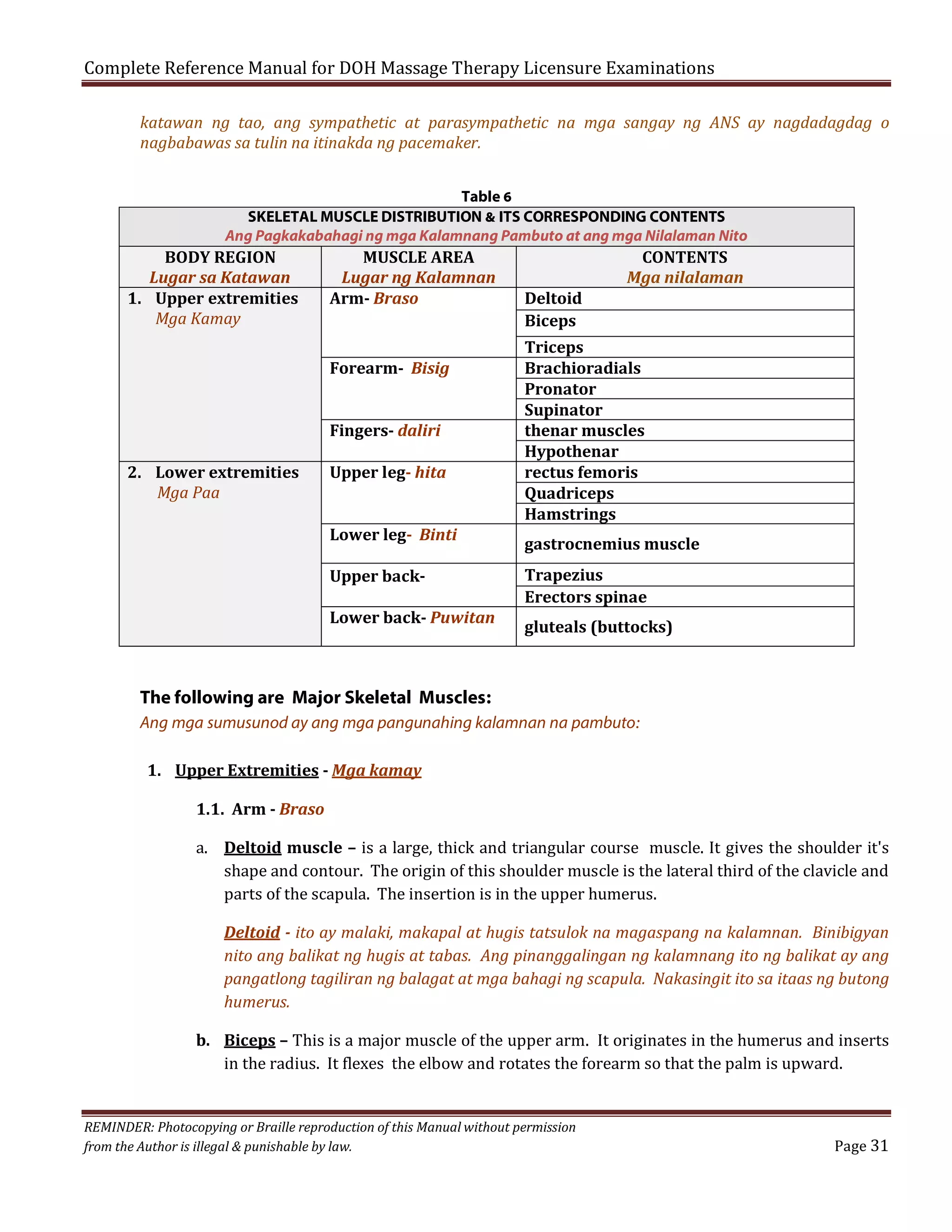
Table 6
SKELETAL MUSCLE DISTRIBUTION & ITS CORRESPONDING CONTENTS
Ang Pagkakabahagi ng mga Kalamnang Pambuto at ang mga Nilalaman Nito

BODY REGION
Lugar sa Katawan
1. Upper extremities
Mga Kamay

MUSCLE AREA
Lugar ng Kalamnan
Arm- Braso

Forearm- Bisig
Fingers- daliri
2. Lower extremities
Mga Paa

Upper leg- hita
Lower leg- Binti
Upper backLower back- Puwitan

Deltoid
Biceps

CONTENTS
Mga nilalaman

Triceps
Brachioradials
Pronator
Supinator
thenar muscles
Hypothenar
rectus femoris
Quadriceps
Hamstrings
gastrocnemius muscle
Trapezius
Erectors spinae
gluteals (buttocks)

The following are Major Skeletal Muscles:
Ang mga sumusunod ay ang mga pangunahing kalamnan na pambuto:
1. Upper Extremities - Mga kamay
1.1. Arm - Braso

a. Deltoid muscle – is a large, thick and triangular course muscle. It gives the shoulder it's
shape and contour. The origin of this shoulder muscle is the lateral third of the clavicle and
parts of the scapula. The insertion is in the upper humerus.

Deltoid - ito ay malaki, makapal at hugis tatsulok na magaspang na kalamnan. Binibigyan
nito ang balikat ng hugis at tabas. Ang pinanggalingan ng kalamnang ito ng balikat ay ang
pangatlong tagiliran ng balagat at mga bahagi ng scapula. Nakasingit ito sa itaas ng butong
humerus.

b. Biceps – This is a major muscle of the upper arm. It originates in the humerus and inserts
in the radius. It flexes the elbow and rotates the forearm so that the palm is upward.
REMINDER: Photocopying or Braille reproduction of this Manual without permission
from the Author is illegal & punishable by law.

Page 31
Complete Reference Manual for DOH Massage Therapy Licensure Examinations

Biceps – Ito ay isang pangunahing kalamnan ng braso. Nagsisimula ito sa butong humerus
at nakasingit sa butong radius. Ibinabaluktot nito ang siko at iniikot ang bisig upang ang
palad ay nasa pataas na direksyon.

c. Triceps – any of several muscles having three points of attachment at one end, particularly
(also triceps brachii /ˈbrākēˌī, -kēˌē/) the large muscle at the back of the upper arm.

1.2.

Forearm - Bisig

a. Brachioradialis – a muscle in the upper arm. It arises at the anterior humerus and
inserts in the ulna. It is a main flexor of the elbow joint.

Brachioradialis - ito ay isang kalamnan sa braso. Nagsisimula ito sa harapan ng
butong humerus at nakasingit sa butong ulna. Ito ang pangunahing tagapagbaluktot
ng kasukasuan sa siko

b. Pronator- a muscle whose contraction produces or assists in the pronation of a limb
or part of a limb.

1.3.

c. Supinator- one of the kinds of rotation allowed by certain skeletal joints, such as the
elbow & the wrist joints, which permit the palm of the hand to turn up.
Fingers -Mga Daliri

a. Thenar muscles – group of muscles in the palm of the human hand at the base of
the thumbs.
Thenar muscles - Grupo ng mga kalamnan sa mga palad na nasa puno ng hinlalaki
ng tao.

b. Hypothenar- fleshy mass at the medial side of the palm. Also called antithenar.

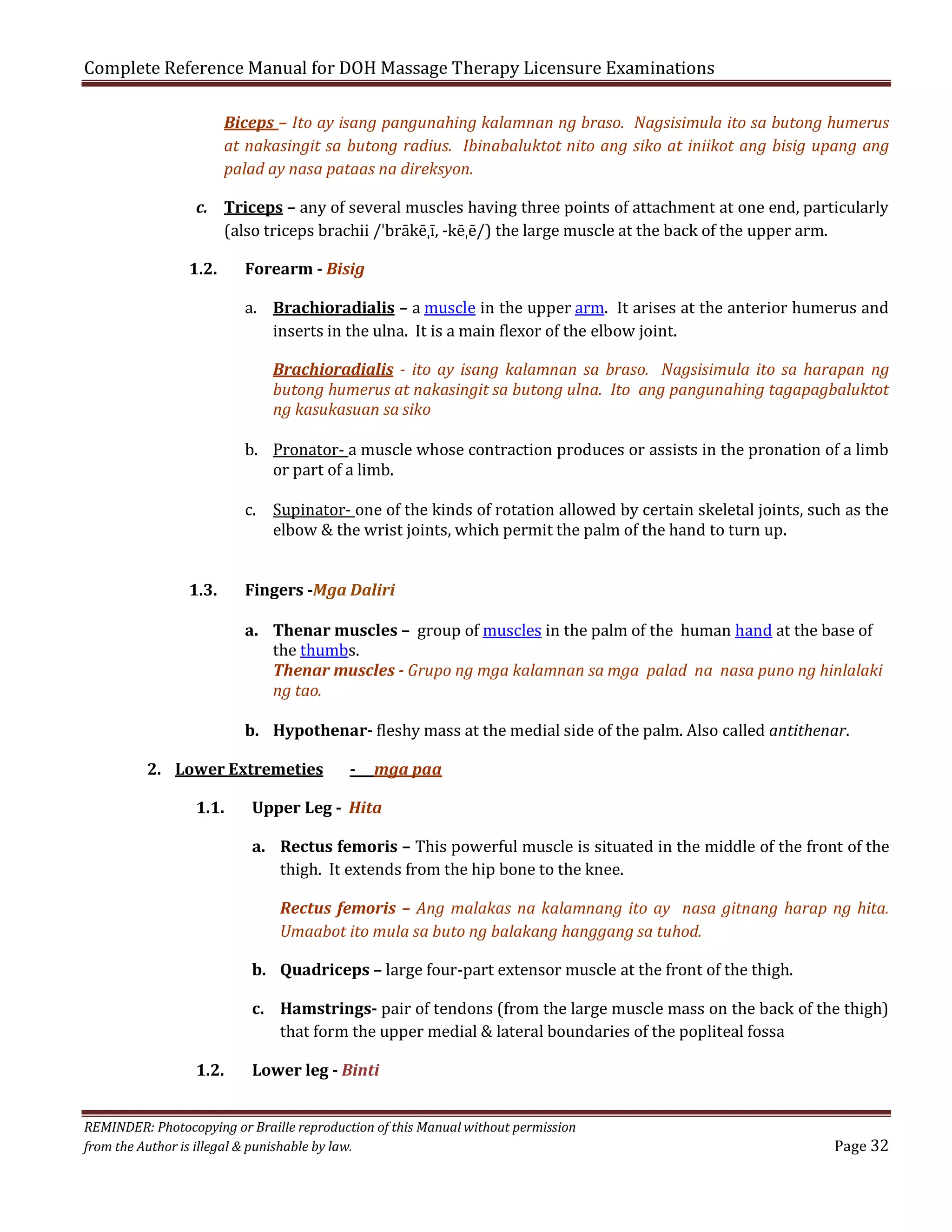
2. Lower Extremeties
1.1.

-

mga paa

Upper Leg - Hita

a. Rectus femoris – This powerful muscle is situated in the middle of the front of the
thigh. It extends from the hip bone to the knee.
Rectus femoris – Ang malakas na kalamnang ito ay nasa gitnang harap ng hita.
Umaabot ito mula sa buto ng balakang hanggang sa tuhod.

b. Quadriceps – large four-part extensor muscle at the front of the thigh.

1.2.

c. Hamstrings- pair of tendons (from the large muscle mass on the back of the thigh)
that form the upper medial & lateral boundaries of the popliteal fossa
Lower leg - Binti

REMINDER: Photocopying or Braille reproduction of this Manual without permission
from the Author is illegal & punishable by law.

Page 32
Complete Reference Manual for DOH Massage Therapy Licensure Examinations

a. Gastrocnemius muscle – This is the big group of muscle in the back of the lower leg.
It runs from its two heads of origin from the femur just above the knee to the heel. It
is involved in standing, walking, running and jumping.

Kalamnang Gastrocnemius - Ito ay malaking grupo ng kalamnan na nasa likod ng
binti. Tumatahak ito mula sa dalawang puno ng pinanggalingan mula sa butong femur
sa taas ng tuhod hanggang sa sakong. Kailangan ito sa pagtayo, paglakad, pagtakbo at
paglundag.

b. Tibialis anterior- is a muscle that originates in the upper two-thirds of the lateral
surface of the tibia and inserts into the first cuneiform and first metatarsal bones of
the foot. Its acts to dorsiflex and invert the foot. This muscle is mostly located near the
shin.

1.3.

Upper back - Itaas sa likod

a. Trapezius- origin, occipital bone, nuchal ligament, spinous processes of seventh
cervical & all thoracic vertebrae;insertion, clavicle, acromion, spine of
scapula; innervation, accessory nerve & cervical plexus; action, rotates scapula to raise
shoulder in abduction of arm, draws scapula backward.
b. Erectors Spinae- a name given the fibers of the more superficial of the deep muscles of
the back, originating from the sacrum, spines of the lumbar & the eleventh & twelfth
thoracic vertebrae, & the iliac crest, which split and insert as the iliocostal, longissimus,
& spinal muscles.

1.3.

Lower back - Puwitan

a. Gluteals (Buttocks) – This muscle group originates along the whole length of the iliac
crest of the pelvis and the anterior superior spine. It is the great extensor of the upper
leg. It acts in rising, sitting, straightening, walking upstairs, and running. It is
important because it is often the first muscle to decompose.
Gluteals – Pigi- Ang grupo ng kalamnang ito ay nagmumula sa kahabaan ng iliac crest
ng balakang at ng harapang itaas ng gulugod. Ito ang malaking tagapag-unat ng hita.
Kumikilos ito sa pagtayo, pag-upo, pag-unat, pagpanhik sa hagdanan at pagtakbo.
Mahalaga ito sapagkat ito ang unang kalamnan na nabubulok.

3. INTEGUMENTARY SYSTEM – Sistemang Balat
The skin is the largest organ of the body. Its two main layers are the epidermis (outer layer)
and dermis (inner layer). It is the protective covering of the body. The skin prevents the entry
of bacteria and other disease-causing microorganisms. It also prevents the loss of body fluids.

REMINDER: Photocopying or Braille reproduction of this Manual without permission
from the Author is illegal & punishable by law.

Page 33
Complete Reference Manual for DOH Massage Therapy Licensure Examinations

The skin filters out the harmful and potentially carcinogenic ultraviolet (UV) radiation in
sunlight. It also helps maintain the body’s temperature at a constant 37°C (98.6°F).

Ang balat ay pinakamalaking organ ng katawan. Ang dalawang pangunahing patong ng balat
ay epidermis o balat na panlabas at dermis o balat na panloob. Ang balat ay ang pananggalang
na pambalot sa katawan. Hinahadlangan ng balat ang pagpasok sa katawan ng bakterya at iba
pang maliliit na organismong nagdadala ng sakit. Hinahadlangan din ng balat ang pagkawala
ng likido ng katawan. Sinasala rin palabas ng balat ang radiation na ultraviolet (UV) ng araw
na mapanganib at nagdudulot ng kanser. Tumutulong din itong mapanatili na palaging 37°C
(98.6°F) ang temperatura ng katawan.
Table 7

SKIN LAYERS & COMPONENTS
SKIN LAYERS
1. Epidermis

2. Dermis

Mga Patong ng Balat at Nilalaman

DESCRIPTION

COMPONENTS

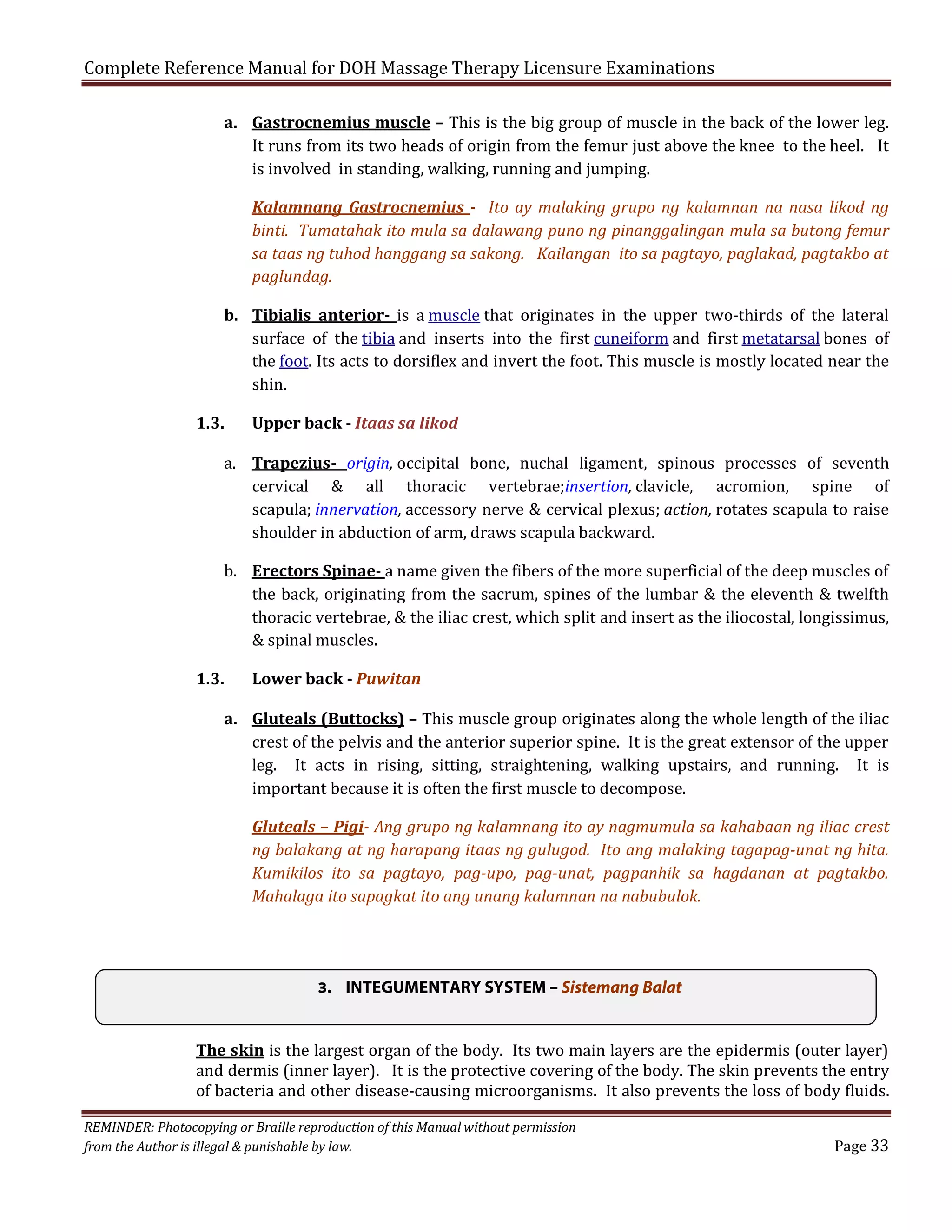
Upper layer of the skin
Itaas na patong ng balat

Keratin
Melanin

Lower, thicker part of
the skin
Mas mababa, mas
makapal na bahagi ng
balat.

Blood vessels
Sensory nerve endings and receptors
Sebaceous glands
Sweat glands
Adipose cells
Tiny veins, arteries, capillaries

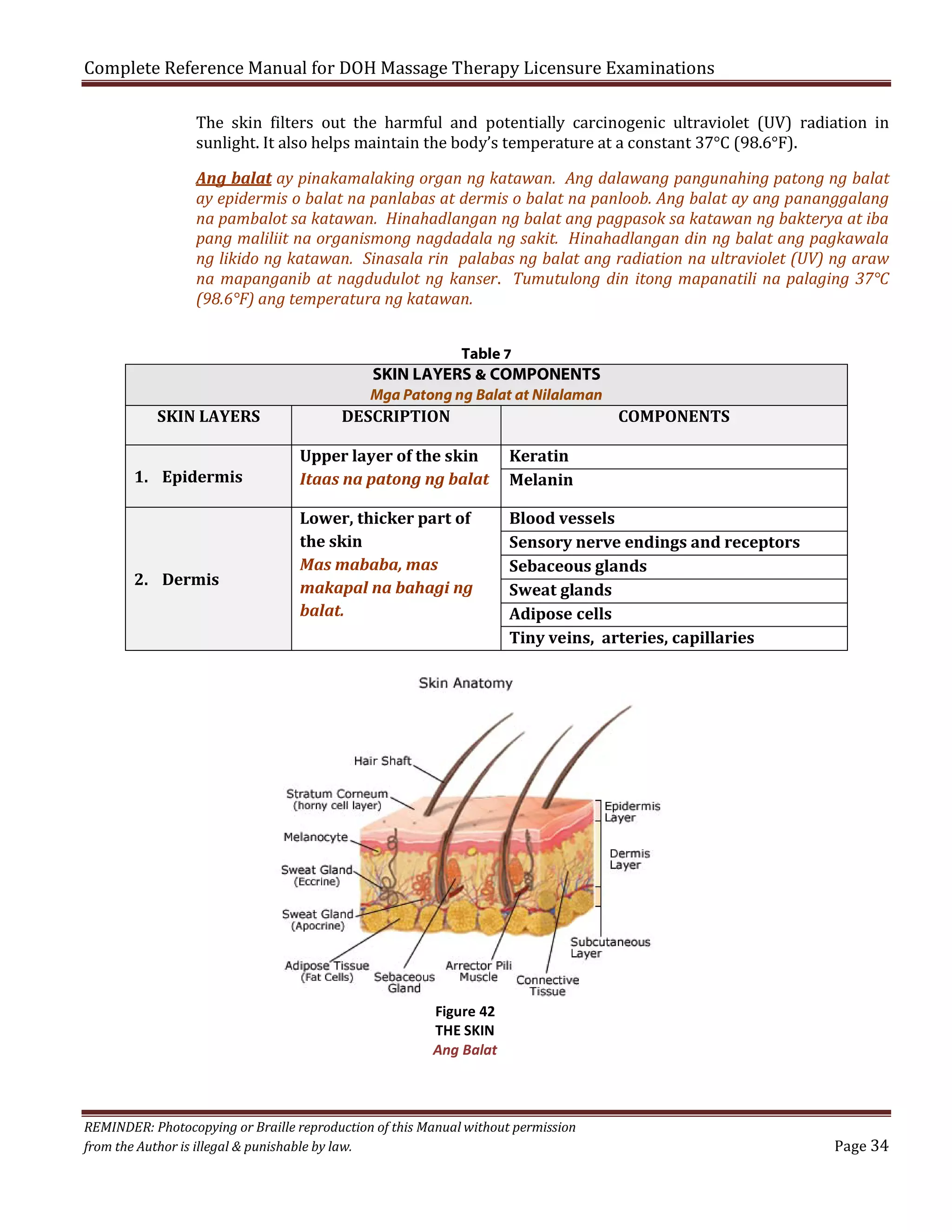
Figure 42
THE SKIN
Ang Balat

REMINDER: Photocopying or Braille reproduction of this Manual without permission
from the Author is illegal & punishable by law.

Page 34
Complete Reference Manual for DOH Massage Therapy Licensure Examinations
Layers of the Skin:
Mga patong ng balat

1. Epidermis – this is the thin, outer portion of the skin. Its main role is protective. Its uppermost layer
consists of dead, flattened cells, packed with keratin (a tough, waterproof protein). This is constantly
worn away. The daily wear and tear, releases scaly skin flakes. The skin flakes are replaced by living
cells that divide continuously.
Other epidermal cells are called melanocytes. They produce the brown pigment melanin. Melanin
gives skin its color . It forms a protective screen against harmful UV rays. People with darker skin
produce more melanin.
Prolonged exposure to sunlight increases melanin production and
temporarily darkens the skin.

Epidermis – Panlabas na Balat. Ito ang manipis na panlabas na bahagi ng balat. Ang pangunahing
gamit nito ay bilang pananggalang. Ang pinakaibabaw (panlabas) na bahagi ay binubuo ng mga patay
at tuyong selula, na may keratin (protinang matigas at di tinatablan ng tubig). Ito ay palaging nasisira.
Ang pang araw-araw na pagkasira ay naglalabas ng natutuklap na balat o libag. Napapalitan naman
ito ng mga buhay na selula na patuloy na dumadami.
Ang ibang selula ng panlabas na balat ay tinatawag na melanocytes. Naglalabas sila ng melanin na
kulay kayumanggi. Ang melanin ang nagbibigay ng kulay sa balat. Ito rin ay bumubuo ng pananggalang
laban sa mapanganib na UV rays. Ang mga taong mas maitim ay naglalabas ng mas maraming melanin.
Ang matagal na pagbibilad sa araw ay nagpaparami sa inilalabas na melanin at pansamantalang
nagpapaitim sa balat.

2. Dermis is the layer beneath the epidermis. It is the thicker part of the skin. A network of collagen
and elastin fibers gives this connective tissue strength and elasticity. The dermis contains blood
vessels, sensory nerve endings and receptors. The blood vessels play a part in temperature regulation.
Also found in the dermis are hair follicles from which hairs grow. There are glands (sebaceous and
sweat glands).
An oily and bactericidal liquid called sebum is released from sebaceous gland. Sebum keeps the skin
and hairs soft, flexible, and waterproof. Sweat glands release watery sweat onto the surface of the
skin in warm conditions. Evaporation of sweat cools the body. Adipose (flat) cells beneath the dermis
help insulate the body. Tiny veins, arteries, and capillaries with red blood cells give living skin a
healthy reddish color which is lost at death.
Dermis – ito ang suson na nasa ilalim ng epidermis. Mas makapal na bahagi ito ng balat. Mayroon
itong mala-lambat na mga himaymay ng collagen at elastin na siyang nagpapatibay sa tagapag-ugnay
na tisyung ito at nagbibigay dito ng tibay at kakayanang umurong or mabanat. Nasa dermis ang mga
ugat, ang mga dulo ng ugat pandamdam at mga tagatanggap (receptors) ng pakiramdam. Malaki ang
bahagi ng mga daluyan ng dugo (blood vessels) sa pagsasa-ayos ng temperatura ng katawan. Makikita
rin sa dermis ang mga follicles na tinutubuan ng buhok. May mga glandula ( sebaceous at sweat).

REMINDER: Photocopying or Braille reproduction of this Manual without permission
from the Author is illegal & punishable by law.

Page 35
Complete Reference Manual for DOH Massage Therapy Licensure Examinations

Ang sebaceous gland ay naglalabas ng malangis at likidong pamatay bakterya. Tinatawag itong sebum
na nagpapanatili sa balat at buhok na malambot, at di tinatablan ng tubig. Ang sweat gland naman ay
naglalabas ng pawis kapag mainit ang panahon. Ang pagkatuyo ng pawis ay nagpapalamig sa katawan.
Sa ilalim ng dermis ay makikita ang Adipose (fat) cells. Ito ang insulasyon ng katawan sa pagpasok at
paglabas ng init. Ang maliliit na mga ugat, arteries at capillaries na may pulang mga selula ng dugo ay
nagbibigay ng malusog na mapula-pulang kulay sa balat. Nawawala ito pag namatay ang tao.
4. CIRCULATORY SYSTEM

-

Sistema ng Sirkulasyon sa Katawan

The circulatory or cardiovascular system - is composed of the heart and a closed system of vessels
called arteries, veins, and capillaries. It is the organ system that passes nutrients, gases, hormones,
blood cells and other nutrients to and from cells of the body. Blood is pumped by the heart around a
closed circuit of blood vessels. It is carried from the heart to the tissues and back to the heart once
again in an unending circulation of this life-giving fluid.

Ang sistema ng sirkulasyon ay binubuo ng puso at sistema ng daluyan na tinatawag na artery, vein
(ugat), at capillary. Ito ang organ na nagdadala ng mga sustansya, gases, hormon, selula ng dugo at iba
pang sustansya patungo at palabas sa mga selula ng katawan. Ang dugo ay ibinobomba ng puso sa
naka-palibot na daluyan. Dinadala mula sa puso hanggang sa mga tisyu at muling pabalik sa puso sa
isang walang katapusang sirkulasyon ng nagbibigay buhay na likido.
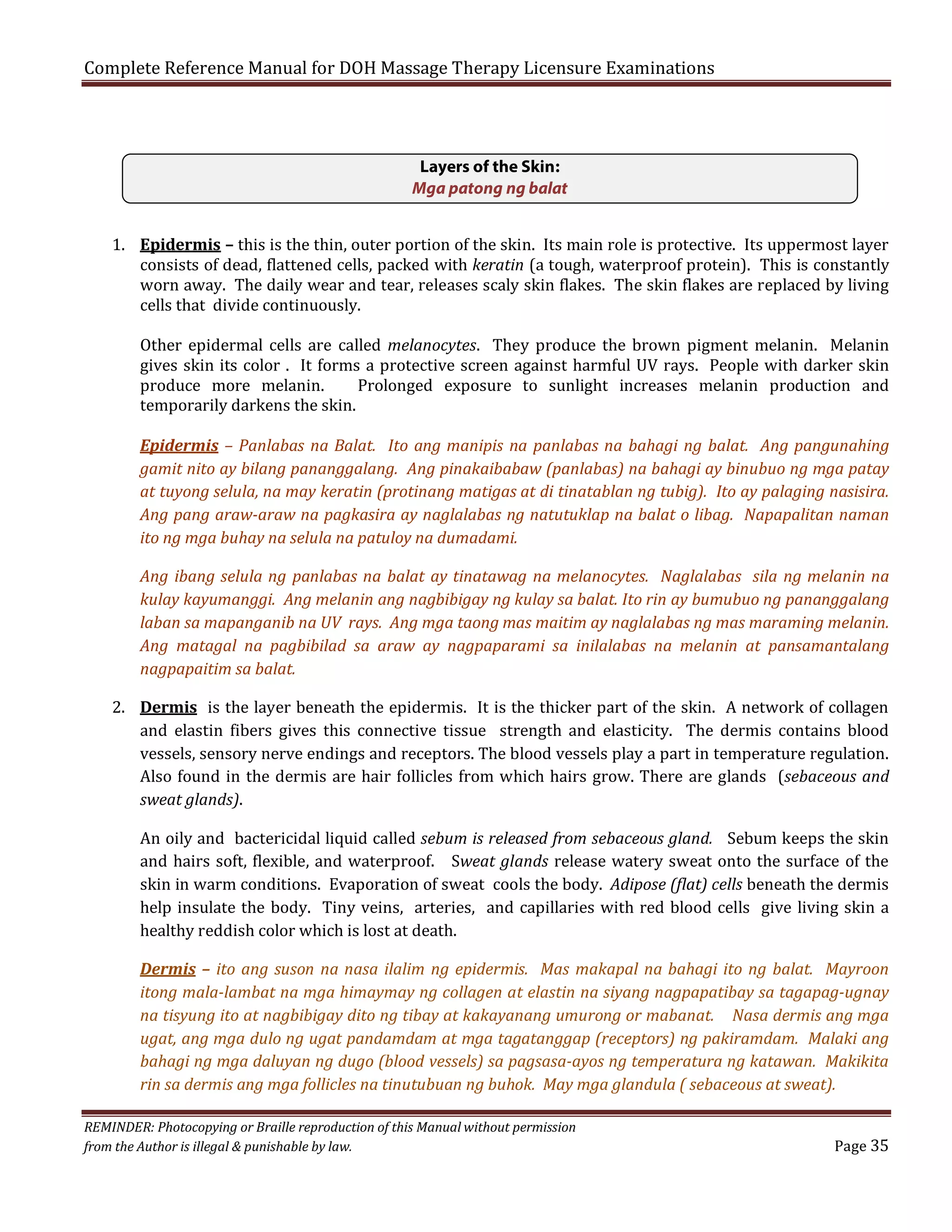
How does this system work?
pulmonary vein

pulmonary artery

lungs
head & arms
aorta
main vein

Right

Left
liver

digestive system
kidneys
legs

Circulatory System
Figure 43
CIRCULATORY SYSTEM PATHWAY
REMINDER: Photocopying or Braille reproduction of this Manual without permission
from the Author is illegal & punishable by law.

Page 36
Complete Reference Manual for DOH Massage Therapy Licensure Examinations

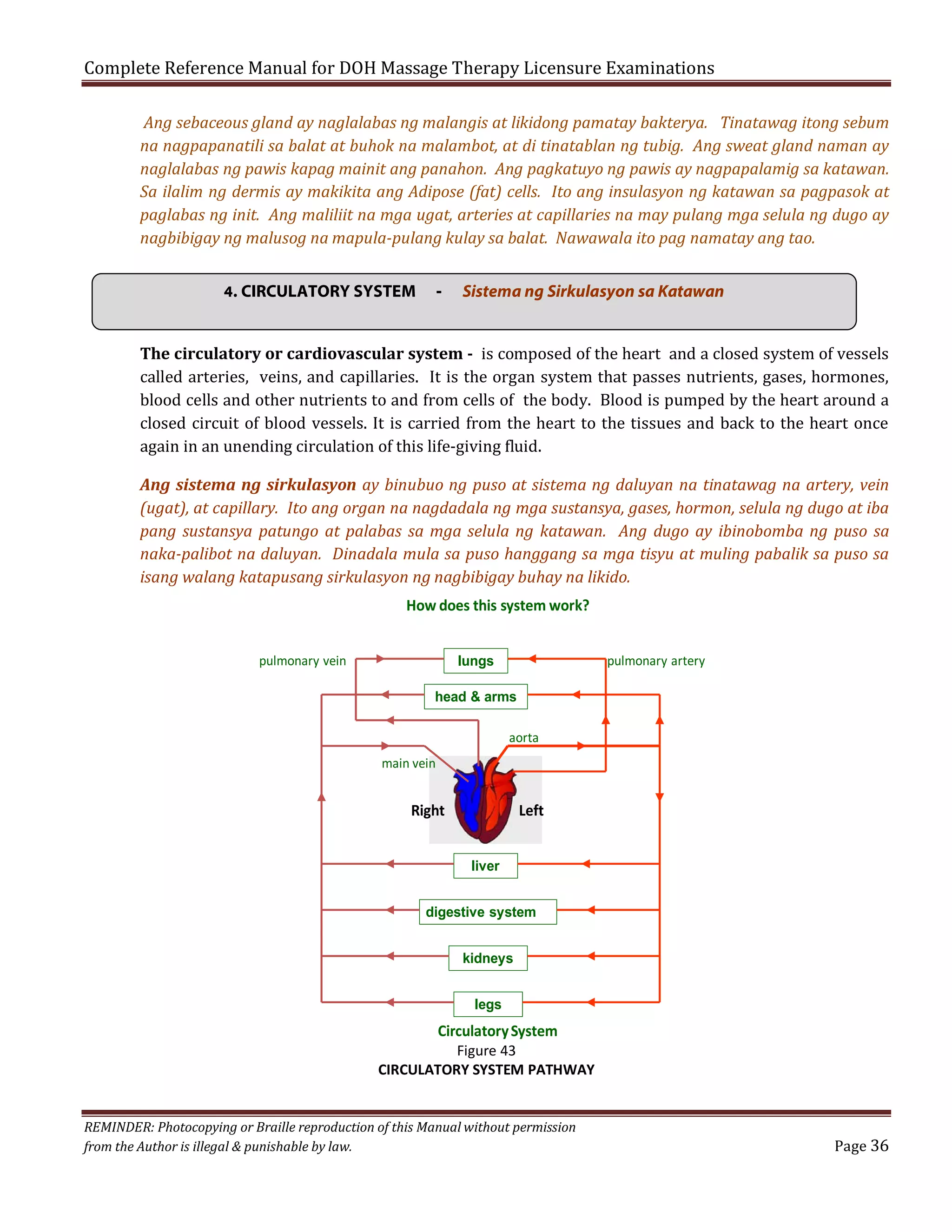
Figure 44
ANATOMY OF THE HEART

Heart Rate - Ang Tibok ng puso

Heart rate is usually expressed as number of beats per minute. It can be monitored by taking
the pulse. The normal heart rate is anywhere in the range of 60 to 85 beats per minute. This may change with
age, sex, and size. Constant rhythmic heart rate is produced by the sinoatrial node.

Ang tibok ng puso ay pangkaraniwang ipinahahayag sa bilang ng tibok bawat minuto. Binabantayan
ito sa pamamagitan ng pagkuha ng pulso. Ang normal na tibok ng puso ay may saklaw na 60-85 pulso bawat
minuto. Subalit, maaaring magbago ito ayon sa gulang, kasarian at laki ng katawan ng tao. Ang palagiang
pagtibok ng puso ay gawain ng sinoatrial node.
The sinoatrial (SA) node is a section of nodal tissue that is located in the upper wall of the right atrium.
It provides sympathetic innervation of the myocardial muscle. It is called the pacemaker of the heart . Most
changes in the heart rate are mediated through the cardiac center in the medulla oblongata of the brain. The
center has both sympathetic and parasympathetic components that adjust the heart rate to meet the changing
needs of the body. Peripheral factors such as emotions, ion concentrations, and body temperature may affect
heart rate.

Ang sinoatrial node ay isang bahagi na nodal tissue. Natatagpuan ito sa itaas na dingding ng kanang
atrium. Ito ang nagbibigay ng pampukaw ng nerbiyos (sympathetic innervation) sa kalamnan ng puso.
Tinatawag itong pacemaker ng puso. Karamihan sa mga pagbabago sa tibok ng puso ay dahil sa pamamagitan
ng cardiac center sa medulla oblongata ng utak. Ang centro ay may mga sangkap ng sympathetic at ng
parasympathetic components na nag aayos ng tibok ng puso upang matugunan ang paiba-ibang
pangangailangan ng katawan. Ang mga kalagayan sa paligid tulad ng mga emosyon, dami ng ion at
temperatura ng katawan ay maaaring makaapekto sa tibok ng puso.

REMINDER: Photocopying or Braille reproduction of this Manual without permission
from the Author is illegal & punishable by law.

Page 37
Complete Reference Manual for DOH Massage Therapy Licensure Examinations

Heart rate is measured in order to monitor the cardiac activity and the overall medical condition of the
individual.
Ang tibok ng puso ay sinusukat upang mabantayan ang kalagayan ng puso at ang pangkalahatang
kalagayang medical ng isang tao.
Table 8

CIRCULATORY SYSTEM ORGANS, STRUCTURE & FUNCTIONS
ORGANS

1. Blood
Dugo

Mga Organ ng Sistema ng Sirkulasyon, Kayarian at Gawain

STRUCTURE
Kayarian
Red blood cells.
Mapulang mga
selula
White blood
cells.. Maputing
mga selula

Produce antibodies that deal with foreign materials like
disease organisms. Maglabas ng antibody laban sa mga
organismong may dala ng sakit

Plasma and
plasma proteins

Carries foods and wastes from tissues. Nagdadala ng pagkain
at dumi mula sa tisyu

Platelets
2. Blood vessels
Tubong daluyan
ng dugo

3. Heart - Puso

FUNCTIONS
Mga Gawain
Transport oxygen through haemoglobin.
Magdala ng oxygen kasama ng haemoglobin

Arteries

Capillaries
Veins

Arch of the
aorta.
Arko ng Aorta

Abdominal aorta
and thoracic
aorta
Inferior and
superior vena
cavae

Blood clotting . Pamumuo ng dugo

Carries blood away from the heart. Nagdadala ng dugo palayo
sa puso

Exchange of materials between blood and tissue cells.
Nagpapalit ng mga sangkap sa pagitan ng dugo at ng selula ng
mga tisyu
Carries blood towards the heart. Nagdadala ng dugo papunta
sa puso
Carries oxygenated blood to the rest of the body. Nagdadala
ng dugong may oxygen sa mga bahagi ng katawan

Supplies blood to the abdominal and thoracic area. Nagdadala
ng dugo sa lugar ng tiyan at dibdib

Carries deoxygenated blood from the rest of the body to the
heart. Nagdadala ng dugong nawalan ng oxygen mula sa mga
bahagi ng katawan patungo sa puso.

REMINDER: Photocopying or Braille reproduction of this Manual without permission
from the Author is illegal & punishable by law.

Page 38
Complete Reference Manual for DOH Massage Therapy Licensure Examinations

1. BLOOD is a liquid tissue. It is the fluid of life. It carries oxygen from the lungs to body tissue and carbon
dioxide from body tissue to the lungs. It is the fluid of growth. It transports nourishment from digestion
and hormones from glands throughout the body.
Blood is the fluid of health. It transports disease-fighting substances to the tissue and waste to the
kidneys. Because it contains living cells, blood is alive. Red blood cells and white blood cells are
responsible for nourishing and cleansing the body. Without blood, the human body would stop working.

Dugo – ito ay isang tisyu na likido. Ito ay likido ng buhay. Nagdadala ito ng oxygen mula sa baga patungo
sa mga tisyu ng katawan at carbon dioxide mula sa tisyu ng katawan patungo sa mga baga. Ito rin ay likido
ng paglaki. Nagdadala ito ng pampalusog mula sa pangtunaw at mga hormon mula sa mga glandula sa
buong katawan.
Ang dugo ay likido ng kalusugan. Nagdadala ito ng mga sustansyang pansanggalang sa mga sakit patungo
sa mga tisyu at nagdadala rin ng mga basura papunta sa bato. Sapagkat mayroong buhay na selula, ang
dugo ay buhay. Ang pulang selula ng dugo (RBC) at ang puting selula (WBC) ang bahala sa pagpapakain at
paglilinis ng katawan. Kung walang dugo, ang katawan ng tao ay titigil sa paggawa.
Structure and Functions of Blood and its Components
Kayarian at gawain ng dugo at ng mga sangkap nito



Red Blood Cell (RBC) - This cell is a concave disk, microscopic in size (about 7 micrometers in
diameter). It contains hemoglobin. Red blood cells (RBCs) are by far the most abundant cells in
the blood. RBCs give blood its red color. As the main element of the circulating blood, its main
function is to transport oxygen, which is carried by the hemoglobin.

Pulang selula ng Dugo - Ang selulang ito ay isang malukong na plato, napakaliit na makikita
lamang kung gagamit ng microscope. Nagtataglay ito ng hemoglobin. Pinakamarami ang pulang
selula sa dugo. Ito ang nagbibigay ng kulay pula sa dugo. Bilang pangunahing sangkap ng
dumadaloy na dugo, ang pangunahing ginagampanan nito ay ang magdala ng oxygen na nasa
hemoglobin.



White Blood Cells (WBC)– These cells are also called leukocytes. They are less in number
than the red blood cells. They are part of in the immune system . They help the body fight
infection. They can be transported to an area where an infection has developed. They deal with
foreign materials, such as disease organisms that get into the body. They may engulf and disable
them or they may cause the body to produce antibodies against them.

Ang puting mga selula ng dugo - Tinatawag na leukocytes. Ang mga selulang ito. Mas kakaunti
ang mga ito kaysa pulang selula ng dugo. Sila ay bahagi ng immune system - sistema na nagbibigay
sa katawan ng kaligtasan sa sakit. Tinutulungan nila ang katawan na labanan ang impeksyon.
Nadadala sila sa bahagi ng katawan na may nagsisimulang impeksyon. Pinakikialaman nila ang
mga organismo at iba pang panlabas na sangkap, tulad ng sakit, na nakakapasok sa katawan.
Sinasakmal nila o kaya ay inaalisan ng lakas ang mga ito. Naglalabas din sila ng mga antibodies o
mga sangkap na panlaban sa sakit.

REMINDER: Photocopying or Braille reproduction of this Manual without permission
from the Author is illegal & punishable by law.

Page 39
Complete Reference Manual for DOH Massage Therapy Licensure Examinations


Platelets - These are irregularly-shaped, colorless bodies that are present in blood. Their sticky
surface lets them, along with other substances, form clots to stop bleeding. Platelets are produced
in the bone marrow, the same as the red blood cells and most of the white blood cells.

Platelets – Ang mga ito ay sangkap na nasa dugo na walang regular na hugis at walang kulay. Ang
malagkit na panlabas nito, at kasama ng iba pang sangkap, ay nagpapabuo sa dugo para mapigil
ang pagdurugo. Ang mga platelet ay ginagawa sa utak (marrow) ng buto, tulad din ng pulang mga
selula ng dugo (RBC) at karamihan sa puting mga selula ng dugo (WBC).



Plasma and plasma proteins - This is a straw-colored, clear liquid in lymph and blood that is 90
percent water. Plasma contains dissolved salts and minerals like calcium, sodium, magnesium,
and potassium,and other substances. Plasma is needed to carry the many parts of the blood
through the bloodstream. It carries food and wastes from the tissues, and keeps the acid-base
balance of the body.

Pinakatubig at protina - Ito ay manilaw- nilaw at malinaw na likido sa lymph at dugo na 90% na
tubig. Ang plasma ay may taglay na tunaw na asin, at mineral tulad ng calcium, sodium, magnesium
at potassium at iba pang mga sangkap. Kailangan ang plasma sa pagdadala ng maraming mga
bahagi ng dugo sa daluyan nito. Ang plasma rin ang namamahagi ng pagkain at nag-aalis ng mga
dumi sa mga tisyu. Ito rin ang nagbabalanse ng pangangasim ng katawan.

2. BLOOD VESSELS

It is located throughout the body, blood vessels are hollow tubes that circulate blood.
Ito ay matatagpuan sa buong katawan ang mga daluyan ng dugo. Ito ay mga tubo na may guwang sa
loob.

Arteries - are elastic blood vessel that transports blood away from the heart. Mga artery- ito ay
nababanat na daluyan ng dugo na nagdadala ng dugo mula sa puso.
Two (2) Types of arteries. Dalawang uri ng mga arterya:


Pulmonary arteries transport blood that has low oxygen content from the right ventricle to the
lungs. (Pulmonary arteries) Malaking ugat sa baga - dinadaluyan ito ng dugo na may kaunti

lang na oxygen mula sa kanang ventricle patungo sa mga baga.


Systemic arteries transport oxygenated blood from the left ventricle to the body tissues. (Systemic
arteries) Malaking ugat na systemic – dinadaluyan ito ng dugong nahaluan na ng oxygen mula sa
kaliwang ventricle patungo sa mga tisyu ng katawan.

REMINDER: Photocopying or Braille reproduction of this Manual without permission
from the Author is illegal & punishable by law.

Page 40
Complete Reference Manual for DOH Massage Therapy Licensure Examinations
Capillaries

These are the smallest and most numerous of the blood vessels. Unlike the arteries and veins,
capillaries are very thin and fragile. They are so thin that blood cells can only pass through them in
single file.

Ito ay mga ito ay pinakamaliliit at pinakamarami sa mga daluyan ng dugo. Di tulad ng artery at vein,
ang capillary ay napakanipis at marupok. Napakanipis ng mga ito kaya ang mga selula ng dugo ay isang
hilera lang kung dumadaan dito.
They form the connection between the vessels that carry blood away from the heart (arteries) and the
vessels that return blood to the heart (veins). The red blood cells inside the capillary release their
oxygen which passes through the wall and into the surrounding tissue. The tissue releases its waste
products, like carbon dioxide, which passes through the capillary wall and into the red blood.

Sila ang nagdudugtong sa mga tubo na dinadaluyan ng dugo palabas ng puso (arteries) at ng tubo na
dinadaluyan ng dugo (veins) pabalik sa puso. Inilalabas ng pulang selula ng dugo sa loob ng capillary
ang dala nitong oxygen na naglalagos patungo sa mga tisyu sa paligid. Ang mga tisyu naman ang
naglalabas ng mga dumi tulad ng carbon dioxide na naglalagos naman papunta sa selula ng pulang
dugo sa loob ng capillaries.
Veins

They are similar to arteries but, because they transport blood at a lower pressure, they are not as
strong as arteries.
Ang mga ito ay katulad ng arteries ngunit dahil mas mahina ang pressure ng pagdaloy ng dugo, hindi
sila singtibay ng arteries.

Veins carry blood toward the heart.
Ang mga ugat (veins) ay dinadaluyan ng dugo patungo sa puso.








In the pulmonary circuit, the pulmonary veins transport blood from the lungs to the left atrium of
the heart.
Sa paligid ng baga, dumadaloy sa mga ugat na pulmonary ang dugo mula sa baga papunta sa
kaliwang atrium ng puso.
This blood has high oxygen content because it has just been oxygenated in the lungs.
Ang dugong ito ay mataas ang taglay na oxygen sapagkat nahaluan na ng oxygen sa baga.

Systemic veins transport blood from the body tissue to the right atrium of the heart.
Ang systemic na ugat naman ang dinadaluyan ng dugo mula sa tisyu ng katawan papunta sa kanang
atrium ng puso.
This blood has reduced oxygen content because the oxygen has been used for metabolic activities
in the tissue cells.

REMINDER: Photocopying or Braille reproduction of this Manual without permission
from the Author is illegal & punishable by law.

Page 41
Complete Reference Manual for DOH Massage Therapy Licensure Examinations

Ang dugong galing sa kanang atrium ng puso ay kakaunti na ang taglay na oxygen sapagkat ang
oxygen ay nagamit na sa pagsunog ng pagkain sa mga selula ng tisyu.





The walls of veins are thinner than those of arteries. This is because blood in the veins has less
pressure than that in the arteries.
o Ito ang dahilan kaya ang tubo ng mga ugat (veins) ay mas manipis kaysa tubo ng arteries.
May kinalaman din dito ang mas mahinang puwersa ng daloy ng dugo sa mga veins kaysa sa
arteries.
Venous valves are especially important in the arms and legs, where they prevent the backflow of
blood in response to the pull of gravity.
o Ang mga balbula sa mga ugat ay tunay na mahalaga sa braso at binti kung saan pinipigil
ang pabalik na pagdaloy ng dugo bilang tugon sa hatak ng gravity.

3. Heart

The heart is a muscular pump. It provides the force needed to circulate the blood to all tissues in the
body. The heart keeps the blood moving through the vessels. It’s shape and size roughly resembles a
man's closed fist.
Ang puso ay isang makalamnang pambomba. Nagbibigay ito ng lakas na kailangan sa pagdaloy ng
dugo patungo sa lahat ng tisyu sa katawan.
Patuloy na pinadadaloy ng puso ang dugo sa
pamamagitan ng tubong daluyan. Ang hugis nito at laki ay halos katulad ng nakatikom na kamao.

The heart lies inside the thorax behind the sternum or breastbone. It is surrounded by a fluid filled
sac called the pericardium. It rests inside the pericardial cavity which is surrounded by the ribcage.
The diaphragm, a tough layer of muscle, lies below. As a result, the heart is well protected.

Ang puso ay nasa loob ng dibdib sa likod ng sternum o buto ng dibdib. Napapaligiran ito ng pericardium
na isang supot na puno ng likido. Makikita ito sa loob ng pericardial cavity na napapalibutan ng mga
tadyang. Nasa ilalim nito ang diaphragm, na isang matibay na nakalatag na kalamnan. Kaya ang puso
ay talagang protektado.
The heart is divided into two halves – the left and right – separated by a partition called septum. The
halves are in turn divided into chambers. The two upper chambers of the heart are called atria.

The lower two chambers are called ventricles. There are valves that allow blood to flow in one
direction. The two pairs of chambers, atrium and ventricle, act as separate pumps. The right side
pumps oxygen poor blood to the lungs. This is the pulmonary circulation. The left side pumps oxygen
rich blood from the lungs, systemic circulation.

Ang puso ay nahahati sa dalawang kalahati, ang kaliwa at kanan, na pinaghiwalay ng dingding na
tinatawag na septum. Ang mga kalahati ay nahati rin. Ang nasa itaas ay dalawang silid na tinatawag
na mga atrium (atria, pl.) ang dalawang silid sa ibaba ay tinatawag na ventricles. May mga balbula
(valves) sa pagitan ng mga silid. Pinipigil ng balbula ang direction ng daloy ng dugo.
May dalawang pares ng mga silid, mga atrium at ventricles. Ang mga ito ay dalawang magkahiwalay
na pambomba. Ang kanang bahagi ay nagbobomba ng dugong walang oxygen papunta sa baga.
REMINDER: Photocopying or Braille reproduction of this Manual without permission
from the Author is illegal & punishable by law.

Page 42
Complete Reference Manual for DOH Massage Therapy Licensure Examinations

Tinatawag itong pulmonary circulation. Ang kaliwang bahagi ay nagbobomba ng dugong sagana sa
oxygen mula sa baga. Ito naman ang systemic circulation.

Arch of the Aorta – This is the curved portion between the ascending and descending parts of the
aorta. It gives rise to the brachiocephalic trunk, left common carotid and left subclavian arteries.
Ang Arko ng Aorta. - Ito ay nakakurbang bahagi sa pagitan ng pataas at pababang Aorta. It ay
nagsasanga sa brachiocephalic trunk, kaliwang common carotid at kaliwang subclavian arteries.
Abdominal Aorta at Thoracic Aorta

As the aorta turns downward, it becomes the thoracic aorta. Below the diaphragm, it is the abdominal
aorta. They lie in the anterior surface of the spinal column.

Habang ang aorta ay pababa, ito ay nagiging thoracic aorta. Sa ibaba ng diaphragm, ito ay nagiging
abdominal aorta. Nakalatag ito sa pangharap na bahagi ng gulugod.
Vena cava are the two largest veins in the body. They carry de-oxygenated blood from different
regions of the body to the right atrium of the heart.

Ang Vena cava ay dalawang pinakamalaking ugat sa katawan. Sa kanila dumadaloy ang dugong
nawalan ng oxygen mula sa iba’t ibang rehiyon ng katawan patungo sa kanang atrium ng puso.
Inferior and Superior Vena Cava

Superior vena cava - is located in the upper chest region. It is formed by the left and right
brachiocephalic veins It brings de-oxygenated blood from the head, neck arm and chest regions of the
body to the right atrium.

Superior vena cava – matatagpuan ito sa itaas na rehiyon ng dibdib. Binubuo ito ng kaliwa at kanang
brachiocephalic vein.(ugat) Nagdadala ito ng dugong nawalan ng oxygen mula sa ulo, leeg, braso at
rehiyon ng dibdib patungo sa kanang atrium.

Inferior vena cava - is formed by the left and right common iliac veins. The inferior vena cava travels
along the spine It brings de-oxygenated blood from the lower body regions – legs, back, abdomen and
pelvis to the right atrium.

Inferior vena cava – binubuo ng kaliwa at kanang common iliac vein. Dumaraan ito sa gulugod . Ang
dala nito ay dugong nawalan ng oxygen mula sa mababang rehiyon ng katawan – sa binti, likod, tiyan at
balakang patungo sa kanang atrium.

5. LYMPHATIC SYSTEM - SISTEMA NG LYMPHATIC
LYMPHATIC SYSTEM - consists of organs, ducts, and nodes. It is home to lymphocytes, small white
blood cells. They are the key players in the immune system. The immune system is a network of

REMINDER: Photocopying or Braille reproduction of this Manual without permission
from the Author is illegal & punishable by law.

Page 43
Complete Reference Manual for DOH Massage Therapy Licensure Examinations

cells, tissues, and organs. They work together to defend the body against attacks by disease causing
microorganisms such as bacteria, viruses, parasites, and fungi.

Sistema ng Lymphatic – binubuo ito ng mga organ, mga maliliit na tubo at mga kulani. Matatagpuan
dito ang mga lymphocytes at maliliit na puting selula ng dugo. Sila ay may mahalagang katungkulan sa
immune system. Ang immune system ay parang lambat ng mga selula, mga tisyu,at mga organ.
Samasama nilang ipinagtatanggol ang katawan laban sa atake ng mga organismong nagdadala ng
sakit, tulad ng mga bacteria, mga virus, mga parasites at mga fungi.

As blood passes through capillary beds, some of the fluid portion leaks through the capillary walls into
the spaces between cells. Much of the fluid diffuses back into the capillaries. A portion remains in the
interstitial spaces between cells. The lymphatic system collects this fluid (called lymph) and returns it
to the circulatory system. Lymphatic vessels are thin-walled vessels in close contact with most tissues.
Lymph vessels join together to eventually form the thoracic duct. This empties lymph from the lower
part of the body into the subclavian vein. This is essential function because without it, the body would
die within 24 hours from the resulting edema (fluid accumulation).

Habang dumadaloy ang dugo sa mga capillaries, ang ibang sangkap na likido ay tumatagos palabas ng
capillary patungo sa mga bakanteng dako sa pagitan ng mga selula. Karamihan sa likido ay muling
tumatagos pabalik sa capillaries. May kaunting natitira sa mga pagitan ng selula. Pinupulot ng sistema
ng Lymphatic ang likidong ito (lymph) at ibinabalik ito sa sistema ng sirkulasyon ng dugo. Ang mga
tubong lymphatic ay may manipis na dingding. May palaging ugnayan ang mga ito sa karamihan ng
mga tisyu. Ang daluyan ng lymph ay nag-uugnay- ugnay hanggang sa mabuo ang thoracic duct. Ito ay
nag-aalis sa lymph mula sa mababang bahagi ng katawan patungo sa subclavian vein. Mahalagang
gawain ito sapagkat kapag hindi ito nagawa, ang katawan ay mamamatay sa loob ng 24 oras dahil sa
pamamanas bunga ng pagka-ipon ng maraming likido

Figure 45
LYMPHATIC SYSTEM

REMINDER: Photocopying or Braille reproduction of this Manual without permission
from the Author is illegal & punishable by law.

Page 44
Complete Reference Manual for DOH Massage Therapy Licensure Examinations

Table 9
LYMPHATIC SYSTEM ORGANS, DESCRIPTION & FUNCTIONS
ORGANS
DESCRIPTION
FUNCTIONS

Mga Organ

1. Lymph nodes
Mga Kulani
2. Spleen
Pali

3. Thymus
Thymus

4. Tonsils
Mga tonsil

Paglalarawan

Swellings in the lymphatic
system
Pamamaga sa lymphatic
system
Largest organ in the
lymphatic system
Pinakamalaking organ sa
lymphatic system

Lies on top of the thorax
and partly over the heart
and lungs
Nasa itaas ng dibdib sa may
bandang puso at baga
Two small masses of
lymphoid tissue on both
sides of the throat
Dalawang maliliit na bukol
ng lymphoid tissue sa
magkabilang panig ng
lalamunan

Mga Gawain

lymphocytes or white blood cells are
stored here
Imbakan ng mga WBC, mga putting
selula ng dugo

removes worn out red cells, bacteria
and cell fragments from the blood
Nag-aalis ng mga sirang RBC, mga
pulang selula ng dugo, bacteria at
mga piraso ng selula mula sa dugo.

produces lymphocytes. Main center
for providing immunity against
harmful microorganisms

Gumagawa ng lymphocytes.
Pangunahing centro sa pagbibigay ng
panlaban sa mikroorganismo
nagdadala ng sakit

provide protection against pathogens
that enter the body through the
mouth or nose
Nagbibigay proteksyon laban sa mga
mikrobyo ng sakit na dumadaan sa
bibig at ilong papasok sa katawan

THE LYMPHATIC SYSTEM ORGANS – Mga organ ng Lymphatic System

a. Lymph Nodes - Mga Kulani

These are swellings in the lymphatic system. Here, lymph is filtered and cleansed of bacteria and waste
roducts from the cells. Lymphocytes (white blood cells which are part of the immune system) are stored
here. Lymph nodes are round or kidney-shaped. Their size varies from very tiny to 1 inch in diameter.
They are usually found in groups in different places throughout the body. There are lymph nodes in the
neck, armpit, chest, abdomen, pelvis, and groin. About two thirds of all lymph nodes and lymphatic tissue
are within or near t he gastrointestinal tract.

REMINDER: Photocopying or Braille reproduction of this Manual without permission
from the Author is illegal & punishable by law.

Page 45
Complete Reference Manual for DOH Massage Therapy Licensure Examinations
Ang mga kulani ay ang pamamaga sa sistema ng lymphatic. Dito, ang lymph ay sinasala at inaalisan ng
bacterya at ng mga dumi mula sa mga selula. Ang mga lymphocytes (maputing selula ng dugo na bahagi ng
immune system) ay nakaimbak dito. Ang mga kulani ay bilog o kahugis ng bato ng tao. Iba-iba ang laki mula
sa maliliit hanggang isang pulgada ang diameter (haba mula sa dalawang magkatapat na gilid ng bilog).
Karaniwan silang nakikitang nakagrupo sa iba’t ibang lugar sa buong katawan. May mga kulani sa leeg, sa
kili-kili,sa dibdib, sa tiyan, sa balakang at sa singit. Dalawa ng tatlong parte ng lahat ng kulani at tisyu ng
lymphatic ay nasa lugar o malapit sa daan ng pangtunaw (gastrointestinal tract).
b. Spleen - is the largest organ in the adult lymphatic system. It is a solid, deep-red organ about 12cm
long. It is located on the left side of the upper abdomen between the lower ribs and the stomach. The
spleen removes worn out red blood cells, bacteria and cell fragments from the blood. It holds a reserve
of blood in case of hemorrhagic shock. It recycles iron and process lymphocytes and antibodies.

Pali (Spleen) - Ito ay pinakamalaking organ sa sistemang lymphatic ng isang tao. Isa itong organo na
buo at mapula, mga 12 sentimetro ang haba. Matatagpuan ito sa kaliwang bahagi ng itaas ng tiyan sa
pagitan ng ibabang tadyang at ng sikmura. Inaalis ng pali ang mga sirang Red Blood Cells (RBC),
bacteria at mga piraso ng selula mula sa dugo. May nakaimbak din itong dugo sakaling magkaroon ng
biglaang pagdurugo sa katawan. Ito ay nagre-recycle ng iron, at nagpoproseso ng mga lymphocytes at
antibodies.

c. Thymus is a specialized organ of the immune system. It lies at the top of the thorax, partly over the
heart and the lungs. In the newborn the thymus controls the development of the spleen and the lymph
nodes. The thymus produces lymphocytes. It is the main center for providing immunity against
harmful microorganisms. After puberty the thymus becomes smaller in size.

Thymus – isa itong natatanging organ ng immune system. Nasa ibabaw ito ng dibdib, sa may banda ng
puso at ng baga. Sa bagong panganak na sanggol, pinangangasiwaan nito ang paglaki ng pali at mga
kulani. Ang thymus ang gumagawa ng mga lymphocytes o White Blood Cells (WBC). Ito ang
pinakasentro sa pagbibigay ng panlaban sa mga mapanganib ng mikroorganismo. Pagkatapos ng
pagbibinata o pagdadalaga ng tao, ang thymus ay lumiliit.

d. Tonsils - these are two small masses of lymphoid tissue. It is found on either side of the throat,
embedded in a pocket at the side of the palate (roof of the mouth). Pathogens may enter the body
through the nose or mouth. Lymphocytes and macrophages in the tonsils provide protection against
these pathogens.

Mga Tonsil- Ito ay dalawang maliit na bukol ng lymphoid tissue. Matatagpuan sa magkabilang panig
ng lalamunan, at nakapaloob ang bawat isa sa isang tila supot sa magkabilang tagiliran ng ngalangala. Ang mga nagdadala ng sakit ay maaaring pumasok sa katawan sa pamamagitan ng ilong o
bibig. Ang mga lymphocyte at macrophages na nasa tonsil ang nagpoprotekta sa katawan laban sa mga
ito.

6. NERVOUS SYSTEM- Ang Sistema ng Nerbiyos (Mga Ugat)

REMINDER: Photocopying or Braille reproduction of this Manual without permission
from the Author is illegal & punishable by law.

Page 46
Complete Reference Manual for DOH Massage Therapy Licensure Examinations

The nervous system is the body's information gatherer, storage center and control system. Its overall
functions are to collect information about the body's external and internal states and transfer this
information to the brain . Information are gathered by sensors such as the eyes and proprioceptors.
Then instruction is sent out to effectors such as muscles and glands to make the body react. It enables
a person to think, create, remember, and feel. It is also responsible for regulation of internal changes
such as heart rate or body temperature.

Ang Nervous System ay ang taga-ipon, imbakan at tagapamahala ng mga inpormasyon sa katawan.
Ang pangkalahatang tungkulin nito ay mangulekta ng inpormasyon mula sa labas at loob ng katawan at
saka ilipat ang mga ito sa utak. Ang mga inpormasyon ay iniipon ng mga sensor tulad ng mga mata, at
mga proprietors o dulo ng mga ugat (nerves), Pagkatapos, ang mga utos ay ipinadadala sa effectors
tulad ng mga kalamnan at mga glandula upang bilang tugon ay kumilos ang katawan. Binibigyan nito
ng kakayahan ang isang tao na makapag-isip, lumikha, makatanda, at makadama. Ito rin ang siyang
nangangasiwa sa pag-aayos ng mga panloob na pagbabago tulad ng tibok ng puso at temperatura ng
katawan.

Two (2) Main Parts of Nervous System:
Dalawang pangunahing bahagi ng Nervous System:
a. The Central Nervous System (CNS) - is made up of the brain and spinal cord. They form the
command center of the nervous system and carry out the roles of processing and integration.
Ang CNS ay binubuo ng utak at utak ng gulugod. Sila ang sentro ng pagbibigay ng direksyon ng
nervous system at ginagampanan nila ang tungkulin ng pagsasa-ayos at pagsasama-sama
 Brain- The brain receives sensory information, process it and sends out motor signals in
response. It is inside the skull or the cranium. It is the seat of intelligence.

Utak – Ang utak ay tumatanggap ng pandamdam na impormasyon, nagsasa-aayos nito at
bilang tugon ay nagpapadala ng hudyat sa dapat ikilos. Ito ay nasa loob ng bungo. Sentro ito ng
karunungan.

 Spinal cord - This is a very large bundle of nerve fibers connected to the brain. It extends from
the foramen magnum at the base of the skull to the upper part of the lumbar region. It is
surrounded and protected by the bony vertebral column. It is the major trunk line carrying
information to and from the brain

Kurdon ng gulugod – Ito ay isang napakalaking bulto ng mga himaymay ng mga ugat (nerves)
na nakaugnay sa utak. Umaabot ito mula sa foramen magnum sa puno ng bungo hanggang sa
itaas na bahagi ng panlikod na rehiyon. Ito ay napapaligiran at binibigyang proteksyon ng
mabutong gulugod. Pangunahing linya ito na nagdadala ng impormasyon patungo at mula sa
utak

b. The Peripheral Nervous System (PNS) consists of nerves that arise from the CNS and connect to
the other parts of the body. Sensory nerves sends messages to the brain and motor nerves carry
responses coming from the brain. There are two parts:
Ang Peripheral Nervous System (PNS) ay binubuo ng mga ugat (nerves) na galing sa CNS at umuugnay sa iba pang bahagi ng katawan. Ang pandamdam na mga ugat ay nagpapadala ng mga
REMINDER: Photocopying or Braille reproduction of this Manual without permission
from the Author is illegal & punishable by law.

Page 47
Complete Reference Manual for DOH Massage Therapy Licensure Examinations

mensahe sa utak at ang motor nerves naman ang nagdadala ng kasagutan mula sa utak. May
dalawang bahagi:

 Somatic Nervous System (SNS) - connects the CNS to the skin and muscle.
The somatic nervous system is the portion responsible for voluntary body movement and for
sensing external stimuli. All five senses are controlled by the somatic nervous system as well
as all the skeletal muscles, used for voluntary movement. It is also responsible for conscious
activities like standing, walking and running.

Somatic Nervous System (SNS) - Ito ay nag-uugnay ng CNS sa balat at kalamnan. Ang SNS ay
bahaging may kinalaman sa kusang paggalaw ng katawan at sa pagdama sa mga udyok mula
sa labas. Lahat ng limang organ na pandamdam ay kontrolado ng SNS, gayundin ang lahat ng
mga kalamnang pambuto, na ginagamit para sa kusang paggalaw. Ito rin ang dahilan sa mga
gawaing may kamalayang ginagawa ng tao tulad ng pagtayo, paglakad, at pag takbo.

 Autonomic Nervous System (ANS) - Connects the CNS to the viscera and controls unconscious
or involuntary activities. The Autonomic Nervous System regulates certain body processes,
such as blood pressure and the rate of breathing. This system works automatically
(autonomously), without a person's conscious effort.

Ang Autonomic Nervous System (ANS) - Ito ay nag-uugnay ng CNS sa tiyan at kumukontrol sa
walang kamalayan o di sinasadyang pagkilos. Ang ANS ang nag-aayos sa ilang mga proseso sa
katawan tulad ng presyon ng dugo at bilis ng paghinga. Kusang gumagawa ang sistema nang
walang kamalayan ang tao.

Figure 46
THE NERVOUS SYSTEM

REMINDER: Photocopying or Braille reproduction of this Manual without permission
from the Author is illegal & punishable by law.

Page 48
Complete Reference Manual for DOH Massage Therapy Licensure Examinations
Table 10

1.
2.

THE NERVOUS SYSTEM
Ang Sistema ng Nerbiyos
Central Nervous System (CNS)
Brain
- Utak
Spinal Cord - Gulugod
Peripheral Nervous System (PNS)
Somatic System , Autonomic System
7. RESPIRATORY SYSTEM

-

Sistema ng Paghinga

The respiratory system takes air into the body. It facilitates the entry of oxygen into the
bloodstream. Blood carries oxygen to all body cells. The system consists of the lungs through which
oxygen enters, and carbon dioxide leaves the bloodstream. The airways are the nose, pharynx
(throat), larynx, trachea, and bronchi. Air is carried by the bronchi between the lungs and the
atmosphere. When breathing air is sucked into and pushed out of the lungs, the respiratory system
removes carbon dioxide from the body and expels it into the atmosphere. It would poison the body if
carbon dioxide is allowed to accumulate inside.

Ang Sistema ng Panghinga ay nagdadala ng oxygen sa loob ng katawan. Pinadadali nito ang
pagpasok ng oxygen sa daluyan ng dugo. Ang dugo naman ang nagdadala ng oxygen sa lahat ng selula
ng katawan. Ang sistemang panghinga ay binubuo ng mga baga kung saan pumapasok ang oxygen at
kung saan lumalabas naman mula sa daluyan ng dugo ang carbon dioxide . Ang mga daanan ng hangin
ay ang ilong, lalamunan, larynx, lagukan at bronchi na nagdadala ng hangin sa pagitan ng mga baga at
ng kapaligiran. Ang hangin ay hinihigop at ibinubuga palabas ng mga baga sa pamamagitan ng
paghinga. Ang sistemang ito ang nag-aalis ng carbon dioxide mula sa katawan at naglalabas nito sa
kapaligiran. Malalason ang katawan kapag pinabayaan ang carbon dioxide na maimbak sa loob ng
katawan.

Organs of the Respiratory System:
Mga organ ng Sistemang Panghinga:
a. Nose

–

Ilong

One of the most visible organs of the body is the nose. It has two holes called nostrils. They are
responsible for reception and expulsion of air for respiration purposes. The nose cleans the air of
dust and other impurities. It warms the air it passes through nasal sinuses if it is too cool, and
moistens the air if it is dry. The nose is also the organ of smell.

Isa sa pinakalantad na organ ng katawan ay ang ilong. Ito ay may dalawang butas na tinatawag na
nostrils. Tungkulin nila ang pagtanggap at pagpapalabas ng hangin para sa paghinga. Nililinis ng
ilong ang hangin mula sa alikabok at iba pang mga dumi. Pinaiinit nito ang malamig na hangin
habang ito ay dumadaan patungo sa nasal sinuses at binabasa kung tuyot. Ang ilong ay organ din ng
pang-amoy.

REMINDER: Photocopying or Braille reproduction of this Manual without permission
from the Author is illegal & punishable by law.

Page 49
Complete Reference Manual for DOH Massage Therapy Licensure Examinations
b.

Pharynx - Lagukan o Lalaugan (Pharynx)

It is the area at the back of the throat that serves both the digestive and respiratory systems. It
is a 5" long passageway for air and food.

Ito ang bahagi sa likod ng lalamunan na nagagamit ng sistemang pangtunaw at ng sistemang
panghinga. Ito ay 5 pulgada ang haba na daanan para sa hangin at sa pagkain.
c.

Trachea

–

Tatagukan

Trachea It is also called the wind pipe. It is a membranous tube. It has cartilaginous
rings that keep it open at all times. It descends from the pharynx to the level of the lungs where
it branches to the left and right bronchi.

Tinatawag din itong windpipe. Isa itong tubo na malamad at parang singsing na cartillage na
nagpapanatili dito na laging bukas. Bumababa ito mula sa lalaugan (pharynx) hanggang sa
kapantay na mga baga kung saan ito ay nagsasanga sa kaliwa at kanang bronchi.
d. Bronchi, Bronchioles

The bronchi are small tubes in the lungs. They subdivide repeatedly into smaller airways
called bronchioles.

Ang bronchi ay maliliit na tubo sa mga baga. Naghihiwalay ito ng ilang beses para maging mas
maliliit na daanan ng hangin na tinatawag na brionchioles.

e. Lungs - Mga baga

Lungs - These are a pair of organs of respiration in the thoracic cavity. The functional units of
the lungs are the alveoli, tiny sacs attached to the ends of smallest bronchioles. Oxygen from
inhaled air passes readily to the blood in capillaries. At the same time, carbon dioxide passes
from the blood into the air spaces of the alveoli and is exhaled. Oxygen and carbon dioxide
exchange takes place between these and capillaries.

Ang mga baga - ay magkaparehas na organ ng panghinga sa loob ng dibdib. Ang yunit sa mga
baga na kumikilos ay ang mga alveoli, maliliit na mga supot nakakabit sa mga dulo ng
pinakamaliliit na bronchioles. Ang oxygen mula sa nalanghap na hangin ay madaling
nakakaraan sa dugo na nasa capillaries. Sa oras ding iyon naglalagos ang carbon dioxide mula sa
dugo patungo sa puwang ng hangin sa alveoli at inilalabas sa hininga. Ang pagpapalitan ng
oxygen at carbon dioxide ay nagaganap sa pagitan ng alveoli at ng mga capillaries.
f.

Diaphragms

-

Dayapram

This is the muscular partition separating the abdominal and thoracic cavities. It is an accessory
muscle for respiration.

Ito ay kalamnang naghihiwalay sa tiyan at dibdib. Isa itong dagdag gamit na kalamnan para sa
panghinga.

REMINDER: Photocopying or Braille reproduction of this Manual without permission
from the Author is illegal & punishable by law.

Page 50
Complete Reference Manual for DOH Massage Therapy Licensure Examinations

Figure 47
THE RESPIRATORY SYSTEM

Table 11
RESPIRATORY SYSTEM STRUCTURE, ORGAN & FUNCTIONS
Sistemang Panghinga: Kayarian, Organ at Gawain

STRUCTURE
Kayarian
1. Upper Respiratory
Tract
Itaas na bahagi ng
Panghinga
2. Lower Respiratory
Tract
Ibabang bahagi ng
Panghinga

3. Accessory
Dagdag gamit

ORGAN
Organ

FUNCTIONS
Mga Gawain
Nose
Where air passes; organ of smell
Ilong
Daanan ng hangin at organ ng pang-amoy
Pharynx
Serves both digestive and respiratory system
Lagukan/Lalaugan Parehong ginagamit ng pangtunaw at Panghinga
Trachea
Wind pipe; transport air to and from lungs
Nagdadala ng hangin patungo at palabas ng baga
Bronchi,
Allows the exchange of air and waste gases between the
Bronchioles
alveolar ducts and the terminal bronchioles.
Nagbibigay daan sa pagpapalit ng hangin at maruming
Gases sa pagitan ng alveolar duct at dulo ng mga Bronchioles
Lung
Transport air to alveoli for gas exchange
Baga
Nagdadala ng hangin sa alveoli para sa pagpapalit ng gas
Diaphragm
Muscular partition that separates abdominal and thoracic
Dayapram
cavities
Kalamnang naghihiwalay sa tiyan at dibdib

REMINDER: Photocopying or Braille reproduction of this Manual without permission
from the Author is illegal & punishable by law.

Page 51
Complete Reference Manual for DOH Massage Therapy Licensure Examinations
PHYSIOLOGY OF RESPIRATION

Breathing is more that just taking air in and letting air out. It's a process. Ang paghinga ay mas higit pa sa
paglanghap at paglabas ng hangin. Ito ay isang proseso o paghahanda
MECHANICS OF VENTILATION – Paraan ng Paghinga
Ventilation, or breathing, is the movement of air through the conducting passages between the atmosphere
and the lungs.
Pagpapasok ng sariwang hangin , o paghinga - ito ay pagdaan/kilos ng hangin sa mga daanan sa pagitan ng
kapaligiran at ng mga baga.

The air moves through the passages because of pressure gradients that are produced by contraction of the
diaphragm and thoracic muscles.
Ang hangin ay kumikilos sa pamamagitan ng mga daanan dahil sa iba-ibang pwersa na nagpapagalaw sa
dayapram at mga kalamnan ng dibdib.

Pulmonary Ventilation - Pagpasok ng Sariwang Hangin sa mga Baga
Pulmonary ventilation is commonly referred to as breathing.
Ang pangkaraniwang tinutukoy na paghinga
Pulmonary Ventilation is the process of air flowing into the lungs during inspiration (inhalation) and out of
the lungs during expiration (exhalation).
Pulmonary Ventilation - Ito ay ang proseso ng pagpasok ng hangin sa mga baga sa panahon ng paglanghap ng
hangin at sa paglabas nito mula sa mga baga sa panahon naman ng pagbuga.
Air flows because of pressure differences between the atmosphere and the gases inside the lungs. Ang hangin
ay gumagalaw dahil sa pagkakaiba ng pwersa sa pagitan ng kapaligiran at ng mga gas sa loob ng mga baga.

Air, like other gases, flows from a region with higher pressure to a region with lower pressure. Ang hangin,
tulad ng ibang mga gas ay dumadaloy mula sa isang rehiyon na may mas mataas na pwersa patungo sa rehiyon
na mas mababa ang pwersa.

Muscular breathing movements and recoil of elastic tissues create the changes in pressure. The result is
ventilation. Ang paggalaw ng mga kalamnang panghinga at ang pagbalik sa dati ng mga nababanat na tisyu ay
lumilikha ng pagbabago sa pwersa. Ang resulta ay paghinga.

Inspiration (inhalation) is the process of taking air into the lungs. It is the active phase of ventilation. It is the
result of muscle contraction. During inspiration, the diaphragm contracts and the thoracic cavity increases in
REMINDER: Photocopying or Braille reproduction of this Manual without permission
from the Author is illegal & punishable by law.

Page 52
Complete Reference Manual for DOH Massage Therapy Licensure Examinations

volume. This decreases the intra alveolar pressure so that air flows into the lungs. Inspiration draws air into
the lungs.

Ang paglanghap - ay pamamaraan ng pagdadala ng hangin sa mga baga. Ito ay
aktibong bahagi ng
paghinga (ventilation). Resulta ito ng pag-urong sulong ng Kalamnan. Habang lumalanghap ng hangin, ang
dayapram ay umu-urong , at ang dibdib ay lumalaki. Binabawasan nito ang pwersa sa mga pagitan ng alveoli
kaya ang hangin ay dumadaloy sa baga. Ang paglanghap ay nagdadala ng hangin sa mga baga.
Expiration (exhalation) is the process of expelling air out of the lungs. During expiration, the relaxation of
the diaphragm and elastic recoil of tissue decreases the thoracic volume and increases the intra alveolar
pressure. Expiration pushes air out of the lungs.

Ang pagbuga ng hangin - ay pamamaraan ng pagbuga ng hangin mula sa mga baga. Habang nagbubuga ng
hangin, ang pagrelax ng dayapram at ang pag-igkas ng lastikong tisyu ay nagbabawas sa laki ng dibdib at
nagdadagdag sa pwersa sa pagitan ng mga alveoli. Ang pagbuga ay nagtutulak ng hangin palabas ng baga.

Figure 48
The Breathing Cycle

8. DIGESTIVE SYSTEM - Ang Sistemang Pangtunaw
The digestive system is responsible for the digestion and absorption of food and water. It
includes the digestive tract and its accessory organs. The digestive tract, also called the alimentary
canal or gastrointestinal (GI) tract, consists of a long continuous tube. It extends from the mouth to
the anus. It includes the mouth, pharynx, oesophagus, stomach, small intestine, and large intestine. The
digestive system process food into molecules that can be absorbed and utilized by the cells of the body.

REMINDER: Photocopying or Braille reproduction of this Manual without permission
from the Author is illegal & punishable by law.

Page 53
Complete Reference Manual for DOH Massage Therapy Licensure Examinations

Digestion is the breaking down of complex nutrients into simple substances that can be absorbed by
the body.

Ang sistemang pangtunaw ay nangangasiwa sa pagtunaw at sa pagsipsip ng pagkain at tubig.
Ito ay binubuo ng daanang pangtunaw (digestive tract) at mga dagdag na bahagi nito. Ang digestive
tract na tinatawag ring alimentary canal o gastrointestinal tract (GI) ay isang mahabang tuloy tuloy na
tubo mula sa bibig hanggang puwit. Kasama dito ang bibig, lalaugan/lagukan, lalamunan, tiyan, maliit
na bituka at malaking bituka. Tinutunaw ng sistemang pangtunaw sa maliliit na molecule ang pagkain
upang masipsip at magamit ng mga selula ng katawan. Ang pagtunaw ay ang pagpipirapiraso ng mga
komplikadong mga sustansya sa maliliit na sangkap na masisipsip ng katawan.

Figure 49
THE DIGESTIVE SYSTEM

ORGANS OF DIGESTIVE SYSTEM – Mga Organ ng Sistemang Pangtunaw

a. Mouth - Bibig

Mouth - The cavity behind the lips. The initial mechanical breakdown of food takes place by
chewing. Enzymes of the saliva begin the mechanical break.

REMINDER: Photocopying or Braille reproduction of this Manual without permission
from the Author is illegal & punishable by law.

Page 54
Complete Reference Manual for DOH Massage Therapy Licensure Examinations

Bibig -Ito ay puwang sa likod ng mga labi. Ang pang-unang mekanikal na pagpipiraso sa
mgapagkain ay nangyayari dito sa pamamagitan ng pagnguya. Ang mga enzymes ng laway ay
nagsisimula sa pagpipira-piraso.

b. Pharynx - Lalaugan /Lagukan

The pharynx or throat is at the back of the mouth cavity. It provides the swallowing mechanism of
food.
Ang Lalaugan ay nasa likod ng bibig. Ito ay nagbibigay ng paraan sa paglulon sa mga pagkain

c. Esophagus - Esopago

Swallowed food passes from the pharynx to the stomach through this membranous tube. Ang
nilulong pagkain ay dumadaan mula sa lalaugan patungo sa sikmura sa pamamagitan ng malamad na
Esophagus

d. Stomach - Sikmura

The muscular pouch where digestion takes place. Involuntary muscular contractions mix acid and
digestive enzymes with the food to further break it down. From the stomach, partially digested food is
passed into the duodenum, the first segment of the small intestine.

Ang Sikmura ay makalamnang supot kung saan nagaganap ang pagtunaw. Ang kusang pag-uurong
sulong ng mga kalamnan ay siyang naghahalo sa acid at enzymes sa mga pagkain upang mas matunaw
pa ito. Mula sa sikmura, ang di pa masyadong tunaw na pagkain ay dumadaan pababa sa duodenum,
ang unang bahagi ng maliit na bituka.
e. Small intestine - Maliit na bituka

This small diameter tube is about six meters (20 feet) long. It is composed of three sections, the
duodenum, jejunum and ileum. Most digestion is completed here and the nutrients is absorbed in the
small intestine wall. The ileum empties into the cecum, the first segment of the large intestine.
Ito ay maliit na tubo na anim na metro o 20 talampakan ang haba. May tatlong bahagi ito: ang
duodenum, jejunum, at ileum. Halos kumpleto na ang pagtunaw ng pagkain dito at ang mga sustansiya
ay nasisipsip ng maliit na bituka. Ibinubuhos ng ileum ang laman nito sa cecum, ang unang bahagi ng
malaking bituka.

f.

Liver- Atay

Liver - This large organ lies just under the diaphragm in the upper right quadrant. It processes
digested food and produces the many different materials required by the body. The liver also
processes various waste from cellular metabolism. Breakdown by-products of hemoglobin are
normally excreted by the liver into the bile ducts. Bile is then dumped into the small intestine where
it aids in digestion. When liver malfunction, the accumulation of bile pigments in the blood produces
jaundice.

Ang Atay ay malaking organ sa ilalim ng Dayapram sa itaas na kanang bahagi ng katawan. Inihahanda
nito ang natunaw na pagkain at naglalabas ng maraming iba-ibang mga sangkap na kailangan ng
katawan. Pinangangasiwaan rin ng atay ang maraming dumi mula sa pagkasunog ng pagkain sa selula.
REMINDER: Photocopying or Braille reproduction of this Manual without permission
from the Author is illegal & punishable by law.

Page 55
Complete Reference Manual for DOH Massage Therapy Licensure Examinations

Ang kakambal na produkto ng hemoglobin ay karaniwang inilalabas ng atay sa maliit na mga tubo ng
apdo. Ang apdo ay itinatambak sa maliit na bituka kung saan tumutulong ito sa pagtunaw. Kapag
ayaw gumana ng atay, ang pagkaka-imbak ng apdo sa dugo ay nagdudulot ng jaundice o paninilaw.

g. Gall bladder - Pantog ng Apdo

A pear-shaped reservoir of bile on the lower surface of the liver. The common bile duct connects the
gall bladder to the duodenum. Ang pantog ng apdo ay hugis peras. Makikita ito sa mas mababang
kinalalagyang ng atay. Ini-uugnay ng tubo ng apdo sa pantog ng apdo ang duodenum.

h. Pancreas - Lapay

Pancreas is an elongated glandular structure lying under the stomach. It produces the digestive
enzyme that enters the duodenum.
Lapay (Pancreas) - Ito ay pahabang glandula na nasa ilalim ng sikmura. Naglalabas ito ng enzyme na
pangtunaw na tumatagos sa duodenum.

i.

Large intestine -

Malaking Bituka

This distal portion of the intestine is about 1.5 meters ( 5 feet) long. Food not thoroughly digested in
the small intestine is transferred here where it is further processed by the bacteria, dehydrated and
excreted as the stool. The large intestine is comprised of the cecum, the colons (ascending, transverse
and descending colons), rectum, and anal canal.
Malaking Bituka - Ito ay dulong bahagi ng bituka na may limang (5) talampakan (1.5 metro) ang
haba. Ang mga di masyadong natunaw na pagkain sa maliit na bituka ay inililipat dito. Ang mga
pagkaing iyon ay pinoproseso ng mga bacteria, binabawasan ng tubig at inilalabas na dumi. Ang
malaking bituka ay binubuo ng cecum, colon rectum at anal canal.
Table 12
DIGESTIVE SYSTEM DIVISION, ORGAN & FUNCTIONS

DIVISION

DIGESTIVE SYSTEM DIVISION, ORGAN & FUNCTIONS
Ang Mga Organ ng sistemang Pangtunaw at Gawain
ORGAN
FUNCTIONS
Mouth -Bibig

Chewing and breaking down of food. Pagnguya at
pagpapaliit sa mga pagkain

Pharynx
Swallowing mechanism of food. Paglulon ng pagkain
Lagukan/Lalaugan
1. Alimentary Canal

Esophagus

Stomach - Sikmura
Small Intestine
Maliit na bituka

Serves as passage of food. Gumaganap na daanan ng
pagkain

Digestion takes place. Pangtunaw ay nangyayari dito
Absorption takes place. Dito nagaganap ang
pagsipsip ng mga selula ng mga tisyu sa natunaw na
pagkain

REMINDER: Photocopying or Braille reproduction of this Manual without permission
from the Author is illegal & punishable by law.

Page 56
Complete Reference Manual for DOH Massage Therapy Licensure Examinations
Large IntestineMalaking bituka
Anus- Puwit
1. Accessory Digestive
Organs
Dagdag gamit na
organ

Liver –Atay

Gall bladderPantog ng Apdo

Pancreas - Lapay

Food further processed and ends up as feces. Patuloy
na pagproseso ng pagkain at natatapos sa dumi
Exit of waste products. Labasan ng dumi

Detoxifies drugs and alcohol. Pagtanggal ng
lason/toxin ng alcohol at mga gamut

Serves as reservoir of bile. Imbakan ng apdo

Produces the digestive enzyme. Naglalabas ng
enzyme na pangtunaw.

Figure 50
THE DIGESTIVE SYSTEM

9. URINARY SYSTEM

-

Sistemang Pang-ihian

The kidneys maintain volume of water and balance and regulate the composition of blood . Ang mga
bato ay nagpapanatili sa dami ng tubig at nagbabalanse dito gayon din inaayos nito ng mga sangkap ng
dugo.

REMINDER: Photocopying or Braille reproduction of this Manual without permission
from the Author is illegal & punishable by law.

Page 57
Complete Reference Manual for DOH Massage Therapy Licensure Examinations

Figure 51
THE URINARY SYSTEM

Figure 52
HOW URINE MOVES THROUGH THE URINARY SYSTEM

REMINDER: Photocopying or Braille reproduction of this Manual without permission
from the Author is illegal & punishable by law.

Page 58
Complete Reference Manual for DOH Massage Therapy Licensure Examinations

ORGANS OF URINARY SYSTEM – Mga Organ ng Sistemang Pang-ihian

a. Kidneys

-

Mga Bato

The two kidneys play a vital role in homeostasis. The blood is processed to produce a waste fluid
of about 1 ml per minute called urine. This is expelled from the body. The kidneys carry out two major
functions. First, is excretion of unwanted and potentially poisonous metabolic wastes produced by cells.
The second, is regulation or removal of excess water and salts (such as sodium and potassium salts) in
order to maintain constant levels of water and salts in the blood and other body fluids.

Ang dalawang bato ay may mahalagang gawain sa homeostasis. Ang dugo ay inihahanda upang
makapaglabas ng maruming likido na mga 1 ml sa bawat minuto. Tinatawag itong ihi. Ito ay inilalabas
mula sa katawan. May dalawang malaking tungkulin ang mga bato. Una ay ang paglalabas ng hindi
kailangan at mapanganib na lasong inilalabas ng mga selula. Pangalawa ay ang pagsasaayos o pag-aalis ng
sobrang tubig at asin (sodium at potassium) upang mapanatili ang di nagbabagong antas ng tubig at asin sa
dugo at iba pang likido sa katawan.
The kidneys - are two bean-shaped organs, each about the size of the fist. They are located in the
middle of the back, just below the rib cage, on either side of the spine. The functional units are nephrons
which consist of a tiny ball of capillaries and associated tubules. Some of the fluid part of the blood passes
through the capillary walls into the tubules. The tubules reabsorb most of the water and whatever else the
body needs. The remainders pass out as urine. The kidney plays a vital role in maintaining mineral and
acidity levels in the blood.

Ang mga bato ng tao - ay dalawang organ na hugis buto ng sitaw. Bawat isa ay sinlaki ng kamao.
Makikita ang mga ito sa gitna ng likod sa ibaba ng mga tadyang, sa magkabilang panig ng gulugod. Ang
gumaganang yunit ay mga nephrons na binubuo ng isang maliit na bola ng mga capillaries at nagsamang
maliliit na tubo. Ang ilang likidong bahagi ng dugo ay dumadaan sa mga dingding ng capillary papuntang
tubo. Muli namang sinisipsip ng mga tubo ang tubig at ano pa mang kailangan ng katawan. Ang natitira ay
inilalabas na ihi. Ang mga bato ay may mahalagang tungkulin sa pagpapanatili ng antas ng mineral at
pangangasim ng dugo.

b. Urether

These are tubular organs through which urine passes from the kidney to the bladder. Each urether
is a small tube, 25–30 cm long. it carries urine from the renal pelvis (the funnel-shaped expanded upper
end of the urether) in the kidney to the urinary bladder.

Isang organ ito na parang tubo na daanan ng ihi mula sa bato patungo sa pantog. Ang bawat isang
urether ay isang maliit na tubo 25-30 sentimetro ang haba. Nagdadala ng ihi mula sa renal pelvis (ang dulo
ng urether na hugis imbudo) sa bato papunta sa pantog ng ihi.
c. Urinary bladder - Pantog ng ihi

This is a muscular sac that serves as storage bag for the urine. The bladder expands as it fills and
the muscular wall contracts when the bladder is emptied.

REMINDER: Photocopying or Braille reproduction of this Manual without permission
from the Author is illegal & punishable by law.

Page 59
Complete Reference Manual for DOH Massage Therapy Licensure Examinations

Ito ay isang makalamnang supot na nagsisilbing ipunan ng ihi. Ang pantog ay lumulobo habang
napupuno at umuurong ang makalamnang bahagi kapag wala na itong laman.
d. Urethra

This is transport tube leading from the bladder to discharge urine outside the body. In males, the
urethra travels through the penis. It carries semen as well as urine. In females, the urethra is shorter than
that in the male. It is found above the vaginal opening.

Ito ay tubong daluyan mula sa pantog upang ilabas ng katawan ang ihi. Sa mga lalaki, ang urethra
ay bumabaybay sa ari (penis) ng lalaki. Nagdadala ito ng tabod (semen) at ng ihi. Sa mga babae, ang
urethra ay mas maikli kaysa sa urethra ng lalaki. Matatagpuan ito sa itaas ng bungad ng ari (vagina) ng
babae.

Table 13
URINARY SYSTEM ORGANS & FUNCTIONS
Ang Sistema ng mga Organ ng Pala-ihian at ang mga Gawain ng mga ito

ORGAN
Kidney
Bato
Urether
Urinary bladder Pantog
Urethra

FUNCTIONS
Gawain
Site of urine production.
Pagawaan ng Ihi
Connects kidney to urinary bladder
Nag-uugnay ng bato sa pantog ng ihi
Serves as storage for the urine
Ipunan ng ihi
Passage through which urine is discharged outside the body
Tubong daanan ng ihi palabas ng katawan

10. ENDOCRINE SYSTEM

- Sistema ng Endokrin

The endocrine systems consist of hormones and glands. Endocrine glands or ductless glands, release
their secretion (hormones) into the bloodstream. The hormones are chemical messengers. They transfer
information to various parts of the body. They regulate the metabolic activities of cells and control
processes such as growth, metabolism, and reproduction.

Ang Sistema ng Endocrine ay binubuo ng mga hormon at mga glandula. Ang mga glandula ng endocrine
na walang tubo ay naglalabas ng mga hormon sa loob ng daluyan ng dugo. Ang mga hormon ay mga
REMINDER: Photocopying or Braille reproduction of this Manual without permission
from the Author is illegal & punishable by law.

Page 60
Complete Reference Manual for DOH Massage Therapy Licensure Examinations

Figure 52
ENDOCRINE GLANDS

tagapaghatid na kemikal. Inililipat nila ang impormasyon sa iba’t ibang bahagi ng katawan. Inaayos nila ang
mga gawain ng mga selula at pinangangasiwaan ang mga proseso tulad ng paglaki, ng metabolismo at ng pagaanak.
Table 14
EXOCRINE VS ENDOCRINE GLANDS
EXOCRINE
ENDOCRINE
Have ducts to carry hormones .
Do not have ducts to carry hormones.
May mga tubong nagdadala ng hormon
Walang tubong nagdadala ng hormone
Hormones released outside of the body
Ang mga hormon ay inilalabas sa Katawan

Hormones released inside of the body.
Ang mga hormon ay inilalabas sa loob ng katawan

Response is slower. it travels through the blood
then released outside
Mabagal ang pagtugon. Dumadaloy kasama ng
dugo palabas ng katawan

Response is faster as it travels directly into the
bloodstream.
Mas mabilis ang pagtugon habang dumadaloy ng
diretso kasama ng dugo

Have sub-classifications
May mas mabababa pang uri

Transmission duration prolonged as hormones
pass through the kidney to filter blood
Ang paghahatid ay tumatagal dahil ang hormon

Do not have sub-classifications.
Walang mas mababang uri

Transmission duration is shorter as hormones no
longer pass through the kidney. Ang paghahatid ay
mas madali dahil hindi na ito dumadaan sa bato

REMINDER: Photocopying or Braille reproduction of this Manual without permission
from the Author is illegal & punishable by law.

Page 61
Complete Reference Manual for DOH Massage Therapy Licensure Examinations
ay dumadaan pa sa bato upang salain ang dugo.

MAJOR ENDOCRINE GLANDS – Pangunahing mga Glandula ng Endocrine
The major endocrine glands are the pituitary, thyroid, parathyroid, thymus, and adrenal gland.
Other organs, including the testes, ovaries, and pancreas are also considered as endocrine organs.

Ang pangunahing mga glandula ng endocrine ay ang mga ito: pituitary, thyroid, parathyroid,
thymus at adrenal. Ang iba pang mga organ, kasama na ang testes, mga obaryo, at pancreas ay ibinibilang din
na kauri din ng endocrine organ.
A. Pituitary gland (hypophysis)

As big as a marble, the pituitary gland lies just beneath the base of the brain. It is sometimes called the
master gland because all other endocrine glands come under its control. Pituitary hormone regulates
metabolism, growth, sexual development and immune response.

Ito ay kasinglaki ng holen, at makikita sa puno ng utak. Kung minsan, tinatawag itong maestrong
glandula sapagkat lahat ng mga glandula ng endocrine ay kontrolado nito. Pinangangasiwaan ng mga hormon
nito ang metabolismo, ang paglaki, ang pagkabuong sexual at ang pagtugon ng immune system.
B. Thyroid gland - Tiroydeo

The thyroid gland is located in front of the neck above the top of the breastbone. Thyroid hormones are
essential for the function of every cell in the body. They help regulate heart rate, blood pressure, body
temperature, and the rate of chemical reactions (metabolism) in the body. They also help regulate the
growth and development of children.

Ang Tiroydeo (Thyroid gland) ay makikita sa harapan ng leeg sa ibabaw ng itaas ng buto ng dibdib. Ang
hormon nito ay mahalaga para sa gawain ng bawat selula sa katawan. Tumutulong sila sa pangangasiwa sa
tibok ng puso, pwersa ng dugo, temperatura ng katawan at bilis ng metabolismo sa katawan.
Pinangangasiwaan din nila ang pagbuo at ang paglaki ng katawan ng mga bata.
C. Parathyroid glands

These are four glands that lie posterior to the thyroid. Their secretion, parathyroid hormone, controls
calcium levels in the blood.

Ito ay apat na mga glandula na nasa likuran ng thyroid gland. Naglalabas sila ng hormon na parathyroid
hormon na nangangasiwa sa antas ng calcium sa dugo.
D. Thymus

REMINDER: Photocopying or Braille reproduction of this Manual without permission
from the Author is illegal & punishable by law.

Page 62
Complete Reference Manual for DOH Massage Therapy Licensure Examinations

This is a lymphoid organ located in the center of the upper chest just behind the sternum (breastbone).
Lymphocytes mature, multiply, and become T cells in the thymus. Thymus hormones stimulate the
immune system.

Ito ay isang lymphoid organ na makikita sa sentro ng itaas na bahagi ng dibdib sa medyo likod na buto ng
dibdib. Ang mga lymphocyte (WBC) ay dito lumalaki, dumadami at nagiging mga T-cell. Ang mga hormon
ng thymus ay siyang nag-uudyok sa immune system.
E. Pancreas - Lapay

This is a fish-shaped spongy grayish-pink organ about 6 inches (15 cm) long. It stretches across the back
of the abdomen, behind the stomach. Specialized cells in the pancreas produce two hormones, insulin and
glucagons. These are needed to maintain stable blood sugar levels in the body. When the body needs for
carbohydrate are met, insulin directs the excess carbohydrate to be converted to fat and stored.

Ito ay isang organ na hugis isda at parang espongha, kulay abuhing rosas at mga anim na pulgada (15
sentimetro) ang haba. Umaabot ito sa kabilang panig ng tiyan, sa likod ng sikmura. Ang di pangkaraniwang
mga selula ng lapay ay naglalabas ng dalawang hormon: insulin at glucagon. Ang mga hormong ito ay
kinakailangan upang mapanatili ang matatag na antas ng asukal sa dugo sa katawan. Kapag naabot na ng
katawan ang pangangailangan sa carbohydrate, ginagawang taba ng insulin ang sobrang carbohydrate at
iniimbak ito.
F. Adrenal or Suprarenal gland

This is a small gland on the top of the kidney. It has an outer portion called the cortex and an inner
medulla. The medulla produces the adrenalin (epinephrine) and noradrenalin (norepinephrine). They
activate the sympathetic nervous system. The adrenal cortex produces the hormones aldosterone and
estrogen. Aldosterone influences the balance of electrolytes and water in the body. Adrenal Glands in
females produce the hormone estrogen.

Ito ay isang maliit na glandula sa itaas ng bato. May panlabas itong bahagi na tinatawag na cortex at ang
panloob ay medulla. Ang medulla ay naglalabas ng hormon na adrenalin (epinephrine) at noradrenalin
(norepinephrine). Pinakikilos nito ang Sympathetic Nervous System. Ang adrenal cortex ay naglalabas ng
mga hormon na aldosterone at estrogen. May kinalaman ang aldosterone sa balanse ng electrolytes at tubig
sa katawan. Ang mga adrenal gland sa mga babae ay naglalabas ng hormon na estrogen.
G. Ovary –

Obaryo

Ovary - A pair of female organ that produce sex female hormones and ova or eggs. Ang Obaryo ay isang
pares na organ sa mga babae na naglalabas ng mga sex hormon at itlog.
H. Testes - Mga Bayag

Testes- A pair of male organ that produce male sex hormones and spermatozoa.
Ang Testes – ay isang pares ng organ ng lalake na naglalabas ng mga hormon ng lalake at semilya.

REMINDER: Photocopying or Braille reproduction of this Manual without permission
from the Author is illegal & punishable by law.

Page 63
Complete Reference Manual for DOH Massage Therapy Licensure Examinations
Table 15
ENDOCRINE SYSTEM ORGANS & FUNCTIONS
ORGAN
1. Pituitary gland

2. Thyroid gland
3. Parathyroid gland
4. Thymus
5. Pancreas –
Lapay
6. Adrenal gland

7. OvaryObaryo
8. TestesMga bayag

FUNCTIONS –
Gawain
Master gland - regulates metabolism, growth, sexual development and
immune response.
Punong glandula - Nangangasiwa sa metabolismo, ng paglaki, ng sexual
na pagtanda at ng pagtugon ng immune system
Influences the rate of body metabolism.
Tumutulong sila sa pangangasiwa sa bilis ng metabolismo sa katawan.
Important in the control of calcium metabolism.
Mahalaga sa pangangasiwa sa metabolismo ng calcium sa dugo.
Stimulate the immune system.
Nag-uudyok sa immune system

Secretes insulin when carbohydrates are being digested.
Naglalabas ng insulin kapag tinutunaw ang carbohydrate

Produces hormones that balance electrolytes and water in the body.
Naglalabas ng hormon na nagbabalanse sa electrolyte at tubig sa
katawan.
Female organ which produce sex female hormones and ova.
Organ ng babae na naglalabas ng sex hormon ng babae at itlog

Male organ which produce male sex hormones and spermatozoa.
Organ ng lalake na naglalabas ng sex hormon ng lalake at semilya.

REMINDER: Photocopying or Braille reproduction of this Manual without permission
from the Author is illegal & punishable by law.

Page 64
Complete Reference Manual for DOH Massage Therapy Licensure Examinations
MODULE 1 – UNIT TEST
ANATOMY & PHYSIOLOGY
1. What is the meaning of anatomy?
Ano ang kahulugan ng salitang anatomy?

2. What is the basic structural and functional unit of most living organisms?
Ano ang pangunahing kaayusan at gumaganang yunit ng karamihan sa nabubuhay na mga organismo?

3. What is a group of organs that work together to perform a larger, more complex function?
Ano ang grupo ng mga organ na magkakasamang gumaganap ng mas malaki at mas kumplikadong
gawain?
4. What is the study of the mechanical, physical and biochemical functions of living things?
Ano ang pag-aaral ng mekanikal, physical at biochemical na mga gawain ng mga nabubuhay na bagay?

5. What are cells of similar origin are organized into groups (tissues) to carry out specific functions?
Ano ang mga selula na iisa ang pinagmulan ay inayos na grupo-grupo (mga tisyu) upang gumanap ng
tiyak na gawai?

6. What gland produces sweat?
Anong glandula ang bumubuo ng pawis?
7. The elbow is __________ to the wrist.
Ang siko ay______________ doon sa pulso.
8. What is the function of melanin?
Ano ang tungkulin ng melanin?

9. A person lying flat on his back is said to be in the __________ position.
Ang taong nakatihaya ay masasabing nasa ________________ posisyon.
10. What are the three types of muscle cells?
Ano ang tatlong uri ng mga muscle cells?

REMINDER: Photocopying or Braille reproduction of this Manual without permission
from the Author is illegal & punishable by law.

Page 65
Complete Reference Manual for DOH Massage Therapy Licensure Examinations
MODULE 2
MICROBIOLOGY & PATHOLOGY

Learning objectives
1. Know and identify various microorganisms and how it could affect both clients and therapists.
2. Gain more understanding on the characteristics and behavior of common microorganisms
3. Understand how microorgarnisms are transmitted and know its appropriate preventive measures.
Microorganisms are always present in the environment. Many of them cause diseases that can be
easily transmitted from one person to another. This is the reason why there is a need for massage therapists
to study Microbiology and Pathology. Massage therapists should know how diseases are transmitted. This will
help prevent the transmission of diseases from client to massage therapist, from massage therapist to client,
and from client to client during massage sessions; hence secure the safety of the public and the community

Ang mga mikroorganismo ay palaging nasa kapaligiran. Marami sa mga ito ay nagdadala ng sakit na
madaling naililipat mula sa isang tao patungo sa iba. Ito ang dahilan kung bakit kailangan ng mga masahista
na pag-aralan ang Mikrobiyolohiya at Patolohiya. Dapat malaman ng mga masahista kung paano kumakalat
ang mga sakit. Ito ay makakatulong upang mapigil sa pagkalat ang sakit mula sa kliyente papunta sa massage
therapist, mula sa massage therapy papunta sa ibang kliyente at mula sa kliyente papunta sa iba pang kliyente
sa panahon ng pagmamasahe; dahil dito masisiguro ang kaligtasan ng publiko at ng pamayanan.

A. DEFINITION OF TERMS – DEPINISYON NG MGA KATAWAGAN

1. Carrier – A person who is infected with a pathogen but shows no symptoms of the disease. He can
transmit the infection to others.
Ang nakapagdadala –Ito ay isang tao na may impeksyon pero walang sintomas ng sakit. Pwede nyang
mailipat ang impeksyon sa iba.

2. Communicable Disease – Any disease that can be transmitted from the victim to a healthy person
through people, animals, air, physical contact, etc.Childhood diseases like measles, mumps, and
chicken pox are communicable.
Naililipat na sakit- Anumang karamdaman na pweding mailipat mula sa maysakit patungo sa isang
malusog na tao sa pamamagitan ng tao, mga hayop, hangin, pisikal contact, atbp. Ang mga sakit ng mga
bata tulad ng tigdas, beke, at bulutong tubig ay naililipat na sakit.
3. Contagious Disease – A disease that one gets from another person, often times, just by being close to
a sick person. One also gets the disease even by touching something the sick person used or touched.
Nakakahawang sakit - Ito ay isang sakit na nakukuha ng isang tao mula sa iba. Madalas nakukuha
ang sakit kahit sa pagiging malapit lang ng isang tao sa isang may sakit. Nakukuha rin ang sakit kahit
sa paghipo lamang ng bagay na ginamit o nahipo ng isang maysakit.

4. Disease – This refers to any condition that impairs body functions. It is associated with specific signs
and symptoms. It may be caused by external factors such as invading disease causing organisms or
internal factors such as physiological disorder.

REMINDER: Photocopying or Braille reproduction of this Manual without permission
from the Author is illegal & punishable by law.

Page 66
Complete Reference Manual for DOH Massage Therapy Licensure Examinations

Sakit – Ito ay tumutukoy sa anumang kalagayan na pumipinsala sa mga ginagawa ng katawan. Ito ay
may tiyak na mga palatandaan at mga sintomas. Maaaring ang dahilan ay panlabas, tulad ng mga
organismo na nagdadala ng sakit; o maaaring panloob ang dahilan,tulad ng sakit na pisiolohikal.

5. Endemic – the occurrence of a disease in a community or a certain group of people.
Ang pagkakaroon ng isang sakit sa isang komunidad o ng isang grupo ng tao ay tinatawag na endemic.

6. Microbiology – This refers to the branch of biology that deals with microorganisms, such as bacteria,
viruses and protozoa, and their effects on other living organisms.
Mikrobiyolohiya- Ito ay sanga ng biology Na may kinalaman SA mga mikroorganismo tulad ng
bakterya, mga virus, protozoa at ang mga epekto ng mga ito SA ibang buhay na organismo.

7. Microbe – A very tiny form of life that can only be seen under a microscope. Examples are viruses,
bacteria, fungi and protozoa.
Mikrobiyo - Isang napakaliit na anyo ng buhay na maaari lamang makita kung may gamit na
mikroscopyo. Halimbawa ay mga virus, bakterya, fungi at protozoa.
8. Pandemic - the occurrence of a disease worldwide or over a large area.
Ang pagkakaroon ng isang sakit sa buong mundo o sa isang napakalaking lugar ay tinatawag na
pandemic.
9. Pathology – The study of diseases.
Patolohiya - Pag-aaral tungkol sa mga sakit.

9. Pathogen – A microorganism or parasite that can cause disease.
Pathogen -Isang mikroorganismo o parasitikona nagdadala ng sakit.
B. MICROBIOLOGY
1. The following are common microorganisms:
Ang mga sumusunod ay mga pangkaraniwang microorganismo
Table 16
COMMON MICROORGANISMS & DESCRIPTIONS
VIRUS
FUNGI
PROTOZOANS

BACTERIA




One-celled
microorgani
sms of the
class
Schizomycet
es.
Some are
round
(cocci), rodshaped
(bacilli),





A microscopic
organism that
grows only in
living cells of
any organism.

More than 200
viruses have
been found
that cause
diseases in
humans.

 A simple
parasitic plant
that lack
chlorophyll
ranging from
unicellular or
multicellular
organism.

 It does not make
its own food,
feeds on organic







REMINDER: Photocopying or Braille reproduction of this Manual without permission
from the Author is illegal & punishable by law.

Lowest form of
animal, singlecelled.
More complex
than bacteria,

About 30 kinds of
protozoa cause
diseases in
humans.

PARASITES

 An organism
living in and
obtaining
nourishment
from another
organism.

 A facultative
parasite may
live on
another
organism but

Page 67
Complete Reference Manual for DOH Massage Therapy Licensure Examinations



spiral
(spirochetes
), or commashaped
(vibrios).



Angmikroorganismo
na isa lang
ang selula,
kabilang sa
grupo
ng

schizomycetes.

Ang ilan ay bilog,
pahaba, pilipit, o
hugis kuwit


They are selflimiting, hence
development
of resistance is
the only
treatment. No
medications
needed
The kinds of
viruses are
adenovirus,
arenavirus,
enterovirus,
herpesvirus,
and rhinovirus

Isang
napakaliit na
organism na
makikita
lamang kung
gamit ang
mikroskopyo. –
Ang mga ito ay
nabubuhay
lamang sa loob
ng isang buhay
na selula ng
ibang
organismo.



Mahigit sa 200
mga virus natuklasang
nagdadala ng
sakit sa mga
tao.



matter, depends
on other life
forms.

 A simple fungus
reproduces by
budding; manycelled fungi
reproduce by
making spores.

 Pinakamababang
uri ng hayop na
isa lang ang
selula


Mas kumplikado
kaysa bakterya.



May 30 uri ng
protozoa ang
nagdudulot ng
sakit sa mga tao.

 Isang simpleng
halamang
parasitiko na
walang taglay
na chlorophyll,
maaaring may
isang selula
lamang o may
maraming selula.
 Hindi ito
gumagawa ng
sariling pagkain.
Kinakain nila ang
mga bagay galing
sa ibang
organism
 Umaasa lang sa
ibang organismo.
 Ang simpleng uri
ay dumarami sa
pag-uusbong. Ang
uri na may
maraming selula
ay dumarami
dahil sa spore

is capable of
living
independently
.

 An obligate
parasite is one
that depends
entirely on
another
organism for
its survival.


Isang
organismo na
nabubuhay at
kumukuha ng
pagkain mula
sa ibang
organismo.

 Ang
Facultativena
parasitiko ay
umaasa sa
ibang
organismo
para mabuhay
subalit may
kakayahan din
silang
mabuhay na
mag-isa.
 Ang
Obligateparasi
tiko ay
umaasa
lamang sa
ibang
organismo
para mabuhay

Walang gamut
na kailangan.
Pagkakaroon

REMINDER: Photocopying or Braille reproduction of this Manual without permission
from the Author is illegal & punishable by law.

Page 68
Complete Reference Manual for DOH Massage Therapy Licensure Examinations
lamang ng
resistensya ang
panlaban.

May iba-ibang uri:
Adenovirus,
arenavirus
Enterovirus
Herpesvirus
rhinovirus

2. Infection Process - Proseso o paraan ng Pagkakaroon ng Impeksyon.

Infection is an invasion of the body tissue by pathogenic microorganisms. The results are signs and
symptoms as well as immunologic response. The patient’s own immune response may compound the
tissue damage; such damage may be systemic or localized.

Ang impeksyon ay isang pag-atakesatisyu ng katawan ng mga mikrobyo ng sakit. Ang resulta ay mga
tanda at mga sintomas, gayon din, mga reaksyon ng panlaban ng katawan. Ang paglaban ng immune
system ng pasyente ay pwedeng makapagpalala sa sakit. Ang pinsala ay maaaring nasa buong katawan o
sa ilang bahagi lang.
Infectious
Agent

Susceptible
Host

Reservoir

CHAIN OF INFECTION

Portal of Entry

Portal of Exit

Mode of
Transmission

1. Infectious agent – To have an infection, there must be a causative agent or pathogen. Pathogens in
humans include different types of organisms such as viruses, bacteria, protozoa and fungi.
Figure 53
CHAIN OF INFECTION

REMINDER: Photocopying or Braille reproduction of this Manual without permission
from the Author is illegal & punishable by law.

Page 69
Complete Reference Manual for DOH Massage Therapy Licensure Examinations
May nakapagdala ng sakit - Nagkakaroon lamang ng impeksyon, kapag may nagdadala nito. Sa mga
mikrobyong nagdadala ng sakit sa tao ay kabilang ang iba’t ibang uri ng organismo tulad ng mga virus,
bakterya, protozoa at fungi.

2. Reservoir – The source of the causative agent. It is the place where an infectious agent lives and
reproduces, or simply exists, while waiting for the opportunity to infect other host. Humans are
reservoir for all human pathogens. These pathogens may live for a period of time in air, water, food,
dust or in some other animal.

May imbakan – Ang pinanggagalingan ng mikrobyo. Ito ay lugar kung saan nabubuhay at dumarami
ang mikrobyo, o kaya, basta nanatili lang doon habang naghihintay ng pagkakataon na makapasok sa
ibang malilipatan. Ang mga tao ay imbakan ng mga mikrobyo ng sakit pantao. Ang mga mikrobyong
iyon ay maaaring mabuhay ng ilang panahon sa hangin, sa tubig, sa pagkain, sa alikabok o sa ibang
hayop.

3. Port of Exit – This is the route of exit of pathogen from the reservoir. Pathogens leave humans by way
of blood, various body secretions (mucus, semen, vaginal secretions, etc), urine, feces, skin lesions and
vomit.

May daan palabas – ito ang daanan sa paglabas ng mikrobyo mula sa pinanggagalingang imbakan. Ang
mga mikrobyo ay nakakalabas sa tao sa pamamagitan ng dugo, o ng iba’t ibang likido na lumalabas sa
katawan(: sipon, plema, mga sangkap mula sa ari ng babae at ng lalaki, atbp.), ihi, mga dumi, katas mula
sa mga sugat, at sa suka.

4. Mode of Transmission – The means taken by infectious agents to move from one host to another
include:
Paraan ng pagkalat – Ito ang mga paraan ng pagpapalipat -lipat ng mikrobyo sa iba-ibang tao o
biktima kabilang ang mga sumusunod:

 Direct skin to skin contact.- When an infected person shakes hands, kisses or makes beso beso
with another person.
Tuwirang pagdiit sa balat - Kapag ang isang maysakit ay nakipagkamay, humalik o nakipag besobeso sa ibang tao.
 Respiratory droplets. Secretions from the respiratory tract of an infected person may be spread
up to one meter during a sneeze. Droplets may also land on inanimate objects (door handles,
dishes, etc.). This could be spread indirectly when someone touches the contaminated object.
Droplets may be inhaled by another person. He may also come in contact with exposed mucous
membranes.

Ang mga patak, o pisik, o talsikng katas mula sa sistema ng hingahan -Ang mga pisik ng katas na
lumabas mula sa sistema ng hingahan ng isang maysakit ay pweding makalat hanggang sa isang
metrong layo kapag ito’y bumahin. Puede ring tumalsik ang mga ito sa mga bagay bagay, (katulad ng
hawakan ng pinto, at mga pinagkainan) at mahawahan ang sinoman na mahahawak sa mga ito.
Maaari ding makuha ang mikrobyo kapag nasinghot o nalanghap ng tao.

 Airborne transmission. This is a common means of transmission. Pathogens remain suspended in
the air or on dust particles. Common colds, Flu and other viral infection are transmitted this way.

REMINDER: Photocopying or Braille reproduction of this Manual without permission
from the Author is illegal & punishable by law.

Page 70
Complete Reference Manual for DOH Massage Therapy Licensure Examinations

Pagkalat sa hangin - Ito ay pangkaraniwang paraan ng pagkalat. Ang mga mikrobyo ay
nananatiling nakalutang sa hangin o nasa alikabok. Ang pangkaraniwang sipon at impeksyon ng
virus ay nakakalat sa ganitong paraan (Nalanghap ng o nalagay sa biktima).

 Blood transmission. Direct blood to blood transmission is rare, although it can happen during
pregnancy or childbirth. In nature, insects like mosquitoes transmit pathogens from the blood of
one person to another. Shared needles (drug addicts, HIV), sharp injury in hospitals and even blood
transfusion have transmitted blood borne pathogens.
Pagkalat sa pamamagitan ng dugo. Ang tuwirang pagkalat sa pamamagitan ng dugo sa dugo ay
di pangkaraniwan, bagaman maaaring mangyari ito sa panahon ng pagbubuntis o panganganak. Sa
kalikasan, ang mga insektong tulad ng lamok, ay nagkakalat ng mga mikrobyo mula sa dugo ng isang
tao papunta sa iba. Ang paggamit ng karayom na pangturok na ginamit na ng iba (sa mga drug adik,
HIV),mga naging sugat sa ospital at kahit ang pagsasalin ng dugo sa pasyente ay nakapaglilipat ng
mikrobyong dala ng dugo.

 Sexually transmitted diseases. Pathogens in body secretions or in lesions near the sex organs are
transferred during sexual contact; vaginal, oral or anal. Breaks in the skin or mucous membranes
enhance transmissions.
Mga sakit na nakakalat sa pamamagitan ng sex. – Ang mga mikrobyong dala ng sekresyon ng
katawan o ng sugat malapit sa ari ng lalaki o babae ay naililipat sa panahon ng pagtatalik, maaaring
mula sa ari, sa bibig o sa dumihan. Ang mga sugat sa balat o sa mga lamad ay nakapagpapabilis ng
pagkalat.
 Fecal-oral transmission. Infected feces contaminate food, water and other materials
(cigarettes, straws, silverware) that go into the mouth.
Pagkalat sa pamamagitan ng dumi o ng bibig – ang mga pagkain, tubig at iba pang mga bagay
(tulad ng mga sigarilyo, mga straw, mga kutsara at tinidor) na isinusubo ay maaaring mahawahan
ng mga mikrobyo mula sa dumi ng tao (kung di maingat sa kalinisan).

5. Port of Entry – The route by which a pathogen enters the body of the new host. Mucous membranes,
broken skin, and blood of the new host serve as port of entry for pathogens.
Pasukan – Ang daan upang makapasok sa katawan ng bagong biktima ang mga mikrobyo. Ang madulas
na lamad, sira sa balat, at ang dugo ng bagong lilipatan ay nagsisilbing daanan ng mga mikrobyo.







Mucous membrane contact. Infectious materials may be inhaled into the lungs. It may also be
splashed on unprotected mucous membranes in the respiratory, urinary or reproductive tracts.

Kontak sa madulas na lamad – Ang mga bagay na may dalang impeksyon ay maaaring masinghot
o malanghap patungo sa baga. Maaari din itong tumalsik sa madulas na lamad ng sistema ng
panghinga, sa ihian at, o sa daanan ng panganganak.
Ingestion- Contaminated food, water or even cigarettes can be ingested.
Paglulon – Ang mga pagkain, tubig at kahit mga sigarilyo na nahawahan ng sakit ay maaaring
malulon.

Break in the skin. Insect vectors such as mosquitoes create break in the skin when they feed.
Many pathogens are transmitted in this way (dengue, malaria, etc.) Existing cuts or sores are
potential point of entry.

REMINDER: Photocopying or Braille reproduction of this Manual without permission
from the Author is illegal & punishable by law.

Page 71
Complete Reference Manual for DOH Massage Therapy Licensure Examinations

Sira sa balat- Ang mga insekto, tulad ng lamok, ay sumisira sa balat kapag kumakagat. Maraming
mikrobyo (tulad ng dengue, malaria, atbp) ang naililipat sa iba sa ganitong paraan. Ang mga hiwa o
sakit sa balat ay daanan din ng mikrobyo.

6. Susceptible Host – Not all hosts are susceptible to a particular pathogen. Strong natural defenses of the
possible hosts may prevent pathogens from causing diseases. Factors such as age, genetics, nutritional
status, personal hygiene and stress level may significantly contribute to the person’s susceptibility to
pathogenic organism. Immunization against a specific pathogen protects possible host.
Ang Madaling Kapitan ng Sakit -Hindi lahat ng tao ay maaaring kapitan ng isang uri ng mikrobyo. Ang
malakas na panlaban o resistensya ng katawan ng ilang tao ay makakapigil upang hindi sila magkasakit.
Ang edad, minanang likas, pagkain ng pangkalusugan, pansariling kalinisan at antas ng pandamdam (sa
emosyon, sa pisikal, at sa mental) ay malaki ang nagagawa sa kakayahan ng isang tao na maiwasan ang
pagkapit ng mikrobyo na nagdudulot ng sakit. Ang bakuna laban sa isang tiyakang sakit ay pananggalang
ng mga tao.

Classic Signs & Symptoms of inflammation:
Mga kilalang mga palatandaan at mga sintomas ng reaksyon ng katawan sa sakit:
a.
b.
c.
d.
e.

Heat (calor)
Loss of function (function laesa)
Pain (dolor)
Redness (rubor) Swelling (tumor) -

Init
di paggalaw o di paggana
pananakit
pamumula
pamamaga (bukol)

3. Signs and Symptoms of Inflammation - Mga Palatandaan at Mga Sintomas ng pamamaga

The body reacts to microbial invasion by producing an inflammatory response. The inflammatory
response is controlled by chemical, cellular and vascular functions. It has the remarkable ability to
adjust that response to the severity of the threat. Other body responses include fever, malaise, nausea,
vomiting and purulent discharge (from wounds).

Ang katawan ay lumalaban sa pag - atake ng mikrobyo sa pamamagitan ng pamamaga. Ang ganitong
reaksyon ay kontrolado ng mga kaganapan sa katawan na kemikal, cellular at vascular. May pambihirang
kakayahan ang katawan na maglapat ng panlaban ayon sa tindi ng panganib. Ang mga sumusunod ay ang
iba pang panlaban ng katawan: Lagnat, masamang pakiramdam, pagduduwal, pagsusuka, at matinding
pagnanana (ng mga sugat)

The typical treatment for inflammation is anti-inflammatory drugs. These can be steroidal, like cortisone
or non-steriodal like aspirin. Regardless of their chemical impact on the body, anti-inflammatory drugs
may have significant impact on massage. They may hide the results of over-treatment. In this case, the
risk that massage could cause injury is high. If a client is taking anti-inflammatory drugs for a condition
that does not contraindicate massage, it is best that she/he make her/his appointment just as her/his

REMINDER: Photocopying or Braille reproduction of this Manual without permission
from the Author is illegal & punishable by law.

Page 72
Complete Reference Manual for DOH Massage Therapy Licensure Examinations

dose is wearing off. This way, it will be possible to get much more accurate information about what
massage is actually doing to her/his body.

Ang mga panlaban sa mga sintomas ng sakit (pamumula, pamamaga, at pananakit) ay ang mga
nakaugaliang gamot. Ang mga ito ay maaaring steroidal ulad ng cortisone, o maaring nonsteroidal, tulad
ng aspirin. Kahit ano pa ang epekto ng kemikal sa katawan, ang mga gamot laban sa mga sintomas ng
sakit ay may matinding epekto sa masahe. Maaari nitong itago ang bunga ng sobrang masahe.Sa ganitong
kaso, mataas ang panganib na pweding idulot ng masahe. Kung ang kliyente ay umiinom ng gamot para
sa isang kondisyong hindi kontra sa masahe, pinakamabuti na magpamasahe siya kapag hindi na siya
umiinom ng gamot. Sa ganitong paraan posibleng magkaroon ng mas malinaw na kaalaman tungkol sa
nagagawa ng masahe sa kanyang katawan.
Inflammation does not always imply the presence of infection. Sprains and dermatitis are two examples
of such condition. When inflammation is present without infection the general rule for circulatory
massage is to wait for the sub-acute stage. During this stage bringing more fluid to the area will not
make matter worse. Lymph draining techniques may be safe and appropriate in earlier stages of noninfectious inflammation

Ang pamamaga sa katawan ay hindi palaging nangangahulugan ng impeksyon. Ang pilay at dermatitis ay
dalawang halimbawa ng ganitong kondisyon. Kapag may pamamaga na wala namang impeksyon, ang
pangkalahatang tuntunin para sa pagmamasaheng pang sirkulasyon ay ang maghintay hanggang sa
hindi na malala ang mga sintomas. Sa ganitong estado, ang pagdadala ng dagdag na likido sa bahagi na
may sintomas ay hindi makakasama. Ang pamamaraan ng pagpapatuyo salymphay maaaring ligtas at
bagay sa mas maagang yugto ng walang impeksyong pamamaga at pananakit.
During the post-acute stages of infection and inflammation, bodywork may be helpful in flushing out
debris. This will also improve the sluggish and congested circulation in the body.
Sa panahon na lagpas na ang malalang estado ng impeksyon at pamamaga, ang masahe sa buong
katawan ay makakatulong sa pagpapadaloy palabas ng tila mga basura sa katawan. Ito ay
makakapagpasigla rin sa mabagal at masikip na pagdaloy ng dugo sa katawan.

REMINDER: Photocopying or Braille reproduction of this Manual without permission
from the Author is illegal & punishable by law.

Page 73
Complete Reference Manual for DOH Massage Therapy Licensure Examinations
C. PATHOLOGY OF SYSTEMS RELEVANT TO THE PRACTICE OF MASSAGE

Ang mga Karamdaman sa mga Sistema ng Katawan na May Kaugnayan sa Pagmamasahe

1. MUSCULOSKELETAL SYSTEM
ANG SISTEMA NG KALAMNAN AT KALANSAY
Table 17

Name of Condition
Pangalan ng
Kalagayan
Dislocations
Pagkalinsad ng buto

Fatigue
Pagkahapo

MUSCULOSKELETAL SYSTEM (PATHOLOGY OF SYSTEMS)
What are they?
How is it recognized?
Is Massage Indicated or
Contraindicated?
Ano ang mga ito?
Paano kikilalanin?
Kailangan ba o Hindi ang
Masahe?
Dislocations are
Acute (New)
Massage is indicated in
traumatic injuries to
dislocations are
the sub-acute stage of
joints. The articulating
extremely painful. The dislocation, as long as
bones are forcefully
bones may be visibly
massage is applied within
separated.
separated. The joint
pain tolerance.
is totally not
As the area heals, massage
functioning.
Ang pagkalinsad ng
may be useful for
buto ay masakit
Ang (bago)
managing scar tissue
napinsala sa
malubhang
accumulation and muscle
kasukasuan. Ang
pagkalinsad ay
spasm around the affected
magkadugtong na mga
napakasakit.
joint.
buto ay sapilitang
Maaaring nakalantad
nagkahiwalay
Pwede ang masahe sa
ang nagkahiwalay
umpisa ng pagkalinsad
namga buto. Ang
kung kayang tiisin ang
kasukasuan ay
sakit. Habang gumalubusang hindi
galing, maaaring makabuti
nagagamit
ang masahe sa pag-aayos
ng pag- hilom at pagkirot
ng kalamnan sa bahaging
napinsala.
Fatigue is a state of
extreme tiredness. The
body has had
inadequate rest and
time to recover
strength.

Ang pagkahapo ay
kalagayang sukdulan
ang pagka- pagod. Ang
katawan ay kulang sa
pahinga at panahon

A person suffering
from mental or
physical fatigue feels
tired, move
inefficiently and may
be more prone to
injury.

Ang taong dumaranas ng
mental at pisikal na
pagkahapo ay
nakakaram- dam ng

REMINDER: Photocopying or Braille reproduction of this Manual without permission
from the Author is illegal & punishable by law.

In the absence of other
contraindicated conditions,
massage is systemically
indicated for fatigue.
Kung walang ibang mga
kondisyon na hindi dapat
ang masahe, ipinapayo
ang masahe sa
pagkahapo.

Page 74
Complete Reference Manual for DOH Massage Therapy Licensure Examinations
upang makabawing
lakas.

Fibromyalgia
Pananakit ng katawan

pagod, di makakilos nang
maayos at maaring mas
madaling mapinsala

Fibromyalgia is a
condition that involves
chronic muscle pain,
trigger points, tender
points and nonrestorative sleep.

Fibromyalgia is
diagnosed when other
diseases have been
ruled out and seven to
ten active trigger
points are identified.

Ang pananakit ng
katawan ay isang
kalagayan na sangkot
ang nagtatagal na sakit
ng kalamnan, mga
trigger points, at may
mga matindi ang sakit
at walang tulog na
nakakapagpapani- bago
ng lakas.

Fractures
Nabaling buto.

A fracture is a break or
crack in a bone.
Ang isang bali ay ang
basag o ang lamat sa
isang buto.

Kapag nakita sa
pagsusuri na walang
ibang karamdaman
ang pasyente, at may
natukoy na 7-10
trigger points ang
matindi ang pananakit,
fibromyalgia ang
tawag sa sakit.

Most fractures are
painful and involve
loss of function at the
nearest joints. Some
fractures may be
difficult to diagnose
without an x- ray.

Karamihan sa mga
nabaling buto ay
masakit at hindi
maigalaw ang
pinakamalapit na
kasukasuan. Ang ilang
nabaling buto ay
mahirap masuri kung
REMINDER: Photocopying or Braille reproduction of this Manual without permission
from the Author is illegal & punishable by law.

Massage is indicated for
fibromyalgia.

Care must be taken not to
over treat. Patients are
extremely sensitive to pain.
They may have
accumulations of waste
products in the tissues that
cannot be flushed out
adequately.
Ang masahe ay ipinapayo
para sa fibromyalgia.

Mag-ingat lang na hindi
masobrahan. Ang pasyente
ay lubhang sensitibo sa
sakit. Maaring mayroon sila
ng mga naipong dumi sa
mga tisyu na hindi lubusang
natatanggal.
Massage is locally
contraindicated for acute
fractures.

But work done on the rest
of the body can yield
reflexive benefits. Massage
is indicated for people in
later stages of recovery
from fractures.
Ang masahe ay hindi
ipinapayo sa bahagi na
may malalang bali ang
buto.

Page 75
Complete Reference Manual for DOH Massage Therapy Licensure Examinations
walang x-ray

Gout - Gota

Gout is an acute
arthritis that cause
severe pain and
swelling in the joints. It
is caused by deposits of
urate crystals (uric
acid) in and around
joints especially in the
feet.

Acute gout causes
joints to become red
hot, swollen, shiny and
extremely painful. It
usually has a sudden
onset.
Ang malalang gout ay
dahilan na ang mga
kasukasuan ay maging
mainit na mamulamula, namamaga,
makintab at
napakasakit.
Pangkaraniwan ang
biglang pag-atake nito.

Ang masahe ay hindi
ipinapayo sa malalang
gout at laging hindi rin
pwede sa mga kasukasuan
na napinsala na ng gout.

A herniated
discisapainful rupture
of the fibrocartilage of
the disc between spinal
vertebrae; occurs most
often in the lumbar
region. It is a situation
in which the nucleus
pulposis or the
surrounding annulus
fibrosis of an
intervertebral disc
protrudes on nerve
roots or on the spinal
cord itself.

The symptoms of
nerve root pressure
include referred pain
along the dermatome,
specific muscle
weakness, paresthesia
and numbness.

Massage is indicated for
the sub-acute stage of
herniated discs.

Ang goutay
malalangarthritis na
dahilan ng matinding
sakit at pamamaga sa
mga kasukasuan. Ang
dahilan ay ang mga
deposito ng uric acid sa
loob at sa paligid ng
kasukasuan lalo na sa
mga paa.
Herniated disc
Sumabog na fibrocartilage
sa pagitan ng bertebra
(mga buto ng gulugod)

Ngunit ang masahe sa
ibang bahagi ng katawan
ay makakatulong.
Ipinapayo din ang masahe
sa mga taong gumagaling
na sa mga nabaling buto.

Ang herniated disc ay
masakit na pagsabog ng
disc sa pagitan ng mga
buto sa gulugod.

Massage is systematically
contraindicated for gout
in the acute stage and
locally contraindicated for
gouty joints at all times.

Ipinapayo ang masahe
kapag hindi pa malala ang
herniated discs.

Ang mga sintomas ng
pwersa sa puno ng
ugat ay ang pananakit
sa bahagi ng katawan
na may mga dulo ng
sensory nerve,
pangangalay ng
kalamnan, at
pamamanhid.

REMINDER: Photocopying or Braille reproduction of this Manual without permission
from the Author is illegal & punishable by law.

Page 76
Complete Reference Manual for DOH Massage Therapy Licensure Examinations
Kadalasan nangyayari
ito sa rehiyon ng
puwitan. Isang
kalagayan ito na ang
nakapaligid na buto sa
gulugod ay umusli sa
puno ng mga ugat o sa
utak ng gulugo

Osteoarthritis

This joint inflammation
is brought about by
wear and tear causing
cumulative damage to
articular cartilage.

Ito ay pamamaga ng
kasukasuan dahil
pagkagasgas (sa
katandaan) na
pumipinsala sa ibabaw
o panlabas na bahagi ng
kartilago

Spasms, cramps
Pasma, pulikat

Spasms and cramps are
involuntary
contractions of skeletal
muscle. Spasms are
considered to be low
grade, long lasting
contractions. Cramps
are short-lived, very
acute contractions.

Ang pasma at pulikat ay
natural na pag-urong
ng mga kalamnang
pambuto. Ang pasma ay
itinuturing na
mababang uri, at mas
matagal. Ang pulikat ay
biglaan at sandali lang.

Affected joints are
stiff, painful and
occasionally palpably
inflamed.
osteoarthritis most
often affects knees,
hips and distal joints
of the fingers.

Ang mga napinsalang
kasukasuan ay
naninigas, masakit at
paminsan minsan ay
namamaga. Ang
madalas na apektado
ay mga tuhod,
balakang at mga
dulong kasukasuan ng
mga daliri.

Cramps are extremely
painful with visible
shortening of muscle
fibers. Long term
spasms are achy and
cause inefficient
movement, but may
not have acute
symptoms.
Ang pulikat ay
napakasakit na may
nakikitang pag-urong
ng himaymay ng
kalamnan. Ang
matagal na
pagkapasma ay may
pananakit at
nagdudulot ng hindi

REMINDER: Photocopying or Braille reproduction of this Manual without permission
from the Author is illegal & punishable by law.

Massage is locally
contraindicated in the
acute stage. In the
subacute stage, massage is
indicated when it can
contribute to muscular
relaxation and mobility of
the affected joint.

Ang masahe ay hindi
ipinapayo para sa mga
bahagi ng katawan na
lubhang naapektuhan. Sa
mga hindi pa malala ang
sintomas, ang masahe ay
maaaring gawin kung
makapagbibigay ng
pagluluwag ng kalamnan at
ng ginhawa sa pagkilos ng
kasukasuan.
Massage is locally
contraindicated for
acutely cramping muscle
bellies.

Although work on
origin/insertion can trick
the proprioceptors to
respond. Sub-acute cramps
respond well to massage,
which can reduce residual
pain and clean up chemical
waste.
Underlying cramp causing
pathologies must be ruled
out before massage is
applied.
Massage is indicated for

Page 77
Complete Reference Manual for DOH Massage Therapy Licensure Examinations
maayos na paggalaw,
ngunit maaaring
walang malubhang
mga sintomas.

long term spasm because it
can break through the
ischemia, a spasm pain
cycle to reintroduce
circulation to the area, as
well as reduce muscle tone
and flush out toxins.
Ang masahe ay hindi
ipinapayo sa malubhang
pulikat.
Bagaman ang pagmasahe
sa pinagmulan ng
kalamnan ay mag- uudyok
sa proprioceptors upang
kumilos.
Ang hindi malubhang
pulikat ay tinatablan ng
masahe na nakakabawas sa
natitirang sakit at nag-aalis
ng mga duming kemikal.
Dapat alamin ang
karamdamang maaaring
dahilan ng pulikat bago
magmasahe.

Sprains
Pilay

Sprains are injured
ligaments

Ang pilay ay
napinsalang mga litid.

In the acute stage,
symptoms include
pain, redness, heat,
swelling and loss of
joint function. In the
sub-acute stage these
symptoms could be
abated, although
perhaps not entirely

REMINDER: Photocopying or Braille reproduction of this Manual without permission
from the Author is illegal & punishable by law.

Sa pangmatagalang
pasma, ipinapayo ang
masahe sapagkat
mapuputol nito ang paguulit-ulit ng pasma at
maibabalik ang sirkulasyon
sa lugar: mababawasan din
ang paninigas ng kalamnan
at tatanggalin din ang mga
lason (toxins).
Massage is indicated for
sub-acute sprains.

It can influence the healthy
development of scar tissue.
It can reduce swelling and
damage due to edematous
ischemia.

Page 78
Complete Reference Manual for DOH Massage Therapy Licensure Examinations
absent. At all stages
pain is present on
passive stretching of
the affected ligament.

Strains
Pagkapuwersa

Strains are injured
muscles.

Ang pagkapuwersa ay
ang pagkakaroon ng
napinsalang kalamnan.

Tendinitis
Pamamaga ng litid

Tendinitis is
inflammation of a
tendon, usually due to
injury at the
tenoperiosteal or
musculotendinous

Sa malubhang
pagkapilay, ito ang
mga sintomas:
pagsakit, pamumula,
pag-init, pamamaga at
di paggalaw
ngkasukasuan. Sa di
malalang kalagayan,
maaaring kumalma
ang mga sintomas,
bagaman hindi
lubusang mawala. Sa
lahat ng bahagdan ng
kalagayan, palaging
may pananakit sa
marahang pag-unat ng
litid na napinsala.
Pain, stiffness and
occasionally palpable
heat and swelling are
present. Pain is
aggravated by
stretching or resisted
exercise of the injured
muscle
Mga sintomas:
Pananakit, paninigas
at paminsan minsang
nararamdamang init
at pamamaga. Ang
pananakit ay
pinalalala ng pag iinat
o tinitiis na ehersisyo
ng napinsalang
kalamnan.

There are pain and
stiffness. , In acute
stages, palpable heat
and swelling are
present. Pain is
aggravated by resisted

REMINDER: Photocopying or Braille reproduction of this Manual without permission
from the Author is illegal & punishable by law.

Care must be taken to rule
out bone fractures.

Ang masahe ay maaaring
gawin sa di malalang pilay.
Matutulungan nito ang
malusog na pagbuo ng
napinsalang tisyu.
Mababawasan nito ang
pamamaga at pinsala
bunga ng manas dahil sa
baradong ugat.
Kailangang tiyakin na
walang baling buto.

Massage is indicated for
muscle strains, to influence
the production of useful
scar tissue, reduce
adhesions and edema and
reestablish range of
motion.
Ang masahe ay ipinapayo
para kalamnang
napuwersa, upang
matulungan ang paglikha
ng mahalagang tisyu ng
peklat, mabawasan ang
pagdirikit ng mga tisyu, at
ang pamamanas.

Layun din ng pagmasahe na
muling maabot ang normal
na saklaw ng pagkilos.
Massage is locally
contraindicated for acute
tendinitis.
Massage is indicated for
tendinitis in the sub-acute

Page 79
Complete Reference Manual for DOH Massage Therapy Licensure Examinations
junction.

Ang tendinitis ay
pamamaga ng litid, na
pangkaraniwan ay dahil
sa pinsala sa
pinagsangahan ng mga
litid at mga kalamnan.

Tenosynovitis

exercise of the injured
muscle tendon unit.

May pananakit at
paninigas. Kung
malala, may
nararamdamang pagiinit at pamamaga.
Ang sakit ay pinalalala
ng tinitiis na ehersiyo
ng napinsalang mga
kalamnan at litid.

Tenosynovitis is the
inflammation of a
tendon and or
surrounding synovial
sheath. It happens
whenever tendon
passes through these
sheaths. It is especially
common in the forearm,
particularly in the
extensor muscle.

Painful swelling, heat
and stiffness during
the acute stage. In the
sub-acute stage, only
stiffness and pain may
be present. The
tendon may feel or
sound creaky
(crepitis) as it moves
through the sheath. It
is difficult to bend
fingers with
Ang tenosynovitis ay
tenosynovitis, but
pamamaga ng litid at ng even harder to
nakapaligid na synovial straighten them.
sheath. Nangyayari ito
May masakit na
kapag ang litid ay
pamamaga, pag-iinit at
dumadaan sa mga
paninigas kapag
synovial sheath.
Madalas itong mangyari malubha ang atake.
Kapag di malala,
sa bisig, lalo na sa
mayroon lang paninigas
kalamnang
at pana nakit. Ang litid
napapahaba.
ay parang mapupunit

stage. This is to influence
the production of useful
scar tissue, reduce
adhesions and edema and
reestablish range of
motion.
Ang masahe ay hindi
ipinapayo sa bahagi na
may malalangtendinitis.

Pwede lang ang masahe
kung bahagya lang ang
sakit. Makakatulong ito sa
paglikha ng mahalagang
tisyu ng nakakatulong na
peklat, mababawasan ang
pagdirikit ng mga tisyu,
gayundin ang pamamanas.
Massage is locally
contraindicated in
tenosynovitis during the
acute stage and very much
indicated during the
subacute stage.

Ang masahe ay hindi
ipinapayo para sa
malubhang kalagayan. Mas
mabuti ang masahe para sa
kalagayang bahagya lang
ang nararamdamang sakit.

kapag gumagalaw.
Mahirap ibaluktot ang
mga daliri at mas
mahirap ituwid.

REMINDER: Photocopying or Braille reproduction of this Manual without permission
from the Author is illegal & punishable by law.

Page 80
Complete Reference Manual for DOH Massage Therapy Licensure Examinations
Osteoporosis

Osteoporosis is a
disease characterized
by bones that have
become very porous,
weak and fragile due to
loss of calcium from the
bone matrix. They are
subject to fracture and
heal slowly.
Osteoporosis occurs in
women following
menopause. It often
leads to curvature of
the spine due to
vertebral collapse.

Ang Osdteoporosis ay
isang sakit na nakikilala
dahil sa mga buto na na
nagkaroon ng
maraming maliliit na
butas, mahina at
marupok dahil sa
kawalan ng calcium
mula sa molde ng buto.
Madali itong mabali at
matagal gumaling. Ang
osteoporosis ay
nangyayari sa mga
kababaihan kasunod ng
menopause. Madalas
itong nagdudulot ng
pagbaluktot ng gulugod
dahil sa pagbagsak ng
buto sa likod.
Myofascial Pain syndrome

Myofascial pain
syndrome is a chronic
form of muscle pain.
The pain of myofascial
pain syndrome centers
around sensitive points
in the muscles called
trigger points. The
trigger points can be
painful when touched.
And the pain can spread
throughout the affected
muscle.

Ang mga butong may
osteoporosis ay may
malinaw na guwang sa
mga puwang nito.
Madalas at madali
itong mabali. Ang
ganitong bali ay
nangyayari sa mga
kalagayan kung saan
ang mga taong
malusog ay hindi
pangkaraniwang
nababalian ng buto.

Myofascial pain
syndrome has muscle
pain that persists or
worsens. Myofascial
pain caused by trigger
points has been linked
to many types of pain,
including headaches,
jaw pain, neck pain,
low back pain, pelvic
pain, arm and leg pain.

Ang myofascial syndrome
ay may pananakit ng

REMINDER: Photocopying or Braille reproduction of this Manual without permission
from the Author is illegal & punishable by law.

Some people believe that a
new form of
complementary therapy
called myofascial release is
beneficial and painrelieving. This therapy
uses gentle fascia
manipulation and
massage,
May mga taong naniniwala
na isang bagong paraan ng
therapy na pangontra sa
myofascial pain syndrome

Page 81
Complete Reference Manual for DOH Massage Therapy Licensure Examinations
Ang Myofascial Pain
Syndrome ay isang
matagalang uri ng
pananakit ng kalamnan.
Ang sakit ay nakasentro sa
paligid ng mga sensitibong
trigger points na
maaaring masakit din
kapag nahawakan. Ang
sakit ay kumakalat sa
naapektuhang kalamnan.

kalamnan na nananatili
o lumalala. Ang
pananakit na ito dahil sa
trigger points ay naguugnay sa iba pang
maraming uri ng sakit
kabilang na ang sakit ng
ulo, sakit ng panga, ng
leeg, likod, balakang,
braso at binti.

REMINDER: Photocopying or Braille reproduction of this Manual without permission
from the Author is illegal & punishable by law.

na tinatawag na myofascial
release ay mabuti at
nagpapaginhawa mula sa
sakit. Ang therapy na ito
ay gumagamit ng
banayad na
pagmamasahe sa
kalamnan.

Page 82
Complete Reference Manual for DOH Massage Therapy Licensure Examinations
2. INTEGUMENTARY SYSTEM – Sistema ng Balat
Table 18

INTEGUMENTARY SYSTEM (Pathology of System)
Name of Condition
Pangalan ng
Kalagayan
Acne

What are they?
Ano ang mga ito?
Acne is a bacterial
infection of the sebaceous
glands. This is usually
found on the face, neck
and upper back. It is
closely associated with
adolescence or liver
dysfunction that results in
excess testosterone in the
system.

It looks like raised
inflamed pustules
on the skin,
sometimes with
white or black tips.

Boils are bumpy red
lumps around a hair
follicle. They are tender,
warm, and very painful.
They vary in size. A
yellow or white point at
the center of the lump can
be seen when the boil is
ready to drain discharge
pusUsually, the cause is
staphylococcus bacteria
that are present on the
skin.

Boils look like acne,
too, except that the
lesions are bigger.
They usually occur
singly rather than
being spread over a
large area. They are
also more painful
than typical acne
lesions.

Ang acne ay isang
impeksyon sa sebaceous
gland na dala ng bakterya.
. Pangkaraniwan itong
nakikita sa mukha, leeg at
itaas ng likod. Madalas
itong iniuugnay sa
kabataan o sa problema sa
atay na nagbubunga ng
sobrang testosteron sa
sistema.

Boils - pigsa

How is it
recognized?
Paano kikilalanin?

Ang mga pigsa ay
matambok na
namumulang bukol sa

Ang acne ay parang
namamagang pantal
sa balat na may
nana, kung minsan
ay may puti o itim sa
ibabaw.

Ang pigsa ay parang
acne maliban sa mas
malaking bukol nito.
Kadalasan nag-iisa
lang ito sa isang
bahagi ng katawan.

REMINDER: Photocopying or Braille reproduction of this Manual without permission
from the Author is illegal & punishable by law.

Is Massage Indicated
or Contraindicated?
Kailangan ba o Hindi
ang Masahe?
Massage is locally
contraindicated for
acne.
The application of an
oily lubricant during
massage may increase
the risk of spreading
infection, causing pain
and aggravating the
symptoms.

Ang masahe ay hindi
ipinapayo sa mga
bahaging may acne.
Ang pagpapahid ng
langis kapag
nagmamasahe ay
makadadagdag sa
pagkalat ng impeksyon,
na nagdudulot ng
pananakit at
lumalalang mga
sintomas.
Massage in
contraindicated for
massage.
Ang masahe ay hindi
ipinapayo para sa
pigsa. Dapat tiyakin
na ang impeksyon ay
hindi pang buong
katawan. Alamin kung
ang kliyente ay may
ibang sintomas tulad ng
pamamaga, lagnat o
paghihirap sa ibang
lugar bukod pa sa
bahagi na
kinaroroonan ng pigsa.

Page 83
Complete Reference Manual for DOH Massage Therapy Licensure Examinations
paligid ng isang follicle ng
buhok o balahibo.

Ang mga ito ay malambot,
mainit at napakasakit.
Iba-iba ang laki ng mga
nito. May dilaw o puting
umbok sa gitna kapag
malapit nang pumutok
ang pigsa.
Burns -pagkasunog

First Degree

Second Degree

Third Degree

Burns are caused by
damage to the skin that
causes the cells to die.
They can be caused by
fire, overexposure to the
sun, dry heat, wet heat,
electricity, and radiation,
extreme cold and toxic
chemicals.

Ang pagkasunog ay dala
ng pinsala sa balat na
pumapatay sa selula.
Dulot ito ng apoy, sobrang
pagkalantad sa araw,
tuyong init, basang init,
elektrisidad,radiation,
sobrang lamig, at mga
kemikal na lason (toxic).

Mas masakit ito
kaysa sa acne.

First degree burns
involve mild
inflammation.

Second degree
burns include
blistering and
damage at the
deeper levels of the
epidermis.
Third degree burns
penetrate the
dermis itself and
often shows white
or black charred
edges.

In the post acute
stage, serious burns
often develops
shrunken
contracted scar
tissue over the area
of affected skin.

Ang unang antas ng
pagkasunog ay may
konting pamamaga.
Ang ikalawang antas
ay may kasamang
paltos at pinsala sa
mas malalim na
lebel ng epidermis.
Ang ikatlong antas
ng sunog ay
nanunuot sa dermis
at kadalasan ay
nagpapakita ng puti
REMINDER: Photocopying or Braille reproduction of this Manual without permission
from the Author is illegal & punishable by law.

Ang bakteryang may
dala ng pigsa ay tunay
na mas mabagsik at
nakakahawa. Ang
kumot na gamit ng
kliyenteng may pigsa ay
dapat labhan agad.

Massage is locally
contraindicated in all
burns (except perhaps
mild sunburns) in the
acute stage.
In the sub-acute and
post-acute stages,
massage may be
performed around the
damaged area within
pain tolerance of the
client.

Ang masahe ay hindi
ipinapayo sa lahat ng
pagkasunog maliban sa
konting pagkasunog sa
araw.
Sa mas mababang
antas ng pinsala, ang
masahe ay maaaring
gawin sa paligid ng
napinsalang lugar na
kayang tiisin ng
kliyente ang sakit.

Page 84
Complete Reference Manual for DOH Massage Therapy Licensure Examinations

Dermatitis/ Eczema

Sakit sa balat na may
pangangati at
pamumula at
pamamaga ng balat.

Dermatitis is the general
term for inflammation of
the skin. Eczema is a type
of atopic dermatitis. It is a
noncontagious skin rash
usually brought about by
an allergic reaction.
Contact dermatitis is a
related but slightly
different type of
hypersensitivity reaction.

Ang dermatitis ay isang
pangkalahatang salita
para sa pamamaga ng
balat.

Ang eczema ay isang uri
ng atopic dermatitis.
Hindi ito nakakahawang
pantal sa balat dahil
lamang ito sa allergy. Ang
contact dermatitis naman
ay kahawig nito sa
reaksyon ng maselang
balat pero may kaunting
kaibahan lang.

o itim na tutong sa
gilid. Kasunod ng
malubhang estado
ang malalang
pagkasunog ay
nagkakaroon ng
nakalubog na
naghilom na tisyu sa
lugar ng nasunog na
balat
Dermatitis presents
itself in various
ways depending on
what type of skin
reactions are
elicited.

Metal allergies tend
to be less inflamed
and more isolated in
area.
Eczema usually
appears as one of
two varieties; very
dry and flaky skin
(seborrheic eczema)
or blister weepy
skin (dyshidrotic
eczema)
May iba-ibang uri
ang dermatitis
depende sa uri ng
reaksyon ng balat.
Ang pagkalapit sa
nakakalasong puno
ng oak o ivy ay
naglalabas ng
malalaki at
mapulang pantal.
Ang allergy sa metal
ay hindi masyadong
namamaga at ilang
bahagi lamang ng
katawan ang
apektado. Ang
eczema ay
lumalabas na may

REMINDER: Photocopying or Braille reproduction of this Manual without permission
from the Author is illegal & punishable by law.

If the skin is very
inflamed, has blisters
and other lesions,
massage is a least
locally
contraindicated until
the acute stage has
passed. If signs indicate
a rash could spread
(e.g. with poison oak)
massage is
systemically
contraindicated while
the irritation is
present.
Dry, flaky eczema
indicates massage. If
the skin is not itchy
and the affected area is
highly isolated as with
a metal allergy to a
watch band or
earrings, massage is
only locally
contraindicated.

Kung ang balat ay
lubhang namamaga,
nagtutubig at may iba
pang mga sugat, hindi
ipinapayo ang
masahe hangga’t hindi
bumubuti ang
kondisyon.
Kapag may
palatandaan na ang
pantal ay maaaring

Page 85
Complete Reference Manual for DOH Massage Therapy Licensure Examinations
dalawang uri. Ang
isang uri ay tuyo at
natutuklap na balat.
Ang isa pa ay
nagtutubig na
pantal sa balat.

Hives

Hives is a kind of skin
rash notable for pale red,
raised, itchy bumps. It is
frequently caused
by allergic reactions; or
emotional stress.
Ang hives ay isang uri ng
pantal sa balat na
kapansin-pansin ang
medyo pamumula, naka
umbok, at makati. Ito ay
madalas na dulot ng
allergy o matinding sakit
ng damdamin.

They can be small
red spots or large
wheals that are
itchy and warm to
the touch. They
generally subside
within a few hours.
Maaari itong
maging maliliit na
butlig, o

malalaking pantal
na makati at mainit
sa hipo.
Pangkaraniwang
nawawala ito sa
loob ng ilang oras.

kumalat, ang masahe
ay hindi dapat gawin.
Maaari ang masahe
sa tuyo at nagbabalat
na eczema.
Ipinapayo ang masahe
sa mga lugar lamang
na hindi makati at ang
apektadong bahagi ay
kaunti lamang, tulad ng
allergy sa metal o sa
relo .

Massage is
systemically
contraindicated for
the acute stage.

It is locally
contraindicated in the
subacute stage of
hives.
By bringing even more
circulation to the skin,
massage would only
worsen a bad situation.
Ang masahe ay hindi
ipinapayo para sa
malubhang kalagayan.

Hindi rin ito ipinapayo
sa di masyadong
malalang kalagayan ng
allergy sa isang bahagi
ng katawan. Ang
pagpapalakas ng
sirkulasyon sa balat sa
pamamagitan ng
masahe ay lalong
makakasama sa
kalagayang ganito.

REMINDER: Photocopying or Braille reproduction of this Manual without permission
from the Author is illegal & punishable by law.

Page 86
Complete Reference Manual for DOH Massage Therapy Licensure Examinations
Lice and Mites
Mga kuto at mite

Lice and mites are tiny
arthropods that drink
blood. They are highly
contagious and spread
through close contact
with skin or infested
sheets or clothing.

Ang kuto at mga hanip ay
napakaliit na hayop na
sumisipsip ng dugo.
Masyadong nakakahawa
ang mga ito at kumakalat
sa pamamagitan ng
pagdaiti sa balat at sa
mga nahawahang kumot o
damit

The mites that cause
scabies are too
small to see, but
they leave itchy
trails where they
burrow under the
skin. They prefer
warm moist places
such as the axillae
or between fingers.
Head lice are easy to
see, but they can
hide. A more
dependable sign is
their eggs. Nits are
small, white, rice –
shaped flecks that
cling strongly to
hair shafts.
Pubic lice look like
itchy white crabs.
All three of these
parasites create a
lot of itching.

Ang mga hanip na
dahilan ng galis ay
napakaliit para makita
ngunit nag-iiwan sila
ng makating bakas
kung saan sila
nagtatago sa ilalim ng
balat. Mas gusto nila
ang mga lugar na
mainit at namamasamasa tulad ng kili-kili
at ng pagitan ng mga
daliri.
Ang kuto ay madaling
makita ngunit nakakapagtago. Ang mas
mapagkakatiwalaang
palatandaan ay ang
kanilang mga itlog o
lisa. tatlong
parasitikong ito ay
sanhi ng pangangati.

REMINDER: Photocopying or Braille reproduction of this Manual without permission
from the Author is illegal & punishable by law.

Massage is
contraindicated for all
three infestations, until
the infestation has
been completely
eradicated.
If a massage therapists
is exposed to any of
these parasites, every
client he or she
subsequently works on
will also be exposed
even before the
therapist shows any
symptoms
Parasitic infestations
are something every
massage therapist
fears.

Ang masahe ay hindi
ipinapayo para sa kati
na bunga ng tatlong
parasitiko hanggat
hindi lubusang
nawawala ang mga ito.
Kapag ang isang
nagmamasahe ay
nagkaroon ng kliyente
na may mga parasitiko,
lahat ng mga
kliyenteng susunod ay
maaaring mahawahan
kahit wala pang
sintomas ang massage
therapist. Ang
pagkakaroon ng
parasitiko ay kina
tatakutan ng bawat
massage therapist.

Page 87
Complete Reference Manual for DOH Massage Therapy Licensure Examinations
Open wounds and sore
Mga hiwa at sugat

These include any injury
to the skin that has not
healed . This is vulnerable
to infection if exposed to
bacteria or other
microorganism. Skin
injuries are vulnerable as
long as there is a visible
crust or scab.

A crust or scab
appears at the site
of the injury

Ang pagbabalat o
langib ay lumalabas
sa bahaging
napinsala.

Kabilang sa mga hiwa at
sugat ay anumang pinsala
sa balat na hindi pa
gumagaling at walang
laban sa impeksyon kung
nakalantad sa mga
bakterya at iba pang
mikrobyo. Ang mga
pinsala sa balat ay walang
laban habang may
nakikitang pagbabalat o
langib.

Scar tissue –
Tisyu ng peklat

Scar tissue is the growth
of new tissue, skin or
fascia after injury.

Ang tisyu ng peklat ay
tumubong bagong tisyu o
manipis na patong ng
balat pagkatapos
mapinsala.

Massage is locally
contraindicated for
any existing skin injury
where bleeding has
occurred.

When the underlying
epidermis has been
completely replaced,
the scab will no longer
be at risk of infection.
However, massage may
be systemically
contraindicated if there
is an underlying
condition such as
diabetes.
Ang masahe ay hindi
ipinapayo para sa
bahagi ng katawan na
napinsala at nagkaroon
ng pagdurugo.

Scar tissue on the
skin often lacks
pigmentation and
hair follicles.

Ang tisyu ng peklat
sa balat ay
kadalasang walang
kulay at follicle ng
balahibo.

REMINDER: Photocopying or Braille reproduction of this Manual without permission
from the Author is illegal & punishable by law.

Kapag lubusan nang
napalitan ang
epidermis, ang langib
ay wala nang panganib
na magka impeksyon.
Gayunman ang masahe
ay hindi ipinapayo
kung may
pinagbabatayan pang
kalagayan tulad ng
diabetes.
Ang masahe ay hindi
ipinapayo sa
apektadong bahagi sa
panahong malala pa
ang pinsala. Kapag
medyo magaling na,
nakakatulong ang
masahe sa mabilis na
paggaling.
Page 88
Complete Reference Manual for DOH Massage Therapy Licensure Examinations
Warts
Kulugo

Warts are small,
rough tumor, typically on
hands and feet. Warts are
common, and are caused
by a viral infection, that
arise from the
keratinocytes in the
epidermis.
Ang kulugo ay maliit at
magaspang na tumor sa
balat, karaniwan sa mga
kamay at mga paa. Ito ay
impeksyon na dala ng
virus na nabubuo mula sa
keratinocytes sa epidermis

Psoariasis

Psoriasis is a chronic,
non-contagious disease. It
is characterized by
inflamed lesions covered
with silvery-white scabs
of dead skin.

Psoriasis ay isang
matagalan, ngunit hindi
nakakahawang sakit.
Nakikilala ito dahil sa mga
namamagang pantal na
natatakpan ng
nangingintab na puting
langib ng patay na balat.

Typical warts
(verruca vulgaris)
look like hard,
cauliflower-shaped
growths. They
usually occur on the
hands. They can
affect anyone. But
teenagers are
especially prone to
them.

Ang karaniwang
kulugo (verruca
vulgaris) ay parang
matigas na hugis
cauliflower na
kuntil. Karaniwang
tumutubo ito sa mga
kamay. Maaaring
magkaroon nito ang
sinuman. Ngunit
ang mga kabataan
ang mas madaling
mahawahan.

Massage is locally
contraindicated in
warts. The virus is
contained in the blood
and shedding skin
cells. This is a possible
way to transfer warts
from another person.

Ang masahe ay hindi
ipinapayo para sa
mga kulugo. Ang virus
ay nasa dugo at
naglalaglag ng selula
ng balat. Ito ay
posibleng paraan para
mailipat sa ibang tao
ang mga kulugo.

Psoriasis is reddish,
scaly rash .The
commonly affected
areas are surfaces of
the elbows, knees,
scalp, and around or
in the ears, navel,
genitals or
buttocks.
Ang psoriasis ay
pantal na mapula,
parang kaliskis. Ang
karaniwang
apektado ay balat sa
siko, tuhod, anit, at
paligid ng mga
tenga, pusod, singit
at puwitan.

REMINDER: Photocopying or Braille reproduction of this Manual without permission
from the Author is illegal & punishable by law.

Page 89
Complete Reference Manual for DOH Massage Therapy Licensure Examinations
3. CIRCULATORY SYSTEM – Sistema ng Sirkulasyon

Table 19
CIRCULATORY SYSTEM (Pathology of System)

Name of Condition
Pangalan ng
Kalagayan
Atherosclerosis

Pagtigas ng mga
arterya o ugat.

What are they?
Ano ang mga ito?

How is it recognized?
Paano kikilalanin?

Atherosclerosis is a
condition in which the
arteries become
partially or completely
occluded due to
atherosclerotic
plaques.

Atherosclerosis has no
symptoms until it is
very advanced.
However it is
connected to several
other types of
circulatory problems
including
hypertension,
arrhythmia, coronary
artery disease, cerebro
vascular disease and
peripheral vascular
disease.

Ang pagtigas ng mga
artery o ugat ay isang
kalagayan na ang mga
artery ay bahagya o
lubusang nabarahan
dahil sa tumigas na
artery.

Is Massage Indicated or
Contraindicated?
Kailangan ba o Hindi
ang Masahe?
Circulatory massage is
systemically
contraindicated for
advanced
atherosclerosis.
Ang masaheng pang
sirkulasyon ay hindi
ipinapayo sa malalang
kaso ng atherosclerosis.

Ang atherosclerosis ay
walang sintomas
hanggang ito ay
lughang malala na.
Kaugnay ito sa ilang
problema sa
sirkulasyon kabilang na
ang mataas na presyon,
arrhythmia, sakit sa
ugat sa puso, ugat sa
ulo at sa mga ugat sa
paligid ng puso.

REMINDER: Photocopying or Braille reproduction of this Manual without permission
from the Author is illegal & punishable by law.

Page 90
Complete Reference Manual for DOH Massage Therapy Licensure Examinations
Edema - Pamamanas

Di-pangkaraniwang
dami ng tubig sa mga
himaymay ng katawan,
gaya ng sa mga binti at
mga bukung-bukong.

Edema is an abnormal
accumulation of fluid
beneath the skin or in
one or more cavities of
the body. The
retention of
interstitial fluid may be
caused by electrolyte
or protein imbalances
or mechanical
obstruction in the
circulatory or
lymphatic systems.
Ang pamamanas ay
isang hindi normal na
pagdami ng tubig sa
ilalim ng balat o sa isa
o mga cavity ng
katawan. Ang
pananatili ng tubig ay
maaaring dala ng
electrolyte o hindi
balanseng protina o
mekanikal na bara sa
sirkulasyon o sa
sistema ng limpatiko.

Edematous body organ
is puffy or boggy.
Retention of fluid is
associated with local
infection or
obstruction of
lymphatic vessel
from local circulation.

Ang katawang may
manas ay mapintog.
Ang pananatili ng tubig
ay ini-uugnay sa
impeksyon sa
apektadong bahagi o
baradong lymphatic
vessel mula sa local na
sirkulasyon.

Massage is
contraindicated for
most edemas,
particularly pitting
edema, where the tissue
does not immediately
spring back from a
touch.

Indicated edemas
include those due to sub
acute soft tissue injury
or temporary
immobilization caused
by some factor that does
not contraindicate
massage.

Ang masahe ay hindi
ipinapayo para sa
manas, lalong lalo na
sa lugar na ang tisyu ay
hindi muling
bumabalik sa dati
kapag diniinan ng
daliri.
Maaari ang masahe sa
pamamanas na dala ng
di gaanong malalang
pinsala sa mga
malalambot na tisyu.
Maaari din ito sa
pamamanas gawa ng
pansamantalang di
pagkilos sanhi ng mga
dahilan na kung saan
ang pagmasahe ay hindi
makasasama .

REMINDER: Photocopying or Braille reproduction of this Manual without permission
from the Author is illegal & punishable by law.

Page 91
Complete Reference Manual for DOH Massage Therapy Licensure Examinations
Embolism or
Thrombus

A mass, such as an air
bubble, detached blood
clot, or foreign body
that travels in the
bloodstream lodges in
a blood vessel, and
obstructs or occludes
it.

Thrombi are stationary
clots; emboli are clots
that travel through the
circulatory system.
Emboli are usually
composed of blood but
may also be fragments
of plaque; fat globules
air bubbles, tumors or
bone chips.

Ang thrombi ay
namuong dugo sa isang
lugar. Ang emboli ay
namuong dugo na
dumadaloy sa
sirkulasyon. karaniwan
ang emboli ay binubuo
ng dugo na may
kasamang mga piraso
ng plaque,fat
globules,air bubble,
mga tumor o mga
piraso ng buto.

Venous emboli lands in
the lungs, causing
pulmonary embolism.
The symptoms of PE
include shortness of
breath, chest pain and
coughing out sputum
that is streaked with
blood.
In the brain an
embolism can cause a
stroke. In arteries an
embolism causes
a heart attack. The
symptoms are altered
vision, chest
pain, fainting,
sweating, palpitations,
difficulty of breathing

Massage is
systematically
contraindicated in the
presence of diagnosed
thrombi or emboli. The
same applies to any
disorders involving
potential blood clots.
Ang masahe ay hindi
ipinapayo kapag may
nakitang thrombi o
emboli, at para sa lahat
ng sakit na may
kinalaman sa pamumuo
ng dugo.

Ang venous emboli ay
bumabara sa baga at
nagiging pulmonary
embolism. Ang mga
sintomas ay hirap sa
paghinga, pananakit ng
dibdib, pag ubo na may
plema at konting dugo.
Ang embolism sa utak
ay maaaring maging
sanhi ng stroke. Sa
artery naman, ang
embolism ay maaring
maging sanhi ng atake
sa puso. Ang mga
sintomas ay panlalabo
ng paningin, pananakit
ng dibdib, pagkahilo,
pagpapawis,
pangangatal, at hirap
sa paghinga.

REMINDER: Photocopying or Braille reproduction of this Manual without permission
from the Author is illegal & punishable by law.

Page 92
Complete Reference Manual for DOH Massage Therapy Licensure Examinations
Heart Attack
Atake sa puso

A heart attack or
myocardial infarction
(MI) is the interruption
of blood supply to a
part of theheart,
causing heart cells to
die. It is caused by a
clot or cholesterol
plaque fragment
getting lodge
somewhere in a
coronary artery.

Ang atake sa puso ay
pagtigil ng pagdaloy ng
dugo sa isang bahagi
ng puso, na dahilan ng
pagkamatay ng selula
ng puso. Nangyari ito
dahil sa pamumuo ng
dugo o cholesterol na
bumara sa artery sa
puso.

Hematoma
Pamumuo ng dugo sa
mga himaymay ng
tisyu.

.

A hematoma is a deep
bruise (leakage of
blood) between muscle
sheaths.
Ang hematoma ay
isang malalim na pasa
(tagas ng dugo) sa
pagitan ng mga patong
ng kalamnan.

Symptoms of heart
attacks include
sudden chest
painangina, shortness
of breath,nausea,
vomiting, palpitations
sweating, a feeling of
great pressure on the
chest. There is pain
around the left
shoulder left arm, jaw
and back.

Ang sintomas ng atake
sa puso ay biglaang
sakit sa dibdib, di
makahinga, pagduwal,
pagsuka, kabog sa
dibdib, pamamawis,
pakiramdam na parang
may nakadagan sa
dibdib. May pananakit
sa paligid ng kaliwang
balikat, kaliwang
braso, panga at likod.
Superficial hematomas
are simple bruises.
Deep bleeds may not
be visible, but they will
be painful and if
extensive bleeding is
present, the affected
tissue will have a
characteristic gel – like
feel.
Ang mababaw na
hematoma ay simpleng
pasa. Ang malalim na
pagdugo ay maaaring
hindi nakikita. Ngunit
ito ay masakit. Kung
may sobrang
pagdurugo, ang
apektadong tisyu ay
parang gel ang hipo

REMINDER: Photocopying or Braille reproduction of this Manual without permission
from the Author is illegal & punishable by law.

Massage is
contraindicated for
patients recovering
from heart attack.

After complete recovery,
heart attack patients
may be good candidates
for massage provided
there is clearance from a
cardiologist.
Ang masahe ay hindi
ipinapayo para sa mga
pasyenteng
gumagaling pa lang
mula sa atake sa puso.
Pagmagaling na ang
pasyente, makakabuti
ang masahe. Kailangan
lang ang pahintulot ng
doctor sa puso.

Massage is locally
contraindicated in
acute hematomas.

There may be blood
clots and pain. During
the sub acute stage (at
least two days later), the
surrounding blood
vessels have been sealed
shut.
The body is in the
process of breaking
down and reabsorbing
the debris. Gentle
massage may be
applied within pain
tolerance around the
perimeter of the area.
Hydrotherapy may be
helpful. Watch for signs
of thrombophlebitis or
deep vein thrombosis. If

Page 93
Complete Reference Manual for DOH Massage Therapy Licensure Examinations

there is any doubt,
consult a doctor.

Ang masahe ay hindi
ipinapayo para sa
malalang hematoma.
Maaaring may namuong
dugo at pananakit. Sa
panahong medyo malala
ang kalagayan
(pagkatapos ng dala
wang araw) ang paligid
ng mga ugat ay
nabarahan. Ang katawan
ay nasa proseso ng
pagsira at muling
pagsipsip sa dumi.
Ang malumanay na
masahe ay maaaring
gawin sa paligid kung
matitiis ang sakit..

REMINDER: Photocopying or Braille reproduction of this Manual without permission
from the Author is illegal & punishable by law.

Page 94
Complete Reference Manual for DOH Massage Therapy Licensure Examinations
Hypertension
Pagtaas ng presyon
ng dugo.

Hypertension is the
technical term for high
blood pressure. It is a
chronic medical
condition in which the
systemic arterial blood
pressure is elevated.
Persistent
hypertension is one of
the risk
factors for stroke, myo
cardial
infarction, heart
failure and arterial
aneurysm.

Hypertension ang
tawag sa pagtaas ng
presyon ng dugo. Ito ay
isang pangmatagalang
kalagayangmedical
kung saan mataas ang
pwersa ng dugo sa
artery. Ang pananatili
ng hypertension ay isa
sa mga mapanganib na
dahilan ng stroke,
myocardial infarction,
atake sa puso at
aneurysm sa artery.

High blood pressure
has no dependable
symptoms. The only
way to identify it is by
taking several blood
pressure
measurements over
time.

It is associated
with headache, drowsi
ness, confusion, vision
disorders, nausea,
and vomiting.

Ang mataas na presyon
ay walang sintomas na
mapagtitiwalaan. Ang
tanging paraan para
matukoy ito ay sa
pamamagitan ng ilang
beses na pagkuha sa
pwersa ng dugo sa loob
ng isang panahon.
Ito ay ini-uugnay sa
sakit ng ulo, pagaantok, pagkalito,
pagkasira ng paningin,
pagduduwal at
pagsuka.

REMINDER: Photocopying or Braille reproduction of this Manual without permission
from the Author is illegal & punishable by law.

For borderline or mild
high blood pressure,
massage may be useful
as a tool to control
stress and increase
general health, but other
pathologies related to
kidney or cardiovascular
disease must be ruled
out.

High blood pressure
that requires medication
usually contraindicates
circulatory massage, but
under some
circumstances, massage
may be appropriate with
a doctor’s approval.

Para sa di masyadong
mataas na presyon,
makakatulong ang
masahe upang makontrol ang stress at
mapaganda ang pangkalahatang kalusugan ng
kliyente.
Ngunit dapat na walang
makitang mga
karamdaman sa kidney o
sa puso. Ang may
hypertension na nanga
ngailangan ng gamutan
ay hindi dapat bigyan ng
masaheng pangsirkulasyon. Ngunit sa
ilang pagkakataon,
maaari ang masahe kung
sang-ayon ang doctor.

Page 95
Complete Reference Manual for DOH Massage Therapy Licensure Examinations
Thrombophelibitis or
deep vein thrombosis
Pagbabara ng isang
daluyan ng dugo dahil
sa pagkakaroon ng
pamumuo.

Thrombophlebitis and
deep vein thrombosis
(DVT) are
inflammations of veins
due to blood clots.
Deep venous
thrombosis (affects
deeper, larger veins).
Risk factors include
prolonged sitting and
disorders related to
blood clotting

Thrombophlebitis at
deep vein thrombosis
ay mga pamamaga ng
ugat dahil nabarahan
ito ng namuong dugo.
Pag may deep venous
thrombosis apektado
ang mas malalim at
mas malaking ugat. Sa
mga bagay na nagiging
panganib ay kasama
ang pag- upo ng
matagal at iba pang
karamdaman na may
kinalaman sa
pamumuo ng dugo.

Symptoms for
thrombophlebitis may
or may not include
pain, heat, redness,
swelling, local
itchiness and a hard
cord-like feeling at the
affected vein.

Symptoms for DVT are
often more extreme.
There may be pitting
edema distal to the
site. Often there is
discoloration and
intermittent or
continuous pain that is
aggravated by activity
or standing still for a
long period of time

Massage is strictly
systemically
contraindicated in
thrombophlebitis or
deep vein thrombosis.

Ang masahe ay
mahigpit na
ipinagbabawal sa
kalagayang ito.

Ang sintomas ng
thrombophlebitis ay
maaaring may roon o
walang pananakit, init,
pamumula, pamamaga,
pangangati sa lugar at
pakiramdam na may
matigas na parang
lubid sa ugat na
apektado.
Ang sintomas para sa
DVT kadalasan ay mas
grabe. Maaaring may
pamamanas na kapag
nadiinan ay lumulubog
ang dalari. Kadalasan
ay may pamumutla at
paudlot udlot o tuloy
tuloy na pananakit na
pinalalala ng mga
gawain o ng pagtayo
ng matagal.

REMINDER: Photocopying or Braille reproduction of this Manual without permission
from the Author is illegal & punishable by law.

Page 96
Complete Reference Manual for DOH Massage Therapy Licensure Examinations
Varicose veins
Ugat na bukol- bukol

Varicose veins are
swollen veins,.They
have become enlarged
and tortuous. They are
usually found in the
legs. The swelling is
caused by valves that
do not work. This
allows blood to flow
backwards and they
enlarge even more.

Ang varicose veins ay
namamagang mga
ugat. Lumaki na ang
mga ito at liko liko.
Karaniwan ang mga
ito’y nakikita sa mga
binti. Ang pamamaga
ay dulot ng balbula na
hindi gumagana. Dahil
dito, ang dugo ay
dumadaloy pabalik
kaya lalo pa itong
lumalaki.

Varicose veins are
ropey,slightly bluish,
elevated veins. Seen
frequently on the
medial side of the calf,
and on the posterior
aspects of the calf and
thigh. There is redness,
dryness, and itchiness
of areas of skin and
ankle swelling.
Ang varicose veins ay
parang lubid, medyo
asul ang kulay ng naka
-umbok na ugat.
Karaniwang nakikita
ito sa gitnang bahagi
ng kalamnan ng binti
at sa alak-alakan. May
pamumula, panunuyo
at pangangati sa lugar
ng balat at pamamaga
sa bukong bukong.

REMINDER: Photocopying or Braille reproduction of this Manual without permission
from the Author is illegal & punishable by law.

Massage is locally
contraindicated for
extreme varicose veins
and anywhere distal to
them.
Mild varicose veins
contraindicate deep,
specific work, but are
otherwise safe for
massage.

Ang masahe ay hindi
ipinapayo para sa
malalang uri ng varicose
vein at kahit saang lugar
malapit dito.
Para sa di malalang uri
ay hindi rin ipinapayo
ang malalim na masahe
bagaman ligtas naman
ito kung malumanay lang
ang masahe.

Page 97
Complete Reference Manual for DOH Massage Therapy Licensure Examinations
4. NERVOUS SYSTEM – Sistema ng mga Ugat (Nerve)

Table 20

NERVOUS SYSTEM

(Pathology of System)

Name of Condition

What are they?

How is it recognized?

Pangalan ng
Kalagayan

Ano ang mga ito?

Paano kikilalanin?

Carpal Tunnel
Syndrome

Carpal Tunnel Syndrome
(CTS) is irritation of the
median nerve as it passes
under the transverse
carpal ligament into the
wrist. it has several
different causes.
It is considered a
compression of
the median
nerve traveling through
the carpal tunnel.

Ang CTS ay pagkagalit ng
median nerve habang
dumadaan ito sa ilalim ng
litid na transverse carpal
sa pulso. Itinuturing itong
pagkaipit ng median nerve
na tumatahak sa carpal
tunnel.

CTS will cause pain,
tingling, numbness and
weakness in the part of
the hand supplied by the
median nerve.

The numbness usually
occurs at night . Pain
also develops in the arm
and shoulder and
swelling of the hand,
which increases at night.

Ang CTS ay nagdudulot ng
sakit,
Pamimitig, pamamanhid
at panghihina sa bahagi
ng kamay na dinadaanan
ng median nerve. Ang
pamamanhid ay
karaniwang
nararamdaman sa gabi.
Ang sakit ay nadarama sa
braso at balikat at may
pamamaga ng kamay na
nadaragdagan sa gabi.

REMINDER: Photocopying or Braille reproduction of this Manual without permission
from the Author is illegal & punishable by law.

Is Massage Indicated or
Contraindicated?
Kailangan ba o Hindi ang
Masahe?

Massage is indicated
with extreme caution
for CTS. Work around
the wrists must stop
immediately if any
symptoms are elicited.

Some types of CTS
respond well to massage.
It is necessary to get a
medical doctor’s
diagnosis in order to
know what type of CTS’s
is present.
Ang masahe ay
ipinapayo na may
matinding pag-iingat
para sa CTS. Ang masahe
sa paligid ng pulso ay
dapat
Itigil agad kapag may
sintomas. Ang ilang uri
ng CTS ay mabilis
matulungan ng masahe.
Kailangan ang pagsusuri
ng doctor upang
malaman ang uri ng CTS.

Page 98
Complete Reference Manual for DOH Massage Therapy Licensure Examinations
Headaches

Sakit ng Ulo

Headaches are pain
caused by a number of
sources. Muscular tension
is the most common
source of pain.
Congestive headaches are
less common. Headaches
due to serious underlying
pathology are the rarest
of all.
Ang sakit ng ulo ay
pananakit na iba-iba ang
pinanggalingan. Ang
pinakakaraniwang
dahilan ay ang pag-igting
ng kalamnan. Bihira ang
sakit ng ulo na dulot ng
sobrang likido sa tisyu.
Pinakamadalang naman
ang sakit ng ulong dulot
ng malubhang
karamdaman.

Insomnia
Hindi makatulog.

Insomnia is the inability
to attain adequate
amount of sleep. It is also
referred to as difficulty
falling asleep at the
beginning of the night,
difficulty returning to
sleep after awakening in
the middle of the night.
Waking too early in the
morning is also called
insomnia.

Ang insomnia ay ang
kawalan ng kakayahan na
makatulog nang sapat.
Tinatawag ding insomnia
ang kahirapang

Tension headaches may
be bilateral and generally
painful. Vascular
headaches are often
unilateral and have a
distinctive “throbbing”
pain from blood flow into
the head. Headaches
brought about by central
nervous system disease
are extreme, severe and
prolonged. they can have
a sudden or gradual
onset.

Ang sakit ng ulo dahil sa
tensyon ay maaaring nasa
magkabilang panig at
karaniwang napakasakit.
Ang sakit sa ulo na
kaugnay ng pagdaloy ng
dugo o lymph karaniwan
ay isang panig lamang.
Ito’y may kakaibang tibok
mula sa daloy ng dugo
patungo sa ulo. Ang sakit
ng ulo na dulot ng sakit sa
CNS ay matindi, malala at
nagtatagal. Maaaring
biglaan o dahan dahan
ang pagsakit.

Signs of insomnia include
general fatigue, reduced
mental capacity and slow
healing processes.
Insomnia is characterized
by persistent difficulty
falling asleep and/or
staying asleep or sleep of
poor quality.

Ang palatandaan ng
insomnia ay
pangkalahatang
pagkapagod, nabawasang
kakayahan ng isip at
mabagal na proseso ng
paggaling. Ang insomnia
ay nakikilala sa patuloy na

REMINDER: Photocopying or Braille reproduction of this Manual without permission
from the Author is illegal & punishable by law.

Massage is
systematically
contraindicated for
headache due to
infection or CNS
disturbance.

Massage is indicated in
vascular headaches
during the subacute
stage. Massage is
indicated for tension
headaches
Ang masahe ay hindi
ipinapayo para sa sakit
ng ulo dahil sa
impeksyon o problema
sa CNS.
Maaari naman ang
masahe sa sakit sa ulo
na dala ng pagdaloy na
dugo o lymph pag ito’y
di malala. Ipinapayo
naman ang masahe para
sa sakit ng ulo dahil sa
tensyon ng kalamnan.

Massage is
systematically
indicated in insomnia.
Ang masahe ay
ipinapayo para sa
insomnia.

Page 99
Complete Reference Manual for DOH Massage Therapy Licensure Examinations
makatulog at kahirapang
makabalik sa pagtulog
kapag nagising sa
kalagitnaan ng gabi.
Insomnia din ang tawag
sa paggising ng
napakaaga.

Seizure Disorders/
Epilepsy

kahirapan sa pagtulog at
o kahirapang manatiling
tulog, o ito’y ang hindi
magandang kalidad ng
pagtulog

Seizure Disorders are
usually caused by
neurological damage. It
may be impossible to
delineate exactly what the
damage is. Epilepsy is one
type of seizures disorder.
Ang sakit na may
kasamang pangingisay ay
karaniwang dulot ng
pinsala sa nerbyos.
Maaaring hindi matiyak
ang tunay na pinsala. Ang
epilepsy ay isang
halimbawa nito

Seizure disorders are
diagnosed through CT
scans and MRI’s. Seizure
may take very different
forms for different
people. They range from
barely noticeable to life
threatening.

Massage is
contraindicated during
seizures, but is indicated
at all times.

Ang sakit na may
pangingisay ay sinusuri sa
pamamagitan ng CT scan
at MRI. Ang pangingisay
ay may iba’t ibang porma
para sa iba- ibang tao.
Ang saklaw ng pagkakaiba-iba ay sa pagitan ng
uring di kapansin pansin
at ng uring banta sa
buhay.

Ang masahe ay hindi
ipinapayo habang may
pangingisay ngunit
maaari sa lahat ng oras
kung walang
pangingisay.

5. ENDOCRING SYSTEM - Sistema ng Endokrine
Table 21

Name of Condition
Pangalan ng
Kalagayan

Diabetes Mellitus

ENDOCRINE SYSTEM
What are they?
How is it recognized?

Ano ang mga ito?

This is a group of
metabolic disorders
characterized by
glucose intolerance or
deficiency and
disturbances in
carbohydrate, fat and
protein metabolism.

Paano kikilalanin?

Early symptoms of
diabetes include
frequent urination,
thirstiness, and
increased appetite along
with weight loss, nausea
and vomiting.
Ang maagang sintomas
ng diabetes ay: madalas

REMINDER: Photocopying or Braille reproduction of this Manual without permission
from the Author is illegal & punishable by law.

Is Massage Indicated or
Contraindicated?
Kailangan ba o Hindi ang
Masahe?

Massage is indicated for
people with diabetes as long
as their tissue is healthy and
they receive medical
clearance.

Ang masahe ay ipinapayo
para sa mga taong may
diabetes kung ang mga tisyu

Page 100
Complete Reference Manual for DOH Massage Therapy Licensure Examinations
Ang diabetes ay isang
grupo ng sakit sa
pagsunog ng pagkain
at nakikilala dahil sa
kalagayan ng asukal sa
katawan o kakulangan
at kaguluhan sa
metabolismo ng
carbohydrate, taba at
protina.

na pag-ihi, pagkauhaw,
at maganang pagkain
kasabay ng pamamayat,
pagduduwal at
pagsusuka.

ay malusog at ang kliyente ay
may pahintulot ng doctor.

6. EXCRETORY SYSTEM – Sistema ng Pag-ihi
Table 22

Name of Condition
Pangalan ng
Kalagayan

Kidney stones

EXCRETORY SYSTEM
What are they?
How is it recognized?
Ano ang mga ito?

A kidney stone is a
deposit of crystalline
substances inside the
kidney or the ureters.

Ang sakit sa bato ay
deposito ng mala-cristal
na sangkap sa loob ng
bato o ureter.

Renal failure

Renal failure is a
situation in which the
kidneys are incapable of
functioning at normal
levels. it may be an acute
or a chronic problem,
but it can be life
threatening.

Paano kikilalanin?

Small stones may show no
symptoms at all, but larger
stones cause extreme pain.
This may be accompanied
by nausea and vomiting.
Pain may refer from the
back into the groin and
hips.

Ang maliliit na bato ay
maaaring di magpakita ng
sintomas. Ngunit ang mas
malalaking crystal na bato
ay nagdudulot ng matinding
sakit. Ito ay maaaring may
kasamang pagduduwal at
pagsusuka. May pananakit
mula sa likod hanggang sa
singit at balakang.
Symptoms of acute and
chronic renal failure differ
in severity and type of
onset. But they both have
reduced urine output,
systemic edema and
changes in mental state
due to the accumulation of

REMINDER: Photocopying or Braille reproduction of this Manual without permission
from the Author is illegal & punishable by law.

Is Massage Indicated or
Contraindicated?
Kailangan ba o Hindi ang
Masahe?

Massage is
contraindicated for
someone experiencing
renal colic (a kidney stone
attack) although it is
appropriate for people
with a history of stones,
but no current symptoms.

Ang masahe ay hindi
ipinapayo sa isang taong
nakakaranas ng renal colic,
o atake sa bato, bagaman
ito ay angkop para sa mga
taong pa-ulit-ulit nang
nagkakasakit sa bato,
ngunit walang sintomas sa
kasalukuyan.
Massage is systematically
contraindicated in both
acute and chronic renal
failure.
Ang masahe ay hindi
ipinapayo para sa
malubha at matagal nang

Page 101
Complete Reference Manual for DOH Massage Therapy Licensure Examinations
Ang renal failure ay isang
kalagayan na ang mga
bato ay hindi na
gumagana nang normal.
Maaaring malubha o
pangmatagalan na ang
problema. Maaari itong
maging banta sa buhay

Urinary tract
infection

A urinary tract infection
(UTI) is an infection of
the urinary tract, usually
caused by bacteria that
live normally and
harmlessly in the
digestive tract.

Ang impeksyon sa daan
ng ihi ay isang impeksyon
dulot ng bakterya na
normal na nabubuhay at
walang dulot na
panganib sa daanan ng
pangtunaw.

toxins in the blood.

problema sa bato.

Ang sintomas ng malala o
pangmatagalang problema
sa bato ay nagkakaiba sa
kalubhaan at uri ng
pagsisimula. Pero
magkaka-parehong may
bawas sa dami ng inilalabas
na ihi, may pamamanas, at
pagbabago sa kalagayang
mental dahil sa pagdami ng
mga lason sa dugo.

Symptoms of UTI’s include
pain and burning
sensations during
urination, frequency,
urgency and cloudy or
blood – tinged urine.
During the acute stage,
fever and general malaise
may also be present.
Ang mga sintomas ng UTI
ay pag-ihing may
pananakit, may napakainit
na pakiramdam , madalas,
madalian, malabo o may
bahid ng dugo ang ihi. Sa
malalang kalagayan,
maaaring magkaroon ng
lagnat,at panghihina ng
katawan.

REMINDER: Photocopying or Braille reproduction of this Manual without permission
from the Author is illegal & punishable by law.

Circulatory massage is
systematically
contraindicated during
acute UTI’s as it is for all
acute infections.

Massage may be
appropriate during the
sub-acute stage. Although
deep work on the abdomen
is still locally
contraindicated until signs
of infection are gone.

Hindi ipinapayo ang
masahe sa malalang UTI
tulad ng sa lahat ng iba
pang malalang impeksyon.
Maaari ang masahe sa
panahong hindi pa malala.
Bagaman ang
pagmamasahe sa tiyan ay
hindi ipinapayo hanggang
sa mawala ang mga tanda
ng impeksyon.

Page 102
Complete Reference Manual for DOH Massage Therapy Licensure Examinations

D. COMPONENTS OF MASSAGE THERAPY INFECTION CONTROL PROGRAM
Mga Bahagi ng Programa sa Pagpigil sa Impeksyon sa Pamamagitan ng Massage Therapy

In general, massage therapists are exposed to more viruses and bacteria than the average person because
of the nature of their work – touching an unclothed person.

A breach in infection control practices facilitates transmission of infection from clients to massage
therapists and vice versa, massage therapist to other clients and to other people that they may be in
contact with either in the workplace or outside the workplace.
Thus, to prevent any untoward infection incidents in the workplace, the following components are
considered:
1. EDUCATION AND TRAINING
EDUKASYON AT PAGSASANAY

Massage therapists should be oriented toward the importance of an infection control program. They
should be equipped with basic knowledge, skills and attitudes for good infection control practices.

In order to implement a good infection control program, an infection control team should be created with
the following tasks:
a. Assess training needs of the staff and provide the required training through awareness
programs, in-service education and on-the-job training;

Example of Trainings: Work Restrictions – employees with certain contagious illnesses are
not allowed to report until they are deemed neither contagious nor communicable.

b. Provide periodic re-training or orientation of staff and review the impact of the training;
c. Organize regular training program for the staff for essential infection control practices.

2. EXPOSURE PREVENTION

As massage therapy professionals, there are precautions that can be taken to reduce the risks of
infection. First, treat every client as if they have an infectious disease. Many persons with infectious
diseases do not exhibit symptoms and may appear to be healthy. Precautions should be taken with clients
who deny having an infectious disease as they may not realize they have an infectious disease or they may
be concealing their disease for fear of discrimination or being denied treatment.
PAGPIGIL NG PAGKALANTAD

Treating all clients in a massage facility with the same basic level of “standard” precautions involves
work practices that are essential to provide a high level of protection to clients, other massage therapists
and other people they get in contact with. Sanitation guidelines for massage therapist professionals
include the following:

REMINDER: Photocopying or Braille reproduction of this Manual without permission
from the Author is illegal & punishable by law.

Page 103
Complete Reference Manual for DOH Massage Therapy Licensure Examinations
a. HAND WASHING AND ANTISEPSIS

PAGHUHUGAS KAMAY AT PAGPIGIL NG PAGKAHAWA

Table 23

PROPER HANDWASHING

Tamang Paghugas ng mga Kamay

METHODS OF IMPROVING MASSAGE THERAPISTS’ HAND HYGIENE:
MGA PARAAN UPANG MAPABUTI ANG KALINISAN NG MGA KAMAY NG THERAPISTS:

1.TRADITIONAL HAND WASHING – the purpose is to remove dirt, organic material, and most transient
microorganisms. Wet hands with running water and apply soap or detergent. Rub hands together
vigorously for at least 10 to 15 seconds. Rinse hands thoroughly and dry.

NAKAUGALIANG PAGHUHUGAS NG KAMAY – ang layunin ay alisin ang dumi, organic material at karamihan sa
mga mikrobyo. Basain ang mga kamay sa dumadaloy na tubig. Maglagay ng sabon o detergent.
Mabilis na pagkuskusin ang dalawang kamay sa loob ng 10 – 15 segundo. Banlawang mabuti ang mga
kamay at patuyuin.

2.HAND ASEPSIS – the purpose is to remove or destroy transient microorganisms. Wet hands with
running water. Apply anti microbial soap or detergent that contains antiseptic. Rub hands together
vigorously for at least 10 to 15 seconds. Rinse hands thoroughly and dry. When hands are not soiled
with dirt or organic material, an alcohol-based antiseptic hand rub may be used as hand antisepsis.
Apply a sufficient amount of the product to the palm of one hand. Rub hands together to completely
cover the surface of both hands and fingers. Continue to rub the hands together until dry. No rinsing
or towel drying is required.

ANG PAGPATAY NG MGA MIKROBYO SA MGA KAMAY – ang layunin ay alisin o sirain ang mga mikroorganismo.
Basain ang mga kamay sa dumadaloy na tubig. Maglagay ng sabon o detergent na may panlaban sa
mikrobyo. Mabilis na pagkuskusin ang dalawang kamay sa loob ng 10-15 segundo. Banlawang mabuti
ang mga kamay at patuyuin. Kapag hindi nadumihan ng organic material, ang isang may alcohol na
antiseptic hand rub ay maaaring gamitin na hand antisepsis. Maglagay ng kaunti sa palad ng isang

REMINDER: Photocopying or Braille reproduction of this Manual without permission
from the Author is illegal & punishable by law.

Page 104
Complete Reference Manual for DOH Massage Therapy Licensure Examinations

kamay. Para kumalat pagkuskusin ang dalawang kamay. Ituloy ang pagkuskos sa dalawang kamay
hanggang matuyo ang mga ito. Di kailangang banlawan o punasan ng bimpo ang mga kamay.

B. USE OF LOTIONS
Frequent hand washing and use of antiseptic products may cause dry, chapped hands. This provides
easy entry for pathogens. Hand moisturizing lotion prevents dryness associated with frequent hand
washing. However avoid petroleum or oil-based lotion. It can break down latex gloves and increase
permeability.
PAGGAMIT NG LOTION

Ang madalas na paghuhugas ng kamay at paggamit ng produktong antisepsis ay nakapagpapatuyo ng
mga kamay. Nakapagdudulot ito ng daanan sa mga mikrobyo. Ang hand moisturizing lotion ay
nakapipigil sa panunuyo na iniuugnay sa madalas na paghuhugas ng mga kamay. Gayunman, iwasan
ang lotion na may petroleum o langis. Makakasira ito sa gomang gwantes (gloves) at makakadagdag sa
pagkamatagusin nito.

C. JEWELRY

MGA ALAHAS

It is not known if wearing rings while applying massage therapy increases the risk of acquiring an
infection. But it may make hand washing more difficult. It may also increase the chances of glove
tears.
Hindi alam kung ang paggamit ng singsing habang nagmamasahe ay nakakadagdag sa panganib ng
pagkakaroon ng impeksyon. Ngunit pinahihirap nito ang paghuhugas ng kamay. Makakadagdag din
ito sa posibilidad na masira ang gloves.

D. FINGERNAILS
Fingernails should be kept clean, short and without nail polish. Long fingernails or cracked nail polish
provide hiding places for microorganisms thus, violating sanitary standards. Long fingernails can also
injure the client or break the protective barrier of gloves. Any practitioner with artificial nails presents
high risk for fungal infections, which can be transmitted to the client.
MGA KUKO SA DALIRI

E. VACCINATION AND IMMUNIZATION

Massage therapists are considered high risk for acquiring vaccine-preventable diseases. Thus, it is
essential that a vaccination and immunization program be put in place to protect them.

PAGBABAKUNA AT PAGBIBIGAY KABAL

Some of the vaccine-preventable diseases that therapists may be exposed during their work are:
Hepatitis B
Influenza
Measles
Mumps
Rubella
REMINDER: Photocopying or Braille reproduction of this Manual without permission
from the Author is illegal & punishable by law.

Page 105
Complete Reference Manual for DOH Massage Therapy Licensure Examinations
F. USE OF PROTECTION BARRIERS
PAGGAMIT NG MGA PANANGGALANG

Using personal protection equipment or gears provides a physical barrier between microorganisms
and the massage therapist. If offers protection by helping to prevent microorganisms from
contaminating hands, eyes, clothing, hair and shoes and for being transmitted to other clients and staff.
Personal protective gears are used when handling blood, body substances, excretions and secretions.
As for any unidentified substance, treat it as unsafe at all times. Proper method of handling unsafe
substances should be imposed to avoid contamination and any protective gear is advisable.

Personal protection equipment includes:

Gloves
Masks
Cap
Gown / scrub suits / uniforms
Boots / shoe covers

Mga personal na gamit pamproteksyon:

-

G. APPROPRIATE HANDLING OF CLIENT MASSAGE EQUIPMENT AND SOILED LINEN
TAMANG PANG ANGASIWA NG MGA MARURUNONG GAMIT NG KLIYENTE

In the event of the body fluid discharge, linens must be removed with gloved hands. Contaminated
linens or equipment must be washed separately from the rest in hot water and put disinfectants.

H. ENVIRONMENTAL CLEANING

Surfaces or equipment in the massage therapy office that do not touch clients directly are known as
environmental surfaces. The surfaces of times such as knobs, switches, and handles can become
contaminated with microorganisms. For the purposes of disinfection, there are two categories of
environmental surfaces:
PAGLILINIS NG PALIGID




I.

clinical contact – (ex. countertops, switches, door knobs).
Mga kailangang hawakan
housekeeping – (ex. walls, floors).
Pangngalaga ng bahay

Clinical contact surfaces should be disinfected with more rigorous methods than housekeeping
surfaces because they are touched more frequently. Following treatment of each patient and at the end
of the work day, environmental surfaces that may have been contaminated by client debris should first
be cleaned with paper towels and a cleaning agent then disinfected appropriately.

POST EXPOSURE PROPHYLAXIS

Even with the most advanced infection plan, certain accidents and exposure may still occur. When this
happens, a written policy for management of exposures will help. Procedures should be in place to
promptly report, medically evaluate, and record all cases of accidental occupational exposures.

PAGPIGIL NG PAGKALAT NG SAKIT PAGKATAPOS MA EXPOSE

REMINDER: Photocopying or Braille reproduction of this Manual without permission
from the Author is illegal & punishable by law.

Page 106
Complete Reference Manual for DOH Massage Therapy Licensure Examinations

A qualified health care professional should be assigned to perform a medical evaluation and provide
first aid and counseling if necessary. The medical evaluator should include in the chart the following:
i.

ii.

iii.
iv.
v.

vi.

vii.

viii.
ix.

x.

Date and time of the exposure
Petsa at oras ng pagkakalantad
Details of where and how the exposure occurred
Mga detalye kung paano at saan nalantad
Type, brand, and size of the massage device involved in the exposure
Uri, brand at sukat ng gamit pangmasahe na nagamit sa pagkalantad
Amount of contaminant involved and what type of injury
Dami ng contaminant na nasangkot at uri ng pinsala
Details regarding the depth of the wound and whether any potentially infectious
fluid was injected into the body
Mga detalye ng lalim ng sugat at mga inpeksyon na tumagos sa katawan
Estimate of the amount of potentially-infectious fluid involved
Tantiya ng dami ng likidong posibleng kontaminado
How long the potentially-infectious material remained on the skin or mucous membranes
before washing or flushing of the area
Gaano katagal ang kontaminadong likido tumagal sa balat bago ito nahugasan
Infectious medical history of the patient from which the exposure occurred
Salaysay patungkol sa pasyente ng nalantad sa inpeksyon
Vaccination history of the exposed massage therapist
Talaan ng pagbabakuna ng nalantad na massage therapist
Details of any counseling, treatment, or prophylaxis performed
Detalye ng anumang payo, gamutan na naganap

3. DISPOSABLE CLIENT CARE ITEMS
MGA DAPAT ITAPON NA MGA GINAMIT SA KLIYENTE

Disposable single-use client care items should not be cleaned, disinfected, or sterilized for reuse at a
later time. Such items should be used only once. Discard them immediately. Some examples are:

Ang mga bagay na pangminsan lamang na gamit sa kliyente ay hindi dapat nililinis, dinidis-empekta o
pinapakuluan para muling gamitin. Ang mga ito ay dapat minsan lang gamitin. Itapon agad ang mga
ito pagkagamit. Halimbawa:

4.

a. Disposable wear implements – mga gamit na disposable –dapat nang ibasura pagkatapos
gamiting minsan
b. Face rest cover – takip sa mukha
c. Gloves – glabs / gwantes
d. Masks - maskara
e. Table paper - papel sa mesa

RECORDS MANAGEMENT
PANGANGASIWA NG MGA TALAAN

REMINDER: Photocopying or Braille reproduction of this Manual without permission
from the Author is illegal & punishable by law.

Page 107
Complete Reference Manual for DOH Massage Therapy Licensure Examinations

The health status of every massage therapist should be recorded in a medical chart and properly
maintained according to what is required by laws regarding confidentiality and duration of
maintenance.
This medical chart should contain information relating to:
a. Initial screening tests
Mga paunang pagsasala
b. Work-related medical examinations
Medical exam na may kinalaman sa trabaho
c. Immunizations
Pagbibigay ng kabal
d. Work restrictions
Mga pagbabawal sa trabaho
e. Exposure incident reports
Mga ulat patungkol sa pagkalantad
f. Post exposure management
Mga gawain pagkatapos malantad

.

Module 2 – Unit Test
Microbiology & Physiology
1. What is this very tiny form of life that can only be seen under a microscope?
Ano ito isang napakaliit na anyo ng buhay na maaari lamang makita kung may gamit na mikroscopyo?

2. What branch of biology deals with microorganisms, such as bacteria, viruses and protozoa, and their
effects on other living organisms.
Anong sangay ng biology na may kinalaman sa mga mikroorganismo tulad ng bakterya, mga virus,
protozoa at ang mga epekto ng mga ito sa ibang buhay na organismo.
3. What is the study of diseases?
Ano ang tawag sa pag-aaral patungkol sa mga sakit.

4. Aside from water, what is needed for traditional hand washing?
Maliban sa tubig, ano ang kinakailangan para sa tinatawag na “traditional hand washing”?

5. What is the description of a person who is infected with a pathogen but shows no symptoms of the
disease?
Ano ang deskripyon sa isang tao na may impeksyon pero walang sintomas ng sakit?

REMINDER: Photocopying or Braille reproduction of this Manual without permission
from the Author is illegal & punishable by law.

Page 108
Complete Reference Manual for DOH Massage Therapy Licensure Examinations

6. What is type of disease is that one gets from another person, often times, just by being close to a sick
person?
Ano itong uri ng sakit na nakukuha ng isang tao mula sa iba. Madalas nakukuha ang sakit kahit sa
pagiging malapit lang ng isang tao sa isang may sakit?

7. What is the term for the condition that impairs body functions?
Ano ang katawagan sa anumang kalagayan na pumipinsala sa katawan (ng tao)?

8. What is the description for an occurrence of a disease in a community or a certain group of people?
Ano ang paglalarawan sa isang uri ng sakit na nagaganap sa isang komunidad o ng isang grupo ng tao?

9. What is this form of infection that involves the whole body?
Ano ito uri ng in impeksyon na dawit ang boung katawan ng tao?
10. What is a spiral-shaped bacteria?
Ano ang tawag sa isang hugis-pilipit ng bakterya?

REMINDER: Photocopying or Braille reproduction of this Manual without permission
from the Author is illegal & punishable by law.

Page 109
Complete Reference Manual for DOH Massage Therapy Licensure Examinations
MODULE 3
MASSAGE THERAPY I (MT I)

FUNDAMENTAL CONCEPTS OF MASSAGE THERAPY

Learning Objectives
1. Know the meaning of massage and how it is best applied.
2. Discuss the evolution of massage and the vital role it played in health and wellness through
generations.
3. Gain knowledge on the various effects of massage in body and wether or not it is indicated given a
certain condition.

Massage is a method of healing that applies various techniques. Primarily used are the hands,
fingers, forearms, elbows, knees and feet. Massage involves acting on and manipulating the body with
fixed or movable pressure, holding, vibration, rocking, friction, kneading and compression of the
muscular structure and soft tissues of the body. Traditional medicine throughout the world recognizes
the significance of therapeutic massage in managing stress, illnesses or chronic ailments.

Ang pagmamasahe ay isang paraan ng pagpapagaling na gumagamit ng iba’t ibang pamamaraan.

Unang unang ginagamit ay ang mga kamay, mga daliri, mga bisig, mga siko, mga tuhod at mga paa. Ang
pagmamasahe ay nangangailangan ng pag-kilos, ng paghawak sa katawan na may permanente o
gumagalaw na puwersa, hinahawakan, pinanginginig, may pagtumba-tumba, pinagkikiskis, may
pagmamasa, at pagpiga o pagpisil ng mga kalamnan at malambot na mga tisyu ng katawan. Ang
nakaugaliang medisina sa buong mundo ay kumikilala sa kahalagahan ng therapeutic massage sa
pangangasiwa sa napagod na katawan, sa mga karamdaman o sa nagtatagal na mga dinaramdam.

It is crucial for a massage therapist to know if a person is indicated or contraindicated for massage. He
must also recognize the physiological and psychological effects of massage to his client.

Napakahalaga para sa isang “massage therapist” na mahalata kung ang isang tao ay nangangailangan ng
masahe o hindi. Dapat din niyang mapansin ang mga epekto ng masahe sa katawan (physiological) at sa
damdamin (psychological) ng kanyang kliyente.

A. Definition of Terms
Depinisyon ng mga Katawagan

1. Contraindications – presence of a disease or physical condition making therapy in the usual manner
impossible or undesirable. It requires further evaluation by a physician before therapist can
recommend a massage therapy plan.
Kontraindikasyon- Ang pagkakaroon ng isang sakit o kalagayang pisikal na dahilan upang maging
imposible o hindi karapatdapat ang therapy na dati nang ginagawa. Nangangailangan ito ng mas
REMINDER: Photocopying or Braille reproduction of this Manual without permission
from the Author is illegal & punishable by law.

Page 110
Complete Reference Manual for DOH Massage Therapy Licensure Examinations

masusing pagsusuri ng isang doctor bago magpayo ang isang massage therapist ng plano sa massage
therapy.

2. Indications – a fitting therapeutic treatment for a given condition. It has beneficial effects and
promotes healing.
Indikasyon - Isang angkop na nakapagpapagaling Na therapy para SA isang kondisyon. Ito ay may
kapakipakinabang na mga epekto at nagtataguyod sa paggaling.

3. Miscellaneous Effects – these are massage results that are either psychological in nature or byproduct of physiological effects.
Iba-ibang epekto – Ito ay mga resulta ng masahe, na sa damdamin o kaya’y sa katawan ang epekto, sa
kliyente.

4. Physiological Effects –this refers to results from activities that affect organs and systemic functions
without regard to a particular disease after undergoing a massage
Epektong Pang-katawan - Tumutukoy ito sa mga resulta ng mga gawain na naka-apekto sa mga
organ at mga gawain ng sistema, na walang kinalaman sa isang partikular na karamdaman, pagkatapos
na mamasahe.

T

B. HISTORY OF MASSAGE
Kasaysayan ng Pagmamasahe

he origin of the word massage is unclear, but it can be traced to numerous sources: Hebrew
word mashes, from Arabic massa meaning "to touch, feel or handle" or
from Latin massa meaning "mass, dough." Greek verb μάσσω (massō) "to handle, touch, to work
with the hands, to knead dough". the Greek roots masso and massin, the Latin root massa, the Arabic root
mass’h, the Sanskrit word makeh, and the French word masser, the French massage "friction of kneading",

Ang pinanggalingan ng salitang masahe ay hindi malinaw. Ngunit matutunton ito sa maraming
pinagmulan: Ang salitang Hebreo na mashes; mula sa Arabic, massa na nangangahulugang “hipuin,
damahin o hawakan”; mula sa Latin, massa ang ibig sabihin ay “masa, tumpok”; mula sa pandiwang Griego,
masso “hawakan, hipuin, mag- trabaho na ginagamit ang mga kamay, magmasa”; ang salitang Sanskrit,
makeh, at ang salitang Frances na masser; ang masahe ng Frances na “pagkiskis sa pagmamasa.”
1. Ancient World - Sinaunang Daigdig

In the ancient East, a concern with illness was documented in China for several millennia. Records
revealed that the practice of massage goes back to as early as 3000B.C. However, it was during the period
between the second century B.C. (200-202 B.C.) and the first century AD (AD 1-100), that Chinese
medicine began to take on its basic shape. Manuscripts were found in China dating from the second
century BC. Massage was discussed as one of the various methods of treatment for illnesses. The Chinese
had developed the art of massage so well. They were the first to train and employ massage therapists who
were blind.

REMINDER: Photocopying or Braille reproduction of this Manual without permission
from the Author is illegal & punishable by law.

Page 111
Complete Reference Manual for DOH Massage Therapy Licensure Examinations

Sa Silangan noong unang panahon, isang pag-aalala sa sakit ang
naitala sa China sa loob ng ilang milenyo. Isiniwalat ng mga tala na ang
pagmamasahe ay nagsimula noon pang 3000 B.C. Gayunman, nuong
panahon sa pagitan ng ikalawang siglo B.C (200-202 B.C) at ng unang
siglo AD (AD1-100) nang ang medisina ng mga Intsik ay nagsimulang
magkaporma. May mga manuskrito (isinulat sa kamay) na nakita sa
China na may petsang mula pa sa ikalawang siglo B.C. Tinalakay dito ang
pagmamasahe bilang isa sa maraming paraan ng panggamot sa mga
karamdaman. Pinaunlad na mabuti ng mga Intsik ang sining ng
pagmamasahe. Sila ang unang nagsanay at nagbigay ng hanapbuhay sa
mga bulag bilang masahista.

As early as the first century AD, various medical schools had been
founded. They had begun to produce diverging ideas. These various ideas
and beliefs were compiled under the name of mythical Yellow Emperor.
This became the classic scripture of traditional Chinese medicine, the
Huang – ti Nei – ching. Although the exact date of the original writing of
Figure 54.
the work is unknown, it was already in its present form by
EARLY TRADITIONAL CHINESE
MEDICINE PRACTICE
approximately the first century BC. The work commonly known as Nei
Ching, contained descriptions of healing touch procedures and their uses.

Mula pa noong unang siglo AD, maraming iba’t-ibang paaralan sa medisina ang naitatag.
Nagpasimulang maglabas ang mga ito ng maraming nagkakaibang mga kaisipan. Ang iba’t-ibang mga
kaisipan at mga paniniwalang nabanggit ay tinipon sa ilalim ng pangalan ng Likhang isip na Dilaw na
Emperador. Ito ay naging klasikong kasulatan ng tradisyonal na medisina ng mga Intsik, ang Huang-ti Neiching. Bagaman hindi alam ang tiyak na petsa ng orihinal na kasulatang ito, ito ay nasa kasalukuyang
kaanyuan na nuon pang mga unang siglo, B.C. Ang naisulat na ito ay pangkaraniwang kilala na “Nei Ching”.
Naglalaman ito ng mga paglalarawan ng mga paraan ng nakakagaling na hipo at ang mga gamit ng mga
ito.

By the sixth century AD, the techniques and use of massage became well established in China. It found
its way to Japan. In general, the Japanese methods of massage were basically the same as the Chinese. In
Japan, we see shiatsu, literally meaning finger pressure. It is considered a component of amma. Shiatsu is a
Japanese modality based on the Asian concept that the body has a series of energy points, or tsubo. When
pressure is properly applied to these points, circulation is improved and nerves are stimulated. Numerous
tsubo points bring balance between mind and body. Like the Chinese, the medieval Japanese employed
blind massage therapists.

Noong ikaanim na siglo AD, ang mga pamamaraan at paggamit ng masahe ay naging tunay na matatag
na sa China. Nakarating ito sa Japan. Sa pangkalahatan, ang mga pamamaraan ng masahe ng Hapon ay
halos kahawig ng sa China. Sa Hapon, nakita natin ang Shiatsu, na literal na nangangahulugan na puwersa
ng mga daliri. Itinuturing itong isang bahagi ng amma. Ang Shiatsu ay isang paraan ng Hapon na nakabase
sa pagka-unawang Asyano, na ang katawan ay may serye ng mga punto ng energiya, o tsubo. Kapag ang
puwersa ay maayos na naisagawa sa mga puntong ito, ang sirkulasyon ay bumubuti at ang mga ugat
(nerves) ay napapasigla. Maraming punto ng tsubo ay nagdadala ng balanse sa pagitan ng isip at katawan.
Tulad ng mga Intsik, ang medieval na Hapones ay may mga bayarang bulag na massage therapist.

In addition to the Chinese and Japanese, other Asian cultures like Indian subcontinent, practiced
massage. They are known to have existed for more than 3000 years. It was believed that knowledge of
massage was probably brought to India from China. It eventually became an integral part of Hindu

REMINDER: Photocopying or Braille reproduction of this Manual without permission
from the Author is illegal & punishable by law.

Page 112
Complete Reference Manual for DOH Massage Therapy Licensure Examinations

tradition. This was shown by the inclusion of massage in the sacred practice of Ayur-Veda (c. 1800 B.C.)
which literally means code of life. As for medicine, the most important Ayurvedic texts are the Samhitas.
Later another work, Manav Dharma Shastra (c. 300 B.C.), also mentioned massage.

Bukod pa sa mga Intsik at Hapones, ang iba pang mga kulturang Asyano tulad ng Indian, ay gumamit din
ng masahe. Sila ay kilalang naroon na nang mahigit sa 3000 taon. Pinaniniwalaan na ang kaalaman sa
pagmamasahe ay posibleng dinala sa India mula sa China. Kalaunan, ito’y tuluyan nang naging bahagi ng
kaugaliang Hindu. Ipinakita ito sa pamamagitan ng pagiging kasama ng pagmamasahe sa banal na
kaugalian ng Ayur-Veda (c. 1800 B.C) na literal na nangangahulugan ng ‘alituntunin ng buhay’. Para naman
sa medisina, ang pinakahalagang mga nasulat sa Ayurvedic ay ang mga Samhitas. Di nagtagal sa isa pang
kasulatan, sa Manav Dharma Shastra (c.300 B.C.) ay binanggit din ang pagmamasahe.

Around 500 B.C., the various ideas of healing and treatments in Greece emerged into healing science.
Hippocrates of Cos, a follower of Herodicus in this new science, became known for his belief. He believed
that the healer should take care to avoid causing any additional harm to the patient. In his essay “On
Joints” he wrote “the physician must be skilled in many things particularly friction”, making him a
proponent of massage.
Noong 500 B.C., ang iba–ibang palagay sa paggaling at mga panggamot sa Griego ay sumibol bilang
siyensya ng pagbibigay lunas sa sakit. Si Hippocrates ng Cos, isang tagasunod ni Herodicus sa bagong
siyensyang ito ay nakilala dahil sa kanyang paniniwala. Naniniwala siya na ang manggagamot ay dapat
mag-ingat upang maiwasan ang paggiging dahilan ng anumang karagdagang kapinsalaan sa pasyente. Sa
kanyang sanaysay “Tungkol sa mga Kasukasuan” sinulat niya ang ganito. “ang manggagamot ay dapat may
kasanayan sa maraming mga bagay lalo na sa pagkikiskis.” Nagpakilala ito sa kanya bilang isang
tagapagtaguyod ng pagmamasahe.
2. Modern Era

– Ang Makabagong Panahon

The era of modern massage began in the early nineteenth century. A
wide variety of authors advocated massage and developed their own systems.
The most important of these writers was Per Henrik Ling (1776 – 1839), a
Swedish physiologist and gymnastics instructor. Through his experiences at
the University of Lund and the Swedish Royal Central Institute of Gymnastics,
Ling developed his own system of medical (Swedish) gymnastic and exercise.
This is known as the Ling System, Swedish Movements, or Swedish Movement
Cure.

The primary focus of Ling’s work was on gymnastics applied to the
treatment of disease and injury. In this regard, Ling was proponent of
Figure 55
gymnastics. This subject that was promoted more than 2000 years earlier by
PER HENRIK LING
Herodicus, the teacher of Hippocrates. According to Ling, gymnastics were a
therapeutic system by which we try – by means of influencing movement – toovercome discomfort
through abnormal conditions.
Ang panahon ng makabagong pagmamasahe ay nagsimula nuong mga unang taon ng ika-labing siyam
na siglo. Maraming sari -saring klase ng mga manunulat ang nagtaguyod ng pagmamasahe at nagpa-unlad
ng sarili nilang mga sistema. Ang pinakamahalaga sa mga manunulat na ito ay si Per Henrik Ling (17761839), isang Swedish physiologist at guro sa gymnastics. Sa pamamagitan ng kanyang mga karanasan sa
Unibersidad ng Lund at Swedish Royal Central Institute of Gymnastics, binuo ni Ling ang sarili niyang
sistema ng medical (Swedish) gymnastics at ehersisyo.
Ito ay kinilala bilang Ling System, Swedish
Movements, o Swedish Movement Cure.

REMINDER: Photocopying or Braille reproduction of this Manual without permission
from the Author is illegal & punishable by law.

Page 113
Complete Reference Manual for DOH Massage Therapy Licensure Examinations

Ang pangunahing focus ng gawa ni Ling ay nasa gymnastics na ginamit sa paggamot sa mga sakit at
pinsala. May kinalaman dito, si Ling ay tagapagtaguyod ng gymnastics. Ito ay isang paksa na isinulong din
ni Herodicus, isang guro ni Hippocrates nuong mahigit pa sa 2000 taon na ang nakaraan. Ayon kay Ling,
ang gymnastics ay mga sistemang nagpapagaling na kung saan sinusubok natin - sa pamamagitan ng mga
nakakapag-impluwensiyang galaw - na mapaglabanan ang kakulangan sa ginhawa sa pamamagitan ng
mga kalagayang hindi normal.

Massage is viewed as a component of Ling’s overall system. It is commonly known as Swedish
massage. Ling, the father of Swedish massage, and his followers used a system of strokes that created a
very relaxing experience. In general, these followers used massage stroke. It is a system of long strokes,
that apply pressure between muscles and bones, rubbing in the same direction as the flow of blood
returning to the heart The movements of the joints promoted general relaxation, improved circulation,
relieved muscle tension, and improved range of motion.

Ang masahe ay ipinalagay na isang bahagi ng kabuuang sistema ni Ling. Ito ay pangkaraniwang
tinutukoy na Swedish massage. Si Ling, ang ama ng Swedish massage at ang kanyang mga tagasunod ay
gumamit ng mga paghagod na lumikha ng nakapagpaparelaks na karanasan. Sa pangkalahatan, ang mga
tagasunod na ito ay gumamit ng pangmasaheng paghagod. Ito ay isang sistema ng mahahabang mga hagod
na gumagamit ng puwersa sa mga pagitan ng mga buto at mga kalamnan, humahagod sa kaparehong
direksyon ng daloy ng dugo na pabalik sa puso. Ang mga paggalaw ng kasukasuan ay nagbigay ng
pangkalahatang kaluwagan, bumuting sirkulasyon, humupang paninigas ng kalamnan at bumuting
saklaw ng pagkilos.

Another key individual in the history of massage was the Dutch physician Johann Mezger (1817 –
1893). He was responsible for making massage a fundamental component of physical rehabilitation. He
has been credited for introducing the French terminology effleurage, petrissage and tapotement to the
massage profession. These terms are still being used today. Mezger was quite successful in getting the
medical profession to accept massage more readily as a bona fide medical treatment for disease and
illness. What occurred was the inclusion of the art of massage in the science of medicine.

Isa pang mahalagang tao sa kasaysayan ng pagmamasahe ay si Johann Mezger, isang Dutch na
manggagamot (1817-1893). Siya ang pasimuno upang ang pagmamasahe ay maging isang saligang bahagi
ng pisikal na pagbabagong buhay. Siya ay itinuturing na nagpasimula ng mga katawagang Frances na
effleurage, petrissage, tapotement sa propesyong pagmamasahe. Ang mga salitang ito ay ginagamit pa
hanggang ngayon. Matagumpay na naipasama ni Mezger sa propesyong medical ang pagmamasahe bilang
legal na panggamot para sa mga sakit at karamdaman. Ang nangyari ay ang pagkakasama ng sining ng
pagmamasahe sa siyensya ng medisina.

3. Latest Development in the Philippines- Mga Pinakabagong Pagsulong sa Pilipinas

As the health care system in the Philippines started to evolve, the Department of
Health (DOH) started to reposition the practice of massage as part of family health
care. With the mandate given through Presidential Decree No. 856 in December 23,
1975, the Department of Health came up with a series of consultative meetings in 2008.
Administrative Order No. 2008 – 0031 was issued. The AO sets the policies and
guidelines for accreditation of training institutions, training programs and training
providers for massage therapy in the Philippines.

REMINDER: Photocopying or Braille reproduction of this Manual without permission
from the Author is illegal & punishable by law.

Page 114
Complete Reference Manual for DOH Massage Therapy Licensure Examinations

Nang ang sistema ng pangangalagang pangkalusugan sa Pilipinas ay nagsimulang yumabong, sinimulan
ng Kagawaran ng Kalusugan (DOH) na muling isama ang pagmamasahe bilang bahagi ng pangangalagang
pangkalusugan sa pamilya. Batay sa kautusang ibinigay sa pamamagitan ng Presidential Decree No. 856
noong Disyembre 23, 1975, ang Kagawaran ng Kalusugan ay nagkaroon ng sunod sunod na pagkonsultang
pagpupulong noong 2008. Ang Administrative Order (AO) No. 2008-0031 ay inilabas. Ang AO ay nagtatakda
ng mga patakaran at mga patnubay para sa pagbibigay ng kapangyarihan sa mga Institusyong nagsasanay,
mga programa ng pagsasanay at mga nagbibigay ng pagsasanay para sa massage therapy sa Pilipinas.

KEY FIGURES IN MODERN PHILIPPINE MASSAGE INDUSTRY



Dr. Kenneth Ronquillo, Chairperson, Committee of Examiners for Massage Therapy
Director IV, Health Human Resource Development Bureau (HHRDB) (DOH)
Dr. Josephine Hipolito, Head, CEMT Secretariat (DOH)
The CEMT under the current leadership has achieved phenomenal milestones in the wellness
industry such as the issuance of directives and creation policies and guidelines relative to
accreditation of training institutions, training providers and traning programs, conduct massage
licensure examinations nationwide, the operationalization of of the CEMT and countless other
achievements never before seen or nor experienced since DOH conducted massage licensure
examinations since the 1940’s.

The administrative order gave way to a series of workshops that developed the curriculum, manual,
code of ethics and the licensure performance protocol. In December 10, 2010, a new Administrative Order
No. 2010-0034 was signed by Secretary Enrique Ona. This revised the existing implementing rules and
regulations of PD 856.

Ang Administrative Order ay nagbigay daan sa isang serye ng mga workshop na bumuo ng kurikulum,
manwal, Alituntunin ng Moralidad at licensure performance protocol. Noong Disyembre 10, 2010, isang
bagong Administrative Order No. 2010-0034 ang pinirmahan ni Sec. Enrique Ona. Ito ang nagrebisa sa
umiiral na nagpapatupad na mga patakaran at mga regulasyon ng PD856.

The popularity of massage therapy today stemmed from the highly stressful conditions of modern
living and harmful effects of unhealthy foods. Presently, more people are increasingly looking for holistic
and natural healthcare methods to remedy their health problems. The Department of Health (DOH)
together with the accredited training institutions, training providers and the Philippine Association of
Philippine Licensed Massage Therapists (PALMT) are one in ensuring the highest standard of massage
therapy practice in the country.

Ang kasikatan ng massage therapy sa kasalukuyan ay sumibol mula sa napaka-nakakapagod na mga
kalagayan ng makabagong pamumuhay at sa mga pinsalang dulot ng mga pagkaing hindi mabuti sa
kalusugan. Ngayon, mas maraming mga tao ang patuloy sa paghahanap ng pangkabuuan at natural na
mga pamamaraan upang malunasan ang kanilang mga problemang pangkalusugan. Ang Kagawaran ng
Kalusugan (DOH) kasama ang kinikilalang mga institusyon ng pagsasanay, mga nagbibigay ng pagsasanay
at ang Philippine Association of Philippine Licensed Massage Therapists (PALMT) ay nagkakaisa sa
pagsisikap na tiyakin na nakaabot sa pinakamataas na pamantayan ang ginagampanang massage therapy
sa bansa.

They strictly enforce the revised implementing rules and regulations in order to keep the credibility of
its profession. Hence, no person shall be authorized to practice massage as a profession in the country
without holding a valid Certificate of Registration (COR). The COR is issued by the Committee of

REMINDER: Photocopying or Braille reproduction of this Manual without permission
from the Author is illegal & punishable by law.

Page 115
Complete Reference Manual for DOH Massage Therapy Licensure Examinations

Examiners for Massage Therapy (CEMT) and approved by the Secretary of Health. Massage therapy in the
Philippines is being promulgated by the Department of Health (DOH) as a profession and a viable career.

Mahigpit nilang ipinapatupad ang nirebisang mga ipinapatupad na mga patakaran at mga regulasyon
upang maingatan ang pagiging totoo ng kanilang propesyon. Kaya nga, dito sa bansa walang sinomang
mapapahintulutang magmasahe bilang isang propesyon kung wala pang hawak na tamang Katibayan ng
Pagpapatala (Certificate of Registration) mula sa Committee of Examiners for Massage Therapy (CEMT) na
aprubado ng Kalihim ng Kalusugan. Ang Massage Therapy sa Pilipinas ay pinalalaganap ng Kagawaran ng
Kalusugan (DOH) bilang isang propesyon at isang trabahong magpapatuloy.
B. EFFECTS OF MASSAGE
Ang Mga Epekto ng Masahe

The effects of massage will vary according to the intent with which it is provided, the selection of
techniques used, and the condition of the client. Depending on the type and manner of manipulation, a sense
of mild relaxation, stimulation, or refreshment may follow massage. Under no circumstances should massage
be applied so vigorously that it causes the client to feel exhausted or cause bruises or injured tissues.

Ang epekto ng masahe ay mag-iba-iba ayon sa dahilan kung bakit ito ginagawa, sa pagpili ng ginamit na
mga pamamaran at sa kalagayan ng kliyente. Ayon sa uri at paraan ng paghawak, isang swabeng relaks na
pakiramdam, masigla o preskong pakiramdam ang maaaring kasunod ng masahe. Walang anumang
kadahilanan upang magsagawa ng pagmamasahe nang napakadiin o labis upang ang kliyente ay mapagod o
magkaroon ng mga pasa o napinsalang mga tisyu.
1. PHYSIOLOGICAL EFFECTS
Table 24

PHYSIOLOGICAL EFFECTS OF MASSAGE ON SYSTEMS
System
Affected
Circulatory
System
Sistema ng
sirkulasyon

Epektong physiological ng masahe sa mga sistema ng katawan

Effect of Massage
Epekto ng Masahe

Dilates blood vessels
Lumaking ugat

Improves
blood circulation.
Napabuting pagdaloy ng
dugo
Decreases blood
pressure Bumabang
presyon ng dugo

Description
Paglalarawan

Aids in the widening or stretching of superficial blood
vessels.
Tumutulong sa pagluwang o paghaba ng mababaw na
daluyan ng dugo .
Deep strokes improve blood circulation by mechanically
assisting venous blood flow back to the heart.
Ang madiing mga hagod/haplos ay nagpapabuti sa daloy ng
dugo sa pamamagitan ng mekanikal na pagtulong sa daloy ng
dugo sa ugat pabalik sa puso.
When blood vessel dilates, the blood pressure decreases
Kapag lumuluwang ang ugat, ang presyon ng dugo ay
nababawasan

REMINDER: Photocopying or Braille reproduction of this Manual without permission
from the Author is illegal & punishable by law.

Page 116
Complete Reference Manual for DOH Massage Therapy Licensure Examinations
Replenishes nutritive
materials
Napalitang mga
sangkap na
pangkalusugan

Increased circulation helps in the delivery of nutrients (e.g.
carbohydrates, water, fat, etc.) and oxygen to cells and
tissues
Ang dagdag na sirkulasyon ay tumutulong sa pagdadala ng
mga sustansya (carbohydrates, tubig, taba, atbp.) at oxygen sa
mga selula at mga tisyu

Reduces heart and
pulse rates
Napababang tibok ng
puso at pulso

Massage decreases heart rate through activation of the
relaxation response
Binabawasan ng masahe ang tibok ng puso sa pamamagitan
ng pagpapakilos sa relaxation response

Helps in removal of
waste products
Nakatulong sa
pagtanggal ng mga
dumi

Increases red blood cell
(RBC) count
Nadagdagang bilang ng
pulang dugo (RBC)
Increases white blood
cell (WBC) count
Nadagdagang bilang ng
WBC

Lymphatic
System

Improves lymph
circulation
Napabuting sirkulasyon
ng lymph

Increase circulation also aids in the removal of metabolic
wastes
Ang dagdag na sirkulasyon ay tumutulong din sa pagtanggal
ng dumi mula sa pagsunog ng pagkain.

The number of RBCs and their oxygen-carrying capacity are
increased. Stagnant capillary beds are stimulated, returning
this blood into general circulation.
Ang bilang ng RBC at ang kanilang kakayahang magdala ng
oxygen ay dumami. Ang mga di gumagalaw na capillary beds
ay pinasisigla at ibinabalik ang dugo sa pangkalahatang
sirkulasyon.

As the body sees massage as a mild stressor, it recruits
additional WBCs leading to an increase in number of WBC.
They enable the body to protect itself more effectively
against disease
Habang natatagpuan ng katawan ang masahe na isang
mahinay na panghatak, humahanap ito ng dagdag na WBC
kaya dumarami ito. Sila ang nagpapagana sa katawan upang
mas epektibong protektahan ang sarili laban sa sakit.
Lymph circulation depends on pressure from muscle
contraction. Pressure changes in the thorax and abdomen
during breathing or applied pressure from massage

Ang sirkulasyon ng lymph ay nakasalalay sa puwersa mula sa
pag-urong ng Kalamnan. Nagbabago ang puwersa sa dibdib
at sikmura kapag humihinga o pag naglagay ng puwersa sa
pagmamasahe.

REMINDER: Photocopying or Braille reproduction of this Manual without permission
from the Author is illegal & punishable by law.

Page 117
Complete Reference Manual for DOH Massage Therapy Licensure Examinations
Reduces edema
(accumulation of
excessive amount of
watery fluid in cells,
tissues, or body
cavities)
Nabawasang
pamamanas

Massage reduces edema (swelling) by improving lymph
circulation
Ang pagmamasahe ay nakakabawas sa pamamanas
(pamamaga) dahil sa pagpapabuti ng sirkulasyon ng lymph

Decreases weight in
patients with edema
Nabawasang timbang
ng pasyente na may
pamamanas

Fluid retention adds weight to a person so when edema is
addressed with massage, weight is reduced
Ang naipong tubig sa katawan ay nagdadagdag sa timbang ng
isang tao. Kaya kapag ang pamamanas ay nagamot ng
masahe, bumababa ang timbang.

Improves skin
condition
Napabuting kalagayan
ng balat

As circulation increases, added nutrients are made available
to the skin thus improving its condition, texture and tone
Sa dagdag na sirkulasyon, mas maraming pampalusog na
sangkap ay nadadala sa balat kaya gumaganda ang
kalagayan, ang hipo at kulay ng balat.

Decreases
circumference of an
area affected with
edema
Nabawasang luwang ng
bahaging apektado ng
pamamanas

Integumentary
System Sistema
ng Balat

When an area swells, the diameter increases and when it
subsides, circumference decreases
Kapag namaga ang isang bahagi, ang diameter ay lumalaki at
kapag nawala ang pamamaga, nababawasan ang laki ng
apektadong bahagi

Increases skin
temperature
Tumaas na temperatura
ng balat

Warming of the skin indicates a reduction of stress
Ang pag-init ng balat ay tanda ng pagka-alis ng pagkapagod.

Stimulates oil glands
Pinasiglang mga
glandula ng langis

Stimulation of the sebaceous oil glands causes an increase in
oil (sebum) production
Ang pagsigla ng mga glandula ng sebaceous oil ay
nagpapadagdag sa pagkakaroon ng mas maraming langis

Reduces stress
Nabawasang
pagkapagod

Activating the relaxation response reduces stress
Ang pinasiglang relaxation response ay nagbabawas ng
pagkapagod.

Reduces skin dryness
Nabawasang pagkatuyo
ng balat
Nervous
System
Sistema ng

Due to the increase in oil (sebum) production
Ito ay dahil sa nadagdagang paggawa ng langis

REMINDER: Photocopying or Braille reproduction of this Manual without permission
from the Author is illegal & punishable by law.

Page 118
Complete Reference Manual for DOH Massage Therapy Licensure Examinations
Nerbyos

Reduces anxiety
Nabawasang pag-aalala

Improves ability to
relax
Nadagdagang
kakayahan na magrelax.
Decreases beta wave
activity
Nabawasang beta wave
activity

Increases delta wave
activity
Nadagdagang galaw ng
delta wave
Activates sensory
receptors
Pinasiglang sensory
receptor

Since relaxation response is activated, anxiety or
nervousness is reduced. Interestingly, a study showed that it
affects both the receiver and giver of massage
Dahil napasigla ang relaxation response, nababawasan ang
pag-aalala at pagkamatatakutin. Nakakatuwa na ayon sa
isang pag-aaral parehong naapektuhan nito ang
nagpapamasahe at ang nagmamasahe.

General relaxation is promoted through activation of the
relaxation response. Relaxation has a diminishing effect on
pain

Ang pangkalahatang pagpapahinga ay naitataguyod dahil sa
pagpapasigla sa relaxation response. Ang pagpapahinga ay
nakakaalis ng pananakit sa katawan.
Beta brain waves are seen during wakefulness and
associated with relaxation. A decrease in beta brainwave
activity was confirmed by electroencephalogram (EEG)
during and after a massage

Ang beta brain waves ay nakikita kapag gising na gising at
may kaugnayan ito sa pagpapahinga. Ang nabawasang beta
brainwave activity ay napatunayan ng
electronencephalogram (EEG) sa panahon at pagkatapos na
pagmamasahe.
Delta wave activities which is typically noted during deep
sleep increase as confirmed by EEG during a massage

Ang galaw ng delta wave na napapansin kapag mahimbing
ang tulog ay nadadagdagan ayon sa EEG kapag minamasahe.
Depending on factors such as stroke choice, direction, speed
and pressure, massage can stimulate different sensory
receptors e.g. cross-fiber tapotement stimulates muscle
spindles which activates muscular contraction
Nakasalalay sa mga bagay tulad ng pagpili ng uri ng
paghagod, direksyon, bilis at puwersa, ang masahe ay
nakakapagpasigla sa iba’t ibang tagatanggap ng
pandamdam, hal. Ang magkasalungat na hibla ng
tapotement ay nagpapasigla sa mga hibla ng kalamnan na
nag-uudyok ng pag-urong sa mga kalamnan.

REMINDER: Photocopying or Braille reproduction of this Manual without permission
from the Author is illegal & punishable by law.

Page 119
Complete Reference Manual for DOH Massage Therapy Licensure Examinations
System
Affected

Endocrine
system
Sistema ng
Endokrin

Effect of Massage

Increases dopamine
levels
Tumaas na level ng
dopamine
Increases serotonin
levels
Tumaas na level ng
serotonin

Reduces analgesic use
Nabawasang paggamit
ng gamot na
pampamanhid

Muscular
system
Sistema ng
Kalamnan

Relieves muscular
tension
Nawalang tension ng
Kalamnan

Relaxes muscles
Napahingang Kalamnan
Reduces muscle soreness
and fatigue
Nabawasang pananakit
at pagkapagod ng
Kalamnan

Description

Massage stimulates the increase production of dopamine. This
decreases stress and reduces depression

Pinasisigla ng masahe ang dagdag na paggawa ng dopamine. Ito
ay nagbabawas ng pagkapagod at pagkalungkot.
Massage stimulates signals that increase the production of
serotonin. Serotonin is believed to inhibit pain signals, thus
reducing pain

Pinasisigla ng masahe ang panghudyat na nagdadagdag ng
paggawa ng serotonin. Ang serotonin ay pinaniniwalaang
pumipigil sa signal ng sakit , kaya nababawasan ang pananakit.

Since pain is reduced with massage, the need for excessive use
of pain medication is also reduced
Dahil binabawasan ng masahe ang pananakit, ang
pangangailangan ng sobrang paggamit ng gamot sa pananakit
ay nababawasan din.

There is a relationship between muscle tension and blood flow.
As massage enhances blood circulation, it relieves muscular
restrictions, tightness, stiffness and spasms
May ugnayan sa pagitan ng pagkabanat ng kalamnan at ng
pagdaloy ng dugo. Habang pinapaganda ng masahe ang
sirkulasyon ng dugo, nawawala naman ang pag-ipit sa
kalamnan, ang pagsikip, pagtigas at pamumulikat ng kalamnan
Muscles relax as massage reduces excitability in the
sympathetic nervous system

Ang mga kalamnan ay napapahinga habang binabawasan ng
masahe ang kakayahang magising ng sympathetic nervous
system

Massage enhances blood circulation increasing the amount of
oxygen and nutrients available to muscles. This reduces muscle
fatigue and post exercise soreness

Pinagaganda ng masahe ang sirkulasyon ng dugo na
nagdadagdag ng oxygen at mga sangkap pampalusog sa mga
Kalamnan. Nakakabawas ito sa pagkapagod ng kalamnan at sa
pananakit pagkatapos ng ehersisyo.

REMINDER: Photocopying or Braille reproduction of this Manual without permission
from the Author is illegal & punishable by law.

Page 120
Complete Reference Manual for DOH Massage Therapy Licensure Examinations
Manually separates
muscle fibers
Paghihiwalay ng mga
himaymay ng kalamnan
gamit ang kamay

Increases range of
motion
Nadagdagang saklaw ng
pagkilos
Improves performance
(balance and posture)
Mas napabuting pagkilos
(balanse at tindig)

Lengthens muscles
Humabang mga
kalamnan
Increases flexibility
Nadagdagang
kakayahang bumaluktot.
Tones weak muscles
Pinalakas na mahinang
mga kalamnan

Respiratory
system

Sistema ng

Reduced respiratory rate
Nabawasang bilis ng
paghinga

Compressive strokes and cross-fiber friction strokes separate
muscle fibers. The result is reduced muscle spasms
Papigang mga hagod at kasalungat sa himaymay na hagod
pakiskis ay naghihiwalay sa mga himaymay. Ang resulta ay
nabawasang pulikat ng kalamnan

When muscular tension is reduced, range of motion is
improved. The freedom of the joints is dictated by the freedom
of the muscles.

Kapag nabawasan ang pagkabanat ng kalamnan, ang saklaw ng
kilos nito ay nadadagdagan. Ang kalayaan ng mga kasukasuan
ay nakadepende sa kalayaan ng mga kalamnan.
When trigger points and muscle tensions are reduced, many
postural distortions are removed. Range of motions increases,
posture is more aligned and balanced, and performance is
improved.
Kapag nabawasan ang trigger points at ang mga pagkabanat sa
kalamnan, maraming pangit sa tindig ng katawan ay
natatanggal. Ang layong abot ng kilos ay nadadagdagan, ang
tindig ay mas naaayos at nagiging balanse, at mas mabuti ang
nagagampanan.
Massage mechanically stretches and broadens tissue especially
when combined with joint mobilization and stretches.

Ang masahe ay nagpapahaba at nagpapalapad ng tisyu lalo na
kapag sinamahan ng pagpapagalaw at pagbanat sa kasukasuan
By lengthening muscles and promoting relaxation

Sa pamamagitan ng pagpapahaba ng mga kalamnan at ng
pagtataguyod ng pagpapahinga.

Muscle spindle activity is increased during massage stroke (e.g.
tapotement, vibration). This further stimulates tiny muscle
contractions and help tone weak muscles
Ang kilos ng ikutan ng kalamnan ay nadadagdagan sa panahon
ng paghagod ng masahe, (tapotement, vibration). Ito ay mas
nakakapagpasigla ng pag-urong ng maliliit na kalamnan at
natutulungang sumigla ang mahinang mga kalamnan.
Massage slows down breathing because of activation of the
relaxation response

Ang masahe ay nagpapabagal ng paghinga dahil sa pag-udyok
sa relaxation response

REMINDER: Photocopying or Braille reproduction of this Manual without permission
from the Author is illegal & punishable by law.

Page 121
Complete Reference Manual for DOH Massage Therapy Licensure Examinations
Strengthens respiratory
muscles
Pinalakas na mga
kalamnan ng panghinga

The muscles of respiration have a greater capacity to contract,
thus helping improve pulmonary functions

Decreases asthma attack
Nabawasang pag-atake
ng asthma

Panghinga

Through increased relaxation and improved pulmonary
functions, a person with asthma experiences fewer attacks after
massage

Increases fluid discharge
from the lungs
Nadagdagang pag-alis ng
likido mula sa mga baga

Digestive
system
Sistema ng
Pangtunaw

Improves evacuation of
the colon
Napabuting pagdumi
Relieves constipation
Ang di pagkakadumi ay
nawala
Relieves colic and
intestinal gas
Napawing colic at gas sa
bituka
Stimulates digestion
Napasiglang pangtunaw

Ang mga kalamnan ng panghinga ay may mas malakas na
kakayahan na umurong, kaya natutulungang mapabuti ang mga
gawain ng pulmon.

Sa pamamagitan ng nadagdagang pagpahinga at napabuting
mga gawain ng pulmon, ang isang taong may hika ay
nakakaranas ng mas kaunting atake pagkatapos ng masahe.
The mechanical loosening and discharge of phlegm increase
with rhythmic pressures like tapotement (cupping) and
vibration on the rib cage

Ang parang makinang pagluwag at pag-alis ng plema ay
nadagdagan sa rhythmic na mga puwersa tulad ng tapotement
at panginginig sa tadyang.

By increasing peristaltic activity in the colon through massage,
movements of bowel content toward the anus for elimination is
facilitated.
sa pagdagdag sa maalong paggalaw ng bituka gawa ng
pagmamasahe, napapabilis ang pagtulak ng dumi sa bituka
palabas sa puwitan.

Because evacuation of the colon is promoted, constipation is
relieved
Sapagkat ang paglabas ng dumi sa bituka ay naitaguyod, ang
hindi pagkakadumi ay nawala.
Increased peristaltic activity. It also relieves colic and the
expulsion of intestinal gases

Nadagdagan ang paggalaw na maalon ng bituka. Napaginhawa
rin mula sa pananakit ang bituka at napalabas ang gas mula
ditto
Massage also promotes activation of the relaxation response.
This stimulates digestion
Ang pagmamasahe ay nagtataguyod din ng pagsigla ng
relaxation response. Nagpapasigla ito ng pangtunaw.

REMINDER: Photocopying or Braille reproduction of this Manual without permission
from the Author is illegal & punishable by law.

Page 122
Complete Reference Manual for DOH Massage Therapy Licensure Examinations
Urinary
system
Sistema ng
Ihian

Increases urine output
Nadagdagang pag-ihi

Improves excretion of
metabolic wastes
Napabuting paglalabas
ng dumi ng metabolism

Massage activates dormant capillary beds and recovers
lymphatic fluids for filtration by the kidney. This increases the
frequency of urination and amount of urine produced.
Ang masahe ay nakakagising sa natutulog na grupo ng mga
capillary at napapanumbalik nito ang likido ng lymph nodes
para sa pagsala ng bato (kidney). Pinadadalas nito ang pag-ihi
at pinadadami ang nagagawang ihi.

Levels of metabolic wastes like nitrogen, inorganic phosphorus
and sodium chloride in urine are increased after massage

Pagkatapos ng pagmamasahe, nadaragdagan ang level ng dumi
ng metabolismo tulad ng nitrogen, inorganic phosphorus at asin
sa ihi.

2. PSYCHOLOGICAL EFFECTS/MISCELLANEOUS EFFECTS
Table 25
PSYCHOLOGICAL/MISCELLANEOUS EFFECTS OF MASSAGE
Iba’t-ibang Epekto ng Pagmamasahe

EFFECTS OF MASSAGE
Mga Epekto ng Masahe
Reduces fatigue and increases vigor
Nabawasang pagkapagod at nadagdagang
kasiglahan

DESCRIPTION
Paglalarawan
Many clients experienced a sense of renewed energy after
massage. This is attributed to effects on muscular system

Improves sleep patterns
Mas napabuting pagtulog

Clients of massage therapy reported deeper sleep. They felt
more rested after waking due to effects on the endocrine
system .
Ang mga kliyente ay nag-ulat ng mahimbing na pagtulog.
Naramdaman nila pagkagising na mas relax sila dahil sa
epekto ng masahe sa sistema ng endocrine.

Reduces job related and post traumatic
stress
Nabawasang pagkapagod dahil sa trabaho
at dahil sa katatapos na pinsala
Improves mood
Napabuting kondisyon ng pag-iisip

Maraming mga kliyente ang nakaranas ng pagbalik ng
kanilang lakas pagkatapos ng masahe. Ito ay ipinapalagay
na epekto sa sistema ng kalamnan.

Massage reduces many types of stress, including job related
and post traumatic stress. This is due to increased
production of dopamine levels that decreases stress.
Nababawasan ng pagmamasahe ang maraming uri ng
pagkapagod kasama na ang may kinalaman sa trabaho at sa
naranasang pinsala. Ito ay dahil sa nadagdagang level ng
nagawang dopamine na nagbabawas sa pagkapagod.

The mental health status and mood improved after massage
due to effects on the endocrine system

REMINDER: Photocopying or Braille reproduction of this Manual without permission
from the Author is illegal & punishable by law.

Page 123
Complete Reference Manual for DOH Massage Therapy Licensure Examinations
Decreases feeling of anger
Nabawasang pagkaramdam ng galit

Improves self-esteem
Gumandang pagpapahalaga sa sarili
Eases communication and expression
Napadaling pakikipag-usap at
pagpapahayag.

Improves lifestyle habits
Gumandang kaugalian sa buhay

Increases physical well being
Nadagdagang kasiyahang pisikal
Reduces touch aversion and touch
sensitivity
Nabawasang pag-ayaw sa hipo at
pagkamaramdamin sa hipo

Increases academic ability
Naging mas magaling sa pag-aaral

Ang kalagayan pangkalusugan ng pag-iisip ay bumuti
pagkatapos ng pagmamasahe dahil sa epekto nito sa sistema
ng endocrine

Clients reported a decreased feelings of anger after
massage. This is due to lesser stress and good state of
mind.
Ang mga kliyente ay nag-ulat ng nabawasang pakiramdam
ng pagkagalit pagkatapos ng masahe. Ito ay dahil sa
nabawasang pagkapagod at dahil sa mabuting estado ng
pag-iisip.
Because clients feel good physically, their self-esteem is
improved.
Sapagkat maganda ang pisikal na pakiramdam, gumanda
ang pagpapahalaga ng kliyente sa sarili
Massage can assist the ease of emotional expression with
relaxation.
Ang masahe ay nakakatulong sa madali at relax na
pagpapahayag ng damdamin.

Lifestyle habits include increased activities of daily living,
fewer physical symptoms, fewer visits to physician, and
increased level of exercising.
Ang mga kaugalian sa buhay ay sumasaklaw sa
naragdagang gawain na pang-araw-araw, mas kaunting
sintomas na pisikal mas kaunting beses nang pagpunta sa
doctor at nadagdagang level ng pag -eehersisyo.

Massage enhances well-being through stress reduction and
subsequent relaxation.
Ang masahe ay nagdaragdag ng kasiyahan dahil sa
nabawasang pagkapagod at sa kapahingahang dulot nito.
After a massage done with much care and empathy, victims
of rape and spousal abuse reported a reduction in touch
aversion. Hypersensitivity to touch was reduced in other
individual.
Pagkatapos ng isang pagmamasaheng ginawa na may
pakikiramay, ang mga sa biktima ng panghahalay at ng
pang-aabuso ng asawa, ay ini-ulat na nabawasan ang pagayaw sa hipo. Nabawasan din sa ibang kliyente ang
pagkamaramdamin sa hipo.

A decrease in math computation time and an increase in
accuracy were noted in massage studies.
Napabilis at mas maraming naging tama sa pagcompute sa
matematika ang nagpamasahe ayon sa naitala sa isang pag-

REMINDER: Photocopying or Braille reproduction of this Manual without permission
from the Author is illegal & punishable by law.

Page 124
Complete Reference Manual for DOH Massage Therapy Licensure Examinations
Increases mental alertness
Naging mas alisto ang isip.

Satisfies emotional needs
Natugunang pangangailangan ng emosyon

aaral tungkol sa pagmamasahe.

Massage increases mental alertness by relaxing the body
and mind and by removing stress.
Dinaragdagan ng masahe ang pagiging alisto sa pag-iisip
dahil sa nakapahinga ang katawan at pag-iisip at dahil din
sa natanggal na pagkapagod

Using the therapeutic relationship, clients emotional needs
for attention, acceptance, caring and nurturing touch is
satisfied.
Ang emosyonal na pangangailangang ng kliyente na
mabigyan ng atensyon, pagtanggap, pag-aalaga at haplos ay
natutugunan sa nakapagpapagaling na karanasan kapag
minamasahe.

INDICATIONS & CONTRAINDICATIONS FOR MASSAGE

INDICATION FOR
MASSAGE
Anxiety

Depression

Insomia

Lumbago
Myalgia

TABLE 26

DESCRIPTION

A feeling of apprehension, uncertainty, and fear without apparent stimulus,
associated with physiological changes.

Isang pakiramdam ng pag-aalala, kawalan ng kasiguruhan at pagkatakot nang
walang dahilan na may kinalaman sa mga pagbabagong nangyayari sa katawan
In psychiatry, a mental state of altered mood characterized by feelings of
sadness, despair, and discouragement; distinguished from grief, which is realistic
and proportionate to a personal loss.
Sa psychiatry, isang kalagayan ng pag-iisip na paiba –iba ang mood, na may
pakiramdam ng kalungkutan, kawalan ng pag-asa at panghihina ng loob; ito’y
kaiba sa paghihinagpis na makatotohanan at kaagapay ng karanasang mawalan
ng anumang pansariling bagay.
Inability to get quality sleep either by not falling asleep or keeping asleep.
Kawalan ng kakayahang magka- roon ng maayos na pagtulog, maaring di
makatulog o di manatiling tulog
Lower back pain.
Pananakit ng ibabang likuran
Muscle pain.
Pananakit ng kalamnan

REMINDER: Photocopying or Braille reproduction of this Manual without permission
from the Author is illegal & punishable by law.

Page 125
Complete Reference Manual for DOH Massage Therapy Licensure Examinations
Myofascial Pain
Syndrome
(MPS)
Neuralgia
Paralysis
Sciatica
Pre and Post
Stress
Syndrome

Pain in a localized area rather than the entire body.
Pananakit sa ilang bahagi lamang, hindi sa buong katawan
Nerve pain.
Pananakit ng ugat (nerve)

A complete loss of strength in an affected limb or muscle group.
Kawalang ng lakas sa mga apektadong bahagi ng katawan o kalamnan.
Sciatic nerve inflammation.
Pamamaga ng sciatic nerve

A set of symptoms occurring together either before or after being stressed.
Isang pangkat ng sintomas na sabay-sabay na nararamdaman bago o pagkatapos
na mapagod, o magkaroon ng matinding karanasan, hal. Pagod, o problema

Table 27

CONTRAINDICATIONS FOR MASSAGE
Local Contraindicationn
Mga di dapat Masahihen sa Apektadong mga Bahagi

CONDITION
Kalagayan

Abdominal diastasis
Abnormal lumps.
Di pangkaraniwang
bukol
Acne vulgaris
(chronic acne)
Akne

Athlete’s foot (Tinea
Pedis or Foot
Ringworm)

DESCRIPTION
Paglalarawan

An abnormally large separation between associated
bones, as between the ribs. Isang di pangkaraniwang
paghihiwalay sa pagitan ng mga magkakasamang buto,
gaya ng sa pagitan ng mga tadyang.
Unusual swelling as in skin lumps. Di pangkaraniwang
pamamaga tulad ng pamamaga sa balat.
A skin disease characterized by pimples on the face,
chest, and back. It occurs when the pores of the skin
become clogged with oil, dead skin cells, and bacteria.

Isang sakit sa balat na nakikilala dahil sa taghiyawat sa
mukha, dibdib at likod. Nangyayari ito kapag ang mga
pores sa balat ay nabarahan ng langis, patay na mga
selula sa balat at bacteria.
A common fungus infection between the toes in which
the skin becomes itchy and sore, cracking and peeling
away

REMINDER: Photocopying or Braille reproduction of this Manual without permission
from the Author is illegal & punishable by law.

AREA TO BE
AVOIDED
Bahaging dapat
iwasan
Avoid abdomen.
Iwasan ang tiyan
Avoid area. Iwasan
ang lugar ng bukol

Avoid infected area.
Iwasan ang lugar na
mayroon ng mga ito

Avoid infected area.
Iwasan ang lugar ng
impeksyon
Page 126
Complete Reference Manual for DOH Massage Therapy Licensure Examinations
Buni

Blister
paltos
Bruise
pasa

Burn
sunog
Decubitus ulcers
Folliculitis
Fracture
Lamat o bali

Furuncle/carbuncle
(boil) Pigsa
Herpes simplex

Isang pangkaraniwang impeksyon ng fungus sa pagitan
ng mga daliri sa paa na ang balat ay masyado ang kati at
sugat, na nagbabalat

A local swelling of the skin that contains watery fluid and Avoid area
is caused by burning, infection, or irritation.
Iwasan ang lugar na
mayroon nito
Isang pamamaga sa balat na may parang tubig na likido
na dala ng pagkasunog, impeksyon o pangangati.
An injury to underlying tissues or bone in which the skin
is unbroken, often characterized by ruptured blood
vessels and discolorations; a contusion.

Avoid bruised area if
less than 72 hrs old
Iwasan ang pasa kung
wala pang 72 oras

Injury to tissues caused by contact with heat, flame,
chemicals, electricity, or radiation.

Avoid area
Iwasan ang lugar ng
pinsala

Pinsala sa ilalim ng mga tisyu o buto na ang balat ay hindi
napinsala, madalas ay nakikila dahil sa nagputok na ugat
at may ibang kulay, isang pasa

Pinsala sa mga tisyu dahil sa pagkakadikit sa init, o apoy,
o mga kemikal, o koryente o radyasyon.
An ulcer due to local interference with the circulation;
also called pressure sore.

Avoid ulcerated area
Iwasan ang
nagnanaknak na lugar

Inflammation or infection of one or more hair follicles
(openings in the skin that enclose hair).

Avoid infected area
Iwasan ang lugar ng
impeksyon.

It is almost always caused by infection by bacteria
resulting in a painful swollen area on the skin caused by
an accumulation of pus and dead tissue.

Avoid infected area
Iwasan ang lugar ng
impeksyon

A contagious Viral disease caused by herpes simplex
virus.
Isang nakakahawang sakit na dala ng virus na herpes

Avoid infected area
Iwasan ang lugar ng
impeksyon

Isang sugat na nagnanaknak dahil sa paghadlang ng
sirkulasyon; Tinatawag din itong sugat dahil sa pwersa
ng dugo.

Sugat o impeksyon sa isa o mahigit pang follicle ng buhok
(puwang sa balat sa paligid ng balahibo)
Breaking of a part, especially a bone
Pagkasira ng isang bahagi, lalo na sa buto

Kadalasan, ito ay dahil sa impeksyon na dala ng bacteria
na nagiging isang masakit na magang bahagi sa balat na
bunga ng naipong nana at patay na tisyu.

REMINDER: Photocopying or Braille reproduction of this Manual without permission
from the Author is illegal & punishable by law.

Page 127
Complete Reference Manual for DOH Massage Therapy Licensure Examinations
Local inflammation
Lokal na pamamaga
Open wounds
Nakabukas na sugat
Phlebitis
Shingles

Varicose veins
Barikos
Wart
Kulugo

simplex.

Usually a result of an injury or infection characterized by
pain, heat, redness, swelling
Kadalasan, ito ay resulta ng isang pinsala o impeksyon na
may pananakit, pag-iinit, pamumula at pamamaga.

Avoid infected area
Iwasan ang lugar ng
impeksyon

Any break in the skin or an organ or part as the result of
violence or a surgical incision

Avoid wounded area
Iwasan ang bahagi ng
sugat

An acute viral disease affecting the ganglia of certain
nerves, characterized by inflammation, pain, and skin
eruptions along the course of the affected nerve

Avoid infected area
Iwasan ang lugar ng
impeksyon.

Anumang sugat sa balat o organ o bahagi na bunga ng
karahasan o hiwa dahil sa pagka-opera
Inflammation of a vein.
Pamamaga ng isang ugat

Isang biglaang sakit dala ng virus na nakakaapekto sa
ganglia ng ilang ugat (nerve), nakikilala dahil sa
pamamaga, pananakit at pagputok ng balat na malapit
sa apektadong ugat (nerve).
Dilated, tortuous, elongated superficial veins that are
usually seen in the legs.

Maga, palipit, pinahabang mga ugat na nakikita sa ilalim
ng balat lalo na sa mga binti
A skin virus that develops a rough, hard bump, usually
appearing on a hand or foot and often with tiny black
dots in the bump

Lightly over affected
area
Iwasan ang medyo
malapit sa lugar

Lightly over affected
area.
Marahan lang sa
lugar na apektado
Avoid infected area
Iwasan ang lugar ng
impeksyon.

Isang virus sa balat na nagbuo ng isang magaspang na
matigas na bukol, pangkaraniwang lumalabas sa isang
kamay o paa at madalas may maliliit na itim na tuldok sa
bukol

REMINDER: Photocopying or Braille reproduction of this Manual without permission
from the Author is illegal & punishable by law.

Page 128
Complete Reference Manual for DOH Massage Therapy Licensure Examinations
Table 28

CONDITION
Kalagayan
Cardiac arrest
Atake sa puso
Chickenpox
Bulutong tubig
Contact dermatitis (if
widespread area is
involved)
Fever
Lagnat

German measles
(rubella)
Tigdas hangin

Gout (during acute stage)
(sa malalang kalagayan)
Hepatitis (during acute
phase)
Hypertension

Infectious disease
Influenza

Absolute Contraindications
Lubusang ipinagbabawal ang Pagmamasahe
DESCRIPTION
Paglalarawan
Sudden cessation of the pumping function of the heart with disappearance of
arterial blood pressure
Biglang pagtigil ng pagtibok ng puso na may pagkawala ng presyon ng dugo sa
artery.
Itchy rash of spots that look like blisters appear all over the body and
accompanied by flu-like symptoms caused by the varicella-zoster virus (VZV)
Makating pamumula ng mga patse na parang mga paltos na lumalabas sa
buong katawan at kasabay ng mga sintomas tulad ng sa flu, dala ng virus

Any skin inflammation that occurs when the skin's surface comes in contact
with a substance originating outside the body.
Anumang pamamaga sa balat kapag nadikit ito sa isang sangkap mula sa labas
ng katawan
Any body temperature elevation over 100 °F (37.8 °C).
Anumang pagtaas ng temperatura ng katawan na higit sa 100F (37.8 C)

Highly contagious viral disease, spread through contact with discharges from
the nose and throat of an infected person
Masyadong nakakahawang viral disease, kumakalat dahil sa mga lumalabas na
sipon/plema sa ilong at lalamunan ng isang taong maysakit.
A form of acute arthritis that causes severe pain and swelling in the joints
Isang uri ng malalang arthritis na dahilan ng matinding sakit at pamamaga sa
kasukasuan.
Inflammation of the liver.
Pamamaga ng atay

High blood pressure (if not controlled by diet, exercise, and or medication)
Mataas na presyon ng dugo (kapag di napigil ng pagkain, ehersisyo at ng mga
gamot.)

Caused by pathogenic microorganisms, such as bacteria, viruses, parasites or
fungi; the diseases can be spread, directly or indirectly, from one person to
another e.g Cholera, Malaria
Dala ng mga mikrobyo tulad ng bacteria, virus, parasite, o fungi. Ang sakit ay
kumakalat ng diretso o hindi man mula sa maysakit papunta sa iba, hal.
Cholera, Malaria

A highly infectious disease that attacks cells in the upper respiratory tract,
causing typical flu symptoms such as fatigue, fever and chills, a hacking cough,
and body aches
Isang masyadong nakakahawang sakit na sumisira sa mga selula sa itaas na

REMINDER: Photocopying or Braille reproduction of this Manual without permission
from the Author is illegal & punishable by law.

Page 129
Complete Reference Manual for DOH Massage Therapy Licensure Examinations

bahagi ng respiratory tract, na may mga sintomas ng flu tulad ng pagkapagod,
lagnat at panlalamig, ubo at sakit ng katawan

Lice
Kuto

A flat wingless parasitic insect that may be a carrier of pathogens.
Isang lapad at walang pakpak na insekto na maaaring tagapagdala ng
mikrobyo.

Migraine headache
(during the migraine
headache episode)

Isang kondisyon na hindi gumagana ang atay. Ito ay maaaring resulta ng
trauma, neoplastic invasion, prolonged biliary obstruction, viral infections
(hepatitis C), or chronic alcoholism.
A severe recurring headache, usually affecting only one side of the head, that
is characterized by sharp pain and is often accompanied by nausea, vomiting,
and visual disturbances

Liver Cirrhosis (if due to
viral agent)

Multiple sclerosis
(during flare-up)

Mumps
Beke
Pneumonia
(during acute phase)
(Sa panahong malala)

A condition in which the liver fails to fulfill its function or is unable to meet
the demand made on it. It may occur as a result of trauma, neoplastic invasion,
prolonged biliary obstruction, viral infections (hepatitis C), or chronic
alcoholism.

Isang matinding paulit-ulit na sakit ng ulo na karaniwang apektado ang isang
panig lang ng ulo at nakikilala dahil sa sakit na parang tinutusok at madalas ay
may kasamang pagduduwal, pagsusuka at panlalabo ng mata.
Chronic autoimmune disorder affecting movement, sensation, and bodily
functions. It is caused by destruction of the myelin insulation covering nerve
fibers (neurons) in the central nervous system (brain and spinal cord).

Natatagalang sakit ng immune system na apektado ang pagkilos, pandamdam
at mga gawain ng katawan. Ang dahilan nito ay ang pagkasira ng myelin
insulation na nakabalot sa mga nerve fibers (neurons) sa central nervous
system (brain and spinal cord).
Relatively contagious mild short-term viral infection of the salivary glands
Impeksyon sa glandula ng laway dahil sa virus na medyo nakakahawa at hindi
nagtatagal

This is an inflammation of the lung tissue affecting one or both sides of the
chest. It often occurs as a result of an infection.
Ito ay isang pamamaga sa tisyue ng baga na apektado ang isa o parehong panig
ng dibdib. Madalas ay nangyayari dahil sa impeksyon.

REMINDER: Photocopying or Braille reproduction of this Manual without permission
from the Author is illegal & punishable by law.

Page 130
Complete Reference Manual for DOH Massage Therapy Licensure Examinations
WELLNESS MASSAGE VS. THERAPEUTIC MASSAGE
Table 29

WELLNESS MASSAGE vs. THERAPEUTIC MASSAGE

Factor
Customer
relationship
Dominant
paradigm
Reason for
treatment
Focus
Termination of
care
Primary
massage
treatment
techniques
Therapist
accountable to

Time spent on
documentation,
coordination,
and
communication
Training

Experience

Receiver’s
emotional
state/level of

Wellness Massage
Client

Patient

client satisfaction
When client’s needs are met
or change
Relaxation massage
techniques like Swedish,
deep tissue, circulatory
massage, and craniosacral
Clients

functional outcomes
Maximum medical improvement (usually)

Intuitive, nurturing
client request

1-5 minutes or less per
session

Basic massage certification
course

Can start practicing right
after passing DOH licensure
exam for massage therapist
Proactively seeking care,
typically healthy and active

Therapeutic Massage

scientific, problem-solving
medical necessity

Clinical massage techniques like myofascial
treatments, deep tissue massage, cross-fiber
friction, neuromuscular “trigger point”
technique, and muscle energy technique
• patients
• referring providers
• other HCPs involved with case
5-20 minutes or more per session
Basic massage certification course plus
advanced training in
• orthopedic assessment & treatment
protocols
• pathologies and contraindications
• medical terminology
• pharmacology
• documentation
• communication skills
Need clinical and professional experience
and/or an internship

Didn’t ask to be injured, may be depressed,
anxious, or otherwise distressed by both the
injury/accident and/or ensuing work, life, and

REMINDER: Photocopying or Braille reproduction of this Manual without permission
from the Author is illegal & punishable by law.

Page 131
Complete Reference Manual for DOH Massage Therapy Licensure Examinations
pro-activeness
Physical
demands on
practitioner

Emotional
demands on
practitioner
Client education
Marketing
model

May be lighter – Swedish
and some other techniques
are less demanding, but
deep tissue massage can be
hard on your body
Typically light and/or
manageable

health complications

Can be heavy – orthopedic assessments, muscle
energy techniques, myofascial treatments,
cross-fiber fractioning, and other injurytreatment techniques can be hard on your body

Can be heavy – patients can be disengaged,
distraught, or otherwise unengaged or difficult
to engage
OK within scope of practice May be OK (therapist should ask the
(“drink plenty of water,” “do prescribing referrer about this,) but shouldn’t
that stretch I showed you,”
contradict what the rest of the medical team is
“put an ice pack on it,” etc.) saying
Consumer marketing (much Business-to-business networking with referring
like a tax preparer, hair
providers, health care networks, etc.; many
dresser, real estate agent,
legal and ethical considerations regarding
etc.); gift certificates,
referral relationships, etc.
referral discounts, and
other consumer marketing
practices are o.k.

REMINDER: Photocopying or Braille reproduction of this Manual without permission
from the Author is illegal & punishable by law.

Page 132
Complete Reference Manual for DOH Massage Therapy Licensure Examinations
Module 3 – Unit Test
Introduction to Massage Therapy
1. What is the Code of Life?
Ano ang maituring na Kodigo ng Buhay?

2. Greek word for massage, which means to handle or touch.
Griyegong salita para sa massage na ibig sabihin ay hawakan o hipuin.

3. Massage is a method of _________________ that applies various techniques.
Ang masahe ay isang paraan ng ____________________ na gumagamit ng ibat-ibang pamamaraan.
4. Known to be the Father of Swedish massage.
Kilala bilang Ama ng Swedish massage.

5. What is the description for a fitting therapeutic treatment on a given condition?
Ano ang paglalarawan sa isang nararapat na pagbibigay treatment sa isang kondisyon?

6. This refers to the presence of disease or physical condition making therapy in the usual manner
impossible or undesirable.
Ito ay patungkol sa presensya ng isang pisikal na kondisyon na kung saan imposible o mahirap gumawa
ng treatment.
7. It is a remedial, rehabilitative and medical type of massage.
Ito ay isang uri ng nakagagaling, rehabilitative at medical ng uri ng masahe.
8. Finger pressure means.
Ibig sabihin diin-daliri.

9. The terms effleurage, petrissage, and tapotement were introduced by
Ang mga salitang effleurage, petrissage at tapotement ay ipinakilala ni
10. What is Presidential Decree 856 and when was this signed into law?
Ano ang Presidential Decree 856 at kailan ito naging batas?

REMINDER: Photocopying or Braille reproduction of this Manual without permission
from the Author is illegal & punishable by law.

Page 133
Complete Reference Manual for DOH Massage Therapy Licensure Examinations
MODULE 4

MASSAGE THERAPY II
Learning Objectives
1. Identify and explain massage therapy processes.
2. Know and apply various massage strokes, variation and sub-variations.
3. Know how to conduct massage therapy using the tools prescribed under the Licensure
Performance Protocol (LPP).
Massage therapists must know the general principles of massage application before applying or
practicing massage. In understanding and abiding by these principles lies the safety of the client, the public,
the profession, the co-therapists and the therapists themselves. They will be protected, guided and be safe
against any untoward or unethical circumstances.

Bago magsagawa ng pagmamasahe, dapat alam na ng mga nagmamasahe ang pangkalahatang mga
patakaran sa pagmamasahe. Sa pagkaunawa at pagsunod sa mga patakarang ito nakasalalay ang kaligtasan
ng mga kliyente, ng mga mamamayan, ng propesyon, ng mga kapwa masahista at ng mga masahista mismo.
Sila ay mapangangalagaan, magagabayan at maliligtas sa anumang hindi kanais-nais at hindi tamang
pangyayari.
A. DEFINITION OF TERMS - Depinisyon ng mga Katawagan
1. Application – is a process of applying something such as healing agent or lotion into the body
especially the skin for soothing action.
Ang paggamit – ay isang proseso ng paglalagay ng isang bagay tulad ng pang-alis ng sakit, o lotion
sa katawan lalo sa balat para sa isang nagpapaginhawang aksyon.
2. Assessment- is an evaluation of the health status of an individual by performing a physical
appraisal after obtaining a health history.

REMINDER: Photocopying or Braille reproduction of this Manual without permission
from the Author is illegal & punishable by law.

Page 134
Complete Reference Manual for DOH Massage Therapy Licensure Examinations
MASSAGE THERAPIST’S CLINICAL DIAGRAM 1

Diagram below describes the flow of care and handling of client’s by massage therapists.
Client Entry

New

Regular
Review SOPA

Assessment

Wellness Massage

Therapeutic Massage

Formulate
Massage plan

Refer to the other
Healthcare
Professionals

Implement Massage Process:
A) Pre-massage B) Massage Proper C) Post-Massage

3. Documentation- refers to a chronological ritten account of a client’s assessment and management
that includes the client’s medical history and complaints, the therapist’s physical findings, the results
of assessment and procedures, and therapeutic procedures.

4. Massage Therapy - This refers to a system of assessment, evaluation and manual application
techniques used in a scientific manner. Muscle locations, stress points and other parts of the human
body are accounted for.

1

Licensure Performance Protocol, p. 6

REMINDER: Photocopying or Braille reproduction of this Manual without permission
from the Author is illegal & punishable by law.

Page 135
Complete Reference Manual for DOH Massage Therapy Licensure Examinations

Included in the technique is the external application of water, heat and cold, stretching, passive
and active joint movement within the normal physiologic range of motion. These are means of
promoting pain relief, injury rehabilitation or health improvement in a safe, non-sexual
environment. The client’s self-determined outcome for the session is respected.

Ang Nakakapagpagaling na Pagmamasahe- Ito ay tumutukoy sa isang sistema ng
pagtantiya, pagsusuri, at kinakamay na pagsasagawa ng mga pamamaraang ginagamit sa isang
siyentipikong kil. Pinahahalagahan dito ang kinaroroonan ng kalamnan, stress points, at iba pang
bahagi ng katawan ng tao.
Kasama sa pamamaraan ang paglalagay sa labas ng katawan ng tubig, mainit man o malamig,
paghatak, mahinay at aktibong galaw ng kasukasuan sa normal na saklaw ng pagkilos ng katawan.
Ang mga ito ay pamamaraan ng pagtataguyod ng kaginhawahan mula sa kirot, pag-aayos ng pinsala
o pagpapabuti ng kalusugan sa isang ligtas, at hindi-sexual na kapaligiran. Iginagalang ang
pansariling kagustuhan ng kliyente sa kalalabasan ng pagmamasahe.

5. Palpation- is an assessment of the body by touching or pressing with the fingers or the palm of the
hand.
6. Range of Motion- is the extent of movement of a joint from full extension to full flexion (bending)
measured in degress like a circle.

7. Sensory Assessment- is the process of appraisal using the senses in a scientific and documented
manner example is the simple pain assessment tool consisting of a 10 cm line with 0 on one end,
representing no pain, and 10 on the other, representing the worst pain ever experienced, hich a
patient indicates so the clinician knows the severity of his or her pain.

8. Stroke – This refers to a single uninterrupted and complete movement or process. This is repeated
in a back-and-forth motion on the surface or deeper structures of the body. A hand or a tool is used.

Hagod o Haplos – Ito ay tumutukoy sa nag-iisang tuloy-tuloy at kompletong paggalaw o proseso.
Inuulit ito sa pabalik-balik na galaw sa ibabaw o sa mas malalim na kayarian ng Katawan. Kamay o
isang tool ang gamit.

9. Visual Assessment- is an appraisal tool using image impressions on tissues, skin color, tone and
texture in relation to a persons’ health condition

10. Vital Signs- refers to the basic indicators of body function, usually meaning heartbeats per minutes,
breaths per minutes, blood pressure, body temperature, and weight.

REMINDER: Photocopying or Braille reproduction of this Manual without permission
from the Author is illegal & punishable by law.

Page 136
Complete Reference Manual for DOH Massage Therapy Licensure Examinations
B. MASSAGE THERAPY (MT) PROCESS

PreMassage

Post
Massage

Massage
Proper

THE APPLICATION OF MASSAGE
PURPOSE:

BOTH FOR RELAXATION & THERAPEUTIC PURPOSES
Ang Pamamaraan ng Pagmamasaheng Nakakapagpagaling

3 PHASES OF MASSAGE THERAPY PROCESS1
3 antas ng pagmamasaheng nakapagpapagaling
1. Pre-massage – This consists of two main activities conducted prior to a massage application.
Bago ang pagmamasahe - Ito ay may dalawang pangunahing gawain bago gawin ang pagmamasahe.

A. Client Assessment. The therapist shall interview the client in order to understand his/her therapeutic
needs and requests. This includes the identification of contraindications, taking the client’s vital signs, and
formulating a massage plan. This assessment shall be recorded in written S.O.A.P. format.

Pagtantiya sa kliyente - Kakausapin ng masahista ang kliyente upang maunawaan ang kanyang mga
dinaramdam na kailangang gumaling, gayundin, ang kanyang mga kahilingan. Kasama dito ang pagtukoy
sa mga bahagi ng katawan na hindi dapat masahihen, ang pagkuha sa mahahalagang palatandaan, at ang
pagpaplano ng paraan o uri ng pagmamasahe. Ang pagsusuring ito ay dapat isulat sa S.O.A.P format

REMINDER: Photocopying or Braille reproduction of this Manual without permission
from the Author is illegal & punishable by law.

Page 137
Complete Reference Manual for DOH Massage Therapy Licensure Examinations

B. Preparation. The therapist prepares the venue and paraphernalia for massage while the client
prepares him/herself for the massage proper.
Paghahanda. Inihahanda ng masahista ang lugar at ang mga gamit para sa pagmamasahe, habang
inihahanda naman ng kliyente ang kanyang sarili para sa gagawing pagmamasahe sa kanya.

DRAPING2
Pagtatakip

Draping is also
a method used
to keep client
warm & help
maintain

The process of using linens to keep a client covered while performing a massage.
Ito ay proseso sa paggamit ng mga kumot (o tuwalya) habang nagmamasahe.

TYPES OF DRAPING
Mga Uri ng Pagtatakip
Table 30
TYPES OF DRAPING

Diaper
• Towel is inserted between two legs just as what
being done on babies

Top cover
• Sometimes called "plain draping", here the
towel is carefully placed on top of the client
exposing only parts of the body to work on

Full sheet
• This involves the use of a large blanket and
covers the client like a cocoon exposing parts of
the body when necessary

2

Licensure Performance Protocol, Section 3, pp. 27-28

REMINDER: Photocopying or Braille reproduction of this Manual without permission
from the Author is illegal & punishable by law.

Page 138
Complete Reference Manual for DOH Massage Therapy Licensure Examinations
1. DIAPER DRAPING
Pagtatakip na parang Diaper

For this technique you will need a regular bath – size towel (two towels if the client is female) and
a covering for the table. The table covering may be a small flat sheet, a cot size fitted sheet, or a
disposable paper sheet. The towel may also serve as the wrap the client uses to get from the
dressing area to the table.



Diaper draping is suitable hen environment is very warm (80⁰ F or warmer) so there is no chance
of the client becoming chilled. This technique also ensures that the genital area is well concealed.



2. TOP COVER
Pagtatakip Mula Ibabaw

This method uses a table covering as in method 1 along with a top covering that is large enough to
cover the entire body. A large bath sheet towel or one half of a sheet will serve this purpose ell. The
minimum size for the top cover is seventy – two inches along and thirty – two inches wide.
The cover sheet may also serve as the wrap the client uses to get from the dressing area the table.
The use of this type of draping ensures warmth and modestry while allowing easy access to each
body part.





3. FULL SHEET DRAPING
Buong Kumot na Pagtatakip

This method employs the use of a full – size double flat sheet (minimum width eighty inches) to
cover the table and wrap the client. When working with a large client 9200 pounds plus), it is
necessary to use a queen – size sheet. When using this method it is necessary to supply an
additional wrap for the client to get from the dressing area to the table. After the client is on the
table the wrap is used to secure the sheet and to cover the client when he or she turns over and
gets up after the massage.



THE FOLLOWING ITEMS MAY BE USED IN DRAPING:

ANG MGA SUMUSUNOD AY MAARING MAGAMIT SA PAGTATAKIP:

1. Sheets
Kumot
2. Towels
Tuwalya

Table 31

APPLICATION OF THERAPEUTIC MASSAGE 3
Paggamit ng Masahing Nakagagaling
Therapeutic Massage – it is a remedial, rehabilitative and medical type of massage in which use for
recovery after physical injury, adjunct to medical treatment for illness and for relieve of muscle
soreness and minor injury pain water, heat & cold, stretching, passive and active joint movement
within the normal range of motion.
3
Licensure Performance Protocol, Section 4, Application of Therapeutic Massage, pp. 32-33
Definition:

Purpose:

To promote pain relief, injury rehabilitation or health improvement in a safe, non-sexual

REMINDER: Photocopying or Braille reproduction of this Manual without permission
environment that respects the client’s self-determined outcome for the sessions.
from the Author is illegal & punishable by law.

Client Complaint
Adhesion

Therapeutic Massage Management
Strokes
Rationale
Effleurage
Helps get rid excess

Precautions

Page 139

Pain tolerance of the client
Complete Reference Manual for DOH Massage Therapy Licensure Examinations
Numbness / Paresthesia

Effleurage
Nerve strokes
Tapotement

Restoring normal nerve
functions

Know the severity of numbness

Stimulates the nervous
system, muscles, vessels.
Enhances muscle tone

Pain / Tenderness

Assess the area
Prepare for deeper strokes
Flush/eliminate

Petrissage

Milk waste products
Stimulate endorphin

Friction
Scar

Effleurage

Increases vasodilation

Effleurage
Petrissage
Friction
(cross-fiber)

Reduces the thickness of the
scar.

Know the pain tolerance of the
client

Pain tolerance of the client

Helps get rid of excess scar
tissue
Stretches muscle fibers

Swelling

Effleurage
Petrissage
Friction

Desquamation of dead skin
Remove fluid re-creating the
normal functions of the
lymphatic system
Increase circulation and waste
elimination

Improperly applying massage
therapy to the affected region
can increase swelling.
Use very gentle touch.

Moves interstitial fluid

REMINDER: Photocopying or Braille reproduction of this Manual without permission
from the Author is illegal & punishable by law.

Page 140
Complete Reference Manual for DOH Massage Therapy Licensure Examinations

2. Massage Proper This is the application of massage techniques, in
accordance with the previously
formulated massage plan.
Ang Aktuwal na Pagmamasahe - Ito ang pagsasagawa ng mga pamamaraan ng pagmamasahe, na
naaayon sa binalak na isasagawang pagmamasahe.
3. Post-massage – – This consists of two main activities conducted after the massage application:
Pagkatapos ng Masahe - May dalawang pangunahing gawain na isinasagawa pagkatapos ng
pagmamasahe:

A) Aftercare means providing assistance to the client after the massage proper.
Pangtapos na pangangalaga – nangangahulugan ito ng pagbibigay ng tulong sa kliyente pagkatapos
ng aktuwal na pagmamasahe.
B) Documentation is the final completion of the S.O.A.P. form, to include the evaluation of the massage,
client response, and the therapist’s recommendations for future sessions.
Paggawa ng Mga Tala – ito ang pagkompleto sa talaan ng S.O.A.P upang isama ang Pagsusuri sa
Pagmamasahe, ang Tugon ng Kliyente at ang mga Rekomendasyon ng Masahista para sa mga susunod
na sesyon.

3 MASSAGE PROCESSES - ILLUSTRATED
1. Pre-massage

1. Client fills up intake form

2. Therapist interviews client

REMINDER: Photocopying or Braille reproduction of this Manual without permission
from the Author is illegal & punishable by law.

Page 141
Complete Reference Manual for DOH Massage Therapy Licensure Examinations

3. Therapist prepares the massage table

4. Therarapist proceeds in providing
treatment

2. Massage Proper (Illustrated)

5. Therapist asks permission to proceed on
Massage Proper

6. Effleurage

REMINDER: Photocopying or Braille reproduction of this Manual without permission
from the Author is illegal & punishable by law.

Page 142
Complete Reference Manual for DOH Massage Therapy Licensure Examinations

7. Petrissage

8. Friction

9. Tapotement

10. Vibration

REMINDER: Photocopying or Braille reproduction of this Manual without permission
from the Author is illegal & punishable by law.

Page 143
Complete Reference Manual for DOH Massage Therapy Licensure Examinations
3. POST- MASSAGE

11. After a cue, advise client to rest for a while

12. Assist client in rising up

13. Provide for a brief after care

REMINDER: Photocopying or Braille reproduction of this Manual without permission
from the Author is illegal & punishable by law.

Page 144
Complete Reference Manual for DOH Massage Therapy Licensure Examinations

14. Performs final documentation

15. Assist client to leave room.
Thanking him/her

A. Different Strokes, Variations and Sub-variations
(Ibat-ibang Uri ng Paghagod/ Paghaplos sa Pagmamasahe, Mga Pagbabago-bago, Kaunting Pag-iibaiba)
Table 32

Five (5) Massage Strokes, Variations and Sub-variations
Ang Limang Uri ng Paghagod/ Paghaplos sa Pagmamasahe,
Mga Pagbabago-bago, Kaunting Pag-iiba-iba
STROKE
Hagod /Haplos

VARIATION
Pagbabago
-bago

SUB-VARIATION
Konting Pag-iiba-iba

REMINDER: Photocopying or Braille reproduction of this Manual without permission
from the Author is illegal & punishable by law.

DESCRIPTION
Palalarawan

Page 145
Complete Reference Manual for DOH Massage Therapy Licensure Examinations
1. EFFLEURAGE

1. One-handed
Isang Kamay

1. Raking -Paghagod na
pakalaykay ng mga daliri

2 fingertips or 5
fingertips, together or
apart with pressure
Dulo ng 2 o 5 daliri,
magkaka- dikit o
magkakahiwalay na
madiin

2. Ironing - Hagod paplantsa

Deep, using palm,
forearm, or fist
Malalim, gamit ang palad,
bisig o kamao

Other term:
-Gliding
-unbroken gliding
movements repeated
following the contour
of the body using:
a.
b.
c.
d.

Palm
Knuckles
Fingertips
forearms

-Padausdos,
diretsong padausdos
na galaw,
-paulit-ulit sinusunod
ang tabas ng
katawan,

3. Circular
Hagod paikot

gamit ang:
a. palad,
b. buko ng mga
daliri,
c. ng daliri,
d. d. bisig

REMINDER: Photocopying or Braille reproduction of this Manual without permission
from the Author is illegal & punishable by law.

Page 146
Complete Reference Manual for DOH Massage Therapy Licensure Examinations
2. Two-handed 1. Heart Shaped - Hugis puso
both hands
gliding on skin
simultaneously
Dalawang
kamay sabay na
padausdos sa
balat

2. Circular - Paikot

3. Alternate
Hand

One hand over or beside
the other in circular
motion
Isang kamay sa ibabaw o
katabi ng isa na paikot
ang galaw

1. Raking - Paghagod ng mga
daliri

Same as one-handed
raking, but using 2 hands
alternately.
Kapareho ng isang kamay
na paghagod ngunit
gamit ang dalawang
kamay na halinhinan

Magkahaliling
kamay

2. Circular
Paikot
4. Nerve Stroke
Paghagod sa
ugat (nerve)

REMINDER: Photocopying or Braille reproduction of this Manual without permission
from the Author is illegal & punishable by law.

Feather-light finger
tracing
Magaang pagtalunton ng
daliri

Page 147
Complete Reference Manual for DOH Massage Therapy Licensure Examinations
2.PETRISSAGE

1. One-handed
Isang kamay

Simple clamp squeeze
Simpleng pagpisil

Other term:
-Kneading

-Cycle of rhythmic
lifting, squeezing,
and releasing of
tissue

2. Two-Handed
Dalawang
kamay

1. Praying Hands
Kamay na nagdadasal

-Paulit ulit na
pagmamasa na
maindayog na pag
angat, pagpisil at
pagbitaw sa tisyu

2. Ocean Waves
Mga Alon ng dagat

3. Alternate
Hand
Magkahaliling
kamay

REMINDER: Photocopying or Braille reproduction of this Manual without permission
from the Author is illegal & punishable by law.

Fingers interlaced, palm
squeezing upward
Mga daliring
magkasalabat, palad na
pataas ang pagpiga

Gliding hands in opposite
directions, with
compression
Paghagod ng mga kamay
na magkasalungat ang
direksyon na may
kasamang pagpiga

Grasp and release
alternately
Magkahaliling pagdakma
at pagbitaw

Page 148
Complete Reference Manual for DOH Massage Therapy Licensure Examinations
4. Fulling
Paghahatak

Palm or thumb pressure
separating while moving
forward
Puwersa ng palad o
hinlalaki na naghihiwalay
habang gumagalaw
pasulong

5. Skin Rolling
Gumugulong sa
balat

Lifting skin and
superficial fascia, no
downward force involved
Itinataas na balat at
pang-ibabaw na balot ng
laman. Walang sangkot
na pababang lakas

3. FRICTION
Other term:
-rubbing

1. Superficial
Warming
(Sawing)
Pang-ibabaw na
pagpapainit

“Heat Rub”Palms moving
briskly in opposite
directions
Pagpapainit. Mga palad
na mabilis na gumagalaw
sa magkasalungat na
direksyon

2. Rolling
Gumugulong

Hold limb with open
hands back-and –forth
From distal to proximal
Hawakan ang paa ng
dalawang bukas na
kamay, urong-sulong
mula sa gitna papunta sa
harap at likuran

PAKISKIS
-Compressing
tissues in several
directions;
Sliding hands, palm,
finger, knuckles back
& forth over skin or
deeper tissue layers.
Usually dry, w/o oil.
-Pagpiga o pagpisil

REMINDER: Photocopying or Braille reproduction of this Manual without permission
from the Author is illegal & punishable by law.

Page 149
Complete Reference Manual for DOH Massage Therapy Licensure Examinations
sa mga tisyu sa
maraming direksyon,
dumadausdos na
mga kamay, palad,
daliri, buto ng
kamao, urongsulong sa balat o
mas malalim na mga
patong ng tisyu.
Karaniwang tuyo,
walang langis.

3.Wringing
Pinapalipit

Grasp firmly while
twisting in opposite
directions
Dakmaing mabuti habang
pinipilipit sa
magkabilang direksyon

4. Cross Fiber
Salungat na
himaymay

“Deep Transverse
Friction”
Fingers movement
perpendicular to muscle
fibers, with moderate to
heavy pressure
“Malalim na pahalang na
pagkiskis” ang mga galaw
ng daliri ay tumutumbok
sa mga hibla ng
kalamnan, na may
mahina at palakas na
puwersa

5. Chucking
Pagtapik

“Deep Transverse
Friction”
Same direction as muscle,
tendon or ligamentous
fibers. Thumb or fingers
move back and forth
“Malalim na pahalang na
pagkikiskis”
Ang direksyon ay
kapareho ng sa
kalamnan, tendon at
himaymay ng maraming
litid. Ang hinlalaki o mga
daliri ay urong-sulong
ang paggalaw.

REMINDER: Photocopying or Braille reproduction of this Manual without permission
from the Author is illegal & punishable by law.

Page 150
Complete Reference Manual for DOH Massage Therapy Licensure Examinations
6. Circular
Paikot

Small circular movements
that glide superficial
tissues over underlying
tissues. Fingers or palm
Maliit na paikot na mga
galaw na dumadausdos sa
pang-ibabaw na mga
tisyu sa ibabaw ng mga
pang ilalim na mga tisyu.
Mga daliri o palad

4.TAPOTEMENT
Other term:
-percussion

Repetitive staccato
striking movements
of hands,
simultaneously or
alternately.

Tambulin paulit ulit,
mabilis na sandaling
paghampas ng mga
kamay, magkasabay
o halinhinan
Using :
• ulnar surface of
hand,
• fingertips,
• open palm
• cupped palm
• loosely closed fist

1. Tapping

1. Punctuation
Pagbantas

Hard tapping
Mabigat na pagtapik

2. Pulsing
Pagpulso

Alternate deep-light
Halinhinang malalim –
mababaw na tapik

3. Raindrops
Patak-ulan

Very light, fingertips tap
skin at different times
Napakagaang tapik ng
dulo ng mga daliri sa
balat sa iba-ibang oras

Using fingertips
of one or both
hands
Various speeds
Tapik, katok

Gamit ang:
•

ulnar, ibabaw ng
kamay

•

dulo ng mga

REMINDER: Photocopying or Braille reproduction of this Manual without permission
from the Author is illegal & punishable by law.

Page 151
Complete Reference Manual for DOH Massage Therapy Licensure Examinations
daliri
•

bukas na palad

•

Skin is lifted by grasping
quickly
at the point of striking
Ang balat ay itinataas sa
pamamagitan ng mabilis
na pagkurot na kalabit

nakakupang
palad

•

2.Pincement
(Plucking)
Kinakalabit

bahagyang
nakasarang
kamao
3.Hacking
(Quacking)
Pagtadtad

1. Chop using ulnar edge of one
or both hands, with fingers
relaxed OR strike with last 3
fingertips

Along muscle > relaxation

Tagain gamit ang gilid ng ulnar
ng isa o parehong kamay na relax
ang mga daliri o hampasin ng
dulo ng 3 daliri

Sa hanay ng kalamnan
para makapahinga

4. Cupping
Hugis Kopa
kamao

Across muscle > microcontractions

Sa kabilang panig ng
kalamnan para sa
napakahinay na
paggalaw

Cupped hands
Loosens phlegm in chest
cavity, may induce
coughing
Hugis kopang kamay.
Nagpapaluwag ng plema
sa dibdib, maaaring
nakaka-udyok ng ubo

REMINDER: Photocopying or Braille reproduction of this Manual without permission
from the Author is illegal & punishable by law.

Page 152
Complete Reference Manual for DOH Massage Therapy Licensure Examinations
5. Pounding
Pagpukpok

Loose fist beating,
moderate strength
When applied palm down,
“Rapping”
Mahinay na pagpukpok
ng nakabukas na kamao,
nakataub ang Palad
“pagtuktok”

6. Clapping
(Slapping)
Tampal

7. Diffused
Pakalat

5.VIBRATION
Other term:

Palm striking skin with
alternate strokes: not
recommended for victims
of abuse
Paghampas ng palad sa
balat na may kahaliling
haplos. Hindi ipinapayo
ito sa biktima ng pangaabuso
Lay palmar surface on
skin while striking back of
hand to diffuse force;
move across surface
Nakapatong na palad sa
balat habang pinapalo
ang likod ng kamay
upang makalat ang lakas,
gumagalaw sa kabilang
panig

1. Fine
Pino

Fingertips trembling the
skin, ,Fingers and wrist
rigid, Gliding along

-shaking
-Rapid shaking,
quivering, trembling,
or rocking

REMINDER: Photocopying or Braille reproduction of this Manual without permission
from the Author is illegal & punishable by law.

Ang mga dulo ng daliri ay
pinanginginig ang balat,
Mga daliri at pulso ay
naninigas na
dumadausdos

Page 153
Complete Reference Manual for DOH Massage Therapy Licensure Examinations
movements applied
with
fingertips or full
hand.

2. Jostling
Tinutulak

Rhythmic and vigorous
shaking back and forth
Grasp at most proximal
point and slide down
distally

-Inaalog, mabilis na
pag-alog,
pinanginginig o
pinapayanig

Maindayog at malakas na
pag-alog, urong -sulong.
Dakmain sa
pinakamalapit na lugar at
padausdusin pababa
palayo sa gitna
3. Rocking
Yanigin,Ugain

Push and catch motion
Pagtulak at pagsalong
galaw

C. POST-MASSAGE 4

Aftercare means providing assistance to the client after the massage proper.
1.
2.
3.
4.
5.
6.

Give 3 to 5 mins to recover of feeling of spongy or spongy or fluffy feeling.
Drink lots of water or herbal tea
Rest
Limit the alcohol after the massage
Pay attention to your body’s reaction
Always feel free to express what you are experiencing before, during, and after a massage sessions so
that your massage therapists has the opportunity to fully address your concerns and needs.
7. Book regular massage

Documentation is the final completion of the S.O.A.P. form, to include the evaluation to the massage, client
response, and the therapist’s recommendation for future sessions.
4

Licensure Perfomance Protocol, C. Post-massage, 31

REMINDER: Photocopying or Braille reproduction of this Manual without permission
from the Author is illegal & punishable by law.

Page 154
Complete Reference Manual for DOH Massage Therapy Licensure Examinations
D. Procedure / Assessment and Documentation
1. Assessment.

In the orld of medicine, there is a saying that states “treatment should never be administered without
a diagnosis”. Similarly, clinical or therapeutic massage should never be done unless an accurate
assessment has first been made. An assessment informs the therapist about the physical integrity of
the tissues of the client’s body that are to be treated, and points the therapist toward the appropriate
treatment tools to facilitate the healing of the condition.

a. VITAL SIGNS

Purpose:
1. To observe the general condition of the client.
2. To serve as a guide in meeting the needs of the client.
3. To aid the massage therapist in planning the client’s therapy program.
4. To prevent possible injury and complication to the client.
Types:
1. Blood Pressure
2. Pulse Rate
3. Respiratory Rate
4. Temperature

General Considerations:

a. Before vital signs are taken, be sure that the client has rested and is placed on a comfortable
position.
b. Explain the procedure to the client so that he/she ill fee at ease.
c. The frequency of taking the vital signs depends upon the condition of the client and the
massage management policy.
d. Stop the activity/program promptly for any significant change in the vital signs.

REMINDER: Photocopying or Braille reproduction of this Manual without permission
from the Author is illegal & punishable by law.

Page 155
Complete Reference Manual for DOH Massage Therapy Licensure Examinations
VITAL SIGN TAKING MADE EASY

BLOOD PRESSURE, PULSE RATE, RESPIRATORY RATE AND TEMPERATURE

Dimension
Normal Value
Definition

Purpose

Blood
Pressure

120/80 mmhg
Pressure of blood
against the walls
of any blood
vessel
1. Measure
systolic,
diastolic and
pulse
pressure.
2. Evaluate
general
condition of
the patient

Special
concerns

1. Keep the
client
physically
and
emotionally
rested before
taking the
blood
pressure.
2. See to it that
the client is
comfortably
positioned,
sitting or
recumbent,
with the arm
abducted a
little and
supported in

Table 33
VITAL SIGN TAKING MADE EASY

Pulse Rate

Respiratory Rate

60 – 100 bpm
Number of
pulsations noted in
a peripheral artery
per unit of time

15 – 20 cpm
Number of
movements of the
chest wall per unit of
time, indicative of
inhalation and
exhalation

1. Count the
number of
times that the
heart beats per
minute.
2. Obtain
information
regarding the
hearts’ action
and client’s
general
condition.

1. Remember that
one pulse
movement, or
one complete
rise and fall of
the arterial
wall is
considered as
one beat or
count.
2. Be sure that
both client and
therapist are in
a comfortable
position.

3. When taking
the pulse, note
the rate,

Temperature
37.5 ºC
Level of heat natural
to a living human
being

1. To obtain
respiratory rate
per minute.

1. To obtain body
temperature

1. Note the rate,
depth and
character of
respiration.

1. When using the
axillary method,
see to it that the
axilla is dry and
the bulb of the
thermometer is
within the hollow
of the axilla.

2. Obtain an
information of
the patient’s
respiratory
status and
general condition

2. While counting,
observe the client
closely for any
sign of
abnormality (like
color, chest
movement, etc.)

3. Ensure that the
client is not
aware that
his/her
respiration is
being counted.

REMINDER: Photocopying or Braille reproduction of this Manual without permission
from the Author is illegal & punishable by law.

2. To obtain an
information of the
client’s
temperature and
general condition.

Page 156
Complete Reference Manual for DOH Massage Therapy Licensure Examinations
such a way
that the
artery is at
heart level.

rhythm,
volume and
quality.

4. Do not take
3. For required
pulse when the
repeated
client is
readings, take
restless or
the blood
when a child is
pressure in
crying.
the
same position 5. If peripheral
and at the
pulse is difficult
same time of
to obtain, take
the day.
the apical or
cardiac area.
4. Take the
blood
pressure
reading as
quickly as
possible to
prevent
congestion
and
discomfort.
5. See to it that
the size of the
cuff is
appropriate
to the
diameter of
the limb on
which it is
used.
6. Allow 20 – 30
seconds for
circulation to
stabilize if
repeated
reading is
necessary.

7. Stop the
activity/prog
ram if there is
significant

REMINDER: Photocopying or Braille reproduction of this Manual without permission
from the Author is illegal & punishable by law.

Page 157
Complete Reference Manual for DOH Massage Therapy Licensure Examinations
change in the
blood
pressure
reading.

B. VISUAL ASSESSMENT
Purpose:
1. To provide information regarding the condition of the soft tissues for any variations of skin
coloration.
2. To observe the differences in bilateral symmetry of tissues.
3. To check for any kind of marks or wounds on the skin.

E. PALPATION

Purpose:
1. To locate the target muscle that is being palpated.
2. To assess its health by feeling for its tone and texture.
e.g.
• Is it tight or loose?
• Is it inflamed or tender to touch?
• Are there trigger points located within it?
• Are fascial adhesions present?

F. SENSORY ASSESSMENT

Purpose:
1. To provide information regarding the conditions of client on pain tolerance.
2. To assess the client’s pain through a pain scale.
e.g.
• When does the pain occur?
• What type of pain is experienced (local referring)?
• What is the level of intensity?
• What aggravates/relieves the pain?

REMINDER: Photocopying or Braille reproduction of this Manual without permission
from the Author is illegal & punishable by law.

Page 158
Complete Reference Manual for DOH Massage Therapy Licensure Examinations
ACUTE vs CHRONIC PAIN

Table 34
ACUTE VERSUS CHRONIC PAIN

Cause

DESCRIPTION

Duration
Pain
Treatment

Quality of life

Normal response to injury or medical
condition

ACUTE

Signal of tissue damage or underlying
medical condition
Short term
Reduces as body heals
Often responds to traditional medical
treatment
Does not affect long term quality of life
May or may not affect mood

G. RANGE OF MOTION (ROM)

often unknown or unrelated to medical
findings

CHRONIC

pain is often not a signal of harm

Last longer than three months
Often continues even after healing
Minimal or no response to traditional
medical treatment
Often interferes with quality of life including
sleep, work, recreational activities

Often accompanied by depression, anger and
depression

Purpose:
1. To help maintain clients’ awareness of movement
2. To decrease or inhibit pain.
3. To determine the joints affected.

Type:
1. Active Range of Motion (AROM) – Limb is actively moved; WITH MUSCLE CONTRACTION
2. Passive Range of Motion (PROM) – Limb is passively moved; NO MUSCLE CONTRACTION

REMINDER: Photocopying or Braille reproduction of this Manual without permission
from the Author is illegal & punishable by law.

Page 159
Complete Reference Manual for DOH Massage Therapy Licensure Examinations
MASSAGE THERAPY ASSESSMENT (NEW)5
Table 35
GUIDE IN TAKING VITAL SIGNS

VITAL SIGNS
BLOOD
PRESSURE

STEPS

1. Place the client in a comfortable position with the arm relaxed, slightly abducted and
supported, so that the artery is at heart level, and the palm is upward.

2. (Procedure for aneroid) Position the sphygmomanometer so that the measuring scan
is turned away from the patient’s line of vision and the mercury column vertical.

3. Roll the client’s sleeve well above the elbow, place the compressor cuff so that the
inflatable bag is centered over the inner aspect of the arm and the tubes away from
the brachial artery, not crossing or coming in contact with each other. The lower edge
of the cuff should be 2 cm. above the antecubital fossa.
4. Wrap the cuff snugly and evenly around the arm and tuck the end of the cuff securely
under the preceding turn.
5. Place yourself so that the upper column of the mercury can be read at eye level.

6. Using 2 fingers feel the strong pulsations of the brachial artery at the antecubital space
and place the bell of the stethoscope over this point without causing too much
pressure.
7. With the stethoscope in position, inflate the cuff until the mercury rises to
approximately 20-30 mm. above the anticipated systolic pressure.

8. Deflate the cuff slowly at 2-3 mm. per heart beat, noting closely on the manometer the
point at which the first sound is heart, record this figure as the systolic pressure.
9. Continue deflating the cuff closely and gradually, noting closely changes in the
Korotkoff sounds. The point at which the sharp thumping sound just before it
becomes inaudible is recorded as the diastolic pressure.

10. After having noted both reading, release the air entirely from the cuff; remove the cuff
from the patient’s arm and place it nearly in its compartment.

5

Licensure Performanace Protocols, pp. 7-14

REMINDER: Photocopying or Braille reproduction of this Manual without permission
from the Author is illegal & punishable by law.

Page 160
Complete Reference Manual for DOH Massage Therapy Licensure Examinations
PULSE RATE

1. Have the patient rest his arm alongside his body with the wrist extended and the palm
of the hand downwards.
2. Place the middle 3 fingers along the radial artery and press it gently against the
radius; rest the thumb on the back of the client’s wrist.

3. Apply only enough pressure so that you can feel the client’s pulsating artery distinctly.
4. Using a watch with a second hand, count the number of pulsations felt on the client’s
artery for one full minute.

RESPIRATORY
RATE

5. If the pulse rate is abnormal, repeat the counting in order to determine accurately its
rate, quality and rhythm.
1. While the finger tips are still in place after counting the pulse rate, observe the
patient’s respiration.

2. Note the rise and fall of the patient’s chest with each inspiration and expiration.
Observation can be made without disturbing the client’s bed clothes.

3. Using a watch with a second hand, count the number of respiration for one full minute.
If respiration is abnormal, repeat the count in order to determine accurately its rate
and characteristics.

TEMPERATURE Procedure for Digital

1. Place the digital thermometer in the armpit. Fold the arm down to cover the digital
thermometer.
2. Wait for the beep and read the recorded temperature.

REMINDER: Photocopying or Braille reproduction of this Manual without permission
from the Author is illegal & punishable by law.

Page 161
Complete Reference Manual for DOH Massage Therapy Licensure Examinations
A. VITAL SIGNS MANAGEMENT FRAMEWORK PROCEDURES

Action to be
taken

Rationale

Table 36
VITAL SIGNS MANAGEMENT FRAMEWORK

Benefits

Blood
Pressure

1. Monitor the
conditions
2. Minimize the
risk of possible
problem.

1. Identify any
contraindications

Pulse Rate

1. Monitor the
conditions
2. Minimize the
risk of possible
problem.

1. Identify any
contraindications

Respiratory
Rate

1. Monitor the
conditions
2. Minimize the
risk of possible
problem.

Temperature 1. Monitor the
conditions
2. Minimize the
risk of possible
problem.

2. Prevent injury or
complications

2. Prevent injury or
complications

1. Identify any
contraindications
2. Prevent injury or
complications

1. Identify any
contraindications
2. Prevent injury or
complications

Possible
problem that
may be
encountered
Hypertension
Hypotension
Tachycardia
Bradycardia
Tachypnea
Bradypnea
Hyperthermia

REMINDER: Photocopying or Braille reproduction of this Manual without permission
from the Author is illegal & punishable by law.

Management
Rest for 5 minutes and
monitor BP; if not stabilized,
refer to other health
profession
Rest for 5 minutes and
monitor BP; if not stabilized,
refer to other health
professional
Drink more water
Rest
Emergency case

Refer to other health
profession
Rest
Emergency case

Refer to other health
professional
Rest
Emergency case

Refer to other health
professional
Rest
Emergency case

Refer to other health
professional
Rest
Emergency case

Refer to other health
professional

Page 162
Complete Reference Manual for DOH Massage Therapy Licensure Examinations
Hypothermia

B.VISUAL ASSESSMENT MANAGEMENT FRAMEWORK

Rest

Emergency case

Refer to other health
professional

Steps:
1.
2.
3.
4.
5.

Identify the Differences in color (areas of redness or paleness)
Identify Differences in fullness or thickness of soft tissues
Identify the symmetry of soft tissues
Identify the Marks, bruises, moles, wounds, scars
Document any visual findings based on SOAP.

Table 37
VISUAL ASSESSMENT MANAGEMENT FRAMEWORK

Action to be
taken

Rationale

Visual
Assessment

1. Evaluate the
conditions/abnormalit
ies of the areas.

Benefits

Possible
problem that
may be
encountered
1. Identify any
Thickness of soft
contraindications tissue

2. Prevent injury or
complications

Fullness of soft
tissue

Bruises

REMINDER: Photocopying or Braille reproduction of this Manual without permission
from the Author is illegal & punishable by law.

Management
If the thickness is due to
underlying pathologies
refer to other health
professional
If the thickness is due to
repetitive movement it
is indicative for
massage.
If the fullness is due to
underlying pathologies
refer to other health
professional

If the fullness is due to
repetitive
movement/hypertrophy
it is indicative for
massage.
Cold compress for 20 to
30 mins.
Elevation of the affected
area.

Page 163
Complete Reference Manual for DOH Massage Therapy Licensure Examinations
Moles

Wounds
Scars

C.PALPATION MANAGEMENT FRAMEWORK

Massage will not help or
hurt moles.
Acute wounds should
apply deep pressure to
prevent bleeding.
Massage
(cross fiber friction)

Steps:
1.
2.
3.
4.
5.
6.

Place the client in a comfortable position.
Expose & palpate the affected area.
Note for any changes in skin temperature.
Look for any scar tissue restricted fascia, trigger points and tissue edema / swelling
Note for skin flexibility / movement.
Write all findings in the SOAP form.
Table 38
PALPATION MANAGEMENT FRAMEWORK

Action to be
taken
Palpation
Assessment

Rationale
To evaluate
different
temperature,
textures and
movements of soft
tissues

Benefits
1. Identify any
contraindications
2. Prevent injury or
complications

Possible problem
that may be
encountered
• Fever
•

Inflammatory

A. SENSORY ASSESSMENT (Pain)
REMINDER: Photocopying or Braille reproduction of this Manual without permission
from the Author is illegal & punishable by law.

Management
Clients with fever
should deny massage

Need to know how long
the pain and discomfort
have been present. An
acute injury that has
existed less than 72
hours is a local
contraindication for
massage, but general
massage will help the
rest of the body relax

Page 164
Complete Reference Manual for DOH Massage Therapy Licensure Examinations
Steps:
1. Place the client in a comfortable position.
2. Ask the affected area. (locations)

3. Ask if the condition is acute or chronic.

4. Ask if the pattern of the pain are; Constant, intermittent or others.
5. Ask if, what relieves pain? Eating, rest, sleep or repositioning.
6. Ask if, what causes pain to increase?

7. Observe if the pain is occurs upon movement or in resting position.
8. Ask the intensity of pain. 0 to 10 scale.
0 – 1 – No pain
2 – 3 – Mild pain
4 – 5 – Moderate pain
6 – 7 – severe pain
8 – 9 – Maximum Pain
10 – Seek Healthcare professionals
9. Write all findings in the SOAP form

Table 39
SENSORY PAIN MANAGEMENT FRAMEWORK

Action to
be taken
Sensory
Assessment

Rationale

Benefits

To evaluate
the severity of
pain

1. Identify any
contraindication
s

2. Prevent injury
or complications

Possible problem
that may be
encountered

Management

Unidentifiable

Refer to the healthcare
professionals

Acute pain

Cold compress

Pain

Uncooperative client
Chronic pain

B. RANGE OF MOTION MANAGEMENT FRAMEWORK
REMINDER: Photocopying or Braille reproduction of this Manual without permission
from the Author is illegal & punishable by law.

Refer to the healthcare
professionals
Hot compress
Contrast bath
Massage

Page 165
Complete Reference Manual for DOH Massage Therapy Licensure Examinations
Steps:
1.
2.
3.
4.
5.

Assess only the affected area / joints
Place the client on a comfortable position
Let him move (active) or help him move (passive) the area
Note for any restriction in movement
Document in the SOAP form

Table 40
RANGE OF MOTION MANAGEMENT FRAMEWORK

Action to be
taken
Range of
Motion
Assessment

Rationale

Benefits

Evaluate and
assess the
integrity,
flexibility and
mobility of joints

1. To help maintain
client’s
awareness of
movement
2. To decrease or
inhibit pain
3. To determine
the joints
affected

Possible problem
that may be
encountered

Uncooperative
client
Limitation of motion
Pain upon
movement

Management
Refer to other healthcare
professionals
Hot compress Massage
Stretching
Cold & hot compress

2. Documentation.

Within the healthcare community, documentation is used to create and maintain a patient’s record and
develop initial and session-to-session treatment plans as well as for communication between healthcare
professions. Documentation is a guideline for safe and effective treatment and proof of the client’s progress.

Currently in massage field, documentation is becoming more common. As massage continues to
develop as a healthcare profession and governmental licensure becomes prevalent, the need to learn
documentation becomes more critical because licensed healthcare practitioners are legally required to
document client progress. There are therapists who do not keep accurate records of client progress because
they consider it unnecessary at the time, think it takes too much time, or do not want to bother clients with
paper work and interviews. Realistically, most clients are not interested in filling out forms or sitting through
an interview. Most of them just want to get on the massage table, receive treatment and go home.

Purpose:
- Preserves basic patient information
- Records changes in patient condition
- Justifies treatment
- Allows continuity of care
- Satisfies regulatory requirements
- Provides date for quality control

Characteristics of Good Medical Record
a. Accurate

REMINDER: Photocopying or Braille reproduction of this Manual without permission
from the Author is illegal & punishable by law.

Page 166
Complete Reference Manual for DOH Massage Therapy Licensure Examinations
b. Complete
c. Legible

Types of Documentation Forms Used in the Practice of Massage
a. Client Intake Form – used in initial massage session which includes clients’ name, gender, date of
birth, session date to name a few.
b. SOAP Form –an acronym for Subjective, Objective, Assessment and Plan. It is a method of
documentation used by massage therapists to write out notes in a clients’ chart.

c. Pain Assessment Form – a pain scales and checklist useful for clinical assessment on clients’ feeling
on pain and for monitoring on the effectiveness of treatments at different points in time.

d. Range of Motion Assessment Form – a form used with the purpose of evaluating if joint movements
are within its normal range.

e. Massage Wellness / Therapeutic Summary Form - a summary form of the massage session per
session details since the initial appointment until the purpose has been achieved. The details on every
session will guide the massage therapist on the effectiveness of the treatment done as requested by
the client.

REMINDER: Photocopying or Braille reproduction of this Manual without permission
from the Author is illegal & punishable by law.

Page 167
Complete Reference Manual for DOH Massage Therapy Licensure Examinations
4. STANDARD FORMS (NEW)6

FORM # 1 - CLIENT INTAKE FORM (SAMPLE COPY)
CLIENT INTAKE FORM
Date: __________________

Personal Information:

Client’s Name: ________________________________________ Contact #: ___________________________
Address: _____________________________________________________________ Age: _________________
E-mail add: _____________________Sex: _______Date of Birth: _________ Occupation: _________________
Emergency Contact: _______________________________________ Phone: ___________________________
The following information will be used to help plan safe and effective massage sessions.
Please answer the questions to the best of your knowledge.
Date of initial Visit: __________________________________________________________________________
1. Have you had a profession massage before?

Yes

No

If yes, how often do you receive massage therapy? ___________________________________
2. Do you have any difficulty lying on your front, back or side?

Yes

No

If yes, please explain ___________________________________________________________
3. Do you have any allergies to oils, lotions or ointments?

Yes

No

If yes, please explain ___________________________________________________________
4. Do you have sensitive skin?

Yes

No

5. Are you wearing contact lenses ( ) dentures ( ) a hearing aid ( ) ?
6. Do you sit for long hours at a workstation, computer or driving?

Yes

No

If yes, please describe __________________________________________________________
7. Do you perform any repetitive movement in your work, sports, or hobby?
6

Yes

No

Licensure Performance Protocol, Section 2, Massage Therapy Documentaion, pp. 16-25

REMINDER: Photocopying or Braille reproduction of this Manual without permission
from the Author is illegal & punishable by law.

Page 168
Complete Reference Manual for DOH Massage Therapy Licensure Examinations
Medical History
In order to plan a massage session that is safe and effective, we need some general information about your
medical history.
1. Are you currently under medical supervision?

Yes

No

If yes, please explain __________________________________________________________
2. Do you see other massage therapists or body workers? Yes

No

If yes, how often?
_____________________________________________________________
3. Are you currently taking any medication?

Yes

No

If yes, please list
______________________________________________________________
4. Please check any condition listed below that applies to you:
( ) contagious skin condition
( ) joint disorder/rheumatoid
arthritis/osteoarthritis/tendonitis
( ) open sores or wounds
( ) osteoporosis
( ) easy bruising
( ) headaches/migraines
( ) recent accident or injury
( ) diabetes
( ) allergies/sensitivity
( ) decreased sensation
( ) heart condition
( ) pregnancy If yes, how many months?
( ) high or low blood pressure
( ) OTHERS: ______________________
Please explain any condition that you have marked above
_____________________________________________________________________________________
_____________________________________________________________________________________
____________
5. Is there anything else about your health history that you think would be useful for your massage
practitioner to know to plan a safe and effective massage session for you?
__________________________________________________________________________________
__________________________________________________________________________________
__________

REMINDER: Photocopying or Braille reproduction of this Manual without permission
from the Author is illegal & punishable by law.

Page 169
Complete Reference Manual for DOH Massage Therapy Licensure Examinations
REMINDER
Draping will be used during the session – only the area being worked on will be uncovered.
Clients under the age of 17 must be accompanied by a parent or legal guardian during the entire session.
Informed written consent must be provided by parent or legal guardian for any client under the age of 17.
WAIVER
I, ________________________________________ (print name) understand that the massage I receive is
provided for the basic purpose of relaxation and relief of muscular tension. If I experience any pain or
discomfort during this session, I will immediately inform the therapist so that the pressure and/or strokes may
be adjusted to my level of comfort. I further understand that massage should not be construed as a substitute
for medical examination, diagnosis, or treatment and that I should see a physician, chiropractor or other
qualified medical specialist for any mental or physical ailment that I am aware of.
I understand that massage therapists are not qualified to perform spinal or skeletal adjustments, diagnose,
prescribe, or treat any physical or mental illness, and that nothing said in the course of the session given
should be construed as such. Because massage should not be performed under certain medical conditions, I
affirm that I have stated all my known medical conditions, and answered all questions honestly.
I agree to keep the therapist updated as to any changes in my medical profile and understand that there shall
be no liability on the therapist’s part should I fail to do so.

Signature of client: _______________________________________________Date: _________________

REMINDER: Photocopying or Braille reproduction of this Manual without permission
from the Author is illegal & punishable by law.

Page 170
Complete Reference Manual for DOH Massage Therapy Licensure Examinations
FORM # 2 - S.O.A.P FORM (SAMPLE COPY)

S.O.A.P. FORM
Client’s Name: _________________________________________ Contact #: __________________________
Address: ____________________________________________________________ Age: ________________
E-mail add: _________________ Sex: __________ Date of Birth: ___________ Occupation: _______________
Emergency Contact: ____________________________________ Phone: _____________________________
Date of Client intake: _______________________________

Subjective

Symptoms: Location / Intensity / frequency / Duration / onset

_________________________________________________________________________________
_________________________________________________________________________________
Findings: Visual / Palpable Results

Objective

________________________________________________________________________________
________________________________________________________________________________
Goals: Long Term / Short Term

Assessment

Long Term: ________________________________________________________________
________________________________________________________________________________
Short Term: _______________________________________________________________
________________________________________________________________________________
Future Treatment / Frequency

Plan

_______________________________________________________________________________
_______________________________________________________________________________

Therapist’s Signature: ___________________________________ Date: __________________________

REMINDER: Photocopying or Braille reproduction of this Manual without permission
from the Author is illegal & punishable by law.

Page 171
Complete Reference Manual for DOH Massage Therapy Licensure Examinations

FORM # 3 - SENSORY (PAIN) ASSESSMENT FORM (SAMPLE COPY)

Sensory (Pain) Assessment Form
Client’s Name: ________________________________________ Contact #: __________________________
C/C:*
__________________________________________________________________________________________
On the diagram below, circle the areas where you feel pain and/or any abnormal sensations (pins & needles,
burning, numbness, etc.) Put an X on the areas that hurt the most.

Please rate your pain by circling the one number that best describes your pain.

Findings:
______________________________________________________________________________________
__________________________________________________________________________________________
Therapist’s Signature: _____________________________________________ Date: ______________________
*Chief Complaint
REMINDER: Photocopying or Braille reproduction of this Manual without permission
from the Author is illegal & punishable by law.

Page 172
Complete Reference Manual for DOH Massage Therapy Licensure Examinations

FORM # 4 – RANGE OF MOTION (R.O.M.) ASSESSMENT FORM (SAMPLE)

Range of Motion (R.O.M.) Assessment Form
Client’s Name: __________________________________________ Contact #: __________________________
C/C:
__________________________________________________________________________________________
Please assess affected area.
Joint: _____________________________ Movement: __________________ Normal or Reduced
Pain or discomfort with AROM? _____
PROM ____
Joint: _____________________________ Movement: __________________ Normal or Reduced
Pain or discomfort with AROM? _____
PROM ____
Joint: _____________________________ Movement: __________________ Normal or Reduced
Pain or discomfort with AROM? _____
PROM ____
Joint: _____________________________ Movement: __________________ Normal or Reduced
Pain or discomfort with AROM? _____
PROM ____

Findings:
___________________________________________________________________________________________
___________________________________________________________________________________________
___________________________________________________________________________________________
___________________________________________________________________________________________

Therapist’s Signature: _____________________________________________ Date: ______________________

REMINDER: Photocopying or Braille reproduction of this Manual without permission
from the Author is illegal & punishable by law.

Page 173
Complete Reference Manual for DOH Massage Therapy Licensure Examinations

FORM # 5 – WELLNESS & THERAPEUTIC MASSAGE SUMMARY FORM (SAMPLE COPY)

WELLNESS MASSAGE & THERAPEUTIC MASSAGE SUMMARY
Client’s Name: ________________________________________ Contact #: __________________________
C/C:
________________________________________________________________________________________

DATE

THERAPIST

MASSAGE
WELLNESS

REMARKS

THERAPEUTIC

Therapist’s Signature: _________________________________________ Date: ______________________

REMINDER: Photocopying or Braille reproduction of this Manual without permission
from the Author is illegal & punishable by law.

Page 174
Complete Reference Manual for DOH Massage Therapy Licensure Examinations
Module 4 – Unit Test
Massage Therapy Application
1. What is it that refers to a system of assessment, evaluation and manual application of techniques used in a
scientific manner?
Ano itong patungkol sa sistema ng tasa, paghusga at manwal na pag gamit ng ibat-ibang kaparaanan sa
pamamagitan ng syentipikong paraan?

2. What is this type of assessment that provides information regarding the conditions of the client on pain
tolerance.

Ano itong uri ng pag a-assess ng nagbibigay ng impormasyon patungkol sa kondisyon ng kliyente lalo na sa
nararamdamang sakit.

3. What is this kind of assessment that is used to help determine affected joints?
Ano itong isang paraan ng pag assess na tumutulong sa pag alam ng mga apektadong kasukasuan?
4. What is it that is defined as pressure of blood against the walls of any blood vessel?
Ano itong paglalarawan ng presyon ng dugo laban sa dingding ng mga daluyan ng dugo?
5. What is it that refers to the number of movements of the chest wall or its rise and fall?
Ano itong patungkol sa pagkuha ng bilang ng pag-angat at pagbaba ng dibdib?
6. What is this referred to as level of heat of the body?
Ano itong patungkol sa antas ng init ng katawan?

7. What is the normal respiratory rate of an adult?
Ano ang normal na bilang ng paghinga ng isang matanda (adult)?
8. What is the normal range of pulse rate of an adult?
Ano ang normal na pulso ng isang matanda (adult)?

9. What is it that refers to a chronological written account of clients assessment and management?
Ano itong patungkol sa talaan ng pag-assess alinsabay pamahahala ng kliyente?

10. It is a process of putting something such as a healing agent or lotion into the body especially the skin, for
soothing action.
Ito ay proseso ng paglagay ang isang gamot o losyon sa katawan lalo na sa balat para sa isang nakakagaling na
resulta.

REMINDER: Photocopying or Braille reproduction of this Manual without permission
from the Author is illegal & punishable by law.

Page 175
Complete Reference Manual for DOH Massage Therapy Licensure Examinations
3 MASSAGE STAGES ILLUSTRATED
2. Pre-massage

16. Client fills up intake form

17. Therapist interviews client

18. Therapist prepares the massage
table

19. Therarapist proceeds in providing
treatment

REMINDER: Photocopying or Braille reproduction of this Manual without permission
from the Author is illegal & punishable by law.

Page 176
Complete Reference Manual for DOH Massage Therapy Licensure Examinations
4. Massage Proper (Illustrated)

20. Therapist asks permission to proceed on
Massage Proper

21. Effleurage

22. Petrissage

23. Friction

REMINDER: Photocopying or Braille reproduction of this Manual without permission
from the Author is illegal & punishable by law.

Page 177
Complete Reference Manual for DOH Massage Therapy Licensure Examinations

24. Tapotement

25. Vibration

REMINDER: Photocopying or Braille reproduction of this Manual without permission
from the Author is illegal & punishable by law.

Page 178
Complete Reference Manual for DOH Massage Therapy Licensure Examinations
5. POST- MASSAGE

26. After a cue, advise client to rest for a
while

27. Assist client in rising up

28. Provide for a brief after care

REMINDER: Photocopying or Braille reproduction of this Manual without permission
from the Author is illegal & punishable by law.

Page 179
Complete Reference Manual for DOH Massage Therapy Licensure Examinations

29. Performs final documentation

30. Assist client to leave room.
Thanking him/her

Module 5

MASSAGE THERAPY III (MT III)
PRACTICE OF MASSAGE THERAPY

E

Learning Objectives
1. Describe ethics and professionalism in relation to the practice of massage.
2. Define massage Code of Ethics and its general responsibilities
3. Know and understand various government laws and directives relative to massage and its
practitioners
thics and professionalism are the cornerstones of a successful massage practice. The massage
therapy profession follows a set of guiding principles based on right and wrong, commonly
referred to as ethics. They provide guidelines for appropriate behaviors and safe decisions. The
fundamental ethical principle for massage therapy is client – centered care. This focuses on the
attitudes, decisions and whatever activities are best for the client’s health and well being. Client –
centered care is the key that determines a massage therapist’s professionalism. This is the
combined qualities of integrity, competency, effective communication and interpersonal skills,
respectful behavior, and good business practices. Ethics and professionalism are closely intertwined
and sometimes inseparable. They reinforce and support each other.

REMINDER: Photocopying or Braille reproduction of this Manual without permission
from the Author is illegal & punishable by law.

Page 180
Complete Reference Manual for DOH Massage Therapy Licensure Examinations
Ang Propesyong Massage Therapy

Ang Tuntunin ng Moralidad (Ethics) at propesyonalismo ang mga pundasyon ng isang
matagumpay na propesyon ng pagmamasahe. Ang Propesyong Massage therapy o pagmamasahe ay
sumusunod sa isang pangkat ng patakarang patnubay na nakabatay sa tama at mali. Ito’y
pangkaraniwang tinutukoy na Tuntunin ng Moralidad. Ang mga ito ay nagbibigay ng mga patnubay
para sa angkop na mga pag-uugali at ligtas na mga pagpapasiya. Ang mahalagang maka-moralidad na
prinsipyo para sa massage therapist ay ang pangangalagang nakatutok sa kliyente. Ito ay nakatutok sa
mga saloobin, mga pasiya at ano pa mang gawain na pinakamabuti para sa kalusugan at kapakanan ng
kliyente. Ang pangangalagang nakatutok sa Kliyente ay ang susi na nagpapakilala sa pagiging
propesyonal ng massage therapist. Ito ay pinagsamang kalidad ng integridad, kahusayan, epektibong
komunikasyon at pakikipagkapwa, magalang na pag-uugali, at mabuting pagpapatakbo ng
pagnenegosyo. Ang Tuntuning ng moralidad (Ethics) at propesyonalismo ay magkasalikop at kung
minsan ay hindi mapaghihiwalay. Pinapalakas nila at sinusuportahan ang isa’t-isa.
The relationships one develops as a professional can be complicated and rewarding. But ethics
and professionalism can provide guidance. Combining ethics and integrity with professionalism
establishes a foundation for developing oneself as an effective, successful, professional massage
therapist.

Ang relasyong nabubuo ng isang tao bilang isang propesyonal ay maaaring maging kumplikado
at kapakipakinabang. Subalit ang Tuntunin ng Moralidad (Ethics) at propesyonalismo ang
makapagbibigay ng gabay. Ang pagsasama ng Ethics at integridad sa propesyonalismo ay nagtatatag
ng isang pundasyon para sa pagpapaunlad ng sarili bilang isang epektibo, matagumpay, at propesyonal
na massage therapist.

A. THE IMPORTANCE OF CODE OF ETHICS

Ang Kahalagahan ng Alituntunin ng Moralidad

A code of ethics is a set of principles or guidelines for decisions and professional conduct that
all massage therapists should follow. It serves as basis for establishing and maintaining the reputation
of massage therapists as honest, respectable professionals. Codes of ethics are often established by
professional organizations as guidelines for their members to use in their practice. At the same time, a
code of ethics helps the public understand the expected behavior of professional massage therapists.

Ang Alituntunin ng Moralidad ay isang pangkat ng mga prinsipyo o mga patnubay para sa mga
pagpapasiya at propesyonal na pag-uugali na dapat sundin ng lahat ng mga masahista. Nagsisilbi itong
basehan sa pagtatatag at pagpapanatili ng reputasyon o dangal ng mga masahista bilang matapat at
kagalang-galang na mga propesyonal. Ang mga Alituntunin ng Moralidad ay madalas na pinananatili
ng mga samahan ng mga propesyonal bilang patnubay para sa kanilang mga miyembro upang gamitin
sa kanilang pagganap ng kanilang mga gawain. Gayondin nakakatulong din sa publiko ang isang
Alituntunin ng Moralidad upang maunawaan nila ang inaasahang pag-uugali ng propesyonal na mga
massage therapist.

REMINDER: Photocopying or Braille reproduction of this Manual without permission
from the Author is illegal & punishable by law.

Page 181
Complete Reference Manual for DOH Massage Therapy Licensure Examinations
1. What is the Code of Ethics?
Ano ang Alituntunin ng Moralidad?

It is a statement that expresses the primary ethical values, obligations and goals of the
profession. It is a commitment to uphold the values and ethical obligations expressed in the Code.

Ito ay isang pahayag na isinasaad ang mga pinagbabatayang mga tamang pagpapahalaga, mga
tungkulin at mga layunin ng propesyon. Ito ay isang pangako sa pagsang-ayon sa mga pagpapahalaga
at sa mga maka-moralidad na mga tungkuling ipinahayag sa Alituntunin.
2. Why do we need a Code of Ethics?
Bakit kailangan ang isang Alituntunin ng Moralidad?

A Code of Ethics defines our commitment to practice in ethical terms. As regulated health
professionals, we have made a promise to society to accept the responsibility and maintain the trust
with which we have been invested.

Ang isang Alituntunin ng Moralidad ay tumutukoy sa ating pangako na magtrabaho sa makamoralidad na paraan. Bilang mga kontroladong mga propesyonal na pangkalusugan, nangako tayo sa
sambayanan na tanggapin ang tungkulin at panatilihin ang tiwala na kanilang pinuhunan sa atin.
3. What does a Code of Ethics do?
Ano ang ginagawa ng Alituntunin ng Moralidad?

It lays out clearly the values of the Massage Therapy Profession. It explains what they are. What
we ought to do in order to protect and promote the public good. What we must avoid doing in order
to prevent harm to the public.

Maliwanag nitong inilalahad ang mga pagpapahalaga ng Propesyong Massage Therapy.
Ipinapaliwanag nito kung ano sila. Ano ang dapat nating gawin upang maprotektahan at maitaguyod
ang kabutihan ng pamayanan.? Ano ang mga hindi natin dapat gawin upang mapigil ang maaaring
maging kapinsalaan sa pamayanan.
4. To whom does this Code apply?
Para kanino ang Alituntunin ng Moralidad na ito?

Massage Therapists who act as practitioners, educators, researchers, administrators or policy
makers are all expected to maintain a commitment to massage therapy values. They have to follow the
principles outlined in this Code.
Ang lahat ng mga massage therapist na aktuwal na nagmamasahe, ang mga nagtuturo, ang mga
nagsasaliksik, ang mga nangangasiwa, o mga gumagawa ng mga patakaran ay inaasahang
magpapanatili sa paglalaan ng kanilang sarili sa mga pinagpapahalagahan ng massage therapy. Dapat
nilang sundin ang mga prinsipyong nakabalangkas sa Alituntuning ito.

REMINDER: Photocopying or Braille reproduction of this Manual without permission
from the Author is illegal & punishable by law.

Page 182
Complete Reference Manual for DOH Massage Therapy Licensure Examinations

M

B. CODE OF ETHICS FOR MASSAGE THERAPISTS
Ang Alituntunin ng Moralidad para sa mga Massage Therapists

PREAMBLE - Paunang Salita

assage Therapists are duly licensed professionals. They possess, maintain and uphold at all
times the dignity, integrity and reputation of the profession. They have high moral values as
well as technical skills and professional competence. They strictly adhere to principles,
standards and values. The principles and rules of conduct embodied in this Code aim to help massage
therapists as individuals and as a professional group. They have to pursue and maintain a high level of
ethical conduct in the practice of massage therapy. They are means by which a massage therapist may
be guided in his/her relationship with the clients, co-practitioners, employers, members of allied
professions and the public in general.

Ang mga Massage therapist ay mga lisensyadong propesyonal. Sila ay nagtataglay,
nagpapanatili at sumasang-ayon sa lahat ng oras sa karangalan, integridad at reputasyon ng
propesyon. Sila ay may mataas na pagpapahalagang moral, gayundin, may mga kakayahang teknikal
at may kahusayang pangpropesyonal.
Mahigpit silang sumusunod sa mga prinsipyo, mga
pamantayanan at mga pagpapahalaga. Ang mga prinsipyo at mga patakaran ng mabuting ugali na
isinama sa Alituntuning ito ay naglalayong makatulong sa mga masahista bilang mga indibidual at
bilang grupo ng mga propesyonal. Dapat nilang ipagpatuloy at panatilihin ang mataas na antas ng
maka-moralidad na pag-uugali sa kanilang trabaho bilang massage therapist. Ang Alituntunin ay
paraan upang gabayan sila sa kanilang relasyon sa mga kliyente, sa mga kapwa massage therapist, sa
mga employer, sa mga miembro ng katulad na mga propesyon at sa publiko sa pangkalahatan

GENERAL RESPONSIBILITIES
Pangkalahatang mga Tungkulin

The services rendered by massage therapists are universal and unrestricted by considerations
of nationality, race, creed, color, politics, or social status. The service rendered by massage therapists
towards various industry stakeholders shall be characterized as follows:
Ang mga serbisyong ibinibigay ng mga massage therapist ay pandaigdig at hindi nalilimita sa
pagsasa-alang-alang sa nasyonalidad, lahi, paniniwala, kulay, pulitika o antas sa lipunan. Ang
serbisyong ibinibigay ng mga massage therapist para sa maraming iba’t-ibang industriya ay makikilala
tulad ng mga sumusunod:

1. DUTIES TOWARD THE CLIENT - The client's health and well being are the paramount concern of
the massage therapist.

Mga Tungkulin sa mga Kliyente – Higit sa lahat, ang kalusugan at kapakanan ng mga Kliyente ang
pinagmamalasakitan ng massage therapist.
2. DUTIES TOWARD THE PROFESSION - The massage therapist shall strive for excellence and

REMINDER: Photocopying or Braille reproduction of this Manual without permission
from the Author is illegal & punishable by law.

Page 183
Complete Reference Manual for DOH Massage Therapy Licensure Examinations

advance the moral reputation of the profession by conducting himself/herself with honor and
integrity.
Tungkulin sa Propesyon – Ang massage therapist ay magsusumikap na maging mahusay at
itataguyod niya ang mabuting pangalan sa moralidad ng propesyon sa pamamagitan ng may
karangalan at may integridad na pag-uugali.

3. DUTIES TOWARD CO-PRACTITIONERS - The massage therapist shall foster fellowship, mutual
assistance, and professional respect among co-practitioners.

Tungkulin sa Kapwa Massage therapist - Pagyayamanin ng masahista ang pagsasama-sama,
pagtutulungan, at paggagalangang pangpropesyonal sa mga kapwa massage therapist.

4. DUTIES TOWARD EMPLOYERS - The massage therapist shall be fair, honest, and loyal in dealings
with employers.
Mga Tungkulin sa mga Employer – Ang massage therapist ay dapat maging makatarungan,
makatotoo at matapat sa pakikitungo sa kanyang employer.

5. DUTIES TOWARD ALLIED PROFESSIONALS - The massage therapist shall respect the dignity,
competence, and the scope of services of allied professionals, working harmoniously with them for
the good of the community.
Tungkulin sa ibang Katulad niya ang Propesyon – Iginagalang ng massage therapist ang
dignidad, ang kahusayan at ang saklaw na mga serbisyo ng katulad na mga propesyonal at
nagtatrabahong may pakikipagkasundo sa kanila para sa kabutihan ng pamayanan.

6. DUTIES TOWARD THE GENERAL PUBLIC - The massage therapist shall obey the laws of the land
and all laws governing the practice of the profession, as enforced by the duly constituted authority.

Tungkulin sa Pangkalahatang Mamamayan - Ang massage therapist ay sumusunod sa mga batas
ng bansa at sa lahat ng mga batas na namamahala sa kanilang propesyon na ipinatutupad ng mga
itinatag na mga kapamahalaan.

DUTIES TOWARD THE CLIENT
Mga Tungkulin sa Kliyente

1. A massage therapist must attend to his/her clients faithfully and conscientiously. He must secure for them
the benefits that rely upon his/her professional skill and care. He/she should not compromise his/her
services to the client under terms and conditions which would impair the quality of client’s care.

REMINDER: Photocopying or Braille reproduction of this Manual without permission
from the Author is illegal & punishable by law.

Page 184
Complete Reference Manual for DOH Massage Therapy Licensure Examinations
Ang isang massage therapist ay dapat magsilbi sa
kanyang mga kliyente na may katapatan at pag-iingat.
Dapat nyang siguruhin na maibigay sa kanila ang lahat ng
benepisyo na nakasalalay sa kanyang propesyonal na
kakayahan at pangangalaga. Hindi niya dapat
ikompromiso ang kanyang mga serbisyo sa kliyente sa mga
kondisyon na makakasira sa kalidad ng pangangalaga sa
kliyente.

6. A massage therapist is expected to practice on a scientific
basis.

Ang massage therapist ay inaasahang nagmamasahe sa paraang makasiyentipiko.

7. A massage therapist shall desist from the performance of any procedure which is doubtful or
questionable in moral propriety.

Ang massage therapist ay tatanggi sa pagsasagawa ng anumang pamamaraan na kaduda-duda o
kahina–hinala dahil laban sa hinihingi ng kagandahang-asal.

8. A massage therapist should keep secret all confidential matters pertaining to the client, except in the
interest of justice, and public health or public safety.
Dapat itago ng massage therapist ang lahat ng lihim ng kliyente, maliban na kung ito’y kailangang
ihayag sa kapakanan ng hustisya, at para sa pampublikong kalusugan o pampublikong kaligtasan.

9. A massage therapist should regularly evaluate the client’s condition. Any unusual changes while in the
process must be given appropriate action.

Dapat regular na suriin ng massage therapist ang kondisyon ng kanyang kliyente. Bigyan agad ng
angkop na aksyon ang anumang pagbabago habang minamasahe ito.

10. A massage therapist should respect the privacy of the client with regards to his/her ideals, beliefs,
values and customs.
Dapat igalang ng massage therapist ang pribadong mga mithiin, mga paniniwala, mga pagpapahalaga,
at mga kaugalian ng kliyente.

11. A massage therapist should motivate the client to enhance wellness.

At dapat ganyakin ng massage therapist ang kliyente na pagbutihin pa nito ang pag-aalaga sa
kalusugan ng kanyang katawan.
DUTIES TO THE PROFESSION
Mga Tungkulin sa Propesyon

1. A massage therapist shall uphold the dignity and integrity of the profession.

Dapat pagtibayin ng isang masahista ang dignidad at integridad ng propesyon.

REMINDER: Photocopying or Braille reproduction of this Manual without permission
from the Author is illegal & punishable by law.

Page 185
Complete Reference Manual for DOH Massage Therapy Licensure Examinations

2. A massage therapist shall strive to broaden his/her cultural outlook and deepen his/her professional
interest.
Ang massage therapist ay dapat magsikap na palawakin ang
kanyang kaunawaan sa kaugalian ng mga tao. Dapat niyang
palalimin ang kanyang malasakit sa kanyang propesyon.

3. Massage therapists should be receptive to new ideas,
knowledge and innovations that contribute to the
development and growth of the profession. They should be
encouraged to conduct research to enhance the growth and
advancement of the profession.

Ang mga massage therapist ay dapat bukas sa mga makabagong kaisipan, kaalaman at mga pagbabago
na nakakatulong sa pag-unlad at paglago ng propesyon. Dapat silang ganyakin na magsaliksik upang
lumago at umunlad sa kanilang propesyon.

4. A massage therapist should not directly or indirectly assist in any immoral or illegal practices.
Likewise, he/she must report to the proper authorities any knowledge of such practices being carried
on by members of the profession.

Sila ay hindi dapat tuwiran o di tuwirang tumulong sa anumang immoral o illegal na mga gawain.
Gayundin, dapat nilang iulat sa tamang may kapangyarihan ang anumang kaalaman sa mga nabanggit
na mga gawain ng mga miembro ng propesyon.

5. A massage therapist should provide optimal level of professional massage service. He must
demonstrate excellence in practice by promoting health and well being through responsible,
compassionate and respectful touch.

Ang isang massage therapist ay dapat magbigay ng pinakamataas na antas ng propesyonal na
pagmamasahe. Dapat siyang magpamalas ng lubos na kahusayan sa pagmamasahe na magtataguyod
ng kalusugan at kaayusan sa pamamagitan ng responsable, mahabagin at magalang na haplos.
DUTIES TO OTHER MASSAGE THERAPISTS
Tungkulin sa Ibang mga Massage Therapist

1. A massage therapist must work harmoniously with his/her colleagues and be willing to share
knowledge and experience for the common interest of all massage therapists.
Ang isang massage therapist ay:
Nagtatrabaho na may pakikipagkasundo sa kanyang mga kasamahan at nakahandang magbahagi ng
kanyang kaalaman at karanasan para sa kapakinabangan ng lahat.

2. A massage therapist must observe utmost caution, tack and prudence regarding the professional
conduct of other massage therapists. He/she should not say anything that might lessen the clients’
confidence in his/her colleagues.

REMINDER: Photocopying or Braille reproduction of this Manual without permission
from the Author is illegal & punishable by law.

Page 186
Complete Reference Manual for DOH Massage Therapy Licensure Examinations
Dapat maging lubos na ma-ingat, maparaan at maging mahinahon tungkol sa pag-uugaling
propesyonal ng ibang mga massage therapist. Hindi siya dapat magsalita ng anuman na makakabawas
ng kompiyansa ng mga kliyente sa sinoman sa kanila.
3. A massage therapist must not take charge of a client under the service of another massage therapist,
nor advise that client’s relatives, unless in a case of emergency, or until the attending massage
therapist has endorsed the case to him/her.
Hindi dapat kunin ang kliyente ng ibang massage therapist, o payuhan kaya ang mga kamag-anak ng
kliyente, maliban sa panahon ng emergency, o kung i-endorso sa kanya ng nag-aasikasong massage
therapist ang nasabing kaso.

4. Irreconcilable differences of opinion or conflicts among massage therapists must be referred to the
Center for Health Development (CHD) Human Resource Development Unit (HRDU) concerned or the
CEMT.

Ang mga hindi mapagkakasunduang
pagkakaiba ng opinion ng mga
massage therapist ay dapat dalhin sa
Center for Health Development (CHD)
Human Resource Development Unit
(HRDU) na kinauukulan o sa CEMT.

5. Other
Licensed
Massage
Therapists
(LMTs)
must
be
encouraged to participate in the
process of self regulation.
This
includes
engaging
in
internal
assessment and accepting external
scrutiny of all aspects of their
professional performance; as well as remediation and discipline of members who have failed to meet
professional standards

Ang ibang lisensyadong massage therapist ay dapat himuking makibahagi sa proseso ng pansariling
regulasyon. Kabilang dito ang pakikilahok sa panloob na pagsusuri at pagtanggap ng panlabas na pagsisiyasat ng lahat na aspeto ng kanilang gawaing propesyonal; gayundin, sa remediation at sa disiplina
ng mga miembro na hindi naka-abot sa pamantayan ng propesyon.

6. Collaborate with other massage therapy associations in the promotion of professional career in the
field of massage.

Makipagtulungan sa ibang mga samahan ng massage therapy sa pagtataguyod ng propesyonal na
gawain sa larangan ng pagmamasahe.

7. Licensed Massage Therapist must be encouraged to upgrade their skills and knowledge towards the
profession of massage therapy.
Dapat himukin ang mga lisensyadong massage therapist na palawakin pa ang kanilang kasanayan at
kaalaman tungkol sa Propesyong Massage Therapy .

REMINDER: Photocopying or Braille reproduction of this Manual without permission
from the Author is illegal & punishable by law.

Page 187
Complete Reference Manual for DOH Massage Therapy Licensure Examinations

8. Professional criticism of associates should be made for the welfare of the client and service. This
should be done only in a formal accusation before proper authority to try the case on its merits.

Ang pamumuna na pangpropesyon sa mga kasamahan ay dapat gawin para sa kapakanan ng kliyente
at ng serbisyo. Dapat lang gawin ito sa isang pormal na pagsasakdal sa tamang may kapangyarihan
upang litisin ang kaso ayon sa kung ano ang katotohanan dito.

9. A massage therapist must not criticize the qualifications of any competitor in order to gain experience
in employment.

Ang isang massage therapist ay di dapat pumuna sa kakayahan ng sinumang kakompetensya upang
magkaroon ng karanasan sa trabaho.

1.

DUTIES TO EMPLOYERS
Mga Tungkulin sa mga Employer

Massage therapists shall not enter into any agreement with any institution or enterprise of suspicious
or ill repute, or are in any manner involved in illegal activities, or whose terms of agreement violate
any provision in this Code.

Ang mga massage therapist ay hindi dapat makipagkasundo sa anumang institusyon o pangangalakal
na may kaduda-dudang reputasyon o sa anumang paraan ay sangkot sa mga gawaing hindi legal, o may
anumang paglabag sa mga itinakda ng Alituntuning ito.

2. Massage therapists employed under a duly registered training institution or wellness enterprise shall
faithfully and wholeheartedly abide by all legal agreements entered into therewith.

Ang mga massage therapist na empleyado ng isang nakarehistrong institusyon ng pagsasanay o
wellness enterprise ay dapat matapat at buong pusong sumunod sa lahat ng mga legal na
pinagkasunduan nila nang siya ay tinanggap at siya’y nagsimulang pumasok.
3. Massage therapists who are training providers shall engage in continuing research on the art and
science of massage. He must apply methods of effective teaching, in accordance with the standards set
by governing authority and the training institutions.
Ang mga massage therapist na nagbibigay ng pagsasanay ay dapat patuloy na nagsasaliksik tungkol sa
sining at siyensya ng pagmamasahe. Dapat silang gumamit ng pinakaepektibong paraan ng pagtuturo,
na naaayon sa mga pamantayan ng nangangasiwang otoridad at mga institusyon ng pagsasanay.

4. Massage therapists shall avoid any conflict of interest, or engage in any activity which competes with
or in any way jeopardizes the goals of the training institutions or wellness enterprise which they are
bound by mutual agreement to serve.
Dapat iwasan ng mga massage therapist ang anumang salungat na adhikain o makihalo sa anumang
gawaing kakompetensya o nakakasama sa mga layunin ng mga institusyon ng pagsasanay o wellness
enterprise kung saan sila ay saklaw ng isang kasunduan na magsilbi.

REMINDER: Photocopying or Braille reproduction of this Manual without permission
from the Author is illegal & punishable by law.

Page 188
Complete Reference Manual for DOH Massage Therapy Licensure Examinations
DUTIES TOWARD OTHER ALLIED PROFESSION
Ang Mga Tungkulin sa Ibang Katulad na mga Propesyon

1. Refer client/s to other allied health care professional on health concerns not within the scope of your
expertise.

Ikonsulta ang kliyente sa ibang katulad na propesyonal ng pangangalagang pangkalusugan tungkol sa
mga pangkalusugang alalahanin na hindi saklaw ng iyong kadalubhasaan.

2. Perform only those services within the scope of your qualification, certification and professional
affiliation.
Isakatuparan lamang ang mga serbisyong saklaw ng iyong kakayahan, taglay na katibayan at
propesyonal na kaugnayan.

3. Acknowledge and respect all other ethical health care providers and gear towards working
harmoniously and professionally to promote health and wellness.

Kilalanin at igalang ang lahat ng iba pang nagbibigay ng marangal na pangangalagang pangkalusugan
at kumiling sa pagtatrabahong may pagkakasundo at propesyonal upang maitaguyod ang kalusugan at
kaayusan.
DUTIES TOWARD THE PUBLIC
Mga Tungkulin sa Publiko

1. A massage therapist should cooperate with the proper authorities in the promotion of health in the
community.

Ang isang massage therapist ay dapat
makipagtulungan sa tamang mga
ahensya sa pagtataguyod ng kalusugan
sa pamayanan.
2. A massage therapist must
render
community
services,
in
collaboration with the local authorities.

Ang isang massage therapist ay dapat
magbigay ng serbisyo sa pamayanan, sa
pakikipagtulungan sa mga local na
pamahalaan.

REMINDER: Photocopying or Braille reproduction of this Manual without permission
from the Author is illegal & punishable by law.

3. Inform the public that Licensed
Massage Therapist is a noble profession
along
with
the
allied
health
practitioners.
Page 189
Complete Reference Manual for DOH Massage Therapy Licensure Examinations
Ipaalam sa publiko na ang maging lisensyadong massage therapist ay isang marangal na propesyon
katulad ng mga kauring propesyonal na pangkalusugan.

4. Promote massage therapy through tri-media. Itaguyod ang massage therapy sa pamamagitan ng trimedia (diyaryo, radyo, television); atbp.
5.

This Code of Ethics for massage therapists shall be disseminated through the accredited training
institutions and massage therapists associations, after approval hereof by the Department of Health,
Committee of Examiners for Massage Therapists (DOH-CEMT) and shall take effect immediately.
EFFECTIVITY - Pagkakaroon ng Bisa

Ang Alituntunin ng Moralidad na ito para sa mga massage therapist ay dapat ipakalat sa pamamagitan
ng kinikilalang mga institusyon ng pagsasanay, at ng mga samahan ng mga masahista, pagkatapos itong
aprobahan ng Kagawaran ng Kalusugan (DOH) Committee of Examiners for Massage Therapists (DOH-CEMT),
at magkakabisa kaagad.
Done in the City of Manila, this July 2010
Ginanap sa Lungsod ng Maynila ngayong buwan ng Hulyo, taong 2010.
Note: The Code of Ethics has been Approved per CEMT Resolution No. 2010-00

C.. THE LEGAL MANDATE OF MASSAGE THERAPY PRACTICE
Ang Naaayon sa Batas na Atas para sa Propesyong Massage Therapy
To uphold and safeguard the massage therapy profession, it is very important to have guidelines.
Presidential Decree No. 856 (P.D. 856) “Code on Sanitation of the Philippines”, specifically Chapter XIII
entitled “Implementing Rules and Regulations governing Massage clinics and sauna bath establishments”
has been amended to upgrade the profession, as well as respond to the illegal and unethical issues in the
practice of massage.

Upang pagtibayin at maingatan ang Propesyong Massage Therapy, napakahalaga ang pagkakaroon
ng mga patnubay. Presidential Decree No. 856 (P.D. 856) “Code on Sanitation of the Philippines”, specifically
Chapter XIII pinamagatang “Pagpapatupad ng mga Patakaran at mga Regulasyon na namamahala sa mga
Klinika sa Pagmamasahe at sa mga gusali ng “sauna bath” ay na-amyendahan na upang maitaas ang
kalidad ng propesyon, at tugunan ang mga ilegal at mga problema sa hindi tamang pagsasagawa ng
pagmamasahe.

REMINDER: Photocopying or Braille reproduction of this Manual without permission
from the Author is illegal & punishable by law.

Page 190
Complete Reference Manual for DOH Massage Therapy Licensure Examinations

July 16, 2010
ADMINISTRATIVE ORDER
NO. 2010 - 0034
SUBJECT

I.

:

REVISED IMPLEMENTING RULES & REGULATIONS GOVERNING MASSAGE
CLINICS AND SAUNA ESTABLISHMENTS
Nirebisang Ipinatutupad na mga Patakaran at mga Regulasyon para sa
MASSAGE CLINICS AT SAUNA ESTABLISHMENTS

RATIONALE - Makatwirang Paliwanag

Traditional medicine throughout the world recognizes the significance of therapeutic massage
in managing stress, illnesses or chronic ailments. Massage therapy is considered the oldest method of
healing that applies various techniques like fixed or movable pressure, holding, vibration, rocking,
friction, kneading and compression using primarily the hands and other areas of the body such as the
forearms, elbows or feet to the muscular structure and soft tissues of the body.

Ang medisinang tradisyunal sa buong mundo ay kumikilala sa kahalagahan ng pangkalusugang
pagmamasahe sa pagsasa-ayos ng pagkapagod, mga karamdaman o tumatagal na mga sakit. Ang
massage therapy ay kinikilalang pinakamatandang paraan ng pagpapagaling na gumagamit ng iba’t
ibang pamamaraan tulad ng permanente o nagagalaw na pwersa, paghawak, panginginig, pagtumbatumba, pagkiskis, pagmamasa at pagpiga na gamit una sa lahat ang mga kamay, at iba pang bahagi ng
katawan tulad ng mga bisig, mga siko, o mga paa sa mga kalamnan at malalambot na mga tisyu ng
katawan
.
Massage therapy can lead to significant biochemical, physical, behavioural and clinical changes
to the client as well as the person giving the massage. It contributes to a higher sense of general wellbeing. Recognizing this, many healthcare professionals have begun to incorporate massage therapy as
a complement to their routine clinical care. Efficacy of massage therapy in patient ranges from
preterm neonates to senior citizens.

Ang massage therapy ay maaaring makapagbigay daan sa mahalagang mga pagbabagong biochemical,
physical, behavioural and klinical sa minamasahe, gayundin sa taong nagmamasahe. Nakakatulong ito
sa pasyente upang magkaroon ng mas mataas na mabuting pakiramdam. Bilang pagkilala dito,
maraming mga propesyonal na nagbibigay ng pangangalagang pangkalusugan ang nagsimulang
nagsama ng massage therapy bilang karagdagan sa routine sa kanilang klinika. Ang pagiging mabisa
ng massage therapy sa mga pasyente – ay sumasaklaw mula sa preterm neonates hanggang sa mga
matatanda.

REMINDER: Photocopying or Braille reproduction of this Manual without permission
from the Author is illegal & punishable by law.

Page 191
Complete Reference Manual for DOH Massage Therapy Licensure Examinations

To effectively carry out the provisions of Section XIII of PD 856 – “Massage Clinics and Sauna Bath
Establishments”, the Department of Health created the Committee of Examiners for Massage
Therapy (CEMT) to regulate the practice of massage therapy. Hence, ensure that only qualified
individuals enter the regulated profession and that the care and services which the massage therapists
provide are within the standards of practice.
Upang maging epektibo ang pagsasagawa ng mga nakatadhana sa Section XIII of PD 856 - “Massage
Clinics and Sauna Bath Establishments,” ang Kagawaran ng Kalusugan ay nagtatag ng
Committee of Examiners for Massage Therapy (CEMT) upang mapangasiwaan ang Propesyong
Massage Therapy. Kaya makakatiyak na tanging ang mga kwalipikadong tao lamang ang
makakapasok sa propesyong ito at ang pangangalaga at mga serbisyong ibinibigay ng mga massage
therapist ay naaayon sa pamantayan ng propesyon.
The revision of the implementing rules and regulations will further adopt current trends and modern
practices of massage. It will prepare massage therapists to become more competent and globally
competitive. At the same time, it will help improve the quality of health service, as well as the
performance of massage therapists.

Ang rebisyon sa ipinatutupad na mga patakaran at mga regulasyon ay lalong magsasama ng mga
pangkasalukuyang kalakaran at makabagong mga paraan ng pagmamasahe. Ihahanda nito ang mga
massage therapist upang maging lalong mahusay at maging handang makipagpaligsahan sa buong
mundo. Kasabay nito, matutulungang mapabuti ang kalidad ng serbisyong pangkalusugan, gayondin,
ang kalidad ng kakayahan ng mga massage therapist.
II.

OBJECTIVES

-

Mga Layunin

General: To set sanitation standards to governing facilities providing massage services
Pangkalahatan: Upang magtakda ng mga pamantayang pangkalinisan sa lahat ng mga lugar na
nagbibigay ng serbisyong pagmamasahe

Specific: - partikular
1. Upgrade the quality of health services being accorded to the public.
Pataasin ang kalidad ng serbisyong pangkalusugan na ibinibigay sa publiko.

2. Delineate the scope of functions of massage therapists and offices responsible in the management
of the practice.
Guhitan o paghiwalayin ang saklaw ng mga gawain ng mga masahista at ng mga opisinang
nangangasiwa sa kanila.

3. Recognize the specific offices responsible relative to the management of facilities providing
massage services.
Kilalanin ang partikular na mga opisinang may tungkuling mangasiwa sa mga facilidad na
nagbibigay ng serbisyong pagmamasahe.
4. Instill the essence of compassionate service to the public/clients.
Itanim ang diwa ng serbisyong may pagkahabag sa publiko/kliyente.

III. SCOPE
Saklaw

REMINDER: Photocopying or Braille reproduction of this Manual without permission
from the Author is illegal & punishable by law.

Page 192
Complete Reference Manual for DOH Massage Therapy Licensure Examinations

These implementing rules and regulations shall apply to all facilities providing massage services, and
practitioners.
Ang mga ipinatutupad na mga patakaran at mga regulasyon ito ay sasakop sa lahat ng pasilidad na
nagbibigay ng serbisyong pagmamasahe at sa mga massage therapist.

IV.

DEFINITION OF TERMS
Pagbibigay kahulugan sa mga Katawagan
To provide the implementers/stakeholders with a common frame of reference in the interpretation of
the guidelines, the following terms are herein defined as used in this Order:
Upang mabigyan ang mga tagapagpatupad/namumuhunan ng isang pangkalahatang balangkas ng
reperensya sa pagpapakahulugan sa mga gabay, ang mga sumusunod na termino ay binigyan ng
kahulugan ayon sa pagkagamit sa Order na ito:

1. Accreditation – This refers to the act of recognition or a method of determining that an eligible
organization, institution, individual or program complies with the approved standards.

Pagbibigay kapangyarihan – Ito ay tumutukoy sa pagsasagawa ng pagkilala o isang paraan ng pagalam kung ang pipiliing samahan, institusyon, indibidual o programa ay sumusunod sa mga pinagtibay
na mga pamantayan.
2. Assessor – This refers to a person expert in the industry of massage, appointed by the chairman of the
Committee of Examiners for Massage Therapy (CEMT) to conduct practical assessment of the
candidates undergoing DOH Massage therapy oral and practical licensure examination.
Assessor - Ito ay tumutukoy sa isang tao na experto sa industriya ng pagmamasahe, na hinirang ng
Chairman ng Committee of Examiners for Massage Therapy (CEMT) upang magsagawa ng isang
praktikal na pagsusuri ng mga kandidato na sasa-ilalim sa pagsusulit ng DOH Massage therapy oral and
practical licensure examination.

3. Certificate of Registration – This refers to a written commendation issued by the DOH-CEMT
authorizing a person to practice massage therapy as a profession.

Ang Katibayan ng Pagpapatala - Tumutukoy ito sa isang nakasulat na pagtatalaga na inilabas ng
DOH-CEMT na pinahihintulutan ang isang tao na magsagawa ng massage therapy bilang isang
propesyon.

4. Committee – This refers to the Department of Health Committee of Examiners for Massage Therapy
(CEMT).

Komite - Tumutukoy ito sa Department of Health Committee of Examiners for Massage Therapy (CEMT)
5. Continuing Massage Therapy Education (CMTE) - This refers the acquisition of knowledge, skills,
ethical and moral values after the initial registration of a massage therapist, which improves and
enhances his/her technical competence in massage therapy

CMPT o Ang Nagpapatuloy na Pag-aaral tungkol sa Massage Therapy Tumutukoy ito sa
pagkakaroon ng kaalaman, mga kakayahan, tama at moral na mga pagpapahalaga, pagkatapos ng

REMINDER: Photocopying or Braille reproduction of this Manual without permission
from the Author is illegal & punishable by law.

Page 193
Complete Reference Manual for DOH Massage Therapy Licensure Examinations

naunang rehistrasyon ng isang masahista, na nagpapabuti at nagdadagdag ng kanyang kakayahang
teknikal sa massage therapy.

6. Health Certificate – This refers to a written commendation issued by the city or municipal health
officer to persons providing massage services after passing the required physical and medical
examinations. This includes having been administered the required immunizations:
6.1 X-Ray/Fluoroscopic examination
6.2 Stool and other examination required
Ito ay tumutukoy sa isang nakasulat na pagtatalaga na inilabas ng Opisyal sa Kalusugan ng siyudad o
bayan sa mga taong nagbibigay ng serbisyong pagmamasahe, pagkatapos pumasa sa kinakailangang
pagsusulit na medical at pisikal. Kasama na dito ang pagkakaroon ng kinakailangang pagbabakuna:

7. Licensed Massage Therapist – This refers to a trained person who passed the licensure examination
for massage therapists. He/She is a holder of a valid Certificate of Registration (COR) and license for
massage therapists issued by the Department of Health (DOH) Committee of Examiners for massage
therapy (CEMT).

8.

Ito ay tumutukoy sa isang taong nagsanay at nakapasa sa pagsusulit para magkalisensya bilang mga
massage therapist. Siya ay may hawak ng may bisang Certificate of Registration (COR) at lisensya para
sa mga massage therapist na inilabas ng Department of Health (DOH) Committee of Examiners for
massage therapy (CEMT).
Massage Therapy - This refers to a system of manual assessment, evaluation and application
techniques used in a scientific manner. Muscle locations, stress points and other parts of the human
body are accounted for. Included in the technique is the external application of water, heat and cold,
stretching, passive and active joint movement within the normal physiologic range of motion. These
are means of promoting pain relief, injury rehabilitation or health improvement in a safe, non-sexual
environment. The client’s self-determined outcome for the session is respected.

Ang massage therapy ay tumutukoy sa isang sistema ng kinakamay na pagtaya, pagsusuri, at mga
pamamaraang ginagamit sa isang paraang makasiyensya. Pinapahalagahan ang kinaroroonan ng mga
kalamnan, mga lugar ng stress at iba pang mga bahagi ng katawan ng tao. Kabilang sa mga
pamamaraan ay ang paggamit ng tubig, init, at lamig, paghatak, mahinay at mabilis na galaw ng kasukasuan sa loob ng normal na saklaw ng pagkilos. Ang mga ito ay paraan ng pagtataguyod ng
kaginhawahan mula sa kirot, pagbabago ng ayos ng pinsala o pagbuti ng kalusugan sa isang ligtas, at
hindi sekswal na kapaligiran. Iginagalang ang pansariling naisin ng kliyente sa kalalabasan ng sesyon.
V.

GENERAL GUIDELINES - Pangkalahatang mga Tuntunin
Article 1
Organization, Structure & Functions
Samahan, Kayarian at mga Tungkulin

SECTION 1
COMMITTEE OF EXAMINERS FOR MASSAGE THERAPY (CEMT)
1.1.
Membership Pagsapi bilang Miembro

REMINDER: Photocopying or Braille reproduction of this Manual without permission
from the Author is illegal & punishable by law.

Page 194
Complete Reference Manual for DOH Massage Therapy Licensure Examinations

1.1.1 There shall be a Committee of Examiners for Massage Therapy, hereinafter referred to as the
“Committee”, created by the Department of Health, through a Department Personnel Order which
shall be directly under the Secretary of Health. The “Committee” shall be composed of a
chairperson, vice-chairperson and members coming from the following offices / organizations
and shall hold office for three (3) years or until their successors shall have been appointed and
duly qualified without prejudice to reappointment for another term;

Dapat magkaroon ng isang Komite ng mga Tagasuri para sa Massage Therapy, na mula dito ay
tutukuyin na “Komite” na itinatag ng Kagawaran ng Kalusugan, sa pamamagitan ng isang
Department Personnel Order na magiging tuwirang nasa ilalim ng Kalihim ng Kalusugan. Ang
“Komite” ay bubuuin ng chairperson, vice-chairperson at mga miembrong mula sa mga sumusunod
na mga opisina, mga samahan at sila’y manunungkulan sa loob ng tatlong (3) taon o hanggang ang
kanilang kapalit ay mahirang; at sila ay karapatdapat rin, sa muling pagpili para sa isa pang
termino;
•
•
•
•
•
•
•

1.1.2
1.2
1.2.1

Health Human Resource Development Bureau – Chairperson
Environmental Health Office – Vice-Chairperson
Sanitary Engineer – Member
Medical Practitioner – Member
Physical Therapist – Member
Legal Officer – Member
Massage Therapists – Members / Assessors / Facilitators (active members of an
organization of massage therapists)

The Health Human Resource Development Bureau (HHRDB) shall serve as the Committee
Secretariat;
Ang Health Human Resource Development Bureau (HHRDB) ang magsisilbi bilang Committee
Secretariat;

Powers, Duties and Functions of the Committee- Mga Kapangyarihan, mga Katungkulan at
mga Gawain ng Komite
To announce, schedule and hold examinations for massage therapists; to approve or disapprove
applications for examination and to perform all other duties pertinent and related thereto;

Magbalita, magtakda at magdaos ng mga pagsusulit para sa mga masahista; mag aproba o hindi
mag-aproba ng mga aplikasyon para sa pagsusulit at gumawa ng lahat ng iba pang mga tungkulin
na mahalaga at may relasyon dito;

1.2.2 To issue licenses to massage therapists who have satisfactorily passed the licensure examination
and have complied with the requirements prescribed by law; to deny the issuance of license to
any candidate and / or to cancel the license issued to any holder of certificate upon conviction of
any criminal offence involving moral turpitude, or has been declared to be of unsound mind or
physically unfit, or who has been found violating existing laws, rules and regulations as the case
maybe;
Mag-isyu ng lisensya para sa mga massage therapist na kasiya -siyang nakapasa sa licensure
examination at nakatupad sa mga hinihingi ng batas, tumanggi sa pagbibigay ng lisensya sa
sinumang kandidato at/o kaya ay magkansela ng lisensya na naibigay na sa sinumang may hawak

REMINDER: Photocopying or Braille reproduction of this Manual without permission
from the Author is illegal & punishable by law.

Page 195
Complete Reference Manual for DOH Massage Therapy Licensure Examinations
1.2.3

1.2.4

1.2.5
1.2.6

ng katibayan kapag nahatulan sa anumang krimen na kasangkot ang moralidad o kaya ay
naipahayag na walang tamang pag-iisip o may kapansanang pisikal o kaya ay napatunayang
lumabag sa umiiral na mga batas, mga patakaran at mga regulasyon;

To issue certified true copies of lost or damaged licenses for massage therapists;
Mag-labas ng sertipikadong tunay na kopya ng nawala o nasirang lisensya para sa mga massage
therapist;
To conduct investigations of all sworn complaints against licensed massage therapists and to
submit its findings and recommendations to the Secretary of Health for appropriate action;

Imbestigahan ang lahat na sinumpaang mga reklamo laban sa mga lisensyadong massage therapist
at magsumite ng kanilang kapasiyahan at rekomendasyon sa Kalihim ng Kalusugan para sa
nararapat na aksyon;
To accredit institutions, associations or trainers conducting training programs and review
courses for massage therapists;
Magbigay ng kapangyarihan sa mga institusyon, asosasyon o mga tagapagsanay na nagsasagawa
ng mga programa ng pagsasanay at parerepaso para sa mga massage therapist;

To establish criteria for the accreditation of institutions, associations or trainers who shall train
the massage therapists;

Magpatibay ng mga pamantayan para sa pagbibigay kapangyarihan sa mga institusyon o mga
tagapagsanay na magsasanay sa mga massage therapist;

1.2.7 It shall be the duty of the Department of Health (DOH) Committee of Examiners for Massage
Therapy (CEMT) to cause the monitoring of massage therapists employed by massage
establishment at least twice a year or as may be deemed necessary for the enforcement of the rules
and regulations as applied to massage therapists.
Magiging tungkulin ng Department of Health (DOH) Committee of Examiners for Massage Therapy
(CEMT) na lumikha ng pagmamanman sa mga massage therapist - na nagtatrabaho sa mga massage
establishment - nang dalawang beses kada taon o kung kailan kinakailangan para sa pagpapatupad
ng mga pamamalakad at regulasyon para sa mga massage therapist;
1.2.8 To perform other functions necessary to regulate, standardize, professionalize and uplift the practice
of massage.
Magsagawa ng iba pang mga tungkuling kinakailangan upang mapangalagaan, isunod sa
pamantayan, magawang propesyonal at maitaas ang gawain ng pagmamasahe;

1.2.9 To perform such other related duties assigned by the Secretary of Health to implement pertinent
provisions of the Code on Sanitation of the Philippines and these implementing rules and
regulations.
Gawin ang iba pang katulad ng tungkulin na inatas ng Kalihim ng Kalusugan para sa pagpapatupad
ng mga mahalagang itinakda ng Aliuntunin para sa Kalinisan ng Pilipinas at ang mga ipinatutupad
na mga patakaran at mga regulasyon.

1.3 Allowance
REMINDER: Photocopying or Braille reproduction of this Manual without permission
from the Author is illegal & punishable by law.

Page 196
Complete Reference Manual for DOH Massage Therapy Licensure Examinations

The Chairperson, Vice-Chairperson and Members of the Committee shall receive a monthly
allowance during their term of office. Likewise, they are allowed to receive honorarium as resource
speakers/persons under Administrative Order No. 93 s.2003 dated September 23, 2003.

Ang Chairperson, Vice-Chairperson at mga Miembro ng Committee ay tatanggap ng buwanang
allowance SA panahon ng kanilang termino. Gayundin, pinapayagan silang tumanggap ng honorarium
bilang mga resource speakers/persons ayon sa Administrative Order No. 93 s.2003 dated September 23,
2003.

SECTION 2
CONTINUING MASSAGE THERAPY EDUCATION COUNCIL (CMTEC)
2.1 Composition - Mga Bumubuo
2.1.1

2.1.2

In accordance to the provisions of Administrative Order No. 2008-0031, the DOH Committee of
Examiners for Massage Therapy (CEMT) hereby creates the three-member composition of the
Continuing Massage Therapy Education Council (CMTEC)
Ayon sa itinakda ng Administrative Order No. 2008-0031, ang DOH Committee of Examiners for
Massage Therapy (CEMT) ay bumuo ng Continuing Massage Therapy Education Council (CMTEC)
na may tatlong miembro.
The CMTE Council shall be composed of a chairperson and two (2) members and will be assisted
by the CEMT Secretariat. The chairperson shall be designated amongst the members of the CEMT.
The first member shall be chosen by the members themselves from amongst the members of the
DOH accredited training institutions for massage therapists. The second member shall be chosen
from among the licensed massage therapists (active organization with the most number of
massage therapist members) who are in active practice with valid certificate of registration and
updated license. He is chosen by the members themselves.

Ang CMTE Council ay binubuo ng isang chairperson at dalawang (2) miembro at tutulungan ng
CEMT Secretariat. Ang chairperson ay hihirangin mula sa mga miembro ng CEMT. Ang unang
miembro ay pipiliin ng mga miembro mismo mula sa mga miembro ng kinikilala ng DOH na mga
institusyon ng pagsasanay ng mga masahista. Ang pangalawa ay pipiliin mula sa mga lisensyadong
mga masahista (mula sa aktibong samahan na may pinakamaraming miembrong masahista) na
aktibong masahista at may bisa pa ang certificate of registration at lisensya. Pinili siya ng mga
miembro mismo.

2.2 Powers, Duties and Functions
Mga Kapangyarihan, Mga Tungkulin at Mga Gawain
2.2.1 Accept, evaluate, and approve applications for accreditation of CMTE programs, activities or
sources as to their relevance to the profession; and determine the number of CMTE credit units to
be earned on the basis of the contents of the program, activity or source submitted by the CMTE
providers;
Tumanggap, sumusuri at mag-aproba ng mga aplikasyon para kilalanin ng mga programa ng
CMTE, mga ginagawa o mga pinagkukunan ayon sa kaugnayan nito sa propesyon; at pagpasiyahan
ang bilang ng CMTE credit units na dapat kunin base sa nilalaman ng programa, mga ginagawa o
pinagkukunan na ibinigay ng mga tagapagbigay ng CMTE;

REMINDER: Photocopying or Braille reproduction of this Manual without permission
from the Author is illegal & punishable by law.

Page 197
Complete Reference Manual for DOH Massage Therapy Licensure Examinations
2.2.2

2.2.3

2.2.4

Determine the appropriateness of the training fee vis-à-vis the training course / programs,
activities to be offered;

Pasiyahan ang pagiging angkop ng bayad sa pagsasanay gayon din ang kurso/mga programa ng
pagsasanay, mga gawain at mga materiayales na iniaalok.

Monitor the implementation of CMTE programs, activities or sources;
Manmanan ang pagpapatupad ng CMTE ng mga programa, gawain o mga pinagkukunan.

2.2.5

Assess periodically and upgrade criteria for CMTE programs, activities or sources; and
Tayahin sa pana-panahon at itaas/paunlarin ang pamantayan para sa mga programa, mga
gawain o mga pinagkukunan ng CMTE; at
Perform such other related functions that may be incidental to the implementation of the CMTE
programs, activities or sources.
Gumawa ng iba pang katulad na mga gawain na maaaring di sinasadya sa pagpapatupad ng CMTE
mga programa, mga ginagawa, o mga pinagkukunan.

2.3 Honoraria

The Chairperson and two Members of the Council shall receive the same compensation /
honorarium as resource speakers/persons under Administrative Order No. 93 s.2003 dated
September 23, 2003.

Ang Chairperson at ang dalawang Miembro ng Konseho ay tatanggap ng parehong pasahod /
honorarium bilang mga tagapagsalita sa ilalim ng Administrative Order No. 93 s.2003 dated
September 23, 2003.
Article 2
Examination, Registration & Practice
SECTION 3

Examination

- Pagsusulit

3.1 Date of Examination
- Araw ng Pagsusulit
Examination for massage therapists shall be conducted any day of the first week of June and
December of every year. In exceptional cases, the committee may give examination on other
dates outside the prescribed ones as may be deemed necessary.

Ang pagsusulit para sa mga masahista ay idaraos anumang araw sa unang lingo ng Junyo at ng
Disyembro taon taon. Sa pambihirang pagkakataon, maaaring magbigay ang komite ng pagsusulit
sa ibang araw na hindi siyang itinakda, kung kinakailangan.

3.2 Place of Examination - Lugar ng pagsusulit

3.2.1 The examination for massage therapists shall be conducted at the Department of Health, Manila, or
Ang pagsusulit para sa mga masahista ay idaraos sa Kagawaran ng Kalusugan, sa Maynila o kaya
3.2.2 At any Department of Health regional health offices as determined by the Committee upon the
recommendation of the regional director.

REMINDER: Photocopying or Braille reproduction of this Manual without permission
from the Author is illegal & punishable by law.

Page 198
Complete Reference Manual for DOH Massage Therapy Licensure Examinations

Sa alinmang opisinang pangrehiyon ng Kagawaran ng Kalusugan na pinagkasunduan ng Komite base
sa mungkahi ng pangrehiyong director.

3.3 Qualifications of Applicants - Mga Katangiang Hinahanap sa mga aplikante
3.3.1

Applicants for the licensure examination must posses the following qualifications:
Ang mga aplikante para sa pagsusulit pang-lisensya ay dapat may katangiang tulad ng mga
sumusunod:
a. He/she must be a Filipino citizen, at least eighteen (18) years old at the time of the examination;

Dapat siya ay isang mamamayang Filipino, labing walong (18) taong gulang na sa panahon ng
pagsusulit.
b. He/she must be of good moral character certified by the Barangay Captain of the community
where the applicant resides.
Siya ay may mabuting pag-uugali na pinatunayan ng Kapitan ng Barangay sa lugar kung saan siya
nakatira.
c. He/she must submit a Certification or Clearance from the National Bureau of Investigation (NBI)
or provincial fiscal that he/she is not convicted by the court of any case involving moral
turpitude;
Dapat siyang magsumite ng isang Katibayan o Pagpapalinaw ng National Bureau of Investigation
(NBI) o ng piskal panlalawigan na walang sakdal sa korte na nagsasangkot sa kanya sa anumang
kaso ng kahiya-hiyang kasamaan;
d. He/she must submit medical certificate from a government physician that he/she is physically
and mentally fit to take the licensure examination;

Dapat siyang magsumite siya ng Katibayang Medical mula sa isang manggagamot ng pahamalaan
na siya ay karapat-dapat sa pangangatawan at sa kaisipan na kumuha ng pagsusulit para sa
lisensya;

e. He/she must be at least a high school graduate;

f.

Dapat ay tapos man lang siya ng mataas na paaralan;

He/she must submit a certificate of training from any Department of Health accredited training
provider that he/she has taken practical massage for at least sixty (60) hours;

Siya ay dapat magsumite ng isang katibayan na nakatapos siya ng pagsasanay sa alinmang
nagbibigay ng pagsasanay na kinikilala ng Kagawaran ng Kalusugan. Gayundin kailangang
nagampanan na niya ang praktikal na pagmamasahe ng 60 oras mula sa isang samahan na kinikilala
rin ng nasabing Kagawaran;
g. He/she must submit certificate of training from any Department of Health accredited training
institution that he/she had received basic instructions on the following:

Dapat siyang magsumite ng katibayan ng pagsasanay mula sa anumang kinikilalang institusyon
ng pagsasanay na kinikilala ng Kagawaran ng Kalusugan. Kailangang nakasaad sa katibayan na
siya ay nakapagsanay tungkol sa mga sumusunod:

REMINDER: Photocopying or Braille reproduction of this Manual without permission
from the Author is illegal & punishable by law.

Page 199
Complete Reference Manual for DOH Massage Therapy Licensure Examinations
COURSE CODE
ANA-PHY
PHY
PTH

Table 41
BASIC INSTRUCTIONS FOR CERTIFICATE OF TRAINING

COURSE TITLE
Anatomy &
Physiology
Physiology
Pathology &
Microbiology

COURSE DESCRIPTION

General and Organ System Anatomy
General and Organ System Physiology
General Pathology and Microbiology

MT I

Massage Therapy I

Intro. to Massage Therapy

MT II

Massage Therapy II

Massage Therapy Application

MT III

Massage Therapy III

Practice of Massage Therapy

3.4 Application and Examination Fees
Aplikasyon at Mga Babayaran sa pagsusulit

3.4.1. Applicants must submit to the committee secretariat the prescribed application form duly
accomplished and notarized and accompanied by three (3) copies of passport size photograph taken within
the last six (6) months;

Ang aplikante ay dapat magsumite sa committee secretariat ng itinakdang application form na
kanyang sinagutan at pina-notario. Ito’y dapat may kasamang tatlo (3) kopya ng kanyang passport
size na larawan na kinuha sa loob lamang ng nakaraang anim na buwan.
3.4.2. Applicants shall pay an examination fee in the amount prescribed by the Department of Health
Committee of Examiners for Massage Therapy; and

Dapat bayaran ng aplikante ang bayad sa pagsusulit na itinakda ng Kagawaran ng Kalusugan
Committee of Examiners for Massage Therapy,
3.4.3. The application form and examination fee, including the necessary documents stated, must be filed
two (2) weeks before the examination date in order for the applicant to be included in the list of examinees.
Ang application form at ang bayad sa pagsusulit, kalakip ang iba pang hinihinging mga kasulatan ay dapat
ipadala/ibigay dalawang (2) linggo bago sa petsa ng pagsusulit upang maisama ang aplikante sa listahan
ng mga kukuha ng pagsusulit.
3.5 Scope of Examination
The examination shall be conducted in two (2) parts: theoretical and oral/practical. The theoretical
examination shall be conducted in writing and shall comprise basic questions based on the prescribed
curriculum (Article 2, Section 3.3). The oral/practical examination shall consist of three (3) phases: (1)
pre-massage phase, (2) massage proper and (3) post-massage phase.
Ang pagsusulit ay idaraos sa dalawang (2) bahagi: panteorya at sinasalita/praktikal. Ang panteoryang
pagsusulit ay idaraos sa pagsulat at binubuo ng mga mahahalagang katanungan base sa mga itinakdo ng
REMINDER: Photocopying or Braille reproduction of this Manual without permission
from the Author is illegal & punishable by law.

Page 200
Complete Reference Manual for DOH Massage Therapy Licensure Examinations

curriculum (Article 2, Section 3.3). Ang sinasalita/praktikal na pagsusulit ay may tatlong bahagi (1) premassage phase, (2) massage proper and (3) post-massage phase.
3.6 Passing Average
- Pasadong Grado
3.6.1. Only those who have passed the theoretical examination shall qualify to take the oral/practical
examination.
Tanging ang mga nakapasa lang sa panteoryang pagsusulit ang makakakuha ng pagsusulit na
sinasalita at praktikal.
3.6.1. All examinees who passed the theoretical examination shall take the oral/practical examination
within one (1) month after official advice, otherwise, the results of the theoretical examination shall be
deemed cancelled. He/she shall pay the fee prescribed by DOH;

Lahat ng mga nakapasa sa panteoryang pagsusulit ay dapat kumuha ng sinasalita/praktikal na
pagsusulit sa loob ng (1) buwan pagkatapos ng opisyal na paunawa; kung hindi, ang resulta ng
panteoryang pagsusulit ay mawawalan ng bisa. Dapat niyang bayaran ang itinakdang bayad ng
Kagawaran ng Kalusugan.
3.6.2. In order that an examinee maybe deemed to have passed the examination successfully, he/she must
obtain a general average of 75% in the theoretical examination and a general average of 75% in the
oral/practical examination.

Upang ang isang kumuha ng pagsusulit ay ipahayag na nakapasa sa pagsusulit, dapat siyang makakuha
ng pangkalahatang grado na 75% sa panteorya at gayundin pangkalahatang grado na 75% sa
sinalita/praktikal na pagsusulit.
SECTION 4
Certificate of Registration
- Katibayan ng Rehistrasyon
4.1 Issuance
- Paglalabas
4.1.1 All examinees who have passed the required examination shall be issued a Certificate of Registration
duly signed by the chairperson of the committee and approved by the Secretary of Health.

Lahat ng mga nakapasa sa kailangang pagsusulit ay mabibigyan ng Katibayan ng Pagpapatala na
pinirmahan ng chairperson ng Komite at aprobado ng Kalihim ng Kalusugan.
4.1.2 The Certificate of Registration shall bear the recent picture and signature of the successful examinee
and will be valid for three (3) years from the date of issuance. Payment of registration and
miscellaneous fees shall be paid to the Department of Health.

Ang Katibayan ng Pagpapatala ay magtataglay ng bagong larawan at ng pirma ng pumasang kumuha
ng pagsusulit at ito’y may bisa sa loob ng tatlong taon mula sa petsa ng paglalabas. Ang kabayaran ng
pagpapatala at iba-iba pang mga bayarin ay dapat ibigay sa Kagawaran ng Kalusugan.
4.1.3 The Certificate of Registration shall be posted conspicuously in the establishment concerned.

Ang Katibayan ng Pagpapatala ay isasabit sa tanyag na lugar sa may kinalamang klinika o
massage center.
4.2 Renewal of the Certificate of Registration
Pagpapanibago ng Katibayan ng Rehistrasyon
4.2.1 A massage therapist shall apply for the renewal of the Certificate of Registration and miscellaneous
fees for three (3) years. He will do this on his / her birth month to any regional health office;
REMINDER: Photocopying or Braille reproduction of this Manual without permission
from the Author is illegal & punishable by law.

Page 201
Complete Reference Manual for DOH Massage Therapy Licensure Examinations

Ang isang massage therapist ay mag-aapply sa pagpapanibago ng Katibayan ng Pagpapatala at ng
iba-ibang bayarin para sa tatlong (3) taon. Gagawin niya ito sa buwan ng kanyang kapanganakan sa
alinmang opisina ng pangrehiyong kalusugan;
4.2.2 The following requirements shall be presented when applying for renewal of the Certificate of
Registration:

Ang mga sumusunod na mga kailangan ay ipapakita kapag nagpapanibago ng Katibayan ng
Pagpapatala:
a. Health Certificate;
Pangkalusugang Katibayan;
b. Current professional tax receipt;
Pangkasalukuyang resibo ng buwis pangpropesyonal
c. Current community tax certificate;
Pangkasalukuyang sedula;
d. Receipt as payment of registration and miscellaneous fees for three (3) years in the amount
prescribed by the Department of Health.
Resibo ng pagbabayad ng pagpapatala at iba-ibang mga bayarin para sa tatlong (3) taon na
itinakda ng Kagawaran ng Kalusugan.
e.
Certificate of Attendance to Continuing Education/training on
Massage conducted by accredited institutions, associations, trainers;
Katibayan ng Pagdalo sa mga pag-aaral at pagsasanay sa pagmamasahe na idinaraos ng mga
kinikilalang mga institusyon, mga samahan at mga tagapagsanay.
f. When all the requirements are found in order, the said certificate shall be stamped with the
notation ”VALIDITY UNTIL _________” and the receipt number of registration fee and the signature
of the regional health director concerned shall be affixed below.

Kapag lahat ng mga kailangan ay maayos na, ang nasabing katibayan ay tatatakan ng “May Bisa
hanggang __________” at ang numero ng resibo ng kabayaran ng pagpapatala na kalapit ang pirma
ng pangrehiyong director ng kalusugan sa ibaba.
4.2.3 The regional health director concerned shall submit the list of renewed licenses of massage
therapists to the Committee every last quarter of the year.
Isusumite ng director ng pangrehiyong Kalusugan ang listahan ng mga pinagpanibagong mga
lisensya ng mga massage therapist sa Komite tuwing huling ikaapat na bahagi ng taon.
4.3 Suspension or Revocation of Certificate of Registration
Pagsuspinde o kanselasyon ng Katibayan ng Rehistrasyon
4.3.1 The Committee and / or the regional health office concerned shall recommend to the Secretary of
Health to reprimand erring massage therapists by suspension or revocation of the certificate of all
those found guilty after due investigation on any of the following grounds:
Irerekomenda ng Komite at/o ng opisina ng pangrehiyong kalusugan na may kinalaman sa kaso
sa Kalihim ng Kalusugan na pagsabihan ang nagkasalang massage therapist sa pamamagitan ng
suspension o kanselasyon ng katibayan ng lahat ng mga mapatunayang nagkasala pagkatapos ng
imbestigasyon tungkol sa alinman sa mga sumusunod:
a. Conviction by a court of competent jurisdiction of any criminal offence involving moral
turpitude;
Paghatol ng isang korte na may kapangyarihan sa anumang krimen na sangkot ang moralidad;
b. Insanity;

REMINDER: Photocopying or Braille reproduction of this Manual without permission
from the Author is illegal & punishable by law.

Page 202
Complete Reference Manual for DOH Massage Therapy Licensure Examinations
Kabaliwan
c. Fraud in the acquisition or renewal of the Certificate of Registration;

Pandaraya sa pagkuha o pagpapanibago ng Katibayan ng Pagpapatala;
d. Gross negligence, ignorance or incompetence in the practice of his/her occupation;

Malubhang kapabayaan, kawalang malay o kawalan ng kakayahan sa pagmamasahe;
e. Addiction to alcoholic drinks and prohibited drugs;
f.

Pagkasugapa sa mga inuming may alcohol/ alak at ipinagbabawal na mga gamot;
False or unethical advertisement and practice;

Mali o di makatwirang pag-aanunsiyo at pagtatrabaho.
g. Physical incapacity which will impair the performance of duty as a massage therapist;
Pagkabaldado na maaaring makasama sa pagtatrabaho ng isang massage therapist.
h. Failure to revalidate the Certificate of Registration for at least five (5) years;
i.

Kabiguan sa pagpapanibago ng Katibayan ng Rehistrasyon sa loob ng lima (5) taon;
Other analogous grounds affecting the occupation.
Mga iba pang katulad na kasong nakakaapekto sa trabaho.

SECTION 5

PRACTICE OF MASSAGE

-

Ang Propesyong Pagmamasahe

5.1 Licensed massage therapists shall practice massage in accordance with the following
Ang mga lisensyadong masahista ay magmamasahe na may pag-ayon sa mga sumusunod:
5.1.1 He must hold a valid Certificate of Registration issued by the Committee and approved by the
Secretary of Health;

Dapat may hawak siyang ng isang may bisang Katibayan ng Pagpapatala na inilabas ng Komite at
aprobado ng Kalihim ng Kalusugan;
5.1.2 He should not use the “Dr. sign before , or the letters “M.D.” after his/her name in advertising
his/her profession in the newspapers, cards, signboards or any other means of advertisement;

Hindi siya dapat naglalagay ng katawagang “Dr”. bago o mga letrang “M.D.” pagkatapos ng kanyang
pangalan sa pag-aanunsiyo ng kanyang propesyon sa mga dyaryo, cards, karatula at ano pa mang
ibang paraan ng pag-aanunsiyo;
5.1.3 He shall not engage in any other occupation that may infect his/her hands and transfer the disease
to other person. In case of disease/infection, the massage therapist shall inhibit him/herself in the
practice of massage until such time that the infection has been cured;
Hindi siya dapat gumagawa ng iba pang trabaho na maaaring maging dahilan na magka- mpeksyon
ang kanyang mga kamay at maililipat ang sakit sa ibang tao. Kung may sakit o may impeksyon, hindi
siya dapat magmasahe hangga’t hindi pa siya gumagaling;

REMINDER: Photocopying or Braille reproduction of this Manual without permission
from the Author is illegal & punishable by law.

Page 203
Complete Reference Manual for DOH Massage Therapy Licensure Examinations
5.1.4

5.1.5
5.1.6
5.1.7

5.1.8

He is not allowed to prescribe any form of drugs or medical therapy;

Hindi siya dapat magreseta ng anumang uri ng gamot o medical therapy;
He shall not perform massage on any person by using or applying substances or preparation of any
kind containing chemicals or materials that are detrimental to human health and hygiene;
Hindi siya dapat gumagamit sa kanyang pagmamasahe ng anumang sangkap na may kemikal o
gamit na makakasama sa kalusugan at kalinisan ng isang tao;
He shall comply with the standard and scientifically accepted procedures and techniques in
performing massage on any person;

Gagawin niya ang ayon sa huwaran at kinikilalang makasiyensyang mga pamamaraan kapag
minamasahe ang sinumang tao;
He shall possess an annual up-to-date Health Certificate secured from the Department of Health
accredited government clinic or hospital.
The Health Certificate shall be clipped visibly in the upper left portion of the uniform worn while
working;

Dapat mayroon siya ng pangkasalukuyang taon na Katibayang Pangkalusugan na galing sa klinika
o ospital ng gobyerno na kinikilala ng Kagawaran ng Kalusugan. Ang Katibayang ito ay nakikitang
nakakabit sa kaliwang itaas ng kanyang uniforme habang siya’y nagtatrabaho;
5.1.9 He shall wear a clean working garment when attending to clients;

Nakasuot siya ng malinis na kasuutan habang nagmamasahe ng kliyente;
5.1.10 He shall wash his/her hands thoroughly with soap, water and 70% isopropyl alcohol before and
after attending to clients;
Huhugasan niyang mabuti ang kanyang mga kamay gamit ang sabon, at tubig at ito’y susundan ng
70% isopropyl alcohol bago at pagkatapos siyang magmasahe ng kliyente;
5.1.11 He shall not be allowed to render other services, other than standard massage;

Hindi siya papayagang magbigay ng serbisyo maliban sa kinikilalang huwarang pagmamasahe;
5.1.12 A licensed massage therapist shall render no more than eight (8) hours of supervision a day;

Ang isang lisensyadong massage therapist ay hindi magmamasahe ng higit sa walong (8) oras arawaraw;
5.2 Career Path
- Landas ng Karera
5.2.1 Human Resource Production, Utilization, Placement and Development
Pantaong Mapagkukunan ng Paglikha, Paggamit, Paglalagay sa Puwesto at Pagpapa-unlad
The Committee, is hereby mandated to formulate and develop a comprehensive Massage Therapy
Program through a continuing massage therapy education. This should be in coordination with the
accredited training institutions; accredited training providers, as well as professional organizations, The
program should include a valid assessment of career performance and potential to upgrade the level of
skills of massage therapists in the country, such as but not limited to the areas of performing massage
procedures as may be determined by the Committee.
Ang Komite, sa pamamagitan nito, ay naatasang magpanukala at lumikha ng isang malawak na
Programa ng massage therapy sa pamamagitan ng isang nagpapatuloy na edukasyon ng mga massage
therapist. Ito ay dapat gawin sa pakikipag-ugnayan sa binigyang kapangyarihang mga institusyon ng
REMINDER: Photocopying or Braille reproduction of this Manual without permission
from the Author is illegal & punishable by law.

Page 204
Complete Reference Manual for DOH Massage Therapy Licensure Examinations

pagsasanay, binigyang kapangyarihang mga tagapagsanay, gayondin ang mga samahang propesyonal.
Dapat isama sa programa ang isang mabisang pagtaya sa pagganap ng karera at ang posibilidad na
mapataas ang antas ng mga kakayahan ng mga masahista sa bansa, halimbawa, ngunit hindi nalilimitahan
lamang dito - mga pamamaraan ng pagmamasahe o iba pang maaaring itakda ng Komite.

5.2.2 Salary and Compensation - Suweldo at pasahod
The minimum base pay of licensed massage therapists shall not be lower than the prescribed
minimum wage by the Department of Labor and Employment (DOLE).
Ang pinakamababang pasahod ng lisensyadong massage therapist ay hindi dapat mas mababa sa
minimum wage na itinakda ng DOLE (Department of Labor and Employment)
This is to enhance the general welfare, commitment to service and professionalism of massage
therapists, who are working in massage clinics, sauna establishments, training institutions and areas
relevant to the practice of the profession. Salaries of Licensed Massage Therapist working in small
massage parlor, shall be in accordance with the number of clients per month as per agreement between
the employer and the massage therapist.
Ito ay para madagdagan ang pangkalahatang kapakanan, pagtatalaga sa serbisyo at sa
propesyonalismo ng mga massage therapist na nagtatrabaho sa mga massage clinics, sauna establishments,
mga institusyon ng pagsasanay at mga lugar na may kaugnayan sa pagmamasahe. Ang mga suweldo ng
Lisensyadong Massage Therapist na nagtatrabago sa maliit na massage parlor ay alinsunod sa bilang ng
mga kliyente buwan-buwan ayon sa kasunduan ng employer at ng massage therapist.
SECTION 6 FUNCTIONS & RESPONSIBILITIES OF THE REGIONAL DIRECTOR.
Mga Gawain at Mga Tungkulin ng Pangrehiyong Director
6.1 The Regional Director shall
Ang Pangrehiyong Direktor ang

6.1.2 Act on the renewal of the Certificates of Registration of massage therapists through the
Human Resource Development Units (HRDUs);
Magpapatupad ng pagpapanibago ng mga Katibayan ng Pagpapatala ng mga massage therapist sa
pamamagitan ng Human Resource Development Units (HRDUs);
6.1.2 Submit the list of renewed licenses of massage therapist to the Committee every last quarter of the
year;

Isusumite niya ang listahan ng mga nagpanibagong lisensya na mga massage therapist sa Komite
tuwing huling ikaapat na bahagi ng taon
6.1.3 Recommend to the Secretary of Health through the Committee, the suspension or revocation of the
certificate of the erring massage therapist.
Irerekomenda niya sa Kalihim ng Kalusugan sa pamamagitan ng Komite ang suspensyon o pagbawi
sa Katibayan ng isang nagkasalang massage therapist.
Article 3
Penal Provisions
Mga Itinadhanang Kaparusahan sa Nagkasala
SECTION 7.
PENAL PROVISION - Itinadhanang Kaparusahan
7.1
Any person who shall violate, disobey, refuse, omit or neglect to comply with any of the provisions of
these rules and regulations, interfere with or hinder, or oppose any officer, agent or member of the
Department or of the bureaus and officers under it, in the performance of his/her duty as such under
REMINDER: Photocopying or Braille reproduction of this Manual without permission
from the Author is illegal & punishable by law.

Page 205
Complete Reference Manual for DOH Massage Therapy Licensure Examinations

these rules and regulations, or shall tear down, mutilate, deface or alter any placard, or notice, affixed
to the premises in the enforcement of these rules and regulations, shall be prosecuted before the Court
of Justice as provided in Section 103 (a) and (b) of the Code of Sanitation of the Philippines (P.D. 856)

7.2

Ang sinumang tao na lalabag, di susunod, tatanggi, mag-aalis o magpapabaya sa pagtupad sa alin man
sa mga itinadhanang mga patakaran at mga regulasyon, makikialam o hahadlang o sasalungat sa
sinumang opisyal, ahente o miembro ng Departamento o ng mga kagawaran at mga opisyal ng mga ito
sa pagtupad ng kanilang mga tungkulin sa ilalim ng mga patakaran at mga regulasyon, o sisira, gigiba,
luluray, o babago sa anumang paskil o paunawa na nakadikit sa mga bahay at sa paligid sa
pagpapatupad ng mga patakarang ito at mga regulasyong ito ay uusigin sa harap ng Korte ng Hustisya
kung paanong nakasaad sa Section 103 (a) at (b) sa Alituntunin sa Kalinisan ng Pilipinas (P.D. 856).
All massage therapist and other personnel who shall violate the provision of P.D. 856 and the IRR shall
be punished by revocation or suspension of license to practice the profession or shall be prosecuted
under Section 103 (a) and (b) of P.D. 856.

Lahat ng mga massage therapist at iba pang manggagawa na susuway sa itinadhana sa P.D. 856 at ng IRR
ay mapaparusahan ng pagbawi sa lisensya o pagsuspende sa Lisensya na magsagawa ng Pagmamasahe o
uusigin sa ilalim ng Section 103 (a) at (b) of P.D. 856.

SECTION 8.
SEPARABILITY CLAUSE - Sugnay sa Paghihiwala
In the event that any rule, section, paragraph, sentence, clause or words of these implementing rules
and regulations is declared invalid for any reason, the other provisions thereof shall not be affected thereby.
Sa pagkakataon na anumang patakaran, section, paragraph, sentence, clause or mga salita ng mga
ipinatutupad na mga patakaran at mga regulasyon ay idineklarang walang bisa dahil sa anumang kadahilanan,
ang mga iba pang mga itinakda ay hindi maaapektuhan nito.
SECTION 9.
REPEALING CLAUSE - Sugnay sa Pagpapawalang Bisa
All rules and regulations which are inconsistent with the provisions of these implementing rules and
regulations are hereby repealed or amended accordingly. As thus amended, all other provisions in this AO still
stands in effect.
Lahat ng mga patakaran at mga regulasyon na hindi katugma sa mga itinakda ng mga ipinatutupad na
mga patakaran at mga regulasyong ito, sa pamamagitan nito, ay pinawawalang bisa o sinususugan. At kung
nasusugan, lahat ng iba pang mga kondisyon sa AO na ito ay nananatili pa rin ang bisa.
SECTION 10.
EFFECTIVITY - Pagpapatupad
These rules and regulations shall take effect after fifteen (15) days from date of publication in the
official gazette or newspaper of general circulation.
Ang mga patakaran at mga regulasyong ito ay magkakabisa /ipatutupad pagkatapos ng labinlimang
(15) araw mula sa petsa ng paglalathala sa official gazette o dyaryo na may pangkalahatang pagpapakalat.

ENRIQUE T. ONA, MD, FPCS, FACS
Secretary of Health

REMINDER: Photocopying or Braille reproduction of this Manual without permission
from the Author is illegal & punishable by law.

Page 206
Complete Reference Manual for DOH Massage Therapy Licensure Examinations

1. What is a Code of Ethics?
Ano ang Code of Ethics?

Module 5 – Unit Test

Practice of Massage Therapy

2. What are the cornerstones of a successful massage therapy practice?
Ano ang haligi ng isang matagumpay na massage therapy practice?

3. What is this combination of quality of integrity, competency, effective communications, interpersonal
skills, respectful behavior and good business ethics?
Ano itong pinagsamang katangian ng kabuuan, kahusayan, epektebong komunikayon,
pakikipagkapwa, maayos ng pag-uugali at mabuting etikong pang negosyo?

4. What is this guiding principle between right and wrong?
Ano itong gabay-prinsipyo patungkol sa tama at mali?

5. Massage therapists are people with high moral values as well as technical skills and professional
competence. Yes or no.
Ang mga massage therapist ay mga taong may mataas na antas ng moralidad at kahusayang
propesyonal. Tama o mali.

6. What is this type of care that focuses on attitude, decision, and activities or whatever is best for the
client’s health and well being?
Ano itong uri ng pag-aaruga na nakatuon sa pag-uugali, desisyon at mga gawain para sa kapakanan at
kagalingan ng kliyente.

7. A massage therapist shall refer clients to appropriate allied health care professionals in matter
beyond their expertise. This is a duty towards
Ang isang massage therapist ay nag re-refer sa tamang mga allied health professionals sa mga bagay
na higit sa kanyang kakayahan. Ito ay tungkuling tungo sa

8. A massage therapist shall render community service in collaboration with the local authorities. This
is our duty towards
REMINDER: Photocopying or Braille reproduction of this Manual without permission
from the Author is illegal & punishable by law.

Page 207
Complete Reference Manual for DOH Massage Therapy Licensure Examinations

Ang isang massage therapist ay nagbibigay serbisyo sa komunidad sa pakipagtulungan sa mga lokal na
otoridad. Ito ay tungkulin tungo sa

9. What chapter of Presidential Decree (PD) 856 tackles the Implementing Rules and Regulations
(IRR) on Massage and Sauna Bath Establishments?
Anong kabanata ng Presidential Decree (PD) 856 ang tumatalakay sa Implementing Rules and
Regulations (IRR) patungkol sa Massage at Sauna Bath Establishments?

10. What is an important provision of Administrative Order (AO) 2010-0034 that leads toward the
conduct of massage licensure examinations?
Ano ang isang mahalagang bahagi ng Administrative Order (AO) 2010-0034 na siyang nag bigay daan
sa pagsagawa ang massage licensure examinations?

APPENDICES

REMINDER: Photocopying or Braille reproduction of this Manual without permission
from the Author is illegal & punishable by law.

Page 208
Complete Reference Manual for DOH Massage Therapy Licensure Examinations

1. ANSWER TO UNIT TESTS

A. Module 1

1. Study of structure and design of living things.
Pag-aaral ng struktura at desinyo ng mga buhay na bagay.
2. Cell
Selula

3. Organ system
Sistema ng organ.
4. Physiology
Pisyolohiya
5.

Tissues.
Tisyu.

6. Sudoriferous glands.
Sudoriferous glands.
7. Proximal.
Proximal.

8. Protect skin from ultraviolet ray.
Proteksyunan ang balat mula sa ultraviolet ray.
9. Prone.
Prone.

10. Skeletal, cardiac & smooth muscles
Skeletal, cardiac & smooth muscles.
1. Microbe
Mikrobyo

B. Module 2

2. Microbiology
Mikrobiyolohiya.
3. Pathology
Patolohiya

REMINDER: Photocopying or Braille reproduction of this Manual without permission
from the Author is illegal & punishable by law.

Page 209
Complete Reference Manual for DOH Massage Therapy Licensure Examinations
4. Soap
Sabon

5. Carrier
Ang nakapagdadala.

6. Contagious disease
Nakakahawang sakit

7. Disease
Sakit

8. Endemic
Endemic

9. Systemic
Systemic

10. Spirochetes
Spirochetes
1. Ayurveda
Ayurveda

C. Module 3

2. Masso
Masso

3. Healing
Kagalingan

4. Per Henrik Ling
Per Henrik Ling
5. Indication
Indication

6. Contraindication
Contraindication

7. Therapeutic massage
Therapeutic massage

REMINDER: Photocopying or Braille reproduction of this Manual without permission
from the Author is illegal & punishable by law.

Page 210
Complete Reference Manual for DOH Massage Therapy Licensure Examinations
8. Shiatsu
Shiatsu

9. Johann Mezger
Johann Mezger

10. Code of Sanitation of the Philipines. December 23, 1975.
Code of Sanitation of the Philipines. December 23, 1975.

1. Massage therapy
Massage therapy

D. Module 4

2. Sensory assessment
Sensory assessment
3. Range of motion
Range of motion
4. Blood Pressure
Blood pressure.

5. Respiratory rate
Respiratory rate.
6. Temperature
Temperatura

7. 15-20 cycles per minute (cpm)
15-20 cyles per minute (cpm)

8. 60-100 beats per minute (bpm)
60-100 beat per minute (bpm)
9. Documentation
Documentation
10. Application
Application

REMINDER: Photocopying or Braille reproduction of this Manual without permission
from the Author is illegal & punishable by law.

Page 211
Complete Reference Manual for DOH Massage Therapy Licensure Examinations
E. Module 5

1. Set of principles for decisions and professional conduct
Ito ay nakatakdang prinsipyo para sa desisyon at propesyonal na pag-uugali
2. Ethics and professionalism
Etiko at propesyonalismo
3. Professionalism.
Propesyonalismo
4. Ethics
Etiko
5. Yes.
Tama

6. Client-centered care
Client-centered care

7. Allied professionals
Mga allied professionals
8. the Public
Publiko

9. Chapter 13
Kabanata 13

10. Creation of the CEMT
Pagtalaga ng CEMT

REMINDER: Photocopying or Braille reproduction of this Manual without permission
from the Author is illegal & punishable by law.

Page 212
Complete Reference Manual for DOH Massage Therapy Licensure Examinations
2. SUPPLEMENTAL CHARTS (VITAL SIGNS TAKING)

1.Blood Pressure

Table 42
BLOOD PRESSURE RANGE FOR ADULTS

BLOOD PRESSURE RANGE FOR ADULTS
Saklaw ng presyon ng dugo sa Mga may edad
RANGE
STATUS
Saklaw
Katayuan
70/40 ~ 90/60
Low blood pressure
Mababang presyon
Over 90/60 ~ 120/80
Normal blood pressure
Normal na presyon
Over 120/80 ~ 140/90
Pre-high blood pressure
Medyo mataas
Over 140/90 ~ 190/100
High blood pressure
Mataas
2. Heart Rate
Table 43
HEART RATE CHART

HEART RATE CHART:
BABIES TO ADULT
AGE
0–1
1+ – 10
10+ - adults
Athletes

BEATS PER MINUTE (BPM)
100 – 160
60 – 140
60 – 100 (Normal)
40 – 60
3. Respiratory Rate

Table 44
RESPIRATORY RATE CHART

TABLE 12. RESPIRATORY RATE CHART: BABIES TO ADULT
AGE
0–1

BREATHS PER MINUTE (RR)
30 - 40

1+ – 3

23 - 35

3+ – 6

20 - 30

6+ – 12

18 - 26

12+ – Adults

18 - 20

REMINDER: Photocopying or Braille reproduction of this Manual without permission
from the Author is illegal & punishable by law.

Page 213
Complete Reference Manual for DOH Massage Therapy Licensure Examinations

3. ACKNOWLEDGMENTS

The Department of Health (DOH) gratefully acknowledges the following who contributed to the development of
the second edition of the Reference Manual for Massage Therapists:
Special thanks are extended to the following accredited training institutions and accredited training providers
who have shared their technical expertise which is instrumental to the 2nd Edition of this manual:
Table 45
DOH ACCREDITED TRAINING INSTITUTIONS

IV A SPA Career Development Training Center
Central Luzon Alternative Health & Development, Inc.

Accredited Training Institutions

Early Divine Scholl Forever Alternative Medicine
Rehabilitation and Training Center
EMPRIZ Review and Training Center
Hand-Med Integrative Healthcare Center

AWSA I Asian Wellness & Spa Academy (Quezon City and
Davao City)
HILOT at HILOM Pilipinas
International NKYR Academy (Cebu City & Quezon City)
NMA Center for Aquatic Therapy & Massage
Remnant Institute of Alternative Medicine

SPA@WORK
Ventura College of Natural Therapeutic Health and Science

Ms. Lorinda J. De Guzman
Mr. Jevren Sibug
Ms. Joanne Castro
Ms. Mary Jane Nunag
Ms. Alma Bernadette Agor

Accredited Training Providers

Ms. Emily Christie Belgira
Ms. Prisca Alejandro
Mr. Faith Maybelle Yecla
Ms. Marie Joy Christi Escalona
Mr. Benjamin B. Eugenio, Jr.
Arch. Delfin Felipe
Mr. Pedro Vasquez II
Mr. Debie Vasquez
Ms. Nona Angeles
Ms. Evangeline Canlas
Mr. Ezekiel E. Acero
Mr. Antonio Acero
Ms. Mary Jane Acero
Mr. Harris Acero
Mr. Joey Callentes
Ms. Resurreccion Deogracias
Ms. Rosalie Ventura

Finally, the DOH would like to acknowledge the initiatives and being pro-active of the members of the :
Dr. Kenneth G. Ronquillo
Dr. Mario S. Baquilod
Dr. Josephine H. Hipolito

Chairperson
Vice-Chairperson
Head Secretariat

Committee of Examiners for Massage Therapy (CEMT):

Dr. Eliza B. Valdez
Engr. Joselito Riego de Dios
Ms. Maileen M. Mendoza
Dr. Roselyne Marie Balita
Atty. Paul Guimbarda

Members

Ms. Maria Fe Villespin
Ms. Mary Ann Dizon
Mr. Gilberto Rigodon
Mr. Eric Arpon

Assessors

Continuing Massage Therapy education Council (CMTEC):
Ms. Maileen J. Mendoza
Chairperson

REMINDER: Photocopying or Braille reproduction of this Manual without permission
from the Author is illegal & punishable by law.

Page 214
Complete Reference Manual for DOH Massage Therapy Licensure Examinations
Mr. Pedro C. Vasquez II
Ms. Maria Fe C. Villespin

4. BIBLIOGRAPHY

1st Member (Accredited Training Institutions Representative)
2nd Member (PALMT Representative)

1. Anatomy and Physiology Made Incredibly Easy, 2nd Edition, Lippincott Williams and Wilkins, 2005

2. A Massage Therapist’s Guide on Pathology, 3rd Edition, Ruth Werner, 2005

3. An Introduction to Microbiology, Gregorio L. Reyes, 1977

4. Beard’s Massage, 4th Edition, Giovanni De Domencio and Elizabeth C. Wood, 1997
5. Clinical Anatomy Made Ridiculously simple, Stephen Godenberg, 1991

6. Clinical Physiology Made Ridiculously simple, Stephen Godenberg, 1995

7. DOH Licensure Performance Protocol, Department of Health, CEMT, 2012
8. Fundamentals of Therapeutic Massage, Fitz S., 1995

9. Implementing Rules and Regulations of Chapter XIII “Massage Clinics and Sauna Bath
Establishments”

10. Introduction to Massage Therapy, Mary Beth Braun and Stephanie Simonson, 2005

11. Massage: A Career at your Fingertips, Martin Ashley, 1992

12. Massage Therapy Principles and Practice, 2nd Edition, Susan G. Salvo Edition, 2002

13. Medical Terminology Made Incredibly Easy, 2nd Edition, Lippincott Williams and Wilkins, 2005
14. Microbiology and Parasitology, E. Duran, Jr, and A. Duran, 2004

15. Microbiology and Parasitology for the Health Professions, 1st Edition, Joy N. Bautista, 2006
16. National Certificate Board for Therapeutic Massage and Bodywork, July 2003
17. Presidential Decree No. 856 “Code on Sanitation of the Philippines”

18. Principle of Anatomy and Physiology, 9th Edition, Tortora Grabowski, 2000

19. Review for Therapeutic Massage and Bodywork Certification, Joseph Ashton and Duke Cassel,
2002

20. Structure and Function in Man, Jacob and Francone, 1971

21. Study Guide: Structure and Functions of the Human Body, 7th Edition, Barbara Janson Cohen and
Dena

22. Lin Wood, 2000

23. The Complete Idiot’s Guide Massage, Joan Budilovsky and Eve Adamson, 1998

24. The Magic of Massage, TanusheePoddler, 2005

25. The Massage Connection: Anatomy and Physiology, 2nd Edition, Kalyani Premkumar, 2004
26. Understanding Human Anatomy and Physiology, 5th Edition, Sylvia S. Mader, 2004

27. US National Institutes of Health/www.cancer.gov.

REMINDER: Photocopying or Braille reproduction of this Manual without permission
from the Author is illegal & punishable by law.

Page 215
At last a valuable reference material that both TESDA & DOH registered
& non-registered Filipino massage therapist should read & study.
The Complete Reference Manual for Massage Therapy Licensure
Examinations English-Filipino Version 1.0 includes DOH-required
topics on:
 Anatomy & Physiology
 Microbiology & Pathology
 Introduction to Massage Therapy
 Massage Therapy Application
 Practice of Massage Therapy
Some unique features of this Manual are as follows:





Most of the materials are translated from English to Filipino
It is packed with original massage illustration photos
Non-AWSA/HIMAS students can buy & use it as supplemental
reading for DOH massage license examinations
Goes with a free DVD-version copy!

Grab a copy now and be among the most informed, updated & equipped
TESDA certified & DOH-licensed massage therapist in the country today!

The author, Benjamin B Eugenio Jr, has an extensive massage training experience, both local & abroad,
producing hundreds of massage professionals since 2001. He was trained & certified in Japan, Thailand
& United Kingdom (CIBTAC) & has attended numerous international gatherings in Brunei, Dubai,
Hongkong, Korea, Indonesia, Singapore & Malaysia. To date, he is a DOH Accredited Training Provider
& a TESDA certified TVET trainer in Massage Therapy NC II.
Eugenio is the founding President & CEO of Asian Wellness & Spa Academy (AWSA) | Handspring Institute
of Massage & Shiatsu (HIMAS), with branches in Manila & Davao. He has been teaching massage since
2001.
Academically, he earned his master’s degree in Public Policy at the prestigious National Graduate
Institute for Policy Studies (GRIPS) in Tokyo, Japan in 2002. In 1984, he earned his BS in Industrial
Education (BSIE) degree & has graduated with Honors at the University of Southeastern Philippines
(USP), Davao. In both instances, he was a scholar under the Japanese & Philippine governments,
respectively.

COMPLETE REFERENCE MANUAL FOR DOH MASSAGE LICENSURE EXAMINATIONS English - Filipino Ver. 1.1

  • 1.
    With Original Massage PhotoIllustrations & Free DVD copy Complete Reference Manual for Licensure Examinations DOH MASSAGE THERAPY English-Tagalog Version 1.0 • • Complete & up-to-date • More photos, charts & tables • Compiled & Edited by CPT BENJAMIN B EUGENIO JR, LMT, CIBTAC, MPA Easy-to-read format PWD & blind-friendly • The only English-Filipino massage manual available Page | 1
  • 2.
    Complete Reference Manualfor DOH Massage Therapy Licensure Examinations FOREWORD MODULE 1 - ANATOMY AND PHYSIOLOGY A. B. Definition of Terms Body Regions 1. Head and Neck 2. Trunk 3. Upper Extremities 4. Lower Extremities C. Body Positions 1. Supine 2. Prone 3. Side-Lying D. Major Organ Systems 1. Skeletal 2. Muscular 3. Integumentary 4. Circulatory 5. Lymphatic 6. Nervous 7. Respiratory 8. Digestive 9. Urinary 10. Endocrine E. Unit Test 9 11 14 23 25 30 36 39 47 50 52 57 61 64 69 MODULE 2 - MICROBIOLOGY AND PATHOLOGY A. B. C. D. E. Definition of Terms Microbiology 1. Common Microorganisms 2. Infection Process 3. Signs of Inflammation Pathology Relevant to Practice of Massage Therapy 1. Musculoskeletal System 2. Integumentary System 3. Circulatory System 4. Nervous System 5. Endocrine System 6. Excretory System Component of Massage Therapy Infection Control Program 1. Education and Training 2. Exposure Prevention 3. Disposable Client Care Items 4. Records Management Unit Test REMINDER: Photocopying or Braille reproduction of this Manual without permission from the Author is illegal & punishable by law. 70 72 75 78 80 88 95 103 105 106 108 117 120 121 Page 2
  • 3.
    Complete Reference Manualfor DOH Massage Therapy Licensure Examinations MODULE 3 - MASSAGE THERAPY I Fundamental Concepts of Massage Therapy A. B. C. D. E. F. Definition of Terms History of Massage 1. Ancient Era 2. Modern Era 3. Latest Developments Effects of Massage 1. Physiological Effects 2. Psychological Effects Indications and Contraindications of Massage 1. Indications 2. Local and Absolute Contraindications Wellness Massage vs. Therapeutic Massage Unit Test 122 123 124 125 129 136 139 140 145 147 MODULES 4 - MASSAGE THERAPY II Massage Therapy Application A. B. C. F. Definition of Terms Massage Therapy Process 1. Pre-Massage 2. Massage Proper a. Effleurage b. Petrissage c. Friction d. Tapotement e. Vibration 3. Post-Massage Assessment & Documentation 1.Vital Signs 2. Visual Assessment 3. Palpation 4. Sensory Assessment 5. Range of Motion Assessment Unit Test 148 151 156 165 166 173 174 175 176 177 186 MODULES 5 - MASSAGE THERAPY III Practice of Massage Therapy A. B. C. Code of Ethics for Massage Therapist Legal Mandate of Massage Therapy Practice a. PD 856 (Code of Sanitation of the Philippines) b. Administrative Order No. 2010-0034 Unit Test REMINDER: Photocopying or Braille reproduction of this Manual without permission from the Author is illegal & punishable by law. 188 197 197 198 217 Page 3
  • 4.
    Complete Reference Manualfor DOH Massage Therapy Licensure Examinations APPENDICES A. Answer to Unit Tests B. Supplemental Charts (Vital Signs Taking) C. Photo Illustrations D. Acknowledgments E. Bibliography REMINDER: Photocopying or Braille reproduction of this Manual without permission from the Author is illegal & punishable by law. 219 223 141-159 224 225 Page 4
  • 5.
    Complete Reference Manualfor DOH Massage Therapy Licensure Examinations This labor of LOVE is dedicated to my mom, Mila, LMT my younger sister, Melanie, LMT & to all those who believe they can touch the world (blind & sighted) -o0o- Ang bunga ng PAG-IBIG na ito ay inaalay sa aking ina, Mila, LMT aking nakakabatang kapatid, Melanie, LMT at sa lahat na naniniwala na kaya nilang hipuin ang mundo (bulag o may paningin) REMINDER: Photocopying or Braille reproduction of this Manual without permission from the Author is illegal & punishable by law. Page 5
  • 6.
    Complete Reference Manualfor DOH Massage Therapy Licensure Examinations No part of this Manual shall be reproduced in any form, digital, print or Braille, without prior written consent from the Author. All rights reserved 2013. REMINDER For more information, contact us at 0917 511 7744 / 0917 506 0960 Or email us at awsa_ceo@yahoo.com Website: www.asianwellnessandspaacademy.com REMINDER: Photocopying or Braille reproduction of this Manual without permission from the Author is illegal & punishable by law. Page 6
  • 7.
    Complete Reference Manualfor DOH Massage Therapy Licensure Examinations PREFACE F irst of all, I wish to extend my special thanks, on behalf of all the massage practitioners in the country, to the Department of Health’s Committee of Examiners for Massage Therapy (CEMT) ably led by its Chairperson, Dr Kenneth Ronquillo, Director IV, Health Human Resource Development Bureau (HHRDB) and Dr. Josephine Hipolito, Head, CEMT Secretariat for producing the first-ever Massage Therapy DOH Licensure Examination Manual in 2010. Since then various editions of said document came into fruition. This English- Tagalog reference manual is definitely one among those. The Reference Manual for DOH Massage Licensure Examinations (English Tagalog Version 1.0) is witness to the earnest efforts of Asian Wellness and Spa Academy (AWSA) also known as Handspring Institute of Massage and Shiatsu (HIMAS) to help provide for a massage training material that is easy to understand, study and apply. With the help of some professional translators, the author came up with a material that proved useful not only amongst sighted massage practitioners but also the visually-impaired massage practitioners. Also, included in this material are the following: 1) Licensure Performance Prototocol (LPP), incorporated in the Manual, 2) an original colored pictures of various massage strokes and variations for easy reference and guidance; and 3) a DVD material of this book plus and audio copy of the same. It is hoped that this book, though obviously a work in progress, may encourage more spa or wellness operators or non-licensed massage professionals to consider enrolling in a DOH accredited massage training instution or any of its affiliate institutions and taking the DOH massage licensure examinations. Lastly, we we remind our readers that this material was never meant to be a substitute to the current official DOH massage licensure training manual. However, painstaking effort to collate, translate, enhance, modify previous DOH materials may prove its worth after thorough study. Mabuhay! CPT Benjamin B Eugenio Jr, LMT, CIBTAC, MPA REMINDER: Photocopying or Braille reproduction of this Manual without permission from the Author is illegal & punishable by law. Page 7
  • 8.
    Complete Reference Manualfor DOH Massage Therapy Licensure Examinations PAUNANG SALITA U na sa lahat, nais ko magpasalamat, sa ngalan ng lahat ng mga nagmamasahe sa buong bansa, sa Kagawaran ng Pangkalusugan lalo na sa Committee of Examiners for Massage Therapy (CEMT) na pinamunuan ni Dr. Kenneth Ronquillo, Direktor IV ng Health Human Resource Development Bureau (HHRDB) at ni Dr. Josephine Hipolito, Pinuno ng CEMT Secretariat sa kanilang pag limbag ng kauna-unahang Massage Therapy DOH Licensure Examination Manual noong 2010. Mula noon iba’t –ibang bersyon na ng nasabing manwal ay lumabas. Ang English-Tagalog na manwal ay kabilang dito. Ang Reference Manual for DOH Massage Licensure Examinations ay patunay sa hangarin ng Asian Wellness and Spa Academy (AWSA) na kilala rin bilang Handspring Institute of Massage and Shiatsu (HIMAS) na tumulong upang magkaroon ng isang training material na madaling unawain, aralin at gamitin. Sa tulong ng mga professional translators, ang may Akda ng aklat na ito ay nakabuo ng isang aralin na naging kapakapakinabang hindi lamang sa mga may paningin kundi maging sa mga may kapansanan sa paningin na mga nagmamasahe. Kabilang din sa aklat na ito ay ang mga sumusunod: 1) Licensure Performance Protocol; 2) mga orihinal na larawan ng iba’tibang stroke ng masahe at ang mga tinatawag na sub-variations nito para sa mas madaling pag-aaral; at 3) kopya ng aklat na ito na naka-DVD ganun din ang audio na kapalit nito. Inaasahan na ang aklat na ito ay magbibigay-encouragement sa lahat ng mga spa o wellness operators o maging sa mga walang lisensya na nagmamasahe upang sila ay maanyahahang mag aral sa mga DOH-accredited na institusyon o mga kaanib nito upang kumuha ng eksaminasyon ng DOH para sa mga nagmamasahe. Panghuli, nais naming paalalahan ang lahat ng mambabasa na hindi naisin ng manunulat na ito na palitan ang opisyal na DOH massage licensure training manual. Subalit ang masusing pagtranslate, pagpapahusay at pagsasaayos ng mga dating DOH na materyales ay magpapatunay ng kahalagahan nito. Mabuhay! CPT Benjamin B Eugenio Jr, LMT, CIBTAC, MPA MODULE 1 - ANATOMY & PHYSIOLOGY REMINDER: Photocopying or Braille reproduction of this Manual without permission from the Author is illegal & punishable by law. Page 8
  • 9.
    Complete Reference Manualfor DOH Massage Therapy Licensure Examinations Learning Objectives 1. Identify and explain various terms, anatomical locations and body regions used in the module. 2. Explain the different major organ systems- its functions, composition and role in the whole human organism. 3. Acquire adequate knowledge on the parameters of vital sign indicators such as: blood pressure, body temperature, respiratory rate and pulse rate A. DEFINITION OF TERMS - Depinisyon ng mga Katawagan 1. Abduction – Is to draw away anything from the midline of the body. Ito ay paglayo ng anumang bagay mula sa kalagitnaang bahagi ng katawan. 2. Adduction – A joint brings a body part closer to the midline of the body or the midline of the hand or foot in the case of finger or toes. Ang kasukasuan ay nagpapalapit ng anumang bahagi ng katawan mula malayo tungo sa kalagitnaang bahagi ng katawan. 3. Anatomy – The study of the structure and design of living things, from cell level up to the the whole organism. Anatomiya – ito ang pag-aaral ng kaayusan at disenyo ng mga bagay na may buhay, mula sa buong organismo hanggang sa pinakamababang antas, ang selula (cell). 4. Cell – The basic structural and functional unit of most living organisms. It is the smallest unit of a multi-cellular organism and is often called the building block of life. Selula- Ang pangunahing kaayusan at gumaganang yunit ng karamihan sa nabubuhay na mga organismo. Ito ang pinakamaliit na yunit ng isang organismo na maraming selula. Pangkaraniwan itong tinatawag na bloke sa pagbuo ng buhay. 5. Circumduction – The movement of a body part so that its end follows a circular path. It is a combination of extension, adduction, flexion and abduction and occurs in the shoulder and hip joints and in the thumb, knuckles and wrist. Ito ay pagkilos ng kamay na kung saan ito ay gumagalaw paikot. Ito ay may kombinasyon ng pag-unat, pleksyon at ito ay nagaganap sa kasukasuan ng balikat, balakang at maging ng pulso. 6. Depression – It refers to the movement inferiorly or downward. Ito ay patungkol sa sa pagkilos na pababa. 7. Dorsiflexion – It involves upward flexing of the foot at the ankle. Ito ay patungkol sa pagkilos ng paitaas ng paa sa bukong-bukong. 8. Elevation – It is a movement superiorly or upward along the coronal plane. Ito ay pagkilos paitaas ayon sa coronal plane. 9. Eversion – It involves turning foot laterally so the sole faces away from the body or if the foot is positioned with toes splayed out. Ito ay patungkol sa pagkilos ng paa upang sa ganun ang talampakan ay gumagalaw palayo sa tagiliran. REMINDER: Photocopying or Braille reproduction of this Manual without permission from the Author is illegal & punishable by law. Page 9
  • 10.
    Complete Reference Manualfor DOH Massage Therapy Licensure Examinations 10. Extension – Is the opposite of flexion. Extension causes the parts at the joint to straighten out or open so that the angle between the body parts is increased and the parts move farther apart. 11. Flexion – Movement that bends a joint so that the angle between two body parts is decreased and parts come close together. 12. Hyperextension – It is the movement beyond the movement of extension. Ito ay patungkol sa anumang pagkilos na lagpas sa karaniwang pag-unat. 13. Inversion – This occurs when the foot moves medially so the sole faces inward or if the foot is positioned so toes turn in. Ito ay patungkol sa pagkilos ng paa upang ang talampakan ay gumagalaw papasok sa gitna ng katawan. 14. Organ – tissues of different kinds are organized into organs to perform specific functions. Organ, bahagi ng katawan – iba-ibang uri ng mga tisyu ng katawan na pinagsamasamang inayos na maging isang bahagi (organ) na gaganap ng tiyak na mga gawain. 15. Organ System – groups of organs that work together to perform a larger, more complex function. Sistema ng mga organ – mga grupo ng mga organ na magkakasamang gumaganap ng mas malaki at mas kumplikadong gawain. 16. Physiology – The study of the mechanical, physical and biochemical functions of living things. Pisyolohiya - ang pag-aaral ng mechanical, physical at biochemical na mga gawain ng mga nabubuhay na bagay. 17. Plantar Flexion – It is the movement at the ankle joint that occurs when the toe is pointed. 18. Pronation – Turning the hand so that the palm faces down. Pagpihit ng kamay upang sa ganun ang palad ay nakaharap pababa. 19. Rotation – The turning movement of a bone around its own long axis and involves movement in the transverse plane. Turning your head is an example of simple rotation. 20. Supination – Involves turning the hand so that the palm faces upward and is in a supine (face up) position. Pagpihit ng kamay upang sa ganun ang palad ay nakaharap pataas. 21. Tissue – cells of similar origin are organized into groups (tissues) to carry out specific functions. Tisyu – ang mga selula na iisa ang pinagmulan ay inayos na grupo-grupo (mga tisyu) upang gumanap ng tiyak na gawain. B. BODY REGIONS Mga Rehiyon ng Katawan REMINDER: Photocopying or Braille reproduction ofRegions without permission B. Body this Manual Mga Rehiyon ng Katawan from the Author is illegal & punishable by law. Page 10
  • 11.
    Complete Reference Manualfor DOH Massage Therapy Licensure Examinations The human body is bilaterally symmetrical. It has right and left sides that are mirror images of each other. Many of the body parts are found in pairs, one in each side of the body, eg. brain hemispheres, eyes, ears, lungs, etc. Assuming that the body is in its anatomical position, the following terms describe the orientation and direction of body parts and organs. Ang katawan ng tao ay simetriko. Ibig sabihin, ang kanan at kaliwang bahagi ay magkapareho. Marami sa mga bahagi ng katawan ay magkapares, isa sa kanan at isa sa kaliwang bahagi ng katawan tulad ng dalawang bahagi ng utak, dalawang mata, dalawang tenga, mga baga at iba pa. Ipagpalagay na ang katawan ay nasa pangkatawang (anatomical) katayuan, ang mga sumusunod na salita ay naglalarawan ng kinalalagyan ng iba’t ibang sangkap at mga bahagi o organ nito. Table 1 ORIENTATION AND DIRECTIONS Orentasyon at Mga Direksyon ORIENTATIONS/ DIRECTIONS Superior Superiyor, mas mataas Inferior Mas mababa Anterior Nauuna, nasa harapan Posterior Likod, nasa likuran Medial Panggitna o nakagitna, malapit sa gitna Lateral Gilid, tagiliran Proximal MEANING Above or towards the head. Sa ibabaw o patungo sa ulo Example: The brain is superior to the heart. Ang utak ay mas mataas sa puso. Below or toward the lower part of the body. Sa ilalim o patungo sa mababang bahagi ng katawan. Example: The nose is inferior to the forehead. Ang ilong ay mas mababa kaysa sa noo. Towards the front of the body. Patungo sa harap ng katawan. Example: Breasts are at the anterior surface. Ang dibdib ay nasa harapan ng katawan. Towards the back of the body .Patungo sa likuran ng katawan. Example: Buttocks are at the posterior surface. Ang puwitan ay nasa likuran ng katawan. At or nearer to the center plane; or in the inner side of the body.Nasa o mas malapit sa gitna o nasa panloob na bahagi. Example: The mouth is medial to the ears. Ang bibig ay nakagitna sa pagitan ng mga tenga Away from the center plane of the body. Malayo mula sa gitna ng katawan. Example: The lungs lie lateral to the heart. Ang mga baga ay nasa magkabilang tagiliran ng puso. Nearer to the center of the body.Mas malapit sa gitna ng katawan. REMINDER: Photocopying or Braille reproduction of this Manual without permission from the Author is illegal & punishable by law. Page 11
  • 12.
    Complete Reference Manualfor DOH Massage Therapy Licensure Examinations Example: The hip is proximal to the knee.Ang balakang ay malapit sa mga tuhod. Malapit Farther from the center of the body. Mas malayo mula sa gitna ng katawan. Example: The foot is distal from the hip. Ang paa ay malayo sa balakang. Distal Malayo sa gitna When viewed externally, the whole body is divided into four (4) regions, or areas: Kapag tiningnan sa labas, ang buong katawan ay nahahati sa apat na rehiyon o purok. Anterior View Harapan Posterior View Likuran Figure 1 ANATOMIC LOCATIONS OF BODY REGIONS Ang Kinalalagyan sa Kayarian ng Katawan ng mga Rehiyon Nito Table 2 BODY REGIONS & DESCRIPTION Mga Rehiyon ng Katawan at Paglalarawan BODY REGIONS Rehiyon ng katawan 1. Head and Neck Region Rehiyon ng Ulo at Leeg DESCRIPTION Paglalarawan The head houses the brain and major sense organs. It also forms the framework of the face. The head is held upright by the muscles and bones of the neck, which connects the head to the trunk. Ang ulo ang kinaroroonan ng utak at mahahalagang organ ng pandama. Ito rin ang balangkas ng mukha. Ang ulo ay naitutuwid ng mga kalamnan at mga buto ng leeg, na nagdudugtong sa ulo at sa katawan. 2. Trunk Katawan The trunk (or torso) forms the central part of the body and has two sections: the thorax forms the upper trunk; from the neck to the diaphragm; the abdomen forms the lower part of the trunk. REMINDER: Photocopying or Braille reproduction of this Manual without permission from the Author is illegal & punishable by law. Page 12
  • 13.
    Complete Reference Manualfor DOH Massage Therapy Licensure Examinations Ang katawan ang bumubuo sa kalagitnaan ng buong katawan. May dalawa itong bahagi. Ang dibdib ay bumubuo sa itaas na bahagi, mula sa leeg hanggang dayapram (diaphragm); ang tiyan ang bumubuo ng ibabang bahagi. Divided into three regions: the arm, forearm and hand; the hallow part just below the connection between the upper extremity and the trunk is the axilla or armpit. 3. Upper Extremities Mga Kamay Hinati sa tatlong rehiyon: Ang braso, bisig at kamay. Ang malalim na bahagi sa ilalim ng braso - sa dako ng pagkakaugnay ng braso sa katawan - ay kili-kili. Divided into thigh, leg and foot. Hinati sa hita, binti at paa 4. Lower Extremities Mga paa C. Body Positions - Mga Posisyon ng Katawan BODY POSITIONS Mga Posisyon ng Katawan No matter what the position of the client, the therapist will describe the location of the anatomical parts as if the client’s body is in its anatomical position. Kahit ano pa ang posisyon ng kliyente, ilalarawan ng therapist ang mga bahagi ng katawan ayon sa Pagkakalagay nito sa Kayarian (Anatomical Position) ng Katawan. Anatomical Position May Be Described as: Ang Pagkakalagay sa Kayarian (anatomical) ng Katawan ay inilarawan na ganito: 1. Body erect and facing forward Katawan ay nakatindig at nakaharap 2. Arms at the side Mga kamay ay nasa tagiliran Figure 2 ANATOMICAL LOCATION Katawang Nakatindig at Nakaharap 3. Palms are facing forward with thumbs on the side Mga palad ay nakalahad na paharap, ang mga hinlalaki ay nasa gilid 4. Feet about a hip distance apart with toes pointing forward Mga paa ay magkahiwalay, sa distansyang kasukat ng lapad ng balakang, at ang mga daliri sa paa ay nakaturo sa harapan REMINDER: Photocopying or Braille reproduction of this Manual without permission from the Author is illegal & punishable by law. Page 13
  • 14.
    Complete Reference Manualfor DOH Massage Therapy Licensure Examinations The illustrations below are the various positions used in massage therapy. The massage therapists must recognize and understand the different positions of the client while applying massage. This will minimize, if not totally prevent or control any possible injuries to the client. Ang paglalarawan sa ibaba ay iba’t ibang posisyon na ginagamit sa pagmamasahe. Dapat alamin at unawain ng nagmamasahe ang iba’t ibang posisyon na nararapat sa kliyente kapag minamasahe niya ito. Ang ganitong kaalaman ay makakatulong na mabawasan, kung di man lubusang maiwasan o mapigil, ang anumang kapinsalaan na maaaring mangyari sa kliyente. Figure 3 SUPINE - a position of the body lying down face up TIHAYA - Nakahigang posisyong patihaya ang mukha ay nakaharap paitaas Figure 4 PRONE - A Position of the Body Lying Down with Face Down DAPA - Nakadapang Posisyon ng Katawan, ang Mukha Nakaharap Pababa REMINDER: Photocopying or Braille reproduction of this Manual without permission from the Author is illegal & punishable by law. Page 14
  • 15.
    Complete Reference Manualfor DOH Massage Therapy Licensure Examinations Figure 5 SIDE-LYING - A Position of the Body Lying on One Side PATAGILID - Isang Posisyong Nakatagilid ang Katawan D. Body Movements – mga kilos ng katawan BODY MOVEMENTS Mga Kilos ng Katawan 1. SPINAL COLUMN Makagulugod na Haligi The vertebral column has the following normal ranges of movement: Flexion, Extension, Lateral Flexion and Rotation. Ang makagulugod na haligi ay may mga sumusunod na normal na pagkilos: Pagbaluktot, Pag-unat, Patagilid na Pagbaluktot at Pag-ikot. Figure 7 FLEXION Pleksyon REMINDER: Photocopying or Braille reproduction of this Manual without permission from the Author is illegal & punishable by law. Figure 6 EXTENSION Pag-unat Page 15
  • 16.
    Complete Reference Manualfor DOH Massage Therapy Licensure Examinations Figure 8 LATERAL FLEXION Patagilid na Pagbaluktot Figure 9 ROTATION Pag-ikot 2. SHOULDER GIRDLE Balikat na Magsinturon The shoulder girdle has the following normal ranges of movement: Elevation, Depression, Adduction and Abduction. Ang balikat na magsinturon ay may karaniwang mga pagkilos: Taas mula sa lupa, Depresyon, Pagtatapat at Paglayo. Figure 10 ELEVATION Taas Mula sa Lupa Figure 11 DEPRESSION Depresyon REMINDER: Photocopying or Braille reproduction of this Manual without permission from the Author is illegal & punishable by law. Page 16
  • 17.
    Complete Reference Manualfor DOH Massage Therapy Licensure Examinations Figure 13 ABDUCTION Paglayo Figure 12 ADDUCTION Pagtatapat 3. SHOULDER JOINT Kasukasuan sa Balikat The shoulder joint has the following normal ranges of movement: Flexion, Extension, Adduction, Abduction and Medial Rotation. Ang kasukasuan sa balikat ay may mga sumusunod na normal na pagkilos: Pleksyon, Pag-unat, Pagtatapat at Paglayo Figure 14 FLEXION Pleksyon Figure 15 EXTENSION Pag-unat REMINDER: Photocopying or Braille reproduction of this Manual without permission from the Author is illegal & punishable by law. Figure 16 ADDUCTION & ABDUCTION Pagtatapat & Paglayo Page 17
  • 18.
    Complete Reference Manualfor DOH Massage Therapy Licensure Examinations Figure 17 OUTWARD MEDIAL ROTATION Panlabas at Panggitna na Pag-ikot Figure 19 CIRCUMDUCTION Pabilog na Ikot ng Kamay Figure 18 INWARD MEDIAL ROTATION Panloob at Panggitna na Pag-ikot 4. ELBOW JOINT Kasukasuan ng Siko The elbow joint the following normal ranges of movement: Flexion, Extension, Pronation, and Supination Ang kasukasuan ng siko ay may mga sumusunod na normal na pagkilos: Pleksyon, Pag-unat, Palad harap pababa at Palad harap patihaya. PRONATION Palad Harap Pababa Figure 20 SUPINATION Palad Harap Patihaya REMINDER: Photocopying or Braille reproduction of this Manual without permission from the Author is illegal & punishable by law. Page 18
  • 19.
    Complete Reference Manualfor DOH Massage Therapy Licensure Examinations Figure 22 EXTENSION Pag-unat Figure 21 FLEXION Pleksyon 5. WRIST JOINT Kasukasuan ng Pulso The wrist joint has the following normal ranges of movement: Flexion, Extension, Adduction, Abduction, and Circumduction. Ang kasukasuan ng pulso ay may mga sumusunod na karaniwang pagkilos: Pleksyon, Pag-unat, Pagtatapat , Paglayo at Pabilog na ikot ng kamay. Figure 23 FLEXION Pleksyon Figure 25 ADDUCTION Pagtatapat Figure 24 EXTENSION Pag-unat Figure 27 CIRCUMDUCTION Pabilog na Ikot ng Kamay REMINDER: Photocopying or Braille reproduction of this Manual without permission from the Author is illegal & punishable by law. Figure 26 ABDUCTION Paglayo Page 19
  • 20.
    Complete Reference Manualfor DOH Massage Therapy Licensure Examinations 6. HIP JOINT Kasukasuan ng Bewang The hip joint has the following normal ranges of movement: Flexion, Extension, Adduction, Abduction Medial Rotation and Lateral Rotation. Ang kasukasuan ng bewang ay may mga karaniwang pagkilos: Pleskyon, Pag-unat, Pagtatapat, Paglayo, Paikot ng panggitna at Paikot na pagilid. Figure 28 FLEXION Pleksyon Figure 31 ABDUCTION Paglayo Figure 29 EXTENSION Pag-unat Figure 32 LATERAL ROTATION Paikot na Pagilid REMINDER: Photocopying or Braille reproduction of this Manual without permission from the Author is illegal & punishable by law. Figure 30 ADDUCTION Pagtatapat Figure 33 MEDIAL ROTATION Paikot na Panggitna Page 20
  • 21.
    Complete Reference Manualfor DOH Massage Therapy Licensure Examinations 7. KNEE JOINT Kasukasuan ng Tuhod The knee joint has the following normal ranges of movement: Flexion and Extension. Ang kasukasuan ng tuhod ay may karaniwmang pagkilos: pleksyon at pag-unat. Figure 35 EXTENSION Pag-unat Figure 34 FLEXION Pleksyon 8. ANKLE JOINT Kasukasuan ng Lulod The ankle joint has the following normal ranges of movement: Plantar Flexion, Dorsi Flexion, Inversion and Eversion. Ang kasukasuan ng lulod ay may mga karaniwang pagkilos: Pleksyon ng talampakan ng paa (plantar flexion) , Pleksyon palikod ng talampakan (dorsi flexion) , Pagbabaliktad mula taas pababa (inversion) at Pagbabaliktad mula loob palabas (eversion). Figure 36 PLANTAR FLEXION Pleksyon ng Talampakan ng Paa Figure 38 INVERSION Pagbabaliktad Mula Taas Pababa Figure 37 DORSI FLEXION Pleksyon Palikod ng Talampakan Figure 39 EVERSION Pagbabaliktad Mula Loob Palabas REMINDER: Photocopying or Braille reproduction of this Manual without permission from the Author is illegal & punishable by law. Page 21
  • 22.
    Complete Reference Manualfor DOH Massage Therapy Licensure Examinations E. Major Organ Systems - Mga Sistema ng Pangunahing mga Organ ng Katawan. The human body has organ systems that work in coordination with one another. Their functions include support and movement, transport system, integration and coordination, absorption and excretion, and reproduction. Ang katawan ng tao ay may mga sistema ng mga organ na magkakasamang sa pagtatrabaho. Ang kanilang mga ginagampanan ay: pag-alalay at paggalaw, sistema ng pagdadala o paghahatid, pagsasama-sama at pag-uugma-ugma, pagsipsip at paglalabas ng mga dumi, at ang pag-aanak Table 3 BODY SYSTEMS, ORGANS & FUNCTIONS Mga Sistema at mga Organ ng Katawan at ang mga Gawain SYSTEM Sistema 1. Skeletal system Sistema ng kalansay ORGANS Mga Bahagi Bones, joints, cartilage and ligaments Mga buto, mga kasukasuan, kartilago, at mga litid MAJOR FUNCTION OF THE SYSTEM Pangunahing Gawain Shape, framework of the body, provide support and protection to vital organs. Hugis, balangkas ng katawan, Umaalalay at nag-iingat sa mahahalagang organ. 3. Integumentary system Sistema ng Balat Skin, hair, nails, oil glands and sweat glands Balat, buhok, mga kuko, mga glandula – ng langis at pawis, 4. Circulatory system Sistema ng Sirkulasyon Heart, blood and blood vessels Puso, dugo at mga ugat Protect internal organs, prevent entry of bacteria Nag- iingat sa mga organ sa loob ng katawan, pumipigil sa pagpasok ng mga bacteria. 2. Muscular system Sistema ng Kalamnan 5. Lymphatic System 6. Nervous System Skeletal, smooth and cardiac muscle Mga kalamnan sa mga buto, sa mga organ at sa puso Spleen, thymus, lymph nodes and tonsils Pali, thymus, mga kulani, at mga tonsil Brain and spinal cord Produce movement , produce heat, maintain balance Nagpapakilos, naglalabas ng init, nagpapanatili ng balanse Distribute nutrients, gases, hormones, blood cells and other nutrients to and from the cells of the body. Namamahagi ng mga sustansya ng pagkain, hangin/gases, mga hormone, mga selula ng dugo at iba pang sustansiya papunta at mula sa mga selula ng katawan Defend the body against diseases. Iniingatan ang katawan laban sa mga sakit. Send, receive and process nerve impulses REMINDER: Photocopying or Braille reproduction of this Manual without permission from the Author is illegal & punishable by law. Page 22
  • 23.
    Complete Reference Manualfor DOH Massage Therapy Licensure Examinations Sistema ng Nerbiyos 7. Respiratory System Sistema ng Panghinga 8. Digestive System Sistema ng Pagtunaw Utak at utak ng gulugod Upper and lower respiratory tract, lungs and accessories Itaas at ibabang tubo ng panghinga, mga baga at iba pang mga dagdag na bahagi. Alimentary canal and accessory digestive organ Kanal na pangpagkain at dagdag na bahagi ng sistema ng pantunaw 9. Urinary System Sistema ng Palaihian 10. Endocrine System Kidneys, ureters, bladder and urethra Mga bato, mga tubo (Ureter) na daluyan ng ihi, pantog, at ihian Glands and hormones Mga glandula at mga hormon in the body. It is the major controlling, regulatory, and communicating system. Nagpapadala, tumatanggap at nagpoproseso ng mga udyok ng mga ugat (nerves) sa katawan. Ito ay pangunahing sistema ng pagpigil, pagsasa-ayos at pagbibigay-alam. Help supply blood with oxygen; remove waste products of metabolism; help regulate pH of blood Tumutulong magdala ng oxygen sa dugo; nagtatanggal ng mga dumi ng metabolismo at nag-aayos ng pH ng dugo. Process food into molecules that can be absorbed and utilized by cells of the body. Pinuproseso ang pagkain para masipsip at magamit ng mga selula ng katawan Produce, store and eliminate urine and waste products of cellular metabolism Naglalabas, nag-iimbak at nagtatapon ng ihi at mga duming bunga ng pagsunog ng pagkain sa mga selula. Act through chemical messengers called hormones that influence growth, development, and metabolic activities Kumikilos sa pamamagitan ng mga kemikal na tagapaghatid ng impormasyon na tinatawag na hormones para sa paglaki, pagtanda at pagsunog ng pagkain. HUMAN BODY SYSTEMS 1. SKELETAL SYSTEM-Sistema ng Kalansay The skeleton provides a strong, internal framework that supports the body, and protect vital organs. The different bones meet at joints. Most joints are freely moveable, making the skeleton flexible and mobile. REMINDER: Photocopying or Braille reproduction of this Manual without permission from the Author is illegal & punishable by law. Page 23
  • 24.
    Complete Reference Manualfor DOH Massage Therapy Licensure Examinations Ang kalansay ay nagbibigay ng matibay na panloob na balangkas na umaalalay sa katawan at nagiingat sa mahahalagang organ. Ang iba’t ibang uri ng mga buto ay nagtatagpo sa mga kasukasuan. Karamihan sa mga kasu-kasuan ay malayang nakakakilos kaya ang kalansay ay madaling nakakabaluktot, nakaka-unat at nakakalipat ng lugar. Figure 40 The skeleton contains cartilage and ligaments. Cartilage is a tough, flexible connective tissue. It forms the framework of the ear and nose. It links the ribs to the sternum, and covers the ends of bones inside the joints. Ligaments are strong strips of fibrous connective tissue. They hold bones together at joints, making the skeleton stable during movement. SKELETON SYSTEM Sisteman ng Kalansay Ang kalansay ay binubuo ng mga kartilago (cartilage) at mga litid. Ang kartilago ay isang naguugnay na tisyu. Makunat ito at naibabaling-baling. Binubuo nito ang balangkas ng tenga at ilong. Pinag-uugnay nito ang mga tadyang sa sternum at tinatakpan nito ang mga dulo ng buto sa loob ng mgakasukasuan. Ang mga litid ay matibay at makitid na mga pilas ng mahiblang tagapag-ugnay na tisyu. Sama-samang binibigkis ng mga ito ang mga buto sa kasukasuan, kaya nagpapatatag sa kalansay kapag ito’s kumikilos. The nervous system coordinates with muscle movements. Without the skeleton, man can not stand, walk and move around. Many blood cells are formed in marrow found in the hallow portion of certain bones. Ang sistema ng nerbyos ay nakikipag-ugma sa mga galaw ng kalamnan. Kung wala ang kalansay, ang tao ay hindi makakatayo, o makakalakad o makakapaglakad-lakad sa paligid. Maraming selula ng dugo ang nabubuo sa utak ng buto na makikita sa loob ng guwang ng ilang mga buto. REMINDER: Photocopying or Braille reproduction of this Manual without permission from the Author is illegal & punishable by law. Page 24
  • 25.
    Complete Reference Manualfor DOH Massage Therapy Licensure Examinations Table 4 MAJOR BONES & BONE GROUPS OF THE BODY Pangunahing mga Buto at mga Grupo ng Buto sa Katawan BONES OF THE HEAD FUNCTIONS Mga buto sa ulo Mga Gawain Skull (29) This is the cranium, the bony framework of the head. It is composed of the Bungo cranial and facial bones; the maxilla and mandible (upper and lower jaws). The skull houses and protects the brain. Ito ang bao, ang mabutong balangkas ng ulo. Binubuo ito ng mga buto ng Bungo at mukha, ang itaas at ibabang panga. Ang bungo ang kinalalagyan at nag iingat sa utak . VERTEBRAL COLUMN Gulugod Vertebrae (26) Bertebra The vertebrae is any of the 33 bones of the vertebral column, divided into 7 cervical, 12 thoracic, 5 lumbar, 5 sacral, and coccygeal vertebrae. The sacral and coccygeal vertebrae are fused into a single unit. The spinal cord passes through the vertebral column and is protected by the vertebrae. Ang Bertebra ay alin man sa 33 buto ng gulugod, hinati ito sa 7 serbikal, 12 pandibdib, 5 panlikod, 5 sacral , at kuyukot. Ang sacral at kuyukot ay pinagsama bilang isang buto. Ang utak ng gulugod ay dumaraan sa loob ng gulugod at REMINDER: Photocopying or Braille reproduction of this Manual without permission from the Author is illegal & punishable by law. Page 25
  • 26.
    Complete Reference Manualfor DOH Massage Therapy Licensure Examinations pinuprotektahan ng bertebra. THORACIC CAGE Kulungang Dibdib Ribs (2x12) Mga tadyang Twelve pairs of narrow curved bones extend from the vertebrae to the sternum. The upper seven pairs enclose the thoracic or chest cavity and protect the heart and lungs. The lower five pairs enclose part of the abdominal cavity. May 12 pares ng makitid at nakakurbang buto mula sa gulugod at umaabot hanggang dibdib. Pitong pares sa itaas ang bumubuo sa kulungang dibdib at nagpoprotekta sa puso at mga baga. Ang limang pares sa ibaba ay nakapaligid sa bahagi ng tiyan. Sternum (1) Gitnang buto sa dibdib The sternum is found on the midline of the anterior chest wall. It extends from the throat down to the upper abdominal area. The anterior end of each rib is attached to the sternum. Ang Sternum ay makikita sa gitna ng dibdib. Mula sa lalamunan umaabot ito pababa sa itaas na bahagi ng tiyan. Ang pangharap na dulo ng bawat tadyang ay nakakabit o naka-ugnay sa sternum. PECTORAL GIRDLE Bigkis na Pektoral Clavicle (2) Balagat Scapula (2) Paypay This is the elongated, slender curved bone of the anterior shoulder known as collarbone. It extends laterally from the top of the sternum to the scapula. The connection of the sternum and the clavicle is an important landmark in locating the internal carotid artery. Ito ay talinghaba at payat na nakakurbang buto sa harapan ng balikat na tinatawag ding Balagat. Mula sa itaas ng sternum umaabot ito patagilid hanggang scapula. Ang ugnayan ng sternum at balagat ay mahalagang palatandaan sa paghanap sa malaking ugat sa leeg. The scapula or shoulder blade provides the attachment of the clavicle (collar bone) and the humerus (upper arm bone). The blade portion extends downward over the dorsal surface of the rib cage. Ang Scapula ay ang pinagkakabitan ng balagat at braso. Ang bahagi ng scapula ay umaabot pababa sa likod ng bahay tadyang. Humerus (2) UPPER EXTREMITIES Mga Kamay Radius (2) This is the long bone of the upper arm. Ito ang mahabang buto sa braso The shorter and the lateral two bones of the forearm. They attach in the thumb side of the wrist. Ito ay mas maikli na dalawang panggilid na buto ng Bisig. Nakakabit sila sa gawing Hinlalaki ng pulsuhan. REMINDER: Photocopying or Braille reproduction of this Manual without permission from the Author is illegal & punishable by law. Page 26
  • 27.
    Complete Reference Manualfor DOH Massage Therapy Licensure Examinations Ulna (2) Carpals (16) Metacarpals (5x2) PELVIC Puwitan Pelvic girdle (2) Bigkis sa puwitan The medial and longer bones of the forearm. They attach in the little finger side of the wrist. Ito ay panggitna at mas mahabang buto sa bisig. Nakakabit ito sa may pulsuhan sa gawi ng maliit na daliri. The wrist bones. Mga buto ng Pulsuhan The five long bones of the hand. They are slightly concave on the palmar surface. Ito ay limang mahabang buto ng Kamay. Medyo nakakurba ito ng paloob sa palad. Three pairs of bones: the ilium, ischium and pubis, fused to form the pelvic girdle. They attach to the lower spine and provide support to the internal organs. They have sockets where the upper leg bones (femur) are attached. Tatlong pares ng buto: ilium, ischium at pubis. Nagsanib ang mga buto para mabuo ang bigkis sa puwitan. Nakakabit ang mga ito sa baba ng gulugod at umaalalay sa mga panloob na organ. May mga saket (sockets) ang mga ito na kinakabitan ng buto sa hita. LOWER EXTREMITIES Mga Paa Femur (2) Fibula (2) Patella (2) Tibia (2) Tarsals (14) Metatarsals (5x2) Phalanges (14x2x2) The longest, strongest, and heaviest bone of the body. This is located in the thigh area. Ang pinakamahaba, pinakamalakas at pinakamabigat na buto ng katawan. Makikita ito sa lugar ng Hita. The lateral and smaller two bones of the lower leg. Ang mas maliit na dalawang buto sa gilid ng Binti. The kneecap. Tuhod. The medial and larger two bones of the lower leg. Ang panggitna at dalawang mas malaking buto sa ibabang bahagi ng Binti The bones in the ankle. Mga buto sa Sakong. The five long bones of the foot that are concave on the plantar or lower surface. Limang mahabang buto sa Paa na nakakurba paloob sa talampakan The bones of the toes and fingers. Ang mga buto ng mga Daliri sa paa. REMINDER: Photocopying or Braille reproduction of this Manual without permission from the Author is illegal & punishable by law. Page 27
  • 28.
    Complete Reference Manualfor DOH Massage Therapy Licensure Examinations 2. MUSCULAR SYSTEM - Sistema ng Kalamnan Muscles are called the "machines" of the body. They help move food from one organ to another. They carry out man’s physical movement. Muscle tissue is made up of cells called fibers. They have the ability to contract or shorten to produce a pulling force. Muscles are extensible, and elastic. They can be stretched and then recoil back to their normal resting length. There are three types of muscles in the body: skeletal, smooth and cardiac. Ang mga kalamnan ay tinatawag na “mga makina” ng katawan. Tumutulong sila sa paglipat ng pagkain mula sa isang organ papunta sa iba pa. Sila ang nagpapakilos sa katawan. Ang tisyu ng kalamnan ay binubuo ng mga selula na tinatawag na mga hibla (fibers). May kakayahan ang mga itong umurong o magpaikli upang magkaroon ng lakas na panghatak. Ang mga kalamnan ay nababanat pahaba o paikli. Nababanat ang mga ito at pagkatapos nakakabalik sa dating normal na haba kapag nakapahinga lang. May tatlong uri ng kalamnan sa katawan: pangkalansay, makinis, at para sa puso. Figure 41 MUSCULAR SYSTEM Sistema ng Kalamnan REMINDER: Photocopying or Braille reproduction of this Manual without permission from the Author is illegal & punishable by law. Page 28
  • 29.
    Complete Reference Manualfor DOH Massage Therapy Licensure Examinations TYPE OF MUSCLE Uri ng Kalamanan A. Skeletal muscle Kalamnang Pambuto B. Smooth muscle Makinis na Kalamnan C. Cardiac muscle Kalamnan ng puso Table 5 TYPES AND DESCRIPTIONS OF MUSCLES Mga Uri at Paglalarawan ng mga Kalamnan DESCRIPTION Paglalarawan Voluntary muscles Hindi kusa ang paggalaw Involuntary muscles Kusang gumagalaw Involuntary muscle Kusang gumagalaw WHERE FOUND Saan makikita Attached to the bones of the skeletons Nakakabit sa mga buto ng kalansay Hollow organs like small intestine, blood vessels Hollow organ tulad ng bituka, mga ugat Heart Puso A. Skeletal muscle - Kalamnang Pangkalansay Skeletal muscles are attached to the bones of the skeleton. They give the body its shape. There are more than 640 individually named muscles. Together they make up more than 40 percent of the body weight. They are arranged in layers that overlap each other. Those just below the skin are called superficial muscles. Those underneath the superficial muscle are called deep muscles. Ang mga kalamnang pangkalansay ay nakakabit sa mga buto ng kalansay. Binibigyan nito ng hugis ang katawan. Mayroong mahigit sa 640 buto ang may pangalang lalamnan. Samasamang binubuo ng mga ito ang 40 porsyento ng timbang ng buong katawan. Nakaayos ang mga ito na patong patong na magkakasanib. Ang kalamnan na nasa ilalim lang ng balat ay tinatawag na mababaw na mga kalamnan. Ang mga nasa ilalim nito ay tinatawag na malalim na mga kalamnan. Each muscle is attached to two or more bones by tough cords of connective tissue called tendons. When skeletal muscles contract across joints, they pull the bones. They produce a range of movements from running to chewing. Instructions for muscle contraction come from the brain and spinal cord. Skeletal muscle is also classified as voluntary muscle. This means that a person can make a conscious decision to move his body. Skeletal muscles maintain body posture by remaining in a state of partial contraction, or tonus. This holds the body upright; stabilize and strengthen certain joints including the knees and shoulders. The heat generated during contraction is used to help maintain body temperature at 37°C (98.6°F) Ang bawat kalamnan ay nakakabit sa dalawa o mahigit pang mga buto sa pamamagitan ng makunat na mga tagapag-ugnay na kordon na tinatawag na mga litid. Kapag ang kalamnan ay umurong sa kabilang panig ng kasu-kasuan, nahahatak ang mga buto. Nagagawa nila ang mga pagkilos na ang saklaw ay mula sa pagtakbo hanggang sa pagnguya. Ang mga utos para sa pag-urong ng kalamnan ay nagmumula sa utak at sa utak ng gulugod. Ang kalamnan na pambuto ay inuuri din bilang mga kalamnang kontrolado ng kalooban. Ang ibig sabihin, ang isang tao ay may kamalayang makakapagpasiya kung igagalaw niya ang kanyang katawan. REMINDER: Photocopying or Braille reproduction of this Manual without permission from the Author is illegal & punishable by law. Page 29
  • 30.
    Complete Reference Manualfor DOH Massage Therapy Licensure Examinations Pinapanatili ng kalamnang pangkalansay ang tindig ng katawan sa pamamagitan ng pananatili sa kalagayang bahagya lamang ang pag-urong o tonus ng kalamnan. Ito ang nagpapanatili sa katawan na nakatindig; pinatatatag at pinalalakas ang ilang kasukasuan, kasama na ang mga tuhod at mga balikat. Ang init na nalilikha ng pag-urong ay ginagamit upang mapanatili ang temperatura ng katawan sa 37°C. (98.6°F) B. Smooth muscle - Makinis na Kalamnan It is found in the walls of hollow organs it controls, like the digestive system, blood vessels, bladder, airways and in female uterus. It is classified as involuntary muscle. Its contraction is automatically controlled by the autonomic nervous system (ANS). This means that man does not have to think about contracting it. For example, smooth muscles in the stomach and intestines contract all day long. And man never knows what's going on inside. Ito ay makikita sa mga pinakadingding ng hollow organ na kontrolado nito, tulad ng sistemang pantunaw, mga ugat, pantog, mga bituka at matris o bahay bata ng babae. Ito ang uri ng mga kalamnang kusang gumagalaw. Ang paggalaw nito ay kontrolado ng autonomic nervous system (ANS). Ang ibig sabihin, hindi kailangang pagpasiyahang gawin ng tao ang pag-urong ng mga kalamnang ito. Halimbawa, ang makinis na kalamnan sa tiyan at bituka ay kusang gumagalaw buong araw na hindi alam ng tao kung ano ang nangyayari sa loob nito. In many organs, smooth muscle forms a double layer. Sheets of smooth muscle fibers run at right angles with each other: one longitudinal on the outside and one circular on the inside. Smooth muscle receives innervation through the autonomic nervous system. Hormones through the blood system can also regulate them. Innervation involves nerve endings forming synapses with smooth muscle cells. The innervation of the different layers by the opposing parts of the ANS (sympathetic and parasympathetic) causes opposite effects on the organ Sa maraming organ, ang makinis na kalamnan ay bumubuo ng dobleng patong. Ang mga pilas ng mga himaymay ng makinis na kalamnan ay nakalatag na magka ekis: isa ay pahaba sa labas at paikot naman sa loob ang isa. Ang makinis na kalamnan ay nakakatanggap ng pampukaw ng nerbyos sa mga ugat (nerve) sa pamamagitan ng ANS (autonomic nervous sytem). Inaayos din ito ng hormon sa pamamagitan ng sistema ng dugo. Sa pamamahagi ng pampukaw ng ugat (nerve) kasangkot ang dulo ng mga ugat na bumubuo ng synapses kasama ng mga selula ng makinis na kalamnan. Ang pamamahagi ng enerhiya ng nerbiyos sa iba’t ibang patong ng magkasalungat na mga bahagi ng ANS (sympathetic and parasympathetic) ay nagdudulot ng magkasalungat na epekto sa organ. C. Cardiac muscle - Kalamnan ng puso Cardiac muscle is found solely in the wall of the heart. Its fibers do not require stimulation to contract. They do so automatically, regularly, and without fail, for a lifetime. Electrical impulse from part of the heart is called pacemaker. It travels across and through the heart wall. It sets the pace of contraction of other cardiac muscle fibers. To meet the human body’s changing demands, the sympathetic and parasympathetic branches of the ANS increase or decrease the rate set by the pacemaker. Cardiac muscle ay kalamnan na sa puso lamang makikita. Ang mga himaymay nito ay hindi nangangailangan ng pampukaw upang umurong. Kusa itong regular na gumagalaw ng tuloy tuloy habang buhay ang tao. Ang simbuyong malakoryente mula sa puso ay tinatawag na pacemaker. Dumadaan ito sa mga dingding ng puso. Sinisimulan nito ang regular na bilis ng paggalaw ng iba pang mga himaymay ng kalamnan ng puso. Upang matugunan ang pabago-bagong pangangailangan ng REMINDER: Photocopying or Braille reproduction of this Manual without permission from the Author is illegal & punishable by law. Page 30
  • 31.
    Complete Reference Manualfor DOH Massage Therapy Licensure Examinations katawan ng tao, ang sympathetic at parasympathetic na mga sangay ng ANS ay nagdadagdag o nagbabawas sa tulin na itinakda ng pacemaker. Table 6 SKELETAL MUSCLE DISTRIBUTION & ITS CORRESPONDING CONTENTS Ang Pagkakabahagi ng mga Kalamnang Pambuto at ang mga Nilalaman Nito BODY REGION Lugar sa Katawan 1. Upper extremities Mga Kamay MUSCLE AREA Lugar ng Kalamnan Arm- Braso Forearm- Bisig Fingers- daliri 2. Lower extremities Mga Paa Upper leg- hita Lower leg- Binti Upper backLower back- Puwitan Deltoid Biceps CONTENTS Mga nilalaman Triceps Brachioradials Pronator Supinator thenar muscles Hypothenar rectus femoris Quadriceps Hamstrings gastrocnemius muscle Trapezius Erectors spinae gluteals (buttocks) The following are Major Skeletal Muscles: Ang mga sumusunod ay ang mga pangunahing kalamnan na pambuto: 1. Upper Extremities - Mga kamay 1.1. Arm - Braso a. Deltoid muscle – is a large, thick and triangular course muscle. It gives the shoulder it's shape and contour. The origin of this shoulder muscle is the lateral third of the clavicle and parts of the scapula. The insertion is in the upper humerus. Deltoid - ito ay malaki, makapal at hugis tatsulok na magaspang na kalamnan. Binibigyan nito ang balikat ng hugis at tabas. Ang pinanggalingan ng kalamnang ito ng balikat ay ang pangatlong tagiliran ng balagat at mga bahagi ng scapula. Nakasingit ito sa itaas ng butong humerus. b. Biceps – This is a major muscle of the upper arm. It originates in the humerus and inserts in the radius. It flexes the elbow and rotates the forearm so that the palm is upward. REMINDER: Photocopying or Braille reproduction of this Manual without permission from the Author is illegal & punishable by law. Page 31
  • 32.
    Complete Reference Manualfor DOH Massage Therapy Licensure Examinations Biceps – Ito ay isang pangunahing kalamnan ng braso. Nagsisimula ito sa butong humerus at nakasingit sa butong radius. Ibinabaluktot nito ang siko at iniikot ang bisig upang ang palad ay nasa pataas na direksyon. c. Triceps – any of several muscles having three points of attachment at one end, particularly (also triceps brachii /ˈbrākēˌī, -kēˌē/) the large muscle at the back of the upper arm. 1.2. Forearm - Bisig a. Brachioradialis – a muscle in the upper arm. It arises at the anterior humerus and inserts in the ulna. It is a main flexor of the elbow joint. Brachioradialis - ito ay isang kalamnan sa braso. Nagsisimula ito sa harapan ng butong humerus at nakasingit sa butong ulna. Ito ang pangunahing tagapagbaluktot ng kasukasuan sa siko b. Pronator- a muscle whose contraction produces or assists in the pronation of a limb or part of a limb. 1.3. c. Supinator- one of the kinds of rotation allowed by certain skeletal joints, such as the elbow & the wrist joints, which permit the palm of the hand to turn up. Fingers -Mga Daliri a. Thenar muscles – group of muscles in the palm of the human hand at the base of the thumbs. Thenar muscles - Grupo ng mga kalamnan sa mga palad na nasa puno ng hinlalaki ng tao. b. Hypothenar- fleshy mass at the medial side of the palm. Also called antithenar. 2. Lower Extremeties 1.1. - mga paa Upper Leg - Hita a. Rectus femoris – This powerful muscle is situated in the middle of the front of the thigh. It extends from the hip bone to the knee. Rectus femoris – Ang malakas na kalamnang ito ay nasa gitnang harap ng hita. Umaabot ito mula sa buto ng balakang hanggang sa tuhod. b. Quadriceps – large four-part extensor muscle at the front of the thigh. 1.2. c. Hamstrings- pair of tendons (from the large muscle mass on the back of the thigh) that form the upper medial & lateral boundaries of the popliteal fossa Lower leg - Binti REMINDER: Photocopying or Braille reproduction of this Manual without permission from the Author is illegal & punishable by law. Page 32
  • 33.
    Complete Reference Manualfor DOH Massage Therapy Licensure Examinations a. Gastrocnemius muscle – This is the big group of muscle in the back of the lower leg. It runs from its two heads of origin from the femur just above the knee to the heel. It is involved in standing, walking, running and jumping. Kalamnang Gastrocnemius - Ito ay malaking grupo ng kalamnan na nasa likod ng binti. Tumatahak ito mula sa dalawang puno ng pinanggalingan mula sa butong femur sa taas ng tuhod hanggang sa sakong. Kailangan ito sa pagtayo, paglakad, pagtakbo at paglundag. b. Tibialis anterior- is a muscle that originates in the upper two-thirds of the lateral surface of the tibia and inserts into the first cuneiform and first metatarsal bones of the foot. Its acts to dorsiflex and invert the foot. This muscle is mostly located near the shin. 1.3. Upper back - Itaas sa likod a. Trapezius- origin, occipital bone, nuchal ligament, spinous processes of seventh cervical & all thoracic vertebrae;insertion, clavicle, acromion, spine of scapula; innervation, accessory nerve & cervical plexus; action, rotates scapula to raise shoulder in abduction of arm, draws scapula backward. b. Erectors Spinae- a name given the fibers of the more superficial of the deep muscles of the back, originating from the sacrum, spines of the lumbar & the eleventh & twelfth thoracic vertebrae, & the iliac crest, which split and insert as the iliocostal, longissimus, & spinal muscles. 1.3. Lower back - Puwitan a. Gluteals (Buttocks) – This muscle group originates along the whole length of the iliac crest of the pelvis and the anterior superior spine. It is the great extensor of the upper leg. It acts in rising, sitting, straightening, walking upstairs, and running. It is important because it is often the first muscle to decompose. Gluteals – Pigi- Ang grupo ng kalamnang ito ay nagmumula sa kahabaan ng iliac crest ng balakang at ng harapang itaas ng gulugod. Ito ang malaking tagapag-unat ng hita. Kumikilos ito sa pagtayo, pag-upo, pag-unat, pagpanhik sa hagdanan at pagtakbo. Mahalaga ito sapagkat ito ang unang kalamnan na nabubulok. 3. INTEGUMENTARY SYSTEM – Sistemang Balat The skin is the largest organ of the body. Its two main layers are the epidermis (outer layer) and dermis (inner layer). It is the protective covering of the body. The skin prevents the entry of bacteria and other disease-causing microorganisms. It also prevents the loss of body fluids. REMINDER: Photocopying or Braille reproduction of this Manual without permission from the Author is illegal & punishable by law. Page 33
  • 34.
    Complete Reference Manualfor DOH Massage Therapy Licensure Examinations The skin filters out the harmful and potentially carcinogenic ultraviolet (UV) radiation in sunlight. It also helps maintain the body’s temperature at a constant 37°C (98.6°F). Ang balat ay pinakamalaking organ ng katawan. Ang dalawang pangunahing patong ng balat ay epidermis o balat na panlabas at dermis o balat na panloob. Ang balat ay ang pananggalang na pambalot sa katawan. Hinahadlangan ng balat ang pagpasok sa katawan ng bakterya at iba pang maliliit na organismong nagdadala ng sakit. Hinahadlangan din ng balat ang pagkawala ng likido ng katawan. Sinasala rin palabas ng balat ang radiation na ultraviolet (UV) ng araw na mapanganib at nagdudulot ng kanser. Tumutulong din itong mapanatili na palaging 37°C (98.6°F) ang temperatura ng katawan. Table 7 SKIN LAYERS & COMPONENTS SKIN LAYERS 1. Epidermis 2. Dermis Mga Patong ng Balat at Nilalaman DESCRIPTION COMPONENTS Upper layer of the skin Itaas na patong ng balat Keratin Melanin Lower, thicker part of the skin Mas mababa, mas makapal na bahagi ng balat. Blood vessels Sensory nerve endings and receptors Sebaceous glands Sweat glands Adipose cells Tiny veins, arteries, capillaries Figure 42 THE SKIN Ang Balat REMINDER: Photocopying or Braille reproduction of this Manual without permission from the Author is illegal & punishable by law. Page 34
  • 35.
    Complete Reference Manualfor DOH Massage Therapy Licensure Examinations Layers of the Skin: Mga patong ng balat 1. Epidermis – this is the thin, outer portion of the skin. Its main role is protective. Its uppermost layer consists of dead, flattened cells, packed with keratin (a tough, waterproof protein). This is constantly worn away. The daily wear and tear, releases scaly skin flakes. The skin flakes are replaced by living cells that divide continuously. Other epidermal cells are called melanocytes. They produce the brown pigment melanin. Melanin gives skin its color . It forms a protective screen against harmful UV rays. People with darker skin produce more melanin. Prolonged exposure to sunlight increases melanin production and temporarily darkens the skin. Epidermis – Panlabas na Balat. Ito ang manipis na panlabas na bahagi ng balat. Ang pangunahing gamit nito ay bilang pananggalang. Ang pinakaibabaw (panlabas) na bahagi ay binubuo ng mga patay at tuyong selula, na may keratin (protinang matigas at di tinatablan ng tubig). Ito ay palaging nasisira. Ang pang araw-araw na pagkasira ay naglalabas ng natutuklap na balat o libag. Napapalitan naman ito ng mga buhay na selula na patuloy na dumadami. Ang ibang selula ng panlabas na balat ay tinatawag na melanocytes. Naglalabas sila ng melanin na kulay kayumanggi. Ang melanin ang nagbibigay ng kulay sa balat. Ito rin ay bumubuo ng pananggalang laban sa mapanganib na UV rays. Ang mga taong mas maitim ay naglalabas ng mas maraming melanin. Ang matagal na pagbibilad sa araw ay nagpaparami sa inilalabas na melanin at pansamantalang nagpapaitim sa balat. 2. Dermis is the layer beneath the epidermis. It is the thicker part of the skin. A network of collagen and elastin fibers gives this connective tissue strength and elasticity. The dermis contains blood vessels, sensory nerve endings and receptors. The blood vessels play a part in temperature regulation. Also found in the dermis are hair follicles from which hairs grow. There are glands (sebaceous and sweat glands). An oily and bactericidal liquid called sebum is released from sebaceous gland. Sebum keeps the skin and hairs soft, flexible, and waterproof. Sweat glands release watery sweat onto the surface of the skin in warm conditions. Evaporation of sweat cools the body. Adipose (flat) cells beneath the dermis help insulate the body. Tiny veins, arteries, and capillaries with red blood cells give living skin a healthy reddish color which is lost at death. Dermis – ito ang suson na nasa ilalim ng epidermis. Mas makapal na bahagi ito ng balat. Mayroon itong mala-lambat na mga himaymay ng collagen at elastin na siyang nagpapatibay sa tagapag-ugnay na tisyung ito at nagbibigay dito ng tibay at kakayanang umurong or mabanat. Nasa dermis ang mga ugat, ang mga dulo ng ugat pandamdam at mga tagatanggap (receptors) ng pakiramdam. Malaki ang bahagi ng mga daluyan ng dugo (blood vessels) sa pagsasa-ayos ng temperatura ng katawan. Makikita rin sa dermis ang mga follicles na tinutubuan ng buhok. May mga glandula ( sebaceous at sweat). REMINDER: Photocopying or Braille reproduction of this Manual without permission from the Author is illegal & punishable by law. Page 35
  • 36.
    Complete Reference Manualfor DOH Massage Therapy Licensure Examinations Ang sebaceous gland ay naglalabas ng malangis at likidong pamatay bakterya. Tinatawag itong sebum na nagpapanatili sa balat at buhok na malambot, at di tinatablan ng tubig. Ang sweat gland naman ay naglalabas ng pawis kapag mainit ang panahon. Ang pagkatuyo ng pawis ay nagpapalamig sa katawan. Sa ilalim ng dermis ay makikita ang Adipose (fat) cells. Ito ang insulasyon ng katawan sa pagpasok at paglabas ng init. Ang maliliit na mga ugat, arteries at capillaries na may pulang mga selula ng dugo ay nagbibigay ng malusog na mapula-pulang kulay sa balat. Nawawala ito pag namatay ang tao. 4. CIRCULATORY SYSTEM - Sistema ng Sirkulasyon sa Katawan The circulatory or cardiovascular system - is composed of the heart and a closed system of vessels called arteries, veins, and capillaries. It is the organ system that passes nutrients, gases, hormones, blood cells and other nutrients to and from cells of the body. Blood is pumped by the heart around a closed circuit of blood vessels. It is carried from the heart to the tissues and back to the heart once again in an unending circulation of this life-giving fluid. Ang sistema ng sirkulasyon ay binubuo ng puso at sistema ng daluyan na tinatawag na artery, vein (ugat), at capillary. Ito ang organ na nagdadala ng mga sustansya, gases, hormon, selula ng dugo at iba pang sustansya patungo at palabas sa mga selula ng katawan. Ang dugo ay ibinobomba ng puso sa naka-palibot na daluyan. Dinadala mula sa puso hanggang sa mga tisyu at muling pabalik sa puso sa isang walang katapusang sirkulasyon ng nagbibigay buhay na likido. How does this system work? pulmonary vein pulmonary artery lungs head & arms aorta main vein Right Left liver digestive system kidneys legs Circulatory System Figure 43 CIRCULATORY SYSTEM PATHWAY REMINDER: Photocopying or Braille reproduction of this Manual without permission from the Author is illegal & punishable by law. Page 36
  • 37.
    Complete Reference Manualfor DOH Massage Therapy Licensure Examinations Figure 44 ANATOMY OF THE HEART Heart Rate - Ang Tibok ng puso Heart rate is usually expressed as number of beats per minute. It can be monitored by taking the pulse. The normal heart rate is anywhere in the range of 60 to 85 beats per minute. This may change with age, sex, and size. Constant rhythmic heart rate is produced by the sinoatrial node. Ang tibok ng puso ay pangkaraniwang ipinahahayag sa bilang ng tibok bawat minuto. Binabantayan ito sa pamamagitan ng pagkuha ng pulso. Ang normal na tibok ng puso ay may saklaw na 60-85 pulso bawat minuto. Subalit, maaaring magbago ito ayon sa gulang, kasarian at laki ng katawan ng tao. Ang palagiang pagtibok ng puso ay gawain ng sinoatrial node. The sinoatrial (SA) node is a section of nodal tissue that is located in the upper wall of the right atrium. It provides sympathetic innervation of the myocardial muscle. It is called the pacemaker of the heart . Most changes in the heart rate are mediated through the cardiac center in the medulla oblongata of the brain. The center has both sympathetic and parasympathetic components that adjust the heart rate to meet the changing needs of the body. Peripheral factors such as emotions, ion concentrations, and body temperature may affect heart rate. Ang sinoatrial node ay isang bahagi na nodal tissue. Natatagpuan ito sa itaas na dingding ng kanang atrium. Ito ang nagbibigay ng pampukaw ng nerbiyos (sympathetic innervation) sa kalamnan ng puso. Tinatawag itong pacemaker ng puso. Karamihan sa mga pagbabago sa tibok ng puso ay dahil sa pamamagitan ng cardiac center sa medulla oblongata ng utak. Ang centro ay may mga sangkap ng sympathetic at ng parasympathetic components na nag aayos ng tibok ng puso upang matugunan ang paiba-ibang pangangailangan ng katawan. Ang mga kalagayan sa paligid tulad ng mga emosyon, dami ng ion at temperatura ng katawan ay maaaring makaapekto sa tibok ng puso. REMINDER: Photocopying or Braille reproduction of this Manual without permission from the Author is illegal & punishable by law. Page 37
  • 38.
    Complete Reference Manualfor DOH Massage Therapy Licensure Examinations Heart rate is measured in order to monitor the cardiac activity and the overall medical condition of the individual. Ang tibok ng puso ay sinusukat upang mabantayan ang kalagayan ng puso at ang pangkalahatang kalagayang medical ng isang tao. Table 8 CIRCULATORY SYSTEM ORGANS, STRUCTURE & FUNCTIONS ORGANS 1. Blood Dugo Mga Organ ng Sistema ng Sirkulasyon, Kayarian at Gawain STRUCTURE Kayarian Red blood cells. Mapulang mga selula White blood cells.. Maputing mga selula Produce antibodies that deal with foreign materials like disease organisms. Maglabas ng antibody laban sa mga organismong may dala ng sakit Plasma and plasma proteins Carries foods and wastes from tissues. Nagdadala ng pagkain at dumi mula sa tisyu Platelets 2. Blood vessels Tubong daluyan ng dugo 3. Heart - Puso FUNCTIONS Mga Gawain Transport oxygen through haemoglobin. Magdala ng oxygen kasama ng haemoglobin Arteries Capillaries Veins Arch of the aorta. Arko ng Aorta Abdominal aorta and thoracic aorta Inferior and superior vena cavae Blood clotting . Pamumuo ng dugo Carries blood away from the heart. Nagdadala ng dugo palayo sa puso Exchange of materials between blood and tissue cells. Nagpapalit ng mga sangkap sa pagitan ng dugo at ng selula ng mga tisyu Carries blood towards the heart. Nagdadala ng dugo papunta sa puso Carries oxygenated blood to the rest of the body. Nagdadala ng dugong may oxygen sa mga bahagi ng katawan Supplies blood to the abdominal and thoracic area. Nagdadala ng dugo sa lugar ng tiyan at dibdib Carries deoxygenated blood from the rest of the body to the heart. Nagdadala ng dugong nawalan ng oxygen mula sa mga bahagi ng katawan patungo sa puso. REMINDER: Photocopying or Braille reproduction of this Manual without permission from the Author is illegal & punishable by law. Page 38
  • 39.
    Complete Reference Manualfor DOH Massage Therapy Licensure Examinations 1. BLOOD is a liquid tissue. It is the fluid of life. It carries oxygen from the lungs to body tissue and carbon dioxide from body tissue to the lungs. It is the fluid of growth. It transports nourishment from digestion and hormones from glands throughout the body. Blood is the fluid of health. It transports disease-fighting substances to the tissue and waste to the kidneys. Because it contains living cells, blood is alive. Red blood cells and white blood cells are responsible for nourishing and cleansing the body. Without blood, the human body would stop working. Dugo – ito ay isang tisyu na likido. Ito ay likido ng buhay. Nagdadala ito ng oxygen mula sa baga patungo sa mga tisyu ng katawan at carbon dioxide mula sa tisyu ng katawan patungo sa mga baga. Ito rin ay likido ng paglaki. Nagdadala ito ng pampalusog mula sa pangtunaw at mga hormon mula sa mga glandula sa buong katawan. Ang dugo ay likido ng kalusugan. Nagdadala ito ng mga sustansyang pansanggalang sa mga sakit patungo sa mga tisyu at nagdadala rin ng mga basura papunta sa bato. Sapagkat mayroong buhay na selula, ang dugo ay buhay. Ang pulang selula ng dugo (RBC) at ang puting selula (WBC) ang bahala sa pagpapakain at paglilinis ng katawan. Kung walang dugo, ang katawan ng tao ay titigil sa paggawa. Structure and Functions of Blood and its Components Kayarian at gawain ng dugo at ng mga sangkap nito  Red Blood Cell (RBC) - This cell is a concave disk, microscopic in size (about 7 micrometers in diameter). It contains hemoglobin. Red blood cells (RBCs) are by far the most abundant cells in the blood. RBCs give blood its red color. As the main element of the circulating blood, its main function is to transport oxygen, which is carried by the hemoglobin. Pulang selula ng Dugo - Ang selulang ito ay isang malukong na plato, napakaliit na makikita lamang kung gagamit ng microscope. Nagtataglay ito ng hemoglobin. Pinakamarami ang pulang selula sa dugo. Ito ang nagbibigay ng kulay pula sa dugo. Bilang pangunahing sangkap ng dumadaloy na dugo, ang pangunahing ginagampanan nito ay ang magdala ng oxygen na nasa hemoglobin.  White Blood Cells (WBC)– These cells are also called leukocytes. They are less in number than the red blood cells. They are part of in the immune system . They help the body fight infection. They can be transported to an area where an infection has developed. They deal with foreign materials, such as disease organisms that get into the body. They may engulf and disable them or they may cause the body to produce antibodies against them. Ang puting mga selula ng dugo - Tinatawag na leukocytes. Ang mga selulang ito. Mas kakaunti ang mga ito kaysa pulang selula ng dugo. Sila ay bahagi ng immune system - sistema na nagbibigay sa katawan ng kaligtasan sa sakit. Tinutulungan nila ang katawan na labanan ang impeksyon. Nadadala sila sa bahagi ng katawan na may nagsisimulang impeksyon. Pinakikialaman nila ang mga organismo at iba pang panlabas na sangkap, tulad ng sakit, na nakakapasok sa katawan. Sinasakmal nila o kaya ay inaalisan ng lakas ang mga ito. Naglalabas din sila ng mga antibodies o mga sangkap na panlaban sa sakit. REMINDER: Photocopying or Braille reproduction of this Manual without permission from the Author is illegal & punishable by law. Page 39
  • 40.
    Complete Reference Manualfor DOH Massage Therapy Licensure Examinations  Platelets - These are irregularly-shaped, colorless bodies that are present in blood. Their sticky surface lets them, along with other substances, form clots to stop bleeding. Platelets are produced in the bone marrow, the same as the red blood cells and most of the white blood cells. Platelets – Ang mga ito ay sangkap na nasa dugo na walang regular na hugis at walang kulay. Ang malagkit na panlabas nito, at kasama ng iba pang sangkap, ay nagpapabuo sa dugo para mapigil ang pagdurugo. Ang mga platelet ay ginagawa sa utak (marrow) ng buto, tulad din ng pulang mga selula ng dugo (RBC) at karamihan sa puting mga selula ng dugo (WBC).  Plasma and plasma proteins - This is a straw-colored, clear liquid in lymph and blood that is 90 percent water. Plasma contains dissolved salts and minerals like calcium, sodium, magnesium, and potassium,and other substances. Plasma is needed to carry the many parts of the blood through the bloodstream. It carries food and wastes from the tissues, and keeps the acid-base balance of the body. Pinakatubig at protina - Ito ay manilaw- nilaw at malinaw na likido sa lymph at dugo na 90% na tubig. Ang plasma ay may taglay na tunaw na asin, at mineral tulad ng calcium, sodium, magnesium at potassium at iba pang mga sangkap. Kailangan ang plasma sa pagdadala ng maraming mga bahagi ng dugo sa daluyan nito. Ang plasma rin ang namamahagi ng pagkain at nag-aalis ng mga dumi sa mga tisyu. Ito rin ang nagbabalanse ng pangangasim ng katawan. 2. BLOOD VESSELS It is located throughout the body, blood vessels are hollow tubes that circulate blood. Ito ay matatagpuan sa buong katawan ang mga daluyan ng dugo. Ito ay mga tubo na may guwang sa loob. Arteries - are elastic blood vessel that transports blood away from the heart. Mga artery- ito ay nababanat na daluyan ng dugo na nagdadala ng dugo mula sa puso. Two (2) Types of arteries. Dalawang uri ng mga arterya:  Pulmonary arteries transport blood that has low oxygen content from the right ventricle to the lungs. (Pulmonary arteries) Malaking ugat sa baga - dinadaluyan ito ng dugo na may kaunti lang na oxygen mula sa kanang ventricle patungo sa mga baga.  Systemic arteries transport oxygenated blood from the left ventricle to the body tissues. (Systemic arteries) Malaking ugat na systemic – dinadaluyan ito ng dugong nahaluan na ng oxygen mula sa kaliwang ventricle patungo sa mga tisyu ng katawan. REMINDER: Photocopying or Braille reproduction of this Manual without permission from the Author is illegal & punishable by law. Page 40
  • 41.
    Complete Reference Manualfor DOH Massage Therapy Licensure Examinations Capillaries These are the smallest and most numerous of the blood vessels. Unlike the arteries and veins, capillaries are very thin and fragile. They are so thin that blood cells can only pass through them in single file. Ito ay mga ito ay pinakamaliliit at pinakamarami sa mga daluyan ng dugo. Di tulad ng artery at vein, ang capillary ay napakanipis at marupok. Napakanipis ng mga ito kaya ang mga selula ng dugo ay isang hilera lang kung dumadaan dito. They form the connection between the vessels that carry blood away from the heart (arteries) and the vessels that return blood to the heart (veins). The red blood cells inside the capillary release their oxygen which passes through the wall and into the surrounding tissue. The tissue releases its waste products, like carbon dioxide, which passes through the capillary wall and into the red blood. Sila ang nagdudugtong sa mga tubo na dinadaluyan ng dugo palabas ng puso (arteries) at ng tubo na dinadaluyan ng dugo (veins) pabalik sa puso. Inilalabas ng pulang selula ng dugo sa loob ng capillary ang dala nitong oxygen na naglalagos patungo sa mga tisyu sa paligid. Ang mga tisyu naman ang naglalabas ng mga dumi tulad ng carbon dioxide na naglalagos naman papunta sa selula ng pulang dugo sa loob ng capillaries. Veins They are similar to arteries but, because they transport blood at a lower pressure, they are not as strong as arteries. Ang mga ito ay katulad ng arteries ngunit dahil mas mahina ang pressure ng pagdaloy ng dugo, hindi sila singtibay ng arteries. Veins carry blood toward the heart. Ang mga ugat (veins) ay dinadaluyan ng dugo patungo sa puso.     In the pulmonary circuit, the pulmonary veins transport blood from the lungs to the left atrium of the heart. Sa paligid ng baga, dumadaloy sa mga ugat na pulmonary ang dugo mula sa baga papunta sa kaliwang atrium ng puso. This blood has high oxygen content because it has just been oxygenated in the lungs. Ang dugong ito ay mataas ang taglay na oxygen sapagkat nahaluan na ng oxygen sa baga. Systemic veins transport blood from the body tissue to the right atrium of the heart. Ang systemic na ugat naman ang dinadaluyan ng dugo mula sa tisyu ng katawan papunta sa kanang atrium ng puso. This blood has reduced oxygen content because the oxygen has been used for metabolic activities in the tissue cells. REMINDER: Photocopying or Braille reproduction of this Manual without permission from the Author is illegal & punishable by law. Page 41
  • 42.
    Complete Reference Manualfor DOH Massage Therapy Licensure Examinations Ang dugong galing sa kanang atrium ng puso ay kakaunti na ang taglay na oxygen sapagkat ang oxygen ay nagamit na sa pagsunog ng pagkain sa mga selula ng tisyu.   The walls of veins are thinner than those of arteries. This is because blood in the veins has less pressure than that in the arteries. o Ito ang dahilan kaya ang tubo ng mga ugat (veins) ay mas manipis kaysa tubo ng arteries. May kinalaman din dito ang mas mahinang puwersa ng daloy ng dugo sa mga veins kaysa sa arteries. Venous valves are especially important in the arms and legs, where they prevent the backflow of blood in response to the pull of gravity. o Ang mga balbula sa mga ugat ay tunay na mahalaga sa braso at binti kung saan pinipigil ang pabalik na pagdaloy ng dugo bilang tugon sa hatak ng gravity. 3. Heart The heart is a muscular pump. It provides the force needed to circulate the blood to all tissues in the body. The heart keeps the blood moving through the vessels. It’s shape and size roughly resembles a man's closed fist. Ang puso ay isang makalamnang pambomba. Nagbibigay ito ng lakas na kailangan sa pagdaloy ng dugo patungo sa lahat ng tisyu sa katawan. Patuloy na pinadadaloy ng puso ang dugo sa pamamagitan ng tubong daluyan. Ang hugis nito at laki ay halos katulad ng nakatikom na kamao. The heart lies inside the thorax behind the sternum or breastbone. It is surrounded by a fluid filled sac called the pericardium. It rests inside the pericardial cavity which is surrounded by the ribcage. The diaphragm, a tough layer of muscle, lies below. As a result, the heart is well protected. Ang puso ay nasa loob ng dibdib sa likod ng sternum o buto ng dibdib. Napapaligiran ito ng pericardium na isang supot na puno ng likido. Makikita ito sa loob ng pericardial cavity na napapalibutan ng mga tadyang. Nasa ilalim nito ang diaphragm, na isang matibay na nakalatag na kalamnan. Kaya ang puso ay talagang protektado. The heart is divided into two halves – the left and right – separated by a partition called septum. The halves are in turn divided into chambers. The two upper chambers of the heart are called atria. The lower two chambers are called ventricles. There are valves that allow blood to flow in one direction. The two pairs of chambers, atrium and ventricle, act as separate pumps. The right side pumps oxygen poor blood to the lungs. This is the pulmonary circulation. The left side pumps oxygen rich blood from the lungs, systemic circulation. Ang puso ay nahahati sa dalawang kalahati, ang kaliwa at kanan, na pinaghiwalay ng dingding na tinatawag na septum. Ang mga kalahati ay nahati rin. Ang nasa itaas ay dalawang silid na tinatawag na mga atrium (atria, pl.) ang dalawang silid sa ibaba ay tinatawag na ventricles. May mga balbula (valves) sa pagitan ng mga silid. Pinipigil ng balbula ang direction ng daloy ng dugo. May dalawang pares ng mga silid, mga atrium at ventricles. Ang mga ito ay dalawang magkahiwalay na pambomba. Ang kanang bahagi ay nagbobomba ng dugong walang oxygen papunta sa baga. REMINDER: Photocopying or Braille reproduction of this Manual without permission from the Author is illegal & punishable by law. Page 42
  • 43.
    Complete Reference Manualfor DOH Massage Therapy Licensure Examinations Tinatawag itong pulmonary circulation. Ang kaliwang bahagi ay nagbobomba ng dugong sagana sa oxygen mula sa baga. Ito naman ang systemic circulation. Arch of the Aorta – This is the curved portion between the ascending and descending parts of the aorta. It gives rise to the brachiocephalic trunk, left common carotid and left subclavian arteries. Ang Arko ng Aorta. - Ito ay nakakurbang bahagi sa pagitan ng pataas at pababang Aorta. It ay nagsasanga sa brachiocephalic trunk, kaliwang common carotid at kaliwang subclavian arteries. Abdominal Aorta at Thoracic Aorta As the aorta turns downward, it becomes the thoracic aorta. Below the diaphragm, it is the abdominal aorta. They lie in the anterior surface of the spinal column. Habang ang aorta ay pababa, ito ay nagiging thoracic aorta. Sa ibaba ng diaphragm, ito ay nagiging abdominal aorta. Nakalatag ito sa pangharap na bahagi ng gulugod. Vena cava are the two largest veins in the body. They carry de-oxygenated blood from different regions of the body to the right atrium of the heart. Ang Vena cava ay dalawang pinakamalaking ugat sa katawan. Sa kanila dumadaloy ang dugong nawalan ng oxygen mula sa iba’t ibang rehiyon ng katawan patungo sa kanang atrium ng puso. Inferior and Superior Vena Cava Superior vena cava - is located in the upper chest region. It is formed by the left and right brachiocephalic veins It brings de-oxygenated blood from the head, neck arm and chest regions of the body to the right atrium. Superior vena cava – matatagpuan ito sa itaas na rehiyon ng dibdib. Binubuo ito ng kaliwa at kanang brachiocephalic vein.(ugat) Nagdadala ito ng dugong nawalan ng oxygen mula sa ulo, leeg, braso at rehiyon ng dibdib patungo sa kanang atrium. Inferior vena cava - is formed by the left and right common iliac veins. The inferior vena cava travels along the spine It brings de-oxygenated blood from the lower body regions – legs, back, abdomen and pelvis to the right atrium. Inferior vena cava – binubuo ng kaliwa at kanang common iliac vein. Dumaraan ito sa gulugod . Ang dala nito ay dugong nawalan ng oxygen mula sa mababang rehiyon ng katawan – sa binti, likod, tiyan at balakang patungo sa kanang atrium. 5. LYMPHATIC SYSTEM - SISTEMA NG LYMPHATIC LYMPHATIC SYSTEM - consists of organs, ducts, and nodes. It is home to lymphocytes, small white blood cells. They are the key players in the immune system. The immune system is a network of REMINDER: Photocopying or Braille reproduction of this Manual without permission from the Author is illegal & punishable by law. Page 43
  • 44.
    Complete Reference Manualfor DOH Massage Therapy Licensure Examinations cells, tissues, and organs. They work together to defend the body against attacks by disease causing microorganisms such as bacteria, viruses, parasites, and fungi. Sistema ng Lymphatic – binubuo ito ng mga organ, mga maliliit na tubo at mga kulani. Matatagpuan dito ang mga lymphocytes at maliliit na puting selula ng dugo. Sila ay may mahalagang katungkulan sa immune system. Ang immune system ay parang lambat ng mga selula, mga tisyu,at mga organ. Samasama nilang ipinagtatanggol ang katawan laban sa atake ng mga organismong nagdadala ng sakit, tulad ng mga bacteria, mga virus, mga parasites at mga fungi. As blood passes through capillary beds, some of the fluid portion leaks through the capillary walls into the spaces between cells. Much of the fluid diffuses back into the capillaries. A portion remains in the interstitial spaces between cells. The lymphatic system collects this fluid (called lymph) and returns it to the circulatory system. Lymphatic vessels are thin-walled vessels in close contact with most tissues. Lymph vessels join together to eventually form the thoracic duct. This empties lymph from the lower part of the body into the subclavian vein. This is essential function because without it, the body would die within 24 hours from the resulting edema (fluid accumulation). Habang dumadaloy ang dugo sa mga capillaries, ang ibang sangkap na likido ay tumatagos palabas ng capillary patungo sa mga bakanteng dako sa pagitan ng mga selula. Karamihan sa likido ay muling tumatagos pabalik sa capillaries. May kaunting natitira sa mga pagitan ng selula. Pinupulot ng sistema ng Lymphatic ang likidong ito (lymph) at ibinabalik ito sa sistema ng sirkulasyon ng dugo. Ang mga tubong lymphatic ay may manipis na dingding. May palaging ugnayan ang mga ito sa karamihan ng mga tisyu. Ang daluyan ng lymph ay nag-uugnay- ugnay hanggang sa mabuo ang thoracic duct. Ito ay nag-aalis sa lymph mula sa mababang bahagi ng katawan patungo sa subclavian vein. Mahalagang gawain ito sapagkat kapag hindi ito nagawa, ang katawan ay mamamatay sa loob ng 24 oras dahil sa pamamanas bunga ng pagka-ipon ng maraming likido Figure 45 LYMPHATIC SYSTEM REMINDER: Photocopying or Braille reproduction of this Manual without permission from the Author is illegal & punishable by law. Page 44
  • 45.
    Complete Reference Manualfor DOH Massage Therapy Licensure Examinations Table 9 LYMPHATIC SYSTEM ORGANS, DESCRIPTION & FUNCTIONS ORGANS DESCRIPTION FUNCTIONS Mga Organ 1. Lymph nodes Mga Kulani 2. Spleen Pali 3. Thymus Thymus 4. Tonsils Mga tonsil Paglalarawan Swellings in the lymphatic system Pamamaga sa lymphatic system Largest organ in the lymphatic system Pinakamalaking organ sa lymphatic system Lies on top of the thorax and partly over the heart and lungs Nasa itaas ng dibdib sa may bandang puso at baga Two small masses of lymphoid tissue on both sides of the throat Dalawang maliliit na bukol ng lymphoid tissue sa magkabilang panig ng lalamunan Mga Gawain lymphocytes or white blood cells are stored here Imbakan ng mga WBC, mga putting selula ng dugo removes worn out red cells, bacteria and cell fragments from the blood Nag-aalis ng mga sirang RBC, mga pulang selula ng dugo, bacteria at mga piraso ng selula mula sa dugo. produces lymphocytes. Main center for providing immunity against harmful microorganisms Gumagawa ng lymphocytes. Pangunahing centro sa pagbibigay ng panlaban sa mikroorganismo nagdadala ng sakit provide protection against pathogens that enter the body through the mouth or nose Nagbibigay proteksyon laban sa mga mikrobyo ng sakit na dumadaan sa bibig at ilong papasok sa katawan THE LYMPHATIC SYSTEM ORGANS – Mga organ ng Lymphatic System a. Lymph Nodes - Mga Kulani These are swellings in the lymphatic system. Here, lymph is filtered and cleansed of bacteria and waste roducts from the cells. Lymphocytes (white blood cells which are part of the immune system) are stored here. Lymph nodes are round or kidney-shaped. Their size varies from very tiny to 1 inch in diameter. They are usually found in groups in different places throughout the body. There are lymph nodes in the neck, armpit, chest, abdomen, pelvis, and groin. About two thirds of all lymph nodes and lymphatic tissue are within or near t he gastrointestinal tract. REMINDER: Photocopying or Braille reproduction of this Manual without permission from the Author is illegal & punishable by law. Page 45
  • 46.
    Complete Reference Manualfor DOH Massage Therapy Licensure Examinations Ang mga kulani ay ang pamamaga sa sistema ng lymphatic. Dito, ang lymph ay sinasala at inaalisan ng bacterya at ng mga dumi mula sa mga selula. Ang mga lymphocytes (maputing selula ng dugo na bahagi ng immune system) ay nakaimbak dito. Ang mga kulani ay bilog o kahugis ng bato ng tao. Iba-iba ang laki mula sa maliliit hanggang isang pulgada ang diameter (haba mula sa dalawang magkatapat na gilid ng bilog). Karaniwan silang nakikitang nakagrupo sa iba’t ibang lugar sa buong katawan. May mga kulani sa leeg, sa kili-kili,sa dibdib, sa tiyan, sa balakang at sa singit. Dalawa ng tatlong parte ng lahat ng kulani at tisyu ng lymphatic ay nasa lugar o malapit sa daan ng pangtunaw (gastrointestinal tract). b. Spleen - is the largest organ in the adult lymphatic system. It is a solid, deep-red organ about 12cm long. It is located on the left side of the upper abdomen between the lower ribs and the stomach. The spleen removes worn out red blood cells, bacteria and cell fragments from the blood. It holds a reserve of blood in case of hemorrhagic shock. It recycles iron and process lymphocytes and antibodies. Pali (Spleen) - Ito ay pinakamalaking organ sa sistemang lymphatic ng isang tao. Isa itong organo na buo at mapula, mga 12 sentimetro ang haba. Matatagpuan ito sa kaliwang bahagi ng itaas ng tiyan sa pagitan ng ibabang tadyang at ng sikmura. Inaalis ng pali ang mga sirang Red Blood Cells (RBC), bacteria at mga piraso ng selula mula sa dugo. May nakaimbak din itong dugo sakaling magkaroon ng biglaang pagdurugo sa katawan. Ito ay nagre-recycle ng iron, at nagpoproseso ng mga lymphocytes at antibodies. c. Thymus is a specialized organ of the immune system. It lies at the top of the thorax, partly over the heart and the lungs. In the newborn the thymus controls the development of the spleen and the lymph nodes. The thymus produces lymphocytes. It is the main center for providing immunity against harmful microorganisms. After puberty the thymus becomes smaller in size. Thymus – isa itong natatanging organ ng immune system. Nasa ibabaw ito ng dibdib, sa may banda ng puso at ng baga. Sa bagong panganak na sanggol, pinangangasiwaan nito ang paglaki ng pali at mga kulani. Ang thymus ang gumagawa ng mga lymphocytes o White Blood Cells (WBC). Ito ang pinakasentro sa pagbibigay ng panlaban sa mga mapanganib ng mikroorganismo. Pagkatapos ng pagbibinata o pagdadalaga ng tao, ang thymus ay lumiliit. d. Tonsils - these are two small masses of lymphoid tissue. It is found on either side of the throat, embedded in a pocket at the side of the palate (roof of the mouth). Pathogens may enter the body through the nose or mouth. Lymphocytes and macrophages in the tonsils provide protection against these pathogens. Mga Tonsil- Ito ay dalawang maliit na bukol ng lymphoid tissue. Matatagpuan sa magkabilang panig ng lalamunan, at nakapaloob ang bawat isa sa isang tila supot sa magkabilang tagiliran ng ngalangala. Ang mga nagdadala ng sakit ay maaaring pumasok sa katawan sa pamamagitan ng ilong o bibig. Ang mga lymphocyte at macrophages na nasa tonsil ang nagpoprotekta sa katawan laban sa mga ito. 6. NERVOUS SYSTEM- Ang Sistema ng Nerbiyos (Mga Ugat) REMINDER: Photocopying or Braille reproduction of this Manual without permission from the Author is illegal & punishable by law. Page 46
  • 47.
    Complete Reference Manualfor DOH Massage Therapy Licensure Examinations The nervous system is the body's information gatherer, storage center and control system. Its overall functions are to collect information about the body's external and internal states and transfer this information to the brain . Information are gathered by sensors such as the eyes and proprioceptors. Then instruction is sent out to effectors such as muscles and glands to make the body react. It enables a person to think, create, remember, and feel. It is also responsible for regulation of internal changes such as heart rate or body temperature. Ang Nervous System ay ang taga-ipon, imbakan at tagapamahala ng mga inpormasyon sa katawan. Ang pangkalahatang tungkulin nito ay mangulekta ng inpormasyon mula sa labas at loob ng katawan at saka ilipat ang mga ito sa utak. Ang mga inpormasyon ay iniipon ng mga sensor tulad ng mga mata, at mga proprietors o dulo ng mga ugat (nerves), Pagkatapos, ang mga utos ay ipinadadala sa effectors tulad ng mga kalamnan at mga glandula upang bilang tugon ay kumilos ang katawan. Binibigyan nito ng kakayahan ang isang tao na makapag-isip, lumikha, makatanda, at makadama. Ito rin ang siyang nangangasiwa sa pag-aayos ng mga panloob na pagbabago tulad ng tibok ng puso at temperatura ng katawan. Two (2) Main Parts of Nervous System: Dalawang pangunahing bahagi ng Nervous System: a. The Central Nervous System (CNS) - is made up of the brain and spinal cord. They form the command center of the nervous system and carry out the roles of processing and integration. Ang CNS ay binubuo ng utak at utak ng gulugod. Sila ang sentro ng pagbibigay ng direksyon ng nervous system at ginagampanan nila ang tungkulin ng pagsasa-ayos at pagsasama-sama  Brain- The brain receives sensory information, process it and sends out motor signals in response. It is inside the skull or the cranium. It is the seat of intelligence. Utak – Ang utak ay tumatanggap ng pandamdam na impormasyon, nagsasa-aayos nito at bilang tugon ay nagpapadala ng hudyat sa dapat ikilos. Ito ay nasa loob ng bungo. Sentro ito ng karunungan.  Spinal cord - This is a very large bundle of nerve fibers connected to the brain. It extends from the foramen magnum at the base of the skull to the upper part of the lumbar region. It is surrounded and protected by the bony vertebral column. It is the major trunk line carrying information to and from the brain Kurdon ng gulugod – Ito ay isang napakalaking bulto ng mga himaymay ng mga ugat (nerves) na nakaugnay sa utak. Umaabot ito mula sa foramen magnum sa puno ng bungo hanggang sa itaas na bahagi ng panlikod na rehiyon. Ito ay napapaligiran at binibigyang proteksyon ng mabutong gulugod. Pangunahing linya ito na nagdadala ng impormasyon patungo at mula sa utak b. The Peripheral Nervous System (PNS) consists of nerves that arise from the CNS and connect to the other parts of the body. Sensory nerves sends messages to the brain and motor nerves carry responses coming from the brain. There are two parts: Ang Peripheral Nervous System (PNS) ay binubuo ng mga ugat (nerves) na galing sa CNS at umuugnay sa iba pang bahagi ng katawan. Ang pandamdam na mga ugat ay nagpapadala ng mga REMINDER: Photocopying or Braille reproduction of this Manual without permission from the Author is illegal & punishable by law. Page 47
  • 48.
    Complete Reference Manualfor DOH Massage Therapy Licensure Examinations mensahe sa utak at ang motor nerves naman ang nagdadala ng kasagutan mula sa utak. May dalawang bahagi:  Somatic Nervous System (SNS) - connects the CNS to the skin and muscle. The somatic nervous system is the portion responsible for voluntary body movement and for sensing external stimuli. All five senses are controlled by the somatic nervous system as well as all the skeletal muscles, used for voluntary movement. It is also responsible for conscious activities like standing, walking and running. Somatic Nervous System (SNS) - Ito ay nag-uugnay ng CNS sa balat at kalamnan. Ang SNS ay bahaging may kinalaman sa kusang paggalaw ng katawan at sa pagdama sa mga udyok mula sa labas. Lahat ng limang organ na pandamdam ay kontrolado ng SNS, gayundin ang lahat ng mga kalamnang pambuto, na ginagamit para sa kusang paggalaw. Ito rin ang dahilan sa mga gawaing may kamalayang ginagawa ng tao tulad ng pagtayo, paglakad, at pag takbo.  Autonomic Nervous System (ANS) - Connects the CNS to the viscera and controls unconscious or involuntary activities. The Autonomic Nervous System regulates certain body processes, such as blood pressure and the rate of breathing. This system works automatically (autonomously), without a person's conscious effort. Ang Autonomic Nervous System (ANS) - Ito ay nag-uugnay ng CNS sa tiyan at kumukontrol sa walang kamalayan o di sinasadyang pagkilos. Ang ANS ang nag-aayos sa ilang mga proseso sa katawan tulad ng presyon ng dugo at bilis ng paghinga. Kusang gumagawa ang sistema nang walang kamalayan ang tao. Figure 46 THE NERVOUS SYSTEM REMINDER: Photocopying or Braille reproduction of this Manual without permission from the Author is illegal & punishable by law. Page 48
  • 49.
    Complete Reference Manualfor DOH Massage Therapy Licensure Examinations Table 10 1. 2. THE NERVOUS SYSTEM Ang Sistema ng Nerbiyos Central Nervous System (CNS) Brain - Utak Spinal Cord - Gulugod Peripheral Nervous System (PNS) Somatic System , Autonomic System 7. RESPIRATORY SYSTEM - Sistema ng Paghinga The respiratory system takes air into the body. It facilitates the entry of oxygen into the bloodstream. Blood carries oxygen to all body cells. The system consists of the lungs through which oxygen enters, and carbon dioxide leaves the bloodstream. The airways are the nose, pharynx (throat), larynx, trachea, and bronchi. Air is carried by the bronchi between the lungs and the atmosphere. When breathing air is sucked into and pushed out of the lungs, the respiratory system removes carbon dioxide from the body and expels it into the atmosphere. It would poison the body if carbon dioxide is allowed to accumulate inside. Ang Sistema ng Panghinga ay nagdadala ng oxygen sa loob ng katawan. Pinadadali nito ang pagpasok ng oxygen sa daluyan ng dugo. Ang dugo naman ang nagdadala ng oxygen sa lahat ng selula ng katawan. Ang sistemang panghinga ay binubuo ng mga baga kung saan pumapasok ang oxygen at kung saan lumalabas naman mula sa daluyan ng dugo ang carbon dioxide . Ang mga daanan ng hangin ay ang ilong, lalamunan, larynx, lagukan at bronchi na nagdadala ng hangin sa pagitan ng mga baga at ng kapaligiran. Ang hangin ay hinihigop at ibinubuga palabas ng mga baga sa pamamagitan ng paghinga. Ang sistemang ito ang nag-aalis ng carbon dioxide mula sa katawan at naglalabas nito sa kapaligiran. Malalason ang katawan kapag pinabayaan ang carbon dioxide na maimbak sa loob ng katawan. Organs of the Respiratory System: Mga organ ng Sistemang Panghinga: a. Nose – Ilong One of the most visible organs of the body is the nose. It has two holes called nostrils. They are responsible for reception and expulsion of air for respiration purposes. The nose cleans the air of dust and other impurities. It warms the air it passes through nasal sinuses if it is too cool, and moistens the air if it is dry. The nose is also the organ of smell. Isa sa pinakalantad na organ ng katawan ay ang ilong. Ito ay may dalawang butas na tinatawag na nostrils. Tungkulin nila ang pagtanggap at pagpapalabas ng hangin para sa paghinga. Nililinis ng ilong ang hangin mula sa alikabok at iba pang mga dumi. Pinaiinit nito ang malamig na hangin habang ito ay dumadaan patungo sa nasal sinuses at binabasa kung tuyot. Ang ilong ay organ din ng pang-amoy. REMINDER: Photocopying or Braille reproduction of this Manual without permission from the Author is illegal & punishable by law. Page 49
  • 50.
    Complete Reference Manualfor DOH Massage Therapy Licensure Examinations b. Pharynx - Lagukan o Lalaugan (Pharynx) It is the area at the back of the throat that serves both the digestive and respiratory systems. It is a 5" long passageway for air and food. Ito ang bahagi sa likod ng lalamunan na nagagamit ng sistemang pangtunaw at ng sistemang panghinga. Ito ay 5 pulgada ang haba na daanan para sa hangin at sa pagkain. c. Trachea – Tatagukan Trachea It is also called the wind pipe. It is a membranous tube. It has cartilaginous rings that keep it open at all times. It descends from the pharynx to the level of the lungs where it branches to the left and right bronchi. Tinatawag din itong windpipe. Isa itong tubo na malamad at parang singsing na cartillage na nagpapanatili dito na laging bukas. Bumababa ito mula sa lalaugan (pharynx) hanggang sa kapantay na mga baga kung saan ito ay nagsasanga sa kaliwa at kanang bronchi. d. Bronchi, Bronchioles The bronchi are small tubes in the lungs. They subdivide repeatedly into smaller airways called bronchioles. Ang bronchi ay maliliit na tubo sa mga baga. Naghihiwalay ito ng ilang beses para maging mas maliliit na daanan ng hangin na tinatawag na brionchioles. e. Lungs - Mga baga Lungs - These are a pair of organs of respiration in the thoracic cavity. The functional units of the lungs are the alveoli, tiny sacs attached to the ends of smallest bronchioles. Oxygen from inhaled air passes readily to the blood in capillaries. At the same time, carbon dioxide passes from the blood into the air spaces of the alveoli and is exhaled. Oxygen and carbon dioxide exchange takes place between these and capillaries. Ang mga baga - ay magkaparehas na organ ng panghinga sa loob ng dibdib. Ang yunit sa mga baga na kumikilos ay ang mga alveoli, maliliit na mga supot nakakabit sa mga dulo ng pinakamaliliit na bronchioles. Ang oxygen mula sa nalanghap na hangin ay madaling nakakaraan sa dugo na nasa capillaries. Sa oras ding iyon naglalagos ang carbon dioxide mula sa dugo patungo sa puwang ng hangin sa alveoli at inilalabas sa hininga. Ang pagpapalitan ng oxygen at carbon dioxide ay nagaganap sa pagitan ng alveoli at ng mga capillaries. f. Diaphragms - Dayapram This is the muscular partition separating the abdominal and thoracic cavities. It is an accessory muscle for respiration. Ito ay kalamnang naghihiwalay sa tiyan at dibdib. Isa itong dagdag gamit na kalamnan para sa panghinga. REMINDER: Photocopying or Braille reproduction of this Manual without permission from the Author is illegal & punishable by law. Page 50
  • 51.
    Complete Reference Manualfor DOH Massage Therapy Licensure Examinations Figure 47 THE RESPIRATORY SYSTEM Table 11 RESPIRATORY SYSTEM STRUCTURE, ORGAN & FUNCTIONS Sistemang Panghinga: Kayarian, Organ at Gawain STRUCTURE Kayarian 1. Upper Respiratory Tract Itaas na bahagi ng Panghinga 2. Lower Respiratory Tract Ibabang bahagi ng Panghinga 3. Accessory Dagdag gamit ORGAN Organ FUNCTIONS Mga Gawain Nose Where air passes; organ of smell Ilong Daanan ng hangin at organ ng pang-amoy Pharynx Serves both digestive and respiratory system Lagukan/Lalaugan Parehong ginagamit ng pangtunaw at Panghinga Trachea Wind pipe; transport air to and from lungs Nagdadala ng hangin patungo at palabas ng baga Bronchi, Allows the exchange of air and waste gases between the Bronchioles alveolar ducts and the terminal bronchioles. Nagbibigay daan sa pagpapalit ng hangin at maruming Gases sa pagitan ng alveolar duct at dulo ng mga Bronchioles Lung Transport air to alveoli for gas exchange Baga Nagdadala ng hangin sa alveoli para sa pagpapalit ng gas Diaphragm Muscular partition that separates abdominal and thoracic Dayapram cavities Kalamnang naghihiwalay sa tiyan at dibdib REMINDER: Photocopying or Braille reproduction of this Manual without permission from the Author is illegal & punishable by law. Page 51
  • 52.
    Complete Reference Manualfor DOH Massage Therapy Licensure Examinations PHYSIOLOGY OF RESPIRATION Breathing is more that just taking air in and letting air out. It's a process. Ang paghinga ay mas higit pa sa paglanghap at paglabas ng hangin. Ito ay isang proseso o paghahanda MECHANICS OF VENTILATION – Paraan ng Paghinga Ventilation, or breathing, is the movement of air through the conducting passages between the atmosphere and the lungs. Pagpapasok ng sariwang hangin , o paghinga - ito ay pagdaan/kilos ng hangin sa mga daanan sa pagitan ng kapaligiran at ng mga baga. The air moves through the passages because of pressure gradients that are produced by contraction of the diaphragm and thoracic muscles. Ang hangin ay kumikilos sa pamamagitan ng mga daanan dahil sa iba-ibang pwersa na nagpapagalaw sa dayapram at mga kalamnan ng dibdib. Pulmonary Ventilation - Pagpasok ng Sariwang Hangin sa mga Baga Pulmonary ventilation is commonly referred to as breathing. Ang pangkaraniwang tinutukoy na paghinga Pulmonary Ventilation is the process of air flowing into the lungs during inspiration (inhalation) and out of the lungs during expiration (exhalation). Pulmonary Ventilation - Ito ay ang proseso ng pagpasok ng hangin sa mga baga sa panahon ng paglanghap ng hangin at sa paglabas nito mula sa mga baga sa panahon naman ng pagbuga. Air flows because of pressure differences between the atmosphere and the gases inside the lungs. Ang hangin ay gumagalaw dahil sa pagkakaiba ng pwersa sa pagitan ng kapaligiran at ng mga gas sa loob ng mga baga. Air, like other gases, flows from a region with higher pressure to a region with lower pressure. Ang hangin, tulad ng ibang mga gas ay dumadaloy mula sa isang rehiyon na may mas mataas na pwersa patungo sa rehiyon na mas mababa ang pwersa. Muscular breathing movements and recoil of elastic tissues create the changes in pressure. The result is ventilation. Ang paggalaw ng mga kalamnang panghinga at ang pagbalik sa dati ng mga nababanat na tisyu ay lumilikha ng pagbabago sa pwersa. Ang resulta ay paghinga. Inspiration (inhalation) is the process of taking air into the lungs. It is the active phase of ventilation. It is the result of muscle contraction. During inspiration, the diaphragm contracts and the thoracic cavity increases in REMINDER: Photocopying or Braille reproduction of this Manual without permission from the Author is illegal & punishable by law. Page 52
  • 53.
    Complete Reference Manualfor DOH Massage Therapy Licensure Examinations volume. This decreases the intra alveolar pressure so that air flows into the lungs. Inspiration draws air into the lungs. Ang paglanghap - ay pamamaraan ng pagdadala ng hangin sa mga baga. Ito ay aktibong bahagi ng paghinga (ventilation). Resulta ito ng pag-urong sulong ng Kalamnan. Habang lumalanghap ng hangin, ang dayapram ay umu-urong , at ang dibdib ay lumalaki. Binabawasan nito ang pwersa sa mga pagitan ng alveoli kaya ang hangin ay dumadaloy sa baga. Ang paglanghap ay nagdadala ng hangin sa mga baga. Expiration (exhalation) is the process of expelling air out of the lungs. During expiration, the relaxation of the diaphragm and elastic recoil of tissue decreases the thoracic volume and increases the intra alveolar pressure. Expiration pushes air out of the lungs. Ang pagbuga ng hangin - ay pamamaraan ng pagbuga ng hangin mula sa mga baga. Habang nagbubuga ng hangin, ang pagrelax ng dayapram at ang pag-igkas ng lastikong tisyu ay nagbabawas sa laki ng dibdib at nagdadagdag sa pwersa sa pagitan ng mga alveoli. Ang pagbuga ay nagtutulak ng hangin palabas ng baga. Figure 48 The Breathing Cycle 8. DIGESTIVE SYSTEM - Ang Sistemang Pangtunaw The digestive system is responsible for the digestion and absorption of food and water. It includes the digestive tract and its accessory organs. The digestive tract, also called the alimentary canal or gastrointestinal (GI) tract, consists of a long continuous tube. It extends from the mouth to the anus. It includes the mouth, pharynx, oesophagus, stomach, small intestine, and large intestine. The digestive system process food into molecules that can be absorbed and utilized by the cells of the body. REMINDER: Photocopying or Braille reproduction of this Manual without permission from the Author is illegal & punishable by law. Page 53
  • 54.
    Complete Reference Manualfor DOH Massage Therapy Licensure Examinations Digestion is the breaking down of complex nutrients into simple substances that can be absorbed by the body. Ang sistemang pangtunaw ay nangangasiwa sa pagtunaw at sa pagsipsip ng pagkain at tubig. Ito ay binubuo ng daanang pangtunaw (digestive tract) at mga dagdag na bahagi nito. Ang digestive tract na tinatawag ring alimentary canal o gastrointestinal tract (GI) ay isang mahabang tuloy tuloy na tubo mula sa bibig hanggang puwit. Kasama dito ang bibig, lalaugan/lagukan, lalamunan, tiyan, maliit na bituka at malaking bituka. Tinutunaw ng sistemang pangtunaw sa maliliit na molecule ang pagkain upang masipsip at magamit ng mga selula ng katawan. Ang pagtunaw ay ang pagpipirapiraso ng mga komplikadong mga sustansya sa maliliit na sangkap na masisipsip ng katawan. Figure 49 THE DIGESTIVE SYSTEM ORGANS OF DIGESTIVE SYSTEM – Mga Organ ng Sistemang Pangtunaw a. Mouth - Bibig Mouth - The cavity behind the lips. The initial mechanical breakdown of food takes place by chewing. Enzymes of the saliva begin the mechanical break. REMINDER: Photocopying or Braille reproduction of this Manual without permission from the Author is illegal & punishable by law. Page 54
  • 55.
    Complete Reference Manualfor DOH Massage Therapy Licensure Examinations Bibig -Ito ay puwang sa likod ng mga labi. Ang pang-unang mekanikal na pagpipiraso sa mgapagkain ay nangyayari dito sa pamamagitan ng pagnguya. Ang mga enzymes ng laway ay nagsisimula sa pagpipira-piraso. b. Pharynx - Lalaugan /Lagukan The pharynx or throat is at the back of the mouth cavity. It provides the swallowing mechanism of food. Ang Lalaugan ay nasa likod ng bibig. Ito ay nagbibigay ng paraan sa paglulon sa mga pagkain c. Esophagus - Esopago Swallowed food passes from the pharynx to the stomach through this membranous tube. Ang nilulong pagkain ay dumadaan mula sa lalaugan patungo sa sikmura sa pamamagitan ng malamad na Esophagus d. Stomach - Sikmura The muscular pouch where digestion takes place. Involuntary muscular contractions mix acid and digestive enzymes with the food to further break it down. From the stomach, partially digested food is passed into the duodenum, the first segment of the small intestine. Ang Sikmura ay makalamnang supot kung saan nagaganap ang pagtunaw. Ang kusang pag-uurong sulong ng mga kalamnan ay siyang naghahalo sa acid at enzymes sa mga pagkain upang mas matunaw pa ito. Mula sa sikmura, ang di pa masyadong tunaw na pagkain ay dumadaan pababa sa duodenum, ang unang bahagi ng maliit na bituka. e. Small intestine - Maliit na bituka This small diameter tube is about six meters (20 feet) long. It is composed of three sections, the duodenum, jejunum and ileum. Most digestion is completed here and the nutrients is absorbed in the small intestine wall. The ileum empties into the cecum, the first segment of the large intestine. Ito ay maliit na tubo na anim na metro o 20 talampakan ang haba. May tatlong bahagi ito: ang duodenum, jejunum, at ileum. Halos kumpleto na ang pagtunaw ng pagkain dito at ang mga sustansiya ay nasisipsip ng maliit na bituka. Ibinubuhos ng ileum ang laman nito sa cecum, ang unang bahagi ng malaking bituka. f. Liver- Atay Liver - This large organ lies just under the diaphragm in the upper right quadrant. It processes digested food and produces the many different materials required by the body. The liver also processes various waste from cellular metabolism. Breakdown by-products of hemoglobin are normally excreted by the liver into the bile ducts. Bile is then dumped into the small intestine where it aids in digestion. When liver malfunction, the accumulation of bile pigments in the blood produces jaundice. Ang Atay ay malaking organ sa ilalim ng Dayapram sa itaas na kanang bahagi ng katawan. Inihahanda nito ang natunaw na pagkain at naglalabas ng maraming iba-ibang mga sangkap na kailangan ng katawan. Pinangangasiwaan rin ng atay ang maraming dumi mula sa pagkasunog ng pagkain sa selula. REMINDER: Photocopying or Braille reproduction of this Manual without permission from the Author is illegal & punishable by law. Page 55
  • 56.
    Complete Reference Manualfor DOH Massage Therapy Licensure Examinations Ang kakambal na produkto ng hemoglobin ay karaniwang inilalabas ng atay sa maliit na mga tubo ng apdo. Ang apdo ay itinatambak sa maliit na bituka kung saan tumutulong ito sa pagtunaw. Kapag ayaw gumana ng atay, ang pagkaka-imbak ng apdo sa dugo ay nagdudulot ng jaundice o paninilaw. g. Gall bladder - Pantog ng Apdo A pear-shaped reservoir of bile on the lower surface of the liver. The common bile duct connects the gall bladder to the duodenum. Ang pantog ng apdo ay hugis peras. Makikita ito sa mas mababang kinalalagyang ng atay. Ini-uugnay ng tubo ng apdo sa pantog ng apdo ang duodenum. h. Pancreas - Lapay Pancreas is an elongated glandular structure lying under the stomach. It produces the digestive enzyme that enters the duodenum. Lapay (Pancreas) - Ito ay pahabang glandula na nasa ilalim ng sikmura. Naglalabas ito ng enzyme na pangtunaw na tumatagos sa duodenum. i. Large intestine - Malaking Bituka This distal portion of the intestine is about 1.5 meters ( 5 feet) long. Food not thoroughly digested in the small intestine is transferred here where it is further processed by the bacteria, dehydrated and excreted as the stool. The large intestine is comprised of the cecum, the colons (ascending, transverse and descending colons), rectum, and anal canal. Malaking Bituka - Ito ay dulong bahagi ng bituka na may limang (5) talampakan (1.5 metro) ang haba. Ang mga di masyadong natunaw na pagkain sa maliit na bituka ay inililipat dito. Ang mga pagkaing iyon ay pinoproseso ng mga bacteria, binabawasan ng tubig at inilalabas na dumi. Ang malaking bituka ay binubuo ng cecum, colon rectum at anal canal. Table 12 DIGESTIVE SYSTEM DIVISION, ORGAN & FUNCTIONS DIVISION DIGESTIVE SYSTEM DIVISION, ORGAN & FUNCTIONS Ang Mga Organ ng sistemang Pangtunaw at Gawain ORGAN FUNCTIONS Mouth -Bibig Chewing and breaking down of food. Pagnguya at pagpapaliit sa mga pagkain Pharynx Swallowing mechanism of food. Paglulon ng pagkain Lagukan/Lalaugan 1. Alimentary Canal Esophagus Stomach - Sikmura Small Intestine Maliit na bituka Serves as passage of food. Gumaganap na daanan ng pagkain Digestion takes place. Pangtunaw ay nangyayari dito Absorption takes place. Dito nagaganap ang pagsipsip ng mga selula ng mga tisyu sa natunaw na pagkain REMINDER: Photocopying or Braille reproduction of this Manual without permission from the Author is illegal & punishable by law. Page 56
  • 57.
    Complete Reference Manualfor DOH Massage Therapy Licensure Examinations Large IntestineMalaking bituka Anus- Puwit 1. Accessory Digestive Organs Dagdag gamit na organ Liver –Atay Gall bladderPantog ng Apdo Pancreas - Lapay Food further processed and ends up as feces. Patuloy na pagproseso ng pagkain at natatapos sa dumi Exit of waste products. Labasan ng dumi Detoxifies drugs and alcohol. Pagtanggal ng lason/toxin ng alcohol at mga gamut Serves as reservoir of bile. Imbakan ng apdo Produces the digestive enzyme. Naglalabas ng enzyme na pangtunaw. Figure 50 THE DIGESTIVE SYSTEM 9. URINARY SYSTEM - Sistemang Pang-ihian The kidneys maintain volume of water and balance and regulate the composition of blood . Ang mga bato ay nagpapanatili sa dami ng tubig at nagbabalanse dito gayon din inaayos nito ng mga sangkap ng dugo. REMINDER: Photocopying or Braille reproduction of this Manual without permission from the Author is illegal & punishable by law. Page 57
  • 58.
    Complete Reference Manualfor DOH Massage Therapy Licensure Examinations Figure 51 THE URINARY SYSTEM Figure 52 HOW URINE MOVES THROUGH THE URINARY SYSTEM REMINDER: Photocopying or Braille reproduction of this Manual without permission from the Author is illegal & punishable by law. Page 58
  • 59.
    Complete Reference Manualfor DOH Massage Therapy Licensure Examinations ORGANS OF URINARY SYSTEM – Mga Organ ng Sistemang Pang-ihian a. Kidneys - Mga Bato The two kidneys play a vital role in homeostasis. The blood is processed to produce a waste fluid of about 1 ml per minute called urine. This is expelled from the body. The kidneys carry out two major functions. First, is excretion of unwanted and potentially poisonous metabolic wastes produced by cells. The second, is regulation or removal of excess water and salts (such as sodium and potassium salts) in order to maintain constant levels of water and salts in the blood and other body fluids. Ang dalawang bato ay may mahalagang gawain sa homeostasis. Ang dugo ay inihahanda upang makapaglabas ng maruming likido na mga 1 ml sa bawat minuto. Tinatawag itong ihi. Ito ay inilalabas mula sa katawan. May dalawang malaking tungkulin ang mga bato. Una ay ang paglalabas ng hindi kailangan at mapanganib na lasong inilalabas ng mga selula. Pangalawa ay ang pagsasaayos o pag-aalis ng sobrang tubig at asin (sodium at potassium) upang mapanatili ang di nagbabagong antas ng tubig at asin sa dugo at iba pang likido sa katawan. The kidneys - are two bean-shaped organs, each about the size of the fist. They are located in the middle of the back, just below the rib cage, on either side of the spine. The functional units are nephrons which consist of a tiny ball of capillaries and associated tubules. Some of the fluid part of the blood passes through the capillary walls into the tubules. The tubules reabsorb most of the water and whatever else the body needs. The remainders pass out as urine. The kidney plays a vital role in maintaining mineral and acidity levels in the blood. Ang mga bato ng tao - ay dalawang organ na hugis buto ng sitaw. Bawat isa ay sinlaki ng kamao. Makikita ang mga ito sa gitna ng likod sa ibaba ng mga tadyang, sa magkabilang panig ng gulugod. Ang gumaganang yunit ay mga nephrons na binubuo ng isang maliit na bola ng mga capillaries at nagsamang maliliit na tubo. Ang ilang likidong bahagi ng dugo ay dumadaan sa mga dingding ng capillary papuntang tubo. Muli namang sinisipsip ng mga tubo ang tubig at ano pa mang kailangan ng katawan. Ang natitira ay inilalabas na ihi. Ang mga bato ay may mahalagang tungkulin sa pagpapanatili ng antas ng mineral at pangangasim ng dugo. b. Urether These are tubular organs through which urine passes from the kidney to the bladder. Each urether is a small tube, 25–30 cm long. it carries urine from the renal pelvis (the funnel-shaped expanded upper end of the urether) in the kidney to the urinary bladder. Isang organ ito na parang tubo na daanan ng ihi mula sa bato patungo sa pantog. Ang bawat isang urether ay isang maliit na tubo 25-30 sentimetro ang haba. Nagdadala ng ihi mula sa renal pelvis (ang dulo ng urether na hugis imbudo) sa bato papunta sa pantog ng ihi. c. Urinary bladder - Pantog ng ihi This is a muscular sac that serves as storage bag for the urine. The bladder expands as it fills and the muscular wall contracts when the bladder is emptied. REMINDER: Photocopying or Braille reproduction of this Manual without permission from the Author is illegal & punishable by law. Page 59
  • 60.
    Complete Reference Manualfor DOH Massage Therapy Licensure Examinations Ito ay isang makalamnang supot na nagsisilbing ipunan ng ihi. Ang pantog ay lumulobo habang napupuno at umuurong ang makalamnang bahagi kapag wala na itong laman. d. Urethra This is transport tube leading from the bladder to discharge urine outside the body. In males, the urethra travels through the penis. It carries semen as well as urine. In females, the urethra is shorter than that in the male. It is found above the vaginal opening. Ito ay tubong daluyan mula sa pantog upang ilabas ng katawan ang ihi. Sa mga lalaki, ang urethra ay bumabaybay sa ari (penis) ng lalaki. Nagdadala ito ng tabod (semen) at ng ihi. Sa mga babae, ang urethra ay mas maikli kaysa sa urethra ng lalaki. Matatagpuan ito sa itaas ng bungad ng ari (vagina) ng babae. Table 13 URINARY SYSTEM ORGANS & FUNCTIONS Ang Sistema ng mga Organ ng Pala-ihian at ang mga Gawain ng mga ito ORGAN Kidney Bato Urether Urinary bladder Pantog Urethra FUNCTIONS Gawain Site of urine production. Pagawaan ng Ihi Connects kidney to urinary bladder Nag-uugnay ng bato sa pantog ng ihi Serves as storage for the urine Ipunan ng ihi Passage through which urine is discharged outside the body Tubong daanan ng ihi palabas ng katawan 10. ENDOCRINE SYSTEM - Sistema ng Endokrin The endocrine systems consist of hormones and glands. Endocrine glands or ductless glands, release their secretion (hormones) into the bloodstream. The hormones are chemical messengers. They transfer information to various parts of the body. They regulate the metabolic activities of cells and control processes such as growth, metabolism, and reproduction. Ang Sistema ng Endocrine ay binubuo ng mga hormon at mga glandula. Ang mga glandula ng endocrine na walang tubo ay naglalabas ng mga hormon sa loob ng daluyan ng dugo. Ang mga hormon ay mga REMINDER: Photocopying or Braille reproduction of this Manual without permission from the Author is illegal & punishable by law. Page 60
  • 61.
    Complete Reference Manualfor DOH Massage Therapy Licensure Examinations Figure 52 ENDOCRINE GLANDS tagapaghatid na kemikal. Inililipat nila ang impormasyon sa iba’t ibang bahagi ng katawan. Inaayos nila ang mga gawain ng mga selula at pinangangasiwaan ang mga proseso tulad ng paglaki, ng metabolismo at ng pagaanak. Table 14 EXOCRINE VS ENDOCRINE GLANDS EXOCRINE ENDOCRINE Have ducts to carry hormones . Do not have ducts to carry hormones. May mga tubong nagdadala ng hormon Walang tubong nagdadala ng hormone Hormones released outside of the body Ang mga hormon ay inilalabas sa Katawan Hormones released inside of the body. Ang mga hormon ay inilalabas sa loob ng katawan Response is slower. it travels through the blood then released outside Mabagal ang pagtugon. Dumadaloy kasama ng dugo palabas ng katawan Response is faster as it travels directly into the bloodstream. Mas mabilis ang pagtugon habang dumadaloy ng diretso kasama ng dugo Have sub-classifications May mas mabababa pang uri Transmission duration prolonged as hormones pass through the kidney to filter blood Ang paghahatid ay tumatagal dahil ang hormon Do not have sub-classifications. Walang mas mababang uri Transmission duration is shorter as hormones no longer pass through the kidney. Ang paghahatid ay mas madali dahil hindi na ito dumadaan sa bato REMINDER: Photocopying or Braille reproduction of this Manual without permission from the Author is illegal & punishable by law. Page 61
  • 62.
    Complete Reference Manualfor DOH Massage Therapy Licensure Examinations ay dumadaan pa sa bato upang salain ang dugo. MAJOR ENDOCRINE GLANDS – Pangunahing mga Glandula ng Endocrine The major endocrine glands are the pituitary, thyroid, parathyroid, thymus, and adrenal gland. Other organs, including the testes, ovaries, and pancreas are also considered as endocrine organs. Ang pangunahing mga glandula ng endocrine ay ang mga ito: pituitary, thyroid, parathyroid, thymus at adrenal. Ang iba pang mga organ, kasama na ang testes, mga obaryo, at pancreas ay ibinibilang din na kauri din ng endocrine organ. A. Pituitary gland (hypophysis) As big as a marble, the pituitary gland lies just beneath the base of the brain. It is sometimes called the master gland because all other endocrine glands come under its control. Pituitary hormone regulates metabolism, growth, sexual development and immune response. Ito ay kasinglaki ng holen, at makikita sa puno ng utak. Kung minsan, tinatawag itong maestrong glandula sapagkat lahat ng mga glandula ng endocrine ay kontrolado nito. Pinangangasiwaan ng mga hormon nito ang metabolismo, ang paglaki, ang pagkabuong sexual at ang pagtugon ng immune system. B. Thyroid gland - Tiroydeo The thyroid gland is located in front of the neck above the top of the breastbone. Thyroid hormones are essential for the function of every cell in the body. They help regulate heart rate, blood pressure, body temperature, and the rate of chemical reactions (metabolism) in the body. They also help regulate the growth and development of children. Ang Tiroydeo (Thyroid gland) ay makikita sa harapan ng leeg sa ibabaw ng itaas ng buto ng dibdib. Ang hormon nito ay mahalaga para sa gawain ng bawat selula sa katawan. Tumutulong sila sa pangangasiwa sa tibok ng puso, pwersa ng dugo, temperatura ng katawan at bilis ng metabolismo sa katawan. Pinangangasiwaan din nila ang pagbuo at ang paglaki ng katawan ng mga bata. C. Parathyroid glands These are four glands that lie posterior to the thyroid. Their secretion, parathyroid hormone, controls calcium levels in the blood. Ito ay apat na mga glandula na nasa likuran ng thyroid gland. Naglalabas sila ng hormon na parathyroid hormon na nangangasiwa sa antas ng calcium sa dugo. D. Thymus REMINDER: Photocopying or Braille reproduction of this Manual without permission from the Author is illegal & punishable by law. Page 62
  • 63.
    Complete Reference Manualfor DOH Massage Therapy Licensure Examinations This is a lymphoid organ located in the center of the upper chest just behind the sternum (breastbone). Lymphocytes mature, multiply, and become T cells in the thymus. Thymus hormones stimulate the immune system. Ito ay isang lymphoid organ na makikita sa sentro ng itaas na bahagi ng dibdib sa medyo likod na buto ng dibdib. Ang mga lymphocyte (WBC) ay dito lumalaki, dumadami at nagiging mga T-cell. Ang mga hormon ng thymus ay siyang nag-uudyok sa immune system. E. Pancreas - Lapay This is a fish-shaped spongy grayish-pink organ about 6 inches (15 cm) long. It stretches across the back of the abdomen, behind the stomach. Specialized cells in the pancreas produce two hormones, insulin and glucagons. These are needed to maintain stable blood sugar levels in the body. When the body needs for carbohydrate are met, insulin directs the excess carbohydrate to be converted to fat and stored. Ito ay isang organ na hugis isda at parang espongha, kulay abuhing rosas at mga anim na pulgada (15 sentimetro) ang haba. Umaabot ito sa kabilang panig ng tiyan, sa likod ng sikmura. Ang di pangkaraniwang mga selula ng lapay ay naglalabas ng dalawang hormon: insulin at glucagon. Ang mga hormong ito ay kinakailangan upang mapanatili ang matatag na antas ng asukal sa dugo sa katawan. Kapag naabot na ng katawan ang pangangailangan sa carbohydrate, ginagawang taba ng insulin ang sobrang carbohydrate at iniimbak ito. F. Adrenal or Suprarenal gland This is a small gland on the top of the kidney. It has an outer portion called the cortex and an inner medulla. The medulla produces the adrenalin (epinephrine) and noradrenalin (norepinephrine). They activate the sympathetic nervous system. The adrenal cortex produces the hormones aldosterone and estrogen. Aldosterone influences the balance of electrolytes and water in the body. Adrenal Glands in females produce the hormone estrogen. Ito ay isang maliit na glandula sa itaas ng bato. May panlabas itong bahagi na tinatawag na cortex at ang panloob ay medulla. Ang medulla ay naglalabas ng hormon na adrenalin (epinephrine) at noradrenalin (norepinephrine). Pinakikilos nito ang Sympathetic Nervous System. Ang adrenal cortex ay naglalabas ng mga hormon na aldosterone at estrogen. May kinalaman ang aldosterone sa balanse ng electrolytes at tubig sa katawan. Ang mga adrenal gland sa mga babae ay naglalabas ng hormon na estrogen. G. Ovary – Obaryo Ovary - A pair of female organ that produce sex female hormones and ova or eggs. Ang Obaryo ay isang pares na organ sa mga babae na naglalabas ng mga sex hormon at itlog. H. Testes - Mga Bayag Testes- A pair of male organ that produce male sex hormones and spermatozoa. Ang Testes – ay isang pares ng organ ng lalake na naglalabas ng mga hormon ng lalake at semilya. REMINDER: Photocopying or Braille reproduction of this Manual without permission from the Author is illegal & punishable by law. Page 63
  • 64.
    Complete Reference Manualfor DOH Massage Therapy Licensure Examinations Table 15 ENDOCRINE SYSTEM ORGANS & FUNCTIONS ORGAN 1. Pituitary gland 2. Thyroid gland 3. Parathyroid gland 4. Thymus 5. Pancreas – Lapay 6. Adrenal gland 7. OvaryObaryo 8. TestesMga bayag FUNCTIONS – Gawain Master gland - regulates metabolism, growth, sexual development and immune response. Punong glandula - Nangangasiwa sa metabolismo, ng paglaki, ng sexual na pagtanda at ng pagtugon ng immune system Influences the rate of body metabolism. Tumutulong sila sa pangangasiwa sa bilis ng metabolismo sa katawan. Important in the control of calcium metabolism. Mahalaga sa pangangasiwa sa metabolismo ng calcium sa dugo. Stimulate the immune system. Nag-uudyok sa immune system Secretes insulin when carbohydrates are being digested. Naglalabas ng insulin kapag tinutunaw ang carbohydrate Produces hormones that balance electrolytes and water in the body. Naglalabas ng hormon na nagbabalanse sa electrolyte at tubig sa katawan. Female organ which produce sex female hormones and ova. Organ ng babae na naglalabas ng sex hormon ng babae at itlog Male organ which produce male sex hormones and spermatozoa. Organ ng lalake na naglalabas ng sex hormon ng lalake at semilya. REMINDER: Photocopying or Braille reproduction of this Manual without permission from the Author is illegal & punishable by law. Page 64
  • 65.
    Complete Reference Manualfor DOH Massage Therapy Licensure Examinations MODULE 1 – UNIT TEST ANATOMY & PHYSIOLOGY 1. What is the meaning of anatomy? Ano ang kahulugan ng salitang anatomy? 2. What is the basic structural and functional unit of most living organisms? Ano ang pangunahing kaayusan at gumaganang yunit ng karamihan sa nabubuhay na mga organismo? 3. What is a group of organs that work together to perform a larger, more complex function? Ano ang grupo ng mga organ na magkakasamang gumaganap ng mas malaki at mas kumplikadong gawain? 4. What is the study of the mechanical, physical and biochemical functions of living things? Ano ang pag-aaral ng mekanikal, physical at biochemical na mga gawain ng mga nabubuhay na bagay? 5. What are cells of similar origin are organized into groups (tissues) to carry out specific functions? Ano ang mga selula na iisa ang pinagmulan ay inayos na grupo-grupo (mga tisyu) upang gumanap ng tiyak na gawai? 6. What gland produces sweat? Anong glandula ang bumubuo ng pawis? 7. The elbow is __________ to the wrist. Ang siko ay______________ doon sa pulso. 8. What is the function of melanin? Ano ang tungkulin ng melanin? 9. A person lying flat on his back is said to be in the __________ position. Ang taong nakatihaya ay masasabing nasa ________________ posisyon. 10. What are the three types of muscle cells? Ano ang tatlong uri ng mga muscle cells? REMINDER: Photocopying or Braille reproduction of this Manual without permission from the Author is illegal & punishable by law. Page 65
  • 66.
    Complete Reference Manualfor DOH Massage Therapy Licensure Examinations MODULE 2 MICROBIOLOGY & PATHOLOGY Learning objectives 1. Know and identify various microorganisms and how it could affect both clients and therapists. 2. Gain more understanding on the characteristics and behavior of common microorganisms 3. Understand how microorgarnisms are transmitted and know its appropriate preventive measures. Microorganisms are always present in the environment. Many of them cause diseases that can be easily transmitted from one person to another. This is the reason why there is a need for massage therapists to study Microbiology and Pathology. Massage therapists should know how diseases are transmitted. This will help prevent the transmission of diseases from client to massage therapist, from massage therapist to client, and from client to client during massage sessions; hence secure the safety of the public and the community Ang mga mikroorganismo ay palaging nasa kapaligiran. Marami sa mga ito ay nagdadala ng sakit na madaling naililipat mula sa isang tao patungo sa iba. Ito ang dahilan kung bakit kailangan ng mga masahista na pag-aralan ang Mikrobiyolohiya at Patolohiya. Dapat malaman ng mga masahista kung paano kumakalat ang mga sakit. Ito ay makakatulong upang mapigil sa pagkalat ang sakit mula sa kliyente papunta sa massage therapist, mula sa massage therapy papunta sa ibang kliyente at mula sa kliyente papunta sa iba pang kliyente sa panahon ng pagmamasahe; dahil dito masisiguro ang kaligtasan ng publiko at ng pamayanan. A. DEFINITION OF TERMS – DEPINISYON NG MGA KATAWAGAN 1. Carrier – A person who is infected with a pathogen but shows no symptoms of the disease. He can transmit the infection to others. Ang nakapagdadala –Ito ay isang tao na may impeksyon pero walang sintomas ng sakit. Pwede nyang mailipat ang impeksyon sa iba. 2. Communicable Disease – Any disease that can be transmitted from the victim to a healthy person through people, animals, air, physical contact, etc.Childhood diseases like measles, mumps, and chicken pox are communicable. Naililipat na sakit- Anumang karamdaman na pweding mailipat mula sa maysakit patungo sa isang malusog na tao sa pamamagitan ng tao, mga hayop, hangin, pisikal contact, atbp. Ang mga sakit ng mga bata tulad ng tigdas, beke, at bulutong tubig ay naililipat na sakit. 3. Contagious Disease – A disease that one gets from another person, often times, just by being close to a sick person. One also gets the disease even by touching something the sick person used or touched. Nakakahawang sakit - Ito ay isang sakit na nakukuha ng isang tao mula sa iba. Madalas nakukuha ang sakit kahit sa pagiging malapit lang ng isang tao sa isang may sakit. Nakukuha rin ang sakit kahit sa paghipo lamang ng bagay na ginamit o nahipo ng isang maysakit. 4. Disease – This refers to any condition that impairs body functions. It is associated with specific signs and symptoms. It may be caused by external factors such as invading disease causing organisms or internal factors such as physiological disorder. REMINDER: Photocopying or Braille reproduction of this Manual without permission from the Author is illegal & punishable by law. Page 66
  • 67.
    Complete Reference Manualfor DOH Massage Therapy Licensure Examinations Sakit – Ito ay tumutukoy sa anumang kalagayan na pumipinsala sa mga ginagawa ng katawan. Ito ay may tiyak na mga palatandaan at mga sintomas. Maaaring ang dahilan ay panlabas, tulad ng mga organismo na nagdadala ng sakit; o maaaring panloob ang dahilan,tulad ng sakit na pisiolohikal. 5. Endemic – the occurrence of a disease in a community or a certain group of people. Ang pagkakaroon ng isang sakit sa isang komunidad o ng isang grupo ng tao ay tinatawag na endemic. 6. Microbiology – This refers to the branch of biology that deals with microorganisms, such as bacteria, viruses and protozoa, and their effects on other living organisms. Mikrobiyolohiya- Ito ay sanga ng biology Na may kinalaman SA mga mikroorganismo tulad ng bakterya, mga virus, protozoa at ang mga epekto ng mga ito SA ibang buhay na organismo. 7. Microbe – A very tiny form of life that can only be seen under a microscope. Examples are viruses, bacteria, fungi and protozoa. Mikrobiyo - Isang napakaliit na anyo ng buhay na maaari lamang makita kung may gamit na mikroscopyo. Halimbawa ay mga virus, bakterya, fungi at protozoa. 8. Pandemic - the occurrence of a disease worldwide or over a large area. Ang pagkakaroon ng isang sakit sa buong mundo o sa isang napakalaking lugar ay tinatawag na pandemic. 9. Pathology – The study of diseases. Patolohiya - Pag-aaral tungkol sa mga sakit. 9. Pathogen – A microorganism or parasite that can cause disease. Pathogen -Isang mikroorganismo o parasitikona nagdadala ng sakit. B. MICROBIOLOGY 1. The following are common microorganisms: Ang mga sumusunod ay mga pangkaraniwang microorganismo Table 16 COMMON MICROORGANISMS & DESCRIPTIONS VIRUS FUNGI PROTOZOANS BACTERIA   One-celled microorgani sms of the class Schizomycet es. Some are round (cocci), rodshaped (bacilli),   A microscopic organism that grows only in living cells of any organism. More than 200 viruses have been found that cause diseases in humans.  A simple parasitic plant that lack chlorophyll ranging from unicellular or multicellular organism.  It does not make its own food, feeds on organic    REMINDER: Photocopying or Braille reproduction of this Manual without permission from the Author is illegal & punishable by law. Lowest form of animal, singlecelled. More complex than bacteria, About 30 kinds of protozoa cause diseases in humans. PARASITES  An organism living in and obtaining nourishment from another organism.  A facultative parasite may live on another organism but Page 67
  • 68.
    Complete Reference Manualfor DOH Massage Therapy Licensure Examinations  spiral (spirochetes ), or commashaped (vibrios).  Angmikroorganismo na isa lang ang selula, kabilang sa grupo ng  schizomycetes. Ang ilan ay bilog, pahaba, pilipit, o hugis kuwit  They are selflimiting, hence development of resistance is the only treatment. No medications needed The kinds of viruses are adenovirus, arenavirus, enterovirus, herpesvirus, and rhinovirus Isang napakaliit na organism na makikita lamang kung gamit ang mikroskopyo. – Ang mga ito ay nabubuhay lamang sa loob ng isang buhay na selula ng ibang organismo.  Mahigit sa 200 mga virus natuklasang nagdadala ng sakit sa mga tao.  matter, depends on other life forms.  A simple fungus reproduces by budding; manycelled fungi reproduce by making spores.  Pinakamababang uri ng hayop na isa lang ang selula  Mas kumplikado kaysa bakterya.  May 30 uri ng protozoa ang nagdudulot ng sakit sa mga tao.  Isang simpleng halamang parasitiko na walang taglay na chlorophyll, maaaring may isang selula lamang o may maraming selula.  Hindi ito gumagawa ng sariling pagkain. Kinakain nila ang mga bagay galing sa ibang organism  Umaasa lang sa ibang organismo.  Ang simpleng uri ay dumarami sa pag-uusbong. Ang uri na may maraming selula ay dumarami dahil sa spore is capable of living independently .  An obligate parasite is one that depends entirely on another organism for its survival.  Isang organismo na nabubuhay at kumukuha ng pagkain mula sa ibang organismo.  Ang Facultativena parasitiko ay umaasa sa ibang organismo para mabuhay subalit may kakayahan din silang mabuhay na mag-isa.  Ang Obligateparasi tiko ay umaasa lamang sa ibang organismo para mabuhay Walang gamut na kailangan. Pagkakaroon REMINDER: Photocopying or Braille reproduction of this Manual without permission from the Author is illegal & punishable by law. Page 68
  • 69.
    Complete Reference Manualfor DOH Massage Therapy Licensure Examinations lamang ng resistensya ang panlaban. May iba-ibang uri: Adenovirus, arenavirus Enterovirus Herpesvirus rhinovirus 2. Infection Process - Proseso o paraan ng Pagkakaroon ng Impeksyon. Infection is an invasion of the body tissue by pathogenic microorganisms. The results are signs and symptoms as well as immunologic response. The patient’s own immune response may compound the tissue damage; such damage may be systemic or localized. Ang impeksyon ay isang pag-atakesatisyu ng katawan ng mga mikrobyo ng sakit. Ang resulta ay mga tanda at mga sintomas, gayon din, mga reaksyon ng panlaban ng katawan. Ang paglaban ng immune system ng pasyente ay pwedeng makapagpalala sa sakit. Ang pinsala ay maaaring nasa buong katawan o sa ilang bahagi lang. Infectious Agent Susceptible Host Reservoir CHAIN OF INFECTION Portal of Entry Portal of Exit Mode of Transmission 1. Infectious agent – To have an infection, there must be a causative agent or pathogen. Pathogens in humans include different types of organisms such as viruses, bacteria, protozoa and fungi. Figure 53 CHAIN OF INFECTION REMINDER: Photocopying or Braille reproduction of this Manual without permission from the Author is illegal & punishable by law. Page 69
  • 70.
    Complete Reference Manualfor DOH Massage Therapy Licensure Examinations May nakapagdala ng sakit - Nagkakaroon lamang ng impeksyon, kapag may nagdadala nito. Sa mga mikrobyong nagdadala ng sakit sa tao ay kabilang ang iba’t ibang uri ng organismo tulad ng mga virus, bakterya, protozoa at fungi. 2. Reservoir – The source of the causative agent. It is the place where an infectious agent lives and reproduces, or simply exists, while waiting for the opportunity to infect other host. Humans are reservoir for all human pathogens. These pathogens may live for a period of time in air, water, food, dust or in some other animal. May imbakan – Ang pinanggagalingan ng mikrobyo. Ito ay lugar kung saan nabubuhay at dumarami ang mikrobyo, o kaya, basta nanatili lang doon habang naghihintay ng pagkakataon na makapasok sa ibang malilipatan. Ang mga tao ay imbakan ng mga mikrobyo ng sakit pantao. Ang mga mikrobyong iyon ay maaaring mabuhay ng ilang panahon sa hangin, sa tubig, sa pagkain, sa alikabok o sa ibang hayop. 3. Port of Exit – This is the route of exit of pathogen from the reservoir. Pathogens leave humans by way of blood, various body secretions (mucus, semen, vaginal secretions, etc), urine, feces, skin lesions and vomit. May daan palabas – ito ang daanan sa paglabas ng mikrobyo mula sa pinanggagalingang imbakan. Ang mga mikrobyo ay nakakalabas sa tao sa pamamagitan ng dugo, o ng iba’t ibang likido na lumalabas sa katawan(: sipon, plema, mga sangkap mula sa ari ng babae at ng lalaki, atbp.), ihi, mga dumi, katas mula sa mga sugat, at sa suka. 4. Mode of Transmission – The means taken by infectious agents to move from one host to another include: Paraan ng pagkalat – Ito ang mga paraan ng pagpapalipat -lipat ng mikrobyo sa iba-ibang tao o biktima kabilang ang mga sumusunod:  Direct skin to skin contact.- When an infected person shakes hands, kisses or makes beso beso with another person. Tuwirang pagdiit sa balat - Kapag ang isang maysakit ay nakipagkamay, humalik o nakipag besobeso sa ibang tao.  Respiratory droplets. Secretions from the respiratory tract of an infected person may be spread up to one meter during a sneeze. Droplets may also land on inanimate objects (door handles, dishes, etc.). This could be spread indirectly when someone touches the contaminated object. Droplets may be inhaled by another person. He may also come in contact with exposed mucous membranes. Ang mga patak, o pisik, o talsikng katas mula sa sistema ng hingahan -Ang mga pisik ng katas na lumabas mula sa sistema ng hingahan ng isang maysakit ay pweding makalat hanggang sa isang metrong layo kapag ito’y bumahin. Puede ring tumalsik ang mga ito sa mga bagay bagay, (katulad ng hawakan ng pinto, at mga pinagkainan) at mahawahan ang sinoman na mahahawak sa mga ito. Maaari ding makuha ang mikrobyo kapag nasinghot o nalanghap ng tao.  Airborne transmission. This is a common means of transmission. Pathogens remain suspended in the air or on dust particles. Common colds, Flu and other viral infection are transmitted this way. REMINDER: Photocopying or Braille reproduction of this Manual without permission from the Author is illegal & punishable by law. Page 70
  • 71.
    Complete Reference Manualfor DOH Massage Therapy Licensure Examinations Pagkalat sa hangin - Ito ay pangkaraniwang paraan ng pagkalat. Ang mga mikrobyo ay nananatiling nakalutang sa hangin o nasa alikabok. Ang pangkaraniwang sipon at impeksyon ng virus ay nakakalat sa ganitong paraan (Nalanghap ng o nalagay sa biktima).  Blood transmission. Direct blood to blood transmission is rare, although it can happen during pregnancy or childbirth. In nature, insects like mosquitoes transmit pathogens from the blood of one person to another. Shared needles (drug addicts, HIV), sharp injury in hospitals and even blood transfusion have transmitted blood borne pathogens. Pagkalat sa pamamagitan ng dugo. Ang tuwirang pagkalat sa pamamagitan ng dugo sa dugo ay di pangkaraniwan, bagaman maaaring mangyari ito sa panahon ng pagbubuntis o panganganak. Sa kalikasan, ang mga insektong tulad ng lamok, ay nagkakalat ng mga mikrobyo mula sa dugo ng isang tao papunta sa iba. Ang paggamit ng karayom na pangturok na ginamit na ng iba (sa mga drug adik, HIV),mga naging sugat sa ospital at kahit ang pagsasalin ng dugo sa pasyente ay nakapaglilipat ng mikrobyong dala ng dugo.  Sexually transmitted diseases. Pathogens in body secretions or in lesions near the sex organs are transferred during sexual contact; vaginal, oral or anal. Breaks in the skin or mucous membranes enhance transmissions. Mga sakit na nakakalat sa pamamagitan ng sex. – Ang mga mikrobyong dala ng sekresyon ng katawan o ng sugat malapit sa ari ng lalaki o babae ay naililipat sa panahon ng pagtatalik, maaaring mula sa ari, sa bibig o sa dumihan. Ang mga sugat sa balat o sa mga lamad ay nakapagpapabilis ng pagkalat.  Fecal-oral transmission. Infected feces contaminate food, water and other materials (cigarettes, straws, silverware) that go into the mouth. Pagkalat sa pamamagitan ng dumi o ng bibig – ang mga pagkain, tubig at iba pang mga bagay (tulad ng mga sigarilyo, mga straw, mga kutsara at tinidor) na isinusubo ay maaaring mahawahan ng mga mikrobyo mula sa dumi ng tao (kung di maingat sa kalinisan). 5. Port of Entry – The route by which a pathogen enters the body of the new host. Mucous membranes, broken skin, and blood of the new host serve as port of entry for pathogens. Pasukan – Ang daan upang makapasok sa katawan ng bagong biktima ang mga mikrobyo. Ang madulas na lamad, sira sa balat, at ang dugo ng bagong lilipatan ay nagsisilbing daanan ng mga mikrobyo.     Mucous membrane contact. Infectious materials may be inhaled into the lungs. It may also be splashed on unprotected mucous membranes in the respiratory, urinary or reproductive tracts. Kontak sa madulas na lamad – Ang mga bagay na may dalang impeksyon ay maaaring masinghot o malanghap patungo sa baga. Maaari din itong tumalsik sa madulas na lamad ng sistema ng panghinga, sa ihian at, o sa daanan ng panganganak. Ingestion- Contaminated food, water or even cigarettes can be ingested. Paglulon – Ang mga pagkain, tubig at kahit mga sigarilyo na nahawahan ng sakit ay maaaring malulon. Break in the skin. Insect vectors such as mosquitoes create break in the skin when they feed. Many pathogens are transmitted in this way (dengue, malaria, etc.) Existing cuts or sores are potential point of entry. REMINDER: Photocopying or Braille reproduction of this Manual without permission from the Author is illegal & punishable by law. Page 71
  • 72.
    Complete Reference Manualfor DOH Massage Therapy Licensure Examinations Sira sa balat- Ang mga insekto, tulad ng lamok, ay sumisira sa balat kapag kumakagat. Maraming mikrobyo (tulad ng dengue, malaria, atbp) ang naililipat sa iba sa ganitong paraan. Ang mga hiwa o sakit sa balat ay daanan din ng mikrobyo. 6. Susceptible Host – Not all hosts are susceptible to a particular pathogen. Strong natural defenses of the possible hosts may prevent pathogens from causing diseases. Factors such as age, genetics, nutritional status, personal hygiene and stress level may significantly contribute to the person’s susceptibility to pathogenic organism. Immunization against a specific pathogen protects possible host. Ang Madaling Kapitan ng Sakit -Hindi lahat ng tao ay maaaring kapitan ng isang uri ng mikrobyo. Ang malakas na panlaban o resistensya ng katawan ng ilang tao ay makakapigil upang hindi sila magkasakit. Ang edad, minanang likas, pagkain ng pangkalusugan, pansariling kalinisan at antas ng pandamdam (sa emosyon, sa pisikal, at sa mental) ay malaki ang nagagawa sa kakayahan ng isang tao na maiwasan ang pagkapit ng mikrobyo na nagdudulot ng sakit. Ang bakuna laban sa isang tiyakang sakit ay pananggalang ng mga tao. Classic Signs & Symptoms of inflammation: Mga kilalang mga palatandaan at mga sintomas ng reaksyon ng katawan sa sakit: a. b. c. d. e. Heat (calor) Loss of function (function laesa) Pain (dolor) Redness (rubor) Swelling (tumor) - Init di paggalaw o di paggana pananakit pamumula pamamaga (bukol) 3. Signs and Symptoms of Inflammation - Mga Palatandaan at Mga Sintomas ng pamamaga The body reacts to microbial invasion by producing an inflammatory response. The inflammatory response is controlled by chemical, cellular and vascular functions. It has the remarkable ability to adjust that response to the severity of the threat. Other body responses include fever, malaise, nausea, vomiting and purulent discharge (from wounds). Ang katawan ay lumalaban sa pag - atake ng mikrobyo sa pamamagitan ng pamamaga. Ang ganitong reaksyon ay kontrolado ng mga kaganapan sa katawan na kemikal, cellular at vascular. May pambihirang kakayahan ang katawan na maglapat ng panlaban ayon sa tindi ng panganib. Ang mga sumusunod ay ang iba pang panlaban ng katawan: Lagnat, masamang pakiramdam, pagduduwal, pagsusuka, at matinding pagnanana (ng mga sugat) The typical treatment for inflammation is anti-inflammatory drugs. These can be steroidal, like cortisone or non-steriodal like aspirin. Regardless of their chemical impact on the body, anti-inflammatory drugs may have significant impact on massage. They may hide the results of over-treatment. In this case, the risk that massage could cause injury is high. If a client is taking anti-inflammatory drugs for a condition that does not contraindicate massage, it is best that she/he make her/his appointment just as her/his REMINDER: Photocopying or Braille reproduction of this Manual without permission from the Author is illegal & punishable by law. Page 72
  • 73.
    Complete Reference Manualfor DOH Massage Therapy Licensure Examinations dose is wearing off. This way, it will be possible to get much more accurate information about what massage is actually doing to her/his body. Ang mga panlaban sa mga sintomas ng sakit (pamumula, pamamaga, at pananakit) ay ang mga nakaugaliang gamot. Ang mga ito ay maaaring steroidal ulad ng cortisone, o maaring nonsteroidal, tulad ng aspirin. Kahit ano pa ang epekto ng kemikal sa katawan, ang mga gamot laban sa mga sintomas ng sakit ay may matinding epekto sa masahe. Maaari nitong itago ang bunga ng sobrang masahe.Sa ganitong kaso, mataas ang panganib na pweding idulot ng masahe. Kung ang kliyente ay umiinom ng gamot para sa isang kondisyong hindi kontra sa masahe, pinakamabuti na magpamasahe siya kapag hindi na siya umiinom ng gamot. Sa ganitong paraan posibleng magkaroon ng mas malinaw na kaalaman tungkol sa nagagawa ng masahe sa kanyang katawan. Inflammation does not always imply the presence of infection. Sprains and dermatitis are two examples of such condition. When inflammation is present without infection the general rule for circulatory massage is to wait for the sub-acute stage. During this stage bringing more fluid to the area will not make matter worse. Lymph draining techniques may be safe and appropriate in earlier stages of noninfectious inflammation Ang pamamaga sa katawan ay hindi palaging nangangahulugan ng impeksyon. Ang pilay at dermatitis ay dalawang halimbawa ng ganitong kondisyon. Kapag may pamamaga na wala namang impeksyon, ang pangkalahatang tuntunin para sa pagmamasaheng pang sirkulasyon ay ang maghintay hanggang sa hindi na malala ang mga sintomas. Sa ganitong estado, ang pagdadala ng dagdag na likido sa bahagi na may sintomas ay hindi makakasama. Ang pamamaraan ng pagpapatuyo salymphay maaaring ligtas at bagay sa mas maagang yugto ng walang impeksyong pamamaga at pananakit. During the post-acute stages of infection and inflammation, bodywork may be helpful in flushing out debris. This will also improve the sluggish and congested circulation in the body. Sa panahon na lagpas na ang malalang estado ng impeksyon at pamamaga, ang masahe sa buong katawan ay makakatulong sa pagpapadaloy palabas ng tila mga basura sa katawan. Ito ay makakapagpasigla rin sa mabagal at masikip na pagdaloy ng dugo sa katawan. REMINDER: Photocopying or Braille reproduction of this Manual without permission from the Author is illegal & punishable by law. Page 73
  • 74.
    Complete Reference Manualfor DOH Massage Therapy Licensure Examinations C. PATHOLOGY OF SYSTEMS RELEVANT TO THE PRACTICE OF MASSAGE Ang mga Karamdaman sa mga Sistema ng Katawan na May Kaugnayan sa Pagmamasahe 1. MUSCULOSKELETAL SYSTEM ANG SISTEMA NG KALAMNAN AT KALANSAY Table 17 Name of Condition Pangalan ng Kalagayan Dislocations Pagkalinsad ng buto Fatigue Pagkahapo MUSCULOSKELETAL SYSTEM (PATHOLOGY OF SYSTEMS) What are they? How is it recognized? Is Massage Indicated or Contraindicated? Ano ang mga ito? Paano kikilalanin? Kailangan ba o Hindi ang Masahe? Dislocations are Acute (New) Massage is indicated in traumatic injuries to dislocations are the sub-acute stage of joints. The articulating extremely painful. The dislocation, as long as bones are forcefully bones may be visibly massage is applied within separated. separated. The joint pain tolerance. is totally not As the area heals, massage functioning. Ang pagkalinsad ng may be useful for buto ay masakit Ang (bago) managing scar tissue napinsala sa malubhang accumulation and muscle kasukasuan. Ang pagkalinsad ay spasm around the affected magkadugtong na mga napakasakit. joint. buto ay sapilitang Maaaring nakalantad nagkahiwalay Pwede ang masahe sa ang nagkahiwalay umpisa ng pagkalinsad namga buto. Ang kung kayang tiisin ang kasukasuan ay sakit. Habang gumalubusang hindi galing, maaaring makabuti nagagamit ang masahe sa pag-aayos ng pag- hilom at pagkirot ng kalamnan sa bahaging napinsala. Fatigue is a state of extreme tiredness. The body has had inadequate rest and time to recover strength. Ang pagkahapo ay kalagayang sukdulan ang pagka- pagod. Ang katawan ay kulang sa pahinga at panahon A person suffering from mental or physical fatigue feels tired, move inefficiently and may be more prone to injury. Ang taong dumaranas ng mental at pisikal na pagkahapo ay nakakaram- dam ng REMINDER: Photocopying or Braille reproduction of this Manual without permission from the Author is illegal & punishable by law. In the absence of other contraindicated conditions, massage is systemically indicated for fatigue. Kung walang ibang mga kondisyon na hindi dapat ang masahe, ipinapayo ang masahe sa pagkahapo. Page 74
  • 75.
    Complete Reference Manualfor DOH Massage Therapy Licensure Examinations upang makabawing lakas. Fibromyalgia Pananakit ng katawan pagod, di makakilos nang maayos at maaring mas madaling mapinsala Fibromyalgia is a condition that involves chronic muscle pain, trigger points, tender points and nonrestorative sleep. Fibromyalgia is diagnosed when other diseases have been ruled out and seven to ten active trigger points are identified. Ang pananakit ng katawan ay isang kalagayan na sangkot ang nagtatagal na sakit ng kalamnan, mga trigger points, at may mga matindi ang sakit at walang tulog na nakakapagpapani- bago ng lakas. Fractures Nabaling buto. A fracture is a break or crack in a bone. Ang isang bali ay ang basag o ang lamat sa isang buto. Kapag nakita sa pagsusuri na walang ibang karamdaman ang pasyente, at may natukoy na 7-10 trigger points ang matindi ang pananakit, fibromyalgia ang tawag sa sakit. Most fractures are painful and involve loss of function at the nearest joints. Some fractures may be difficult to diagnose without an x- ray. Karamihan sa mga nabaling buto ay masakit at hindi maigalaw ang pinakamalapit na kasukasuan. Ang ilang nabaling buto ay mahirap masuri kung REMINDER: Photocopying or Braille reproduction of this Manual without permission from the Author is illegal & punishable by law. Massage is indicated for fibromyalgia. Care must be taken not to over treat. Patients are extremely sensitive to pain. They may have accumulations of waste products in the tissues that cannot be flushed out adequately. Ang masahe ay ipinapayo para sa fibromyalgia. Mag-ingat lang na hindi masobrahan. Ang pasyente ay lubhang sensitibo sa sakit. Maaring mayroon sila ng mga naipong dumi sa mga tisyu na hindi lubusang natatanggal. Massage is locally contraindicated for acute fractures. But work done on the rest of the body can yield reflexive benefits. Massage is indicated for people in later stages of recovery from fractures. Ang masahe ay hindi ipinapayo sa bahagi na may malalang bali ang buto. Page 75
  • 76.
    Complete Reference Manualfor DOH Massage Therapy Licensure Examinations walang x-ray Gout - Gota Gout is an acute arthritis that cause severe pain and swelling in the joints. It is caused by deposits of urate crystals (uric acid) in and around joints especially in the feet. Acute gout causes joints to become red hot, swollen, shiny and extremely painful. It usually has a sudden onset. Ang malalang gout ay dahilan na ang mga kasukasuan ay maging mainit na mamulamula, namamaga, makintab at napakasakit. Pangkaraniwan ang biglang pag-atake nito. Ang masahe ay hindi ipinapayo sa malalang gout at laging hindi rin pwede sa mga kasukasuan na napinsala na ng gout. A herniated discisapainful rupture of the fibrocartilage of the disc between spinal vertebrae; occurs most often in the lumbar region. It is a situation in which the nucleus pulposis or the surrounding annulus fibrosis of an intervertebral disc protrudes on nerve roots or on the spinal cord itself. The symptoms of nerve root pressure include referred pain along the dermatome, specific muscle weakness, paresthesia and numbness. Massage is indicated for the sub-acute stage of herniated discs. Ang goutay malalangarthritis na dahilan ng matinding sakit at pamamaga sa mga kasukasuan. Ang dahilan ay ang mga deposito ng uric acid sa loob at sa paligid ng kasukasuan lalo na sa mga paa. Herniated disc Sumabog na fibrocartilage sa pagitan ng bertebra (mga buto ng gulugod) Ngunit ang masahe sa ibang bahagi ng katawan ay makakatulong. Ipinapayo din ang masahe sa mga taong gumagaling na sa mga nabaling buto. Ang herniated disc ay masakit na pagsabog ng disc sa pagitan ng mga buto sa gulugod. Massage is systematically contraindicated for gout in the acute stage and locally contraindicated for gouty joints at all times. Ipinapayo ang masahe kapag hindi pa malala ang herniated discs. Ang mga sintomas ng pwersa sa puno ng ugat ay ang pananakit sa bahagi ng katawan na may mga dulo ng sensory nerve, pangangalay ng kalamnan, at pamamanhid. REMINDER: Photocopying or Braille reproduction of this Manual without permission from the Author is illegal & punishable by law. Page 76
  • 77.
    Complete Reference Manualfor DOH Massage Therapy Licensure Examinations Kadalasan nangyayari ito sa rehiyon ng puwitan. Isang kalagayan ito na ang nakapaligid na buto sa gulugod ay umusli sa puno ng mga ugat o sa utak ng gulugo Osteoarthritis This joint inflammation is brought about by wear and tear causing cumulative damage to articular cartilage. Ito ay pamamaga ng kasukasuan dahil pagkagasgas (sa katandaan) na pumipinsala sa ibabaw o panlabas na bahagi ng kartilago Spasms, cramps Pasma, pulikat Spasms and cramps are involuntary contractions of skeletal muscle. Spasms are considered to be low grade, long lasting contractions. Cramps are short-lived, very acute contractions. Ang pasma at pulikat ay natural na pag-urong ng mga kalamnang pambuto. Ang pasma ay itinuturing na mababang uri, at mas matagal. Ang pulikat ay biglaan at sandali lang. Affected joints are stiff, painful and occasionally palpably inflamed. osteoarthritis most often affects knees, hips and distal joints of the fingers. Ang mga napinsalang kasukasuan ay naninigas, masakit at paminsan minsan ay namamaga. Ang madalas na apektado ay mga tuhod, balakang at mga dulong kasukasuan ng mga daliri. Cramps are extremely painful with visible shortening of muscle fibers. Long term spasms are achy and cause inefficient movement, but may not have acute symptoms. Ang pulikat ay napakasakit na may nakikitang pag-urong ng himaymay ng kalamnan. Ang matagal na pagkapasma ay may pananakit at nagdudulot ng hindi REMINDER: Photocopying or Braille reproduction of this Manual without permission from the Author is illegal & punishable by law. Massage is locally contraindicated in the acute stage. In the subacute stage, massage is indicated when it can contribute to muscular relaxation and mobility of the affected joint. Ang masahe ay hindi ipinapayo para sa mga bahagi ng katawan na lubhang naapektuhan. Sa mga hindi pa malala ang sintomas, ang masahe ay maaaring gawin kung makapagbibigay ng pagluluwag ng kalamnan at ng ginhawa sa pagkilos ng kasukasuan. Massage is locally contraindicated for acutely cramping muscle bellies. Although work on origin/insertion can trick the proprioceptors to respond. Sub-acute cramps respond well to massage, which can reduce residual pain and clean up chemical waste. Underlying cramp causing pathologies must be ruled out before massage is applied. Massage is indicated for Page 77
  • 78.
    Complete Reference Manualfor DOH Massage Therapy Licensure Examinations maayos na paggalaw, ngunit maaaring walang malubhang mga sintomas. long term spasm because it can break through the ischemia, a spasm pain cycle to reintroduce circulation to the area, as well as reduce muscle tone and flush out toxins. Ang masahe ay hindi ipinapayo sa malubhang pulikat. Bagaman ang pagmasahe sa pinagmulan ng kalamnan ay mag- uudyok sa proprioceptors upang kumilos. Ang hindi malubhang pulikat ay tinatablan ng masahe na nakakabawas sa natitirang sakit at nag-aalis ng mga duming kemikal. Dapat alamin ang karamdamang maaaring dahilan ng pulikat bago magmasahe. Sprains Pilay Sprains are injured ligaments Ang pilay ay napinsalang mga litid. In the acute stage, symptoms include pain, redness, heat, swelling and loss of joint function. In the sub-acute stage these symptoms could be abated, although perhaps not entirely REMINDER: Photocopying or Braille reproduction of this Manual without permission from the Author is illegal & punishable by law. Sa pangmatagalang pasma, ipinapayo ang masahe sapagkat mapuputol nito ang paguulit-ulit ng pasma at maibabalik ang sirkulasyon sa lugar: mababawasan din ang paninigas ng kalamnan at tatanggalin din ang mga lason (toxins). Massage is indicated for sub-acute sprains. It can influence the healthy development of scar tissue. It can reduce swelling and damage due to edematous ischemia. Page 78
  • 79.
    Complete Reference Manualfor DOH Massage Therapy Licensure Examinations absent. At all stages pain is present on passive stretching of the affected ligament. Strains Pagkapuwersa Strains are injured muscles. Ang pagkapuwersa ay ang pagkakaroon ng napinsalang kalamnan. Tendinitis Pamamaga ng litid Tendinitis is inflammation of a tendon, usually due to injury at the tenoperiosteal or musculotendinous Sa malubhang pagkapilay, ito ang mga sintomas: pagsakit, pamumula, pag-init, pamamaga at di paggalaw ngkasukasuan. Sa di malalang kalagayan, maaaring kumalma ang mga sintomas, bagaman hindi lubusang mawala. Sa lahat ng bahagdan ng kalagayan, palaging may pananakit sa marahang pag-unat ng litid na napinsala. Pain, stiffness and occasionally palpable heat and swelling are present. Pain is aggravated by stretching or resisted exercise of the injured muscle Mga sintomas: Pananakit, paninigas at paminsan minsang nararamdamang init at pamamaga. Ang pananakit ay pinalalala ng pag iinat o tinitiis na ehersisyo ng napinsalang kalamnan. There are pain and stiffness. , In acute stages, palpable heat and swelling are present. Pain is aggravated by resisted REMINDER: Photocopying or Braille reproduction of this Manual without permission from the Author is illegal & punishable by law. Care must be taken to rule out bone fractures. Ang masahe ay maaaring gawin sa di malalang pilay. Matutulungan nito ang malusog na pagbuo ng napinsalang tisyu. Mababawasan nito ang pamamaga at pinsala bunga ng manas dahil sa baradong ugat. Kailangang tiyakin na walang baling buto. Massage is indicated for muscle strains, to influence the production of useful scar tissue, reduce adhesions and edema and reestablish range of motion. Ang masahe ay ipinapayo para kalamnang napuwersa, upang matulungan ang paglikha ng mahalagang tisyu ng peklat, mabawasan ang pagdirikit ng mga tisyu, at ang pamamanas. Layun din ng pagmasahe na muling maabot ang normal na saklaw ng pagkilos. Massage is locally contraindicated for acute tendinitis. Massage is indicated for tendinitis in the sub-acute Page 79
  • 80.
    Complete Reference Manualfor DOH Massage Therapy Licensure Examinations junction. Ang tendinitis ay pamamaga ng litid, na pangkaraniwan ay dahil sa pinsala sa pinagsangahan ng mga litid at mga kalamnan. Tenosynovitis exercise of the injured muscle tendon unit. May pananakit at paninigas. Kung malala, may nararamdamang pagiinit at pamamaga. Ang sakit ay pinalalala ng tinitiis na ehersiyo ng napinsalang mga kalamnan at litid. Tenosynovitis is the inflammation of a tendon and or surrounding synovial sheath. It happens whenever tendon passes through these sheaths. It is especially common in the forearm, particularly in the extensor muscle. Painful swelling, heat and stiffness during the acute stage. In the sub-acute stage, only stiffness and pain may be present. The tendon may feel or sound creaky (crepitis) as it moves through the sheath. It is difficult to bend fingers with Ang tenosynovitis ay tenosynovitis, but pamamaga ng litid at ng even harder to nakapaligid na synovial straighten them. sheath. Nangyayari ito May masakit na kapag ang litid ay pamamaga, pag-iinit at dumadaan sa mga paninigas kapag synovial sheath. Madalas itong mangyari malubha ang atake. Kapag di malala, sa bisig, lalo na sa mayroon lang paninigas kalamnang at pana nakit. Ang litid napapahaba. ay parang mapupunit stage. This is to influence the production of useful scar tissue, reduce adhesions and edema and reestablish range of motion. Ang masahe ay hindi ipinapayo sa bahagi na may malalangtendinitis. Pwede lang ang masahe kung bahagya lang ang sakit. Makakatulong ito sa paglikha ng mahalagang tisyu ng nakakatulong na peklat, mababawasan ang pagdirikit ng mga tisyu, gayundin ang pamamanas. Massage is locally contraindicated in tenosynovitis during the acute stage and very much indicated during the subacute stage. Ang masahe ay hindi ipinapayo para sa malubhang kalagayan. Mas mabuti ang masahe para sa kalagayang bahagya lang ang nararamdamang sakit. kapag gumagalaw. Mahirap ibaluktot ang mga daliri at mas mahirap ituwid. REMINDER: Photocopying or Braille reproduction of this Manual without permission from the Author is illegal & punishable by law. Page 80
  • 81.
    Complete Reference Manualfor DOH Massage Therapy Licensure Examinations Osteoporosis Osteoporosis is a disease characterized by bones that have become very porous, weak and fragile due to loss of calcium from the bone matrix. They are subject to fracture and heal slowly. Osteoporosis occurs in women following menopause. It often leads to curvature of the spine due to vertebral collapse. Ang Osdteoporosis ay isang sakit na nakikilala dahil sa mga buto na na nagkaroon ng maraming maliliit na butas, mahina at marupok dahil sa kawalan ng calcium mula sa molde ng buto. Madali itong mabali at matagal gumaling. Ang osteoporosis ay nangyayari sa mga kababaihan kasunod ng menopause. Madalas itong nagdudulot ng pagbaluktot ng gulugod dahil sa pagbagsak ng buto sa likod. Myofascial Pain syndrome Myofascial pain syndrome is a chronic form of muscle pain. The pain of myofascial pain syndrome centers around sensitive points in the muscles called trigger points. The trigger points can be painful when touched. And the pain can spread throughout the affected muscle. Ang mga butong may osteoporosis ay may malinaw na guwang sa mga puwang nito. Madalas at madali itong mabali. Ang ganitong bali ay nangyayari sa mga kalagayan kung saan ang mga taong malusog ay hindi pangkaraniwang nababalian ng buto. Myofascial pain syndrome has muscle pain that persists or worsens. Myofascial pain caused by trigger points has been linked to many types of pain, including headaches, jaw pain, neck pain, low back pain, pelvic pain, arm and leg pain. Ang myofascial syndrome ay may pananakit ng REMINDER: Photocopying or Braille reproduction of this Manual without permission from the Author is illegal & punishable by law. Some people believe that a new form of complementary therapy called myofascial release is beneficial and painrelieving. This therapy uses gentle fascia manipulation and massage, May mga taong naniniwala na isang bagong paraan ng therapy na pangontra sa myofascial pain syndrome Page 81
  • 82.
    Complete Reference Manualfor DOH Massage Therapy Licensure Examinations Ang Myofascial Pain Syndrome ay isang matagalang uri ng pananakit ng kalamnan. Ang sakit ay nakasentro sa paligid ng mga sensitibong trigger points na maaaring masakit din kapag nahawakan. Ang sakit ay kumakalat sa naapektuhang kalamnan. kalamnan na nananatili o lumalala. Ang pananakit na ito dahil sa trigger points ay naguugnay sa iba pang maraming uri ng sakit kabilang na ang sakit ng ulo, sakit ng panga, ng leeg, likod, balakang, braso at binti. REMINDER: Photocopying or Braille reproduction of this Manual without permission from the Author is illegal & punishable by law. na tinatawag na myofascial release ay mabuti at nagpapaginhawa mula sa sakit. Ang therapy na ito ay gumagamit ng banayad na pagmamasahe sa kalamnan. Page 82
  • 83.
    Complete Reference Manualfor DOH Massage Therapy Licensure Examinations 2. INTEGUMENTARY SYSTEM – Sistema ng Balat Table 18 INTEGUMENTARY SYSTEM (Pathology of System) Name of Condition Pangalan ng Kalagayan Acne What are they? Ano ang mga ito? Acne is a bacterial infection of the sebaceous glands. This is usually found on the face, neck and upper back. It is closely associated with adolescence or liver dysfunction that results in excess testosterone in the system. It looks like raised inflamed pustules on the skin, sometimes with white or black tips. Boils are bumpy red lumps around a hair follicle. They are tender, warm, and very painful. They vary in size. A yellow or white point at the center of the lump can be seen when the boil is ready to drain discharge pusUsually, the cause is staphylococcus bacteria that are present on the skin. Boils look like acne, too, except that the lesions are bigger. They usually occur singly rather than being spread over a large area. They are also more painful than typical acne lesions. Ang acne ay isang impeksyon sa sebaceous gland na dala ng bakterya. . Pangkaraniwan itong nakikita sa mukha, leeg at itaas ng likod. Madalas itong iniuugnay sa kabataan o sa problema sa atay na nagbubunga ng sobrang testosteron sa sistema. Boils - pigsa How is it recognized? Paano kikilalanin? Ang mga pigsa ay matambok na namumulang bukol sa Ang acne ay parang namamagang pantal sa balat na may nana, kung minsan ay may puti o itim sa ibabaw. Ang pigsa ay parang acne maliban sa mas malaking bukol nito. Kadalasan nag-iisa lang ito sa isang bahagi ng katawan. REMINDER: Photocopying or Braille reproduction of this Manual without permission from the Author is illegal & punishable by law. Is Massage Indicated or Contraindicated? Kailangan ba o Hindi ang Masahe? Massage is locally contraindicated for acne. The application of an oily lubricant during massage may increase the risk of spreading infection, causing pain and aggravating the symptoms. Ang masahe ay hindi ipinapayo sa mga bahaging may acne. Ang pagpapahid ng langis kapag nagmamasahe ay makadadagdag sa pagkalat ng impeksyon, na nagdudulot ng pananakit at lumalalang mga sintomas. Massage in contraindicated for massage. Ang masahe ay hindi ipinapayo para sa pigsa. Dapat tiyakin na ang impeksyon ay hindi pang buong katawan. Alamin kung ang kliyente ay may ibang sintomas tulad ng pamamaga, lagnat o paghihirap sa ibang lugar bukod pa sa bahagi na kinaroroonan ng pigsa. Page 83
  • 84.
    Complete Reference Manualfor DOH Massage Therapy Licensure Examinations paligid ng isang follicle ng buhok o balahibo. Ang mga ito ay malambot, mainit at napakasakit. Iba-iba ang laki ng mga nito. May dilaw o puting umbok sa gitna kapag malapit nang pumutok ang pigsa. Burns -pagkasunog First Degree Second Degree Third Degree Burns are caused by damage to the skin that causes the cells to die. They can be caused by fire, overexposure to the sun, dry heat, wet heat, electricity, and radiation, extreme cold and toxic chemicals. Ang pagkasunog ay dala ng pinsala sa balat na pumapatay sa selula. Dulot ito ng apoy, sobrang pagkalantad sa araw, tuyong init, basang init, elektrisidad,radiation, sobrang lamig, at mga kemikal na lason (toxic). Mas masakit ito kaysa sa acne. First degree burns involve mild inflammation. Second degree burns include blistering and damage at the deeper levels of the epidermis. Third degree burns penetrate the dermis itself and often shows white or black charred edges. In the post acute stage, serious burns often develops shrunken contracted scar tissue over the area of affected skin. Ang unang antas ng pagkasunog ay may konting pamamaga. Ang ikalawang antas ay may kasamang paltos at pinsala sa mas malalim na lebel ng epidermis. Ang ikatlong antas ng sunog ay nanunuot sa dermis at kadalasan ay nagpapakita ng puti REMINDER: Photocopying or Braille reproduction of this Manual without permission from the Author is illegal & punishable by law. Ang bakteryang may dala ng pigsa ay tunay na mas mabagsik at nakakahawa. Ang kumot na gamit ng kliyenteng may pigsa ay dapat labhan agad. Massage is locally contraindicated in all burns (except perhaps mild sunburns) in the acute stage. In the sub-acute and post-acute stages, massage may be performed around the damaged area within pain tolerance of the client. Ang masahe ay hindi ipinapayo sa lahat ng pagkasunog maliban sa konting pagkasunog sa araw. Sa mas mababang antas ng pinsala, ang masahe ay maaaring gawin sa paligid ng napinsalang lugar na kayang tiisin ng kliyente ang sakit. Page 84
  • 85.
    Complete Reference Manualfor DOH Massage Therapy Licensure Examinations Dermatitis/ Eczema Sakit sa balat na may pangangati at pamumula at pamamaga ng balat. Dermatitis is the general term for inflammation of the skin. Eczema is a type of atopic dermatitis. It is a noncontagious skin rash usually brought about by an allergic reaction. Contact dermatitis is a related but slightly different type of hypersensitivity reaction. Ang dermatitis ay isang pangkalahatang salita para sa pamamaga ng balat. Ang eczema ay isang uri ng atopic dermatitis. Hindi ito nakakahawang pantal sa balat dahil lamang ito sa allergy. Ang contact dermatitis naman ay kahawig nito sa reaksyon ng maselang balat pero may kaunting kaibahan lang. o itim na tutong sa gilid. Kasunod ng malubhang estado ang malalang pagkasunog ay nagkakaroon ng nakalubog na naghilom na tisyu sa lugar ng nasunog na balat Dermatitis presents itself in various ways depending on what type of skin reactions are elicited. Metal allergies tend to be less inflamed and more isolated in area. Eczema usually appears as one of two varieties; very dry and flaky skin (seborrheic eczema) or blister weepy skin (dyshidrotic eczema) May iba-ibang uri ang dermatitis depende sa uri ng reaksyon ng balat. Ang pagkalapit sa nakakalasong puno ng oak o ivy ay naglalabas ng malalaki at mapulang pantal. Ang allergy sa metal ay hindi masyadong namamaga at ilang bahagi lamang ng katawan ang apektado. Ang eczema ay lumalabas na may REMINDER: Photocopying or Braille reproduction of this Manual without permission from the Author is illegal & punishable by law. If the skin is very inflamed, has blisters and other lesions, massage is a least locally contraindicated until the acute stage has passed. If signs indicate a rash could spread (e.g. with poison oak) massage is systemically contraindicated while the irritation is present. Dry, flaky eczema indicates massage. If the skin is not itchy and the affected area is highly isolated as with a metal allergy to a watch band or earrings, massage is only locally contraindicated. Kung ang balat ay lubhang namamaga, nagtutubig at may iba pang mga sugat, hindi ipinapayo ang masahe hangga’t hindi bumubuti ang kondisyon. Kapag may palatandaan na ang pantal ay maaaring Page 85
  • 86.
    Complete Reference Manualfor DOH Massage Therapy Licensure Examinations dalawang uri. Ang isang uri ay tuyo at natutuklap na balat. Ang isa pa ay nagtutubig na pantal sa balat. Hives Hives is a kind of skin rash notable for pale red, raised, itchy bumps. It is frequently caused by allergic reactions; or emotional stress. Ang hives ay isang uri ng pantal sa balat na kapansin-pansin ang medyo pamumula, naka umbok, at makati. Ito ay madalas na dulot ng allergy o matinding sakit ng damdamin. They can be small red spots or large wheals that are itchy and warm to the touch. They generally subside within a few hours. Maaari itong maging maliliit na butlig, o malalaking pantal na makati at mainit sa hipo. Pangkaraniwang nawawala ito sa loob ng ilang oras. kumalat, ang masahe ay hindi dapat gawin. Maaari ang masahe sa tuyo at nagbabalat na eczema. Ipinapayo ang masahe sa mga lugar lamang na hindi makati at ang apektadong bahagi ay kaunti lamang, tulad ng allergy sa metal o sa relo . Massage is systemically contraindicated for the acute stage. It is locally contraindicated in the subacute stage of hives. By bringing even more circulation to the skin, massage would only worsen a bad situation. Ang masahe ay hindi ipinapayo para sa malubhang kalagayan. Hindi rin ito ipinapayo sa di masyadong malalang kalagayan ng allergy sa isang bahagi ng katawan. Ang pagpapalakas ng sirkulasyon sa balat sa pamamagitan ng masahe ay lalong makakasama sa kalagayang ganito. REMINDER: Photocopying or Braille reproduction of this Manual without permission from the Author is illegal & punishable by law. Page 86
  • 87.
    Complete Reference Manualfor DOH Massage Therapy Licensure Examinations Lice and Mites Mga kuto at mite Lice and mites are tiny arthropods that drink blood. They are highly contagious and spread through close contact with skin or infested sheets or clothing. Ang kuto at mga hanip ay napakaliit na hayop na sumisipsip ng dugo. Masyadong nakakahawa ang mga ito at kumakalat sa pamamagitan ng pagdaiti sa balat at sa mga nahawahang kumot o damit The mites that cause scabies are too small to see, but they leave itchy trails where they burrow under the skin. They prefer warm moist places such as the axillae or between fingers. Head lice are easy to see, but they can hide. A more dependable sign is their eggs. Nits are small, white, rice – shaped flecks that cling strongly to hair shafts. Pubic lice look like itchy white crabs. All three of these parasites create a lot of itching. Ang mga hanip na dahilan ng galis ay napakaliit para makita ngunit nag-iiwan sila ng makating bakas kung saan sila nagtatago sa ilalim ng balat. Mas gusto nila ang mga lugar na mainit at namamasamasa tulad ng kili-kili at ng pagitan ng mga daliri. Ang kuto ay madaling makita ngunit nakakapagtago. Ang mas mapagkakatiwalaang palatandaan ay ang kanilang mga itlog o lisa. tatlong parasitikong ito ay sanhi ng pangangati. REMINDER: Photocopying or Braille reproduction of this Manual without permission from the Author is illegal & punishable by law. Massage is contraindicated for all three infestations, until the infestation has been completely eradicated. If a massage therapists is exposed to any of these parasites, every client he or she subsequently works on will also be exposed even before the therapist shows any symptoms Parasitic infestations are something every massage therapist fears. Ang masahe ay hindi ipinapayo para sa kati na bunga ng tatlong parasitiko hanggat hindi lubusang nawawala ang mga ito. Kapag ang isang nagmamasahe ay nagkaroon ng kliyente na may mga parasitiko, lahat ng mga kliyenteng susunod ay maaaring mahawahan kahit wala pang sintomas ang massage therapist. Ang pagkakaroon ng parasitiko ay kina tatakutan ng bawat massage therapist. Page 87
  • 88.
    Complete Reference Manualfor DOH Massage Therapy Licensure Examinations Open wounds and sore Mga hiwa at sugat These include any injury to the skin that has not healed . This is vulnerable to infection if exposed to bacteria or other microorganism. Skin injuries are vulnerable as long as there is a visible crust or scab. A crust or scab appears at the site of the injury Ang pagbabalat o langib ay lumalabas sa bahaging napinsala. Kabilang sa mga hiwa at sugat ay anumang pinsala sa balat na hindi pa gumagaling at walang laban sa impeksyon kung nakalantad sa mga bakterya at iba pang mikrobyo. Ang mga pinsala sa balat ay walang laban habang may nakikitang pagbabalat o langib. Scar tissue – Tisyu ng peklat Scar tissue is the growth of new tissue, skin or fascia after injury. Ang tisyu ng peklat ay tumubong bagong tisyu o manipis na patong ng balat pagkatapos mapinsala. Massage is locally contraindicated for any existing skin injury where bleeding has occurred. When the underlying epidermis has been completely replaced, the scab will no longer be at risk of infection. However, massage may be systemically contraindicated if there is an underlying condition such as diabetes. Ang masahe ay hindi ipinapayo para sa bahagi ng katawan na napinsala at nagkaroon ng pagdurugo. Scar tissue on the skin often lacks pigmentation and hair follicles. Ang tisyu ng peklat sa balat ay kadalasang walang kulay at follicle ng balahibo. REMINDER: Photocopying or Braille reproduction of this Manual without permission from the Author is illegal & punishable by law. Kapag lubusan nang napalitan ang epidermis, ang langib ay wala nang panganib na magka impeksyon. Gayunman ang masahe ay hindi ipinapayo kung may pinagbabatayan pang kalagayan tulad ng diabetes. Ang masahe ay hindi ipinapayo sa apektadong bahagi sa panahong malala pa ang pinsala. Kapag medyo magaling na, nakakatulong ang masahe sa mabilis na paggaling. Page 88
  • 89.
    Complete Reference Manualfor DOH Massage Therapy Licensure Examinations Warts Kulugo Warts are small, rough tumor, typically on hands and feet. Warts are common, and are caused by a viral infection, that arise from the keratinocytes in the epidermis. Ang kulugo ay maliit at magaspang na tumor sa balat, karaniwan sa mga kamay at mga paa. Ito ay impeksyon na dala ng virus na nabubuo mula sa keratinocytes sa epidermis Psoariasis Psoriasis is a chronic, non-contagious disease. It is characterized by inflamed lesions covered with silvery-white scabs of dead skin. Psoriasis ay isang matagalan, ngunit hindi nakakahawang sakit. Nakikilala ito dahil sa mga namamagang pantal na natatakpan ng nangingintab na puting langib ng patay na balat. Typical warts (verruca vulgaris) look like hard, cauliflower-shaped growths. They usually occur on the hands. They can affect anyone. But teenagers are especially prone to them. Ang karaniwang kulugo (verruca vulgaris) ay parang matigas na hugis cauliflower na kuntil. Karaniwang tumutubo ito sa mga kamay. Maaaring magkaroon nito ang sinuman. Ngunit ang mga kabataan ang mas madaling mahawahan. Massage is locally contraindicated in warts. The virus is contained in the blood and shedding skin cells. This is a possible way to transfer warts from another person. Ang masahe ay hindi ipinapayo para sa mga kulugo. Ang virus ay nasa dugo at naglalaglag ng selula ng balat. Ito ay posibleng paraan para mailipat sa ibang tao ang mga kulugo. Psoriasis is reddish, scaly rash .The commonly affected areas are surfaces of the elbows, knees, scalp, and around or in the ears, navel, genitals or buttocks. Ang psoriasis ay pantal na mapula, parang kaliskis. Ang karaniwang apektado ay balat sa siko, tuhod, anit, at paligid ng mga tenga, pusod, singit at puwitan. REMINDER: Photocopying or Braille reproduction of this Manual without permission from the Author is illegal & punishable by law. Page 89
  • 90.
    Complete Reference Manualfor DOH Massage Therapy Licensure Examinations 3. CIRCULATORY SYSTEM – Sistema ng Sirkulasyon Table 19 CIRCULATORY SYSTEM (Pathology of System) Name of Condition Pangalan ng Kalagayan Atherosclerosis Pagtigas ng mga arterya o ugat. What are they? Ano ang mga ito? How is it recognized? Paano kikilalanin? Atherosclerosis is a condition in which the arteries become partially or completely occluded due to atherosclerotic plaques. Atherosclerosis has no symptoms until it is very advanced. However it is connected to several other types of circulatory problems including hypertension, arrhythmia, coronary artery disease, cerebro vascular disease and peripheral vascular disease. Ang pagtigas ng mga artery o ugat ay isang kalagayan na ang mga artery ay bahagya o lubusang nabarahan dahil sa tumigas na artery. Is Massage Indicated or Contraindicated? Kailangan ba o Hindi ang Masahe? Circulatory massage is systemically contraindicated for advanced atherosclerosis. Ang masaheng pang sirkulasyon ay hindi ipinapayo sa malalang kaso ng atherosclerosis. Ang atherosclerosis ay walang sintomas hanggang ito ay lughang malala na. Kaugnay ito sa ilang problema sa sirkulasyon kabilang na ang mataas na presyon, arrhythmia, sakit sa ugat sa puso, ugat sa ulo at sa mga ugat sa paligid ng puso. REMINDER: Photocopying or Braille reproduction of this Manual without permission from the Author is illegal & punishable by law. Page 90
  • 91.
    Complete Reference Manualfor DOH Massage Therapy Licensure Examinations Edema - Pamamanas Di-pangkaraniwang dami ng tubig sa mga himaymay ng katawan, gaya ng sa mga binti at mga bukung-bukong. Edema is an abnormal accumulation of fluid beneath the skin or in one or more cavities of the body. The retention of interstitial fluid may be caused by electrolyte or protein imbalances or mechanical obstruction in the circulatory or lymphatic systems. Ang pamamanas ay isang hindi normal na pagdami ng tubig sa ilalim ng balat o sa isa o mga cavity ng katawan. Ang pananatili ng tubig ay maaaring dala ng electrolyte o hindi balanseng protina o mekanikal na bara sa sirkulasyon o sa sistema ng limpatiko. Edematous body organ is puffy or boggy. Retention of fluid is associated with local infection or obstruction of lymphatic vessel from local circulation. Ang katawang may manas ay mapintog. Ang pananatili ng tubig ay ini-uugnay sa impeksyon sa apektadong bahagi o baradong lymphatic vessel mula sa local na sirkulasyon. Massage is contraindicated for most edemas, particularly pitting edema, where the tissue does not immediately spring back from a touch. Indicated edemas include those due to sub acute soft tissue injury or temporary immobilization caused by some factor that does not contraindicate massage. Ang masahe ay hindi ipinapayo para sa manas, lalong lalo na sa lugar na ang tisyu ay hindi muling bumabalik sa dati kapag diniinan ng daliri. Maaari ang masahe sa pamamanas na dala ng di gaanong malalang pinsala sa mga malalambot na tisyu. Maaari din ito sa pamamanas gawa ng pansamantalang di pagkilos sanhi ng mga dahilan na kung saan ang pagmasahe ay hindi makasasama . REMINDER: Photocopying or Braille reproduction of this Manual without permission from the Author is illegal & punishable by law. Page 91
  • 92.
    Complete Reference Manualfor DOH Massage Therapy Licensure Examinations Embolism or Thrombus A mass, such as an air bubble, detached blood clot, or foreign body that travels in the bloodstream lodges in a blood vessel, and obstructs or occludes it. Thrombi are stationary clots; emboli are clots that travel through the circulatory system. Emboli are usually composed of blood but may also be fragments of plaque; fat globules air bubbles, tumors or bone chips. Ang thrombi ay namuong dugo sa isang lugar. Ang emboli ay namuong dugo na dumadaloy sa sirkulasyon. karaniwan ang emboli ay binubuo ng dugo na may kasamang mga piraso ng plaque,fat globules,air bubble, mga tumor o mga piraso ng buto. Venous emboli lands in the lungs, causing pulmonary embolism. The symptoms of PE include shortness of breath, chest pain and coughing out sputum that is streaked with blood. In the brain an embolism can cause a stroke. In arteries an embolism causes a heart attack. The symptoms are altered vision, chest pain, fainting, sweating, palpitations, difficulty of breathing Massage is systematically contraindicated in the presence of diagnosed thrombi or emboli. The same applies to any disorders involving potential blood clots. Ang masahe ay hindi ipinapayo kapag may nakitang thrombi o emboli, at para sa lahat ng sakit na may kinalaman sa pamumuo ng dugo. Ang venous emboli ay bumabara sa baga at nagiging pulmonary embolism. Ang mga sintomas ay hirap sa paghinga, pananakit ng dibdib, pag ubo na may plema at konting dugo. Ang embolism sa utak ay maaaring maging sanhi ng stroke. Sa artery naman, ang embolism ay maaring maging sanhi ng atake sa puso. Ang mga sintomas ay panlalabo ng paningin, pananakit ng dibdib, pagkahilo, pagpapawis, pangangatal, at hirap sa paghinga. REMINDER: Photocopying or Braille reproduction of this Manual without permission from the Author is illegal & punishable by law. Page 92
  • 93.
    Complete Reference Manualfor DOH Massage Therapy Licensure Examinations Heart Attack Atake sa puso A heart attack or myocardial infarction (MI) is the interruption of blood supply to a part of theheart, causing heart cells to die. It is caused by a clot or cholesterol plaque fragment getting lodge somewhere in a coronary artery. Ang atake sa puso ay pagtigil ng pagdaloy ng dugo sa isang bahagi ng puso, na dahilan ng pagkamatay ng selula ng puso. Nangyari ito dahil sa pamumuo ng dugo o cholesterol na bumara sa artery sa puso. Hematoma Pamumuo ng dugo sa mga himaymay ng tisyu. . A hematoma is a deep bruise (leakage of blood) between muscle sheaths. Ang hematoma ay isang malalim na pasa (tagas ng dugo) sa pagitan ng mga patong ng kalamnan. Symptoms of heart attacks include sudden chest painangina, shortness of breath,nausea, vomiting, palpitations sweating, a feeling of great pressure on the chest. There is pain around the left shoulder left arm, jaw and back. Ang sintomas ng atake sa puso ay biglaang sakit sa dibdib, di makahinga, pagduwal, pagsuka, kabog sa dibdib, pamamawis, pakiramdam na parang may nakadagan sa dibdib. May pananakit sa paligid ng kaliwang balikat, kaliwang braso, panga at likod. Superficial hematomas are simple bruises. Deep bleeds may not be visible, but they will be painful and if extensive bleeding is present, the affected tissue will have a characteristic gel – like feel. Ang mababaw na hematoma ay simpleng pasa. Ang malalim na pagdugo ay maaaring hindi nakikita. Ngunit ito ay masakit. Kung may sobrang pagdurugo, ang apektadong tisyu ay parang gel ang hipo REMINDER: Photocopying or Braille reproduction of this Manual without permission from the Author is illegal & punishable by law. Massage is contraindicated for patients recovering from heart attack. After complete recovery, heart attack patients may be good candidates for massage provided there is clearance from a cardiologist. Ang masahe ay hindi ipinapayo para sa mga pasyenteng gumagaling pa lang mula sa atake sa puso. Pagmagaling na ang pasyente, makakabuti ang masahe. Kailangan lang ang pahintulot ng doctor sa puso. Massage is locally contraindicated in acute hematomas. There may be blood clots and pain. During the sub acute stage (at least two days later), the surrounding blood vessels have been sealed shut. The body is in the process of breaking down and reabsorbing the debris. Gentle massage may be applied within pain tolerance around the perimeter of the area. Hydrotherapy may be helpful. Watch for signs of thrombophlebitis or deep vein thrombosis. If Page 93
  • 94.
    Complete Reference Manualfor DOH Massage Therapy Licensure Examinations there is any doubt, consult a doctor. Ang masahe ay hindi ipinapayo para sa malalang hematoma. Maaaring may namuong dugo at pananakit. Sa panahong medyo malala ang kalagayan (pagkatapos ng dala wang araw) ang paligid ng mga ugat ay nabarahan. Ang katawan ay nasa proseso ng pagsira at muling pagsipsip sa dumi. Ang malumanay na masahe ay maaaring gawin sa paligid kung matitiis ang sakit.. REMINDER: Photocopying or Braille reproduction of this Manual without permission from the Author is illegal & punishable by law. Page 94
  • 95.
    Complete Reference Manualfor DOH Massage Therapy Licensure Examinations Hypertension Pagtaas ng presyon ng dugo. Hypertension is the technical term for high blood pressure. It is a chronic medical condition in which the systemic arterial blood pressure is elevated. Persistent hypertension is one of the risk factors for stroke, myo cardial infarction, heart failure and arterial aneurysm. Hypertension ang tawag sa pagtaas ng presyon ng dugo. Ito ay isang pangmatagalang kalagayangmedical kung saan mataas ang pwersa ng dugo sa artery. Ang pananatili ng hypertension ay isa sa mga mapanganib na dahilan ng stroke, myocardial infarction, atake sa puso at aneurysm sa artery. High blood pressure has no dependable symptoms. The only way to identify it is by taking several blood pressure measurements over time. It is associated with headache, drowsi ness, confusion, vision disorders, nausea, and vomiting. Ang mataas na presyon ay walang sintomas na mapagtitiwalaan. Ang tanging paraan para matukoy ito ay sa pamamagitan ng ilang beses na pagkuha sa pwersa ng dugo sa loob ng isang panahon. Ito ay ini-uugnay sa sakit ng ulo, pagaantok, pagkalito, pagkasira ng paningin, pagduduwal at pagsuka. REMINDER: Photocopying or Braille reproduction of this Manual without permission from the Author is illegal & punishable by law. For borderline or mild high blood pressure, massage may be useful as a tool to control stress and increase general health, but other pathologies related to kidney or cardiovascular disease must be ruled out. High blood pressure that requires medication usually contraindicates circulatory massage, but under some circumstances, massage may be appropriate with a doctor’s approval. Para sa di masyadong mataas na presyon, makakatulong ang masahe upang makontrol ang stress at mapaganda ang pangkalahatang kalusugan ng kliyente. Ngunit dapat na walang makitang mga karamdaman sa kidney o sa puso. Ang may hypertension na nanga ngailangan ng gamutan ay hindi dapat bigyan ng masaheng pangsirkulasyon. Ngunit sa ilang pagkakataon, maaari ang masahe kung sang-ayon ang doctor. Page 95
  • 96.
    Complete Reference Manualfor DOH Massage Therapy Licensure Examinations Thrombophelibitis or deep vein thrombosis Pagbabara ng isang daluyan ng dugo dahil sa pagkakaroon ng pamumuo. Thrombophlebitis and deep vein thrombosis (DVT) are inflammations of veins due to blood clots. Deep venous thrombosis (affects deeper, larger veins). Risk factors include prolonged sitting and disorders related to blood clotting Thrombophlebitis at deep vein thrombosis ay mga pamamaga ng ugat dahil nabarahan ito ng namuong dugo. Pag may deep venous thrombosis apektado ang mas malalim at mas malaking ugat. Sa mga bagay na nagiging panganib ay kasama ang pag- upo ng matagal at iba pang karamdaman na may kinalaman sa pamumuo ng dugo. Symptoms for thrombophlebitis may or may not include pain, heat, redness, swelling, local itchiness and a hard cord-like feeling at the affected vein. Symptoms for DVT are often more extreme. There may be pitting edema distal to the site. Often there is discoloration and intermittent or continuous pain that is aggravated by activity or standing still for a long period of time Massage is strictly systemically contraindicated in thrombophlebitis or deep vein thrombosis. Ang masahe ay mahigpit na ipinagbabawal sa kalagayang ito. Ang sintomas ng thrombophlebitis ay maaaring may roon o walang pananakit, init, pamumula, pamamaga, pangangati sa lugar at pakiramdam na may matigas na parang lubid sa ugat na apektado. Ang sintomas para sa DVT kadalasan ay mas grabe. Maaaring may pamamanas na kapag nadiinan ay lumulubog ang dalari. Kadalasan ay may pamumutla at paudlot udlot o tuloy tuloy na pananakit na pinalalala ng mga gawain o ng pagtayo ng matagal. REMINDER: Photocopying or Braille reproduction of this Manual without permission from the Author is illegal & punishable by law. Page 96
  • 97.
    Complete Reference Manualfor DOH Massage Therapy Licensure Examinations Varicose veins Ugat na bukol- bukol Varicose veins are swollen veins,.They have become enlarged and tortuous. They are usually found in the legs. The swelling is caused by valves that do not work. This allows blood to flow backwards and they enlarge even more. Ang varicose veins ay namamagang mga ugat. Lumaki na ang mga ito at liko liko. Karaniwan ang mga ito’y nakikita sa mga binti. Ang pamamaga ay dulot ng balbula na hindi gumagana. Dahil dito, ang dugo ay dumadaloy pabalik kaya lalo pa itong lumalaki. Varicose veins are ropey,slightly bluish, elevated veins. Seen frequently on the medial side of the calf, and on the posterior aspects of the calf and thigh. There is redness, dryness, and itchiness of areas of skin and ankle swelling. Ang varicose veins ay parang lubid, medyo asul ang kulay ng naka -umbok na ugat. Karaniwang nakikita ito sa gitnang bahagi ng kalamnan ng binti at sa alak-alakan. May pamumula, panunuyo at pangangati sa lugar ng balat at pamamaga sa bukong bukong. REMINDER: Photocopying or Braille reproduction of this Manual without permission from the Author is illegal & punishable by law. Massage is locally contraindicated for extreme varicose veins and anywhere distal to them. Mild varicose veins contraindicate deep, specific work, but are otherwise safe for massage. Ang masahe ay hindi ipinapayo para sa malalang uri ng varicose vein at kahit saang lugar malapit dito. Para sa di malalang uri ay hindi rin ipinapayo ang malalim na masahe bagaman ligtas naman ito kung malumanay lang ang masahe. Page 97
  • 98.
    Complete Reference Manualfor DOH Massage Therapy Licensure Examinations 4. NERVOUS SYSTEM – Sistema ng mga Ugat (Nerve) Table 20 NERVOUS SYSTEM (Pathology of System) Name of Condition What are they? How is it recognized? Pangalan ng Kalagayan Ano ang mga ito? Paano kikilalanin? Carpal Tunnel Syndrome Carpal Tunnel Syndrome (CTS) is irritation of the median nerve as it passes under the transverse carpal ligament into the wrist. it has several different causes. It is considered a compression of the median nerve traveling through the carpal tunnel. Ang CTS ay pagkagalit ng median nerve habang dumadaan ito sa ilalim ng litid na transverse carpal sa pulso. Itinuturing itong pagkaipit ng median nerve na tumatahak sa carpal tunnel. CTS will cause pain, tingling, numbness and weakness in the part of the hand supplied by the median nerve. The numbness usually occurs at night . Pain also develops in the arm and shoulder and swelling of the hand, which increases at night. Ang CTS ay nagdudulot ng sakit, Pamimitig, pamamanhid at panghihina sa bahagi ng kamay na dinadaanan ng median nerve. Ang pamamanhid ay karaniwang nararamdaman sa gabi. Ang sakit ay nadarama sa braso at balikat at may pamamaga ng kamay na nadaragdagan sa gabi. REMINDER: Photocopying or Braille reproduction of this Manual without permission from the Author is illegal & punishable by law. Is Massage Indicated or Contraindicated? Kailangan ba o Hindi ang Masahe? Massage is indicated with extreme caution for CTS. Work around the wrists must stop immediately if any symptoms are elicited. Some types of CTS respond well to massage. It is necessary to get a medical doctor’s diagnosis in order to know what type of CTS’s is present. Ang masahe ay ipinapayo na may matinding pag-iingat para sa CTS. Ang masahe sa paligid ng pulso ay dapat Itigil agad kapag may sintomas. Ang ilang uri ng CTS ay mabilis matulungan ng masahe. Kailangan ang pagsusuri ng doctor upang malaman ang uri ng CTS. Page 98
  • 99.
    Complete Reference Manualfor DOH Massage Therapy Licensure Examinations Headaches Sakit ng Ulo Headaches are pain caused by a number of sources. Muscular tension is the most common source of pain. Congestive headaches are less common. Headaches due to serious underlying pathology are the rarest of all. Ang sakit ng ulo ay pananakit na iba-iba ang pinanggalingan. Ang pinakakaraniwang dahilan ay ang pag-igting ng kalamnan. Bihira ang sakit ng ulo na dulot ng sobrang likido sa tisyu. Pinakamadalang naman ang sakit ng ulong dulot ng malubhang karamdaman. Insomnia Hindi makatulog. Insomnia is the inability to attain adequate amount of sleep. It is also referred to as difficulty falling asleep at the beginning of the night, difficulty returning to sleep after awakening in the middle of the night. Waking too early in the morning is also called insomnia. Ang insomnia ay ang kawalan ng kakayahan na makatulog nang sapat. Tinatawag ding insomnia ang kahirapang Tension headaches may be bilateral and generally painful. Vascular headaches are often unilateral and have a distinctive “throbbing” pain from blood flow into the head. Headaches brought about by central nervous system disease are extreme, severe and prolonged. they can have a sudden or gradual onset. Ang sakit ng ulo dahil sa tensyon ay maaaring nasa magkabilang panig at karaniwang napakasakit. Ang sakit sa ulo na kaugnay ng pagdaloy ng dugo o lymph karaniwan ay isang panig lamang. Ito’y may kakaibang tibok mula sa daloy ng dugo patungo sa ulo. Ang sakit ng ulo na dulot ng sakit sa CNS ay matindi, malala at nagtatagal. Maaaring biglaan o dahan dahan ang pagsakit. Signs of insomnia include general fatigue, reduced mental capacity and slow healing processes. Insomnia is characterized by persistent difficulty falling asleep and/or staying asleep or sleep of poor quality. Ang palatandaan ng insomnia ay pangkalahatang pagkapagod, nabawasang kakayahan ng isip at mabagal na proseso ng paggaling. Ang insomnia ay nakikilala sa patuloy na REMINDER: Photocopying or Braille reproduction of this Manual without permission from the Author is illegal & punishable by law. Massage is systematically contraindicated for headache due to infection or CNS disturbance. Massage is indicated in vascular headaches during the subacute stage. Massage is indicated for tension headaches Ang masahe ay hindi ipinapayo para sa sakit ng ulo dahil sa impeksyon o problema sa CNS. Maaari naman ang masahe sa sakit sa ulo na dala ng pagdaloy na dugo o lymph pag ito’y di malala. Ipinapayo naman ang masahe para sa sakit ng ulo dahil sa tensyon ng kalamnan. Massage is systematically indicated in insomnia. Ang masahe ay ipinapayo para sa insomnia. Page 99
  • 100.
    Complete Reference Manualfor DOH Massage Therapy Licensure Examinations makatulog at kahirapang makabalik sa pagtulog kapag nagising sa kalagitnaan ng gabi. Insomnia din ang tawag sa paggising ng napakaaga. Seizure Disorders/ Epilepsy kahirapan sa pagtulog at o kahirapang manatiling tulog, o ito’y ang hindi magandang kalidad ng pagtulog Seizure Disorders are usually caused by neurological damage. It may be impossible to delineate exactly what the damage is. Epilepsy is one type of seizures disorder. Ang sakit na may kasamang pangingisay ay karaniwang dulot ng pinsala sa nerbyos. Maaaring hindi matiyak ang tunay na pinsala. Ang epilepsy ay isang halimbawa nito Seizure disorders are diagnosed through CT scans and MRI’s. Seizure may take very different forms for different people. They range from barely noticeable to life threatening. Massage is contraindicated during seizures, but is indicated at all times. Ang sakit na may pangingisay ay sinusuri sa pamamagitan ng CT scan at MRI. Ang pangingisay ay may iba’t ibang porma para sa iba- ibang tao. Ang saklaw ng pagkakaiba-iba ay sa pagitan ng uring di kapansin pansin at ng uring banta sa buhay. Ang masahe ay hindi ipinapayo habang may pangingisay ngunit maaari sa lahat ng oras kung walang pangingisay. 5. ENDOCRING SYSTEM - Sistema ng Endokrine Table 21 Name of Condition Pangalan ng Kalagayan Diabetes Mellitus ENDOCRINE SYSTEM What are they? How is it recognized? Ano ang mga ito? This is a group of metabolic disorders characterized by glucose intolerance or deficiency and disturbances in carbohydrate, fat and protein metabolism. Paano kikilalanin? Early symptoms of diabetes include frequent urination, thirstiness, and increased appetite along with weight loss, nausea and vomiting. Ang maagang sintomas ng diabetes ay: madalas REMINDER: Photocopying or Braille reproduction of this Manual without permission from the Author is illegal & punishable by law. Is Massage Indicated or Contraindicated? Kailangan ba o Hindi ang Masahe? Massage is indicated for people with diabetes as long as their tissue is healthy and they receive medical clearance. Ang masahe ay ipinapayo para sa mga taong may diabetes kung ang mga tisyu Page 100
  • 101.
    Complete Reference Manualfor DOH Massage Therapy Licensure Examinations Ang diabetes ay isang grupo ng sakit sa pagsunog ng pagkain at nakikilala dahil sa kalagayan ng asukal sa katawan o kakulangan at kaguluhan sa metabolismo ng carbohydrate, taba at protina. na pag-ihi, pagkauhaw, at maganang pagkain kasabay ng pamamayat, pagduduwal at pagsusuka. ay malusog at ang kliyente ay may pahintulot ng doctor. 6. EXCRETORY SYSTEM – Sistema ng Pag-ihi Table 22 Name of Condition Pangalan ng Kalagayan Kidney stones EXCRETORY SYSTEM What are they? How is it recognized? Ano ang mga ito? A kidney stone is a deposit of crystalline substances inside the kidney or the ureters. Ang sakit sa bato ay deposito ng mala-cristal na sangkap sa loob ng bato o ureter. Renal failure Renal failure is a situation in which the kidneys are incapable of functioning at normal levels. it may be an acute or a chronic problem, but it can be life threatening. Paano kikilalanin? Small stones may show no symptoms at all, but larger stones cause extreme pain. This may be accompanied by nausea and vomiting. Pain may refer from the back into the groin and hips. Ang maliliit na bato ay maaaring di magpakita ng sintomas. Ngunit ang mas malalaking crystal na bato ay nagdudulot ng matinding sakit. Ito ay maaaring may kasamang pagduduwal at pagsusuka. May pananakit mula sa likod hanggang sa singit at balakang. Symptoms of acute and chronic renal failure differ in severity and type of onset. But they both have reduced urine output, systemic edema and changes in mental state due to the accumulation of REMINDER: Photocopying or Braille reproduction of this Manual without permission from the Author is illegal & punishable by law. Is Massage Indicated or Contraindicated? Kailangan ba o Hindi ang Masahe? Massage is contraindicated for someone experiencing renal colic (a kidney stone attack) although it is appropriate for people with a history of stones, but no current symptoms. Ang masahe ay hindi ipinapayo sa isang taong nakakaranas ng renal colic, o atake sa bato, bagaman ito ay angkop para sa mga taong pa-ulit-ulit nang nagkakasakit sa bato, ngunit walang sintomas sa kasalukuyan. Massage is systematically contraindicated in both acute and chronic renal failure. Ang masahe ay hindi ipinapayo para sa malubha at matagal nang Page 101
  • 102.
    Complete Reference Manualfor DOH Massage Therapy Licensure Examinations Ang renal failure ay isang kalagayan na ang mga bato ay hindi na gumagana nang normal. Maaaring malubha o pangmatagalan na ang problema. Maaari itong maging banta sa buhay Urinary tract infection A urinary tract infection (UTI) is an infection of the urinary tract, usually caused by bacteria that live normally and harmlessly in the digestive tract. Ang impeksyon sa daan ng ihi ay isang impeksyon dulot ng bakterya na normal na nabubuhay at walang dulot na panganib sa daanan ng pangtunaw. toxins in the blood. problema sa bato. Ang sintomas ng malala o pangmatagalang problema sa bato ay nagkakaiba sa kalubhaan at uri ng pagsisimula. Pero magkaka-parehong may bawas sa dami ng inilalabas na ihi, may pamamanas, at pagbabago sa kalagayang mental dahil sa pagdami ng mga lason sa dugo. Symptoms of UTI’s include pain and burning sensations during urination, frequency, urgency and cloudy or blood – tinged urine. During the acute stage, fever and general malaise may also be present. Ang mga sintomas ng UTI ay pag-ihing may pananakit, may napakainit na pakiramdam , madalas, madalian, malabo o may bahid ng dugo ang ihi. Sa malalang kalagayan, maaaring magkaroon ng lagnat,at panghihina ng katawan. REMINDER: Photocopying or Braille reproduction of this Manual without permission from the Author is illegal & punishable by law. Circulatory massage is systematically contraindicated during acute UTI’s as it is for all acute infections. Massage may be appropriate during the sub-acute stage. Although deep work on the abdomen is still locally contraindicated until signs of infection are gone. Hindi ipinapayo ang masahe sa malalang UTI tulad ng sa lahat ng iba pang malalang impeksyon. Maaari ang masahe sa panahong hindi pa malala. Bagaman ang pagmamasahe sa tiyan ay hindi ipinapayo hanggang sa mawala ang mga tanda ng impeksyon. Page 102
  • 103.
    Complete Reference Manualfor DOH Massage Therapy Licensure Examinations D. COMPONENTS OF MASSAGE THERAPY INFECTION CONTROL PROGRAM Mga Bahagi ng Programa sa Pagpigil sa Impeksyon sa Pamamagitan ng Massage Therapy In general, massage therapists are exposed to more viruses and bacteria than the average person because of the nature of their work – touching an unclothed person. A breach in infection control practices facilitates transmission of infection from clients to massage therapists and vice versa, massage therapist to other clients and to other people that they may be in contact with either in the workplace or outside the workplace. Thus, to prevent any untoward infection incidents in the workplace, the following components are considered: 1. EDUCATION AND TRAINING EDUKASYON AT PAGSASANAY Massage therapists should be oriented toward the importance of an infection control program. They should be equipped with basic knowledge, skills and attitudes for good infection control practices. In order to implement a good infection control program, an infection control team should be created with the following tasks: a. Assess training needs of the staff and provide the required training through awareness programs, in-service education and on-the-job training; Example of Trainings: Work Restrictions – employees with certain contagious illnesses are not allowed to report until they are deemed neither contagious nor communicable. b. Provide periodic re-training or orientation of staff and review the impact of the training; c. Organize regular training program for the staff for essential infection control practices. 2. EXPOSURE PREVENTION As massage therapy professionals, there are precautions that can be taken to reduce the risks of infection. First, treat every client as if they have an infectious disease. Many persons with infectious diseases do not exhibit symptoms and may appear to be healthy. Precautions should be taken with clients who deny having an infectious disease as they may not realize they have an infectious disease or they may be concealing their disease for fear of discrimination or being denied treatment. PAGPIGIL NG PAGKALANTAD Treating all clients in a massage facility with the same basic level of “standard” precautions involves work practices that are essential to provide a high level of protection to clients, other massage therapists and other people they get in contact with. Sanitation guidelines for massage therapist professionals include the following: REMINDER: Photocopying or Braille reproduction of this Manual without permission from the Author is illegal & punishable by law. Page 103
  • 104.
    Complete Reference Manualfor DOH Massage Therapy Licensure Examinations a. HAND WASHING AND ANTISEPSIS PAGHUHUGAS KAMAY AT PAGPIGIL NG PAGKAHAWA Table 23 PROPER HANDWASHING Tamang Paghugas ng mga Kamay METHODS OF IMPROVING MASSAGE THERAPISTS’ HAND HYGIENE: MGA PARAAN UPANG MAPABUTI ANG KALINISAN NG MGA KAMAY NG THERAPISTS: 1.TRADITIONAL HAND WASHING – the purpose is to remove dirt, organic material, and most transient microorganisms. Wet hands with running water and apply soap or detergent. Rub hands together vigorously for at least 10 to 15 seconds. Rinse hands thoroughly and dry. NAKAUGALIANG PAGHUHUGAS NG KAMAY – ang layunin ay alisin ang dumi, organic material at karamihan sa mga mikrobyo. Basain ang mga kamay sa dumadaloy na tubig. Maglagay ng sabon o detergent. Mabilis na pagkuskusin ang dalawang kamay sa loob ng 10 – 15 segundo. Banlawang mabuti ang mga kamay at patuyuin. 2.HAND ASEPSIS – the purpose is to remove or destroy transient microorganisms. Wet hands with running water. Apply anti microbial soap or detergent that contains antiseptic. Rub hands together vigorously for at least 10 to 15 seconds. Rinse hands thoroughly and dry. When hands are not soiled with dirt or organic material, an alcohol-based antiseptic hand rub may be used as hand antisepsis. Apply a sufficient amount of the product to the palm of one hand. Rub hands together to completely cover the surface of both hands and fingers. Continue to rub the hands together until dry. No rinsing or towel drying is required. ANG PAGPATAY NG MGA MIKROBYO SA MGA KAMAY – ang layunin ay alisin o sirain ang mga mikroorganismo. Basain ang mga kamay sa dumadaloy na tubig. Maglagay ng sabon o detergent na may panlaban sa mikrobyo. Mabilis na pagkuskusin ang dalawang kamay sa loob ng 10-15 segundo. Banlawang mabuti ang mga kamay at patuyuin. Kapag hindi nadumihan ng organic material, ang isang may alcohol na antiseptic hand rub ay maaaring gamitin na hand antisepsis. Maglagay ng kaunti sa palad ng isang REMINDER: Photocopying or Braille reproduction of this Manual without permission from the Author is illegal & punishable by law. Page 104
  • 105.
    Complete Reference Manualfor DOH Massage Therapy Licensure Examinations kamay. Para kumalat pagkuskusin ang dalawang kamay. Ituloy ang pagkuskos sa dalawang kamay hanggang matuyo ang mga ito. Di kailangang banlawan o punasan ng bimpo ang mga kamay. B. USE OF LOTIONS Frequent hand washing and use of antiseptic products may cause dry, chapped hands. This provides easy entry for pathogens. Hand moisturizing lotion prevents dryness associated with frequent hand washing. However avoid petroleum or oil-based lotion. It can break down latex gloves and increase permeability. PAGGAMIT NG LOTION Ang madalas na paghuhugas ng kamay at paggamit ng produktong antisepsis ay nakapagpapatuyo ng mga kamay. Nakapagdudulot ito ng daanan sa mga mikrobyo. Ang hand moisturizing lotion ay nakapipigil sa panunuyo na iniuugnay sa madalas na paghuhugas ng mga kamay. Gayunman, iwasan ang lotion na may petroleum o langis. Makakasira ito sa gomang gwantes (gloves) at makakadagdag sa pagkamatagusin nito. C. JEWELRY MGA ALAHAS It is not known if wearing rings while applying massage therapy increases the risk of acquiring an infection. But it may make hand washing more difficult. It may also increase the chances of glove tears. Hindi alam kung ang paggamit ng singsing habang nagmamasahe ay nakakadagdag sa panganib ng pagkakaroon ng impeksyon. Ngunit pinahihirap nito ang paghuhugas ng kamay. Makakadagdag din ito sa posibilidad na masira ang gloves. D. FINGERNAILS Fingernails should be kept clean, short and without nail polish. Long fingernails or cracked nail polish provide hiding places for microorganisms thus, violating sanitary standards. Long fingernails can also injure the client or break the protective barrier of gloves. Any practitioner with artificial nails presents high risk for fungal infections, which can be transmitted to the client. MGA KUKO SA DALIRI E. VACCINATION AND IMMUNIZATION Massage therapists are considered high risk for acquiring vaccine-preventable diseases. Thus, it is essential that a vaccination and immunization program be put in place to protect them. PAGBABAKUNA AT PAGBIBIGAY KABAL Some of the vaccine-preventable diseases that therapists may be exposed during their work are: Hepatitis B Influenza Measles Mumps Rubella REMINDER: Photocopying or Braille reproduction of this Manual without permission from the Author is illegal & punishable by law. Page 105
  • 106.
    Complete Reference Manualfor DOH Massage Therapy Licensure Examinations F. USE OF PROTECTION BARRIERS PAGGAMIT NG MGA PANANGGALANG Using personal protection equipment or gears provides a physical barrier between microorganisms and the massage therapist. If offers protection by helping to prevent microorganisms from contaminating hands, eyes, clothing, hair and shoes and for being transmitted to other clients and staff. Personal protective gears are used when handling blood, body substances, excretions and secretions. As for any unidentified substance, treat it as unsafe at all times. Proper method of handling unsafe substances should be imposed to avoid contamination and any protective gear is advisable. Personal protection equipment includes: Gloves Masks Cap Gown / scrub suits / uniforms Boots / shoe covers Mga personal na gamit pamproteksyon: - G. APPROPRIATE HANDLING OF CLIENT MASSAGE EQUIPMENT AND SOILED LINEN TAMANG PANG ANGASIWA NG MGA MARURUNONG GAMIT NG KLIYENTE In the event of the body fluid discharge, linens must be removed with gloved hands. Contaminated linens or equipment must be washed separately from the rest in hot water and put disinfectants. H. ENVIRONMENTAL CLEANING Surfaces or equipment in the massage therapy office that do not touch clients directly are known as environmental surfaces. The surfaces of times such as knobs, switches, and handles can become contaminated with microorganisms. For the purposes of disinfection, there are two categories of environmental surfaces: PAGLILINIS NG PALIGID   I. clinical contact – (ex. countertops, switches, door knobs). Mga kailangang hawakan housekeeping – (ex. walls, floors). Pangngalaga ng bahay Clinical contact surfaces should be disinfected with more rigorous methods than housekeeping surfaces because they are touched more frequently. Following treatment of each patient and at the end of the work day, environmental surfaces that may have been contaminated by client debris should first be cleaned with paper towels and a cleaning agent then disinfected appropriately. POST EXPOSURE PROPHYLAXIS Even with the most advanced infection plan, certain accidents and exposure may still occur. When this happens, a written policy for management of exposures will help. Procedures should be in place to promptly report, medically evaluate, and record all cases of accidental occupational exposures. PAGPIGIL NG PAGKALAT NG SAKIT PAGKATAPOS MA EXPOSE REMINDER: Photocopying or Braille reproduction of this Manual without permission from the Author is illegal & punishable by law. Page 106
  • 107.
    Complete Reference Manualfor DOH Massage Therapy Licensure Examinations A qualified health care professional should be assigned to perform a medical evaluation and provide first aid and counseling if necessary. The medical evaluator should include in the chart the following: i. ii. iii. iv. v. vi. vii. viii. ix. x. Date and time of the exposure Petsa at oras ng pagkakalantad Details of where and how the exposure occurred Mga detalye kung paano at saan nalantad Type, brand, and size of the massage device involved in the exposure Uri, brand at sukat ng gamit pangmasahe na nagamit sa pagkalantad Amount of contaminant involved and what type of injury Dami ng contaminant na nasangkot at uri ng pinsala Details regarding the depth of the wound and whether any potentially infectious fluid was injected into the body Mga detalye ng lalim ng sugat at mga inpeksyon na tumagos sa katawan Estimate of the amount of potentially-infectious fluid involved Tantiya ng dami ng likidong posibleng kontaminado How long the potentially-infectious material remained on the skin or mucous membranes before washing or flushing of the area Gaano katagal ang kontaminadong likido tumagal sa balat bago ito nahugasan Infectious medical history of the patient from which the exposure occurred Salaysay patungkol sa pasyente ng nalantad sa inpeksyon Vaccination history of the exposed massage therapist Talaan ng pagbabakuna ng nalantad na massage therapist Details of any counseling, treatment, or prophylaxis performed Detalye ng anumang payo, gamutan na naganap 3. DISPOSABLE CLIENT CARE ITEMS MGA DAPAT ITAPON NA MGA GINAMIT SA KLIYENTE Disposable single-use client care items should not be cleaned, disinfected, or sterilized for reuse at a later time. Such items should be used only once. Discard them immediately. Some examples are: Ang mga bagay na pangminsan lamang na gamit sa kliyente ay hindi dapat nililinis, dinidis-empekta o pinapakuluan para muling gamitin. Ang mga ito ay dapat minsan lang gamitin. Itapon agad ang mga ito pagkagamit. Halimbawa: 4. a. Disposable wear implements – mga gamit na disposable –dapat nang ibasura pagkatapos gamiting minsan b. Face rest cover – takip sa mukha c. Gloves – glabs / gwantes d. Masks - maskara e. Table paper - papel sa mesa RECORDS MANAGEMENT PANGANGASIWA NG MGA TALAAN REMINDER: Photocopying or Braille reproduction of this Manual without permission from the Author is illegal & punishable by law. Page 107
  • 108.
    Complete Reference Manualfor DOH Massage Therapy Licensure Examinations The health status of every massage therapist should be recorded in a medical chart and properly maintained according to what is required by laws regarding confidentiality and duration of maintenance. This medical chart should contain information relating to: a. Initial screening tests Mga paunang pagsasala b. Work-related medical examinations Medical exam na may kinalaman sa trabaho c. Immunizations Pagbibigay ng kabal d. Work restrictions Mga pagbabawal sa trabaho e. Exposure incident reports Mga ulat patungkol sa pagkalantad f. Post exposure management Mga gawain pagkatapos malantad . Module 2 – Unit Test Microbiology & Physiology 1. What is this very tiny form of life that can only be seen under a microscope? Ano ito isang napakaliit na anyo ng buhay na maaari lamang makita kung may gamit na mikroscopyo? 2. What branch of biology deals with microorganisms, such as bacteria, viruses and protozoa, and their effects on other living organisms. Anong sangay ng biology na may kinalaman sa mga mikroorganismo tulad ng bakterya, mga virus, protozoa at ang mga epekto ng mga ito sa ibang buhay na organismo. 3. What is the study of diseases? Ano ang tawag sa pag-aaral patungkol sa mga sakit. 4. Aside from water, what is needed for traditional hand washing? Maliban sa tubig, ano ang kinakailangan para sa tinatawag na “traditional hand washing”? 5. What is the description of a person who is infected with a pathogen but shows no symptoms of the disease? Ano ang deskripyon sa isang tao na may impeksyon pero walang sintomas ng sakit? REMINDER: Photocopying or Braille reproduction of this Manual without permission from the Author is illegal & punishable by law. Page 108
  • 109.
    Complete Reference Manualfor DOH Massage Therapy Licensure Examinations 6. What is type of disease is that one gets from another person, often times, just by being close to a sick person? Ano itong uri ng sakit na nakukuha ng isang tao mula sa iba. Madalas nakukuha ang sakit kahit sa pagiging malapit lang ng isang tao sa isang may sakit? 7. What is the term for the condition that impairs body functions? Ano ang katawagan sa anumang kalagayan na pumipinsala sa katawan (ng tao)? 8. What is the description for an occurrence of a disease in a community or a certain group of people? Ano ang paglalarawan sa isang uri ng sakit na nagaganap sa isang komunidad o ng isang grupo ng tao? 9. What is this form of infection that involves the whole body? Ano ito uri ng in impeksyon na dawit ang boung katawan ng tao? 10. What is a spiral-shaped bacteria? Ano ang tawag sa isang hugis-pilipit ng bakterya? REMINDER: Photocopying or Braille reproduction of this Manual without permission from the Author is illegal & punishable by law. Page 109
  • 110.
    Complete Reference Manualfor DOH Massage Therapy Licensure Examinations MODULE 3 MASSAGE THERAPY I (MT I) FUNDAMENTAL CONCEPTS OF MASSAGE THERAPY Learning Objectives 1. Know the meaning of massage and how it is best applied. 2. Discuss the evolution of massage and the vital role it played in health and wellness through generations. 3. Gain knowledge on the various effects of massage in body and wether or not it is indicated given a certain condition. Massage is a method of healing that applies various techniques. Primarily used are the hands, fingers, forearms, elbows, knees and feet. Massage involves acting on and manipulating the body with fixed or movable pressure, holding, vibration, rocking, friction, kneading and compression of the muscular structure and soft tissues of the body. Traditional medicine throughout the world recognizes the significance of therapeutic massage in managing stress, illnesses or chronic ailments. Ang pagmamasahe ay isang paraan ng pagpapagaling na gumagamit ng iba’t ibang pamamaraan. Unang unang ginagamit ay ang mga kamay, mga daliri, mga bisig, mga siko, mga tuhod at mga paa. Ang pagmamasahe ay nangangailangan ng pag-kilos, ng paghawak sa katawan na may permanente o gumagalaw na puwersa, hinahawakan, pinanginginig, may pagtumba-tumba, pinagkikiskis, may pagmamasa, at pagpiga o pagpisil ng mga kalamnan at malambot na mga tisyu ng katawan. Ang nakaugaliang medisina sa buong mundo ay kumikilala sa kahalagahan ng therapeutic massage sa pangangasiwa sa napagod na katawan, sa mga karamdaman o sa nagtatagal na mga dinaramdam. It is crucial for a massage therapist to know if a person is indicated or contraindicated for massage. He must also recognize the physiological and psychological effects of massage to his client. Napakahalaga para sa isang “massage therapist” na mahalata kung ang isang tao ay nangangailangan ng masahe o hindi. Dapat din niyang mapansin ang mga epekto ng masahe sa katawan (physiological) at sa damdamin (psychological) ng kanyang kliyente. A. Definition of Terms Depinisyon ng mga Katawagan 1. Contraindications – presence of a disease or physical condition making therapy in the usual manner impossible or undesirable. It requires further evaluation by a physician before therapist can recommend a massage therapy plan. Kontraindikasyon- Ang pagkakaroon ng isang sakit o kalagayang pisikal na dahilan upang maging imposible o hindi karapatdapat ang therapy na dati nang ginagawa. Nangangailangan ito ng mas REMINDER: Photocopying or Braille reproduction of this Manual without permission from the Author is illegal & punishable by law. Page 110
  • 111.
    Complete Reference Manualfor DOH Massage Therapy Licensure Examinations masusing pagsusuri ng isang doctor bago magpayo ang isang massage therapist ng plano sa massage therapy. 2. Indications – a fitting therapeutic treatment for a given condition. It has beneficial effects and promotes healing. Indikasyon - Isang angkop na nakapagpapagaling Na therapy para SA isang kondisyon. Ito ay may kapakipakinabang na mga epekto at nagtataguyod sa paggaling. 3. Miscellaneous Effects – these are massage results that are either psychological in nature or byproduct of physiological effects. Iba-ibang epekto – Ito ay mga resulta ng masahe, na sa damdamin o kaya’y sa katawan ang epekto, sa kliyente. 4. Physiological Effects –this refers to results from activities that affect organs and systemic functions without regard to a particular disease after undergoing a massage Epektong Pang-katawan - Tumutukoy ito sa mga resulta ng mga gawain na naka-apekto sa mga organ at mga gawain ng sistema, na walang kinalaman sa isang partikular na karamdaman, pagkatapos na mamasahe. T B. HISTORY OF MASSAGE Kasaysayan ng Pagmamasahe he origin of the word massage is unclear, but it can be traced to numerous sources: Hebrew word mashes, from Arabic massa meaning "to touch, feel or handle" or from Latin massa meaning "mass, dough." Greek verb μάσσω (massō) "to handle, touch, to work with the hands, to knead dough". the Greek roots masso and massin, the Latin root massa, the Arabic root mass’h, the Sanskrit word makeh, and the French word masser, the French massage "friction of kneading", Ang pinanggalingan ng salitang masahe ay hindi malinaw. Ngunit matutunton ito sa maraming pinagmulan: Ang salitang Hebreo na mashes; mula sa Arabic, massa na nangangahulugang “hipuin, damahin o hawakan”; mula sa Latin, massa ang ibig sabihin ay “masa, tumpok”; mula sa pandiwang Griego, masso “hawakan, hipuin, mag- trabaho na ginagamit ang mga kamay, magmasa”; ang salitang Sanskrit, makeh, at ang salitang Frances na masser; ang masahe ng Frances na “pagkiskis sa pagmamasa.” 1. Ancient World - Sinaunang Daigdig In the ancient East, a concern with illness was documented in China for several millennia. Records revealed that the practice of massage goes back to as early as 3000B.C. However, it was during the period between the second century B.C. (200-202 B.C.) and the first century AD (AD 1-100), that Chinese medicine began to take on its basic shape. Manuscripts were found in China dating from the second century BC. Massage was discussed as one of the various methods of treatment for illnesses. The Chinese had developed the art of massage so well. They were the first to train and employ massage therapists who were blind. REMINDER: Photocopying or Braille reproduction of this Manual without permission from the Author is illegal & punishable by law. Page 111
  • 112.
    Complete Reference Manualfor DOH Massage Therapy Licensure Examinations Sa Silangan noong unang panahon, isang pag-aalala sa sakit ang naitala sa China sa loob ng ilang milenyo. Isiniwalat ng mga tala na ang pagmamasahe ay nagsimula noon pang 3000 B.C. Gayunman, nuong panahon sa pagitan ng ikalawang siglo B.C (200-202 B.C) at ng unang siglo AD (AD1-100) nang ang medisina ng mga Intsik ay nagsimulang magkaporma. May mga manuskrito (isinulat sa kamay) na nakita sa China na may petsang mula pa sa ikalawang siglo B.C. Tinalakay dito ang pagmamasahe bilang isa sa maraming paraan ng panggamot sa mga karamdaman. Pinaunlad na mabuti ng mga Intsik ang sining ng pagmamasahe. Sila ang unang nagsanay at nagbigay ng hanapbuhay sa mga bulag bilang masahista. As early as the first century AD, various medical schools had been founded. They had begun to produce diverging ideas. These various ideas and beliefs were compiled under the name of mythical Yellow Emperor. This became the classic scripture of traditional Chinese medicine, the Huang – ti Nei – ching. Although the exact date of the original writing of Figure 54. the work is unknown, it was already in its present form by EARLY TRADITIONAL CHINESE MEDICINE PRACTICE approximately the first century BC. The work commonly known as Nei Ching, contained descriptions of healing touch procedures and their uses. Mula pa noong unang siglo AD, maraming iba’t-ibang paaralan sa medisina ang naitatag. Nagpasimulang maglabas ang mga ito ng maraming nagkakaibang mga kaisipan. Ang iba’t-ibang mga kaisipan at mga paniniwalang nabanggit ay tinipon sa ilalim ng pangalan ng Likhang isip na Dilaw na Emperador. Ito ay naging klasikong kasulatan ng tradisyonal na medisina ng mga Intsik, ang Huang-ti Neiching. Bagaman hindi alam ang tiyak na petsa ng orihinal na kasulatang ito, ito ay nasa kasalukuyang kaanyuan na nuon pang mga unang siglo, B.C. Ang naisulat na ito ay pangkaraniwang kilala na “Nei Ching”. Naglalaman ito ng mga paglalarawan ng mga paraan ng nakakagaling na hipo at ang mga gamit ng mga ito. By the sixth century AD, the techniques and use of massage became well established in China. It found its way to Japan. In general, the Japanese methods of massage were basically the same as the Chinese. In Japan, we see shiatsu, literally meaning finger pressure. It is considered a component of amma. Shiatsu is a Japanese modality based on the Asian concept that the body has a series of energy points, or tsubo. When pressure is properly applied to these points, circulation is improved and nerves are stimulated. Numerous tsubo points bring balance between mind and body. Like the Chinese, the medieval Japanese employed blind massage therapists. Noong ikaanim na siglo AD, ang mga pamamaraan at paggamit ng masahe ay naging tunay na matatag na sa China. Nakarating ito sa Japan. Sa pangkalahatan, ang mga pamamaraan ng masahe ng Hapon ay halos kahawig ng sa China. Sa Hapon, nakita natin ang Shiatsu, na literal na nangangahulugan na puwersa ng mga daliri. Itinuturing itong isang bahagi ng amma. Ang Shiatsu ay isang paraan ng Hapon na nakabase sa pagka-unawang Asyano, na ang katawan ay may serye ng mga punto ng energiya, o tsubo. Kapag ang puwersa ay maayos na naisagawa sa mga puntong ito, ang sirkulasyon ay bumubuti at ang mga ugat (nerves) ay napapasigla. Maraming punto ng tsubo ay nagdadala ng balanse sa pagitan ng isip at katawan. Tulad ng mga Intsik, ang medieval na Hapones ay may mga bayarang bulag na massage therapist. In addition to the Chinese and Japanese, other Asian cultures like Indian subcontinent, practiced massage. They are known to have existed for more than 3000 years. It was believed that knowledge of massage was probably brought to India from China. It eventually became an integral part of Hindu REMINDER: Photocopying or Braille reproduction of this Manual without permission from the Author is illegal & punishable by law. Page 112
  • 113.
    Complete Reference Manualfor DOH Massage Therapy Licensure Examinations tradition. This was shown by the inclusion of massage in the sacred practice of Ayur-Veda (c. 1800 B.C.) which literally means code of life. As for medicine, the most important Ayurvedic texts are the Samhitas. Later another work, Manav Dharma Shastra (c. 300 B.C.), also mentioned massage. Bukod pa sa mga Intsik at Hapones, ang iba pang mga kulturang Asyano tulad ng Indian, ay gumamit din ng masahe. Sila ay kilalang naroon na nang mahigit sa 3000 taon. Pinaniniwalaan na ang kaalaman sa pagmamasahe ay posibleng dinala sa India mula sa China. Kalaunan, ito’y tuluyan nang naging bahagi ng kaugaliang Hindu. Ipinakita ito sa pamamagitan ng pagiging kasama ng pagmamasahe sa banal na kaugalian ng Ayur-Veda (c. 1800 B.C) na literal na nangangahulugan ng ‘alituntunin ng buhay’. Para naman sa medisina, ang pinakahalagang mga nasulat sa Ayurvedic ay ang mga Samhitas. Di nagtagal sa isa pang kasulatan, sa Manav Dharma Shastra (c.300 B.C.) ay binanggit din ang pagmamasahe. Around 500 B.C., the various ideas of healing and treatments in Greece emerged into healing science. Hippocrates of Cos, a follower of Herodicus in this new science, became known for his belief. He believed that the healer should take care to avoid causing any additional harm to the patient. In his essay “On Joints” he wrote “the physician must be skilled in many things particularly friction”, making him a proponent of massage. Noong 500 B.C., ang iba–ibang palagay sa paggaling at mga panggamot sa Griego ay sumibol bilang siyensya ng pagbibigay lunas sa sakit. Si Hippocrates ng Cos, isang tagasunod ni Herodicus sa bagong siyensyang ito ay nakilala dahil sa kanyang paniniwala. Naniniwala siya na ang manggagamot ay dapat mag-ingat upang maiwasan ang paggiging dahilan ng anumang karagdagang kapinsalaan sa pasyente. Sa kanyang sanaysay “Tungkol sa mga Kasukasuan” sinulat niya ang ganito. “ang manggagamot ay dapat may kasanayan sa maraming mga bagay lalo na sa pagkikiskis.” Nagpakilala ito sa kanya bilang isang tagapagtaguyod ng pagmamasahe. 2. Modern Era – Ang Makabagong Panahon The era of modern massage began in the early nineteenth century. A wide variety of authors advocated massage and developed their own systems. The most important of these writers was Per Henrik Ling (1776 – 1839), a Swedish physiologist and gymnastics instructor. Through his experiences at the University of Lund and the Swedish Royal Central Institute of Gymnastics, Ling developed his own system of medical (Swedish) gymnastic and exercise. This is known as the Ling System, Swedish Movements, or Swedish Movement Cure. The primary focus of Ling’s work was on gymnastics applied to the treatment of disease and injury. In this regard, Ling was proponent of Figure 55 gymnastics. This subject that was promoted more than 2000 years earlier by PER HENRIK LING Herodicus, the teacher of Hippocrates. According to Ling, gymnastics were a therapeutic system by which we try – by means of influencing movement – toovercome discomfort through abnormal conditions. Ang panahon ng makabagong pagmamasahe ay nagsimula nuong mga unang taon ng ika-labing siyam na siglo. Maraming sari -saring klase ng mga manunulat ang nagtaguyod ng pagmamasahe at nagpa-unlad ng sarili nilang mga sistema. Ang pinakamahalaga sa mga manunulat na ito ay si Per Henrik Ling (17761839), isang Swedish physiologist at guro sa gymnastics. Sa pamamagitan ng kanyang mga karanasan sa Unibersidad ng Lund at Swedish Royal Central Institute of Gymnastics, binuo ni Ling ang sarili niyang sistema ng medical (Swedish) gymnastics at ehersisyo. Ito ay kinilala bilang Ling System, Swedish Movements, o Swedish Movement Cure. REMINDER: Photocopying or Braille reproduction of this Manual without permission from the Author is illegal & punishable by law. Page 113
  • 114.
    Complete Reference Manualfor DOH Massage Therapy Licensure Examinations Ang pangunahing focus ng gawa ni Ling ay nasa gymnastics na ginamit sa paggamot sa mga sakit at pinsala. May kinalaman dito, si Ling ay tagapagtaguyod ng gymnastics. Ito ay isang paksa na isinulong din ni Herodicus, isang guro ni Hippocrates nuong mahigit pa sa 2000 taon na ang nakaraan. Ayon kay Ling, ang gymnastics ay mga sistemang nagpapagaling na kung saan sinusubok natin - sa pamamagitan ng mga nakakapag-impluwensiyang galaw - na mapaglabanan ang kakulangan sa ginhawa sa pamamagitan ng mga kalagayang hindi normal. Massage is viewed as a component of Ling’s overall system. It is commonly known as Swedish massage. Ling, the father of Swedish massage, and his followers used a system of strokes that created a very relaxing experience. In general, these followers used massage stroke. It is a system of long strokes, that apply pressure between muscles and bones, rubbing in the same direction as the flow of blood returning to the heart The movements of the joints promoted general relaxation, improved circulation, relieved muscle tension, and improved range of motion. Ang masahe ay ipinalagay na isang bahagi ng kabuuang sistema ni Ling. Ito ay pangkaraniwang tinutukoy na Swedish massage. Si Ling, ang ama ng Swedish massage at ang kanyang mga tagasunod ay gumamit ng mga paghagod na lumikha ng nakapagpaparelaks na karanasan. Sa pangkalahatan, ang mga tagasunod na ito ay gumamit ng pangmasaheng paghagod. Ito ay isang sistema ng mahahabang mga hagod na gumagamit ng puwersa sa mga pagitan ng mga buto at mga kalamnan, humahagod sa kaparehong direksyon ng daloy ng dugo na pabalik sa puso. Ang mga paggalaw ng kasukasuan ay nagbigay ng pangkalahatang kaluwagan, bumuting sirkulasyon, humupang paninigas ng kalamnan at bumuting saklaw ng pagkilos. Another key individual in the history of massage was the Dutch physician Johann Mezger (1817 – 1893). He was responsible for making massage a fundamental component of physical rehabilitation. He has been credited for introducing the French terminology effleurage, petrissage and tapotement to the massage profession. These terms are still being used today. Mezger was quite successful in getting the medical profession to accept massage more readily as a bona fide medical treatment for disease and illness. What occurred was the inclusion of the art of massage in the science of medicine. Isa pang mahalagang tao sa kasaysayan ng pagmamasahe ay si Johann Mezger, isang Dutch na manggagamot (1817-1893). Siya ang pasimuno upang ang pagmamasahe ay maging isang saligang bahagi ng pisikal na pagbabagong buhay. Siya ay itinuturing na nagpasimula ng mga katawagang Frances na effleurage, petrissage, tapotement sa propesyong pagmamasahe. Ang mga salitang ito ay ginagamit pa hanggang ngayon. Matagumpay na naipasama ni Mezger sa propesyong medical ang pagmamasahe bilang legal na panggamot para sa mga sakit at karamdaman. Ang nangyari ay ang pagkakasama ng sining ng pagmamasahe sa siyensya ng medisina. 3. Latest Development in the Philippines- Mga Pinakabagong Pagsulong sa Pilipinas As the health care system in the Philippines started to evolve, the Department of Health (DOH) started to reposition the practice of massage as part of family health care. With the mandate given through Presidential Decree No. 856 in December 23, 1975, the Department of Health came up with a series of consultative meetings in 2008. Administrative Order No. 2008 – 0031 was issued. The AO sets the policies and guidelines for accreditation of training institutions, training programs and training providers for massage therapy in the Philippines. REMINDER: Photocopying or Braille reproduction of this Manual without permission from the Author is illegal & punishable by law. Page 114
  • 115.
    Complete Reference Manualfor DOH Massage Therapy Licensure Examinations Nang ang sistema ng pangangalagang pangkalusugan sa Pilipinas ay nagsimulang yumabong, sinimulan ng Kagawaran ng Kalusugan (DOH) na muling isama ang pagmamasahe bilang bahagi ng pangangalagang pangkalusugan sa pamilya. Batay sa kautusang ibinigay sa pamamagitan ng Presidential Decree No. 856 noong Disyembre 23, 1975, ang Kagawaran ng Kalusugan ay nagkaroon ng sunod sunod na pagkonsultang pagpupulong noong 2008. Ang Administrative Order (AO) No. 2008-0031 ay inilabas. Ang AO ay nagtatakda ng mga patakaran at mga patnubay para sa pagbibigay ng kapangyarihan sa mga Institusyong nagsasanay, mga programa ng pagsasanay at mga nagbibigay ng pagsasanay para sa massage therapy sa Pilipinas. KEY FIGURES IN MODERN PHILIPPINE MASSAGE INDUSTRY   Dr. Kenneth Ronquillo, Chairperson, Committee of Examiners for Massage Therapy Director IV, Health Human Resource Development Bureau (HHRDB) (DOH) Dr. Josephine Hipolito, Head, CEMT Secretariat (DOH) The CEMT under the current leadership has achieved phenomenal milestones in the wellness industry such as the issuance of directives and creation policies and guidelines relative to accreditation of training institutions, training providers and traning programs, conduct massage licensure examinations nationwide, the operationalization of of the CEMT and countless other achievements never before seen or nor experienced since DOH conducted massage licensure examinations since the 1940’s. The administrative order gave way to a series of workshops that developed the curriculum, manual, code of ethics and the licensure performance protocol. In December 10, 2010, a new Administrative Order No. 2010-0034 was signed by Secretary Enrique Ona. This revised the existing implementing rules and regulations of PD 856. Ang Administrative Order ay nagbigay daan sa isang serye ng mga workshop na bumuo ng kurikulum, manwal, Alituntunin ng Moralidad at licensure performance protocol. Noong Disyembre 10, 2010, isang bagong Administrative Order No. 2010-0034 ang pinirmahan ni Sec. Enrique Ona. Ito ang nagrebisa sa umiiral na nagpapatupad na mga patakaran at mga regulasyon ng PD856. The popularity of massage therapy today stemmed from the highly stressful conditions of modern living and harmful effects of unhealthy foods. Presently, more people are increasingly looking for holistic and natural healthcare methods to remedy their health problems. The Department of Health (DOH) together with the accredited training institutions, training providers and the Philippine Association of Philippine Licensed Massage Therapists (PALMT) are one in ensuring the highest standard of massage therapy practice in the country. Ang kasikatan ng massage therapy sa kasalukuyan ay sumibol mula sa napaka-nakakapagod na mga kalagayan ng makabagong pamumuhay at sa mga pinsalang dulot ng mga pagkaing hindi mabuti sa kalusugan. Ngayon, mas maraming mga tao ang patuloy sa paghahanap ng pangkabuuan at natural na mga pamamaraan upang malunasan ang kanilang mga problemang pangkalusugan. Ang Kagawaran ng Kalusugan (DOH) kasama ang kinikilalang mga institusyon ng pagsasanay, mga nagbibigay ng pagsasanay at ang Philippine Association of Philippine Licensed Massage Therapists (PALMT) ay nagkakaisa sa pagsisikap na tiyakin na nakaabot sa pinakamataas na pamantayan ang ginagampanang massage therapy sa bansa. They strictly enforce the revised implementing rules and regulations in order to keep the credibility of its profession. Hence, no person shall be authorized to practice massage as a profession in the country without holding a valid Certificate of Registration (COR). The COR is issued by the Committee of REMINDER: Photocopying or Braille reproduction of this Manual without permission from the Author is illegal & punishable by law. Page 115
  • 116.
    Complete Reference Manualfor DOH Massage Therapy Licensure Examinations Examiners for Massage Therapy (CEMT) and approved by the Secretary of Health. Massage therapy in the Philippines is being promulgated by the Department of Health (DOH) as a profession and a viable career. Mahigpit nilang ipinapatupad ang nirebisang mga ipinapatupad na mga patakaran at mga regulasyon upang maingatan ang pagiging totoo ng kanilang propesyon. Kaya nga, dito sa bansa walang sinomang mapapahintulutang magmasahe bilang isang propesyon kung wala pang hawak na tamang Katibayan ng Pagpapatala (Certificate of Registration) mula sa Committee of Examiners for Massage Therapy (CEMT) na aprubado ng Kalihim ng Kalusugan. Ang Massage Therapy sa Pilipinas ay pinalalaganap ng Kagawaran ng Kalusugan (DOH) bilang isang propesyon at isang trabahong magpapatuloy. B. EFFECTS OF MASSAGE Ang Mga Epekto ng Masahe The effects of massage will vary according to the intent with which it is provided, the selection of techniques used, and the condition of the client. Depending on the type and manner of manipulation, a sense of mild relaxation, stimulation, or refreshment may follow massage. Under no circumstances should massage be applied so vigorously that it causes the client to feel exhausted or cause bruises or injured tissues. Ang epekto ng masahe ay mag-iba-iba ayon sa dahilan kung bakit ito ginagawa, sa pagpili ng ginamit na mga pamamaran at sa kalagayan ng kliyente. Ayon sa uri at paraan ng paghawak, isang swabeng relaks na pakiramdam, masigla o preskong pakiramdam ang maaaring kasunod ng masahe. Walang anumang kadahilanan upang magsagawa ng pagmamasahe nang napakadiin o labis upang ang kliyente ay mapagod o magkaroon ng mga pasa o napinsalang mga tisyu. 1. PHYSIOLOGICAL EFFECTS Table 24 PHYSIOLOGICAL EFFECTS OF MASSAGE ON SYSTEMS System Affected Circulatory System Sistema ng sirkulasyon Epektong physiological ng masahe sa mga sistema ng katawan Effect of Massage Epekto ng Masahe Dilates blood vessels Lumaking ugat Improves blood circulation. Napabuting pagdaloy ng dugo Decreases blood pressure Bumabang presyon ng dugo Description Paglalarawan Aids in the widening or stretching of superficial blood vessels. Tumutulong sa pagluwang o paghaba ng mababaw na daluyan ng dugo . Deep strokes improve blood circulation by mechanically assisting venous blood flow back to the heart. Ang madiing mga hagod/haplos ay nagpapabuti sa daloy ng dugo sa pamamagitan ng mekanikal na pagtulong sa daloy ng dugo sa ugat pabalik sa puso. When blood vessel dilates, the blood pressure decreases Kapag lumuluwang ang ugat, ang presyon ng dugo ay nababawasan REMINDER: Photocopying or Braille reproduction of this Manual without permission from the Author is illegal & punishable by law. Page 116
  • 117.
    Complete Reference Manualfor DOH Massage Therapy Licensure Examinations Replenishes nutritive materials Napalitang mga sangkap na pangkalusugan Increased circulation helps in the delivery of nutrients (e.g. carbohydrates, water, fat, etc.) and oxygen to cells and tissues Ang dagdag na sirkulasyon ay tumutulong sa pagdadala ng mga sustansya (carbohydrates, tubig, taba, atbp.) at oxygen sa mga selula at mga tisyu Reduces heart and pulse rates Napababang tibok ng puso at pulso Massage decreases heart rate through activation of the relaxation response Binabawasan ng masahe ang tibok ng puso sa pamamagitan ng pagpapakilos sa relaxation response Helps in removal of waste products Nakatulong sa pagtanggal ng mga dumi Increases red blood cell (RBC) count Nadagdagang bilang ng pulang dugo (RBC) Increases white blood cell (WBC) count Nadagdagang bilang ng WBC Lymphatic System Improves lymph circulation Napabuting sirkulasyon ng lymph Increase circulation also aids in the removal of metabolic wastes Ang dagdag na sirkulasyon ay tumutulong din sa pagtanggal ng dumi mula sa pagsunog ng pagkain. The number of RBCs and their oxygen-carrying capacity are increased. Stagnant capillary beds are stimulated, returning this blood into general circulation. Ang bilang ng RBC at ang kanilang kakayahang magdala ng oxygen ay dumami. Ang mga di gumagalaw na capillary beds ay pinasisigla at ibinabalik ang dugo sa pangkalahatang sirkulasyon. As the body sees massage as a mild stressor, it recruits additional WBCs leading to an increase in number of WBC. They enable the body to protect itself more effectively against disease Habang natatagpuan ng katawan ang masahe na isang mahinay na panghatak, humahanap ito ng dagdag na WBC kaya dumarami ito. Sila ang nagpapagana sa katawan upang mas epektibong protektahan ang sarili laban sa sakit. Lymph circulation depends on pressure from muscle contraction. Pressure changes in the thorax and abdomen during breathing or applied pressure from massage Ang sirkulasyon ng lymph ay nakasalalay sa puwersa mula sa pag-urong ng Kalamnan. Nagbabago ang puwersa sa dibdib at sikmura kapag humihinga o pag naglagay ng puwersa sa pagmamasahe. REMINDER: Photocopying or Braille reproduction of this Manual without permission from the Author is illegal & punishable by law. Page 117
  • 118.
    Complete Reference Manualfor DOH Massage Therapy Licensure Examinations Reduces edema (accumulation of excessive amount of watery fluid in cells, tissues, or body cavities) Nabawasang pamamanas Massage reduces edema (swelling) by improving lymph circulation Ang pagmamasahe ay nakakabawas sa pamamanas (pamamaga) dahil sa pagpapabuti ng sirkulasyon ng lymph Decreases weight in patients with edema Nabawasang timbang ng pasyente na may pamamanas Fluid retention adds weight to a person so when edema is addressed with massage, weight is reduced Ang naipong tubig sa katawan ay nagdadagdag sa timbang ng isang tao. Kaya kapag ang pamamanas ay nagamot ng masahe, bumababa ang timbang. Improves skin condition Napabuting kalagayan ng balat As circulation increases, added nutrients are made available to the skin thus improving its condition, texture and tone Sa dagdag na sirkulasyon, mas maraming pampalusog na sangkap ay nadadala sa balat kaya gumaganda ang kalagayan, ang hipo at kulay ng balat. Decreases circumference of an area affected with edema Nabawasang luwang ng bahaging apektado ng pamamanas Integumentary System Sistema ng Balat When an area swells, the diameter increases and when it subsides, circumference decreases Kapag namaga ang isang bahagi, ang diameter ay lumalaki at kapag nawala ang pamamaga, nababawasan ang laki ng apektadong bahagi Increases skin temperature Tumaas na temperatura ng balat Warming of the skin indicates a reduction of stress Ang pag-init ng balat ay tanda ng pagka-alis ng pagkapagod. Stimulates oil glands Pinasiglang mga glandula ng langis Stimulation of the sebaceous oil glands causes an increase in oil (sebum) production Ang pagsigla ng mga glandula ng sebaceous oil ay nagpapadagdag sa pagkakaroon ng mas maraming langis Reduces stress Nabawasang pagkapagod Activating the relaxation response reduces stress Ang pinasiglang relaxation response ay nagbabawas ng pagkapagod. Reduces skin dryness Nabawasang pagkatuyo ng balat Nervous System Sistema ng Due to the increase in oil (sebum) production Ito ay dahil sa nadagdagang paggawa ng langis REMINDER: Photocopying or Braille reproduction of this Manual without permission from the Author is illegal & punishable by law. Page 118
  • 119.
    Complete Reference Manualfor DOH Massage Therapy Licensure Examinations Nerbyos Reduces anxiety Nabawasang pag-aalala Improves ability to relax Nadagdagang kakayahan na magrelax. Decreases beta wave activity Nabawasang beta wave activity Increases delta wave activity Nadagdagang galaw ng delta wave Activates sensory receptors Pinasiglang sensory receptor Since relaxation response is activated, anxiety or nervousness is reduced. Interestingly, a study showed that it affects both the receiver and giver of massage Dahil napasigla ang relaxation response, nababawasan ang pag-aalala at pagkamatatakutin. Nakakatuwa na ayon sa isang pag-aaral parehong naapektuhan nito ang nagpapamasahe at ang nagmamasahe. General relaxation is promoted through activation of the relaxation response. Relaxation has a diminishing effect on pain Ang pangkalahatang pagpapahinga ay naitataguyod dahil sa pagpapasigla sa relaxation response. Ang pagpapahinga ay nakakaalis ng pananakit sa katawan. Beta brain waves are seen during wakefulness and associated with relaxation. A decrease in beta brainwave activity was confirmed by electroencephalogram (EEG) during and after a massage Ang beta brain waves ay nakikita kapag gising na gising at may kaugnayan ito sa pagpapahinga. Ang nabawasang beta brainwave activity ay napatunayan ng electronencephalogram (EEG) sa panahon at pagkatapos na pagmamasahe. Delta wave activities which is typically noted during deep sleep increase as confirmed by EEG during a massage Ang galaw ng delta wave na napapansin kapag mahimbing ang tulog ay nadadagdagan ayon sa EEG kapag minamasahe. Depending on factors such as stroke choice, direction, speed and pressure, massage can stimulate different sensory receptors e.g. cross-fiber tapotement stimulates muscle spindles which activates muscular contraction Nakasalalay sa mga bagay tulad ng pagpili ng uri ng paghagod, direksyon, bilis at puwersa, ang masahe ay nakakapagpasigla sa iba’t ibang tagatanggap ng pandamdam, hal. Ang magkasalungat na hibla ng tapotement ay nagpapasigla sa mga hibla ng kalamnan na nag-uudyok ng pag-urong sa mga kalamnan. REMINDER: Photocopying or Braille reproduction of this Manual without permission from the Author is illegal & punishable by law. Page 119
  • 120.
    Complete Reference Manualfor DOH Massage Therapy Licensure Examinations System Affected Endocrine system Sistema ng Endokrin Effect of Massage Increases dopamine levels Tumaas na level ng dopamine Increases serotonin levels Tumaas na level ng serotonin Reduces analgesic use Nabawasang paggamit ng gamot na pampamanhid Muscular system Sistema ng Kalamnan Relieves muscular tension Nawalang tension ng Kalamnan Relaxes muscles Napahingang Kalamnan Reduces muscle soreness and fatigue Nabawasang pananakit at pagkapagod ng Kalamnan Description Massage stimulates the increase production of dopamine. This decreases stress and reduces depression Pinasisigla ng masahe ang dagdag na paggawa ng dopamine. Ito ay nagbabawas ng pagkapagod at pagkalungkot. Massage stimulates signals that increase the production of serotonin. Serotonin is believed to inhibit pain signals, thus reducing pain Pinasisigla ng masahe ang panghudyat na nagdadagdag ng paggawa ng serotonin. Ang serotonin ay pinaniniwalaang pumipigil sa signal ng sakit , kaya nababawasan ang pananakit. Since pain is reduced with massage, the need for excessive use of pain medication is also reduced Dahil binabawasan ng masahe ang pananakit, ang pangangailangan ng sobrang paggamit ng gamot sa pananakit ay nababawasan din. There is a relationship between muscle tension and blood flow. As massage enhances blood circulation, it relieves muscular restrictions, tightness, stiffness and spasms May ugnayan sa pagitan ng pagkabanat ng kalamnan at ng pagdaloy ng dugo. Habang pinapaganda ng masahe ang sirkulasyon ng dugo, nawawala naman ang pag-ipit sa kalamnan, ang pagsikip, pagtigas at pamumulikat ng kalamnan Muscles relax as massage reduces excitability in the sympathetic nervous system Ang mga kalamnan ay napapahinga habang binabawasan ng masahe ang kakayahang magising ng sympathetic nervous system Massage enhances blood circulation increasing the amount of oxygen and nutrients available to muscles. This reduces muscle fatigue and post exercise soreness Pinagaganda ng masahe ang sirkulasyon ng dugo na nagdadagdag ng oxygen at mga sangkap pampalusog sa mga Kalamnan. Nakakabawas ito sa pagkapagod ng kalamnan at sa pananakit pagkatapos ng ehersisyo. REMINDER: Photocopying or Braille reproduction of this Manual without permission from the Author is illegal & punishable by law. Page 120
  • 121.
    Complete Reference Manualfor DOH Massage Therapy Licensure Examinations Manually separates muscle fibers Paghihiwalay ng mga himaymay ng kalamnan gamit ang kamay Increases range of motion Nadagdagang saklaw ng pagkilos Improves performance (balance and posture) Mas napabuting pagkilos (balanse at tindig) Lengthens muscles Humabang mga kalamnan Increases flexibility Nadagdagang kakayahang bumaluktot. Tones weak muscles Pinalakas na mahinang mga kalamnan Respiratory system Sistema ng Reduced respiratory rate Nabawasang bilis ng paghinga Compressive strokes and cross-fiber friction strokes separate muscle fibers. The result is reduced muscle spasms Papigang mga hagod at kasalungat sa himaymay na hagod pakiskis ay naghihiwalay sa mga himaymay. Ang resulta ay nabawasang pulikat ng kalamnan When muscular tension is reduced, range of motion is improved. The freedom of the joints is dictated by the freedom of the muscles. Kapag nabawasan ang pagkabanat ng kalamnan, ang saklaw ng kilos nito ay nadadagdagan. Ang kalayaan ng mga kasukasuan ay nakadepende sa kalayaan ng mga kalamnan. When trigger points and muscle tensions are reduced, many postural distortions are removed. Range of motions increases, posture is more aligned and balanced, and performance is improved. Kapag nabawasan ang trigger points at ang mga pagkabanat sa kalamnan, maraming pangit sa tindig ng katawan ay natatanggal. Ang layong abot ng kilos ay nadadagdagan, ang tindig ay mas naaayos at nagiging balanse, at mas mabuti ang nagagampanan. Massage mechanically stretches and broadens tissue especially when combined with joint mobilization and stretches. Ang masahe ay nagpapahaba at nagpapalapad ng tisyu lalo na kapag sinamahan ng pagpapagalaw at pagbanat sa kasukasuan By lengthening muscles and promoting relaxation Sa pamamagitan ng pagpapahaba ng mga kalamnan at ng pagtataguyod ng pagpapahinga. Muscle spindle activity is increased during massage stroke (e.g. tapotement, vibration). This further stimulates tiny muscle contractions and help tone weak muscles Ang kilos ng ikutan ng kalamnan ay nadadagdagan sa panahon ng paghagod ng masahe, (tapotement, vibration). Ito ay mas nakakapagpasigla ng pag-urong ng maliliit na kalamnan at natutulungang sumigla ang mahinang mga kalamnan. Massage slows down breathing because of activation of the relaxation response Ang masahe ay nagpapabagal ng paghinga dahil sa pag-udyok sa relaxation response REMINDER: Photocopying or Braille reproduction of this Manual without permission from the Author is illegal & punishable by law. Page 121
  • 122.
    Complete Reference Manualfor DOH Massage Therapy Licensure Examinations Strengthens respiratory muscles Pinalakas na mga kalamnan ng panghinga The muscles of respiration have a greater capacity to contract, thus helping improve pulmonary functions Decreases asthma attack Nabawasang pag-atake ng asthma Panghinga Through increased relaxation and improved pulmonary functions, a person with asthma experiences fewer attacks after massage Increases fluid discharge from the lungs Nadagdagang pag-alis ng likido mula sa mga baga Digestive system Sistema ng Pangtunaw Improves evacuation of the colon Napabuting pagdumi Relieves constipation Ang di pagkakadumi ay nawala Relieves colic and intestinal gas Napawing colic at gas sa bituka Stimulates digestion Napasiglang pangtunaw Ang mga kalamnan ng panghinga ay may mas malakas na kakayahan na umurong, kaya natutulungang mapabuti ang mga gawain ng pulmon. Sa pamamagitan ng nadagdagang pagpahinga at napabuting mga gawain ng pulmon, ang isang taong may hika ay nakakaranas ng mas kaunting atake pagkatapos ng masahe. The mechanical loosening and discharge of phlegm increase with rhythmic pressures like tapotement (cupping) and vibration on the rib cage Ang parang makinang pagluwag at pag-alis ng plema ay nadagdagan sa rhythmic na mga puwersa tulad ng tapotement at panginginig sa tadyang. By increasing peristaltic activity in the colon through massage, movements of bowel content toward the anus for elimination is facilitated. sa pagdagdag sa maalong paggalaw ng bituka gawa ng pagmamasahe, napapabilis ang pagtulak ng dumi sa bituka palabas sa puwitan. Because evacuation of the colon is promoted, constipation is relieved Sapagkat ang paglabas ng dumi sa bituka ay naitaguyod, ang hindi pagkakadumi ay nawala. Increased peristaltic activity. It also relieves colic and the expulsion of intestinal gases Nadagdagan ang paggalaw na maalon ng bituka. Napaginhawa rin mula sa pananakit ang bituka at napalabas ang gas mula ditto Massage also promotes activation of the relaxation response. This stimulates digestion Ang pagmamasahe ay nagtataguyod din ng pagsigla ng relaxation response. Nagpapasigla ito ng pangtunaw. REMINDER: Photocopying or Braille reproduction of this Manual without permission from the Author is illegal & punishable by law. Page 122
  • 123.
    Complete Reference Manualfor DOH Massage Therapy Licensure Examinations Urinary system Sistema ng Ihian Increases urine output Nadagdagang pag-ihi Improves excretion of metabolic wastes Napabuting paglalabas ng dumi ng metabolism Massage activates dormant capillary beds and recovers lymphatic fluids for filtration by the kidney. This increases the frequency of urination and amount of urine produced. Ang masahe ay nakakagising sa natutulog na grupo ng mga capillary at napapanumbalik nito ang likido ng lymph nodes para sa pagsala ng bato (kidney). Pinadadalas nito ang pag-ihi at pinadadami ang nagagawang ihi. Levels of metabolic wastes like nitrogen, inorganic phosphorus and sodium chloride in urine are increased after massage Pagkatapos ng pagmamasahe, nadaragdagan ang level ng dumi ng metabolismo tulad ng nitrogen, inorganic phosphorus at asin sa ihi. 2. PSYCHOLOGICAL EFFECTS/MISCELLANEOUS EFFECTS Table 25 PSYCHOLOGICAL/MISCELLANEOUS EFFECTS OF MASSAGE Iba’t-ibang Epekto ng Pagmamasahe EFFECTS OF MASSAGE Mga Epekto ng Masahe Reduces fatigue and increases vigor Nabawasang pagkapagod at nadagdagang kasiglahan DESCRIPTION Paglalarawan Many clients experienced a sense of renewed energy after massage. This is attributed to effects on muscular system Improves sleep patterns Mas napabuting pagtulog Clients of massage therapy reported deeper sleep. They felt more rested after waking due to effects on the endocrine system . Ang mga kliyente ay nag-ulat ng mahimbing na pagtulog. Naramdaman nila pagkagising na mas relax sila dahil sa epekto ng masahe sa sistema ng endocrine. Reduces job related and post traumatic stress Nabawasang pagkapagod dahil sa trabaho at dahil sa katatapos na pinsala Improves mood Napabuting kondisyon ng pag-iisip Maraming mga kliyente ang nakaranas ng pagbalik ng kanilang lakas pagkatapos ng masahe. Ito ay ipinapalagay na epekto sa sistema ng kalamnan. Massage reduces many types of stress, including job related and post traumatic stress. This is due to increased production of dopamine levels that decreases stress. Nababawasan ng pagmamasahe ang maraming uri ng pagkapagod kasama na ang may kinalaman sa trabaho at sa naranasang pinsala. Ito ay dahil sa nadagdagang level ng nagawang dopamine na nagbabawas sa pagkapagod. The mental health status and mood improved after massage due to effects on the endocrine system REMINDER: Photocopying or Braille reproduction of this Manual without permission from the Author is illegal & punishable by law. Page 123
  • 124.
    Complete Reference Manualfor DOH Massage Therapy Licensure Examinations Decreases feeling of anger Nabawasang pagkaramdam ng galit Improves self-esteem Gumandang pagpapahalaga sa sarili Eases communication and expression Napadaling pakikipag-usap at pagpapahayag. Improves lifestyle habits Gumandang kaugalian sa buhay Increases physical well being Nadagdagang kasiyahang pisikal Reduces touch aversion and touch sensitivity Nabawasang pag-ayaw sa hipo at pagkamaramdamin sa hipo Increases academic ability Naging mas magaling sa pag-aaral Ang kalagayan pangkalusugan ng pag-iisip ay bumuti pagkatapos ng pagmamasahe dahil sa epekto nito sa sistema ng endocrine Clients reported a decreased feelings of anger after massage. This is due to lesser stress and good state of mind. Ang mga kliyente ay nag-ulat ng nabawasang pakiramdam ng pagkagalit pagkatapos ng masahe. Ito ay dahil sa nabawasang pagkapagod at dahil sa mabuting estado ng pag-iisip. Because clients feel good physically, their self-esteem is improved. Sapagkat maganda ang pisikal na pakiramdam, gumanda ang pagpapahalaga ng kliyente sa sarili Massage can assist the ease of emotional expression with relaxation. Ang masahe ay nakakatulong sa madali at relax na pagpapahayag ng damdamin. Lifestyle habits include increased activities of daily living, fewer physical symptoms, fewer visits to physician, and increased level of exercising. Ang mga kaugalian sa buhay ay sumasaklaw sa naragdagang gawain na pang-araw-araw, mas kaunting sintomas na pisikal mas kaunting beses nang pagpunta sa doctor at nadagdagang level ng pag -eehersisyo. Massage enhances well-being through stress reduction and subsequent relaxation. Ang masahe ay nagdaragdag ng kasiyahan dahil sa nabawasang pagkapagod at sa kapahingahang dulot nito. After a massage done with much care and empathy, victims of rape and spousal abuse reported a reduction in touch aversion. Hypersensitivity to touch was reduced in other individual. Pagkatapos ng isang pagmamasaheng ginawa na may pakikiramay, ang mga sa biktima ng panghahalay at ng pang-aabuso ng asawa, ay ini-ulat na nabawasan ang pagayaw sa hipo. Nabawasan din sa ibang kliyente ang pagkamaramdamin sa hipo. A decrease in math computation time and an increase in accuracy were noted in massage studies. Napabilis at mas maraming naging tama sa pagcompute sa matematika ang nagpamasahe ayon sa naitala sa isang pag- REMINDER: Photocopying or Braille reproduction of this Manual without permission from the Author is illegal & punishable by law. Page 124
  • 125.
    Complete Reference Manualfor DOH Massage Therapy Licensure Examinations Increases mental alertness Naging mas alisto ang isip. Satisfies emotional needs Natugunang pangangailangan ng emosyon aaral tungkol sa pagmamasahe. Massage increases mental alertness by relaxing the body and mind and by removing stress. Dinaragdagan ng masahe ang pagiging alisto sa pag-iisip dahil sa nakapahinga ang katawan at pag-iisip at dahil din sa natanggal na pagkapagod Using the therapeutic relationship, clients emotional needs for attention, acceptance, caring and nurturing touch is satisfied. Ang emosyonal na pangangailangang ng kliyente na mabigyan ng atensyon, pagtanggap, pag-aalaga at haplos ay natutugunan sa nakapagpapagaling na karanasan kapag minamasahe. INDICATIONS & CONTRAINDICATIONS FOR MASSAGE INDICATION FOR MASSAGE Anxiety Depression Insomia Lumbago Myalgia TABLE 26 DESCRIPTION A feeling of apprehension, uncertainty, and fear without apparent stimulus, associated with physiological changes. Isang pakiramdam ng pag-aalala, kawalan ng kasiguruhan at pagkatakot nang walang dahilan na may kinalaman sa mga pagbabagong nangyayari sa katawan In psychiatry, a mental state of altered mood characterized by feelings of sadness, despair, and discouragement; distinguished from grief, which is realistic and proportionate to a personal loss. Sa psychiatry, isang kalagayan ng pag-iisip na paiba –iba ang mood, na may pakiramdam ng kalungkutan, kawalan ng pag-asa at panghihina ng loob; ito’y kaiba sa paghihinagpis na makatotohanan at kaagapay ng karanasang mawalan ng anumang pansariling bagay. Inability to get quality sleep either by not falling asleep or keeping asleep. Kawalan ng kakayahang magka- roon ng maayos na pagtulog, maaring di makatulog o di manatiling tulog Lower back pain. Pananakit ng ibabang likuran Muscle pain. Pananakit ng kalamnan REMINDER: Photocopying or Braille reproduction of this Manual without permission from the Author is illegal & punishable by law. Page 125
  • 126.
    Complete Reference Manualfor DOH Massage Therapy Licensure Examinations Myofascial Pain Syndrome (MPS) Neuralgia Paralysis Sciatica Pre and Post Stress Syndrome Pain in a localized area rather than the entire body. Pananakit sa ilang bahagi lamang, hindi sa buong katawan Nerve pain. Pananakit ng ugat (nerve) A complete loss of strength in an affected limb or muscle group. Kawalang ng lakas sa mga apektadong bahagi ng katawan o kalamnan. Sciatic nerve inflammation. Pamamaga ng sciatic nerve A set of symptoms occurring together either before or after being stressed. Isang pangkat ng sintomas na sabay-sabay na nararamdaman bago o pagkatapos na mapagod, o magkaroon ng matinding karanasan, hal. Pagod, o problema Table 27 CONTRAINDICATIONS FOR MASSAGE Local Contraindicationn Mga di dapat Masahihen sa Apektadong mga Bahagi CONDITION Kalagayan Abdominal diastasis Abnormal lumps. Di pangkaraniwang bukol Acne vulgaris (chronic acne) Akne Athlete’s foot (Tinea Pedis or Foot Ringworm) DESCRIPTION Paglalarawan An abnormally large separation between associated bones, as between the ribs. Isang di pangkaraniwang paghihiwalay sa pagitan ng mga magkakasamang buto, gaya ng sa pagitan ng mga tadyang. Unusual swelling as in skin lumps. Di pangkaraniwang pamamaga tulad ng pamamaga sa balat. A skin disease characterized by pimples on the face, chest, and back. It occurs when the pores of the skin become clogged with oil, dead skin cells, and bacteria. Isang sakit sa balat na nakikilala dahil sa taghiyawat sa mukha, dibdib at likod. Nangyayari ito kapag ang mga pores sa balat ay nabarahan ng langis, patay na mga selula sa balat at bacteria. A common fungus infection between the toes in which the skin becomes itchy and sore, cracking and peeling away REMINDER: Photocopying or Braille reproduction of this Manual without permission from the Author is illegal & punishable by law. AREA TO BE AVOIDED Bahaging dapat iwasan Avoid abdomen. Iwasan ang tiyan Avoid area. Iwasan ang lugar ng bukol Avoid infected area. Iwasan ang lugar na mayroon ng mga ito Avoid infected area. Iwasan ang lugar ng impeksyon Page 126
  • 127.
    Complete Reference Manualfor DOH Massage Therapy Licensure Examinations Buni Blister paltos Bruise pasa Burn sunog Decubitus ulcers Folliculitis Fracture Lamat o bali Furuncle/carbuncle (boil) Pigsa Herpes simplex Isang pangkaraniwang impeksyon ng fungus sa pagitan ng mga daliri sa paa na ang balat ay masyado ang kati at sugat, na nagbabalat A local swelling of the skin that contains watery fluid and Avoid area is caused by burning, infection, or irritation. Iwasan ang lugar na mayroon nito Isang pamamaga sa balat na may parang tubig na likido na dala ng pagkasunog, impeksyon o pangangati. An injury to underlying tissues or bone in which the skin is unbroken, often characterized by ruptured blood vessels and discolorations; a contusion. Avoid bruised area if less than 72 hrs old Iwasan ang pasa kung wala pang 72 oras Injury to tissues caused by contact with heat, flame, chemicals, electricity, or radiation. Avoid area Iwasan ang lugar ng pinsala Pinsala sa ilalim ng mga tisyu o buto na ang balat ay hindi napinsala, madalas ay nakikila dahil sa nagputok na ugat at may ibang kulay, isang pasa Pinsala sa mga tisyu dahil sa pagkakadikit sa init, o apoy, o mga kemikal, o koryente o radyasyon. An ulcer due to local interference with the circulation; also called pressure sore. Avoid ulcerated area Iwasan ang nagnanaknak na lugar Inflammation or infection of one or more hair follicles (openings in the skin that enclose hair). Avoid infected area Iwasan ang lugar ng impeksyon. It is almost always caused by infection by bacteria resulting in a painful swollen area on the skin caused by an accumulation of pus and dead tissue. Avoid infected area Iwasan ang lugar ng impeksyon A contagious Viral disease caused by herpes simplex virus. Isang nakakahawang sakit na dala ng virus na herpes Avoid infected area Iwasan ang lugar ng impeksyon Isang sugat na nagnanaknak dahil sa paghadlang ng sirkulasyon; Tinatawag din itong sugat dahil sa pwersa ng dugo. Sugat o impeksyon sa isa o mahigit pang follicle ng buhok (puwang sa balat sa paligid ng balahibo) Breaking of a part, especially a bone Pagkasira ng isang bahagi, lalo na sa buto Kadalasan, ito ay dahil sa impeksyon na dala ng bacteria na nagiging isang masakit na magang bahagi sa balat na bunga ng naipong nana at patay na tisyu. REMINDER: Photocopying or Braille reproduction of this Manual without permission from the Author is illegal & punishable by law. Page 127
  • 128.
    Complete Reference Manualfor DOH Massage Therapy Licensure Examinations Local inflammation Lokal na pamamaga Open wounds Nakabukas na sugat Phlebitis Shingles Varicose veins Barikos Wart Kulugo simplex. Usually a result of an injury or infection characterized by pain, heat, redness, swelling Kadalasan, ito ay resulta ng isang pinsala o impeksyon na may pananakit, pag-iinit, pamumula at pamamaga. Avoid infected area Iwasan ang lugar ng impeksyon Any break in the skin or an organ or part as the result of violence or a surgical incision Avoid wounded area Iwasan ang bahagi ng sugat An acute viral disease affecting the ganglia of certain nerves, characterized by inflammation, pain, and skin eruptions along the course of the affected nerve Avoid infected area Iwasan ang lugar ng impeksyon. Anumang sugat sa balat o organ o bahagi na bunga ng karahasan o hiwa dahil sa pagka-opera Inflammation of a vein. Pamamaga ng isang ugat Isang biglaang sakit dala ng virus na nakakaapekto sa ganglia ng ilang ugat (nerve), nakikilala dahil sa pamamaga, pananakit at pagputok ng balat na malapit sa apektadong ugat (nerve). Dilated, tortuous, elongated superficial veins that are usually seen in the legs. Maga, palipit, pinahabang mga ugat na nakikita sa ilalim ng balat lalo na sa mga binti A skin virus that develops a rough, hard bump, usually appearing on a hand or foot and often with tiny black dots in the bump Lightly over affected area Iwasan ang medyo malapit sa lugar Lightly over affected area. Marahan lang sa lugar na apektado Avoid infected area Iwasan ang lugar ng impeksyon. Isang virus sa balat na nagbuo ng isang magaspang na matigas na bukol, pangkaraniwang lumalabas sa isang kamay o paa at madalas may maliliit na itim na tuldok sa bukol REMINDER: Photocopying or Braille reproduction of this Manual without permission from the Author is illegal & punishable by law. Page 128
  • 129.
    Complete Reference Manualfor DOH Massage Therapy Licensure Examinations Table 28 CONDITION Kalagayan Cardiac arrest Atake sa puso Chickenpox Bulutong tubig Contact dermatitis (if widespread area is involved) Fever Lagnat German measles (rubella) Tigdas hangin Gout (during acute stage) (sa malalang kalagayan) Hepatitis (during acute phase) Hypertension Infectious disease Influenza Absolute Contraindications Lubusang ipinagbabawal ang Pagmamasahe DESCRIPTION Paglalarawan Sudden cessation of the pumping function of the heart with disappearance of arterial blood pressure Biglang pagtigil ng pagtibok ng puso na may pagkawala ng presyon ng dugo sa artery. Itchy rash of spots that look like blisters appear all over the body and accompanied by flu-like symptoms caused by the varicella-zoster virus (VZV) Makating pamumula ng mga patse na parang mga paltos na lumalabas sa buong katawan at kasabay ng mga sintomas tulad ng sa flu, dala ng virus Any skin inflammation that occurs when the skin's surface comes in contact with a substance originating outside the body. Anumang pamamaga sa balat kapag nadikit ito sa isang sangkap mula sa labas ng katawan Any body temperature elevation over 100 °F (37.8 °C). Anumang pagtaas ng temperatura ng katawan na higit sa 100F (37.8 C) Highly contagious viral disease, spread through contact with discharges from the nose and throat of an infected person Masyadong nakakahawang viral disease, kumakalat dahil sa mga lumalabas na sipon/plema sa ilong at lalamunan ng isang taong maysakit. A form of acute arthritis that causes severe pain and swelling in the joints Isang uri ng malalang arthritis na dahilan ng matinding sakit at pamamaga sa kasukasuan. Inflammation of the liver. Pamamaga ng atay High blood pressure (if not controlled by diet, exercise, and or medication) Mataas na presyon ng dugo (kapag di napigil ng pagkain, ehersisyo at ng mga gamot.) Caused by pathogenic microorganisms, such as bacteria, viruses, parasites or fungi; the diseases can be spread, directly or indirectly, from one person to another e.g Cholera, Malaria Dala ng mga mikrobyo tulad ng bacteria, virus, parasite, o fungi. Ang sakit ay kumakalat ng diretso o hindi man mula sa maysakit papunta sa iba, hal. Cholera, Malaria A highly infectious disease that attacks cells in the upper respiratory tract, causing typical flu symptoms such as fatigue, fever and chills, a hacking cough, and body aches Isang masyadong nakakahawang sakit na sumisira sa mga selula sa itaas na REMINDER: Photocopying or Braille reproduction of this Manual without permission from the Author is illegal & punishable by law. Page 129
  • 130.
    Complete Reference Manualfor DOH Massage Therapy Licensure Examinations bahagi ng respiratory tract, na may mga sintomas ng flu tulad ng pagkapagod, lagnat at panlalamig, ubo at sakit ng katawan Lice Kuto A flat wingless parasitic insect that may be a carrier of pathogens. Isang lapad at walang pakpak na insekto na maaaring tagapagdala ng mikrobyo. Migraine headache (during the migraine headache episode) Isang kondisyon na hindi gumagana ang atay. Ito ay maaaring resulta ng trauma, neoplastic invasion, prolonged biliary obstruction, viral infections (hepatitis C), or chronic alcoholism. A severe recurring headache, usually affecting only one side of the head, that is characterized by sharp pain and is often accompanied by nausea, vomiting, and visual disturbances Liver Cirrhosis (if due to viral agent) Multiple sclerosis (during flare-up) Mumps Beke Pneumonia (during acute phase) (Sa panahong malala) A condition in which the liver fails to fulfill its function or is unable to meet the demand made on it. It may occur as a result of trauma, neoplastic invasion, prolonged biliary obstruction, viral infections (hepatitis C), or chronic alcoholism. Isang matinding paulit-ulit na sakit ng ulo na karaniwang apektado ang isang panig lang ng ulo at nakikilala dahil sa sakit na parang tinutusok at madalas ay may kasamang pagduduwal, pagsusuka at panlalabo ng mata. Chronic autoimmune disorder affecting movement, sensation, and bodily functions. It is caused by destruction of the myelin insulation covering nerve fibers (neurons) in the central nervous system (brain and spinal cord). Natatagalang sakit ng immune system na apektado ang pagkilos, pandamdam at mga gawain ng katawan. Ang dahilan nito ay ang pagkasira ng myelin insulation na nakabalot sa mga nerve fibers (neurons) sa central nervous system (brain and spinal cord). Relatively contagious mild short-term viral infection of the salivary glands Impeksyon sa glandula ng laway dahil sa virus na medyo nakakahawa at hindi nagtatagal This is an inflammation of the lung tissue affecting one or both sides of the chest. It often occurs as a result of an infection. Ito ay isang pamamaga sa tisyue ng baga na apektado ang isa o parehong panig ng dibdib. Madalas ay nangyayari dahil sa impeksyon. REMINDER: Photocopying or Braille reproduction of this Manual without permission from the Author is illegal & punishable by law. Page 130
  • 131.
    Complete Reference Manualfor DOH Massage Therapy Licensure Examinations WELLNESS MASSAGE VS. THERAPEUTIC MASSAGE Table 29 WELLNESS MASSAGE vs. THERAPEUTIC MASSAGE Factor Customer relationship Dominant paradigm Reason for treatment Focus Termination of care Primary massage treatment techniques Therapist accountable to Time spent on documentation, coordination, and communication Training Experience Receiver’s emotional state/level of Wellness Massage Client Patient client satisfaction When client’s needs are met or change Relaxation massage techniques like Swedish, deep tissue, circulatory massage, and craniosacral Clients functional outcomes Maximum medical improvement (usually) Intuitive, nurturing client request 1-5 minutes or less per session Basic massage certification course Can start practicing right after passing DOH licensure exam for massage therapist Proactively seeking care, typically healthy and active Therapeutic Massage scientific, problem-solving medical necessity Clinical massage techniques like myofascial treatments, deep tissue massage, cross-fiber friction, neuromuscular “trigger point” technique, and muscle energy technique • patients • referring providers • other HCPs involved with case 5-20 minutes or more per session Basic massage certification course plus advanced training in • orthopedic assessment & treatment protocols • pathologies and contraindications • medical terminology • pharmacology • documentation • communication skills Need clinical and professional experience and/or an internship Didn’t ask to be injured, may be depressed, anxious, or otherwise distressed by both the injury/accident and/or ensuing work, life, and REMINDER: Photocopying or Braille reproduction of this Manual without permission from the Author is illegal & punishable by law. Page 131
  • 132.
    Complete Reference Manualfor DOH Massage Therapy Licensure Examinations pro-activeness Physical demands on practitioner Emotional demands on practitioner Client education Marketing model May be lighter – Swedish and some other techniques are less demanding, but deep tissue massage can be hard on your body Typically light and/or manageable health complications Can be heavy – orthopedic assessments, muscle energy techniques, myofascial treatments, cross-fiber fractioning, and other injurytreatment techniques can be hard on your body Can be heavy – patients can be disengaged, distraught, or otherwise unengaged or difficult to engage OK within scope of practice May be OK (therapist should ask the (“drink plenty of water,” “do prescribing referrer about this,) but shouldn’t that stretch I showed you,” contradict what the rest of the medical team is “put an ice pack on it,” etc.) saying Consumer marketing (much Business-to-business networking with referring like a tax preparer, hair providers, health care networks, etc.; many dresser, real estate agent, legal and ethical considerations regarding etc.); gift certificates, referral relationships, etc. referral discounts, and other consumer marketing practices are o.k. REMINDER: Photocopying or Braille reproduction of this Manual without permission from the Author is illegal & punishable by law. Page 132
  • 133.
    Complete Reference Manualfor DOH Massage Therapy Licensure Examinations Module 3 – Unit Test Introduction to Massage Therapy 1. What is the Code of Life? Ano ang maituring na Kodigo ng Buhay? 2. Greek word for massage, which means to handle or touch. Griyegong salita para sa massage na ibig sabihin ay hawakan o hipuin. 3. Massage is a method of _________________ that applies various techniques. Ang masahe ay isang paraan ng ____________________ na gumagamit ng ibat-ibang pamamaraan. 4. Known to be the Father of Swedish massage. Kilala bilang Ama ng Swedish massage. 5. What is the description for a fitting therapeutic treatment on a given condition? Ano ang paglalarawan sa isang nararapat na pagbibigay treatment sa isang kondisyon? 6. This refers to the presence of disease or physical condition making therapy in the usual manner impossible or undesirable. Ito ay patungkol sa presensya ng isang pisikal na kondisyon na kung saan imposible o mahirap gumawa ng treatment. 7. It is a remedial, rehabilitative and medical type of massage. Ito ay isang uri ng nakagagaling, rehabilitative at medical ng uri ng masahe. 8. Finger pressure means. Ibig sabihin diin-daliri. 9. The terms effleurage, petrissage, and tapotement were introduced by Ang mga salitang effleurage, petrissage at tapotement ay ipinakilala ni 10. What is Presidential Decree 856 and when was this signed into law? Ano ang Presidential Decree 856 at kailan ito naging batas? REMINDER: Photocopying or Braille reproduction of this Manual without permission from the Author is illegal & punishable by law. Page 133
  • 134.
    Complete Reference Manualfor DOH Massage Therapy Licensure Examinations MODULE 4 MASSAGE THERAPY II Learning Objectives 1. Identify and explain massage therapy processes. 2. Know and apply various massage strokes, variation and sub-variations. 3. Know how to conduct massage therapy using the tools prescribed under the Licensure Performance Protocol (LPP). Massage therapists must know the general principles of massage application before applying or practicing massage. In understanding and abiding by these principles lies the safety of the client, the public, the profession, the co-therapists and the therapists themselves. They will be protected, guided and be safe against any untoward or unethical circumstances. Bago magsagawa ng pagmamasahe, dapat alam na ng mga nagmamasahe ang pangkalahatang mga patakaran sa pagmamasahe. Sa pagkaunawa at pagsunod sa mga patakarang ito nakasalalay ang kaligtasan ng mga kliyente, ng mga mamamayan, ng propesyon, ng mga kapwa masahista at ng mga masahista mismo. Sila ay mapangangalagaan, magagabayan at maliligtas sa anumang hindi kanais-nais at hindi tamang pangyayari. A. DEFINITION OF TERMS - Depinisyon ng mga Katawagan 1. Application – is a process of applying something such as healing agent or lotion into the body especially the skin for soothing action. Ang paggamit – ay isang proseso ng paglalagay ng isang bagay tulad ng pang-alis ng sakit, o lotion sa katawan lalo sa balat para sa isang nagpapaginhawang aksyon. 2. Assessment- is an evaluation of the health status of an individual by performing a physical appraisal after obtaining a health history. REMINDER: Photocopying or Braille reproduction of this Manual without permission from the Author is illegal & punishable by law. Page 134
  • 135.
    Complete Reference Manualfor DOH Massage Therapy Licensure Examinations MASSAGE THERAPIST’S CLINICAL DIAGRAM 1 Diagram below describes the flow of care and handling of client’s by massage therapists. Client Entry New Regular Review SOPA Assessment Wellness Massage Therapeutic Massage Formulate Massage plan Refer to the other Healthcare Professionals Implement Massage Process: A) Pre-massage B) Massage Proper C) Post-Massage 3. Documentation- refers to a chronological ritten account of a client’s assessment and management that includes the client’s medical history and complaints, the therapist’s physical findings, the results of assessment and procedures, and therapeutic procedures. 4. Massage Therapy - This refers to a system of assessment, evaluation and manual application techniques used in a scientific manner. Muscle locations, stress points and other parts of the human body are accounted for. 1 Licensure Performance Protocol, p. 6 REMINDER: Photocopying or Braille reproduction of this Manual without permission from the Author is illegal & punishable by law. Page 135
  • 136.
    Complete Reference Manualfor DOH Massage Therapy Licensure Examinations Included in the technique is the external application of water, heat and cold, stretching, passive and active joint movement within the normal physiologic range of motion. These are means of promoting pain relief, injury rehabilitation or health improvement in a safe, non-sexual environment. The client’s self-determined outcome for the session is respected. Ang Nakakapagpagaling na Pagmamasahe- Ito ay tumutukoy sa isang sistema ng pagtantiya, pagsusuri, at kinakamay na pagsasagawa ng mga pamamaraang ginagamit sa isang siyentipikong kil. Pinahahalagahan dito ang kinaroroonan ng kalamnan, stress points, at iba pang bahagi ng katawan ng tao. Kasama sa pamamaraan ang paglalagay sa labas ng katawan ng tubig, mainit man o malamig, paghatak, mahinay at aktibong galaw ng kasukasuan sa normal na saklaw ng pagkilos ng katawan. Ang mga ito ay pamamaraan ng pagtataguyod ng kaginhawahan mula sa kirot, pag-aayos ng pinsala o pagpapabuti ng kalusugan sa isang ligtas, at hindi-sexual na kapaligiran. Iginagalang ang pansariling kagustuhan ng kliyente sa kalalabasan ng pagmamasahe. 5. Palpation- is an assessment of the body by touching or pressing with the fingers or the palm of the hand. 6. Range of Motion- is the extent of movement of a joint from full extension to full flexion (bending) measured in degress like a circle. 7. Sensory Assessment- is the process of appraisal using the senses in a scientific and documented manner example is the simple pain assessment tool consisting of a 10 cm line with 0 on one end, representing no pain, and 10 on the other, representing the worst pain ever experienced, hich a patient indicates so the clinician knows the severity of his or her pain. 8. Stroke – This refers to a single uninterrupted and complete movement or process. This is repeated in a back-and-forth motion on the surface or deeper structures of the body. A hand or a tool is used. Hagod o Haplos – Ito ay tumutukoy sa nag-iisang tuloy-tuloy at kompletong paggalaw o proseso. Inuulit ito sa pabalik-balik na galaw sa ibabaw o sa mas malalim na kayarian ng Katawan. Kamay o isang tool ang gamit. 9. Visual Assessment- is an appraisal tool using image impressions on tissues, skin color, tone and texture in relation to a persons’ health condition 10. Vital Signs- refers to the basic indicators of body function, usually meaning heartbeats per minutes, breaths per minutes, blood pressure, body temperature, and weight. REMINDER: Photocopying or Braille reproduction of this Manual without permission from the Author is illegal & punishable by law. Page 136
  • 137.
    Complete Reference Manualfor DOH Massage Therapy Licensure Examinations B. MASSAGE THERAPY (MT) PROCESS PreMassage Post Massage Massage Proper THE APPLICATION OF MASSAGE PURPOSE: BOTH FOR RELAXATION & THERAPEUTIC PURPOSES Ang Pamamaraan ng Pagmamasaheng Nakakapagpagaling 3 PHASES OF MASSAGE THERAPY PROCESS1 3 antas ng pagmamasaheng nakapagpapagaling 1. Pre-massage – This consists of two main activities conducted prior to a massage application. Bago ang pagmamasahe - Ito ay may dalawang pangunahing gawain bago gawin ang pagmamasahe. A. Client Assessment. The therapist shall interview the client in order to understand his/her therapeutic needs and requests. This includes the identification of contraindications, taking the client’s vital signs, and formulating a massage plan. This assessment shall be recorded in written S.O.A.P. format. Pagtantiya sa kliyente - Kakausapin ng masahista ang kliyente upang maunawaan ang kanyang mga dinaramdam na kailangang gumaling, gayundin, ang kanyang mga kahilingan. Kasama dito ang pagtukoy sa mga bahagi ng katawan na hindi dapat masahihen, ang pagkuha sa mahahalagang palatandaan, at ang pagpaplano ng paraan o uri ng pagmamasahe. Ang pagsusuring ito ay dapat isulat sa S.O.A.P format REMINDER: Photocopying or Braille reproduction of this Manual without permission from the Author is illegal & punishable by law. Page 137
  • 138.
    Complete Reference Manualfor DOH Massage Therapy Licensure Examinations B. Preparation. The therapist prepares the venue and paraphernalia for massage while the client prepares him/herself for the massage proper. Paghahanda. Inihahanda ng masahista ang lugar at ang mga gamit para sa pagmamasahe, habang inihahanda naman ng kliyente ang kanyang sarili para sa gagawing pagmamasahe sa kanya. DRAPING2 Pagtatakip Draping is also a method used to keep client warm & help maintain The process of using linens to keep a client covered while performing a massage. Ito ay proseso sa paggamit ng mga kumot (o tuwalya) habang nagmamasahe. TYPES OF DRAPING Mga Uri ng Pagtatakip Table 30 TYPES OF DRAPING Diaper • Towel is inserted between two legs just as what being done on babies Top cover • Sometimes called "plain draping", here the towel is carefully placed on top of the client exposing only parts of the body to work on Full sheet • This involves the use of a large blanket and covers the client like a cocoon exposing parts of the body when necessary 2 Licensure Performance Protocol, Section 3, pp. 27-28 REMINDER: Photocopying or Braille reproduction of this Manual without permission from the Author is illegal & punishable by law. Page 138
  • 139.
    Complete Reference Manualfor DOH Massage Therapy Licensure Examinations 1. DIAPER DRAPING Pagtatakip na parang Diaper For this technique you will need a regular bath – size towel (two towels if the client is female) and a covering for the table. The table covering may be a small flat sheet, a cot size fitted sheet, or a disposable paper sheet. The towel may also serve as the wrap the client uses to get from the dressing area to the table.  Diaper draping is suitable hen environment is very warm (80⁰ F or warmer) so there is no chance of the client becoming chilled. This technique also ensures that the genital area is well concealed.  2. TOP COVER Pagtatakip Mula Ibabaw This method uses a table covering as in method 1 along with a top covering that is large enough to cover the entire body. A large bath sheet towel or one half of a sheet will serve this purpose ell. The minimum size for the top cover is seventy – two inches along and thirty – two inches wide. The cover sheet may also serve as the wrap the client uses to get from the dressing area the table. The use of this type of draping ensures warmth and modestry while allowing easy access to each body part.    3. FULL SHEET DRAPING Buong Kumot na Pagtatakip This method employs the use of a full – size double flat sheet (minimum width eighty inches) to cover the table and wrap the client. When working with a large client 9200 pounds plus), it is necessary to use a queen – size sheet. When using this method it is necessary to supply an additional wrap for the client to get from the dressing area to the table. After the client is on the table the wrap is used to secure the sheet and to cover the client when he or she turns over and gets up after the massage.  THE FOLLOWING ITEMS MAY BE USED IN DRAPING: ANG MGA SUMUSUNOD AY MAARING MAGAMIT SA PAGTATAKIP: 1. Sheets Kumot 2. Towels Tuwalya Table 31 APPLICATION OF THERAPEUTIC MASSAGE 3 Paggamit ng Masahing Nakagagaling Therapeutic Massage – it is a remedial, rehabilitative and medical type of massage in which use for recovery after physical injury, adjunct to medical treatment for illness and for relieve of muscle soreness and minor injury pain water, heat & cold, stretching, passive and active joint movement within the normal range of motion. 3 Licensure Performance Protocol, Section 4, Application of Therapeutic Massage, pp. 32-33 Definition: Purpose: To promote pain relief, injury rehabilitation or health improvement in a safe, non-sexual REMINDER: Photocopying or Braille reproduction of this Manual without permission environment that respects the client’s self-determined outcome for the sessions. from the Author is illegal & punishable by law. Client Complaint Adhesion Therapeutic Massage Management Strokes Rationale Effleurage Helps get rid excess Precautions Page 139 Pain tolerance of the client
  • 140.
    Complete Reference Manualfor DOH Massage Therapy Licensure Examinations Numbness / Paresthesia Effleurage Nerve strokes Tapotement Restoring normal nerve functions Know the severity of numbness Stimulates the nervous system, muscles, vessels. Enhances muscle tone Pain / Tenderness Assess the area Prepare for deeper strokes Flush/eliminate Petrissage Milk waste products Stimulate endorphin Friction Scar Effleurage Increases vasodilation Effleurage Petrissage Friction (cross-fiber) Reduces the thickness of the scar. Know the pain tolerance of the client Pain tolerance of the client Helps get rid of excess scar tissue Stretches muscle fibers Swelling Effleurage Petrissage Friction Desquamation of dead skin Remove fluid re-creating the normal functions of the lymphatic system Increase circulation and waste elimination Improperly applying massage therapy to the affected region can increase swelling. Use very gentle touch. Moves interstitial fluid REMINDER: Photocopying or Braille reproduction of this Manual without permission from the Author is illegal & punishable by law. Page 140
  • 141.
    Complete Reference Manualfor DOH Massage Therapy Licensure Examinations 2. Massage Proper This is the application of massage techniques, in accordance with the previously formulated massage plan. Ang Aktuwal na Pagmamasahe - Ito ang pagsasagawa ng mga pamamaraan ng pagmamasahe, na naaayon sa binalak na isasagawang pagmamasahe. 3. Post-massage – – This consists of two main activities conducted after the massage application: Pagkatapos ng Masahe - May dalawang pangunahing gawain na isinasagawa pagkatapos ng pagmamasahe: A) Aftercare means providing assistance to the client after the massage proper. Pangtapos na pangangalaga – nangangahulugan ito ng pagbibigay ng tulong sa kliyente pagkatapos ng aktuwal na pagmamasahe. B) Documentation is the final completion of the S.O.A.P. form, to include the evaluation of the massage, client response, and the therapist’s recommendations for future sessions. Paggawa ng Mga Tala – ito ang pagkompleto sa talaan ng S.O.A.P upang isama ang Pagsusuri sa Pagmamasahe, ang Tugon ng Kliyente at ang mga Rekomendasyon ng Masahista para sa mga susunod na sesyon. 3 MASSAGE PROCESSES - ILLUSTRATED 1. Pre-massage 1. Client fills up intake form 2. Therapist interviews client REMINDER: Photocopying or Braille reproduction of this Manual without permission from the Author is illegal & punishable by law. Page 141
  • 142.
    Complete Reference Manualfor DOH Massage Therapy Licensure Examinations 3. Therapist prepares the massage table 4. Therarapist proceeds in providing treatment 2. Massage Proper (Illustrated) 5. Therapist asks permission to proceed on Massage Proper 6. Effleurage REMINDER: Photocopying or Braille reproduction of this Manual without permission from the Author is illegal & punishable by law. Page 142
  • 143.
    Complete Reference Manualfor DOH Massage Therapy Licensure Examinations 7. Petrissage 8. Friction 9. Tapotement 10. Vibration REMINDER: Photocopying or Braille reproduction of this Manual without permission from the Author is illegal & punishable by law. Page 143
  • 144.
    Complete Reference Manualfor DOH Massage Therapy Licensure Examinations 3. POST- MASSAGE 11. After a cue, advise client to rest for a while 12. Assist client in rising up 13. Provide for a brief after care REMINDER: Photocopying or Braille reproduction of this Manual without permission from the Author is illegal & punishable by law. Page 144
  • 145.
    Complete Reference Manualfor DOH Massage Therapy Licensure Examinations 14. Performs final documentation 15. Assist client to leave room. Thanking him/her A. Different Strokes, Variations and Sub-variations (Ibat-ibang Uri ng Paghagod/ Paghaplos sa Pagmamasahe, Mga Pagbabago-bago, Kaunting Pag-iibaiba) Table 32 Five (5) Massage Strokes, Variations and Sub-variations Ang Limang Uri ng Paghagod/ Paghaplos sa Pagmamasahe, Mga Pagbabago-bago, Kaunting Pag-iiba-iba STROKE Hagod /Haplos VARIATION Pagbabago -bago SUB-VARIATION Konting Pag-iiba-iba REMINDER: Photocopying or Braille reproduction of this Manual without permission from the Author is illegal & punishable by law. DESCRIPTION Palalarawan Page 145
  • 146.
    Complete Reference Manualfor DOH Massage Therapy Licensure Examinations 1. EFFLEURAGE 1. One-handed Isang Kamay 1. Raking -Paghagod na pakalaykay ng mga daliri 2 fingertips or 5 fingertips, together or apart with pressure Dulo ng 2 o 5 daliri, magkaka- dikit o magkakahiwalay na madiin 2. Ironing - Hagod paplantsa Deep, using palm, forearm, or fist Malalim, gamit ang palad, bisig o kamao Other term: -Gliding -unbroken gliding movements repeated following the contour of the body using: a. b. c. d. Palm Knuckles Fingertips forearms -Padausdos, diretsong padausdos na galaw, -paulit-ulit sinusunod ang tabas ng katawan, 3. Circular Hagod paikot gamit ang: a. palad, b. buko ng mga daliri, c. ng daliri, d. d. bisig REMINDER: Photocopying or Braille reproduction of this Manual without permission from the Author is illegal & punishable by law. Page 146
  • 147.
    Complete Reference Manualfor DOH Massage Therapy Licensure Examinations 2. Two-handed 1. Heart Shaped - Hugis puso both hands gliding on skin simultaneously Dalawang kamay sabay na padausdos sa balat 2. Circular - Paikot 3. Alternate Hand One hand over or beside the other in circular motion Isang kamay sa ibabaw o katabi ng isa na paikot ang galaw 1. Raking - Paghagod ng mga daliri Same as one-handed raking, but using 2 hands alternately. Kapareho ng isang kamay na paghagod ngunit gamit ang dalawang kamay na halinhinan Magkahaliling kamay 2. Circular Paikot 4. Nerve Stroke Paghagod sa ugat (nerve) REMINDER: Photocopying or Braille reproduction of this Manual without permission from the Author is illegal & punishable by law. Feather-light finger tracing Magaang pagtalunton ng daliri Page 147
  • 148.
    Complete Reference Manualfor DOH Massage Therapy Licensure Examinations 2.PETRISSAGE 1. One-handed Isang kamay Simple clamp squeeze Simpleng pagpisil Other term: -Kneading -Cycle of rhythmic lifting, squeezing, and releasing of tissue 2. Two-Handed Dalawang kamay 1. Praying Hands Kamay na nagdadasal -Paulit ulit na pagmamasa na maindayog na pag angat, pagpisil at pagbitaw sa tisyu 2. Ocean Waves Mga Alon ng dagat 3. Alternate Hand Magkahaliling kamay REMINDER: Photocopying or Braille reproduction of this Manual without permission from the Author is illegal & punishable by law. Fingers interlaced, palm squeezing upward Mga daliring magkasalabat, palad na pataas ang pagpiga Gliding hands in opposite directions, with compression Paghagod ng mga kamay na magkasalungat ang direksyon na may kasamang pagpiga Grasp and release alternately Magkahaliling pagdakma at pagbitaw Page 148
  • 149.
    Complete Reference Manualfor DOH Massage Therapy Licensure Examinations 4. Fulling Paghahatak Palm or thumb pressure separating while moving forward Puwersa ng palad o hinlalaki na naghihiwalay habang gumagalaw pasulong 5. Skin Rolling Gumugulong sa balat Lifting skin and superficial fascia, no downward force involved Itinataas na balat at pang-ibabaw na balot ng laman. Walang sangkot na pababang lakas 3. FRICTION Other term: -rubbing 1. Superficial Warming (Sawing) Pang-ibabaw na pagpapainit “Heat Rub”Palms moving briskly in opposite directions Pagpapainit. Mga palad na mabilis na gumagalaw sa magkasalungat na direksyon 2. Rolling Gumugulong Hold limb with open hands back-and –forth From distal to proximal Hawakan ang paa ng dalawang bukas na kamay, urong-sulong mula sa gitna papunta sa harap at likuran PAKISKIS -Compressing tissues in several directions; Sliding hands, palm, finger, knuckles back & forth over skin or deeper tissue layers. Usually dry, w/o oil. -Pagpiga o pagpisil REMINDER: Photocopying or Braille reproduction of this Manual without permission from the Author is illegal & punishable by law. Page 149
  • 150.
    Complete Reference Manualfor DOH Massage Therapy Licensure Examinations sa mga tisyu sa maraming direksyon, dumadausdos na mga kamay, palad, daliri, buto ng kamao, urongsulong sa balat o mas malalim na mga patong ng tisyu. Karaniwang tuyo, walang langis. 3.Wringing Pinapalipit Grasp firmly while twisting in opposite directions Dakmaing mabuti habang pinipilipit sa magkabilang direksyon 4. Cross Fiber Salungat na himaymay “Deep Transverse Friction” Fingers movement perpendicular to muscle fibers, with moderate to heavy pressure “Malalim na pahalang na pagkiskis” ang mga galaw ng daliri ay tumutumbok sa mga hibla ng kalamnan, na may mahina at palakas na puwersa 5. Chucking Pagtapik “Deep Transverse Friction” Same direction as muscle, tendon or ligamentous fibers. Thumb or fingers move back and forth “Malalim na pahalang na pagkikiskis” Ang direksyon ay kapareho ng sa kalamnan, tendon at himaymay ng maraming litid. Ang hinlalaki o mga daliri ay urong-sulong ang paggalaw. REMINDER: Photocopying or Braille reproduction of this Manual without permission from the Author is illegal & punishable by law. Page 150
  • 151.
    Complete Reference Manualfor DOH Massage Therapy Licensure Examinations 6. Circular Paikot Small circular movements that glide superficial tissues over underlying tissues. Fingers or palm Maliit na paikot na mga galaw na dumadausdos sa pang-ibabaw na mga tisyu sa ibabaw ng mga pang ilalim na mga tisyu. Mga daliri o palad 4.TAPOTEMENT Other term: -percussion Repetitive staccato striking movements of hands, simultaneously or alternately. Tambulin paulit ulit, mabilis na sandaling paghampas ng mga kamay, magkasabay o halinhinan Using : • ulnar surface of hand, • fingertips, • open palm • cupped palm • loosely closed fist 1. Tapping 1. Punctuation Pagbantas Hard tapping Mabigat na pagtapik 2. Pulsing Pagpulso Alternate deep-light Halinhinang malalim – mababaw na tapik 3. Raindrops Patak-ulan Very light, fingertips tap skin at different times Napakagaang tapik ng dulo ng mga daliri sa balat sa iba-ibang oras Using fingertips of one or both hands Various speeds Tapik, katok Gamit ang: • ulnar, ibabaw ng kamay • dulo ng mga REMINDER: Photocopying or Braille reproduction of this Manual without permission from the Author is illegal & punishable by law. Page 151
  • 152.
    Complete Reference Manualfor DOH Massage Therapy Licensure Examinations daliri • bukas na palad • Skin is lifted by grasping quickly at the point of striking Ang balat ay itinataas sa pamamagitan ng mabilis na pagkurot na kalabit nakakupang palad • 2.Pincement (Plucking) Kinakalabit bahagyang nakasarang kamao 3.Hacking (Quacking) Pagtadtad 1. Chop using ulnar edge of one or both hands, with fingers relaxed OR strike with last 3 fingertips Along muscle > relaxation Tagain gamit ang gilid ng ulnar ng isa o parehong kamay na relax ang mga daliri o hampasin ng dulo ng 3 daliri Sa hanay ng kalamnan para makapahinga 4. Cupping Hugis Kopa kamao Across muscle > microcontractions Sa kabilang panig ng kalamnan para sa napakahinay na paggalaw Cupped hands Loosens phlegm in chest cavity, may induce coughing Hugis kopang kamay. Nagpapaluwag ng plema sa dibdib, maaaring nakaka-udyok ng ubo REMINDER: Photocopying or Braille reproduction of this Manual without permission from the Author is illegal & punishable by law. Page 152
  • 153.
    Complete Reference Manualfor DOH Massage Therapy Licensure Examinations 5. Pounding Pagpukpok Loose fist beating, moderate strength When applied palm down, “Rapping” Mahinay na pagpukpok ng nakabukas na kamao, nakataub ang Palad “pagtuktok” 6. Clapping (Slapping) Tampal 7. Diffused Pakalat 5.VIBRATION Other term: Palm striking skin with alternate strokes: not recommended for victims of abuse Paghampas ng palad sa balat na may kahaliling haplos. Hindi ipinapayo ito sa biktima ng pangaabuso Lay palmar surface on skin while striking back of hand to diffuse force; move across surface Nakapatong na palad sa balat habang pinapalo ang likod ng kamay upang makalat ang lakas, gumagalaw sa kabilang panig 1. Fine Pino Fingertips trembling the skin, ,Fingers and wrist rigid, Gliding along -shaking -Rapid shaking, quivering, trembling, or rocking REMINDER: Photocopying or Braille reproduction of this Manual without permission from the Author is illegal & punishable by law. Ang mga dulo ng daliri ay pinanginginig ang balat, Mga daliri at pulso ay naninigas na dumadausdos Page 153
  • 154.
    Complete Reference Manualfor DOH Massage Therapy Licensure Examinations movements applied with fingertips or full hand. 2. Jostling Tinutulak Rhythmic and vigorous shaking back and forth Grasp at most proximal point and slide down distally -Inaalog, mabilis na pag-alog, pinanginginig o pinapayanig Maindayog at malakas na pag-alog, urong -sulong. Dakmain sa pinakamalapit na lugar at padausdusin pababa palayo sa gitna 3. Rocking Yanigin,Ugain Push and catch motion Pagtulak at pagsalong galaw C. POST-MASSAGE 4 Aftercare means providing assistance to the client after the massage proper. 1. 2. 3. 4. 5. 6. Give 3 to 5 mins to recover of feeling of spongy or spongy or fluffy feeling. Drink lots of water or herbal tea Rest Limit the alcohol after the massage Pay attention to your body’s reaction Always feel free to express what you are experiencing before, during, and after a massage sessions so that your massage therapists has the opportunity to fully address your concerns and needs. 7. Book regular massage Documentation is the final completion of the S.O.A.P. form, to include the evaluation to the massage, client response, and the therapist’s recommendation for future sessions. 4 Licensure Perfomance Protocol, C. Post-massage, 31 REMINDER: Photocopying or Braille reproduction of this Manual without permission from the Author is illegal & punishable by law. Page 154
  • 155.
    Complete Reference Manualfor DOH Massage Therapy Licensure Examinations D. Procedure / Assessment and Documentation 1. Assessment. In the orld of medicine, there is a saying that states “treatment should never be administered without a diagnosis”. Similarly, clinical or therapeutic massage should never be done unless an accurate assessment has first been made. An assessment informs the therapist about the physical integrity of the tissues of the client’s body that are to be treated, and points the therapist toward the appropriate treatment tools to facilitate the healing of the condition. a. VITAL SIGNS Purpose: 1. To observe the general condition of the client. 2. To serve as a guide in meeting the needs of the client. 3. To aid the massage therapist in planning the client’s therapy program. 4. To prevent possible injury and complication to the client. Types: 1. Blood Pressure 2. Pulse Rate 3. Respiratory Rate 4. Temperature General Considerations: a. Before vital signs are taken, be sure that the client has rested and is placed on a comfortable position. b. Explain the procedure to the client so that he/she ill fee at ease. c. The frequency of taking the vital signs depends upon the condition of the client and the massage management policy. d. Stop the activity/program promptly for any significant change in the vital signs. REMINDER: Photocopying or Braille reproduction of this Manual without permission from the Author is illegal & punishable by law. Page 155
  • 156.
    Complete Reference Manualfor DOH Massage Therapy Licensure Examinations VITAL SIGN TAKING MADE EASY BLOOD PRESSURE, PULSE RATE, RESPIRATORY RATE AND TEMPERATURE Dimension Normal Value Definition Purpose Blood Pressure 120/80 mmhg Pressure of blood against the walls of any blood vessel 1. Measure systolic, diastolic and pulse pressure. 2. Evaluate general condition of the patient Special concerns 1. Keep the client physically and emotionally rested before taking the blood pressure. 2. See to it that the client is comfortably positioned, sitting or recumbent, with the arm abducted a little and supported in Table 33 VITAL SIGN TAKING MADE EASY Pulse Rate Respiratory Rate 60 – 100 bpm Number of pulsations noted in a peripheral artery per unit of time 15 – 20 cpm Number of movements of the chest wall per unit of time, indicative of inhalation and exhalation 1. Count the number of times that the heart beats per minute. 2. Obtain information regarding the hearts’ action and client’s general condition. 1. Remember that one pulse movement, or one complete rise and fall of the arterial wall is considered as one beat or count. 2. Be sure that both client and therapist are in a comfortable position. 3. When taking the pulse, note the rate, Temperature 37.5 ºC Level of heat natural to a living human being 1. To obtain respiratory rate per minute. 1. To obtain body temperature 1. Note the rate, depth and character of respiration. 1. When using the axillary method, see to it that the axilla is dry and the bulb of the thermometer is within the hollow of the axilla. 2. Obtain an information of the patient’s respiratory status and general condition 2. While counting, observe the client closely for any sign of abnormality (like color, chest movement, etc.) 3. Ensure that the client is not aware that his/her respiration is being counted. REMINDER: Photocopying or Braille reproduction of this Manual without permission from the Author is illegal & punishable by law. 2. To obtain an information of the client’s temperature and general condition. Page 156
  • 157.
    Complete Reference Manualfor DOH Massage Therapy Licensure Examinations such a way that the artery is at heart level. rhythm, volume and quality. 4. Do not take 3. For required pulse when the repeated client is readings, take restless or the blood when a child is pressure in crying. the same position 5. If peripheral and at the pulse is difficult same time of to obtain, take the day. the apical or cardiac area. 4. Take the blood pressure reading as quickly as possible to prevent congestion and discomfort. 5. See to it that the size of the cuff is appropriate to the diameter of the limb on which it is used. 6. Allow 20 – 30 seconds for circulation to stabilize if repeated reading is necessary. 7. Stop the activity/prog ram if there is significant REMINDER: Photocopying or Braille reproduction of this Manual without permission from the Author is illegal & punishable by law. Page 157
  • 158.
    Complete Reference Manualfor DOH Massage Therapy Licensure Examinations change in the blood pressure reading. B. VISUAL ASSESSMENT Purpose: 1. To provide information regarding the condition of the soft tissues for any variations of skin coloration. 2. To observe the differences in bilateral symmetry of tissues. 3. To check for any kind of marks or wounds on the skin. E. PALPATION Purpose: 1. To locate the target muscle that is being palpated. 2. To assess its health by feeling for its tone and texture. e.g. • Is it tight or loose? • Is it inflamed or tender to touch? • Are there trigger points located within it? • Are fascial adhesions present? F. SENSORY ASSESSMENT Purpose: 1. To provide information regarding the conditions of client on pain tolerance. 2. To assess the client’s pain through a pain scale. e.g. • When does the pain occur? • What type of pain is experienced (local referring)? • What is the level of intensity? • What aggravates/relieves the pain? REMINDER: Photocopying or Braille reproduction of this Manual without permission from the Author is illegal & punishable by law. Page 158
  • 159.
    Complete Reference Manualfor DOH Massage Therapy Licensure Examinations ACUTE vs CHRONIC PAIN Table 34 ACUTE VERSUS CHRONIC PAIN Cause DESCRIPTION Duration Pain Treatment Quality of life Normal response to injury or medical condition ACUTE Signal of tissue damage or underlying medical condition Short term Reduces as body heals Often responds to traditional medical treatment Does not affect long term quality of life May or may not affect mood G. RANGE OF MOTION (ROM) often unknown or unrelated to medical findings CHRONIC pain is often not a signal of harm Last longer than three months Often continues even after healing Minimal or no response to traditional medical treatment Often interferes with quality of life including sleep, work, recreational activities Often accompanied by depression, anger and depression Purpose: 1. To help maintain clients’ awareness of movement 2. To decrease or inhibit pain. 3. To determine the joints affected. Type: 1. Active Range of Motion (AROM) – Limb is actively moved; WITH MUSCLE CONTRACTION 2. Passive Range of Motion (PROM) – Limb is passively moved; NO MUSCLE CONTRACTION REMINDER: Photocopying or Braille reproduction of this Manual without permission from the Author is illegal & punishable by law. Page 159
  • 160.
    Complete Reference Manualfor DOH Massage Therapy Licensure Examinations MASSAGE THERAPY ASSESSMENT (NEW)5 Table 35 GUIDE IN TAKING VITAL SIGNS VITAL SIGNS BLOOD PRESSURE STEPS 1. Place the client in a comfortable position with the arm relaxed, slightly abducted and supported, so that the artery is at heart level, and the palm is upward. 2. (Procedure for aneroid) Position the sphygmomanometer so that the measuring scan is turned away from the patient’s line of vision and the mercury column vertical. 3. Roll the client’s sleeve well above the elbow, place the compressor cuff so that the inflatable bag is centered over the inner aspect of the arm and the tubes away from the brachial artery, not crossing or coming in contact with each other. The lower edge of the cuff should be 2 cm. above the antecubital fossa. 4. Wrap the cuff snugly and evenly around the arm and tuck the end of the cuff securely under the preceding turn. 5. Place yourself so that the upper column of the mercury can be read at eye level. 6. Using 2 fingers feel the strong pulsations of the brachial artery at the antecubital space and place the bell of the stethoscope over this point without causing too much pressure. 7. With the stethoscope in position, inflate the cuff until the mercury rises to approximately 20-30 mm. above the anticipated systolic pressure. 8. Deflate the cuff slowly at 2-3 mm. per heart beat, noting closely on the manometer the point at which the first sound is heart, record this figure as the systolic pressure. 9. Continue deflating the cuff closely and gradually, noting closely changes in the Korotkoff sounds. The point at which the sharp thumping sound just before it becomes inaudible is recorded as the diastolic pressure. 10. After having noted both reading, release the air entirely from the cuff; remove the cuff from the patient’s arm and place it nearly in its compartment. 5 Licensure Performanace Protocols, pp. 7-14 REMINDER: Photocopying or Braille reproduction of this Manual without permission from the Author is illegal & punishable by law. Page 160
  • 161.
    Complete Reference Manualfor DOH Massage Therapy Licensure Examinations PULSE RATE 1. Have the patient rest his arm alongside his body with the wrist extended and the palm of the hand downwards. 2. Place the middle 3 fingers along the radial artery and press it gently against the radius; rest the thumb on the back of the client’s wrist. 3. Apply only enough pressure so that you can feel the client’s pulsating artery distinctly. 4. Using a watch with a second hand, count the number of pulsations felt on the client’s artery for one full minute. RESPIRATORY RATE 5. If the pulse rate is abnormal, repeat the counting in order to determine accurately its rate, quality and rhythm. 1. While the finger tips are still in place after counting the pulse rate, observe the patient’s respiration. 2. Note the rise and fall of the patient’s chest with each inspiration and expiration. Observation can be made without disturbing the client’s bed clothes. 3. Using a watch with a second hand, count the number of respiration for one full minute. If respiration is abnormal, repeat the count in order to determine accurately its rate and characteristics. TEMPERATURE Procedure for Digital 1. Place the digital thermometer in the armpit. Fold the arm down to cover the digital thermometer. 2. Wait for the beep and read the recorded temperature. REMINDER: Photocopying or Braille reproduction of this Manual without permission from the Author is illegal & punishable by law. Page 161
  • 162.
    Complete Reference Manualfor DOH Massage Therapy Licensure Examinations A. VITAL SIGNS MANAGEMENT FRAMEWORK PROCEDURES Action to be taken Rationale Table 36 VITAL SIGNS MANAGEMENT FRAMEWORK Benefits Blood Pressure 1. Monitor the conditions 2. Minimize the risk of possible problem. 1. Identify any contraindications Pulse Rate 1. Monitor the conditions 2. Minimize the risk of possible problem. 1. Identify any contraindications Respiratory Rate 1. Monitor the conditions 2. Minimize the risk of possible problem. Temperature 1. Monitor the conditions 2. Minimize the risk of possible problem. 2. Prevent injury or complications 2. Prevent injury or complications 1. Identify any contraindications 2. Prevent injury or complications 1. Identify any contraindications 2. Prevent injury or complications Possible problem that may be encountered Hypertension Hypotension Tachycardia Bradycardia Tachypnea Bradypnea Hyperthermia REMINDER: Photocopying or Braille reproduction of this Manual without permission from the Author is illegal & punishable by law. Management Rest for 5 minutes and monitor BP; if not stabilized, refer to other health profession Rest for 5 minutes and monitor BP; if not stabilized, refer to other health professional Drink more water Rest Emergency case Refer to other health profession Rest Emergency case Refer to other health professional Rest Emergency case Refer to other health professional Rest Emergency case Refer to other health professional Rest Emergency case Refer to other health professional Page 162
  • 163.
    Complete Reference Manualfor DOH Massage Therapy Licensure Examinations Hypothermia B.VISUAL ASSESSMENT MANAGEMENT FRAMEWORK Rest Emergency case Refer to other health professional Steps: 1. 2. 3. 4. 5. Identify the Differences in color (areas of redness or paleness) Identify Differences in fullness or thickness of soft tissues Identify the symmetry of soft tissues Identify the Marks, bruises, moles, wounds, scars Document any visual findings based on SOAP. Table 37 VISUAL ASSESSMENT MANAGEMENT FRAMEWORK Action to be taken Rationale Visual Assessment 1. Evaluate the conditions/abnormalit ies of the areas. Benefits Possible problem that may be encountered 1. Identify any Thickness of soft contraindications tissue 2. Prevent injury or complications Fullness of soft tissue Bruises REMINDER: Photocopying or Braille reproduction of this Manual without permission from the Author is illegal & punishable by law. Management If the thickness is due to underlying pathologies refer to other health professional If the thickness is due to repetitive movement it is indicative for massage. If the fullness is due to underlying pathologies refer to other health professional If the fullness is due to repetitive movement/hypertrophy it is indicative for massage. Cold compress for 20 to 30 mins. Elevation of the affected area. Page 163
  • 164.
    Complete Reference Manualfor DOH Massage Therapy Licensure Examinations Moles Wounds Scars C.PALPATION MANAGEMENT FRAMEWORK Massage will not help or hurt moles. Acute wounds should apply deep pressure to prevent bleeding. Massage (cross fiber friction) Steps: 1. 2. 3. 4. 5. 6. Place the client in a comfortable position. Expose & palpate the affected area. Note for any changes in skin temperature. Look for any scar tissue restricted fascia, trigger points and tissue edema / swelling Note for skin flexibility / movement. Write all findings in the SOAP form. Table 38 PALPATION MANAGEMENT FRAMEWORK Action to be taken Palpation Assessment Rationale To evaluate different temperature, textures and movements of soft tissues Benefits 1. Identify any contraindications 2. Prevent injury or complications Possible problem that may be encountered • Fever • Inflammatory A. SENSORY ASSESSMENT (Pain) REMINDER: Photocopying or Braille reproduction of this Manual without permission from the Author is illegal & punishable by law. Management Clients with fever should deny massage Need to know how long the pain and discomfort have been present. An acute injury that has existed less than 72 hours is a local contraindication for massage, but general massage will help the rest of the body relax Page 164
  • 165.
    Complete Reference Manualfor DOH Massage Therapy Licensure Examinations Steps: 1. Place the client in a comfortable position. 2. Ask the affected area. (locations) 3. Ask if the condition is acute or chronic. 4. Ask if the pattern of the pain are; Constant, intermittent or others. 5. Ask if, what relieves pain? Eating, rest, sleep or repositioning. 6. Ask if, what causes pain to increase? 7. Observe if the pain is occurs upon movement or in resting position. 8. Ask the intensity of pain. 0 to 10 scale. 0 – 1 – No pain 2 – 3 – Mild pain 4 – 5 – Moderate pain 6 – 7 – severe pain 8 – 9 – Maximum Pain 10 – Seek Healthcare professionals 9. Write all findings in the SOAP form Table 39 SENSORY PAIN MANAGEMENT FRAMEWORK Action to be taken Sensory Assessment Rationale Benefits To evaluate the severity of pain 1. Identify any contraindication s 2. Prevent injury or complications Possible problem that may be encountered Management Unidentifiable Refer to the healthcare professionals Acute pain Cold compress Pain Uncooperative client Chronic pain B. RANGE OF MOTION MANAGEMENT FRAMEWORK REMINDER: Photocopying or Braille reproduction of this Manual without permission from the Author is illegal & punishable by law. Refer to the healthcare professionals Hot compress Contrast bath Massage Page 165
  • 166.
    Complete Reference Manualfor DOH Massage Therapy Licensure Examinations Steps: 1. 2. 3. 4. 5. Assess only the affected area / joints Place the client on a comfortable position Let him move (active) or help him move (passive) the area Note for any restriction in movement Document in the SOAP form Table 40 RANGE OF MOTION MANAGEMENT FRAMEWORK Action to be taken Range of Motion Assessment Rationale Benefits Evaluate and assess the integrity, flexibility and mobility of joints 1. To help maintain client’s awareness of movement 2. To decrease or inhibit pain 3. To determine the joints affected Possible problem that may be encountered Uncooperative client Limitation of motion Pain upon movement Management Refer to other healthcare professionals Hot compress Massage Stretching Cold & hot compress 2. Documentation. Within the healthcare community, documentation is used to create and maintain a patient’s record and develop initial and session-to-session treatment plans as well as for communication between healthcare professions. Documentation is a guideline for safe and effective treatment and proof of the client’s progress. Currently in massage field, documentation is becoming more common. As massage continues to develop as a healthcare profession and governmental licensure becomes prevalent, the need to learn documentation becomes more critical because licensed healthcare practitioners are legally required to document client progress. There are therapists who do not keep accurate records of client progress because they consider it unnecessary at the time, think it takes too much time, or do not want to bother clients with paper work and interviews. Realistically, most clients are not interested in filling out forms or sitting through an interview. Most of them just want to get on the massage table, receive treatment and go home. Purpose: - Preserves basic patient information - Records changes in patient condition - Justifies treatment - Allows continuity of care - Satisfies regulatory requirements - Provides date for quality control Characteristics of Good Medical Record a. Accurate REMINDER: Photocopying or Braille reproduction of this Manual without permission from the Author is illegal & punishable by law. Page 166
  • 167.
    Complete Reference Manualfor DOH Massage Therapy Licensure Examinations b. Complete c. Legible Types of Documentation Forms Used in the Practice of Massage a. Client Intake Form – used in initial massage session which includes clients’ name, gender, date of birth, session date to name a few. b. SOAP Form –an acronym for Subjective, Objective, Assessment and Plan. It is a method of documentation used by massage therapists to write out notes in a clients’ chart. c. Pain Assessment Form – a pain scales and checklist useful for clinical assessment on clients’ feeling on pain and for monitoring on the effectiveness of treatments at different points in time. d. Range of Motion Assessment Form – a form used with the purpose of evaluating if joint movements are within its normal range. e. Massage Wellness / Therapeutic Summary Form - a summary form of the massage session per session details since the initial appointment until the purpose has been achieved. The details on every session will guide the massage therapist on the effectiveness of the treatment done as requested by the client. REMINDER: Photocopying or Braille reproduction of this Manual without permission from the Author is illegal & punishable by law. Page 167
  • 168.
    Complete Reference Manualfor DOH Massage Therapy Licensure Examinations 4. STANDARD FORMS (NEW)6 FORM # 1 - CLIENT INTAKE FORM (SAMPLE COPY) CLIENT INTAKE FORM Date: __________________ Personal Information: Client’s Name: ________________________________________ Contact #: ___________________________ Address: _____________________________________________________________ Age: _________________ E-mail add: _____________________Sex: _______Date of Birth: _________ Occupation: _________________ Emergency Contact: _______________________________________ Phone: ___________________________ The following information will be used to help plan safe and effective massage sessions. Please answer the questions to the best of your knowledge. Date of initial Visit: __________________________________________________________________________ 1. Have you had a profession massage before? Yes No If yes, how often do you receive massage therapy? ___________________________________ 2. Do you have any difficulty lying on your front, back or side? Yes No If yes, please explain ___________________________________________________________ 3. Do you have any allergies to oils, lotions or ointments? Yes No If yes, please explain ___________________________________________________________ 4. Do you have sensitive skin? Yes No 5. Are you wearing contact lenses ( ) dentures ( ) a hearing aid ( ) ? 6. Do you sit for long hours at a workstation, computer or driving? Yes No If yes, please describe __________________________________________________________ 7. Do you perform any repetitive movement in your work, sports, or hobby? 6 Yes No Licensure Performance Protocol, Section 2, Massage Therapy Documentaion, pp. 16-25 REMINDER: Photocopying or Braille reproduction of this Manual without permission from the Author is illegal & punishable by law. Page 168
  • 169.
    Complete Reference Manualfor DOH Massage Therapy Licensure Examinations Medical History In order to plan a massage session that is safe and effective, we need some general information about your medical history. 1. Are you currently under medical supervision? Yes No If yes, please explain __________________________________________________________ 2. Do you see other massage therapists or body workers? Yes No If yes, how often? _____________________________________________________________ 3. Are you currently taking any medication? Yes No If yes, please list ______________________________________________________________ 4. Please check any condition listed below that applies to you: ( ) contagious skin condition ( ) joint disorder/rheumatoid arthritis/osteoarthritis/tendonitis ( ) open sores or wounds ( ) osteoporosis ( ) easy bruising ( ) headaches/migraines ( ) recent accident or injury ( ) diabetes ( ) allergies/sensitivity ( ) decreased sensation ( ) heart condition ( ) pregnancy If yes, how many months? ( ) high or low blood pressure ( ) OTHERS: ______________________ Please explain any condition that you have marked above _____________________________________________________________________________________ _____________________________________________________________________________________ ____________ 5. Is there anything else about your health history that you think would be useful for your massage practitioner to know to plan a safe and effective massage session for you? __________________________________________________________________________________ __________________________________________________________________________________ __________ REMINDER: Photocopying or Braille reproduction of this Manual without permission from the Author is illegal & punishable by law. Page 169
  • 170.
    Complete Reference Manualfor DOH Massage Therapy Licensure Examinations REMINDER Draping will be used during the session – only the area being worked on will be uncovered. Clients under the age of 17 must be accompanied by a parent or legal guardian during the entire session. Informed written consent must be provided by parent or legal guardian for any client under the age of 17. WAIVER I, ________________________________________ (print name) understand that the massage I receive is provided for the basic purpose of relaxation and relief of muscular tension. If I experience any pain or discomfort during this session, I will immediately inform the therapist so that the pressure and/or strokes may be adjusted to my level of comfort. I further understand that massage should not be construed as a substitute for medical examination, diagnosis, or treatment and that I should see a physician, chiropractor or other qualified medical specialist for any mental or physical ailment that I am aware of. I understand that massage therapists are not qualified to perform spinal or skeletal adjustments, diagnose, prescribe, or treat any physical or mental illness, and that nothing said in the course of the session given should be construed as such. Because massage should not be performed under certain medical conditions, I affirm that I have stated all my known medical conditions, and answered all questions honestly. I agree to keep the therapist updated as to any changes in my medical profile and understand that there shall be no liability on the therapist’s part should I fail to do so. Signature of client: _______________________________________________Date: _________________ REMINDER: Photocopying or Braille reproduction of this Manual without permission from the Author is illegal & punishable by law. Page 170
  • 171.
    Complete Reference Manualfor DOH Massage Therapy Licensure Examinations FORM # 2 - S.O.A.P FORM (SAMPLE COPY) S.O.A.P. FORM Client’s Name: _________________________________________ Contact #: __________________________ Address: ____________________________________________________________ Age: ________________ E-mail add: _________________ Sex: __________ Date of Birth: ___________ Occupation: _______________ Emergency Contact: ____________________________________ Phone: _____________________________ Date of Client intake: _______________________________ Subjective Symptoms: Location / Intensity / frequency / Duration / onset _________________________________________________________________________________ _________________________________________________________________________________ Findings: Visual / Palpable Results Objective ________________________________________________________________________________ ________________________________________________________________________________ Goals: Long Term / Short Term Assessment Long Term: ________________________________________________________________ ________________________________________________________________________________ Short Term: _______________________________________________________________ ________________________________________________________________________________ Future Treatment / Frequency Plan _______________________________________________________________________________ _______________________________________________________________________________ Therapist’s Signature: ___________________________________ Date: __________________________ REMINDER: Photocopying or Braille reproduction of this Manual without permission from the Author is illegal & punishable by law. Page 171
  • 172.
    Complete Reference Manualfor DOH Massage Therapy Licensure Examinations FORM # 3 - SENSORY (PAIN) ASSESSMENT FORM (SAMPLE COPY) Sensory (Pain) Assessment Form Client’s Name: ________________________________________ Contact #: __________________________ C/C:* __________________________________________________________________________________________ On the diagram below, circle the areas where you feel pain and/or any abnormal sensations (pins & needles, burning, numbness, etc.) Put an X on the areas that hurt the most. Please rate your pain by circling the one number that best describes your pain. Findings: ______________________________________________________________________________________ __________________________________________________________________________________________ Therapist’s Signature: _____________________________________________ Date: ______________________ *Chief Complaint REMINDER: Photocopying or Braille reproduction of this Manual without permission from the Author is illegal & punishable by law. Page 172
  • 173.
    Complete Reference Manualfor DOH Massage Therapy Licensure Examinations FORM # 4 – RANGE OF MOTION (R.O.M.) ASSESSMENT FORM (SAMPLE) Range of Motion (R.O.M.) Assessment Form Client’s Name: __________________________________________ Contact #: __________________________ C/C: __________________________________________________________________________________________ Please assess affected area. Joint: _____________________________ Movement: __________________ Normal or Reduced Pain or discomfort with AROM? _____ PROM ____ Joint: _____________________________ Movement: __________________ Normal or Reduced Pain or discomfort with AROM? _____ PROM ____ Joint: _____________________________ Movement: __________________ Normal or Reduced Pain or discomfort with AROM? _____ PROM ____ Joint: _____________________________ Movement: __________________ Normal or Reduced Pain or discomfort with AROM? _____ PROM ____ Findings: ___________________________________________________________________________________________ ___________________________________________________________________________________________ ___________________________________________________________________________________________ ___________________________________________________________________________________________ Therapist’s Signature: _____________________________________________ Date: ______________________ REMINDER: Photocopying or Braille reproduction of this Manual without permission from the Author is illegal & punishable by law. Page 173
  • 174.
    Complete Reference Manualfor DOH Massage Therapy Licensure Examinations FORM # 5 – WELLNESS & THERAPEUTIC MASSAGE SUMMARY FORM (SAMPLE COPY) WELLNESS MASSAGE & THERAPEUTIC MASSAGE SUMMARY Client’s Name: ________________________________________ Contact #: __________________________ C/C: ________________________________________________________________________________________ DATE THERAPIST MASSAGE WELLNESS REMARKS THERAPEUTIC Therapist’s Signature: _________________________________________ Date: ______________________ REMINDER: Photocopying or Braille reproduction of this Manual without permission from the Author is illegal & punishable by law. Page 174
  • 175.
    Complete Reference Manualfor DOH Massage Therapy Licensure Examinations Module 4 – Unit Test Massage Therapy Application 1. What is it that refers to a system of assessment, evaluation and manual application of techniques used in a scientific manner? Ano itong patungkol sa sistema ng tasa, paghusga at manwal na pag gamit ng ibat-ibang kaparaanan sa pamamagitan ng syentipikong paraan? 2. What is this type of assessment that provides information regarding the conditions of the client on pain tolerance. Ano itong uri ng pag a-assess ng nagbibigay ng impormasyon patungkol sa kondisyon ng kliyente lalo na sa nararamdamang sakit. 3. What is this kind of assessment that is used to help determine affected joints? Ano itong isang paraan ng pag assess na tumutulong sa pag alam ng mga apektadong kasukasuan? 4. What is it that is defined as pressure of blood against the walls of any blood vessel? Ano itong paglalarawan ng presyon ng dugo laban sa dingding ng mga daluyan ng dugo? 5. What is it that refers to the number of movements of the chest wall or its rise and fall? Ano itong patungkol sa pagkuha ng bilang ng pag-angat at pagbaba ng dibdib? 6. What is this referred to as level of heat of the body? Ano itong patungkol sa antas ng init ng katawan? 7. What is the normal respiratory rate of an adult? Ano ang normal na bilang ng paghinga ng isang matanda (adult)? 8. What is the normal range of pulse rate of an adult? Ano ang normal na pulso ng isang matanda (adult)? 9. What is it that refers to a chronological written account of clients assessment and management? Ano itong patungkol sa talaan ng pag-assess alinsabay pamahahala ng kliyente? 10. It is a process of putting something such as a healing agent or lotion into the body especially the skin, for soothing action. Ito ay proseso ng paglagay ang isang gamot o losyon sa katawan lalo na sa balat para sa isang nakakagaling na resulta. REMINDER: Photocopying or Braille reproduction of this Manual without permission from the Author is illegal & punishable by law. Page 175
  • 176.
    Complete Reference Manualfor DOH Massage Therapy Licensure Examinations 3 MASSAGE STAGES ILLUSTRATED 2. Pre-massage 16. Client fills up intake form 17. Therapist interviews client 18. Therapist prepares the massage table 19. Therarapist proceeds in providing treatment REMINDER: Photocopying or Braille reproduction of this Manual without permission from the Author is illegal & punishable by law. Page 176
  • 177.
    Complete Reference Manualfor DOH Massage Therapy Licensure Examinations 4. Massage Proper (Illustrated) 20. Therapist asks permission to proceed on Massage Proper 21. Effleurage 22. Petrissage 23. Friction REMINDER: Photocopying or Braille reproduction of this Manual without permission from the Author is illegal & punishable by law. Page 177
  • 178.
    Complete Reference Manualfor DOH Massage Therapy Licensure Examinations 24. Tapotement 25. Vibration REMINDER: Photocopying or Braille reproduction of this Manual without permission from the Author is illegal & punishable by law. Page 178
  • 179.
    Complete Reference Manualfor DOH Massage Therapy Licensure Examinations 5. POST- MASSAGE 26. After a cue, advise client to rest for a while 27. Assist client in rising up 28. Provide for a brief after care REMINDER: Photocopying or Braille reproduction of this Manual without permission from the Author is illegal & punishable by law. Page 179
  • 180.
    Complete Reference Manualfor DOH Massage Therapy Licensure Examinations 29. Performs final documentation 30. Assist client to leave room. Thanking him/her Module 5 MASSAGE THERAPY III (MT III) PRACTICE OF MASSAGE THERAPY E Learning Objectives 1. Describe ethics and professionalism in relation to the practice of massage. 2. Define massage Code of Ethics and its general responsibilities 3. Know and understand various government laws and directives relative to massage and its practitioners thics and professionalism are the cornerstones of a successful massage practice. The massage therapy profession follows a set of guiding principles based on right and wrong, commonly referred to as ethics. They provide guidelines for appropriate behaviors and safe decisions. The fundamental ethical principle for massage therapy is client – centered care. This focuses on the attitudes, decisions and whatever activities are best for the client’s health and well being. Client – centered care is the key that determines a massage therapist’s professionalism. This is the combined qualities of integrity, competency, effective communication and interpersonal skills, respectful behavior, and good business practices. Ethics and professionalism are closely intertwined and sometimes inseparable. They reinforce and support each other. REMINDER: Photocopying or Braille reproduction of this Manual without permission from the Author is illegal & punishable by law. Page 180
  • 181.
    Complete Reference Manualfor DOH Massage Therapy Licensure Examinations Ang Propesyong Massage Therapy Ang Tuntunin ng Moralidad (Ethics) at propesyonalismo ang mga pundasyon ng isang matagumpay na propesyon ng pagmamasahe. Ang Propesyong Massage therapy o pagmamasahe ay sumusunod sa isang pangkat ng patakarang patnubay na nakabatay sa tama at mali. Ito’y pangkaraniwang tinutukoy na Tuntunin ng Moralidad. Ang mga ito ay nagbibigay ng mga patnubay para sa angkop na mga pag-uugali at ligtas na mga pagpapasiya. Ang mahalagang maka-moralidad na prinsipyo para sa massage therapist ay ang pangangalagang nakatutok sa kliyente. Ito ay nakatutok sa mga saloobin, mga pasiya at ano pa mang gawain na pinakamabuti para sa kalusugan at kapakanan ng kliyente. Ang pangangalagang nakatutok sa Kliyente ay ang susi na nagpapakilala sa pagiging propesyonal ng massage therapist. Ito ay pinagsamang kalidad ng integridad, kahusayan, epektibong komunikasyon at pakikipagkapwa, magalang na pag-uugali, at mabuting pagpapatakbo ng pagnenegosyo. Ang Tuntuning ng moralidad (Ethics) at propesyonalismo ay magkasalikop at kung minsan ay hindi mapaghihiwalay. Pinapalakas nila at sinusuportahan ang isa’t-isa. The relationships one develops as a professional can be complicated and rewarding. But ethics and professionalism can provide guidance. Combining ethics and integrity with professionalism establishes a foundation for developing oneself as an effective, successful, professional massage therapist. Ang relasyong nabubuo ng isang tao bilang isang propesyonal ay maaaring maging kumplikado at kapakipakinabang. Subalit ang Tuntunin ng Moralidad (Ethics) at propesyonalismo ang makapagbibigay ng gabay. Ang pagsasama ng Ethics at integridad sa propesyonalismo ay nagtatatag ng isang pundasyon para sa pagpapaunlad ng sarili bilang isang epektibo, matagumpay, at propesyonal na massage therapist. A. THE IMPORTANCE OF CODE OF ETHICS Ang Kahalagahan ng Alituntunin ng Moralidad A code of ethics is a set of principles or guidelines for decisions and professional conduct that all massage therapists should follow. It serves as basis for establishing and maintaining the reputation of massage therapists as honest, respectable professionals. Codes of ethics are often established by professional organizations as guidelines for their members to use in their practice. At the same time, a code of ethics helps the public understand the expected behavior of professional massage therapists. Ang Alituntunin ng Moralidad ay isang pangkat ng mga prinsipyo o mga patnubay para sa mga pagpapasiya at propesyonal na pag-uugali na dapat sundin ng lahat ng mga masahista. Nagsisilbi itong basehan sa pagtatatag at pagpapanatili ng reputasyon o dangal ng mga masahista bilang matapat at kagalang-galang na mga propesyonal. Ang mga Alituntunin ng Moralidad ay madalas na pinananatili ng mga samahan ng mga propesyonal bilang patnubay para sa kanilang mga miyembro upang gamitin sa kanilang pagganap ng kanilang mga gawain. Gayondin nakakatulong din sa publiko ang isang Alituntunin ng Moralidad upang maunawaan nila ang inaasahang pag-uugali ng propesyonal na mga massage therapist. REMINDER: Photocopying or Braille reproduction of this Manual without permission from the Author is illegal & punishable by law. Page 181
  • 182.
    Complete Reference Manualfor DOH Massage Therapy Licensure Examinations 1. What is the Code of Ethics? Ano ang Alituntunin ng Moralidad? It is a statement that expresses the primary ethical values, obligations and goals of the profession. It is a commitment to uphold the values and ethical obligations expressed in the Code. Ito ay isang pahayag na isinasaad ang mga pinagbabatayang mga tamang pagpapahalaga, mga tungkulin at mga layunin ng propesyon. Ito ay isang pangako sa pagsang-ayon sa mga pagpapahalaga at sa mga maka-moralidad na mga tungkuling ipinahayag sa Alituntunin. 2. Why do we need a Code of Ethics? Bakit kailangan ang isang Alituntunin ng Moralidad? A Code of Ethics defines our commitment to practice in ethical terms. As regulated health professionals, we have made a promise to society to accept the responsibility and maintain the trust with which we have been invested. Ang isang Alituntunin ng Moralidad ay tumutukoy sa ating pangako na magtrabaho sa makamoralidad na paraan. Bilang mga kontroladong mga propesyonal na pangkalusugan, nangako tayo sa sambayanan na tanggapin ang tungkulin at panatilihin ang tiwala na kanilang pinuhunan sa atin. 3. What does a Code of Ethics do? Ano ang ginagawa ng Alituntunin ng Moralidad? It lays out clearly the values of the Massage Therapy Profession. It explains what they are. What we ought to do in order to protect and promote the public good. What we must avoid doing in order to prevent harm to the public. Maliwanag nitong inilalahad ang mga pagpapahalaga ng Propesyong Massage Therapy. Ipinapaliwanag nito kung ano sila. Ano ang dapat nating gawin upang maprotektahan at maitaguyod ang kabutihan ng pamayanan.? Ano ang mga hindi natin dapat gawin upang mapigil ang maaaring maging kapinsalaan sa pamayanan. 4. To whom does this Code apply? Para kanino ang Alituntunin ng Moralidad na ito? Massage Therapists who act as practitioners, educators, researchers, administrators or policy makers are all expected to maintain a commitment to massage therapy values. They have to follow the principles outlined in this Code. Ang lahat ng mga massage therapist na aktuwal na nagmamasahe, ang mga nagtuturo, ang mga nagsasaliksik, ang mga nangangasiwa, o mga gumagawa ng mga patakaran ay inaasahang magpapanatili sa paglalaan ng kanilang sarili sa mga pinagpapahalagahan ng massage therapy. Dapat nilang sundin ang mga prinsipyong nakabalangkas sa Alituntuning ito. REMINDER: Photocopying or Braille reproduction of this Manual without permission from the Author is illegal & punishable by law. Page 182
  • 183.
    Complete Reference Manualfor DOH Massage Therapy Licensure Examinations M B. CODE OF ETHICS FOR MASSAGE THERAPISTS Ang Alituntunin ng Moralidad para sa mga Massage Therapists PREAMBLE - Paunang Salita assage Therapists are duly licensed professionals. They possess, maintain and uphold at all times the dignity, integrity and reputation of the profession. They have high moral values as well as technical skills and professional competence. They strictly adhere to principles, standards and values. The principles and rules of conduct embodied in this Code aim to help massage therapists as individuals and as a professional group. They have to pursue and maintain a high level of ethical conduct in the practice of massage therapy. They are means by which a massage therapist may be guided in his/her relationship with the clients, co-practitioners, employers, members of allied professions and the public in general. Ang mga Massage therapist ay mga lisensyadong propesyonal. Sila ay nagtataglay, nagpapanatili at sumasang-ayon sa lahat ng oras sa karangalan, integridad at reputasyon ng propesyon. Sila ay may mataas na pagpapahalagang moral, gayundin, may mga kakayahang teknikal at may kahusayang pangpropesyonal. Mahigpit silang sumusunod sa mga prinsipyo, mga pamantayanan at mga pagpapahalaga. Ang mga prinsipyo at mga patakaran ng mabuting ugali na isinama sa Alituntuning ito ay naglalayong makatulong sa mga masahista bilang mga indibidual at bilang grupo ng mga propesyonal. Dapat nilang ipagpatuloy at panatilihin ang mataas na antas ng maka-moralidad na pag-uugali sa kanilang trabaho bilang massage therapist. Ang Alituntunin ay paraan upang gabayan sila sa kanilang relasyon sa mga kliyente, sa mga kapwa massage therapist, sa mga employer, sa mga miembro ng katulad na mga propesyon at sa publiko sa pangkalahatan GENERAL RESPONSIBILITIES Pangkalahatang mga Tungkulin The services rendered by massage therapists are universal and unrestricted by considerations of nationality, race, creed, color, politics, or social status. The service rendered by massage therapists towards various industry stakeholders shall be characterized as follows: Ang mga serbisyong ibinibigay ng mga massage therapist ay pandaigdig at hindi nalilimita sa pagsasa-alang-alang sa nasyonalidad, lahi, paniniwala, kulay, pulitika o antas sa lipunan. Ang serbisyong ibinibigay ng mga massage therapist para sa maraming iba’t-ibang industriya ay makikilala tulad ng mga sumusunod: 1. DUTIES TOWARD THE CLIENT - The client's health and well being are the paramount concern of the massage therapist. Mga Tungkulin sa mga Kliyente – Higit sa lahat, ang kalusugan at kapakanan ng mga Kliyente ang pinagmamalasakitan ng massage therapist. 2. DUTIES TOWARD THE PROFESSION - The massage therapist shall strive for excellence and REMINDER: Photocopying or Braille reproduction of this Manual without permission from the Author is illegal & punishable by law. Page 183
  • 184.
    Complete Reference Manualfor DOH Massage Therapy Licensure Examinations advance the moral reputation of the profession by conducting himself/herself with honor and integrity. Tungkulin sa Propesyon – Ang massage therapist ay magsusumikap na maging mahusay at itataguyod niya ang mabuting pangalan sa moralidad ng propesyon sa pamamagitan ng may karangalan at may integridad na pag-uugali. 3. DUTIES TOWARD CO-PRACTITIONERS - The massage therapist shall foster fellowship, mutual assistance, and professional respect among co-practitioners. Tungkulin sa Kapwa Massage therapist - Pagyayamanin ng masahista ang pagsasama-sama, pagtutulungan, at paggagalangang pangpropesyonal sa mga kapwa massage therapist. 4. DUTIES TOWARD EMPLOYERS - The massage therapist shall be fair, honest, and loyal in dealings with employers. Mga Tungkulin sa mga Employer – Ang massage therapist ay dapat maging makatarungan, makatotoo at matapat sa pakikitungo sa kanyang employer. 5. DUTIES TOWARD ALLIED PROFESSIONALS - The massage therapist shall respect the dignity, competence, and the scope of services of allied professionals, working harmoniously with them for the good of the community. Tungkulin sa ibang Katulad niya ang Propesyon – Iginagalang ng massage therapist ang dignidad, ang kahusayan at ang saklaw na mga serbisyo ng katulad na mga propesyonal at nagtatrabahong may pakikipagkasundo sa kanila para sa kabutihan ng pamayanan. 6. DUTIES TOWARD THE GENERAL PUBLIC - The massage therapist shall obey the laws of the land and all laws governing the practice of the profession, as enforced by the duly constituted authority. Tungkulin sa Pangkalahatang Mamamayan - Ang massage therapist ay sumusunod sa mga batas ng bansa at sa lahat ng mga batas na namamahala sa kanilang propesyon na ipinatutupad ng mga itinatag na mga kapamahalaan. DUTIES TOWARD THE CLIENT Mga Tungkulin sa Kliyente 1. A massage therapist must attend to his/her clients faithfully and conscientiously. He must secure for them the benefits that rely upon his/her professional skill and care. He/she should not compromise his/her services to the client under terms and conditions which would impair the quality of client’s care. REMINDER: Photocopying or Braille reproduction of this Manual without permission from the Author is illegal & punishable by law. Page 184
  • 185.
    Complete Reference Manualfor DOH Massage Therapy Licensure Examinations Ang isang massage therapist ay dapat magsilbi sa kanyang mga kliyente na may katapatan at pag-iingat. Dapat nyang siguruhin na maibigay sa kanila ang lahat ng benepisyo na nakasalalay sa kanyang propesyonal na kakayahan at pangangalaga. Hindi niya dapat ikompromiso ang kanyang mga serbisyo sa kliyente sa mga kondisyon na makakasira sa kalidad ng pangangalaga sa kliyente. 6. A massage therapist is expected to practice on a scientific basis. Ang massage therapist ay inaasahang nagmamasahe sa paraang makasiyentipiko. 7. A massage therapist shall desist from the performance of any procedure which is doubtful or questionable in moral propriety. Ang massage therapist ay tatanggi sa pagsasagawa ng anumang pamamaraan na kaduda-duda o kahina–hinala dahil laban sa hinihingi ng kagandahang-asal. 8. A massage therapist should keep secret all confidential matters pertaining to the client, except in the interest of justice, and public health or public safety. Dapat itago ng massage therapist ang lahat ng lihim ng kliyente, maliban na kung ito’y kailangang ihayag sa kapakanan ng hustisya, at para sa pampublikong kalusugan o pampublikong kaligtasan. 9. A massage therapist should regularly evaluate the client’s condition. Any unusual changes while in the process must be given appropriate action. Dapat regular na suriin ng massage therapist ang kondisyon ng kanyang kliyente. Bigyan agad ng angkop na aksyon ang anumang pagbabago habang minamasahe ito. 10. A massage therapist should respect the privacy of the client with regards to his/her ideals, beliefs, values and customs. Dapat igalang ng massage therapist ang pribadong mga mithiin, mga paniniwala, mga pagpapahalaga, at mga kaugalian ng kliyente. 11. A massage therapist should motivate the client to enhance wellness. At dapat ganyakin ng massage therapist ang kliyente na pagbutihin pa nito ang pag-aalaga sa kalusugan ng kanyang katawan. DUTIES TO THE PROFESSION Mga Tungkulin sa Propesyon 1. A massage therapist shall uphold the dignity and integrity of the profession. Dapat pagtibayin ng isang masahista ang dignidad at integridad ng propesyon. REMINDER: Photocopying or Braille reproduction of this Manual without permission from the Author is illegal & punishable by law. Page 185
  • 186.
    Complete Reference Manualfor DOH Massage Therapy Licensure Examinations 2. A massage therapist shall strive to broaden his/her cultural outlook and deepen his/her professional interest. Ang massage therapist ay dapat magsikap na palawakin ang kanyang kaunawaan sa kaugalian ng mga tao. Dapat niyang palalimin ang kanyang malasakit sa kanyang propesyon. 3. Massage therapists should be receptive to new ideas, knowledge and innovations that contribute to the development and growth of the profession. They should be encouraged to conduct research to enhance the growth and advancement of the profession. Ang mga massage therapist ay dapat bukas sa mga makabagong kaisipan, kaalaman at mga pagbabago na nakakatulong sa pag-unlad at paglago ng propesyon. Dapat silang ganyakin na magsaliksik upang lumago at umunlad sa kanilang propesyon. 4. A massage therapist should not directly or indirectly assist in any immoral or illegal practices. Likewise, he/she must report to the proper authorities any knowledge of such practices being carried on by members of the profession. Sila ay hindi dapat tuwiran o di tuwirang tumulong sa anumang immoral o illegal na mga gawain. Gayundin, dapat nilang iulat sa tamang may kapangyarihan ang anumang kaalaman sa mga nabanggit na mga gawain ng mga miembro ng propesyon. 5. A massage therapist should provide optimal level of professional massage service. He must demonstrate excellence in practice by promoting health and well being through responsible, compassionate and respectful touch. Ang isang massage therapist ay dapat magbigay ng pinakamataas na antas ng propesyonal na pagmamasahe. Dapat siyang magpamalas ng lubos na kahusayan sa pagmamasahe na magtataguyod ng kalusugan at kaayusan sa pamamagitan ng responsable, mahabagin at magalang na haplos. DUTIES TO OTHER MASSAGE THERAPISTS Tungkulin sa Ibang mga Massage Therapist 1. A massage therapist must work harmoniously with his/her colleagues and be willing to share knowledge and experience for the common interest of all massage therapists. Ang isang massage therapist ay: Nagtatrabaho na may pakikipagkasundo sa kanyang mga kasamahan at nakahandang magbahagi ng kanyang kaalaman at karanasan para sa kapakinabangan ng lahat. 2. A massage therapist must observe utmost caution, tack and prudence regarding the professional conduct of other massage therapists. He/she should not say anything that might lessen the clients’ confidence in his/her colleagues. REMINDER: Photocopying or Braille reproduction of this Manual without permission from the Author is illegal & punishable by law. Page 186
  • 187.
    Complete Reference Manualfor DOH Massage Therapy Licensure Examinations Dapat maging lubos na ma-ingat, maparaan at maging mahinahon tungkol sa pag-uugaling propesyonal ng ibang mga massage therapist. Hindi siya dapat magsalita ng anuman na makakabawas ng kompiyansa ng mga kliyente sa sinoman sa kanila. 3. A massage therapist must not take charge of a client under the service of another massage therapist, nor advise that client’s relatives, unless in a case of emergency, or until the attending massage therapist has endorsed the case to him/her. Hindi dapat kunin ang kliyente ng ibang massage therapist, o payuhan kaya ang mga kamag-anak ng kliyente, maliban sa panahon ng emergency, o kung i-endorso sa kanya ng nag-aasikasong massage therapist ang nasabing kaso. 4. Irreconcilable differences of opinion or conflicts among massage therapists must be referred to the Center for Health Development (CHD) Human Resource Development Unit (HRDU) concerned or the CEMT. Ang mga hindi mapagkakasunduang pagkakaiba ng opinion ng mga massage therapist ay dapat dalhin sa Center for Health Development (CHD) Human Resource Development Unit (HRDU) na kinauukulan o sa CEMT. 5. Other Licensed Massage Therapists (LMTs) must be encouraged to participate in the process of self regulation. This includes engaging in internal assessment and accepting external scrutiny of all aspects of their professional performance; as well as remediation and discipline of members who have failed to meet professional standards Ang ibang lisensyadong massage therapist ay dapat himuking makibahagi sa proseso ng pansariling regulasyon. Kabilang dito ang pakikilahok sa panloob na pagsusuri at pagtanggap ng panlabas na pagsisiyasat ng lahat na aspeto ng kanilang gawaing propesyonal; gayundin, sa remediation at sa disiplina ng mga miembro na hindi naka-abot sa pamantayan ng propesyon. 6. Collaborate with other massage therapy associations in the promotion of professional career in the field of massage. Makipagtulungan sa ibang mga samahan ng massage therapy sa pagtataguyod ng propesyonal na gawain sa larangan ng pagmamasahe. 7. Licensed Massage Therapist must be encouraged to upgrade their skills and knowledge towards the profession of massage therapy. Dapat himukin ang mga lisensyadong massage therapist na palawakin pa ang kanilang kasanayan at kaalaman tungkol sa Propesyong Massage Therapy . REMINDER: Photocopying or Braille reproduction of this Manual without permission from the Author is illegal & punishable by law. Page 187
  • 188.
    Complete Reference Manualfor DOH Massage Therapy Licensure Examinations 8. Professional criticism of associates should be made for the welfare of the client and service. This should be done only in a formal accusation before proper authority to try the case on its merits. Ang pamumuna na pangpropesyon sa mga kasamahan ay dapat gawin para sa kapakanan ng kliyente at ng serbisyo. Dapat lang gawin ito sa isang pormal na pagsasakdal sa tamang may kapangyarihan upang litisin ang kaso ayon sa kung ano ang katotohanan dito. 9. A massage therapist must not criticize the qualifications of any competitor in order to gain experience in employment. Ang isang massage therapist ay di dapat pumuna sa kakayahan ng sinumang kakompetensya upang magkaroon ng karanasan sa trabaho. 1. DUTIES TO EMPLOYERS Mga Tungkulin sa mga Employer Massage therapists shall not enter into any agreement with any institution or enterprise of suspicious or ill repute, or are in any manner involved in illegal activities, or whose terms of agreement violate any provision in this Code. Ang mga massage therapist ay hindi dapat makipagkasundo sa anumang institusyon o pangangalakal na may kaduda-dudang reputasyon o sa anumang paraan ay sangkot sa mga gawaing hindi legal, o may anumang paglabag sa mga itinakda ng Alituntuning ito. 2. Massage therapists employed under a duly registered training institution or wellness enterprise shall faithfully and wholeheartedly abide by all legal agreements entered into therewith. Ang mga massage therapist na empleyado ng isang nakarehistrong institusyon ng pagsasanay o wellness enterprise ay dapat matapat at buong pusong sumunod sa lahat ng mga legal na pinagkasunduan nila nang siya ay tinanggap at siya’y nagsimulang pumasok. 3. Massage therapists who are training providers shall engage in continuing research on the art and science of massage. He must apply methods of effective teaching, in accordance with the standards set by governing authority and the training institutions. Ang mga massage therapist na nagbibigay ng pagsasanay ay dapat patuloy na nagsasaliksik tungkol sa sining at siyensya ng pagmamasahe. Dapat silang gumamit ng pinakaepektibong paraan ng pagtuturo, na naaayon sa mga pamantayan ng nangangasiwang otoridad at mga institusyon ng pagsasanay. 4. Massage therapists shall avoid any conflict of interest, or engage in any activity which competes with or in any way jeopardizes the goals of the training institutions or wellness enterprise which they are bound by mutual agreement to serve. Dapat iwasan ng mga massage therapist ang anumang salungat na adhikain o makihalo sa anumang gawaing kakompetensya o nakakasama sa mga layunin ng mga institusyon ng pagsasanay o wellness enterprise kung saan sila ay saklaw ng isang kasunduan na magsilbi. REMINDER: Photocopying or Braille reproduction of this Manual without permission from the Author is illegal & punishable by law. Page 188
  • 189.
    Complete Reference Manualfor DOH Massage Therapy Licensure Examinations DUTIES TOWARD OTHER ALLIED PROFESSION Ang Mga Tungkulin sa Ibang Katulad na mga Propesyon 1. Refer client/s to other allied health care professional on health concerns not within the scope of your expertise. Ikonsulta ang kliyente sa ibang katulad na propesyonal ng pangangalagang pangkalusugan tungkol sa mga pangkalusugang alalahanin na hindi saklaw ng iyong kadalubhasaan. 2. Perform only those services within the scope of your qualification, certification and professional affiliation. Isakatuparan lamang ang mga serbisyong saklaw ng iyong kakayahan, taglay na katibayan at propesyonal na kaugnayan. 3. Acknowledge and respect all other ethical health care providers and gear towards working harmoniously and professionally to promote health and wellness. Kilalanin at igalang ang lahat ng iba pang nagbibigay ng marangal na pangangalagang pangkalusugan at kumiling sa pagtatrabahong may pagkakasundo at propesyonal upang maitaguyod ang kalusugan at kaayusan. DUTIES TOWARD THE PUBLIC Mga Tungkulin sa Publiko 1. A massage therapist should cooperate with the proper authorities in the promotion of health in the community. Ang isang massage therapist ay dapat makipagtulungan sa tamang mga ahensya sa pagtataguyod ng kalusugan sa pamayanan. 2. A massage therapist must render community services, in collaboration with the local authorities. Ang isang massage therapist ay dapat magbigay ng serbisyo sa pamayanan, sa pakikipagtulungan sa mga local na pamahalaan. REMINDER: Photocopying or Braille reproduction of this Manual without permission from the Author is illegal & punishable by law. 3. Inform the public that Licensed Massage Therapist is a noble profession along with the allied health practitioners. Page 189
  • 190.
    Complete Reference Manualfor DOH Massage Therapy Licensure Examinations Ipaalam sa publiko na ang maging lisensyadong massage therapist ay isang marangal na propesyon katulad ng mga kauring propesyonal na pangkalusugan. 4. Promote massage therapy through tri-media. Itaguyod ang massage therapy sa pamamagitan ng trimedia (diyaryo, radyo, television); atbp. 5. This Code of Ethics for massage therapists shall be disseminated through the accredited training institutions and massage therapists associations, after approval hereof by the Department of Health, Committee of Examiners for Massage Therapists (DOH-CEMT) and shall take effect immediately. EFFECTIVITY - Pagkakaroon ng Bisa Ang Alituntunin ng Moralidad na ito para sa mga massage therapist ay dapat ipakalat sa pamamagitan ng kinikilalang mga institusyon ng pagsasanay, at ng mga samahan ng mga masahista, pagkatapos itong aprobahan ng Kagawaran ng Kalusugan (DOH) Committee of Examiners for Massage Therapists (DOH-CEMT), at magkakabisa kaagad. Done in the City of Manila, this July 2010 Ginanap sa Lungsod ng Maynila ngayong buwan ng Hulyo, taong 2010. Note: The Code of Ethics has been Approved per CEMT Resolution No. 2010-00 C.. THE LEGAL MANDATE OF MASSAGE THERAPY PRACTICE Ang Naaayon sa Batas na Atas para sa Propesyong Massage Therapy To uphold and safeguard the massage therapy profession, it is very important to have guidelines. Presidential Decree No. 856 (P.D. 856) “Code on Sanitation of the Philippines”, specifically Chapter XIII entitled “Implementing Rules and Regulations governing Massage clinics and sauna bath establishments” has been amended to upgrade the profession, as well as respond to the illegal and unethical issues in the practice of massage. Upang pagtibayin at maingatan ang Propesyong Massage Therapy, napakahalaga ang pagkakaroon ng mga patnubay. Presidential Decree No. 856 (P.D. 856) “Code on Sanitation of the Philippines”, specifically Chapter XIII pinamagatang “Pagpapatupad ng mga Patakaran at mga Regulasyon na namamahala sa mga Klinika sa Pagmamasahe at sa mga gusali ng “sauna bath” ay na-amyendahan na upang maitaas ang kalidad ng propesyon, at tugunan ang mga ilegal at mga problema sa hindi tamang pagsasagawa ng pagmamasahe. REMINDER: Photocopying or Braille reproduction of this Manual without permission from the Author is illegal & punishable by law. Page 190
  • 191.
    Complete Reference Manualfor DOH Massage Therapy Licensure Examinations July 16, 2010 ADMINISTRATIVE ORDER NO. 2010 - 0034 SUBJECT I. : REVISED IMPLEMENTING RULES & REGULATIONS GOVERNING MASSAGE CLINICS AND SAUNA ESTABLISHMENTS Nirebisang Ipinatutupad na mga Patakaran at mga Regulasyon para sa MASSAGE CLINICS AT SAUNA ESTABLISHMENTS RATIONALE - Makatwirang Paliwanag Traditional medicine throughout the world recognizes the significance of therapeutic massage in managing stress, illnesses or chronic ailments. Massage therapy is considered the oldest method of healing that applies various techniques like fixed or movable pressure, holding, vibration, rocking, friction, kneading and compression using primarily the hands and other areas of the body such as the forearms, elbows or feet to the muscular structure and soft tissues of the body. Ang medisinang tradisyunal sa buong mundo ay kumikilala sa kahalagahan ng pangkalusugang pagmamasahe sa pagsasa-ayos ng pagkapagod, mga karamdaman o tumatagal na mga sakit. Ang massage therapy ay kinikilalang pinakamatandang paraan ng pagpapagaling na gumagamit ng iba’t ibang pamamaraan tulad ng permanente o nagagalaw na pwersa, paghawak, panginginig, pagtumbatumba, pagkiskis, pagmamasa at pagpiga na gamit una sa lahat ang mga kamay, at iba pang bahagi ng katawan tulad ng mga bisig, mga siko, o mga paa sa mga kalamnan at malalambot na mga tisyu ng katawan . Massage therapy can lead to significant biochemical, physical, behavioural and clinical changes to the client as well as the person giving the massage. It contributes to a higher sense of general wellbeing. Recognizing this, many healthcare professionals have begun to incorporate massage therapy as a complement to their routine clinical care. Efficacy of massage therapy in patient ranges from preterm neonates to senior citizens. Ang massage therapy ay maaaring makapagbigay daan sa mahalagang mga pagbabagong biochemical, physical, behavioural and klinical sa minamasahe, gayundin sa taong nagmamasahe. Nakakatulong ito sa pasyente upang magkaroon ng mas mataas na mabuting pakiramdam. Bilang pagkilala dito, maraming mga propesyonal na nagbibigay ng pangangalagang pangkalusugan ang nagsimulang nagsama ng massage therapy bilang karagdagan sa routine sa kanilang klinika. Ang pagiging mabisa ng massage therapy sa mga pasyente – ay sumasaklaw mula sa preterm neonates hanggang sa mga matatanda. REMINDER: Photocopying or Braille reproduction of this Manual without permission from the Author is illegal & punishable by law. Page 191
  • 192.
    Complete Reference Manualfor DOH Massage Therapy Licensure Examinations To effectively carry out the provisions of Section XIII of PD 856 – “Massage Clinics and Sauna Bath Establishments”, the Department of Health created the Committee of Examiners for Massage Therapy (CEMT) to regulate the practice of massage therapy. Hence, ensure that only qualified individuals enter the regulated profession and that the care and services which the massage therapists provide are within the standards of practice. Upang maging epektibo ang pagsasagawa ng mga nakatadhana sa Section XIII of PD 856 - “Massage Clinics and Sauna Bath Establishments,” ang Kagawaran ng Kalusugan ay nagtatag ng Committee of Examiners for Massage Therapy (CEMT) upang mapangasiwaan ang Propesyong Massage Therapy. Kaya makakatiyak na tanging ang mga kwalipikadong tao lamang ang makakapasok sa propesyong ito at ang pangangalaga at mga serbisyong ibinibigay ng mga massage therapist ay naaayon sa pamantayan ng propesyon. The revision of the implementing rules and regulations will further adopt current trends and modern practices of massage. It will prepare massage therapists to become more competent and globally competitive. At the same time, it will help improve the quality of health service, as well as the performance of massage therapists. Ang rebisyon sa ipinatutupad na mga patakaran at mga regulasyon ay lalong magsasama ng mga pangkasalukuyang kalakaran at makabagong mga paraan ng pagmamasahe. Ihahanda nito ang mga massage therapist upang maging lalong mahusay at maging handang makipagpaligsahan sa buong mundo. Kasabay nito, matutulungang mapabuti ang kalidad ng serbisyong pangkalusugan, gayondin, ang kalidad ng kakayahan ng mga massage therapist. II. OBJECTIVES - Mga Layunin General: To set sanitation standards to governing facilities providing massage services Pangkalahatan: Upang magtakda ng mga pamantayang pangkalinisan sa lahat ng mga lugar na nagbibigay ng serbisyong pagmamasahe Specific: - partikular 1. Upgrade the quality of health services being accorded to the public. Pataasin ang kalidad ng serbisyong pangkalusugan na ibinibigay sa publiko. 2. Delineate the scope of functions of massage therapists and offices responsible in the management of the practice. Guhitan o paghiwalayin ang saklaw ng mga gawain ng mga masahista at ng mga opisinang nangangasiwa sa kanila. 3. Recognize the specific offices responsible relative to the management of facilities providing massage services. Kilalanin ang partikular na mga opisinang may tungkuling mangasiwa sa mga facilidad na nagbibigay ng serbisyong pagmamasahe. 4. Instill the essence of compassionate service to the public/clients. Itanim ang diwa ng serbisyong may pagkahabag sa publiko/kliyente. III. SCOPE Saklaw REMINDER: Photocopying or Braille reproduction of this Manual without permission from the Author is illegal & punishable by law. Page 192
  • 193.
    Complete Reference Manualfor DOH Massage Therapy Licensure Examinations These implementing rules and regulations shall apply to all facilities providing massage services, and practitioners. Ang mga ipinatutupad na mga patakaran at mga regulasyon ito ay sasakop sa lahat ng pasilidad na nagbibigay ng serbisyong pagmamasahe at sa mga massage therapist. IV. DEFINITION OF TERMS Pagbibigay kahulugan sa mga Katawagan To provide the implementers/stakeholders with a common frame of reference in the interpretation of the guidelines, the following terms are herein defined as used in this Order: Upang mabigyan ang mga tagapagpatupad/namumuhunan ng isang pangkalahatang balangkas ng reperensya sa pagpapakahulugan sa mga gabay, ang mga sumusunod na termino ay binigyan ng kahulugan ayon sa pagkagamit sa Order na ito: 1. Accreditation – This refers to the act of recognition or a method of determining that an eligible organization, institution, individual or program complies with the approved standards. Pagbibigay kapangyarihan – Ito ay tumutukoy sa pagsasagawa ng pagkilala o isang paraan ng pagalam kung ang pipiliing samahan, institusyon, indibidual o programa ay sumusunod sa mga pinagtibay na mga pamantayan. 2. Assessor – This refers to a person expert in the industry of massage, appointed by the chairman of the Committee of Examiners for Massage Therapy (CEMT) to conduct practical assessment of the candidates undergoing DOH Massage therapy oral and practical licensure examination. Assessor - Ito ay tumutukoy sa isang tao na experto sa industriya ng pagmamasahe, na hinirang ng Chairman ng Committee of Examiners for Massage Therapy (CEMT) upang magsagawa ng isang praktikal na pagsusuri ng mga kandidato na sasa-ilalim sa pagsusulit ng DOH Massage therapy oral and practical licensure examination. 3. Certificate of Registration – This refers to a written commendation issued by the DOH-CEMT authorizing a person to practice massage therapy as a profession. Ang Katibayan ng Pagpapatala - Tumutukoy ito sa isang nakasulat na pagtatalaga na inilabas ng DOH-CEMT na pinahihintulutan ang isang tao na magsagawa ng massage therapy bilang isang propesyon. 4. Committee – This refers to the Department of Health Committee of Examiners for Massage Therapy (CEMT). Komite - Tumutukoy ito sa Department of Health Committee of Examiners for Massage Therapy (CEMT) 5. Continuing Massage Therapy Education (CMTE) - This refers the acquisition of knowledge, skills, ethical and moral values after the initial registration of a massage therapist, which improves and enhances his/her technical competence in massage therapy CMPT o Ang Nagpapatuloy na Pag-aaral tungkol sa Massage Therapy Tumutukoy ito sa pagkakaroon ng kaalaman, mga kakayahan, tama at moral na mga pagpapahalaga, pagkatapos ng REMINDER: Photocopying or Braille reproduction of this Manual without permission from the Author is illegal & punishable by law. Page 193
  • 194.
    Complete Reference Manualfor DOH Massage Therapy Licensure Examinations naunang rehistrasyon ng isang masahista, na nagpapabuti at nagdadagdag ng kanyang kakayahang teknikal sa massage therapy. 6. Health Certificate – This refers to a written commendation issued by the city or municipal health officer to persons providing massage services after passing the required physical and medical examinations. This includes having been administered the required immunizations: 6.1 X-Ray/Fluoroscopic examination 6.2 Stool and other examination required Ito ay tumutukoy sa isang nakasulat na pagtatalaga na inilabas ng Opisyal sa Kalusugan ng siyudad o bayan sa mga taong nagbibigay ng serbisyong pagmamasahe, pagkatapos pumasa sa kinakailangang pagsusulit na medical at pisikal. Kasama na dito ang pagkakaroon ng kinakailangang pagbabakuna: 7. Licensed Massage Therapist – This refers to a trained person who passed the licensure examination for massage therapists. He/She is a holder of a valid Certificate of Registration (COR) and license for massage therapists issued by the Department of Health (DOH) Committee of Examiners for massage therapy (CEMT). 8. Ito ay tumutukoy sa isang taong nagsanay at nakapasa sa pagsusulit para magkalisensya bilang mga massage therapist. Siya ay may hawak ng may bisang Certificate of Registration (COR) at lisensya para sa mga massage therapist na inilabas ng Department of Health (DOH) Committee of Examiners for massage therapy (CEMT). Massage Therapy - This refers to a system of manual assessment, evaluation and application techniques used in a scientific manner. Muscle locations, stress points and other parts of the human body are accounted for. Included in the technique is the external application of water, heat and cold, stretching, passive and active joint movement within the normal physiologic range of motion. These are means of promoting pain relief, injury rehabilitation or health improvement in a safe, non-sexual environment. The client’s self-determined outcome for the session is respected. Ang massage therapy ay tumutukoy sa isang sistema ng kinakamay na pagtaya, pagsusuri, at mga pamamaraang ginagamit sa isang paraang makasiyensya. Pinapahalagahan ang kinaroroonan ng mga kalamnan, mga lugar ng stress at iba pang mga bahagi ng katawan ng tao. Kabilang sa mga pamamaraan ay ang paggamit ng tubig, init, at lamig, paghatak, mahinay at mabilis na galaw ng kasukasuan sa loob ng normal na saklaw ng pagkilos. Ang mga ito ay paraan ng pagtataguyod ng kaginhawahan mula sa kirot, pagbabago ng ayos ng pinsala o pagbuti ng kalusugan sa isang ligtas, at hindi sekswal na kapaligiran. Iginagalang ang pansariling naisin ng kliyente sa kalalabasan ng sesyon. V. GENERAL GUIDELINES - Pangkalahatang mga Tuntunin Article 1 Organization, Structure & Functions Samahan, Kayarian at mga Tungkulin SECTION 1 COMMITTEE OF EXAMINERS FOR MASSAGE THERAPY (CEMT) 1.1. Membership Pagsapi bilang Miembro REMINDER: Photocopying or Braille reproduction of this Manual without permission from the Author is illegal & punishable by law. Page 194
  • 195.
    Complete Reference Manualfor DOH Massage Therapy Licensure Examinations 1.1.1 There shall be a Committee of Examiners for Massage Therapy, hereinafter referred to as the “Committee”, created by the Department of Health, through a Department Personnel Order which shall be directly under the Secretary of Health. The “Committee” shall be composed of a chairperson, vice-chairperson and members coming from the following offices / organizations and shall hold office for three (3) years or until their successors shall have been appointed and duly qualified without prejudice to reappointment for another term; Dapat magkaroon ng isang Komite ng mga Tagasuri para sa Massage Therapy, na mula dito ay tutukuyin na “Komite” na itinatag ng Kagawaran ng Kalusugan, sa pamamagitan ng isang Department Personnel Order na magiging tuwirang nasa ilalim ng Kalihim ng Kalusugan. Ang “Komite” ay bubuuin ng chairperson, vice-chairperson at mga miembrong mula sa mga sumusunod na mga opisina, mga samahan at sila’y manunungkulan sa loob ng tatlong (3) taon o hanggang ang kanilang kapalit ay mahirang; at sila ay karapatdapat rin, sa muling pagpili para sa isa pang termino; • • • • • • • 1.1.2 1.2 1.2.1 Health Human Resource Development Bureau – Chairperson Environmental Health Office – Vice-Chairperson Sanitary Engineer – Member Medical Practitioner – Member Physical Therapist – Member Legal Officer – Member Massage Therapists – Members / Assessors / Facilitators (active members of an organization of massage therapists) The Health Human Resource Development Bureau (HHRDB) shall serve as the Committee Secretariat; Ang Health Human Resource Development Bureau (HHRDB) ang magsisilbi bilang Committee Secretariat; Powers, Duties and Functions of the Committee- Mga Kapangyarihan, mga Katungkulan at mga Gawain ng Komite To announce, schedule and hold examinations for massage therapists; to approve or disapprove applications for examination and to perform all other duties pertinent and related thereto; Magbalita, magtakda at magdaos ng mga pagsusulit para sa mga masahista; mag aproba o hindi mag-aproba ng mga aplikasyon para sa pagsusulit at gumawa ng lahat ng iba pang mga tungkulin na mahalaga at may relasyon dito; 1.2.2 To issue licenses to massage therapists who have satisfactorily passed the licensure examination and have complied with the requirements prescribed by law; to deny the issuance of license to any candidate and / or to cancel the license issued to any holder of certificate upon conviction of any criminal offence involving moral turpitude, or has been declared to be of unsound mind or physically unfit, or who has been found violating existing laws, rules and regulations as the case maybe; Mag-isyu ng lisensya para sa mga massage therapist na kasiya -siyang nakapasa sa licensure examination at nakatupad sa mga hinihingi ng batas, tumanggi sa pagbibigay ng lisensya sa sinumang kandidato at/o kaya ay magkansela ng lisensya na naibigay na sa sinumang may hawak REMINDER: Photocopying or Braille reproduction of this Manual without permission from the Author is illegal & punishable by law. Page 195
  • 196.
    Complete Reference Manualfor DOH Massage Therapy Licensure Examinations 1.2.3 1.2.4 1.2.5 1.2.6 ng katibayan kapag nahatulan sa anumang krimen na kasangkot ang moralidad o kaya ay naipahayag na walang tamang pag-iisip o may kapansanang pisikal o kaya ay napatunayang lumabag sa umiiral na mga batas, mga patakaran at mga regulasyon; To issue certified true copies of lost or damaged licenses for massage therapists; Mag-labas ng sertipikadong tunay na kopya ng nawala o nasirang lisensya para sa mga massage therapist; To conduct investigations of all sworn complaints against licensed massage therapists and to submit its findings and recommendations to the Secretary of Health for appropriate action; Imbestigahan ang lahat na sinumpaang mga reklamo laban sa mga lisensyadong massage therapist at magsumite ng kanilang kapasiyahan at rekomendasyon sa Kalihim ng Kalusugan para sa nararapat na aksyon; To accredit institutions, associations or trainers conducting training programs and review courses for massage therapists; Magbigay ng kapangyarihan sa mga institusyon, asosasyon o mga tagapagsanay na nagsasagawa ng mga programa ng pagsasanay at parerepaso para sa mga massage therapist; To establish criteria for the accreditation of institutions, associations or trainers who shall train the massage therapists; Magpatibay ng mga pamantayan para sa pagbibigay kapangyarihan sa mga institusyon o mga tagapagsanay na magsasanay sa mga massage therapist; 1.2.7 It shall be the duty of the Department of Health (DOH) Committee of Examiners for Massage Therapy (CEMT) to cause the monitoring of massage therapists employed by massage establishment at least twice a year or as may be deemed necessary for the enforcement of the rules and regulations as applied to massage therapists. Magiging tungkulin ng Department of Health (DOH) Committee of Examiners for Massage Therapy (CEMT) na lumikha ng pagmamanman sa mga massage therapist - na nagtatrabaho sa mga massage establishment - nang dalawang beses kada taon o kung kailan kinakailangan para sa pagpapatupad ng mga pamamalakad at regulasyon para sa mga massage therapist; 1.2.8 To perform other functions necessary to regulate, standardize, professionalize and uplift the practice of massage. Magsagawa ng iba pang mga tungkuling kinakailangan upang mapangalagaan, isunod sa pamantayan, magawang propesyonal at maitaas ang gawain ng pagmamasahe; 1.2.9 To perform such other related duties assigned by the Secretary of Health to implement pertinent provisions of the Code on Sanitation of the Philippines and these implementing rules and regulations. Gawin ang iba pang katulad ng tungkulin na inatas ng Kalihim ng Kalusugan para sa pagpapatupad ng mga mahalagang itinakda ng Aliuntunin para sa Kalinisan ng Pilipinas at ang mga ipinatutupad na mga patakaran at mga regulasyon. 1.3 Allowance REMINDER: Photocopying or Braille reproduction of this Manual without permission from the Author is illegal & punishable by law. Page 196
  • 197.
    Complete Reference Manualfor DOH Massage Therapy Licensure Examinations The Chairperson, Vice-Chairperson and Members of the Committee shall receive a monthly allowance during their term of office. Likewise, they are allowed to receive honorarium as resource speakers/persons under Administrative Order No. 93 s.2003 dated September 23, 2003. Ang Chairperson, Vice-Chairperson at mga Miembro ng Committee ay tatanggap ng buwanang allowance SA panahon ng kanilang termino. Gayundin, pinapayagan silang tumanggap ng honorarium bilang mga resource speakers/persons ayon sa Administrative Order No. 93 s.2003 dated September 23, 2003. SECTION 2 CONTINUING MASSAGE THERAPY EDUCATION COUNCIL (CMTEC) 2.1 Composition - Mga Bumubuo 2.1.1 2.1.2 In accordance to the provisions of Administrative Order No. 2008-0031, the DOH Committee of Examiners for Massage Therapy (CEMT) hereby creates the three-member composition of the Continuing Massage Therapy Education Council (CMTEC) Ayon sa itinakda ng Administrative Order No. 2008-0031, ang DOH Committee of Examiners for Massage Therapy (CEMT) ay bumuo ng Continuing Massage Therapy Education Council (CMTEC) na may tatlong miembro. The CMTE Council shall be composed of a chairperson and two (2) members and will be assisted by the CEMT Secretariat. The chairperson shall be designated amongst the members of the CEMT. The first member shall be chosen by the members themselves from amongst the members of the DOH accredited training institutions for massage therapists. The second member shall be chosen from among the licensed massage therapists (active organization with the most number of massage therapist members) who are in active practice with valid certificate of registration and updated license. He is chosen by the members themselves. Ang CMTE Council ay binubuo ng isang chairperson at dalawang (2) miembro at tutulungan ng CEMT Secretariat. Ang chairperson ay hihirangin mula sa mga miembro ng CEMT. Ang unang miembro ay pipiliin ng mga miembro mismo mula sa mga miembro ng kinikilala ng DOH na mga institusyon ng pagsasanay ng mga masahista. Ang pangalawa ay pipiliin mula sa mga lisensyadong mga masahista (mula sa aktibong samahan na may pinakamaraming miembrong masahista) na aktibong masahista at may bisa pa ang certificate of registration at lisensya. Pinili siya ng mga miembro mismo. 2.2 Powers, Duties and Functions Mga Kapangyarihan, Mga Tungkulin at Mga Gawain 2.2.1 Accept, evaluate, and approve applications for accreditation of CMTE programs, activities or sources as to their relevance to the profession; and determine the number of CMTE credit units to be earned on the basis of the contents of the program, activity or source submitted by the CMTE providers; Tumanggap, sumusuri at mag-aproba ng mga aplikasyon para kilalanin ng mga programa ng CMTE, mga ginagawa o mga pinagkukunan ayon sa kaugnayan nito sa propesyon; at pagpasiyahan ang bilang ng CMTE credit units na dapat kunin base sa nilalaman ng programa, mga ginagawa o pinagkukunan na ibinigay ng mga tagapagbigay ng CMTE; REMINDER: Photocopying or Braille reproduction of this Manual without permission from the Author is illegal & punishable by law. Page 197
  • 198.
    Complete Reference Manualfor DOH Massage Therapy Licensure Examinations 2.2.2 2.2.3 2.2.4 Determine the appropriateness of the training fee vis-à-vis the training course / programs, activities to be offered; Pasiyahan ang pagiging angkop ng bayad sa pagsasanay gayon din ang kurso/mga programa ng pagsasanay, mga gawain at mga materiayales na iniaalok. Monitor the implementation of CMTE programs, activities or sources; Manmanan ang pagpapatupad ng CMTE ng mga programa, gawain o mga pinagkukunan. 2.2.5 Assess periodically and upgrade criteria for CMTE programs, activities or sources; and Tayahin sa pana-panahon at itaas/paunlarin ang pamantayan para sa mga programa, mga gawain o mga pinagkukunan ng CMTE; at Perform such other related functions that may be incidental to the implementation of the CMTE programs, activities or sources. Gumawa ng iba pang katulad na mga gawain na maaaring di sinasadya sa pagpapatupad ng CMTE mga programa, mga ginagawa, o mga pinagkukunan. 2.3 Honoraria The Chairperson and two Members of the Council shall receive the same compensation / honorarium as resource speakers/persons under Administrative Order No. 93 s.2003 dated September 23, 2003. Ang Chairperson at ang dalawang Miembro ng Konseho ay tatanggap ng parehong pasahod / honorarium bilang mga tagapagsalita sa ilalim ng Administrative Order No. 93 s.2003 dated September 23, 2003. Article 2 Examination, Registration & Practice SECTION 3 Examination - Pagsusulit 3.1 Date of Examination - Araw ng Pagsusulit Examination for massage therapists shall be conducted any day of the first week of June and December of every year. In exceptional cases, the committee may give examination on other dates outside the prescribed ones as may be deemed necessary. Ang pagsusulit para sa mga masahista ay idaraos anumang araw sa unang lingo ng Junyo at ng Disyembro taon taon. Sa pambihirang pagkakataon, maaaring magbigay ang komite ng pagsusulit sa ibang araw na hindi siyang itinakda, kung kinakailangan. 3.2 Place of Examination - Lugar ng pagsusulit 3.2.1 The examination for massage therapists shall be conducted at the Department of Health, Manila, or Ang pagsusulit para sa mga masahista ay idaraos sa Kagawaran ng Kalusugan, sa Maynila o kaya 3.2.2 At any Department of Health regional health offices as determined by the Committee upon the recommendation of the regional director. REMINDER: Photocopying or Braille reproduction of this Manual without permission from the Author is illegal & punishable by law. Page 198
  • 199.
    Complete Reference Manualfor DOH Massage Therapy Licensure Examinations Sa alinmang opisinang pangrehiyon ng Kagawaran ng Kalusugan na pinagkasunduan ng Komite base sa mungkahi ng pangrehiyong director. 3.3 Qualifications of Applicants - Mga Katangiang Hinahanap sa mga aplikante 3.3.1 Applicants for the licensure examination must posses the following qualifications: Ang mga aplikante para sa pagsusulit pang-lisensya ay dapat may katangiang tulad ng mga sumusunod: a. He/she must be a Filipino citizen, at least eighteen (18) years old at the time of the examination; Dapat siya ay isang mamamayang Filipino, labing walong (18) taong gulang na sa panahon ng pagsusulit. b. He/she must be of good moral character certified by the Barangay Captain of the community where the applicant resides. Siya ay may mabuting pag-uugali na pinatunayan ng Kapitan ng Barangay sa lugar kung saan siya nakatira. c. He/she must submit a Certification or Clearance from the National Bureau of Investigation (NBI) or provincial fiscal that he/she is not convicted by the court of any case involving moral turpitude; Dapat siyang magsumite ng isang Katibayan o Pagpapalinaw ng National Bureau of Investigation (NBI) o ng piskal panlalawigan na walang sakdal sa korte na nagsasangkot sa kanya sa anumang kaso ng kahiya-hiyang kasamaan; d. He/she must submit medical certificate from a government physician that he/she is physically and mentally fit to take the licensure examination; Dapat siyang magsumite siya ng Katibayang Medical mula sa isang manggagamot ng pahamalaan na siya ay karapat-dapat sa pangangatawan at sa kaisipan na kumuha ng pagsusulit para sa lisensya; e. He/she must be at least a high school graduate; f. Dapat ay tapos man lang siya ng mataas na paaralan; He/she must submit a certificate of training from any Department of Health accredited training provider that he/she has taken practical massage for at least sixty (60) hours; Siya ay dapat magsumite ng isang katibayan na nakatapos siya ng pagsasanay sa alinmang nagbibigay ng pagsasanay na kinikilala ng Kagawaran ng Kalusugan. Gayundin kailangang nagampanan na niya ang praktikal na pagmamasahe ng 60 oras mula sa isang samahan na kinikilala rin ng nasabing Kagawaran; g. He/she must submit certificate of training from any Department of Health accredited training institution that he/she had received basic instructions on the following: Dapat siyang magsumite ng katibayan ng pagsasanay mula sa anumang kinikilalang institusyon ng pagsasanay na kinikilala ng Kagawaran ng Kalusugan. Kailangang nakasaad sa katibayan na siya ay nakapagsanay tungkol sa mga sumusunod: REMINDER: Photocopying or Braille reproduction of this Manual without permission from the Author is illegal & punishable by law. Page 199
  • 200.
    Complete Reference Manualfor DOH Massage Therapy Licensure Examinations COURSE CODE ANA-PHY PHY PTH Table 41 BASIC INSTRUCTIONS FOR CERTIFICATE OF TRAINING COURSE TITLE Anatomy & Physiology Physiology Pathology & Microbiology COURSE DESCRIPTION General and Organ System Anatomy General and Organ System Physiology General Pathology and Microbiology MT I Massage Therapy I Intro. to Massage Therapy MT II Massage Therapy II Massage Therapy Application MT III Massage Therapy III Practice of Massage Therapy 3.4 Application and Examination Fees Aplikasyon at Mga Babayaran sa pagsusulit 3.4.1. Applicants must submit to the committee secretariat the prescribed application form duly accomplished and notarized and accompanied by three (3) copies of passport size photograph taken within the last six (6) months; Ang aplikante ay dapat magsumite sa committee secretariat ng itinakdang application form na kanyang sinagutan at pina-notario. Ito’y dapat may kasamang tatlo (3) kopya ng kanyang passport size na larawan na kinuha sa loob lamang ng nakaraang anim na buwan. 3.4.2. Applicants shall pay an examination fee in the amount prescribed by the Department of Health Committee of Examiners for Massage Therapy; and Dapat bayaran ng aplikante ang bayad sa pagsusulit na itinakda ng Kagawaran ng Kalusugan Committee of Examiners for Massage Therapy, 3.4.3. The application form and examination fee, including the necessary documents stated, must be filed two (2) weeks before the examination date in order for the applicant to be included in the list of examinees. Ang application form at ang bayad sa pagsusulit, kalakip ang iba pang hinihinging mga kasulatan ay dapat ipadala/ibigay dalawang (2) linggo bago sa petsa ng pagsusulit upang maisama ang aplikante sa listahan ng mga kukuha ng pagsusulit. 3.5 Scope of Examination The examination shall be conducted in two (2) parts: theoretical and oral/practical. The theoretical examination shall be conducted in writing and shall comprise basic questions based on the prescribed curriculum (Article 2, Section 3.3). The oral/practical examination shall consist of three (3) phases: (1) pre-massage phase, (2) massage proper and (3) post-massage phase. Ang pagsusulit ay idaraos sa dalawang (2) bahagi: panteorya at sinasalita/praktikal. Ang panteoryang pagsusulit ay idaraos sa pagsulat at binubuo ng mga mahahalagang katanungan base sa mga itinakdo ng REMINDER: Photocopying or Braille reproduction of this Manual without permission from the Author is illegal & punishable by law. Page 200
  • 201.
    Complete Reference Manualfor DOH Massage Therapy Licensure Examinations curriculum (Article 2, Section 3.3). Ang sinasalita/praktikal na pagsusulit ay may tatlong bahagi (1) premassage phase, (2) massage proper and (3) post-massage phase. 3.6 Passing Average - Pasadong Grado 3.6.1. Only those who have passed the theoretical examination shall qualify to take the oral/practical examination. Tanging ang mga nakapasa lang sa panteoryang pagsusulit ang makakakuha ng pagsusulit na sinasalita at praktikal. 3.6.1. All examinees who passed the theoretical examination shall take the oral/practical examination within one (1) month after official advice, otherwise, the results of the theoretical examination shall be deemed cancelled. He/she shall pay the fee prescribed by DOH; Lahat ng mga nakapasa sa panteoryang pagsusulit ay dapat kumuha ng sinasalita/praktikal na pagsusulit sa loob ng (1) buwan pagkatapos ng opisyal na paunawa; kung hindi, ang resulta ng panteoryang pagsusulit ay mawawalan ng bisa. Dapat niyang bayaran ang itinakdang bayad ng Kagawaran ng Kalusugan. 3.6.2. In order that an examinee maybe deemed to have passed the examination successfully, he/she must obtain a general average of 75% in the theoretical examination and a general average of 75% in the oral/practical examination. Upang ang isang kumuha ng pagsusulit ay ipahayag na nakapasa sa pagsusulit, dapat siyang makakuha ng pangkalahatang grado na 75% sa panteorya at gayundin pangkalahatang grado na 75% sa sinalita/praktikal na pagsusulit. SECTION 4 Certificate of Registration - Katibayan ng Rehistrasyon 4.1 Issuance - Paglalabas 4.1.1 All examinees who have passed the required examination shall be issued a Certificate of Registration duly signed by the chairperson of the committee and approved by the Secretary of Health. Lahat ng mga nakapasa sa kailangang pagsusulit ay mabibigyan ng Katibayan ng Pagpapatala na pinirmahan ng chairperson ng Komite at aprobado ng Kalihim ng Kalusugan. 4.1.2 The Certificate of Registration shall bear the recent picture and signature of the successful examinee and will be valid for three (3) years from the date of issuance. Payment of registration and miscellaneous fees shall be paid to the Department of Health. Ang Katibayan ng Pagpapatala ay magtataglay ng bagong larawan at ng pirma ng pumasang kumuha ng pagsusulit at ito’y may bisa sa loob ng tatlong taon mula sa petsa ng paglalabas. Ang kabayaran ng pagpapatala at iba-iba pang mga bayarin ay dapat ibigay sa Kagawaran ng Kalusugan. 4.1.3 The Certificate of Registration shall be posted conspicuously in the establishment concerned. Ang Katibayan ng Pagpapatala ay isasabit sa tanyag na lugar sa may kinalamang klinika o massage center. 4.2 Renewal of the Certificate of Registration Pagpapanibago ng Katibayan ng Rehistrasyon 4.2.1 A massage therapist shall apply for the renewal of the Certificate of Registration and miscellaneous fees for three (3) years. He will do this on his / her birth month to any regional health office; REMINDER: Photocopying or Braille reproduction of this Manual without permission from the Author is illegal & punishable by law. Page 201
  • 202.
    Complete Reference Manualfor DOH Massage Therapy Licensure Examinations Ang isang massage therapist ay mag-aapply sa pagpapanibago ng Katibayan ng Pagpapatala at ng iba-ibang bayarin para sa tatlong (3) taon. Gagawin niya ito sa buwan ng kanyang kapanganakan sa alinmang opisina ng pangrehiyong kalusugan; 4.2.2 The following requirements shall be presented when applying for renewal of the Certificate of Registration: Ang mga sumusunod na mga kailangan ay ipapakita kapag nagpapanibago ng Katibayan ng Pagpapatala: a. Health Certificate; Pangkalusugang Katibayan; b. Current professional tax receipt; Pangkasalukuyang resibo ng buwis pangpropesyonal c. Current community tax certificate; Pangkasalukuyang sedula; d. Receipt as payment of registration and miscellaneous fees for three (3) years in the amount prescribed by the Department of Health. Resibo ng pagbabayad ng pagpapatala at iba-ibang mga bayarin para sa tatlong (3) taon na itinakda ng Kagawaran ng Kalusugan. e. Certificate of Attendance to Continuing Education/training on Massage conducted by accredited institutions, associations, trainers; Katibayan ng Pagdalo sa mga pag-aaral at pagsasanay sa pagmamasahe na idinaraos ng mga kinikilalang mga institusyon, mga samahan at mga tagapagsanay. f. When all the requirements are found in order, the said certificate shall be stamped with the notation ”VALIDITY UNTIL _________” and the receipt number of registration fee and the signature of the regional health director concerned shall be affixed below. Kapag lahat ng mga kailangan ay maayos na, ang nasabing katibayan ay tatatakan ng “May Bisa hanggang __________” at ang numero ng resibo ng kabayaran ng pagpapatala na kalapit ang pirma ng pangrehiyong director ng kalusugan sa ibaba. 4.2.3 The regional health director concerned shall submit the list of renewed licenses of massage therapists to the Committee every last quarter of the year. Isusumite ng director ng pangrehiyong Kalusugan ang listahan ng mga pinagpanibagong mga lisensya ng mga massage therapist sa Komite tuwing huling ikaapat na bahagi ng taon. 4.3 Suspension or Revocation of Certificate of Registration Pagsuspinde o kanselasyon ng Katibayan ng Rehistrasyon 4.3.1 The Committee and / or the regional health office concerned shall recommend to the Secretary of Health to reprimand erring massage therapists by suspension or revocation of the certificate of all those found guilty after due investigation on any of the following grounds: Irerekomenda ng Komite at/o ng opisina ng pangrehiyong kalusugan na may kinalaman sa kaso sa Kalihim ng Kalusugan na pagsabihan ang nagkasalang massage therapist sa pamamagitan ng suspension o kanselasyon ng katibayan ng lahat ng mga mapatunayang nagkasala pagkatapos ng imbestigasyon tungkol sa alinman sa mga sumusunod: a. Conviction by a court of competent jurisdiction of any criminal offence involving moral turpitude; Paghatol ng isang korte na may kapangyarihan sa anumang krimen na sangkot ang moralidad; b. Insanity; REMINDER: Photocopying or Braille reproduction of this Manual without permission from the Author is illegal & punishable by law. Page 202
  • 203.
    Complete Reference Manualfor DOH Massage Therapy Licensure Examinations Kabaliwan c. Fraud in the acquisition or renewal of the Certificate of Registration; Pandaraya sa pagkuha o pagpapanibago ng Katibayan ng Pagpapatala; d. Gross negligence, ignorance or incompetence in the practice of his/her occupation; Malubhang kapabayaan, kawalang malay o kawalan ng kakayahan sa pagmamasahe; e. Addiction to alcoholic drinks and prohibited drugs; f. Pagkasugapa sa mga inuming may alcohol/ alak at ipinagbabawal na mga gamot; False or unethical advertisement and practice; Mali o di makatwirang pag-aanunsiyo at pagtatrabaho. g. Physical incapacity which will impair the performance of duty as a massage therapist; Pagkabaldado na maaaring makasama sa pagtatrabaho ng isang massage therapist. h. Failure to revalidate the Certificate of Registration for at least five (5) years; i. Kabiguan sa pagpapanibago ng Katibayan ng Rehistrasyon sa loob ng lima (5) taon; Other analogous grounds affecting the occupation. Mga iba pang katulad na kasong nakakaapekto sa trabaho. SECTION 5 PRACTICE OF MASSAGE - Ang Propesyong Pagmamasahe 5.1 Licensed massage therapists shall practice massage in accordance with the following Ang mga lisensyadong masahista ay magmamasahe na may pag-ayon sa mga sumusunod: 5.1.1 He must hold a valid Certificate of Registration issued by the Committee and approved by the Secretary of Health; Dapat may hawak siyang ng isang may bisang Katibayan ng Pagpapatala na inilabas ng Komite at aprobado ng Kalihim ng Kalusugan; 5.1.2 He should not use the “Dr. sign before , or the letters “M.D.” after his/her name in advertising his/her profession in the newspapers, cards, signboards or any other means of advertisement; Hindi siya dapat naglalagay ng katawagang “Dr”. bago o mga letrang “M.D.” pagkatapos ng kanyang pangalan sa pag-aanunsiyo ng kanyang propesyon sa mga dyaryo, cards, karatula at ano pa mang ibang paraan ng pag-aanunsiyo; 5.1.3 He shall not engage in any other occupation that may infect his/her hands and transfer the disease to other person. In case of disease/infection, the massage therapist shall inhibit him/herself in the practice of massage until such time that the infection has been cured; Hindi siya dapat gumagawa ng iba pang trabaho na maaaring maging dahilan na magka- mpeksyon ang kanyang mga kamay at maililipat ang sakit sa ibang tao. Kung may sakit o may impeksyon, hindi siya dapat magmasahe hangga’t hindi pa siya gumagaling; REMINDER: Photocopying or Braille reproduction of this Manual without permission from the Author is illegal & punishable by law. Page 203
  • 204.
    Complete Reference Manualfor DOH Massage Therapy Licensure Examinations 5.1.4 5.1.5 5.1.6 5.1.7 5.1.8 He is not allowed to prescribe any form of drugs or medical therapy; Hindi siya dapat magreseta ng anumang uri ng gamot o medical therapy; He shall not perform massage on any person by using or applying substances or preparation of any kind containing chemicals or materials that are detrimental to human health and hygiene; Hindi siya dapat gumagamit sa kanyang pagmamasahe ng anumang sangkap na may kemikal o gamit na makakasama sa kalusugan at kalinisan ng isang tao; He shall comply with the standard and scientifically accepted procedures and techniques in performing massage on any person; Gagawin niya ang ayon sa huwaran at kinikilalang makasiyensyang mga pamamaraan kapag minamasahe ang sinumang tao; He shall possess an annual up-to-date Health Certificate secured from the Department of Health accredited government clinic or hospital. The Health Certificate shall be clipped visibly in the upper left portion of the uniform worn while working; Dapat mayroon siya ng pangkasalukuyang taon na Katibayang Pangkalusugan na galing sa klinika o ospital ng gobyerno na kinikilala ng Kagawaran ng Kalusugan. Ang Katibayang ito ay nakikitang nakakabit sa kaliwang itaas ng kanyang uniforme habang siya’y nagtatrabaho; 5.1.9 He shall wear a clean working garment when attending to clients; Nakasuot siya ng malinis na kasuutan habang nagmamasahe ng kliyente; 5.1.10 He shall wash his/her hands thoroughly with soap, water and 70% isopropyl alcohol before and after attending to clients; Huhugasan niyang mabuti ang kanyang mga kamay gamit ang sabon, at tubig at ito’y susundan ng 70% isopropyl alcohol bago at pagkatapos siyang magmasahe ng kliyente; 5.1.11 He shall not be allowed to render other services, other than standard massage; Hindi siya papayagang magbigay ng serbisyo maliban sa kinikilalang huwarang pagmamasahe; 5.1.12 A licensed massage therapist shall render no more than eight (8) hours of supervision a day; Ang isang lisensyadong massage therapist ay hindi magmamasahe ng higit sa walong (8) oras arawaraw; 5.2 Career Path - Landas ng Karera 5.2.1 Human Resource Production, Utilization, Placement and Development Pantaong Mapagkukunan ng Paglikha, Paggamit, Paglalagay sa Puwesto at Pagpapa-unlad The Committee, is hereby mandated to formulate and develop a comprehensive Massage Therapy Program through a continuing massage therapy education. This should be in coordination with the accredited training institutions; accredited training providers, as well as professional organizations, The program should include a valid assessment of career performance and potential to upgrade the level of skills of massage therapists in the country, such as but not limited to the areas of performing massage procedures as may be determined by the Committee. Ang Komite, sa pamamagitan nito, ay naatasang magpanukala at lumikha ng isang malawak na Programa ng massage therapy sa pamamagitan ng isang nagpapatuloy na edukasyon ng mga massage therapist. Ito ay dapat gawin sa pakikipag-ugnayan sa binigyang kapangyarihang mga institusyon ng REMINDER: Photocopying or Braille reproduction of this Manual without permission from the Author is illegal & punishable by law. Page 204
  • 205.
    Complete Reference Manualfor DOH Massage Therapy Licensure Examinations pagsasanay, binigyang kapangyarihang mga tagapagsanay, gayondin ang mga samahang propesyonal. Dapat isama sa programa ang isang mabisang pagtaya sa pagganap ng karera at ang posibilidad na mapataas ang antas ng mga kakayahan ng mga masahista sa bansa, halimbawa, ngunit hindi nalilimitahan lamang dito - mga pamamaraan ng pagmamasahe o iba pang maaaring itakda ng Komite. 5.2.2 Salary and Compensation - Suweldo at pasahod The minimum base pay of licensed massage therapists shall not be lower than the prescribed minimum wage by the Department of Labor and Employment (DOLE). Ang pinakamababang pasahod ng lisensyadong massage therapist ay hindi dapat mas mababa sa minimum wage na itinakda ng DOLE (Department of Labor and Employment) This is to enhance the general welfare, commitment to service and professionalism of massage therapists, who are working in massage clinics, sauna establishments, training institutions and areas relevant to the practice of the profession. Salaries of Licensed Massage Therapist working in small massage parlor, shall be in accordance with the number of clients per month as per agreement between the employer and the massage therapist. Ito ay para madagdagan ang pangkalahatang kapakanan, pagtatalaga sa serbisyo at sa propesyonalismo ng mga massage therapist na nagtatrabaho sa mga massage clinics, sauna establishments, mga institusyon ng pagsasanay at mga lugar na may kaugnayan sa pagmamasahe. Ang mga suweldo ng Lisensyadong Massage Therapist na nagtatrabago sa maliit na massage parlor ay alinsunod sa bilang ng mga kliyente buwan-buwan ayon sa kasunduan ng employer at ng massage therapist. SECTION 6 FUNCTIONS & RESPONSIBILITIES OF THE REGIONAL DIRECTOR. Mga Gawain at Mga Tungkulin ng Pangrehiyong Director 6.1 The Regional Director shall Ang Pangrehiyong Direktor ang 6.1.2 Act on the renewal of the Certificates of Registration of massage therapists through the Human Resource Development Units (HRDUs); Magpapatupad ng pagpapanibago ng mga Katibayan ng Pagpapatala ng mga massage therapist sa pamamagitan ng Human Resource Development Units (HRDUs); 6.1.2 Submit the list of renewed licenses of massage therapist to the Committee every last quarter of the year; Isusumite niya ang listahan ng mga nagpanibagong lisensya na mga massage therapist sa Komite tuwing huling ikaapat na bahagi ng taon 6.1.3 Recommend to the Secretary of Health through the Committee, the suspension or revocation of the certificate of the erring massage therapist. Irerekomenda niya sa Kalihim ng Kalusugan sa pamamagitan ng Komite ang suspensyon o pagbawi sa Katibayan ng isang nagkasalang massage therapist. Article 3 Penal Provisions Mga Itinadhanang Kaparusahan sa Nagkasala SECTION 7. PENAL PROVISION - Itinadhanang Kaparusahan 7.1 Any person who shall violate, disobey, refuse, omit or neglect to comply with any of the provisions of these rules and regulations, interfere with or hinder, or oppose any officer, agent or member of the Department or of the bureaus and officers under it, in the performance of his/her duty as such under REMINDER: Photocopying or Braille reproduction of this Manual without permission from the Author is illegal & punishable by law. Page 205
  • 206.
    Complete Reference Manualfor DOH Massage Therapy Licensure Examinations these rules and regulations, or shall tear down, mutilate, deface or alter any placard, or notice, affixed to the premises in the enforcement of these rules and regulations, shall be prosecuted before the Court of Justice as provided in Section 103 (a) and (b) of the Code of Sanitation of the Philippines (P.D. 856) 7.2 Ang sinumang tao na lalabag, di susunod, tatanggi, mag-aalis o magpapabaya sa pagtupad sa alin man sa mga itinadhanang mga patakaran at mga regulasyon, makikialam o hahadlang o sasalungat sa sinumang opisyal, ahente o miembro ng Departamento o ng mga kagawaran at mga opisyal ng mga ito sa pagtupad ng kanilang mga tungkulin sa ilalim ng mga patakaran at mga regulasyon, o sisira, gigiba, luluray, o babago sa anumang paskil o paunawa na nakadikit sa mga bahay at sa paligid sa pagpapatupad ng mga patakarang ito at mga regulasyong ito ay uusigin sa harap ng Korte ng Hustisya kung paanong nakasaad sa Section 103 (a) at (b) sa Alituntunin sa Kalinisan ng Pilipinas (P.D. 856). All massage therapist and other personnel who shall violate the provision of P.D. 856 and the IRR shall be punished by revocation or suspension of license to practice the profession or shall be prosecuted under Section 103 (a) and (b) of P.D. 856. Lahat ng mga massage therapist at iba pang manggagawa na susuway sa itinadhana sa P.D. 856 at ng IRR ay mapaparusahan ng pagbawi sa lisensya o pagsuspende sa Lisensya na magsagawa ng Pagmamasahe o uusigin sa ilalim ng Section 103 (a) at (b) of P.D. 856. SECTION 8. SEPARABILITY CLAUSE - Sugnay sa Paghihiwala In the event that any rule, section, paragraph, sentence, clause or words of these implementing rules and regulations is declared invalid for any reason, the other provisions thereof shall not be affected thereby. Sa pagkakataon na anumang patakaran, section, paragraph, sentence, clause or mga salita ng mga ipinatutupad na mga patakaran at mga regulasyon ay idineklarang walang bisa dahil sa anumang kadahilanan, ang mga iba pang mga itinakda ay hindi maaapektuhan nito. SECTION 9. REPEALING CLAUSE - Sugnay sa Pagpapawalang Bisa All rules and regulations which are inconsistent with the provisions of these implementing rules and regulations are hereby repealed or amended accordingly. As thus amended, all other provisions in this AO still stands in effect. Lahat ng mga patakaran at mga regulasyon na hindi katugma sa mga itinakda ng mga ipinatutupad na mga patakaran at mga regulasyong ito, sa pamamagitan nito, ay pinawawalang bisa o sinususugan. At kung nasusugan, lahat ng iba pang mga kondisyon sa AO na ito ay nananatili pa rin ang bisa. SECTION 10. EFFECTIVITY - Pagpapatupad These rules and regulations shall take effect after fifteen (15) days from date of publication in the official gazette or newspaper of general circulation. Ang mga patakaran at mga regulasyong ito ay magkakabisa /ipatutupad pagkatapos ng labinlimang (15) araw mula sa petsa ng paglalathala sa official gazette o dyaryo na may pangkalahatang pagpapakalat. ENRIQUE T. ONA, MD, FPCS, FACS Secretary of Health REMINDER: Photocopying or Braille reproduction of this Manual without permission from the Author is illegal & punishable by law. Page 206
  • 207.
    Complete Reference Manualfor DOH Massage Therapy Licensure Examinations 1. What is a Code of Ethics? Ano ang Code of Ethics? Module 5 – Unit Test Practice of Massage Therapy 2. What are the cornerstones of a successful massage therapy practice? Ano ang haligi ng isang matagumpay na massage therapy practice? 3. What is this combination of quality of integrity, competency, effective communications, interpersonal skills, respectful behavior and good business ethics? Ano itong pinagsamang katangian ng kabuuan, kahusayan, epektebong komunikayon, pakikipagkapwa, maayos ng pag-uugali at mabuting etikong pang negosyo? 4. What is this guiding principle between right and wrong? Ano itong gabay-prinsipyo patungkol sa tama at mali? 5. Massage therapists are people with high moral values as well as technical skills and professional competence. Yes or no. Ang mga massage therapist ay mga taong may mataas na antas ng moralidad at kahusayang propesyonal. Tama o mali. 6. What is this type of care that focuses on attitude, decision, and activities or whatever is best for the client’s health and well being? Ano itong uri ng pag-aaruga na nakatuon sa pag-uugali, desisyon at mga gawain para sa kapakanan at kagalingan ng kliyente. 7. A massage therapist shall refer clients to appropriate allied health care professionals in matter beyond their expertise. This is a duty towards Ang isang massage therapist ay nag re-refer sa tamang mga allied health professionals sa mga bagay na higit sa kanyang kakayahan. Ito ay tungkuling tungo sa 8. A massage therapist shall render community service in collaboration with the local authorities. This is our duty towards REMINDER: Photocopying or Braille reproduction of this Manual without permission from the Author is illegal & punishable by law. Page 207
  • 208.
    Complete Reference Manualfor DOH Massage Therapy Licensure Examinations Ang isang massage therapist ay nagbibigay serbisyo sa komunidad sa pakipagtulungan sa mga lokal na otoridad. Ito ay tungkulin tungo sa 9. What chapter of Presidential Decree (PD) 856 tackles the Implementing Rules and Regulations (IRR) on Massage and Sauna Bath Establishments? Anong kabanata ng Presidential Decree (PD) 856 ang tumatalakay sa Implementing Rules and Regulations (IRR) patungkol sa Massage at Sauna Bath Establishments? 10. What is an important provision of Administrative Order (AO) 2010-0034 that leads toward the conduct of massage licensure examinations? Ano ang isang mahalagang bahagi ng Administrative Order (AO) 2010-0034 na siyang nag bigay daan sa pagsagawa ang massage licensure examinations? APPENDICES REMINDER: Photocopying or Braille reproduction of this Manual without permission from the Author is illegal & punishable by law. Page 208
  • 209.
    Complete Reference Manualfor DOH Massage Therapy Licensure Examinations 1. ANSWER TO UNIT TESTS A. Module 1 1. Study of structure and design of living things. Pag-aaral ng struktura at desinyo ng mga buhay na bagay. 2. Cell Selula 3. Organ system Sistema ng organ. 4. Physiology Pisyolohiya 5. Tissues. Tisyu. 6. Sudoriferous glands. Sudoriferous glands. 7. Proximal. Proximal. 8. Protect skin from ultraviolet ray. Proteksyunan ang balat mula sa ultraviolet ray. 9. Prone. Prone. 10. Skeletal, cardiac & smooth muscles Skeletal, cardiac & smooth muscles. 1. Microbe Mikrobyo B. Module 2 2. Microbiology Mikrobiyolohiya. 3. Pathology Patolohiya REMINDER: Photocopying or Braille reproduction of this Manual without permission from the Author is illegal & punishable by law. Page 209
  • 210.
    Complete Reference Manualfor DOH Massage Therapy Licensure Examinations 4. Soap Sabon 5. Carrier Ang nakapagdadala. 6. Contagious disease Nakakahawang sakit 7. Disease Sakit 8. Endemic Endemic 9. Systemic Systemic 10. Spirochetes Spirochetes 1. Ayurveda Ayurveda C. Module 3 2. Masso Masso 3. Healing Kagalingan 4. Per Henrik Ling Per Henrik Ling 5. Indication Indication 6. Contraindication Contraindication 7. Therapeutic massage Therapeutic massage REMINDER: Photocopying or Braille reproduction of this Manual without permission from the Author is illegal & punishable by law. Page 210
  • 211.
    Complete Reference Manualfor DOH Massage Therapy Licensure Examinations 8. Shiatsu Shiatsu 9. Johann Mezger Johann Mezger 10. Code of Sanitation of the Philipines. December 23, 1975. Code of Sanitation of the Philipines. December 23, 1975. 1. Massage therapy Massage therapy D. Module 4 2. Sensory assessment Sensory assessment 3. Range of motion Range of motion 4. Blood Pressure Blood pressure. 5. Respiratory rate Respiratory rate. 6. Temperature Temperatura 7. 15-20 cycles per minute (cpm) 15-20 cyles per minute (cpm) 8. 60-100 beats per minute (bpm) 60-100 beat per minute (bpm) 9. Documentation Documentation 10. Application Application REMINDER: Photocopying or Braille reproduction of this Manual without permission from the Author is illegal & punishable by law. Page 211
  • 212.
    Complete Reference Manualfor DOH Massage Therapy Licensure Examinations E. Module 5 1. Set of principles for decisions and professional conduct Ito ay nakatakdang prinsipyo para sa desisyon at propesyonal na pag-uugali 2. Ethics and professionalism Etiko at propesyonalismo 3. Professionalism. Propesyonalismo 4. Ethics Etiko 5. Yes. Tama 6. Client-centered care Client-centered care 7. Allied professionals Mga allied professionals 8. the Public Publiko 9. Chapter 13 Kabanata 13 10. Creation of the CEMT Pagtalaga ng CEMT REMINDER: Photocopying or Braille reproduction of this Manual without permission from the Author is illegal & punishable by law. Page 212
  • 213.
    Complete Reference Manualfor DOH Massage Therapy Licensure Examinations 2. SUPPLEMENTAL CHARTS (VITAL SIGNS TAKING) 1.Blood Pressure Table 42 BLOOD PRESSURE RANGE FOR ADULTS BLOOD PRESSURE RANGE FOR ADULTS Saklaw ng presyon ng dugo sa Mga may edad RANGE STATUS Saklaw Katayuan 70/40 ~ 90/60 Low blood pressure Mababang presyon Over 90/60 ~ 120/80 Normal blood pressure Normal na presyon Over 120/80 ~ 140/90 Pre-high blood pressure Medyo mataas Over 140/90 ~ 190/100 High blood pressure Mataas 2. Heart Rate Table 43 HEART RATE CHART HEART RATE CHART: BABIES TO ADULT AGE 0–1 1+ – 10 10+ - adults Athletes BEATS PER MINUTE (BPM) 100 – 160 60 – 140 60 – 100 (Normal) 40 – 60 3. Respiratory Rate Table 44 RESPIRATORY RATE CHART TABLE 12. RESPIRATORY RATE CHART: BABIES TO ADULT AGE 0–1 BREATHS PER MINUTE (RR) 30 - 40 1+ – 3 23 - 35 3+ – 6 20 - 30 6+ – 12 18 - 26 12+ – Adults 18 - 20 REMINDER: Photocopying or Braille reproduction of this Manual without permission from the Author is illegal & punishable by law. Page 213
  • 214.
    Complete Reference Manualfor DOH Massage Therapy Licensure Examinations 3. ACKNOWLEDGMENTS The Department of Health (DOH) gratefully acknowledges the following who contributed to the development of the second edition of the Reference Manual for Massage Therapists: Special thanks are extended to the following accredited training institutions and accredited training providers who have shared their technical expertise which is instrumental to the 2nd Edition of this manual: Table 45 DOH ACCREDITED TRAINING INSTITUTIONS IV A SPA Career Development Training Center Central Luzon Alternative Health & Development, Inc. Accredited Training Institutions Early Divine Scholl Forever Alternative Medicine Rehabilitation and Training Center EMPRIZ Review and Training Center Hand-Med Integrative Healthcare Center AWSA I Asian Wellness & Spa Academy (Quezon City and Davao City) HILOT at HILOM Pilipinas International NKYR Academy (Cebu City & Quezon City) NMA Center for Aquatic Therapy & Massage Remnant Institute of Alternative Medicine SPA@WORK Ventura College of Natural Therapeutic Health and Science Ms. Lorinda J. De Guzman Mr. Jevren Sibug Ms. Joanne Castro Ms. Mary Jane Nunag Ms. Alma Bernadette Agor Accredited Training Providers Ms. Emily Christie Belgira Ms. Prisca Alejandro Mr. Faith Maybelle Yecla Ms. Marie Joy Christi Escalona Mr. Benjamin B. Eugenio, Jr. Arch. Delfin Felipe Mr. Pedro Vasquez II Mr. Debie Vasquez Ms. Nona Angeles Ms. Evangeline Canlas Mr. Ezekiel E. Acero Mr. Antonio Acero Ms. Mary Jane Acero Mr. Harris Acero Mr. Joey Callentes Ms. Resurreccion Deogracias Ms. Rosalie Ventura Finally, the DOH would like to acknowledge the initiatives and being pro-active of the members of the : Dr. Kenneth G. Ronquillo Dr. Mario S. Baquilod Dr. Josephine H. Hipolito Chairperson Vice-Chairperson Head Secretariat Committee of Examiners for Massage Therapy (CEMT): Dr. Eliza B. Valdez Engr. Joselito Riego de Dios Ms. Maileen M. Mendoza Dr. Roselyne Marie Balita Atty. Paul Guimbarda Members Ms. Maria Fe Villespin Ms. Mary Ann Dizon Mr. Gilberto Rigodon Mr. Eric Arpon Assessors Continuing Massage Therapy education Council (CMTEC): Ms. Maileen J. Mendoza Chairperson REMINDER: Photocopying or Braille reproduction of this Manual without permission from the Author is illegal & punishable by law. Page 214
  • 215.
    Complete Reference Manualfor DOH Massage Therapy Licensure Examinations Mr. Pedro C. Vasquez II Ms. Maria Fe C. Villespin 4. BIBLIOGRAPHY 1st Member (Accredited Training Institutions Representative) 2nd Member (PALMT Representative) 1. Anatomy and Physiology Made Incredibly Easy, 2nd Edition, Lippincott Williams and Wilkins, 2005 2. A Massage Therapist’s Guide on Pathology, 3rd Edition, Ruth Werner, 2005 3. An Introduction to Microbiology, Gregorio L. Reyes, 1977 4. Beard’s Massage, 4th Edition, Giovanni De Domencio and Elizabeth C. Wood, 1997 5. Clinical Anatomy Made Ridiculously simple, Stephen Godenberg, 1991 6. Clinical Physiology Made Ridiculously simple, Stephen Godenberg, 1995 7. DOH Licensure Performance Protocol, Department of Health, CEMT, 2012 8. Fundamentals of Therapeutic Massage, Fitz S., 1995 9. Implementing Rules and Regulations of Chapter XIII “Massage Clinics and Sauna Bath Establishments” 10. Introduction to Massage Therapy, Mary Beth Braun and Stephanie Simonson, 2005 11. Massage: A Career at your Fingertips, Martin Ashley, 1992 12. Massage Therapy Principles and Practice, 2nd Edition, Susan G. Salvo Edition, 2002 13. Medical Terminology Made Incredibly Easy, 2nd Edition, Lippincott Williams and Wilkins, 2005 14. Microbiology and Parasitology, E. Duran, Jr, and A. Duran, 2004 15. Microbiology and Parasitology for the Health Professions, 1st Edition, Joy N. Bautista, 2006 16. National Certificate Board for Therapeutic Massage and Bodywork, July 2003 17. Presidential Decree No. 856 “Code on Sanitation of the Philippines” 18. Principle of Anatomy and Physiology, 9th Edition, Tortora Grabowski, 2000 19. Review for Therapeutic Massage and Bodywork Certification, Joseph Ashton and Duke Cassel, 2002 20. Structure and Function in Man, Jacob and Francone, 1971 21. Study Guide: Structure and Functions of the Human Body, 7th Edition, Barbara Janson Cohen and Dena 22. Lin Wood, 2000 23. The Complete Idiot’s Guide Massage, Joan Budilovsky and Eve Adamson, 1998 24. The Magic of Massage, TanusheePoddler, 2005 25. The Massage Connection: Anatomy and Physiology, 2nd Edition, Kalyani Premkumar, 2004 26. Understanding Human Anatomy and Physiology, 5th Edition, Sylvia S. Mader, 2004 27. US National Institutes of Health/www.cancer.gov. REMINDER: Photocopying or Braille reproduction of this Manual without permission from the Author is illegal & punishable by law. Page 215
  • 216.
    At last avaluable reference material that both TESDA & DOH registered & non-registered Filipino massage therapist should read & study. The Complete Reference Manual for Massage Therapy Licensure Examinations English-Filipino Version 1.0 includes DOH-required topics on:  Anatomy & Physiology  Microbiology & Pathology  Introduction to Massage Therapy  Massage Therapy Application  Practice of Massage Therapy Some unique features of this Manual are as follows:     Most of the materials are translated from English to Filipino It is packed with original massage illustration photos Non-AWSA/HIMAS students can buy & use it as supplemental reading for DOH massage license examinations Goes with a free DVD-version copy! Grab a copy now and be among the most informed, updated & equipped TESDA certified & DOH-licensed massage therapist in the country today! The author, Benjamin B Eugenio Jr, has an extensive massage training experience, both local & abroad, producing hundreds of massage professionals since 2001. He was trained & certified in Japan, Thailand & United Kingdom (CIBTAC) & has attended numerous international gatherings in Brunei, Dubai, Hongkong, Korea, Indonesia, Singapore & Malaysia. To date, he is a DOH Accredited Training Provider & a TESDA certified TVET trainer in Massage Therapy NC II. Eugenio is the founding President & CEO of Asian Wellness & Spa Academy (AWSA) | Handspring Institute of Massage & Shiatsu (HIMAS), with branches in Manila & Davao. He has been teaching massage since 2001. Academically, he earned his master’s degree in Public Policy at the prestigious National Graduate Institute for Policy Studies (GRIPS) in Tokyo, Japan in 2002. In 1984, he earned his BS in Industrial Education (BSIE) degree & has graduated with Honors at the University of Southeastern Philippines (USP), Davao. In both instances, he was a scholar under the Japanese & Philippine governments, respectively.