SAFIYYAH BINTI ROSLAN (043827)
SAHIRAH BINTI SARIFF (043445)
FARAH ADRIANA BINTI MOHD ROSMADI (043636)
NUR HAYATI BINTI NISAR AHMAD (043209)
NURASYIKIN BINTI RAHMAT (042961)
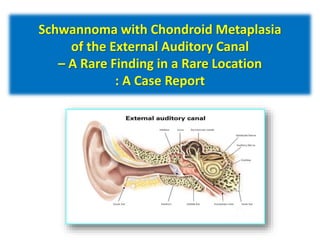
Schwannoma with Chondroid Metaplasia
of the External Auditory Canal
– A Rare Finding in a Rare Location
: A Case Report
ABSTRACT
Background
• Schwannomas are uncommon tumors of the external auditory canal.
• In the English literature, very few cases of schwannomas originating in the external
auditory canal were reported and none of them showed chondroid metaplasia.
• This is the first case of schwannoma with chondroid metaplasia in this location was
reported by Bennani et. Al (2018).
Case presentation
• In this report, it has been described a 22-year-old white man who presented with an external
auditory slow growing mass.
• A computed tomography scan of the temporal bone demonstrated a well-circumscribed, soft
tissue mass narrowing most of the external auditory canal.
• A surgical biopsy was performed and the histological examination showed a schwannoma
with chondroid metaplasia.
Schwannoma should be considered in the differential
diagnosis of benign or malignant tissue masses involving the
external ear canal.
Conclusion
INTRODUCTION
 Schwannomas are slow growing benign tumors arising from Schwann cells
of peripheral nerve sheaths.
 Between 25 and 45% of extracranial schwannomas occur in the head and
neck region.
 They are frequently located at the internal acoustic meatus arising from the
vestibular nerves within the cranial vault.
 They are uncommon in the external auditory canal
 Only 10 cases have been reported in the international literature according to
the best of their knowledge.[1-10]
 So far, chondroid metaplasia which is seen in this case has not been reported.
 Bennani et al (2018) report the first case of schwannoma with chondroid
metaplasia in the external auditory canal with the aim of shedding more light
on this tumor in this exceptional location, and on the fact that
schwannoma should be considered in the differential diagnosis of benign or
malignant tissue masses involving the external ear canal, even the clinical
and radiological findings are somewhat nonspecific in this location.
METHOD
1) Physical examination
- A pale and firm mass arising from the inferior wall of right external auditory
canal were examined.
2) Neurological examination
- Did not show any lesions in CNS or PNS.
3) Laboratory analyses
- Hematological and biochemical tests were carried out to help make a
diagnosis (Table 1).
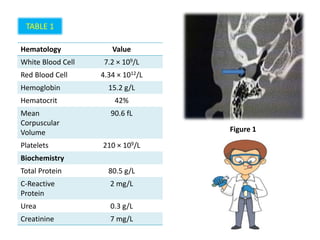
4) Computed tomography (CT) scan
- CT scan of the temporal bone was done.
- a well circumscribed, soft tissue mass narrowing most of the external auditory
canal was demonstrated (Fig.1).
5) Excisional biopsy
- A procedure where the entire abnormality or area of interest is removed for
examination under a microscope.
- The patient undergoes an excisional biopsy of the mass, under local anesthesia
(a numbing medicine).
- After the biopsy, the tissue sample was examined under a microscope for:
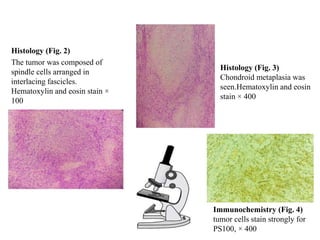
a) Histology
- Tumor cells were stained with hematoxylin and eosin stain
- The tumor was composed of spindle cells arranged in interlacing fascicles
(Fig. 2).
- A chondroid metaplasia was also seen in the tissue sample (Fig. 3).
b) Immunochemistry
- Tumor cells were strongly stained with PS100 (Fig.4).
TABLE 1
Hematology Value
White Blood Cell 7.2 × 10⁹/L
Red Blood Cell 4.34 × 10¹²/L
Hemoglobin 15.2 g/L
Hematocrit 42%
Mean
Corpuscular
Volume
90.6 fL
Platelets 210 × 109/L
Biochemistry
Total Protein 80.5 g/L
C-Reactive
Protein
2 mg/L
Urea 0.3 g/L
Creatinine 7 mg/L
Figure 1
Histology (Fig. 3)
Chondroid metaplasia was
seen.Hematoxylin and eosin
stain × 400
Histology (Fig. 2)
The tumor was composed of
spindle cells arranged in
interlacing fascicles.
Hematoxylin and eosin stain ×
100
Immunochemistry (Fig. 4)
tumor cells stain strongly for
PS100, × 400
RESULT
• After multiple examination and test, the diagnosis of
schwannoma with chondroid metaplasia was made.
• The tumor mass was removed and after 8 month there
is no sign of local recurrence of the tumor.
DISCUSSION
 Schwannomas of the head and neck are common, and are mostly seen arising from the
internal acoustic meatus commonly associated with large nerve trunks.
 But, those arise from the external auditory canal are very rare [3].
 Most of the extracranial schwannomas in the head and neck originate from cutaneous
or muscular branches of the cervical or brachial plexus. Cutaneous sensory nerves that
are covered by Schwann cells, from which schwannoma may originate, supply the
external auditory meatus and canal.
 In the present case the tumor was located mainly at the inferior canal wall, which was
supplied by the auricular nerve [1].
 This cases was conducted in the age ranges 18-59 years patients with mass in their
external auditory canal.
 The clinical presentation of schwannoma is usually a slow growing and
asymptomatic mass.
 In the external auditory canal the clinical presentation may appear as recurrent
external otitis and a mild conductive hearing loss secondary to obstruction of the
canal from the tumor mass [1].
 Neurogenic symptoms such as pain or paresthesia are uncommon [5].
 Schwannomas are encapsulated and therefore they can be easily dissected from the
surrounding tissues. Thus, one cases reported with erosion of the bony canal wall [3].
 On histologic examination, the tumor is characterized by streams of elongated
spindle cells, with the elongated nuclei often arrayed in a palisade pattern.
 Schwannomas should be differentiated from other spindle cell tumors such as
neurofibroma, leiomyoma, and desmoplastic melanoma.
 Neurofibromas are not encapsulated , usually multicentric , which is an
important clinical distinction from schwannomas, and may be accompanied by a
special entity called von Recklinghausen’s disease.
 Radiologic imaging by CT shows schwannomas to be well-circumscribed,
homogenous masses.
 A CT scan is very useful in making a decision about the extent of the lesion,
integrity of the tympanic membrane, and the type of surgical approach [5].
 Treatment is complete excision of the tumor via either transmeatal or post-aural
approach.
 The choice of approach will depend on tumor size, location, and relation to
surrounding structures [3].
 When complete excision is performed local recurrence is rare [1].
 A transmeatal approach was performed in the present case and a good cleavage
plane provided an en bloc resection (EBR) with preservation of surrounding
structures [5].
CONCLUSION
 A differential diagnosis should be made with respect to a number of other soft
tissue neoplasms such as fibroma, chondroma, and leiomyoma.
 A definitive diagnosis should be based on the histological and
immunohistochemical findings.
 Schwannoma should be considered in the differential diagnosis of benign or
malignant tissue masses involving the external ear canal, although, in this location,
the clinical and radiological findings are somewhat nonspecific and rare.
REFERENCES
1. Gross M, et al. Schwannoma of the external auditory canal. Auris Nasus Larynx.
2005;32(1):77–9.
2. Morais D, et al. Schwannoma of the external auditory canal: an exceptional location.
Acta Otorrinolaringol (Engl Ed). 2007;58(4):169–70.
3. Bakshi SS, Shankar K, Parida PK. A large schwannoma of external auditory canal: an
unusual case. Kulak Burun Boğaz Ihtis Derg. 2015;25(4):229.
4. Jovanovic MB, Djeric D, Poljovka R, Milenkovic S. Obliterative external ear canal
schwannoma. Int Adv Otol. 2009;5:394–8.
5. Topal O, Erbek SS, Erbek S. Schwannoma of the external auditory canal: a case report.
Head Face Med. 2007;3(1):6.
6. Kumar D, Somavanshi S, Kumar H, Agrawal A, Singh H. Schwannoma of the External
Auditory Canal: A Rare Location. Otorhinolaryngol Clin Int J. 2015; 7(3):147–8.
7. Wu C-M, Hwang C-F, Lin CH, Su C-Y. External ear canal schwannoma: an unusual
case report. J Laryngol Otolaryngol. 1993;107:829–30.
8. Lewis WB, Mattucci KF, Smilari T. Schwannoma of external auditory canal: an
unusual finding. Int Surg. 1995;80:287–90.
9. Harcourt JP, Tungekar MF. Schwannoma of the external auditory canal. J Laryngol
Otol. 1995;109:1016–8.
10. Galli J, d’Ecclesia A, La-Rocca LM, Almadori G. Giant schwannoma of external
auditory canal: a case report. Otolaryngol Head Neck Surg. 2001; 124:473–4.
11. Bennani. A, Karich. N, Kamaoui. I, Chraibi. M, Abbaoui. S. (2017). Schwannoma
with chondroid metaplasia of the external auditory canal – a rare finding in a rare
location: a case report. Journal of Medical Case Reports. Retrieved
fromhttps://doi.org/10.1186/s13256-018-1584-4
12. Whaley. T. (n,d). Incisional & Excisional Biopsy. Retrieved from
https://www.oncolink.org/cancer-treatment/procedures-diagnostic-tests/biopsy-
procedures/incisional-excisional-biopsy
13. Mayo Clinic Staff. (n,d). Cancer blood tests: Lab tests used in cancer diagnosis.
Retrieved from https://www.mayoclinic.org/diseases-conditions/cancer/in-depth/cancer-
diagnosis/art-20046459
14. Gross M, et al. Schwannoma of the external auditory canal. Auris Nasus Larynx.
2005;32(1):77–9.
15. Bakshi SS, Shankar K, Parida PK. A large schwannoma of external auditory canal: an
unusual case. Kulak Burun Boğaz Ihtis Derg. 2015;25(4):229.
16. Topal O, Erbek SS, Erbek S. Schwannoma of the external auditory canal: a case
report. Head Face Med. 2007;3(1):6.
Thank You
For
Lending Your Ears!

EPIDEMIOLOGY AND BIOSTATISTICS (case report)

  • 1.
    SAFIYYAH BINTI ROSLAN(043827) SAHIRAH BINTI SARIFF (043445) FARAH ADRIANA BINTI MOHD ROSMADI (043636) NUR HAYATI BINTI NISAR AHMAD (043209) NURASYIKIN BINTI RAHMAT (042961)
  • 2.
    Schwannoma with ChondroidMetaplasia of the External Auditory Canal – A Rare Finding in a Rare Location : A Case Report
  • 3.
    ABSTRACT Background • Schwannomas areuncommon tumors of the external auditory canal. • In the English literature, very few cases of schwannomas originating in the external auditory canal were reported and none of them showed chondroid metaplasia. • This is the first case of schwannoma with chondroid metaplasia in this location was reported by Bennani et. Al (2018). Case presentation • In this report, it has been described a 22-year-old white man who presented with an external auditory slow growing mass. • A computed tomography scan of the temporal bone demonstrated a well-circumscribed, soft tissue mass narrowing most of the external auditory canal. • A surgical biopsy was performed and the histological examination showed a schwannoma with chondroid metaplasia.
  • 4.
    Schwannoma should beconsidered in the differential diagnosis of benign or malignant tissue masses involving the external ear canal. Conclusion
  • 5.
    INTRODUCTION  Schwannomas areslow growing benign tumors arising from Schwann cells of peripheral nerve sheaths.  Between 25 and 45% of extracranial schwannomas occur in the head and neck region.  They are frequently located at the internal acoustic meatus arising from the vestibular nerves within the cranial vault.  They are uncommon in the external auditory canal  Only 10 cases have been reported in the international literature according to the best of their knowledge.[1-10]
  • 6.
     So far,chondroid metaplasia which is seen in this case has not been reported.  Bennani et al (2018) report the first case of schwannoma with chondroid metaplasia in the external auditory canal with the aim of shedding more light on this tumor in this exceptional location, and on the fact that schwannoma should be considered in the differential diagnosis of benign or malignant tissue masses involving the external ear canal, even the clinical and radiological findings are somewhat nonspecific in this location.
  • 7.
    METHOD 1) Physical examination -A pale and firm mass arising from the inferior wall of right external auditory canal were examined. 2) Neurological examination - Did not show any lesions in CNS or PNS. 3) Laboratory analyses - Hematological and biochemical tests were carried out to help make a diagnosis (Table 1). 4) Computed tomography (CT) scan - CT scan of the temporal bone was done. - a well circumscribed, soft tissue mass narrowing most of the external auditory canal was demonstrated (Fig.1).
  • 8.
    5) Excisional biopsy -A procedure where the entire abnormality or area of interest is removed for examination under a microscope. - The patient undergoes an excisional biopsy of the mass, under local anesthesia (a numbing medicine). - After the biopsy, the tissue sample was examined under a microscope for: a) Histology - Tumor cells were stained with hematoxylin and eosin stain - The tumor was composed of spindle cells arranged in interlacing fascicles (Fig. 2). - A chondroid metaplasia was also seen in the tissue sample (Fig. 3). b) Immunochemistry - Tumor cells were strongly stained with PS100 (Fig.4).
  • 9.
    TABLE 1 Hematology Value WhiteBlood Cell 7.2 × 10⁹/L Red Blood Cell 4.34 × 10¹²/L Hemoglobin 15.2 g/L Hematocrit 42% Mean Corpuscular Volume 90.6 fL Platelets 210 × 109/L Biochemistry Total Protein 80.5 g/L C-Reactive Protein 2 mg/L Urea 0.3 g/L Creatinine 7 mg/L Figure 1
  • 10.
    Histology (Fig. 3) Chondroidmetaplasia was seen.Hematoxylin and eosin stain × 400 Histology (Fig. 2) The tumor was composed of spindle cells arranged in interlacing fascicles. Hematoxylin and eosin stain × 100 Immunochemistry (Fig. 4) tumor cells stain strongly for PS100, × 400
  • 11.
    RESULT • After multipleexamination and test, the diagnosis of schwannoma with chondroid metaplasia was made. • The tumor mass was removed and after 8 month there is no sign of local recurrence of the tumor.
  • 12.
    DISCUSSION  Schwannomas ofthe head and neck are common, and are mostly seen arising from the internal acoustic meatus commonly associated with large nerve trunks.  But, those arise from the external auditory canal are very rare [3].  Most of the extracranial schwannomas in the head and neck originate from cutaneous or muscular branches of the cervical or brachial plexus. Cutaneous sensory nerves that are covered by Schwann cells, from which schwannoma may originate, supply the external auditory meatus and canal.  In the present case the tumor was located mainly at the inferior canal wall, which was supplied by the auricular nerve [1].  This cases was conducted in the age ranges 18-59 years patients with mass in their external auditory canal.
  • 13.
     The clinicalpresentation of schwannoma is usually a slow growing and asymptomatic mass.  In the external auditory canal the clinical presentation may appear as recurrent external otitis and a mild conductive hearing loss secondary to obstruction of the canal from the tumor mass [1].  Neurogenic symptoms such as pain or paresthesia are uncommon [5].  Schwannomas are encapsulated and therefore they can be easily dissected from the surrounding tissues. Thus, one cases reported with erosion of the bony canal wall [3].  On histologic examination, the tumor is characterized by streams of elongated spindle cells, with the elongated nuclei often arrayed in a palisade pattern.  Schwannomas should be differentiated from other spindle cell tumors such as neurofibroma, leiomyoma, and desmoplastic melanoma.
  • 14.
     Neurofibromas arenot encapsulated , usually multicentric , which is an important clinical distinction from schwannomas, and may be accompanied by a special entity called von Recklinghausen’s disease.  Radiologic imaging by CT shows schwannomas to be well-circumscribed, homogenous masses.  A CT scan is very useful in making a decision about the extent of the lesion, integrity of the tympanic membrane, and the type of surgical approach [5].  Treatment is complete excision of the tumor via either transmeatal or post-aural approach.  The choice of approach will depend on tumor size, location, and relation to surrounding structures [3].  When complete excision is performed local recurrence is rare [1].  A transmeatal approach was performed in the present case and a good cleavage plane provided an en bloc resection (EBR) with preservation of surrounding structures [5].
  • 15.
    CONCLUSION  A differentialdiagnosis should be made with respect to a number of other soft tissue neoplasms such as fibroma, chondroma, and leiomyoma.  A definitive diagnosis should be based on the histological and immunohistochemical findings.  Schwannoma should be considered in the differential diagnosis of benign or malignant tissue masses involving the external ear canal, although, in this location, the clinical and radiological findings are somewhat nonspecific and rare.
  • 16.
    REFERENCES 1. Gross M,et al. Schwannoma of the external auditory canal. Auris Nasus Larynx. 2005;32(1):77–9. 2. Morais D, et al. Schwannoma of the external auditory canal: an exceptional location. Acta Otorrinolaringol (Engl Ed). 2007;58(4):169–70. 3. Bakshi SS, Shankar K, Parida PK. A large schwannoma of external auditory canal: an unusual case. Kulak Burun Boğaz Ihtis Derg. 2015;25(4):229. 4. Jovanovic MB, Djeric D, Poljovka R, Milenkovic S. Obliterative external ear canal schwannoma. Int Adv Otol. 2009;5:394–8. 5. Topal O, Erbek SS, Erbek S. Schwannoma of the external auditory canal: a case report. Head Face Med. 2007;3(1):6. 6. Kumar D, Somavanshi S, Kumar H, Agrawal A, Singh H. Schwannoma of the External Auditory Canal: A Rare Location. Otorhinolaryngol Clin Int J. 2015; 7(3):147–8. 7. Wu C-M, Hwang C-F, Lin CH, Su C-Y. External ear canal schwannoma: an unusual case report. J Laryngol Otolaryngol. 1993;107:829–30. 8. Lewis WB, Mattucci KF, Smilari T. Schwannoma of external auditory canal: an unusual finding. Int Surg. 1995;80:287–90.
  • 17.
    9. Harcourt JP,Tungekar MF. Schwannoma of the external auditory canal. J Laryngol Otol. 1995;109:1016–8. 10. Galli J, d’Ecclesia A, La-Rocca LM, Almadori G. Giant schwannoma of external auditory canal: a case report. Otolaryngol Head Neck Surg. 2001; 124:473–4. 11. Bennani. A, Karich. N, Kamaoui. I, Chraibi. M, Abbaoui. S. (2017). Schwannoma with chondroid metaplasia of the external auditory canal – a rare finding in a rare location: a case report. Journal of Medical Case Reports. Retrieved fromhttps://doi.org/10.1186/s13256-018-1584-4 12. Whaley. T. (n,d). Incisional & Excisional Biopsy. Retrieved from https://www.oncolink.org/cancer-treatment/procedures-diagnostic-tests/biopsy- procedures/incisional-excisional-biopsy 13. Mayo Clinic Staff. (n,d). Cancer blood tests: Lab tests used in cancer diagnosis. Retrieved from https://www.mayoclinic.org/diseases-conditions/cancer/in-depth/cancer- diagnosis/art-20046459 14. Gross M, et al. Schwannoma of the external auditory canal. Auris Nasus Larynx. 2005;32(1):77–9. 15. Bakshi SS, Shankar K, Parida PK. A large schwannoma of external auditory canal: an unusual case. Kulak Burun Boğaz Ihtis Derg. 2015;25(4):229. 16. Topal O, Erbek SS, Erbek S. Schwannoma of the external auditory canal: a case report. Head Face Med. 2007;3(1):6.
  • 18.