How to choose 

research methods
Emma Howell & James Lang
How to choose 

research methods
Emma Howell & James Lang
How do you decide what 

research method(s) to use?
Do you ever have tricky 

compromises to make?
Do you have a formula for 

making your decision?
Rules vs people
The rules perspective
THE RULES PERSPECTIVE
Choosing a research method is a
process of weighing up different
considerations & criteria to arrive
at an optimal approach.
1
2
3
4
5
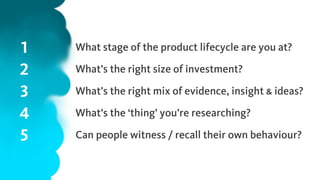
What stage of the product lifecycle are you at?
What’s the right size of investment?
What’s the right mix of evidence, insight & ideas?
What’s the ‘thing’ you’re researching?
Can people witness / recall their own behaviour?
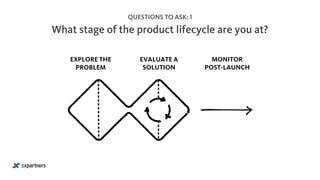
What stage of the product lifecycle are you at?
EXPLORE THE
PROBLEM
EVALUATE A
SOLUTION
MONITOR
POST-LAUNCH
QUESTIONS TO ASK: 1
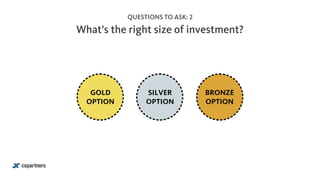
What’s the right size of investment?
GOLD

OPTION
SILVER

OPTION
BRONZE

OPTION
QUESTIONS TO ASK: 2
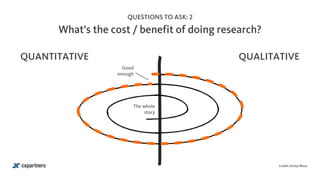
QUALITATIVEQUANTITATIVE
What’s the cost / benefit of doing research?
QUESTIONS TO ASK: 2
Credit: Kristy Blazo
Good
enough
The whole
story
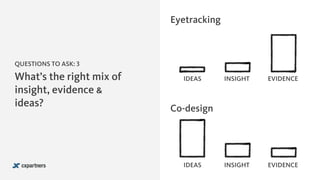
What’s the right mix of
insight, evidence &
ideas?
IDEAS INSIGHT EVIDENCE
QUESTIONS TO ASK: 3
Co-design
Eyetracking
IDEAS INSIGHT EVIDENCE
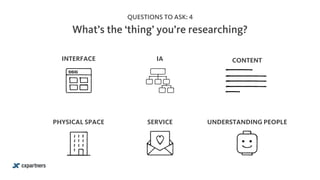
What’s the ‘thing’ you’re researching?
INTERFACE
PHYSICAL SPACE
IA
SERVICE
CONTENT
UNDERSTANDING PEOPLE
QUESTIONS TO ASK: 4
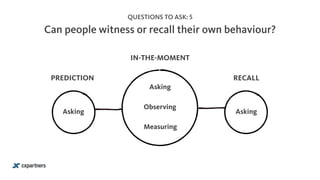
PREDICTION RECALL
IN-THE-MOMENT
Asking Asking
Asking
Observing
Measuring
Can people witness or recall their own behaviour?
QUESTIONS TO ASK: 5
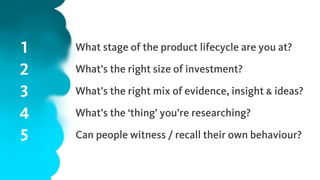
1
2
3
4
5
What stage of the product lifecycle are you at?
What’s the right size of investment?
What’s the right mix of evidence, insight & ideas?
What’s the ‘thing’ you’re researching?
Can people witness / recall their own behaviour?
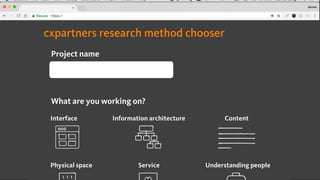
cxpartners research method chooser
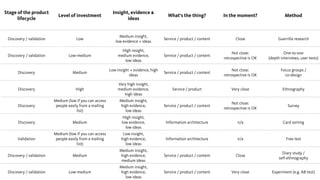
Stage of the product
lifecycle
Level of investment
Insight, evidence &
ideas
What’s the thing? In the moment? Method
Discovery / validation Low
Medium insight, 

low evidence + ideas
Service / product / content Close Guerrilla research
Discovery / validation Low-medium
High insight, 

medium evidence, 

low ideas
Service / product / content
Not close: 

retrospective is OK
One-to-one 

(depth interviews, user tests)
Discovery Medium
Low insight + evidence, high
ideas
Service / product / content
Not close: 

retrospective is OK
Focus groups / 

co-design
Discovery High
Very high insight, 

medium evidence, 

high ideas
Service / product Very close Ethnography
Discovery
Medium (low if you can access
people easily from a mailing
list)
Medium insight, 

high evidence, 

low ideas
Service / product / content
Not close: 

retrospective is OK
Survey
Discovery Medium
High insight, 

low evidence, 

low ideas
Information architecture n/a Card sorting
Validation
Medium (low if you can access
people easily from a mailing
list)
Low insight, 

high evidence,

low ideas
Information architecture n/a Tree test
Discovery / validation Medium
Medium insight, 

high evidence, 

medium ideas
Service / product / content Close
Diary study / 

self-ethnography
Discovery / validation Low-medium
Medium insight, 

high evidence, 

low ideas
Service / product / content Very close Experiment (e.g. AB test)
LET’S TRY IT
• Work in groups of 6 or so
• Decide on the research methodology
• You’ve got 5 minutes
Rules vs people
The people perspective
THE PEOPLE PERSPECTIVE
Choosing research methods is a
creative exercise, where ‘right’
choices and rules are secondary to
stakeholder engagement and
experience.
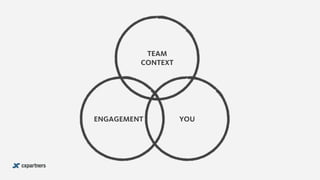
ENGAGEMENT
TEAM

CONTEXT
YOU
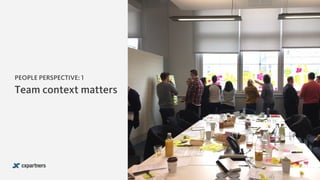
Team context matters
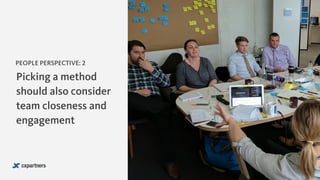
PEOPLE PERSPECTIVE: 1
Picking a method
should also consider
team closeness and
engagement
Y
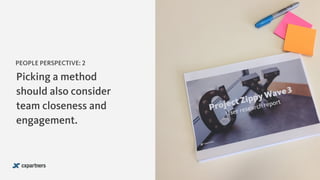
PEOPLE PERSPECTIVE: 2
Picking a method
should also consider
team closeness and
engagement.
PEOPLE PERSPECTIVE: 2
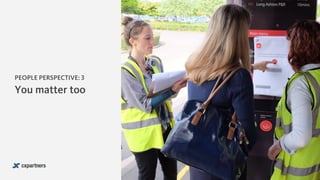
pic: a photo of client
observing fieldwork,
ideally something cool
and contextual
You matter too
PEOPLE PERSPECTIVE: 3
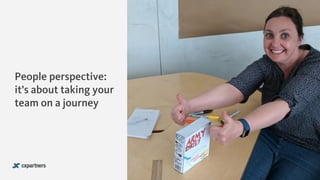
People perspective:
it’s about taking your
team on a journey
LET’S TRY IT
• Work in the same groups
• Does the new information affect your
choice of methodology?
• You’ve got 5 minutes
A rules + people approach
Have you ever ended up in debates
about which method to use?
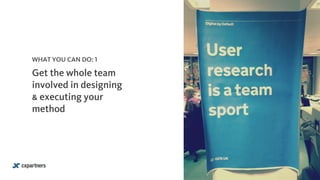
Get the whole team
involved in designing
& executing your
method
WHAT YOU CAN DO: 1
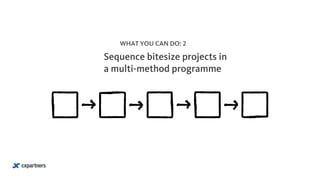
WHAT YOU CAN DO: 2
Sequence bitesize projects in
a multi-method programme
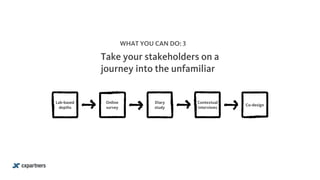
Lab-based
depths
Online
survey
Diary
study
Contextual

interviews
Co-design
WHAT YOU CAN DO: 3
Take your stakeholders on a
journey into the unfamiliar
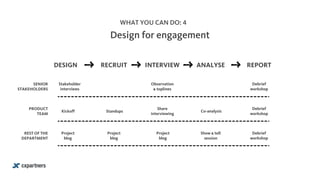
WHAT YOU CAN DO: 4
Design for engagement
DESIGN RECRUIT INTERVIEW ANALYSE REPORT
SENIOR
STAKEHOLDERS
PRODUCT
TEAM
REST OF THE
DEPARTMENT
Kickoff Standups
Share
interviewing
Co-analysis
Debrief
workshop
Project
blog
Show & tell
session
Debrief
workshop
Debrief
workshop
Stakeholder
interviews
Observation
& toplines
Project
blog
Project
blog
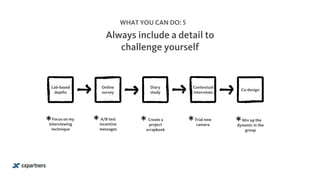
WHAT YOU CAN DO: 5
Always include a detail to
challenge yourself
Lab-based
depths
Online
survey
Diary
study
Contextual

interviews
Co-design
Focus on my
interviewing
technique
A/B test
incentive
messages
Create a
project
scrapbook
Trial new
camera
Mix up the
dynamic in the
group
1
2
3
4
5
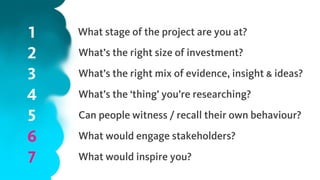
6
7
What stage of the project are you at?
What’s the right size of investment?
What’s the right mix of evidence, insight & ideas?
What’s the ‘thing’ you’re researching?
Can people witness / recall their own behaviour?
What would engage stakeholders?
What would inspire you?
Q&A
Emma Howell - UX Consultant and Research
Lead at cxpartners
James Lang - UX Research Lead at Google
emma.howell@cxpartners.co.uk
Thank you
James Lang & Emma Howell
Thank you

Choosing a research methodology

  • 1.
    How to choose
 research methods Emma Howell & James Lang
  • 2.
    How to choose
 research methods Emma Howell & James Lang
  • 3.
    How do youdecide what 
 research method(s) to use?
  • 4.
    Do you everhave tricky 
 compromises to make?
  • 5.
    Do you havea formula for 
 making your decision?
  • 6.
  • 7.
  • 8.
    THE RULES PERSPECTIVE Choosinga research method is a process of weighing up different considerations & criteria to arrive at an optimal approach.
  • 9.
    1 2 3 4 5 What stage ofthe product lifecycle are you at? What’s the right size of investment? What’s the right mix of evidence, insight & ideas? What’s the ‘thing’ you’re researching? Can people witness / recall their own behaviour?
  • 10.
    What stage ofthe product lifecycle are you at? EXPLORE THE PROBLEM EVALUATE A SOLUTION MONITOR POST-LAUNCH QUESTIONS TO ASK: 1
  • 11.
    What’s the rightsize of investment? GOLD
 OPTION SILVER
 OPTION BRONZE
 OPTION QUESTIONS TO ASK: 2
  • 12.
    QUALITATIVEQUANTITATIVE What’s the cost/ benefit of doing research? QUESTIONS TO ASK: 2 Credit: Kristy Blazo Good enough The whole story
  • 13.
    What’s the rightmix of insight, evidence & ideas? IDEAS INSIGHT EVIDENCE QUESTIONS TO ASK: 3 Co-design Eyetracking IDEAS INSIGHT EVIDENCE
  • 14.
    What’s the ‘thing’you’re researching? INTERFACE PHYSICAL SPACE IA SERVICE CONTENT UNDERSTANDING PEOPLE QUESTIONS TO ASK: 4
  • 15.
    PREDICTION RECALL IN-THE-MOMENT Asking Asking Asking Observing Measuring Canpeople witness or recall their own behaviour? QUESTIONS TO ASK: 5
  • 16.
    1 2 3 4 5 What stage ofthe product lifecycle are you at? What’s the right size of investment? What’s the right mix of evidence, insight & ideas? What’s the ‘thing’ you’re researching? Can people witness / recall their own behaviour?
  • 17.
  • 18.
    Stage of theproduct lifecycle Level of investment Insight, evidence & ideas What’s the thing? In the moment? Method Discovery / validation Low Medium insight, 
 low evidence + ideas Service / product / content Close Guerrilla research Discovery / validation Low-medium High insight, 
 medium evidence, 
 low ideas Service / product / content Not close: 
 retrospective is OK One-to-one 
 (depth interviews, user tests) Discovery Medium Low insight + evidence, high ideas Service / product / content Not close: 
 retrospective is OK Focus groups / 
 co-design Discovery High Very high insight, 
 medium evidence, 
 high ideas Service / product Very close Ethnography Discovery Medium (low if you can access people easily from a mailing list) Medium insight, 
 high evidence, 
 low ideas Service / product / content Not close: 
 retrospective is OK Survey Discovery Medium High insight, 
 low evidence, 
 low ideas Information architecture n/a Card sorting Validation Medium (low if you can access people easily from a mailing list) Low insight, 
 high evidence,
 low ideas Information architecture n/a Tree test Discovery / validation Medium Medium insight, 
 high evidence, 
 medium ideas Service / product / content Close Diary study / 
 self-ethnography Discovery / validation Low-medium Medium insight, 
 high evidence, 
 low ideas Service / product / content Very close Experiment (e.g. AB test)
  • 19.
    LET’S TRY IT •Work in groups of 6 or so • Decide on the research methodology • You’ve got 5 minutes
  • 20.
  • 21.
  • 22.
    THE PEOPLE PERSPECTIVE Choosingresearch methods is a creative exercise, where ‘right’ choices and rules are secondary to stakeholder engagement and experience.
  • 23.
  • 24.
  • 25.
    Picking a method shouldalso consider team closeness and engagement Y PEOPLE PERSPECTIVE: 2
  • 26.
    Picking a method shouldalso consider team closeness and engagement. PEOPLE PERSPECTIVE: 2
  • 27.
    pic: a photoof client observing fieldwork, ideally something cool and contextual You matter too PEOPLE PERSPECTIVE: 3
  • 28.
    People perspective: it’s abouttaking your team on a journey
  • 29.
    LET’S TRY IT •Work in the same groups • Does the new information affect your choice of methodology? • You’ve got 5 minutes
  • 30.
    A rules +people approach
  • 31.
    Have you everended up in debates about which method to use?
  • 33.
    Get the wholeteam involved in designing & executing your method WHAT YOU CAN DO: 1
  • 34.
    WHAT YOU CANDO: 2 Sequence bitesize projects in a multi-method programme
  • 35.
    Lab-based depths Online survey Diary study Contextual
 interviews Co-design WHAT YOU CANDO: 3 Take your stakeholders on a journey into the unfamiliar
  • 36.
    WHAT YOU CANDO: 4 Design for engagement DESIGN RECRUIT INTERVIEW ANALYSE REPORT SENIOR STAKEHOLDERS PRODUCT TEAM REST OF THE DEPARTMENT Kickoff Standups Share interviewing Co-analysis Debrief workshop Project blog Show & tell session Debrief workshop Debrief workshop Stakeholder interviews Observation & toplines Project blog Project blog
  • 37.
    WHAT YOU CANDO: 5 Always include a detail to challenge yourself Lab-based depths Online survey Diary study Contextual
 interviews Co-design Focus on my interviewing technique A/B test incentive messages Create a project scrapbook Trial new camera Mix up the dynamic in the group
  • 38.
    1 2 3 4 5 6 7 What stage ofthe project are you at? What’s the right size of investment? What’s the right mix of evidence, insight & ideas? What’s the ‘thing’ you’re researching? Can people witness / recall their own behaviour? What would engage stakeholders? What would inspire you?
  • 39.
  • 40.
    Emma Howell -UX Consultant and Research Lead at cxpartners James Lang - UX Research Lead at Google emma.howell@cxpartners.co.uk Thank you
  • 41.
    James Lang &Emma Howell Thank you