Bias in Research
Emma Howell
@oohmawolfie
Every bit of research I have ever done is biased
you
Standard Operating Procedures:
An order of actions/activities/
sentences that are kept constant
across participants.
Don’t throw
sandwiches at
baboons.
It makes science bad.
I’ve moved from
primates and
flying sandwiches
to limited budget
and leading
questions
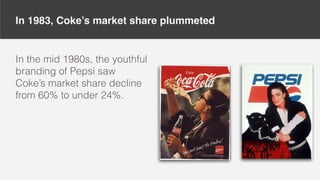
In 1983, Coke’s market share plummeted
In the mid 1980s, the youthful
branding of Pepsi saw
Coke’s market share decline
from 60% to under 24%.
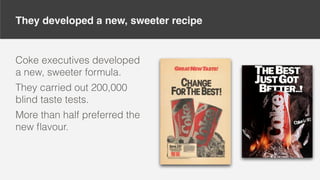
They developed a new, sweeter recipe
Coke executives developed
a new, sweeter formula.
They carried out 200,000
blind taste tests.
More than half preferred the
new flavour.
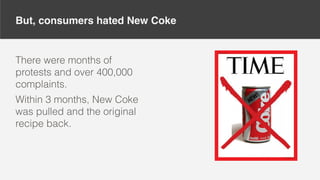
But, consumers hated New Coke
There were months of
protests and over 400,000
complaints.
Within 3 months, New Coke
was pulled and the original
recipe back.
What went wrong?
They had carried out a quarter of a million taste tests and
spent $4 million on development.
They were left with $30million of New Coke.
Their research was biased..
Which lead to a huge mistake in their interpretation of the
findings.
They:
• Only tested in one area
• Used closed questions in surveys
• Failed to consider brand perception
• Only tested taste.
Coke, 1980s research Integrity
You may design the wrong stuff
Wrong stuff can cost money
Coke, 1980s research
Let’s think about how your research sessions are biased
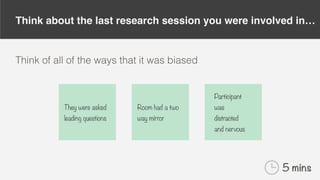
Think about the last research session you were involved in…
Think of all of the ways that it was biased
They were asked
leading questions
Room had a two
way mirror
Participant
was
distracted
and nervous
5 mins
Coke, 1980s research
We can have a massive impact on the way our
participants behave
Coke, 1980s research
But it’s not just the research session we need to think about…
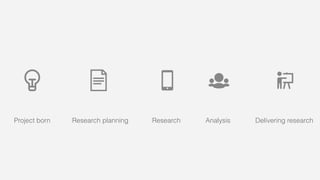
Project born Research planning Research Analysis Delivering research
Coke, 1980s research
Let’s think about how your research sessions are biased
projects
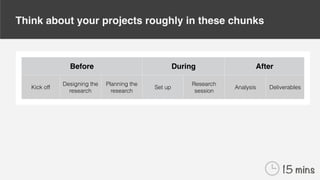
Think about your projects roughly in these chunks
Before During After
Kick off
Designing the
research
Planning the
research
Set up
Research
session
Analysis Deliverables
15 mins
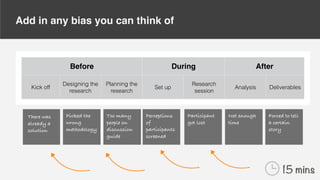
Add in any bias you can think of
Before During After
Kick off
Designing the
research
Planning the
research
Set up
Research
session
Analysis Deliverables
There was
already a
solution
Picked the
wrong
methodology
Too many
people on
discussion
guide
Perceptions
of
participants
screened
Participant
got lost
Not enough
time
Forced to tell
a certain
story
15 mins
Before During After
Kick off
Designing the
research
Planning the
research
Set up
Research
session
Analysis Deliverables
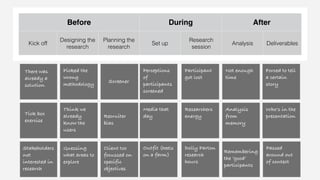
There was
already a
solution
Picked the
wrong
methodology
Screener
Perceptions
of
participants
screened
Participant
got lost
Not enough
time
Forced to tell
a certain
story
Tick box
exercise
Think we
already
know the
users
Recruiter
bias
Media that
day
Researchers
energy
Analysis
from
memory
Who’s in the
presentation
Stakeholders
not
interested in
research
Guessing
what areas to
explore
Client too
focussed on
specific
objectives
Outfit (heels
on a farm)
Dolly Parton
research
hours
Remembering
the ‘good’
participants
Passed
around out
of context
Coke, 1980s research
What can we do about research bias?
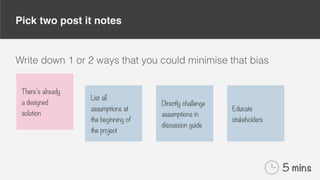
Pick two post it notes
Write down 1 or 2 ways that you could minimise that bias
There’s already
a designed
solution
List all
assumptions at
the beginning of
the project
Directly challenge
assumptions in
discussion guide
Educate
stakeholders
5 mins
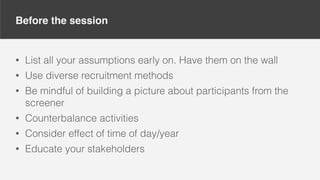
Before the session
• List all your assumptions early on. Have them on the wall
• Use diverse recruitment methods
• Be mindful of building a picture about participants from the
screener
• Counterbalance activities
• Consider effect of time of day/year
• Educate your stakeholders
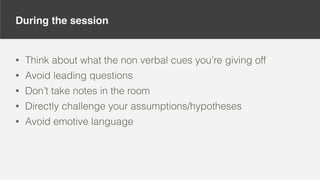
During the session
• Think about what the non verbal cues you’re giving off
• Avoid leading questions
• Don’t take notes in the room
• Directly challenge your assumptions/hypotheses
• Avoid emotive language
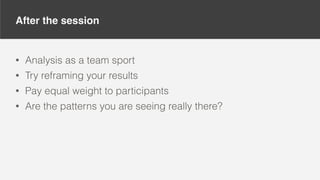
After the session
• Analysis as a team sport
• Try reframing your results
• Pay equal weight to participants
• Are the patterns you are seeing really there?
Coke, 1980s research
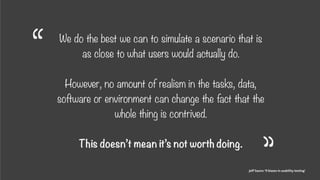
We do the best we can to simulate a scenario that is
as close to what users would actually do. 


However, no amount of realism in the tasks, data,
software or environment can change the fact that the
whole thing is contrived.


This doesn’t mean it’s not worth doing.
Jeff Sauro: ‘9 biases in usability testing’
“
“
Coke, 1980s research
@oohmawolfie
Thank
you

Bias in Research

  • 1.
    Bias in Research EmmaHowell @oohmawolfie
  • 2.
    Every bit ofresearch I have ever done is biased
  • 3.
    Every bit ofresearch I have ever done is biased you
  • 4.
    Standard Operating Procedures: Anorder of actions/activities/ sentences that are kept constant across participants.
  • 5.
  • 6.
    I’ve moved from primatesand flying sandwiches to limited budget and leading questions
  • 7.
    In 1983, Coke’smarket share plummeted In the mid 1980s, the youthful branding of Pepsi saw Coke’s market share decline from 60% to under 24%.
  • 8.
    They developed anew, sweeter recipe Coke executives developed a new, sweeter formula. They carried out 200,000 blind taste tests. More than half preferred the new flavour.
  • 9.
    But, consumers hatedNew Coke There were months of protests and over 400,000 complaints. Within 3 months, New Coke was pulled and the original recipe back.
  • 10.
    What went wrong? Theyhad carried out a quarter of a million taste tests and spent $4 million on development. They were left with $30million of New Coke.
  • 11.
    Their research wasbiased.. Which lead to a huge mistake in their interpretation of the findings. They: • Only tested in one area • Used closed questions in surveys • Failed to consider brand perception • Only tested taste.
  • 12.
    Coke, 1980s researchIntegrity You may design the wrong stuff Wrong stuff can cost money
  • 13.
    Coke, 1980s research Let’sthink about how your research sessions are biased
  • 14.
    Think about thelast research session you were involved in… Think of all of the ways that it was biased They were asked leading questions Room had a two way mirror Participant was distracted and nervous 5 mins
  • 15.
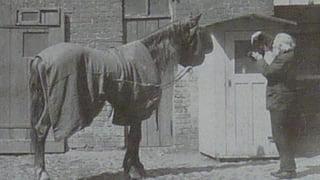
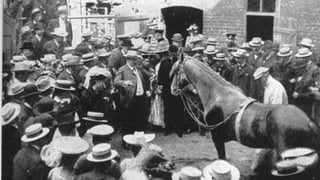
    Coke, 1980s research Wecan have a massive impact on the way our participants behave
  • 19.
    Coke, 1980s research Butit’s not just the research session we need to think about…
  • 20.
    Project born Researchplanning Research Analysis Delivering research
  • 21.
    Coke, 1980s research Let’sthink about how your research sessions are biased projects
  • 22.
    Think about yourprojects roughly in these chunks Before During After Kick off Designing the research Planning the research Set up Research session Analysis Deliverables 15 mins
  • 23.
    Add in anybias you can think of Before During After Kick off Designing the research Planning the research Set up Research session Analysis Deliverables There was already a solution Picked the wrong methodology Too many people on discussion guide Perceptions of participants screened Participant got lost Not enough time Forced to tell a certain story 15 mins
  • 24.
    Before During After Kickoff Designing the research Planning the research Set up Research session Analysis Deliverables There was already a solution Picked the wrong methodology Screener Perceptions of participants screened Participant got lost Not enough time Forced to tell a certain story Tick box exercise Think we already know the users Recruiter bias Media that day Researchers energy Analysis from memory Who’s in the presentation Stakeholders not interested in research Guessing what areas to explore Client too focussed on specific objectives Outfit (heels on a farm) Dolly Parton research hours Remembering the ‘good’ participants Passed around out of context
  • 25.
    Coke, 1980s research Whatcan we do about research bias?
  • 26.
    Pick two postit notes Write down 1 or 2 ways that you could minimise that bias There’s already a designed solution List all assumptions at the beginning of the project Directly challenge assumptions in discussion guide Educate stakeholders 5 mins
  • 27.
    Before the session •List all your assumptions early on. Have them on the wall • Use diverse recruitment methods • Be mindful of building a picture about participants from the screener • Counterbalance activities • Consider effect of time of day/year • Educate your stakeholders
  • 28.
    During the session •Think about what the non verbal cues you’re giving off • Avoid leading questions • Don’t take notes in the room • Directly challenge your assumptions/hypotheses • Avoid emotive language
  • 29.
    After the session •Analysis as a team sport • Try reframing your results • Pay equal weight to participants • Are the patterns you are seeing really there?
  • 30.
    Coke, 1980s research Wedo the best we can to simulate a scenario that is as close to what users would actually do. 
 
 However, no amount of realism in the tasks, data, software or environment can change the fact that the whole thing is contrived.
 
 This doesn’t mean it’s not worth doing. Jeff Sauro: ‘9 biases in usability testing’ “ “
  • 31.