CHOOSING A QUALITATIVE DATA
ANALYSIS (QDA) PLAN
• Data Analysis should change what you do, not just
how you do it. - Matin Movassate
• If you are to choose the right data analysis plan for
your study, it is first pertinent to collect qualitative
data.
• If the data and methods of data analysis plan are right,
it will have numerous benefits, including taking the
right decisions.
What is a Qualitative Data Analysis?
• QDA is based on interpretative policy to examine the
symbolic and meaningful content of data.
• For conducting Data Analysis for any research, it is
also important to have the right methodology.
• In other words, it is interpreting the qualitative data
by many processes and procedures to transform them
into great insights for taking dynamic decisions.
What is Qualitative Data?
• Descriptive data that are non-numerical and capturing
concepts and opinions, values and behaviors of
people in a social context is called Qualitative data
Collection.
• It is the data from observation of audio and video
recordings and also reading the transcripts of
interviews and copies of documents.
What Purpose Does The Qualitative Data
Analysis Plan Perform?
• Unlike Quantitative data analysis, which is more of
numbers and statistics, qualitative analysis is analysis
of subjective and non-numerical qualitative data.
Hence it performs many functions including:
• Organizing data
• Interpreting data
• Identifying patterns
• Forming the basis for informed and verifiable
conclusions
• Ties research objectives to data
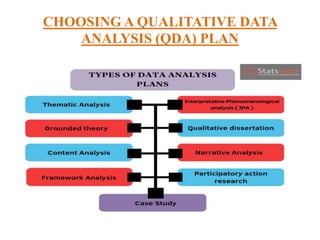
CHOOSING A QUALITATIVE DATA
ANALYSIS (QDA) PLAN
The Different Types Of Data Analysis Plans
Thematic Analysis (TA)
• TA is a flexible and non-research design specific data
analysis plan.
• It generates themes from interview data and is useful
in case studies, phenomenology, and generic
qualitative and narrative analysis, among others.
Types Of Data Analysis Plans
Interpretative Phenomenological Analysis (IPA)
• For the phenomenological research study, IPA is the
right choice. It brings out the core of the
phenomenon under review.
• Other plans like Moustakas' Modified Van Kaam,
Colaizzi, Giorgi, and Heuristic analysis also help to
study phenomenological research.
• Even TA can be used, and the ultimate aim and focus
should be to generate meaningful results.
Types Of Data Analysis Plans
Grounded Theory
• Unlike TA and IPA, the grounded theory uses specific
data analysis plan. It requires you to use the analyzed
data concurrently and applying constant comparison
method of analysis.
• . It goes beyond adding to the existing knowledge
and developing a new theory about a phenomenon
grounded on data.
Types Of Data Analysis Plans
Qualitative dissertation (QD)
• QD is the most effective of all other types of other plans and it
is used in market research.
Content Analysis
The qualitative content analysis draws realistic conclusions after
organizing and obtaining elicit meaning from the data.
It involves four major stages, which include:
• Decontextualization
• Recontextualization
• Categorization
• Compilation
Types Of Data Analysis Plans
Narrative analysis
• Narrative analysis focuses on different elements to
make diverse but equally substantial and meaningful
interpretations and conclusions.
• It is a genre of analytical frames used by researchers
to interpret information with the context of research
shared by all in daily life.
• Also known as discourse studies, is a broad term for
studying the ways of how people use language.
Types Of Data Analysis Plans
Framework analysis
• Framework analysis assesses policies and procedures
from the same people that they affect.
Framework analysis uses five steps, including:
• Familiarization
• Identifying a thematic framework
• Indexing
• Charting & mapping
• Interpretation
Types Of Data Analysis Plans
Participatory action research (PAR)
• PAR enhances collective inquiry among the
communities concerned as an approach to research
them. It also emphasizes participation and action
among them.
Case Study
• The case study qualitative analysis plan has evolved
over the last few years into a vital tool useful for
investigating trends and specific situations in a lot of
scientific disciplines.

Choosing a qualitative data analysis Plan

  • 1.
    CHOOSING A QUALITATIVEDATA ANALYSIS (QDA) PLAN • Data Analysis should change what you do, not just how you do it. - Matin Movassate • If you are to choose the right data analysis plan for your study, it is first pertinent to collect qualitative data. • If the data and methods of data analysis plan are right, it will have numerous benefits, including taking the right decisions.
  • 2.
    What is aQualitative Data Analysis? • QDA is based on interpretative policy to examine the symbolic and meaningful content of data. • For conducting Data Analysis for any research, it is also important to have the right methodology. • In other words, it is interpreting the qualitative data by many processes and procedures to transform them into great insights for taking dynamic decisions.
  • 3.
    What is QualitativeData? • Descriptive data that are non-numerical and capturing concepts and opinions, values and behaviors of people in a social context is called Qualitative data Collection. • It is the data from observation of audio and video recordings and also reading the transcripts of interviews and copies of documents.
  • 4.
    What Purpose DoesThe Qualitative Data Analysis Plan Perform? • Unlike Quantitative data analysis, which is more of numbers and statistics, qualitative analysis is analysis of subjective and non-numerical qualitative data. Hence it performs many functions including: • Organizing data • Interpreting data • Identifying patterns • Forming the basis for informed and verifiable conclusions • Ties research objectives to data
  • 5.
    CHOOSING A QUALITATIVEDATA ANALYSIS (QDA) PLAN
  • 6.
    The Different TypesOf Data Analysis Plans Thematic Analysis (TA) • TA is a flexible and non-research design specific data analysis plan. • It generates themes from interview data and is useful in case studies, phenomenology, and generic qualitative and narrative analysis, among others.
  • 7.
    Types Of DataAnalysis Plans Interpretative Phenomenological Analysis (IPA) • For the phenomenological research study, IPA is the right choice. It brings out the core of the phenomenon under review. • Other plans like Moustakas' Modified Van Kaam, Colaizzi, Giorgi, and Heuristic analysis also help to study phenomenological research. • Even TA can be used, and the ultimate aim and focus should be to generate meaningful results.
  • 8.
    Types Of DataAnalysis Plans Grounded Theory • Unlike TA and IPA, the grounded theory uses specific data analysis plan. It requires you to use the analyzed data concurrently and applying constant comparison method of analysis. • . It goes beyond adding to the existing knowledge and developing a new theory about a phenomenon grounded on data.
  • 9.
    Types Of DataAnalysis Plans Qualitative dissertation (QD) • QD is the most effective of all other types of other plans and it is used in market research. Content Analysis The qualitative content analysis draws realistic conclusions after organizing and obtaining elicit meaning from the data. It involves four major stages, which include: • Decontextualization • Recontextualization • Categorization • Compilation
  • 10.
    Types Of DataAnalysis Plans Narrative analysis • Narrative analysis focuses on different elements to make diverse but equally substantial and meaningful interpretations and conclusions. • It is a genre of analytical frames used by researchers to interpret information with the context of research shared by all in daily life. • Also known as discourse studies, is a broad term for studying the ways of how people use language.
  • 11.
    Types Of DataAnalysis Plans Framework analysis • Framework analysis assesses policies and procedures from the same people that they affect. Framework analysis uses five steps, including: • Familiarization • Identifying a thematic framework • Indexing • Charting & mapping • Interpretation
  • 12.
    Types Of DataAnalysis Plans Participatory action research (PAR) • PAR enhances collective inquiry among the communities concerned as an approach to research them. It also emphasizes participation and action among them. Case Study • The case study qualitative analysis plan has evolved over the last few years into a vital tool useful for investigating trends and specific situations in a lot of scientific disciplines.