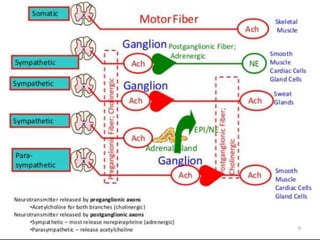
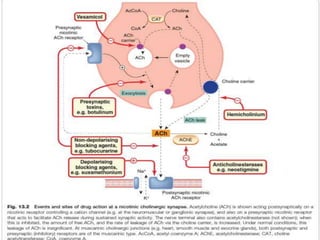
CHOLINERGIC DRUGS
[PARASYMPATHOMIMETICS]
DR. RAMESH KRISHNAN
MD,PHARMACOLOGY[2 ND YEAR]
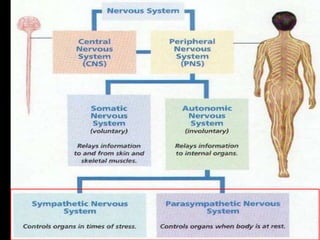
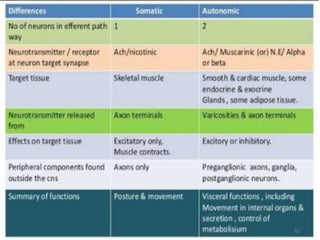
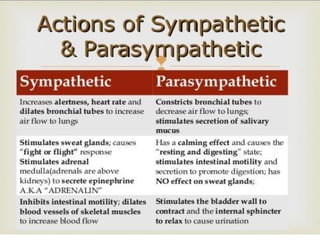
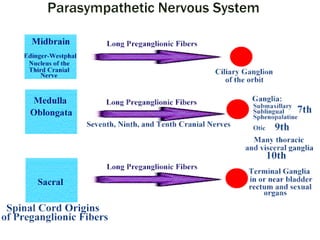
Autonomic Nervous System
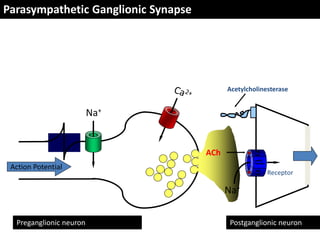
Action Potential
Na+
aab
ACh
Acetylcholinesterase
Na+
Parasympathetic Ganglionic Synapse
Preganglionic neuron Postganglionic neuron
Receptor
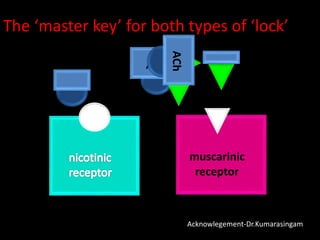
nicotine
muscarine
muscarinic
receptor
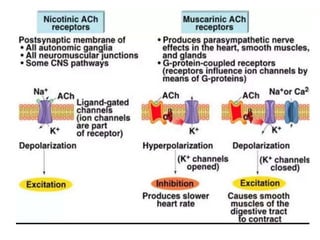
The ‘master key’ for both types of ‘lock’
ACh
ACh
Acknowlegement-Dr.Kumarasingam
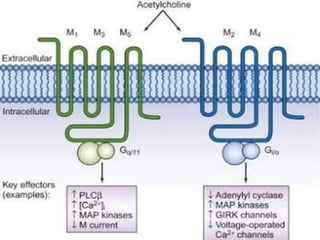
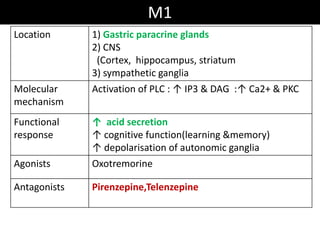
M1
Location 1) Gastric paracrine glands
2) CNS
(Cortex, hippocampus, striatum
3) sympathetic ganglia
Molecular
mechanism
Activation of PLC : ↑ IP3 & DAG :↑ Ca2+ & PKC
Functional
response
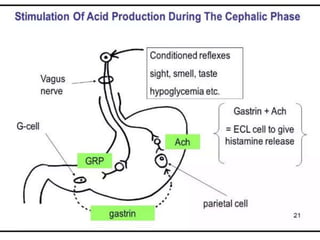
↑ acid secretion
↑ cognitive function(learning &memory)
↑ depolarisation of autonomic ganglia
Agonists Oxotremorine
Antagonists Pirenzepine,Telenzepine
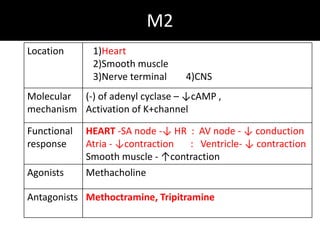
M2
Location 1)Heart
2)Smooth muscle
3)Nerve terminal 4)CNS
Molecular
mechanism
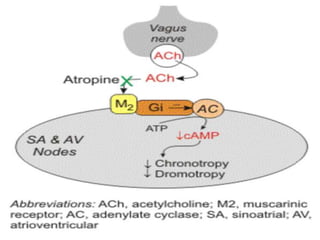
(-) of adenyl cyclase – ↓cAMP ,
Activation of K+channel
Functional
response
HEART -SA node -↓ HR : AV node - ↓ conduction
Atria - ↓contraction : Ventricle- ↓ contraction
Smooth muscle - ↑contraction
Agonists Methacholine
Antagonists Methoctramine, Tripitramine
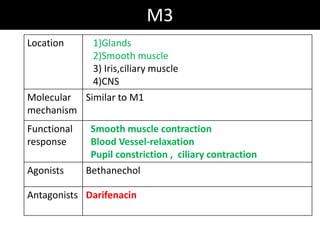
M3
Location 1)Glands
2)Smooth muscle
3) Iris,ciliary muscle
4)CNS
Molecular
mechanism
Similar to M1
Functional
response
Smooth muscle contraction
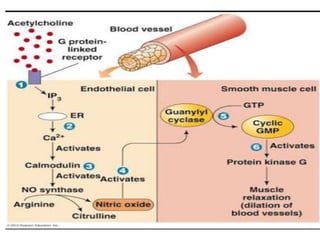
Blood Vessel-relaxation
Pupil constriction , ciliary contraction
Agonists Bethanechol
Antagonists Darifenacin
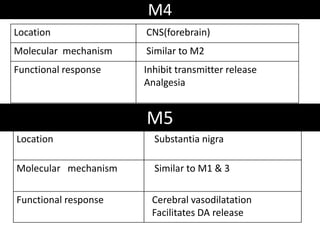
M4
Location CNS(forebrain)
Molecular mechanism Similar to M2
Functional response Inhibit transmitter release
Analgesia
Location Substantia nigra
Molecular mechanism Similar to M1 & 3
Functional response Cerebral vasodilatation
Facilitates DA release
M5
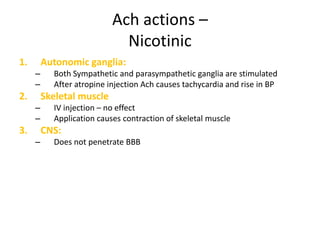
Ach actions –
Nicotinic
1. Autonomic ganglia:
– Both Sympathetic and parasympathetic ganglia are stimulated
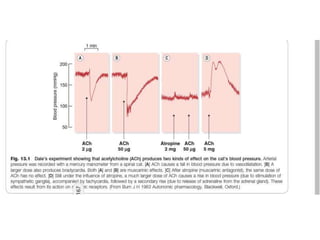
– After atropine injection Ach causes tachycardia and rise in BP
2. Skeletal muscle
– IV injection – no effect
– Application causes contraction of skeletal muscle
3. CNS:
– Does not penetrate BBB
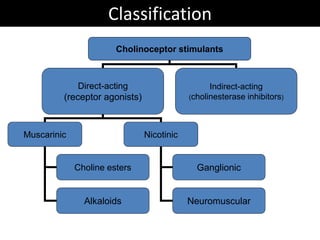
Classification
Cholinoceptor stimulants
Direct-acting
(receptor agonists)
Indirect-acting
(cholinesterase inhibitors)
Muscarinic Nicotinic
Choline esters
Alkaloids
Ganglionic
Neuromuscular
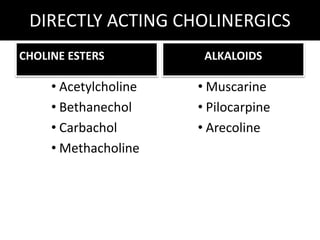
DIRECTLY ACTING CHOLINERGICS
CHOLINE ESTERS
• Acetylcholine
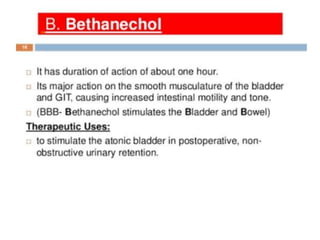
• Bethanechol
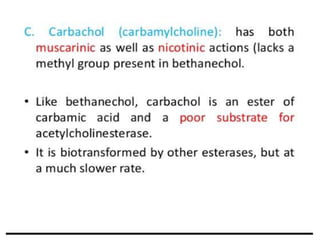
• Carbachol
• Methacholine
ALKALOIDS
• Muscarine
• Pilocarpine
• Arecoline
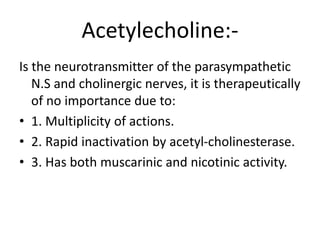
Acetylecholine:-
Is the neurotransmitter of the parasympathetic
N.S and cholinergic nerves, it is therapeutically
of no importance due to:
• 1. Multiplicity of actions.
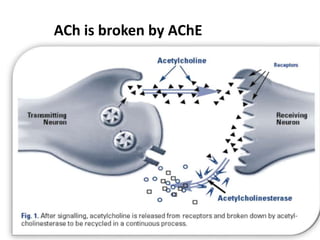
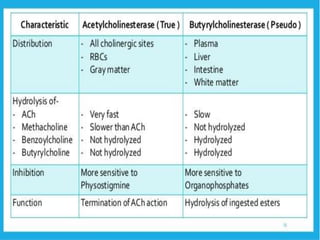
• 2. Rapid inactivation by acetyl-cholinesterase.
• 3. Has both muscarinic and nicotinic activity.
CHOLINOMIMETIC ALKALOIDS
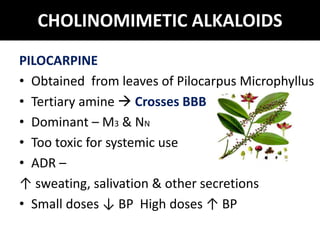
PILOCARPINE
• Obtained from leaves of Pilocarpus Microphyllus
• Tertiary amine  Crosses BBB
• Dominant – M3 & NN
• Too toxic for systemic use
• ADR –
↑ sweating, salivation & other secretions
• Small doses ↓ BP High doses ↑ BP
USES
1. EYE - Penetrates cornea – Miosis, Ciliary muscle
contraction, ↓IOP lasting 4 – 8 hrs
• 3rd line drug - Primary open angle Glaucoma
–S/E : Initial stinging ,
–Painful spasm of accomodation
• To counteract Mydriatics
• Prevent adhesions of Iris with lens/ cornea
2. As SIALOGOGUE
MUSCARINE
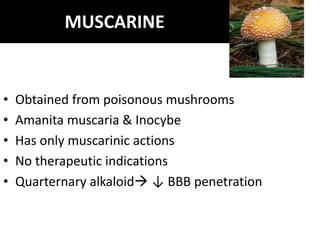
• Obtained from poisonous mushrooms
• Amanita muscaria & Inocybe
• Has only muscarinic actions
• No therapeutic indications
• Quarternary alkaloid ↓ BBB penetration
ARECOLINE
• Betel nut
• Predominant M + slight N
• Prominent CNS effect
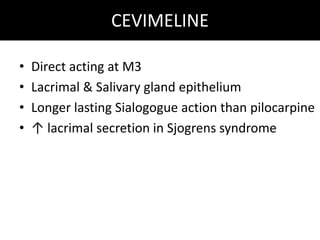
CEVIMELINE
• Direct acting at M3
• Lacrimal & Salivary gland epithelium
• Longer lasting Sialogogue action than pilocarpine
• ↑ lacrimal secretion in Sjogrens syndrome
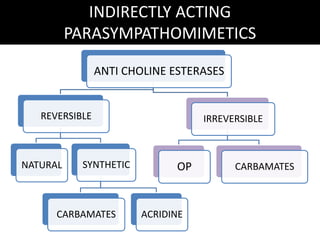
INDIRECTLY ACTING
PARASYMPATHOMIMETICS
ANTI CHOLINE ESTERASES
REVERSIBLE
NATURAL SYNTHETIC
CARBAMATES ACRIDINE
IRREVERSIBLE
OP CARBAMATES
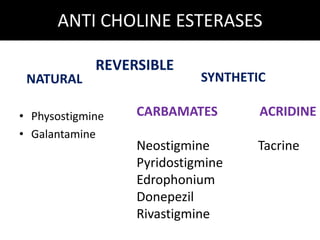
ANTI CHOLINE ESTERASES
NATURAL
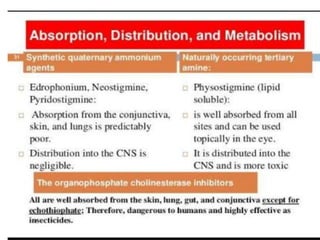
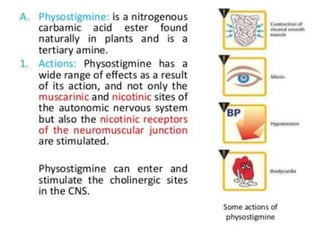
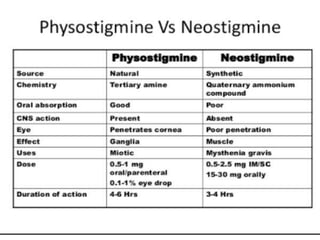
• Physostigmine
• Galantamine
SYNTHETIC
CARBAMATES ACRIDINE
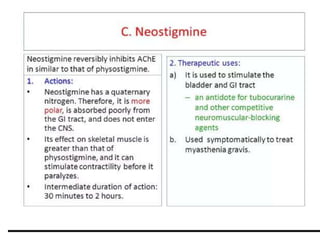
Neostigmine Tacrine
Pyridostigmine
Edrophonium
Donepezil
Rivastigmine
REVERSIBLE
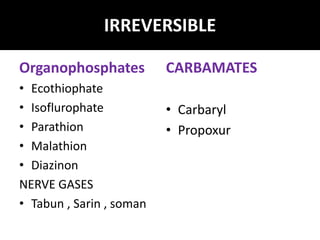
IRREVERSIBLE
Organophosphates
• Ecothiophate
• Isoflurophate
• Parathion
• Malathion
• Diazinon
NERVE GASES
• Tabun , Sarin , soman
CARBAMATES
• Carbaryl
• Propoxur
ACh is broken by AChE
Mechanism of action :-
• 1.Acetylcholinesterase inhibitors - inhibit the
AChE, responsible for breakdown of ACh
• 2.increased cholinergic activity -both nicotinic
and muscarinic receptors
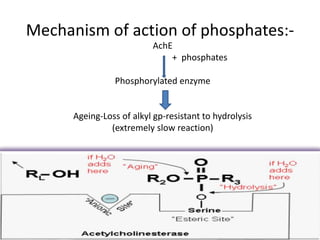
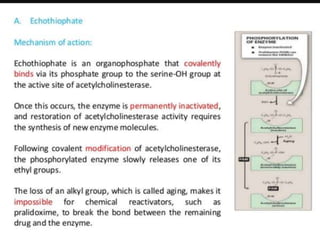
Mechanism of action of phosphates:-
AchE
+ phosphates
Phosphorylated enzyme
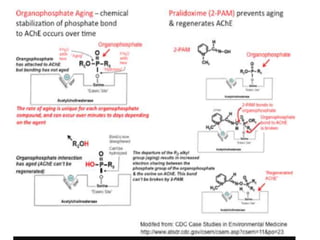
Ageing-Loss of alkyl gp-resistant to hydrolysis
(extremely slow reaction)
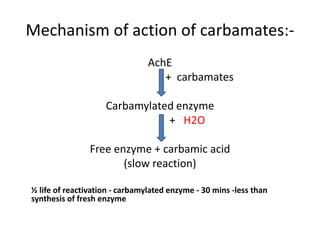
Mechanism of action of carbamates:-
AchE
+ carbamates
Carbamylated enzyme
+ H2O
Free enzyme + carbamic acid
(slow reaction)
½ life of reactivation - carbamylated enzyme - 30 mins -less than
synthesis of fresh enzyme
USES OF ANTICHOLINESTERASE DRUGS
1.MIOTIC
A) GLAUCOMA
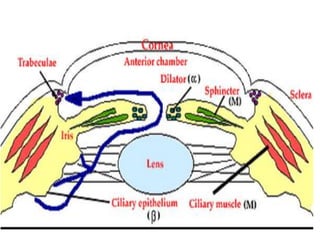
• ↑ tone of ciliary muscle ( attached to scleral spur) &
• ↑ tone of Sphincter pupillae  pull on & improve
alignment of trabeculae  outflow facility is ↑
• Physostigmine (0.1 %)
B ) TO REVERSE EFFECT OF MYDRIATICS
C ) TO PREVENT ADHESIONS OF IRIS WITH CORNEA / LENS
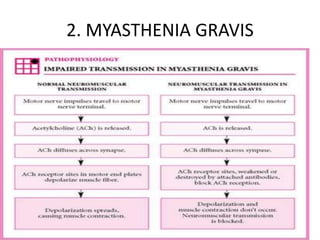
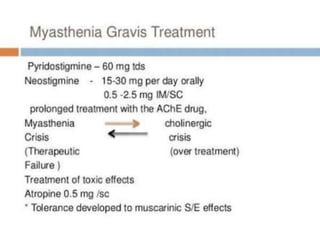
2. MYASTHENIA GRAVIS
3.POST OPERATIVE PARALYTIC ILEUS / URINARY RETENTION
• Neostigmine
4.POST OPERATIVE DECURARIZATION
• Atropine (Block M) Followed by Neostigmine
5.COBRA BITE
• Neostigmine + Atropine  prevent Respiratory Paralysis
6.ANTI CHOLINERGIC OVERDOSAGE
• TCA, Phenothiazine, Anti Histamine – Physostigmine.
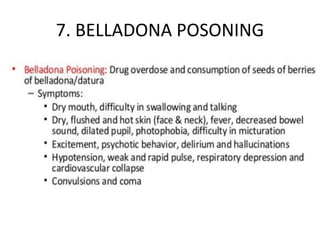
7. BELLADONA POSONING
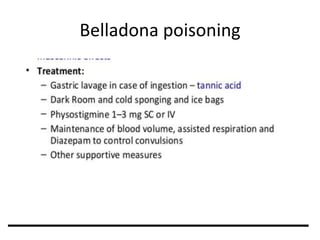
Belladona poisoning
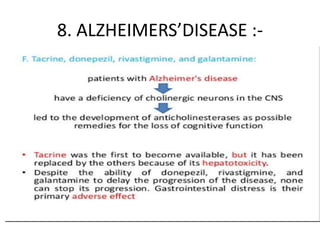
8. ALZHEIMERS’DISEASE :-
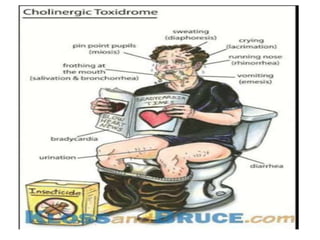
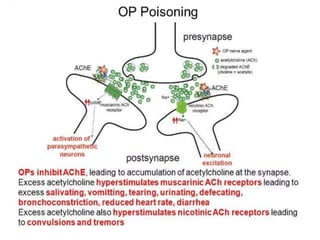
Management of OP Poisoning :-
• Termination of further exposure
fresh air, wash the skin & mucosa with soap
& water, gastric lavage
• Maintain airway- PPV if its failing
• Supportive measures
– Maintain BP
– Hydration
– control of convulsions -diazepam
1. Atropine
• Highly effective, it counteract Muscarinic
symptoms, higher doses antagonise central
effects
• 2 mg IV repeated every 10 minutes till
dryness of mouth
• Dilatation of pupil and HR up to 140
• Does not reverse peripheral muscle paralysis
CHOLINE ESTERASE REACTIVATORS
2.OXIMES
• Phosphorylated enzyme reacts very slowly with
water
• Hydrolysis occurs a million times faster if more
reactive OH groups in the form of oximes are
given.
• PRALIDOXIME
• Quarternary N : Attaches to Anionic site – which
remains unoccupied in OP poisoning
Cholinergic ramesh
Cholinergic ramesh

Cholinergic ramesh

  • 1.
    CHOLINERGIC DRUGS [PARASYMPATHOMIMETICS] DR. RAMESHKRISHNAN MD,PHARMACOLOGY[2 ND YEAR]
  • 2.
  • 7.
    Action Potential Na+ aab ACh Acetylcholinesterase Na+ Parasympathetic GanglionicSynapse Preganglionic neuron Postganglionic neuron Receptor
  • 9.
    nicotine muscarine muscarinic receptor The ‘master key’for both types of ‘lock’ ACh ACh Acknowlegement-Dr.Kumarasingam
  • 12.
    M1 Location 1) Gastricparacrine glands 2) CNS (Cortex, hippocampus, striatum 3) sympathetic ganglia Molecular mechanism Activation of PLC : ↑ IP3 & DAG :↑ Ca2+ & PKC Functional response ↑ acid secretion ↑ cognitive function(learning &memory) ↑ depolarisation of autonomic ganglia Agonists Oxotremorine Antagonists Pirenzepine,Telenzepine
  • 14.
    M2 Location 1)Heart 2)Smooth muscle 3)Nerveterminal 4)CNS Molecular mechanism (-) of adenyl cyclase – ↓cAMP , Activation of K+channel Functional response HEART -SA node -↓ HR : AV node - ↓ conduction Atria - ↓contraction : Ventricle- ↓ contraction Smooth muscle - ↑contraction Agonists Methacholine Antagonists Methoctramine, Tripitramine
  • 16.
    M3 Location 1)Glands 2)Smooth muscle 3)Iris,ciliary muscle 4)CNS Molecular mechanism Similar to M1 Functional response Smooth muscle contraction Blood Vessel-relaxation Pupil constriction , ciliary contraction Agonists Bethanechol Antagonists Darifenacin
  • 22.
    M4 Location CNS(forebrain) Molecular mechanismSimilar to M2 Functional response Inhibit transmitter release Analgesia Location Substantia nigra Molecular mechanism Similar to M1 & 3 Functional response Cerebral vasodilatation Facilitates DA release M5
  • 23.
    Ach actions – Nicotinic 1.Autonomic ganglia: – Both Sympathetic and parasympathetic ganglia are stimulated – After atropine injection Ach causes tachycardia and rise in BP 2. Skeletal muscle – IV injection – no effect – Application causes contraction of skeletal muscle 3. CNS: – Does not penetrate BBB
  • 25.
    Classification Cholinoceptor stimulants Direct-acting (receptor agonists) Indirect-acting (cholinesteraseinhibitors) Muscarinic Nicotinic Choline esters Alkaloids Ganglionic Neuromuscular
  • 26.
    DIRECTLY ACTING CHOLINERGICS CHOLINEESTERS • Acetylcholine • Bethanechol • Carbachol • Methacholine ALKALOIDS • Muscarine • Pilocarpine • Arecoline
  • 27.
    Acetylecholine:- Is the neurotransmitterof the parasympathetic N.S and cholinergic nerves, it is therapeutically of no importance due to: • 1. Multiplicity of actions. • 2. Rapid inactivation by acetyl-cholinesterase. • 3. Has both muscarinic and nicotinic activity.
  • 30.
    CHOLINOMIMETIC ALKALOIDS PILOCARPINE • Obtainedfrom leaves of Pilocarpus Microphyllus • Tertiary amine  Crosses BBB • Dominant – M3 & NN • Too toxic for systemic use • ADR – ↑ sweating, salivation & other secretions • Small doses ↓ BP High doses ↑ BP
  • 31.
    USES 1. EYE -Penetrates cornea – Miosis, Ciliary muscle contraction, ↓IOP lasting 4 – 8 hrs • 3rd line drug - Primary open angle Glaucoma –S/E : Initial stinging , –Painful spasm of accomodation • To counteract Mydriatics • Prevent adhesions of Iris with lens/ cornea 2. As SIALOGOGUE
  • 32.
    MUSCARINE • Obtained frompoisonous mushrooms • Amanita muscaria & Inocybe • Has only muscarinic actions • No therapeutic indications • Quarternary alkaloid ↓ BBB penetration
  • 33.
    ARECOLINE • Betel nut •Predominant M + slight N • Prominent CNS effect
  • 34.
    CEVIMELINE • Direct actingat M3 • Lacrimal & Salivary gland epithelium • Longer lasting Sialogogue action than pilocarpine • ↑ lacrimal secretion in Sjogrens syndrome
  • 35.
    INDIRECTLY ACTING PARASYMPATHOMIMETICS ANTI CHOLINEESTERASES REVERSIBLE NATURAL SYNTHETIC CARBAMATES ACRIDINE IRREVERSIBLE OP CARBAMATES
  • 36.
    ANTI CHOLINE ESTERASES NATURAL •Physostigmine • Galantamine SYNTHETIC CARBAMATES ACRIDINE Neostigmine Tacrine Pyridostigmine Edrophonium Donepezil Rivastigmine REVERSIBLE
  • 37.
    IRREVERSIBLE Organophosphates • Ecothiophate • Isoflurophate •Parathion • Malathion • Diazinon NERVE GASES • Tabun , Sarin , soman CARBAMATES • Carbaryl • Propoxur
  • 38.
  • 40.
    Mechanism of action:- • 1.Acetylcholinesterase inhibitors - inhibit the AChE, responsible for breakdown of ACh • 2.increased cholinergic activity -both nicotinic and muscarinic receptors
  • 41.
    Mechanism of actionof phosphates:- AchE + phosphates Phosphorylated enzyme Ageing-Loss of alkyl gp-resistant to hydrolysis (extremely slow reaction)
  • 42.
    Mechanism of actionof carbamates:- AchE + carbamates Carbamylated enzyme + H2O Free enzyme + carbamic acid (slow reaction) ½ life of reactivation - carbamylated enzyme - 30 mins -less than synthesis of fresh enzyme
  • 51.
    USES OF ANTICHOLINESTERASEDRUGS 1.MIOTIC A) GLAUCOMA • ↑ tone of ciliary muscle ( attached to scleral spur) & • ↑ tone of Sphincter pupillae  pull on & improve alignment of trabeculae  outflow facility is ↑ • Physostigmine (0.1 %) B ) TO REVERSE EFFECT OF MYDRIATICS C ) TO PREVENT ADHESIONS OF IRIS WITH CORNEA / LENS
  • 52.
  • 54.
    3.POST OPERATIVE PARALYTICILEUS / URINARY RETENTION • Neostigmine 4.POST OPERATIVE DECURARIZATION • Atropine (Block M) Followed by Neostigmine 5.COBRA BITE • Neostigmine + Atropine  prevent Respiratory Paralysis 6.ANTI CHOLINERGIC OVERDOSAGE • TCA, Phenothiazine, Anti Histamine – Physostigmine.
  • 55.
  • 56.
  • 57.
  • 59.
    Management of OPPoisoning :- • Termination of further exposure fresh air, wash the skin & mucosa with soap & water, gastric lavage • Maintain airway- PPV if its failing • Supportive measures – Maintain BP – Hydration – control of convulsions -diazepam
  • 60.
    1. Atropine • Highlyeffective, it counteract Muscarinic symptoms, higher doses antagonise central effects • 2 mg IV repeated every 10 minutes till dryness of mouth • Dilatation of pupil and HR up to 140 • Does not reverse peripheral muscle paralysis
  • 61.
    CHOLINE ESTERASE REACTIVATORS 2.OXIMES •Phosphorylated enzyme reacts very slowly with water • Hydrolysis occurs a million times faster if more reactive OH groups in the form of oximes are given. • PRALIDOXIME • Quarternary N : Attaches to Anionic site – which remains unoccupied in OP poisoning